
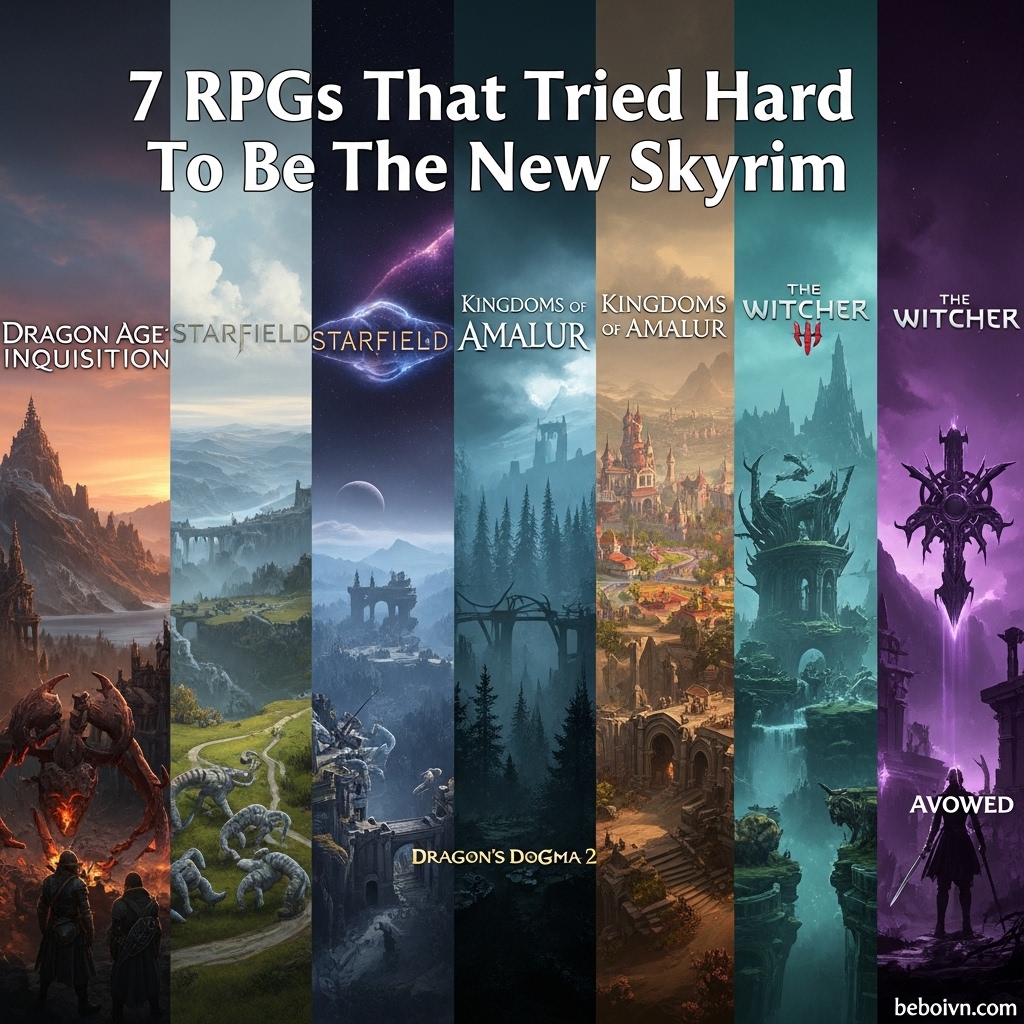
When The Elder Scrolls V: Skyrim burst onto the gaming scene in 2011, it didn’t just release a game—it created a phenomenon. Bethesda’s open-world RPG redefined what players expected from fantasy adventures, offering unprecedented freedom, a living breathing world, and countless hours of content that kept players exploring for years. Skyrim’s success was so monumental that it left an indelible mark on the gaming industry, inspiring countless developers to attempt to capture that same lightning in a bottle. In the years since Skyrim’s release, we’ve seen numerous RPGs that tried hard to be the new Skyrim, each with their own unique take on what made Bethesda’s masterpiece so special. Let’s explore seven of the most ambitious attempts to dethrone the king of open-world RPGs.
Dragon Age: Inquisition – BioWare’s Skyrim Ambition
When BioWare announced Dragon Age: Inquisition, the gaming community immediately recognized what they were attempting. The developer known for narrative-driven RPGs like Mass Effect was clearly making a play for Skyrim’s open-world throne. Inquisition represented BioWare’s most ambitious effort to marry their signature deep storytelling and character development with the expansive exploration that made Skyrim so beloved.
The Skyrim Influence
Dragon Age: Inquisition borrowed heavily from Skyrim’s playbook, featuring large explorable regions filled with side quests, collectibles, and points of interest. Like Skyrim, the game allowed players to tackle content in whatever order they chose, with a main quest that could be ignored for dozens of hours while exploring the world. The game even adopted a similar visual style, with sweeping landscapes and detailed environments that invited exploration.
Where It Succeeded?
Where Inquisition truly excelled was in its characters and storytelling—areas where BioWare has always outshone Bethesda. The companions in Inquisition were far more developed and memorable than most of Skyrim’s NPCs, with personal quests, romance options, and meaningful interactions that evolved throughout the game. The political intrigue of Thedas also provided a more compelling main narrative than Skyrim’s relatively straightforward dragon-hunting plot.
Where It Fell Short?
Despite its ambitions, Inquisition never quite captured the magic of Skyrim’s exploration. The open areas, while large, often felt like disconnected zones rather than a cohesive world. The combat, while serviceable, lacked the visceral satisfaction of Skyrim’s first-person melee. Most importantly, Inquisition couldn’t match the sense of discovery that made exploring Skyrim so rewarding—every cave and ruin in Skyrim felt like it might contain something unique, whereas Inquisition’s content often felt more formulaic.
For more on how BioWare’s approach to open worlds evolved, check out our analysis of Dragon Age’s evolution through the years.
Starfield – Bethesda’s Own “Skyrim in Space”
Perhaps the most direct attempt to create a new Skyrim came from Bethesda themselves with Starfield. Marketed explicitly as “Skyrim in space,” Starfield represented the studio’s first new IP in 25 years and was positioned as the spiritual successor to their fantasy masterpiece.
The Skyrim DNA
Starfield wears its Skyrim influences proudly. The game features the same trademark Bethesda gameplay loop: explore, discover locations, loot items, complete quests, and repeat. The character progression system, dialogue interface, and even the way quests are structured all feel immediately familiar to anyone who’s spent time in Skyrim. The game even includes space dragons (in the form of Starborn) and ancient ruins to discover, mirroring Skyrim’s central themes.
Where It Succeeded?
Starfield’s greatest achievement is its sheer scale. With over 1,000 planets to explore, the game offers unprecedented scope that even Skyrim can’t match. The space setting also allows for incredible variety in environments, from futuristic cities to alien wilderness. The ship-building and customization systems add a new dimension to the Bethesda formula, giving players a personal stake in their exploration that goes beyond just character progression.
Where It Fell Short?
Despite its ambitions, Starfield struggled to capture the magic that made Skyrim special. The procedural generation of many planets led to repetitive content that lacked the handcrafted charm of Skyrim’s world. The game’s loading screens and fragmented structure broke the immersion that Skyrim’s seamless world provided. Most importantly, Starfield lacked the strong central identity that made Skyrim so compelling—while Skyrim was clearly a fantasy RPG about dragons and destiny, Starfield never quite figured out what it wanted to be beyond “big space game.”
For a deeper dive into Starfield’s development and challenges, read our behind-the-scenes look at Bethesda’s space epic.
Kingdoms of Amalur: Reckoning – The Skyrim Predecessor Connection
Kingdoms of Amalur: Reckoning holds a special place in the pantheon of Skyrim-like RPGs, largely due to its development pedigree. Led by Ken Rolston, the lead designer behind The Elder Scrolls III: Morrowind and IV: Oblivion, Reckoning was positioned as a spiritual successor to the series that would eventually spawn Skyrim.
The Skyrim Blueprint
Reckoning borrowed heavily from the Elder Scrolls formula, featuring an open world, first-person perspective, and action-oriented combat. The game’s skill system and character progression felt immediately familiar to Elder Scrolls veterans, allowing players to mix and match abilities from different classes rather than being locked into a single role. The world design, while more colorful than Skyrim’s, followed similar principles of discovery and exploration.
Where It Succeeded?
Where Reckoning truly excelled was in its combat system. While Skyrim’s combat often felt clunky and simplistic, Reckoning featured a deep, satisfying fighting system that combined elements of action games with traditional RPG mechanics. The “Fateless” concept allowed for incredible character customization, and the game’s vibrant art style set it apart from the more realistic look of Skyrim. The lore, co-created by fantasy author R.A. Salvatore, was rich and engaging, offering a fresh take on fantasy tropes.
Where It Fell Short?
Despite its strengths, Reckoning never captured the cultural impact of Skyrim. The game world, while large, felt more like a series of disconnected zones than a cohesive world. The narrative, while interesting, lacked the epic scope and memorable moments of Skyrim’s main quest. Most damagingly, the game’s developer 38 Studios filed for bankruptcy shortly after release, preventing any sequels or DLC that could have expanded on the promising foundation.
The Witcher 3: Wild Hunt – The Game That Surpassed Skyrim
If any game can claim to have truly dethroned Skyrim, it’s The Witcher 3: Wild Hunt. CD Projekt Red’s masterpiece didn’t just try to be like Skyrim—it aimed to improve upon Bethesda’s formula in nearly every way, and many would argue it succeeded.
Beyond Skyrim’s Blueprint
The Witcher 3 took the open-world RPG formula that Skyrim popularized and elevated it with superior writing, characters, and quest design. Like Skyrim, it featured a massive open world filled with points of interest, side quests, and hidden treasures. But where Skyrim’s content often felt generic, The Witcher 3’s quests were masterpieces of storytelling, with meaningful choices and consequences that rippled throughout the world.
Where It Succeeded?
The Witcher 3’s greatest strength was its narrative depth. Every quest, even minor side activities, felt handcrafted and meaningful. The characters were complex and memorable, with Geralt standing as one of gaming’s most iconic protagonists. The combat, while still not perfect, was more engaging than Skyrim’s, and the game’s visual presentation was stunning. Most importantly, The Witcher 3 proved that an open-world RPG could have both freedom and a compelling, well-written story.
Where It Fell Short?
If The Witcher 3 has any weaknesses compared to Skyrim, it’s in the role-playing freedom. While the game offered choices, players were always playing as Geralt—a defined character with his own personality and backstory. Skyrim, by contrast, allowed players to create their own character from scratch and truly role-play as whoever they wanted to be. The world of The Witcher 3, while beautiful, also felt more curated and less wild than Skyrim’s untamed wilderness.
For more on how The Witcher 3 changed the RPG landscape, check out our analysis of its impact on open-world design.
Elden Ring – Dark Souls Meets Skyrim
When FromSoftware announced they were making an open-world game, the gaming world wondered how their signature challenging gameplay would translate to a Skyrim-style format. The result, Elden Ring, turned out to be one of the most brilliant fusion of ideas in gaming history—taking the exploration and discovery of Skyrim and combining it with the deep combat and lore of the Souls series.
The Skyrim Influence Meets Souls
Elden Ring borrowed Skyrim’s sense of scale and freedom but filtered it through FromSoftware’s unique design philosophy. Like Skyrim, the game drops players into a massive world with minimal direction and encourages exploration. But where Skyrim’s world felt welcoming and accessible, Elden Ring’s Lands Between is mysterious, dangerous, and rewarding for those brave enough to venture off the beaten path.
Where It Succeeded?
Elden Ring’s greatest achievement is its world design. Every location in the game feels meticulously crafted, with secrets, shortcuts, and surprises around every corner. The combat is deep and satisfying, offering far more complexity than Skyrim’s relatively simple system. The game’s lore, while more obscure than Skyrim’s straightforward storytelling, is incredibly rich and rewarding for players who dig into it. Most importantly, Elden Ring captured the sense of discovery that made Skyrim so special—every cave, castle, and hidden path feels like it might contain something amazing.
Where It Fell Short?
Elden Ring’s greatest strength—its difficulty—is also its biggest barrier for Skyrim fans. While Skyrim was designed to be accessible to players of all skill levels, Elden Ring demands patience, skill, and perseverance. The game’s obscure storytelling and lack of traditional quest markers can also be frustrating for players accustomed to Skyrim’s more guided approach. Additionally, while the world is massive and beautiful, it lacks the lived-in feeling of Skyrim’s towns and cities.
Dragon’s Dogma 2 – Capcom’s Skyrim Challenger
Dragon’s Dogma 2 represents Capcom’s ambitious attempt to create a massive open-world RPG that could compete with the likes of Skyrim. Building on the cult classic original, Dragon’s Dogma 2 aimed to deliver the exploration and freedom of Skyrim with its own unique twists.
The Skyrim Comparison
Dragon’s Dogma 2 clearly took inspiration from Skyrim’s open-world design, featuring a large fantasy world to explore, numerous side quests, and a focus on player freedom. Like Skyrim, the game allows players to approach challenges in multiple ways and encourages exploration off the beaten path. The character progression and loot systems also feel familiar to Elder Scrolls veterans.
Where It Succeeded?
Where Dragon’s Dogma 2 truly shines is in its unique pawn system and combat mechanics. The ability to create and share AI companions with other players adds a social element that Skyrim lacks. The combat is far more dynamic and engaging than Skyrim’s, with players able to climb large monsters and target specific body parts. The game’s day/night cycle and weather systems also have a more significant impact on gameplay, creating a more immersive and dangerous world.
Where It Fell Short?
Despite its strengths, Dragon’s Dogma 2 struggled with some of the same issues that plague many Skyrim competitors. The world, while large, can feel empty and repetitive at times. The story and characters lack the depth and memorability of Skyrim’s (or even many other RPGs’). The game also suffered from technical issues at launch, including performance problems that hampered the exploration experience. Most importantly, Dragon’s Dogma 2 never quite captured the magic of discovery that made exploring Skyrim so rewarding.
Avowed – Obsidian’s Skyrim-Inspired Epic
As the most recent entry on our list, Avowed represents Obsidian Entertainment’s ambitious attempt to create a Skyrim-like experience in the established Pillars of Eternity universe. From the moment it was announced, Avowed was positioned as Obsidian’s answer to Skyrim, with early development pitches explicitly describing it as such.
The Skyrim Foundation
Avowed wears its Skyrim influences on its sleeve. The game features first-person perspective, real-time combat, and a focus on exploration and discovery in a fantasy world. Like Skyrim, players can approach quests and challenges in multiple ways, with a variety of weapons, magic, and abilities at their disposal. The game’s structure, with large open zones to explore, clearly follows the blueprint established by Bethesda’s masterpiece.
Where It Succeeded?
Where Avowed truly excels is in its writing and world-building—areas where Obsidian has always excelled. The game’s narrative is more complex and morally gray than Skyrim’s straightforward dragon-hunting plot. The companions are well-developed and interesting, with their own agendas and storylines. The combat system, while still evolving, shows promise with its mix of melee, ranged, and magical options. The game’s visual presentation is also stunning, bringing the world of Eora to life in beautiful detail.
Where It Fell Short?
As a newer release, Avowed is still finding its identity, and it shows in some areas. The game’s open zones, while large, don’t yet have the density of content that makes Skyrim’s world so engaging. The progression system feels less satisfying than Skyrim’s straightforward leveling and skill improvements. Most importantly, Avowed hasn’t yet proven it can capture the sense of endless discovery that made players sink hundreds of hours into Skyrim—only time will tell if it can achieve that same magic.
The Legacy of Skyrim’s Influence
Looking at these seven ambitious RPGs, it’s clear that Skyrim’s influence on the gaming industry has been profound and lasting. Each game on this list took different elements of what made Skyrim special and tried to build upon them, with varying degrees of success.
What Made Skyrim So Hard to Replicate?
The reason so many games have tried and failed to dethrone Skyrim comes down to several key factors. First, Skyrim achieved a perfect balance of freedom and structure that’s incredibly difficult to replicate. The game gave players complete freedom to explore while still providing enough direction and purpose to keep them engaged. Second, Skyrim’s world felt alive in a way that few other games have managed—every location had a story, every NPC had a routine, and the world reacted to player actions in meaningful ways.
Finally, Skyrim had a certain magic that’s hard to define—a combination of atmosphere, music, art design, and gameplay that created an experience greater than the sum of its parts. This intangible quality is what keeps players returning to Skyrim even after all these years, and it’s what every game on this list has tried, in some way, to capture.
The Future of Open-World RPGs
As we look to the future, it’s clear that Skyrim’s influence will continue to shape the RPG landscape for years to come. Games like Elden Ring and The Witcher 3 have shown that it’s possible to improve upon Skyrim’s formula, while others like Starfield and Avowed demonstrate that even Bethesda themselves and other talented developers struggle to recapture that magic.
The next true “Skyrim killer” may not be a game that tries to copy Skyrim’s formula exactly, but rather one that takes the core principles that made Skyrim great—freedom, exploration, discovery—and applies them in new and innovative ways. Until then, we’ll continue to see ambitious RPGs that try hard to be the new Skyrim, each adding their own unique spin to the formula that changed gaming forever.