
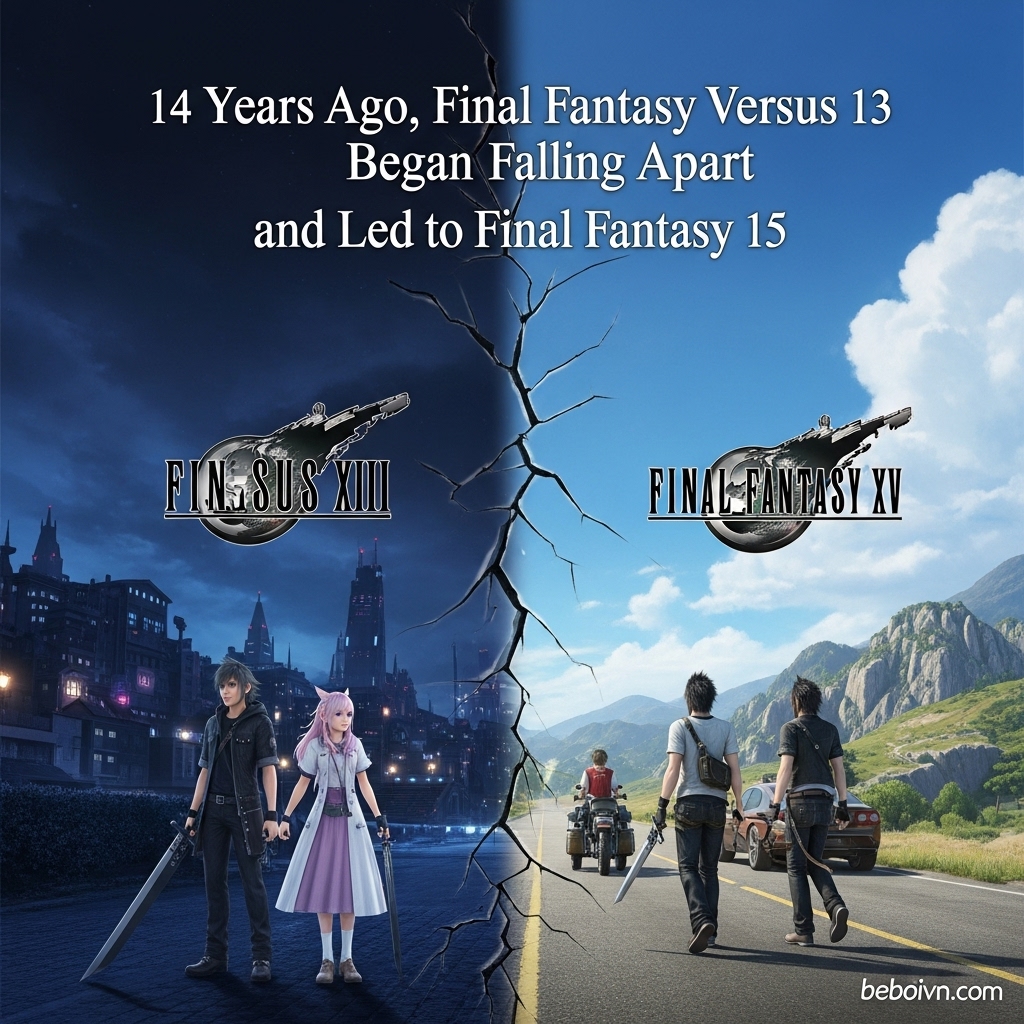
Fourteen years ago, one of the most ambitious and heartbreaking stories in gaming development began unfolding as Final Fantasy Versus 13 started its slow, painful descent into cancellation. What began as a promising action RPG spin-off in 2006 would ultimately transform into Final Fantasy 15, but not before leaving behind a trail of broken promises, shattered dreams, and what many consider to be one of gaming’s greatest “what if” scenarios. The story of Final Fantasy Versus 13’s demise is a cautionary tale of ambition meeting reality, and how the fallout from its cancellation continues to resonate throughout the gaming industry today.
The Grand Vision: Final Fantasy Versus 13’s Ambitious Origins
When Final Fantasy Versus 13 was first announced at E3 2006, it represented Square Enix’s bold new vision for the future of the Final Fantasy franchise. As part of the Fabula Nova Crystallis collection—a trio of games sharing the same mythos but featuring different stories and gameplay styles—Versus 13 was positioned as the dark, mature counterpart to the more traditional Final Fantasy 13. The game’s theme, “a fantasy based on reality,” promised to blend modern-day settings with supernatural elements in a way that had never been seen before in the series.
Tetsuya Nomura’s Dream Project
Directed by Tetsuya Nomura, the creative mind behind Kingdom Hearts and character designer for countless Final Fantasy games, Versus 13 was meant to be his magnum opus. Nomura envisioned a seamless open-world action RPG that would push the PlayStation 3 to its absolute limits. The game was to feature real-time combat inspired by the CGI film Final Fantasy VII: Advent Children, with players able to switch between party members on the fly, each offering unique combat styles.
Early trailers showcased a world that was breathtaking in its ambition—a modern-day city-state called Insomnia, protected by magical barriers and ruled by a royal family with the power to control weapons and teleport. The protagonist, Noctis Lucis Caelum, was a brooding prince who could wield multiple weapons simultaneously and warp across the battlefield in dazzling displays of acrobatic combat.
The Fabula Nova Crystallis Connection
Versus 13 was conceived as part of Square Enix’s grand Fabula Nova Crystallis project, which included Final Fantasy 13, Final Fantasy Agito 13 (later renamed Type-0), and Versus 13 itself. The idea was to create a shared universe where all three games would explore the same mythological concepts—gods like Bhunivelze, Pulse, Lindzei, and Etro—but from different perspectives and with different gameplay mechanics.
However, unlike its counterparts, Versus 13 was intended to be a much darker, more mature take on the Final Fantasy formula. The story revolved around political intrigue, warfare between nations fighting over crystals, and the burden of royalty in a modern world. Early concepts suggested the game would explore themes of mortality, sacrifice, and the heavy responsibilities that come with power.
The First Cracks: Development Hell Begins
Despite its impressive reveal, Final Fantasy Versus 13’s development was troubled from the start. The game was announced far too early, with Nomura later admitting that much of what was shown in initial trailers was little more than proof-of-concept footage rather than actual gameplay. This premature reveal would set unrealistic expectations that the development team would struggle to meet for years to come.
Engine Troubles and Technical Limitations
One of the first major hurdles facing Versus 13 was the game engine. Initially planned to use the Crystal Tools engine (the same engine powering Final Fantasy 13), the team quickly realized that this engine wasn’t suitable for the seamless open-world experience they envisioned. This led to the creation of the Luminous Engine, a brand new engine designed specifically to handle Versus 13’s ambitious technical requirements.
However, developing a new engine while simultaneously trying to create a groundbreaking game proved to be an enormous challenge. The Luminous Engine was plagued with technical issues, and programmers found it incredibly difficult to work with. This engine trouble would become a recurring theme throughout Versus 13’s development, constantly pushing back timelines and forcing the team to reevaluate their goals.
The Kingdom Hearts 3 Dilemma
Adding to the development challenges was the fact that Nomura’s team—the same group responsible for the Kingdom Hearts series—was essentially split between two major projects. The original plan was for Versus 13 to be completed first, with development on Kingdom Hearts 3 beginning afterward using the same engine and technology. However, as Versus 13’s delays mounted, fans grew increasingly impatient for the next Kingdom Hearts installment, putting pressure on Square Enix to shift resources.
This created a no-win situation: either continue pouring resources into the troubled Versus 13 project or disappoint the massive Kingdom Hearts fanbase by further delaying their beloved series. The decision to prioritize Kingdom Hearts 3 would ultimately come at the expense of Versus 13’s original vision.
The Breaking Point: Multiple Crises Hit Simultaneously
By 2010-2011, Final Fantasy Versus 13 was in full-blown development hell. Multiple crises hit the project simultaneously, each one pushing the game further from its original vision and closer to cancellation.
Final Fantasy 13’s Troubled Legacy
The first major blow came from the troubled development of Final Fantasy 13 itself. When FFXIII released in 2009 to mixed reviews—criticized for its linear gameplay, confusing story, and departure from traditional Final Fantasy elements—Square Enix found itself in damage control mode. The company had invested enormous resources into the Crystal Tools engine and the Fabula Nova Crystallis concept, and they needed to salvage their investment.
This led to Square Enix pulling staff from Versus 13 to help with Final Fantasy 13-2 and Lightning Returns: Final Fantasy 13, effectively stalling Versus 13’s development for extended periods. The Versus team found themselves in a cruel irony: their game was supposed to be part of the FFXIII universe, but they were losing team members to keep that same universe afloat.
The Final Fantasy 14 Disaster
Perhaps the most devastating blow came with the catastrophic launch of Final Fantasy XIV in 2010. The original version of FFXIV was so poorly received that Square Enix was forced to apologize publicly and completely rebuild the game from scratch. This emergency rebuild required massive resources, and once again, the Versus 13 team found their members being pulled away to help salvage the company’s flagship MMO.
The impact was devastating. As one Square Enix employee later revealed, “Problems with the Crystal Tools engine forced Square Enix to pull staff from Versus XIII to help with the development and release the game on schedule. As a result, Versus XIII was stuck in pre-production hell for years. It did not officially start any type of development until early 2010.”
Console Generation Transition
By 2012, it became increasingly clear that the PlayStation 3 and Xbox 360 generation was winding down. Versus 13, still trapped in development hell, was being built for consoles that would soon be obsolete. In July 2012, Square Enix held secret talks and concluded that the game needed to be rebuilt for next-generation consoles.
This decision, while necessary from a business perspective, was devastating from a creative standpoint. Years of work would need to be scrapped, and the game would need to be completely reimagined for new hardware. The Versus 13 that fans had been promised for six years was effectively dead.
The Transformation: From Versus 13 to Final Fantasy 15
In June 2013, Square Enix made it official: Final Fantasy Versus 13 was being rebranded as Final Fantasy 15. The announcement came during Sony’s PlayStation 4 reveal event, with a stunning trailer that showed glimpses of the game running on next-generation hardware. However, the announcement was bittersweet for fans who had followed Versus 13’s development for years.
Nomura’s Explanation and Departure
Tetsuya Nomura later explained the decision in an interview with Famitsu magazine: “Around one or two years after we announced FF Versus 13, it was suggested to us to shift to FF15 as part of the company’s direction. By that time, a fair amount of time had already passed since the announcement and Versus was a well-known title, so it wasn’t a given that this would be 15.”
The technical limitations of the PlayStation 3 were a major factor in the decision. “With current-gen systems, we couldn’t fully express what we wanted to do in this project,” Nomura admitted. “I wanted FF15 to be as seamless as possible, and to achieve that, we needed to have all the actions you could potentially do always be available in memory.”
However, the most significant change came in 2014 when it was announced that Hajime Tabata, director of Final Fantasy Type-0, would be taking over as director of Final Fantasy 15, replacing Nomura who would focus on Kingdom Hearts 3. This change in leadership marked the definitive end of Versus 13 as originally conceived.
What Was Lost in Translation
The transformation from Versus 13 to Final Fantasy 15 wasn’t just a name change—it was a fundamental reimagining of the project. Many elements that made Versus 13 unique were lost or significantly altered in the transition:
Stella Nox Fleuret to Lunafreya Nox Fleuret: Perhaps the most significant change was the replacement of Stella, a character who was supposed to be Noctis’s equal and rival, with Lunafreya, a more traditional damsel character. Stella was intended to have her own storyline and powers, while Lunafreya’s role was largely reduced to being Noctis’s love interest.
Darker Tone to Brotherhood: Versus 13 was described as having a much darker, more mature tone with themes of mortality and sacrifice. Final Fantasy 15, while still dealing with serious themes, adopted a more lighthearted approach focusing on the brotherhood between Noctis and his friends.
Political Intrigue Simplified: The complex political landscape of Versus 13, with multiple nations vying for power and intricate alliances, was significantly simplified in Final Fantasy 15 to focus more on the personal journey of Noctis and his friends.
Combat System Changes: While both games featured action-oriented combat, Versus 13 was supposed to allow players to switch between all party members, each with unique playstyles. Final Fantasy 15 limited players to controlling only Noctis, with party members being AI-controlled.
The Aftermath: Legacy and Cultural Impact
Even though Final Fantasy Versus 13 never materialized as originally conceived, its impact on gaming culture cannot be overstated. The game has become something of a legend among gamers, representing both the heights of ambition and the depths of development hell.
The “What If” That Haunts Square Enix
Versus 13 has become Square Enix’s great “what if”—a game that represents an alternate timeline where the company might have taken a different creative direction. The dark, mature vision of Versus 13 stands in stark contrast to the more mainstream approach of Final Fantasy 15, and many fans continue to wonder what might have been.
This cultural impact is perhaps best exemplified by how Versus 13 elements continue to pop up in unexpected places. The Kingdom Hearts series, in particular, has become something of a repository for Versus 13’s lost concepts. Kingdom Hearts 3 featured Yozora, a character who bears a striking resemblance to Noctis, and the secret ending of Kingdom Hearts 3 shows Sora in a world that looks suspiciously like Versus 13’s Insomnia.
Lessons Learned (Or Not)
The Versus 13 saga offers several important lessons for game development:
Don’t Announce Too Early: Nomura himself admitted that revealing Versus 13 in 2006 was a mistake, saying it “resulted in it being burdened by audience expectations, making for a messier development process.”
Engine Development Is Risky: The decision to create a new engine specifically for Versus 13 contributed significantly to its delays and eventual cancellation. Modern game development has shown that using established engines is often more practical than building from scratch.
Management Matters: The constant pulling of staff from Versus 13 to work on other projects highlights the importance of proper project management and resource allocation in game development.
Final Fantasy 15’s Complicated Legacy
Final Fantasy 15, for all its flaws, did eventually release in 2016 to generally positive reviews. The game sold well and has since been expanded with numerous DLCs and updates. However, it always carries with it the shadow of Versus 13—the knowledge that it could have been something entirely different.
The game’s development continued to be troubled even after its rebranding, with significant portions of the story being cut and later released as DLC. This led to criticism that Final Fantasy 15 felt incomplete at launch, a problem that many trace back to its chaotic development history as Versus 13.
Conclusion: The Dream That Refuses to Die
Fourteen years after Final Fantasy Versus 13 began falling apart, its legacy continues to loom large over the gaming industry. What started as an ambitious spin-off evolved into one of the most infamous development stories in gaming history, ultimately transforming into Final Fantasy 15 but leaving behind a trail of broken promises and unfulfilled potential.
The story of Final Fantasy Versus 13 serves as both a cautionary tale and a source of endless fascination. It represents the dangers of overambition in game development, the importance of proper management, and the heartbreak that comes when creative visions collide with business realities. Yet it also represents the enduring power of gaming dreams—even when those dreams never fully materialize.
Today, elements of Versus 13 continue to surface in unexpected places, from Kingdom Hearts to indie games that draw inspiration from its dark, modern aesthetic. The dream of Versus 13, it seems, refuses to die completely. Instead, it lives on in fragments, scattered across different games and continuing to inspire developers and gamers alike.
As we look back on this pivotal moment in gaming history, we’re reminded that sometimes the most influential games are the ones that never actually release. Final Fantasy Versus 13 may have fallen apart 14 years ago, but its impact continues to shape the industry in ways that its creators likely never imagined.