
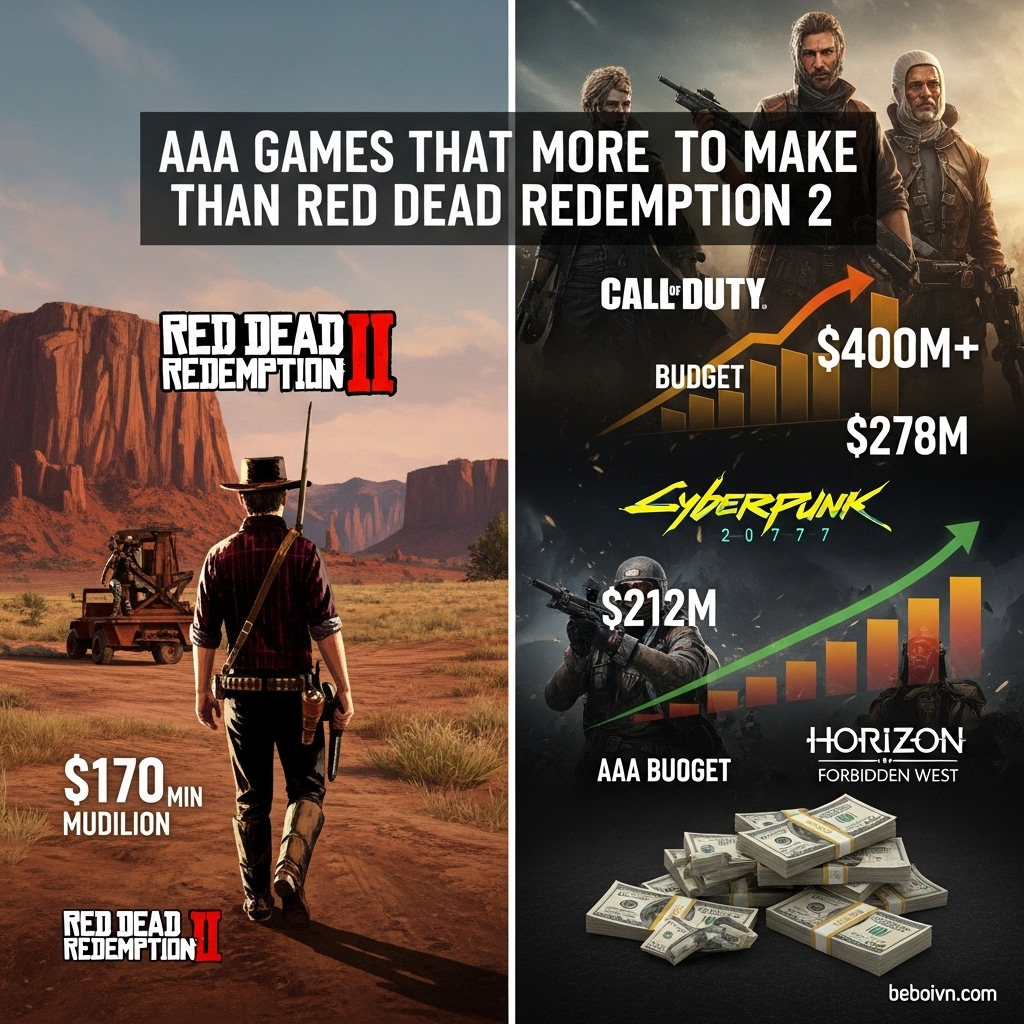
When Rockstar Games released Red Dead Redemption 2 in 2018 with a staggering development budget of $170 million, many thought it represented the peak of AAA game development costs. However, the gaming industry has only continued to scale new heights since then, with numerous titles surpassing even RDR2’s monumental budget. These astronomical figures reflect not just inflation, but the increasing complexity of game development, the push for photorealistic graphics, and the growing expectations of gamers worldwide.
Understanding Red Dead Redemption 2’s Benchmark
Before diving into the games that exceeded RDR2’s budget, it’s essential to understand why its $170 million price tag was so significant. Red Dead Redemption 2 wasn’t just expensive—it was revolutionary. The game featured unprecedented attention to detail, with every rock, tree, and building meticulously crafted. Rockstar employed over 1,000 people for nearly eight years, creating a living, breathing world that set new standards for open-world games.
The $170 million figure represented just the development cost, not including marketing, which reportedly added another $200-$300 million to the total budget. This investment resulted in a game that felt truly next-generation, even on current-gen hardware, with realistic wildlife behavior, dynamic weather systems, and an emotional narrative that resonated with millions of players.
Yet, as impressive as RDR2’s budget was, it’s now being surpassed by an increasing number of AAA titles. Let’s explore the games that have managed to eclipse this monumental benchmark.
The Billion-Dollar Club: Call of Duty’s Unprecedented Spending
Call of Duty: Black Ops Cold War – $700 Million
Perhaps the most staggering figure in modern game development comes from the Call of Duty franchise. Call of Duty: Black Ops Cold War reportedly cost approximately $700 million to develop, making it more than four times as expensive as Red Dead Redemption 2. This astronomical budget reflects the annual release cycle’s demands, cutting-edge graphics, and the extensive multiplayer infrastructure required for modern first-person shooters.
The Black Ops Cold War budget includes not just the base game but also the continuous content updates, seasonal passes, and the cross-platform integration that has become standard for the franchise. With yearly releases, each Call of Duty title must innovate while maintaining the core gameplay that fans expect, creating a perfect storm of rising development costs.
Call of Duty: Modern Warfare (2019) – $640 Million
Not far behind its successor, 2019’s Modern Warfare reboot carried a development budget of $640 million. This reboot aimed to revitalize the Modern Warfare subseries with a more grounded, realistic approach to military conflict. The budget reflects the complete rebuild of the game’s engine, the photorealistic character models, and the extensive motion capture work required for the cinematic campaign.
Modern Warfare’s budget also included the development of the free-to-play Warzone battle royale mode, which has since become a phenomenon in its own right. The integration of Warzone with the main game required additional resources, contributing to the massive budget that easily surpasses RDR2’s.
Call of Duty: Black Ops 3 – $450 Million
Even earlier in the franchise, Black Ops 3 carried a $450 million development budget, nearly triple Red Dead Redemption 2’s costs. This 2015 title pushed the boundaries of what was possible on PlayStation 3 and Xbox 360, with advanced lighting systems, complex character customization, and the introduction of the Pick 10 class system that revolutionized Call of Duty multiplayer.
The budget also covered the extensive Zombies mode, which has become a cornerstone of the Black Ops series, featuring intricate storylines and cooperative gameplay that required additional development resources beyond the standard multiplayer experience.
The Open-World Giants: Pushing Boundaries Beyond RDR2
Grand Theft Auto V – $265 Million
While technically released before Red Dead Redemption 2, Grand Theft Auto V’s $265 million development budget deserves mention as it set the stage for RDR2’s ambitions. Rockstar Games invested heavily in creating the living, breathing world of Los Santos, which still stands as one of the most detailed open-world environments ever created.
What makes GTA V’s budget particularly impressive is that it was achieved in 2013, when development costs were generally lower across the industry. The game’s success, with over 190 million copies sold, justified the investment and paved the way for the even more ambitious RDR2.
Cyberpunk 2077 – $174 Million + $103.6 Million Post-Launch
Cyberpunk 2077 represents a fascinating case study in game development budgets. The base game cost approximately $174 million to develop—already exceeding RDR2’s budget—but what makes this figure particularly interesting is the additional $103.6 million CD Projekt Red spent post-launch to fix the game’s numerous issues and restore player trust.
This combined total of nearly $278 million reflects not just the initial ambition of creating a dense, futuristic open world but also the cost of redemption in the modern gaming era. The post-launch investment included major updates, the Phantom Liberty expansion, and the comprehensive 2.0 update that overhauled many of the game’s systems.
Horizon Forbidden West – $212 Million
Guerrilla Games’ Horizon Forbidden West carried a development budget of $212 million, significantly surpassing Red Dead Redemption 2’s costs. This sequel to the critically acclaimed Horizon Zero Dawn pushed the boundaries of what was possible on PlayStation 5, with stunning visuals, complex machine designs, and a vast, varied open world.
The budget reflects the game’s technological ambitions, including advanced water physics, detailed character animations, and the seamless integration of different biomes. Forbidden West also featured extensive motion capture work and voice acting, with a story that expanded significantly on the original’s lore and world-building.
The Narrative Powerhouses: Cinematic Excellence at a Premium
The Last of Us Part 2 – $220 Million
Naughty Dog’s The Last of Us Part 2 represents one of the most expensive narrative-driven games ever made, with a development budget of $220 million. This figure reflects the studio’s commitment to cinematic excellence, with unprecedented attention to character animations, facial expressions, and environmental storytelling.
The budget covered years of development, during which Naughty Dog perfected their already-impressive animation systems to create some of the most realistic character interactions ever seen in gaming. The game’s emotional impact and technical achievements came at a premium price, but the result was a title that set new standards for narrative gaming.
Battlefield 6 – $400 Million+
While yet to be released, the upcoming Battlefield 6 is already reported to have a development budget exceeding $400 million. This figure reflects EA’s ambition to create the most technologically advanced Battlefield game yet, with real-time destruction, large-scale battles, and next-generation graphics that push current hardware to its limits.
The substantial budget also accounts for the development challenges faced during the COVID-19 pandemic, which caused delays and required additional resources for remote work infrastructure. Battlefield 6 represents EA’s bet on the future of large-scale multiplayer shooters, with a budget that reflects the high stakes involved.
Understanding Why These Costs Keep Rising
Several factors contribute to the increasing costs of AAA game development, explaining why more and more titles are surpassing Red Dead Redemption 2’s once-unthinkable budget:
Technological Advancement
Each new console generation brings with it increased expectations for visual fidelity and technical performance. Games must now support 4K resolution, ray tracing, high frame rates, and features like haptic feedback and 3D audio. These requirements demand more powerful engines, more detailed assets, and more extensive testing—all of which drive up costs.
Team Size and Development Time
Modern AAA games often require teams of 500-1,000+ developers working for 5-7 years. The sheer manpower needed to create the vast worlds and complex systems expected in modern games is staggering. Red Dead Redemption 2, for comparison, had over 1,000 people working on it, but newer titles are pushing these numbers even higher.
Voice Acting and Motion Capture
The demand for Hollywood-quality performances in games has led to increased investment in voice acting and motion capture. Top-tier voice actors can command substantial fees, and the technology for capturing nuanced performances continues to improve—and become more expensive.
Marketing and Live Service
While the figures discussed here represent development costs, it’s worth noting that marketing budgets for AAA games often equal or exceed development costs. Additionally, the live service model requires ongoing investment in content updates, server maintenance, and community management—costs that weren’t as significant in the era before games as a service.
The Future of AAA Game Development Costs
As we look toward the future, it’s clear that Red Dead Redemption 2’s $170 million budget will increasingly become the baseline rather than the exception. Upcoming titles like Grand Theft Auto VI are rumored to have budgets exceeding $1 billion, reflecting the continued escalation of development costs.
This trend raises important questions about the sustainability of the AAA game development model. With costs rising exponentially, games need to sell millions of copies just to break even, leading to safer design choices and microtransactions that many players find objectionable.
However, these massive investments also result in some of the most groundbreaking and memorable gaming experiences ever created. The tension between commercial viability and creative ambition will continue to shape the industry, with Red Dead Redemption 2 serving as an important benchmark in this ongoing evolution.
Conclusion: The New Normal in AAA Game Development
Red Dead Redemption 2’s $170 million development budget once seemed like the upper limit of game development costs, but it has since become just another milestone on the path toward increasingly expensive AAA productions. From Call of Duty’s billion-dollar ambitions to the technological marvels of Horizon Forbidden West and The Last of Us Part 2, the gaming industry continues to push boundaries in ways that would have been unimaginable just a decade ago.
These astronomical budgets reflect both the growing maturity of the gaming industry and the increasing expectations of players worldwide. While the sustainability of this model remains debatable, there’s no denying that these massive investments have resulted in some of the most immersive, technically impressive, and emotionally resonant gaming experiences ever created.
As we move forward, the question isn’t whether games will continue to surpass Red Dead Redemption 2’s budget—they already have—but rather how the industry will adapt to these new financial realities. Whether through new business models, technological innovations, or changes in development practices, the gaming industry will need to find ways to balance creative ambition with financial responsibility.
For now, though, we can appreciate the incredible achievements made possible by these unprecedented investments, knowing that each new budget record broken represents another step forward in the evolution of interactive entertainment.