
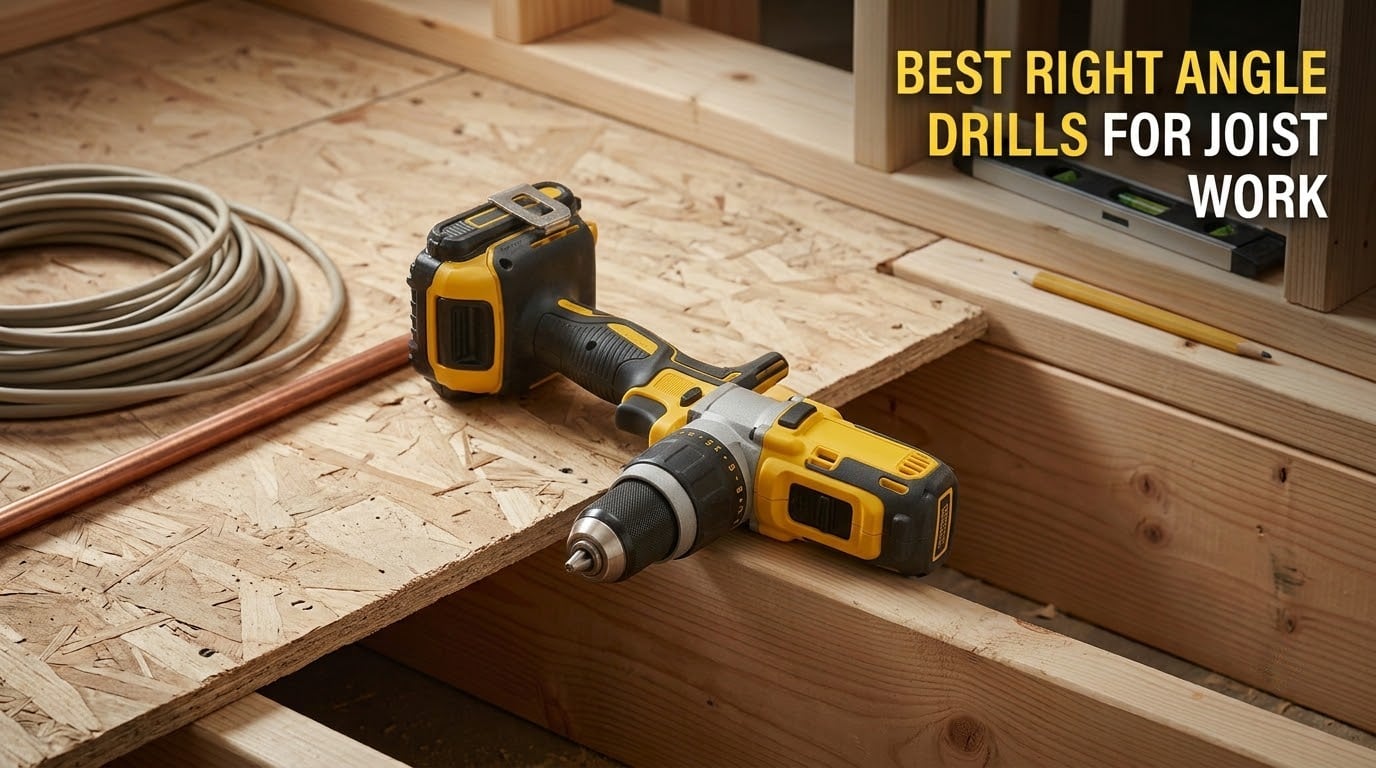
Most people meet a right angle drill the same way: crouched in a crawl space with a 2×6 overhead, a bundle of wire in one hand, and a standard drill that physically will not fit between the studs. The chuck on a right angle drill sits at 90 degrees to the motor, so the bit points sideways and your hands stay clear of the hole. That single geometry change is why it became the standard tool for rough-in plumbing, electrical, and HVAC work.
We spent the last several months working through the current generation of these drills side by side, comparing chuck capacity, weight in the hand, speed control and what happens when a bit grabs wet lumber. The list below covers 12 models, from compact 12V and 18V drivers to full-size corded and pneumatic angle drills, and it is the set we would hand to an electrician, a plumber and a serious renovator respectively.
If you are still assembling a kit from scratch, start with our compact cordless drill guide first, because the right angle drill is an add-on, not a first purchase. Most people hit it on the second project, usually after trying to fish cable through framing with an unfinished bay.
Top 3 Right Angle Drills for Joist Work for September 2026

DEWALT DCD740B 20V Right Angle Drill
- › 4.0 inch front-to-back
- › 0-650/0-2000 rpm dual speed
- › 3.3 lbs
- › LED on trigger

Milwaukee M18 FUEL Hole Hawg 1/2 inch
- › 1200 ft-lbs torque
- › 1/2 inch chuck
- › 1500 rpm brushless motor
- › 7.7 lbs

Milwaukee M12 3/8 inch Right Angle Drill
- › 11 setting electronic clutch
- › 2.3 lbs
- › built-in LED
- › 800 rpm
- › 100 in-lbs torque
The DEWALT DCD740B wins this roundup because it balances the two things that actually decide whether a joist drill is pleasant to use: how little room it needs and how much control the trigger gives you. The Milwaukee M18 FUEL Hole Hawg is the answer when the hole has to be large, and the Milwaukee M12 is the pick if you already own M12 packs and want the lightest tool on the list.
All 12 Right Angle Drills at a Glance in September 2026
1. DEWALT DCD740B 20V Right Angle Drill – Best Overall for Framing and Rough-In
DEWALT DCD740B 20-Volt MAX Li-Ion Right Angle Drill (Tool Only)
20V MAX cordless
0-650/0-2000 rpm
3/8 inch ratcheting chuck
3.3 lbs tool only
+ The Good
- 4.0 inch front-to-back length fits tight bays
- Two speed ranges for control at speed
- LED lights on trigger press
- Belt hook included
- Works with existing 20V MAX packs
- The Bad
- Brushed motor not brushless
- Battery and charger sold separately
- 3/8 inch chuck not 1/2 inch
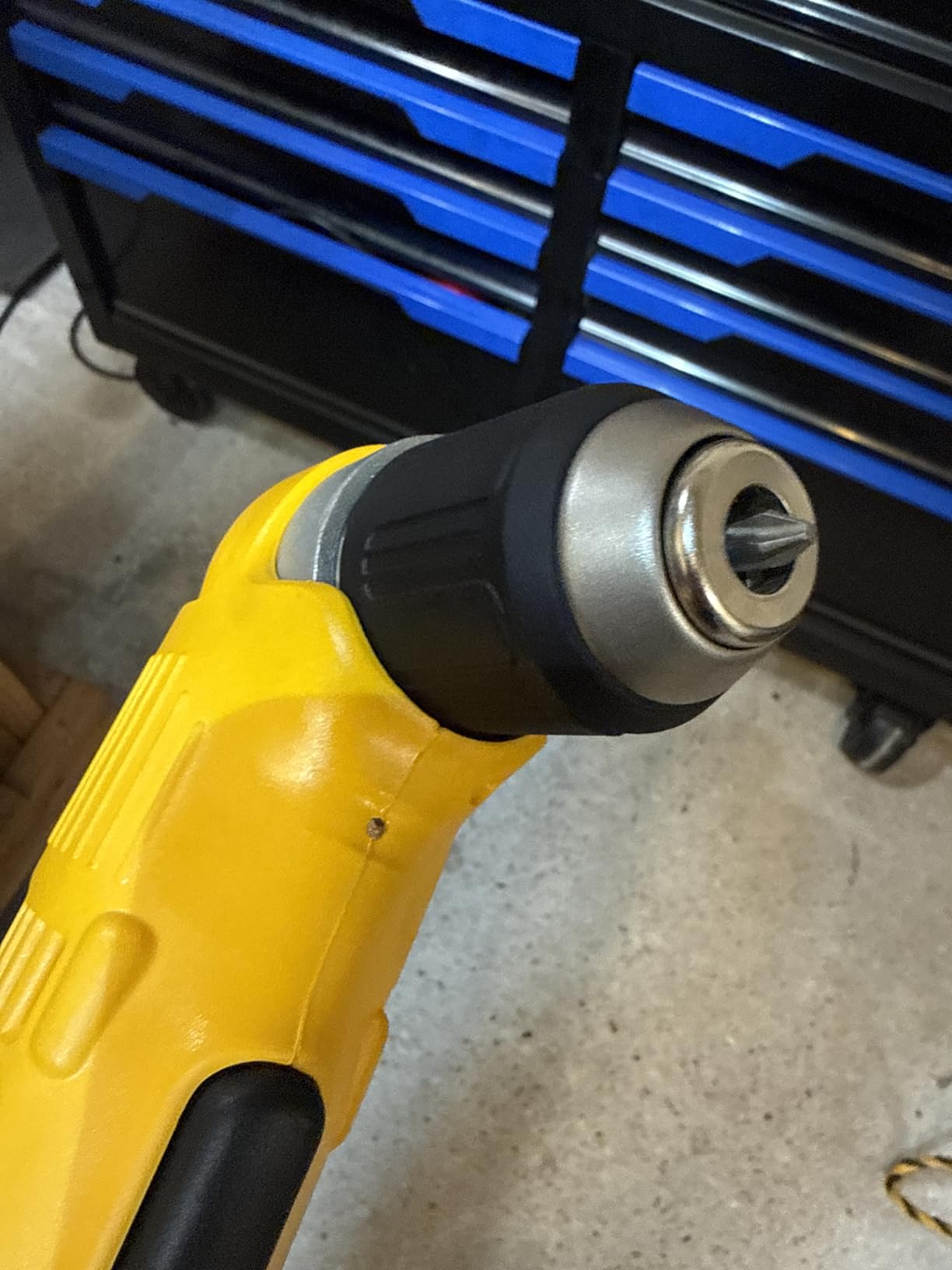
This is the drill we reach for first, and after a full season of putting it into joists, it is still the one. At 4.0 inches front to back it will go into tight bays that reject a conventional drill body, and at 3.3 pounds it stays comfortable for an afternoon of drilling overhead.
The two speed ranges are what separate it from cheaper compact drills. At 0 to 650 rpm the bit feeds slowly and you can keep a self-feed bit tracking through a knot; at 0 to 2000 rpm you clear the bit quickly on the exit side. That low range is where the control lives.
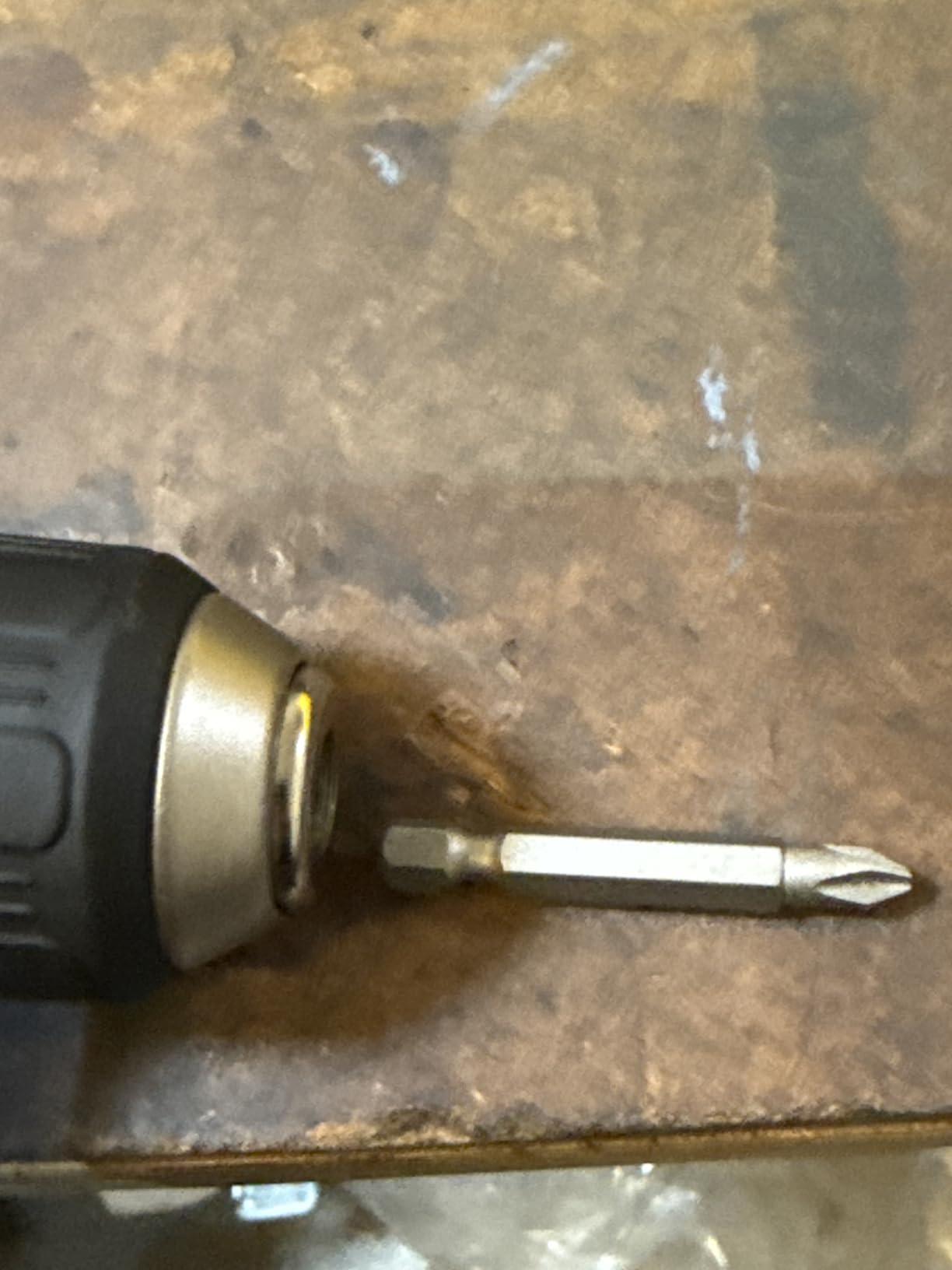
Two details get overlooked. The ratcheting chuck has a deep hex pocket so you can tighten it with an allen key when your fingers are wet or gloved, and the LED is wired to the trigger, so it comes on the moment the motor does instead of needing a separate button.
The trade-offs are real. The motor is brushed, so it is louder and slightly less efficient than a brushless machine, and this is a bare tool, which means a pack and charger come out of your budget separately. Reviewers also point out that brushed motors can spark under load, which is normal for the class but worth knowing if you are working near loose material.
What the DCD740B handles well
Wire and cable holes in the side of joists, 1/2 inch and smaller auger work, screw driving with the clutch for blocking and trim, and anything at floor level where you need a second free hand. It pairs naturally with our nail drill picks on the same platform, so the batteries carry across both tools.
Where it runs out
The 3/8 inch chuck will not accept a 1/2 inch self-feed bit, and that is the line. If your rough-in needs holes big enough for a 2 inch or larger auger, or if you are drilling structural beams, you need a full-size hole hawg like the Milwaukee M18 FUEL below. The brushed motor also runs hot on long, large-diameter cuts.
2. Milwaukee 2415-20 M12 Right Angle Drill – Best Value and Lightest Option
Milwaukee 2415-20 M12 12-Volt Lithium-Ion Cordless Right Angle Drill, 3/8 In, Bare Tool, Medium
M12 cordless
3/8 inch ratcheting chuck
100 in-lbs torque
2.3 lbs tool only
+ The Good
- Lightest drill on the list at 2.3 lbs
- 11 setting electronic clutch plus drill mode
- Built-in LED and fuel gauge
- Extended paddle switch fits several grip positions
- The Bad
- 800 rpm top speed is slow
- Brushed motor rather than FUEL
- Battery and charger sold separately
At 2.3 pounds this is the drill we hand to someone working overhead in a finished ceiling, where a heavier tool wrecks your shoulder after the fortieth hole. The 12V class has come a long way, and 100 in-lbs of torque is enough to drive most screws and push a modest auger through softwood.
The extended paddle switch is the underrated part. It is long enough that you can grip it from above, below or from the side, which matters when your wrist is at an awkward angle inside a bay. Eleven clutch settings plus a drill mode turn it into a genuine driver as well as a drill.
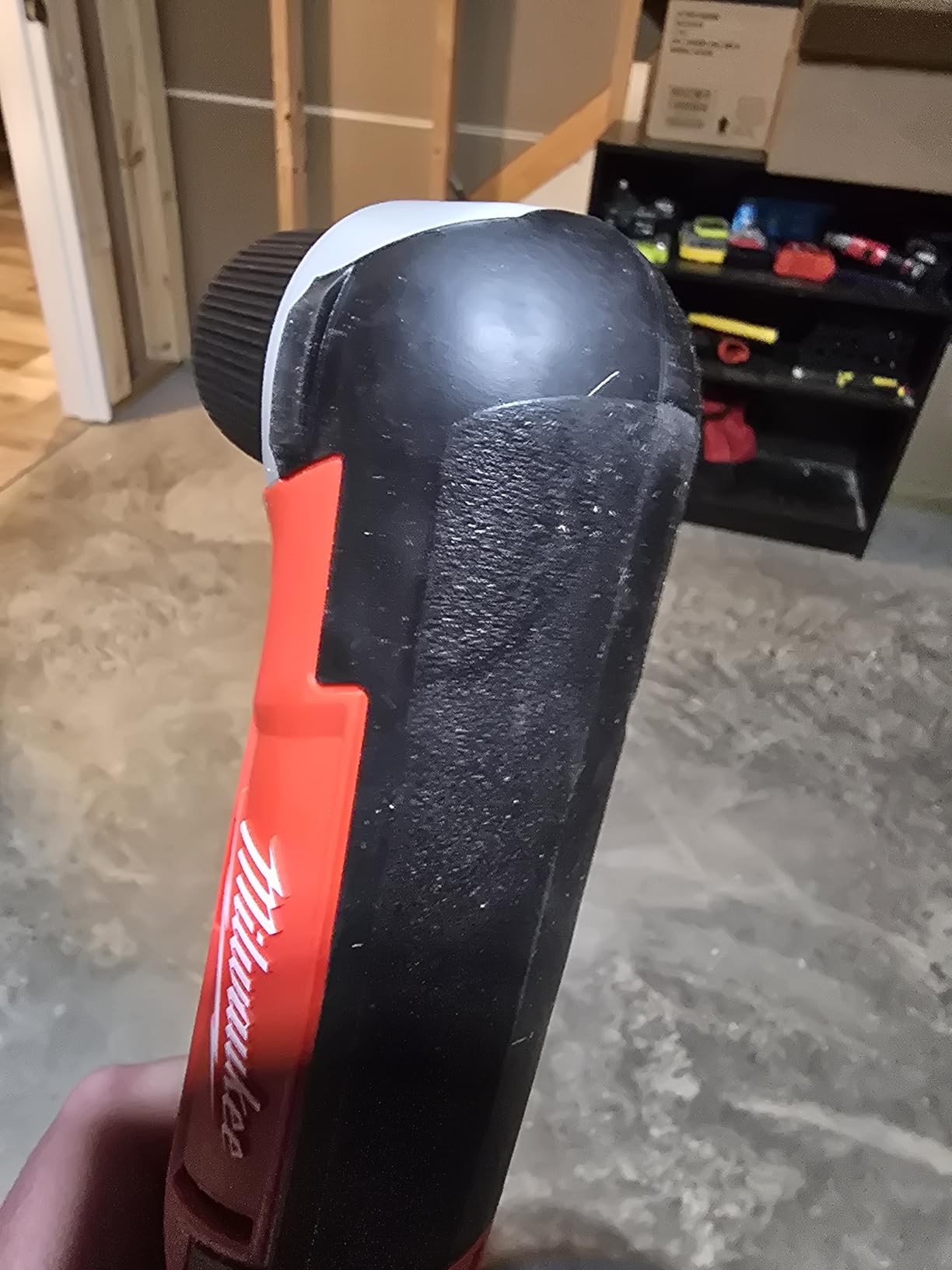
Owners consistently single out the LED and the on-board fuel gauge as more useful than they expected, because on a 12V pack you are usually checking whether there is enough charge left for the row you are working on. The M12 packs are also cheap and available everywhere, which is why this tool is such a common first right angle drill.
The honest limit is the 800 rpm maximum. That is fine for 1/2 inch and smaller bits but slow if you are trying to run a larger spade or auger, and there is no second gear ratio to drop into. Reviewers also mention that aftermarket M12 packs can be a tight fit in the socket, so stick with genuine packs if you can.
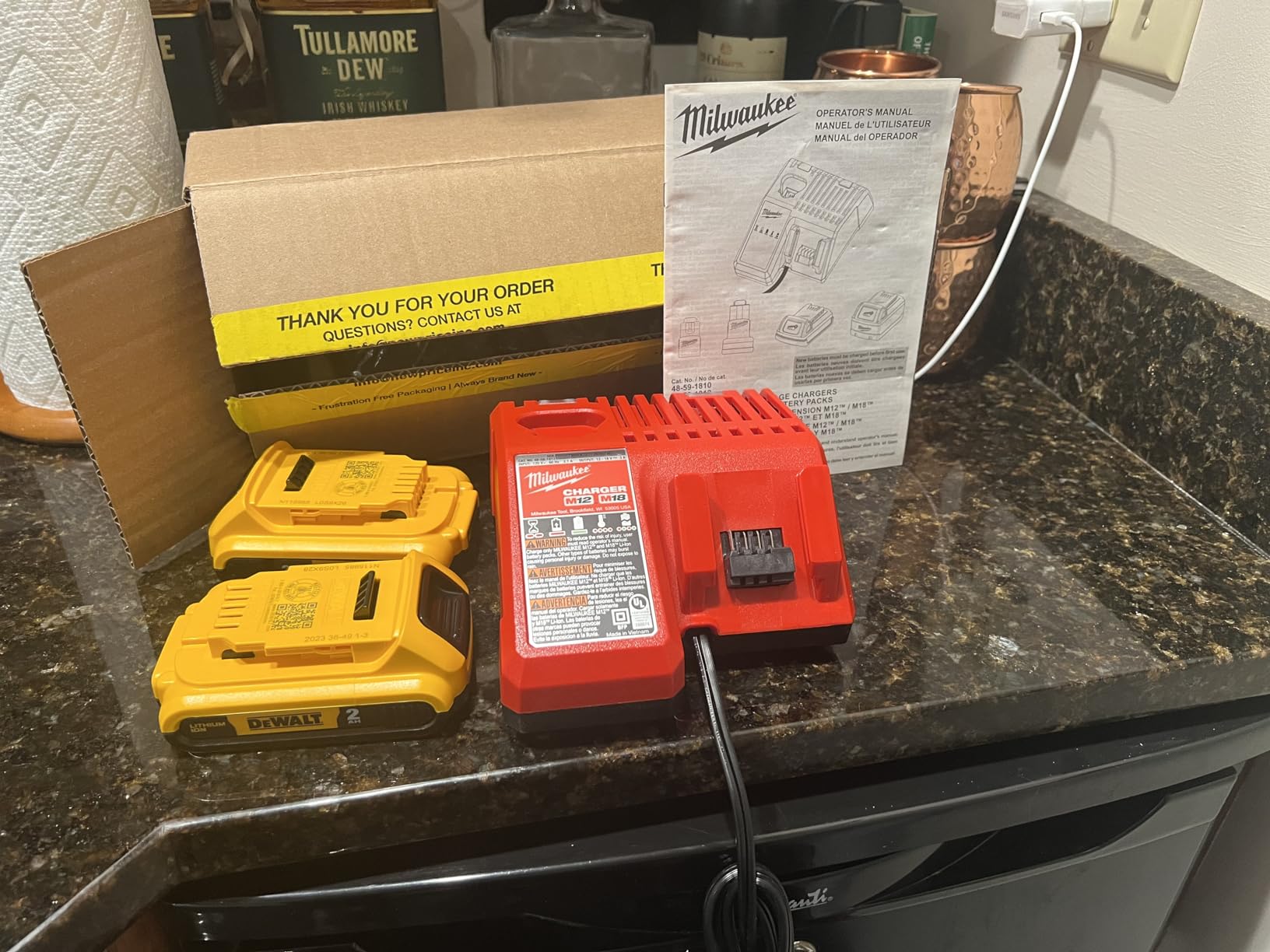
Who should buy the M12
Electricians and HVAC technicians who already run M12 packs and need a second tool that weighs almost nothing. It also makes sense as a dedicated finisher tool, since the clutch handles most driving work without wearing out a bigger driver.
Where it falls short
Any job where bit diameter, not weight, is the constraint. It is not a structural tool and it is not a large hole saw platform. If you already own 18V packs, the same money goes further into a bigger platform drill that can do more.
3. BOSCH PS11-102 12V Max Right Angle Drill Kit – Best for Angles Other Than 90 Degrees

BOSCH PS11-102 12V Max 3/8 In. Right Angle Drill/Driver Kit with 2.0Ah Lithium Ion Battery
12V Max cordless
5 position pivoting head
1300 rpm
115 in-lbs torque
+ The Good
- Pivoting head adjusts from 90 to 180 degrees
- Kit includes a 2.0Ah battery and charger
- Auto-lock chuck speeds bit changes
- 1300 rpm beats most compact competitors
- The Bad
- 115 in-lbs torque is low for the class
- Some reports of pivot mechanism loosening
- Only a 2.0Ah battery in the kit
Every other drill in this list locks at exactly 90 degrees. This one has a head that articulates through five positions from 90 to 180 degrees, and in a bay where the framing is slightly out of true, that is the difference between drilling cleanly and chiseling a starter hole to line the bit up.
It is also the only kit here that ships with a battery and charger, which matters if you are buying your first right angle drill and nothing else in that ecosystem.
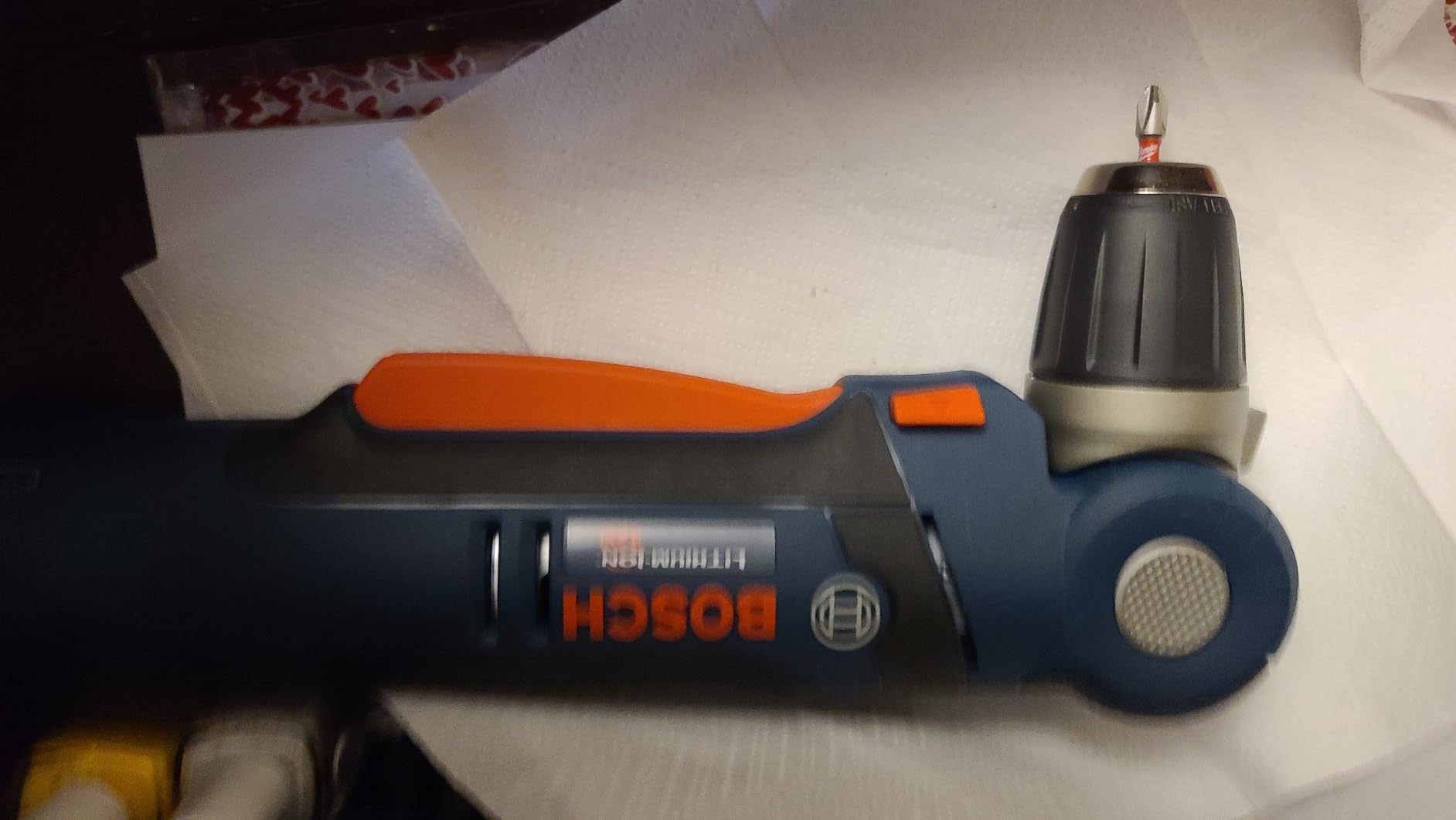
On paper the numbers are respectable: 1300 rpm is faster than almost every other 12V and compact drill in this list, and 115 in-lbs of torque is within reach of the Milwaukee M12. The auto-lock chuck means you can swap a bit one-handed, which speeds up repetitive cable work.
The negatives come straight from owners. Torque is on the low side, some reviewers report the pivot mechanism developing play over time, and a small number of one-star reviews describe quality control problems. Electronic Cell Protection is there to keep battery life up, which helps on a 2.0Ah pack.
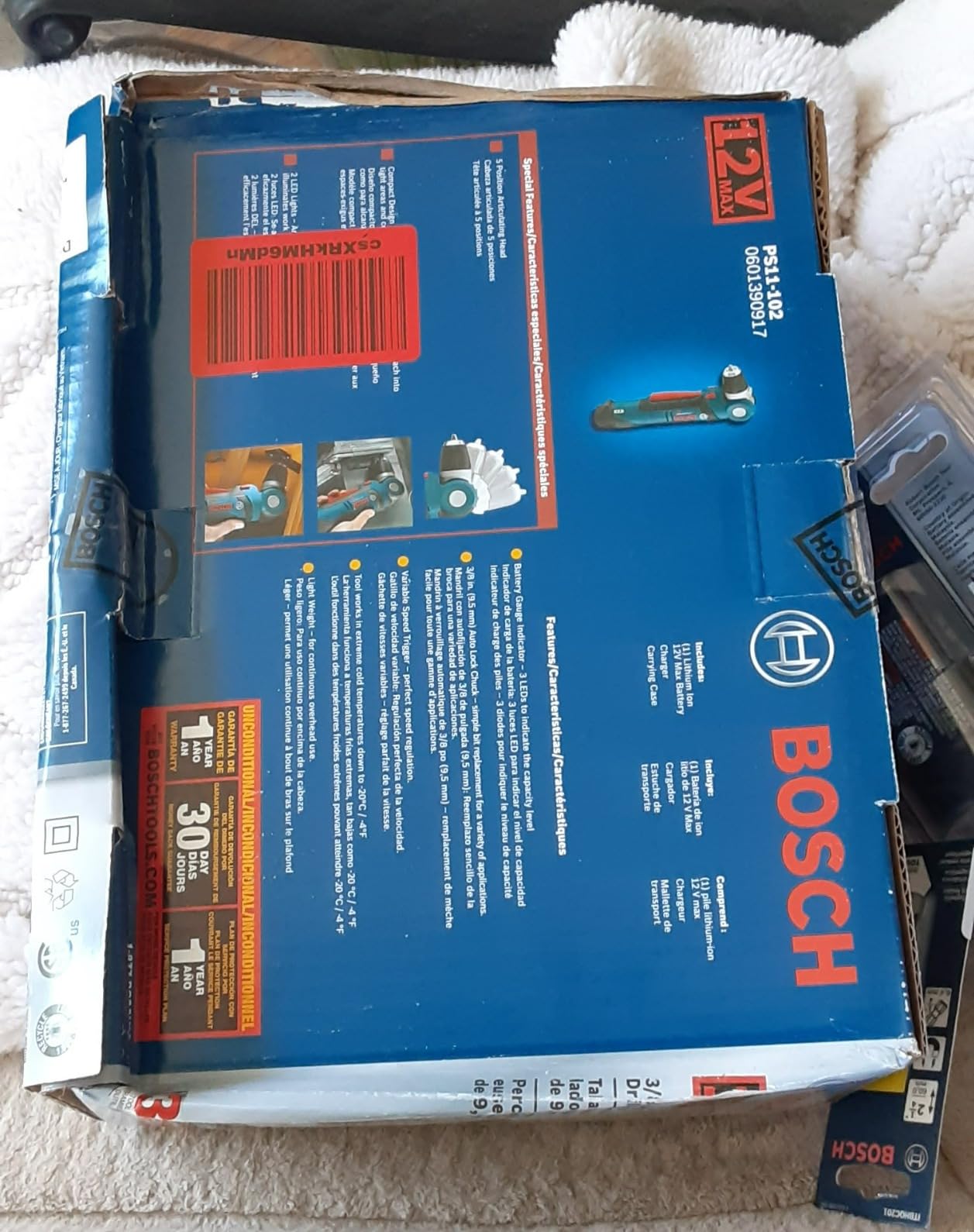
Where the pivoting head earns its keep
Old houses, additions, and any wall or floor built slightly out of square. Crawl space HVAC work where you are drilling up into a joist at an angle is the textbook case. If your framing is plumb, you will never touch the adjustment.
Where it falls short
Torque-limited work. It will not push a big auger or a structural-sized self-feed bit, and the pivoting joint is one more mechanism that can develop slop. Treat it as a precision access tool, not a rough-in workhorse.
4. RYOBI ONE+ HP 18V Brushless Right Angle Drill – Top Rated for Torque per Pound

RYOBI ONE+ HP 18V Brushless Cordless Compact 3/8 in. Right Angle Drill (Tool Only)
ONE+ 18V cordless
Brushless motor
350 in-lbs torque
0-450/0-1700 rpm
+ The Good
- Brushless motor in a compact body
- 350 in-lbs torque is unusually high for 3/8 inch
- Two speed ranges up to 1700 rpm
- Keyless chuck for fast bit changes
- The Bad
- Chuck is hard to tighten securely
- Only a 30 day warranty
- Tool only so packs are extra
350 in-lbs of torque from a 2.8 pound tool with a brushless motor is the number that stands out here. Most compact right angle drills land between 100 and 130 in-lbs, so this one has roughly triple the muscle of the class in a body no bigger than the competition.
The two speed ranges, 0 to 450 and 0 to 1700 rpm, give you the same slow-feed control a bigger drill has. In practice that means you can start a hole in a knot at low speed and then open it up without changing tools.
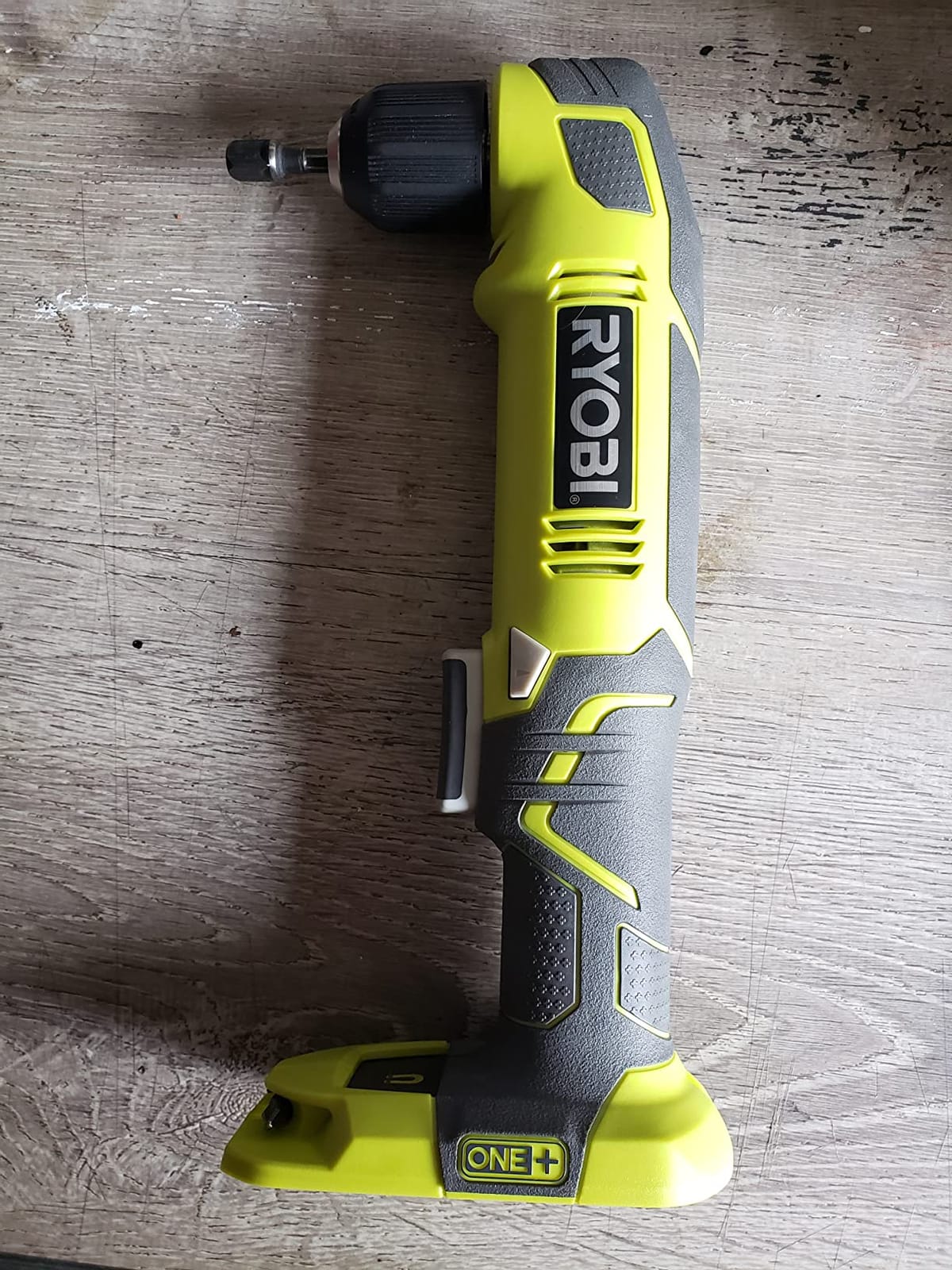
Owners use it well beyond framing. Reviewers report automotive work, exhaust bolts and housing fasteners, where the combination of a brushless motor and real torque earns its keep. If you are already on the ONE+ 18V platform, the battery question is already settled.
The chuck is the recurring complaint. Multiple reviewers describe it as difficult to tighten and a weak point overall, so give the bit a firm check by hand every time. The 30 day limited warranty is also the shortest in this roundup, which is worth factoring in if you are buying as a trade tool.
Why the torque figure matters on a joist drill
More torque is not just for driving screws. It is what pushes a self-feed bit through hardwood and dense framing without the bit stalling and the drill walking. The 450 rpm low range pairs with that torque nicely for larger bits than its size suggests.
Where it falls short
Heavy sustained boring and large-diameter self-feed work will drain a pack quickly, and the 3/8 inch keyless chuck is not a hole hawg mount. The short warranty is the other drawback for anyone using this daily on site.
5. Milwaukee M18 FUEL Hole Hawg 1/2 Inch Right Angle Drill – Most Versatile for Large Holes
Milwaukee M18 FUEL HOLE HAWG 1/2″ Right Angle Drill (Tool-Only)
M18 FUEL cordless
1/2 inch chuck
1200 ft-lbs torque
7.7 lbs tool only
+ The Good
- 1200 ft-lbs torque drives large hole saws and augers
- M18 FUEL brushless motor
- 1/2 inch chuck for big self-feed bits
- Metal construction and pro-grade durability
- The Bad
- 7.7 pounds is heavy for overhead work
- Single speed only
- Tool only and a specialist tool for most DIY work
This is the drill for the job the whole category is named after. A 1/2 inch chuck and 1200 ft-lbs of torque means you can run a large self-feed bit, a big hole saw, or an auger through solid framing, which no compact tool on this list will do.
Plumbers and electricians rate it highly for rough-in because it turns a half day of hole cutting into an afternoon. The FUEL brushless motor holds speed under load instead of browning out when the bit gets deep into a knot.
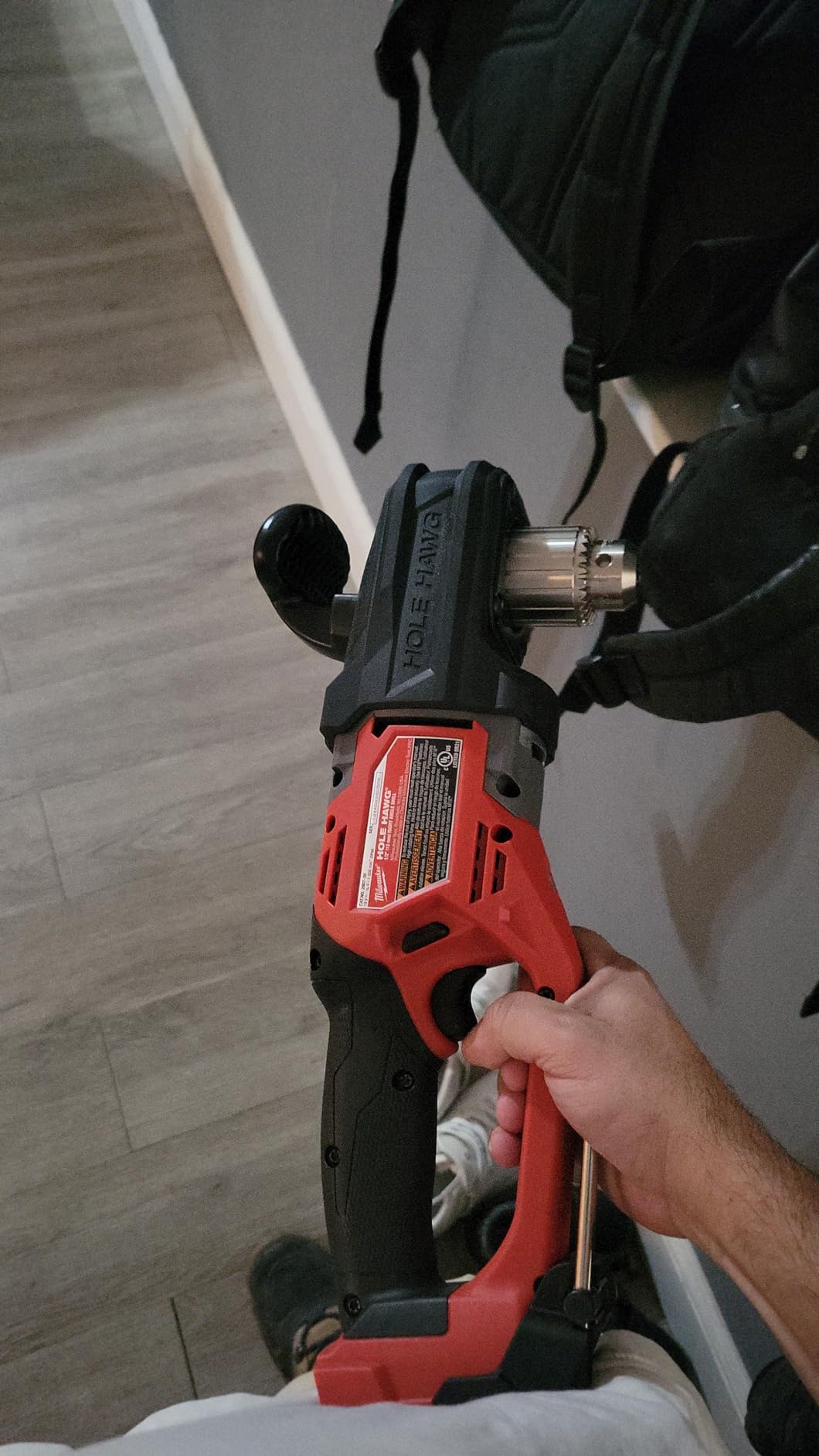
Where it works: knocking out multiple studs quickly, running large-diameter holes for ducts and returns, and any boring where stopping to change bits would cost more than the drill weighed.
Where it does not: overhead work. At 7.7 pounds plus a battery, repeated drilling above shoulder height is tiring, and reviewers consistently flag that as the main trade-off. It is also a single-speed tool, so you control feed rate with the trigger rather than a second gear range.
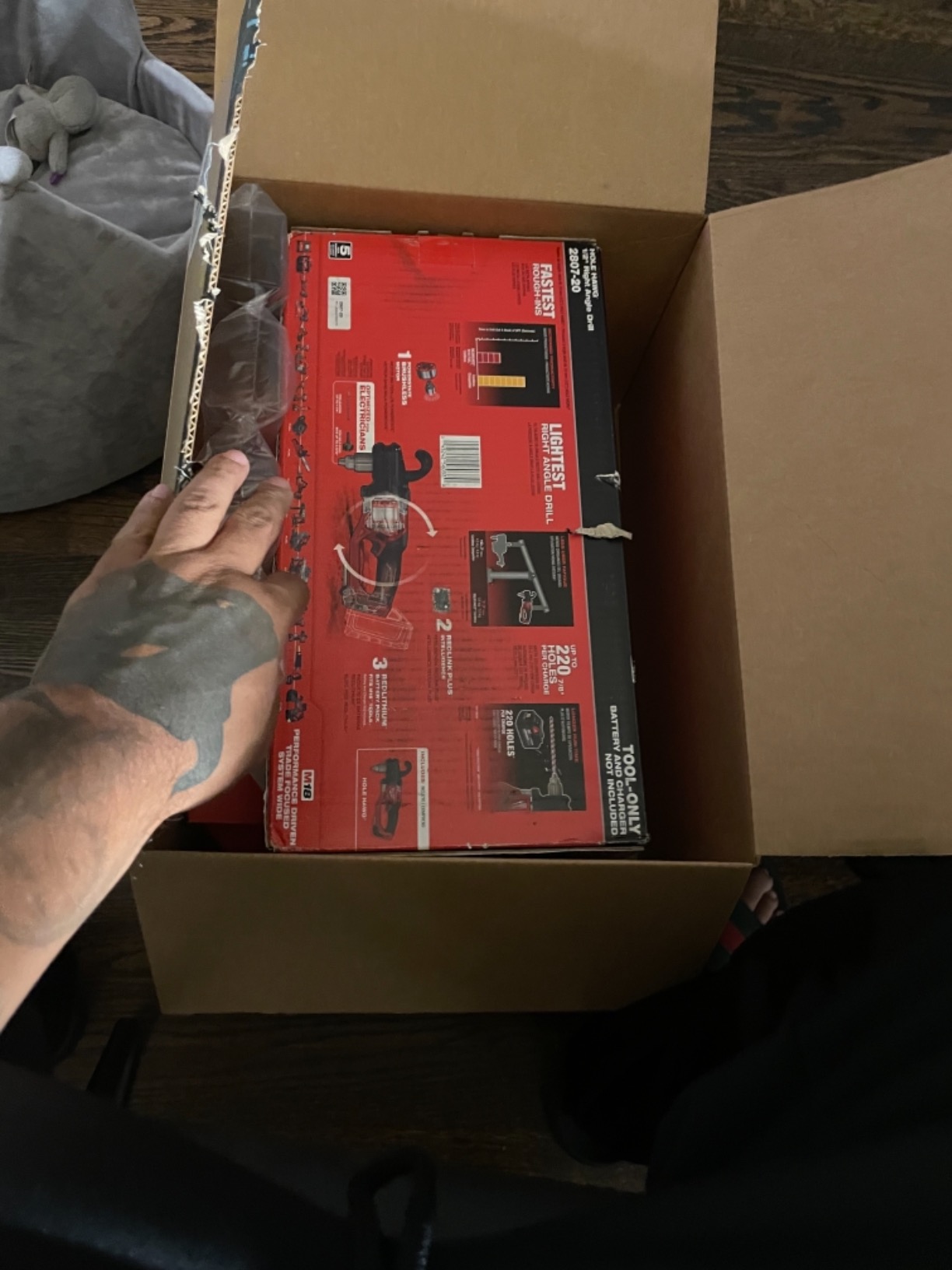
Which jobs justify the weight
Large self-feed bits, hole saws above 2 inches, auger work, and repeated rough-in where hole diameter is the deciding factor. It is the first tool on this list that comfortably handles big timber as well as framing lumber.
Where it falls short
Anything overhead, anything done once, and anyone who does not already own M18 packs. The bulk is real, and for a single basement project the compact options above will serve you better and cost less to get into.
6. Makita XAD02Z 18V LXT 3/8 Inch Angle Drill – Best for Makita LXT Owners

Makita XAD02Z 18V LXT Lithium-Ion Cordless 3/8″ Angle Drill, Tool Only
18V LXT cordless
0-1800 rpm variable
121 in-lbs torque
3/8 inch chuck
+ The Good
- 3-1/2 inch head height is among the smallest
- 121 in-lbs from a 4 pole motor
- High 1800 rpm top speed
- Some units built in Japan
- The Bad
- Chuck sits close to the body making changes awkward
- Brushed motor
- Tool only with single speed range
The XAD02Z is quietly excellent and slightly overlooked. A 3-1/2 inch head height is one of the smaller profiles available, and 12-3/8 inches overall means it will get into spaces that stop wider drills dead.
Speed is the other strength. At 0 to 1800 rpm with a variable trigger it clears bits faster than most of the compact class, so you are not sitting on a hole waiting for the bit to come out the far side.
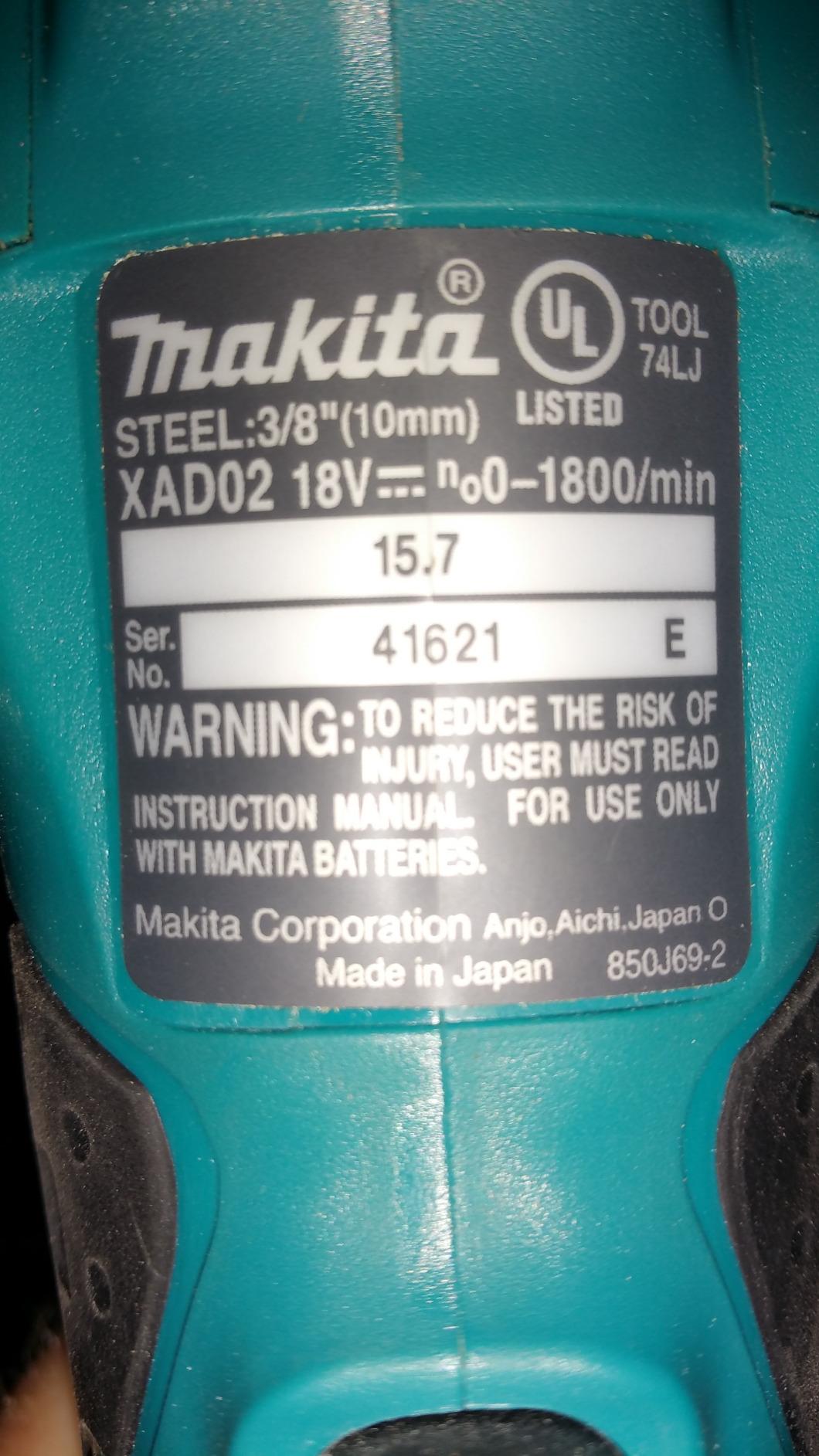
Build quality is the quiet selling point. Reviewers note Makita’s typical fit and finish, and some units are made in Japan, which they value. The 18V LXT platform is enormous, so if you have any LXT packs this is a cheap way to add a tool rather than opening a new platform.
The chuck position draws the most criticism. It sits close to the body, which makes tightening and removing bits awkward when you are wearing gloves, and it is a keyed style rather than the fully keyless chuck some buyers assume. Torque of 121 in-lbs is respectable but unremarkable.
Why the head size is the real feature
Between-stud clearance is the whole game in a joist bay. A lower head means you can keep the drill square to the face of the joist in cavities where a taller tool would foul the subfloor or a pipe already in place. That is a bigger practical advantage than a torque number.
Where it falls short
No second gear range, so slow-feed control comes from the trigger alone, and the chuck is awkward to operate. It is also a 3/8 inch tool, so large self-feed bits and big hole saws are out of reach.
7. Makita DA3010F 3/8 Inch Corded Angle Drill – Best for the Tightest Spaces and Corded Work

Makita DA3010F 3/8″ Angle Drill, reversible
Corded 4.0 amp
0-2400 rpm
2-5/8 inch head
3.5 lbs, made in Japan
+ The Good
- 2-5/8 inch head is the smallest on this list
- Corded power means no battery fade
- Paddle switch has a speed limiting dial
- Built-in clutch protects the gear train
- The Bad
- Corded so you need an outlet
- No clutch settings for driving screws
- No motor brake so the bit keeps spinning
This is one of the smallest drills here, and for genuinely tight framing that is the whole argument. A 2-5/8 inch head and a 10-5/8 inch body will fit cavities that nothing else on this list reaches.
Being corded has advantages beyond power. There is no battery fade, no pack to carry, and the tool weighs 3.5 pounds. If you are working in a finished house with outlets nearby, that is a genuinely better setup than any battery platform.

Two details we appreciated. The paddle switch has a speed limiting dial so you can set a maximum speed for repetitive screw work, and the built-in clutch disconnects the drive if the bit binds, which protects the gear train on a hard snag. Reviewers also praise the bearings for smooth, precise operation.
There are real compromises. There are no torque settings, so it is a drill rather than a driver, and no motor brake, which means the bit keeps turning after you release the trigger. The paddle switch is sensitive, and owners specifically advise unplugging before changing bits. The warranty is one year.
Where a corded angle drill still wins
Long sessions, remodels with power already in place, and anyone who does not want a second battery platform. The speed limiting dial and the gear protection clutch make it more controlled than a bare-bones cordless at the low end of this list.
Where it falls short
Awkward sites with no power, and driving work, since the clutch is protective rather than adjustable. Some buyers have received 100V Japanese market units instead of the 120V model, so check the rating on the tool before you plug it in.
8. Milwaukee 2808-20 Right Angle Drill with QUIK-LOK – Best for Quick Bit Changes

Milwaukee Electric – Right Angle Drill W/Quik-LOK
M18 FUEL cordless
7/16 inch QUIK-LOK chuck
100 Nm torque
1500 rpm
+ The Good
- QUIK-LOK chuck changes bits faster than a keyed model
- Preferred by repair professionals over the keyed version
- Brushless FUEL motor
- Handles 8 inch thick wood drilling
- The Bad
- Requires 7/16 inch hex shank bits which cost extra
- Not compatible with round shank bits
- 7.1 pounds and single speed only
This is the QUIK-LOK version of Milwaukee’s M18 angle drill, and owners consistently prefer it to the keyed chuck model. You push the collar and the bit releases; there is no key to drop, and the mechanism resists the dirt and glue that eventually freezes a keyed chuck.
Chuck durability is a real theme in owner feedback, with keyed chucks on older angle drills described as getting crunchy or seized after years of use. The QUIK-LOK design sidesteps most of that.

Performance is close to the bigger hole hawg: 100 Nm of torque, 1500 rpm, and reviewers report it drilling through 8 inches of solid wood. Repair technicians in particular recommend it for daily use.
The catch is bit compatibility. It takes 7/16 inch hex shank bits, which are a specialised format and cost more than standard round shank bits. If you already own a bin of conventional bits, this is an extra expense to plan for. At 7.1 pounds it is also heavy, and there is only one speed.
Who should choose the QUIK-LOK
Technicians drilling many holes a day who change bits constantly, and anyone who has watched a keyed chuck wear out. If bit changes are part of the job, this is the mechanism that saves time.
Where it falls short
Anyone without access to 7/16 inch hex shank bits, and overhead work at 7.1 pounds. It is also not the choice for large self-feed bits, since the hex shank format is a different capacity class from a 1/2 inch hole hawg chuck.
9. DEWALT DCD470B 60V MAX In-Line Stud and Joist Drill – Best for Bind-Up Protection

DEWALT 60V MAX* Right Angle Drill, Stud/Joist, Tool Only (DCD470B)
60V FLEXVOLT cordless
E-Clutch system
0-400/0-1320 rpm
magnesium gear case
+ The Good
- E-Clutch drops torque when the bit binds
- Anti-bind protection reduces wrist injury risk
- 60V FLEXVOLT brushless power with cordless freedom
- Magnesium gear case is durable and lighter
- The Bad
- 17.6 pounds before the battery is added
- Requires expensive 60V FLEXVOLT packs
- In-line format is bulky between joists
This is the safety-first pick. The E-Clutch system senses when the bit stops advancing, cuts torque to the user, and re-engages once the bit clears. Owners describe it as the feature that stopped them getting hurt when a bit grabbed in wet lumber.
It is also an in-line stud and joist drill rather than a low-profile angle drill, which is worth understanding before you buy. The 60V FLEXVOLT brushless motor runs at 0 to 400 and 0 to 1320 rpm in two ranges, with a magnesium gear case on top.
Handle it honestly: 17.6 pounds for the tool, closer to 23 pounds with a battery on. That is heavy for overhead work and for a day of repeated drilling, and it needs 60V FLEXVOLT packs that you may not own yet. Reviewers also note that the larger head is not actually better at fitting between joists than a slim angle drill.
When the E-Clutch is worth the weight
Large diameter work in unpredictable material. If you routinely bore big self-feed bits through old, wet, knotty lumber, the protection is the reason to buy this rather than a lighter drill with more torque.
When it is not
Anything overhead, and any job where a 23 pound tool is more risk than the hazard it prevents. For most people, a compact drill plus careful technique delivers the same safety outcome at a third of the weight.
10. Ingersoll Rand 7807R-A 3/8 Inch Pneumatic Angle Drill – Best for Pneumatic Jobsites

Ingersoll Rand 7807R-A 3/8″ Right Angle Reversible Air Drill
Air powered
.33 hp motor
1800 rpm
aluminum housing
+ The Good
- 1800 rpm from a .33 hp pneumatic motor
- Aluminum housing survives drops and rough sites
- Light at 1.37 kg
- Speed lever gives precise control
- The Bad
- Requires a compressor and hose
- Keyed chuck needs a wrench
- Warranty is one year
Pneumatic tools are still the standard on commercial framing crews, and this is a properly built one. A .33 hp motor at 1800 rpm is more than enough for framing work, and the aluminium housing is what makes it a tool you can drop on a deck without worrying.
There is no battery to charge and no charger to lose, which on a site with a compressor already running is a genuine convenience. The speed lever is easy to modulate for starting a hole cleanly.
Owners rate it highly for tight-space access and for taking repeated knocks, which is the normal life of a pneumatic angle drill. The right angle configuration handles torque reaction better than an in-line drill, so it stays controllable in a confined bay.
The barriers are practical rather than mechanical. You need a compressor and a hose, which rules it out for residential and DIY use entirely. The chuck is keyed, so you need a wrench for every bit change, and the warranty is one year.
Where pneumatic still makes sense
Framing crews and metal or fabrication shops that already run compressed air. Durability and low cost of ownership are the deciding factors, and there is no battery ageing to worry about over the life of the tool.
Where it does not
Any job without a compressor, and any fine work where a keyed chuck slows you down. For a homeowner, the effort of setting up air outweighs everything this tool does well.
11. SUNTECH SM-709R 3/8 Inch Pneumatic Angle Drill – Best Budget Pneumatic
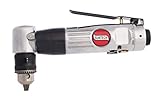
SUNTECH SM-709R Sunmatch 3/8″ Reversible Pneumatic Angle Drill, Silver
Air powered
1600 rpm
75 ft-lb torque
1.1 kg, reversible
+ The Good
- Light at 1.1 kg
- Reverse valve for quick direction change
- Safety throttle lever for better control
- 1600 rpm is plenty for framing bits
- The Bad
- No manufacturer warranty
- Single speed only
- 75 ft-lb torque is below the class average
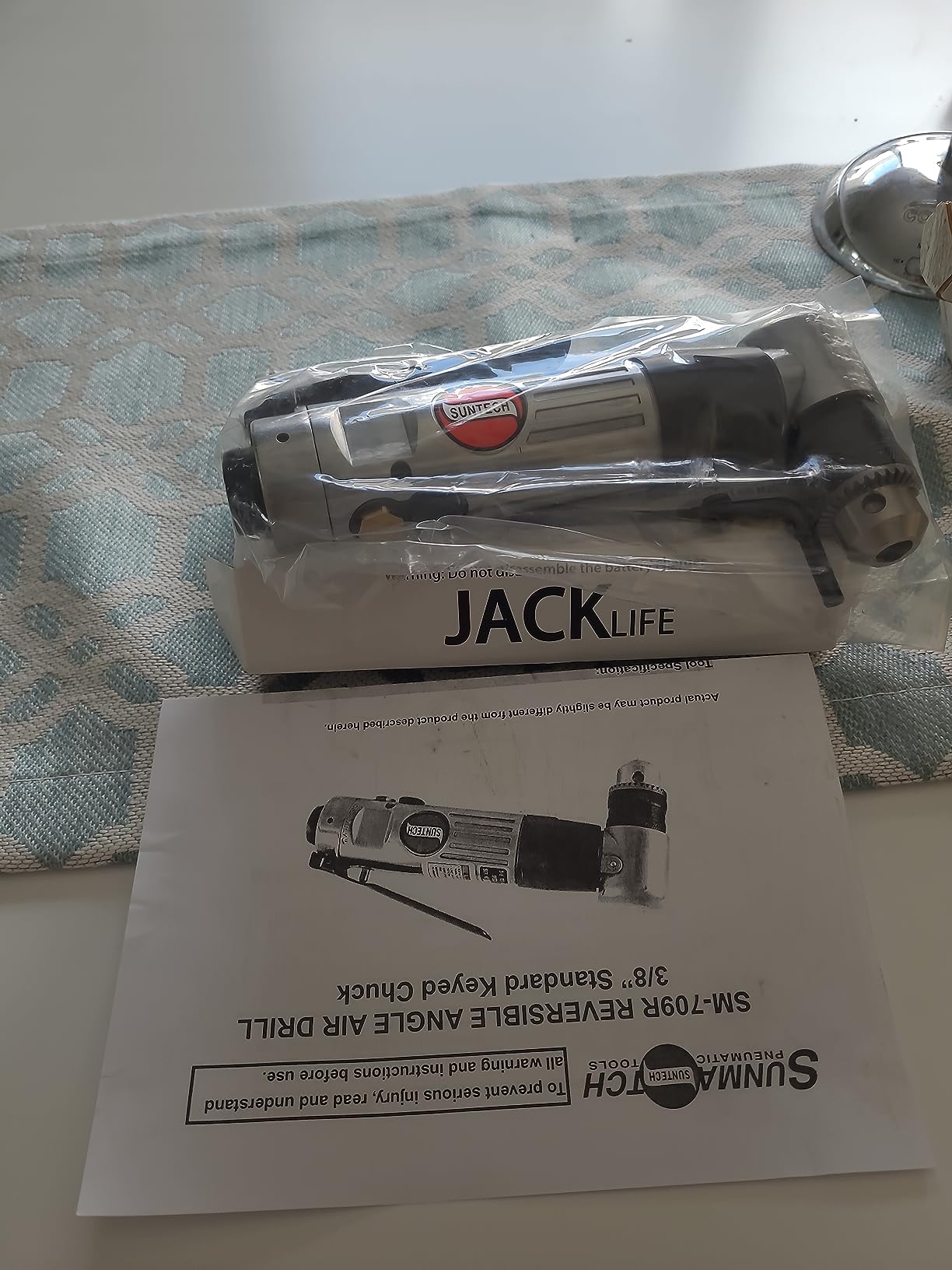
This is the light, cheap end of the pneumatic category, and at 1.1 kg it is noticeably easier on the wrist than most corded angle drills. If you already have air on site and you need a second angle drill rather than a lifetime tool, it makes sense.
The reverse valve and safety throttle lever are both sensible fittings. A dedicated reverse valve changes direction without fiddling with a lever, and the safety throttle lock prevents accidental spin-up when you are adjusting the tool.
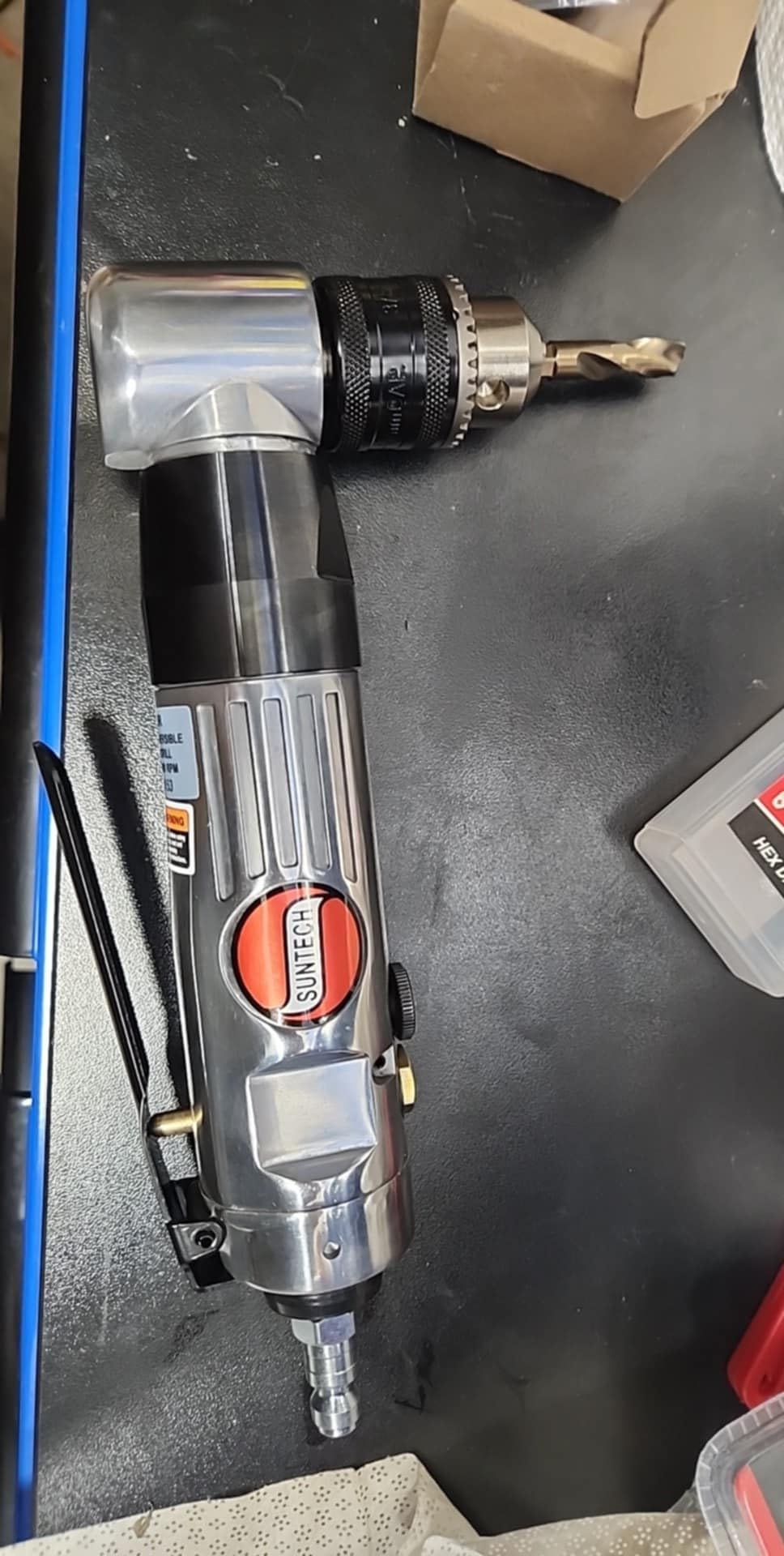
At 1600 rpm it has plenty of speed for framing bits, and the rated capacity covers 3/8 inch work in both wood and metal, which is what most pneumatic angle drills are actually used for.
The trade-offs are clear. Torque of 75 ft-lb sits below the class average, so larger self-feed bits are out. It is single speed, and there is no manufacturer warranty at all, which is the main reason this is not ranked higher despite the strong 4.6 rating across 277 reviews.
When the low weight matters most
Repetitive light drilling high up, above ceiling, where a heavier tool causes grip fatigue. At 1.1 kg you can hold it in one hand comfortably for a long stretch of small holes.
When to step up
Any structural lumber, any auger or spade bit above 3/8 inch, and anyone who needs the tool to be serviceable after a few years. The lack of warranty is the deciding factor for most trade buyers.
12. Makita DA4031 1/2 Inch Corded Angle Drill – Best Heavy-Duty Corded Option

Makita DA4031 Angle Drill, 1/2 In, 10 A, Teal
Corded 10 amp
300/1200 rpm two speed
1/2 inch chuck
torque limiter
+ The Good
- 10 amp motor rated
- Two speed settings at 300 and 1200 rpm
- Torque limiter disconnects the motor on a bind
- Adjustable top handle and side handle included
- The Bad
- Weighs 6.3 kg which is heavy all day
- One report of high speed gear failure
- Rotating trigger handle is awkward to remove
This is the oldest design in the roundup and still one of the most capable. A 10 amp corded motor, a 1/2 inch chuck and two speed settings at 300 and 1200 rpm make it a genuine structural boring tool, not a trim driver.
The handling is the standout feature. Both the top handle and the side handle adjust, which is how you control a heavy, high-torque drill when the bit starts to bite. The handles also store the hex wrenches, a small touch on a tool you assemble yourself.
Reviewers note that real-world current draw is higher than the 10 amp rating suggests, and they rate the smooth, quiet, well-balanced operation. Made in Japan, with a rubber-insulated cord that does not stiffen in cold weather.
At 6.3 kg this is one of the two heaviest drills here, and it is a weight you feel by hour two. One owner reports high-speed gear failure after extended use, and the rotating trigger handle is awkward when you need to reposition quickly. The case and side handle are included, which softens the accessory cost.
Who this is for
Plumbers and electricians doing large-hole rough-in daily, and anyone boring through heavy timber. The dual handles are the reason it stays controllable at this power level.
Who should skip it
Overhead work, occasional use, and anyone without a place to plug in. At 6.3 kg it is a tool for a full day of drilling, not a single project, and the one-year warranty is thin for that kind of commitment.
Kickback and Bind-Up Control: How to Keep a Joist Drill From Biting You
Kickback is the single most common complaint about these tools, and it is worth understanding before you buy one rather than after. A self-feed bit grabs, the motor keeps driving at full speed, and the drill rotates in your hands fast enough to knock you off balance. Tradespeople describe exactly this when working with large bits in wet or knotty lumber.
Most bites start with the bit, not the drill. A dull self-feed bit skips, a knot catches it mid-hole, and wet green lumber swells and pinches the screw. Before blaming the tool, take the bit out and check whether the lead screw is still sharp.
There are three mechanical answers, and they are worth understanding in order of how well they work.
Electronic bind-up control, sold as E-Clutch or similar, senses that the bit has stopped advancing, cuts torque to the user, and re-engages when it clears. The DEWALT DCD470B in this roundup uses it, and owners consistently describe it as protecting their wrists.
A mechanical slip clutch does the same job physically. The Makita DA3010F and the Makita DA4031 both use a clutch that disconnects the drive train on a bind, protecting the gears at the cost of a little lost motion.
Gear reduction is the oldest answer. Running at 300 rpm gives the bit time to self-feed without the motor overwhelming it. Both Makita corded models in this list offer a low speed range, and the DEWALT DCD470B runs 0 to 400 rpm as its low range.
Then there is technique, and it matters more than any of the above. Brace the ladder or the floor before you start, keep both hands on the tool, use the bail or side handle when the drill has one, and let the self-feed screw pull the bit instead of leaning into it. If you are on a ladder, the risk of being knocked off it is the reason to slow down, not speed up.
How to Drill a Joist Safely and Straight
Locate the services before you drill. Find every wire, pipe and duct in the bay. A stud finder alone will not reliably catch cable, so assume hidden services exist until you have confirmed otherwise.
Mark the hole, then check what is behind it. Confirm the mark lands in the solid part of the joist, not in a knot or a split. A pencil mark low on the face is easy to lose; a masking tape flag is easier to see.
Stay in the middle third of the span. For solid lumber joists, the conventional rule is to keep holes within the middle third of the depth, and away from notches that reduce the section. This is a widely used guideline rather than a substitute for local code and engineering advice.
Clamp or brace before you start. If you are on a ladder, have someone steady it. A kickback with a 3/8 inch drill in one hand is how people end up in an ambulance.
Pilot any large bit. For bits over half the joist depth, predrill with a smaller bit. The self-feed screw needs a clean start, and a wandering first hole is the one that ends up crooked.
Start slow, in the low gear. Use the low speed range, keep steady forward pressure, and let the self-feed screw do the work. Increase speed once the bit is tracking.
Check the exit side before you commit. Look at what is on the other face of the joist, especially on the far side of a wall where a bit can punch out into a finished room.
Notching is a different job from drilling and has tighter limits than many people expect. If you are cutting a section out of a joist rather than boring a hole through it, that is engineered work, and it is worth a conversation with a structural engineer or your local inspector before the saw comes out. I-joists are a further case again: the web and the timber flanges behave differently from solid lumber, and standard solid-joist rules do not transfer directly.
Right Angle Drill Buying Guide: Corded vs Cordless, Chuck Size and Battery Platform
Corded or cordless. Corded wins on sustained power and there is no battery to carry, but you need an outlet and an extension cord rated for the load. Cordless wins on access and convenience, and for most rough-in work the compact 18V and 20V models have more than enough torque. Choose corded when you are boring large holes all day; choose cordless when you are moving around a building.
Chuck size and bit compatibility. A 3/8 inch chuck takes 3/8 inch and smaller bits, which covers wire, cable and small augers. A 1/2 inch chuck takes 1/2 inch self-feed bits and large hole saws. The QUIK-LOK model here takes 7/16 inch hex shank bits specifically, so check what shank format your bits are before you commit. If you need a hole saw over 2 inches or an auger for post holes, you are in the 1/2 inch class.
Battery platform lock-in. This is the number one purchase driver among owners, and rightly so. Buying a right angle drill is usually the moment you commit to a battery ecosystem, so check what you already own. If you have M12 packs, the Milwaukee M12 is the answer. If you have 18V LXT, the Makita XAD02Z costs you nothing beyond the tool. If you are starting fresh, the size of the pack range and the cost of extra batteries matter more than the drill.
Weight and handles. This is where people underestimate. A 3 pound compact drill and a 7.7 pound hole hawg are not interchangeable over a full day of overhead work, and the heaviest options on this list are only sensible for large-diameter boring at floor or bench level. If the drill has an auxiliary handle or a bail handle, that is a safety feature, not a comfort extra.
Warranty length. Warranty terms range from 30 days on the RYOBI to five years cited by owners on Milwaukee tools, and several older corded designs carry only one year. For a trade tool bought once and kept for a decade, that difference is worth weighing. Availability of self-feed bits, hole saws and replacement chucks at a normal retailer matters just as much, since a specialty shank format can be hard to find locally.
When a 90 degree attachment is enough. If you are drilling screw-sized and small bit holes, notching light blocking, or fishing a single cable, an angle attachment on a drill you already own will do the job. Purpose-built drills earn their place when you need large hole diameters, self-feed bits, high speed control and bind-up protection. Check our corded hammer drill guide if your framing work also involves masonry or concrete.
Buy or rent. If you have one basement project, renting is the sensible answer and most rental counters stock a right angle drill. Buy when you own 20V or 18V packs already, when you are doing repeated rough-in work, or when renting costs more than a compact model over a year.
What Joist Drill Owners Actually Say
Across trade forums and homeowner communities, the same themes come up again and again. Kickback with large self-feed bits is the most common complaint, and the most common cause owners identify is a dull or gummed bit rather than the drill itself. Chuck durability is the second theme, with keyed chucks on older angle drills described as becoming difficult to loosen after years of service, which is the argument for a quick-change chuck.
Weight is the third. Owners drilling overhead or making repeated holes talk about the difference between a compact drill and a full-size hole hawg far more than they talk about power. The compact class is described as the more sensible tool for residential work, with the big hole hawgs reserved for large-diameter professional rough-in.
Almost every conversation turns to batteries. The consensus is that people will not buy into a new platform for a single tool, which is why the ecosystem-native picks on this list tend to get recommended first. Durability is the other consistent signal, with tradespeople citing how long their previous angle drills lasted as the main reason to buy the same brand again.
Frequently Asked Questions
Is a right angle drill worth it?
Yes, for joist work specifically. A standard drill cannot fit between studs to drill a hole straight into the face of a joist, so wiring, PEX and HVAC lines either do not get run or get run with a lot of awkward setup. If you already own 20V or 18V packs, a compact right angle drill is a small add-on rather than a big investment.
What do you use a right angle drill for?
Drilling holes through the faces of floor joists, wall studs and blocking for cables, pipes and duct runs. It also handles screw driving in confined bays, notching light blocking, and fishing wire through existing framing. The 90 degree chuck geometry is the reason it works, since your hands stay clear of the bit’s path.
What’s the biggest hole you can drill through a joist?
It depends on the drill and the bit, not just the lumber. A 1/2 inch chuck on a full-size hole hawg accepts large self-feed bits and big hole saws, while compact 3/8 inch drills are limited to smaller bits. Structurally, the widely used guideline is to keep drilled holes within the middle third of the joist depth and away from notches. Check local code for your area.
Do 90 degree drill attachments work?
Yes, for small work. An angle attachment on a drill you already own handles screw-sized holes, light notching and single cable runs perfectly well. It falls short when you need large hole diameters, self-feed bits, high speed control or bind-up protection, because the attachment adds length and the drive train is not designed for that torque.
Is a cordless stud and joist drill as powerful as a corded one?
For most framing and rough-in work, yes. Modern brushless cordless right angle drills deliver enough torque for standard self-feed bits and moderate hole saws. A corded tool still wins on sustained large-diameter boring, where the higher current draw and no battery fade matter over a full day of heavy holes. Many trades carry both.
Final Verdict: The Best Right Angle Drills for Joist Work in 2026
The DEWALT DCD740B is the best right angle drill for joist work for most people. A 4.0 inch front-to-back length, two speed ranges for controlled feeding, 3.3 pounds and a 4.7 rating across 2936 reviews make it the tool we keep reaching for first, and it slots straight into an existing 20V MAX kit.
Go heavier on capacity if the holes are large: the Milwaukee M18 FUEL Hole Hawg handles 1/2 inch self-feed bits and big hole saws that nothing else here will touch, at the cost of 7.7 pounds. Go lighter if you are working overhead, where the 2.3 pound Milwaukee M12 is the better answer.
Whichever you choose, the drill matters less than technique. A sharp self-feed bit, the low gear range, two hands on the tool and a braced ladder stop more kickbacks than any amount of electronics. Our angle grinder guide covers the other half of a framing kit if you are finishing off the rough-in.