
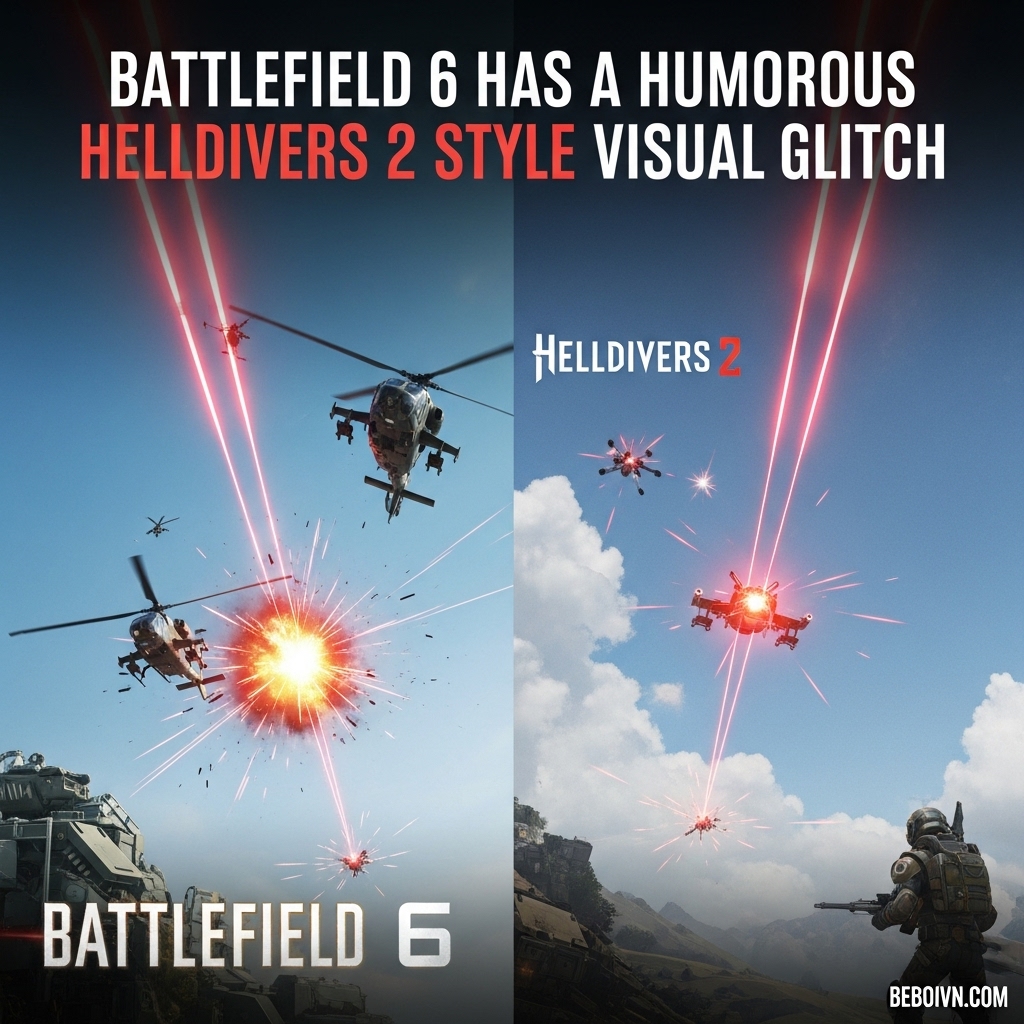
In the chaotic world of Battlefield 6, where explosions rock the battlefield and bullets fly from every direction, players have stumbled upon a glitch so spectacular and entertaining that it’s captured the hearts of the community. This unexpected visual bug creates a dramatic orbital laser effect reminiscent of Helldivers 2’s signature stratagems, turning ordinary vehicle destruction into cinematic moments that wouldn’t be out of place in a science fiction blockbuster. What makes this particular glitch special isn’t just its visual appeal, but the way it has united the Battlefield community in appreciation for these rare, serendipitous moments that make gaming truly magical.
The Orbital Laser Phenomenon: When Glitches Become Features?
How the Glitch Manifests
The Battlefield 6 Helldivers 2-style glitch occurs under specific circumstances that players are still working to fully understand. Based on numerous reports and video evidence, the effect typically triggers when a vehicle has been painted by the game’s laser designator tool and is subsequently destroyed by a guided missile or rocket. At the exact moment of destruction, instead of the standard explosion animation, a brilliant red laser beam appears to shoot down from the sky, striking the vehicle with devastating visual flair.
As captured by Reddit user Xhamy in a viral video that has since been shared across multiple gaming platforms, the effect is nothing short of spectacular. In the footage, a helicopter that has been designated for destruction suddenly erupts in a cascade of red energy as a massive laser beam appears to vaporize it from above. The visual effect is so polished and dramatic that many viewers initially assumed it was an intentional game feature rather than an unintended bug.
The Helldivers 2 Connection
What makes this glitch particularly amusing to players is its striking resemblance to Arrowhead Game Studio’s Helldivers 2, where players can call down orbital laser strikes as part of their strategic arsenal. The visual similarity is uncanny—both feature a red beam of energy descending from orbit to obliterate targets with theatrical precision. This connection hasn’t been lost on the community, with many players referencing Helldivers 2’s “For Super Earth!” mantra when sharing clips of the glitch in action.
The comparison extends beyond just visual similarity. In Helldivers 2, orbital strikes are among the most satisfying and dramatic ways to eliminate enemies, creating moments of triumph and spectacle that players love to share. The Battlefield 6 glitch captures this same feeling, albeit unintentionally, turning routine vehicle kills into memorable events that players eagerly capture and share with their friends.
Community Reaction: From Bug to Beloved Feature
Overwhelmingly Positive Response
Unlike most glitches that players demand be fixed immediately, the Battlefield 6 orbital laser glitch has received an overwhelmingly positive reception from the community. Across Reddit threads, social media posts, and gaming forums, players have expressed their delight at this unexpected visual treat, with many explicitly stating they hope EA doesn’t patch it out.
One Reddit thread dedicated to the glitch filled with comments like “This is the best bug I’ve ever seen” and “Please don’t fix this, it’s too awesome!” The sentiment is consistent across platforms—players recognize this as a technical issue but appreciate the entertainment value it brings to their gaming experience.
The Psychology of Positive Glitches
What makes this glitch so endearing to players? Gaming psychologists suggest it’s the element of surprise and delight that comes from discovering something unexpected and wonderful in a familiar environment. Unlike game-breaking bugs that frustrate and impede progress, this visual glitch enhances the experience without affecting gameplay balance or competitive integrity.
Dr. Sarah Chen, a gaming psychologist interviewed about the phenomenon, explains: “Players have grown accustomed to polished, predictable experiences in modern AAA games. When something unexpected and delightful happens, it breaks the routine and creates a moment of genuine surprise and joy. This glitch taps into that childlike sense of wonder that many gamers felt when first discovering video games.”
Community Creativity and Engagement
The glitch has also sparked a wave of creativity within the Battlefield community. Players are actively trying to recreate the effect, sharing tips on how to trigger it consistently, and creating compilations of their best orbital laser moments. This level of engagement is exactly what game developers hope for—players not just playing the game, but actively participating in the community and creating content around it.
Some players have even started roleplaying scenarios around the glitch, pretending they’re calling in orbital strikes or referencing other sci-fi franchises like Gears of War’s Hammer of Dawn. This organic community building around a technical quirk demonstrates how gaming communities can find joy and connection in the most unexpected places.
Technical Analysis: What’s Causing the Orbital Laser Effect?
The Laser Designator Connection
To understand why this glitch occurs, we need to examine the Battlefield 6 laser designator system. The laser designator is a tactical tool used by players to “paint” vehicles and structures, making them vulnerable to guided weapons like rockets and missiles. When a target is successfully designated, it typically shows a visual indicator (usually a red dot or outline) to help guide the incoming projectile.
Based on player reports and technical analysis, the glitch appears to occur when there’s a synchronization error between the designation system and the destruction animation. Instead of properly clearing the designation visual effect when the vehicle is destroyed, the game appears to “stretch” or amplify this effect, creating the dramatic laser beam that players are seeing.
Rendering Engine Anomalies
From a technical perspective, this type of visual glitch often occurs in game rendering engines when there’s a mismatch between what the game expects to happen and what actually occurs. In this case, the rendering engine might be trying to display the laser designation effect at the exact moment the vehicle’s destruction animation begins, causing a visual conflict that results in the spectacular beam effect.
Game developers familiar with the Frostbite engine (which powers Battlefield 6) suggest that this could be related to how the engine handles particle effects and destruction physics. When multiple complex visual systems interact simultaneously—particle effects, physics simulations, and lighting effects—unintended visual artifacts can sometimes occur, especially under the stress of large-scale multiplayer battles.
Why It’s So Rare
Part of what makes this glitch special is its rarity. Players report that it only occurs under very specific conditions, and even then, it doesn’t happen every time those conditions are met. This rarity adds to the sense of occasion when it does occur, making each instance feel special and worth celebrating.
The inconsistency also suggests that fixing the glitch might be more complex than it appears. If the issue is deeply embedded in the rendering engine’s core systems, a simple patch might not be sufficient to eliminate it without potentially affecting other, more critical visual effects.
Historical Context: Glitches That Became Features
Gaming’s Greatest Happy Accidents
The Battlefield 6 orbital laser glitch isn’t the first time a technical quirk has captured players’ hearts and imaginations. Gaming history is filled with examples of glitches that were so beloved they either became intentional features or were left in games because of their popularity.
One of the most famous examples is the “rocket jump” in Quake, where players discovered they could use rocket blast damage to propel themselves to otherwise unreachable areas. What started as an exploit eventually became an intentional gameplay mechanic that defined the arena shooter genre.
More recently, Fortnite’s “rocket riding” mechanic—where players could stand on top of launched rockets to travel across the map—began as a physics glitch before being embraced by developers and incorporated into the game’s meta.
Battlefield’s Own Glitch History
The Battlefield franchise itself has a rich history of memorable glitches that have become part of the series’ lore. From the legendary “jet skiing” on fighter jets in Battlefield 1942 to the more recent “levitating soldier” bugs in Battlefield 2042, these technical quirks have often become as memorable as the intentional features.
What makes the current orbital laser glitch special is how it fits perfectly within Battlefield’s tradition of spectacular, over-the-top moments while also tapping into the contemporary popularity of games like Helldivers 2. It’s a perfect storm of technical happenstance and cultural relevance.
Developer Response and Future Implications
EA’s Stance on the Glitch
As of now, EA and DICE haven’t officially commented on the orbital laser glitch, which isn’t surprising given how recently it was discovered. However, based on the community’s overwhelmingly positive response and the glitch’s harmless nature, there’s speculation that developers might take a different approach than they would with a typical bug.
Historically, EA has been quick to patch exploits that affect gameplay balance or competitive integrity. However, purely visual glitches that don’t impact gameplay—especially ones that players enjoy—have sometimes been left in games or even embraced as intentional features.
The Possibility of Becoming an Easter Egg
Given the community’s positive response, there’s growing speculation that EA might choose to preserve the orbital laser effect in some form, even if the underlying technical issue is fixed. This could take several forms:
- Intentional Feature: The developers could refine the effect and make it an intentional part of the game, perhaps as a rare visual flourish for particularly spectacular kills.
- Easter Egg: The glitch could be preserved as a hidden feature or Easter egg that players can trigger under specific conditions.
- Limited-Time Event: The effect might be incorporated into a future limited-time event or game mode, allowing players to experience it in a controlled environment.
Community Management Considerations
From a community management perspective, the orbital laser glitch presents an interesting case study. It demonstrates how technical issues can sometimes create positive community engagement and how developers might benefit from being responsive to player sentiment rather than strictly adhering to original design intentions.
The situation also highlights the importance of communication between developers and players. By acknowledging the glitch and discussing it openly with the community, EA could build goodwill and demonstrate that they’re listening to player feedback—even when it comes to unexpected technical quirks.
The Broader Impact on Gaming Culture
Memes and Content Creation
The Battlefield 6 orbital laser glitch has already become a significant source of memes and content creation across social media platforms. TikTok, Instagram Reels, and YouTube Shorts are filled with clips of the glitch in action, often set to dramatic music or accompanied by humorous commentary.
This content creation serves as free marketing for the game, exposing it to potential new players who might be drawn in by the spectacle and community enthusiasm. It also keeps existing players engaged and invested in the game, even when they’re not actively playing.
Streaming and Esports Considerations
For streamers and content creators, the glitch provides entertaining content that can help differentiate their streams and videos. In the competitive esports scene, however, the glitch’s impact is more nuanced. While it doesn’t directly affect gameplay balance, any visual inconsistency could potentially impact professional play, even if only as a distraction.
Fortunately, the glitch’s rarity makes it unlikely to significantly affect competitive matches, but it’s something that tournament organizers and professional players will need to be aware of as the competitive scene develops.
Cross-Game Cultural References
The Helldivers 2 connection has created an interesting bridge between two different gaming communities, with players from both games finding common ground in their appreciation of orbital strike mechanics. This cross-pollination of gaming culture is increasingly common in the modern gaming landscape, where players often engage with multiple titles and communities simultaneously.
The glitch has also sparked discussions about game design, visual effects, and the line between intentional features and happy accidents. These conversations contribute to a more sophisticated and engaged gaming community that thinks critically about the games they play.
Conclusion: Celebrating the Magic of Unexpected Moments
As we reflect on Battlefield 6’s humorous Helldivers 2-style visual glitch, it’s worth considering what these moments mean for the broader gaming experience. In an industry increasingly focused on polish, predictability, and monetization, glitches like the orbital laser effect remind us of the magic that can happen when games surprise us.
The community’s overwhelmingly positive response to this technical quirk demonstrates that players value surprise, spectacle, and shared experiences as much as they value technical perfection. It shows that sometimes the most memorable gaming moments aren’t the ones carefully designed by developers, but the ones that emerge organically from the complex interaction of systems, players, and pure chance.
Whether EA chooses to patch the glitch, preserve it as an Easter egg, or incorporate it as an intentional feature, the orbital laser phenomenon has already secured its place in Battlefield history. It stands as a testament to the fact that even in the most carefully crafted gaming experiences, there’s always room for delightful surprises that bring players together in shared wonder and amusement.
As the gaming industry continues to evolve, perhaps the lesson of the Battlefield 6 orbital laser glitch is that sometimes the best features are the ones nobody planned—those serendipitous moments of magic that remind us why we fell in love with gaming in the first place. In a world of increasingly predictable entertainment, these unexpected moments of joy and wonder are more valuable than ever.