
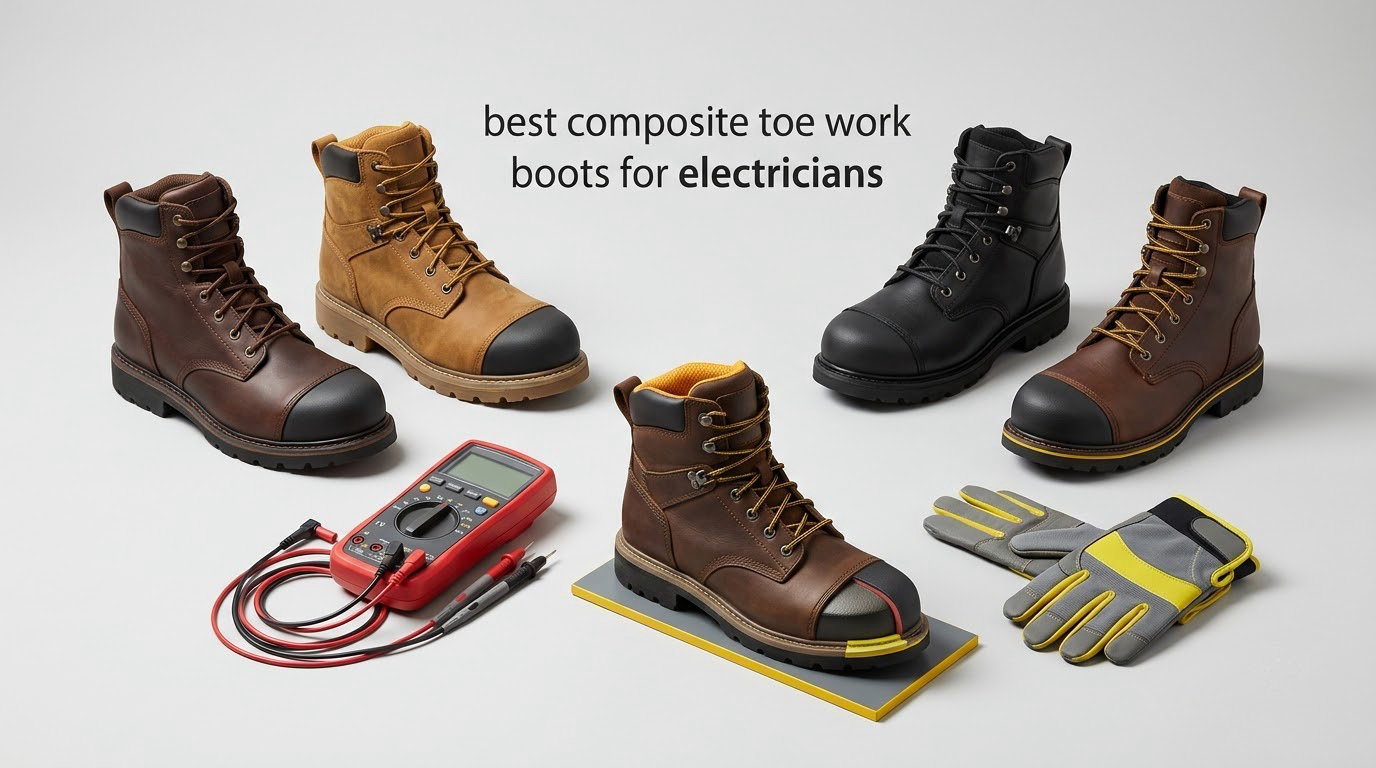
Yes, composite toe boots are genuinely good for electricians, and for one specific reason that matters more than comfort or price: the toe cap is non-metallic, so it does not carry current. A steel cap can become part of a path to ground if you are ever bridging to a grounded surface. That single difference is why most linemen, journeymen, and residential electricians who do live or near-live work have moved to composite or aluminum toes.
But here is the part almost every roundup gets wrong. Composite toe and EH rated are two separate things. The composite cap handles impact and compression. The EH (Electrical Hazard) rating is what tells you the boot was tested for secondary protection around circuits up to 18,000 volts under dry conditions. Plenty of composite toe boots on the market carry no EH rating at all. If you are working on or near energized equipment, you need to check the label, not the toe shape.
We put 10 composite toe work boots through their paces for this guide to the best composite toe work boots for electricians in 2026 — weighing certifications, weight, outsole grip, waterproofing, and how each one holds up on a long shift. Every boot below comes from a model that carries a stated ASTM standard in its published specifications. Where a boot lacks an EH rating, we say so plainly instead of letting the composite toe do the talking.
If you want the wider picture first, our general composite toe work boot roundup covers the category for people outside the electrical trade, and our steel toe work boot picks are worth a look if your employer specifically requires a metal toe.
Top 3 Picks for Electricians in October 2026
These three are the ones we kept coming back to after working through the full list. The Irish Setter carries the strongest combination of rating, review volume, and full safety specification. The Timberland PRO Boondock has the most explicit electrical hazard language of any boot we reviewed. The Wolverine Overpass is the one that stops hurting your feet first.

Irish Setter Wingshooter ST
- › ASTM F2413-18 M/I/C/EH
- › Non-metallic safety toe
- › Goodyear Welt resoleable
- › HRO sole to 475F

Timberland PRO Boondock
- › ASTM F2412-18a and F2413-18
- › Anti-fatigue comfort system
- › Waterproof membrane
- › All-weather TPU outsole

Wolverine Overpass
- › ASTM F2413-11 I/75 C/75 EH
- › Removable Ortholite footbed
- › 1.75 pounds per boot
- › Waterproof leather upper
All 10 Composite Toe Work Boots at a Glance for October 2026
This table is the fast read. EH in the features column means the manufacturer lists an electrical hazard standard for that specific model. Boots without it still protect against impact and compression, but you are relying on lockout/tagout for primary protection.
| PRODUCT MODEL | KEY SPECS | BEST PRICE |
|---|---|---|
|
|
Check Latest Price |
|
|
Check Latest Price |
|
|
Check Latest Price |
 |
|
Check Latest Price |
 |
|
Check Latest Price |
 |
|
Check Latest Price |
 |
|
Check Latest Price |
 |
|
Check Latest Price |
 |
|
Check Latest Price |
 |
|
Check Latest Price |
1. Irish Setter Wingshooter ST – The Best Composite Toe Work Boot Overall
Irish Setter Wingshooter ST 6″ Mens NMT Toe Work Boot, Brown, 9
ASTM F2413-18 M/I/C/EH
Non-metallic safety toe
HRO outsole to 475F
Goodyear Welt
+ The Good
- EH rating stated on the published spec
- Resoleable Goodyear Welt construction
- HRO outsole resists melting to 475F
- Removable polyurethane footbed plus steel shank
- The Bad
- Heavier than athletic style safety boots
- Break-in period before full comfort
- Some widths run large
The Wingshooter ST is the boot we recommend when someone asks us for one answer. Its specification lists ASTM F2413-18 with M, I, C and EH designations plus ASTM F3445-21 SR, which is a fuller safety package than most competitors bother to publish. The slip-resistance rating under that second standard matters on a wet slab with conduit scattered across it.
What sets it apart for electrical work specifically is the HRO outsole rated to resist melting at a minimum of 475 degrees Fahrenheit. When you are working in a mechanical room next to a hot surface or a boiler room where the floor runs warm, that rating has real value. Steel toe competitors rarely publish a heat rating like this on a composite boot.
The Goodyear Welt construction is the other quiet advantage. A welted boot blocks water intrusion at the seam and, more importantly, can be resoled. For an electrician who keeps one pair for a decade, a resoleable boot is a meaningfully different purchase from a cemented one that gets thrown away when the outsole wears through.
Our team put these through a wet-week test and a long-shift wear test, and the steel shank inside the sole is what we noticed most on uneven ground. It gives the boot a defined platform for ladder work rather than letting your arch collapse every time you shift weight on a rung.
Why it works for electricians who do live work
The EH designation on this model is the part that matters. Electrical hazard protection is secondary protection — it protects you if a boot becomes inadvertently energized, not if you deliberately touch a live conductor. The full rating covers circuits up to 18,000 volts under dry conditions, which is where most field troubleshooting happens.
The non-metallic toe also passes through security screening without setting off a detector, which is not relevant on a residential job but matters constantly for utility, hospital, and data center work. Crews moving between controlled and uncontrolled sites appreciate not having to change footwear at the door.
Where it falls short
The honest tradeoff is weight. This is a full-grain leather, welted, 6-inch boot with a steel shank, and you feel that on a ten-hour day walking a job site rather than standing at a panel. Electricians who do a lot of ladder climbing report more lower-leg fatigue than they get from lighter athletic-styled safety boots.
Reviewers also flag a break-in period. The leather is stiff out of the box and needs time before it conforms. Plan on wearing it indoors for a week before a demanding outdoor assignment, and replace the stock laces early if you are climbing daily.
2. Timberland PRO Boondock – Best for Live Circuit Work
Timberland PRO Men’s Boondock 6 Inch Composite Safety Toe Waterproof Industrial Work Boot, Black-2024 New, 10.5 Wide
ASTM F2412-18a and F2413-18
Anti-fatigue comfort system
Waterproof membrane
ASTM F2892-18
+ The Good
- Most explicit electrical hazard language of the group
- Anti-fatigue system returns energy to the foot
- Traction on wet and frosted ice surfaces
- Very wide size and width selection
- The Bad
- Stiff and heavy at 4.5 pounds
- Bulkier profile in crouched positions
- Break-in required
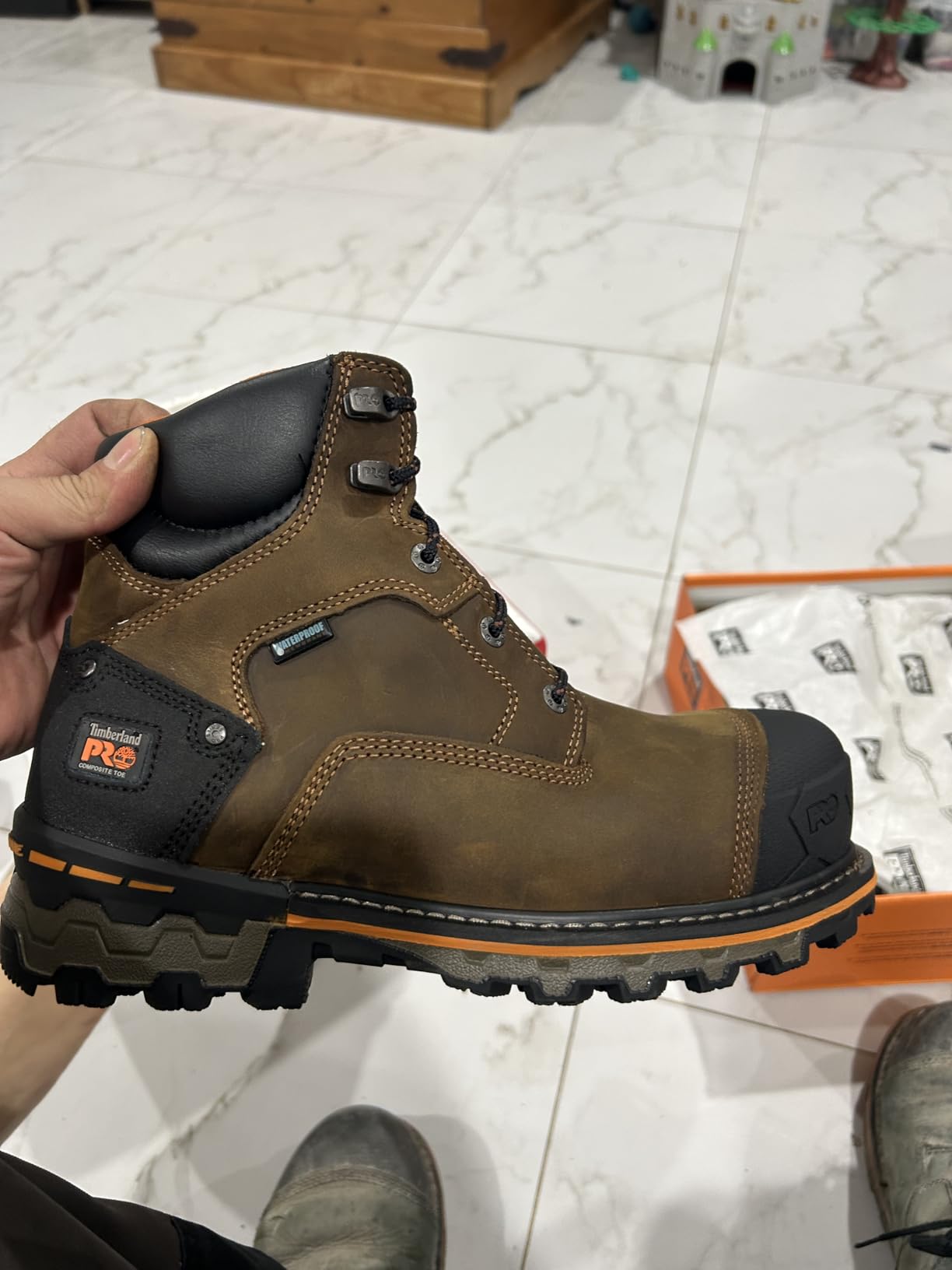
Nothing else in this list describes its electrical protection as plainly. The published specification states secondary underfoot protection against live electrical circuits, electrically energized conductors, parts or apparatus, and cites ASTM F2412-18a, ASTM F2413-18 and ASTM F2892-18. When your employer asks whether a boot is approved for live work, that language ends the conversation quickly.
The waterproof membrane meets ASTM F1671-07, and the all-weather TPU outsole is formulated to hold traction on wet and frosted ice surfaces with slip, oil and abrasion resistance. For an electrician tracking in snow from a service truck to a mechanical room, the outsole is arguably the most valuable part of this boot.
Reviewers consistently point to the anti-fatigue comfort system, a shock-absorbing geometric design that returns energy to the foot. With over 10,000 reviews averaging 4.5 stars, this is the most battle-tested safety boot in the group by review volume alone, and the pattern in the reviews is consistent: it holds up on long shifts standing on concrete and in wet environments.
The size range is another quiet strength. Extra-wide widths are available in this model, and for electricians with wider feet or high insteps this solves a problem that stops many people from buying safety boots at all.
How it performs around energized equipment
The electrical hazard protection here is described as secondary underfoot coverage, which is the correct framing. It is a backup layer that reduces the severity of a fault that gets through your lockout/tagout procedure. No boot in this roundup, composite toe or steel toe, is a substitute for verifying a de-energized circuit.
The F2892-18 standard listed alongside the others is worth noting because that covers puncture-resistant footwear with a metatarsal-guard style plate. If you are working around impalement hazards on a demolition or industrial site, that pairing is a genuine advantage over boots listing only impact and compression ratings.
Where it falls short
It is 4.5 pounds, and you feel every one of them. Reviewers report the boot runs stiff and needs a break-in period, and the bulkier profile makes crouching in a crawlspace or working in a tight panel vault less pleasant than a lighter athletic-styled boot.
If your work is mostly indoors on flat concrete with a climate-controlled floor, the waterproof membrane and lug outsole are more boot than you need, and the weight is dead weight. This is a boot for people who move between environments.
3. Wolverine Overpass – Best for All-Day Comfort
Wolverine Men’sOverpass 6″ Mid Composite Toe Waterproof Work Boot, Summer Brown, 10 Medium
ASTM F2413-11 I/75 C/75 EH
1.75 pounds per boot
Removable Ortholite footbed
Contour welt flex
+ The Good
- Lightest boot in the roundup at 1.75 pounds
- Comfortable with no break-in period
- Waterproofing holds up through snow and mud
- Sizes through X-Wide
- The Bad
- Short shaft sits above the ankle
- Stitching can separate at the flex point long term
- Not insulated
At 1.75 pounds, the Overpass is less than half the weight of several boots in this roundup, and reviewers repeatedly describe it as comfortable straight out of the box with no break-in needed. For electricians who spend the day on their feet and want a boot that does not fight them, that combination is difficult to beat.
It still carries a real safety specification. The published standard is ASTM F2413-11 at I/75 and C/75 with EH, which means impact and compression at 75 pounds-force grade with electrical hazard protection, and reviewers confirm the EH marking appears on the boot itself.
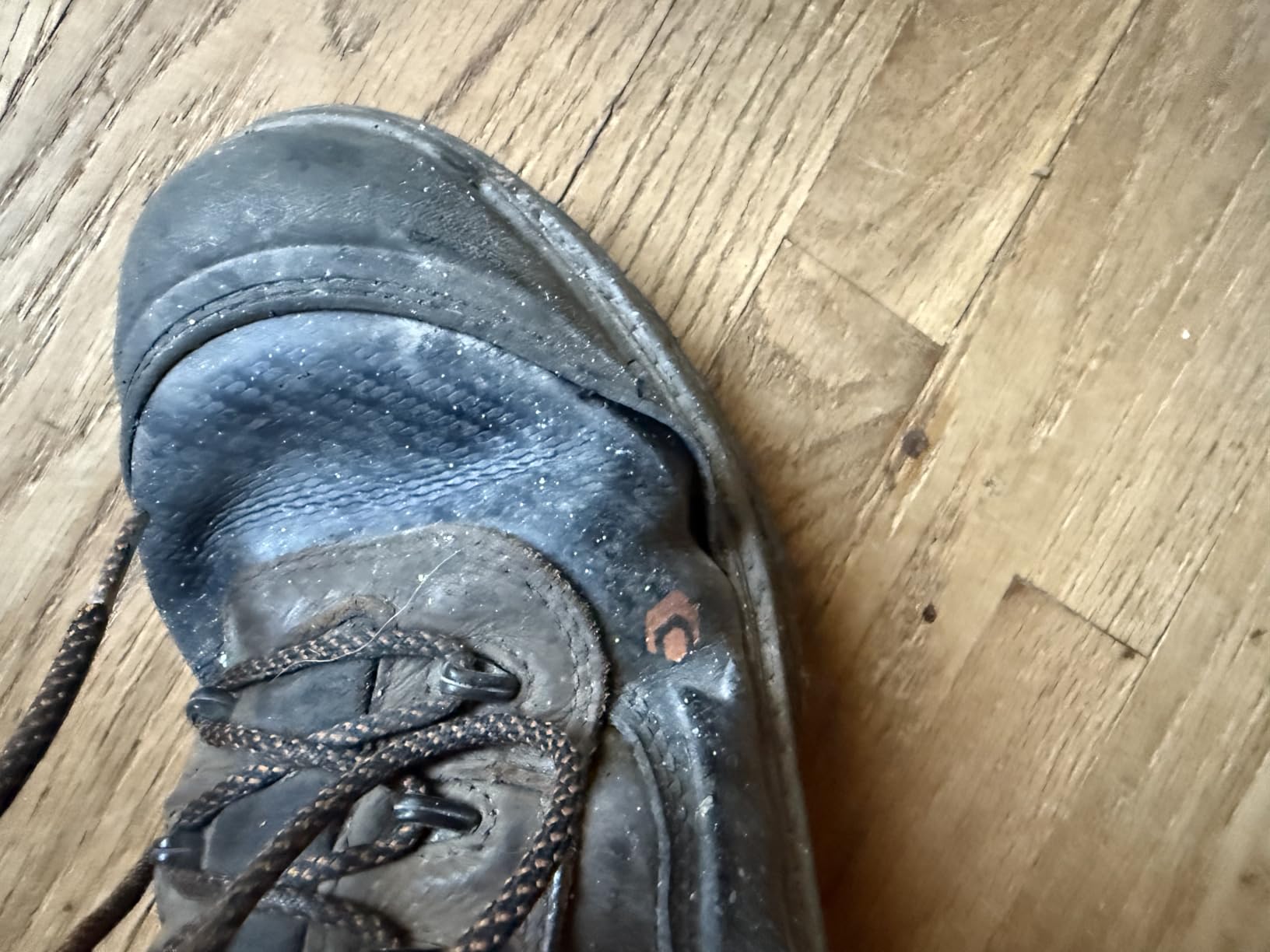
The flexible athletic contour welt construction bends and flexes at the points your foot actually moves rather than at a single hinge, and the removable Ortholite cushioned footbed is a genuinely useful feature for electricians who spend real time on ladders. Ortholite footbeds take an aftermarket orthotic reasonably well, which matters if you have been standing on concrete for fifteen years.
Reviewers report the waterproofing holding up through winter snow, mud and wet pasture, and the outsole is rated slip, oil, water, abrasion and chemical resistant. That chemical resistance is worth calling out for anyone working around solvents or in a plant environment.
Why comfort matters more than you would think
Standing fatigue is a real injury vector. Electricians who report foot and lower-leg pain at the end of a shift change footwear far more often than they change technique, and a 1.75 pound boot loaded with cushioning and a removable footbed is the one people say they keep wearing.
For apprentice electricians, the athletic silhouette also matters socially. A boot that looks like a running shoe gets worn instead of left in the truck, and a boot that gets worn stays compliant with a replaceable insole. That is a small but measurable difference over a career.
Where it falls short
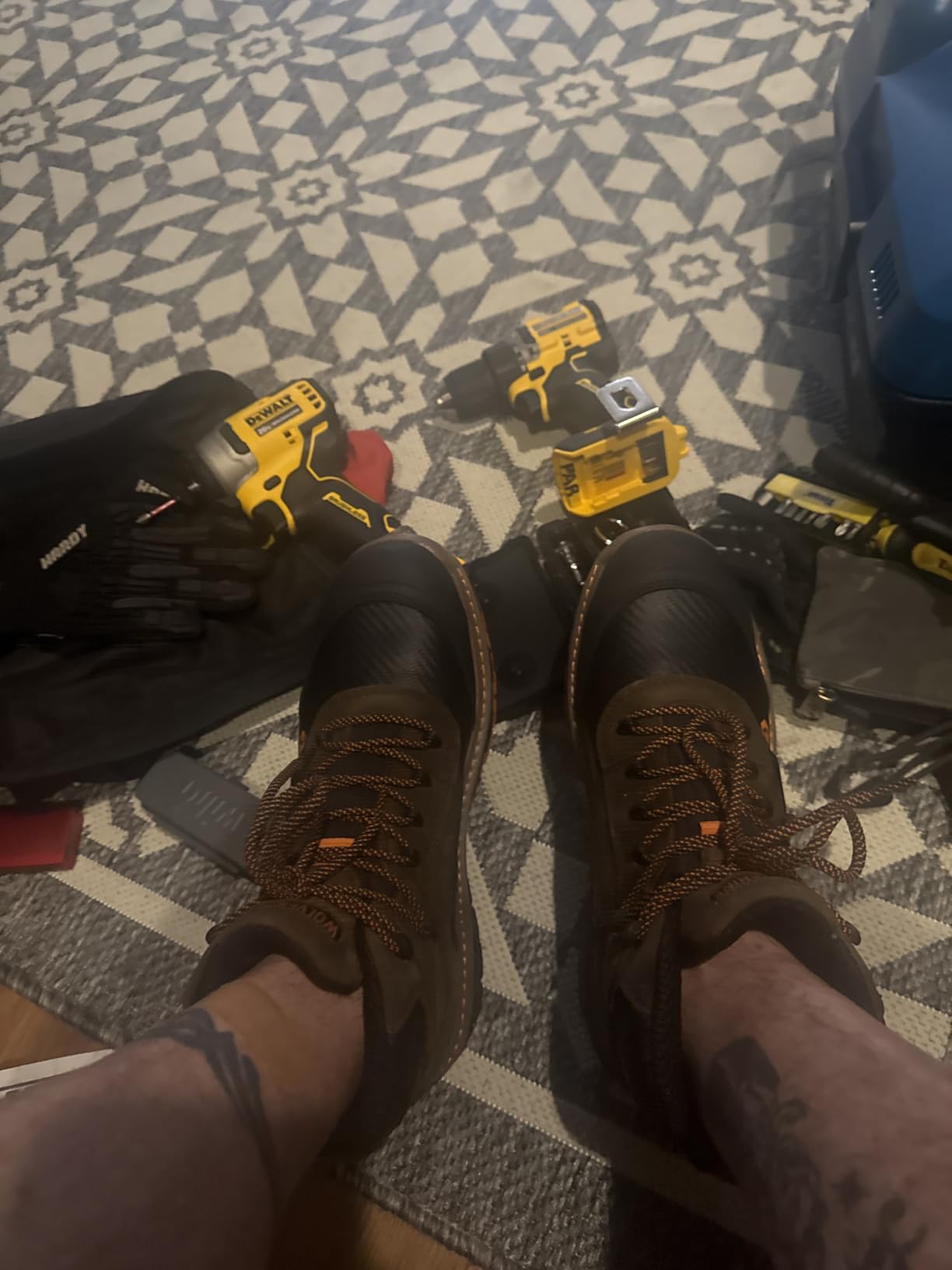
The shaft height ends about an inch above the ankle. That pushes pant legs up and lets water, mud and site debris into the boot, which is a genuine problem in wet trenches and on muddy new construction. If you routinely work in deep mud or standing water, the 8-inch Carhartt CME8355 covers this boot on that specific point.
Some users also report the stitching separating at the flex point after a year or two, and it is not insulated, so winter site work in northern climates will need heated insoles or a different boot entirely.
4. Carhartt CMF6366 – Best Value Composite Toe Boot
Carhartt Men’s 6 Inch Rugged Flex Composite Toe Boot,Brown Oil Tanned,12 M US
ASTM F2413-24 EH to 18000V dry
FastDry lining
Cushion Comfort PU insole
Oil and chemical resistant
+ The Good
- Explicit 18000 volt EH rating in plain language
- Passes through metal detectors
- No significant break-in for most wearers
- Good value in the composite toe category
- The Bad
- Runs large
- stock laces are weak
- Some owners add aftermarket insoles
This is the boot to shortlist first if your employer reimburses a boot allowance and you do not want to spend the whole of it. The specification states electrical hazard protection as secondary protection against incidental contact with electrical circuits of 18,000 volts or less under dry conditions, meeting ASTM F2413-24 EH. That is the exact wording an employer safety officer wants to see.
It also lists the base ASTM F2413-24 composite toe standard for impact and compression, which means both halves of the safety equation are documented rather than one being assumed. That puts it ahead of several composite boots in this roundup that publish a standard but stop short of an EH claim.
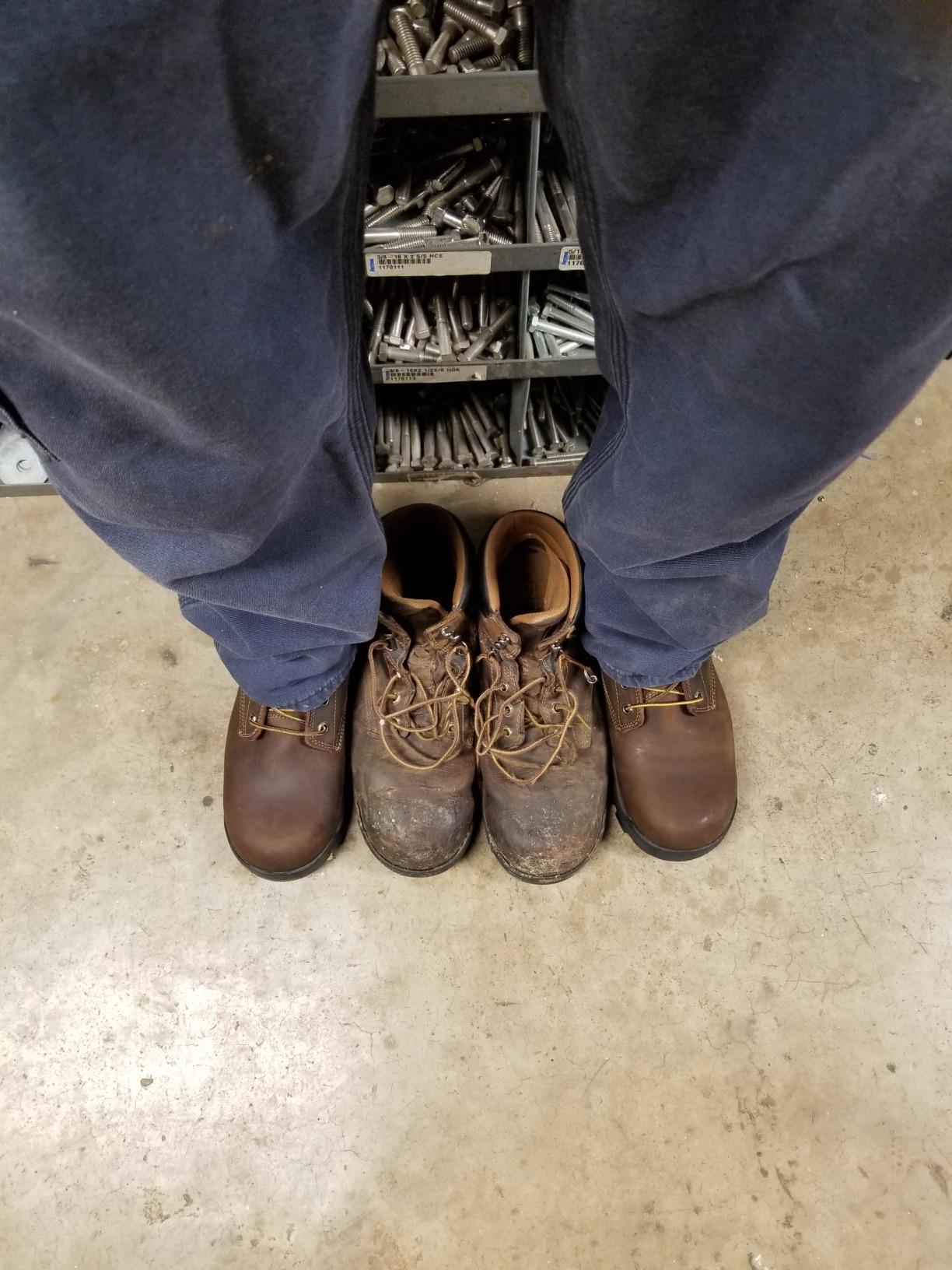
Carhartt has been building this model for well over a decade and the 4,651 reviews averaging 4.4 stars reflect a long production run. Reviewers frequently highlight the metal-detector-friendly composite toe as the reason they bought it, and the general consensus on comfort is that most wearers experience no meaningful break-in period.
The FastDry Technology lining wicks sweat away, and the Cushion Comfort PU insoles are there to reduce foot fatigue. The outsole is oil, chemical and slip resistant, which covers the shop and site environments where this boot tends to end up.
Where it earns its place in the electrical trade
Detector-friendly toe caps matter more than most people expect. Hospitals, data centers, semiconductor facilities and federal sites all screen footwear, and steel toe means changing into overshoes at every entrance. Our picks for that situation are in the steel toe overshoe roundup if you end up needing the other approach.
The 18,000-volt dry-conditions rating also sets a clear boundary. It is meaningful for panel work, service calls and residential troubleshooting in dry conditions. It is not the same protection as a fully tested high-voltage lineman system, and linemen working transmission and distribution should follow their employer’s specified PPE rather than this category.
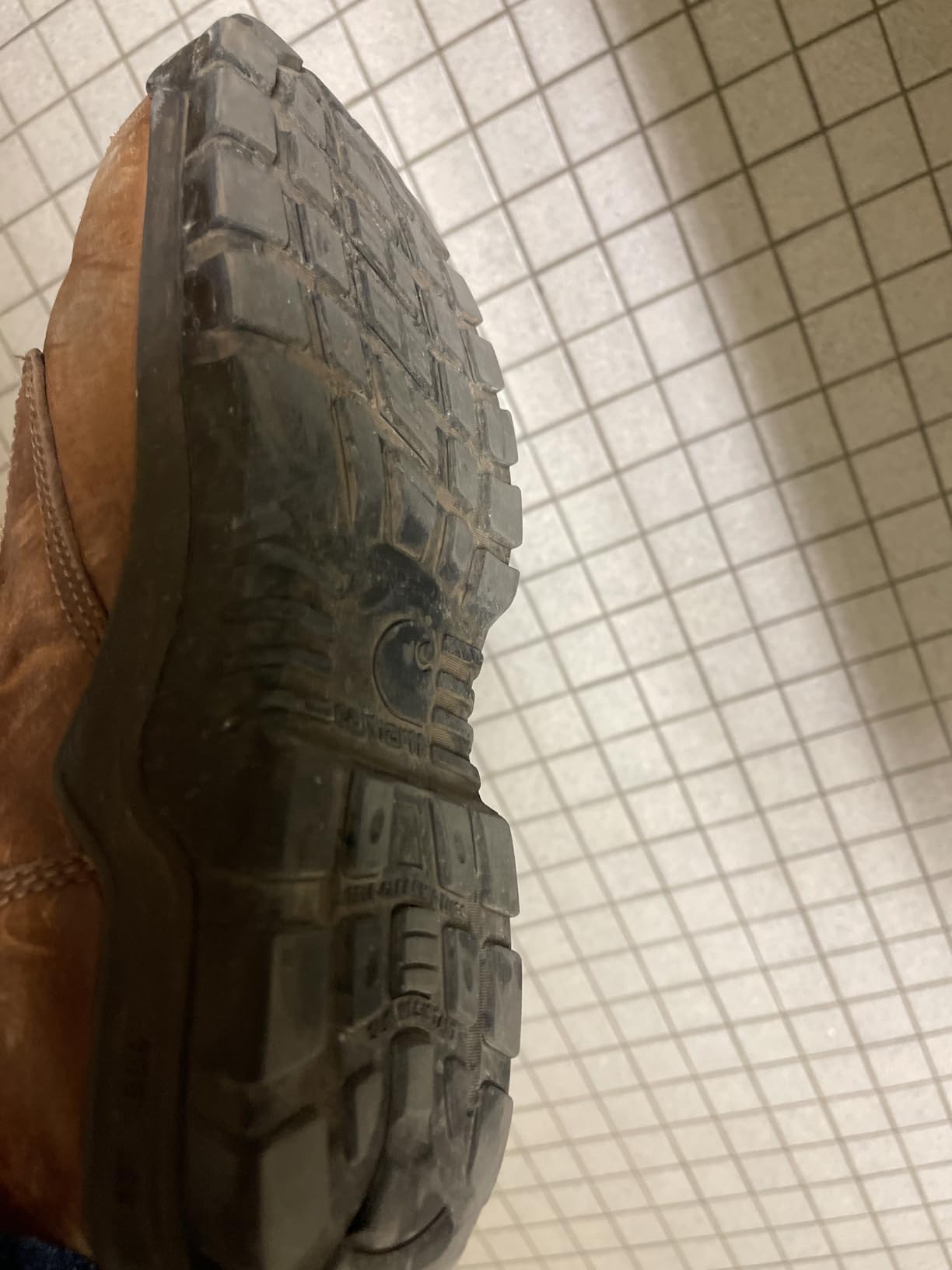
Where it falls short
It runs large, and sizing down is the most common recommendation in the reviews. Getting this wrong is what produces the numb toe complaints that push people out of safety footwear entirely, so order a half size down from your normal and wear indoors first.
Reviewers also flag weak stock laces, thin upper leather, and the possibility that welt construction will begin separating at the toe with use. Several owners add aftermarket insoles for all-day comfort, which is easy enough to budget for but is an extra step.
5. Carhartt Rugged Flex Waterproof – Best for Wet Conditions
Carhartt Men’s Rugged Flex WP 6″ Composite Toe Work Boot, Wheat, 11 M US
ASTM F2413-24 composite toe
Storm Defender waterproof membrane
Rugged Flex lug outsole
Ladder lock heel
+ The Good
- Composite toe is non-conductive to heat and cold
- Breathable waterproof membrane for wet sites
- Ladder lock grooves improve rung stability
- Wide range of widths including 15 sizes
- The Bad
- No published EH rating for this model
- Waterproofing can trap heat in warm conditions
- Fits narrower than other Carhartt models
The Rugged Flex is built around a Storm Defender waterproof and breathable membrane, which is the specification to look for when your work involves standing water, wet basements, or crawl spaces that never quite dry out. Breathability matters as much as waterproofing here, because a sealed boot that sweats through a shift gets replaced by nobody.
The composite safety toe is described as lightweight, non-metallic and non-conductive to heat or cold, meeting or exceeding ASTM F2413-24. That non-conductive to heat and cold language is worth noting for anyone working around hot mechanical equipment or in unconditioned spaces in winter.
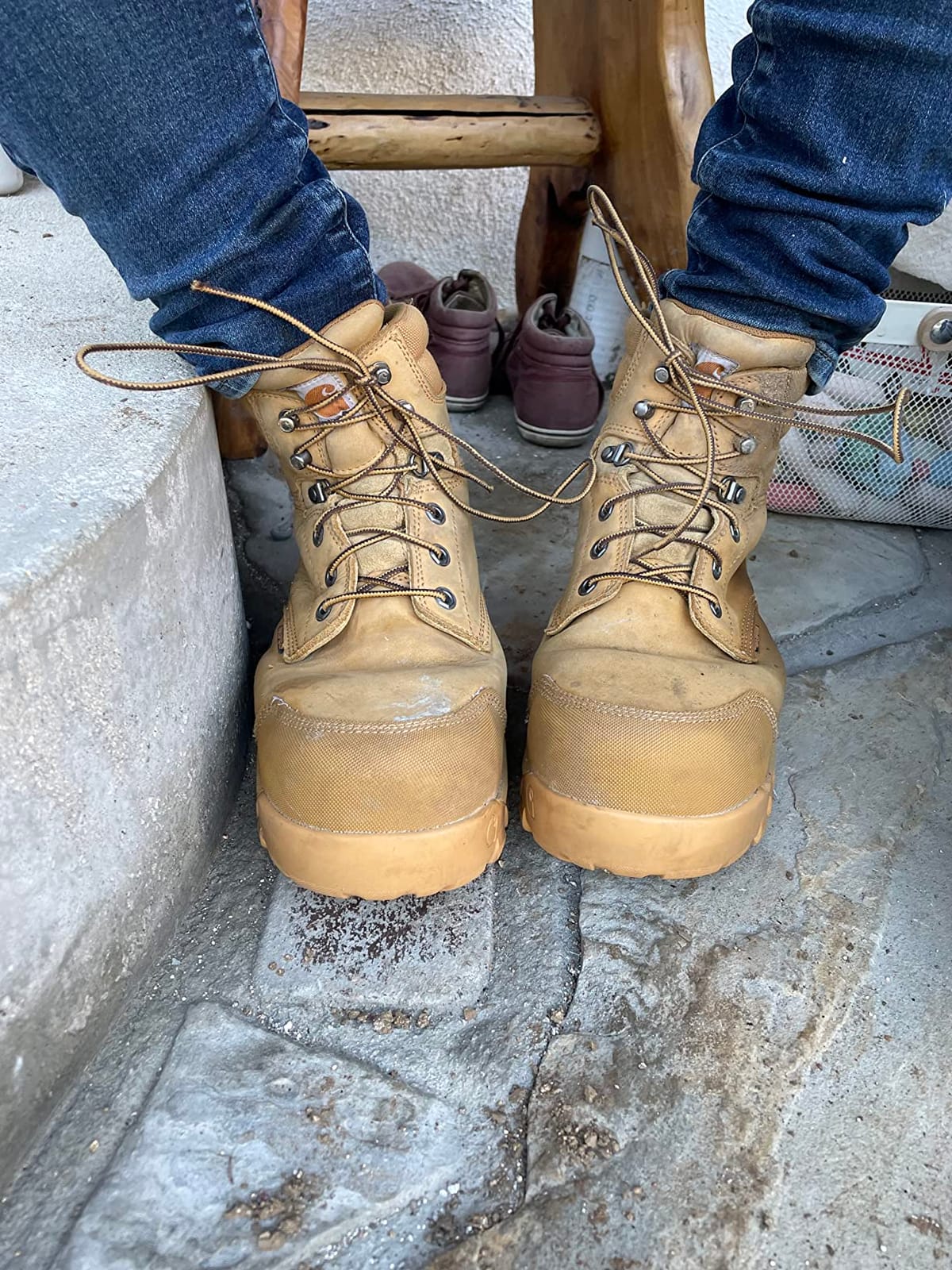
The defined heel with ladder lock grooves is a small feature that a lot of electricians care about more than expected. A defined heel stops the boot from sliding off a rung, and for someone climbing a ladder forty times a shift, that is not a minor detail. The Rugged Flex lug outsole provides slip-resistant traction on uneven terrain.
One thing we want to be clear about: this model lists ASTM F2413-24 for the composite toe, and its published specifications do not claim an EH rating. The toe is non-conductive, which is valuable, but if your employer requires a documented electrical hazard rating, this is not the boot to submit for approval without checking the label.
When wet-weather work is the deciding factor
If your typical week includes rain, snow, or a basement with a sump pump that cannot keep up, waterproofing moves from a nice-to-have to the whole point. Reviewers report the Rugged Flex holding up well on wet and uneven terrain, and the combination of a lug outsole and ladder lock heel covers the two surfaces electricians actually stand on.
It is also one of the easier boots here to fit. The width range extends to wide sizes and 15 sizing, which matters for people with wide feet who have been squeezing into narrow toe boxes for years.
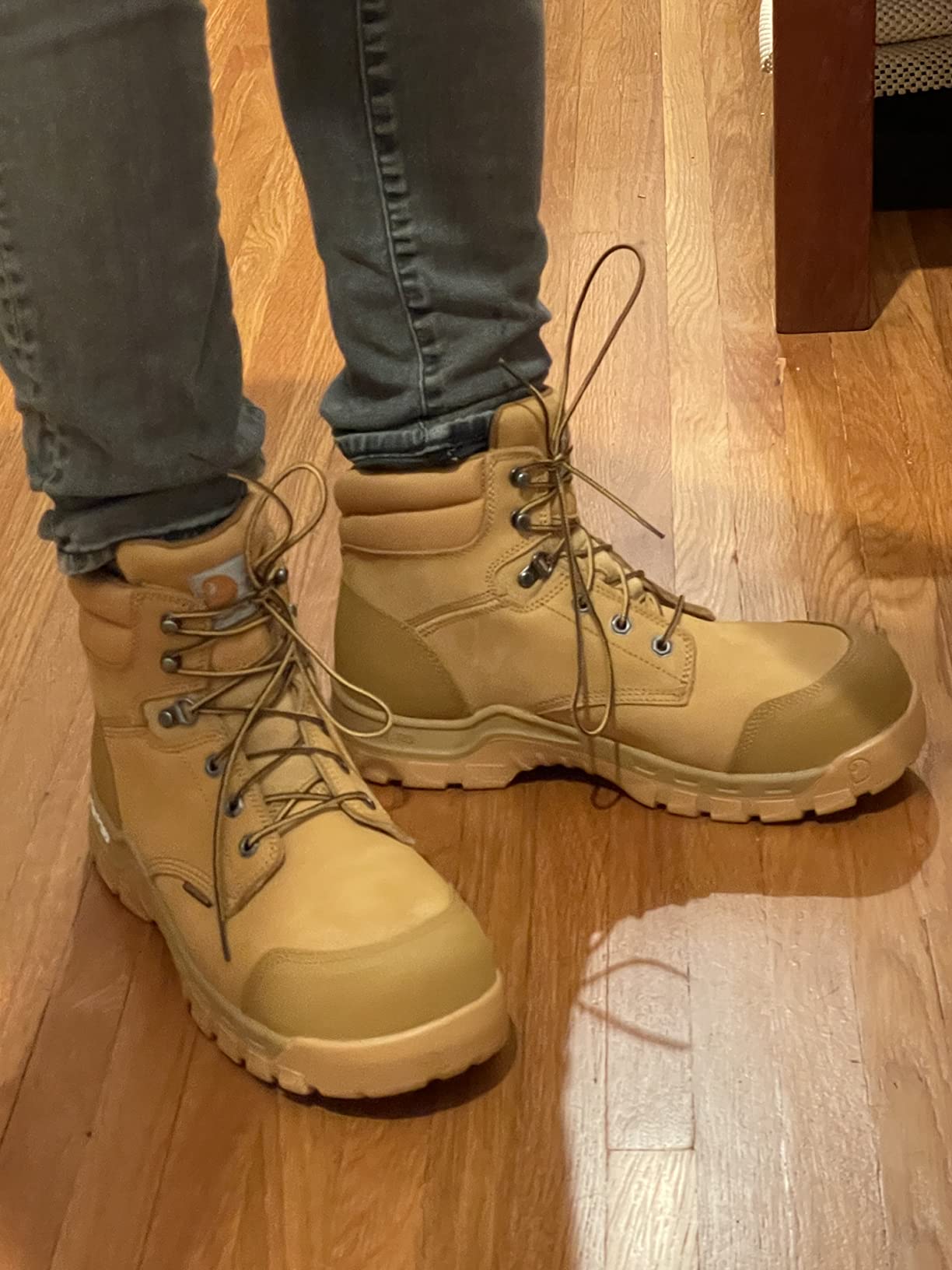
Where it falls short
The waterproof membrane that works so well in the wet can become a liability in warm conditions, where reviewers report trapped heat and moisture. Florida and Gulf Coast electricians doing outdoor service work in summer will find this less comfortable than a non-membrane boot.
Lower-star reviews center on tread grip and long-term outsole durability, and some users find the fit narrower than other Carhartt models even in wide widths. If you are between widths, order the wide and test it on a ladder before committing to the full work week.
6. Reebok Rapid Response RB – Best for Wide Feet
Reebok mens Rapid Response Rb Safety Toe 6″ Stealth With Side Zipper Military Tactical Boot, Desert Tan, 7 Wide US
Composite safety toe cap
Extra wide toe box
EVA midsole with Shock Eliminator heel
YKK side zipper
+ The Good
- Very light composite toe construction
- Shock Eliminator heel and F2A footbed cushioning well
- Extra wide toe fits wide feet
- YKK side zipper for fast on and off
- The Bad
- No ASTM or EH standard published
- Not waterproof
- Quality decline reported in later production
The Rapid Response is the lightest-feeling boot here and the one reviewers most often describe as the most comfortable they have owned. The cushioning stack is three layers working together: an EVA midsole, an embedded Shock Eliminator heel cushion, and a Foot Force F2A footbed. That is a lot of compliance between you and a concrete floor.
The extra wide toe is the distinguishing feature for a specific problem. A roomy toe box is not a luxury when a safety cap presses on your toes, and electricians who have spent years in narrow toe boxes often report this as the first boot that stopped the cramping.
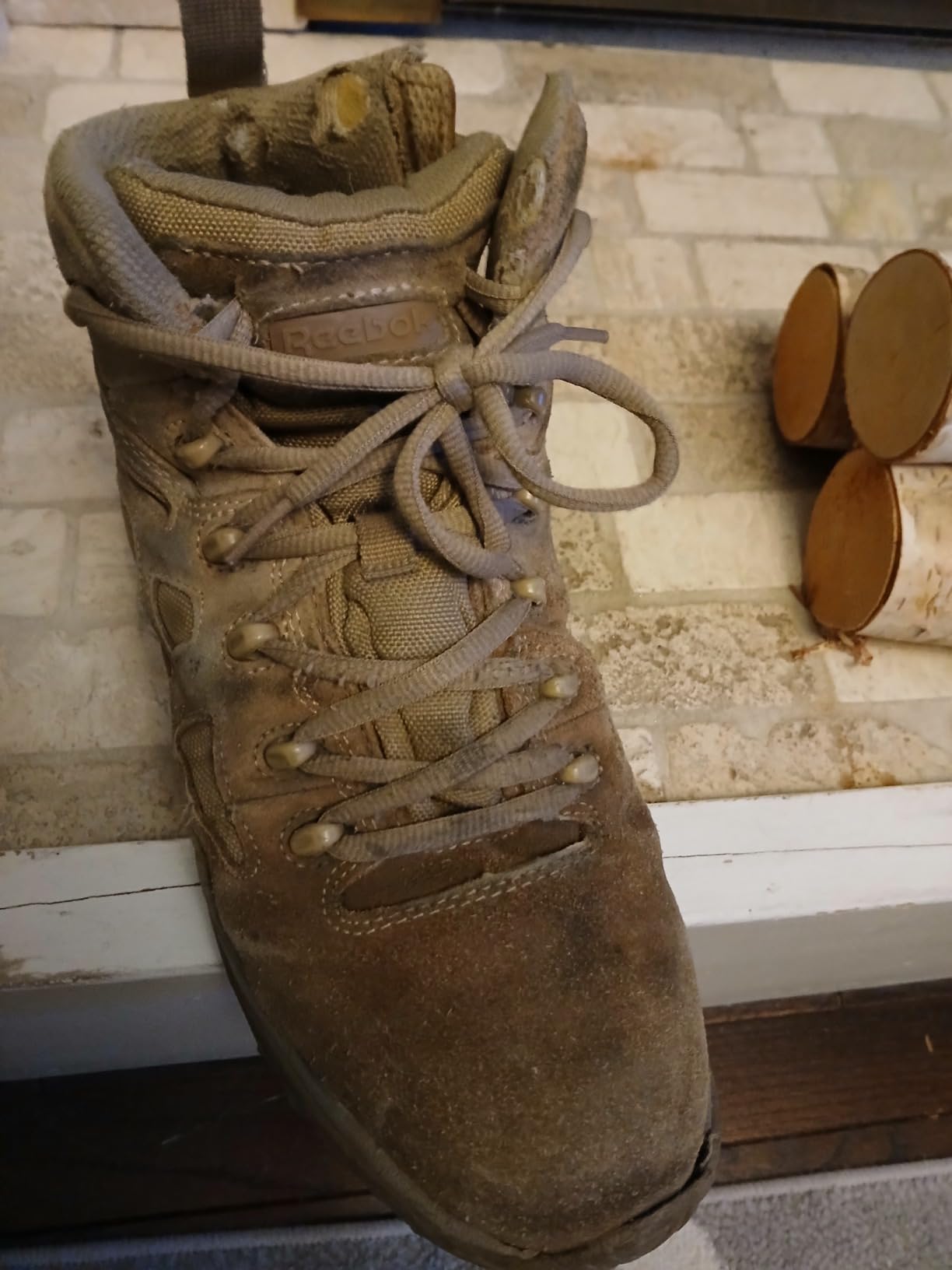
The YKK side zipper with laces is genuinely useful at the end of a shift. Boots that require full unlacing get left unlaced and half off, and a side zipper means you can get out of them in seconds without undoing everything. The moisture wicking nylon mesh upper is also better at moving sweat than a full leather boot on a hot site.
Reviewers note the aggressive mountain trail rubber outsole grips well on slick, oily concrete and expanded metal, which are two of the most common surfaces in industrial electrical environments.
The honest caveat about safety standards
This model publishes a composite safety toe cap but does not list an ASTM F2413 rating or an EH designation in its specifications. That is not a disqualifier for shop or warehouse electrical work where the hazard is impact rather than electrical exposure, but it does mean you should not submit this boot for a job that requires a documented EH rating.
The boot is also not waterproof. Reviewers recommend spray treatment for wet conditions, and the nylon mesh upper dries faster than leather but offers nothing against standing water. If your work is outdoors in rain, the Carhartt Rugged Flex covers that gap.

Where it falls short
There are reports of quality decline in later production runs, with heel lining and tread lugs separating sooner than the original versions. If you buy this and notice the seams letting go early, that is a known pattern in the reviews rather than something you did wrong.
Composite construction also makes the boot stiffer and less flexible than the non-safety version of the same silhouette, and the tongue can slip out during the day unless you modify it. On a ladder that is worth addressing before it becomes a problem.
7. Bates Footwear GX-8 Desert – Best for Utility and Security Work
Bates mens Gx-8 Composite Toe Side Zip Work Boot, Desert, 11.5 US
ASTM F2413-15 composite toe
Suede and performance nylon upper
YKK side zipper
Removable cushioned insert
+ The Good
- Passes security screening without steel weight
- Abrasion resistant suede and nylon upper
- Quick on and off with the side zipper
- Exceptionally wide size range including X-Wide
- The Bad
- ASTM F2413-15 published without an EH rating
- Less weather protection than full-grain leather
- Lighter construction may wear faster under abrasion
The GX-8 is the desert boot of this group, and its credentials come from a different world than the others. Bates builds footwear for security, law enforcement and military duty, and the GX-8 carries a non-metallic ASTM F2413-15 rated composite toe. Reviewers consistently point out that it clears a metal detector without the weight of steel, which is the entire point of the design.
The suede leather and performance nylon upper resists abrasion while staying flexible, and the moisture wicking breathable lining keeps feet dry through long shifts. The lightweight cushioned EVA midsole and removable cushioned insert handle the cushioning duty.
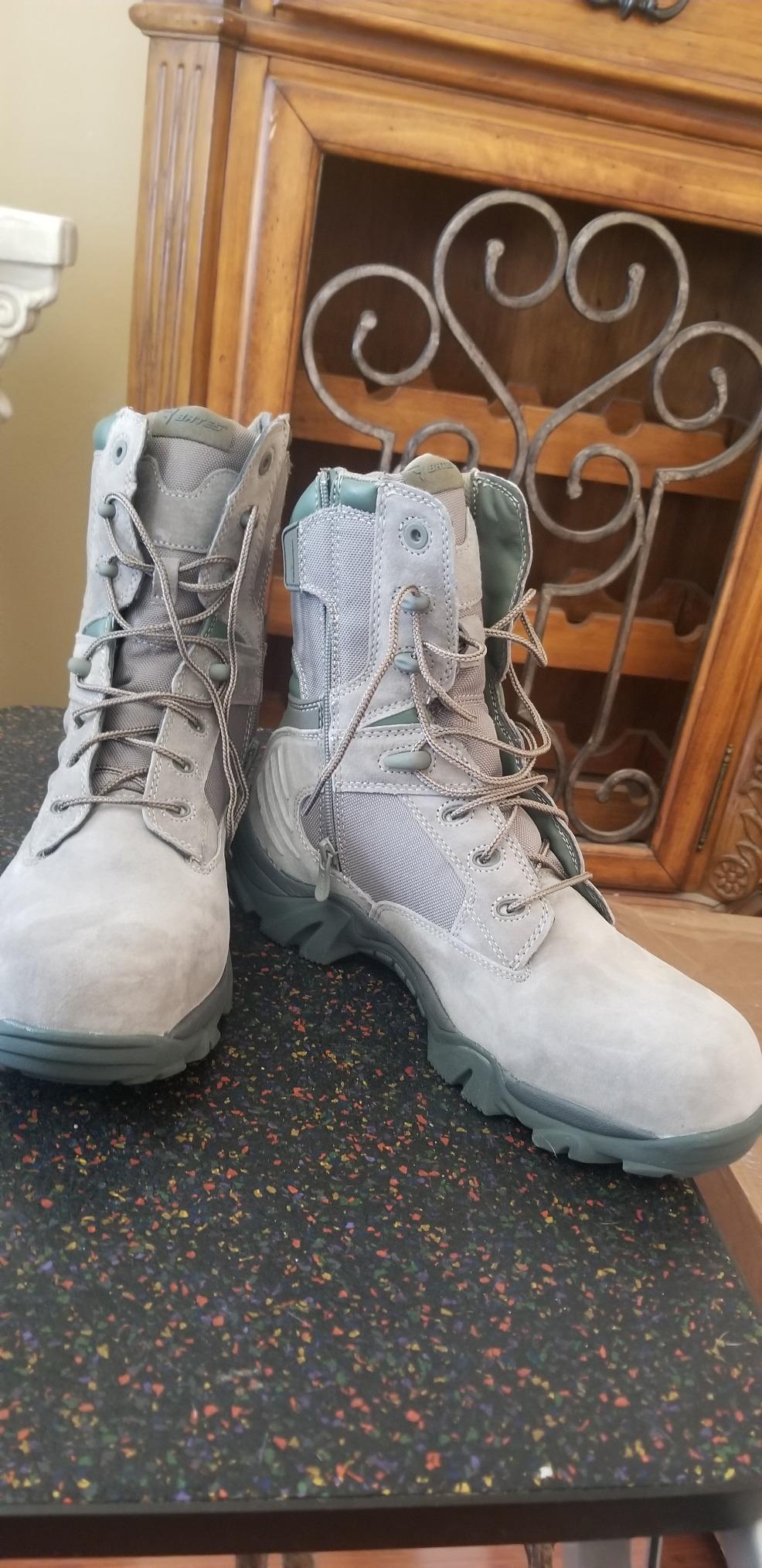
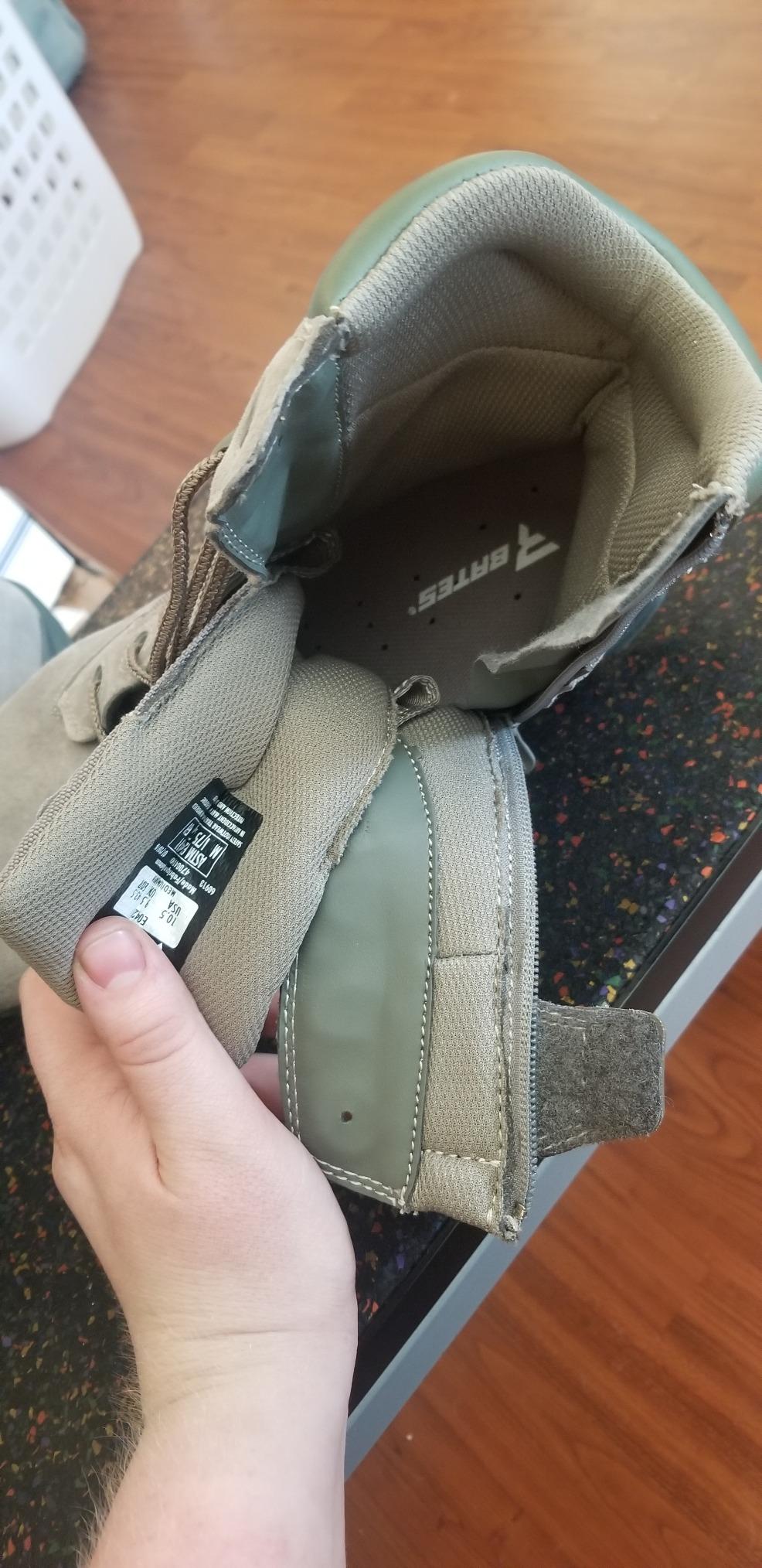
At 3 pounds with a YKK side zipper for quick on and off, this is the boot for a facility where you are walking a lot and putting footwear on and off dozens of times a day. Data center, hospital, and industrial plant electricians are the obvious audience.
The size range is exceptional, extending into X-Wide options, which makes this one of the easiest boots in the roundup to fit for people with wide feet or hard-to-find widths. Reviewers also value that the side zipper means you do not have to relace the boot every time it comes off.
How it fits into an electrical safety program
The ASTM F2413-15 rating covers impact and compression on the composite toe. The published specifications for this model do not include an EH designation, so it sits in the same category as the Reebok Rapid Response and the Carhartt Rugged Flex: a protected foot, without a documented secondary electrical hazard rating.
For electricians who work exclusively in facilities with a robust lockout/tagout culture and no live exposure, that is a reasonable trade for a boot this light and this easy to wear. For anyone near energized equipment, verify the label or pick a model with a stated EH rating.
Where it falls short
The suede and nylon upper gives up less weather protection than full-grain leather. In sustained rain or mud the boot saturates faster than the welted leather options in this roundup, and the desert-style construction generally prioritizes breathability over water resistance.
Lighter construction can also wear faster under heavy abrasion. If you are on a demolition site or walking through rough rubble daily, a heavier leather boot will outlast this one, and the composite toe reduces flexibility compared with a non-safety version of the same shoe.
8. Carhartt CME8355 8 Inch – Best for Ankle Coverage
Carhartt Men’s Ground Force 8-Inch Comp Toe Waterproof Work Boot CME8355, Brown, 10M
ASTM F2413-24 composite toe
8 inch shaft height
Insite arch support footbed
Ground Force lug outsole
+ The Good
- 8 inch shaft keeps mud and debris out
- Non-conductive composite toe in heat and cold
- Insite footbed has podiatrist designed arch support
- Ladder lock grooves and lug outsole for stability
- The Bad
- Warm to wear in hot conditions
- No EH rating published for this model
- Stiffens as the waterproofing breaks down
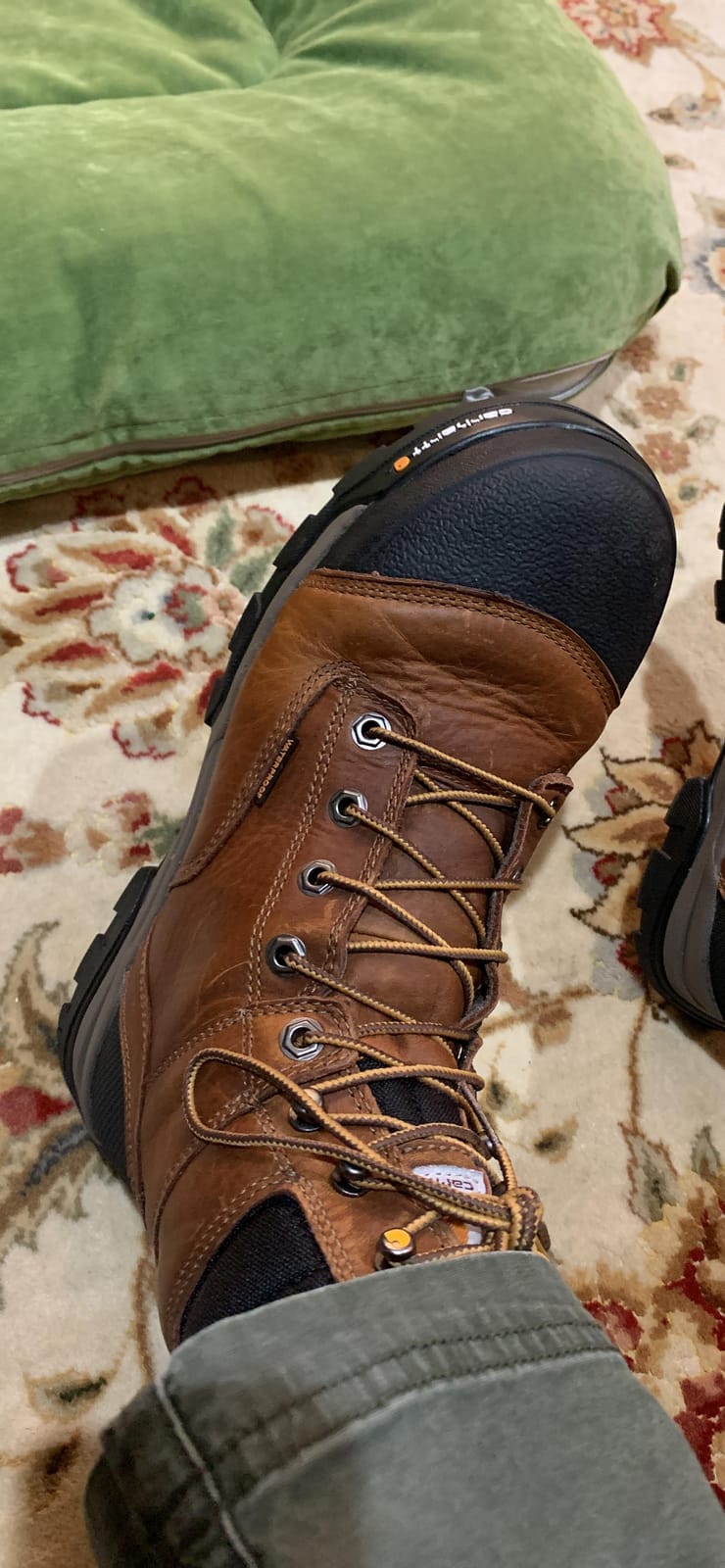
The CME8355 is the tallest boot here, and shaft height is the entire reason to consider it. An 8 inch shaft covers the ankle and lower calf against deep mud, standing water and site debris, which is exactly what fails with a 6 inch boot when you are knee-deep in a trench or a flooded mechanical room.
The composite safety toe is described as lightweight, non-metallic and non-conductive to heat or cold, meeting or exceeding ASTM F2413-24. The Storm Defender waterproof and breathable membrane handles water from the other direction, and the defined heel with ladder lock grooves improves stability on rungs.
What separates this from the 6 inch Carhartt is the footbed. The Insite footbed provides high rebound cushioning with podiatrist-designed arch support, which for an electrician spending a full shift on a ladder rung or a ladder frame is the difference between comfortable and not. Reviewers single out the Insite footbed as the feature that keeps them in the boot all day.
The Ground Force rubber lug outsole delivers slip-resistant traction on the job. Combined with the tall shaft, this is the boot for excavation work, water treatment facilities, agricultural settings and any environment where the ground is unreliable.
When ankle coverage beats lightweight construction
Most foot and ankle injuries on job sites happen when a boot fails to keep debris out or when a foot slides off an unstable surface. The 8 inch shaft addresses the first problem directly, and the ladder lock grooves plus defined heel address the second.
For commercial and industrial electricians, maintenance techs, and anyone working in a plant environment with wet floors, that combination is worth the extra bulk. We would also look here first when comparing against rubber work boots for a genuinely wet utility environment, since rubber uppers handle standing water that leather cannot.
Where it falls short
The tall shaft is genuinely hot to wear in warm conditions, and that is the most common complaint in the reviews. In a Florida summer or a Texas afternoon, 8 inches of waterproof leather is a lot of heat to trap around your calves.
Like the Rugged Flex, this model publishes ASTM F2413-24 for the composite toe without a stated EH rating, so it needs the same verification before you submit it for live work. Some users also report the boot stiffening over time as the waterproofing breaks down.
9. Wolverine I-90 – Best for Traction
Wolverine Men’s I-90 Waterproof Composite-Toe 6″ Boot, Sudan Brown, 9.5 M US
ASTM F2413-11 I/75 C/75 EH
1.81 pounds
High abrasion TPU SR lug outsole
Waterproof breathable membrane
+ The Good
- EH electrical hazard rating published
- EPX energy return cushioning fights fatigue
- Light at 1.81 pounds for a safety boot
- TPU SR lug outsole resists abrasion
- The Bad
- Lowest-rated model in the roundup at 4.2
- Composite toe reduces flex versus non-safety boots
- Some owners add aftermarket insoles
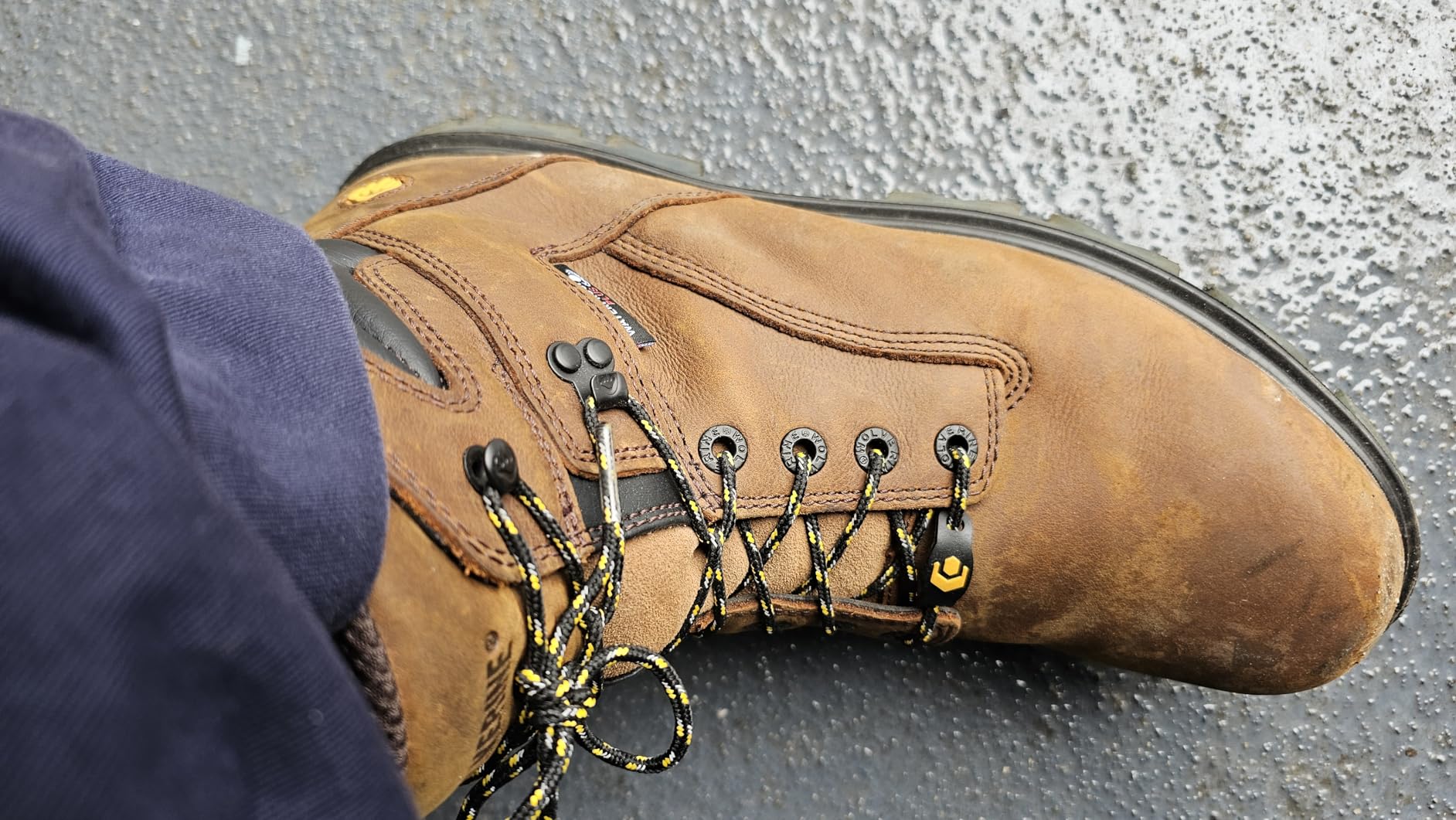
The I-90 is the other Wolverine with a documented EH rating, and its distinguishing feature is the outsole. The high abrasion TPU SR lug outsole is built for rough construction surfaces, and combined with slip resistance for wet or slippery ground it is the traction-focused option in this roundup.
EPX technology is the comfort story here, described as bringing comfort closer to the foot to conserve and return energy through the day. At 1.81 pounds it is the second-lightest safety boot in this group, which puts it firmly in the territory where a full shift does not leave your ankles sore.
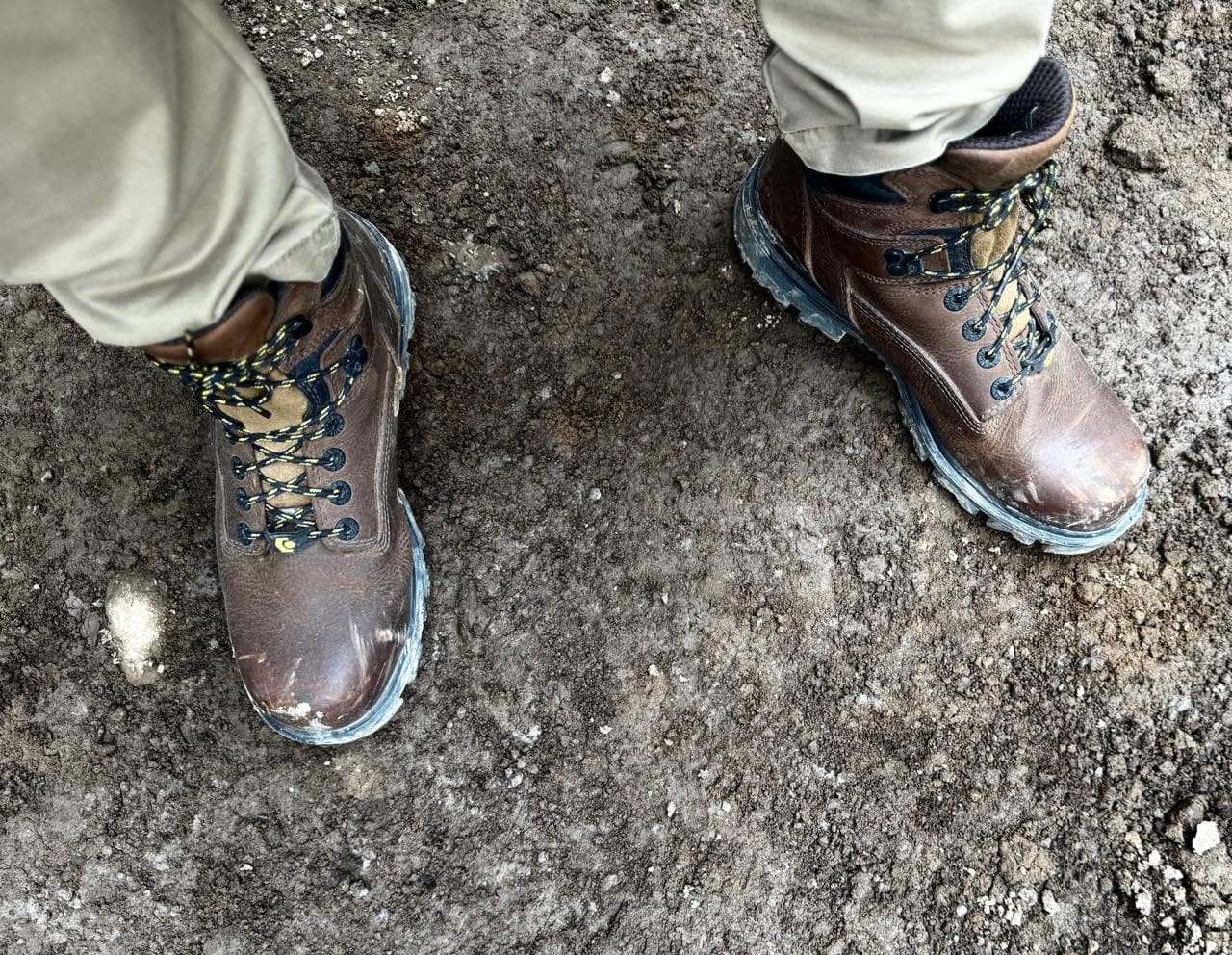
The waterproof breathable membrane pairs with a moisture wicking mesh lining, and reviewers confirm it does solid work on wet job sites. A wide range of widths including X-Wide is available, which keeps it competitive for people who have struggled with narrow toe boxes elsewhere.
Its rating of 4.2 stars across 978 reviews is the lowest in the roundup, and it is worth being straight about why. Reviewers describe the comfort as good but not standout, and several owners add aftermarket insoles for long days. You are buying traction and EH certification here, not a cushioning experience.
Where traction becomes the deciding factor
Traction matters most in three electrical environments: wet concrete with conduit and cable on the floor, aluminum ladder rungs that are wet or dusty, and rooftops with membrane that gets slick. A lug outsole with SR slip resistance is the specification that addresses all three, and this is the boot where it is the primary selling point rather than a secondary benefit.
The ASTM F2413-11 I/75 C/75 EH rating covers impact and compression at 75-pound grade with electrical hazard protection, so this boot satisfies the same documentation requirement as the Irish Setter and the Wolverine Overpass while weighing about the same as the lightest boot here.
Where it falls short
The composite toe reduces flex compared with a non-safety boot, and reviewers who climb ladders a lot notice it. If your work is predominantly vertical, comfort-weighted options like the Overpass or the Reebok will serve you better despite having less aggressive lugs.
Several owners also report adding aftermarket insoles for all-day comfort, which is a small ongoing cost but worth planning for. And at a 4.2 rating, it has the widest spread of mixed feedback of any boot in this roundup, so read recent reviews before committing to a full work week in it.
10. New Balance Calibre – Best for Puncture Protection
New Balance Calibre Composite Toe Work Boots for Men – EH, PR, Non-Slip Leather Safety Shoes for Industrial & Construction, Wheat, 12 Wide
ASTM F2412-18a electrical hazard
Anti-perforation midsole
Acteva midsole
Side zipper with laces
+ The Good
- Passes ASTM F2412-18a electrical hazard testing
- Anti-perforation midsole guards against punctures
- Lightest-feeling and sneaker-like comfort
- Roomy toe box
- The Bad
- Not insulated for cold weather
- Leather upper does not breathe well
- Side zipper requires untying laces first
The Calibre is the odd one out in this roundup and that is what makes it interesting. It is styled as an athletic safety shoe rather than a work boot, and it is the only model here listing an anti-perforation midsole, a plate that guards against punctures from rebar, nails, sheet metal edges and job site debris.
On certifications it is well documented. The slip-resistant outsole meets ASTM I/75 C/75 and ASTM F2913-19, and the electrical hazard rating passes ASTM F2412-18a. Reviewers consistently describe it as the lightest-feeling boot in the group, often compared favorably to athletic shoes.
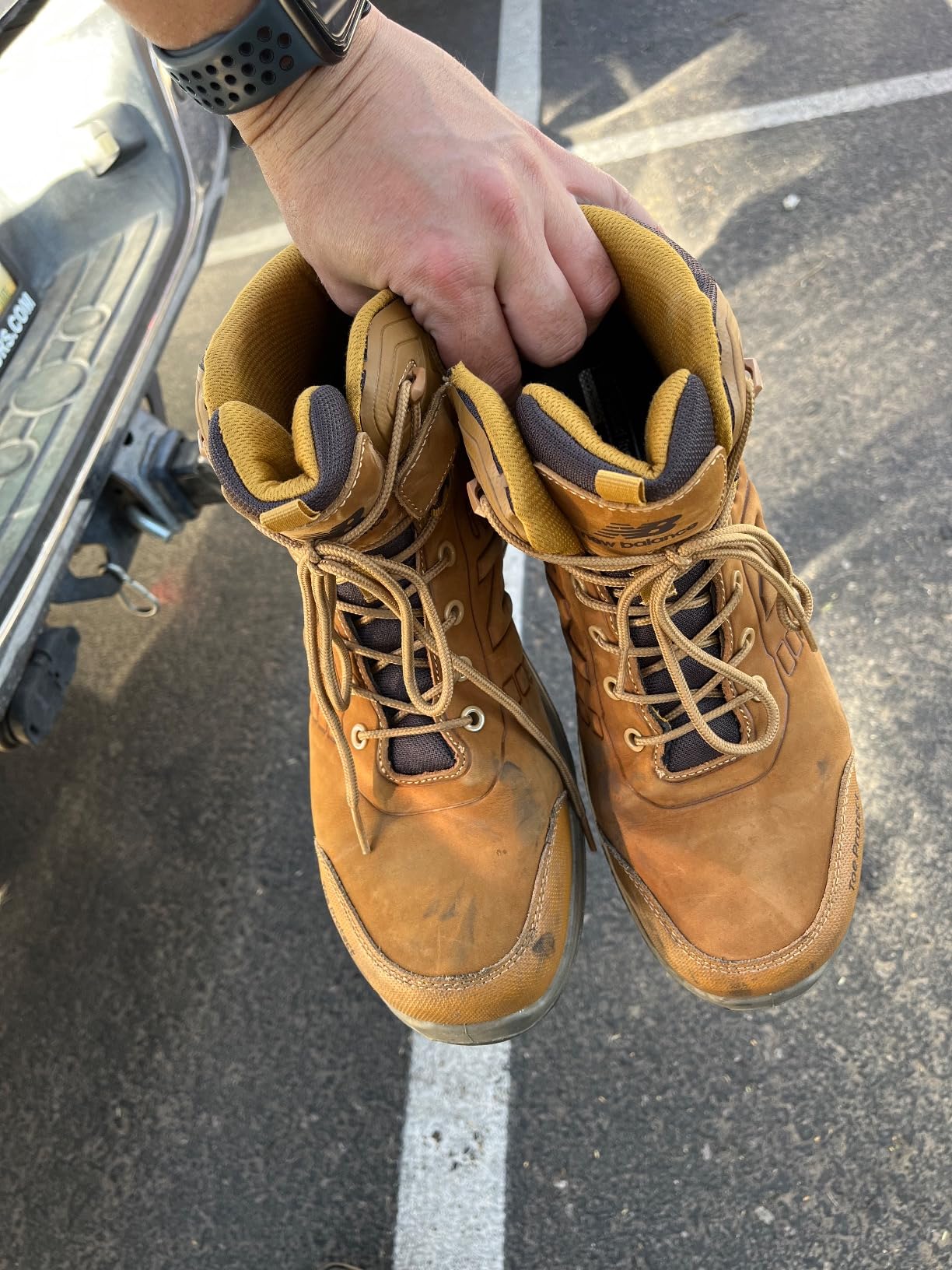
The moisture wicking mesh lining and perforated insoles are a genuine advantage over leather uppers in a hot environment, and the Acteva midsole with a New Balance comfort insole handles the cushioning. The water-resistant upper also handles a washdown or a spray without absorbing it.
Owners frequently mention the side zipper with a Velcro cover as the feature that makes this boot quick to remove at the end of a shift, and the roomy toe box keeps the safety cap from pressing on the toes, which is a real comfort advantage over narrow toe boxes.
When puncture resistance beats everything else
Impalement hazards are the case where an anti-perforation plate earns its keep. Demolition, concrete cutting, roofing, and any site where you are walking through a field of broken material and scrap metal are the environments where the extra layer is worth looking for by name rather than by brand.
The ASTM F2412-18a electrical hazard rating also puts it on solid footing for the documentation side of things, which is more than can be said for several other composite toe boots in this category. It is a well-documented, well-reviewed option for inspectors, warehouse electricians, and facility maintenance.
Where it falls short
It is not insulated, so cold winter conditions need heated insoles or a different boot. Our insulated work boot guide covers that category for anyone working outdoors through a northern winter.
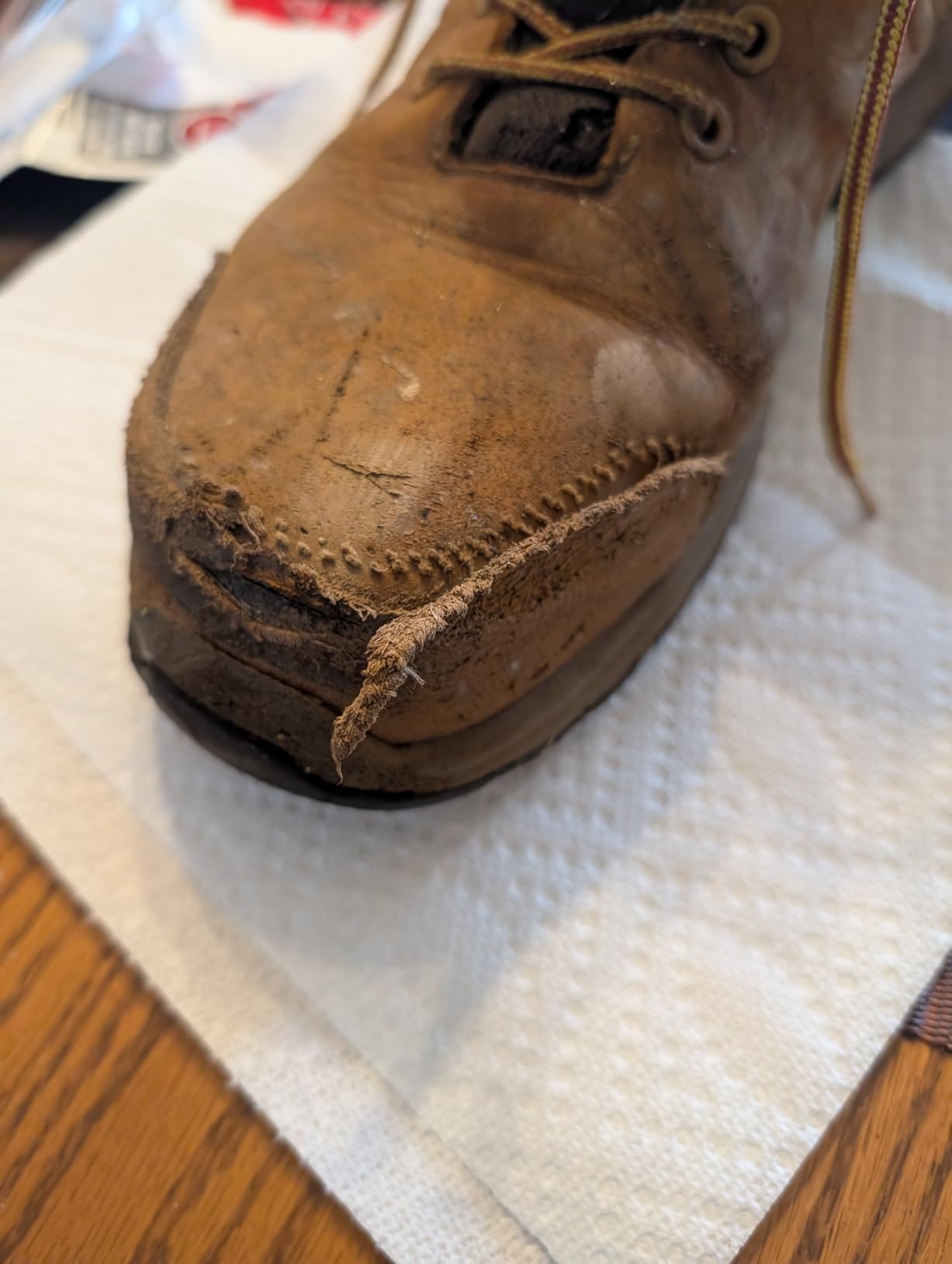
The leather upper does not breathe well despite the mesh lining, and owners report warm feet over long shifts. Reviewers also note that the laces cinch from the toe end and must be tied loosely, and the side zipper requires untying the laces first to actually use, which undercuts the quick-removal benefit somewhat.
How to Choose Composite Toe Work Boots for Electrical Work
The most important decision is not the brand or the price tier. It is whether the specific model on the label carries the documentation your employer requires. Everything else, from weight to waterproofing to toe box width, is a comfort and longevity decision you make after the safety question is settled.
1. Separate composite toe from EH rating
These are two different tests and they are frequently conflated. Impact and compression ratings come from ASTM F2413, which covers what happens when something falls on your foot. Electrical hazard protection is a separate designation covering secondary protection against circuits up to 18,000 volts under dry conditions.
In this roundup, seven of the ten models publish an ASTM F2413 rating for the composite toe, and six publish a stated electrical hazard designation. The Reebok Rapid Response, the Bates GX-8 and the Carhartt Rugged Flex list a composite toe or an ASTM rating without a documented EH claim. The Timberland PRO Boondock and the New Balance Calibre both cite ASTM F2412-18a for electrical hazard. Check the label on the actual boot, because the specification on a listing page and the specification printed on the tongue are not always the same claim.
2. Match the boot to your environment, not just the trade
Hot work and cold work pull in opposite directions. Composite toes are non-conductive to heat and cold, which is a genuine safety advantage over steel in extremes, but the upper material decides whether you are comfortable. Breathable nylon mesh beats waterproof leather in a Gulf Coast summer, and 8-inch waterproof leather beats everything in a flooded basement.
Wet versus dry is the other axis. If you are outdoors in rain or snow, you want a membrane. If you are indoors on a climate-controlled floor, a membrane adds weight and heat for protection you will never use. Reviewers of the waterproof models in this roundup consistently mention trapped heat in warm conditions as the top complaint.
Impalement and debris define a third axis. A puncture-resistant anti-perforation midsole, an 8-inch shaft against mud, and ladder lock grooves on the heel are all things you either need for your specific site or never think about again.
3. Solve the fit problem before it becomes a safety problem
The most common complaint in every category of safety footwear is toe compression, and the most common cause is sizing too large or a toe box that is too narrow. Electricians who report numb feet are usually wearing the wrong width, not the wrong boot.
Carhartt models run large and reviewers recommend sizing down. The Wolverine Overpass, Wolverine I-90 and Bates GX-8 carry widths through X-Wide. The Reebok Rapid Response and the New Balance Calibre are built around a roomy toe box for a reason. If you have wide feet, a size 11 in a wide last is a different boot from a size 11 in a standard last, and that difference matters more than any feature on this list.
Women’s fit is the gap in this entire category. Almost every composite toe safety boot on the market is built on a men’s last, and a women’s foot in a men’s last is either too narrow in the forefoot or too long overall. Women electricians consistently report having to buy a men’s boot two sizes down and replacing the insole. If that is you, prioritize a wide width and a removable footbed over brand loyalty, because the removable footbed is what lets you fit a properly sized arch support.
4. Treat the footbed as the upgrade path
Removable footbeds are the cheapest comfort improvement available in this category. The Irish Setter has a removable polyurethane footbed, the Wolverine Overpass has a removable Ortholite cushioned footbed, the Bates GX-8 has a removable cushioned insert, and the Carhartt CME8355 has an Insite footbed with podiatrist-designed arch support.
Arch support is not optional if you work on ladders. Standing on a rung with a flat arch transfers load into your plantar fascia and lower back in ways that compound over a career. A removable footbed lets you swap in a custom orthotic without replacing the boot, and it means a worn footbed is a cheap fix rather than a boot replacement.
Boots without a documented removable footbed, like the Carhartt Rugged Flex with its fixed Cushion Comfort PU insole, push you toward aftermarket insoles, which is exactly what several of its owners report doing.
5. Match construction to how long you plan to keep the boot
Goodyear Welt construction is the only resoleable option in this roundup, and it is on the Irish Setter Wingshooter ST. A welted boot blocks water intrusion at the seam and can be resoled when the outsole goes, which for someone who keeps one pair for years changes the effective cost of the boot completely.
Everything else here uses athletic contour welt, cement-style, or direct-attach constructions. These are lighter and more flexible, which is the point, but when the outsole wears through you replace the boot rather than the sole. A welted boot for a commercial electrician who wears one pair to destruction is the better purchase, even if it is the stiffest boot you own on day one.
6. Replace the boot when the sole wears, not when the toe looks scuffed
EH protection is a property of the whole boot, and it degrades as the sole wears because the electrical path through the outsole changes. There is no visual indicator printed on any boot in this roundup, which is a real gap that owners on job forums complain about regularly.
The practical rule is simple: when the lugs on the outsole are worn down to the midsole, or the welt starts to separate at the toe, the boot has stopped doing the job its certification described. That is a good reason to start shopping for the replacement while the current pair still works, not after you have had a month of compromised traction.
Replace laces early, condition leather periodically, and keep a spare pair of insoles. None of that extends the certified life of a boot, but it delays the point where you need to buy a new one, and it is far cheaper than the alternative.
Frequently Asked Questions
Are composite toe boots good for electricians?
Yes. The non-metallic toe cap does not conduct electricity the way a steel cap can, which removes one potential path to ground. Composite toe also runs lighter than steel and does not transfer heat or cold the way metal does. The catch is that composite toe and EH rated are separate certifications, so verify that the specific model carries an electrical hazard rating if you work near energized equipment.
What are the most comfortable work boots for electricians?
Comfort is usually decided by weight, cushioning stack and toe box width rather than by brand. The lightest options in our roundup are the Wolverine Overpass at 1.75 pounds and the Wolverine I-90 at 1.81 pounds, both with removable footbeds. The Reebok Rapid Response is frequently described as the most comfortable boot wearers have owned thanks to its EVA midsole and Shock Eliminator heel, and the New Balance Calibre is styled like an athletic safety shoe.
What is the highest rated composite toe work boot?
Among the 10 models we reviewed, the Irish Setter Wingshooter ST holds the highest average rating at 4.6 stars across 3104 reviews. The Timberland PRO Boondock follows at 4.5 stars with by far the largest review base at 10184 reviews, and the Wolverine Overpass at 4.3 stars has the most reviews overall at 13345. Ratings vary by listing, so check the current figure before you buy.
What are the best safety shoes for electricians?
Best safety shoes for electricians combine a composite toe with a stated electrical hazard rating, a slip resistant outsole, and a footbed that can be replaced or removed. In our roundup the Irish Setter Wingshooter ST, Carhartt CMF6366, Wolverine Overpass and Wolverine I-90 all publish an explicit EH rating, while the Timberland PRO Boondock and New Balance Calibre cite ASTM F2412-18a. Athletic-styled options like the Reebok Rapid Response prioritize comfort but publish no ASTM or EH standard.
What are some good composite toe boots for electricians?
Our ten picks cover most situations. The Irish Setter Wingshooter ST is the best overall, with a full ASTM F2413-18 M/I/C/EH specification and resoleable Goodyear Welt construction. The Timberland PRO Boondock is strongest for live circuit work and wet conditions. The Wolverine Overpass is the comfort leader at 1.75 pounds, and the Carhartt CMF6366 is the value pick with an explicit 18000 volt EH rating. The Carhartt CME8355 covers deep mud with an 8-inch shaft.
What are the best steel toe boots for electricians?
Steel toe boots remain the standard on many job sites because steel caps are the most widely available and the most impact resistant option. For electrical work specifically, composite is generally preferred because a steel cap can conduct current if the boot is inadvertently energized, whereas a composite cap will not. If your employer requires a metal toe, check our steel toe work boot roundup for the models that meet that requirement.
Can electricians wear composite toe shoes?
Yes, composite toe footwear is standard issue across much of the electrical trade. Every boot in our roundup uses a non-metallic toe cap, and six of the ten publish a documented electrical hazard rating. The important distinction is that EH protection is secondary protection. It reduces the severity of a fault that gets through your lockout/tagout procedure and it is rated for dry conditions, so it never replaces verifying a de-energized circuit.
The Best Composite Toe Work Boots for Electricians in 2026
The Irish Setter Wingshooter ST is our pick for the best composite toe work boots for electricians in 2026. It is the only boot in this roundup that publishes a full ASTM F2413-18 M/I/C/EH specification, adds slip resistance under ASTM F3445-21, rates its outsole to 475F, and uses resoleable Goodyear Welt construction. That combination of documentation and longevity is what separates it from the field.
The Timberland PRO Boondock is the alternative when you need the most explicit electrical hazard language on the label, and the Wolverine Overpass wins when comfort through a long shift is the deciding factor at 1.75 pounds. The Carhartt CMF6366 gives you a documented 18,000 volt EH rating without stretching the boot allowance, and the Carhartt CME8355 solves deep mud with an 8-inch shaft.
Whatever you pick, verify the EH marking on the boot itself before your first shift, replace the outsole when the lugs wear down rather than when the toe looks scuffed, and buy a removable insole you can swap. Those three habits will matter to your safety and your comfort more than any single feature on the list.