
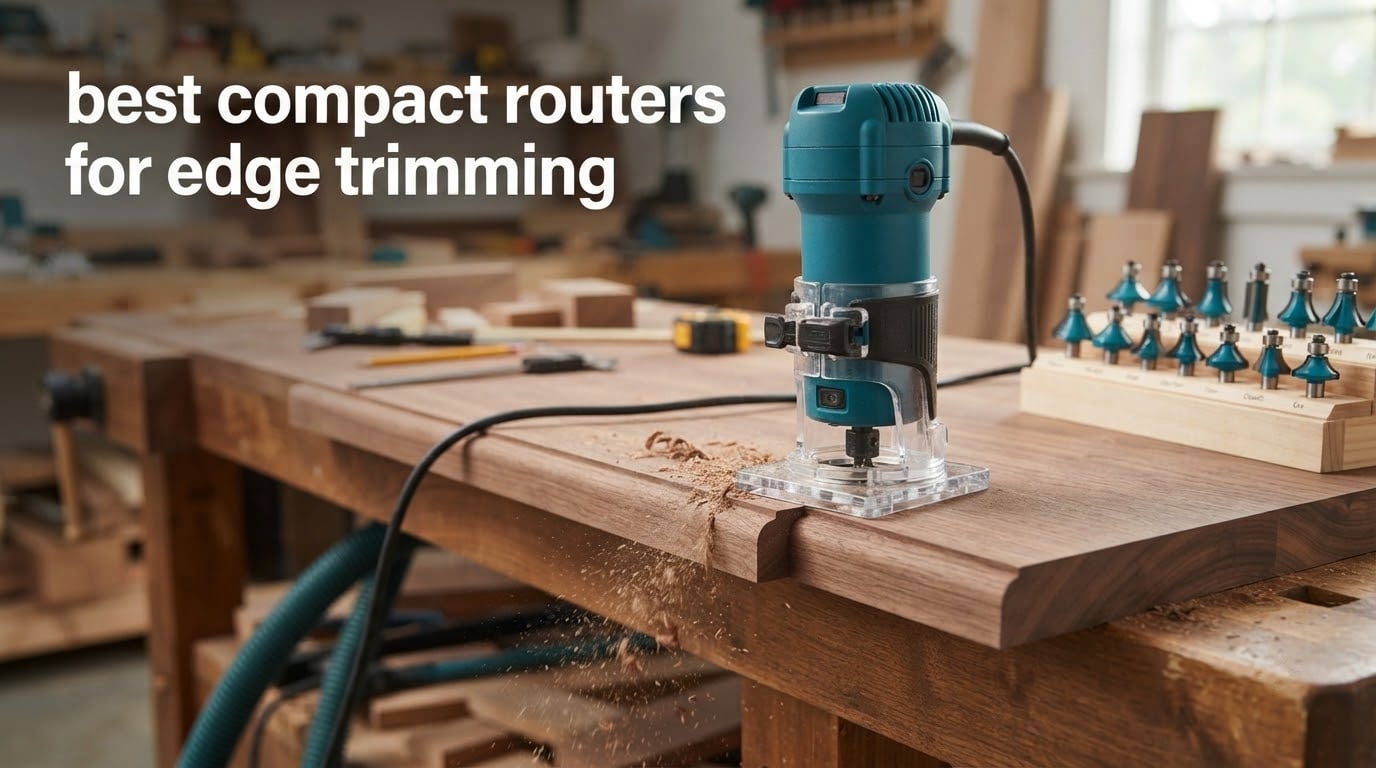
If you have landed here searching for a small router for a Wi-Fi network, stop reading. This guide is about the woodworking tool, and the search term for it is a trim router, a palm router or a laminate trimmer. Those are all names for a palm-sized router that spins a 1/4-inch shank bit through a small flat base so you can cut clean edges on laminate, veneer, plywood and solid wood.
Why edge trimming specifically? Because an edge is where a bad cut is impossible to hide. A wandering base, a depth setting that drifts mid-pass or a motor that bogs down on hardwood leaves a visible scar on the finished piece, and no amount of sanding hides it. Every router below was judged on the things that decide that outcome: how precisely the depth adjustment holds a setting, whether the speed dial gives you fine control for shallow passes, whether the base is small and clear enough to see the bit on narrow stock, and whether guides are included for straight runs.
Our top three: the DEWALT DCW600B is the strongest all-round edge trimmer here, with a brushless motor, dual LEDs and 10780 owner reviews backing it. The Milwaukee 2723-20 is the pick if you want cordless power that does not sag on hardwood. The Makita RT0701C is the one experienced shops name when they talk about the best bit adjustment system available on a compact router. If you are still working out which category of tool you need, our palm router guide explains the difference in more depth.
We compared ten routers across the full range, corded and cordless, premium and budget, using published specifications and the pattern of complaints that shows up repeatedly in owner reviews. Nothing here is invented lab data. What we added is the lens: every tool was re-read as an edge-trimming instrument rather than a general-purpose one.
Top 3 Compact Routers for Edge Trimming in October 2026

DEWALT DCW600B Cordless Router
- › Brushless 20V motor
- › Variable speed dial
- › Dual LED work lights
- › Depth adjustment ring

Milwaukee 2723-20 Cordless
- › 1.25 hp class motor
- › Interchangeable base plates
- › Dust port
- › 18V battery platform

Makita RT0701C Compact Router
- › Rack and pinion depth system
- › 10000 to 30000 RPM
- › Quick release cam lock
- › High visibility base
Best Compact Routers for Edge Trimming at a Glance for October 2026
| PRODUCT MODEL | KEY SPECS | BEST PRICE |
|---|---|---|
|
|
Check Latest Price |
|
|
Check Latest Price |
|
|
Check Latest Price |
 |
|
Check Latest Price |
 |
|
Check Latest Price |
 |
|
Check Latest Price |
 |
|
Check Latest Price |
 |
|
Check Latest Price |
 |
|
Check Latest Price |
 |
|
Check Latest Price |
One note on terminology before the individual reviews. A compact router and a trim router are the same category of tool, and a palm router describes the same thing with an emphasis on how it is held. A laminate trimmer is usually the cheapest member of the family, built for one job on laminate. Our compact travel router guide covers the networking meaning of the same words, which is worth a skim if you arrived from that search.
1. DEWALT DCW600B – Best Compact Router for Edge Trimming Overall
DEWALT 20V Max XR Cordless Router, Brushless, Tool Only (DCW600B)
20V brushless motor
Variable speed dial
Dual LED lights
Depth adjustment ring
+ The Good
- Brushless motor holds speed under load
- Dual LEDs light the actual cut line
- Depth ring makes changes fast
- One of the largest owner review counts in the group
- The Bad
- Tool only so battery and charger cost extra
- Fixed base is bulkier than a dedicated palm router
The DEWALT DCW600B is a cordless 20V Max XR router with a brushless motor and the highest volume of owner feedback in this group at 10780 reviews. At an edge, the two features that matter most are the depth adjustment ring, which changes bit height quickly between passes, and the pair of LEDs that throw light directly onto the cut line.
Variable speed lets you drop the RPM for a small straight bit trimming a cabinet door and wind it up for a larger roundover on a table edge. Soft start with full-time electronic feedback keeps the motor from bogging as the bit engages, and an electronic brake slows it after shutoff so the bit is not left spinning on the workpiece.
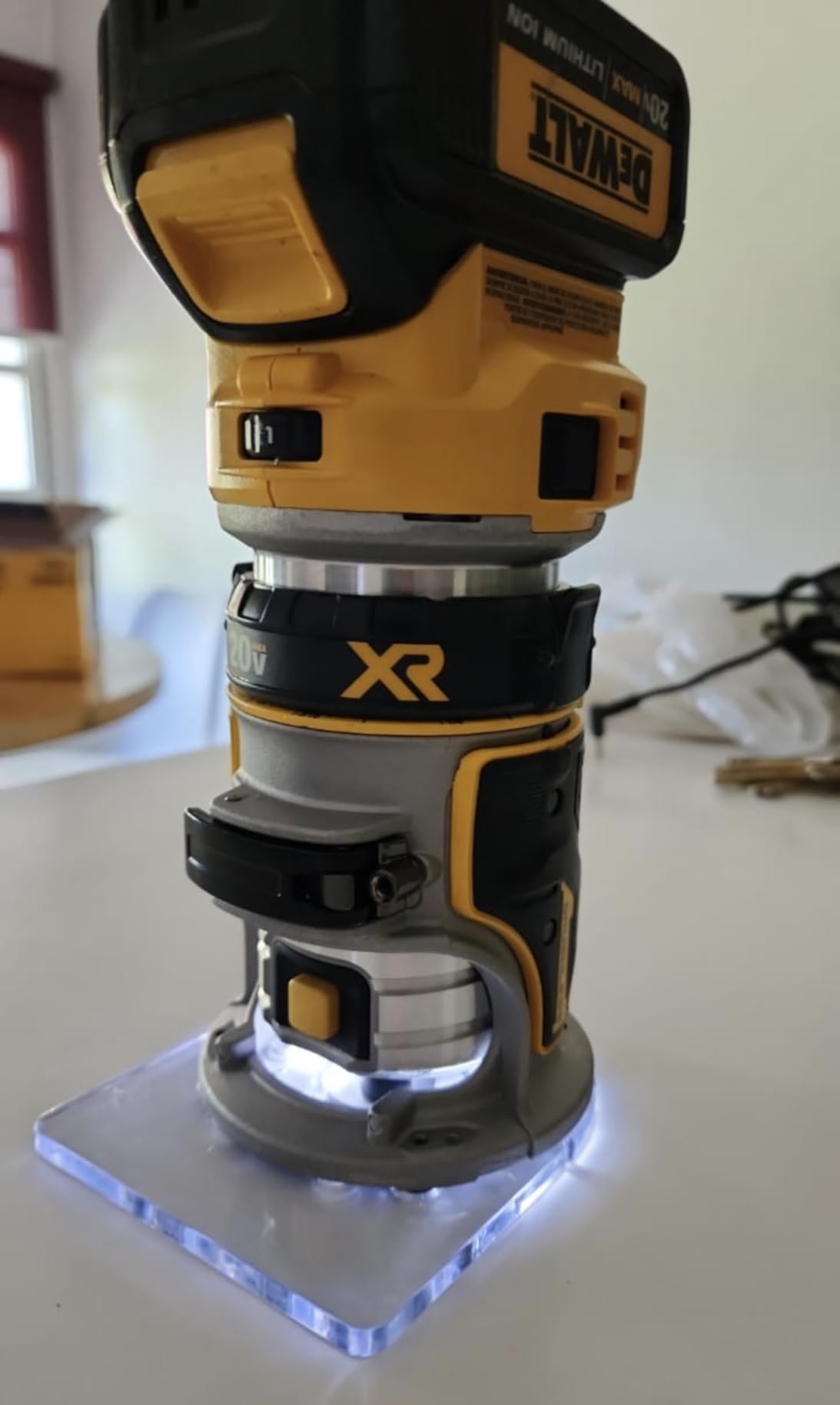
On hardwood edges the brushless motor is the reason it leads this list. Plenty of compact routers manage laminate and plywood without complaint, then labour on oak or walnut. This one reports strong smooth cuts, and reviewers single out the onboard lighting and speed control as the features they notice every time they work.
The tradeoff is honest and worth stating. This is a bare tool, so a battery and charger are separate purchases unless you already run 20V Max packs. The fixed base is also a little larger than a dedicated palm router, which costs you some of the hand clearance that makes tight corners comfortable.
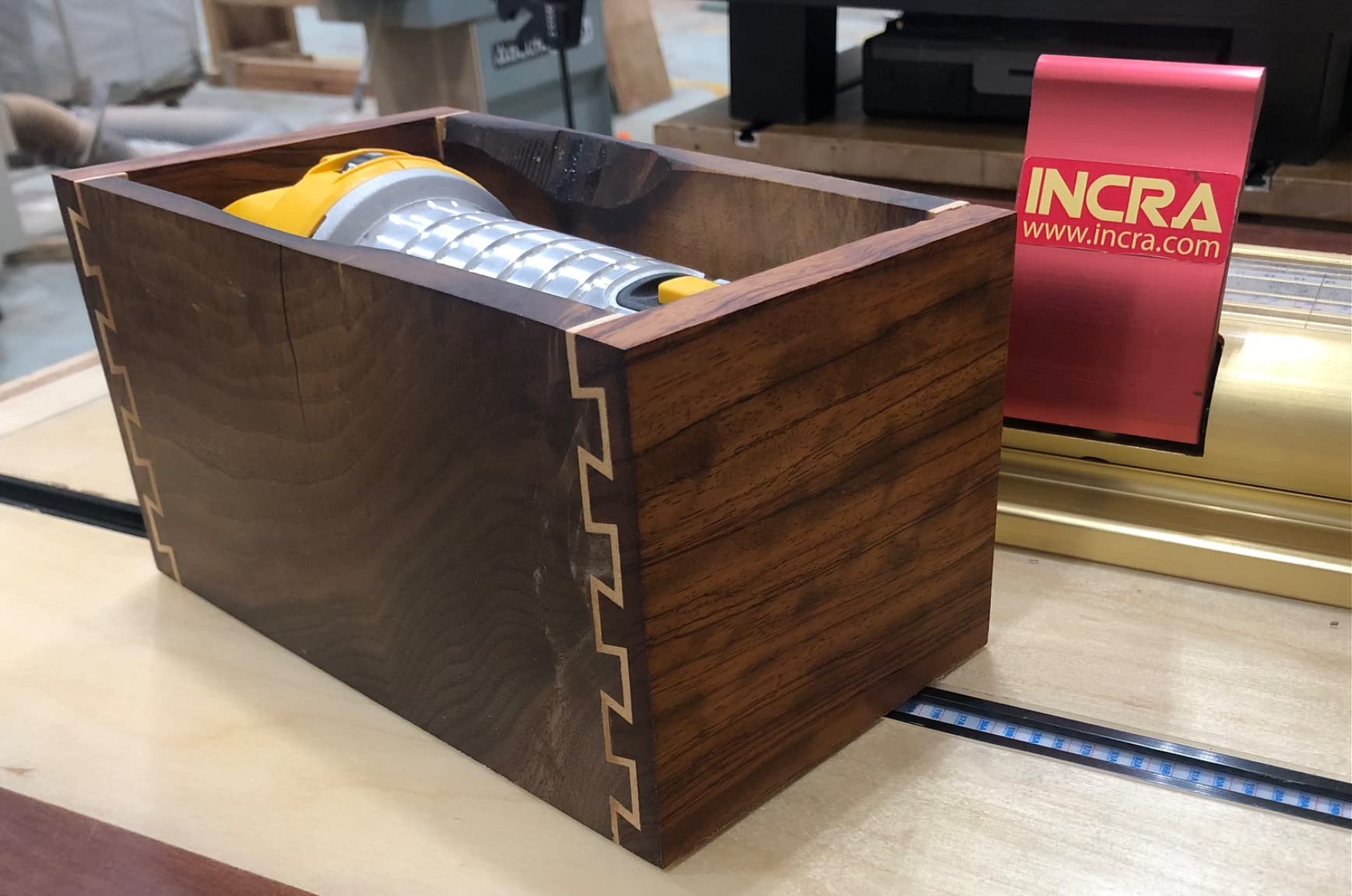
What edge work it handles best
This is the router we would hand someone trimming drawer fronts, cabinet doors and table edges in a shop without a convenient outlet. The brushless motor recovers from load, so a single long pass along a solid wood edge does not drift in speed and burn the corner.
The LEDs are not a gimmick at an edge. On a clear or dark finished surface, the shadow of a bit and base is the main reason people gouge laminate. Lighting the cut line removes the guesswork that leads to a slow, hesitant pass and a tear-out.
Where it disappoints for edge work
If your only router work is delicate 1/4-inch bit work on small parts, this body is more tool than you need, and the base will feel bulky on stock narrower than a couple of inches. The Bosch Colt below is the more natural shape for that job.
Battery runtime is the other consideration. Owners running heavy passes will burn through a pack faster than a corded motor allows, so keep a second pack on the bench if you are doing a full table of doors.
2. Milwaukee 2723-20 – Best Cordless Router for Hardwood Edges
Milwaukee Cordless Compact Router,18.0 Voltage
1.25 hp class motor
5 amps
Fixed base
Interchangeable base plates
+ The Good
- Strong smooth cuts on hardwood
- Compact body moves easily around a workpiece
- Interchangeable base plates
- Good battery life per pack
- The Bad
- Wide body tires large hands on long sessions
- Factory acrylic base has a notch that can catch the workpiece
- Slight slop at the start of fine adjustment
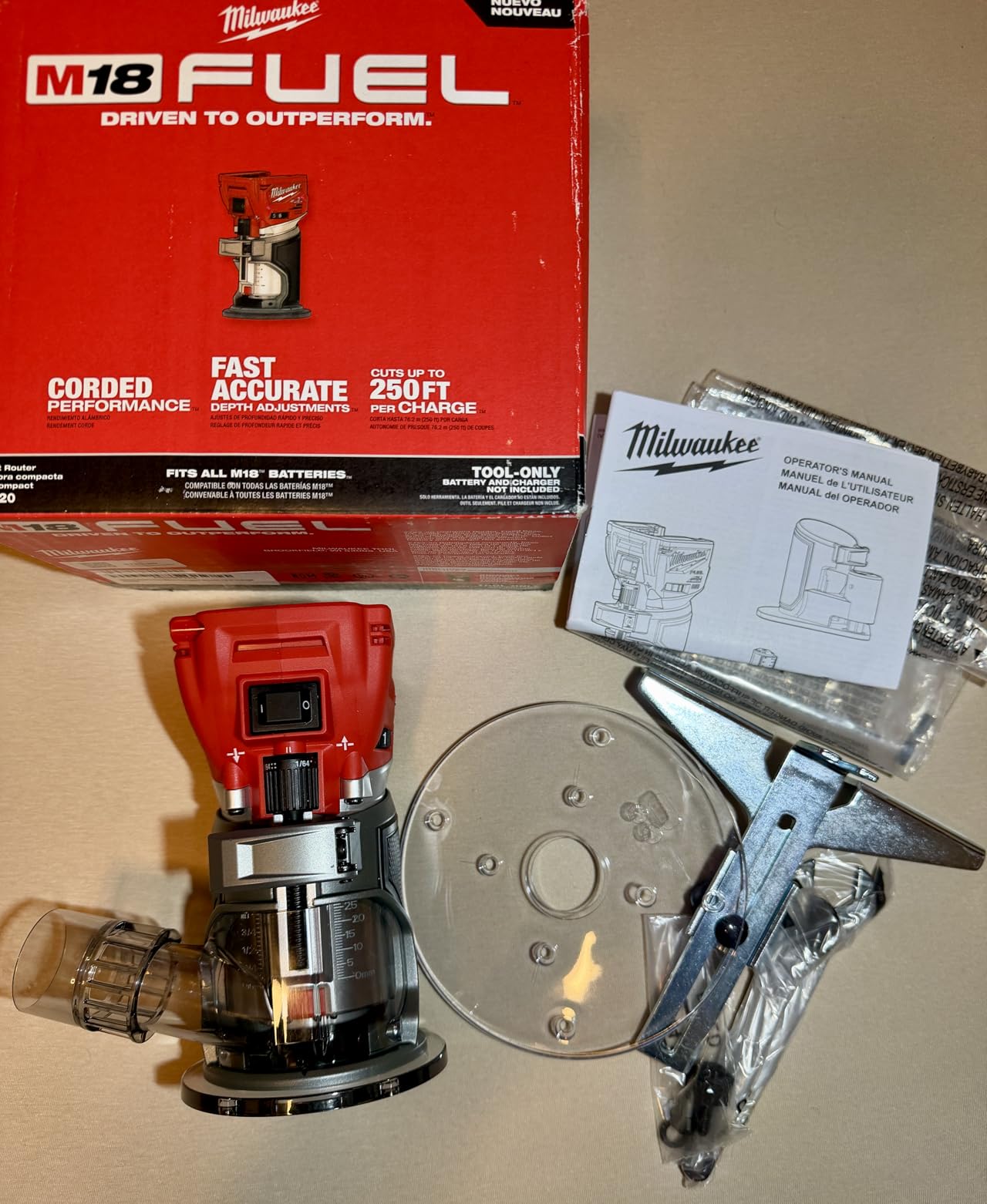
The Milwaukee 2723-20 is an 18V compact router rated at 1.25 hp and 5 amps, and it is the cordless option we would trust hardest on a hardwood edge. Reviewers report strong smooth cuts and enough endurance for roughly 100 linear feet of 3/8-inch rabbets on about half a charge of a 5 amp-hour pack.
Interchangeable base plates are the feature that matters most for edge work over the long term. A flat plate is what you want for flush trimming; a different plate with a dust port is what you want once the edge work turns into groove and profile work. Having both avoids owning a second router.
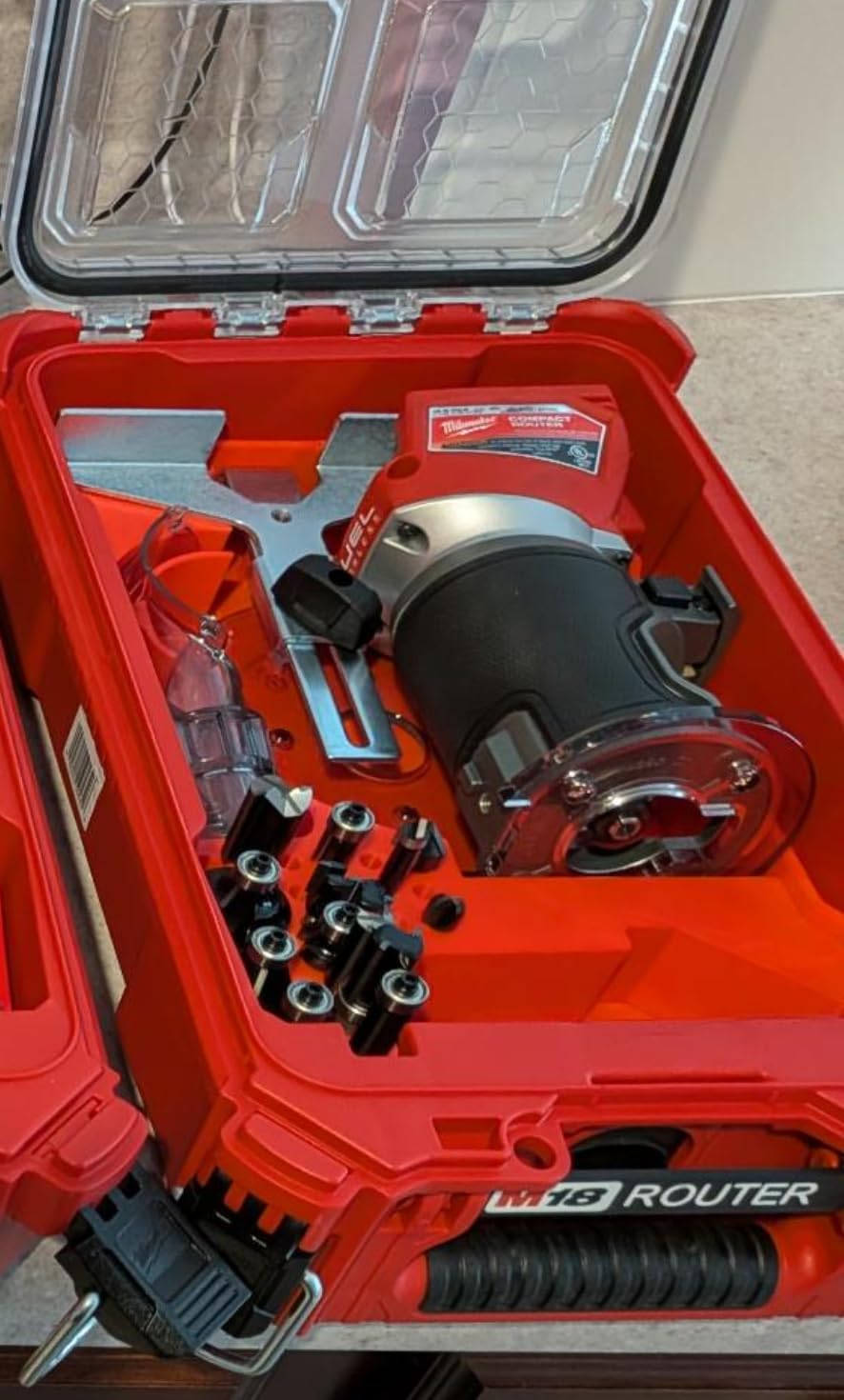
The 18V battery platform is the quiet reason many people end up here. If you already own M18 packs for drills and drivers, the router is effectively the cheapest tool you can add to that system, and GarageJournal forum members regularly point out that platform compatibility drives their cordless router choice more than the tool itself does.
The complaints cluster in a small area. The body is on the wide side for large hands, and the factory acrylic base has a notch that some owners say can catch a workpiece on a pass. Fine adjustment also has slight slop at the very start of its travel.
What edge work it handles best
Dense hardwoods on longer runs, where a cordless motor would normally sag. At 1.25 hp this has enough headroom to take more than one shallow pass on oak or walnut without the bit stalling and scorching the edge.
It also suits site and outdoor trimming, where there is no outlet within reach and a cord would be either in the way or in the way of somebody walking past it.
Where it disappoints for edge work
The dust port is loosely fitting, and owners report that attaching a vacuum hose unbalances the tool enough to affect a straight pass. Plan on routing without extraction, or budget for a better-fitting adapter.
For very small parts, the wide body limits visibility compared with a true palm router. If your edges are on thin decorative stock, the Bosch GKF12V later in this list is a better shape for the job.
3. Makita RT0701C – Best Compact Router for Precision Depth Control
Makita RT0701C 1-1/4 HP Compact Router, Fixed Base
1-1/4 HP
6.5 amps
10000-30000 RPM
Rack and pinion depth adjustment
+ The Good
- Precise rack and pinion fine adjustment
- Slim ergonomic body
- Quiet for its power class
- Quick release cam lock for base swaps
- The Bad
- Fixed base only package with no light
- Battery-free tool that needs an outlet nearby
- Speed dial can loosen during long runs
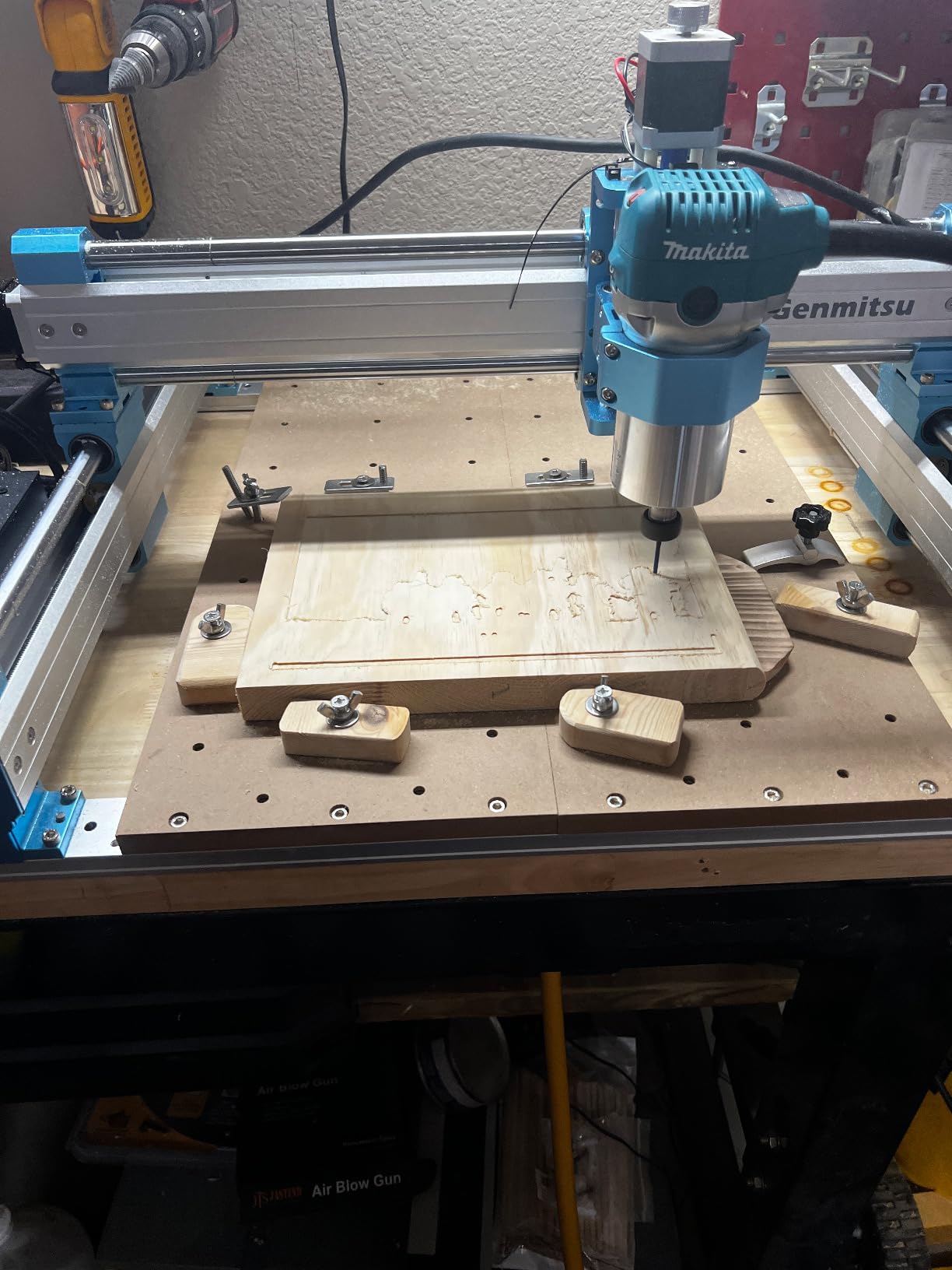
The Makita RT0701C is a 1-1/4 HP, 6.5 amp corded compact router, and its rack and pinion depth adjustment is the reason experienced woodworkers keep naming it. On SawMillCreek the recurring verdict on DEWALT routers is about adjustment rather than raw power, and on RouterForums the Makita line gets called a precision trim router with several bases available. That reputation is about holding a setting.
Speed control runs from 10,000 to 30,000 RPM, which is a genuinely wide range for a compact router. Low speed is right for a small straight bit on veneer; high speed suits larger profiles. Electronic speed control holds the setting under load, and soft start eases the bit into the wood.

The quick release cam lock makes height changes and base swaps fast, which matters more than it sounds. When you are running five shallow passes on a table edge, a fast depth change is the difference between a clean workflow and a frustrating one.
Owners also praise how quiet it runs for the power class, and how the slim body stays comfortable in one hand for a long edge. The high visibility base helps you see the bit against the workpiece, and it accepts standard template guides.
What edge work it handles best
Flush trimming and edge profiling where repeatability matters more than raw speed. A rack and pinion system with a fine adjustment lets you creep up on depth in small increments instead of guessing and overshooting into a burn mark.
It also handles demanding material. Owners report it taking aluminum and hardwoods without complaint, which puts it well past the point where an edge trimmer should be refusing the job.
Where it disappoints for edge work
This package is the fixed base only, so plunge, tilt and offset bases are all extra. If you think you will ever need an offset base for an inside corner, buy the kit version instead of planning an upgrade later.
There is no light built into the base, and no dust port in the standard configuration. On a dark finished edge, that means relying on shop lighting and your own positioning, and expecting to sweep up after.
4. Bosch PR20EVS Colt – Best Palm Router for Small Bits and Detail Edges
BOSCH PR20EVS Colt 1.0 HP Variable-Speed Palm Router, Quick-Clamp System
1.0 HP
5.6 amps
16000-35000 RPM
Quick clamp depth system
+ The Good
- Fast macro and micro depth adjustment in one clamp
- Finger support pockets steady the tool at an edge
- Angled cord exit keeps the cord clear
- Spindle lock for one wrench bit changes
- The Bad
- 1 HP is less power than 1.25 HP compacts for heavy cuts
- Soft plastic body feels less solid than metal rivals
The Bosch PR20EVS Colt is a 1.0 HP, 5.6 amp palm router running 16,000 to 35,000 RPM, and it is the long-standing recommendation for small bits and precise detail work. On WoodworkingTalk the comment that recurs is straightforward: a Bosch Colt trim router for smaller bits.
Its quick clamp depth system gives both macro and micro adjustment in one mechanism, which is exactly what a profiling pass needs. You can drop the bit a coarse amount, then creep it up with the fine control without changing tools or wrestling a separate mechanism.
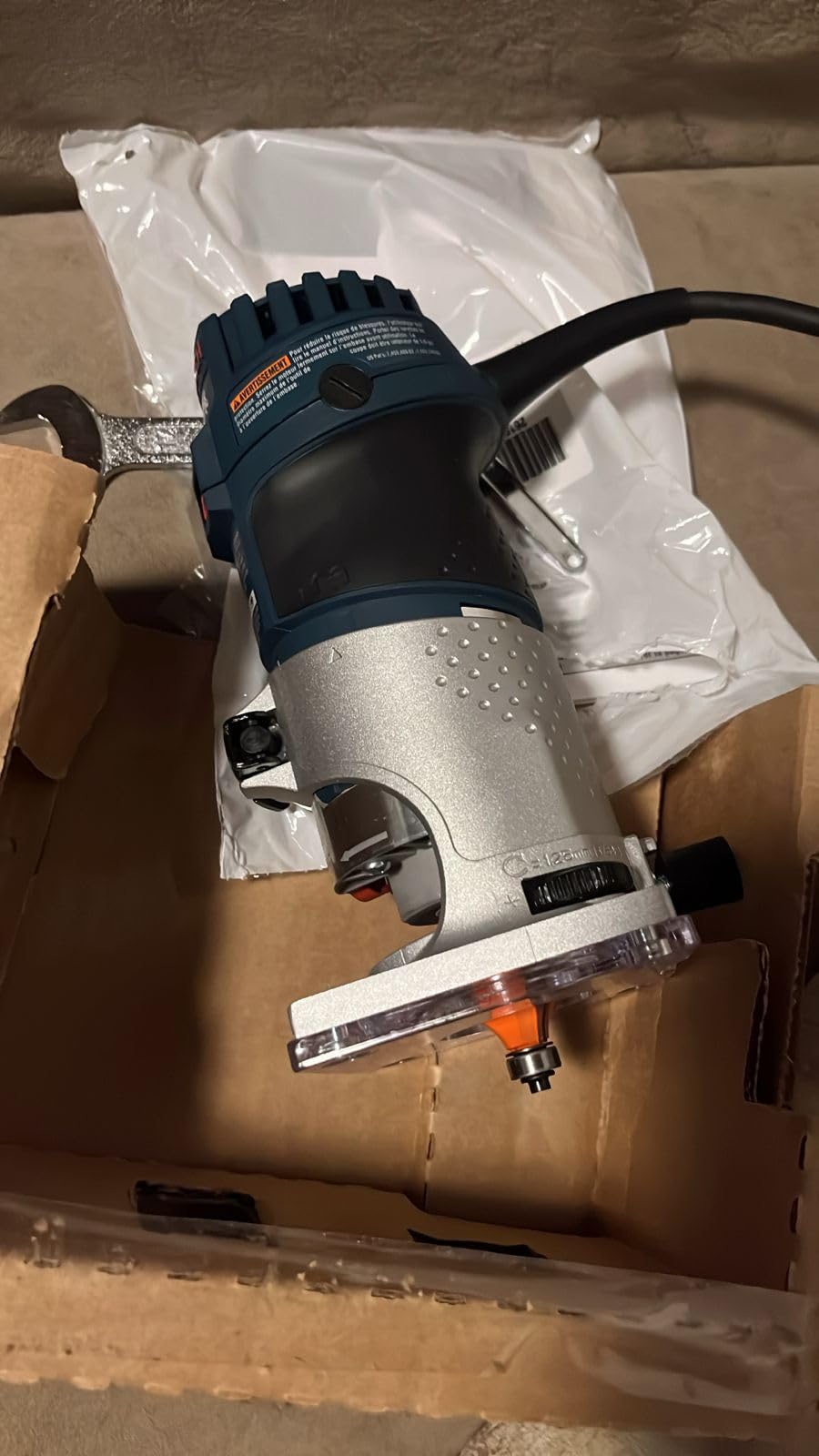
Finger support pockets in the base are a small detail with real edge consequences. They give the leading hand a physical stop at the workpiece, which stops the base from creeping sideways and is a genuine answer to the complaint that small bases wander on thin stock.
The angled cord exit keeps the cord from dragging across your line of travel, and the included straight edge guide works up to 3-5/8 inch from the workpiece edge. The spindle lock means a bit change takes one wrench.

What edge work it handles best
Small roundovers, chamfers and detail profiles in small parts, picture frames and decorative trim. At 35,000 RPM the top of the range gives clean finish cuts on hardwood with a small bit, and the base shape is comfortable to hold in one hand for the whole pass.
It is also the natural choice for inside corners and curved edges, where the compact palm grip reaches places a larger fixed base cannot.
Where it disappoints for edge work
At 1 HP it gives up roughly a quarter of the power of the 1.25 HP machines in this list. On thick hardwood with a wide bit, you will be taking shallower passes than you would with a Makita or DEWALT.
The body is plastic rather than metal, which reviewers note feels less premium. It is a durability impression rather than a failure report, but it is the reason this router sits below the three leaders.
5. AVID POWER MW104 – Best Value Compact Router with the Biggest Kit
AVID POWER 6.5 Amp 1.25 HP Compact Router Tools for Woodworking, Fixed Base Wood Router with Trim Router Bits, 6 Variable Speeds, Edge Guide, Roller Guide, Dust Hood (Red, 65mm)
1.25 HP
6.5 amps
10,000-32,000 RPM across 6 speeds
Dual LED lights
+ The Good
- Largest accessory bundle including guides and bits
- Dual LED lights on the cutting line
- Six speed settings cover hardwood through laminate
- Aluminum body and base with dust hood
- The Bad
- Widest rating spread in the group
- Build and finish lighter than premium routers
- Bundled bits are entry-level grade
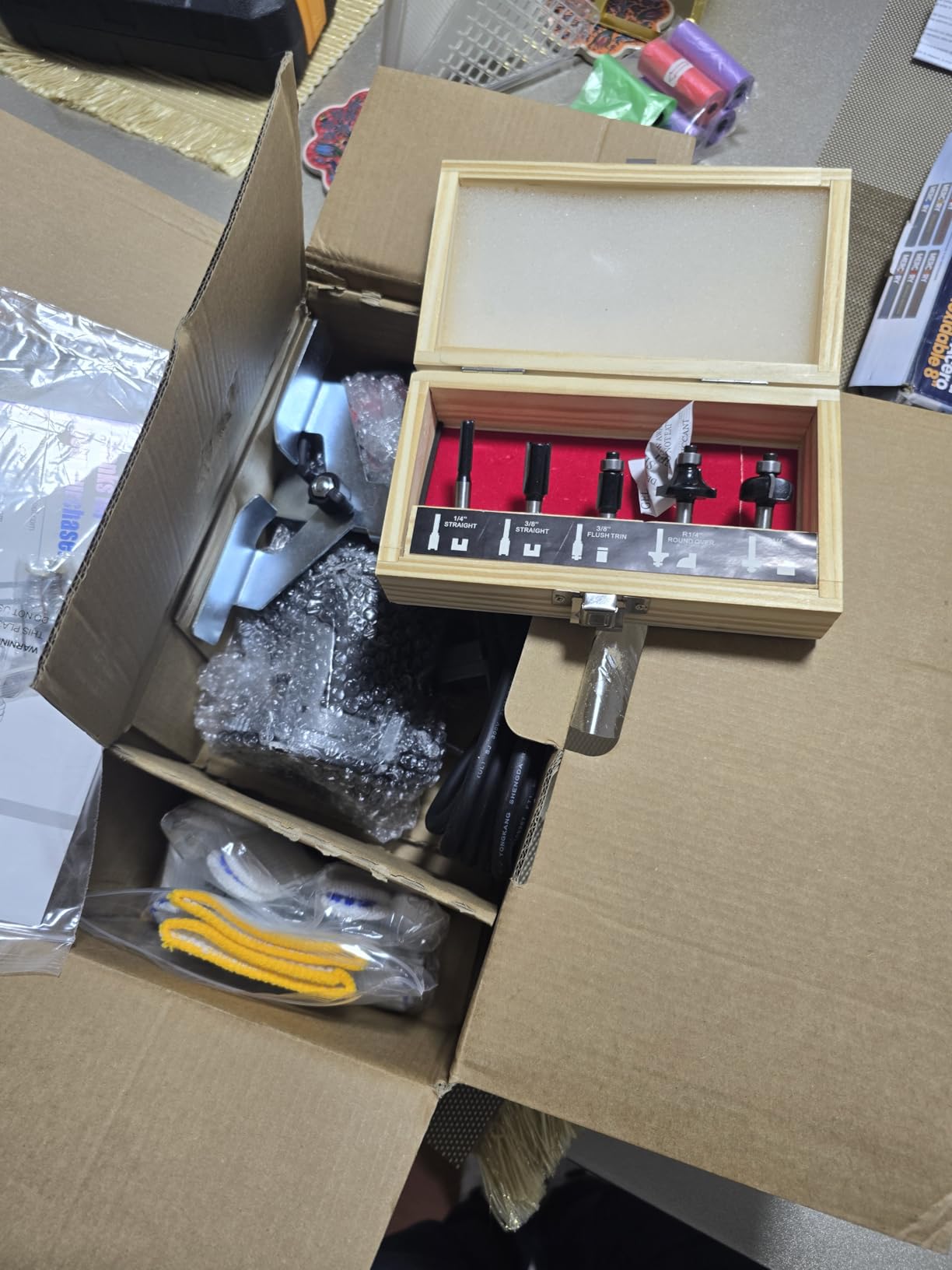
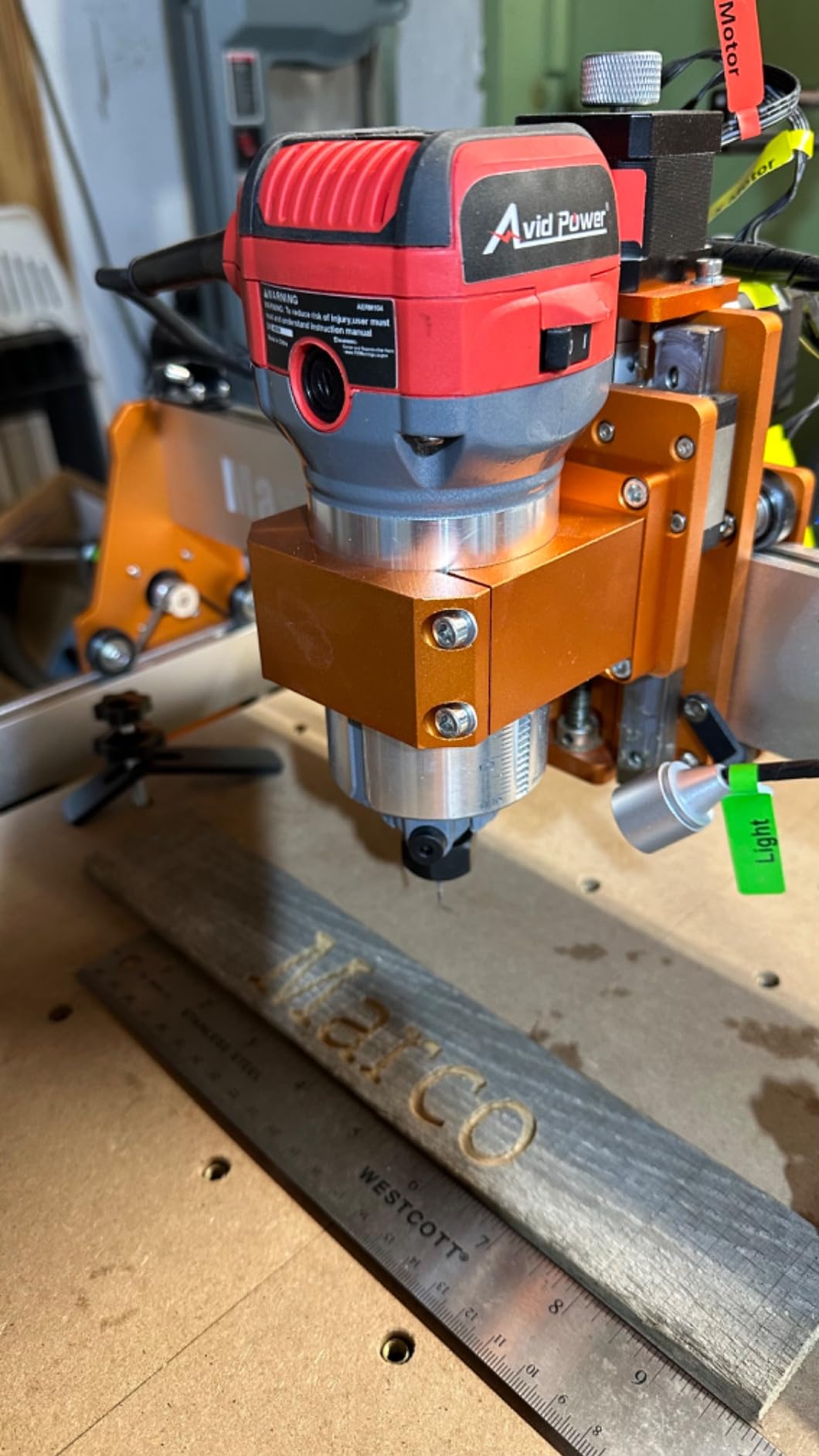
The AVID POWER MW104 is a 1.25 HP, 6.5 amp, 800W corded router with six speed settings running from 10,000 to 32,000 RPM, and it arrives with more in the box than anything else here. The kit holds five bits, an edge guide, a roller guide, both 1/4-inch and 3/8-inch collets, spare carbon brushes and a wrench.
For a first edge-trimming job, that bundle matters. The edge guide and roller guide are exactly the two accessories you need for straight runs and for following curved edges, and buying them separately adds cost and delay.
Dual bright LEDs illuminate the cutting path, which solves the visibility problem on finished surfaces for very little money. The rack and pinion depth adjustment is described by owners as locking tight during use, and the rubber-covered handle reduces fatigue on longer routing sessions.
The aluminum body and base with a dust hood mean you can hook up a shop vac, which matters if you are trimming panels indoors. Owners like the accessory completeness and the lighting, and the 4.4 average reflects solid everyday performance with some quality complaints mixed in.
What edge work it handles best
Everything from laminate and plywood through hardwood edges on a budget. The 1.25 hp class motor at 6.5 amps gives it enough power to make multiple passes on solid wood, and six speed settings let you slow down for a small bit.
The roller guide is the underrated part here. Running the base against a straight edge on narrow stock is the most reliable way to get a straight trim without a jig, and this is one of the few routers in the group that ships with both guide types.
Where it disappoints for edge work
The 4.4 average comes with the widest spread of ratings in this list and a noticeable share of critical reviews. For a tool you rely on to make visible finished edges, that consistency gap is the reason it does not rank higher despite the specification sheet.
Replace the bundled bits before serious work. They are entry-level, and a dull bit at the edge is exactly what causes chipping that people blame on the router.
6. Ryobi ONE+ PCL424B – Best Compact Router for Small and Thin Parts
RYOBI ONE+ 18V Cordless Compact Fixed Base Router Tool Only (Battery Not Included) – PCL424B
18V ONE+ cordless
3.2 lb tool only
20000-30000 RPM
Micro depth dial
+ The Good
- Lightest body here at 3.2 lb for one hand control
- Micro dial plus quick release lever for fast settings
- Clear base shows the cut line
- Low vibration at full speed
- The Bad
- Battery and charger not included
- Not built for heavy duty routing
- Vacuum hose unbalances the tool
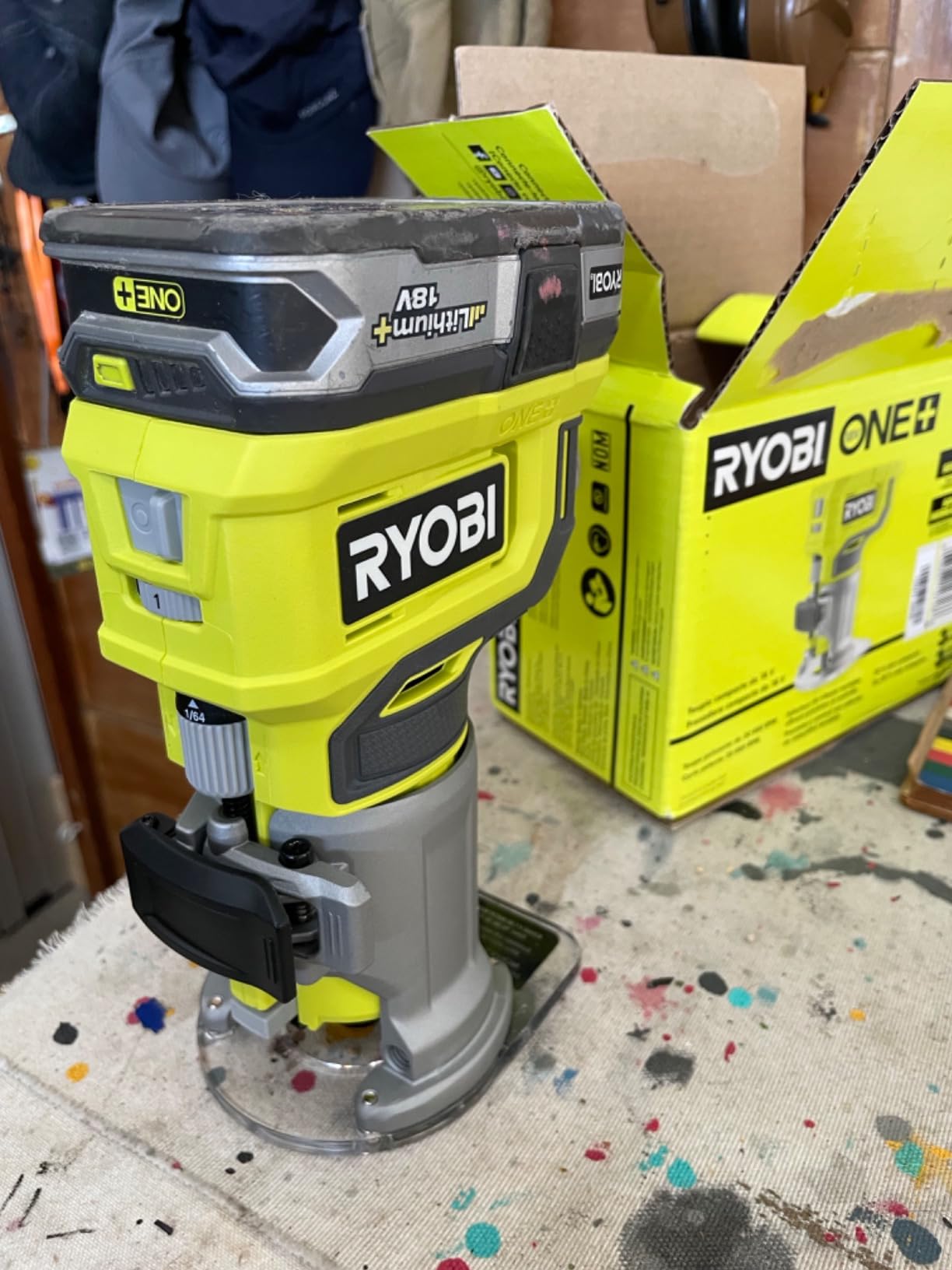
The Ryobi ONE+ PCL424B weighs 3.2 pounds as a bare tool, which makes it the easiest of the cordless options to control one-handed on small work. When you are trimming the edge of a small box or a thin shelf, that weight difference is the whole experience.
Depth control comes from a micro dial plus a quick release lever, which together give fine settings without fumbling. The clear base gives good visibility of the cut line, and owners report smooth running with minimal vibration even at the top of the 20,000 to 30,000 RPM range.
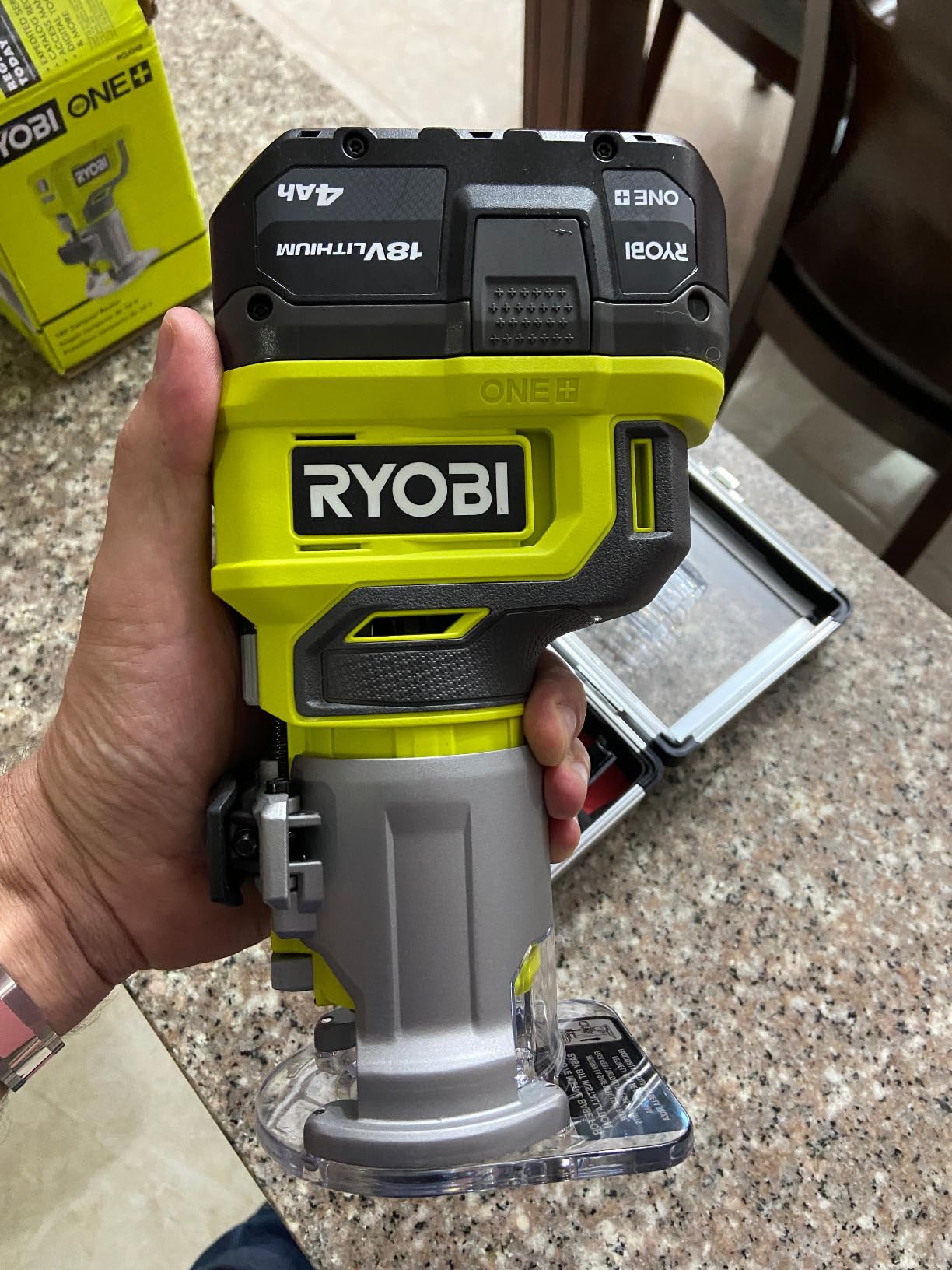
If you already own any Ryobi 18V ONE+ battery, this is a straightforward platform addition. Reviewers use it for hinge and latch plate cuts, edge rounding and light shelf trimming, which is a fair description of where a compact router is genuinely the right tool.
The clear base deserves a specific mention for edge work. When the bit and the cut line are both visible through the base, you can run a trimmer pass instead of a plunge-and-drag pass, and that is the difference between a clean edge and a tear-out.
What edge work it handles best
Light and medium edge work on cabinet parts, boxes and shelves, especially where one hand is already busy holding the workpiece. Cordless means no cord across the bench when the stock is small and awkward.
It also suits hinge mortising and template work on small parts, where the light body reduces wrist fatigue over repeated cuts.
Where it disappoints for edge work
This is not a heavy routing machine and reviewers say so plainly. Push it on thick hardwood with a wide bit and it will bog before it finishes, which on a visible edge means burn marks.
Battery runtime depends heavily on amp-hour capacity, so larger packs are advisable. Also note that attaching a vacuum hose unbalances the tool and blocks the clear base window, which defeats its main edge-work advantage.
7. Bosch GKF12V-25N – Best Palm Router for Flush Trimming
Bosch GKF12V-25N 12V Max EC Brushless Palm Edge Router (Bare Tool)
12V EC brushless
13000 max RPM
0.04 inch per dial turn
Spindle lock
+ The Good
- Exceptionally light and well balanced for edge work
- Offset palm design puts the tool over the stock
- Fine depth adjustment of 0.04 inch per dial revolution
- Finger barriers keep hands away from the bit
- The Bad
- No integrated dust extraction
- Single speed 13000 RPM is slow for large bits
- 12V packs lack power for deep and wide work
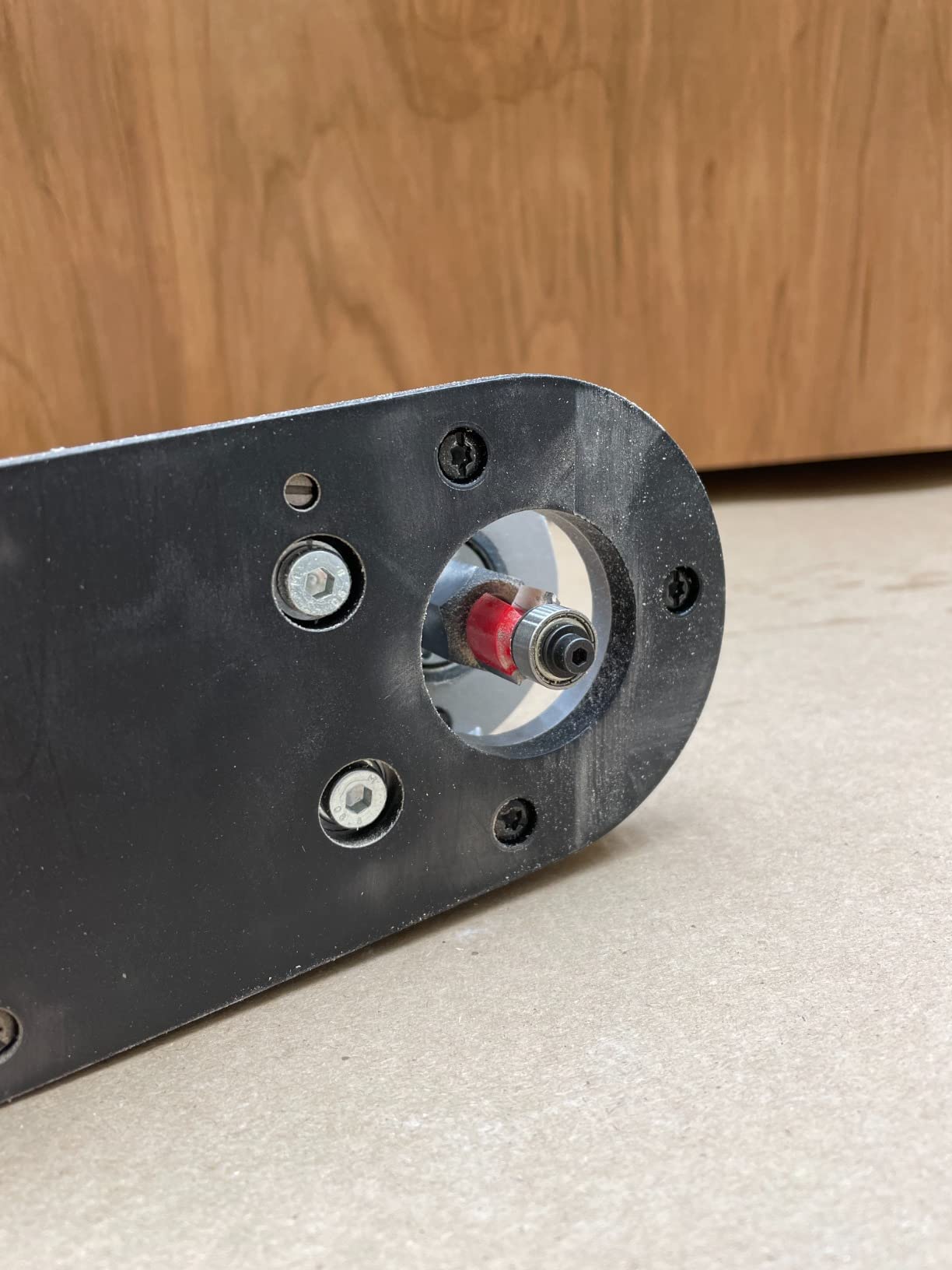
The Bosch GKF12V-25N is a 12V Max EC brushless palm edge router built specifically for the job this guide is about. Its offset palm design positions the motor over the workpiece, which is the classic answer to a small base wandering on thin stock: the mass sits above the cut rather than beside it.
Owners treat it as the go-to tool for flush trimming, roundovers and chamfers, largely because of weight and balance. At 2.2 pounds it is the lightest thing here, and the narrow handle diameter gives a secure one-hand grip for long profiles.
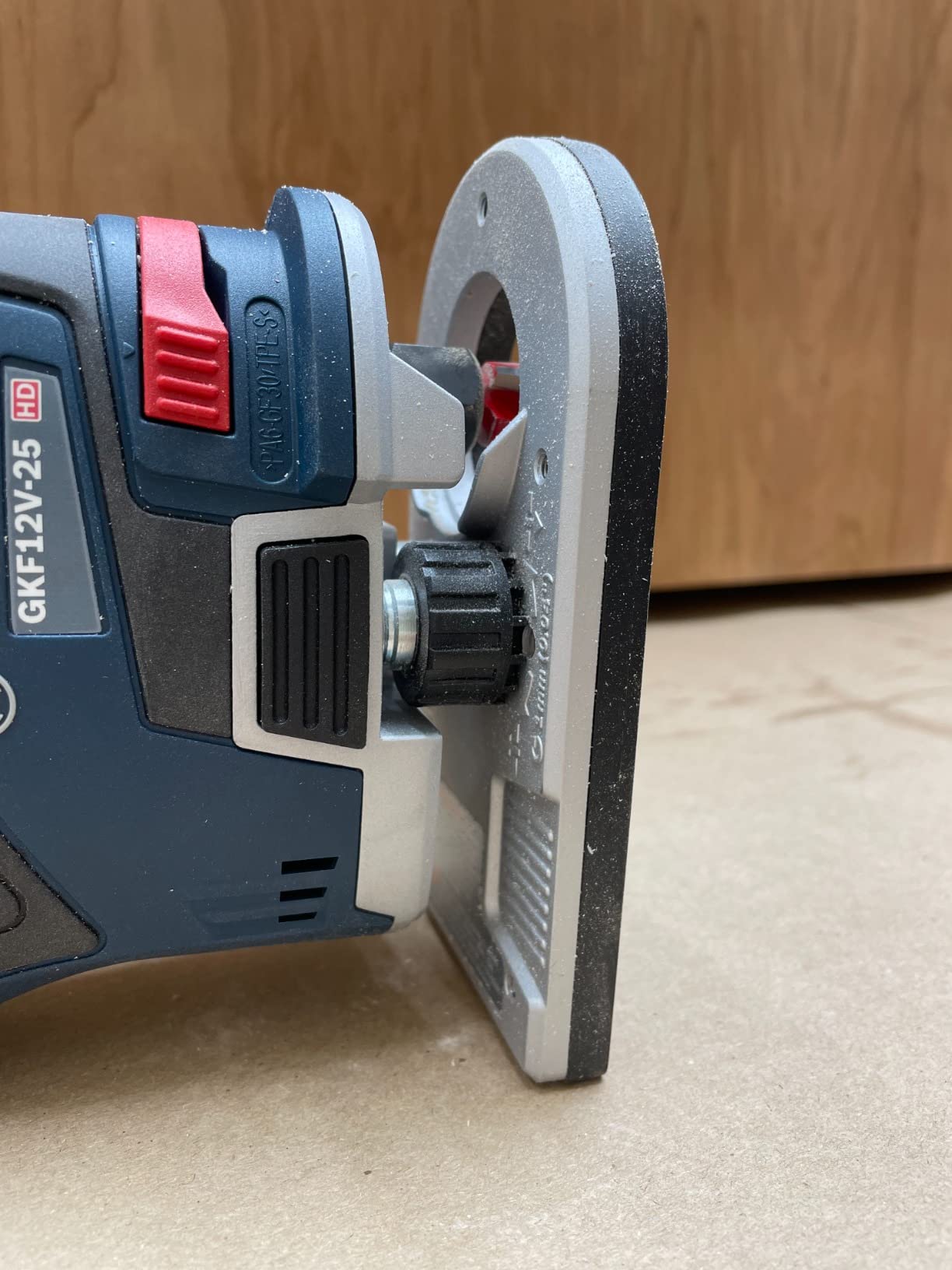
Depth adjustment is unusually fine for a machine at this end of the market, at 0.04 inch per dial revolution, with a depth lock to stop the setting being knocked. Constant speed circuitry monitors and maintains speed under load, and restart protection prevents the tool firing up when you swap batteries.
Finger barriers keep your hands clear of the bit area, and the spindle lock makes bit changes a one-wrench job. Reported round-over capacity runs to about 23 feet per battery amp-hour.
What edge work it handles best
Flush trimming laminate and veneer, and roundovers and chamfers on cabinet doors and drawer fronts. The offset geometry and light body make it the easiest tool here to hold steady on a long, uninterrupted pass.
Because it is a bare tool, anyone who already owns Bosch 12V packs can add it cheaply. For fine finish work the single speed is not a real limitation at all.
Where it disappoints for edge work
There is no integrated dust extraction. Dust control requires an aftermarket or printed base, which is a real annoyance if you are trimming panels indoors.
The 13,000 RPM ceiling is slow for large bits, and 12V packs do not have the power for deep and wide cuts. Both limits are fine for the edge work it is designed for and frustrating the moment you ask it to do something else.
8. WEN RT1460 – Best Budget Router for Laminate Edges
WEN RT1460 6-Amp Handheld 1/4-Inch Variable Speed Laminate Trim Router for Woodworking
6 amp soft start
12000-30000 RPM
Clear base plate
1-5/8 inch base travel
+ The Good
- Transparent base plate shows the cut line clearly
- Soft start reduces strain on start-up
- Scale with 1/16-inch markings aids consistent depth
- Includes straight fence and trim guide
- The Bad
- Depth rack develops play and needs periodic greasing
- Collet can run hot and slip
- Reports of the tool running very hot on extended cuts
The WEN RT1460 is a 6 amp corded laminate trim router with variable speed from 12,000 to 30,000 RPM and a transparent base plate. For the specific job of trimming laminate where overspray adhesive and a visible cut line both matter, that clear base is a genuinely useful feature rather than a gimmick.
Base travel is 1-5/8 inch with a 1-inch scale marked in 1/16-inch increments, which is enough scale to keep a consistent depth across a long panel. The kit includes a straight guide fence and a trim guide for curves and irregular pieces.
Soft start eases the motor in, and reviewers note it runs quieter than larger routers while still having adequate power for solid hardwood at the lower end of its work.
The two-year warranty is longer than several premium-brand options here, which is worth noting for a tool at this end of the market.
What edge work it handles best
Flush trimming laminate sheets and veneer, especially where you want to watch the cut line rather than guess at it. The clear base and the supplied straight fence make repeat panels consistent.
For a first router on a small budget, the included fence, trim guide and soft start cover the basics of safe edge work without extra purchases.
Where it disappoints for edge work
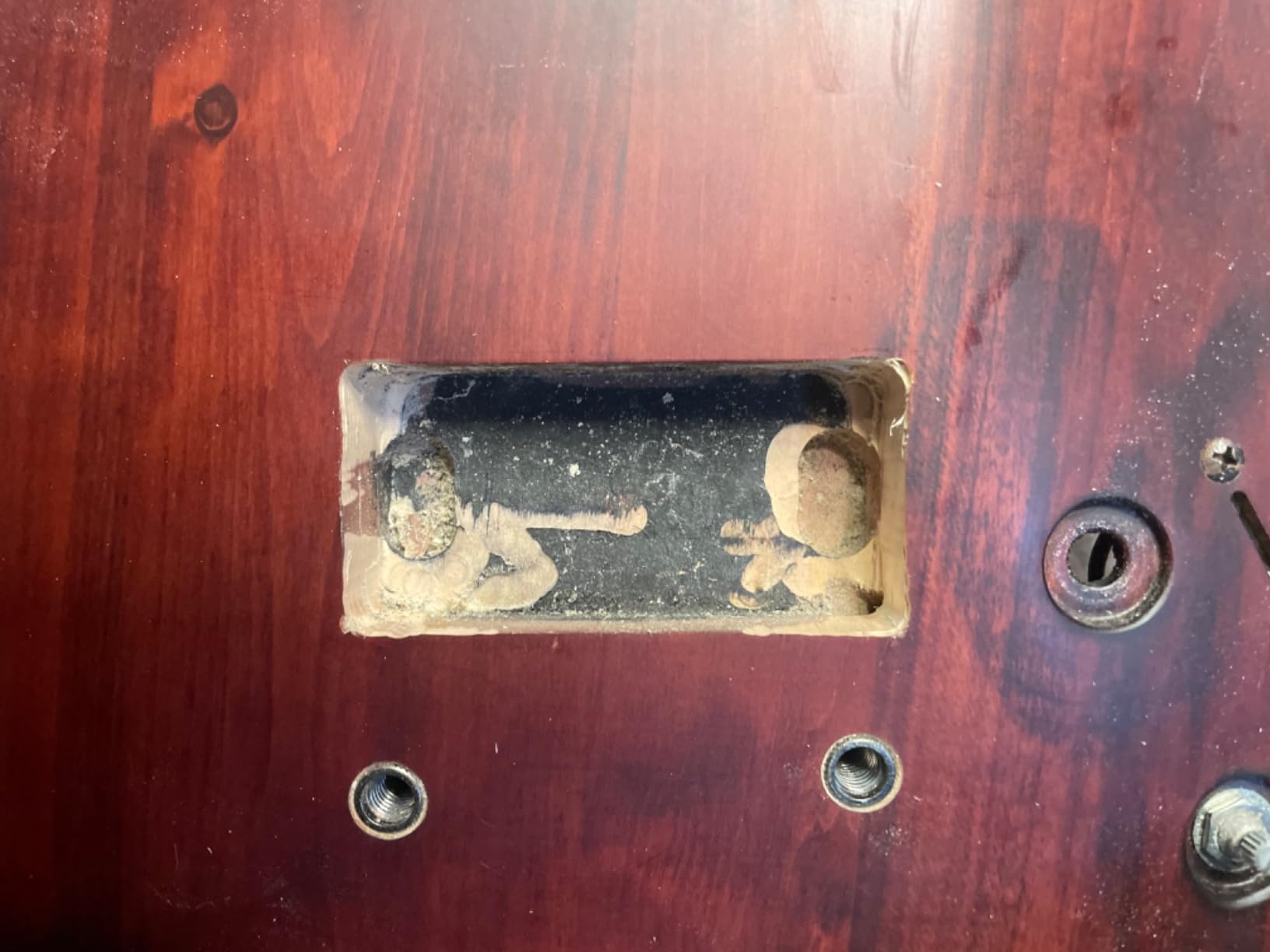
The rack and pinion depth adjustment develops play over time and needs periodic greasing. Once it is loose, fine depth settings drift, which shows up directly as an uneven edge.
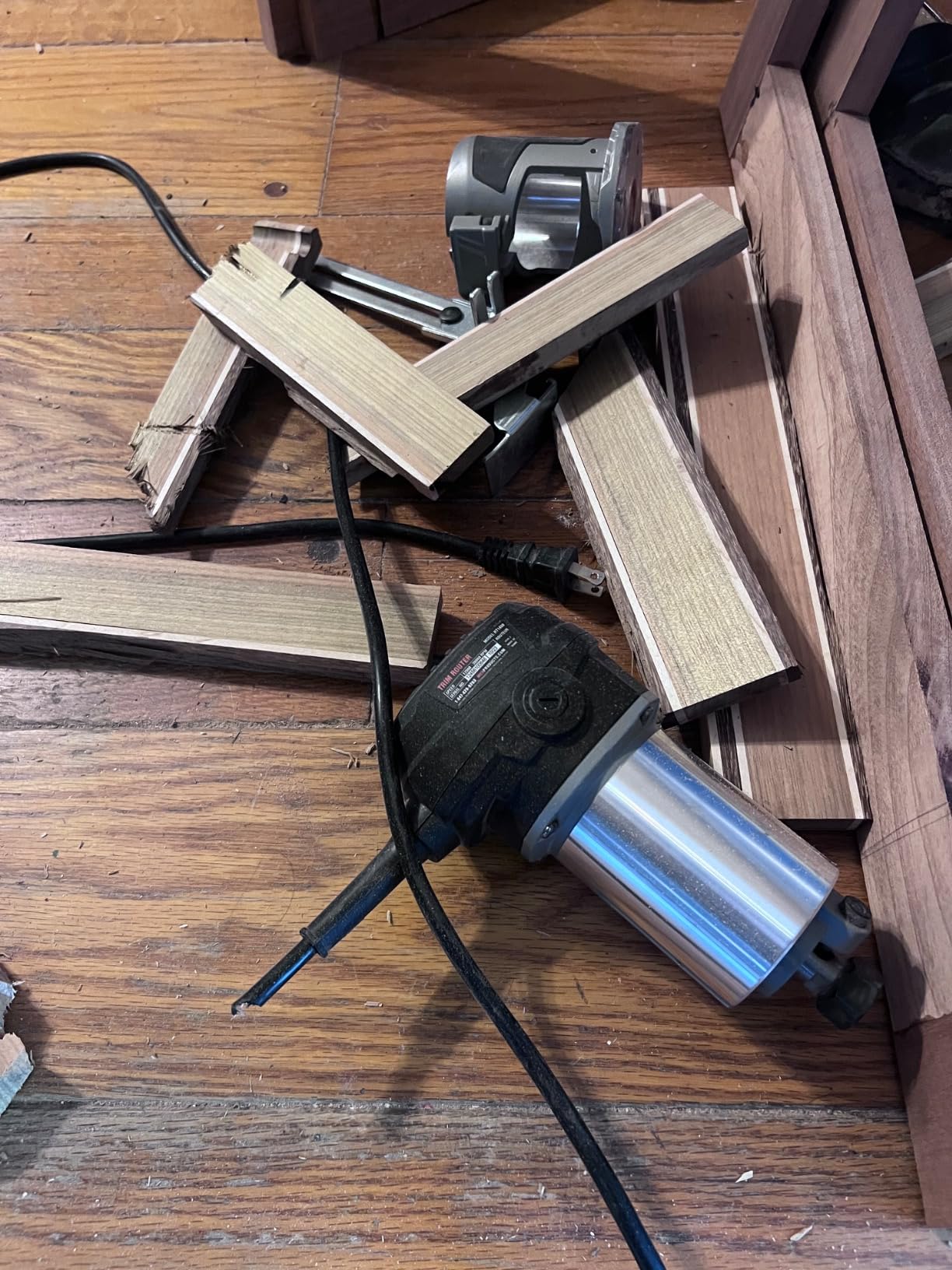
There are repeated reports of the tool running very hot on extended cuts, and the collet can run hot and slip. On a long panel, work in sections and let the motor cool rather than pushing through in one pass.
9. WORKPRO 6.5 Amp Compact Router Kit – Best Starter Kit for New Shoppers
WORKPRO 6.5 Amp Corded Compact Router Kit
6.5 amp motor
Six speeds from 12000-30000 RPM
14 piece accessory kit
Rack and pinion depth adjustment
+ The Good
- Powerful 6.5 amp motor compared favorably to costlier routers
- Fourteen piece kit includes both collets and three guides
- Transparent dust hood keeps the work area visible
- Enough weight to stay put while routing
- The Bad
- Depth adjustment feels sloppy until clamped
- Straight guide fence described as shoddy
- Motor can bog down in deep cuts
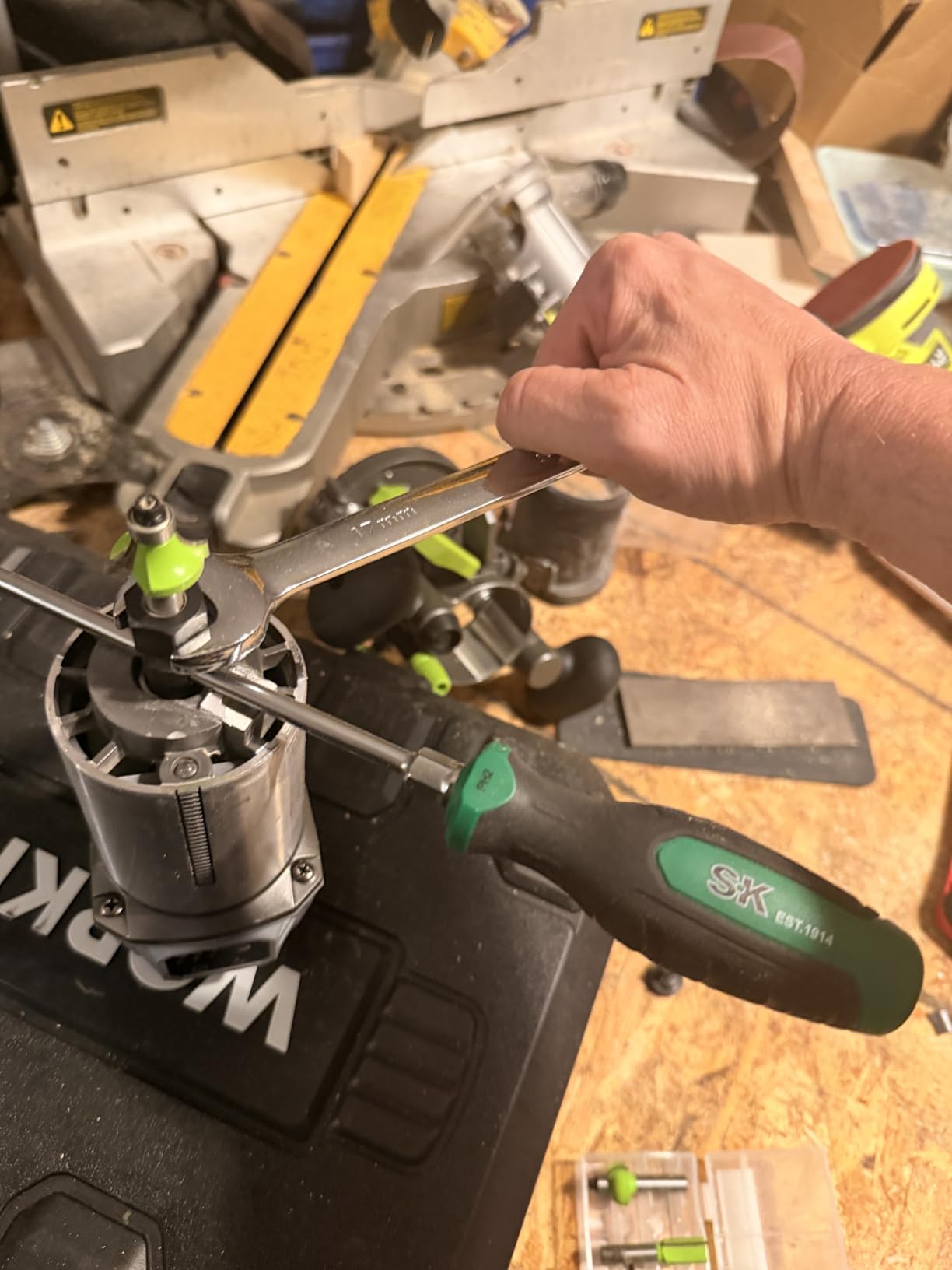
The WORKPRO 6.5 Amp Compact Router Kit is a fixed-base corded router with six speed settings from 12,000 to 30,000 RPM and a fourteen piece package. The kit holds six bits, 1/4-inch and 3/8-inch collet cones, a straight guide, a trim guide, a template guide, a dust hood and two wrenches.
Owners compare the 6.5 amp motor favorably to more expensive routers, and the accessory list covers every guide type you would need for edge work. A transparent dust hood keeps the cutting area visible while still letting you attach extraction, which is a combination few kits at this level manage.
The rubber-wrapped handles and enough mass to stay put while routing make it stable on a bench without clamping it down. Several owners bought a second unit, which is a reasonable signal for occasional use.
The rating spread is wide, with 66 percent five-star reviews against 11 percent one-star. The critical reviews cluster around specific components rather than the tool as a whole, which is the usual pattern with kit routers.
What edge work it handles best
General edge trimming, grooving, edge planing, curve cutting and chamfering on cabinet work and home projects, with the template guide opening up guided work straight out of the box.
It suits someone building a first kit and wanting every guide type in the same box rather than adding accessories one job at a time.
Where it disappoints for edge work
The depth adjustment can feel sloppy until it is clamped down hard. For an edge that will be visible, set the depth with a gauge rather than trusting the mechanism alone.
The straight guide fence is described as shoddy, which matters because a straight fence is the reference surface for a straight trim. The motor can also bog down if pushed too hard in deep cuts.
10. AVID POWER AERM186 – Best Compact Router for Occasional Light Work
AVID POWER Compact Wood Router Tool for Woodworking 630W 5.3 Amp, Trim Bits
630W 5.3 amp motor
35000 RPM maximum
1/4 inch collet
Three guide modes
+ The Good
- Complete kit with five trim bits and both guide types
- High 35000 RPM ceiling for clean finish cuts
- Air vent design intended to limit overheating
- Lightweight corded body is easy to control
- The Bad
- Weakest rating consistency in the group
- 630W motor lacks power for thick hardwood
- All-plastic construction is the least durable here
The AVID POWER AERM186 is a 630W, 5.3 amp corded router with a 35,000 RPM maximum speed and a 1/4-inch collet. The kit includes five trim bits, a straight guide, a roller guide, two wrenches and spare carbon brushes, which covers the basics for light trimming and hobby work.
The high top speed is useful for finish cuts, and the air vent design is intended to keep the motor from overheating during prolonged use. Three guide modes cover straight, curved and intricate work on the same base.
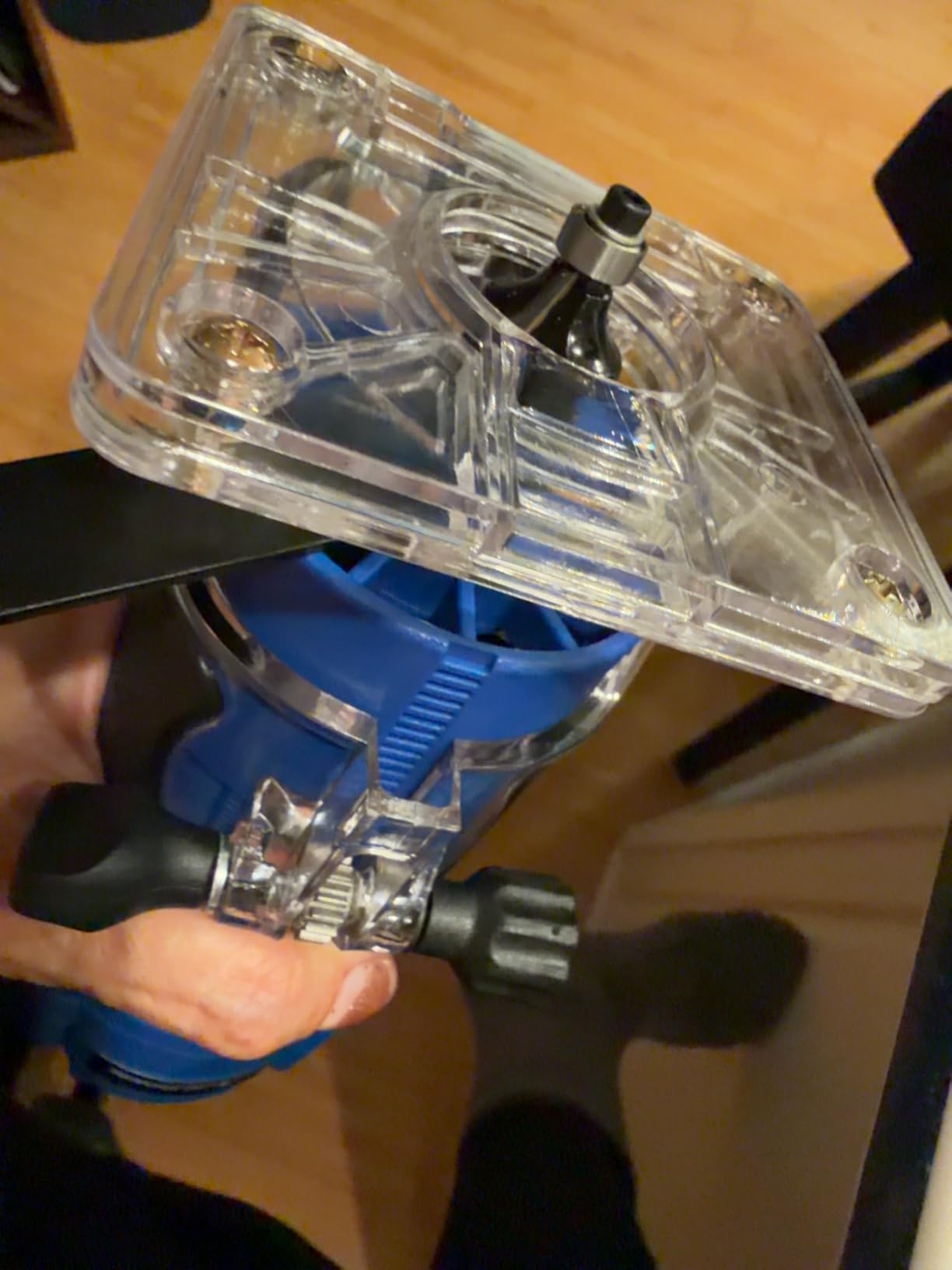
Owners consistently cite low cost, included accessories and speed as the reasons they are happy. For trimming edges on small shop projects and one-off pieces, it does the job without ceremony.
The rating distribution is the weakest in this group, with 67 percent five-star and 12 percent one-star reviews. That is not a reason to avoid it for light work, but it is a reason not to build a whole furniture schedule around it.

What edge work it handles best
Light trimming and hobby routing, including slots, grooves and hinge trimming on thin material. The roller and straight guides let you follow a line without buying anything else.
It also works as a second router. If a premium machine in this list is your main edge tool, having a cheap backup for small cuts keeps the good bit and the good depth settings undisturbed.
Where it disappoints for edge work
The 630W, 5.3 amp motor has less power than the 1.25 HP routers for thick hardwood. Owners who tried to push it on heavier cuts report the motor bogging, which on a finished edge means burning.
All-plastic construction is the least durable in this group, and the included bits and spares are entry-level grade. Keep it on light duty and it will be fine.
How to Trim an Edge Without Chipping or Burning
Most ruined edges are not caused by a bad router. They are caused by a bit that is dull, a pass taken too deep, or a workpiece that was not held properly. Get these seven things right and even a mid-range compact router will produce an edge you are happy to finish.
1. Clamp before you cut, not after. A workpiece that can move will move at the moment the bit engages. Use clamps on both sides of the cut line where possible so the force has somewhere to go that is not into the edge.
2. Choose the bit for the profile you want. A straight bit with a bearing makes a flush trim. A straight bit without a bearing cuts a groove. A roundover bit takes the sharp edge off a table top or shelf front. An ogee builds a decorative S-curve, and a chamfer makes a simple angled break. Edge profiles need multiple bearing cuts, so expect three or four passes rather than one.
3. Sharpen or replace before the first pass. A dull bit pushes rather than cuts, which heats the edge and burns it. It also wants to wander. This is the single highest-value habit in edge work, and it is also why the bundled bits in budget kits get replaced.
4. Set the depth in increments you can see. Start about a sixteenth of an inch proud of the workpiece and work down in several small adjustments. On a dial with fine adjustment, use the fine range. On a coarse rack and pinion, set the depth with a gauge rather than trusting the mechanism.
5. Take multiple shallow passes. Move the router in one continuous, steady motion along the edge. Stopping and starting on an edge is what leaves scallops. If a pass feels like it is labouring, the depth is too great or the speed too low, so raise one of them before cutting deeper.
6. Match speed to bit diameter. A small bit wants higher RPM, a large bit wants lower RPM to stay within the motor’s power. Most of the routers here cover 10,000 to 30,000 RPM or close to it, which is enough range to get this right on any bit you are likely to own.
7. Feed a vacuum where the base allows, then brush the edge anyway. Dust makes the cut line invisible and turns a trim pass into a guess. Where a dust port interferes with your view, route without it and accept the cleanup, as several owners of cordless routers report.
The failure modes map cleanly onto these steps. Chipping usually means a dull bit, zero climb angle or pushing across the grain. Burn marks mean too much depth or too little speed. Tear-out means the base wandered, usually from insufficient workpiece support. A scalloped edge means the feed speed was uneven. None of these are tool faults, and all of them are fixable with technique.
Corded vs Cordless for Edge Trimming
Buy corded if the outlet is near the bench. A corded motor holds speed under load indefinitely, produces more power for the same body size, and never pauses mid-pass because of a battery. For long table edges, stacks of cabinet doors and anything in hardwood, that consistency is worth more than freedom. Cordless tools also carry an ongoing battery cost that a corded router simply does not have.
Buy cordless if the work is away from an outlet or the stock is awkward. A cord crossing the bench while you try to hold a small part at a precise angle is a real hazard and a real source of wandering. Cordless also wins on site work and outdoor trimming, and the platform matters more than the tool: buy into the battery system you already own. GarageJournal forum members make exactly this argument when they pick cordless routers, noting that battery sharing across tools is the deciding factor rather than the router itself.
FestoolOwnersGroup members make the other side of the argument well, noting that corded is simply more reliable over time with no battery to age out of the machine. The unresolved concern about compact routers generally is that a small base gives less workpiece support and can wander; cordless models are often the ones with the smallest bases, so that concern applies more, not less.
Our verdict for edge trimming: corded for the primary bench, cordless for the second bench and for site work. If you can only have one, and the outlet is within reach of your bench, choose corded.
Can a Plunge Router Do Edge Work?
Yes, a plunge router can trim edges, but for most edge work a fixed base is the better tool. A plunge mechanism exists to take depth in a single controlled downward pass, which is what you need when cutting a dado or a groove into the face of a board. On an edge, you already have a natural reference: the base running along the side of the workpiece.
The case for owning a plunge base on a compact router is specific. It lets you cut grooves, dados and housing without switching tools, and it gives you a second way to approach a stopped groove. The case against is the slop that shows up in owner reports, where a lot of routers leave divots on the first plunge because the mechanism has play in it, a complaint raised on r/Tools. On a visible finished edge, that first-plunge divot has to be sanded out.
An offset base is the one base worth adding specifically for edges. It moves the motor to one side so the bit can reach an inside corner where a standard base physically cannot. A tilt base is useful for bevels and for working on the face of a thick slab. Neither is a replacement for good depth adjustment on a fixed base, which remains the first thing to get right.
So: if your edge work is flush trimming and profiling, a fixed base with a precise depth system is all you need. Buy the plunge, offset or tilt bases later, and only for the specific job that demands one.
How to Choose a Compact Router for Edge Trimming
Before choosing, be clear about what a 1/4-inch collet router can and cannot do. The consensus on r/woodworking is that trim routers with a 1/4-inch collet are mainly for edge work, and that is the honest description. Edges, dados, grooves, hinge mortising and template work are all within reach. Heavy shaping, large joinery and 1/2-inch shank work are not. If that is your shop, you need a mid-size router instead.
Depth adjustment precision comes first. This is the most-cited quality differentiator among experienced users, and the reason DEWALT and Makita routers lead roundups across multiple independent forums. Look for a rack and pinion system with a real fine adjustment, or a twist ring with a lock. Avoid mechanisms that need a gauge to trust.
Speed range decides how many passes you need. A wide range from around 10,000 to 30,000 RPM lets you run a small bit fast for a finish cut and a large bit slow to stay within the motor’s power. Single-speed tools are fine for the work they were designed for and frustrating outside it.
Base visibility and footprint matter more than horsepower. A clear base lets you trimmer the edge instead of plunge-and-dragging, which is the difference between a clean cut and tear-out. An offset palm design puts the motor over the workpiece and steadies a thin part. This is also the honest answer to the small-base support concern: the fix is a better-shaped base, not more power.
Guides decide straightness. An edge guide, roller guide or trim guide is what lets a handheld router hold a line on a long edge. Some routers include them, and among those that do, the AVID POWER MW104 and WORKPRO kit are the most complete. A template guide is worth having later for guided work.
Check what is in the box beyond the router. A bare cordless tool needs a battery and a charger in a separate ecosystem you may already own. A bare fixed-base router may not include a dust port, a guide or a light, each of which changes how well it handles edges. Cordless battery platform compatibility is the factor that decides cordless purchases more often than the router itself does.
Know when a router is overkill. If all you need is to take the sharp edge off a board or a small shelf, a hand plane, a sanding block or a file will do it faster and with no cord, dust or noise. Compact routers earn their place when you start flush trimming laminate and veneer, cutting hinges, or profiling cabinet parts. If that is not on your list, save the money.
On durability, warranty length is treated by owners as a rough proxy for build quality, with three years on some premium models against one year on others. It is not a perfect signal, but it is one more data point alongside the rating spread and the volume of reviews.
Frequently Asked Questions
What is the best router for trimming?
For most people trimming laminate, veneer and cabinet edges, the best choice is a compact router with a precise fixed base and a speed dial. Our pick is the DEWALT DCW600B for cordless work and the Makita RT0701C for corded work, because both hold a depth setting through repeated shallow passes.
Is a compact router the same as a trim router?
Yes. Compact router, trim router and palm router all describe the same category of small handheld woodworking router with a 1/4-inch collet and a small flat base. Palm router emphasises how the tool is held, and laminate trimmer is usually the cheapest model built for one specific job on laminate.
Are compact routers worth it?
They are worth it once you are flush trimming laminate, cutting hinges, routing dados or profiling cabinet edges, because they are lighter and cheaper than a full-size router. If you only need to break a sharp edge on a board, a hand plane, sanding block or file will do it faster.
What router tool can I use to round edges?
Use a roundover router bit in any compact router with a 1/4-inch collet. Start with a small radius and work up in steps, taking several shallow passes rather than one deep cut. Match the router speed to the bit diameter and keep the workpiece clamped.
Can a plunge router do trim and edge work?
A plunge router can trim edges, but a fixed base is usually better for flush trimming and profiling because the base running along the workpiece edge is the reference. The plunge base earns its place on dados, grooves and stopped work, not on finished edges.
Are corded or cordless routers better?
Corded is better at a fixed bench because the motor holds speed indefinitely and never pauses mid-pass. Cordless is better away from an outlet and on awkward small stock, and the battery platform you already own often decides the purchase more than the router itself.
Who makes the best corded trim router?
DEWALT and Makita are the two most frequently recommended corded trim routers across woodworking forums, with Bosch the long-standing choice for small bits and precise detail work. In this comparison the DEWALT DCW600B leads on overall rating and review volume, and the Makita RT0701C on depth adjustment precision.
Which Compact Router for Which Edge Job
For the widest set of edge jobs, start with the DEWALT DCW600B. Its brushless motor, variable speed and dual LEDs handle laminate, veneer and solid wood edges in a shop where the outlet is inconvenient, and the volume of owner feedback behind it is unmatched in this list.
For a bench with power close by, the Makita RT0701C is the answer. The rack and pinion depth system is the most-cited precision advantage in woodworking forums, and at 1-1/4 HP it has the headroom for hardwood and metal edges that the 1 HP machines lack.
For small bits, curved edges and detail profiles, the Bosch PR20EVS Colt remains the forum favourite. For flush trimming on thin stock, the Bosch GKF12V-25N wins on weight and offset balance alone. For value and included accessories, the AVID POWER MW104 gives you both guide types in the box.
That is the short version of our best compact routers for edge trimming in 2026. Whichever one you pick, the difference between a good edge and a ruined one comes down to a sharp bit, shallow passes, and a base that stays where you put it. Get those right and any of the ten on this list will do the job.