
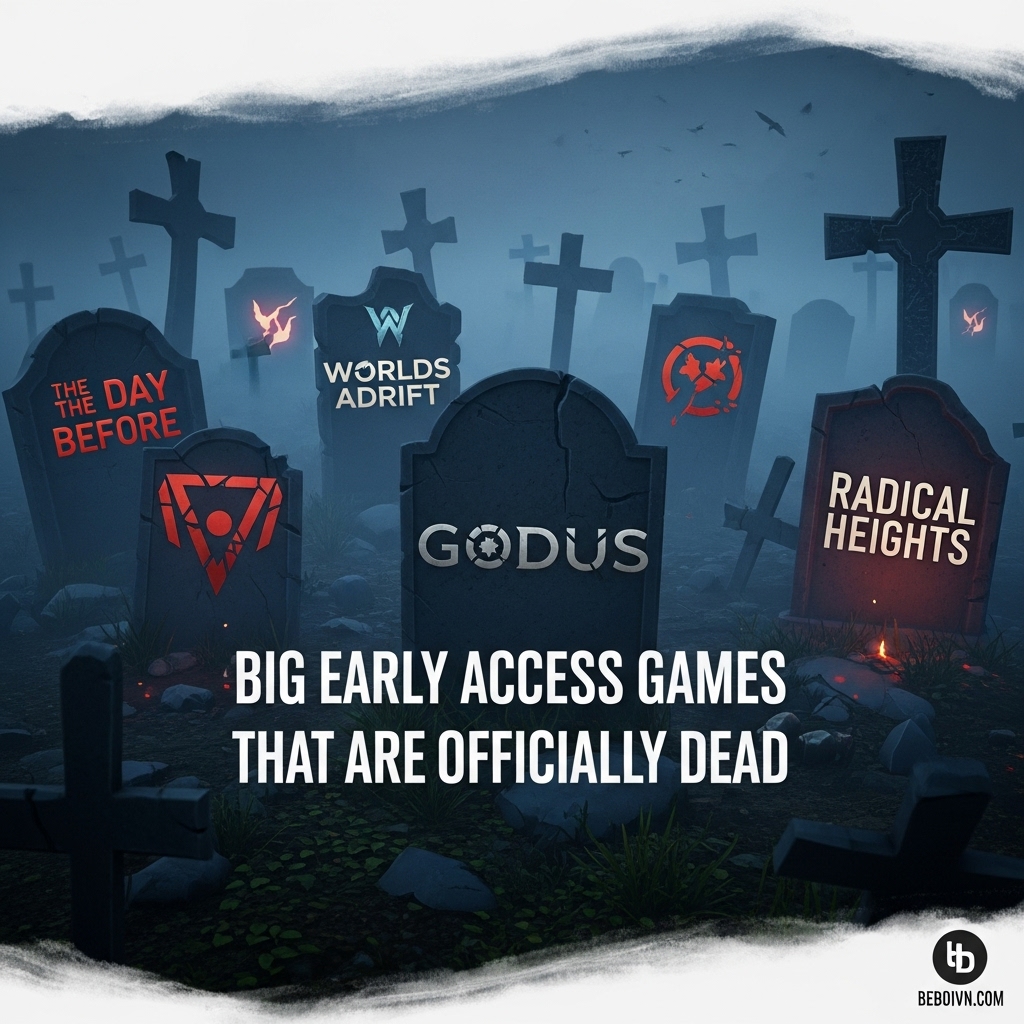
Steam Early Access has revolutionized game development, allowing developers to fund projects through community support while giving players early access to promising titles. Games like Hades, Subnautica, and Valheim prove that this model can lead to incredible success stories. However, for every triumph, there’s a tragedy lurking in the shadows. The digital graveyard is filled with big Early Access games that are officially dead, abandoned by developers who couldn’t deliver on their ambitious promises.
The concept of Early Access was brilliant: let players help shape games while providing crucial funding. But what happens when developers bite off more than they can chew? When ambitious dreams collide with harsh reality? The result is often a trail of broken promises, angry customers, and games that vanish into the digital ether, leaving behind nothing but cautionary tales.
Let’s explore some of the most notable casualties in the Early Access cemetery and understand what went wrong.
The Day Before: The Most Spectacular Failure in Gaming History
No discussion of failed Early Access games would be complete without mentioning The Day Before. This zombie survival MMO promised everything gamers could want: a massive open world, cooperative gameplay, stunning graphics, and innovative mechanics. The hype machine was working overtime, with millions of wishlists on Steam and anticipation reaching fever pitch.
When The Day Before finally launched into Early Access in December 2023, it immediately became one of the biggest gaming disasters in recent memory. The game that was promised bore little resemblance to the product players received. Missing features, game-breaking bugs, and a complete lack of the promised MMO elements led to an almost unprecedented 1/10 review score from IGN.
Just four days after launch, developer Fntastic announced they were shutting down the game and closing the studio. “The Day Before has failed financially, and we lack the funds to continue,” they stated in a social media post. The studio blamed overly ambitious goals, a low indie budget, and a team with no AAA experience for the catastrophic failure.
What makes The Day Before particularly egregious is how it represents everything wrong with modern game marketing. The developers showed trailers and screenshots that were essentially lies, building hype for a game they clearly couldn’t deliver. It’s become the poster child for Early Access failures and a cautionary tale that will be studied for years to come.
Worlds Adrift: When Ambition Outweighs Viability?
Worlds Adrift was one of the most ambitious concepts ever to hit Early Access. Developed by Bossa Studios (creators of Surgeon Simulator), this MMO sandbox promised a world of floating islands where players could build physics-based airships and explore a universe permanently changed by player actions.
The game entered Early Access in July 2017 with incredible promise. The Island Creator tool allowed players to design their own floating islands, and the physics-based ship building system was revolutionary. Players could harvest resources and construct airships of any size and shape, with real physics affecting everything from fuel consumption to handling based on ship design.
However, the ambitious technical requirements became the game’s undoing. The servers and technology required to run the persistent physics-based world demanded massive ongoing costs that Bossa Studios simply couldn’t sustain. On July 26, 2019, Bossa announced they were shutting down Worlds Adrift, citing that the game was “no longer commercially viable.”
The community was devastated, but many understood the business reality. Worlds Adrift was simply too ambitious for its time, requiring more resources than an indie studio could reasonably provide. It stands as a tragic example of how innovation sometimes outpaces practicality in game development.
Godus: Peter Molyneux’s Broken Promises
Few developers have fallen from grace as dramatically as Peter Molyneux. Once hailed as a visionary genius behind classics like Black & White and Fable, Molyneux’s reputation took a massive hit with Godus. Marketed as a true “God game” that would reinvent the genre, Godus promised evolving civilizations, player-driven outcomes, and ongoing updates shaped by community input.
The game was heavily promoted following the success of Molyneux’s Curiosity – What’s Inside the Cube? experiment. Players were promised that their involvement would shape the game’s development, with long-term updates and features that would evolve based on community feedback.
Instead, Godus became synonymous with broken promises. Updates slowed to a trickle, developer communication ceased, and the game remained in a perpetual state of “almost finished.” By 2016, the game was effectively abandoned, with the lead designer fired and 22cans (Molyneux’s studio) moving on to other projects.
What makes Godus particularly painful is that it came from a developer with such a storied history. If Peter Molyneux couldn’t deliver on his Early Access promises, what hope did other developers have? Godus remains one of the most cited examples of Early Access failure and played a significant role in Steam implementing stronger warnings about abandoned games.
Radical Heights: The Battle Royale That Never Stood a Chance
In the wake of Fortnite’s massive success, every developer wanted a piece of the battle royale pie. Radical Heights, developed by Boss Key Productions (led by Cliff Bleszinski), was one of the most prominent attempts to cash in on the trend.
What made Radical Heights unique was its 1980s game show aesthetic, complete with trampolines, cash prizes, and over-the-top action. The game was notable for being developed in just six months and launched as a free-to-play title in April 2018.
However, Radical Heights suffered from what can only be described as catastrophic timing. The game launched directly into the teeth of Fortnite’s Season 4 update, which introduced superhero-themed content that dominated gaming news and player attention. Within days, Radical Heights’ player count plummeted to single digits.
The game was shut down just three months later in July 2018, when Boss Key Productions closed its doors. Radical Heights serves as a perfect example of how timing and market saturation can doom even the most promising concepts. In the battle royale gold rush, Radical Heights was just another casualty.
The Culling: When Bad Timing Strikes Twice?
The Culling has the unfortunate distinction of failing not once, but twice. Originally developed by Xaviant, The Culling was a battle royale game that actually predates Fortnite’s battle royale mode. It launched in Early Access in 2016 and showed promise with its unique take on the genre, featuring smaller player counts and more intimate combat.
However, The Culling suffered from terrible timing. Just as it was gaining traction, PlayerUnknown’s Battlegrounds (PUBG) exploded in popularity, followed shortly by Fortnite. The Culling couldn’t compete with these giants, and player interest dwindled.
In a bizarre twist, Xaviant decided to release The Culling 2 in 2018, skipping Early Access entirely and launching as a finished product. The sequel was immediately criticized for being an unfinished, buggy mess. To make matters worse, its release coincided with yet another major Fortnite season update, ensuring it would be completely overshadowed.
The Culling 2’s player count dropped so dramatically that it was shut down within months, while the original game languished in Early Access purgatory before eventually being abandoned. It’s a rare case of a franchise failing twice in spectacular fashion, both times due to poor timing and market conditions.
Folk Tale: The Beautiful Game That Time Forgot
Folk Tale is perhaps one of the most tragic entries on this list. Developed by Games Foundry, this charming city-building game with RPG elements showed tremendous promise when it entered Early Access in 2013. The game featured beautiful hand-painted graphics, engaging gameplay mechanics, and a unique blend of genres that set it apart from other Early Access titles.
For several years, Folk Tale received regular updates and maintained a dedicated community. Players praised its art style, humor, and innovative approach to the city-building genre. However, updates began to slow in 2016, and by 2017, the developer had gone completely silent.
The game’s official website was taken down, and no further updates were forthcoming. Despite being still available for purchase on Steam (until it was eventually delisted), Folk Tale was effectively abandoned. The developer’s disappearance remains a mystery to this day, with no official announcement about the game’s status.
What makes Folk Tale particularly heartbreaking is that it was genuinely good and showed real potential. Unlike many failed Early Access games that were clearly scams or poorly conceived, Folk Tale was a labor of love that simply ran out of steam. It serves as a reminder that even the most promising projects can fall victim to development hell and vanish without a trace.
DayZ: The Five-Year Journey to Nowhere
DayZ is a fascinating case study in Early Access longevity versus player patience. Originally a mod for ARMA 2, DayZ pioneered the survival genre that would later spawn countless imitators. When it launched as a standalone Early Access title in 2013, it was met with massive enthusiasm and sold millions of copies within weeks.
However, what followed was one of the longest and most troubled development cycles in gaming history. DayZ remained in Early Access for over five years, plagued by constant bugs, poorly implemented systems, and a development pace that could charitably be described as glacial.
When DayZ finally reached version 1.0 and left Early Access in 2018, the gaming community had largely moved on. Games like PUBG and Fortnite had taken the spotlight, and the survival genre had evolved significantly. The DayZ that finally launched felt dated and incomplete, failing to live up to the promise shown years earlier.
While DayZ technically “finished” and continues to receive updates, it’s widely considered a failure in terms of meeting player expectations. The five-year Early Access period killed much of the enthusiasm and player base, making it a cautionary tale about how prolonged development can destroy even the most promising concepts.
Atlas: The Pirate MMO That Sank Under Its Own Weight
Atlas, developed by Grapeshot Games (a sister studio to Ark: Survival Evolved’s Studio Wildcard), promised to be the ultimate pirate MMO. With massive servers supporting hundreds of players, naval combat, base building, and exploration of a vast ocean world, Atlas had ambitions that were truly staggering.
The game launched into Early Access in December 2018 and immediately suffered from catastrophic technical issues. Server problems, rampant cheating, game-breaking bugs, and performance issues plagued the title from day one. Despite regular updates and patches, the core problems remained unfixed.
What makes Atlas particularly frustrating is that it had genuine potential. The concept of a large-scale pirate MMO was exciting, and when the game worked, it could be incredibly fun. However, the developers seemed more interested in adding new content rather than fixing fundamental issues, leading to a player base that gradually abandoned ship.
Today, Atlas continues to receive updates, but it’s a shadow of its former self. The player count is a fraction of what it was at launch, and the game serves as another example of how ambition without proper execution leads to failure in the Early Access space.
Why Do These Big Early Access Games Fail?
Looking at these spectacular failures, several common patterns emerge:
1. Overpromising and Underdelivering: Many failed Early Access games promise the moon but can barely deliver a pebble. The Day Before is the most extreme example, but others like Godus and Atlas also made promises they couldn’t keep.
2. Technical Ambition Outpacing Resources: Games like Worlds Adrift and Atlas had revolutionary concepts that required technical solutions beyond their developers’ capabilities or budgets.
3. Poor Timing: Radical Heights and The Culling both fell victim to releasing alongside massive Fortnite updates, ensuring they would be completely overshadowed.
4. Development Hell: DayZ’s five-year Early Access period shows how prolonged development can kill player enthusiasm and leave a game feeling dated upon release.
5. Lack of Communication: Many failed games simply stop communicating with their community, leaving players in the dark about development progress or problems.
6. Market Saturation: The battle royale genre saw numerous casualties as games tried to compete with established giants like Fortnite and PUBG.
The Future of Early Access: Lessons Learned
These failures haven’t gone unnoticed by Valve or the gaming community. Steam now implements warnings for Early Access games that haven’t been updated in months, helping potential buyers make more informed decisions. The community has also become more skeptical, with players being more cautious about which Early Access titles they support.
However, Early Access remains a vital part of the gaming ecosystem. Without it, we wouldn’t have masterpieces like Hades, Subnautica, or Valheim. The key is finding a balance between ambition and realism, between innovation and execution.
For developers, the lessons are clear: be honest about your capabilities, communicate regularly with your community, and don’t promise what you can’t deliver. For players, the lesson is to approach Early Access with cautious optimism, understanding that not every game will reach its full potential.
Conclusion: The Graveyard of Broken Dreams
The world of Early Access gaming is filled with both triumphs and tragedies. While success stories like Hades and Valheim show what’s possible when the model works, failures like The Day Before and Worlds Adrift serve as stark reminders of what can go wrong.
These big Early Access games that are officially dead represent more than just failed software – they’re broken promises, wasted potential, and cautionary tales that will influence game development for years to come. They remind us that in the world of gaming, ambition without execution is just a dream, and that even the most promising concepts can sink under the weight of their own aspirations.
As we move forward, both developers and players would do well to remember these lessons. The graveyard of failed Early Access games grows larger every year, but with each failure comes valuable knowledge that can help shape the future of game development. After all, every success story is built on the foundation of past failures.