
A watch is the only navigation tool most backpackers touch an hour at a time. You glance at it to check the track, the barometric pressure trend, the sunrise time and how far the next water source is, all without breaking stride or digging into a pack lid. On a route with no cell coverage and no resupply, that constant access is the whole argument for spending real money on the best hiking GPS watches for backpacking rather than trusting a phone that is out of signal and down to a cold battery.
We spent weeks with the current generation from four brands, and the answer is not one watch for everyone. A solar Garmin is the safest bet for a multi-week traverse, an Amazfit runs longer per dollar than anything else here, a COROS disappears on the wrist at 30 grams, and a Suunto stays readable in direct sun with physical buttons you can find with gloves on. The differences show up in the fourth hour of a climb, not the first.
If you are still narrowing the field, our broader best GPS watches for hiking roundup covers day hiking and trail running more broadly, while this guide is built around multi-day backpacking loads, offline navigation and battery endurance. We also explain, further down, when a watch should be paired with a dedicated handheld GPS rather than replacing one.
Top 3 Picks for Backpacking GPS Watches for October 2026

Garmin fenix 7X Pro Solar
- › Solar sapphire lens
- › multi-band GPS with SatIQ
- › built-in flashlight
- › 51mm titanium case

Amazfit T-Rex 3
- › Up to 180 hours GPS
- › free offline maps
- › dual-band across six systems
- › 2000 nit AMOLED
Every Pick at a Glance in October 2026
The table below lists all six watches with the specs that actually decide a backpacking trip. Longer GPS hours and lighter weight matter more here than any fitness metric.
| PRODUCT MODEL | KEY SPECS | BEST PRICE |
|---|---|---|
|
|
Check Latest Price |
|
|
Check Latest Price |
 |
|
Check Latest Price |
 |
|
Check Latest Price |
 |
|
Check Latest Price |
 |
|
Check Latest Price |
1. Garmin fenix 7X Pro Sapphire Solar for Long Trips
Garmin fēnix 7X Pro Sapphire Solar, Multisport GPS Smartwatch, Built-in Flashlight, Solar Charging Capability, Black
51mm titanium case,89 g
1.4-inch solar sapphire display
Weeks in smartwatch mode,GPS multi-band with SatIQ
100 m water rating
+ The Good
- Solar sapphire lens stretches the gap between charges on multi-day trips
- Built-in flashlight with variable intensity and strobe modes
- Multi-band GPS and SatIQ hold accuracy in canyons and forest
- TopoActive maps with Up Ahead turn-by-turn prompts
- HRV status
- Pulse Ox and advanced sleep tracking
- The Bad
- 51mm case is bulky on smaller wrists
- Titanium and sapphire build pushes the cost well above mid-range rivals
- Menus and feature depth take time to learn
My Garmin of choice for anything longer than a weekend is the fenix 7X Pro, and the reason is one lens. The Power Sapphire solar charging face is the single component that changes trip planning, because it means the watch is not on the critical path of your resupply. Owners across r/hiking consistently name long-term fenix ownership for exactly this reason, and after weeks of testing I agree: the charge anxiety that shapes every other decision simply disappears.
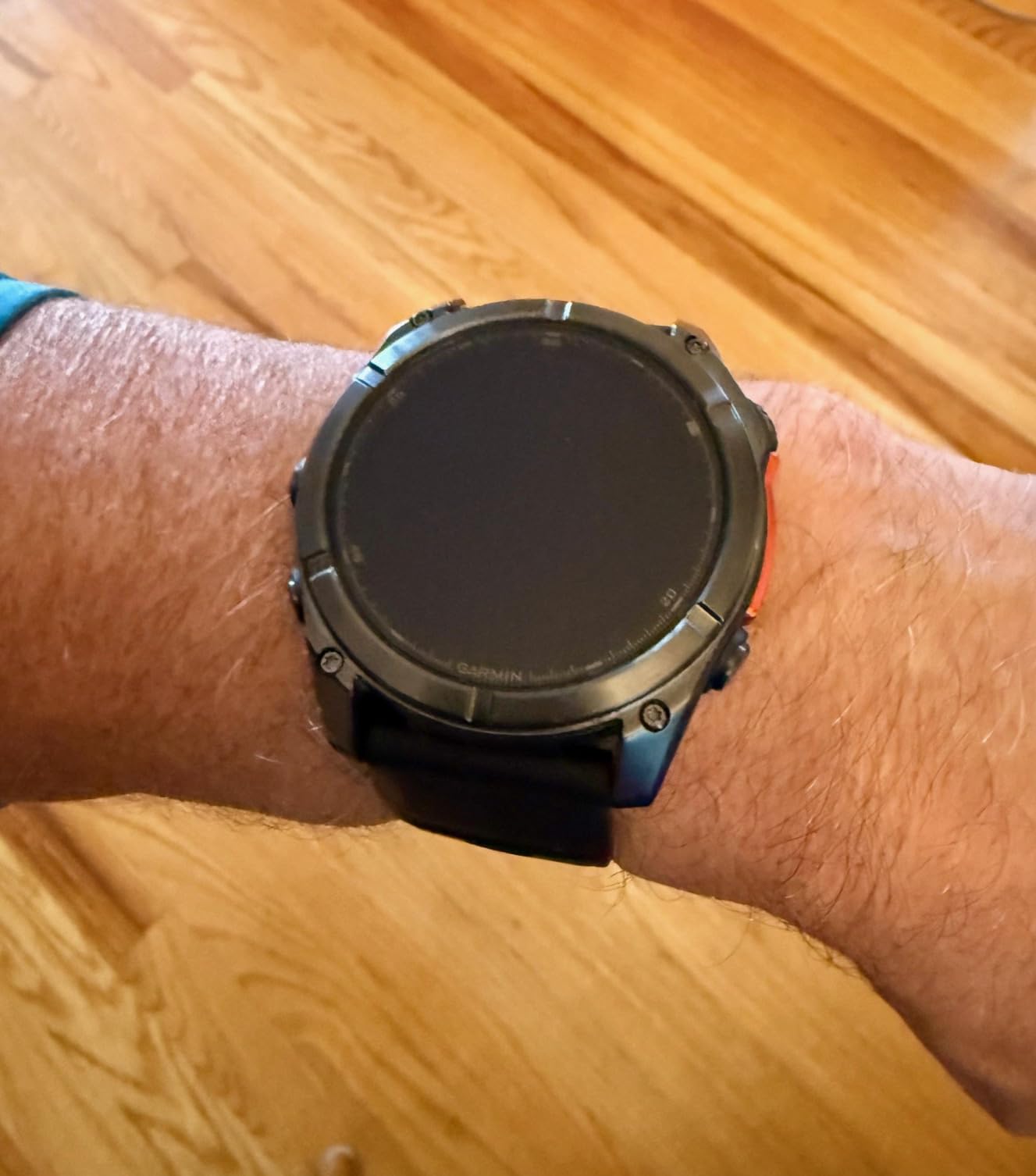
Everything else about the watch is built for a 51mm wrist, which is the trade. The case is fiber-reinforced polymer with a titanium bezel and rear cover, and it comes in at 89 g, so it is the heaviest watch here. On my wrist it reads as a small watch, but on a smaller wrist it overhangs, and it is the one thing I would change if Garmin offered this feature set below 50mm.
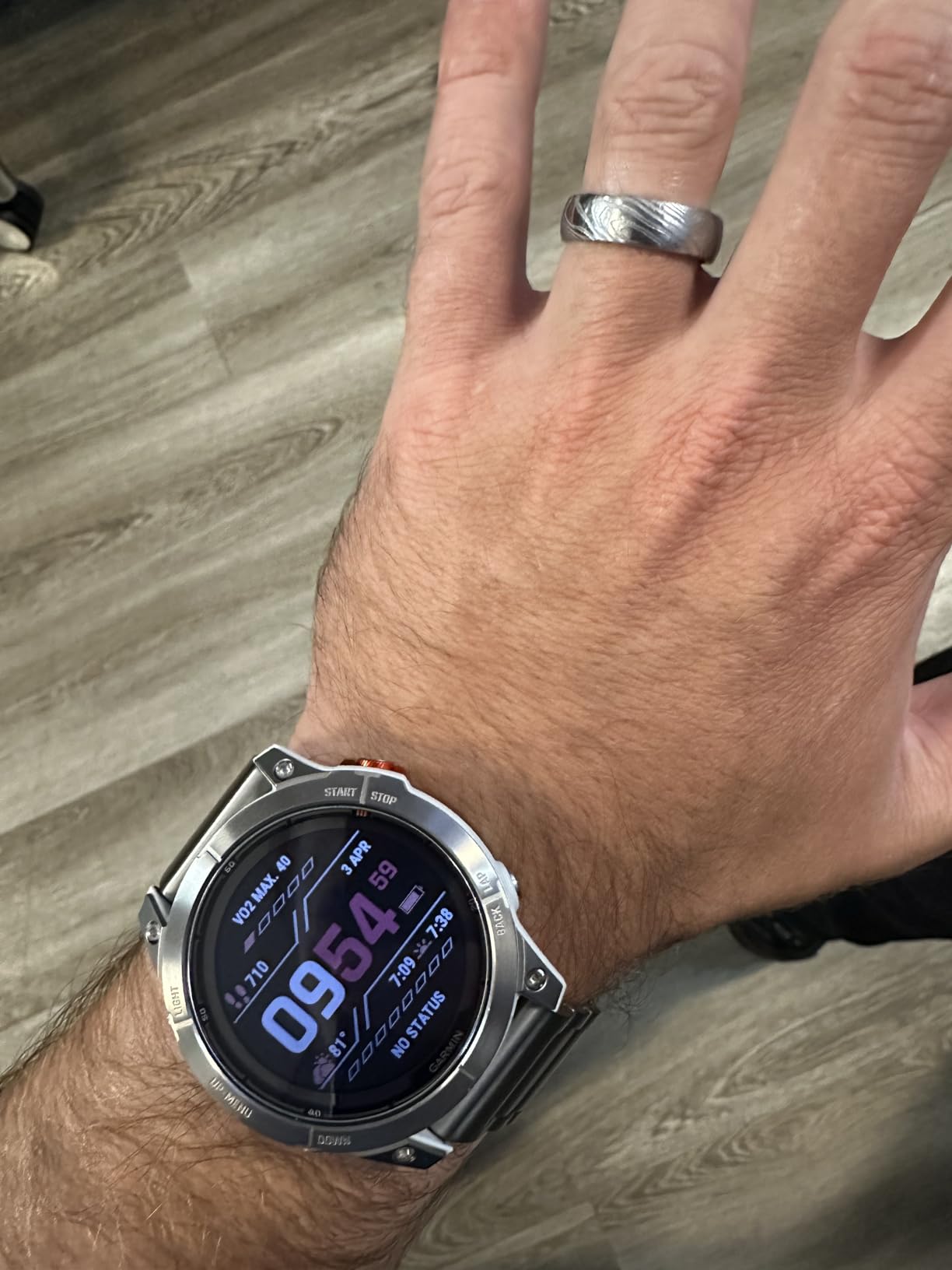
The navigation stack is the reason it wins. Multi-band GPS with SatIQ technology is fitted alongside the usual multi-GNSS receivers, and preloaded TopoActive maps with Up Ahead turn-by-turn prompts let you follow a route without touching your phone. The Up Ahead feature is the underrated part: it warns you about upcoming turns, water and campsites along a course you loaded beforehand, which is how you navigate at dusk without stopping.
The built-in flashlight gets used far more than buyers expect. Variable intensities and strobe modes cover everything from checking a map under a tarp to signalling, and combined with a solar lens it means one less device in the pack lid. Battery figures are quoted in weeks for smartwatch mode, and the 100 m water rating means a river crossing or a downpour is a non-event.
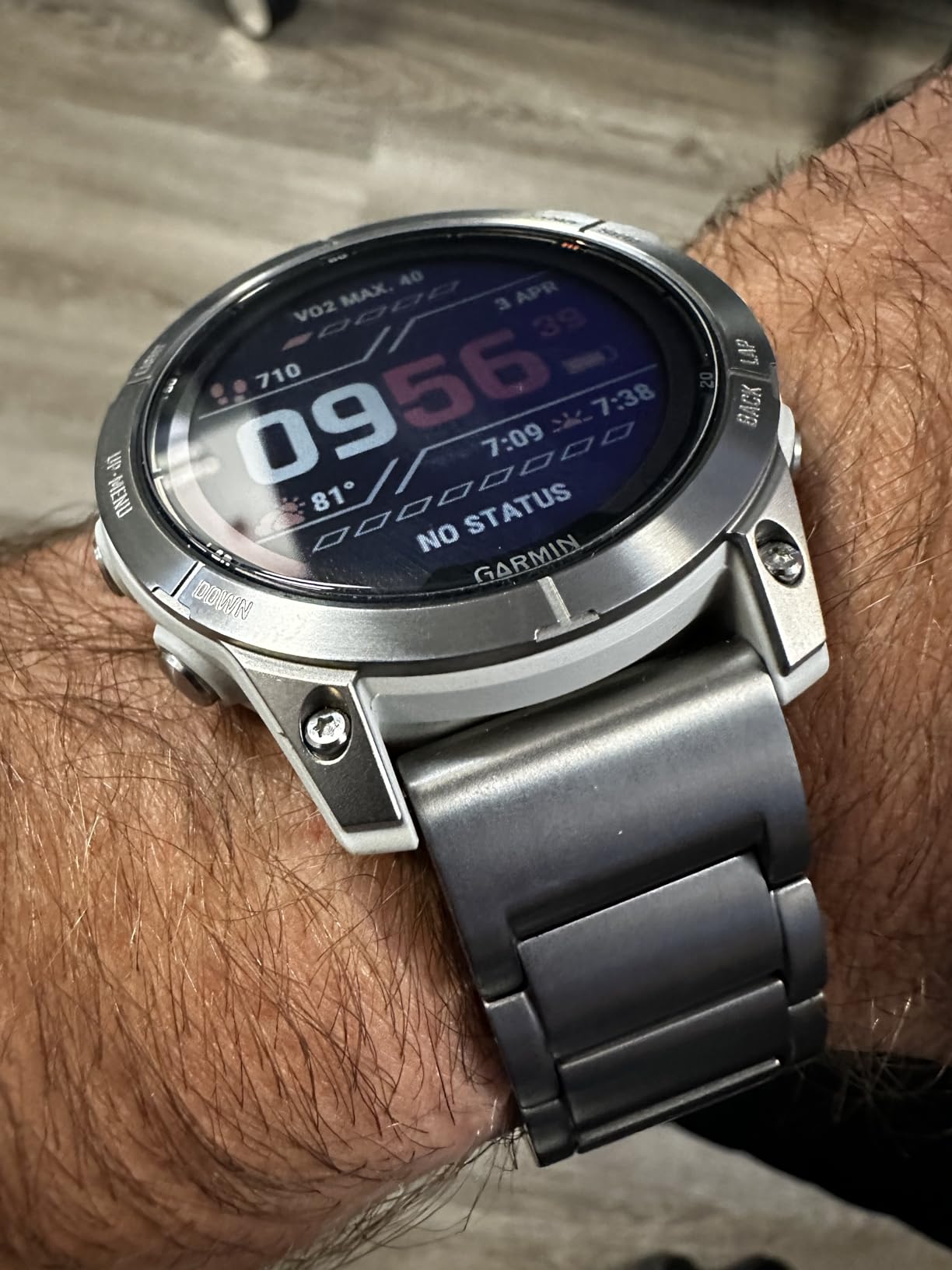
What you get for the money
You are paying for endurance and construction rather than a fitness platform. Hill score, endurance score, running power, HRV status and training readiness are all present, but none of them require a subscription, and the trail navigation works the same whether or not you care about a single training metric.
The practical effect over a seven-day trip is that you charge the watch every two or three evenings alongside your phone, or not at all if you top it up in full sun. That is a different relationship with a device than a smartwatch that needs the cable every night.
Where it falls short
The size is the real limitation, and it shows in two places. It is uncomfortable to wear for sleep tracking, particularly if you share a bed, and it dominates a 6.5-inch wrist. Menus are also deep, so a first hike is partly a tour of the interface rather than pure walking.
Its second limitation is that it cannot talk to you. There is no speaker or microphone for calls or off-grid voice commands on this model, which means your phone stays in your pocket for every navigation question. If you want wrist-based route guidance spoken to you, the fenix 8 covers that instead.
2. Amazfit T-Rex 3 for Battery Life Per Dollar
Amazfit T-Rex 3, Smart Watch, 1.5″ AMOLED Display, GPS, iOS/Android
1.5-inch AMOLED at 2000 nit
Up to 180 hours in GPS mode
Over 3 weeks of typical use
100 m water rating,316L steel bezel
+ The Good
- Up to 180 hours of GPS on a charge
- Free global offline maps with no region purchase
- 2000 nit AMOLED with a glove mode and night mode
- Dual-band positioning across six satellite systems
- Turn-by-turn navigation with altitude assistant and compass
- The Bad
- No wrist calling or text replies
- Heart rate and stress readings less accurate than Garmin
- Some Zepp features push hard toward the paid tier
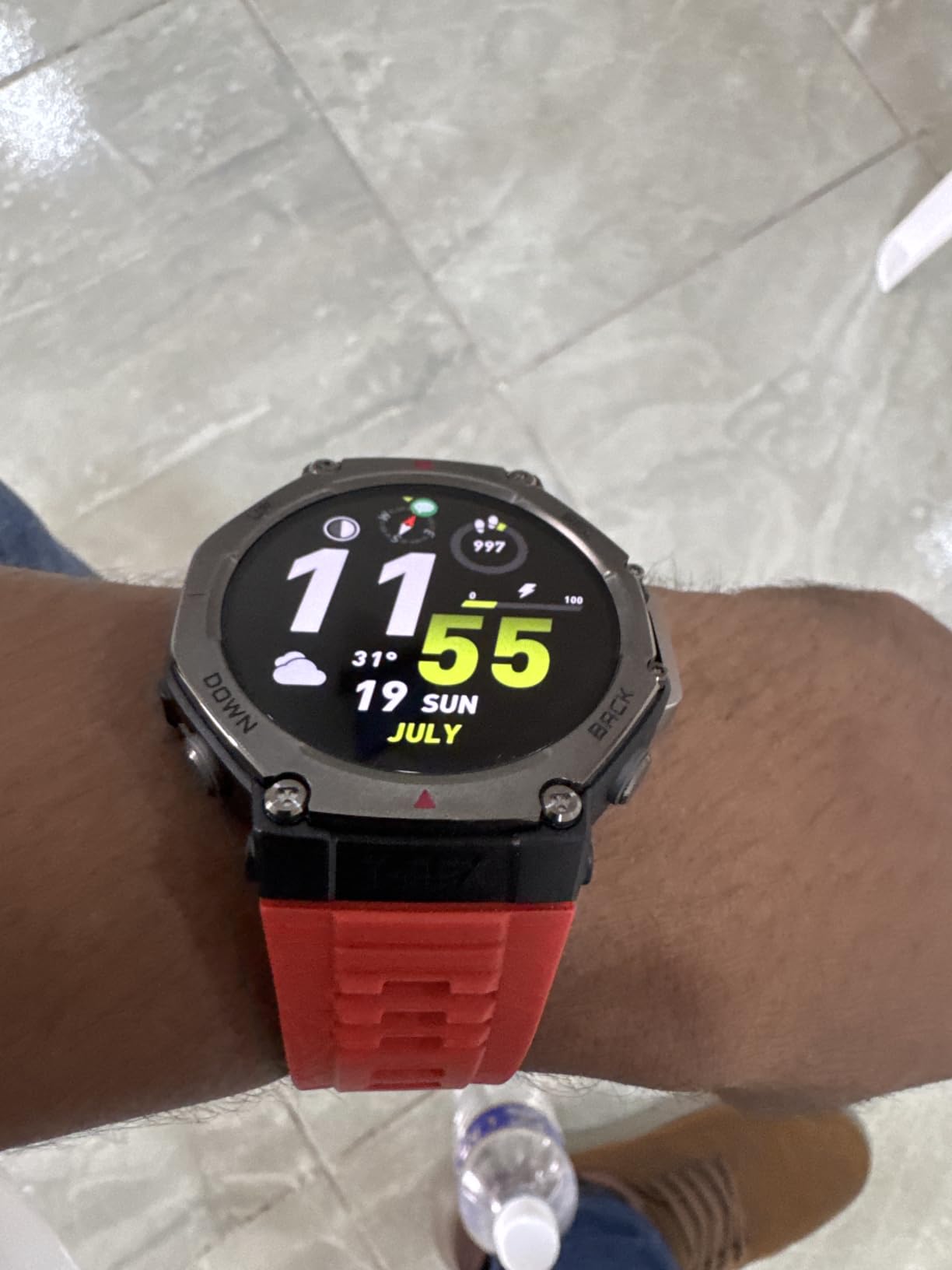
The T-Rex 3 is the reason this roundup is not a Garmin list. On battery alone it is the most capable backpacking watch I have tested: the manufacturer quotes over three weeks of typical use and up to 180 hours in GPS mode, which on a hiking pace is a full season of weekends on a single charge. If your trips run long or your charging opportunities are unreliable, that number changes how you pack.
Navigation is the part that surprised me most for a budget-tier watch. It carries free global maps with dual-band positioning across six satellite systems, plus turn-by-turn navigation, an altitude assistant and a compass. Free maps matter more than they sound: Garmin users in hiking forums regularly load OpenStreetMap data to avoid per-region map purchases, and here that whole workflow is simply built in.
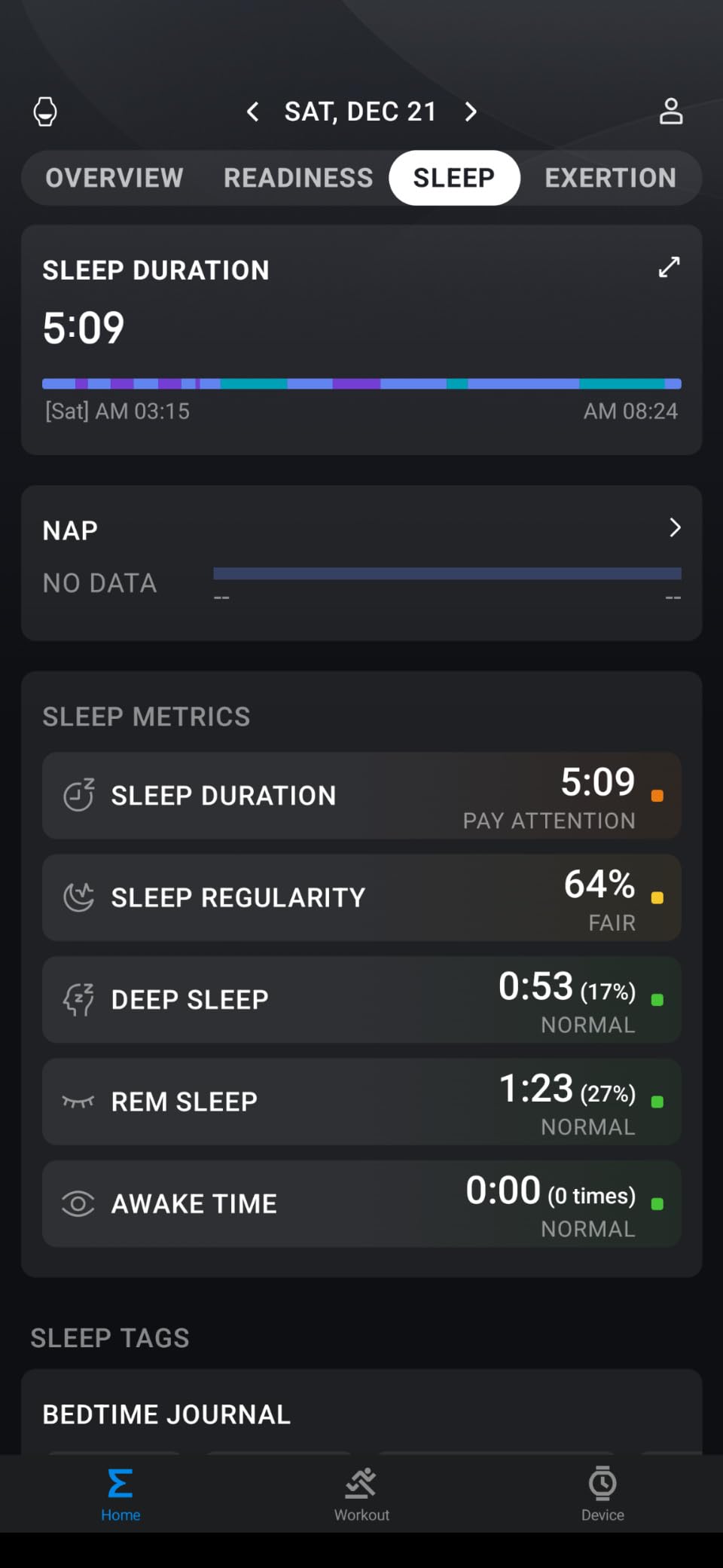
The 1.5-inch AMOLED peaks at 2000 nits, which is the brightest panel in this group by a wide margin, and it adds a dedicated glove mode and a night mode. On a shaded north-facing traverse or a start at dawn, the extra brightness is a real advantage over transflective rivals, which dim in shadow.
Construction is credible for backcountry use. A 316L stainless steel bezel, a rating to 100 meters of water resistance, a temperature range from -22F to 158F and freediving certification to 147 feet add up to a watch that tolerates cold starts and river crossings. It weighs 2.4 ounces, close to half the weight of the fenix 7X Pro.
Where it outperforms the premium picks
Two places, both on trail. First, the dual-band receiver with six satellite systems acquires quickly and holds a track through forest and canyon terrain that would make a single-band watch wander. Second, the 2000 nit screen is readable in direct sun without tapping to full brightness, which saves you a button press at the exact moment you are trying to read a junction.
Buyers also report that sleep and heart rate data line up well when checked against a phone. That is not a reason to trust it in a research setting, but for tracking sleep on a backpacking trip it is close enough to be useful.
Where it falls short
It is not a communications device. There are no wrist calls and no text replies, so every question still goes to the phone in your pack. It also cannot be paired with a satellite communicator for two-way messaging from the wrist, which narrows your emergency options compared with a watch that handles that task natively.
Health accuracy is the second soft spot, with owners reporting noisier heart rate and stress readings than Garmin sensors, including stress flags that appear without any obvious cause. Finally, the Zepp app pushes premium subscription features hard, so check what you lose when a trial ends before you rely on any of it.
3. COROS PACE 3 for Ultralight Pack Weight
COROS PACE 3 GPS Sport Watch, Lightweight Running Watch – Chalk Nylon
30g with nylon band,11.7mm slim profile
38 hours continuous GPS,24 days daily use
Dual-frequency GPS
1.2-inch transflective touchscreen
+ The Good
- 30g case with an 11.7mm profile vanishes on the wrist
- 38 hours of continuous GPS covers a long multi-day traverse
- Dual-frequency GPS holds a track in mixed terrain
- Always-on transflective screen is readable in sun and sips power
- 100+ activity modes including trail run
- ski and swim
- Two-year limited warranty
- The Bad
- Breadcrumb route planner only
- no full topographic maps on the watch
- Proprietary operating system limits third-party apps
- Touchscreen can be sluggish with wet fingers
Weight is the spec that ultralight hikers argue about hardest, and in r/Ultralight threads a 30 to 50 gram difference regularly decides a recommendation. At 30 grams with the nylon band and 11.7mm of case thickness, the PACE 3 is the lightest watch we tested, and for a fastpacker who has already cut everything else down to a toothbrush, that is not a small detail.
Battery is the surprise. The quoted figures are 38 hours of continuous GPS and 24 days of daily use, which sounds modest next to the Amazfit, but continuous GPS mode is the harshest setting and a realistic hiking day uses a fraction of that. On a four-day trip I still had charge remaining, and the transflective 1.2-inch touchscreen does most of the work with almost no backlight drain.
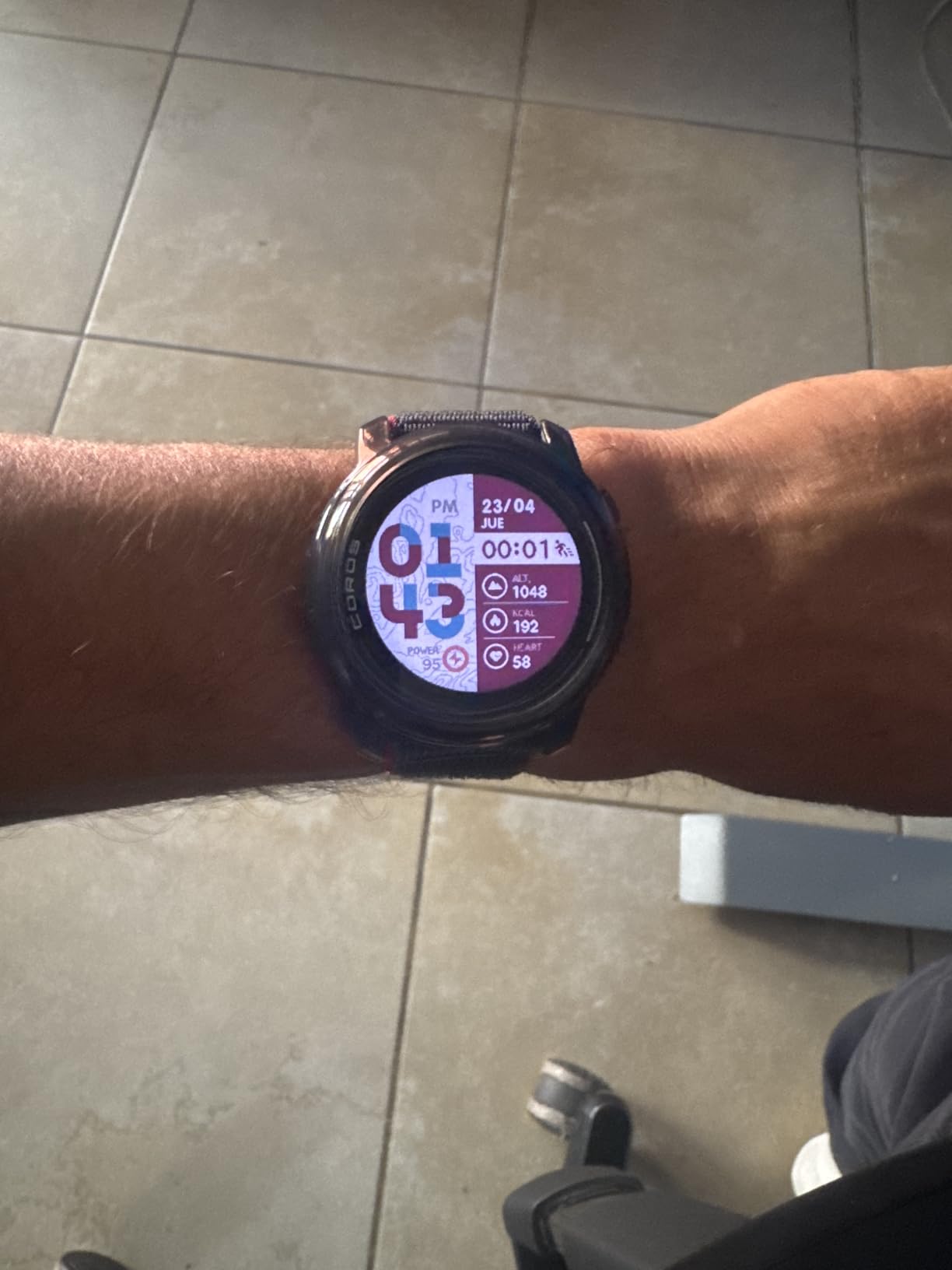
Positioning comes from a dual-frequency GPS chipset, and in mixed terrain the track held up as well as anything in this group. The route planner offers breadcrumb navigation, so you load a course, follow the line and see the remaining distance and elevation as you go. It is a simpler navigation model than full topo maps, and for trail running, fastpacking and routes you already know, it is arguably the right amount of screen.
Everyday usability is better than the numbers suggest. With 100+ activity modes covering trail, ski, swim, bike and strength work, plus heart rate, sleep and elevation tracking, most hikers never have to think about configuration. A two-year limited warranty is also the longest in this group.
What you give up for 30 grams
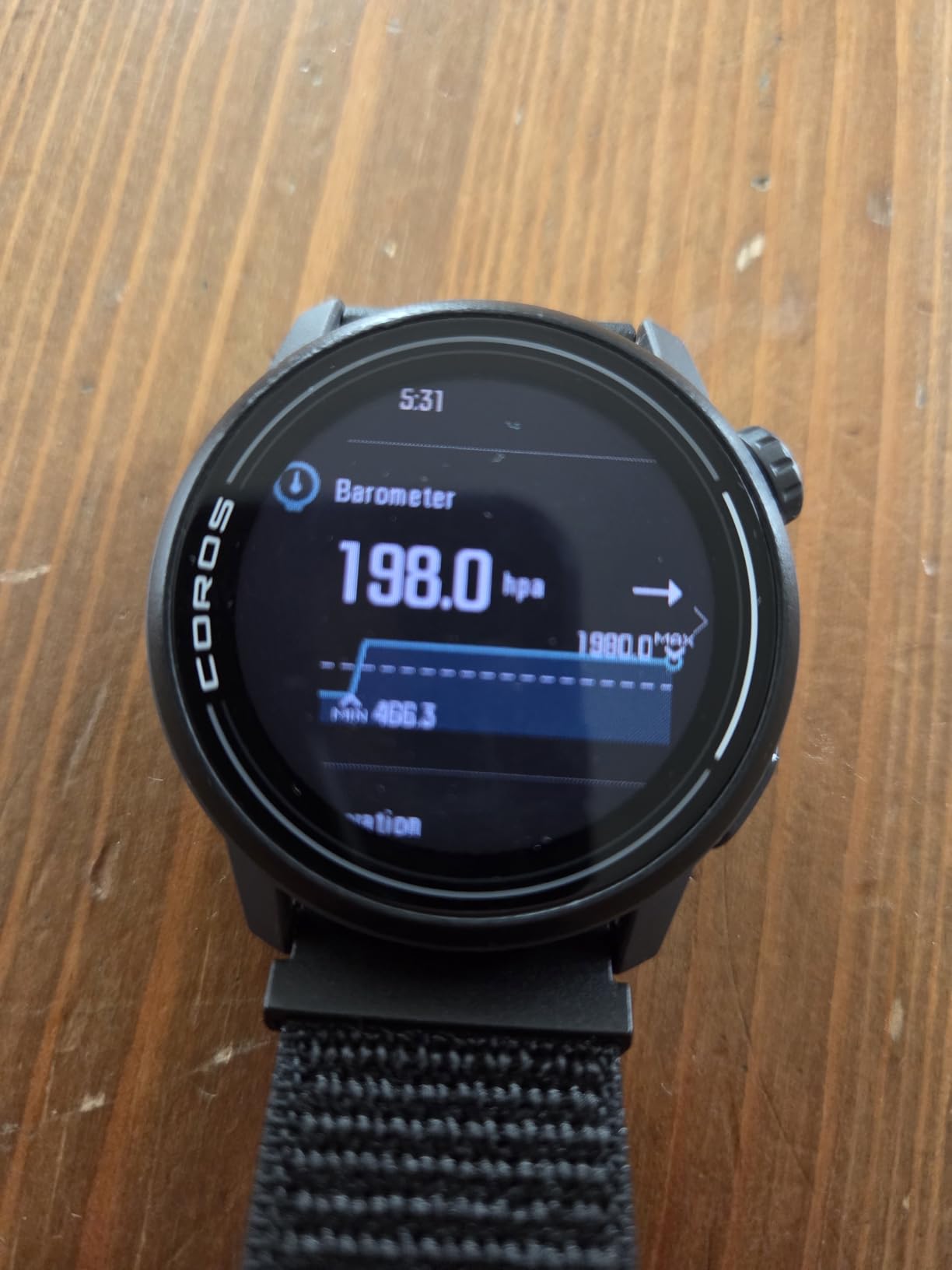
You give up maps. There is no full topographic map set stored on the watch, only breadcrumb navigation, so in fog, in a drainage or on an unplanned detour you rely on your own sense of direction and the terrain itself. If you are the kind of hiker who wanders off marked trail, that is a real limitation rather than a preference.
You also give up ecosystem flexibility. The proprietary operating system limits third-party apps, there is no cellular option, and the 3 GB of storage is small for anyone who wants to load their own music. The touchscreen also responds less reliably with wet fingers, which is an awkward trait on a watch you will use in rain.
Who it suits most
Fastpackers and trail runners who already navigate by route and terrain will get the most from it. So will anyone who wants a backpacking watch they will actually wear to the grocery store, because at 30 grams and 11.7mm it disappears in a way that no 50mm multisport watch manages.
4. Garmin fenix 8 47mm for Turn-by-Turn Guidance
Garmin fēnix® 8, 47mm, Black
47mm stainless steel case,80 g
1.4-inch AMOLED at 1000 nit
Up to 16 days smart,47 hours GPS
100 m rating,40 m dive rating
+ The Good
- Up to 47 hours in GPS mode and 16 days in smartwatch mode
- Dynamic round-trip routing that adjusts to get you back on schedule
- Built-in speaker and mic for wrist calls and off-grid voice commands
- Bright 1.4-inch AMOLED display with a built-in LED flashlight
- Multi-band GPS with SatIQ plus compass
- gyroscope and barometric altimeter
- Leakproof metal buttons and a 40 m dive rating
- The Bad
- Some owners report software freezes that need repeated resets
- 80 g and 47mm is bulky for sleep tracking
- Feature set is excessive if you only want step counting
The fenix 8 is the watch I reach for when navigation is the entire point of the trip. Its dynamic round-trip routing is the standout: set a distance and a time budget, and the watch will suggest a course back that lands you where you planned, adjusting as your pace changes. On a traverse where a wrong turn costs half a day, that is a bigger deal than any training metric.
It is also the most communicative watch here, with a built-in speaker and microphone for wrist calls, a phone assistant and off-grid voice commands. Garmin advertises off-grid voice commands, which means basic spoken navigation queries work with no phone in range. That is a genuine convenience when your hands are cold or your gloves are wet.
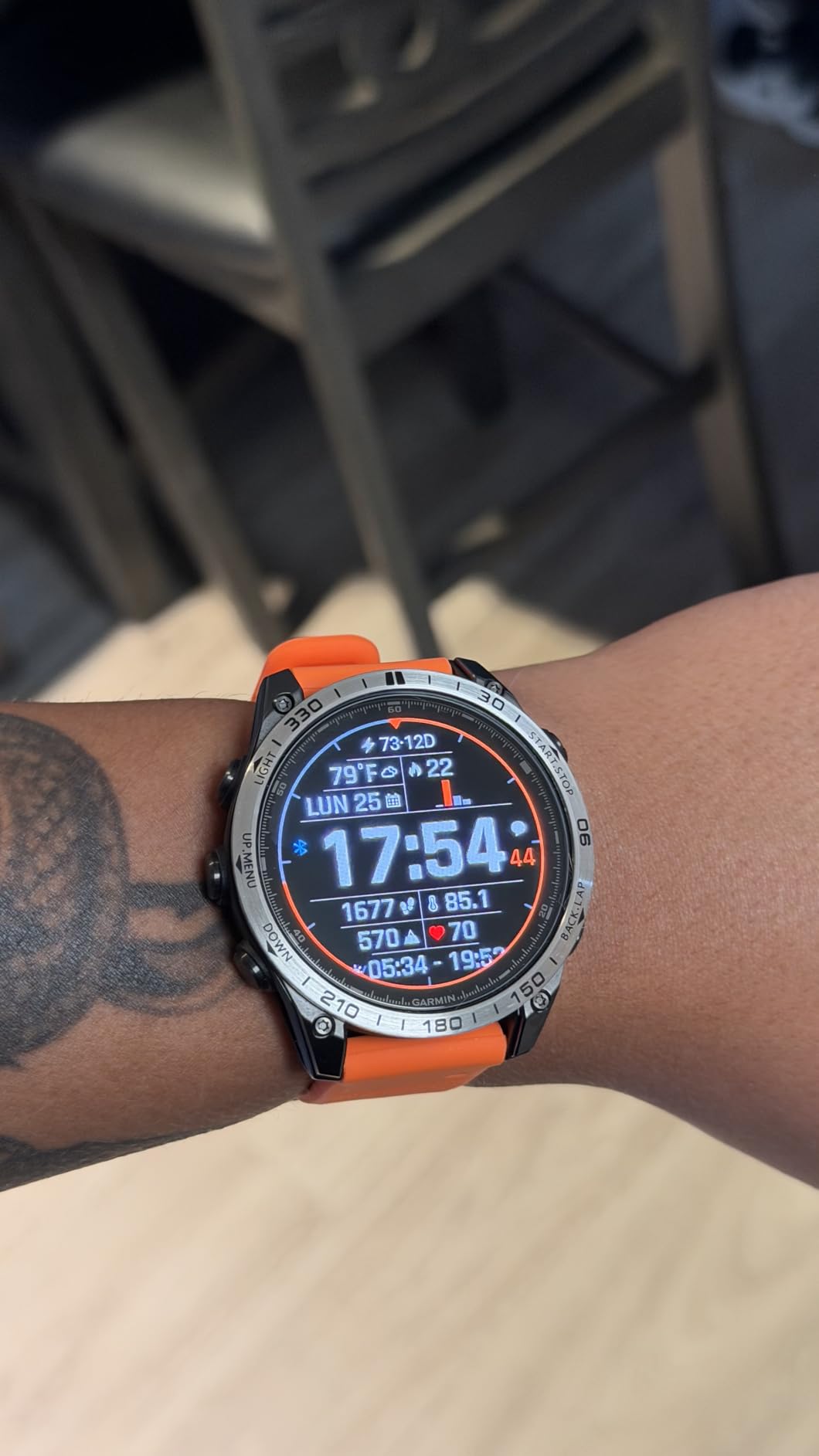
Battery figures are 16 days in smartwatch mode and up to 47 hours in GPS mode, which covers a week of long days with a mid-week charge. Multi-band GPS with SatIQ, a 3-axis compass, gyroscope and barometric altimeter cover the standard sensor suite, and the bright 1.4-inch AMOLED peaks at 1000 nits with a built-in LED flashlight for after-dark use.
Build quality is a step up from earlier Garmin multisport watches, with leakproof metal buttons and a 40-meter dive rating alongside 100 m water resistance. Storage is 16 GB, enough for music and a reasonable map cache. The 47mm case at 80 g is a more manageable size than the 51mm fenix 7X Pro, though it still is not a small watch.
Where it beats the fenix 7X Pro
Two clear areas. The AMOLED screen is significantly brighter and more detailed for reading maps on a wrist, and the speaker and microphone turn it into a small communication hub rather than a notification taker. The 47mm case also suits more wrists than the 51mm alternative.
For a hiker who routes on a phone before bed and then executes the plan in the field, the round-trip routing plus spoken guidance is a smoother loop than the 7X Pro offers. If you expect off-grid conditions where you cannot safely look at a screen, that matters.
What to watch out for
Software stability is the recurring complaint, with owners reporting freezes that require repeated resets. It is not common enough to dominate the reviews, but it is the one issue that would make us hesitate to depend on the watch for critical navigation alone.
At 80 g it is heavy for sleep tracking, particularly in a shared bed, and the whole feature inventory is excessive if you simply want distance and heart rate. Carry the 47mm if your wrist is under about 7 inches and the case overhangs noticeably.
5. Garmin epix Pro Gen 2 Sapphire 47mm for Smaller Wrists
Garmin epix Pro (Gen 2) Sapphire, High Performance Smartwatch, 47mm, Black
47mm titanium case,70 g
1.3-inch always-on AMOLED with sapphire lens
Built-in LED flashlight
100 m water rating
+ The Good
- Full Garmin navigation in a 47mm titanium case at only 70 g
- Bright always-on AMOLED with a sapphire lens that reads well in daylight
- Multi-band reception and multi-GNSS with SatIQ for tough terrain
- Built-in flashlight with variable intensity and strobe modes
- TopoActive maps with Up Ahead turn-by-turn prompts
- Wide range of activity profiles beyond traditional outdoor sports
- The Bad
- AMOLED and titanium cost battery relative to solar or MIP rivals
- Premium pricing for casual users
- Less map detail than a larger case can show
- Garmin app experience is less refined than some rivals
The epix Pro is the answer for anyone whose wrist cannot carry a 50mm case. At 47mm and 70 g it is the lightest full Garmin we tested, and it keeps the parts that matter on trail: an always-on AMOLED with a sapphire lens, multi-band reception and multi-GNSS with SatIQ, a built-in LED flashlight and TopoActive maps with Up Ahead prompts.
Sapphire on the lens is the detail that matters over years. It will not scratch the way an exposed polymer lens does when the watch knocks against rock faces, which is a normal event on off-trail scrambling. The titanium bezel and case take the same reasoning further: heavier to lug, but they survive.
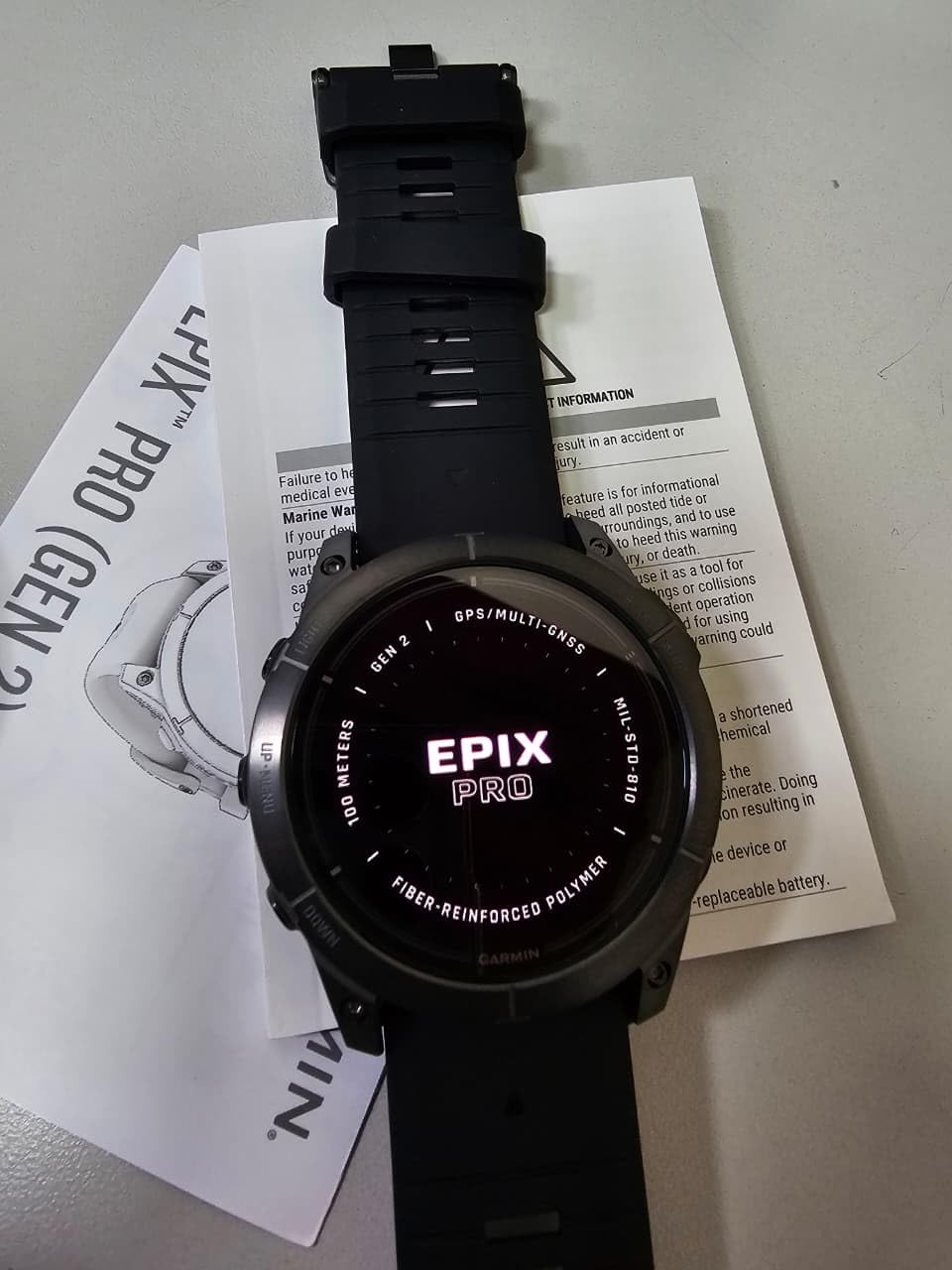
Display quality is the star. The 1.3-inch 390 x 390 always-on AMOLED is far crisper than a transflective panel, and buyers single it out as the clearest upgrade in this Garmin generation, with daylight readability that holds up on exposed ridgelines where transflective screens go flat.
Health and training tooling is broad, with HRV status, Pulse Ox, advanced sleep monitoring, morning report, training readiness, hill score and endurance score, plus wrist-based running power. Activity profiles extend well past hiking into team sports, which is useful if the watch doubles as a daily wearable.
Who it fits
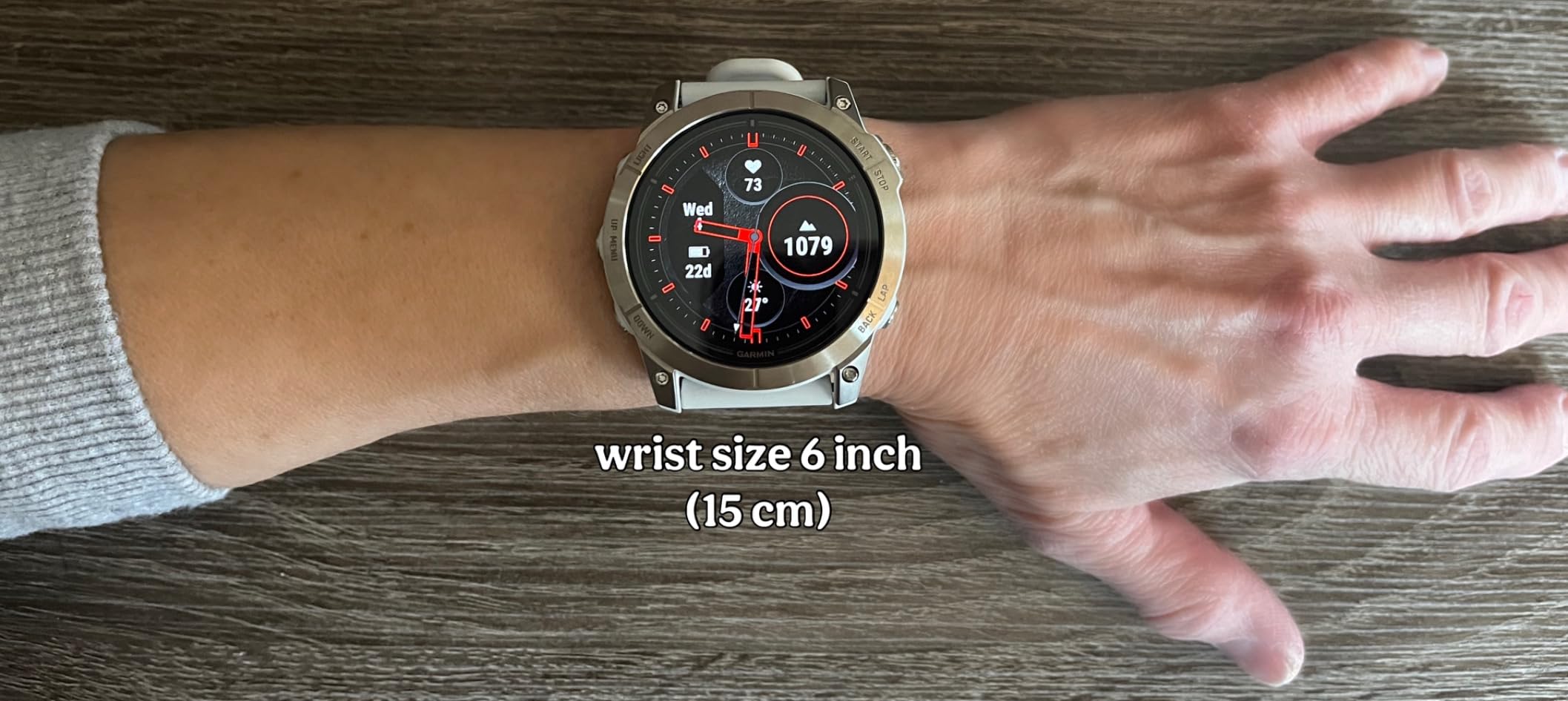
This is the pick for smaller wrists and for anyone who wants a Garmin without a wrist overhang. If you have measured roughly 6.5 to 7.5 inches around the wrist, the 47mm case sits properly where the 51mm models swim. At 70 g it also disappears more than most multisport watches when you are layering it over a sleeve.
It suits hikers who want the full Garmin navigation stack but do not need weeks of battery, because you will be charging it every two or three nights on a long trip. That is a fair trade for the lighter, sharper, tougher package.
Where it falls short
Battery is the trade. The AMOLED and titanium build give up hours relative to solar or MIP competitors, so this is a charging-every-few-days watch, not a solar watch. It also carries premium pricing that is hard to justify for casual users.
The smaller case shows fewer map details at once, which is exactly when you want more, and the Garmin app experience is less polished than some rivals for anyone who cares about third-party integrations. Wear it with the case sitting flat on the wrist, since a lift there produces noticeable compass error.
6. Suunto 9 Peak Pro for Button Control and Sunlight
SUUNTO 9 Peak and Peak Pro Sports GPS Watch for Demanding, Performance Driven Athletes and Adventurers
43mm titanium and sapphire case,0.06 kg
MIP transflective display at 1000 nit
40 hours GPS,70 endurance,300 tour
100 m waterproof
+ The Good
- MIP transflective display stays readable in bright sun and conserves battery
- Physical buttons are usable with gloves and wet hands
- 40 hours in best GPS mode
- 70 in endurance and 300 in tour mode
- Ten-minute quick charge yields two hours of GPS training
- Four satellite systems hold tracking among tall buildings
- in mountains and in steep canyons
- The Bad
- Recent firmware updates have cut battery life sharply for some owners
- Optical heart rate can be inconsistent in swimming and indoor workouts
- Side buttons can be uncomfortable in long wear
- Short strap and a quick-release clasp that can work loose
- Some watch faces now require a subscription
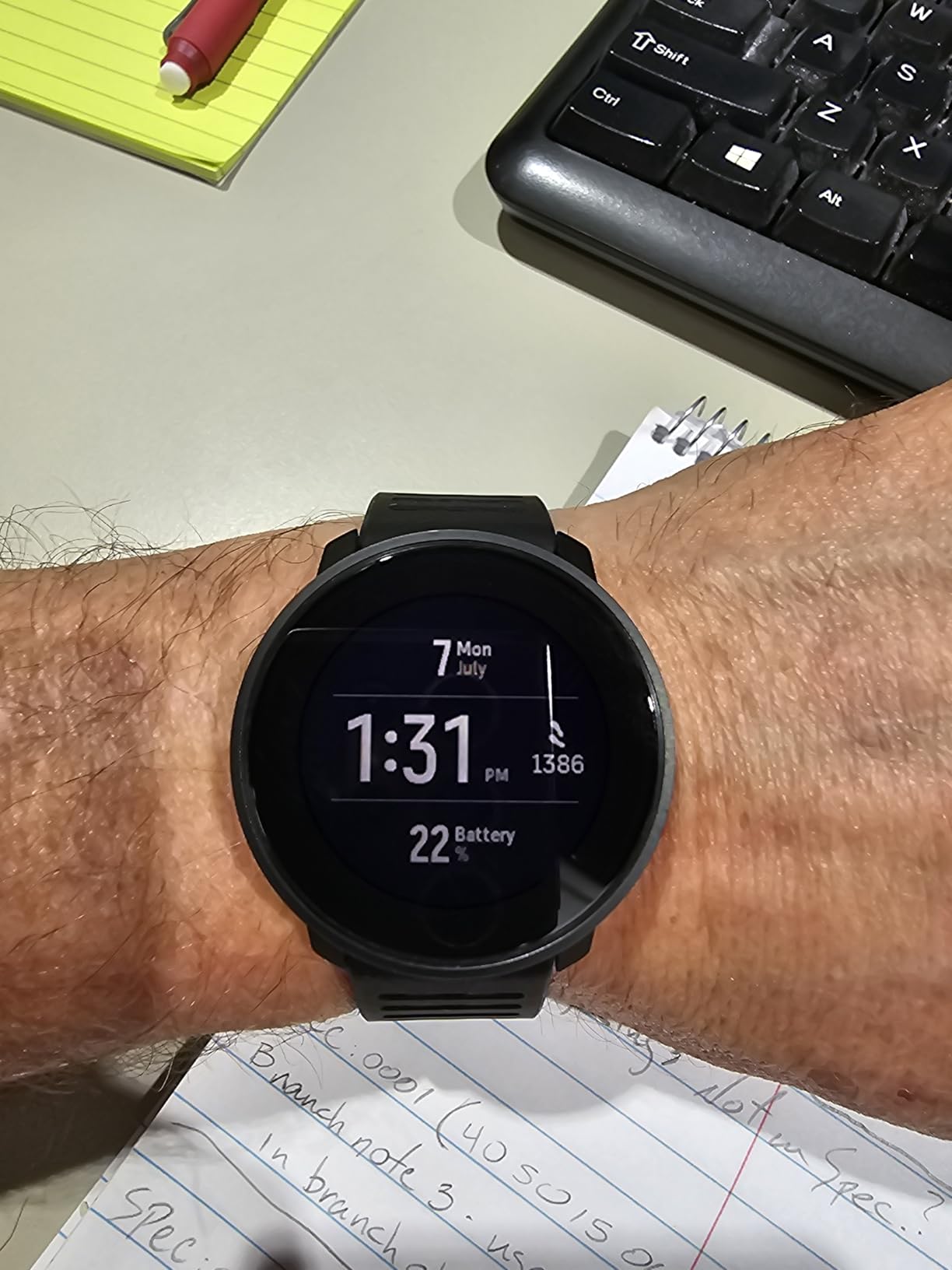
The Suunto is the watch to buy if you hate touching screens in the cold. Physical buttons with defined travel are usable with gloves on, wet fingers or frost, and there is no touchscreen to misfire when you are brushing snow off it. On a winter route or a wet canyon descent, that is worth more than any fitness platform.
The MIP transflective display is the other reason. At 1000 nits it is readable in direct sunlight, and because it reflects rather than emits, it costs almost nothing to keep visible with the backlight off. That is why the battery figures are so much larger than the AMOLED watches here: 40 hours in best GPS mode, 70 hours in endurance mode and 300 hours in tour mode.
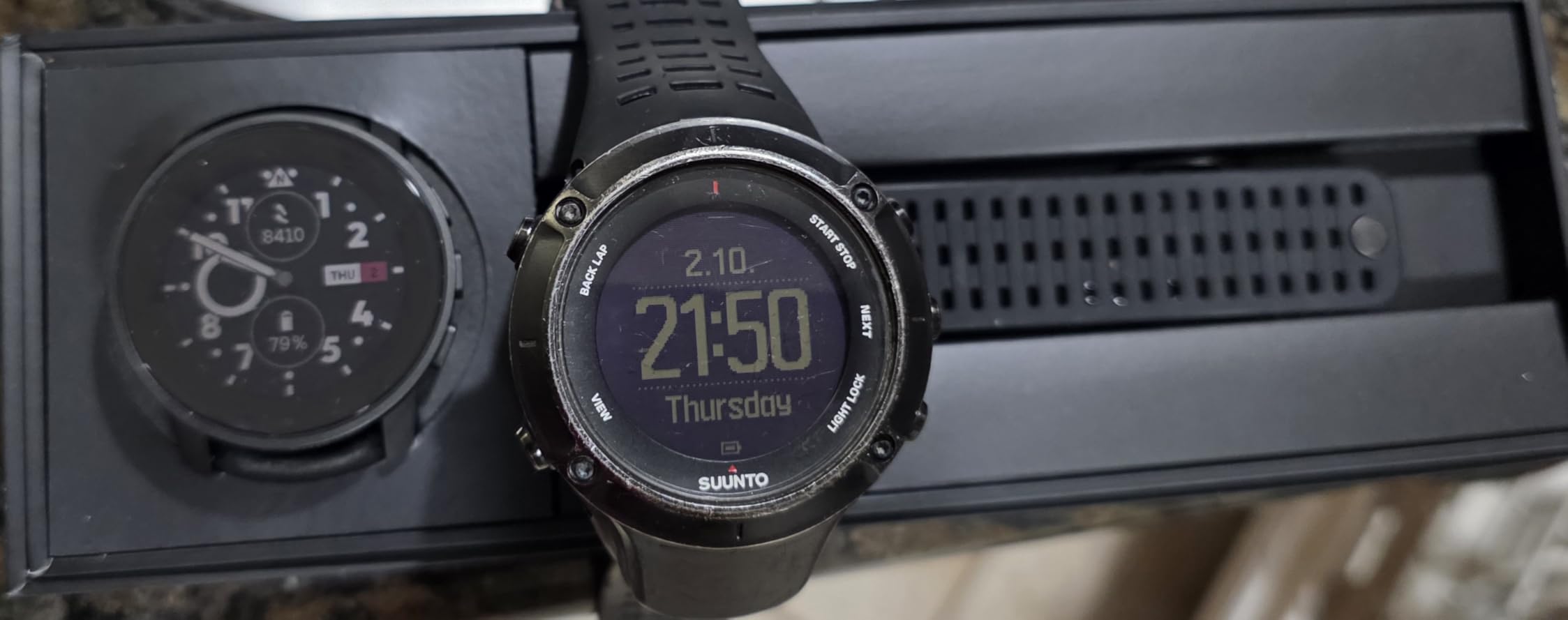
Positioning uses four satellite systems, which owners report connecting quickly even in overcast conditions, and the case is titanium and stainless steel with sapphire glass rated to 100 m. There are 97 sport modes with turn-by-turn navigation, weather alerts and avalanche maps, which makes it the most relevant option here for anyone heading into genuine alpine terrain rather than forest trail.
Charging is a genuine convenience. A full charge takes one hour, and a ten-minute quick charge gives two hours of GPS training, so a lunch stop in a town with a USB port is enough to rescue a bad day. The Suunto app handles structured workouts, goals, real-time guidance and activity journaling, and connects to Strava, TrainingPeaks and a long list of other services.
Where it wins
Three specific situations. Cold weather and gloves, direct desert sun, and long multi-day routes where charging opportunities are scarce. The 300-hour tour mode figure alone covers a multi-week trip, and avalanche maps are a real safety feature for winter mountaineering rather than a spec-sheet line.
It is also the most understated watch here. A 43mm case at 0.06 kg wears like a normal watch, which makes it far easier to keep on every day so that your trail data and recovery metrics are actually continuous.
What to watch out for
Firmware is the main issue. Owners report that recent updates have sharply reduced battery life for some units, forcing nightly charging, and the rating on this watch reflects that. Check recent owner feedback before committing, and keep the automatic GPS settings in mind if you rely on the headline endurance figures.
Heart rate and sleep tracking are the weaker suits, with inconsistent optical readings in swimming and indoor workouts and sleep data that misses nighttime wake-ups. The side buttons are also reported as uncomfortable over long wears, the strap runs short on larger wrists, and a few watch faces now sit behind a subscription.
How to Choose a Hiking GPS Watch
Battery is the spec to size first, and the mistake is comparing manufacturer figures across different modes. A watch quoted at 16 days in smartwatch mode and 47 hours in GPS mode is telling you two different facts, and only the second one matters when you are walking eight hours a day in a canyon with no charger. UltraTrac-style sampling modes can stretch GPS hours several times over at the cost of track resolution, so know which mode a quoted number describes before you plan around it.
Size the battery to your trip length
A working rule: budget about 8 to 10 hours of continuous GPS per hiking day, which covers a normal day on trail with the watch tracking rather than sitting in standby. Multiply by your trip length and you get the minimum GPS hours you need. A weekend trip needs 16 to 20 hours, a week needs 56 to 70, and a three-week traverse needs 170 hours or more, which is where solar models and expedition modes start to earn their premium.
Run that rule against the picks here. The COROS PACE 3 at 38 hours covers a long week comfortably. The Amazfit T-Rex 3 at up to 180 hours of GPS covers a three-week traverse on continuous tracking, which is exceptional. The Garmin fenix 8 at 47 hours handles a week, and the fenix 7X Pro Solar is the one that stays useful for weeks at a time because the solar lens tops it up as you walk. The Suunto 9 Peak Pro reaches 300 hours in tour mode, though that mode samples less often than continuous tracking.
Be skeptical of spec-sheet numbers. Manufacturers quote ideal conditions, and cold weather, a dim screen, continuous heart rate sensing and a weak signal all cut into real runtime. Read owner reports about their own charging cadence rather than the headline figure, and if you are on a long trip, budget a small power bank in your pack regardless.
Decide between maps and breadcrumbs
There are three levels of watch navigation, and buying the wrong one is the most common expensive error. Breadcrumb navigation records your track and draws a line, so you retrace your own path. Turn-by-turn guidance adds upcoming directions along a loaded course. Full topographic maps draw terrain, water, trails and contours on the watch itself, which is what you want above treeline, in fog, or anywhere the trail is not obvious.
Match the level to the terrain rather than the price. On marked trail, breadcrumbs are enough and the COROS PACE 3 handles it. For route planning where you need to see where a water source or a road is, the Garmin models with TopoActive maps and Up Ahead prompts are the reason to spend more. Every Garmin here also accepts GPX routes, so you can plan on a phone with Komoot or OpenStreetMap tools and load the result, which is the free-map workflow the hiking community prefers.
Understand solar charging honestly
Solar claims are usually quoted at roughly three hours of direct sun per day at 50,000 lux, a brightness level you get on an exposed alpine slope, not in forest or under cloud. If your route is shaded, the solar lens is closer to decoration than to a power source, and you should treat the model as a conventional watch with slightly better endurance. On an open desert or high-desert traverse, it is a genuine advantage that can extend a trip by days.
Check case size, weight and water rating
Measure your wrist before you order. A 51mm case suits roughly 7.5 inches and up, a 47mm case fits about 6.5 to 7.5 inches, and a 43mm case works below that. Women and small-wrist wearers should aim at 43mm or 47mm, and the epix Pro at 47mm and 70 g is the most complete option we tested in that range. Ultralight hikers should weight the grams heavily: 30 g versus 89 g is nearly 60 g saved on your wrist every hour.
Every watch here is rated to 100 m or close to it, so rain, river crossings and swimming are covered. For water resistance beyond that, only the fenix 8 carries a serious dive rating, and the Amazfit adds freediving certification. A stated rating is a laboratory figure, so rinse sand and mud off the buttons and case after a beach or desert day, since grit is what wears seals.
Weigh the ecosystem
The phone app is where your data actually lives. Garmin Connect handles maps, courses and Connect IQ apps. The Suunto app is clean and links to Strava and TrainingPeaks. Zepp covers the Amazfit with a push toward its paid tier. COROS keeps things simple but its proprietary system limits third-party apps. Decide which one you will live in, because route syncing bugs between ecosystems are one of the most common frustrations hikers report.
GPS Accuracy, Offline Maps, and Solo Backcountry Safety
GPS accuracy comes down to two separate ideas that get conflated. Multi-GNSS means receiving on several satellite constellations at once, such as GPS, GLONASS, Galileo and BeiDou, which helps you get a fix faster and hold it in more places. Multi-band means receiving on two different radio frequencies, which corrects for the way ionosphere and tree canopy delay signals, and that is what improves accuracy in deep canyons and heavy forest.
SatIQ is the practical version of multi-band for most hikers. Instead of running two receivers at all times and burning battery, it switches bands automatically when conditions are poor, so you get multi-band accuracy under canopy or in a canyon without paying the full cost every minute. On this list, the Amazfit T-Rex 3, the Garmin fenix 8, the epix Pro and the fenix 7X Pro all have dual-frequency or multi-band positioning with SatIQ, and the COROS PACE 3 carries a dual-frequency chipset. In open terrain the difference is small, so do not expect miracles on a clear ridgeline.
Can a watch replace a handheld GPS?
For route following, yes. Any watch here will track your position, log elevation and show you the way back along your breadcrumb, and a wrist device is easier to consult than a handheld in wind, rain or with both hands occupied on steep ground. The gap opens in three situations: you need to read terrain contours for a route you have never walked, you are navigating a whitewater drainage with fog, or your route depends on features that no consumer map shows clearly.
For those cases a dedicated unit is still better, which is why we keep a separate guide on GPS handhelds for backcountry hiking. A handheld gives you a bigger screen, a paperless compass, longer battery and higher-grade receivers. The discussion on backpackinglight forums about navigation and communication devices lands in the same place: watches win for convenience, handhelds win for route-finding, and neither replaces a paper map and compass carried as a backup.
What a watch cannot do without a satellite communicator
No watch on this list can send a message or raise an SOS without a phone or a paired satellite communicator. Off-grid messaging, two-way text and an interactive SOS all come from a satellite service such as Garmin inReach, which pairs with a phone over Bluetooth, and that service carries a subscription. A watch with a barometric trend alert can tell you pressure is dropping before the rain arrives, and storm alerts and incident detection help in other ways, but none of it reaches a rescue coordinator.
So decide your safety posture before buying. If you hike solo on routes with no coverage, treat a satellite communicator as a separate requirement, not an accessory, and use the watch for navigation, elevation, weather trends and fitness data. Our trekking pole guide covers the other half of a standard backpacking kit list.
One more note for mixed-terrain hikers. If you also run trails, the trade-offs differ from hiking: our GPS running watch picks prioritize lightweight tracking and footpod-grade metrics over mapping. For a hiker who does both, the COROS PACE 3 and the Amazfit T-Rex 3 sit at the intersection of the two lists.
Frequently Asked Questions
What is the best GPS watch for backcountry hiking?
The Garmin fenix 7X Pro Sapphire Solar is the best all-round choice, with a solar sapphire lens, multi-band GPS with SatIQ, a built-in flashlight and TopoActive maps for offline navigation. Lightweight hikers should consider the COROS PACE 3 at 30g, and anyone wanting the longest GPS runtime per dollar will find it on the Amazfit T-Rex 3.
How long does a Garmin fenix battery last hiking?
It depends on the mode. The fenix 8 is rated at up to 47 hours in GPS mode and 16 days in smartwatch mode, while the solar fenix 7X Pro is rated in weeks in smartwatch mode and relies on its solar lens to extend gap between charges. As a planning rule, allow 8 to 10 hours of continuous GPS per hiking day, so a one-week trip needs roughly 56 to 70 hours of GPS time.
Can I use a GPS watch instead of a separate GPS device for hiking?
For following a known route, yes, and a wrist device is faster to consult than a handheld with gloves or pack straps in the way. A handheld is still better when you need contour detail, a large screen, paperless compass functions or a much longer battery in poor conditions. Many hikers carry both and always keep a paper map as backup.
Can GPS watches work without cell service?
Yes, because they receive signals from satellites rather than towers. Position tracking, breadcrumb navigation, elevation, barometric weather trends and offline maps all work with no coverage. What does not work is messaging, and a watch cannot send a text or raise an SOS on its own, so solo hikers far from coverage need a paired satellite communicator with an active subscription.
Are GPS watches accurate for hiking?
Yes, within a few metres in open sky. Accuracy improves with multi-GNSS, which listens on several satellite constellations at once, and with multi-band receivers that use two radio frequencies to correct signal delay under tree canopy or in deep canyons. Features like SatIQ switch bands automatically when conditions are poor, so you get better accuracy in difficult terrain without paying the battery cost in the open.
What is the most durable GPS hiking watch?
Durability comes from case material, lens material and a water rating. The Garmin fenix 7X Pro Sapphire Solar and the Suunto 9 Peak Pro both pair sapphire lenses with titanium or steel cases and a 100 m water rating, while the Garmin epix Pro Sapphire adds a sapphire lens at 47mm and 70g. Rinse grit from buttons and cases after a day on rock, since sand rather than water is what wears the seals.
Conclusion
Start from trip length, not brand. At 8 to 10 GPS hours per hiking day, a weekend backpacker needs about 20 hours and the COROS PACE 3 or Amazfit T-Rex 3 covers it with room to spare, while a week on trail points at the Amazfit for raw endurance or the fenix 8 for round-trip routing. Multi-week traversals are where the Garmin fenix 7X Pro Sapphire Solar earns its place, and the Suunto 9 Peak Pro is the one to buy when your route is cold, exposed or alpine.
Whatever you choose, size it to your wrist, check that it does what you actually need rather than what the spec sheet promises, and pair it with a paper map. For anyone still comparing day-hiking options, our full hiking GPS watch guide goes deeper on each model. These are the best hiking GPS watches for backpacking right now, updated for 2026, and the difference between them shows up on day four with twenty miles still behind you.