
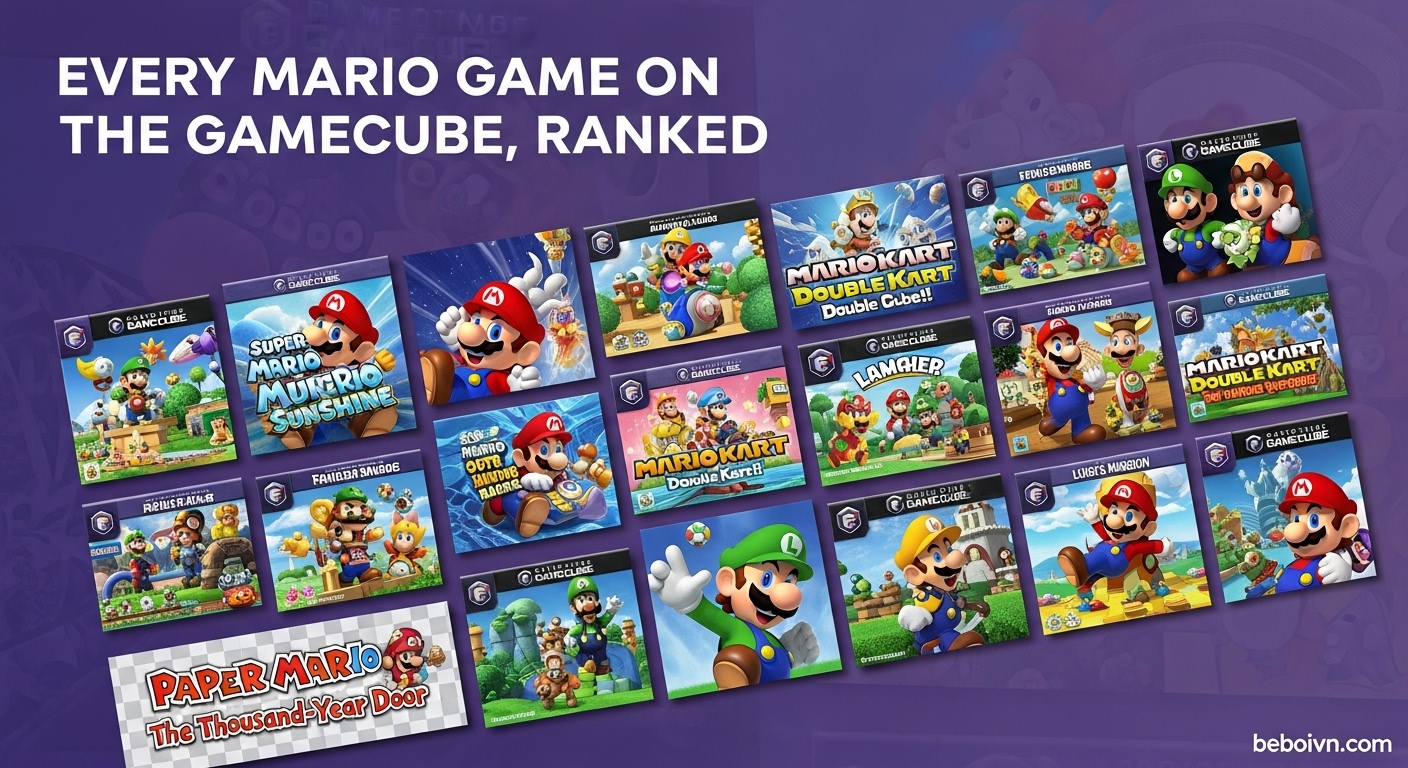
The Nintendo GameCube holds a special place in gaming history, and for Mario fans, it represents a golden era of creativity and innovation. While the PlayStation 2 dominated sales figures and the Xbox brought Microsoft into the console wars, the GameCube quietly built an incredible library of Mario titles that showcased Nintendo’s willingness to experiment with their most iconic franchise. From traditional platforming adventures to wild sports spin-offs and rhythm game crossovers, the GameCube era gave us some of the most memorable Mario games ever created.
The GameCube’s Mario Legacy: A Brief Overview
Before diving into the rankings, it’s worth understanding why the GameCube’s Mario library is so unique. Unlike previous Nintendo consoles that focused heavily on traditional Mario platformers, the GameCube era saw Nintendo embracing spin-offs and experimental concepts. This wasn’t necessarily by choice—Super Mario Sunshine was the only mainline Mario platformer on the system—but rather a reflection of Nintendo’s strategy to diversify the Mario franchise across multiple genres.
The result? A collection of games that ranged from absolutely brilliant to downright bizarre, each contributing something unique to Mario’s legacy. Whether you’re a longtime fan looking to revisit these classics or a newcomer curious about GameCube’s hidden gems, this comprehensive ranking will guide you through every Mario game on Nintendo’s purple lunchbox of a console.
14. Mario Party 7: The Final Hurrah
Release Date: November 7, 2005
Developer: Hudson Soft
Mario Party 7 arrived late in the GameCube’s lifecycle, and it shows. As the fourth Mario Party title on the system, it suffers from franchise fatigue, offering little innovation beyond its predecessors. While still enjoyable with friends, the mini-games feel recycled, and the board designs lack the creativity that made earlier entries special. It’s not a bad game by any means—Mario Party’s core formula remains fun—but it represents the series running out of steam on the GameCube.
Why it ranks here: Mario Party 7 is the definition of “more of the same,” which isn’t necessarily a compliment when three superior Mario Party games already exist on the same console.
13. Dance Dance Revolution: Mario Mix: The Rhythm Game Experiment
Release Date: October 24, 2005
Developer: Konami, Nintendo SPD, Hudson Soft
On paper, Dance Dance Revolution: Mario Mix sounds like a bizarre cash-in—a rhythm game crossover that shouldn’t work. Surprisingly, it’s actually a competent DDR title with a charming Mario skin. The game features a story mode where Mario must recover Music Keys stolen by Waluigi, and while the narrative is forgettable, the gameplay is solid DDR with Mario-themed remixes of classic tunes.
Why it ranks here: While better than expected, DDR: Mario Mix is still a niche entry that appeals primarily to rhythm game fans. It’s a fun curiosity but lacks the broad appeal of other Mario titles.
12. Mario Party 5: The Middle Child
Release Date: November 10, 2003
Developer: Hudson Soft
Mario Party 5 finds itself in an awkward position—sandwiched between the excellent Mario Party 4 and the superior Mario Party 6. It introduced some new mechanics and mini-games, but nothing revolutionary. The game still delivers the classic Mario Party experience of ruining friendships through dice rolls and button mashing, but it doesn’t stand out in the crowded GameCube Mario Party lineup.
Why it ranks here: Perfectly adequate but completely overshadowed by better Mario Party entries on the same console.
11. Mario Party 4: The GameCube Debut
Release Date: October 21, 2002
Developer: Hudson Soft, Nintendo
As the first Mario Party on GameCube, Mario Party 4 was a visual showcase that demonstrated the system’s graphical capabilities over the Nintendo 64. The jump to 3D boards and improved mini-game graphics was impressive at the time, and many of its mini-games remain classics. However, later entries would build upon this foundation with better mechanics and more creative boards.
Why it ranks here: Historically significant as the GameCube’s first Mario Party, but ultimately surpassed by its sequels.
10. Mario Party 6: The Peak of Party Gaming
Release Date: December 6, 2004
Developer: Hudson Soft
Mario Party 6 represents the pinnacle of the series on GameCube, introducing the microphone peripheral and a host of creative new mini-games that took advantage of it. The boards are well-designed, the mini-games are consistently fun, and the addition of day/night cycles added a strategic element missing from previous entries. If you’re going to play only one Mario Party on GameCube, this should be it.
Why it ranks here: The most polished and feature-complete Mario Party on the system, with innovative mechanics that still hold up today.
9. Mario Golf: Toadstool Tour: A Leisurely Classic
Release Date: July 28, 2003
Developer: Camelot Software Planning
Mario Golf: Toadstool Tour proves that golf and Mario characters are a match made in heaven. Camelot Software (the masters of Mario sports games) delivered a golf title that’s accessible to beginners while offering enough depth for serious players. The courses are beautifully designed, each character has unique stats that affect gameplay, and the power shot system adds a strategic layer to each swing.
Why it ranks here: While not the most exciting Mario sports game, Toadstool Tour is the most polished and satisfying golf experience in the franchise.
8. Mario Power Tennis: Serving Up Fun
Release Date: October 28, 2004
Developer: Camelot Software Planning, Nintendo SPD
If Mario Golf was about precision, Mario Power Tennis is all about spectacle. This isn’t just tennis with Mario characters—it’s tennis with Mario chaos. Each character has unique special moves, courts feature interactive elements, and the game moves at a breakneck pace that makes traditional tennis look boring by comparison. The two-player co-op mode is particularly brilliant, allowing friends to team up as classic Mario duos.
Why it ranks here: The most arcade-fun tennis game ever made, with a level of personality and creativity that tennis games rarely achieve.
7. Super Mario Strikers: Soccer With Attitude
Release Date: November 18, 2005
Developer: Next Level Games
Super Mario Strikers took the Mario sports formula in a completely different direction—edgy, aggressive, and surprisingly intense. Gone are the cheerful, family-friendly aesthetics of other Mario sports games. Instead, Strikers features grungy stadiums, aggressive tackles, and a general attitude that feels more like a gritty soccer game than a Mario title. The two-player system (one captain, one sidekick) adds strategy, and the Super Strike mechanic makes every goal feel epic.
Why it ranks here: The most unique and daring Mario sports game on GameCube, with an attitude that still feels fresh today.
6. Mario Superstar Baseball: America’s Pastime, Mario Style
Release Date: July 21, 2005
Developer: Namco, Nintendo SPD
Baseball and Mario characters shouldn’t work this well, but Mario Superstar Baseball is an absolute home run. Namco managed to create a baseball game that’s simple enough for casual players but deep enough for hardcore fans, all while incorporating Mario elements like special moves and items. The chemistry system between characters adds a strategic layer, and the various game modes provide plenty of replayability.
Why it ranks here: The best Mario baseball game ever made, with a perfect balance of accessibility and depth.
5. Super Smash Bros. Melee: The Fighting Game Phenomenon
Release Date: November 21, 2001
Developer: HAL Laboratory
Technically, Super Smash Bros. Melee isn’t a “Mario game”—it’s a crossover fighting game featuring characters from across Nintendo’s franchises. However, Mario’s presence is so significant (he’s literally on the cover) and the game so important to GameCube’s legacy that it deserves inclusion. Melee improved upon the original in every way, with a larger roster, deeper mechanics, and a level of competitive depth that keeps it relevant in fighting game tournaments to this day.
Why it ranks here: While not exclusively a Mario title, Melee’s impact on GameCube and Mario’s prominence make it essential. It’s also arguably the best fighting game ever made.
4. Paper Mario: The Thousand-Year Door: RPG Perfection
Release Date: July 22, 2004
Developer: Intelligent Systems
Paper Mario: The Thousand-Year Door isn’t just the best RPG on GameCube—it’s one of the best RPGs ever made, period. The game combines traditional Mario elements with deep RPG mechanics, a hilarious script, and some of the most creative level design in the franchise. The paper aesthetic isn’t just a visual gimmick; it’s integral to gameplay, allowing Mario to slip through cracks, fold into objects, and interact with the world in ways impossible in other Mario games.
Why it ranks here: A masterpiece of game design that balances humor, heart, and gameplay in a way few games ever achieve. Its recent Switch remake only proves how timeless this classic truly is.
3. Luigi’s Mansion: The Hero We Needed
Release Date: September 14, 2001
Developer: Nintendo
Luigi’s Mansion was a risky move for Nintendo—making Mario’s cowardly brother the star of a GameCube launch title that played more like a horror-comedy than a traditional platformer. The risk paid off spectacularly. Using the Poltergust 3000 to capture ghosts is incredibly satisfying, the mansion’s atmosphere is perfectly spooky yet charming, and Luigi’s nervous animations are endlessly entertaining. It’s a game that shouldn’t work but absolutely does.
Why it ranks here: A bold experiment that created an entirely new franchise, proving that Mario characters could succeed in genres far beyond platforming.
2. Mario Kart: Double Dash!!: Twice The Racing Fun
Release Date: November 7, 2003
Developer: Nintendo EAD
Mario Kart: Double Dash!! took the proven Mario Kart formula and doubled down on innovation—literally. The two-character system (one driver, one item thrower) completely changed the strategic dynamic of races, allowing for co-op play and new tactics that weren’t possible in previous entries. The tracks are some of the best in series history (Baby Park remains a chaotic masterpiece), and the special items unique to each character pair added another layer of strategy.
Why it ranks here: The most innovative Mario Kart ever made, with a co-op system so good it’s baffling Nintendo hasn’t brought it back.
1. Super Mario Sunshine: The Misunderstood Masterpiece
Release Date: July 19, 2002
Developer: Nintendo EAD
Super Mario Sunshine is the GameCube’s only traditional Mario platformer, and what a platformer it is. Often misunderstood upon release for its departure from Mario 64’s formula, Sunshine has aged beautifully into one of the most creative and ambitious Mario games ever made. The FLUDD water jet isn’t just a gimmick—it’s a gameplay mechanic that enables incredible freedom of movement and puzzle-solving that still feels unique today.
The tropical setting of Isle Delfino is vibrant and full of personality, the blue coin collection system encourages exploration, and the secret FLUDD-less levels provide some of the most challenging platforming in Mario history. While the camera can be frustrating and some missions feel repetitive, these minor issues can’t overshadow the game’s incredible ambition and creativity.
Why it ranks #1: As the GameCube’s flagship Mario title and one of the most creative platformers ever made, Super Mario Sunshine represents the absolute best of Mario on GameCube. It’s a game that dared to be different, and in doing so, created something truly special.
Conclusion: The GameCube’s Mario Legacy
Looking back at the GameCube’s Mario library, it’s remarkable how much variety and creativity Nintendo packed into one console generation. From the experimental brilliance of Luigi’s Mansion to the racing perfection of Mario Kart: Double Dash!!, each game brought something unique to the Mario franchise. While the PlayStation 2 may have won the sales battle, the GameCube won the hearts of Mario fans with its willingness to take risks and push the franchise in new directions.
Whether you’re revisiting these classics or discovering them for the first time, the GameCube’s Mario games represent a golden era of creativity that still influences Nintendo’s approach to Mario games today. In an age where sequels often play it safe, these games remind us of a time when Nintendo wasn’t afraid to let Mario try something new—even if that something involved vacuuming ghosts or playing soccer with attitude.