
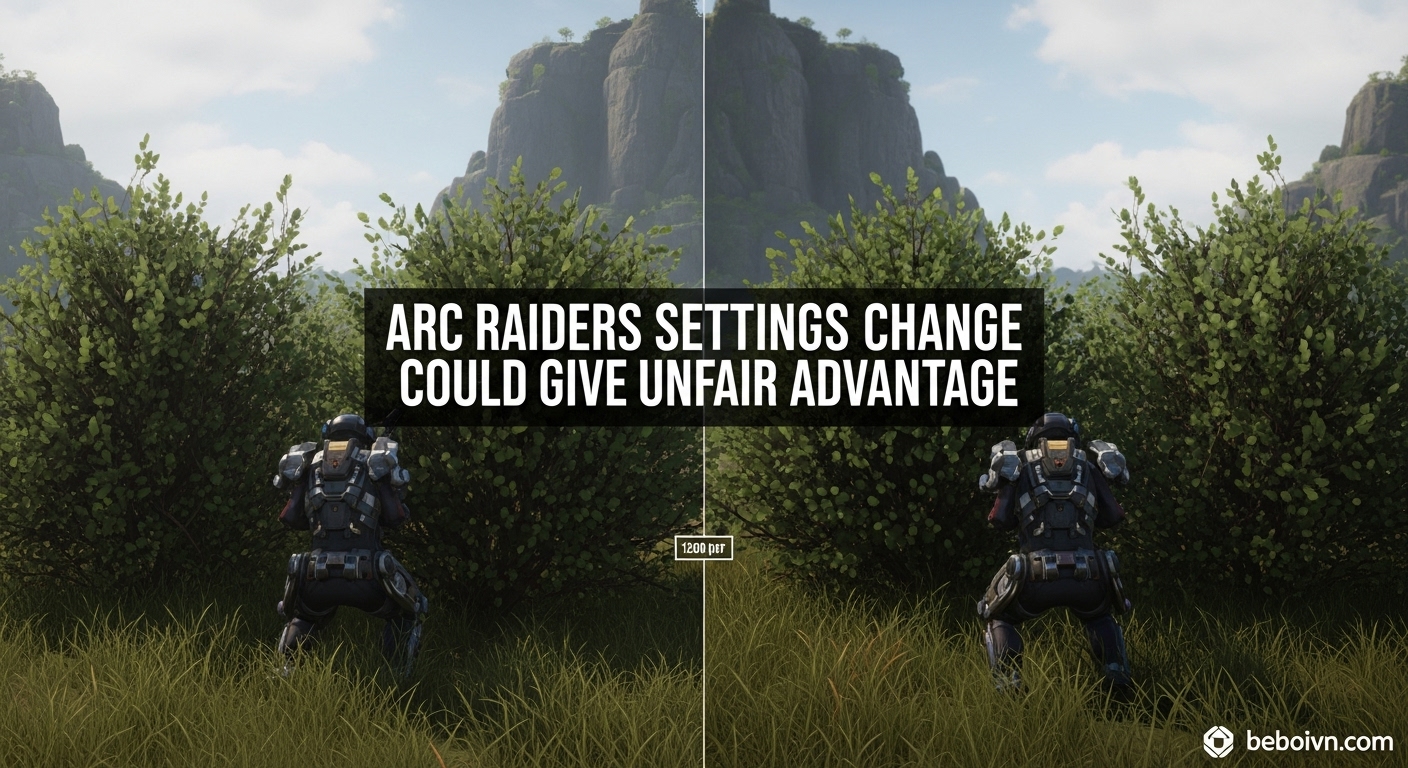
When ARC Raiders finally launched after years of anticipation, players were eager to dive into Embark Studios’ latest extraction shooter. But within days, a controversial discovery sent shockwaves through the community: certain graphics settings weren’t just improving performance—they were fundamentally altering gameplay in ways that give some players an unfair advantage. This isn’t just about pretty graphics anymore; it’s about competitive integrity and whether everyone is playing the same game.
The Low Settings Controversy That’s Rocking ARC Raiders
The controversy centers around one critical issue: ARC Raiders settings change could give unfair advantage to players who optimize their graphics for visibility rather than visual fidelity. Players quickly discovered that setting foliage quality to “Low” doesn’t just reduce the detail of bushes and grass—it removes them entirely from the game world.
Imagine this scenario: You’re carefully positioned behind what appears to be dense foliage, thinking you’re completely concealed from enemy players. You’ve used the environment strategically, positioning yourself where the vegetation should provide perfect cover. But unbeknownst to you, players running on low graphics settings see nothing but empty space where your cover should be. To them, you’re standing in the open, completely exposed, making you an easy target.
This isn’t a minor graphical glitch—it’s a fundamental gameplay imbalance that’s turning the competitive meta on its head.
How the Settings Advantage Actually Works?
The mechanics behind this advantage are surprisingly straightforward yet profoundly impactful. When players set their foliage quality to Low, the game doesn’t just render simpler versions of bushes and grass—it eliminates them completely from the scene. This means:
- Complete removal of knee-high vegetation: Small bushes and shrubbery that provide tactical cover simply vanish
- Enhanced visibility at distance: Players can spot enemy movement that would normally be obscured by environmental clutter
- No visual penalty for low-end hardware: Unlike traditional optimization, this actually rewards players with less powerful systems
- Third-person advantage amplification: The third-person camera perspective makes this issue even more pronounced, as players can peer around corners without exposing themselves
What makes this particularly problematic is that it creates what experts are calling a “pay to lose” scenario. Players who invested in high-end gaming rigs capable of running ARC Raiders on Epic settings are actually putting themselves at a competitive disadvantage compared to those with modest hardware running the game on Low.
The Community’s Furious Response
The reaction from the ARC Raiders community has been swift and intense. Reddit threads dedicated to this issue have exploded with activity, featuring thousands of comments from frustrated players across all platforms. The sentiment is remarkably consistent: this isn’t just a technical oversight—it’s a threat to the game’s competitive integrity.
“I haven’t got the chance to play TT2 however, the graphics look off on Server Slam even on Epic Settings with DLAA enabled,” one player lamented. “I thought I was the only one noticing this until I saw the discussions online.”
Console players are particularly outraged, and for good reason. Unlike their PC counterparts, console gamers have no ability to adjust graphics settings. They’re locked into whatever visual preset Embark Studios has chosen, which means they’re consistently playing at a disadvantage against PC players who’ve optimized for visibility. Some console players have already taken the drastic step of disabling crossplay entirely rather than continue competing on an uneven playing field.
Why This Matters More Than You Think?
At first glance, this might seem like just another graphical quirk that players will adapt to. But the implications run much deeper, especially for a competitive extraction shooter like ARC Raiders where positioning, stealth, and environmental awareness are paramount skills.
Consider the core gameplay loop of ARC Raiders: players drop into a map, gather resources, complete objectives, and attempt to extract while avoiding or engaging enemy players. Success often depends on your ability to use the environment effectively—taking cover behind trees, hiding in bushes, and using natural terrain features to break sightlines. When the environment itself becomes unreliable due to graphics settings, the entire foundation of competitive play begins to crumble.
This issue also creates a troubling psychological divide within the player base. Competitive players feel compelled to run the game on Low settings just to remain viable, even if they prefer the visual experience of higher settings. Meanwhile, casual players who prioritize aesthetics suddenly find themselves getting picked off by enemies they never saw coming, leading to frustration and potentially driving them away from the game.
Historical Context: We’ve Seen This Before
If this situation feels familiar, that’s because we’ve seen similar controversies play out in other competitive shooters. Most notably, PUBG faced identical issues in its early days, where grass rendering distance gave players on low settings a significant visibility advantage. The community backlash was so intense that the developers eventually had to implement unified rendering across all graphics quality levels.
Hunt: Showdown, another extraction-style shooter, learned from these mistakes and implemented systems where low settings don’t remove critical environmental elements. The developers understood that competitive fairness must take precedence over performance optimization when the two conflict.
Even Tarkov, known for its punishing gameplay and hardcore mechanics, has struggled with similar issues, leading to ongoing debates about how to balance accessibility with competitive integrity.
What Players Are Demanding from Embark Studios?
The community isn’t just complaining—they’re offering concrete solutions. The most common request is straightforward: ensure that critical gameplay elements like foliage remain present across all graphics quality levels, even if their visual quality is reduced.
Specifically, players are asking for:
- Unified object rendering: Bushes and grass should appear on all settings, even if simplified
- Minecraft-level minimum quality: Rather than disappearing entirely, foliage should render at a basic, blocky level on low settings
- Crossplay considerations: Console players need protection against PC advantages they can’t compensate for
- Transparency from developers: Clear communication about intended fixes and timelines
As one player put it, “It bothers me that low quality settings don’t ‘reduce quality’ of objects. They reduce the NUMBER of objects. That’s pretty much the gist of it. Players are advocating for the objects to look ‘Minecraft level’ in quality before disappearing in order to remove the advantage.”
The Technical Challenge: Performance vs. Fairness
Embark Studios faces a delicate balancing act. On one hand, they need to ensure the game runs smoothly on a wide range of hardware configurations, including lower-end systems that many players use. On the other hand, they must maintain competitive integrity so that graphics settings don’t become a deciding factor in combat outcomes.
The current approach—removing objects entirely on low settings—was likely implemented with good intentions. It’s a common optimization technique that can significantly improve frame rates on less powerful hardware. However, in a competitive multiplayer environment, this well-intentioned optimization has created unintended consequences that threaten the game’s long-term health.
What makes this particularly challenging is that Embark is working with Unreal Engine 5, which is known for its visual fidelity but also its demanding hardware requirements. Finding the right balance between performance and fairness will require careful optimization and potentially some creative technical solutions.
Competitive Impact: How This Changes the Meta
The settings advantage is already beginning to influence the competitive meta in significant ways. Players who understand the issue are adjusting their playstyle accordingly:
- Aggressive positioning: Knowing that traditional cover might be invisible to some players, many are adopting more aggressive positions that don’t rely on concealment
- Long-range engagements: With enhanced visibility at distance, players are more confident engaging enemies from afar rather than closing to medium range
- Movement-focused gameplay: Some players are emphasizing constant movement over static positioning, making themselves harder targets regardless of visibility advantages
- Information warfare: Players are actively communicating about enemy graphics settings and adjusting their tactics accordingly
This shift in gameplay dynamics could fundamentally alter what makes a player successful in ARC Raiders, potentially rewarding technical knowledge over traditional shooting skills and tactical awareness.
What Embark Studios Has Said So Far?
As of now, Embark Studios has been relatively quiet about this specific issue, though they have acknowledged general performance challenges for low- and mid-range systems. The developers have committed to extensive post-launch support, including a new map in November and additional content in December, suggesting they’re taking player feedback seriously.
The studio has already demonstrated responsiveness to community concerns with features like the loot return system for victims of cheaters. This gives players hope that the graphics settings issue will be addressed promptly, especially given how vocal the community has been about its importance.
The Path Forward: Potential Solutions
Several potential solutions could address this controversy while maintaining performance across different hardware configurations:
1. Unified Foliage Rendering
The most straightforward solution would be to ensure that all foliage elements render on every graphics quality setting, with only their visual quality changing. This approach has proven successful in other competitive shooters and would immediately level the playing field.
2. Distance-Based Scaling
Another approach would be to implement distance-based scaling where foliage remains visible at all settings but its rendering distance varies based on quality presets. This would maintain some performance benefit for low-end systems while preserving competitive integrity at engagement ranges.
3. Server-Side Validation
More technically complex but potentially more effective would be server-side validation of line-of-sight calculations. This would ensure that what a client sees matches what the server considers valid, preventing players from exploiting graphical differences.
4. Separate Competitive Preset
Embark could introduce a dedicated competitive preset that enforces specific settings for ranked play, similar to how some fighting games handle stage selection and other variables.
Why This Matters for ARC Raiders’ Long-Term Success
The resolution of this controversy could significantly impact ARC Raiders’ trajectory as a competitive title. Extraction shooters live and die by their competitive integrity, and players need to trust that their losses come from skill differences rather than technical advantages.
The community’s passionate response demonstrates how much players care about this issue. They’re not just complaining about graphics—they’re defending the core principles of fair competition that make multiplayer gaming compelling. If Embark addresses this thoughtfully and promptly, they could strengthen player trust and loyalty. If they don’t, they risk alienating the very community that’s embracing their game.
What Players Can Do Right Now?
While waiting for official fixes, players have several options to mitigate the settings advantage:
- Educate yourself: Understanding how different settings affect visibility can help you adapt your playstyle
- Consider competitive presets: If you’re serious about competitive play, you may need to prioritize visibility over visuals temporarily
- Provide constructive feedback: Share your experiences with Embark Studios through official channels
- Engage in community discussions: Help raise awareness while maintaining respectful dialogue
The Bigger Picture: Graphics Settings in Competitive Gaming
This controversy highlights a broader issue in competitive gaming: the tension between accessibility and competitive integrity. As games become more visually impressive and technically demanding, developers must constantly balance the needs of players with different hardware capabilities while ensuring fair competition.
ARC Raiders isn’t the first game to face this challenge, and it certainly won’t be the last. The way Embark Studios handles this situation could set important precedents for how future games approach similar issues.
Conclusion: A Critical Juncture for ARC Raiders
The ARC Raiders settings change could give unfair advantage controversy represents a critical test for Embark Studios and the future of their extraction shooter. How they respond will signal their commitment to competitive integrity and their understanding of what makes multiplayer gaming compelling.
The community has made its position clear: fair competition must take precedence over performance optimization when the two conflict. Players are willing to accept reduced visual quality for better performance, but they’re not willing to accept fundamentally different gameplay experiences based on graphics settings.
As ARC Raiders continues its post-launch evolution, addressing this settings advantage issue should be a top priority. The solutions may be technically challenging, but the alternative—fragmenting the player base and undermining competitive integrity—is far worse. With thoughtful implementation and clear communication, Embark has the opportunity to turn this controversy into a demonstration of their commitment to their community and the competitive values that make multiplayer gaming great.
The ball is in Embark’s court, and players are watching closely. How they handle this moment could define ARC Raiders’ legacy in the competitive gaming landscape for years to come.