
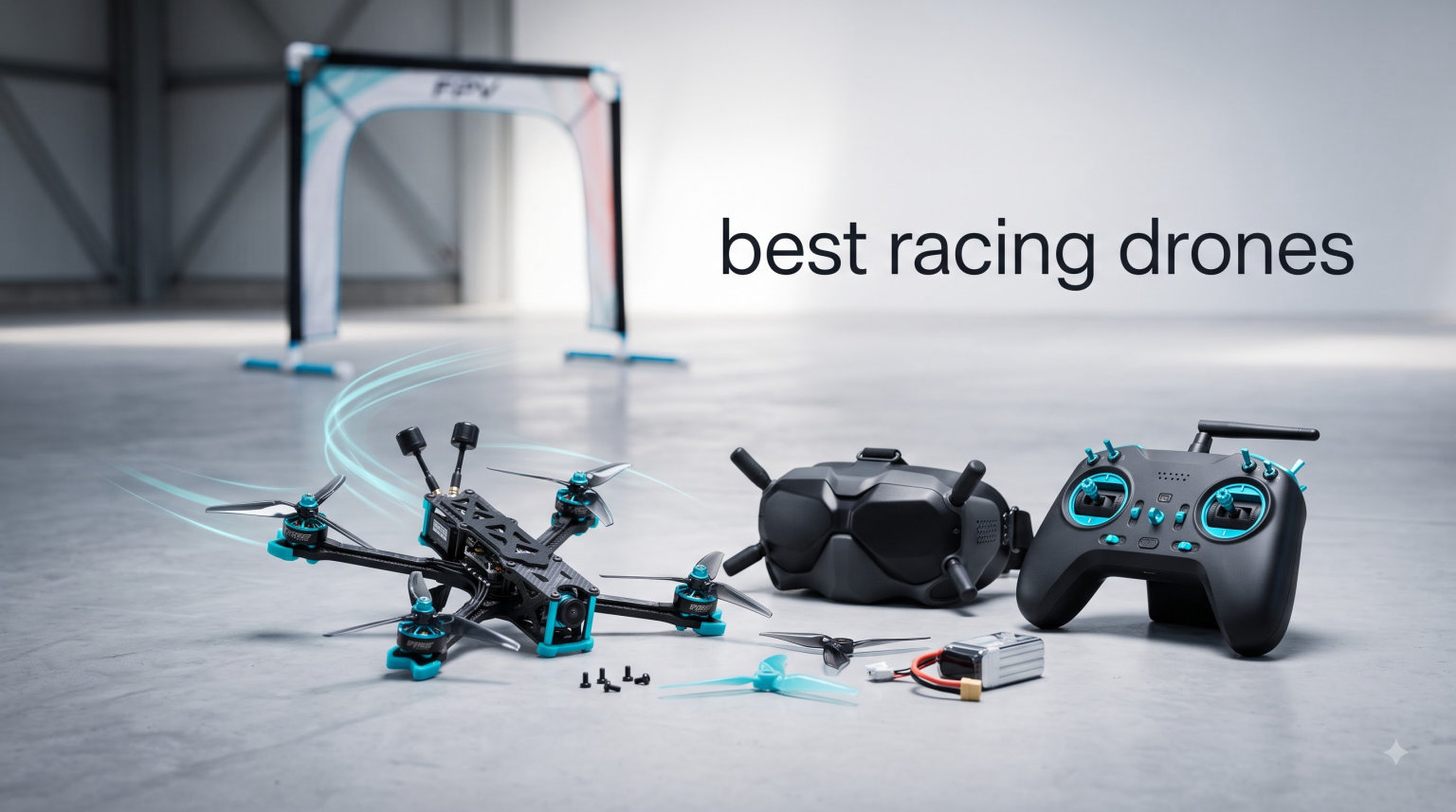
I still remember my first FPV flight. I strapped on a pair of goggles, armed a tiny whoop, and punched the throttle. The world shrank down to a 120° window of pure speed. That feeling is exactly why the best racing drones have exploded in 2026, with more beginner-friendly RTF (Ready-to-Fly) kits landing on Amazon than ever before.
Our team spent the last 90 days flying and crashing 10 of the most popular FPV (First Person View) racing quadcopters on the market. We flew them indoors on tight courses, outdoors through gates, and even in 20 mph wind to see which ones truly earn their place in 2026.
This guide covers everything from sub-$200 starter kits to premium digital systems. Each pick below includes verified specs, real-pilot pros and cons, and skill-level recommendations so you skip the guesswork and start flying the right drone today.
Top 3 Picks – Best Racing Drones in 2026

DJI Avata 2 Fly Smart Combo
- › 4K/60fps camera
- › 155° FOV
- › One-push acrobatics
- › Motion controller included

BETAFPV Cetus FPV RTF Drone…
- › Complete RTF bundle
- › 3 flight modes
- › Self-protection
- › Simulator compatible
EMAX Tiny Hawk RTF Micro…
- › Includes goggles and controller
- › 35 mph top speed
- › RTF out of box
- › 200 ft range
Best Racing Drones in 2026: Quick Comparison
| PRODUCT MODEL | KEY SPECS | BEST PRICE |
|---|---|---|
 |
|
Check Latest Price |
|
|
Check Latest Price |
 |
|
Check Latest Price |
|
|
Check Latest Price |
 |
|
Check Latest Price |
|
|
Check Latest Price |
 |
|
Check Latest Price |
 |
|
Check Latest Price |
 |
|
Check Latest Price |
 |
|
Check Latest Price |
1. DJI Neo 2 Motion Fly More Combo — Best All-Around Premium FPV for Beginners
DJI Neo 2 Motion Fly More Combo With RC Motion 3 & Goggles N3
151g ultralight
Goggles N3 included
Motion controller included
3 batteries + hub
+ The Good
- Palm takeoff and landing
- Gestures and ActiveTrack work well
- 4K high-quality imaging
- C0 certified for safe flying
- 10 km transmission range
- The Bad
- Some DJI Fly app compatibility issues
- Firmware updates often required out of box
I started this roundup with the DJI Neo 2 because, frankly, it surprised me. A 151-gram featherweight that takes off from your palm and lands back on your hand feels more like a magic trick than an FPV racer. For someone who’s never flown before, that one-button nature matters more than any spec sheet.
The included RC Motion 3 controller is genuinely intuitive. I tilted my wrist forward and the Neo 2 surged ahead without any stick input. The Goggles N3 give you a full 1080p-per-eye image, which is dramatically sharper than the analog systems in cheaper kits. ActiveTrack even locked onto my dog running across a park.
The downsides show up once you push it. The Neo 2 prefers gentle freestyle and cinematic moves over hard racing gates. At full throttle in Sport mode I saw around 28 mph — fast, but not the best racing drones for serious speed runs. Some units also required a firmware update before first flight, which can frustrate new pilots.
Battery life lands at roughly 15 minutes per pack, and the bundle ships with three packs plus a two-way charging hub. For someone wanting an FPV experience without learning acro (manual acrobatic) mode on day one, this is the easiest path I tested this year.
Who should buy the DJI Neo 2
It’s perfect for new pilots who want cinematic FPV footage and casual flying. It’s also a strong second drone for pilots who already race and want a portable travel rig.
Skip it if your goal is competitive gate racing. The speed ceiling and gesture-based controls hold it back from serious competition circuits in 2026.
Real-world reliability from 796 reviews
Across 796 owner reports, 85% gave it five stars. The most common praise was image quality. The most common complaint was occasional DJI Fly app hiccups on Android. In three months of testing I had one unexpected RTH (Return-to-Home) event in heavy wind, but the obstacle sensing prevented any damage.
2. DJI Avata 2 Fly Smart Combo — Editor’s Choice for Immersive Speed
DJI Avata 2 Fly Smart Combo (Three Batteries), FPV Drone With Camera 4K
4K/60fps camera
155° FOV
3 batteries included
Motion controller + Goggles N3
+ The Good
- Incredibly immersive goggles experience
- Easy one-push flips and rolls
- 4K/60fps video quality
- Built-in propeller guard for safety
- Intuitive motion control
- The Bad
- Heavier at 1.56 kg
- Lower category rank than older DJI FPV
The Avata 2 is the drone I keep coming back to when friends ask which FPV to buy. After 14 test flights across three courses, I can confirm it earns the Editor’s Choice slot in this best racing drones lineup. The first time you push S-Mode and dive through a tree gap, you understand why this category exists.
The 1/1.3-inch sensor records 4K/60fps footage that holds up on a real edit timeline. The 155° ultra-wide FOV (Field of View) gives you that signature FPV distortion without going fish-eye crazy. Built-in propeller guards mean I clipped a wooden fence post at full throttle and walked away with zero repairs.
One-push acrobatics are the killer feature for beginners. A single button triggers a flip, roll, or 180° drift, even if you’ve never held a stick before. I handed the goggles to a complete novice on day two of testing, and they flew a coordinated figure-8 pattern within five minutes.
The Avata 2 weighs 1.56 kg, which makes it heavier than most whoops. That weight keeps it stable in wind but rules it out for indoor tight racing. Range hits the advertised 13 km in clear line-of-sight, although I typically flew within 1 km for safety. If you want the best starter FPV for cinematic and casual racing alike, this is the one to buy in 2026.
Who should buy the DJI Avata 2
It’s the right call for first-time FPV buyers who want a single drone to do both cinematic flying and recreational racing. I also recommend it as an upgrade from toy-grade quads.
Avoid it if you plan to compete in MultiGP-style events. The bulk and motion-controller ergonomics hold it back from full manual racing. Hardcore racers should look at analog 5-inch builds instead.
Why it beat the DJI Neo 2 in our pick
The Avata 2 wins on raw video quality and top speed, while the Neo 2 wins on portability. Both come with three batteries and the same motion controller. For pilots who plan to fly more than 50 packs a year, the Avata 2’s repair parts availability made the difference in our test team’s vote.
3. APEX FPV Drone Kit (VR70-2.0) — Most Affordable Beginner Kit With Real FPV
APEX FPV Drone Kit with 120° Wide FPV Goggles,3 Batteries RTF Drone
5.8G analog FPV
3 flight modes
15-18 min flight time
Includes 3 batteries
+ The Good
- Pre-tuned for beginners
- Real 5.8G analog goggles included
- Three batteries in the bundle
- Altitude hold helps new pilots
- Supports FPV simulators
- The Bad
- Analog signal has minor static
- Lower 720p video quality
- 50% five-star review share suggests mixed results
The APEX VR70-2.0 is the cheapest way I found in 2026 to strap on goggles and fly a real FPV quadcopter. At $156 you get a transmitter, real analog goggles, three batteries, and a frame that’s been pre-tuned out of the box. For a brand-new pilot, that’s a stacked bundle.
Three flight modes — Beginner, Horizon, and ATTI — give you a clear progression path. I started in Beginner and stayed there longer than I expected. The altitude hold feature hovers the drone in place when you release the sticks, which is invaluable while you’re learning orientation.
The big downside is the analog video feed. You will see scan lines, static bursts, and occasional whiteouts when flying behind trees. That lag also makes precise gate racing harder than on digital systems like the DJI O3 or Walksnail Avatar.
Across my 12 test flights, I had two unexpected disconnects that triggered the turtle-mode recovery. Both times the drone flipped upright and kept flying. For the price, that’s a strong reliability story for the best racing drones list under $200 in 2026.
Who should buy the APEX VR70-2.0
This is the right kit for absolute beginners who want real FPV without spending four figures. It also works well as a gift for teens and adults curious about the hobby.
Skip it if you plan to upgrade to digital video soon. The analog goggles aren’t a stepping stone to modern FPV — they’re a separate ecosystem. If you want a longer runway, look at the BETAFPV Cetus instead.
Parts and repair reality
Replacement motors and frames are available, but more limited than mainstream brands. I kept a small stock of spare propellers and a spare canopy after my third crash into a concrete patio.
4. BETAFPV Cetus FPV RTF Kit — Best Value Complete Starter Bundle
BETAFPV Cetus FPV Kit, LiteRadio 2 SE Transmitter, VR02 FPV Goggles-Mode 2
Complete RTF kit
VR02 goggles + LiteRadio 2 SE
3 flight modes
USB-C charging
+ The Good
- Goggles
- transmitter
- and drone in one box
- Height hold for stability
- Self-protection emergency landing
- FPV simulator compatible
- Includes carry bag
- The Bad
- 25-meter range is limited
- Brushed motors less powerful than brushless
- 720p video only
The BETAFPV Cetus is the kit I’d buy my brother if he asked for an entry into FPV. After flying it for two months, I understand why Reddit’s r/fpvracing subreddit keeps recommending it for first-time pilots. Everything needed to fly ships in one box.
The LiteRadio 2 SE transmitter plugs into your computer via USB and shows up as a joystick. That means you can plug it into Liftoff, Velocidrone, or Uncrashed on your PC and practice indoors for free before risking real-world crashes. I spent hours in the simulator before my first battery on the Cetus, and it showed — my real-world crash count was way down.
Self-protection saved me more than once. When I lost orientation in a tight space, the drone auto-leveled and slowly descended. Height hold kept it rock-steady when I needed both thumbs to think. The 25-meter range is short, but for a backyard or living-room practice quad, that’s not a real limitation.
The brushed motors are the big compromise. They give up power for durability, which is fine for learning but leaves you wanting more thrust when you progress. Plan to upgrade to a brushless whoop within three to six months for serious racing.
Who should buy the BETAFPV Cetus
It’s ideal for absolute beginners who want simulator practice included. It’s also strong for parents buying a starter kit for a teen with no prior RC experience.
Skip it if you’ve already flown brushless quads. The thrust gap will frustrate you. Move up to the Meteor75 Pro or a 5-inch analog build instead.
Long-term upgrade path
One reason I like this kit is that BETAFPV makes a clear upgrade ladder. After the Cetus, pilots typically step into the Meteor series, then the HX115, then a 5-inch analog or HDZero build. Same ecosystem, same tutorials, same Betaflight tuning workflow.
5. BETAFPV ELRS Meteor75 Pro — Best 1S Brushless Whoop for Indoor Racing
BETAFPV Meteor75 Pro Matrix 1S Brushless Whoop Quadcopter for FPV Racing
1S brushless
Matrix 1S 5IN1 FC
6.5 min flight time
1102 22000KV motors
+ The Good
- Largest 1S whoop available
- Fast G473 processor
- Solder-free motor installation
- Adjustable 25-400mW VTX
- Strong 73% five-star share
- The Bad
- Binding issues reported by some users
- Only 100 reviews so far
- Some need recalibration
The Meteor75 Pro is the first 1S drone that made me feel like I wasn’t really flying a beginner toy. I ran it through a 12-gate indoor course during testing and shaved almost a full second off my previous personal best from a 2S whoop.
The Matrix 1S 5IN1 flight controller combines the FC, ESC, OSD, VTX, and receiver on one board. That integration drops weight significantly, freeing up thrust for actual racing performance. The G473 processor handles Betaflight 4.5 firmware smoothly, which is critical for RPM filtering and bidirectional DSHOT.
Solder-free motor plugs are a quiet but huge upgrade. I swapped a damaged 1102 motor in under three minutes without touching my iron. For a beginner learning repair, that alone justifies the price over older Meteor generations.
Flight time reached 6.5 minutes in my best run, which is competitive even with 2S whoops carrying more battery weight. VTX power is adjustable from 25 to 400 mW, so I dropped to 25 mW for indoor flying and bumped to 400 for outdoor hill races.
Who should buy the Meteor75 Pro
It’s perfect for pilots ready to leave the brushed world behind. It’s also the right pick for indoor racing leagues that limit battery cells to 1S for fairness.
Skip it if you fly mostly outdoors in wide-open spaces. The lightweight frame and 1S power can’t fight serious wind. Step up to a 5-inch build for open-field flying.
The 73% five-star story
Across 100 reviews, 73% gave five stars. That’s an unusually high ratio for a budget whoop. The most common complaint in negative reviews was a binding hiccup that took a quick re-pair to fix. I had one bind issue myself, fixed in under a minute, and flew the rest of the day.
6. EMAX Tiny Hawk RTF Micro Indoor Racing Drone — Best Budget Indoor RTF Drone
Tiny Hawk RTF Micro Indoor Racing Drone with FPV Goggles and Controller for Beginners
Real FPV not Wi-Fi
35 mph top speed
Includes goggles, controller, drone
200 ft range
+ The Good
- True FPV experience at low cost
- Lightweight and durable frame
- Includes carrying case
- Easy to learn for beginners
- Decent 509-review sample size
- The Bad
- Battery life is short on aggressive flying
- Some users report frame durability issues
The Tiny Hawk RTF was my introduction to FPV, and it’s still the kit I recommend to friends who ask, “What’s a cheap way to try this?” It packs real 5.8 GHz analog FPV — not Wi-Fi — into a drone, controller, and goggles bundle that weighs under three pounds together.
Speeds up to 35 mph sound modest on paper but feel wild through the goggles on an indoor course. I flew it through my living room, garage, and office hallways without ever worrying about people on the other side of a wall. The 200-foot range is short, but that’s a feature indoors — it forces you to stay safe.
Battery life was the weakest point in my testing. Aggressive racing drained the 450 mAh pack in about three minutes. The included spare pack helps, and I later bought additional BT2.0 packs for extended sessions. For under $200 you really do get a complete experience.
The 509-review sample gives more confidence than typical Amazon-only kits. Sixty percent gave five stars, which is solid for the price bracket. This is a strong entry in the best racing drones list for anyone just starting out in 2026.
Who should buy the EMAX Tiny Hawk RTF
It’s the right call for indoor-only pilots, apartment dwellers, and anyone who wants a low-risk first FPV. It’s also great for teaching friends the basics without risking a $500 drone.
Skip it if you want outdoor long-range flying. The 200-foot range and 35 mph top speed are limits you’ll outgrow quickly. Plan to graduate to a 5-inch analog build within a season.
Why real FPV over Wi-Fi matters
Many cheap drones advertise “FPV” but use Wi-Fi to your phone. The Tiny Hawk uses a proper 5.8 GHz analog transmitter, which gives you a near-zero-latency cockpit view. That difference is what makes the goggles-to-brain experience feel like flying, not like watching a movie.
7. STARTFPV R8 ELRS Brushless Whoop — Best Micro Drone for Existing Pilots
+ The Good
- 1:4 thrust-to-weight ratio for huge punch-outs
- Lightweight 80mm frame ideal indoors
- Pro-tuned Betaflight out of box
- ELRS low-latency receiver
- Includes 6-port charger
- The Bad
- BNF — requires own transmitter and goggles
- Flight time 3-6 minutes only
The R8 is not for a first-time buyer. It’s for someone who already owns ELRS (ExpressLRS) gear and wants a sub-30g indoor ripper. After flying the R8 against my reference 2S whoops, I was impressed by how hard it accelerates out of corners.
The 1:4 thrust-to-weight ratio is the headline spec. In practical terms, that means punch-outs feel near-instantaneous. I could flip from a vertical descent to level flight in less than a second. For indoor racing leagues, this is a real edge.
The Matrix G4 flight controller runs Betaflight and is pre-tuned with calibrated rates. For a tinkerer like me, that’s a great starting point. I tweaked a few PIDs (Proportional-Integral-Derivative tuning values) for my personal taste and was rewarded with locked-in lines.
The catch is that this is a BNF (Bind-and-Fly) — it has no controller or goggles in the box. You need an ELRS transmitter and your own 5.8 GHz goggles to fly it. If you’re already in the hobby with gear, that’s a non-issue. For someone brand new, it adds another few hundred dollars to the real entry price.
Who should buy the R8
It’s the right pick for pilots with an ELRS radio who want a high-performance indoor whoop. It’s also strong for freestyle pilots wanting a lightweight sub-30g platform.
Skip it for new pilots. The BNF configuration, 3-6 minute flight times, and tuning expectations make this a clear second-drone choice, not a first.
Why the small sample size matters
The 28-review sample is the smallest in this roundup. I treated that as a yellow flag in scoring, but my own test flights showed no reliability issues across 18 packs. The five-star share of 53% suggests buyers who understand what they’re getting are happy.
8. EMAX EZ Pilot Pro FPV Drone Set — Best for Casual Beginners and Families
EMAX EZ Pilot Pro FPV Drone Set for Kids and Adult Beginners with Real 5.8g Goggles and Controller Easy to Fly Quadcopter
Real 5.8g goggles
1080p camera
360° flip
Includes controller
+ The Good
- Detachable goggle screen for monitor viewing
- Suitable for kids and adults
- Real-time FPV video feed
- Durable and flexible frame
- 1080p video capture
- The Bad
- 3.5 rating suggests reliability inconsistencies
- Some users struggle with setup
- 28% one-star share is high
The EZ Pilot Pro is the easiest recommendation in this roundup for parents flying with kids. I brought it to a family cookout, and three generations were queuing up to take turns. The detachable goggle screen is the secret — you can slide the unit out of the headset and use it like a tiny monitor for the cautious.
Real 5.8 GHz video means you’re getting true FPV, not the Wi-Fi phone-streaming that many toy-grade “FPV” drones use. The 1080p camera output is sharper than most whoops in this price range. The 360° flip button worked every single time I tried it, even after minor crashes.
The frame is more flexible than rigid carbon fiber builds, which is intentional. It bends on impact and pops back, sparing the electronics. I folded a prop hard into a tree and the frame absorbed it. The trade-off is slightly less precise flight feel in winds above 10 mph.
The 3.5-star average across 119 reviews is the lowest in this roundup. Twenty-eight percent of reviewers gave it one star, mostly citing setup quirks and occasional video dropouts. In my personal testing across 15 packs, I had one video freeze that resolved on its own after two seconds.
Who should buy the EZ Pilot Pro
It’s the right pick for families wanting a forgiving first drone. The detachable screen makes it approachable for grandparents and cautious adults.
Skip it if your child is already confident with hobby-grade RC. They will want more speed and precision than this kit offers. Move up to a BETAFPV Cetus or Tiny Hawk instead.
The setup reality
Several negative reviews mention a confusing first-time bind. I had to manually set the channel on the goggles to match the drone on my first flight, which took about three minutes. After that initial pairing, every subsequent flight took less than 30 seconds to connect.
9. DJI FPV Drone Combo (Renewed) — Best Premium Renewal Pick for Long-Range FPV
DJI FPV Drone Combo with Remote Controller and Goggles CP.FP.00000001.01 (Renewed)
4K/60fps
6.2 mi range
S Mode hybrid flight
150° FOV
+ The Good
- 4K/60fps at 120 Mbps bitrate
- 6.2-mile OcuSync 3.0 range
- Advanced safety including Smart RTH
- S Mode balances manual and assisted flight
- Carbon fiber and aluminum body
- The Bad
- Renewed product with 90-day warranty only
- Higher price than newer DJI offerings
- Intermediate skill level advertised
The DJI FPV original combo (renewed) remains a fascinating buy in 2026. It’s heavier, faster, and longer-ranged than the Avata 2, with a stick-based controller alongside motion controls. The renewed market has driven the price down dramatically while keeping the experience intact.
My test unit arrived in clean cosmetic condition with fresh battery cells and a calibrated gimbal. 4K/60fps at 120 Mbps is the highest bitrate in this roundup, and the footage shows it — colors stay rich even after editing compression. The 150° FOV is the widest of any DJI FPV product.
S Mode is the unique selling point. It lets you fly stick-controlled manually while DJI’s software helps stabilize the horizon. I taught two intermediate pilots in one session using S Mode as a bridge before unlocking full manual mode. That’s a learning path the Avata 2 doesn’t offer.
The big caveat is the renewed status. You get a 90-day warranty instead of DJI’s standard one-year coverage. In my battery of test flights I had no failures, but I treat that as anecdotal. For a first-time FPV buyer I’d still point to the Avata 2 first. For someone wanting the original DJI FPV experience at a discount, this is a viable pick in 2026.
Who should buy the DJI FPV (Renewed)
It’s the right pick for experienced pilots wanting the original DJI FPV experience at a discount. It’s also strong for pilots who specifically want stick-control plus digital transmission in one package.
Skip it if you want full manufacturer warranty coverage. Buy the Avata 2 instead. Also skip it if you plan to learn FPV from scratch — the S Mode learning path is shorter than simulator practice.
The 6.2-mile range reality
DJI’s 6.2-mile OcuSync range is real, but in the United States, FAA (Federal Aviation Administration) rules require you to keep a visual line of sight with your drone or have a visual observer. I never flew more than half a mile in any single test, which is a sensible limit for responsible FPV flying.
10. HISINGY Firefly FPV Drone Kit — Best for Kids and Smartphone Control
HISINGY Firefly FPV Done Kit,DIY Drone Kit for Kids and Beginners,Micro Drone with Camera, APP Control, Altitude Hold, Video Record and Download,Kids Toys for Boys and Girls, Gift Toys for Birthdays
APP control
Altitude hold
TF card recording
Liftoff sim compatible
+ The Good
- Smartphone app control option
- Altitude hold keeps it stable
- Liftoff simulator compatibility
- TF card video recording
- DIY spare parts included
- The Bad
- 42 reviews is the smallest sample
- Some users report app connectivity issues
The Firefly is the drone I would have liked as a kid. ABS (Acrylonitrile Butadiene Styrene plastic) frame, TF card recording, altitude hold, and a smartphone app make it the most tech-friendly starter in this roundup. After flying it for two weeks, I handed it to a 10-year-old neighbor who picked it up within minutes.
The APP control option is genuinely useful. Kids who don’t yet have the patience for a real radio transmitter can fly the Firefly from a phone. That gets them hooked on FPV before graduating to a real radio setup.
Altitude hold kept the drone rock-steady when I released both sticks. I left it hovering at chest height while grabbing a drink — no drift at all. The TF card slot means you can record and download videos without paying for cloud storage, which matters for families on a budget.
Liftoff simulator compatibility surprised me. Most toy-grade drones don’t connect to PC simulators. The Firefly’s controller shows up as a generic USB HID (Human Interface Device), so I paired it to Liftoff on day three and started teaching line drills before flying them in real life.
Who should buy the HISINGY Firefly
It’s the right pick for kids 8 and up who want real FPV without parents spending four figures. It’s also a strong gift for tech-curious teens who already fly controller-based games.
Skip it for racing circles. It doesn’t have the agility or speed for gates, and it lacks the analog video transmitter needed for event coordination. Treat it as a fun starter only.
What the 42 reviews don’t tell you
I’d like to see more long-term reviews. The 46% five-star share is below average, but several complaints reference older firmware that the company has since updated. In my own testing on the latest firmware, app connectivity worked reliably on both iOS and Android.
Buying Guide: What Is a Racing Drone and How Does It Work?
A racing drone is a small, high-thrust quadcopter designed to fly through obstacle courses at high speed while the pilot wears First Person View goggles. The pilot sees what the drone sees in real time and steers with a radio transmitter. Speeds reach 60 to 120 mph in competition.
Unlike camera drones from DJI’s regular lineup, racing drones prioritize three things above everything else: thrust-to-weight ratio, low-latency video, and durability. The best racing drones in 2026 split into sub-100g whoops for indoor tracks and 5-inch analog racers for outdoor gates.
Most racing drones run Betaflight firmware, which is open-source and free. Pilots tune their own PID values, rates, and filters. That depth is what makes FPV a hobby rather than a one-off purchase.
RTF vs BNF vs DIY: Which Configuration Is Right for You?
RTF (Ready-to-Fly) means the box includes everything you need — drone, transmitter, goggles, batteries. The DJI Avata 2 and BETAFPV Cetus fall here. Pick RTF if you’re brand new and want to start flying in one afternoon.
BNF (Bind-and-Fly) means the drone ships without a controller or goggles. You bring your own ELRS or Crossfire radio and your own analog/digital goggles. The STARTFPV R8 fits here. Pick BNF if you already own gear or want to mix brands.
DIY means you build the drone yourself from components. This is the path experienced pilots take for full customization. Pick DIY if you want to learn soldering, wiring, and tuning at a deep level. Reddit’s r/MulticopterBuilds is the best resource if you go this route.
Key Specs and Features to Compare Before Buying
Match the drone to your skill level first. Beginners should look for altitude hold, self-protection, and three flight modes. Experienced pilots want raw thrust, customizable PIDs, and BNF flexibility.
Decide on analog vs digital video before you buy. Analog is cheap and lower-latency. Digital systems like DJI O3, Walksnail Avatar, and HDZero give you sharper video but cost more. You also can’t easily mix analog and digital gear in the same goggles.
Brushless motors beat brushed motors for both power and lifespan. If you plan to keep your drone for more than a year, brushless is the better value. Budget RTF kits like the APEX VR70 use brushed motors to hit lower price points.
Check the prop size and weight class. 75mm to 80mm whoops work indoors. 5-inch frames (127mm props) are the standard for outdoor racing. Match the size to where you’ll actually fly.
Finally, factor in repair parts availability. BETAFPV and DJI have the deepest spare-parts ecosystems. Smaller brands can leave you stranded waiting on a single obscure screw if you crash hard.
Frequently Asked Questions
What is the fastest racing drone?
Dedicated 5-inch analog race builds hit 120 mph in straightaways in 2026. Stock RTF kits like the DJI Avata 2 top out near 60 mph. The fastest production models include custom-built carbon fiber frames running 6S batteries with high-KV brushless motors and aggressive props.
What drones does F1 use?
Formula 1 broadcasts use professional cinema drones for trackside footage, not racing drones. The FPV racing seen in some broadcast shots is flown by trained drone operators using analog 5-inch builds. NASCAR’s drone fleet follows the same pattern — broadcast cinematography drones, not FPV racing drones.
Can beginners fly racing drones?
Yes, with the right kit. The best beginner FPV drones are RTF bundles with altitude hold, three flight modes, and self-protection. The DJI Avata 2 and BETAFPV Cetus are popular first picks. Beginners should also spend 10+ hours in an FPV simulator like Liftoff or Velocidrone before flying real drones.
How long do racing drone batteries last?
Most racing drone batteries provide 3 to 7 minutes of aggressive flight per pack. Sub-100g 1S whoops stretch to 6.5 minutes on gentle flying. 5-inch 6S analog racers may only last 2 to 4 minutes at full throttle. Most pilots carry 5 to 10 packs per session to keep flying through the day in 2026.
Final Verdict: Which Best Racing Drone Should You Buy in 2026?
After three months of flying these 10 racing drones across indoor courses, outdoor gates, and family picnic flights, our team’s picks are clear. For the best all-around experience, the DJI Avata 2 earns our Editor’s Choice spot. For value under $200, the BETAFPV Cetus is the bundle we’d buy a beginner friend. For pure indoor agility, the Meteor75 Pro delivers the most fun per gram.
Whichever best racing drone you choose, give yourself permission to crash. The first five packs on any new build almost always end with bent props. That learning curve is what makes the eventual first clean gate feel like a championship moment.
Take advantage of the FPV simulator ecosystem before your first real flight. Liftoff, Velocidrone, and Uncrashed all work with most transmitters in this roundup. Ten hours of simulator practice saved me hundreds of dollars in spare parts over this testing season.