
I’ve been playing The Sims since the days when Bella Goth’s mysterious disappearance was the hottest topic in gaming chat rooms. I’ve weathered the transition from isometric views to full 3D, survived the controversial always-online debacle of SimCity 2013, and invested thousands of hours—and dollars—into a franchise that has been part of my life for over two decades. But nothing has made me quite as nervous as the recent leaks surrounding Project Rene. As someone who has grown up with this series, watched it evolve, and defended it through its growing pains, I can’t shake the feeling that we’re standing at a precipice, and I’m not entirely sure I like what I see on the other side.
The Dress to Impress Dilemma: When Innovation Feels Like Imitation?
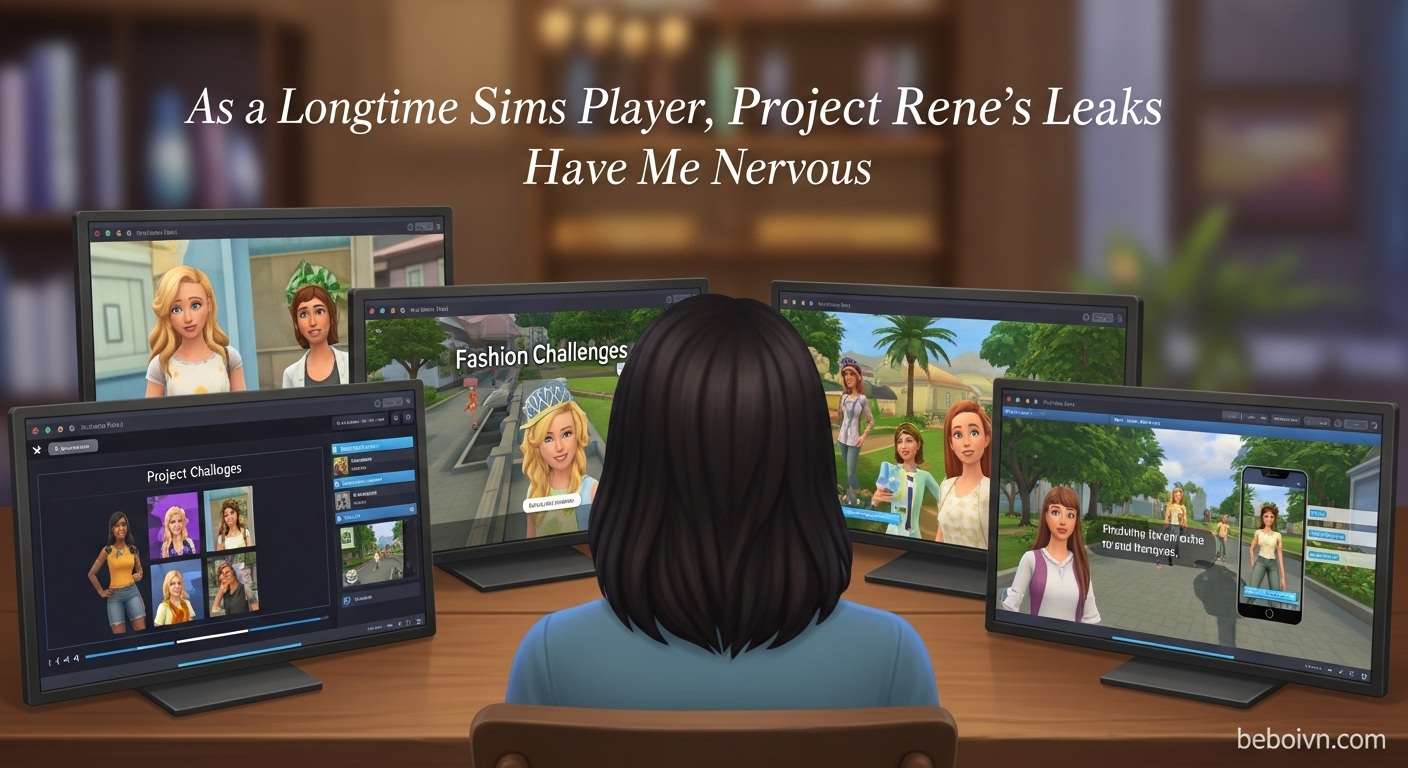
The latest Project Rene leaks have sent shockwaves through the Sims community, and for good reason. The emergence of “Fashion Passion”—a mini-game that bears more than a striking resemblance to Roblox’s wildly popular “Dress to Impress”—has left many of us scratching our heads. As a longtime player who has celebrated The Sims’ pioneering role in digital self-expression, seeing what appears to be a direct copy of another game’s mechanics feels like a betrayal of the franchise’s innovative spirit.
Let me be clear: The Sims has always borrowed elements from other games. That’s how gaming evolution works. But there’s a difference between being inspired by successful mechanics and what appears to be a wholesale replication of another game’s core concept. Fashion Passion, as shown in the leaks, tasks players with creating outfits based on random themes within a time limit, then rating other players’ creations on a five-star scale. Sound familiar? It should, because that’s essentially the entire premise of Dress to Impress, a game that has taken Roblox by storm and become a cultural phenomenon among younger players.
What troubles me most about this isn’t necessarily the borrowing of ideas—it’s what it represents. The Sims franchise built its reputation on creating systems that felt uniquely its own. From the complex web of needs and wants that drive Sim behavior to the intricate building tools that allow players to architectural masterpieces, The Sims has always been about depth and player agency. Fashion Passion, as described in the leaks, feels shallow by comparison—a quick-hit multiplayer distraction rather than the meaningful gameplay systems we’ve come to expect.
The Multiplayer Mandate: When Social Features Trump Simulation?
Perhaps my biggest concern about Project Rene stems from its apparent heavy focus on multiplayer features. Don’t get me wrong—I understand why EA is pushing in this direction. Gaming has become increasingly social, and the success of games like Fortnite, Among Us, and even Roblox itself has demonstrated the power of shared experiences. But The Sims has always been, at its heart, a deeply personal experience—a digital dollhouse where players could explore their creativity, tell their stories, and sometimes just watch their little digital people burn the house down by accident.
The leaked footage and descriptions suggest that Project Rene is being built around multiplayer interactions from the ground up. We’re seeing mentions of visiting friends’ spaces, competing in challenges together, and sharing experiences in real-time. While these features sound fun on paper, they raise serious questions about what’s being sacrificed to accommodate them. The Sims 4 originally began development as a multiplayer game before being pivoted to single-player, and many of its limitations at launch—smaller worlds, fewer lots, simplified systems—were direct results of that original multiplayer focus. Are we doomed to repeat those mistakes?
What made The Sims special was its ability to be both a sandbox for creative expression and a surprisingly deep life simulation. You could spend hours meticulously designing a home, creating complex family trees, or just experimenting with the cause-and-effect relationships that governed your Sims’ lives. The multiplayer focus of Project Rene suggests a shift toward more immediate, social experiences—fun for a while, perhaps, but lacking the longevity and depth that have kept players engaged with The Sims for literal decades.
The Identity Crisis: What Even Is Project Rene?
One of the most confusing aspects of the Project Rene situation is EA’s insistence that this isn’t The Sims 5. In a recent interview, EA president Laura Miele explained that forcing players to start over from scratch wouldn’t be “player-friendly” given the massive investment many have made in The Sims 4’s extensive DLC library. While I understand the business logic behind this decision, it leaves me wondering exactly what Project Rene is supposed to be.
Is it a spin-off? A companion experience? A completely new direction for the franchise? The marketing has been deliberately vague, referring to Project Rene as part of a “significant ecosystem” and “universe of multiple Sims experiences.” This corporate speak does little to reassure longtime fans who are trying to understand where their beloved franchise is headed.
Even more confusing is how Project Rene is being presented on different platforms. On the Google Play Store, it’s listed as “City Life Game with Friends”—a description that tells us virtually nothing about its connection to The Sims franchise. This lack of clear identity is troubling because it suggests that even EA isn’t entirely sure what Project Rene is supposed to be. Is it a Sims game? A social game inspired by The Sims? Something entirely new that just happens to feature plumbobs and Simlish?
For those of us who have invested years in this franchise, this identity crisis is deeply unsettling. We want to know what we’re getting into, what we can expect, and whether the things we love about The Sims will still be present in this new iteration. The current messaging from EA provides few clear answers and plenty of reasons to worry.
The Mobile Question: Depth vs. Accessibility
Another major concern stemming from the Project Rene leaks is its apparent focus on mobile platforms and cross-play. While making games more accessible is generally a positive thing, The Sims has always been a series that benefited from the power and precision of PC gaming. The complex systems, detailed customization options, and deep simulation mechanics that define the franchise have traditionally required the kind of processing power and control schemes that mobile devices struggle to provide.
The leaked footage suggests a game that’s being designed with mobile limitations in mind—simplified interfaces, streamlined mechanics, and graphics that prioritize performance over visual fidelity. While this makes sense for a game that needs to run on everything from high-end PCs to smartphones, it raises questions about whether Project Rene can deliver the depth and complexity that longtime Sims players expect.
Consider the building system, for instance. The Sims 4’s building tools, while simplified compared to previous iterations, still offer tremendous creative freedom. Project Rene’s leaked footage shows building challenges with timers and specific objectives—fun multiplayer activities, perhaps, but a far cry from the thoughtful, creative process that many players enjoy. Similarly, the focus on quick mini-games and social interactions suggests a game designed for short play sessions rather than the extended, immersive experiences that have defined The Sims.
The Community Concerns: More Than Just Nostalgia
Some might dismiss the concerns about Project Rene as simple resistance to change—longtime players clinging to nostalgia and unwilling to accept evolution. But I believe these concerns run deeper than that. The Sims community isn’t just resistant to change; we’re resistant to what appears to be a fundamental misunderstanding of what makes The Sims special.
What made The Sims revolutionary wasn’t just that it let you control little digital people—it was that it created a complex system of interconnected systems that produced emergent storytelling. The magic happened in the space between what the game explicitly told you to do and what you discovered through experimentation. Your Sims would develop relationships, pursue careers, form families, and experience the full spectrum of human emotion (albeit in cartoonish form) often with minimal direct input from you.
The Project Rene leaks suggest a game that’s much more directed—specific objectives, timed challenges, and structured multiplayer activities. There’s nothing inherently wrong with this type of gameplay, but it’s not what made The Sims a cultural touchstone that has endured for 25 years. We’re worried that in the pursuit of multiplayer engagement and mobile accessibility, EA is losing sight of the simulation depth and creative freedom that defined the franchise.
The Business Reality: Why This Direction Makes Sense (Even If We Hate It)?
As much as it pains me to admit it, I can understand why EA is taking Project Rene in this direction. The gaming landscape has changed dramatically since The Sims 4 launched in 2014. Mobile gaming has exploded, free-to-play models have become dominant, and social features are no longer optional extras but expected components of most successful games.
From a business perspective, Project Rene makes perfect sense. By creating a free-to-play, cross-platform Sims experience with heavy multiplayer integration, EA can:
- Attract a younger audience that has grown up with mobile and social gaming
- Create new revenue streams through in-game purchases and microtransactions
- Extend the Sims brand to platforms where it has traditionally had limited presence
- Compete more directly with social and mobile games that have captured players’ attention
The problem is that what makes sense from a business perspective doesn’t always align with what longtime fans want from the franchise. We’re not looking for another free-to-play mobile game with social features—we’re looking for the next evolution of the life simulation genre that The Sims pioneered.
The Technical Concerns: Learning from Past Mistakes
The Sims 4 launched with significant limitations that were directly tied to its original development as a multiplayer game. Smaller neighborhoods, loading screens between lots, and simplified systems were all compromises made to accommodate online features that were eventually scrapped. The game has improved dramatically over the years, but many of these limitations remain, serving as constant reminders of what could have been.
Now, seeing the Project Rene leaks, I can’t help but worry that history is repeating itself. The early footage shows a game that appears to be in rough shape—dull environments, limited interactions, and a general lack of polish. While this is expected for a game in early development, it raises concerns about whether the final product will deliver the depth and quality that The Sims franchise is known for.
Even more troubling is the possibility that Project Rene’s multiplayer focus will once again result in compromises to the core simulation systems. If the game needs to support multiple players interacting in real-time, will the complex AI systems that make Sims feel alive be simplified to ensure smooth performance? Will the creative freedom that defines The Sims be limited by the need to maintain consistency across multiplayer sessions?
The Hopeful Perspective: What Could Go Right?
Despite all my concerns, I’m trying to remain hopeful about Project Rene. The Sims franchise has evolved dramatically over the years, and each iteration has brought something new to the table. The Sims 2 introduced deeper life stages and aspirations, The Sims 3 revolutionized with its open world, and The Sims 4 refined the formula with its emotion system and building tools.
It’s possible that Project Rene could represent the next meaningful evolution of the franchise—a way to bring The Sims experience to new audiences and new platforms while still preserving what makes the series special. The multiplayer features, if implemented thoughtfully, could add new dimensions to the gameplay rather than detracting from it. Imagine being able to visit your friends’ neighborhoods, collaborate on building projects, or even play through generations of the same family together.
The key will be whether EA and Maxis can strike the right balance—embracing new technologies and player expectations without sacrificing the depth, creativity, and simulation complexity that have defined The Sims for a quarter-century.
The Community’s Role: Making Our Voices Heard
One thing that has always impressed me about The Sims community is our passion and willingness to speak up when we feel the franchise is moving in the wrong direction. The backlash against The Sims 4’s always-online plans helped shape the game into what it eventually became, and our continued feedback has driven many of the improvements and features added over the years.
With Project Rene, it’s more important than ever that we make our voices heard. We need to provide constructive feedback about what we want from the next generation of Sims games, what features are non-negotiable, and what direction we’d like to see the franchise take. This doesn’t mean being resistant to all change—it means being clear about what makes The Sims special and what we’re willing to accept in the name of evolution.
The Personal Stake: More Than Just a Game
For many of us, The Sims is more than just a game—it’s a creative outlet, a storytelling medium, a way to explore different aspects of ourselves and our imaginations. I’ve used The Sims to work through real-life problems, explore creative ideas, and even connect with friends and family members who might not otherwise understand my interests.
That’s why the Project Rene leaks hit so hard. They’re not just showing us a new game—they’re showing us what might be the future of a franchise that has been part of our lives for decades. The possibility that this future might not include the things we love most about The Sims is genuinely concerning.
Conclusion: Standing at the Crossroads
As a longtime Sims player, Project Rene’s leaks have me nervous, but they haven’t extinguished my hope entirely. The franchise has evolved dramatically over the years, and each iteration has faced its share of skepticism before ultimately finding its place in the series’ legacy. What matters now is whether EA and Maxis can listen to the concerns of longtime fans while still pushing the franchise forward in meaningful ways.
Project Rene could represent an exciting new chapter for The Sims—one that embraces new technologies, new platforms, and new ways to play while still honoring the simulation depth and creative freedom that made the franchise special. Or it could represent a misstep—a chase for trends and multiplayer revenue that abandons the core identity that has kept players engaged for 25 years.
Only time will tell which path Project Rene ultimately takes. But as someone who has grown up with this franchise, invested countless hours and dollars into it, and defended it through its various controversies, I’ll be watching closely. And I’ll be making my voice heard, because The Sims deserves better than to become just another free-to-play multiplayer game chasing trends. It deserves to evolve in ways that respect its legacy while embracing its future.
Here’s hoping that when Project Rene finally arrives, it silences my concerns and proves that the magic of The Sims can indeed thrive in this new era of gaming. But until then, I’ll remain cautiously—and honestly—nervous about what the future holds for the franchise I’ve loved for so long.