
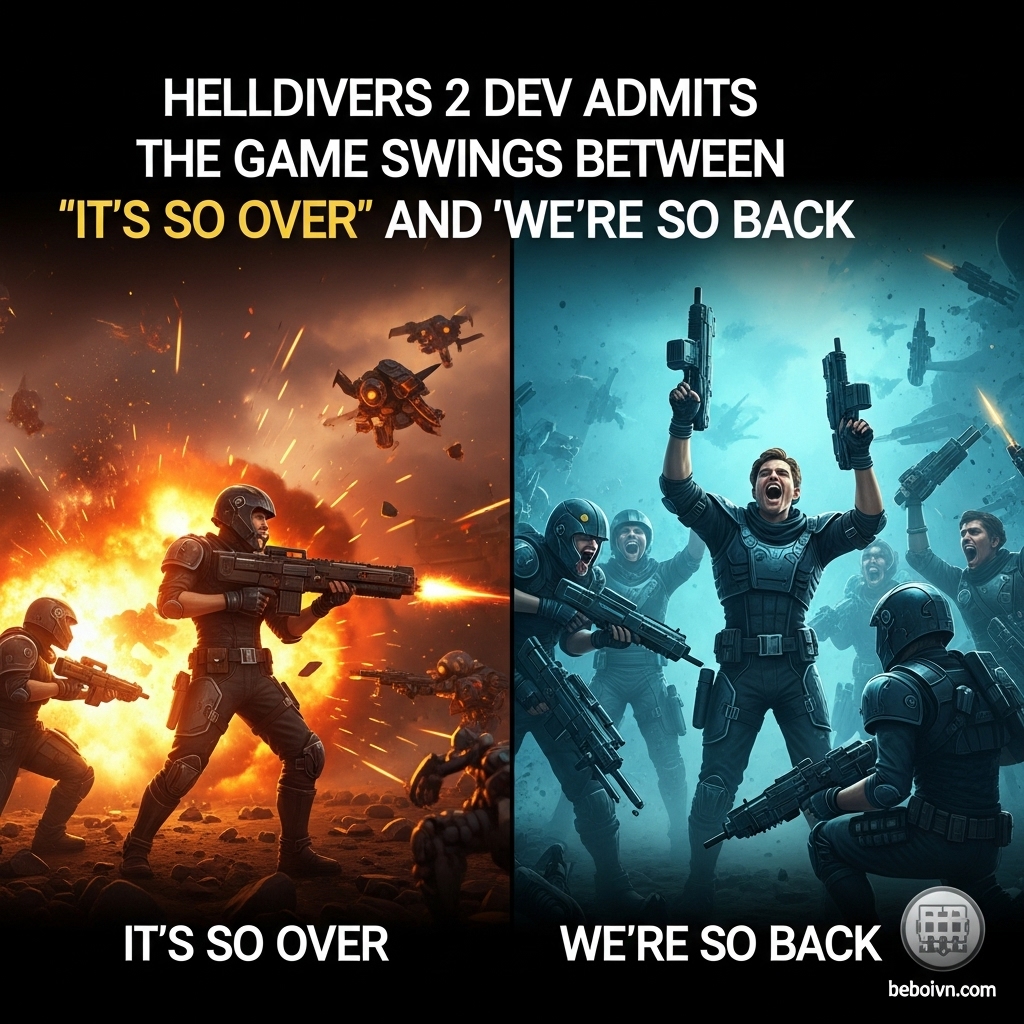
In a refreshingly honest admission that perfectly captures the rollercoaster experience of both playing and developing Helldivers 2, Arrowhead Game Studios’ former CEO and current creative lead Johan Pilestedt has acknowledged what players have been saying for months: the game exists in a constant state of flux between “it’s so over” and “we’re so back.” This candid revelation comes as the development team grapples with the challenges of maintaining one of gaming’s most unexpected live-service success stories, a game that has defied expectations while simultaneously struggling under the weight of its own popularity.
The phrase “it’s so over” and “we’re so back” has become something of a rallying cry within the Helldivers 2 community, perfectly encapsulating the game’s tumultuous journey since its explosive launch in February 2024. From controversial balance patches to performance issues that have left players frustrated, and from incredible content updates that restore faith to technical problems that threaten to undermine the entire experience, Helldivers 2 has indeed become a masterclass in gaming’s most dramatic emotional whiplash. Now, with the game’s development team openly admitting to the challenges they face, players are getting an unprecedented look behind the curtain at what it takes to keep this galactic war machine running.
The Birth of a Live-Service Phenomenon
When Helldivers 2 launched in early 2024, nobody—not even its developers—could have predicted the meteoric rise to fame that would follow. The game, which had been in development for nearly eight years (specifically “seven years, 11 months, and 26 days” as Pilestedt precisely recalls), suddenly found itself at the center of gaming culture. The cooperative third-person shooter, which tasks players with spreading democracy across the galaxy in the most explosive ways possible, struck a chord with audiences worldwide, becoming an instant sensation and proving that there was still room for new live-service successes in an increasingly crowded market.
The game’s success was built on a foundation of several key elements that set it apart from competitors. First and foremost was its commitment to the “live” aspect of live-service gaming. Unlike many games that follow predictable content schedules, Helldivers 2 embraced chaos and unpredictability. Major Orders that changed the galactic war map, surprise updates that introduced new weapons or enemies, and the sense that anything could happen at any time created an electrifying atmosphere that kept players coming back day after day.
However, this same unpredictability that made Helldivers 2 special also became the source of its greatest challenges. As Pilestedt explained during the Golden Joystick Awards 2025, the development team found themselves in uncharted territory, having to maintain and evolve a game that had far exceeded everyone’s expectations. “The team is still working on the same game almost a decade later,” he noted, highlighting the extraordinary longevity of a project that has now entered its second year of post-launch support.
The Breaking Point: When Technical Debt Comes Due?
Perhaps the most damning admission came from Game Director Mikael Eriksson, who revealed that Helldivers 2 is “starting to break at the seams” due to development choices that prioritized new content over technical stability. In a candid YouTube Q&A session, Eriksson took responsibility for the situation, stating, “This is, you know, in large part on me, that we have focused too much on making new things, and just not enough on fixing the issues that we have.”
This technical debt—the accumulation of shortcuts, quick fixes, and postponed optimizations—has become the game’s greatest enemy. Eriksson described how the team kept “getting away with things that we really shouldn’t be getting away with,” creating a situation where problems compounded over time until they could no longer be ignored. “We keep getting away with things that we really shouldn’t be getting away with,” he admitted. “And since we do keep getting away with it, we sort of just get used to it, and then we just keep developing the game as we normally do… like where we are where we’re at right now… we’ve been starting to break at the seams, and it’s not just in one place, unfortunately. It’s in many different places at once.”
The consequences of this approach have been severe. Players have reported everything from game-breaking crashes to performance issues that make the game nearly unplayable on certain systems. The file size has ballooned to over 150GB on PC, a figure that Eriksson himself described as “unacceptably large.” These technical problems have created a frustrating experience for many players, leading to multiple instances of review bombing and community backlash.
The Balance Backlash: When Nerfs Hit Hard?
One of the most significant swings in the “it’s so over” and “we’re so back” cycle came during the game’s balance patch controversies. As the game grew in popularity, certain weapons and strategies emerged as clearly superior, leading Arrowhead to implement a series of nerfs designed to encourage variety and maintain challenge. However, these changes often had the opposite effect, disrupting the delicate balance that had made the game so enjoyable in the first place.
Johan Pilestedt reflected on this turbulent period, acknowledging that “one of the controversies when it comes to the balancing changes we did was that players felt like this doesn’t make sense anymore. It feels like the guns aren’t doing what it says on the box.” This disconnect between player expectations and game reality created significant frustration within the community, with many feeling that their favorite weapons had been rendered ineffective overnight.
The backlash was intense. Players took to social media and review platforms to voice their displeasure, leading to waves of review bombing that temporarily damaged the game’s reputation. The situation became so heated that Arrowhead implemented a 60-day “make-good plan” that included multiple sweeping patches buffing various aspects of the game. By the end of this period, damage numbers had increased significantly, enemy armor values were reduced, and the overall power curve had shifted dramatically upward.
Interestingly, Pilestedt doesn’t see this increased power level as necessarily problematic. “We of course want to create a game where you are a Helldiver and have a destroyer in orbit that can call down awesome firepower,” he explained. “At that point, some of the more challenging enemies, yea, they’re maybe not as challenging anymore, but at least they react appropriately to what it would be like to be hit by a 380-millimeter barrage.”
The Community’s Role: A Double-Edged Sword
Throughout these ups and downs, the Helldivers 2 community has proven to be both the game’s greatest asset and its most formidable challenge. The passionate player base that has embraced the game’s unique blend of cooperative chaos and satirical militarism has also been quick to voice its displeasure when things go wrong.
This dynamic has created an interesting relationship between the developers and the community. On one hand, the feedback from players has been invaluable in helping shape the game’s direction. On the other hand, the intensity of community reactions—ranging from constructive criticism to outright toxicity—has made development increasingly challenging.
Pilestedt has been particularly vocal about this aspect, noting that the community’s characterization of the game as swinging between “it’s so over” and “we’re so back” is remarkably accurate. “The community has coined it really well,” he said. “It’s a never-ending ping pong between ‘it’s so over’ and ‘we’re so back,’ and I think that’s sort of the way that we’ll continue developing the game.”
This acknowledgment is significant because it shows a level of self-awareness that isn’t always present in game development. By openly admitting to the game’s flaws and the cyclical nature of its reception, Arrowhead is demonstrating a commitment to transparency that, while sometimes painful, ultimately serves to strengthen the relationship between developers and players.
The Path Forward: Rebuilding for Stability
With the game “starting to break at the seams,” Arrowhead has been forced to pivot its development priorities. Eriksson announced that the studio is now “so focused right now on addressing this and rethinking a little bit about how we’re developing the game in this live-service environment.” This shift represents a fundamental change in approach, moving away from the content-first mentality that has defined much of the game’s post-launch support.
The new strategy involves releasing updates every two weeks, with a focus on addressing the most pressing technical issues. While this may mean fewer flashy content updates in the short term, the hope is that it will create a more stable foundation for future development. “We will avoid this going forward,” Eriksson promised, indicating that the team has learned from their mistakes and is committed to building a more sustainable development process.
This focus on technical stability comes at a critical time for the game. As Helldivers 2 approaches the end of its second year, the challenge of maintaining player interest while addressing fundamental technical problems has never been greater. The development team finds itself in a difficult position, needing to balance the community’s appetite for new content with the necessity of fixing long-standing issues.
Lessons Learned: The Live-Service Reality
The Helldivers 2 experience offers valuable lessons for the gaming industry as a whole, particularly for studios venturing into the live-service space. The game’s journey from surprise hit to technical struggle illustrates the challenges of maintaining complex online games in an era where player expectations have never been higher.
One of the key takeaways is the importance of building scalable technical infrastructure from the outset. Eriksson admitted that the “foundations of this big tower were made for a little bungalow,” suggesting that the game’s architecture wasn’t designed to handle the level of success it achieved. This mismatch between expectations and reality is a common problem in game development, but it’s particularly acute in the live-service genre, where games are expected to evolve and expand over time.
Another important lesson is the need to balance content creation with technical maintenance. While new content is essential for keeping players engaged, neglecting technical optimization can lead to the kind of situation Helldivers 2 now finds itself in, where fundamental issues threaten to undermine the entire experience.
Perhaps most importantly, Helldivers 2 demonstrates the value of transparency and honesty in developer-community relations. By openly acknowledging their mistakes and challenges, Arrowhead has maintained a level of trust with their player base that might otherwise have been lost. This trust, while tested repeatedly, remains one of the game’s greatest assets.
The Future of Managed Democracy: What’s Next for Helldivers 2?
As Arrowhead works to address the game’s technical issues, players are naturally wondering what the future holds for Helldivers 2. The studio has indicated that they see the game as a potential “forever game,” similar to titles like RuneScape that can continue evolving for years to come. However, achieving this vision will require overcoming significant technical and design challenges.
In the short term, players can expect a focus on performance optimization and bug fixes, with new content taking a backseat to stability improvements. The planned bi-weekly updates should provide a steady stream of improvements, even if they lack the excitement of major content drops. This period of consolidation may be frustrating for players hungry for new experiences, but it’s necessary for the game’s long-term health.
Looking further ahead, the question becomes how Arrowhead can balance the competing demands of their player base. The challenge will be finding ways to introduce new content and features without compromising the technical stability they’re working so hard to achieve. This may involve rethinking aspects of the game’s architecture or finding new approaches to content creation that are less demanding on the game’s systems.
Conclusion: Embracing the Chaos
The Helldivers 2 development journey serves as a fascinating case study in the realities of modern game development, particularly in the live-service space. The game’s swings between “it’s so over” and “we’re so back” reflect not just the technical challenges of maintaining a complex online game, but also the emotional rollercoaster that comes with trying to create something truly special in an increasingly competitive industry.
What makes Helldivers 2’s story particularly compelling is the developers’ willingness to be open about their struggles. In an industry often characterized by carefully managed PR statements and corporate spin, Arrowhead’s honesty about their mistakes and challenges is refreshing. This transparency, while sometimes painful to witness, ultimately serves to strengthen the bond between developers and players, creating a sense of shared investment in the game’s future.
As the game continues to evolve, players can expect more of these dramatic swings between triumph and tribulation. The “never-ending ping pong between ‘it’s so over’ and ‘we’re so back'” is likely to continue, as Arrowhead works to balance the competing demands of their passionate community. But in a way, this chaos is perfectly fitting for a game about spreading democracy through overwhelming firepower and occasional friendly fire.
The Helldivers 2 experience reminds us that game development, like the galactic war it depicts, is messy, unpredictable, and occasionally frustrating. But it’s also capable of creating moments of pure magic that keep players coming back, mission after mission. As Arrowhead continues to navigate these challenges, they do so with the knowledge that their community is watching, ready to celebrate the highs and endure the lows, secure in the knowledge that, in Helldivers 2, it’s never really over—it’s just time to regroup and come back stronger.