
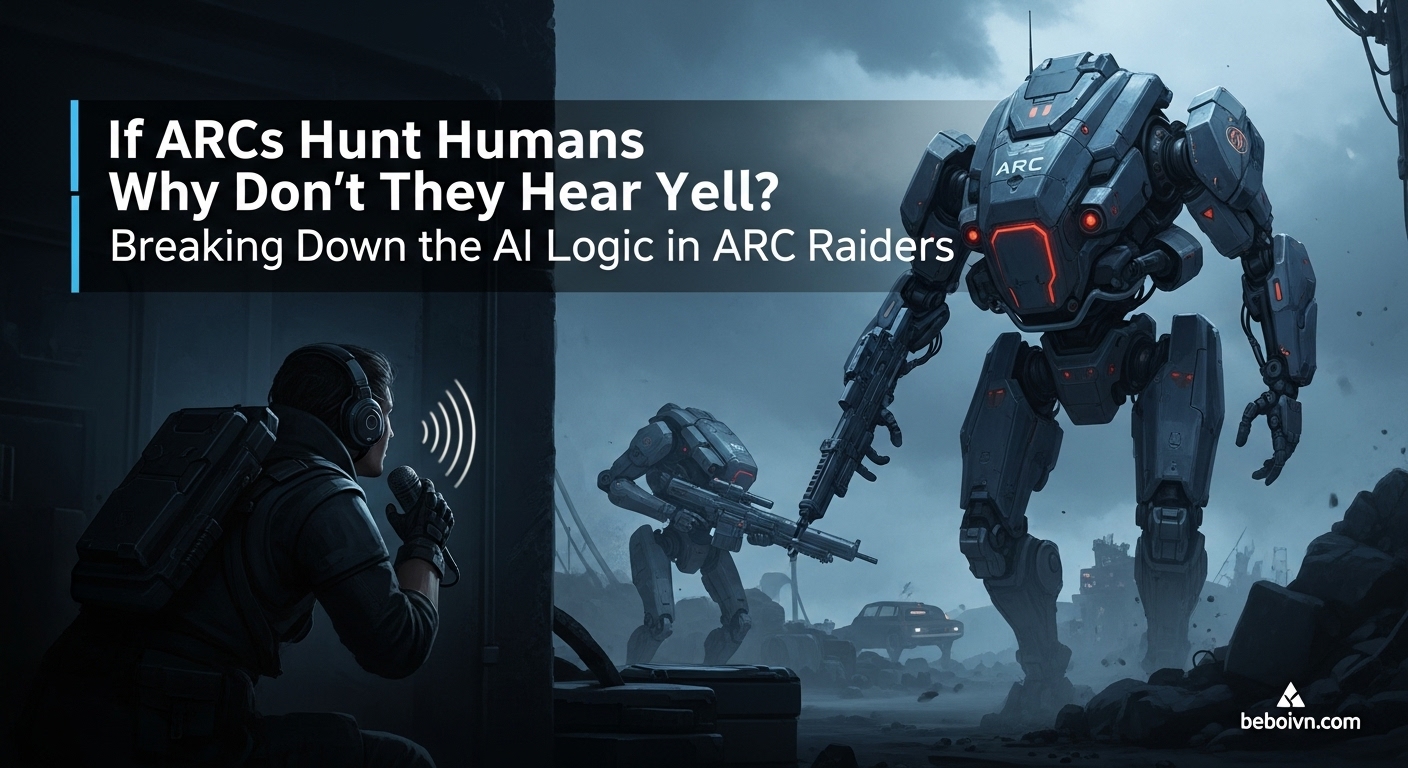
In the post-apocalyptic world of ARC Raiders, players face a fascinating paradox: highly sophisticated machines that hunt humans with deadly precision, yet somehow can’t hear you when you yell at them. This contradiction has puzzled many players, especially given the game’s innovative proximity chat system where human players can hear each other’s voices and emotes in real-time. So what’s really going on with the AI logic in ARC Raiders that makes these relentless hunters selectively deaf to human voices?
The Core Paradox: Sophisticated Hunters, Selective Hearing
Before diving into the technical details, let’s establish what makes this question so compelling. ARC Raiders presents us with machines that have driven humanity underground, possess advanced locomotion systems, can coordinate attacks, and adapt to player behavior – yet they somehow can’t detect the sound of human voices, even when players are literally shouting at them through proximity chat.
This isn’t just a minor gameplay quirk; it’s a fundamental design choice that speaks volumes about how Embark Studios approaches game development, player experience, and the delicate balance between realism and playability.
Understanding ARC Raiders’ Proximity Chat System
To fully grasp why ARCs don’t hear players, we first need to understand how proximity chat works in ARC Raiders. The game features a sophisticated voice system where players with active microphones can hear each other when within proximity, creating genuine human interactions in a world trying to tear them apart.
How Proximity Chat Functions:
- Players within range can hear each other’s microphone input
- Voice volume and clarity decrease with distance
- Emotes and voice commands are also audible to nearby players
- Creates emergent social dynamics and tension
This system works brilliantly for player-to-player interaction, creating moments where you might hear someone around the corner and have to decide whether to greet them, hide, or prepare for a fight. Yet somehow, the ARC machines – supposedly the apex predators of this world – remain completely oblivious to these audio cues.
The Official Explanation: Game Design Over Realism
According to Embark Studios’ developers, the decision to make ARCs unable to hear player voices was a deliberate game design choice, not a technical limitation. Game Design Director Virgil Watkins has been clear that this decision serves multiple purposes in creating the best possible player experience.
Three Core Design Principles
1. Maintaining Playable PvE Pressure The ARC enemies are designed to provide consistent, manageable pressure rather than overwhelming threat. As Watkins explains, “The ARC exist primarily to put PvE pressure on players as they search for valuable materials rather than to simulate realistic sensory responses.”
If ARCs could hear players talking, it would make the game exponentially more difficult. Players would need to remain completely silent while moving through ARC-infested areas, eliminating much of the social interaction that makes the game unique.
2. Encouraging Player Communication Perhaps the most important reason is that allowing ARCs to hear player voices would actively discourage communication between players. In a game that’s surprisingly cooperative despite its PvP potential, this would be devastating to the community dynamics.
As one developer put it, “If the ARC could hear players talk through their mics or hear their Raiders emoting to another player, it would discourage communication between players and likely lead to a more competitive, less friendly community.”
3. Maintaining Fairness and Clarity Extraction shooters like ARC Raiders thrive on players understanding when and why they’ve been detected. If ARCs could hear players talking, detection would become unpredictable and potentially feel unfair.
Players need clear feedback about what actions trigger ARC responses. Currently, ARCs react to predictable stimuli like gunfire, sprinting, metal detectors, and other clear audio/visual cues. Adding voice detection would introduce too much variability and make the game feel inconsistent.
The Technical Reality: How ARC AI Actually Works?
Contrary to some exaggerated claims circulating online, ARC Raiders doesn’t use generative AI for its enemy behavior. Instead, the game employs sophisticated machine learning and reinforcement learning systems specifically trained for locomotion and behavior patterns.
Machine Learning for Locomotion
Embark Studios has been transparent about their use of machine learning for ARC movement systems. As Virgil Watkins stated, “We use something called machine learning, or reinforcement learning, and that’s to do with the locomotion for our larger drones with multiple legs.”
This technology creates what developers call “fantastic emergent moments.” For example:
- When you shoot off an ARC’s leg, it attempts to rebalance itself
- ARCs adapt their movement patterns based on terrain
- Multi-legged machines learn to navigate complex environments dynamically
Scripted Detection Systems
Rather than using complex audio analysis for voice detection, ARCs rely on carefully scripted detection systems that respond to specific, predictable stimuli:
Visual Detection:
- Line-of-sight spotting
- Movement detection within visual range
- Light and shadow considerations
Audio Detection (Limited):
- Gunfire sounds
- Metal detector activations
- Explosions and loud impacts
- Footsteps (when very close)
Environmental Triggers:
- Motion detector activations
- Broken machinery alerts
- Distress calls from other ARCs
This approach ensures that players can learn and predict ARC behavior patterns, creating a skill-based experience rather than one based on random voice detection.
The Game Design Philosophy: Fun Over Simulation
At its core, ARC Raiders’ approach to AI detection reflects a broader game design philosophy that prioritizes player experience over realistic simulation. This is evident in several aspects of the game’s design.
Balancing Multiple Threat Layers
ARC Raiders isn’t just about fighting machines – it’s an extraction shooter where players must balance three distinct threat layers:
- PvE threats from ARC machines
- PvP threats from other players
- Environmental threats from the dangerous world
Making ARCs too sensitive to player voices would overload this delicate balance, potentially making the game overwhelmingly difficult and less enjoyable for the majority of players.
Creating Social Gameplay Opportunities
The decision to make ARCs deaf to player voices directly enables the game’s surprisingly cooperative social dynamics. Players can:
- Coordinate tactics verbally without fear of detection
- Call out warnings to nearby players
- Engage in the emergent social interactions that make the game special
This design choice has contributed to ARC Raiders developing a reputation for having one of the friendliest communities in the extraction shooter genre, despite its PvP elements.
The Technical Challenges: Why Voice Detection Would Be Problematic
Beyond game design considerations, there are significant technical challenges that make implementing voice detection for ARCs problematic.
Audio Processing Complexity
Implementing reliable voice detection would require:
- Real-time audio analysis of player microphones
- Distinguishing between relevant voice sounds and background noise
- Volume threshold calculations based on distance
- Handling multiple audio sources simultaneously
This would consume significant processing resources and potentially impact game performance, especially on lower-end systems.
Consistency and Fairness Issues
Voice detection would introduce numerous fairness concerns:
- Players with different microphone quality would have different experiences
- Background noise could trigger false detections
- Volume settings and audio hardware would create inconsistent experiences
- Players could exploit the system by speaking quietly or loudly strategically
Developer Insights: The Embark Studios Perspective
Embark Studios has been remarkably transparent about their design decisions and AI technology use. Their approach reflects a thoughtful balance between innovation and practicality.
Machine Learning vs. Generative AI
It’s crucial to understand that Embark distinguishes clearly between different types of AI technology:
- Machine Learning/Reinforcement Learning: Used for ARC locomotion and behavior patterns
- Generative AI: Not used for enemy AI (though used for some voice synthesis)
As Watkins clarified, “Arc Raiders in no way uses generative AI whatsoever. We use something called machine learning, or reinforcement learning, and that’s to do with the locomotion for our larger drones with multiple legs, but there’s no generative content whatsoever.”
The Ethical Considerations
The studio has also addressed ethical concerns about AI use in game development. While they use machine learning for enemy behavior and text-to-speech systems (with voice actor consent), they’ve drawn clear lines about what technologies they will and won’t implement.
Player Experience: Why This Design Works?
From a player perspective, the decision to make ARCs unable to hear voices creates several important benefits:
Predictable Learning Curve
New players can learn ARC behavior patterns through clear cause-and-effect relationships. When you make noise with a gun, ARCs react. When you sprint nearby, they might detect you. This predictability allows players to develop skill and mastery over time.
Strategic Depth
The current system creates interesting strategic decisions:
- Players can choose when to make noise (shooting vs. stealth)
- Voice communication becomes a tactical advantage
- Players must balance the risk of noise-making actions
Community Building
Perhaps most importantly, this design choice has fostered a surprisingly cooperative community. Players can communicate freely without fear of detection, leading to more positive social interactions and emergent gameplay moments.
The Future of AI in Gaming: Lessons from ARC Raiders
ARC Raiders’ approach to AI design offers valuable insights for the future of artificial intelligence in gaming:
Purpose-Driven AI Design
The game demonstrates that AI should serve specific gameplay purposes rather than being implemented for its own sake. Every AI system in ARC Raiders has a clear purpose that enhances the player experience.
Balance Between Innovation and Accessibility
While pushing technical boundaries with machine learning for locomotion, the game maintains accessibility through predictable, learnable behavior patterns.
Player Experience as the North Star
Ultimately, every design decision prioritizes what makes the game fun and engaging, even if it means sacrificing some realism or technical sophistication.
Conclusion: The Wisdom of Selective Deafness
The answer to “If ARCs hunt humans, why don’t they hear you yell?” ultimately comes down to thoughtful game design. Embark Studios made a deliberate choice to prioritize player experience, community building, and balanced gameplay over realistic simulation.
This decision reflects a mature understanding of what makes games work: sometimes the best design choices are the ones that seem counterintuitive at first glance. By making their sophisticated hunting machines selectively deaf to player voices, Embark created a more engaging, social, and ultimately enjoyable experience.
The AI logic in ARC Raiders isn’t about creating the most realistic machines possible – it’s about creating the best possible game experience. And in that regard, the decision to make ARCs unable to hear player voices isn’t a limitation; it’s a feature that helps make ARC Raiders one of the most compelling extraction shooters on the market today.
As the gaming industry continues to evolve and experiment with AI technologies, ARC Raiders stands as an example of how to thoughtfully integrate advanced systems while keeping player experience at the forefront of every decision.
For more insights into ARC Raiders’ development and game design philosophy, check out our interview with Embark Studios’ design team and our analysis of machine learning in modern games.