
I found that beboivn.com is a gaming website with tier lists, beginner guides, and redeem codes. I can use this information to create relevant internal links. Now I have all the information I need to create a comprehensive article about Battlefield 6 having some of the smallest maps in the series.
When Battlefield 6 launched in October 2025, fans were excited to return to the franchise’s signature large-scale warfare. However, something felt off. The battles seemed more confined, the engagements more chaotic, and the overall experience more claustrophobic than previous entries. Now, thanks to meticulous community research, we have concrete proof: Battlefield 6 has some of the smallest maps in the series, and the data reveals just how dramatic this shift really is.
The Data Doesn’t Lie: Battlefield 6’s Map Size Crisis
Reddit user ClaraTheRed, alongside contributor PENGUINonPC, spent an entire weekend conducting what might be the most comprehensive Battlefield map analysis ever undertaken. Their research compared 87 maps across Battlefield 3, 4, Hardline, 1, 2042, and 6, using three distinct datasets: top-down visual comparisons, playable area in square kilometers, and total map size.
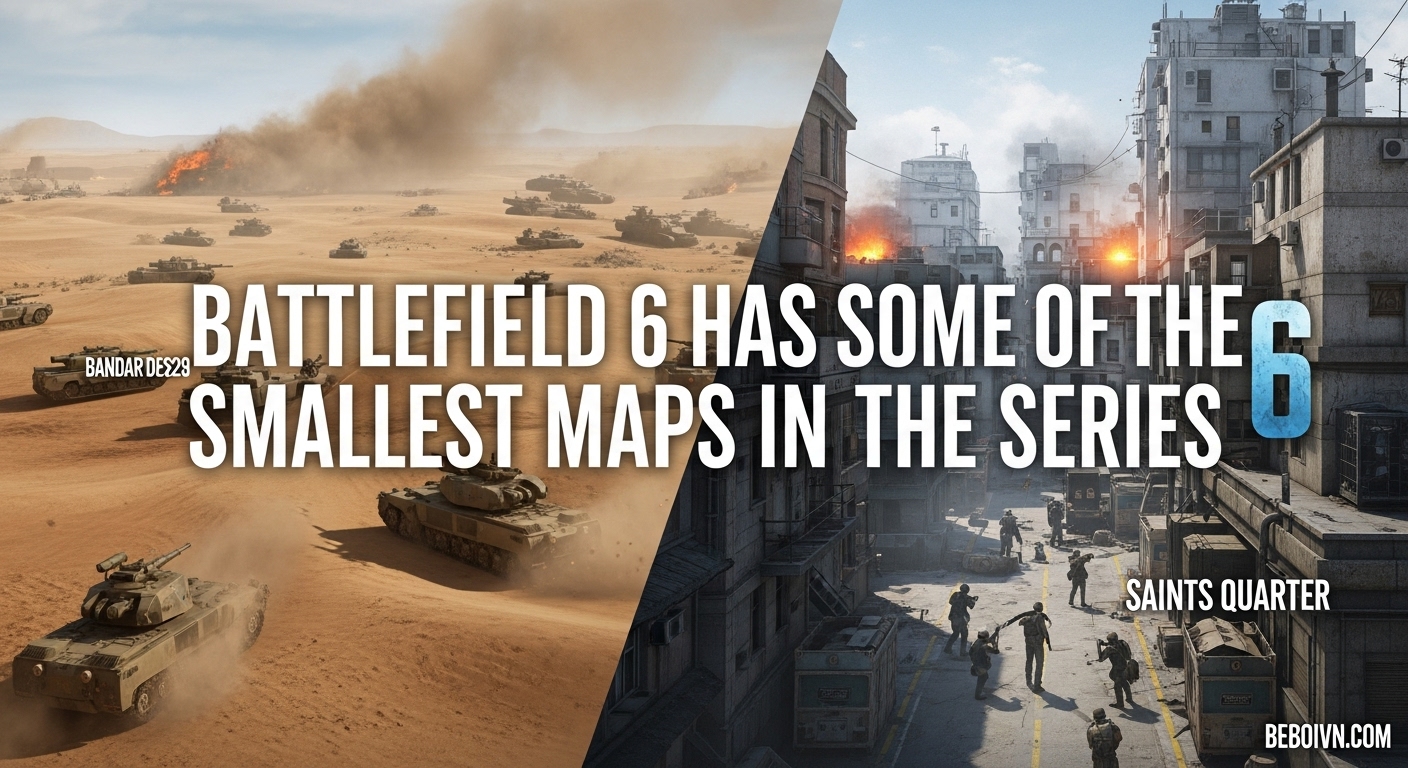
The results are staggering. Battlefield 3’s Bandar Desert reigns supreme at nearly 2.5 square kilometers, followed by Alborz Mountains (also from BF3) at 1.5 square kilometers. Battlefield 4’s Paracel Storm and BF3’s Strike at Karkand round out the top four. Where does Battlefield 6 fit into this hierarchy? Not even close to the top.
Operation Firestorm, Battlefield 6’s largest map (ironically a remake of the BF3 classic), doesn’t even crack the top 30 largest maps in franchise history. The situation gets worse from there. Four of Battlefield 6’s launch maps—Siege of Cairo, Iberian Offensive, Empire State, and Saints Quarter—rank among the five smallest maps studied. Only Battlefield 3’s infamous Ziba Tower is smaller than these four BF6 maps. Saints Quarter, in particular, holds the dubious honor of being the second-smallest map in Battlefield history.
For context, Mirak Valley, the largest original Battlefield 6 map, ranks 35th overall. When you consider that Battlefield 3 and 4—widely regarded as having some of the best map design in the series—dominate the upper echelons of size rankings, the contrast becomes even more pronounced.
Why Size Matters: The Battlefield Philosophy?
To understand why this matters, we need to appreciate what makes Battlefield, well… Battlefield. Unlike its competitors, Battlefield has always been about scale—about creating believable warzones where strategy matters as much as twitch reflexes. The series’ identity is built on several pillars that large maps enable:
Strategic Depth: Large maps allow for multiple approaches to objectives. You can flank, you can hold key positions, you can retreat and regroup. These options create a tactical chess match that smaller maps simply cannot support.
Vehicle Warfare: Battlefield’s signature vehicles need room to operate. Tanks, jets, and helicopters aren’t just fancy killstreaks—they’re strategic assets that require space to be effective. When maps are too small, vehicles become overpowered or useless, with no middle ground.
Dynamic Battle Flow: Great Battlefield maps create natural ebbs and flows in combat. One moment you’re in intense close-quarters fighting, the next you’re traversing open terrain under sniper fire. This variety keeps matches fresh for hours.
Squad Play: Large maps encourage teamwork. Moving across open territory is dangerous alone, so squads naturally form and work together. Small maps often devolve into every-player-for-themselves chaos.
For more insights on FPS game design philosophy, check out our FPS game mechanics guide on Beboivn.
Beyond Square Meters: Design Flaws That Make Maps Feel Even Smaller
The size issue would be problematic enough on its own, but Battlefield 6’s maps suffer from additional design flaws that make them feel even more confined than their actual dimensions suggest.
The “Empty Space” Problem: As PC Gamer’s Morgan Park brilliantly analyzed, great Battlefield maps include strategic empty space—areas that aren’t valuable territory but serve crucial gameplay functions. These outskirts allow for flanking maneuvers, provide escape routes for overwhelmed vehicles, and create constant threats to fortified positions. Battlefield 6’s maps, particularly Blackwell Fields and New Sobek City, lack this breathing room, forcing players into narrow “lanes” of combat.
Overconnected Flag Layouts: Traditional Battlefield maps scatter objectives across the terrain, creating natural front lines and strategic points of interest. BF6’s maps tend to connect all flags with contiguous roads, placing them too close to the map’s center. This design eliminates natural flanking routes and creates predictable, repetitive gameplay patterns.
Excessive Sightlines: Many BF6 maps feature wide open areas with minimal cover, combined with elevated positions that dominate the battlefield. This leads to constant exposure and frustrating deaths from unseen enemies, contributing to the “chaotic” feeling players report.
Poor Multi-Mode Adaptation: The maps seem designed with specific modes in mind, particularly Breakthrough and smaller-scale engagements. However, they don’t translate well to Conquest, Battlefield’s signature mode. As one Reddit user put it, the maps feel like “clusterf**k lane battlers” rather than proper Battlefield environments.
The Call of Duty Effect: Is Battlefield Losing Its Identity?
The most compelling theory about why Battlefield 6’s maps are so small comes from that same PC Gamer analysis: DICE is trying to “have its Battlefield cake and eat Call of Duty too.” The evidence is compelling.
Battlefield 6 introduces several new modes beyond the traditional Conquest and Rush: Breakthrough (which favors narrow, linear maps), 8v8 Team Deathmatch, King of the Hill, and Domination (which all favor compact, square layouts). These modes require different map designs than classic Battlefield experiences.
However, in attempting to appeal to both audiences, DICE may have alienated its core fanbase. Battlefield players want “freeform, natural spaces” and “spawns so far away from each other that you’re in a different zip code,” as the PC Gamer article notes. They want the islands, harbors, deserts, and forests that defined the series’ best maps—environments with loads of empty space that serves a purpose.
This identity crisis isn’t new. Battlefield 2042 faced similar criticism for its 128-player maps that felt too large and empty. DICE’s response was to shrink them, but the pendulum seems to have swung too far in the opposite direction with Battlefield 6.
Player Backlash: Community Response to Map Sizes
The community reaction has been overwhelmingly negative, with Reddit threads complaining about map sizes regularly reaching thousands of upvotes. Common sentiments include:
- “Maps don’t feel right. I’m 3 hours in and only really played Conquest because I love big maps, but even the ‘big’ maps don’t feel all that big.”
- “There’s too much action packed in every minute of gameplay. Even if gameplay feels kinda slow paced then intensity of maps and their size makes it feel way too fast.”
- “Non stop running around, non stop chaos, can’t stop for a moment.”
- “Even Mirak isn’t big (and it’s designed badly, no vertical terrain obstacles). Firestorm is the only respectable sized map in the game.”
These comments highlight a crucial point: it’s not just about objective measurements. Players feel the difference in gameplay flow, strategic options, and overall experience. The maps create a different type of combat—one that’s more frantic, less tactical, and ultimately less “Battlefield.”
For more community reactions and gaming discussions, visit our gaming community hub on Beboivn.
What Could Be Done: Potential Solutions
The situation isn’t hopeless. DICE has several options to address the map size crisis:
Expand Existing Maps: As PC Gamer notes, DICE could expand the borders on constricting maps without breaking anything. The empty space already exists in many cases—it’s just artificially limited by invisible walls.
Introduce Truly Large Maps: Season 1 and future seasons offer opportunities to introduce larger, more traditional Battlefield maps. The community has been vocal about wanting classic-style environments, and DICE could win back goodwill by delivering them.
Redesign for Multiple Modes: Rather than trying to make one map work for all modes, DICE could create mode-specific versions. A Conquest version could be larger with more strategic options, while a Breakthrough version could remain more focused.
Leverage Battlefield Labs: The new Battlefield Labs initiative allows players to test specific focus areas. This could be the perfect platform to experiment with larger map designs and gather community feedback before full implementation.
Bring Back Classic Maps: While DICE has stated that remastering old maps is “much more complicated than people think,” fan-favorite environments from Battlefield 3 and 4 could provide templates for successful large-scale design.
The Future of Battlefield Maps
Battlefield 6’s map size controversy represents a critical juncture for the franchise. The series has always been defined by its scale, its commitment to creating believable warzones where strategy matters as much as shooting. By significantly reducing map sizes, DICE risks losing what makes Battlefield unique.
However, the game’s strong launch—selling over 7 million copies in just five days—shows that there’s still immense appetite for the Battlefield experience. The core gameplay, gunplay, and destruction mechanics are widely praised. If DICE can address the map size issue through post-launch support, Battlefield 6 could still evolve into the game fans want it to be.
The success of Operation Firestorm, despite being smaller than its BF3 counterpart, suggests that players aren’t opposed to smaller maps in principle—they’re opposed to poorly designed ones. Maps that maintain strategic depth, offer multiple approaches, and support varied gameplay styles can work at any size.
Conclusion: Can Battlefield 6 Reclaim Its Scale?
Battlefield 6 has some of the smallest maps in the series, and the data proves it. From Saints Quarter being the second-smallest map in franchise history to Operation Firestorm failing to crack the top 30 largest maps, the evidence is overwhelming. Combined with design flaws that eliminate strategic options and force players into narrow combat lanes, it’s no wonder fans feel something is fundamentally different.
Yet, there’s hope. The foundation is solid, the player base is engaged, and DICE has proven willing to evolve based on feedback. The question is whether they’ll recognize that Battlefield’s identity isn’t found in trying to be all things to all people, but in embracing what made the series great in the first place: epic scale, strategic depth, and the freedom to wage war your way.
As Season 1 approaches and new maps are promised, Battlefield 6 stands at a crossroads. Will it continue down the path of constrained, chaotic combat, or will it reclaim the large-scale warfare that defined the series? The answer will determine not just the game’s future, but the future of Battlefield itself.