
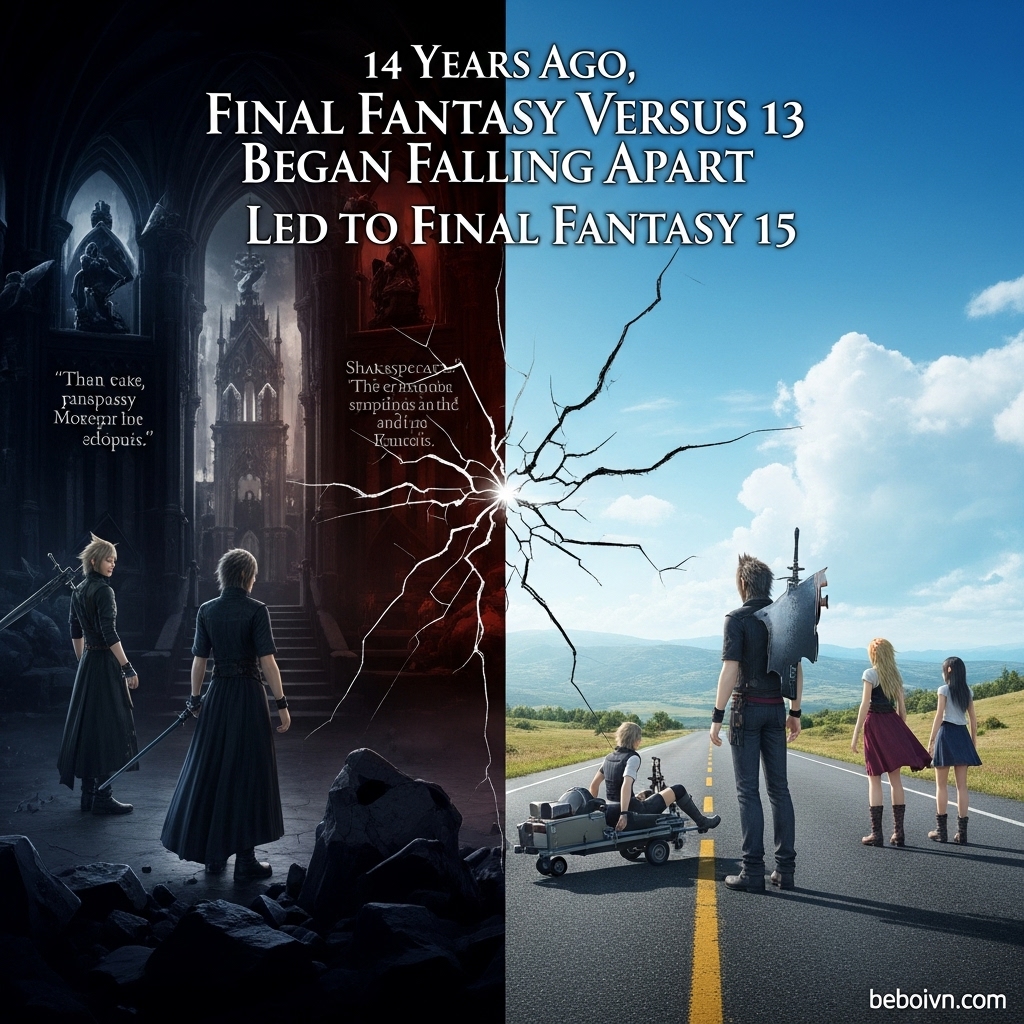
In the annals of gaming history, few development stories are as tragic, complex, and ultimately transformative as that of Final Fantasy Versus 13. Fourteen years ago, around 2011, what was once promised as a dark, mature spin-off in the Fabula Nova Crystallis collection began its slow, painful collapse—a development hell that would eventually birth one of the most ambitious mainline Final Fantasy entries ever created. This is the story of how Versus 13’s demise paved the way for Final Fantasy 15’s controversial existence, a tale of technological ambition, corporate mismanagement, and the relentless pursuit of creative vision against impossible odds.
The Grand Promise: What Versus 13 Was Supposed to Be?
When Final Fantasy Versus 13 was first unveiled at E3 2006, it represented everything fans had been craving from the franchise—a stark departure from the increasingly linear, brightly-colored entries that had dominated the PS2 era. Directed by Tetsuya Nomura, the visionary behind Kingdom Hearts and the character designer for countless Final Fantasy classics, Versus 13 promised a darker, more mature take on the Final Fantasy universe, heavily influenced by Shakespearean themes and real-world political drama.
The initial trailer showcased a protagonist named Noctis Lucis Caelum, a prince with the ability to wield multiple weapons simultaneously and teleport across the battlefield. The game was set to explore themes of “sadness and tragedy,” with Nomura explicitly stating he wanted to create something “unsuitable for the main series”—a bold declaration that immediately captured the imagination of fans growing weary of the franchise’s increasingly family-friendly direction.
What made Versus 13 particularly exciting was its proposed gameplay mechanics. Unlike the turn-based or heavily scripted battle systems of contemporary Final Fantasy games, Versus 13 aimed for a seamless action-RPG experience reminiscent of Kingdom Hearts, but with the complexity and depth expected of a mainline Final Fantasy title. Early footage suggested players could switch between party members during combat, with each character featuring unique combat styles—Prompto using handguns to target weak points, while other characters brought their own specialized abilities to the fray.
The First Cracks: Technical Limitations and Engine Troubles
By 2009, when Final Fantasy 13 finally shipped after its own protracted development, the cracks in Versus 13’s foundation were already beginning to show. The game was being built using Square Enix’s proprietary Crystal Tools engine, the same engine powering Final Fantasy 13. However, what worked for the linear, corridor-based design of FF13 proved woefully inadequate for Versus 13’s ambitious vision of a seamless open world.
Nomura wanted to create a truly seamless experience where players could transition from epic battles to quiet exploration without loading screens or jarring transitions. This vision required keeping vast amounts of data in memory at all times—character models, weapon variations, magic spells, enemy AI, and environmental details. The PlayStation 3’s hardware limitations, combined with Crystal Tools’ inefficiencies, made this vision nearly impossible to realize.
As Nomura would later explain in interviews with Polygon, the team constantly found themselves hitting technical walls: “With current-gen systems, we couldn’t fully express what we wanted to do in this project. There were more and more things that we would’ve had to change the form of.” The engine simply couldn’t handle the scope of what they were trying to achieve, forcing the team into what Nomura described as a “weeding process”—constantly cutting features and scaling back ambitions to make the game runnable on PS3 hardware.
Resource Drain: The XIV Disaster and Internal Chaos
While technical challenges plagued Versus 13’s development, an even more devastating blow came from within Square Enix itself. Around 2010, just as Versus 13 was finally gaining some development momentum, disaster struck in the form of Final Fantasy XIV’s catastrophic launch.
The initial version of Final Fantasy XIV was so riddled with bugs, performance issues, and design flaws that Square Enix was forced to issue unprecedented apologies to players and investors. The situation was so dire that the company made the extraordinary decision to completely rebuild the game from scratch, a process that would take years and require massive resources.
Guess which development team found its personnel constantly being pulled away to help fix the XIV disaster? That’s right—the already-struggling Versus 13 team found themselves repeatedly seconded to firefighting duties elsewhere in the company. As documented in various retrospective analyses, this constant resource drain created a stop-start development cycle that prevented any meaningful progress on Versus 13 for extended periods.
This internal chaos wasn’t limited to just the XIV crisis. The Crystal Tools engine, already struggling with Versus 13’s requirements, was also causing issues across multiple Square Enix projects. Team members working on Versus 13 found themselves constantly being pulled into supporting other titles, creating a vicious cycle where their own project could never gain the sustained focus needed to move forward.
The Vision Shift: From Dark Tragedy to Brotherhood
By 2011, when Square Enix finally released new footage of Versus 13, observant fans noticed something significant had changed. The grim, oppressive atmosphere of the original reveal had given way to something lighter, more optimistic. The trailer showed green landscapes, rural areas, and a more balanced tone that hinted at the eventual direction of Final Fantasy 15.
This tonal shift wasn’t accidental. As development continued, Nomura and his team began reevaluating the game’s direction. The Shakespearean tragedy elements were still present, but they were being balanced with themes of friendship, loyalty, and brotherhood that would eventually become central to Final Fantasy 15’s identity.
The 2011 trailer also introduced two characters who would become central to the final game: Ignis and Gladiolus, Noctis’s loyal companions. Their presence signaled a move away from the solitary, brooding protagonist of the original concept toward something more ensemble-focused—a decision that would prove crucial to the game’s eventual transformation.
The Breaking Point: Next-Gen Transition and the Final Decision
Around 2012, fourteen years ago, Versus 13 reached its breaking point. Multiple factors converged to make continuing development on the PlayStation 3 untenable:
- Technical Limitations: The PS3 simply couldn’t handle the scope of what Nomura wanted to achieve. The seamless world, complex combat systems, and visual fidelity he envisioned were beyond the console’s capabilities.
- Changing Market: The PlayStation 4 and Xbox One were on the horizon, and Square Enix leadership recognized that releasing a technically compromised version on aging hardware would make the company look inferior compared to next-gen titles.
- Development Stagnation: After years of stop-start development, Versus 13 was still only 20-25% complete, with most character designs and visual elements still unfinalized.
- Corporate Strategy: Square Enix was undergoing significant restructuring, and there was growing pressure to deliver a mainline Final Fantasy title that could showcase next-generation capabilities.
As Nomura would later reveal, the decision to transform Versus 13 into Final Fantasy 15 wasn’t made lightly. “Around one or two years after we announced FF Versus 13, it was suggested to us to shift to FF15 as part of the company’s direction,” he explained. The suggestion came from Square Enix leadership, who recognized that the project’s scope and ambition made it more suitable as a mainline entry that could justify next-generation hardware.
The Rebirth: Hajime Tabata and the Final Fantasy 15 Transformation
With the decision made to rebrand Versus 13 as Final Fantasy 15, Square Enix brought in Hajime Tabata, director of Final Fantasy Type-0, to help steer the project. Tabata initially served as co-director alongside Nomura but eventually took over completely when Nomura was reassigned to other projects, including the highly anticipated Final Fantasy 7 Remake.
Under Tabata’s leadership, the game underwent significant changes. The Fabula Nova Crystallis mythology was deemphasized, with many specific references removed to make the game more accessible to new players. The combat system was streamlined, the open world expanded, and the story was reworked to focus more on the brotherhood between Noctis and his companions.
Tabata later revealed that when he took over, Versus 13 was still in a very early state: “In terms of character designs or visuals, nothing really had been fixed at that point. We were still working on updating it and revising those designs.” This explains why so much of what was shown in early Versus 13 trailers never made it into the final game—it was never fully realized to begin with.
What Was Lost: The Versus 13 That Never Was
The transformation from Versus 13 to Final Fantasy 15 wasn’t without its casualties. Fans who had followed the project for years were disappointed to find that many elements from the original trailers and concept art didn’t make it into the final game:
- Stella Nox Fleuret: The mysterious female character shown in early trailers, intended as Noctis’s counterpart and potential love interest, was completely removed from the game.
- Darker Story Elements: The Shakespearean tragedy aspects were significantly toned down in favor of a more optimistic narrative about friendship and sacrifice.
- Original Combat Mechanics: The ability to switch between party members during combat, a feature prominently shown in early footage, was simplified to focus primarily on Noctis.
- Specific Locations and Set Pieces: Several environments and scenarios shown in trailers were either redesigned or cut entirely.
Perhaps most frustrating for long-time fans was the sense that they would never experience the game that had been promised in 2006. The Versus 13 that existed in their imaginations—dark, mature, complex, and revolutionary—would remain forever unrealized, replaced by the very different (though still ambitious) Final Fantasy 15.
What Was Gained: The Final Fantasy 15 Legacy
While the loss of Versus 13’s original vision was painful, the transformation did result in some significant achievements:
- Technical Innovation: Final Fantasy 15 pushed the boundaries of what was possible in open-world RPGs, featuring a seamless world with dynamic weather, day/night cycles, and unprecedented attention to detail.
- Genre Evolution: The game introduced the “road trip” concept to JRPGs, creating a more intimate, character-driven experience that resonated with many players.
- Multimedia Expansion: Square Enix created an entire “Final Fantasy 15 Universe” including a feature film (Kingsglaive), an animated series (Brotherhood), and various DLC expansions that expanded the world and characters.
- New Development Paradigm: The lessons learned from Versus 13’s troubled development influenced Square Enix’s approach to future projects, including the more structured development of Final Fantasy 7 Remake.
Lessons from the Ashes: What Versus 13 Taught the Industry
The story of Final Fantasy Versus 13’s transformation into Final Fantasy 15 offers several important lessons for the gaming industry:
The Danger of Early Announcements
Tabata himself would later admit that revealing Versus 13 in 2006 was a mistake. “I think it was a mistake to reveal Versus 13 in 2006, as this resulted in it being burdened by audience expectations, making for a messier development process.” This sentiment has been echoed by other developers who’ve learned the hard way that announcing games too early can create unrealistic expectations and development pressure.
Technical Reality vs. Creative Vision
Versus 13’s story is a classic example of the gap between creative vision and technical reality. Nomura’s ambitions were genuinely revolutionary, but the technology of the time simply couldn’t support them. This disconnect between what developers want to create and what current hardware can achieve remains one of the biggest challenges in AAA game development.
The Importance of Focused Development
The constant resource drain and team reassignments that plagued Versus 13’s development highlight the importance of focused, sustained development effort. When teams are constantly being pulled in multiple directions, projects inevitably suffer, leading to delays, quality issues, and in extreme cases, complete cancellation.
Adaptability in Game Development
Perhaps the most important lesson from Versus 13’s transformation is the value of adaptability. While the original vision was lost, the ability to pivot and reimagine the project ultimately resulted in a successful (if controversial) game that many players loved. This flexibility—while painful for fans of the original concept—may have saved the project from complete cancellation.
The Legacy: Versus 13 in Gaming Culture
Even though it was never released, Final Fantasy Versus 13 has left an indelible mark on gaming culture. It’s become a cautionary tale about the dangers of over-promising, a symbol of lost potential, and a touchstone for discussions about game development challenges.
The mystique surrounding Versus 13 has only grown over time. Fan communities continue to analyze every piece of leaked footage, every interview quote, and every rumor about what might have been. The game has achieved a sort of legendary status—not for what it was, but for what it represented: the perfect JRPG that existed only in the collective imagination of its fans.
This cultural legacy is perhaps Versus 13’s most enduring achievement. While Final Fantasy 15 may eventually be forgotten as just another entry in a long-running franchise, Versus 13 will live on in gaming history as a symbol of ambition, potential, and the heartbreaking gap between dreams and reality in game development.
Conclusion: A Tragic Transformation
Fourteen years ago, Final Fantasy Versus 13 began falling apart—a victim of technical limitations, corporate mismanagement, and the weight of its own ambitions. What emerged from those ashes was Final Fantasy 15, a game that, while successful in its own right, could never fully live up to the promise of its predecessor.
The story of Versus 13’s transformation is more than just a development history—it’s a cautionary tale about the dangers of over-promising, the challenges of technological innovation, and the painful compromises that sometimes must be made to bring creative visions to life. For fans who followed the project from its 2006 announcement through its eventual rebranding, it remains one of gaming’s great “what if” scenarios—a game that existed more in potential than in reality.
Yet, in the end, Versus 13’s legacy lives on. It influenced the development of Final Fantasy 15, shaped Square Enix’s approach to future projects, and left an indelible mark on gaming culture. The dream of Versus 13 may have died, but its impact continues to resonate, reminding us that sometimes the most influential games are the ones that never actually get made.