
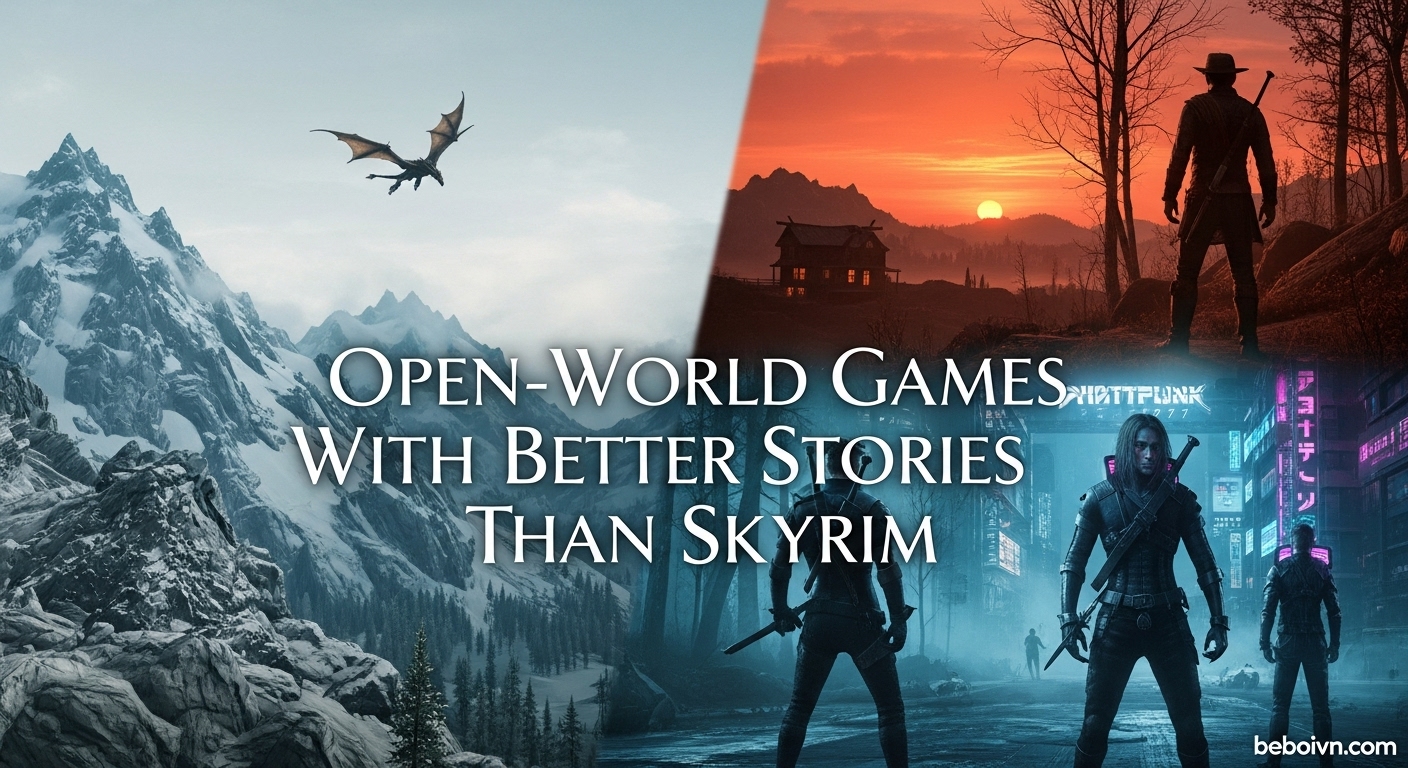
Skyrim revolutionized open-world gaming when it launched in 2011, offering players unprecedented freedom to explore a vast, living world filled with dragons, dungeons, and endless possibilities. However, even the most dedicated Elder Scrolls fans would admit that storytelling has never been Bethesda’s strongest suit. While Skyrim excels in world-building and player agency, its main narrative often feels like an afterthought compared to the epic tales told by other open-world masterpieces.
The gaming landscape has evolved dramatically since Skyrim’s release, with developers pushing the boundaries of interactive storytelling in ways that make even the Dragonborn’s adventures seem somewhat shallow by comparison. Today, we’ll explore the open-world games that deliver narratives so compelling, they make Skyrim’s story look like a rough draft.
The Evolution of Open-World Storytelling
Before diving into specific games, it’s worth understanding how open-world storytelling has transformed since Skyrim’s era. Modern developers have learned that player freedom and narrative depth aren’t mutually exclusive. In fact, the best open-world games now use their expansive worlds as canvases for stories that adapt to player choices, creating experiences that feel both personal and epic.
Skyrim’s approach to storytelling—scattering narrative fragments across countless side quests while maintaining a relatively straightforward main plot—represented an earlier philosophy in open-world design. The games we’re about to explore demonstrate how far we’ve come, featuring protagonists with actual personalities, supporting characters with meaningful arcs, and stories that resonate long after the credits roll.
Red Dead Redemption 2: The Gold Standard of Interactive Storytelling
If there’s one game that consistently tops lists of open-world narratives, it’s Rockstar’s masterpiece. Red Dead Redemption 2 doesn’t just tell a story—it creates an entire world that feels lived-in and authentic, with every character contributing to a larger tapestry of human experience.
Arthur Morgan’s journey from loyal gang member to man questioning his entire life philosophy represents everything Skyrim’s main story lacks: emotional depth, character development, and genuine stakes. While the Dragonborn fights dragons and saves the world, Arthur grapples with mortality, loyalty, and the cost of living outside the law. The game’s slow-burn approach to storytelling might test some players’ patience, but those who invest in its world are rewarded with one of gaming’s most powerful narratives.
What makes Red Dead Redemption 2’s storytelling superior to Skyrim’s isn’t just the quality of the writing—it’s how every element of the game world reinforces the narrative. The changing seasons, the deteriorating health of gang members, and even the way NPCs react to your choices all contribute to a story that feels organic and unavoidable, unlike Skyrim’s often-disconnected main quest.
The Witcher 3: Wild Hunt: Character-Driven Narrative Excellence
CD Projekt Red’s magnum opus represents perhaps the perfect balance between open-world freedom and narrative cohesion. While Skyrim gives players a blank slate protagonist, The Witcher 3 introduces Geralt of Rivia—a fully realized character with established relationships, motivations, and a personality that shines through every interaction.
The central story of Geralt searching for his adopted daughter Ciri provides emotional weight that Skyrim’s “save the world from dragons” premise can’t match. More importantly, The Witcher 3’s side quests aren’t just distractions from the main story—they’re narrative gems in their own right, with complex moral choices and consequences that ripple throughout the game world.
Where Skyrim’s factions feel like separate entities with little connection to each other, The Witcher 3 weaves its various storylines into a cohesive whole. The Bloody Baron’s questline alone contains more emotional depth and character development than Skyrim’s entire main quest, demonstrating how open-world games can tell intimate, personal stories while still maintaining epic scope.
Ghost of Tsushima: Poetry in Motion and Narrative
Sucker Punch’s samurai epic takes a different approach to storytelling, using its open world not just as a playground but as a narrative device. Ghost of Tsushima tells the story of Jin Sakhai’s struggle between honoring samurai traditions and adopting practical but dishonorable guerrilla tactics to save his homeland.
What makes Ghost of Tsushima’s narrative superior to Skyrim’s is its thematic consistency and visual storytelling. Every aspect of the game—from the changing colors of leaves to the way combat evolves—reinforces Jin’s internal conflict. The game doesn’t need lengthy exposition to convey its themes; it shows them through gameplay, environment, and character interactions.
Skyrim’s civil war storyline attempts to tackle similar themes of tradition versus progress, but it lacks the personal stakes and character development that make Ghost of Tsushima’s narrative so compelling. Jin’s journey feels like a personal tragedy rather than a world-saving epic, making it more relatable and emotionally resonant.
Cyberpunk 2077: A Dystopian Masterpiece of Character and World
Despite its rocky launch, Cyberpunk 2077 delivers one of gaming’s most ambitious narratives, using its open world to explore themes of identity, mortality, and corporate corruption in ways Skyrim never attempts. V’s journey through Night City represents everything modern open-world storytelling can achieve when developers fully commit to narrative depth.
What sets Cyberpunk 2077 apart from Skyrim is how its world-building and character development are inseparable. Every district of Night City tells a story about class struggle, technological dependence, or human resilience. The supporting characters aren’t just quest-givers—they’re fully realized people with their own motivations, fears, and arcs that intersect meaningfully with V’s journey.
While Skyrim’s factions feel like separate entities with little connection to each other, Cyberpunk 2077’s various storylines weave together into a cohesive exploration of what it means to be human in a world that’s increasingly losing its humanity. The game’s multiple endings and branching narratives ensure that each player’s experience feels unique and personal.
Fallout: New Vegas: Player Agency Meets Narrative Depth
Many gamers consider Fallout: New Vegas the gold standard for player choice in open-world RPGs, and for good reason. While Skyrim presents players with clear-cut moral choices, New Vegas embraces moral ambiguity, forcing players to make difficult decisions with far-reaching consequences.
The story of the Courier seeking revenge and getting caught up in the power struggle between New Vegas factions represents everything Skyrim’s civil war storyline could have been. Where Skyrim’s conflict feels superficial, New Vegas’ faction war has genuine ideological depth, with each faction presenting compelling arguments for their vision of the wasteland’s future.
What makes New Vegas’ narrative superior to Skyrim’s is how it respects player intelligence and agency. The game doesn’t present obvious good and evil choices—it presents competing philosophies and lets players decide which path aligns with their values. This approach creates a more mature and thought-provoking narrative experience than Skyrim’s relatively simplistic good-versus-evil framework.
Kingdom Come: Deliverance: Historical Authenticity and Human Drama
Warhorse Studios’ medieval RPG takes a radically different approach to storytelling, focusing on historical authenticity and human drama rather than fantasy epic. Kingdom Come: Deliverance tells the story of Henry, a blacksmith’s son seeking revenge after his village is destroyed—a far cry from Skyrim’s chosen-one narrative.
What makes Kingdom Come’s storytelling superior to Skyrim’s is its commitment to realism and emotional authenticity. Henry isn’t a dragon-slaying hero; he’s a frightened, angry young man struggling to survive in a brutal world. The game’s narrative doesn’t rely on prophecies or magical artifacts—it relies on human emotions, political intrigue, and the harsh realities of medieval life.
The game’s attention to historical detail extends to its storytelling, with quests that feel grounded in actual medieval concerns rather than fantasy tropes. While Skyrim’s world feels like a theme park version of medieval life, Kingdom Come’s world feels lived-in and authentic, making its narrative more immersive and emotionally resonant.
Death Stranding: Experimental Storytelling in Open Worlds
Hideo Kojima’s polarizing masterpiece represents perhaps the most ambitious attempt to push open-world storytelling into new territory. Death Stranding tells a complex, metaphorical story about connection, isolation, and the human condition in a post-apocalyptic world.
What makes Death Stranding’s narrative superior to Skyrim’s is its willingness to take risks and explore unconventional themes. While Skyrim plays it safe with traditional fantasy storytelling, Death Stranding experiments with structure, theme, and player interaction in ways that challenge our understanding of what video game narratives can be.
The game’s story unfolds through environmental storytelling, cryptic cutscenes, and player actions that have literal narrative consequences. This approach creates a more immersive and thought-provoking narrative experience than Skyrim’s relatively straightforward quest structure, even if it requires more patience and engagement from players.
Horizon Zero Dawn: Mystery and World-Building Excellence
Guerrilla Games’ post-apocalyptic adventure combines compelling mystery with exceptional world-building to create a narrative that puts Skyrim’s lore to shame. Horizon Zero Dawn tells the story of Aloy, an outcast seeking answers about her world’s past and future.
What makes Horizon’s narrative superior to Skyrim’s is how its mystery unfolds naturally through exploration and discovery. While Skyrim’s lore feels like exposition dumped on players through books and dialogue, Horizon’s world-building is integrated into its gameplay, with every ruin and machine containing clues about the game’s central mystery.
The game’s story balances personal stakes with epic scope, following Aloy’s journey from outcast to savior while gradually revealing the truth about her world’s apocalyptic past. This approach creates a more satisfying narrative arc than Skyrim’s relatively straightforward dragon-slaying adventure, with revelations that genuinely surprise and engage players.
The Future of Open-World Storytelling
As we look beyond these exceptional examples, it’s clear that open-world storytelling continues to evolve. Games like Elden Ring demonstrate how environmental storytelling can create rich narratives without traditional exposition, while upcoming titles promise to push the boundaries even further.
What these games share in common is a commitment to using their open worlds as narrative tools rather than just playgrounds. They understand that player freedom and narrative depth aren’t mutually exclusive—that in fact, the best open-world games use player choice to enhance rather than diminish their stories.
Skyrim will always hold a special place in gaming history for its world design and player freedom, but when it comes to storytelling, these games demonstrate how far the medium has come. They prove that open-world games can deliver narratives as compelling as any linear experience, while still offering the freedom and exploration that make the genre so beloved.
Why Story Matters More Than Ever in Open Worlds
In an era where games increasingly compete with film and television for narrative prestige, the importance of strong storytelling in open-world games cannot be overstated. Players expect more than just vast worlds to explore—they want stories that resonate, characters they care about, and narratives that stick with them long after they’ve put down the controller.
The games we’ve explored represent the pinnacle of open-world storytelling, each demonstrating different approaches to balancing player freedom with narrative depth. From Red Dead Redemption 2’s character-driven epic to Death Stranding’s experimental narrative, they show that open-world games can tell stories as compelling as any other medium.
For players who loved Skyrim’s world but craved deeper storytelling, these games offer the perfect next step. They maintain the sense of exploration and freedom that makes open-world games so compelling while delivering narratives that engage both emotionally and intellectually.
Conclusion: Beyond Skyrim’s Narrative Horizons
Skyrim revolutionized open-world gaming, but its storytelling has always been its weakest link. The games we’ve explored demonstrate how far the medium has come, delivering narratives that are more emotionally resonant, thematically complex, and structurally innovative than anything Bethesda has attempted.
From the personal tragedy of Red Dead Redemption 2 to the philosophical depth of Death Stranding, these games prove that open-world storytelling can be both expansive and intimate, epic and personal. They represent the future of narrative design in gaming, showing that player freedom and compelling storytelling aren’t mutually exclusive—they’re complementary.
For gamers who have spent hundreds of hours exploring Skyrim’s world but wished for deeper stories, these games offer the perfect solution. They maintain the sense of discovery and freedom that makes open-world games so compelling while delivering narratives that engage both emotionally and intellectually.
As the gaming industry continues to evolve, we can expect even more ambitious attempts to push the boundaries of open-world storytelling. But for now, these games represent the gold standard—proving that when it comes to narrative depth, they truly are open-world games with better stories than Skyrim.