
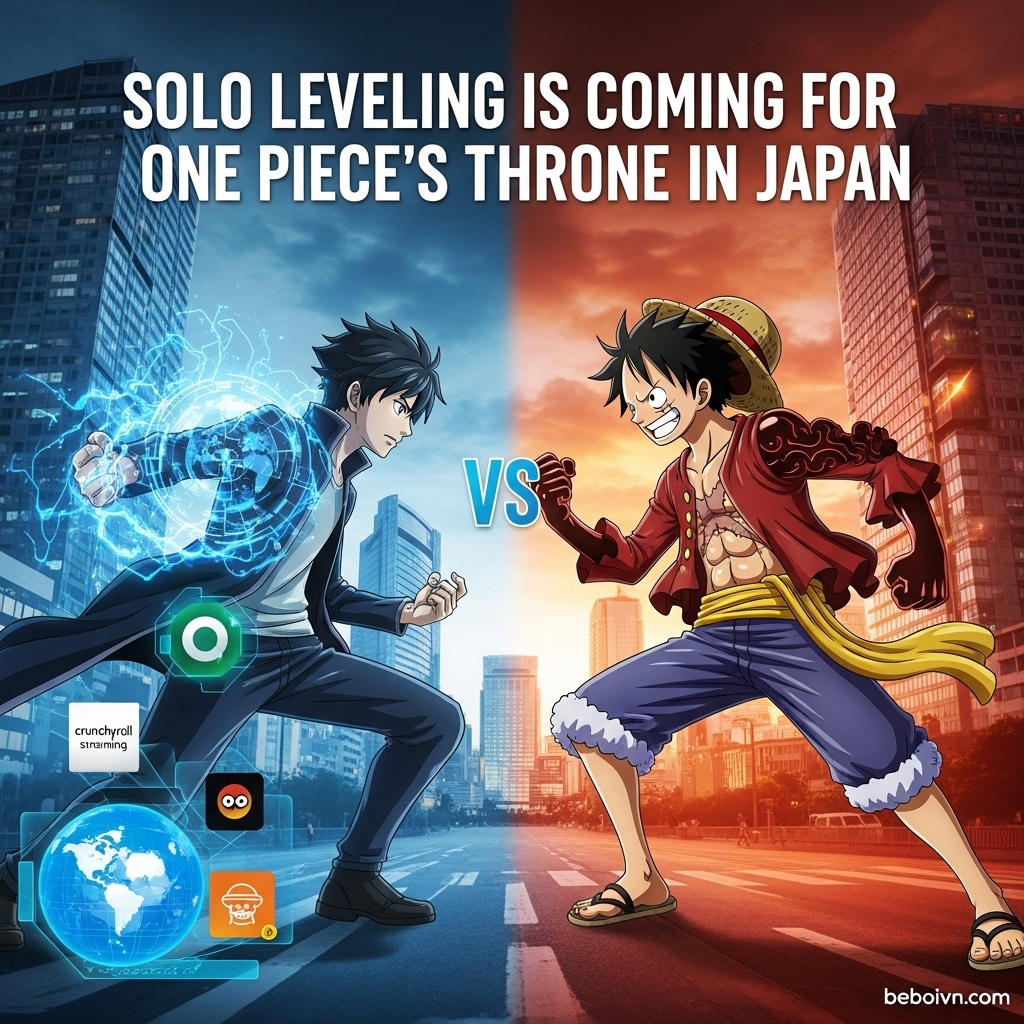
The anime world is witnessing an unprecedented power shift as Solo Leveling, the South Korean webcomic adaptation that has taken the global market by storm, sets its sights on One Piece’s long-held dominance in Japan. What began as an international phenomenon has now evolved into a legitimate challenge to the established hierarchy of Japanese anime, with industry insiders and fans alike wondering if we’re witnessing the changing of the guard.
The Global Phenomenon That Shook Anime’s Foundation
Solo Leveling’s rise to prominence has been nothing short of meteoric. In just over a year, the series has accomplished what many anime franchises spend decades trying to achieve: becoming the most-watched anime on Crunchyroll, surpassing even the mighty One Piece in terms of user reviews and engagement. By March 2025, Solo Leveling had accumulated over 603,000 user reviews on the platform, edging out One Piece’s 596,000—a staggering achievement considering One Piece’s 1,100+ episodes spanning more than two decades.
The series’ global appeal has been undeniable. Winning Anime of the Year at the 2025 Crunchyroll Anime Awards and shattering streaming records worldwide, Solo Leveling has proven that its appeal transcends cultural boundaries. However, this international success has created an intriguing dichotomy that lies at the heart of Solo Leveling’s ambition to claim One Piece’s throne in Japan.
The Japan Challenge: Where Solo Leveling Faces Its Toughest Battle?
Despite its global dominance, Solo Leveling’s reception in Japan has been surprisingly modest. According to data from Abema, Japan’s premier streaming service, Solo Leveling ranked only #5 in Winter’s most watched anime, significantly trailing behind established hits like The Apothecary Diaries Season 2. This performance gap between global and Japanese markets has been so pronounced that even the show’s own producers were caught off guard.
“The way the Solo Leveling anime was received in Japan was no different from any other anime. So when we learned how the series exceptionally blew up in popularity for our global Solo Leveling fans, honestly speaking, this difference in reaction was very unexpected,” admitted Atsushi Kaneko, Solo Leveling’s producer, during an appearance on The Anime Effect Podcast.
This disparity becomes even more striking when examining physical media sales. Solo Leveling’s Season 1 Blu-ray releases failed to crack Japan’s official sales rankings—a stark contrast to its digital dominance internationally. For a series that has become a cultural touchstone for anime fans worldwide, this lukewarm domestic reception presents both a challenge and an opportunity.
Why Solo Leveling Struggles in Japan: Cultural and Market Factors
Several factors contribute to Solo Leveling’s relatively modest performance in Japan compared to its global success. Understanding these elements is crucial to appreciating the magnitude of the challenge it faces in dethroning One Piece.
Market Saturation and Genre Familiarity
Japanese audiences have been exposed to decades of power fantasy and progression-based storytelling. While Solo Leveling’s “system” interface and rapid power progression feel fresh to international viewers, Japanese anime fans have seen similar concepts in series like Hunter x Hunter, DanMachi, and countless isekai titles. The novelty that captivates global audiences doesn’t resonate quite as strongly in a market that’s practically invented these tropes.
Cultural Origin Bias
Despite the globalization of media, there remains a subtle preference among Japanese audiences for homegrown content. Solo Leveling, originating as a South Korean web novel and manhwa, carries with it certain stylistic and narrative elements that distinguish it from traditional anime. While these differences have been part of its appeal internationally, they may create a slight barrier to full acceptance in the Japanese market.
Competition from Established Giants
One Piece isn’t just another anime in Japan—it’s a cultural institution. With over 25 years of continuous publication, multiple films, merchandise empire, and generational fanbase, One Piece has achieved a level of market penetration that makes it practically immune to challenges from newcomers. Solo Leveling isn’t just competing against another anime; it’s battling against decades of accumulated cultural capital.
The Strategic Pivot: How Solo Leveling Plans to Conquer Japan?
Recognizing this challenge, Solo Leveling’s production team has begun implementing a strategic approach to bridge the gap between its global success and Japanese ambitions. The most telling indication of this shift came from producer Atsushi Kaneko himself, who outlined a clear vision for the franchise’s future in Japan.
The Season 3 Gambit
“As a Japanese person living in Japan, the anime is not at the level of Dragon Ball, One Piece, or Naruto. But if season three happens, that’s when I want to truly break that boundary,” Kaneko stated, revealing the production team’s ambitions to elevate Solo Leveling to the upper echelon of Japanese anime popularity.
This statement is significant because it acknowledges the current reality while setting a clear target for future growth. Season 3 represents not just another installment in the series but a deliberate attempt to crack the Japanese market in a meaningful way.
The 2026 Movie Strategy
Perhaps the most ambitious element of Solo Leveling’s Japan strategy is the planned 2026 theatrical release. According to industry reports, the Solo Leveling movie is being positioned as a major event that could potentially draw massive audiences in Japanese theaters. The theatrical approach mirrors the successful strategies employed by other anime franchises that used films to broaden their appeal and reach new demographics.
The movie format offers several advantages for breaking into the Japanese market:
- Higher Production Values: Theatrical releases typically receive superior animation quality and production resources, making them more attractive to discerning Japanese audiences.
- Cultural Event Status: Major anime films in Japan are treated as cultural events, generating media coverage and public buzz that weekly episodes can’t match.
- Broader Audience Reach: Theaters attract viewers who might not typically follow weekly anime series, including casual fans and families.
Content Evolution: Adapting for Japanese Tastes
Beyond strategic scheduling and release formats, Solo Leveling is also evolving its content to better resonate with Japanese audiences. Early feedback from Japanese viewers suggests certain elements that need refinement:
Pacing and Character Development
Japanese anime audiences often place greater emphasis on character development and narrative pacing compared to international viewers who may prioritize action and spectacle. Solo Leveling’s early episodes faced some criticism in Japan for rushing through character moments in favor of action sequences. The production team appears to be taking this feedback to heart, with later episodes showing greater attention to character relationships and emotional depth.
Cultural Localization
While maintaining its core identity, Solo Leveling is incorporating more elements that resonate specifically with Japanese cultural sensibilities. This includes subtle adjustments to humor, character interactions, and the incorporation of more traditionally Japanese anime tropes that domestic audiences expect and appreciate.
The Numbers Game: Can Solo Leveling Really Catch One Piece?
To understand whether Solo Leveling’s ambition to challenge One Piece in Japan is realistic, we need to examine the current landscape and the trajectory both franchises are on.
Current Market Position in Japan
- One Piece: Consistently ranks among the top 3 most popular anime in Japan, with Blu-ray sales regularly exceeding 10,000 units per volume, manga sales in the millions, and theatrical releases grossing billions of yen.
- Solo Leveling: Currently ranks outside the top 5 in most Japanese streaming metrics, with Blu-ray sales that didn’t register on official charts, and limited merchandise presence.
Growth Trajectory Analysis
Despite the current gap, Solo Leveling’s growth curve in Japan shows promising signs. The series has been steadily climbing Japanese streaming rankings since its debut, with each new season showing improved performance. If this trajectory continues—and especially with the boost from a theatrical release—Solo Leveling could potentially enter Japan’s top 10 anime within the next two years.
However, reaching One Piece’s level presents a much steeper challenge. One Piece benefits from decades of accumulated goodwill, multi-generational fanbases, and a multimedia empire that extends far beyond anime and manga. Solo Leveling would need not just continued growth but exponential expansion across all metrics to truly challenge One Piece’s throne.
The X-Factors: What Could Accelerate Solo Leveling’s Rise?
Several potential developments could dramatically accelerate Solo Leveling’s ascent in the Japanese market:
The Netflix Live-Action Adaptation
The recently announced Netflix live-action adaptation of Solo Leveling could serve as a massive catalyst for increased interest in the original anime. Japanese audiences have shown tremendous appetite for high-quality live-action adaptations of their favorite manga and anime (as evidenced by the success of One Piece’s own live-action series). A well-received Solo Leveling live-action show could introduce the franchise to entirely new demographics in Japan.
Cross-Media Synergy
Solo Leveling’s expansion into gaming, with titles like “Solo Leveling: ARISE,” creates additional touchpoints for Japanese audiences to discover and engage with the franchise. As the gaming and anime industries continue to converge in Japan, this cross-media presence could prove crucial for building sustained popularity.
Shifting Anime Consumption Patterns
The way Japanese audiences consume anime is evolving, with streaming services gaining ground over traditional broadcast television. Solo Leveling’s strength on global platforms like Crunchyroll could translate more effectively to Japanese audiences as streaming continues to grow in domestic market share.
The Stakes: Why This Battle Matters Beyond Anime?
The competition between Solo Leveling and One Piece in Japan represents more than just a rivalry between two popular series—it symbolizes broader shifts in the global anime industry and Japan’s place within it.
Globalization vs. Traditional Markets
Solo Leveling’s challenge to One Piece highlights the growing influence of global markets on what was once a predominantly domestic industry. Japanese anime studios are increasingly looking beyond their home market for growth and inspiration, leading to more diverse content and production approaches.
The Rise of Non-Japanese Anime
As a Korean work adapted into anime format, Solo Leveling represents the blurring lines between what constitutes “anime” in the traditional sense. Its success could pave the way for more non-Japanese works to enter the anime space, potentially reshaping the industry’s creative landscape.
Changing Audience Expectations
The different reception patterns between Japanese and international audiences reveal evolving tastes and expectations among anime fans worldwide. Understanding these differences is crucial for studios looking to create content that resonates across cultural boundaries.
Conclusion: The Long Road Ahead for Solo Leveling
Solo Leveling’s ambition to claim One Piece’s throne in Japan is undoubtedly bold, but it faces significant hurdles. While the series has conquered the global market with unprecedented speed, breaking into Japan’s established anime hierarchy requires more than just international success—it demands cultural adaptation, strategic planning, and time.
The pieces are falling into place: a dedicated production team with clear ambitions, a planned theatrical release for 2026, and growing recognition among Japanese audiences. However, truly challenging One Piece’s decades-long dominance will require sustained effort across multiple fronts—content quality, marketing strategy, and cultural adaptation.
What’s clear is that Solo Leveling isn’t just another flash-in-the-pan international hit. It represents a new kind of global anime phenomenon that’s forcing the industry to reconsider traditional boundaries and market assumptions. Whether or not it ultimately succeeds in dethroning One Piece in Japan, its attempt to do so marks a significant moment in anime history—one that could reshape how we think about anime production, distribution, and cultural identity in the years to come.
For now, One Piece’s throne remains secure, but the challenger has arrived, and the battle for Japan’s anime supremacy has only just begun. As Solo Leveling continues its strategic push into the Japanese market, anime fans worldwide will be watching to see if this global phenomenon can overcome cultural barriers and achieve the ultimate prize: acceptance at the highest level of the country that invented the medium.