
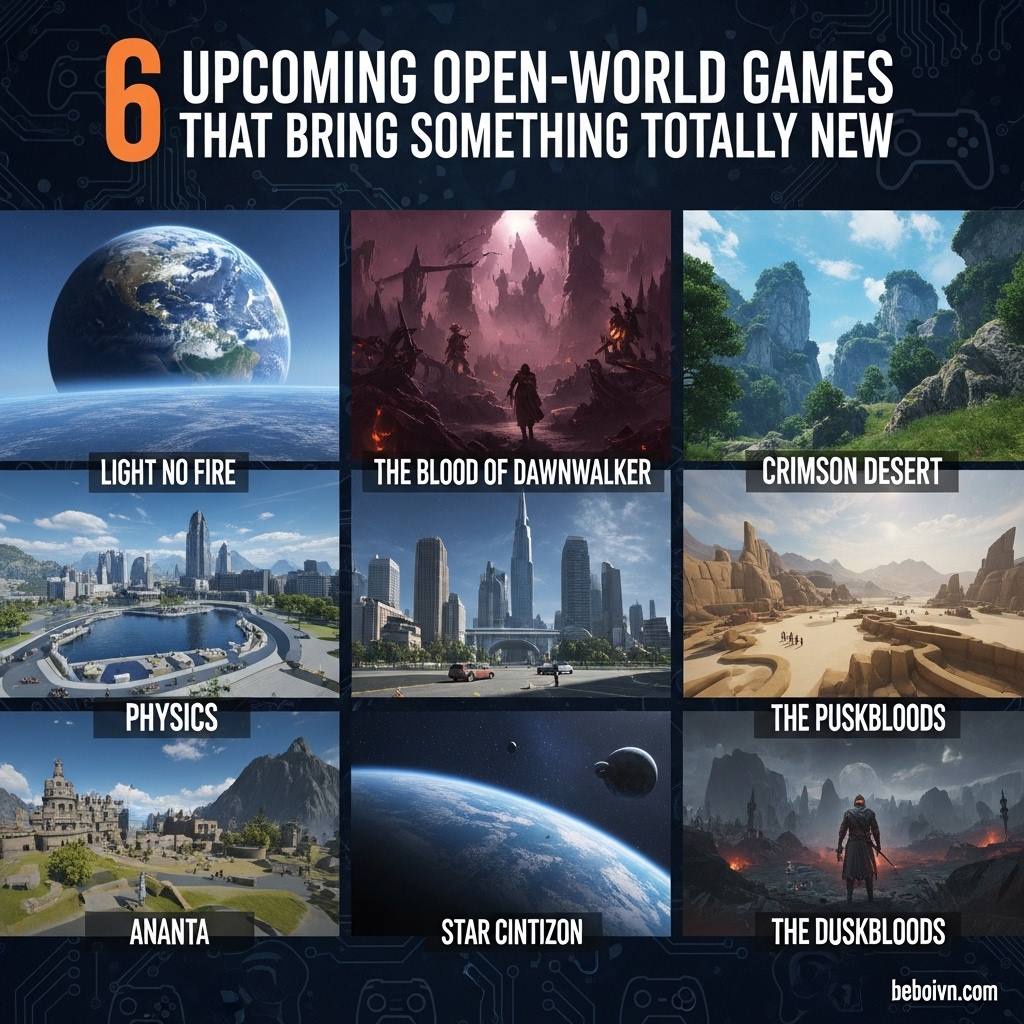
The open-world genre has evolved dramatically since its inception, transforming from simple sandbox environments into vast, living ecosystems that push the boundaries of interactive entertainment. Yet for all its progress, many modern open-world games still follow familiar formulas—tower climbing, checkpoint clearing, and repetitive side activities have become industry standards. However, a new wave of upcoming titles is poised to shatter these conventions, introducing innovations that could redefine what we expect from virtual worlds. These aren’t just bigger or prettier open-world games—they’re fundamentally different approaches to player freedom, world simulation, and interactive storytelling. Let’s explore six upcoming open-world games that bring something totally new to the table.
Light No Fire: The Earth-Sized Procedural Revolution
When Hello Games announced Light No Fire, the gaming community collectively held its breath. After the remarkable redemption story of No Man’s Sky—transforming from a disappointing launch into one of gaming’s greatest comeback stories—the developers are now attempting something even more ambitious: a fully explorable Earth-sized planet with unprecedented levels of detail and interactivity.
What Makes It Revolutionary?
Light No Fire isn’t just another survival game or exploration sim—it’s attempting to solve one of gaming’s greatest challenges: creating a world that feels truly infinite yet meaningfully detailed. While No Man’s Sky gave us a universe to explore, Light No Fire promises to deliver a single planet with the complexity and diversity of Earth itself, complete with realistic ecosystems, weather patterns, and geological formations that evolve over time.
The game’s most groundbreaking feature is its “procedural storytelling” system, where the world itself generates narratives based on player actions and environmental conditions. Unlike traditional open-world games where stories are pre-scripted, Light No Fire will create emergent narratives that feel organic and unique to each player’s journey. Imagine discovering a village that only exists because you diverted a river months earlier, or stumbling upon ruins that tell the story of a civilization that rose and fell based on environmental changes you indirectly caused.
The Technical Marvel
What sets Light No Fire apart is Hello Games’ approach to procedural generation. Rather than using simple algorithms to create repetitive landscapes, they’ve developed a system that simulates millions of years of geological and biological evolution. This means every mountain range, river system, and forest ecosystem has a logical history and purpose, creating a world that feels authentic and lived-in.
The game also promises seamless transitions between different biomes and elevations, from deep ocean trenches to mountain peaks, all without loading screens. This technical achievement alone could set new standards for open-world game design, potentially influencing how future games approach world-building and environmental storytelling.
The Blood of Dawnwalker: Time-Based Choice Consequences
While many RPGs claim to offer meaningful choices, The Blood of Dawnwalker is taking this concept to unprecedented levels with its innovative time-based consequence system. Set in a dark fantasy world where supernatural threats lurk in the shadows, this game introduces a mechanic where every decision you make has tangible, time-sensitive consequences that ripple throughout the world.
The Innovation: Living Timelines
What makes The Blood of Dawnwalker truly unique is its “living timeline” system. Unlike traditional RPGs where choices might affect dialogue options or quest outcomes, this game tracks the temporal impact of your decisions. For example, if you choose to investigate a mysterious disappearance instead of pursuing a main quest lead, the game world continues evolving in real-time. The person you were supposed to meet might move to a different location, the situation they were involved in could escalate, or entirely new opportunities might arise while you were distracted.
This creates a sense of urgency and weight to every decision that’s rarely seen in open-world games. The game world doesn’t wait for you—it lives and breathes independently, making your choices feel genuinely consequential. You might return to a village weeks later to find it completely transformed based on actions you took—or didn’t take—much earlier in the game.
Dynamic World Evolution
The Blood of Dawnwalker also features a world that evolves based on both player actions and the passage of time. Seasons change naturally, affecting gameplay mechanics and available activities. NPC routines shift based on the time of day, weather conditions, and world events. Most impressively, the game’s supernatural threats grow stronger and more organized if left unchecked, creating a dynamic difficulty system that feels organic rather than artificial.
This approach to world-building creates a more immersive and responsive experience than traditional open-world games, where the world often feels static and waiting for player input. In The Blood of Dawnwalker, the world feels alive and unpredictable, making every playthrough potentially unique.
Crimson Desert: The Seamless Emergent Gameplay Sandbox
Pearl Abyss, the developers behind Black Desert Online, are taking everything they learned from their MMO and applying it to a single-player open-world experience that promises to redefine emergent gameplay. Crimson Desert isn’t just another action RPG—it’s a living sandbox where player creativity and improvisation drive the experience.
Breaking the Open-World Mold
What sets Crimson Desert apart is its approach to player freedom. While most open-world games offer a illusion of choice within carefully designed parameters, Crimson Desert aims to create a truly systemic world where almost anything is possible. The game’s physics engine allows for unprecedented environmental interaction, from using nearby objects as improvised weapons to creating complex chain reactions that affect the entire game world.
For instance, players might knock over a tower to create a bridge across a chasm, use a cart as a mobile barricade during combat, or even manipulate weather systems to their advantage. The game’s AI responds dynamically to these player actions, creating emergent scenarios that feel organic and unscripted.
The Living World System
Crimson Desert’s most innovative feature is its “living world” system, where NPCs and creatures follow complex behavioral patterns rather than simple scripted routines. Guards don’t just patrol predetermined paths—they respond to environmental changes, remember player actions, and even form relationships with each other that evolve over time.
This creates a world that feels genuinely alive and responsive. You might distract guards by causing a commotion elsewhere, only to find those same guards later discussing the incident and adjusting their patrol routes accordingly. Animals hunt, migrate, and interact with each other based on realistic ecosystem simulation, creating a world that feels like it exists independently of the player’s presence.
Ananta: The Physics-Based Metroidvania Open World
Ananta represents a fascinating fusion of genres and mechanics that could create a completely new type of open-world experience. Combining the traversal freedom of Spider-Man games with the Metroidvania progression system and GTA-style urban chaos, Ananta promises to deliver something truly unique in the open-world space.
Revolutionary Traversal Mechanics
What makes Ananta stand out is its physics-based traversal system. Unlike other open-world games where movement is largely predetermined (climbing specific surfaces, using designated vehicles), Ananta allows players to use their environment in creative ways to navigate the world. The game’s protagonist has Spider-Man-like abilities, but with a twist—every surface can be used for momentum-based movement, and the physics engine allows for incredible improvisation.
Players can swing between buildings, run up walls, and even use enemy attacks as launch pads for aerial maneuvers. What’s revolutionary is how these traversal abilities integrate with combat and exploration. You might use a well-timed swing to dodge an attack while simultaneously positioning yourself for a counter-attack, or create elaborate parkour routes to reach previously inaccessible areas.
Dynamic Environmental Interaction
Ananta also introduces a level of environmental interaction rarely seen in open-world games. The urban environment is fully destructible and deformable, allowing players to create their own paths through the world. Need to get to a rooftop? Smash through a window and use the debris as a ramp. Being chased by enemies? Bring down a building to block their path.
This level of environmental freedom creates emergent gameplay possibilities that make each playthrough unique. The game’s world responds dynamically to player actions, with structural damage affecting the environment long-term and NPCs reacting to the chaos you create.
Star Citizen: The Persistent Universe Simulation
While Star Citizen has been in development for what feels like an eternity, its ambitious scope and innovative approach to open-world design cannot be ignored. Unlike traditional open-world games that create the illusion of a living world, Star Citizen is attempting to create an actual persistent universe simulation with unprecedented levels of detail and interactivity.
The True Open-World Promise
What makes Star Citizen revolutionary is its approach to world simulation. This isn’t just a game with an open world—it’s a complete universe simulation with realistic physics, economics, and social systems. Every planet, space station, and ship in the game world exists in a persistent state that continues evolving even when players aren’t actively interacting with it.
The game’s economy is fully simulated, with supply and demand affecting prices across the universe. Players can influence this economy through their actions, creating ripples that affect other players’ experiences. Political systems evolve based on player actions and NPC decisions, creating a dynamic world that feels genuinely alive and responsive.
Unprecedented Scale and Detail
Star Citizen’s most impressive innovation is its scale and detail. The game features multiple star systems, each with fully explorable planets, space stations, and celestial bodies. What’s remarkable is that all of this exists in a seamless instance, allowing players to travel from the surface of a planet to orbit and beyond without loading screens.
The level of detail is equally impressive. Every ship has fully functional interiors with interactive components, every space station has unique layouts and NPCs with their own routines and stories, and every planet features diverse ecosystems and geological formations. This attention to detail creates a sense of immersion that goes beyond anything else in the open-world genre.
The Duskbloods: The Narrative-Driven PvPvE Evolution
FromSoftware, the creators of Dark Souls and Elden Ring, are taking their unique approach to world design and storytelling in a bold new direction with The Duskbloods. This upcoming title promises to blend the studio’s signature challenging gameplay with innovative multiplayer systems that could redefine how we think about narrative in open-world games.
Innovative Multiplayer Narrative Integration
What makes The Duskbloods revolutionary is its approach to combining player-driven stories with developer-crafted narratives. The game features a unique PvPvE (Player versus Player versus Environment) system where player actions directly impact the world’s story and evolution. Unlike traditional MMOs where player actions feel inconsequential to the grand narrative, The Duskbloods creates a world where player decisions can permanently alter the course of history.
The game features “narrative hotspots”—areas of the world where player actions can trigger major story events. These events are dynamically generated based on player behavior, creating emergent storytelling that feels both organic and meaningful. For example, players might discover an ancient artifact that triggers a world-changing event, or their actions in a particular region might lead to the rise or fall of factions.
Dynamic World Evolution System
The Duskbloods also introduces a dynamic world evolution system where the environment and its inhabitants respond to player actions on a massive scale. Clear out a dungeon, and it might be repopulated by different creatures or taken over by a rival faction. Ignore a growing threat, and it might spread across the region, changing the landscape and available quests.
This creates a world that feels genuinely responsive and alive, where player actions have lasting consequences that shape the experience for everyone. The game also features a unique “legacy system” where particularly significant player actions become part of the world’s history, creating a shared narrative tapestry that evolves over time.
The Future of Open-World Gaming
These six upcoming titles represent more than just incremental improvements to the open-world formula—they’re fundamental reimaginings of what virtual worlds can be. From Light No Fire’s Earth-sized procedural planet to The Duskbloods’ narrative-driven multiplayer evolution, these games are pushing the boundaries of what’s possible in interactive entertainment.
What’s particularly exciting about this new wave of open-world games is their focus on player agency and systemic depth. Rather than creating the illusion of choice, these games are building worlds that genuinely respond to player actions, creating experiences that feel unique and personal to each player.
As we look toward the future of gaming, it’s clear that the open-world genre is evolving in exciting new directions. The days of static worlds and repetitive activities are giving way to dynamic, living ecosystems that offer unprecedented levels of freedom and immersion. These six upcoming games aren’t just bringing something new to the table—they’re completely redesigning the table itself.
For players tired of the same old open-world formulas, these titles represent a beacon of hope for the future of the genre. They promise worlds that feel truly alive, choices that genuinely matter, and experiences that are as unique as the players themselves. The revolution in open-world gaming is just beginning, and these six games are leading the charge into a bold new era of interactive entertainment.