
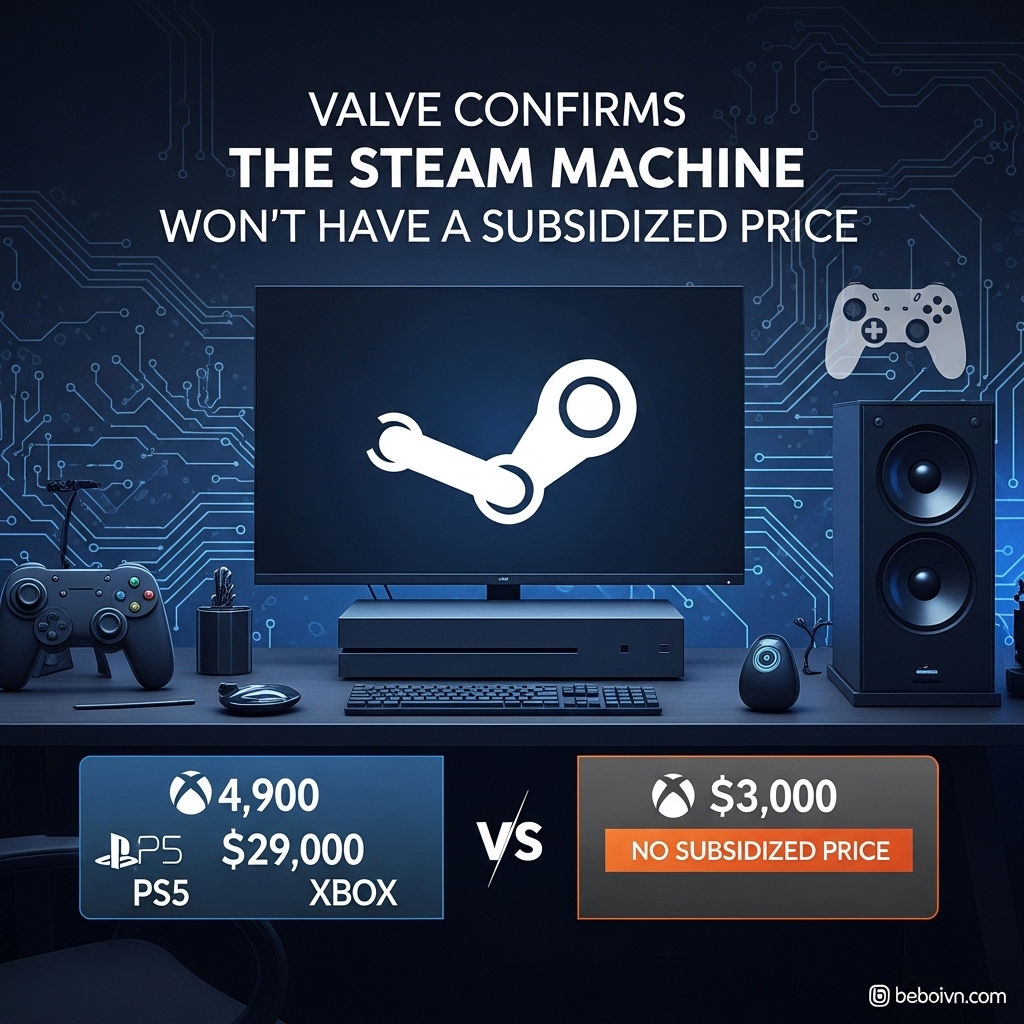
In a move that has sent shockwaves through the gaming community, Valve has officially confirmed that the upcoming Steam Machine won’t feature subsidized pricing, effectively positioning the device as a premium PC competitor rather than a direct console alternative. This revelation, coming directly from Valve engineers and executives, has significant implications for both consumers and the broader gaming hardware market, potentially reshaping how we think about the intersection of PC and console gaming.
The Pricing Bombshell: What Valve Actually Said?
The confirmation came through multiple channels, with Valve software engineer Pierre-Loup Griffais providing the most detailed explanation during interviews with various gaming publications. When asked directly about whether Valve would subsidize the Steam Machine’s cost to make it more competitive with console pricing, Griffais was unequivocal: “No, it’s more in line with what you might expect from the current PC market.”
This statement, while seemingly straightforward, carries enormous weight in the gaming industry. Console manufacturers like Sony and Microsoft have long operated on a business model where hardware is sold at or below cost, with the expectation of recouping losses through software sales, subscription services, and licensing fees. Valve’s decision to abandon this model for the Steam Machine represents a fundamental divergence from industry norms.
Griffais elaborated further, explaining that Valve’s goal is “for it to be a good deal at that level of performance” while emphasizing features that “are actually really hard to build if you’re making your own gaming PC from parts.” These features include the device’s remarkably small form factor, whisper-quiet operation, and integrated SteamOS optimization—all elements that, according to Valve, justify a PC-level price point.
Understanding the Hardware Behind the Pricing Decision
To fully grasp why Valve has taken this stance, it’s essential to understand what the Steam Machine actually brings to the table in terms of hardware specifications. The device is powered by a semi-custom AMD processor featuring six cores and twelve threads, capable of reaching clock speeds up to 4.8 GHz. This is paired with a custom RDNA 3 GPU featuring 28 compute units running at up to 2.45 GHz, supported by 8GB of GDDR6 VRAM.
The system includes 16GB of DDR5 RAM—a particularly noteworthy specification given the current market conditions. As of late 2025, DDR5 memory prices have skyrocketed by over 200% compared to early 2025, with kits that sold for $90 now commanding prices exceeding $250. This dramatic increase is largely attributed to AI companies like OpenAI and Google allocating massive memory supplies for server farms, leaving consumer markets facing severe shortages and inflated prices.
Storage options include either 512GB or 2TB NVMe SSDs, both expandable via microSD cards—a feature that adds versatility but also contributes to the overall cost structure. The device also boasts impressive connectivity options, including Wi-Fi 6E, Bluetooth 5.3, multiple USB ports, DisplayPort 1.4, and HDMI 2.0, all packed into a remarkably compact 6-inch cube weighing just 2.6 kg.
Perhaps most impressively, the Steam Machine supports up to 8K resolution via DisplayPort and can handle 4K gaming at 60 frames per second with FSR (FidelityFX Super Resolution) support. These capabilities clearly position the device as a high-performance gaming machine rather than a budget-friendly console alternative.
The Console Pricing Model: Why Valve Won’t Play That Game?
To understand the significance of Valve’s decision, it’s crucial to examine how console pricing typically works. When Sony launches a PlayStation 5 or Microsoft releases an Xbox Series X, these companies often sell the hardware at a loss. For example, industry estimates suggest that the PS5 cost Sony around $450-$500 to manufacture at launch, yet it was sold for $399-$499 depending on the model.
This loss-leader strategy works because console manufacturers make money through:
- Game licensing fees (typically 30% of every game sold)
- Subscription services (PlayStation Plus, Xbox Game Pass)
- Accessory sales (controllers, headsets, charging docks)
- Digital storefront commissions
Valve, however, operates under a different business model. While they do take a commission on Steam sales, the PC gaming ecosystem is fundamentally more open than console environments. PC gamers can buy games from multiple storefronts (Epic Games Store, GOG, etc.), use third-party accessories, and even install different operating systems on their hardware. This openness makes it much harder for Valve to guarantee that they’ll recoup hardware subsidies through software sales.
As Linus Sebastian of Linus Tech Tips noted during a conversation with Valve representatives, when he suggested that the Steam Machine should follow a console pricing model around $500, “nobody said anything, but the energy of the room wasn’t great.” This anecdote perfectly illustrates Valve’s reluctance to commit to console-style pricing, likely because they recognize the fundamental differences in their business ecosystem.
Market Positioning: PC Competitor, Not Console Killer
Valve’s pricing decision effectively positions the Steam Machine as a premium PC competitor rather than a console alternative. This strategic positioning has several important implications:
Target Audience Shift
By pricing the Steam Machine in line with equivalent PC hardware (likely in the $700-$1000 range), Valve is targeting a different demographic than traditional console buyers. Instead of competing directly with the $500 PS5 or $600 Xbox Series X, the Steam Machine will appeal to:
- PC enthusiasts looking for a compact, living-room-friendly gaming solution
- Steam Deck owners wanting to upgrade to more powerful hardware
- Gamers who value the openness and flexibility of PC gaming but prefer console-like convenience
- Early adopters interested in Valve’s vision for integrated hardware-software experiences
Competitive Landscape
This pricing strategy places the Steam Machine in direct competition with small form factor PCs from manufacturers like Alienware, Corsair, and MSI, rather than with Sony and Microsoft. It’s a bold move that acknowledges Valve’s strengths in the PC space while avoiding a head-to-head battle with console giants who have decades of experience and massive marketing budgets.
The decision also suggests that Valve sees the future of gaming hardware as increasingly hybrid—blurring the lines between traditional PCs and consoles while maintaining the openness and flexibility that defines PC gaming.
The Economic Reality: Why Subsidization Doesn’t Work for Valve?
Several economic factors make console-style subsidization impractical for Valve and the Steam Machine:
Component Cost Volatility
The current state of the PC hardware market makes fixed pricing particularly challenging. As mentioned earlier, DDR5 RAM prices have more than doubled in recent months due to AI industry demand. Similarly, GPU prices remain volatile, and supply chain disruptions continue to affect various components.
By committing to non-subsidized pricing, Valve gives itself flexibility to adjust the final price based on actual component costs at launch, rather than being locked into an artificially low price point that could result in significant losses.
Software Revenue Uncertainty
Unlike console manufacturers, Valve can’t guarantee that Steam Machine owners will purchase their games exclusively through Steam. The open nature of PC gaming means users can:
- Buy games from competing digital storefronts
- Purchase physical copies that don’t generate commission revenue
- Play free-to-play games that don’t contribute to Valve’s bottom line
- Use alternative operating systems that bypass Steam entirely
This uncertainty makes it financially risky for Valve to subsidize hardware costs with the expectation of recouping losses through software sales.
Production Scale Economics
Console manufacturers benefit from enormous production scales. Sony and Microsoft typically sell tens of millions of units of each console generation, allowing them to negotiate favorable component prices and achieve manufacturing efficiencies.
Valve, while successful, operates on a different scale. The Steam Deck has sold well, but it’s unlikely that the Steam Machine will achieve the same production volumes as mainstream consoles. Lower production volumes mean higher per-unit costs, making subsidization even more challenging.
Consumer Impact: What This Means for Gamers?
Valve’s pricing decision has significant implications for consumers, both positive and negative:
The Reality Check
For gamers hoping for a $500 miracle machine that could compete with next-gen consoles, this news is undoubtedly disappointing. The Steam Machine will likely cost significantly more than current-generation consoles, potentially putting it out of reach for budget-conscious consumers.
However, this pricing transparency also prevents unrealistic expectations from forming. By being upfront about the pricing strategy, Valve avoids the backlash that would inevitably follow if they had hinted at console-level pricing only to reveal a much higher cost later.
Value Proposition
While the Steam Machine may cost more upfront, it offers several advantages over traditional consoles:
- Access to the entire Steam library (thousands of games, including backward compatibility)
- PC gaming flexibility (mod support, multiple control schemes, customizable settings)
- Hardware upgradeability (storage expansion, potential for future upgrades)
- Multi-purpose functionality (can run PC applications, productivity software, etc.)
- No online subscription fees (unlike PlayStation Plus and Xbox Game Pass)
For gamers who value these features, the higher upfront cost may be justified by long-term value and flexibility.
Market Segmentation
The pricing decision effectively creates clear market segmentation:
- Budget gamers: Traditional consoles ($400-$600)
- Mid-range enthusiasts: Steam Machine ($700-$1000)
- High-end enthusiasts: Custom gaming PCs ($1500+)
This segmentation allows each option to serve its target audience effectively without direct competition on price alone.
Industry Implications: Beyond Just One Device
Valve’s decision not to subsidize the Steam Machine has broader implications for the gaming industry:
Challenging Console Business Models
By successfully launching a premium-priced gaming device that competes on features rather than price, Valve could inspire other companies to explore similar strategies. This might lead to:
- More diverse hardware options at various price points
- Greater emphasis on unique features and capabilities
- Reduced pressure on manufacturers to sell hardware at a loss
PC Gaming Renaissance
The Steam Machine represents another step in the ongoing evolution of PC gaming toward greater accessibility and convenience. If successful, it could:
- Accelerate adoption of PC gaming in living rooms
- Encourage more developers to optimize games for couch-friendly PC experiences
- Drive innovation in small form factor PC hardware
Platform Competition
Valve’s approach highlights the growing competition between different gaming platforms. With Microsoft reportedly working on next-generation Xbox hardware that may blur the lines between console and PC, Valve’s Steam Machine could be positioning itself for a future where the traditional console-PC dichotomy becomes increasingly irrelevant.
The Road Ahead: Challenges and Opportunities
As we look toward the Steam Machine’s expected 2026 launch, several challenges and opportunities emerge:
Pricing Uncertainty
While Valve has confirmed that the Steam Machine won’t be subsidized, they haven’t announced specific pricing. This uncertainty creates both challenges and opportunities:
- Challenge: Consumers can’t budget for the purchase without knowing the cost
- Opportunity: Valve can adjust pricing based on final component costs and market conditions
Market Education
Valve will need to effectively communicate why the Steam Machine justifies its premium price point. This involves:
- Clearly articulating the value proposition beyond raw specifications
- Demonstrating real-world performance advantages
- Showcasing unique features that differentiate it from both consoles and traditional PCs
Ecosystem Development
The success of the Steam Machine will depend partly on the broader Steam ecosystem:
- Continued growth of the Steam Deck user base
- Expansion of SteamOS compatibility with more games
- Development of exclusive or optimized content for Steam hardware
Historical Context: Learning from Past Steam Machines
This isn’t Valve’s first attempt at creating living room PC hardware. The original Steam Machines initiative, launched around 2015, featured multiple manufacturers creating various devices running SteamOS. That initiative struggled for several reasons:
- Fragmented hardware specifications across different manufacturers
- Limited game compatibility with SteamOS at launch
- Confusing positioning between console and PC experiences
- Pricing that was often higher than equivalent consoles
Valve appears to have learned from these mistakes with the new Steam Machine:
- Unified hardware specifications (only one model with storage options)
- Mature SteamOS with extensive game compatibility
- Clear positioning as a premium PC alternative
- Transparent pricing strategy from the beginning
Conclusion: A Bold Bet on PC Gaming’s Future
Valve’s confirmation that the Steam Machine won’t have a subsidized price represents more than just a pricing decision—it’s a statement about the company’s vision for the future of gaming. By refusing to play by console industry rules, Valve is betting that there’s a significant market for premium PC hardware that offers the best of both worlds: the power and flexibility of PC gaming combined with the convenience and integration of console experiences.
This approach carries significant risks. The Steam Machine will face skepticism from consumers accustomed to console pricing, competition from both console manufacturers and traditional PC builders, and the challenge of justifying its premium price point in a crowded market.
However, it also offers tremendous potential. If successful, the Steam Machine could help bridge the gap between PC and console gaming, accelerate the adoption of Linux-based gaming systems, and establish Valve as a serious hardware competitor in an industry dominated by much larger companies.
For gamers, the message is clear: the Steam Machine won’t be a budget-friendly console alternative. Instead, it represents a premium option for those who value PC gaming’s flexibility and power but want a more integrated, living-room-friendly experience. Whether this approach will resonate with consumers remains to be seen, but one thing is certain: Valve’s refusal to subsidize the Steam Machine’s price is a bold bet on the enduring appeal of PC gaming’s open, flexible future.
As we move closer to the Steam Machine’s 2026 launch, the gaming industry will be watching closely to see if Valve’s gamble pays off—and whether consumers are ready to embrace a premium-priced device that challenges conventional wisdom about how gaming hardware should be priced and positioned.