
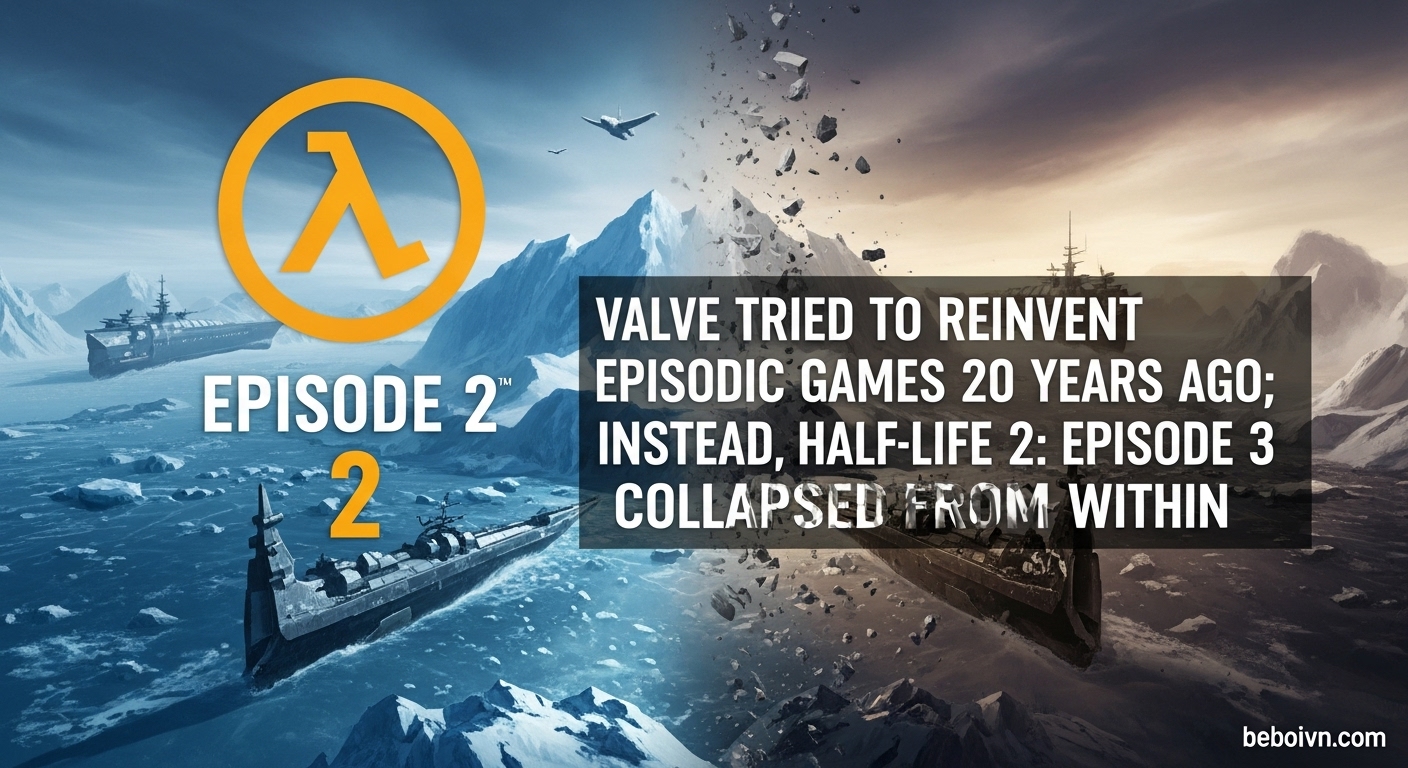
Twenty years ago, Valve Corporation stood at the forefront of gaming innovation, attempting to revolutionize how players experienced narrative-driven games through an ambitious episodic model. What began as a promising experiment to deliver regular, bite-sized content chunks instead of waiting years for full sequels ultimately collapsed under the weight of its own ambitions. The story of how Valve tried to reinvent episodic gaming, only to watch Half-Life 2: Episode 3 crumble from within, represents one of gaming’s most fascinating “what if” scenarios—a tale of ambition, creative paralysis, and the harsh realities of game development.
The Birth of Valve’s Episodic Vision
In the mid-2000s, the gaming industry operated on a familiar pattern: developers would spend years crafting massive, self-contained experiences, release them to eager fans, and then disappear for another half-decade to work on the next installment. Valve, fresh off the monumental success of Half-Life 2 in 2004, saw an opportunity to disrupt this cycle. The company envisioned a future where players wouldn’t wait six years between Half-Life games, but instead receive regular, episodic continuations of Gordon Freeman’s story.
The concept was brilliant in theory. By breaking down what would have been Half-Life 3 into smaller, more manageable episodes, Valve could maintain player engagement, experiment with new gameplay mechanics, and deliver content more frequently. Gabe Newell, Valve’s president, explicitly stated that this episodic trilogy would be “the equivalent of Half-Life 3,” signaling the company’s commitment to this new approach.
The Early Success: Episodes 1 and 2
Valve’s episodic experiment began promisingly. Half-Life 2: Episode One arrived in June 2006, just 18 months after Half-Life 2’s release—a dramatic improvement over the six-year gap between the first two games. The episode picked up immediately after Half-Life 2’s cliffhanger ending, continuing Gordon and Alyx’s escape from City 17 as the Citadel prepared to detonate. Critics praised the focused narrative and improved character development, particularly the deepening relationship between Gordon and Alyx.
Episode Two followed in October 2007, expanding the scope significantly. This installment introduced new environments, enemies, and gameplay mechanics while advancing the overarching plot in meaningful ways. The episode ended with one of gaming’s most devastating cliffhangers: Eli Vance’s death at the hands of a Combine Advisor, leaving players desperately awaiting resolution. This ending perfectly set up Episode Three, which promised to take players to the Arctic in search of the mysterious Borealis research vessel.
On the surface, Valve’s episodic model appeared to be working. Episodes were releasing regularly, maintaining narrative momentum, and keeping players engaged. However, behind the scenes at Valve’s Bellevue headquarters, the foundation was already beginning to crack.
The Growing Pains of Episodic Development
What seemed like a streamlined approach to game development quickly revealed its flaws. The episodic model, designed to shorten development cycles and deliver content more frequently, was actually creating new pressures and complications. As level designer Dario Casali later admitted, “We found ourselves creeping ever forward towards, ‘Well, let’s just keep putting more and more, and more stuff in this game because we want to make it as good as we can,’ and then we realized these episodes are turning more into sequels.”
This scope creep became Episode Three’s undoing. What was supposed to be a quick, focused continuation had ballooned into something far more ambitious. Engineer David Speyrer revealed that after six months of development, Episode Three was little more than “a collection of playable levels in no particular order, along with some story beats.” The team estimated they would need another six months just to reach “critical mass” with their mechanics, followed by potentially another year or two of development—hardly the rapid turnaround the episodic model promised.
The Creative Crisis: Why Episode Three Stalled?
As development dragged on, Valve’s team began experiencing what can only be described as a creative crisis. The designers who had revolutionized first-person shooters twice before found themselves struggling to articulate why Episode Three needed to exist beyond simply finishing the story. Robin Walker, a veteran Valve designer, explained that the company traditionally used Half-Life games to “solve some interesting collision of technology and art that had reared itself.” With Episode Three, they failed to find that unifying idea that would provide the sense of “wonderment, or opening, or expansion” that defined previous Half-Life games.
The creative malaise extended to gameplay innovation as well. Half-Life had always been at the forefront of introducing new mechanics—from the physics-based gameplay of Half-Life 2 to the Gravity Gun that changed how players interacted with the world. For Episode Three, the team experimented with concepts like an “ice gun” that could create barriers and ramps, and gelatinous enemies that could slide through gates and absorb other foes. However, none of these ideas captured the team’s imagination or felt like the revolutionary leap players expected.
The Borealis: Episode Three’s Ambitious Setting
Despite the development struggles, we know from concept art and developer interviews that Episode Three would have taken players to the Arctic in pursuit of the Borealis, a research vessel with the ability to travel through time and space. This mysterious ship, mentioned in both Half-Life 2 and Portal, represented a convergence of Valve’s two major franchises and promised to reveal crucial information about the nature of the Combine and the resistance’s potential to defeat them.
The Arctic setting would have presented unique gameplay challenges, with players navigating harsh environments, dealing with extreme cold, and facing new Combine threats adapted to the frozen landscape. The ice gun mechanic would have been central to gameplay, allowing players to create temporary structures, solve environmental puzzles, and potentially combat enemies in creative ways.
Perhaps most intriguingly, Episode Three would have continued the narrative thread of the G-Man losing control over Gordon Freeman. As Newell explained, whereas the original Half-Life saw the mysterious G-Man transform Gordon into his tool, and Half-Life 2 saw Gordon being used by G-Man, the episodes would see G-Man lose control—suggesting a dramatic confrontation or resolution to their long-standing relationship.
The Distraction: Left 4 Dead and Shifting Priorities
In 2008, as Episode Three development languished, Valve’s attention shifted dramatically to a new project: Left 4 Dead. This cooperative zombie shooter introduced the revolutionary AI Director, a system that dynamically adjusted gameplay based on player performance. The technology and design philosophy behind Left 4 Dead represented exactly the kind of innovation Valve craved—a fresh take on multiplayer gaming with procedural elements that kept each playthrough unique.
The team poured their energy into Left 4 Dead, which became a smash hit upon release. By the time developers considered returning to Episode Three, sentiments had changed. The window for Half-Life 3 had closed, or so they believed. “Well, we missed it. It’s too late now,” Speyrer recalled the team thinking. “We really need to make a new engine to continue the Half-Life series.”
This rationalization—blaming the need for Source 2 engine development—became a convenient cover for a deeper problem: nobody on the development team could articulate why Episode Three needed to exist beyond finishing the story. The creative spark that had driven previous Half-Life games had dimmed, replaced by a sense of obligation rather than inspiration.
The Official Cancellation and Fan Reaction
Valve never officially announced Episode Three’s cancellation in a press release or blog post. Instead, the news trickled out slowly over years. In 2011, Wired labeled Episode Three as vaporware, and frustrated fans began sending crowbars to Valve’s office as a form of protest. By 2017, Business Insider declared that Half-Life 3 had become “a farce.”
Gabe Newell finally addressed the situation in a 2011 interview, confirming that Valve had moved on from the episodic model. The admission was understated but definitive: the experiment that was supposed to revolutionize gaming had failed, and with it, Episode Three had quietly died.
The fan reaction was a mix of disappointment, anger, and resignation. Half-Life had always been more than just a game—it was a benchmark for the industry, a series that pushed boundaries and defined what was possible in interactive entertainment. The thought that Gordon Freeman’s story might never conclude properly was unthinkable to many fans.
Marc Laidlaw’s “Epistle 3” and the Aftermath
In 2016, Marc Laidlaw, the writer who had shaped Half-Life’s narrative since the beginning, left Valve. A year later, he posted a short story titled “Epistle 3” on his personal website, describing it as “a snapshot of a dream I had many years ago.” The story featured characters with names similar to Half-Life’s cast—Gertie Fremont instead of Gordon Freeman, Alex Vaunt instead of Alyx Vance—but the narrative was unmistakably a version of what Episode Three might have been.
In Laidlaw’s story, Gordon and Alyx travel to the Arctic to board the Borealis, discovering it can travel through time and space. They seize control of the ship and set it on a collision course with the Combine’s home world, but the explosion isn’t enough to destroy the empire completely. In a devastating twist, Alyx is abducted by the G-Man, while Gordon is rescued by Vortigaunts and transported to an uncertain future.
The story triggered a backlash from fans, some of whom review-bombed Valve’s Dota 2 in protest. It also inspired numerous fan projects attempting to recreate what Episode Three might have been. However, Laidlaw later expressed regret about publishing the story, stating it wasn’t representative of Episode Three and had created problems for his former colleagues at Valve.
The Broader Context: Why Episodic Gaming Failed?
Valve’s struggle with Episode Three wasn’t an isolated incident—it was part of a larger industry trend that saw episodic gaming rise and fall within a decade. In the mid-2000s, episodic gaming seemed like the future, promising regular content drops, sustained player engagement, and the ability to iterate based on feedback. Games like Telltale’s The Walking Dead and Square Enix’s Hitman experimented with the model, with varying degrees of success.
However, several factors contributed to episodic gaming’s decline. Long gaps between episodes—sometimes stretching to years—eroded player interest and narrative momentum. The rise of streaming services changed audience expectations, making viewers less willing to endure cliffhangers and wait for resolutions. As one Vice article noted, “From both financial and entertainment perspectives, there was no reason for players to invest in episodic games until they were done, which in turn makes them poor investments to actually develop as episodic games.”
Telltale Games’ closure in 2018 served as the epitaph for episodic gaming’s golden age. The company, once the standard-bearer for episodic narrative games, collapsed under the weight of its own ambitions, unable to sustain the model despite numerous successful licensed titles.
Half-Life: Alyx and the Unexpected Return
In 2020, after years of silence, Valve surprised the gaming world with Half-Life: Alyx, a virtual reality prequel that returned to the series’ roots. The game was met with critical acclaim and demonstrated that Valve hadn’t abandoned the franchise entirely. More importantly, its ending directly addressed the cliffhanger from Episode Two, providing some measure of closure for long-suffering fans.
The development of Alyx revealed something important about Valve’s approach to game development: the company still values Half-Life, but needs a compelling technological or design reason to return to it. Virtual reality provided that reason, just as the Source engine had driven Half-Life 2’s development, and physics innovation had powered the original Half-Life.
Lessons from Episode Three’s Collapse
The story of Half-Life 2: Episode Three offers several valuable lessons for game developers and the industry as a whole:
- Creative vision cannot be forced: Episode Three failed because the team couldn’t find a compelling reason for its existence beyond finishing the story. Great games need a strong creative core, not just commercial obligation.
- Development models must serve the project, not vice versa: Valve’s episodic model, while innovative, ultimately constrained rather than enabled the team’s ambitions. When development needs outgrow the model, it’s time to adapt.
- Innovation requires risk: Valve’s best work has come from taking risks and exploring new technologies. Episode Three stagnated because it lacked this innovative spark.
- Sometimes, silence speaks volumes: Valve’s refusal to discuss Episode Three for years, while frustrating for fans, reflected the company’s philosophy of only speaking when they have something meaningful to say.
- Legacy matters: Despite never being released, Episode Three’s mystique has kept Half-Life relevant for decades, demonstrating the power of anticipation and unfinished narratives in gaming culture.
The Legacy of What Might Have Been
In 2024, as part of Half-Life 2’s 20th anniversary celebration, Valve finally released footage and concept art from Episode Three’s development. The material offered a tantalizing glimpse of what might have been—Arctic environments, the ice gun mechanic, and early versions of the blob-like enemies that had been described in interviews.
For many fans, this release was bittersweet. It confirmed that Episode Three had been in development and showed the ambitious scope of what Valve had envisioned, but it also served as a final acknowledgment that the game would never be completed as originally planned.
Yet, there’s something poetic about Episode Three’s legacy. Like the Borealis itself—lost between dimensions, existing in multiple possibilities simultaneously—Episode Three lives on in the collective imagination of gamers. It represents the road not taken, the game that could have been, and the enduring mystery of what happens when creative ambition meets the harsh realities of game development.
Conclusion: The Enduring Mystery of Half-Life 2: Episode 3
Valve’s attempt to reinvent episodic gaming 20 years ago stands as both a bold experiment and a cautionary tale. The company that had revolutionized first-person shooters twice before found itself unable to solve the puzzle of its own making. Half-Life 2: Episode 3 didn’t collapse due to technical limitations or market forces—it collapsed from within, undone by creative paralysis, shifting priorities, and the simple inability to answer the question: “Why does this game need to exist?”
Yet, in failure, Episode Three achieved a strange kind of immortality. Its absence has become more iconic than its presence ever could have been. The mystery surrounding its development, the tantalizing glimpses of what might have been, and the ongoing speculation about its fate have kept Half-Life relevant in gaming culture long after most franchises would have faded.
As we look back on Valve’s episodic experiment, we see not just a failed game, but a pivotal moment in gaming history—a time when the industry was testing new models, new technologies, and new ways of telling stories. The collapse of Half-Life 2: Episode 3 marked the end of an era, but it also paved the way for new approaches to game development, from games as a service to virtual reality experiences.
In the end, Valve tried to reinvent episodic games 20 years ago, and while that specific experiment failed, its legacy lives on in every game that dares to push boundaries, challenge conventions, and ask the question: “What’s next?” For Gordon Freeman, the answer may remain a mystery, but for gaming as a whole, the journey continues—shaped in no small part by the game that never was.