
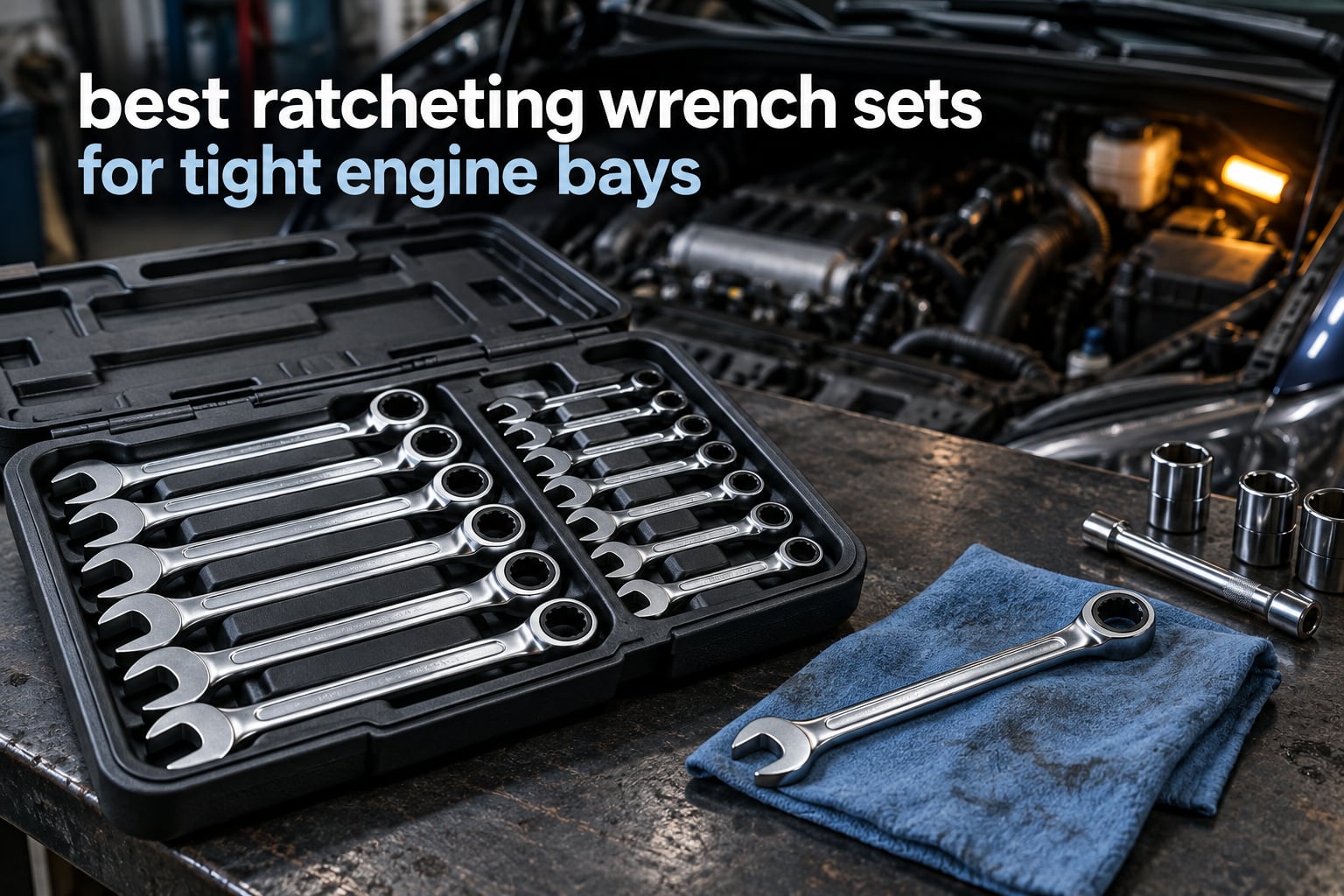
Most people buy the wrong ratcheting wrench set for engine work, and they buy it for the reason a wrench that will not fit looks identical to one that will. The box end of a ratcheting wrench is a toothed gear in a shell. That shell adds diameter around the fastener, and in a modern engine bay, where intake runners, coolant hoses and wiring looms are routed right up to the bolt, diameter is the one thing you cannot negotiate with. A ratchet wrench set that reads well in a catalogue can still leave a bolt untouched because the ring end will not drop over the flange.
So this roundup filters on fit, not brand. Every set below is judged on swing arc, head articulation, box end thickness, offset, tooth profile and whether the advertised piece count actually covers the sizes you will reach for. If you are starting out and want the wider picture, start with our general wrench set picks, then come back here for the clearance question specifically.
We looked at ten ratcheting and stubby combination wrench sets, read the published specifications for each, and weighed them against failure patterns reported by technicians on The Garage Journal, Bob Is The Oil Guy and r/mechanic. We did not torque-test these in a lab, and we are not going to pretend otherwise. What we did instead is compare manufacturer specs against what owners report after months of underhood use, and flag clearly where the two disagree. That transparency matters here, because the top-ranking thread for this category on r/HVAC opens with a complaint that every ratcheting wrench listing reads as junk, and that complaint is fair.
Two things to keep in mind as you read. First, swing arc is the angle you must turn the wrench before you can lift it off the bolt and reverse. Second, once a fastener is actually loose, the ratcheting mechanism is doing nothing for you. For breaking seized hardware, you want a cheater bar or a breaker bar, not a finer tooth count.
Top 3 Picks for Tight Engine Bays for September 2026
The GEARWRENCH stubby set takes the top spot because it does the thing engine bays demand most, which is getting short. A stubby pattern drops the ring end into gaps where a full-length wrench physically cannot rotate, and this one mixes SAE and metric in a single tray so you are not swapping tools mid-job.
Milwaukee takes the clearance crown. At 144 ratcheting positions the arc swing drops to 2.5 degrees, which is the tightest figure in this group, and that number is what decides whether a 10mm battery terminal clamp or a hidden subframe bolt is reachable at all.
CRAFTSMAN covers the middle of the range. Twenty pieces across both unit systems, a 4 degree arc, 12-point engagement and a full lifetime warranty make it the most complete single purchase here if you have not committed to a metric-only or SAE-only approach.
10 Ratcheting Wrench Sets at a Glance in September 2026
| PRODUCT MODEL | KEY SPECS | BEST PRICE |
|---|---|---|
 |
|
Check Latest Price |
 |
|
Check Latest Price |
 |
|
Check Latest Price |
 |
|
Check Latest Price |
 |
|
Check Latest Price |
 |
|
Check Latest Price |
 |
|
Check Latest Price |
 |
|
Check Latest Price |
 |
|
Check Latest Price |
 |
|
Check Latest Price |
The table above is the fast read. Everything below it explains why a set sits where it does, and where its weak points are.
1. GEARWRENCH 14-Piece 72-Tooth Stubby Set – Shortest Reach, Dual Units
Best for: reaching deep under intake runners and hoses where a full-length wrench cannot turn at all.
GEARWRENCH 14 Pc 72T Stubby Ratcheting SAE/mm Combination Wrench Set|85206
72-tooth ratchet,stubby pattern
SAE and metric mixed tray
Alloy steel, limited lifetime warranty
+ The Good
- Stubby reach into gaps full-length wrenches cannot enter
- Off-corner box end resists rounding worn fasteners
- Open and box ends do not slip
- Best balance of coverage and reach in this group
- The Bad
- No 16mm or 17mm metric sizes
- Thin plastic holder feels cheap next to the wrenches
- Stubby length gives up leverage on large fasteners
The 72-tooth mechanism here needs roughly a 5 degree swing, which is the practical sweet spot for engine bays. You are not chasing the smallest possible number, you are chasing a number small enough to clear a hose and a mechanism that still moves smoothly when the fastener is tight.
What sets this apart is the off-corner loading box end. It contacts the flats of the hex rather than driving into the corners, which matters more than it sounds in an engine bay where every fastener has been in place for a decade and shows rounded corners under a flashlight. Owners across reviews repeatedly single this out as the reason their fasteners still tighten properly.
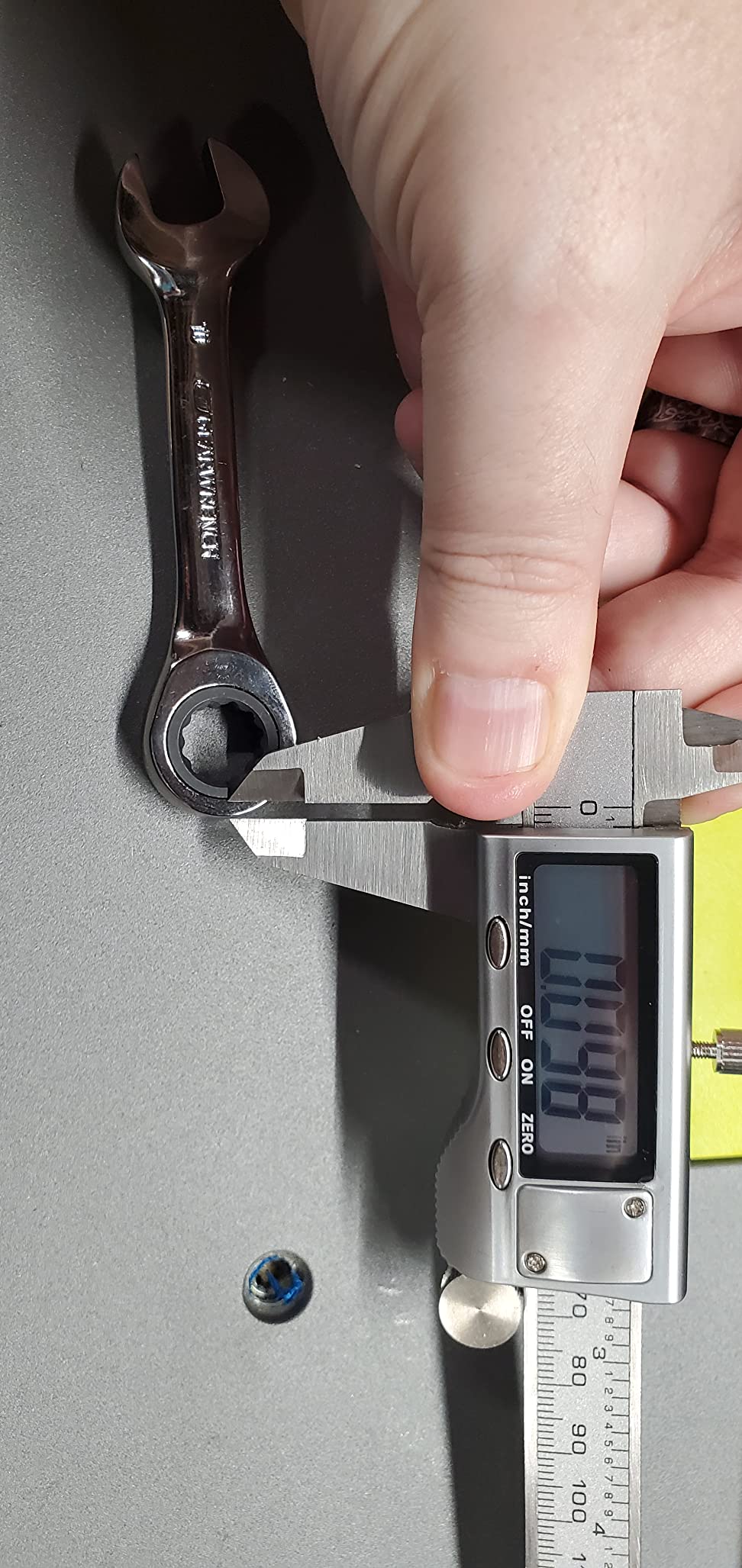
The size mix is where it gets interesting. You get 3/8, 7/16, 1/2, 9/16, 5/8 and 11/16 inch alongside 3/4 inch, then 10, 11, 12, 13, 14, 15 and 18mm. That is an unusually practical mix for mixed underhood work, because a lot of factory fasteners in that range are metric even on American trucks. There is no 16mm or 17mm, and owners complain about that specifically, so plan to source those two sizes separately if you work on intake plenums.
The build is alloy steel with a polished finish and a standard limited lifetime warranty. Mechanic reviewers on forums describe the feel as comparable to Snap-on and Mac Tools, which is a strong word for a set at this level. The one recurring complaint is the holder, which is thin and feels cheap compared with the steel it contains.
What you can actually reach with it
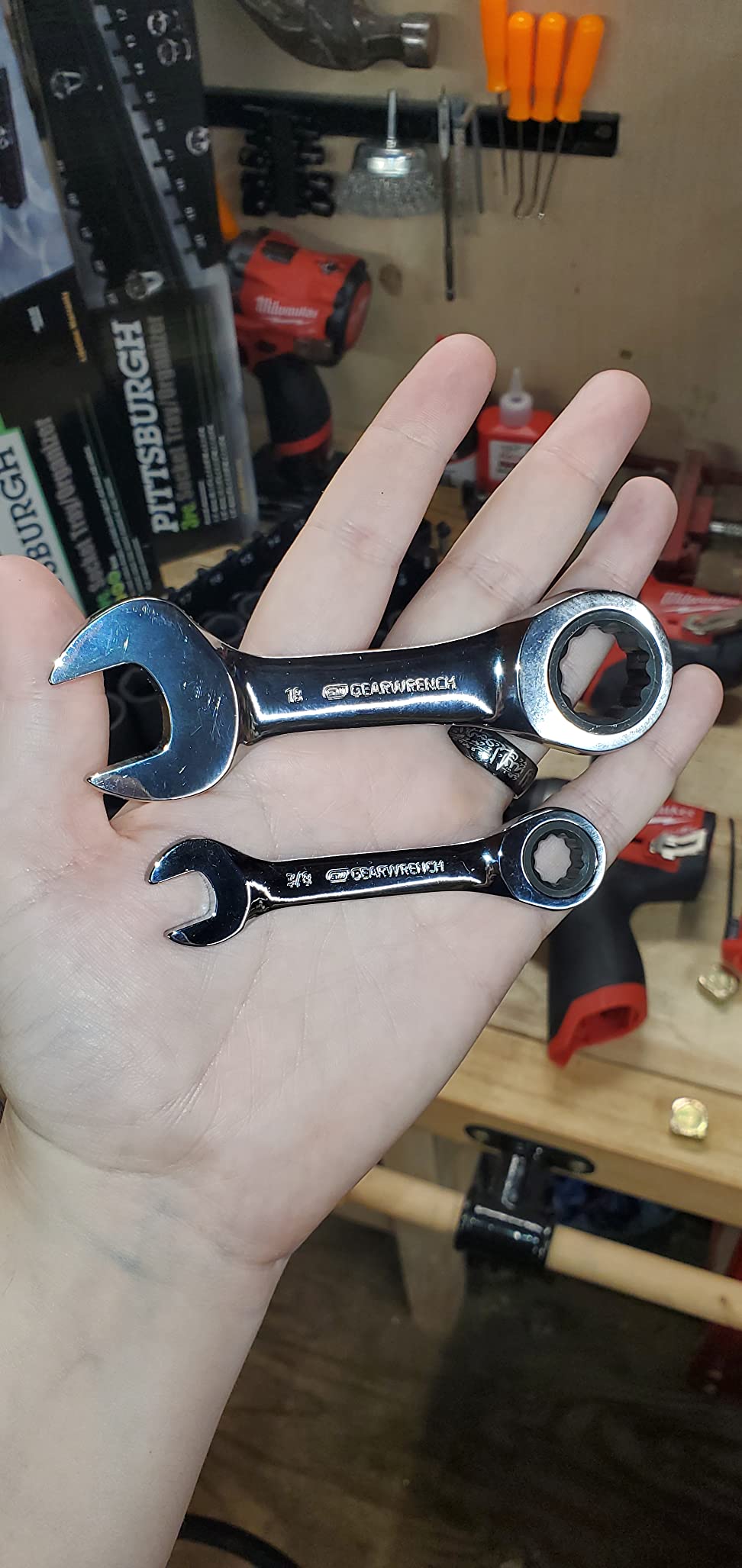
The stubby length is the entire argument. On battery terminal clamps, engine block dipstick tubes, alternator mounting bolts and the small brackets that bolt to the back of an intake manifold, a full-length combination wrench simply cannot swing because the handle hits something else. This set turns in gaps of a couple of centimetres.
The 15-piece claim in the listing is misleading, by the way. The manufacturer part number is 85206 and it is a 14-piece set of wrenches plus a holder. The rating it has earned across a large volume of reviews is not a rounding artefact, either.
Where it will disappoint you
Do not buy this as your only set, and do not buy it to break fasteners loose. Stubby patterns trade handle length for access, which means torque, and the forum consensus is unambiguous that a ratcheting box end is the wrong tool for a seized bolt. That is a breaker bar job.
For a broader look at what a full-size set gives you, our large wrench set picks cover the cases where reach is not the constraint.
2. TEKTON 12-Piece Stubby Set – The Compact Clearance Champion
Best for: the deepest, most awkward recesses, if you can accept lifting the wrench on every stroke.
TEKTON Stubby Combination Wrench Set, 12-Piece | WRN01170
8-19mm metric, 12 pieces
15 degree offset open end
12-point box end, chrome vanadium
+ The Good
- Full 8-19mm metric coverage with no skipped sizes
- Angled open end doubles engagement in tight gaps
- 12-point box end grips flats not corners
- Folding holder keeps the set portable
- The Bad
- Not ratcheting
- so you lift and reseat on every stroke
- Metric only with no SAE sizes
- Stubby length limits torque on large fasteners
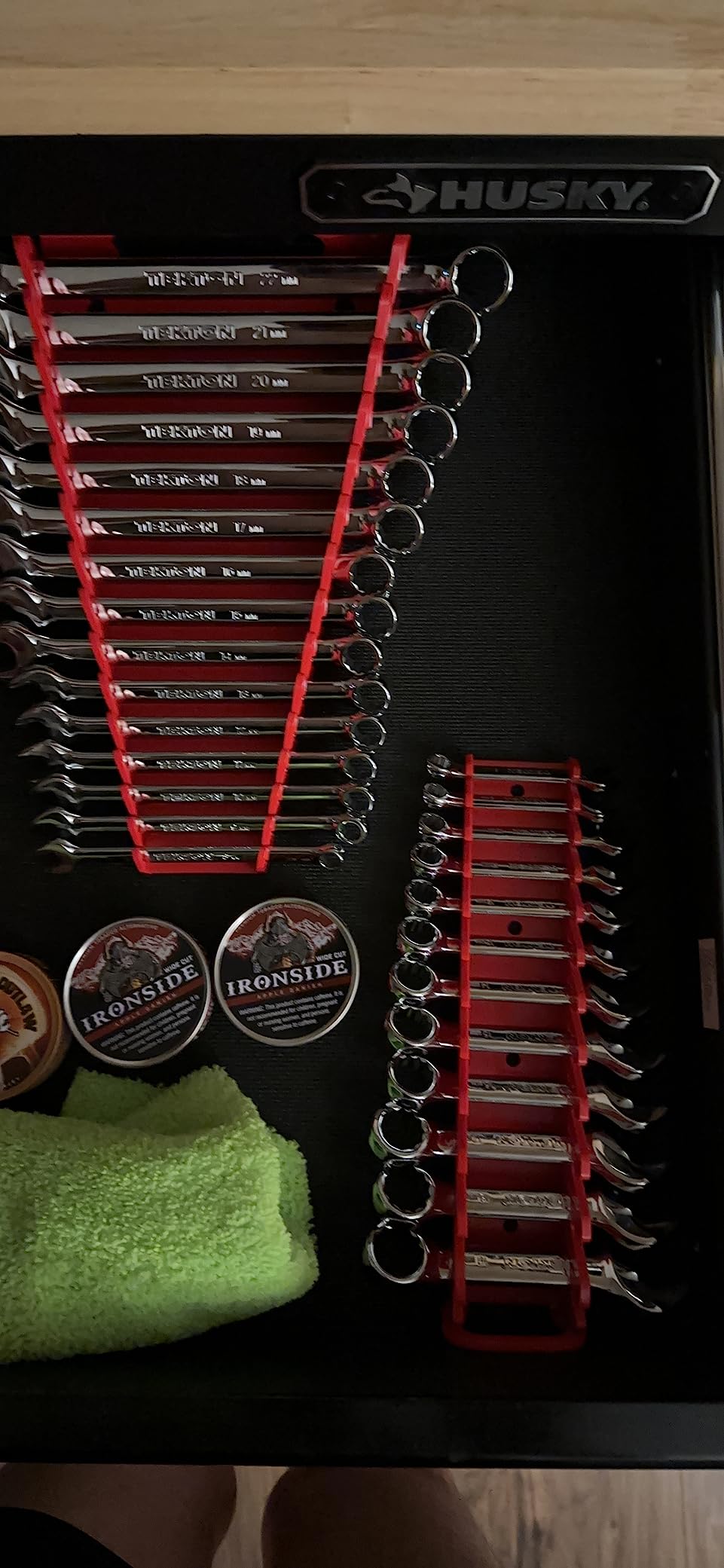
This is not a ratcheting set, and the listing says so, which is refreshing. What it is, is the most compact metric coverage available in this group: 8, 9, 10, 11, 12, 13, 14, 15, 16, 17, 18 and 19mm, with no gaps in that run at all.
That gap-free run is the quiet hero. Plenty of advertised piece counts overstate usable coverage because a set lists 8, 10, 12, 13, 14, 15 and 17mm and calls itself a metric set. This one has every millimetre between 8 and 19, and buyers consistently point at that as the reason they keep it in the car rather than the garage.
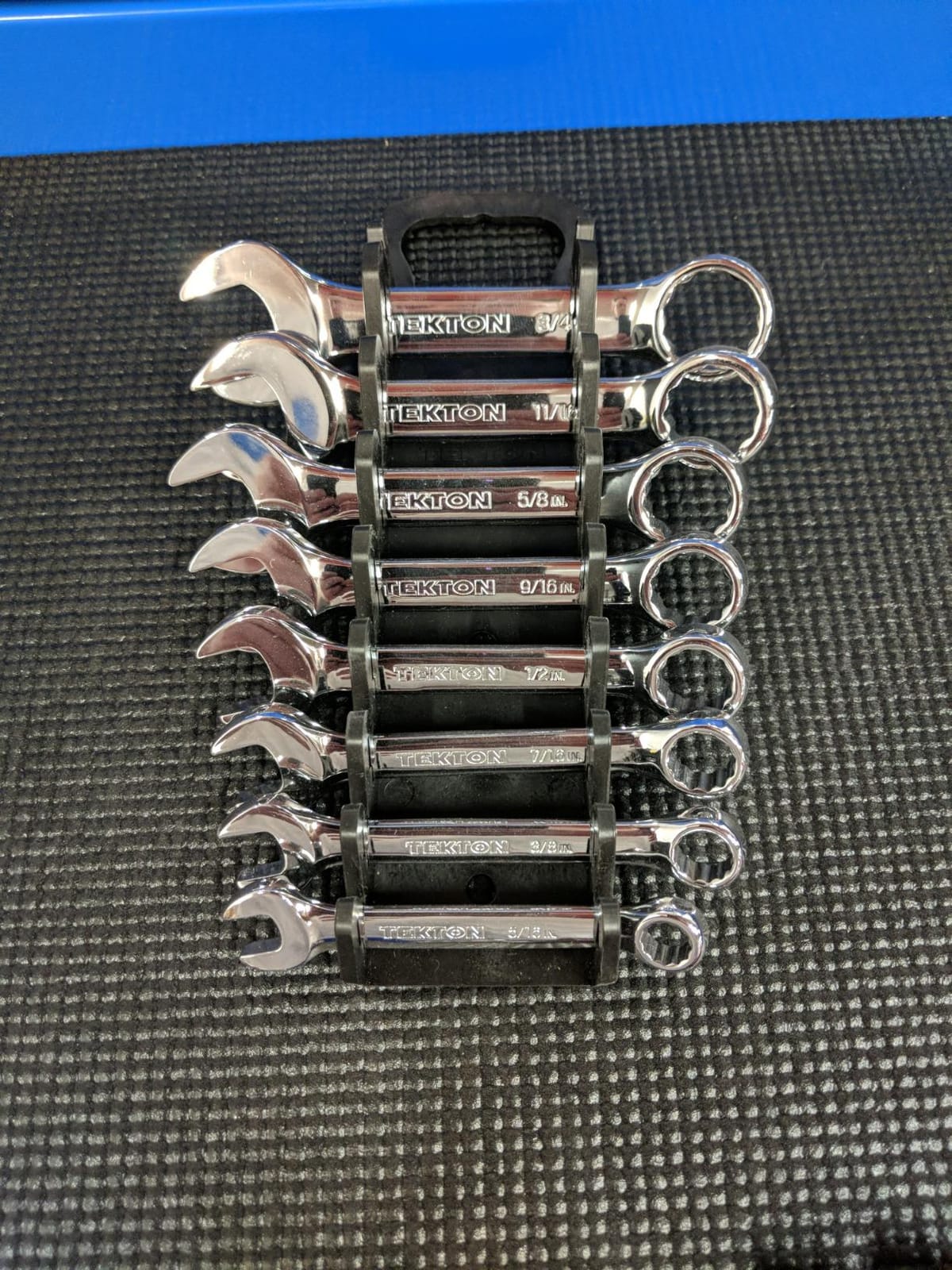
The 15 degree offset on the open end is the detail that earns its keep under a dashboard. Offset open ends give you two usable angles per wrench, so flipping it over is a legitimate second attempt rather than a rerun of the same geometry. In a space where you get one attempt before the wrench fouls a bracket, that is a real gain.
Construction is chrome vanadium with a 12-point box end, offset 15 degrees for finger clearance. The box opening is designed to grip the flat sides of a fastener head, which is the same anti-round-off logic as the GEARWRENCH off-corner design, arriving through a different route.
Why the absence of a ratchet might be fine
There is a version of engine bay work where a 5 degree arc saves you and a version where it does not matter. If the fastener is already broken loose or only finger tight, the ratcheting mechanism is a liability you pay for in backdrag and in ring end diameter. A plain 12-point box end is smaller and will go places a ratcheting end simply will not.
So for final tightening, reassembly and access to fasteners sitting in tight pockets, this set competes with ratcheting wrenches and sometimes beats them. Keep a ratcheting set for the fasteners buried behind obstructions, and this one for the fasteners you can see and feel.
Where it will disappoint you
There is no ratcheting mechanism, so on a fastener that is not yet free you are lifting and reseating the wrench every stroke. In a deep pocket that cycle is slow and frustrating, and it is the reason people buy ratcheting wrenches in the first place.
It is also metric only. If your work touches domestic fasteners at all, this covers half the job. TEKTON backs it with a no-time-limit, no-receipt warranty, which is a better warranty position than most of the field.
3. Klein Tools 8-Piece 90-Tooth SAE Set – Color-Coded Fast-Finding
Best for: American trucks and older domestic engines where SAE sizes dominate and you work by feel.
KLEIN TOOLS 69408G Ratcheting Combination Wrench Set, SAE, 8-Piece, 90-Tooth Ratchet, I-Beam Handle, Color-Coded Size Markings, Roll Pouch Storage
90-tooth ratchet, 8 SAE sizes
Color-coded size markings
Pass-through ratchet, black phosphate
+ The Good
- 90-tooth ratchet gives one of the tightest arcs in this group
- Color coding saves real time in a crowded toolbox
- Pass-through ratchet works on long threaded studs
- Black phosphate resists corrosion
- The Bad
- SAE only with no metric sizes
- Fixed head cannot angle into obstructed access paths
- Higher cost per wrench than most metric sets
Eight sizes, 5/16 through 3/4 inch, and every one of them runs a 90-tooth ratchet. Klein states a 20 percent access improvement over a 72-tooth design, which puts the working arc in the region of four degrees. That is meaningfully tighter than the 5-degree sets on most of this list, and it is why trade users reach for this set in strut towers and conduit runs.
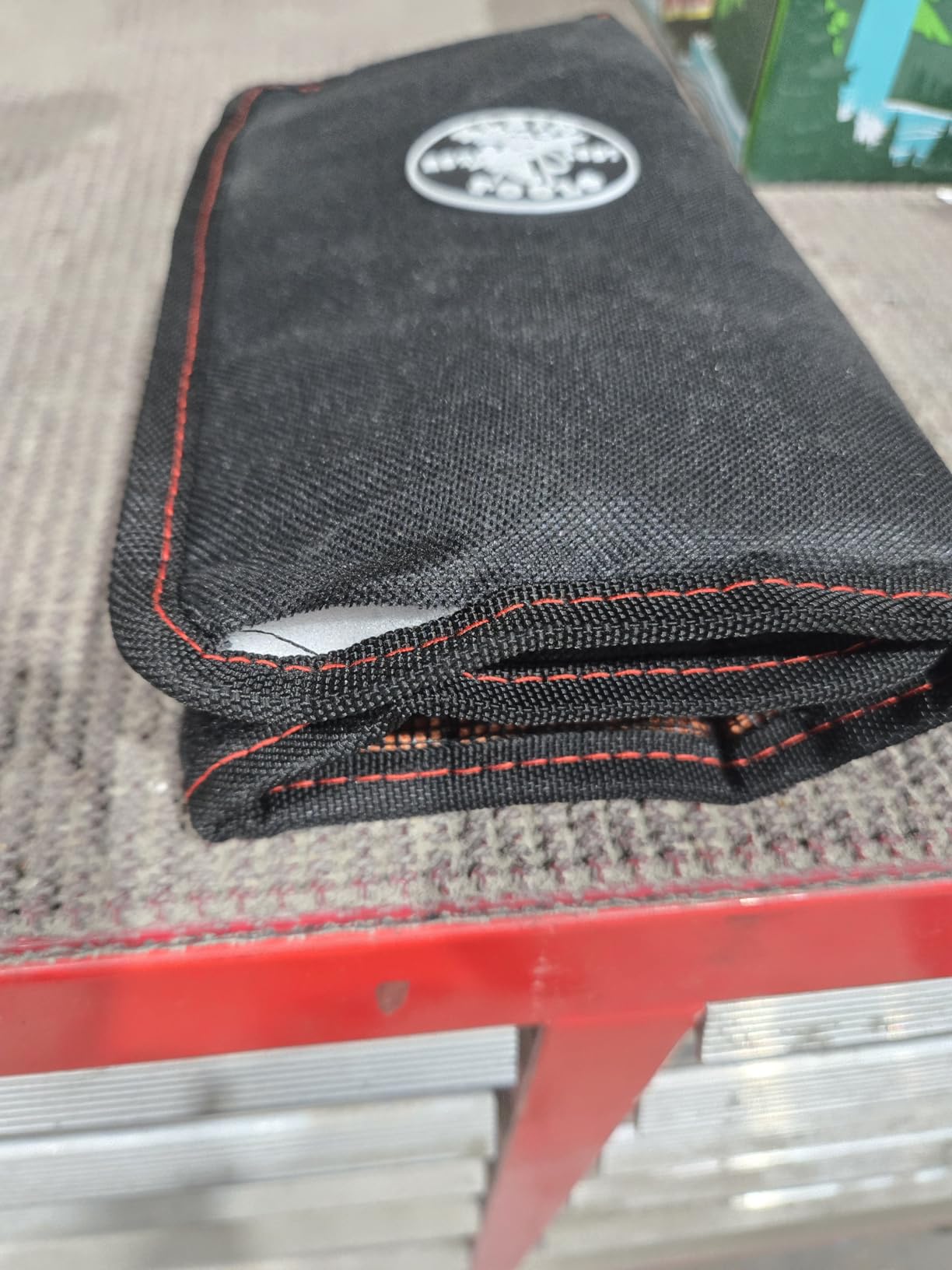
The colour coding is a small thing that gets a lot of use. Size markings are colour-matched between the wrenches and the roll pouch, so when you are on a roll under a fender lip you can find the size by hue before you find it by reading. Klein also laser-etches the ratchet direction indicators, so you are not guessing which way to turn in low light.
The pass-through ratchet is the sleeper feature. On a long threaded stud with a nut partway down, a conventional wrench will not slide over the exposed thread to reach the nut. A pass-through ratchet slips over it and still drives. On suspension and subframe hardware that protrudes, that alone can make a set usable where others are not.
Finish is black phosphate alloy steel with a hang hole at the handle end, and it comes with a roll pouch for moving between jobs. Trade reviewers describe the seat on fasteners as solid, with the caveat that long-term durability is not yet proven on this specific part number.
Where the colour coding pays off
Any job where you are lying on a creeper with a headlamp pointed at a bracket and your hand is on the handle. The failure mode with unlabelled wrenches is not that you cannot read the size, it is that you can read it only after you have extracted the wrench and taken your hand off the fastener. Colour coding collapses that loop.
For anyone pairing a wrench set with diagnostic gear, our engine compression tester picks cover the other half of a first diagnostic pass.
Where it will disappoint you
It is SAE only, and it has a fixed head. A fixed head means the ring end stays perpendicular to the handle, so when the bolt axis is not parallel to your forearm you are limited to the swing arc and nothing else. In a bay where a flex head would let you angle into the fastener, this set simply cannot follow.
Eight pieces is also a small set. It is a focused SAE kit, not a full complement, and cost per wrench runs higher than most of the metric sets here because of the mechanism work in each head.
4. WORKPRO 8-Piece Stubby Flex-Head Set – Articulation on a Budget
Best for: combining stubby reach with a flex head at the lowest outlay of any articulating set here.
WORKPRO 8-Piece Stubby Flex-Head Ratcheting Wrench Set, Metric 8-17mm
Stubby plus 180 degree flex head
72-tooth, 5 degree arc
Anti-slip teeth, Cr-V, 8 metric sizes
+ The Good
- Stubby length and flex head together reach where neither alone can
- Anti-slip teeth hold rounded fasteners
- 5 degree arc suits narrow gaps
- Heat-treated Cr-V with electrophoretic coating
- The Bad
- 6-point box ends give fewer engagement angles than 12-point
- Only 8 sizes and 16mm
- 18mm
- 19mm are absent
- Smallest sizes can still be short for deep fasteners
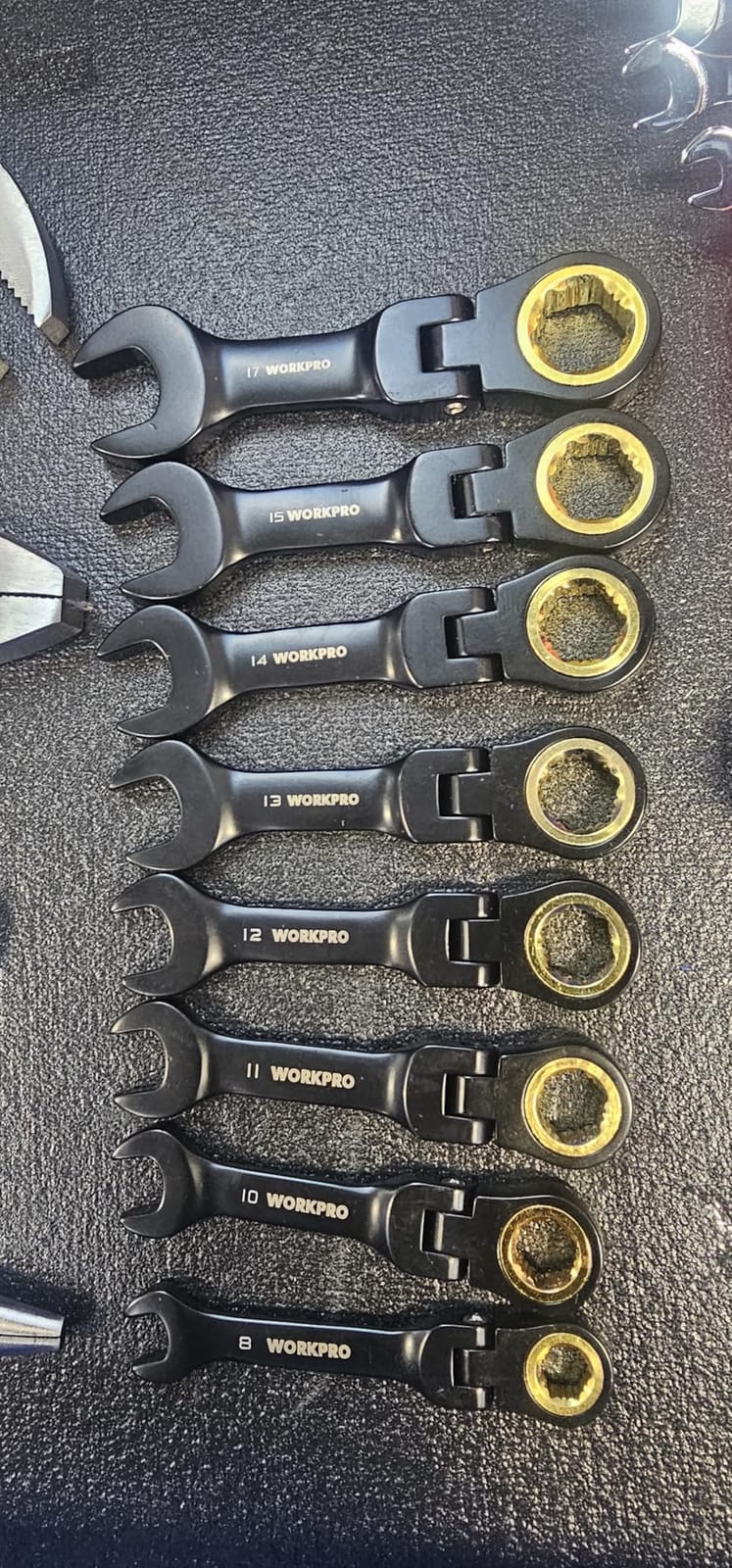
This is the combination people usually want and rarely find: a stubby pattern that reaches, joined to a 180 degree flex head that angles. Most stubby sets give you one, most flex sets give you the other. Having both at once means you can reach a fastener that is deep and also sits at an angle to your hand, which is most of them.
Sizes run 8, 10, 11, 12, 13, 14, 15 and 17mm. Note what is missing: 9, 16, 18 and 19mm. That is a real limitation, and reviewers call it out, so treat the piece count as eight usable wrenches rather than a complete metric complement.
The anti-slip tooth design is the marketing claim worth examining. It is described as keeping the head engaged on the flats rather than the corners, with a claimed 30 percent grip improvement, which is the same failure mode the off-corner and 12-point designs address. On fasteners that have been round-headed by a previous cheater bar, that is the feature that decides whether you can finish the job.
How the flex head changes the work
A flex head pivots so the handle can sit at an angle to the fastener axis. That means the swing arc only has to clear an obstruction, not fight the geometry of your wrist. On a bolt tucked behind a coolant pipe, the flex head is often the difference between working and not working, and it costs almost nothing in ring end diameter compared with a standard ratcheting end.
One practical note: these flex heads are held by a screw that can be tightened, so check the pivot feels firm before you lean on the wrench. A head that creeps under load is an annoyance, not a hazard, but it costs you time.
Where it will disappoint you
The 6-point box end is the compromise that pays for the flexibility elsewhere. Six engagement angles means you line up more often, which is more work in a space where lining up already takes effort. Most of the other sets here use 12-point ends for that reason.
Review volume is modest compared with the leaders in this group, and a minority of buyers note that the smallest sizes can still be too short for the deepest engine bay recesses. Treat it as a second set that complements a metric run rather than replacing one.
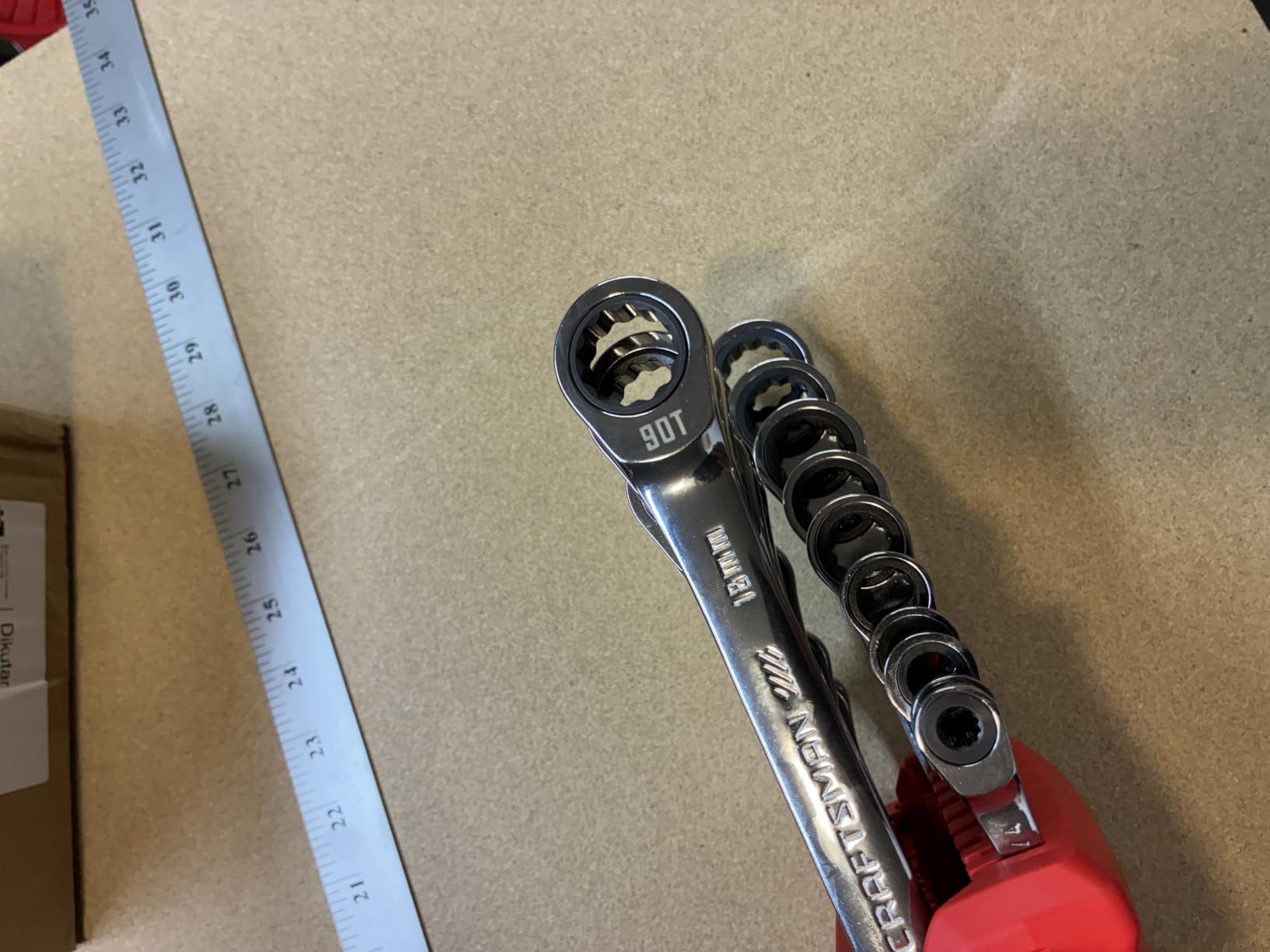
5. CRAFTSMAN 20-Piece 90-Tooth Set – SAE and Metric in One Case
Best for: buyers who want both unit systems in one purchase and a tight arc swing.
CRAFTSMAN Ratchet Wrenches Set, 20 Pc, 90 Tooth SAE/Metric Ratcheting Wrench Set with Case, 4 Degree Arc Swing (CMMT87220)
90-tooth ratchet, 4 degree arc
20 pieces, SAE and metric
12-point box end, lifetime warranty
+ The Good
- 4 degree arc works where wider-sweep sets will not move
- Covers both unit systems in a single case
- 12-point ends engage quickly with no backdrag
- Slim handle feels better in hand than a socket and ratchet
- The Bad
- Fixed head cannot angle into obstructed access
- 11.42 inch length is bulky for very deep recesses
- One review reports a 10mm ratcheting end breaking after light use
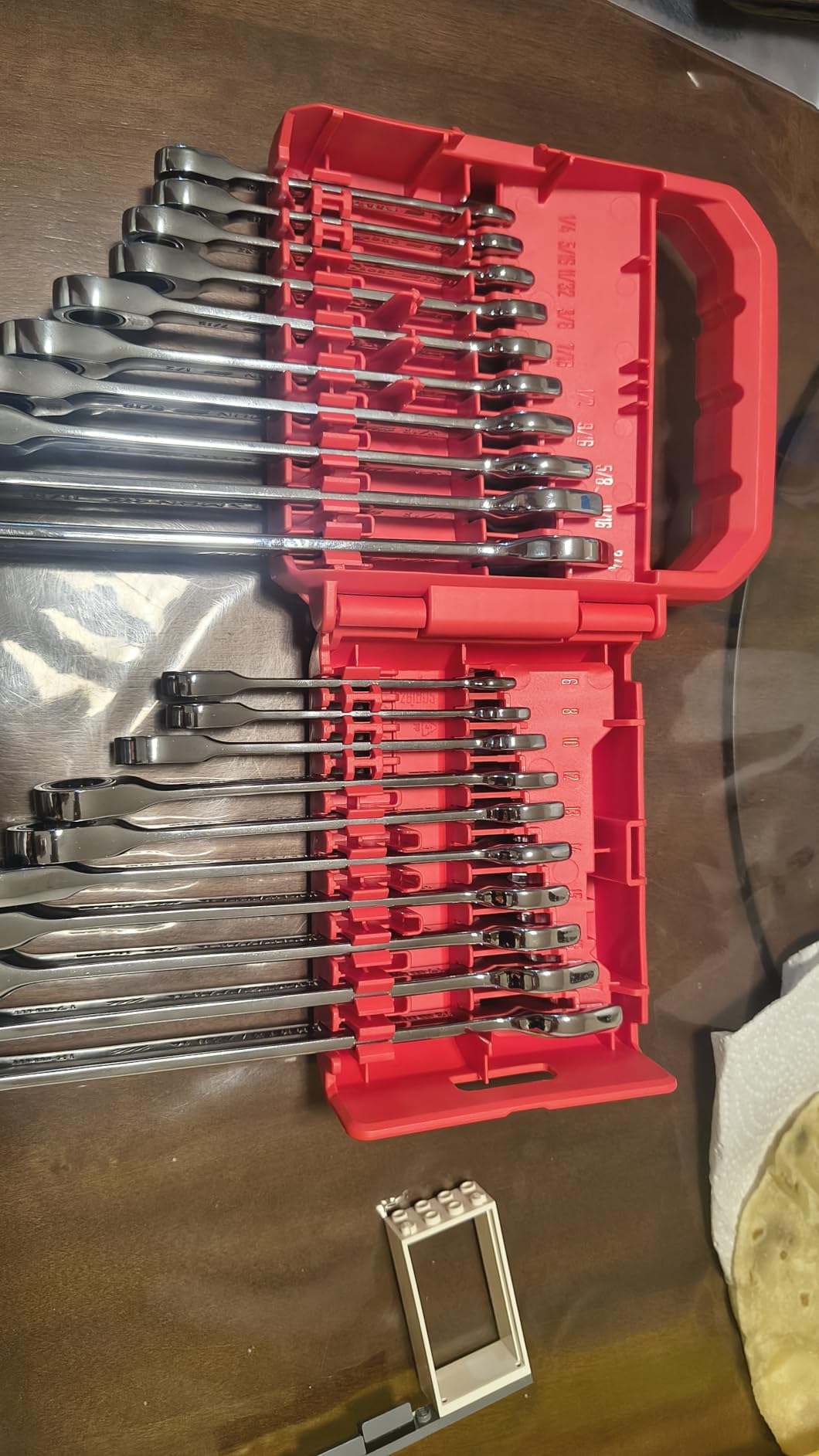
Ten SAE sizes and ten metric sizes in one moulded case, and the model is CMMT87220. The SAE side runs 1/4, 5/16, 11/32, 3/8, 7/16, 1/2, 9/16, 5/8, 11/16 and 3/4 inch. The metric side runs 6, 8, 10, 12, 13, 14, 15, 16, 17 and 18mm.
The 90-tooth mechanism produces a 4 degree arc swing, which puts it behind the Milwaukee set and ahead of everything running 72 teeth. Reviewers describe it as frequently the only wrench that will work in a genuinely confined application, and that is the honest use case: the fastener is the one you would otherwise have removed with a cut-off wheel.
The 12-point box end is a deliberate choice. Twelve points means you can engage a fastener from twelve angles instead of six, which in a fixed-head design partly substitutes for the articulation you do not get. Combined with a slim handle, owners report it feels closer to a hand tool than to a socket and ratchet assembly.
Why owning both unit systems matters
It is a boring advantage until the first time you are under a hood and the bolt is metric. Having one case open rather than two changes how a job flows, and it removes the excuse to postpone a task because the right tool is in the other case. The 11/32 inch size is a good signal of intent too, because that is a size most sets skip and it shows up on older domestic hardware.
Full lifetime warranty coverage with a replacement service is the strongest warranty position among the sets in this group. For a tool you will keep in the car for years, that is worth more than a small specification win.
Where it will disappoint you
Fixed head is the main limitation. When a fastener is angled relative to your forearm, a 4 degree arc only helps if your wrist can line up with the bolt axis. A flex head would buy you reach that this set does not offer.
At 11.42 inches, the longest set here, it is also bulkier than a stubby pattern in genuinely deep recesses. And there is an isolated report of a 10mm ratcheting end breaking after light use. One review is not a pattern, but it is a reminder that a lifetime warranty is most valuable on the sizes you use least.
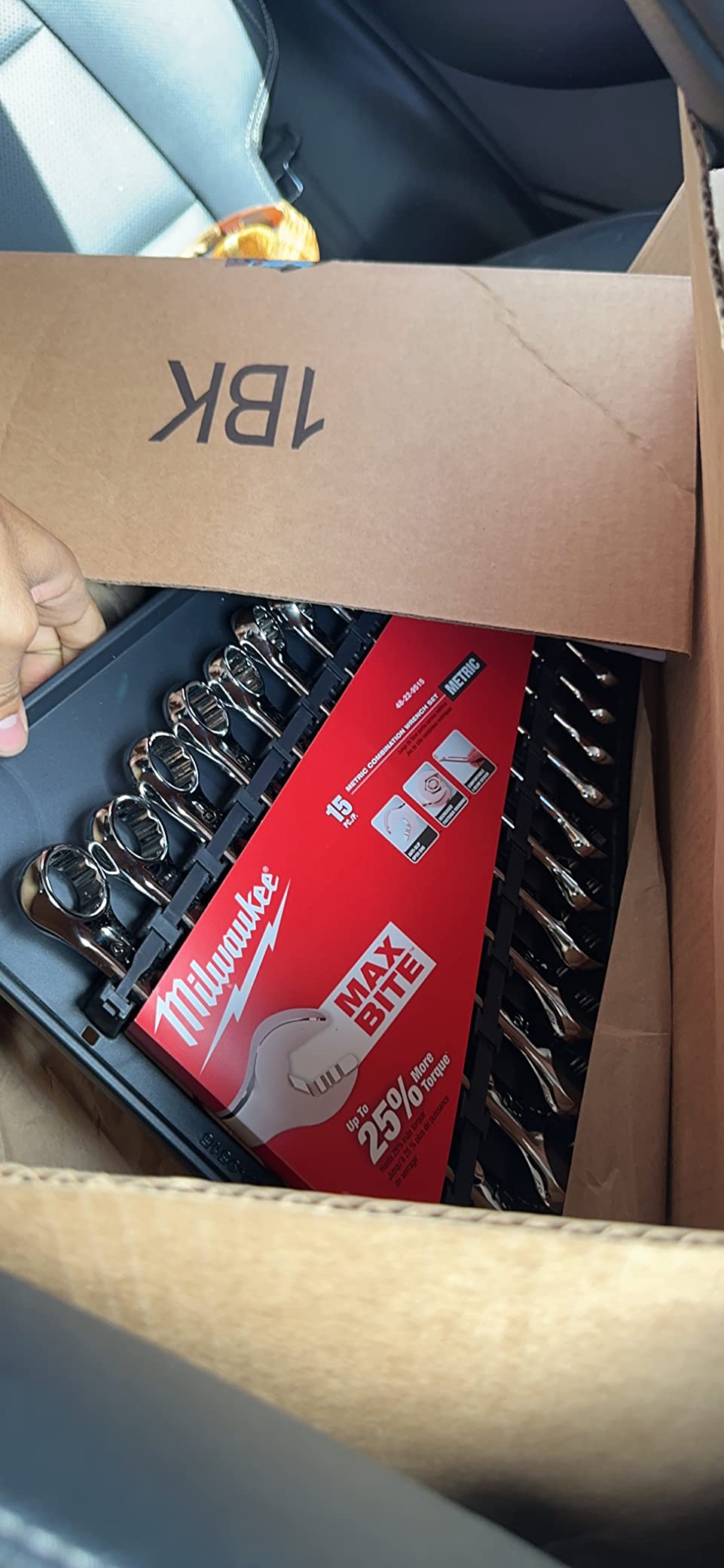
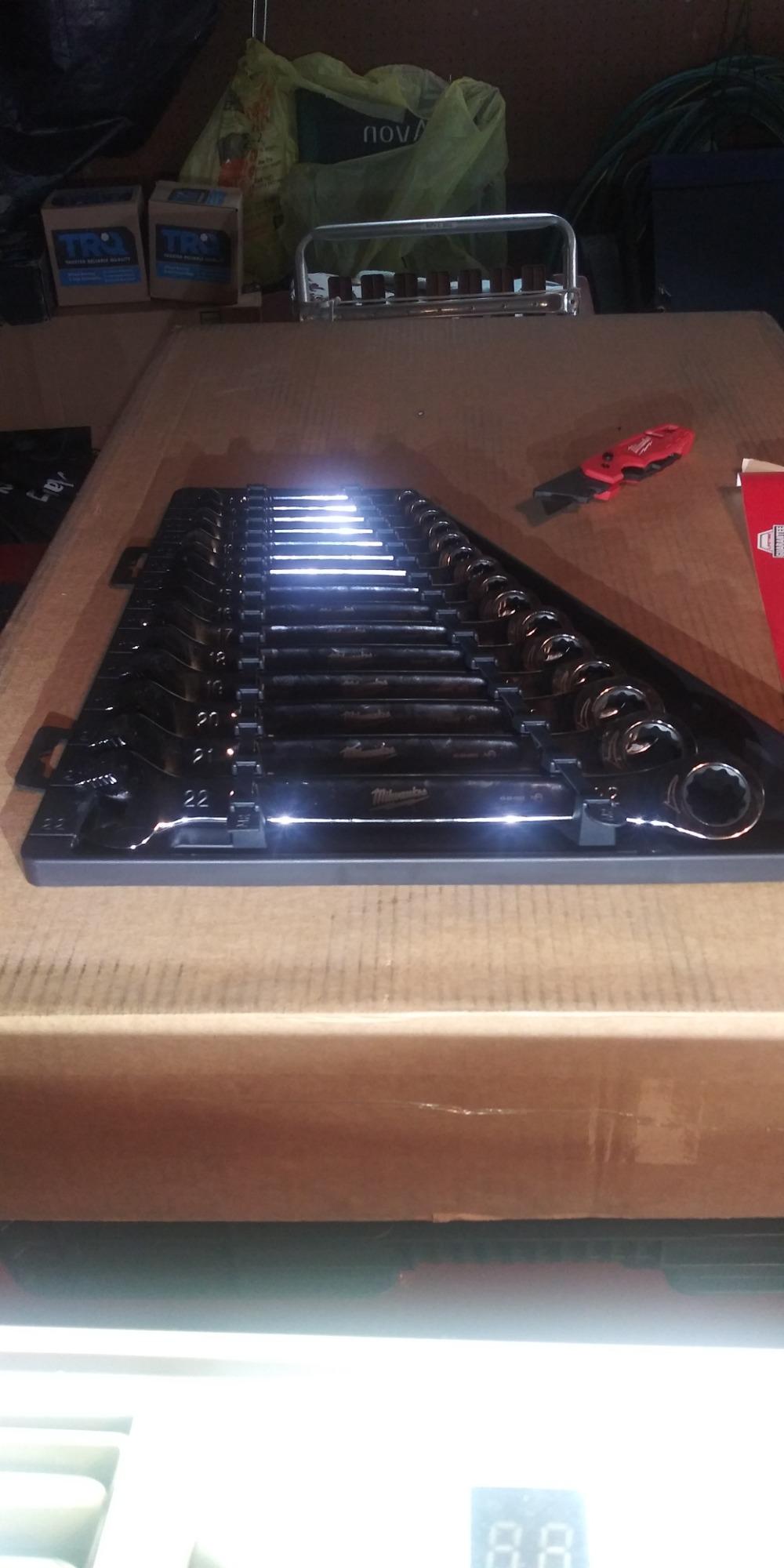
6. Milwaukee 15-Piece Metric Set – 2.5-Degree Arc for the Worst Gaps
Best for: single hardest-to-reach fasteners where nothing else will fit.
MLW48-22-9516 Ratcheting Combination Wrench Set Metric
144 ratcheting positions
2.5 degree arc swing
15-piece metric, alloy steel
+ The Good
- 144 positions give the tightest arc swing of any set here
- 2.5 degrees works where almost nothing else fits
- Alloy steel holds up under shop use
- 12-point ends balance strength and tolerance
- The Bad
- Highest outlay of any set in this group
- Metric only so SAE needs a second set
- Fixed ratchet head rather than a flexing head
Part number MLW48-22-9516, fifteen metric pieces, and 144 ratcheting positions. That figure is more than double what a 72-tooth mechanism gives you, and it translates to a 2.5 degree arc swing. No other set in this roundup gets below four degrees.
This is the set to buy when you have one specific bolt that everything else refuses to reach. Owners describe the 2.5 degree figure as the reason the set exists, and the reviews skew heavily five-star for a straightforward reason: when the tool works in a gap you thought was impossible, the price stops being the interesting part of the equation.
Construction is alloy steel with a polished finish, and the box end is 12-point. Roughly nine in ten ratings on this listing sit at five stars, and buyers treating it as a long-term professional investment report consistent performance rather than a single good outcome.
It is worth being clear about the shape of the benefit. A 2.5 degree arc does not make the wrench stronger, does not make it smaller, and does not help at all once the fastener is loose. It widens the set of locations where the wrench can be engaged in the first place. That is a narrow but real gain, and it is exactly the thing a crowded engine bay rewards.
When a 2.5 degree arc actually matters
Picture a hidden bracket bolt behind a coolant hose where the only clear path for a handle is a narrow slot angled slightly away from the bolt axis. A 4 degree wrench may fit and bind. A 2.5 degree wrench fits and keeps moving. The difference between those two outcomes is the difference between removing a bracket and cutting a hose to reach it.
The same logic applies to battery terminals in vehicles with tight cowl clearance, and to the upper fasteners on intake manifolds where the fuel rail sits close overhead. These are locations where ring end diameter is the limiting factor, and a finer mechanism buys you a fraction of a millimetre at the very point where you need it.
Where it will disappoint you
It is the most expensive set in this group, and for most engines that money is not well spent, because a 4 or 5 degree set covers the overwhelming majority of jobs. Buy it as a targeted second set, not as a first one.
It is metric only, and the head is fixed rather than flexing. On an angled fastener in a wide-open area, a flexing head from a cheaper set can reach where this one cannot. Its strength is arc, not articulation, and the two are not substitutes.
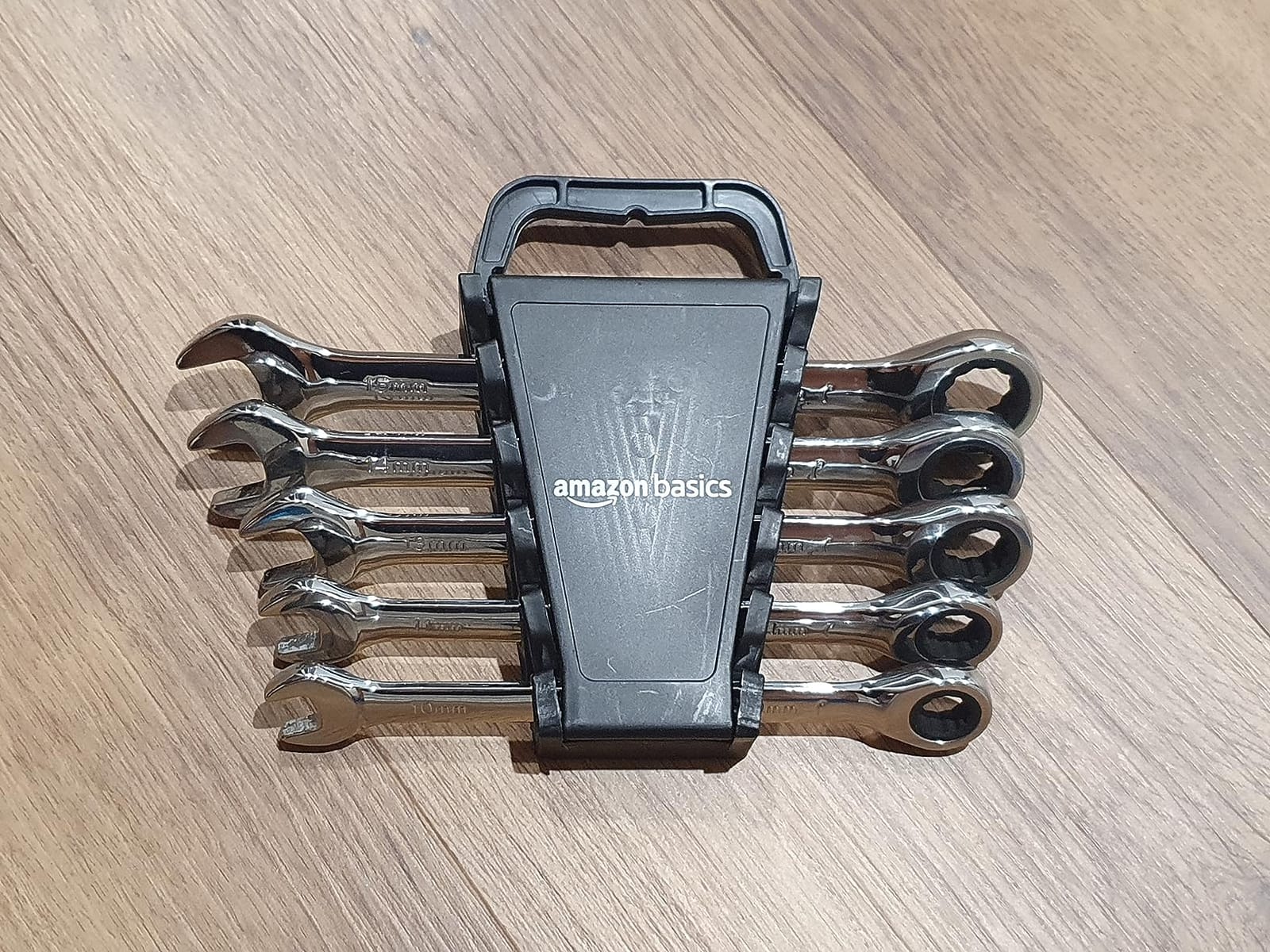
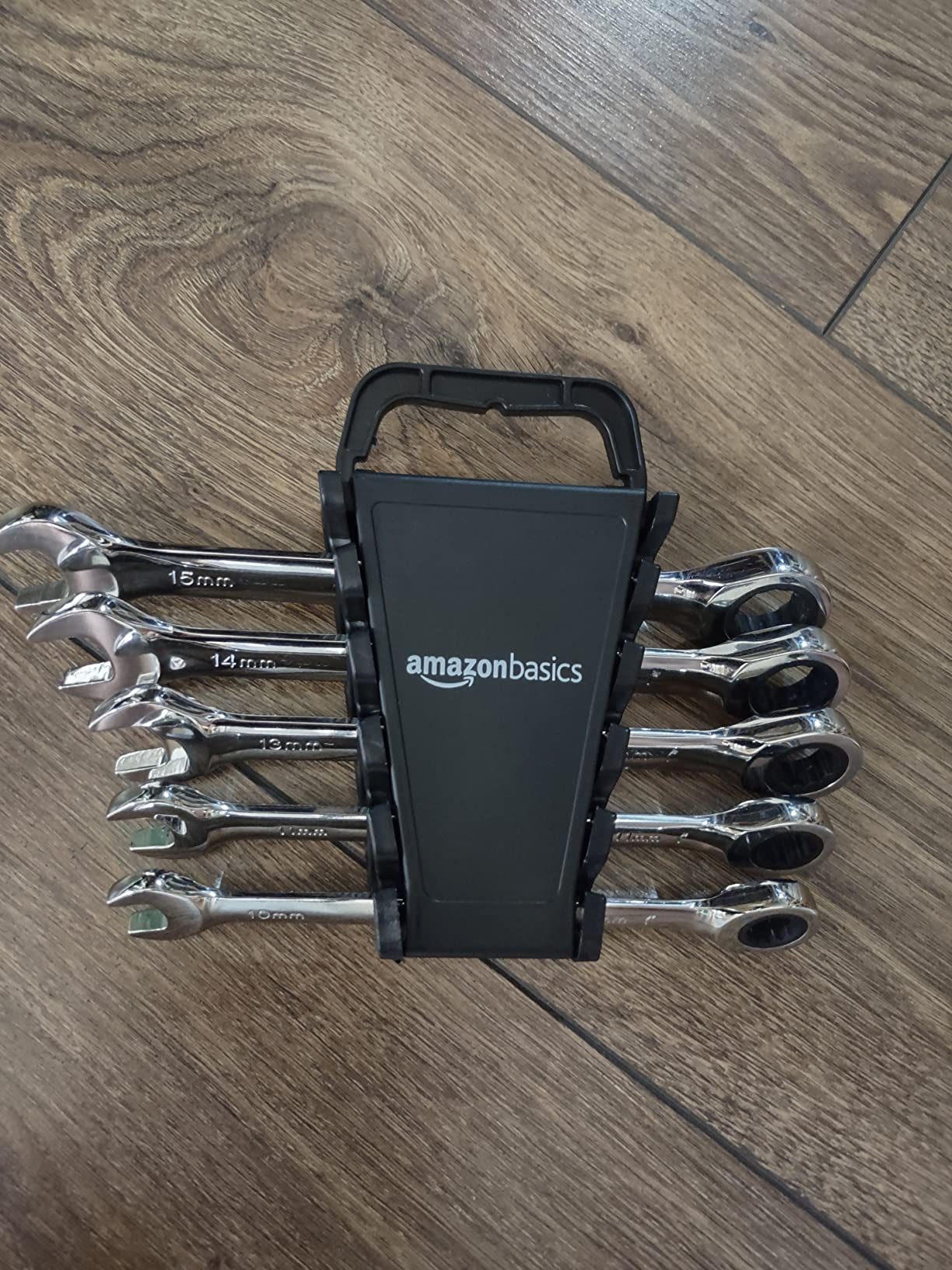
7. Amazon Basics 7-Piece Metric Set – A Compact Working Backup
Best for: a second set, a gift, or a car kit where size and weight matter more than coverage.
Amazon Basics Metric Ratcheting Combination Wrench Set, 7-Piece, Chrome Vanadium Steel, 72-Tooth, 8mm, 10mm, 12mm, 13mm, 14mm, 15mm, 17mm
72-tooth, 5 degree arc
7 metric sizes, drop-forged Cr-V
Full-drive box ends
+ The Good
- Lowest cost per wrench in this group
- 5 degree arc works acceptably in tight spots
- Drop-forged hardened Cr-V holds up to repeated use
- Full-drive box ends resist rounding
- The Bad
- Only 7 sizes with 9mm
- 11mm
- 16mm
- 18mm and 19mm absent
- Fixed head limits reach into deep bays
- Fixed square box end has fewer engagement angles
Part number DS-CWS-7M, seven metric sizes: 8, 10, 12, 13, 14, 15 and 17mm. That is a small set, and the gaps are real. No 9mm, no 11mm, no 16mm, no 18mm, no 19mm, and 11mm in particular is one you reach for constantly on Japanese engines.
What it does have is a 72-tooth ratchet running a 5 degree arc, drop-forged hardened chrome vanadium steel, and full-drive box ends. The forging and heat treatment are the right specification for a tool that gets thrown in a car and forgotten about, and the review pool of several thousand ratings is large enough that the 4.6 average is a dependable number rather than noise.
Owners consistently describe the value in terms of cost per wrench, and the recurring complaint is the size selection rather than the build. That is the correct order of complaint. A well-made wrench that is the wrong size is still the wrong size.
When a small set is the right size
There are jobs where seven sizes is plenty. A battery terminal service, an oil change, a set of intake manifold fasteners on a four cylinder, a coolant bleed. Each of those needs three or four specific sizes and nothing else, and a set that fits in a glovebox is worth more on a roadside job than a comprehensive one that rides in a truck bed.
It is also a reasonable first ratcheting set. A lot of buyers who start here conclude that ratcheting wrenches are not worth it, because the sizes they needed were missing. Better to learn the mechanism on a small set and then buy the coverage you actually need.
Where it will disappoint you
The fixed square box end has fewer engagement angles than a 12-point design, which means more lining up in exactly the awkward spots this category is bought for. Combined with a fixed head, it has no articulation and no flexibility, so it is the least adaptable tool here despite the ratcheting mechanism.
Because 11mm and 16mm are both absent, this will not carry a metric job on its own. Buy it as a companion to a fuller set, not instead of one. Our wrench set roundup covers the fuller options.
8. DURATECH 12-Piece Flex-Head Set – Gap-Free 8-19mm Metric
Best for: metric-only work where you want every millimetre from 8 to 19 with a flex head.
DURATECH Flex-Head Ratcheting Wrench Set, Metric, 12-piece, 8-19mm
8-19mm metric, no skipped sizes
180 degree flex head, 72-tooth
Drop-forged Cr-V, chrome plated
+ The Good
- Every metric size from 8 to 19mm with no gaps
- Flex head reaches obstructed access points
- Smooth 5 degree arc
- Organizer pouch with printed size slots
- The Bad
- Bulky ratchet heads on the smallest wrenches
- 6mm and 7mm not included
- One review reported wrenches missing from the pouch on arrival
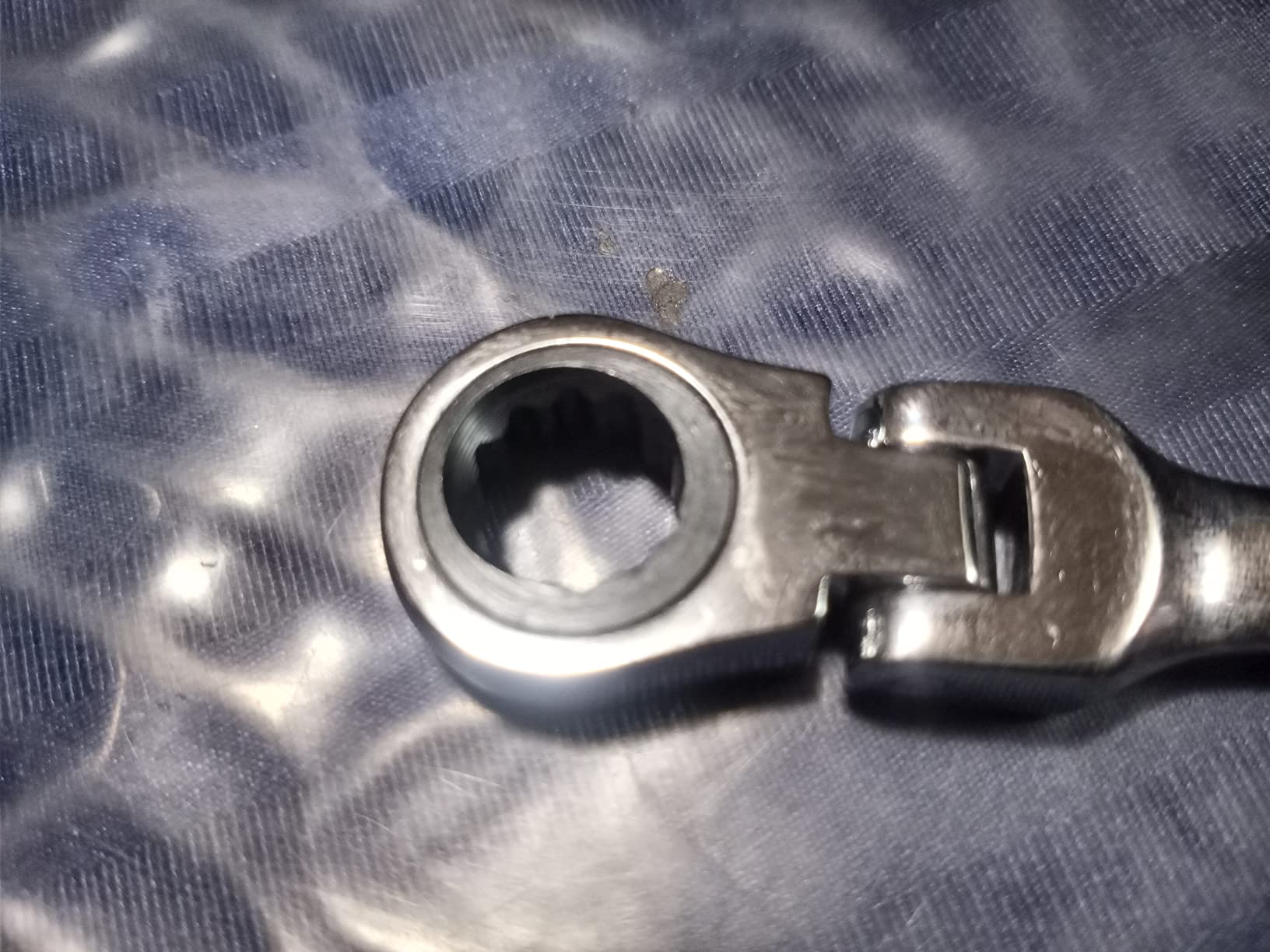
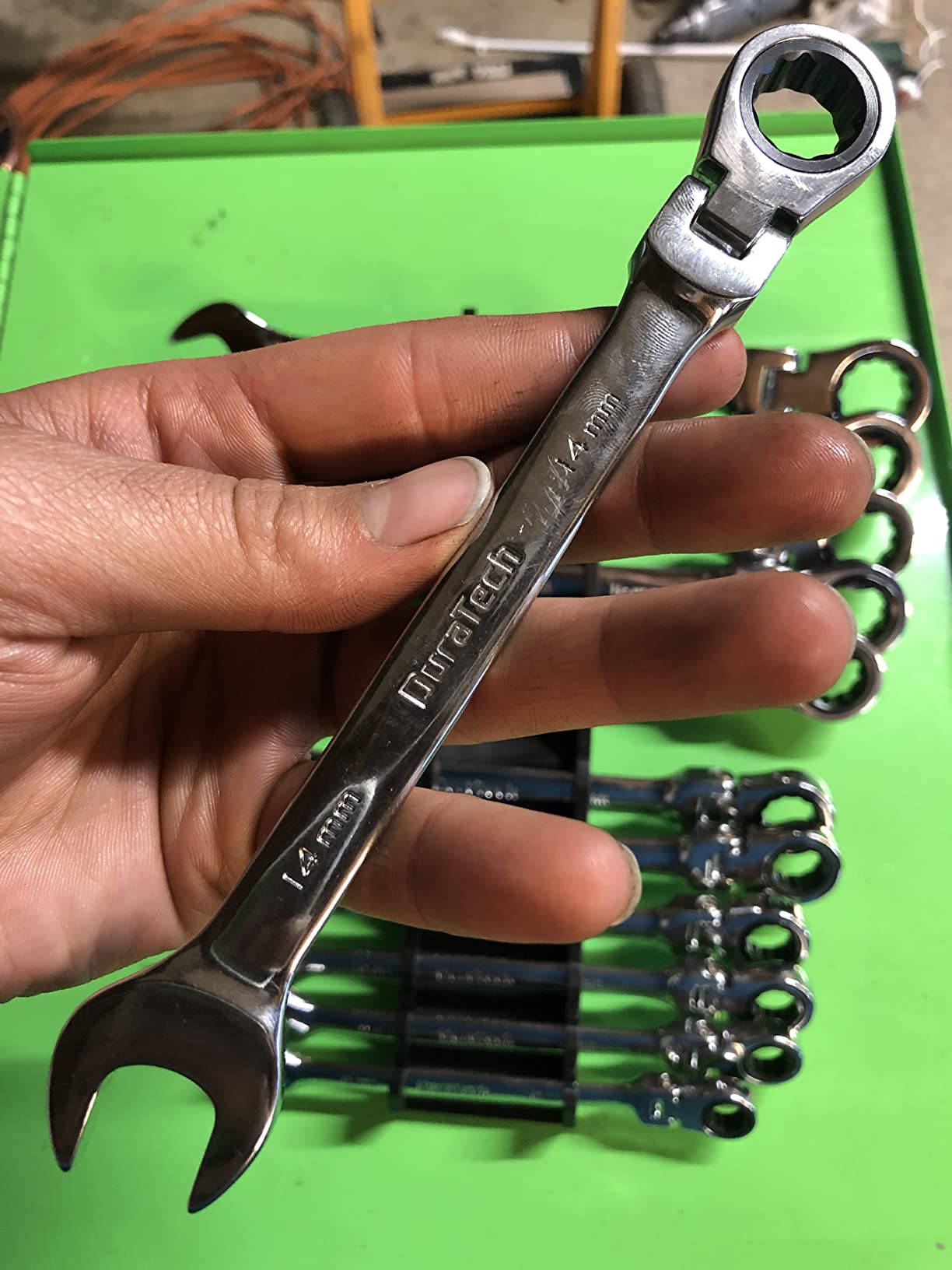
DTRFGW12M, twelve pieces, 8, 9, 10, 11, 12, 13, 14, 15, 16, 17, 18 and 19mm. That is a skip-free run, and in a category where advertised piece counts routinely overstate usable coverage, it is worth naming as a genuine strength rather than a marketing claim.
The mechanism is a 72-tooth ratchet on a 5 degree working arc, combined with a 180 degree flex head. The two features cover different failure modes. The arc handles obstructed access where the handle itself is in the way. The flex head handles access where the fastener is angled to your hand. Having both means you are not choosing which problem you can solve.
Material is drop-forged, heat-treated chrome vanadium with chrome plating for corrosion resistance, and the set is stated to exceed ANSI standard. Owners of both the full set and individual sizes report months of regular use with no issues.
Why skip-free coverage beats a high piece count
A 20-piece set with gaps might contain only fourteen sizes you actually use, while a 12-piece skip-free set contains twelve. Buyers figure this out quickly, usually after a 19mm nut that has to be sourced separately. For a metric-focused home garage, the DURATECH run is the most complete single answer in this group.
The pouch is worth a mention because it is genuinely useful rather than a token. Each slot has the size printed on it, and a tailored cover keeps the wrenches from sliding out, which means the set can live in a trunk or a gear bag without arriving as a loose jumble.
Where it will disappoint you
The most common critique is the chunky ratchet mechanism on the smallest sizes. The same shell that gives you a durable 5 degree arc at 19mm makes the 8mm and 9mm heads bulky, and that is precisely where you need them small. This is the fixed trade-off of ratcheting mechanisms across the whole category.
There is no 6mm or 7mm, which owners wish were included, and there is an isolated report of a set arriving with wrenches missing from the pouch. That last one is a fulfilment issue rather than a product flaw, but it is the kind of thing to check on arrival.
9. WORKPRO 22-Piece Flex-Head Set – Both Unit Systems With Articulating Heads
Best for: mixed metric and SAE work where you want a flex head on every wrench.
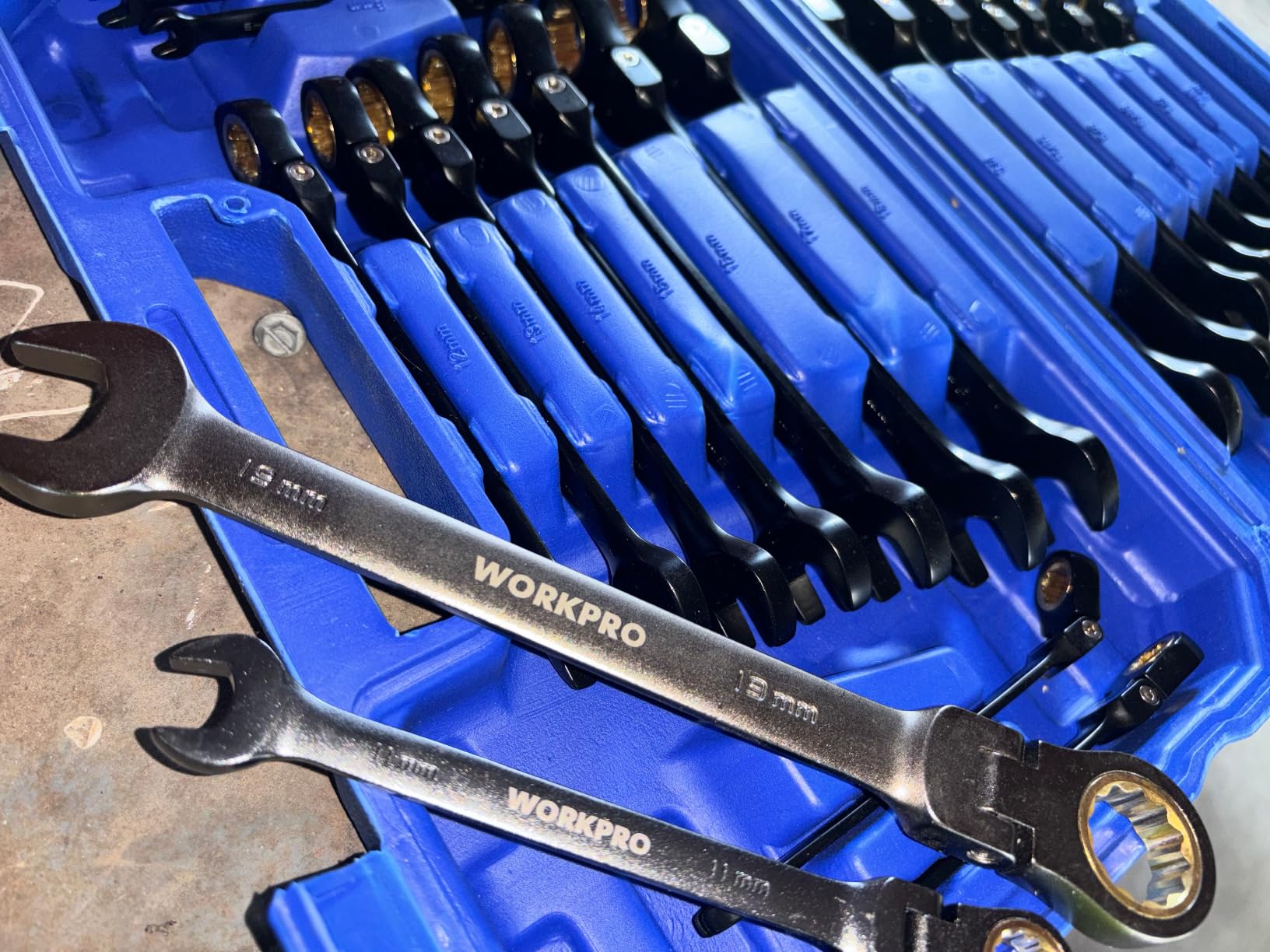
WORKPRO 22-piece Ratcheting Wrench Set with 180° Flex Head, Anti-Slip
22 pieces, metric and SAE
180 degree pivoting head on each
Anti-slip teeth, Cr-V, 72-tooth
+ The Good
- Flex head on every wrench in the set
- Covers both unit systems in one case
- Wrenches fit bolts accurately and run true to size
- Smooth light ratcheting pressure
- Moulded case with working latches
- The Bad
- 7mm and 11mm missing and must be bought separately
- Large and heavy for a compact tool bag
- 6-point box ends give fewer engagement angles
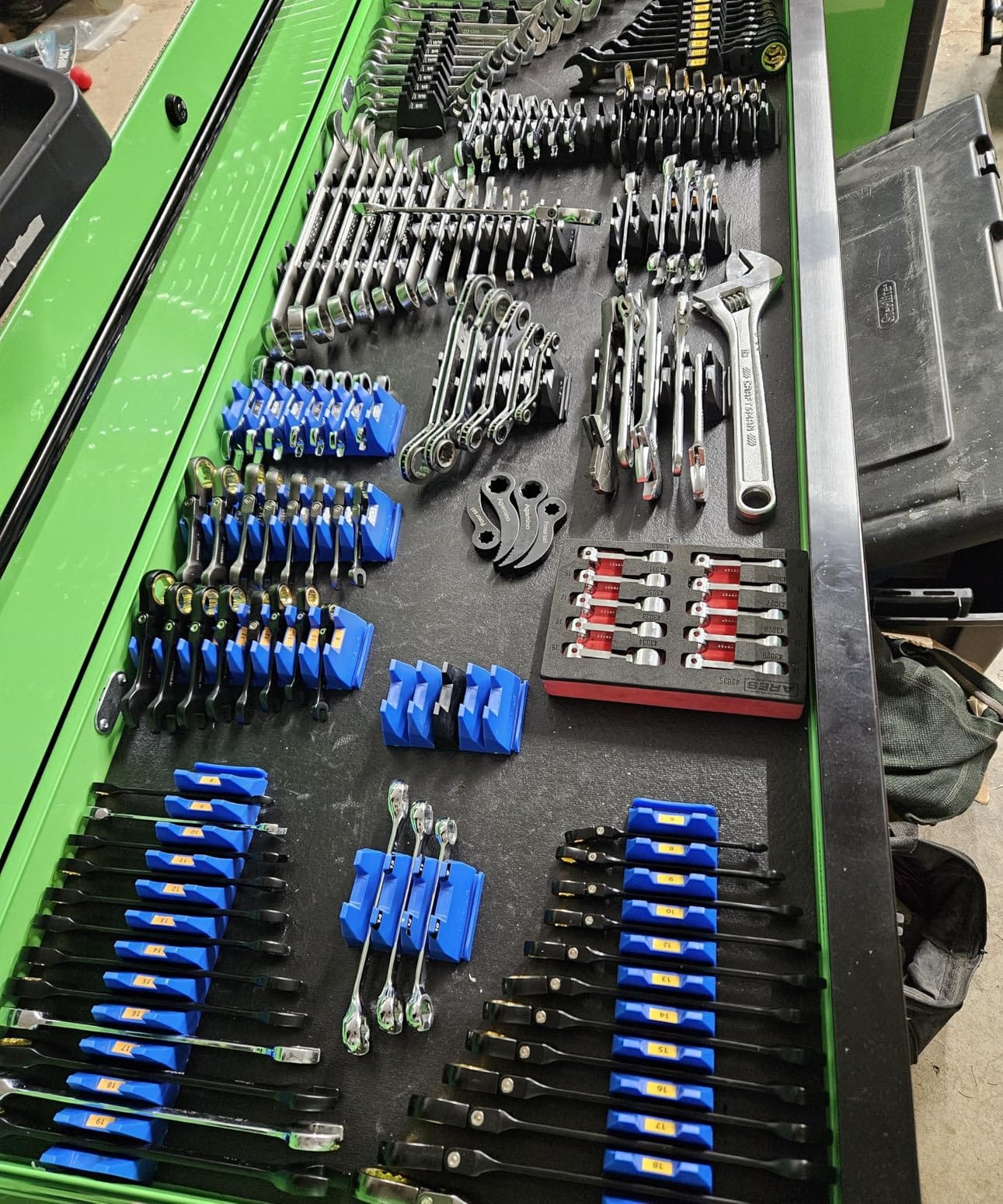
Model W003377AE: eleven metric sizes from 6 to 18mm and eleven SAE sizes from 1/4 to 3/4 inch, every one with a 180 degree pivoting head. Buyers who use it report the flex heads staying where they are set and the ratcheting action still smooth after a year or more, and several have bought a second set.
The flex heads are retained by a hex-key screw that can be tightened as needed, which is a practical detail. On a set you use daily, a head that has crept out of position is a minor irritation every single time, and being able to reset it takes a minute rather than a return.
The anti-slip tooth design is described as 30 percent better grip than hexagonal spanners, which again means contact on the flats rather than the corners. Owners also note the wrenches fit bolts accurately and run true to size, which sounds mundane until you have used a set where the 13mm is really a 12.8mm and rounds the fastener.
What a flex head on every wrench actually buys
When articulation is standard rather than occasional, you stop thinking about wrist angle. You bring the handle in from whatever direction the gap allows and the head takes up the difference. On an engine bay where the approach to a fastener is a curving path around a hose, that flexibility is the difference between reaching and not.
It is why this set suits work that involves a lot of varied fasteners rather than one repeated job. A full day of removing assorted underhood hardware, with the approach angle changing at every bolt, is where per-wrench articulation pays back more than a finer tooth count.
Where it will disappoint you
The missing 7mm and 11mm sizes are the recurring gripe, and both are common on real hardware. You will be sourcing them separately, which is worth knowing before you plan the job around this set.
At 22 pieces in a moulded case it is large and heavy, and that is a problem for mobile work where the case lives in a small bag. The 6-point box ends also give fewer engagement angles than 12-point designs, which is the same compromise as the other WORKPRO set here.
10. SUZUME 24-Piece Flex-Head Set – Complete Coverage Including 19mm
Best for: buyers who want the widest size coverage in one case, with 19mm and 7/8 inch included.
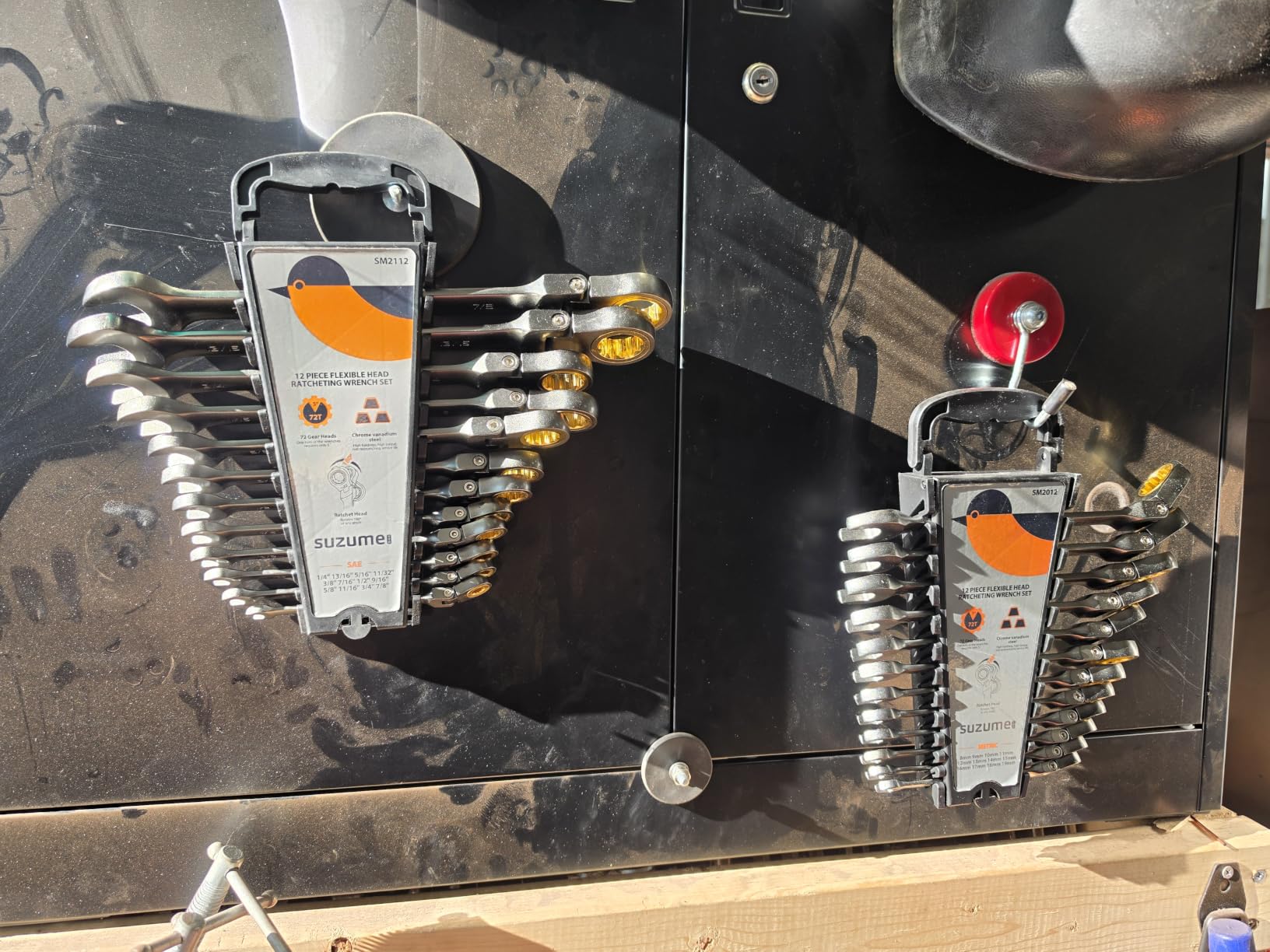
SUZUME 24-piece Flex Head Ratcheting Wrench Set Metric & SAE 180° flexible
24 pieces, 8-19mm and 1/4-7/8 inch
180 degree flex head, 72-tooth
Black nickel coated Cr-V
+ The Good
- Widest coverage here including the often-missing 19mm and 7/8 inch
- Flex head plus 5 degree arc handles confined clearances
- Black nickel coating resists rust in greasy damp bays
- Handle-equipped rack keeps sizes easy to find
- The Bad
- 12 inch standard length is bulky for deep recesses
- Rack and 24 pieces add bulk for mobile use
- No customer review images to confirm finish quality
Model SM2324, twenty-four pieces, metric 8-19mm and SAE 1/4 to 7/8 inch, with no skipped sizes. The 19mm is the headline. It is a size most sets in this category omit, and it is one you meet the moment you remove an intake manifold or a wheel hub on anything modern.
Each wrench has a 180 degree rotating head and a 72-tooth ratchet requiring 5 degrees of rotation. Coverage is stated to span more than 90 percent of standard cars, trucks and SUVs, which is a marketing claim you can check against your own vehicle by looking at the three fasteners you most often touch.
Material is chrome vanadium steel with heat treatment and a black nickel coating, described as resistant to rust in greasy or damp environments. That matters for a set stored in a garage or a truck bed rather than hung on a pegboard, and it is the reason the coating matters more than it would on a chrome set.
Why 19mm changes how a set feels
There is a specific frustration in owning a metric ratcheting set and still needing a separate wrench for the one size that comes up constantly. It undermines the reason you bought a ratcheting set, which is that the right tool is already in the case. A set that includes 19mm and 7/8 inch closes the loop for the majority of underhood fasteners on North American vehicles.
The fatigue testing is also worth noting as a spec rather than a promise. The set is tested to keep the gears locked past 15,000 cycles and the flex heads holding position past 20,000 cycles. Treat that as manufacturer data, not as evidence you will see, but it is a more useful number than nothing.
Where it will disappoint you
At 12 inches this is a standard-length set, not a stubby. In the very deepest recesses a stubby pattern reaches that a 12 inch wrench cannot, and the flex head does not solve that, because the problem there is length rather than angle.
The handle-equipped rack is a genuine advantage on a bench and a genuine disadvantage in a car, since twenty-four pieces plus a rack is a lot of bulk to carry around. A small share of reviews also raise build-quality concerns, so inspect the gears and flex heads before you rely on it for daily work.
How to Choose a Ratcheting Wrench Set for a Cramped Engine Bay
Is a 72 tooth or 90 tooth ratchet better? A 90-tooth ratchet is better when access is the constraint, because it cuts the swing arc to roughly four or five degrees; a 72-tooth ratchet is better when you are turning a tight fastener you can actually see, because the shallower teeth carry less backdrag and move faster. For a cramped engine bay, arc wins, because arc is the only number that decides whether the tool engages at all.
The trade-off is straightforward physics. More teeth packed into the same ring diameter means each tooth is smaller, which means the wrench turns further before a tooth drops into the next detent. That is the arc, and a small arc is what gets you into a gap.
What you give up is backdrag. A fine mechanism has more internal friction at every tooth engagement, so on a fastener that is already finger tight the wrench feels heavier and slower. The number most manufacturers publish is access improvement rather than raw arc, and Klein states a 20 percent gain for its 90-tooth design over 72 teeth. Milwaukee publishes the tightest figure in this group at 2.5 degrees from 144 positions.
Follow these five steps to pick the right set
First, decide your unit system before you look at anything else. If your work is on Japanese or European cars, metric is the priority and you should buy a skip-free metric run. If it is domestic trucks and older American engines, lead with SAE. A dual-system set like the CRAFTSMAN or WORKPRO 22-piece covers both, at the cost of fewer sizes in each.
Second, check for gaps rather than counting pieces. Advertised counts are the least reliable number in this category. A 7-piece set that skips 9, 11, 16, 18 and 19mm gives you far less than a 12-piece skip-free run, and the same pattern applies to the dual-system sets that omit 7mm and 11mm.
Third, match head type to the problem. Stubby for pure reach, flex head for angled fasteners, fixed head for lowest bulk and lowest cost. If you can only have one, a flex head at standard length is the most broadly useful, because a stubby set cannot reach an angled fastener that a flex set can.
Fourth, accept that arc and articulation solve different problems. Milwaukee wins on arc. The WORKPRO and SUZUME sets win on articulation. If you are reaching a hidden bolt behind a hose, arc matters more; if the bolt is angled to your wrist in an open area, the flex head matters more.
Fifth, plan for the fact that the ratcheting end is bigger than a plain box end. A location designed around a socket may reject the wrench outright, and no tooth count fixes that. This is the point technicians make over and over on The Garage Journal, and it is the single most useful thing in this roundup that no product photo will tell you.
How to free a ratcheting mechanism that binds
A wrench that has locked up usually has a contaminated mechanism, not a broken one. Owners report the same fix repeatedly, and it comes from forum knowledge rather than any manual.
Take the box end off if the design allows it, or submerge the head end, and soak it in clean full-synthetic automatic transmission fluid. Give it time rather than a quick dip. The fluid loosens the grit and old grease holding the pawl against the gear wall, and the mechanism usually starts moving again within a session of work.
Then clean it properly and lubricate it. A dedicated mechanism cleaner followed by a light oil is the approach most owners prefer over leaving ATF in place, since ATF is a solvent and a lubricant but not a long-term coating. Work the mechanism through its full travel, wipe the excess off the outside, and store it dry.
Do this before it binds rather than after. A wrench that seizes under load in a cramped bay means a longer job, not a longer life.
Brand tiers, honestly
Brands in this category sort into fairly predictable tiers, and the honest version is that the tier predicts the mechanism quality and the warranty rather than the access.
Value tier sets here give you the mechanism and 72 teeth at the lowest outlay, with thin storage and occasional size gaps as the trade. Mid tier adds better steel specification, better finishes and more consistent sizing. Premium buys you a tighter arc, and the practical limit of premium is the arc, because nobody above 90 teeth changes the fundamental geometry. The professional tier is where ratcheting wrenches start costing serious money for durability the ratcheting function does not even need.
That last point is the contrarian view worth stating plainly, and it comes from working technicians rather than marketing copy. The ratcheting mechanism is a convenience feature. The strength and durability of the steel is what actually keeps the tool in your toolbox for a decade, and at the professional end you are paying for steel while the ratcheting remains a gadget.
When you should skip ratcheting wrenches entirely
If your work is mostly breaking seized fasteners loose, a ratcheting box end is the wrong purchase at any tier. Once a fastener is free, the mechanism is inert, and every ounce of ring end diameter you carried in paid for nothing. A plain combination wrench is smaller and will fit places a ratcheting end will not.
Buy a cheater bar or breaker bar for the breaking-loose work and keep ratcheting wrenches for reassembly and for the fasteners you can see. Owners across forums and review threads report breaking worn fasteners with ratcheting box ends, and the recurring result is a damaged mechanism or a cracked head. That is not a quality problem in the set. It is the wrong tool for the job.
Frequently Asked Questions
Is a 72 tooth or 90 tooth ratchet better?
A 90-tooth ratchet is better for confined access because it cuts the swing arc to about four or five degrees, which decides whether the wrench engages at all. A 72-tooth ratchet is better on a tight fastener you can see and feel, because the shallower teeth carry less backdrag and move faster. In a cramped engine bay, arc wins.
What brand makes the best ratcheting wrenches?
There is no single winner, because brands sort by tier rather than by mechanism quality. Value sets give you 72 teeth at the lowest cost, mid sets improve steel and sizing, premium sets buy a tighter arc, and the professional tier is paying for steel rather than for ratcheting. Judge each set on arc, head type and size gaps.
Are ratcheting wrenches worth it for engine work?
Yes for fasteners you cannot see or reach comfortably, because the ratcheting mechanism removes the need to lift the tool off a bolt in a confined space. No for fasteners that are already visible, and no for breaking seized hardware, where a plain box end fits more places and a cheater bar does the work.
Can you break a seized bolt loose with a ratcheting wrench?
Generally no. The extra diameter in a ratcheting box end increases the load on the teeth, and repeated reports from owners describe broken mechanisms when using one to break fasteners free. Use a cheater bar or breaker bar for that step, then use the ratcheting wrench for the tightening and reassembly that follows.
What size ratcheting wrench set do I need?
Most DIYers need a skip-free metric run from 8 to 19mm, which covers the fasteners on the vast majority of underhood work. Check for gaps rather than piece count, because many sets skip 9mm, 11mm, 16mm, 18mm or 19mm. If you work on domestic trucks, choose an SAE set or a dual-system set instead.
How do you clean a ratcheting wrench?
Soak the box end in clean full-synthetic automatic transmission fluid to loosen grit and old grease holding the pawl against the gear wall, then clean it with a dedicated mechanism cleaner and apply a light oil. Work the mechanism through its full travel, wipe the outside, and store it dry so the mechanism does not bind again.
Which Ratcheting Wrench Set Should You Buy
If you want the single best ratcheting wrench set for tight engine bays, buy the GEARWRENCH 14-piece stubby set. It is the only product here that combines stubby reach with a mixed SAE and metric tray, and its off-corner box end is the right answer to the rounded fasteners that come out of an engine bay.
If you need the widest possible access, buy the Milwaukee 15-piece metric set. The 2.5 degree arc is the tightest in this group, and there are locations where nothing else will engage. Just treat it as a targeted addition, not a whole garage solution.
If you want one case that covers everything without a second purchase, buy the CRAFTSMAN 20-piece. A 4 degree arc, 12-point ends, both unit systems and a full lifetime warranty make it the most defensible single buy in this roundup.
If you work metric-only and want every millimetre, buy the DURATECH 12-piece. Skip-free 8 to 19mm with a flex head, and no hunting for a separate 19mm. If you want the same coverage with the largest size range possible, the SUZUME 24-piece adds SAE to 7/8 inch on a handle-equipped rack.
Whatever you choose, keep a plain combination set and a cheater bar alongside it. The ratcheting mechanism is a convenience, and the tool that breaks the bolt loose is still the more important one. For wider coverage beyond the ratcheting sets, our engine stand picks cover the supporting equipment most home garages end up needing next.