
If you want one machine that fixes swirl marks on your own paint without a trailing extension cord, the DEWALT DCM849B is the best cordless car polisher in this group. It is not the cheapest and it is not the smallest, but it pairs a brushless motor with a 7-inch backing plate and a 4.6-star average across more than 1900 owner reviews, which is the strongest combination of rating and volume here.
A cordless car polisher is a battery-powered machine that spins a polishing pad through a small eccentric orbit to shave off light swirl marks, fine scratches, oxidation and water spots, and to spread wax, sealant or ceramic coating. Because the pad both spins and orbits, the machine spreads compound for you and reduces the chance of burning through clear coat. That safety margin is why almost every entry in this roundup is a random orbital rather than a straight rotary.
This is a cordless-only guide, updated for 2026. I cover the whole ladder: pocket-sized 12V minis for emblems and door jambs, mid-size random orbitals for weekend maintenance, and the 20V and 18V machines from DEWALT and Milwaukee that handle real one-step correction. If you are still deciding whether polishers are worth owning at all, start with our broader guide to the best car polishers first, then come back here.
Top 3 Cordless Car Polishers for Car Paint in September 2026
All 10 Cordless Polishers at a Glance for September 2026
Every machine below is a genuine cordless polisher, and the differences that matter are orbit size, motor class, and what arrives in the box. Read the orbit column first, because it decides whether the tool can cut through a swirl or only spread wax.
| PRODUCT MODEL | KEY SPECS | BEST PRICE |
|---|---|---|
 |
|
Check Latest Price |
 |
|
Check Latest Price |
 |
|
Check Latest Price |
 |
|
Check Latest Price |
 |
|
Check Latest Price |
 |
|
Check Latest Price |
 |
|
Check Latest Price |
 |
|
Check Latest Price |
 |
|
Check Latest Price |
 |
|
Check Latest Price |
Two things jump out of that list. The first is that the three machines with the highest owner review counts are all budget and mid-price Amazon brands, not the big tool names. The second is that the DEWALT and Milwaukee machines both ship without a battery, which changes the real cost of each one.
Are Cordless Car Polishers Any Good?
Yes. A modern cordless random orbital is genuinely capable of one-step correction on clear-coated paint, and the gap to a corded machine has closed enough that a full car can be polished in an afternoon on one or two battery packs. In this group the DEWALT DCM849B and the Milwaukee 2738-20 both carry brushless motors and 7-inch plates, which is real correction hardware rather than a toy.
The honest caveat is that not every cordless polisher here will cut through a swirl. The 5mm orbit on the BATOCA S3 and the 8mm orbits on the Avhrit and Niusken are built to spread wax and sealant evenly, not to bite into hard clear coat. A 12V mini such as the SPTA or the WORKPRO is genuinely good, but only for emblems, headlights, door jambs and spot work. And any machine, cordless or corded, will burn paint if you park the pad on a warm panel or lean on it.
So the short version: buy a 15mm or larger dual-action machine for correcting, buy an 8mm or smaller one for maintaining, and be honest about which job you actually have.
The 10 Best Cordless Polishers for Car Paint
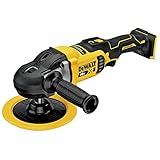
1. DEWALT DCM849B 20V 7-Inch Rotary Polisher
DEWALT 20V MAX* XR Cordless Polisher, Rotary, Variable Speed, 7-Inch, 180 mm, Tool Only (DCM849B)
Brushless motor
No-load 800-2200 RPM
7 inch plate
4.8 lb
Tool only
+ The Good
- Brushless motor delivers efficient performance and long runtime
- Variable speed trigger plus dial gives fine control at every step
- 7-inch backing plate covers most applications with fewer passes
- Rubber overmolded gear case improves grip
- Can be held with front grip or side handle
- The Bad
- Tool only so battery and charger must be purchased separately
- Rotary action requires more technique than a random orbital for beginners
The DCM849B is the tool I would hand a weekend detailer who owns a single car and wants real correction power. DEWALT’s brushless motor spins the 7-inch plate through a no-load range of 800 to 2200 RPM, and the machine carries a 4.6-star average from 1967 owner reviews, which is the deepest well of verified feedback in this group.
What sets it apart from every other entry is control. The variable speed trigger and the dial work together, so you can feather the machine down to a crawl when you hit a body line and still run near maximum when you are laying compound across a flat door. Owners credit that combination, along with the rubber overmold on the gear case, which both improves grip and reduces the risk of surface impressions on soft paint.
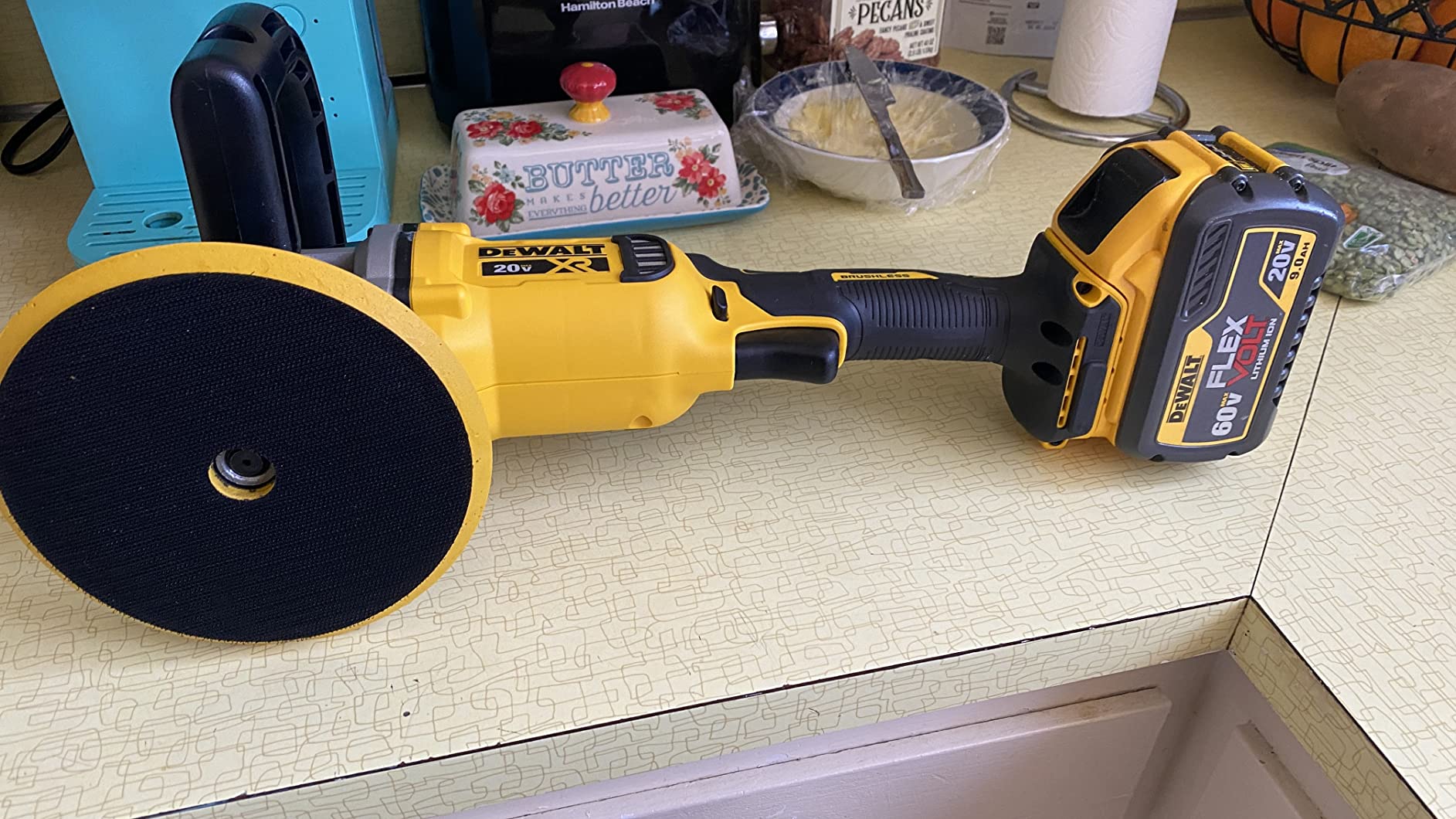
Be clear about what this is: a rotary polisher, not a dual action. The pad spins in one direction only, so it cuts harder than a random orbital and demands a light hand. That is why it sits at number one for experienced users and why I would not hand it to someone on their first-ever polish.
The 4.8 lb weight and the bail handle plus side handle arrangement mean you can run it two-handed for a whole panel or one-handed on a roof edge. DEWALT backs it with a one-year warranty on material and workmanship, and it uses the 20V MAX platform that so many people already own. If you already have 20V packs and a charger, this is the cheapest way into a real cordless polisher.
What the tool-only listing really costs you
Nothing arrives in the box but the polisher, the 7-inch backing plate, the side handle and the bail handle. You still need one 20V MAX battery, a charger, and at least two pads plus a compound to have anything to work with. If you own no DEWALT tools at all, that is a battery, a charger and consumables before the first pass on paint.
Reviewers flag the tool-only format as the single most common complaint on this listing, and it is a fair one. Ask yourself honestly whether you already own 20V MAX packs. If yes, the DCM849B is the smart buy. If no, compare the all-in cost against a kit that includes batteries before you commit.
Where a beginner should start instead
Rotary polishers generate heat fast, and heat is what lifts clear coat. If this is your first correction, a random orbital such as the Milwaukee 2738-20 or the Protmex will forgive mistakes that this machine will not. Come back to the DCM849B once you have corrected a few panels by hand and understand what swirl removal actually requires.
2. Milwaukee 2738-20 M18 7-Inch Variable Speed Polisher
Milwaukee 2738-20 M18 18-Volt Fuel Lithium-Ion Brushless Cordless 7 inch Variable Speed Polisher (Tool-Only)
18V M18 brushless platform
2200 RPM
7 inch head
7.5 lb
Tool only
+ The Good
- Delivers corded-class power and runtime on the M18 18V platform
- 7-inch variable speed head covers full panels efficiently
- Brushless construction suited to demanding correction work
- The Bad
- Heaviest machine in the group at 7.5 lb which tires long sessions
- Tool only so battery and charger must be bought separately
Milwaukee’s 2738-20 has been the reference cordless polisher for years and the owner reviews still reflect that, with 80% of reviewers handing over five stars. The M18 brushless platform is rated for demanding correction work and the 7-inch variable speed head covers a full door or quarter panel in a reasonable number of passes.
If you have Milwaukee tools already, the logic is identical to the DEWALT. The M18 18V platform is one of the most widely owned battery systems in North America, and DEWALT’s own 20V MAX is its closest rival. Pick whichever ecosystem you already have and the polisher becomes a marginal cost rather than a starting expense.
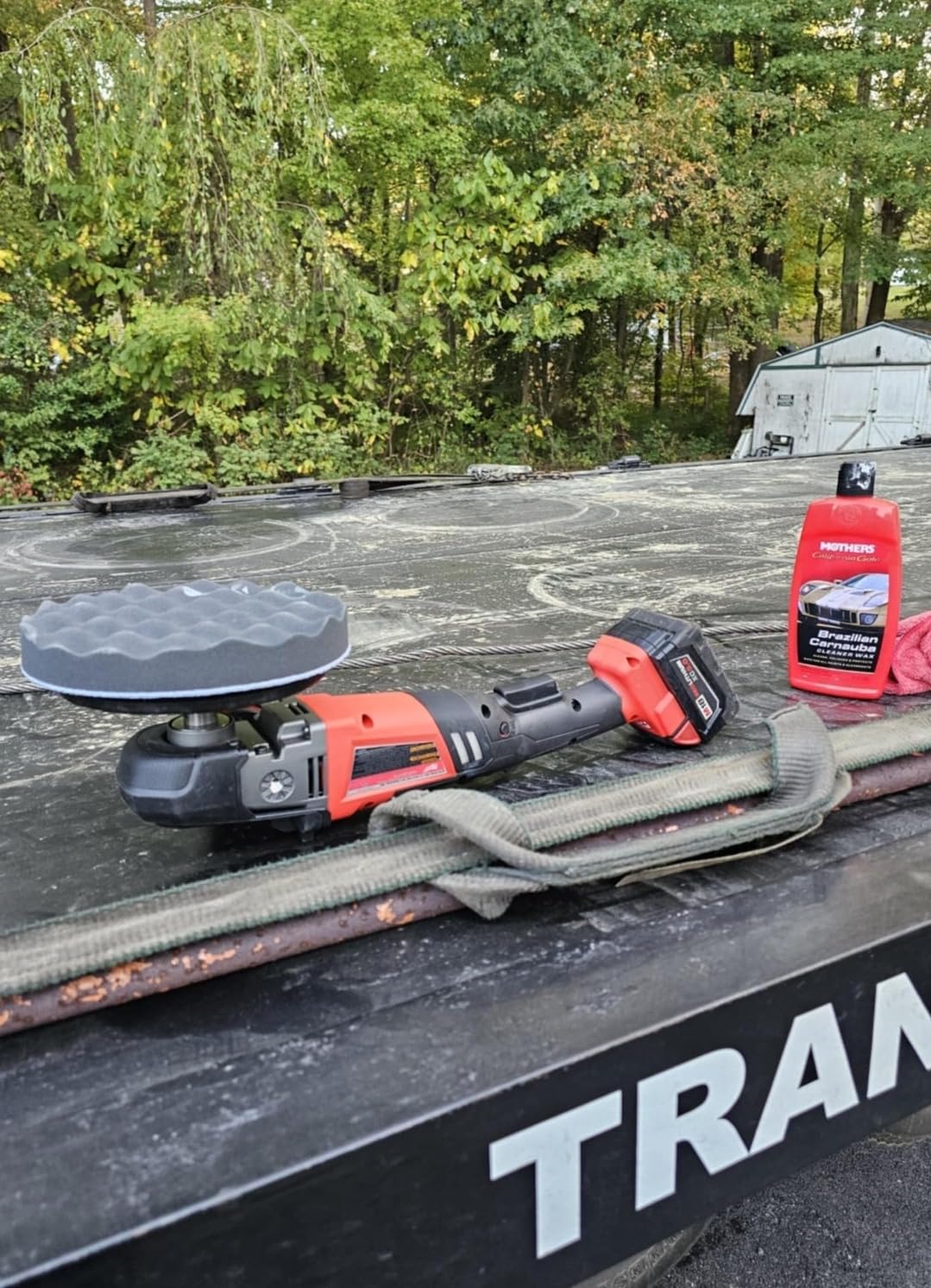
Two things separate this from the DEWALT. The first is weight: at 7.5 lb this is the heaviest machine in the group, and on a roof or a long panel that adds up across a full afternoon. The second is that the speed control is on the machine rather than split between a trigger and a dial, which some users prefer and others find less precise.
Owners rate it at 4.6 from 1641 reviews, calling out the power and runtime that match corded polishers, and the recurring trade-off is the same every time: weight, and the fact that no battery or charger is in the box. Do not expect a complete kit.
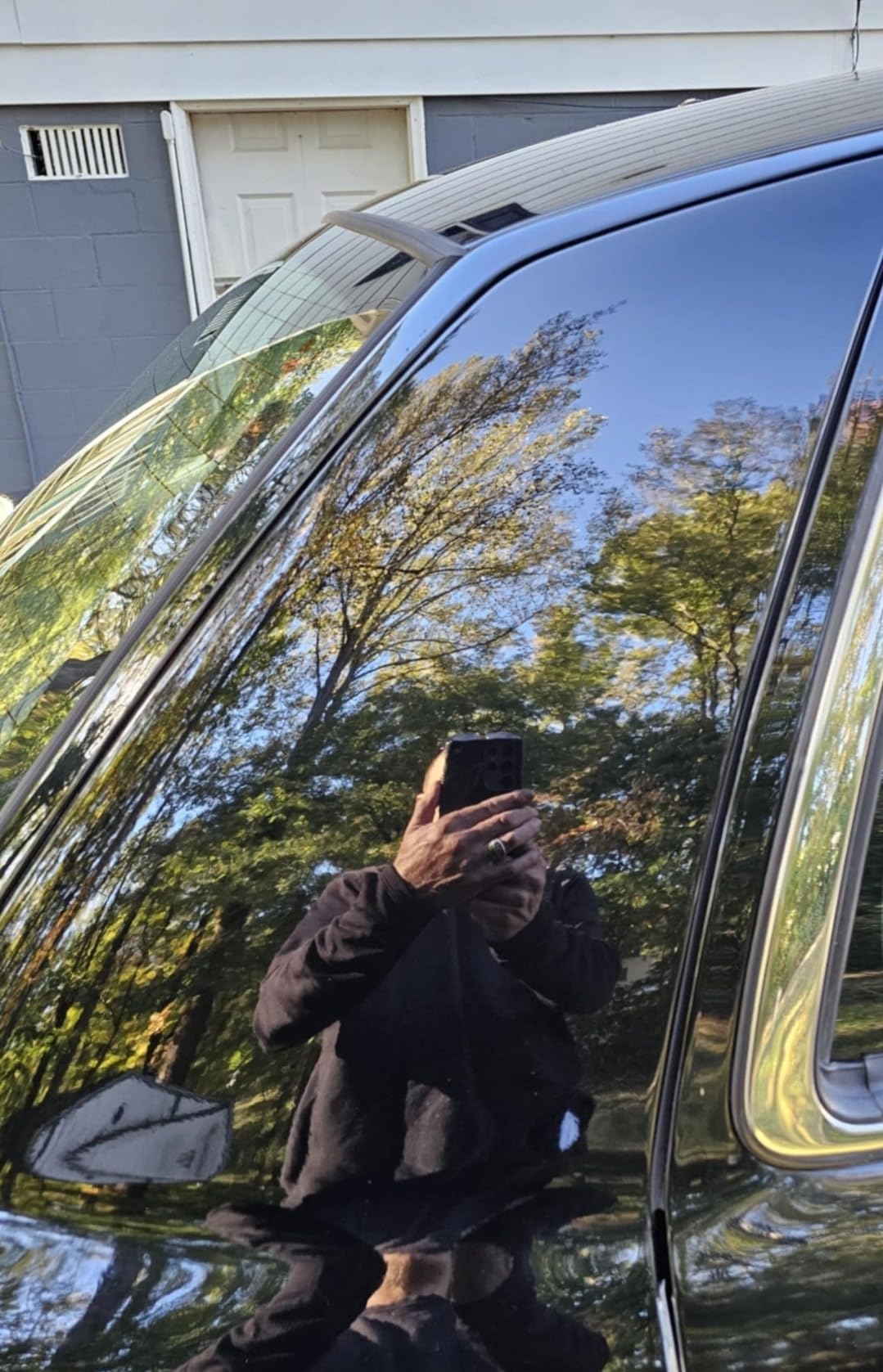
Who this is genuinely for
This suits detailers and mobile work where the car is not parked next to an outlet, and anyone who wants the confidence of a professional-grade brushless machine without running a cord behind the vehicle. The 18V voltage class also gives you more headroom on a loaded pad than any 12V machine here.
It is less ideal for a single-car owner on a budget, because both the tool and the battery outlay are higher than the alternatives, and the weight adds fatigue on a first attempt. The M18 XC5.0 packs are the ones worth pairing with it if you already have smaller capacity ones.
Where the money goes beyond the tool
Like the DEWALT, this is a tool-only machine. The polisher head is what you receive. A high-capacity M18 battery, a charger, a 7-inch backing plate pad, a cutting pad and a finishing pad are all additional purchases before the tool touches paint.
That is the honest version of the conversation, and it is where plenty of first-time buyers get surprised. Budget for the ecosystem, not just the machine, and the M18 platform is the reason this one still sits near the top.
3. Protmex 21V Cordless Buffer Polisher with Two Batteries
Protmex Cordless Car Buffer Polisher w/ 2x2000mAh 21V Batteries, Orange
Pure copper motor
6 speeds 2800-5500 RPM
Two 21V 2000mAh packs
3.3 lb
2 year warranty
+ The Good
- Lightweight 3.3 lb cordless design avoids dragging a cord around the vehicle
- Two 21V 2000mAh batteries allow continuous work with a charged spare
- Six speed settings from 2800 to 5500 rpm
- Wide pad kit includes sponges wool discs and sandpapers
- The Bad
- Pure copper motor and temperature control mean sustained high-speed work is limited
- Eccentric motion suits wax spreading more than heavy paint correction
With 3088 owner reviews and a 4.3-star average, the Protmex is the most reviewed machine in this guide, and that volume is exactly why it is worth taking seriously as a value pick. The 21V dual-battery format is unusual at this level, and the 3.3 lb weight is the lightest among the full-size machines here.
Owners rate it highly for value, portability and the dual-battery convenience, with 68% five-star and 16% four-star. The six speed settings from 2800 to 5500 RPM cover waxing on the low end and defect work on the high end, and the wide pad kit covers vehicles, furniture, ceramic, wood and metal.
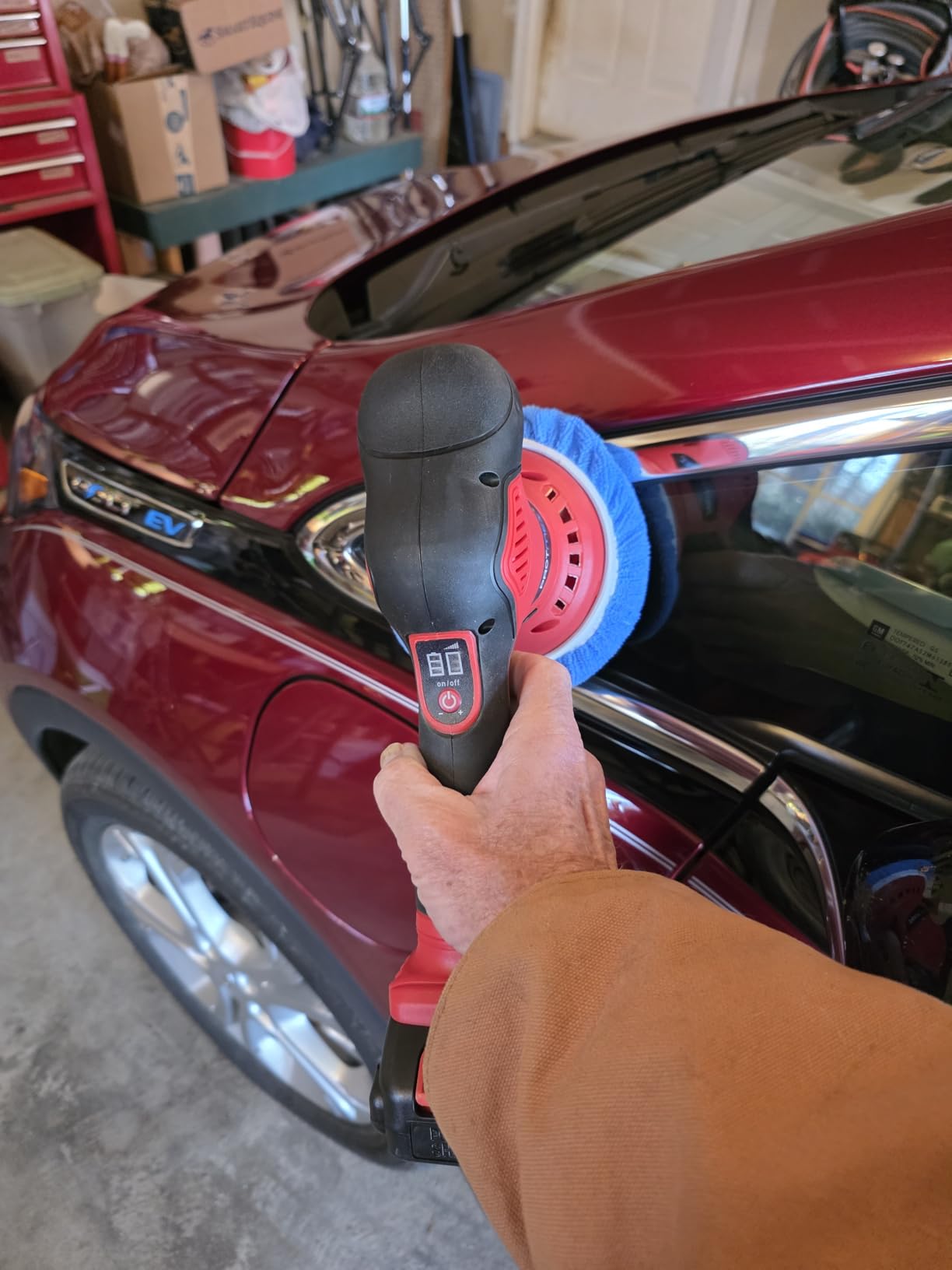
The upgraded pure copper motor has temperature control protection built in, and that is both a strength and a limit. It keeps the machine from cooking itself on a long job, but it also means sustained high-speed work is not what this tool is built for. Think of it as a fast waxer and light swirl remover rather than a correction machine.
The 2-year manufacturer warranty is longer than most of the budget competition offers, which is a genuine plus. The 21V 2000mAh packs are proprietary, so you cannot borrow them from a DEWALT or Milwaukee charger setup, and third-party replacements are not always a match.
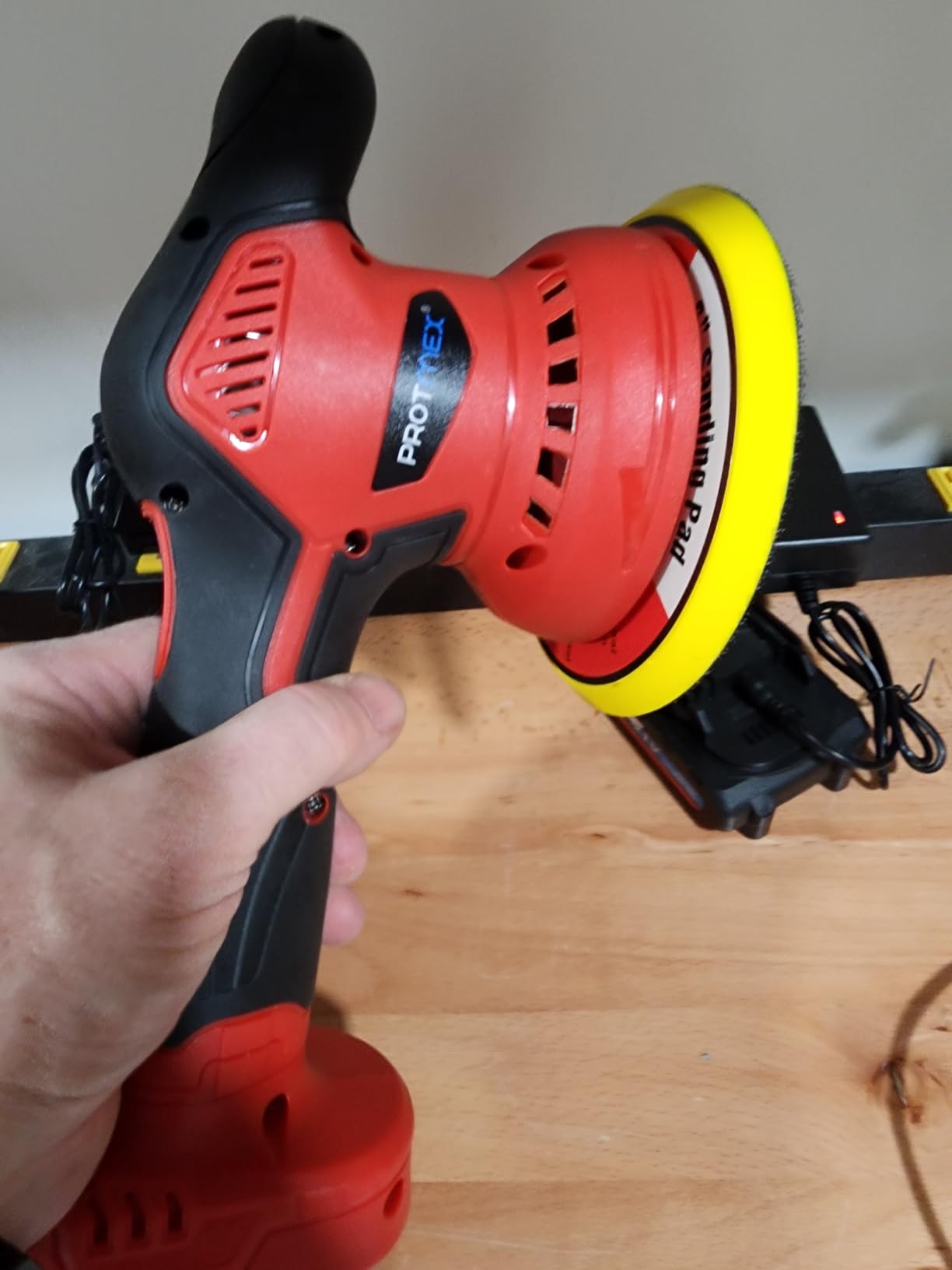
Best fit for first-time owners learning the craft
This is a sensible machine to learn on. At 3.3 lb with two batteries and a full pad kit in the box, you can work a full panel, swap the pack, and clean up without tracking down a charger. Nothing about the format will punish a first-timer the way a rotary will.
The tradeoff is that the eccentric motion is optimized for spreading wax evenly rather than for biting into clear coat. If your goal is genuine one-step correction, look at the DEWALT or the Milwaukee instead. If your goal is regular maintenance and a clean finish on a daily driver, this does the job.
What the pad kit does and does not include
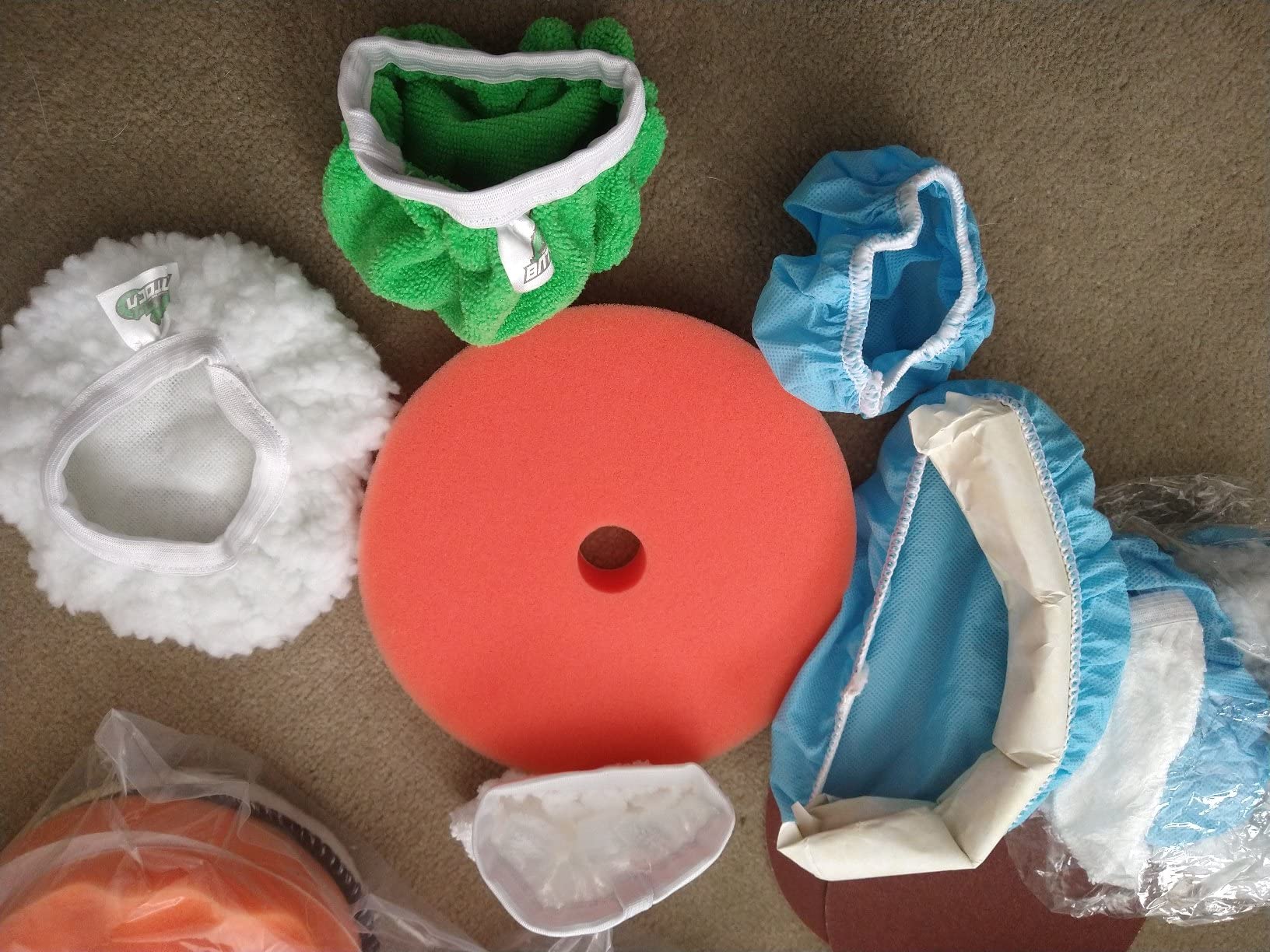
Included are sponges, wave sponges, wool discs and sandpapers. That is a broad kit, but the sandpapers are not for paint correction on a clear-coated car, and the wool discs are aggressive on modern two-stage paint if you use them above mid speed.
Purchase a proper cutting pad and a soft finishing pad separately for real correction work. The included kit is generous enough for the waxing and light-cleaning use the tool is really aimed at.
4. BATOCA S3 12V Dual Action Polisher
BATOCA S3 Cordless Car Polishers and Buffers, DA Orbital Polishing Machine
5mm random orbit
6 speeds 2500-5000 RPM
2x 2.0Ah batteries
2.4 lb
ABS shell
+ The Good
- Very light at 2.4 lb and easy to carry and store
- Two 2.0Ah batteries with fast charger let you charge one while using the other
- Six speed levels suit waxes sealants and glazes
- Hi-impact ABS shell with all-copper motor runs quietly
- 5mm random orbit gives an even finish on painted surfaces
- The Bad
- Mini-format machine is aimed more at wax and glaze work than heavy correction
- 12V battery pack limits runtime on larger vehicles
The BATOCA S3 is the easiest machine here to hold, at 2.4 lb, and owners reward it for exactly that. The 4.4-star average across 2089 reviews comes with 70% five-star, and the praise centres on portability, quiet operation and the dual-battery setup.
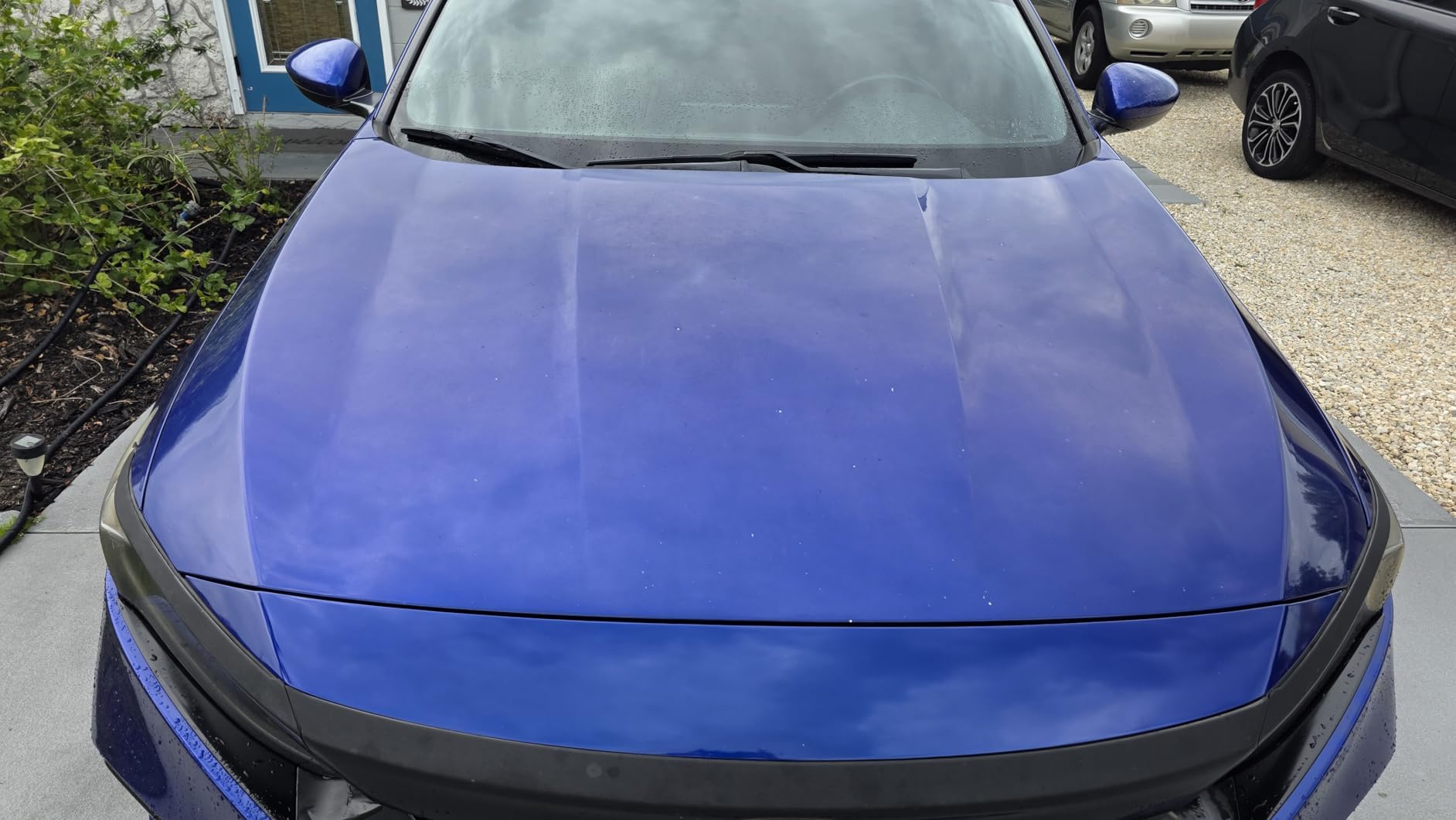
Its 5mm random orbit is the key spec. That is a small throw, which means the pad is buffing and spreading rather than cutting, and the result is an even finish on all painted surfaces without much risk. For someone applying sealant, ceramic coating or a glaze, that is the correct machine.
The compact body measures 6 by 9.5 by 5.3 inches, which means it lives in a cabinet and does not need a shelf. Two 2.0Ah batteries and a fast charger mean you can work while the second pack charges, and the all-copper motor inside the hi-impact ABS shell runs quietly enough for a residential driveway.
Where it falls short is the 12V pack on a larger vehicle. Twenty minutes of work per battery is realistic, so a sedan means several swap cycles. And no amount of speed selection turns a 5mm throw into a correction tool.
Why the orbit size matters more than the speed dial
A 5mm orbit moves the pad in a very tight circle. The pad spends most of its time in place rather than sweeping across the panel, which is ideal for distributing product evenly and terrible for removing anything embedded in the clear coat. Users who bought it hoping to cut swirls tend to return it.
Buyers who bought it to maintain a finish, spread wax and polish small panels with a light hand tend to keep it and rate it highly. Know which of those two people you are before you buy.
What it can and cannot do on a daily driver
It handles sealant and ceramic coating application, glaze and wax, light dusting with a soft pad, and small panels such as roof sections and door skins. It is genuinely pleasant to work with because of the weight and the low noise.
It will not remove scratches that catch a fingernail, and it will not cut through meaningful swirl marks. For that you need a longer throw. Treat this as the maintenance tool that pairs with a correction machine, or as a standalone first purchase if your paint is already in good shape.
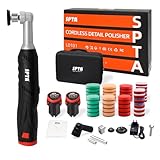
5. SPTA 12V Mini Cordless Polisher
SPTA Cordless Mini Car Polisher, 12V Micro Cordless Scratches Killer Car Polisher RO/DA Mini Car Polisher for polishing, Sanding and Cleaning
1 inch backing plate
1000-5000 OPM
Switchable rotary head
80W battery
Up to 1 hour
+ The Good
- Over 50% lighter than a standard polisher for tight areas
- 1 inch backing plate reaches emblems body lines and hard-to-access spots
- Switchable dual action and rotary heads at 1000-5000 OPM
- Cordless freedom with up to an hour of runtime per battery
- The Bad
- Mini format is not suited to large panel correction
- No pad or accessory detail is broken out in the listing
The SPTA fills a gap that none of the bigger machines can. Its 1-inch backing plate is for emblems, body lines, panel gaps and the tight spaces around headlights and badges, and owners rate it 4.5 from 1377 reviews with 77% five-star. The go-to use is spot correction and detail finishing, not whole panels.
It runs a free-spinning dual action head at a variable 1000 to 5000 OPM, and the shaft switches to a rotary configuration when you want to concentrate the action on a specific defect. That switchable dual-mode design is unusual at this size and is the main reason to pick it over a plain mini polisher.
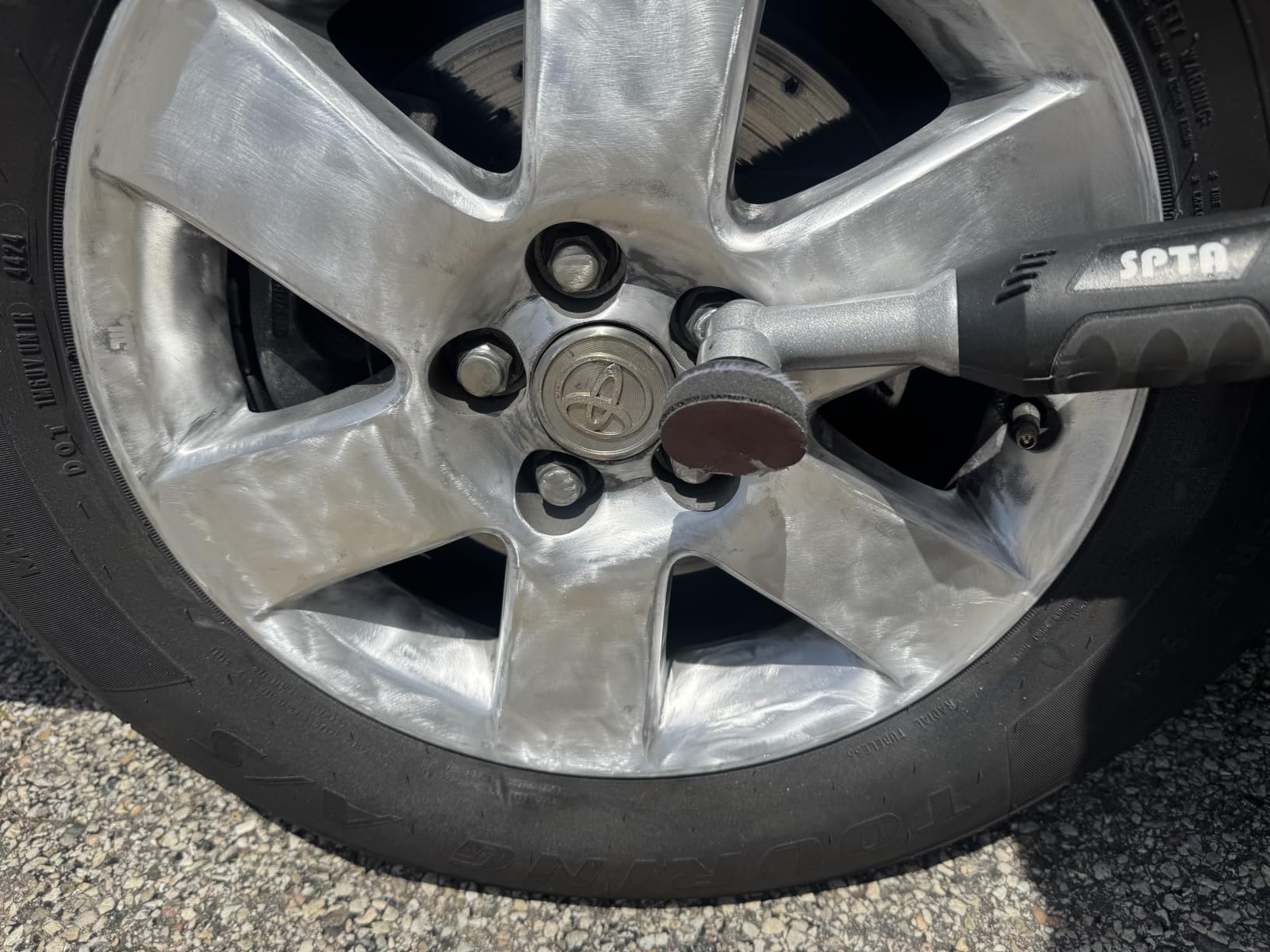
The 80W battery is rated for up to an hour of working time at maximum speed, which is a genuinely useful figure for a machine this small, because the load on the motor is so low. Nothing about a 1-inch pad generates the heat and draw of a 6-inch correction pass.
Reviews do point out that the listing breaks out very little detail on included pads and accessories, so treat the accessory situation as unknown and plan to buy your own foam, wool and microfiber layers. The core machine is the part worth judging.
Where a 1-inch polisher earns its place
Reach for it on a 3-inch polish around a badge, a mirror, a roof edge, a door jamb and the pinch weld under a hood. It also handles spot-swirl work on a dark panel where a big machine would struggle to keep the pad flat. Detailers regularly keep a mini exactly for these jobs.
The sub-5-inch and 2-inch cordless category is genuinely underserved, and this is the clearest example in the guide. If your car’s problem areas are small and awkward, this solves them faster and safer than trying to feather a 6-inch pad into a corner.
Where it will disappoint you
It will not correct a door. A 1-inch plate at 5000 OPM covers a tiny fraction of the surface a 6-inch machine covers in the same second, and working a full car on it turns a three-hour job into an entire weekend.
It is also a 12V machine, so the runtime advantage only applies at low loads. If you pair it with a cutting compound and a wool pad, expect far less than an hour. Buy it as a companion tool, not as your only polisher.
6. Avhrit 6 Inch Cordless Buffer Polisher Kit
Avhrit 6 Inch Cordless Car Buffer Polisher kit w/ 2x2000mAh 21V Batteries
300W copper motor
8mm random orbit
6 speeds 2500-6000 RPM
Two 21V 2000mAh packs
4 lb
+ The Good
- Two 21V 2.0Ah batteries let you swap packs without waiting on the charger
- Lightweight 3 lb body with an ergonomic wide handle
- 6 speed settings from 2500 to 6000 RPM
- 8mm random orbit produces a swirl-free finish
- Full pad kit with hook and loop backing plate
- The Bad
- Included pads are unlabeled for firmness and the foam can shed after use
- Very strong velcro makes pads hard to remove and prone to separating
- Some buyers report batteries that will not recharge
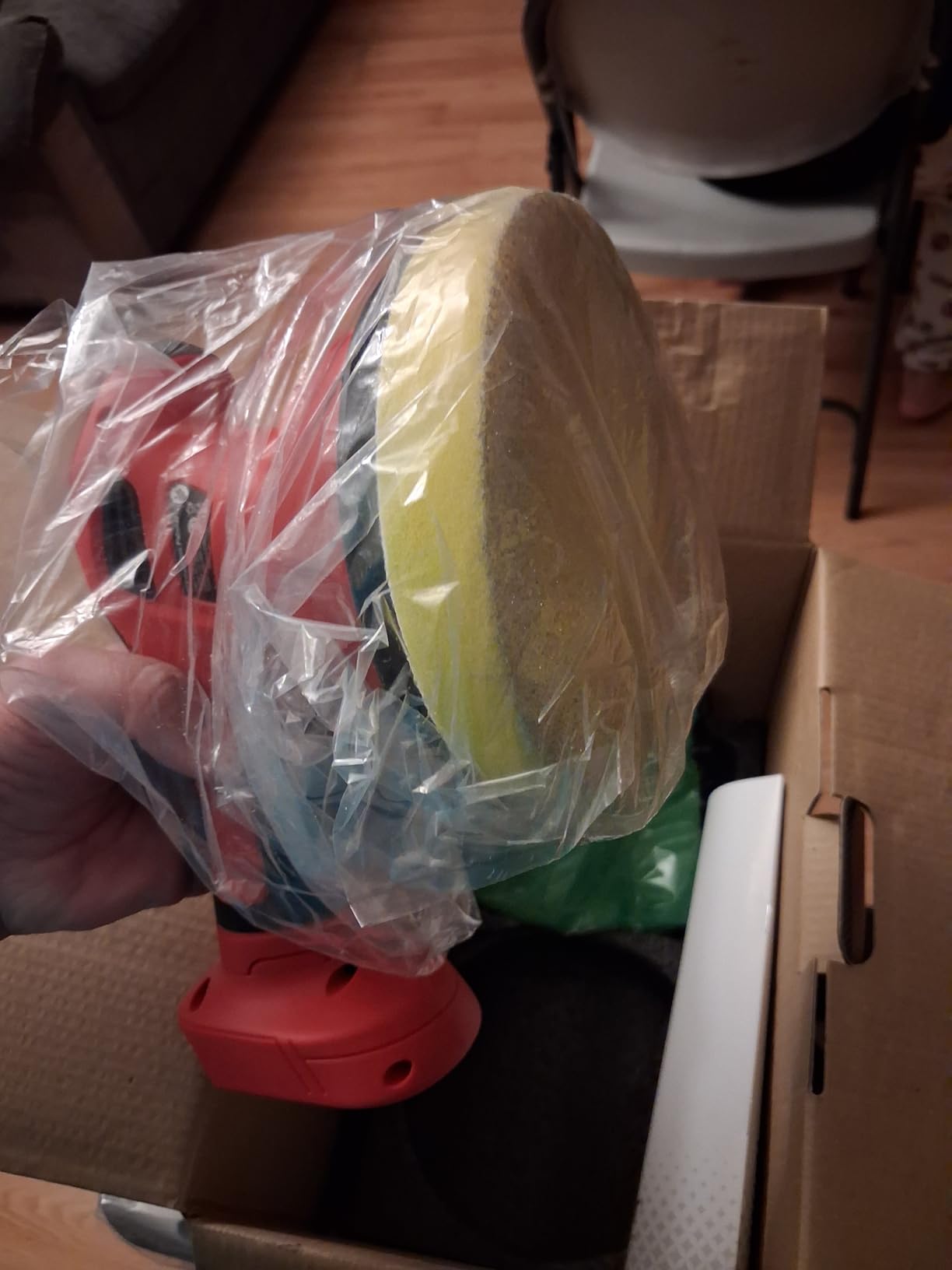
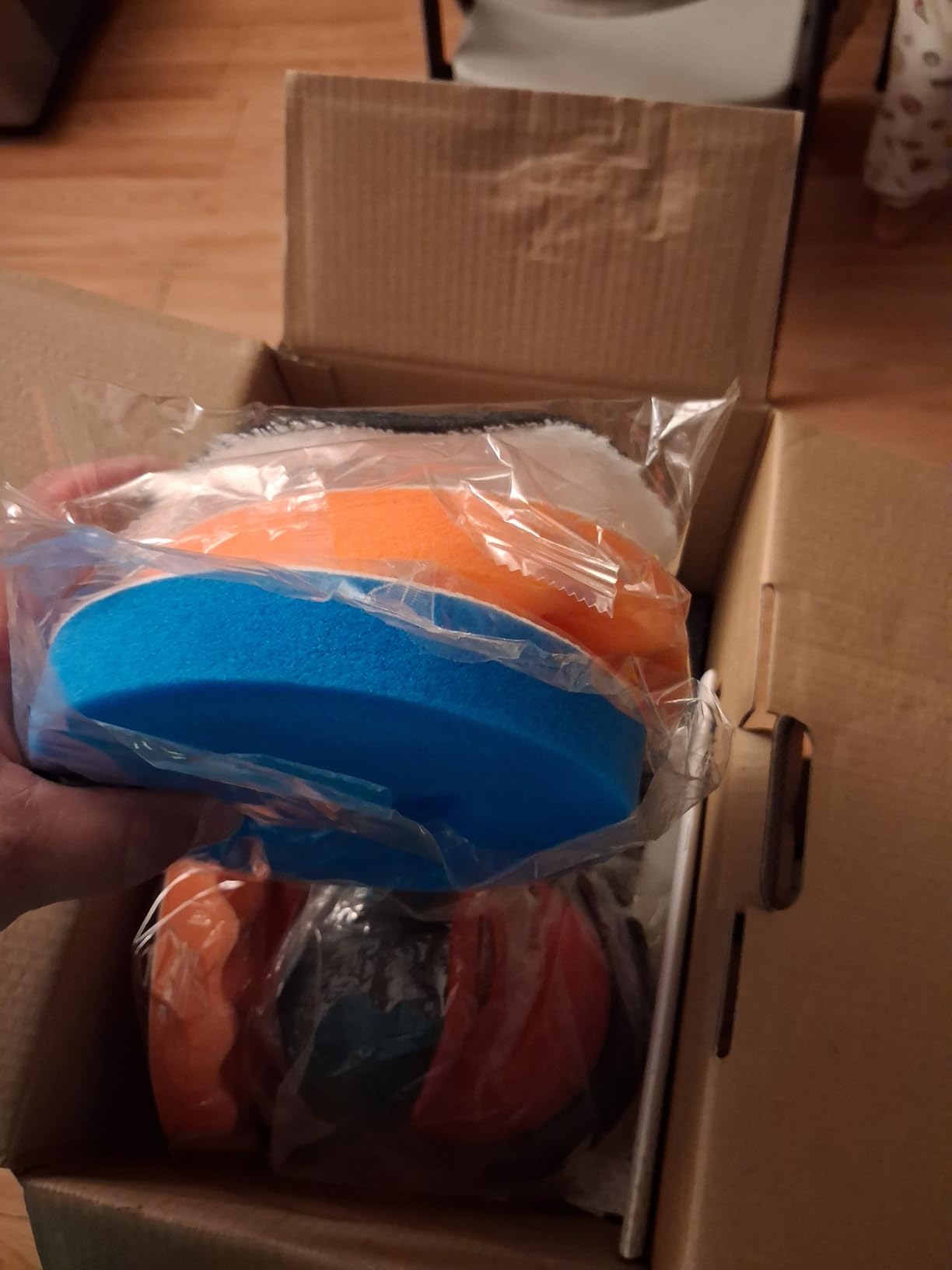
The Avhrit kit is the most complete package on this list for the least outlay: polisher, charger, two 21V 2.0Ah batteries, two foam pads, two waffle pro foam pads, a knitted wool pad and a towel. Owners rate it 4.2 from 1172 reviews, with 67% five-star, and one reports polishing and waxing a crew cab truck on one battery each.
The 300W copper motor is described as high-efficiency with anti-interference and lower noise, and the 8mm random orbit is the largest in the budget group. That gives better coverage than the 5mm BATOCA S3 while staying far safer than a rotary, and the 6-inch hook and loop plate changes pads quickly.
The 6-speed range from 2500 to 6000 RPM is generous for the money, and the widened ergonomic handle keeps the 3 lb body comfortable over a long session. It also works on boats, furniture, wood, leather and tiles, which broadens its usefulness well beyond a car.
Now the honest part. Reviewers report batteries that will not recharge and replacement packs that do not fit, hook and loop so aggressive that pads separate from the plate, and foam that sheds after use. Battery output also drops noticeably before the pack reads empty, so do not trust the indicator as a runtime gauge.
Is a kit like this safe to learn on?
Yes, and this is a well-trodden first step. Detailers frequently recommend a low-cost machine with a bottle of polish as a way to learn the motions on a panel before committing to a real machine. At 4 lb with a random orbit and no forced rotation, the failure mode is a hazy finish rather than a burned panel.
The 8mm orbit does not cut hard clear coat, so the ceiling on what you can damage is low. Buy a separate soft finishing pad and a gentle polish before your first pass, keep the speed at the low half, and move constantly.
What to buy beyond the kit
The included foam pads are not labelled for firmness, so you do not know which is a cutting pad and which is a finishing pad. Buy a proper cutting pad and a soft finishing pad separately, plus your own compound, so the pad choice is a decision rather than a guess.
The battery concern is the bigger issue. If a pack fails to recharge, the proprietary 21V format limits your options. Check the battery support on the listing before you commit, and keep your expectations at the maintenance level this motor can deliver.
7. Niusken 21V Dual Action Polisher Kit
Niusken Cordless Car Buffer Polisher kit, DA Polisher with 2*21V Batteries
8mm dual action
6 speeds 2800-5800 RPM
LED speed and battery display
3.3 lb
5 inch plate
+ The Good
- LED display shows current speed and remaining battery in real time
- Two 21V 2000mAh batteries and fast charger cover a full sedan or SUV
- 8mm dual action motion spreads wax evenly with low noise
- Only 3.3 lb with an ergonomic grip
- Large accessory kit covers cars boats furniture metal wood and marble
- The Bad
- Proprietary battery system is not compatible with DEWALT or third-party packs
- Overheat protection shuts the unit down after roughly 20 minutes at high speed
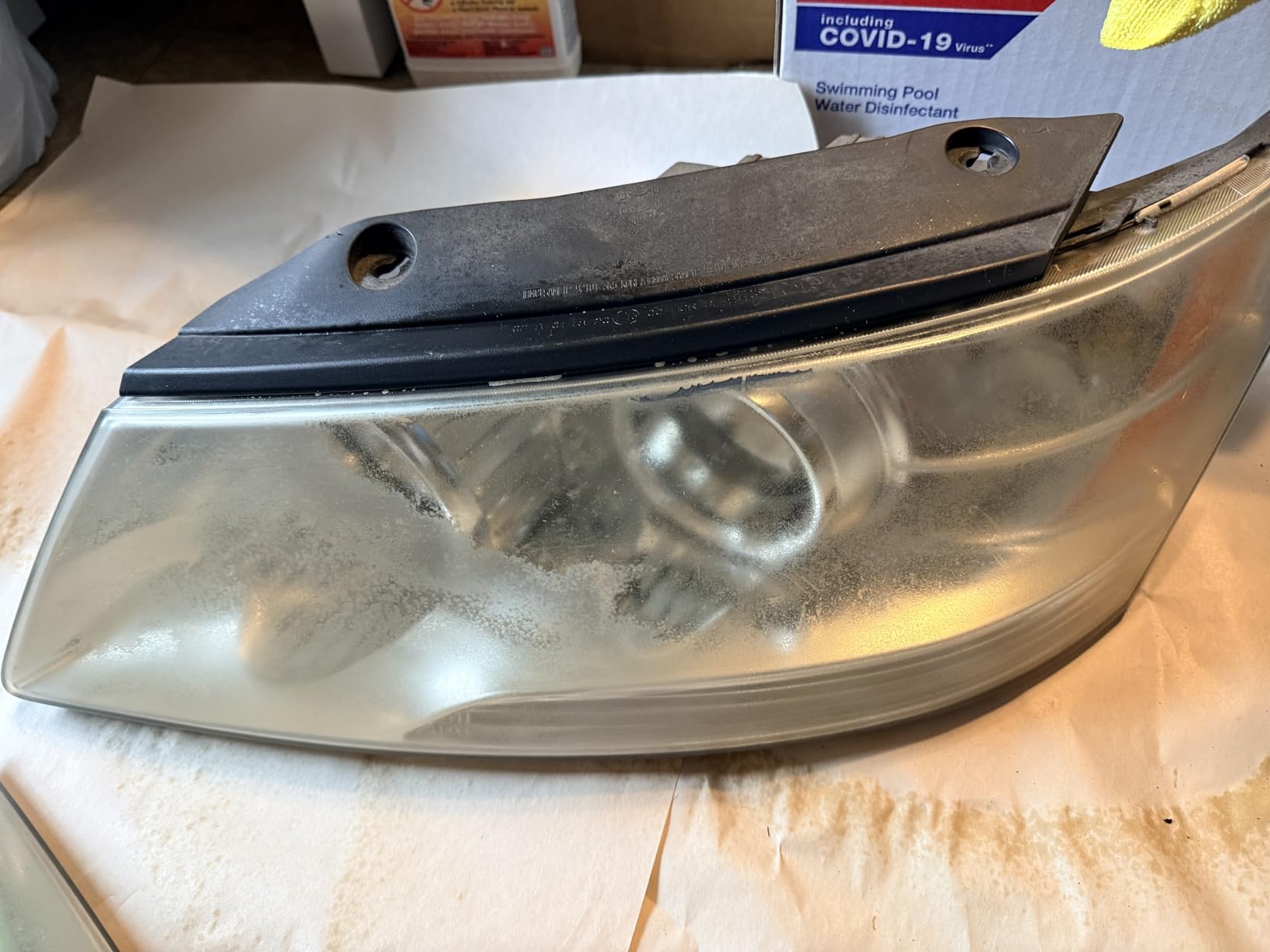
The Niusken is the rare budget machine with a real instrumentation feature: an LED screen that shows live speed and remaining battery. Owners rate it 4.4 from 922 reviews with 70% five-star, and that readout is the thing reviewers mention first.
It ranks at number one in the Amazon Body Repair Grinders and Polishers category, which tells you how much of it is being sold right now. The pure copper brushed motor runs 6 speeds from 2800 to 5800 RPM, and the 8mm dual action motion spreads wax evenly with low noise and good heat control.
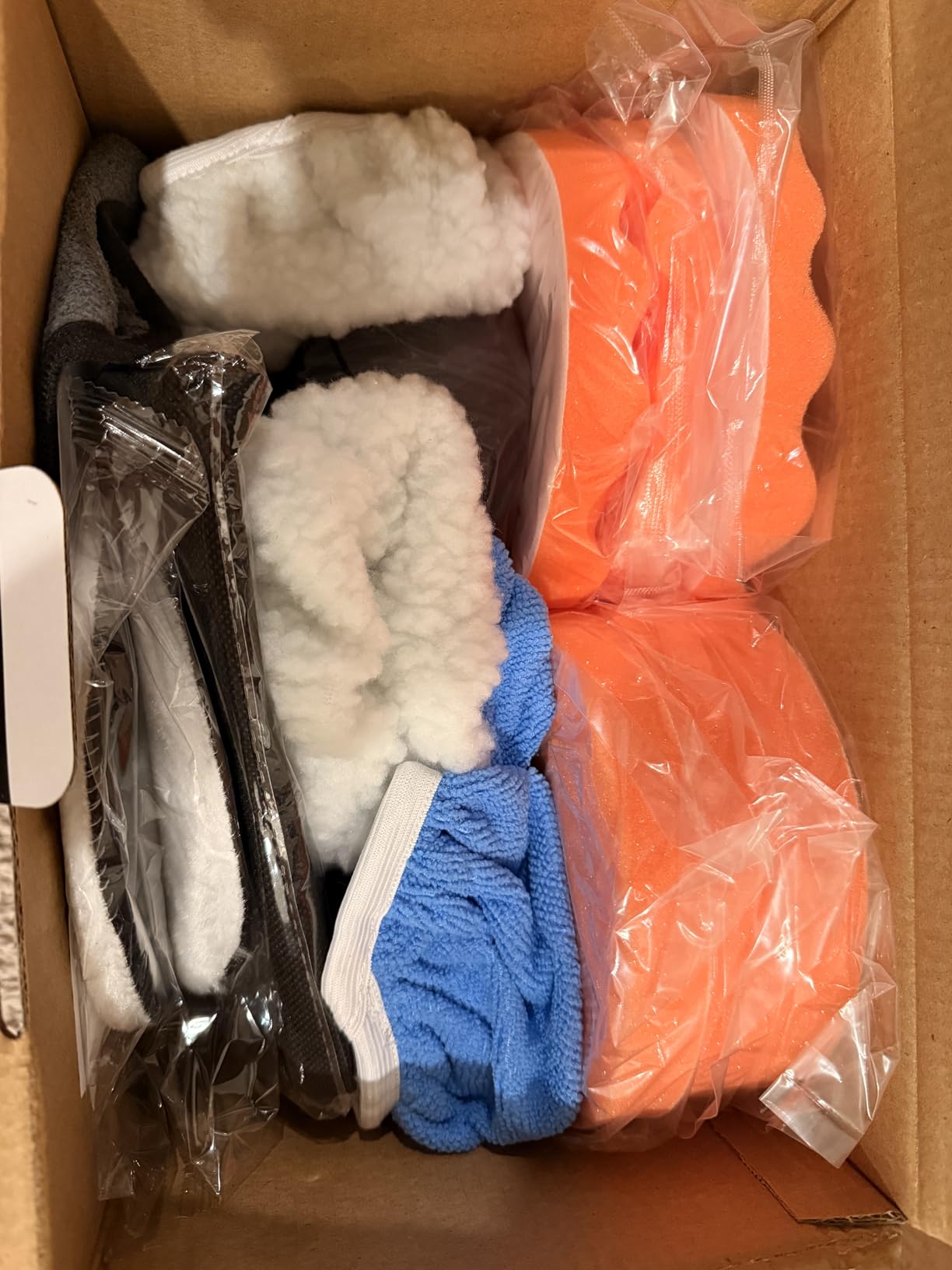
Two 21V 2000mAh batteries and a fast charger are enough to cover a full sedan or SUV in one session according to buyers, and the accessory bundle is genuinely large: sponge pads, wave sponges, wool pads, microfiber bonnets, non-woven bonnets and sanding discs.
Two caveats matter. The battery system is proprietary and will not work with DEWALT or most third-party packs, so this is a closed ecosystem. And the overheat protection cuts the unit down after roughly 20 minutes at high speed, which is a real limit on a long correction session.
Why the LED display changes how you work
Knowing the exact speed and the state of the pack turns a guess into a decision. You can drop one gear when the compound starts to dry out instead of pressing harder, which is one of the main ways beginners haze soft paint. You also know when to swap packs before the tool bogs down mid-panel.
That is a genuine advantage over the trigger-only machines in this group, and it is why reviewers keep returning to it. If you are learning the craft, having visible feedback is worth a lot.
What the 20-minute cutoff means for a full car
It is not a defect, it is a thermal cutoff doing its job, but you need to plan around it. Work in 15-minute sections, drop to a lower speed, or rest the tool between panels, and you will get through a car comfortably. Sitting at maximum speed for 20 minutes straight will stop it.
If you already own DEWALT 20V packs, this is the wrong machine and the VERVEWAVE later in this guide is the right one. Buying a second proprietary battery ecosystem to own a polisher rarely pays off.
8. BATOCA S5 Rotary and Dual Action Mini Polisher
BATOCA S5 Cordless Mini Car Polisher Buffer Sander Rotary & Dual Action
2-in-1 rotary and 12mm orbit
5 second shaft change
1 inch and 3 inch plates
926 g
12V
+ The Good
- 2-in-1 design switches between rotary and 12mm random orbital in about 5 seconds
- 1 inch and 3 inch backing plates reach emblems wheels headlights and trunk areas
- Two 12V 2.0Ah batteries swap with BATOCA S3 and S6 packs
- 6 speeds from 2000 to 5500 rpm
- Large accessory package with pads sandpaper gloves apron towel and tool bag
- The Bad
- Audible at 80.6 dB(A) which is louder than some users expect
- The eccentric head produces noticeably more vibration than the rotary setting
- Only the 1 inch backing plate fits the straight shaft
The S5 is the only machine here that converts between two genuinely different machines. Swap the straight shaft for the eccentric shaft and you have a rotary for defect work; swap back and you have a 12mm random orbital for finishing. The change takes about five seconds and needs no tools.
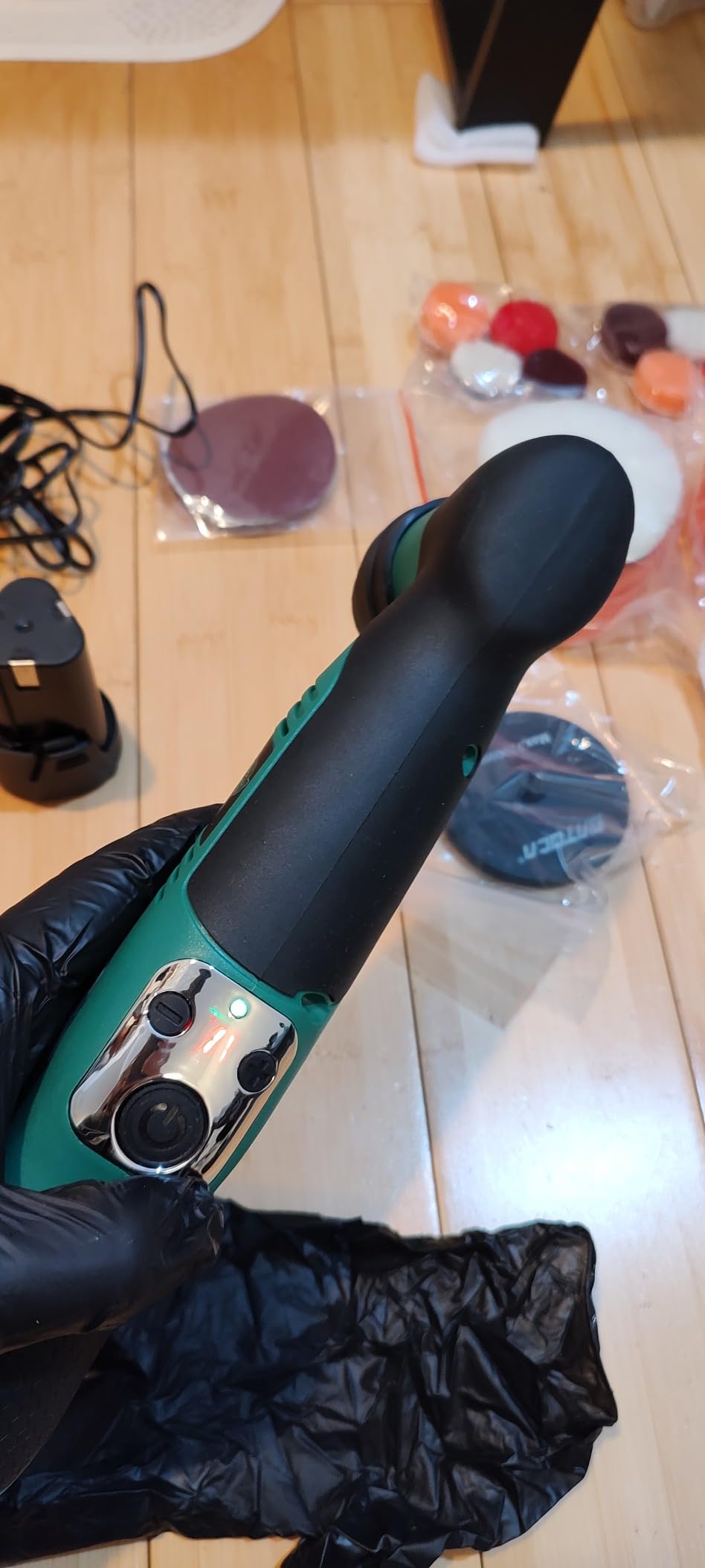
Owners rate it 4.4 from 564 reviews with 73% five-star, and the quick shaft swap is what they highlight. You also get 1-inch and 3-inch backing plates, so it reaches emblems, wheels, headlights and trunk areas that a full-size machine overshoots.
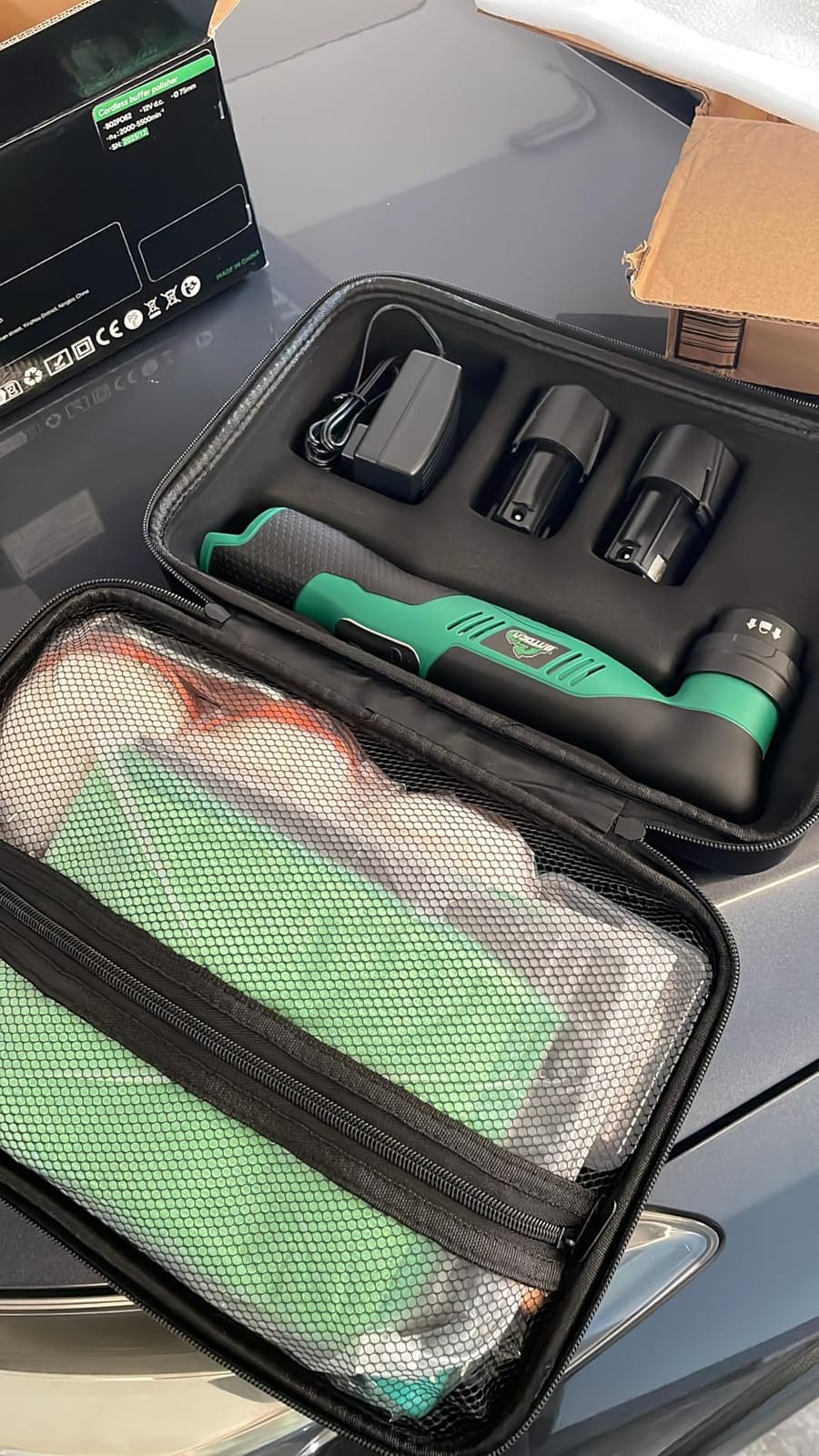
At 926 grams it is the lightest machine in this guide, and the two 12V 2.0Ah batteries give roughly 20 to 30 minutes each. Those packs are interchangeable with the BATOCA S3 and S6, so if you own the S3 from earlier in this list, you already have compatible power.
Manufacturer figures put sound pressure at 80.6 dB(A) and vibration at 10.976 m per second squared. Reviewers confirm the eccentric head is noticeably more aggressive than the rotary setting, which is exactly what a 12mm throw is supposed to feel like.
When the 2-in-1 switch earns its keep
On a specific defect, you switch to rotary and concentrate the action on a small area with a cutting pad. On a panel finish, you switch to the 12mm orbital and run a soft pad and finer polish across the whole surface. That is a proper correction-then-refinement workflow in a 926 g tool.
It is also the machine for detailers who work two cars and do not want to carry a 5-inch polisher into a garage. The accessory package includes pads, sandpaper, gloves, an apron, a towel and a tool bag, so it is a genuinely complete kit.
What the noise and vibration tell you
At 80.6 dB(A) this is not a quiet machine, and owners who expected a whisper are disappointed. In a residential driveway at night that matters. Vibration on the eccentric head is the price of a 12mm orbit, and it is transmitted into your wrist over a long session.
One practical limitation catches people out: only the 1-inch backing plate fits the straight rotary shaft, so the 3-inch plate is orbital-only. Plan your pad choices around that when you swap heads.
9. VERVEWAVE Orbital Polisher for DEWALT 20V Batteries
VERVEWAVE Cordless Buffer Polisher Kit for Dewalt 20V Battery (No Battery), 6-Inch Orbital Car Polisher Variable Speed 1800—5500 RPM, 17PCS Polishing Accessories, for Car Polishing/Waxing (Tool Only)
DC brushless motor
6 speeds 1800-5500 RPM
Runs on DEWALT 20V MAX
Lock switch
2.4 kg
+ The Good
- Brushless motor gives strong steady power and does not drain DEWALT packs quickly
- Lock switch prevents surprise restarts when a pack is exhausted
- Well balanced and light enough to reach a roof without fatigue
- Variable speed works consistently across all six settings
- Good value for a cordless DA polisher in this class
- The Bad
- Tool only so a battery and charger must be sourced separately
- Not built for heavy daily commercial use with repeat failures reported
- Included foam pad backing separates from the foam after washing
This is the sleeper pick for DEWALT owners. It runs on DEWALT 20V MAX packs from the DCB200 through the DCB240 range, and it is sold as a tool with a 17-piece accessory kit of sandpapers, foam, wool and waxing pads. No second battery ecosystem, no proprietary charger.
At 4.6 stars from 469 reviews with 80% five-star, the rating is the joint-highest in this guide despite being one of the cheaper machines. Reviewers call out the power, the balance, the lock switch and the consistency of the variable speed across all six settings.
The upgraded DC brushless motor delivers more power with less noise and a longer motor life than a brushed equivalent, and reviewers specifically note that it does not drain DEWALT packs quickly. The lock switch is a genuinely thoughtful feature, because a polisher that restarts by itself when a pack empties is a paint risk.
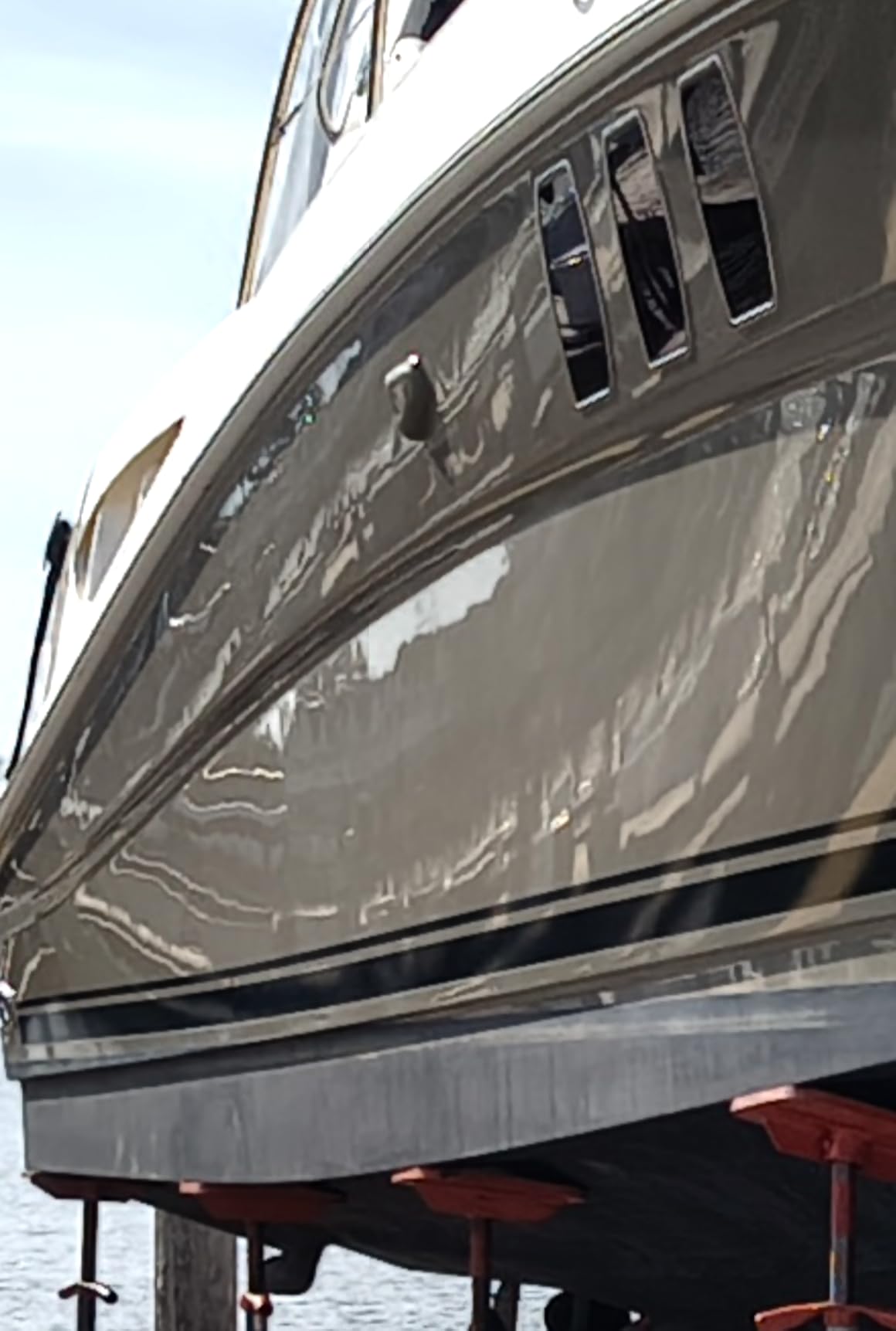
At 2.4 kg it is well balanced enough to reach a roof or the hull of a boat without fatigue. The eccentric random orbital design is intended to produce an even polish without the over-polishing haze that cheap fixed-orbit machines leave behind.
Why the lock switch matters more than it sounds
Polishing with a depleted battery is how people burn paint. The machine bogs, the speed drops, the user presses harder to compensate, and friction turns into heat. A lock switch that prevents surprise restarts and keeps the trigger honest is cheap insurance against exactly that.
The extended ergonomic handle with a soft rubber front is designed for the same reason. On a machine that runs at 1800 to 5500 RPM, grip quality determines whether you can keep pressure constant or start leaning.
Where it is not the right tool
It is not built for heavy daily commercial use. Reviewers report heavy vibration and repeat failures under that kind of load, and the results are described as mid-tier, meaning more passes than a high-end machine for the same finish.
Also expect the included foam pad backing to separate from the foam after washing, and remember no battery or charger is included. If you already own 20V MAX packs, this is a low-risk way to add a polisher to your kit. If you own none, the tool-only format means you are buying a battery ecosystem as well.
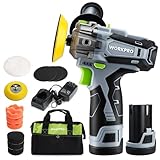
10. WORKPRO 12V Mini Polisher Kit
WORKPRO 12V Cordless Mini Polisher Kit, 3″ Buffer & Sander
3 inch pad
1.9 lb including battery
0-2800 and 0-7500 RPM
Two 2000mAh packs
Three grip positions
+ The Good
- Very light at 1.9 lb including the battery
- Two 2000mAh batteries each charge in an hour with an on-body status indicator
- Variable speed button plus trigger covers 0-2800 and 0-7500 RPM
- Three grip positions and spindle lock pad changes
- Works on cars floors gutters metal wood and tile
- The Bad
- Mini 3 inch format limits it to small areas and detail work
- Lowest average rating in the group at 4.2 with 8% one-star reviews
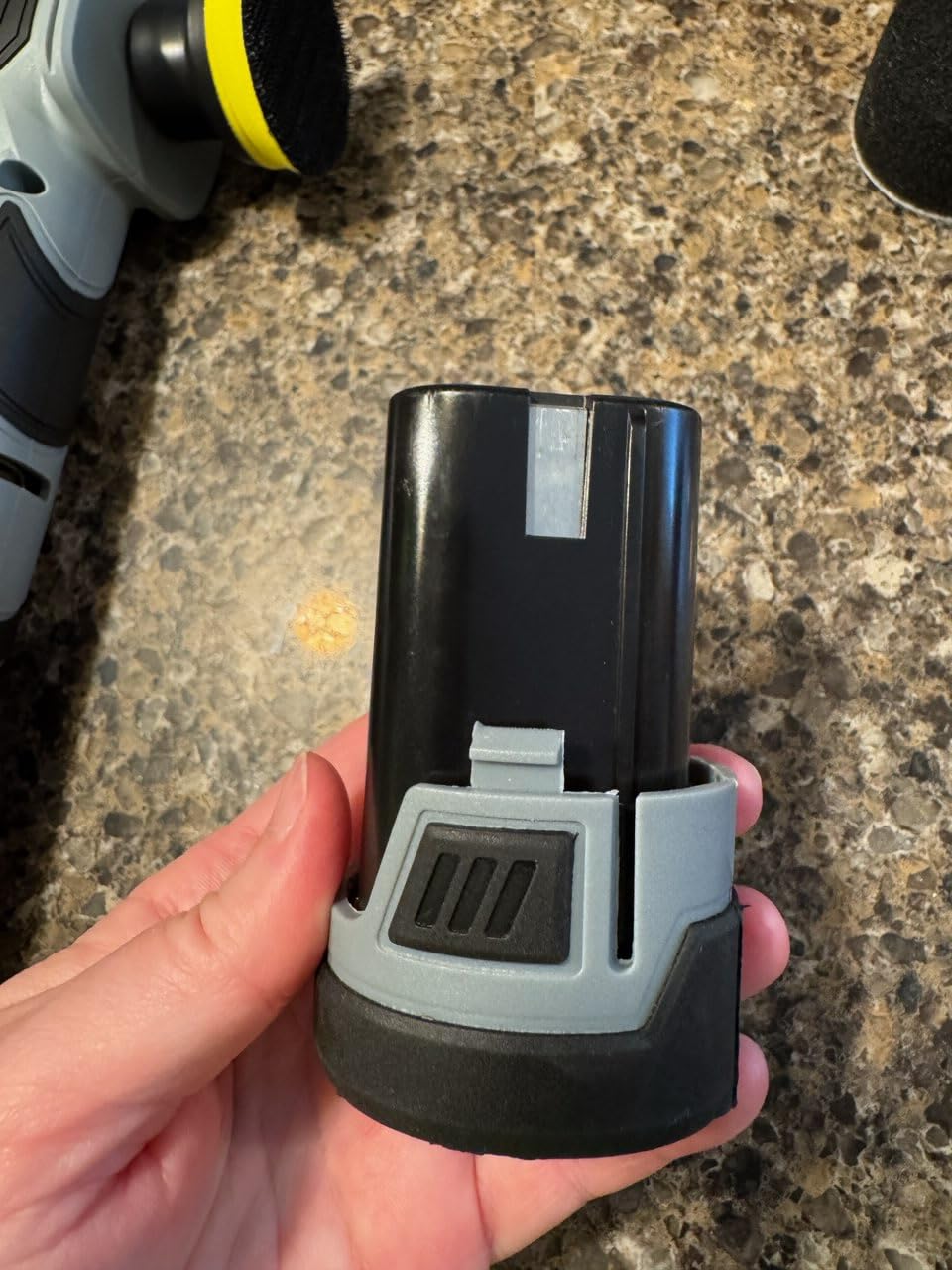
The WORKPRO is the lightest full kit here, at 1.9 lb including the battery, and the only one with a three-position handle and a spindle lock for quick backing pad changes. Owners rate it 4.2 from 414 reviews with 65% five-star, and the weight and dual batteries are what they praise.
Speed control is unusual for this class: a variable speed button plus trigger gives you 0 to 2800 and 0 to 7500 RPM ranges, so you can hold a low working speed and still reach high speed for a spot job. The two 2000mAh lithium-ion batteries each charge in an hour and an on-body indicator shows the state of the pack.
At 4.2 stars with 8% one-star reviews, this is the lowest average rating in the group, and that is worth weighing. Some of that comes from buyers who expected a full-size machine and received a 3-inch mini, which is a category misunderstanding rather than a defect.
The kit includes a side handle, backing pads, sandpapers, wool and sponge pads and a carrying bag. It also works on floors, gutters, metal, wood and tile, so it earns its place as a general household finishing tool even if it is not a car correction machine.
Where a 3-inch 12V polisher works well
Small panels, door jambs, badges, headlights, alloy wheel recesses and the edges of a painted bumper. At 1.9 lb you can hold it in one hand and work overhead without fatigue, which none of the larger machines here let you do comfortably.
It is also a good partner tool. Once you have corrected a car with a larger machine, this is what removes residue from crevices and puts sealant into tight areas a 6-inch pad cannot reach.
Where the 8% one-star reviews come from
Expectation mismatch, mostly. This is a 3-inch 12V machine, and it will not cut through swirl marks on a large panel no matter how you set the speed. Buyers who wanted a one-step correction tool are disappointed; buyers who wanted a light, cheap detail finisher are largely satisfied.
Check what you are actually buying. If your goal is removing swirls from a whole car, put the money into a longer-throw machine instead. If your goal is small-area finishing on a budget, this is a sensible pick.
How to Choose a Cordless Car Polisher
Orbital throw explained: 8mm, 12mm, 15mm and 21mm
Orbital throw is the diameter of the path the pad travels around the backing plate, and it is the single most important spec in this entire category. A small throw means the pad stays nearly in one place and buffs. A large throw means the pad sweeps across the panel and cuts. Every other feature is secondary to getting this one right for your paint.
Worth knowing: none of the ten machines in this roundup is a 15mm or 21mm unit. They are what you step up to when a random orbital of this class is no longer enough, which is precisely why the sizes are explained here.
Every product in the guide has a listed orbit or plate size you can verify: the BATOCA S3 at 5mm, the Avhrit and Niusken at 8mm, the BATOCA S5 at 12mm, the SPTA and WORKPRO as 1-inch and 3-inch plate machines, and the DEWALT and Milwaukee as 7-inch rotary units.
Before you pick a throw, decide whether you are correcting defects or spreading product. If you are applying sealant, ceramic coating or wax, a small throw is better, because it distributes product evenly without generating heat. If you are removing swirls, a cutting pad, a real compound and a longer throw are the only combination that works, and speed settings alone will not compensate for a short throw.
Once you have a machine, protect the finish afterwards. Our guide to the best car waxes for paint protection covers what to layer on top of corrected paint so you do not have to correct it again next month.
Rotary, random orbital or gear-driven forced rotation
A rotary polisher spins the pad in a single direction. The DEWALT DCM849B is the clearest example in this guide. It cuts the fastest and it generates heat the fastest, and it is the machine that has ruined more clear coat than any other category. It rewards technique and punishes impatience.
A random orbital, also called dual action, spins the pad while orbiting it around a small circle. The dual motion spreads compound automatically and makes the machine far more forgiving. Every other machine in this roundup falls into this group, which is why the guide is beginner-friendly by design.
A gear-driven forced-rotation machine sits between the two. It uses gears to keep the pad turning in one direction while the head still orbits, which professionals argue corrects faster with less heat than a pure random orbital. The trade-off is cost and weight, and a much steeper learning curve.
For a first machine, buy the random orbital. A forced-rotation polisher is a second or third machine, not a first one, and none of the ten here is in that class.
Battery platform is the real cost of ownership
The most useful question you can ask before buying anything on this list is not about the polisher. It is which battery packs already sit in your garage. The DEWALT DCM849B and Milwaukee 2738-20 ship without a battery. The Protmex, Avhrit, Niusken, BATOCA S3, BATOCA S5, SPTA and WORKPRO all include packs in the box.
That distinction is worth real money. If you already own 20V MAX or M18 packs, a tool-only listing is the cheapest possible entry. If you own nothing from either ecosystem, the tool-only version means buying a battery, a charger and then pads and compound before you begin. The VERVEWAVE exists specifically for people who own DEWALT 20V packs and do not want a second platform.
The proprietary 21V and 12V systems in the budget machines cannot be shared with anything else, so treat the included batteries as the whole power budget and check battery replacement support before you buy.
Battery pack capacity also sets your working rhythm. Small packs mean 20 to 30 minutes per charge on a large vehicle, which is why the dual-battery machines here feel more capable than their size suggests. Two packs and a fast charger mean you never wait.
Weight, balance and speed control
Weight is not a vanity spec. The machines here range from 1.9 lb for the WORKPRO to 7.5 lb for the Milwaukee, and the practical difference shows up on a roof, a long quarter panel or the hundredth pass. A heavy machine plus a leaning technique is how paint gets hot.
Speed control comes in two forms. A simple on-off or low-medium-high selector gives you very little to work with, while a variable speed trigger plus dial lets you hold a precise working speed and change it as the panel changes. For real correction work, the finer control is worth paying for.
Balance and grip matter as much as raw weight. The rubber overmolded gear case on the DEWALT and the extended rubber-front handle on the VERVEWAVE are both designed to keep pressure constant, and a consistent hand is the best protection against hazing.
Buffer or polisher: which one do you need
A polisher removes defects. A buffer, sometimes called a wax applicator, spreads and removes product. Many machines do both depending on the pad and compound you use, but the intent differs, and knowing which job you have determines the pad and compound you buy.
Polishing needs a firm cutting pad and a liquid compound with real abrasives, worked at moderate speed with a longer throw. Buffing needs a soft foam or wool pad and a wax or sealant, worked at low speed. Using a cutting pad and compound when you only wanted to spread wax wastes product and risks thinning the finish unnecessarily.
A one-step polish is a single liquid product that cuts and refines together, and it is the most beginner-friendly approach. On a machine with a shorter throw, it is also the most realistic, because it asks less of the machine than a cut-and-refine two-stage process.
How to Avoid Burning Your Paint
Paint damage fear is the reason most people never buy a polisher at all, and it is a reasonable fear. Dual action machines reduce the risk enormously, but they do not remove it. Three failure modes cause nearly every burn.
Parking the pad. This is the number one cause of burned clear coat. If you stop moving while the pad is still spinning, friction turns into heat in one spot and the clear coat softens and burns through in seconds. The rule is simple: the polisher moves whenever the trigger is on. If you need to stop, lift the pad off the panel first.
Leaning on the tool. A dual action machine ramps up its action when you press harder, which is a feature until you realise it means pressing harder generates more heat. Let the machine do the work with a light floating grip and move in slow, overlapping passes.
High speed on soft or thin paint. Modern clear coat, repainted panels, matte finishes and dark colours all respond badly to high speed with a stiff pad. Drop two or three speed settings, use a softer pad, and work a test section in low light where you can see the finish change colour before anything goes wrong.
Two habits prevent most damage. Work in sections smaller than you think you need, and wipe each section with a clean microfiber towel before moving on, so you can see what the machine actually did. And if you feel heat through the tool body, stop and let it cool rather than pushing through.
When a panel is beyond saving, restoration is the next step rather than more polishing, and our guide to the best airless paint sprayers covers the equipment for a clean respray of that panel.
Frequently Asked Questions
What is the best cordless car polishing machine?
For most people the DEWALT DCM849B is the best cordless car polishing machine in this group, because its brushless motor, 7-inch plate and 800-2200 RPM range handle real correction work. If you already own 18V M18 packs, the Milwaukee 2738-20 is the equivalent choice. For maintaining a finish rather than correcting it, a lighter random orbital such as the Protmex or the BATOCA S3 is easier to live with.
Are cordless car polishers any good?
Yes. A modern cordless random orbital can do a genuine one-step correction on clear-coated paint, and a full car is achievable in an afternoon on one or two battery packs. The caveat is that entry-level machines with a 5mm or 8mm orbit will spread wax evenly but will not cut through swirl marks, and any machine can burn paint if you park the pad or lean on it.
What is the best cordless car polisher for a beginner?
Start with a random orbital that weighs under 4 lb and has more than one battery in the box. The Protmex at 3.3 lb with two 21V packs and the BATOCA S3 at 2.4 lb are both easy to control, and neither will punish a first-timer the way a rotary can. Avoid starting on a rotary polisher such as the DEWALT DCM849B.
What is the difference between a car buffer and a polisher?
A polisher removes defects such as swirl marks, light scratches and oxidation using a firm pad and an abrasive compound. A buffer spreads and removes wax, sealant or ceramic coating using a soft foam or wool pad at low speed. The same machine can do both, but the pad, the compound and the working speed are completely different.
Can you use an orbital sander for polishing a car?
You can use a random orbital machine for polishing, but not at sander settings. Use a soft finishing pad and a fine liquid polish at the lower half of the speed range, because a cutting-grade pad at high speed on a sander-style setting will thin the clear coat very quickly on a clear-coated car.
How long does a cordless car polisher battery last?
It depends on pack capacity and load. A small 2.0Ah pack typically gives 20 to 30 minutes of light waxing work, while higher capacity packs on 18V and 20V platforms run considerably longer at correction speeds. Running a stiff cutting pad at high speed roughly halves the runtime compared with finishing work.
Which Cordless Car Polisher Should You Buy?
The DEWALT DCM849B is the best cordless car polisher in this group, and it is the right answer if you already own 20V MAX packs and have some polishing experience behind you. Pick the Milwaukee 2738-20 instead if your garage is full of M18 tools. Both are brushless, both have 7-inch plates, and both are rated at 4.6 stars across well over 1600 owner reviews each.
Buying your first machine? Take the Protmex for its 3.3 lb weight, two batteries and complete pad kit, or the BATOCA S3 if you want the lightest option. Both are forgiving, both include power in the box, and neither will burn paint if you keep moving.
For tight spaces and small areas, the SPTA 12V mini with its 1-inch plate and switchable rotary head handles the jobs a full-size machine cannot. If you own DEWALT 20V packs and want a random orbital without a second battery ecosystem, the VERVEWAVE is the one to look at.
Whichever you choose, keep the pad moving, keep the grip light, and check the finish with a clean microfiber towel after every section. That habit matters more than any spec on this page.