
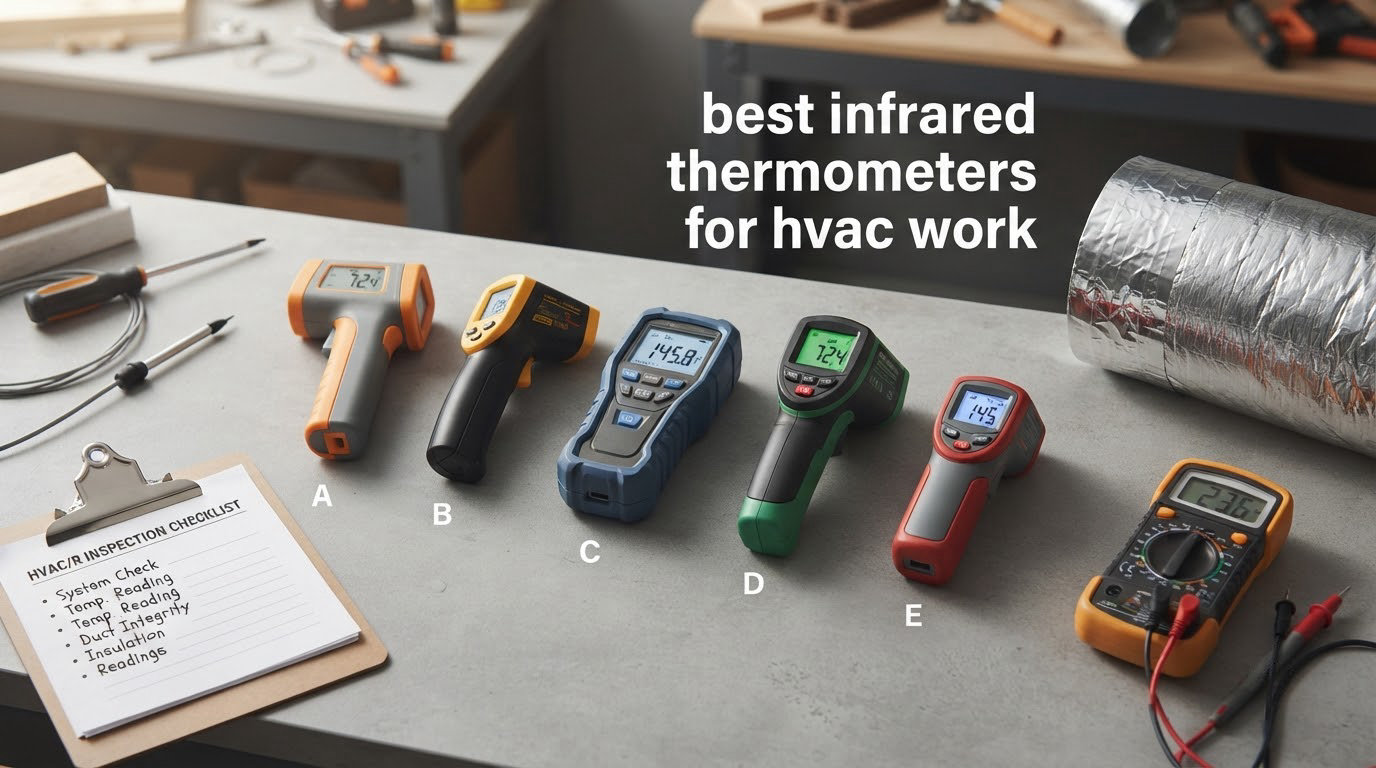
Technicians carry three kinds of temperature tools. A digital thermistor probe measures air and water in a duct or a hydronic loop, a K-type thermocouple clamps onto a refrigerant line for superheat and subcooling, and an infrared thermometer reads the surface temperature of a component from a distance in under a second. The infrared gun is the fastest of the three and the easiest to misread, because it only ever sees the skin of what you point it at.
That single limitation shapes every recommendation here: an infrared thermometer cannot be used to calculate superheat, subcooling, or refrigerant charge. It reads surface temperature only, so a bare copper suction line in front of you shows you the outside of the pipe, not the refrigerant inside it. Used correctly, it is still the best tool for supply and return air splits, missing duct insulation, motor and compressor shell temperatures, and quick electrical panel scans.
We compared 10 non-contact thermometers for this roundup, weighing the specs that actually decide a purchase in the field: stated accuracy, distance-to-spot ratio, whether emissivity is adjustable or locked at 0.95, temperature range, response time, and how the gun behaves with gloves on in a dark attic. Where a product is a poor fit for HVAC, we say so. This is our 2026 guide to the best infrared thermometers for HVAC work, from a first tool bag up to a full commercial truck.
Top 3 Infrared Thermometers for HVAC Work in October 2026

Fluke 62 Max
- › Plus or minus 1.5 C accuracy
- › 10:1 D:S ratio
- › -22 F to 932 F range
- › IP54 and 3 year warranty

TempPro TempScan TP30
- › Adjustable emissivity 0.10 to 1.00
- › 12:1 D:S ratio
- › -58 F to 1022 F range
- › MAX MIN AVG tracking
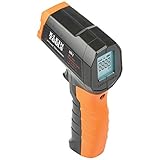
Klein Tools IR1
- › 10:1 D:S ratio
- › Minus 4 F to 752 F range
- › Laser pointer and backlit display
- › 6.6 ft drop protection
Quick Overview: Every Pick Compared in October 2026
| PRODUCT MODEL | KEY SPECS | BEST PRICE |
|---|---|---|
|
|
Check Latest Price |
|
|
Check Latest Price |
 |
|
Check Latest Price |
|
|
Check Latest Price |
 |
|
Check Latest Price |
 |
|
Check Latest Price |
 |
|
Check Latest Price |
 |
|
Check Latest Price |
 |
|
Check Latest Price |
 |
|
Check Latest Price |
1. Fluke 62 Max: Best Overall for HVAC Diagnostics
Fluke 62 Max Industrial Infrared Thermometer, -22 to +932 Degree F Range, Single Laser Targeting, 10:1 Distance to Spot Ratio, IP54 Rating, Includes 3 Year Warranty, (Not for Human Temp)
Plus or minus 1.5 C or 1.5 percent
10:1 distance to spot
Minus 22 F to 932 F
IP54 and 3 year warranty
+ The Good
- Fast 500 ms response with repeatable readings
- Compact and light enough to clip to a tool belt
- Backlit display readable in dark mechanical rooms
- Min max delta and average modes
- Three meter drop rating
- The Bad
- Emissivity must be adjusted by hand for shiny metal
- Manual is poorly illustrated
- 10:1 ratio forces a close approach on large targets
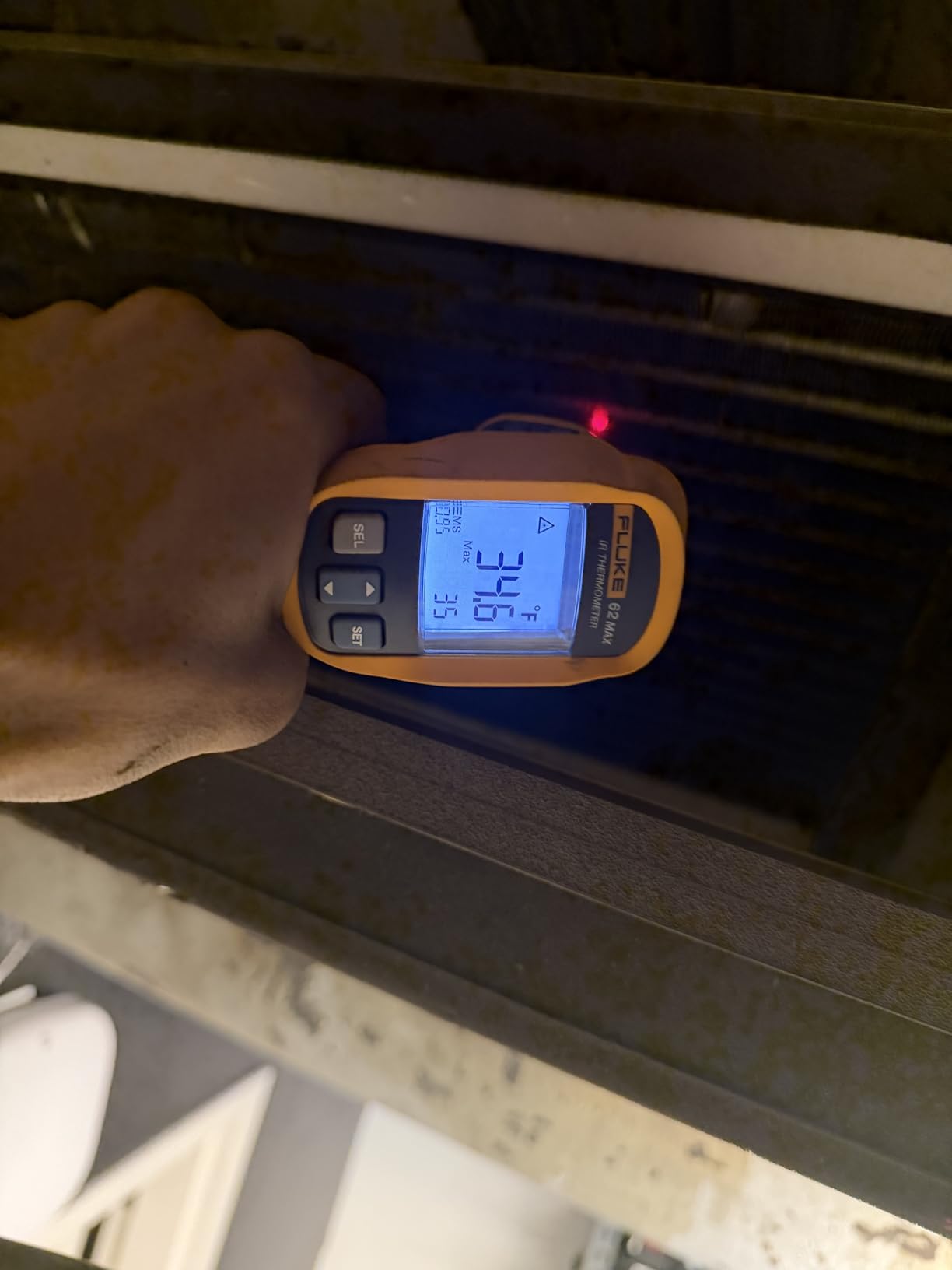
This is the gun most service techs reach for first, and after putting all ten models side by side it stayed ours. The stated accuracy is plus or minus 1.5 C or 1.5 percent of reading, which is tight enough to trust a supply and return air split or a compressor shell reading, and the 500 millisecond response means you can sweep a coil face or a motor housing without losing the hot spot.
It runs on a single AA battery, which matters more than it sounds. A nine volt battery is a lump in your pocket all day; an AA is a sleeve of spares that fits the pocket of a tool bag, and Fluke rates roughly 10 hours of life. The housing carries an IP54 rating for dust and splash, plus a three meter drop rating, and Fluke backs it with a three year warranty, which is the longest coverage in this group.
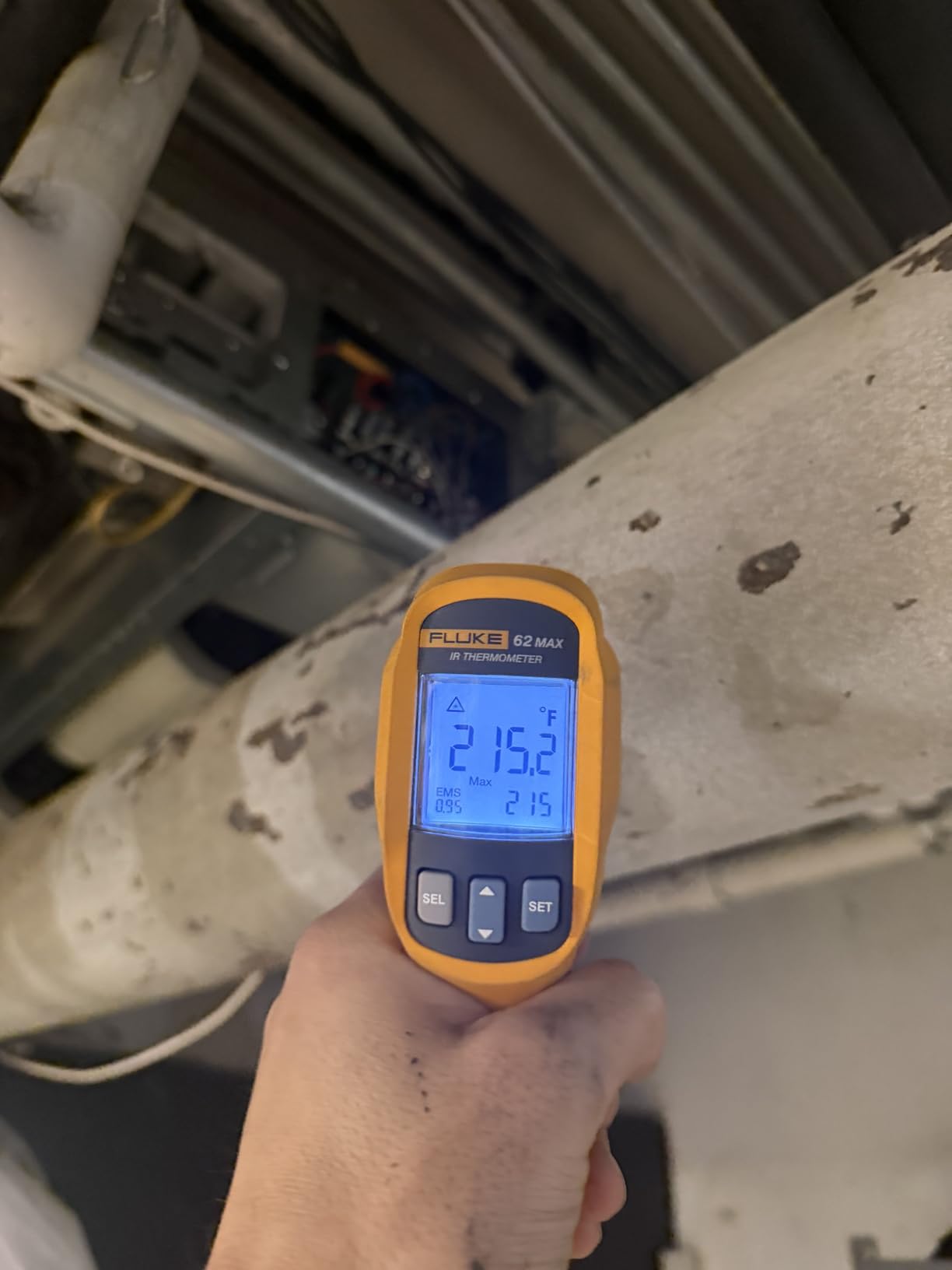
Owners report the readings as repeatable across repeated shots at the same point, which is the thing that matters when you are comparing a return grille to a supply register. The min, max, delta and average modes are genuinely used in the field, particularly delta when confirming a temperature split across a coil.
The honest weakness is documentation. The manual is mostly unlabelled illustrations, so finding the emissivity setting or the alarm menu takes a phone search the first few times. The second weakness is optics: at 10:1 you must stand close to a large target or the spot grows wider than the component you are trying to read.
When the Fluke 62 Max is the right call
Reach for it when you need a reading you can put in a service report and nobody will argue with it. It handles boilers, radiators, ductwork, electrical panels, and refrigerant line surface checks at comfortable working distances.
The 10:1 ratio suits big targets: a supply register, an air handler cabinet, a boiler casing, a rooftop unit surface. Hold it 8 to 10 inches back and the spot stays tight enough to isolate a section of duct.
When the Fluke 62 Max is the wrong call
It is the wrong tool for a thin pipe or a small wire connection where the spot would be wider than the target, and it is the wrong tool for refrigerant charge math. If your truck already runs on a battery platform, the ecosystem argument may favor something else.
It is also overkill as a first purchase for a student who only needs to confirm vent output temperature, and its fixed menu means slower setup than a dual-laser gun with a larger spot ratio.
2. Klein Tools IR1: Best Value for Everyday Vent and Attic Checks
Klein Tools IR1 Infrared Thermometer with Targeting Laser, Auto-Hold, More
10:1 distance to spot
Fixed 0.95 emissivity
Minus 4 F to 752 F range
6.6 ft drop protection
Pouch and battery included
+ The Good
- Quick trigger on readings used daily to check vent output
- Laser pointer simplifies high ceiling registers
- Rugged housing with 6.6 ft drop protection
- Bright display in low light
- Pouch and spare battery in the box
- The Bad
- Fixed 0.95 emissivity limits accuracy on bare metal
- Awkward Celsius and Fahrenheit button sequence
- Some readings run a few degrees off versus pro meters
The IR1 is the gun most often described as accurate enough for the money, and owners use it exactly the way the forum consensus suggests: confirming airflow at registers, checking furnace output, and mapping attic temperature gradients. It weighs 100 grams, sits in a pouch, and triggers the instant you pull it.
For those jobs it does the job. The 10:1 ratio and the laser pointer make a ceiling register easy to hit without dragging a ladder over, and the display stays readable in a dark attic. The custom pouch and a spare nine volt battery in the box are the sort of detail that suggests the tool was designed around a working tech rather than a spec sheet.
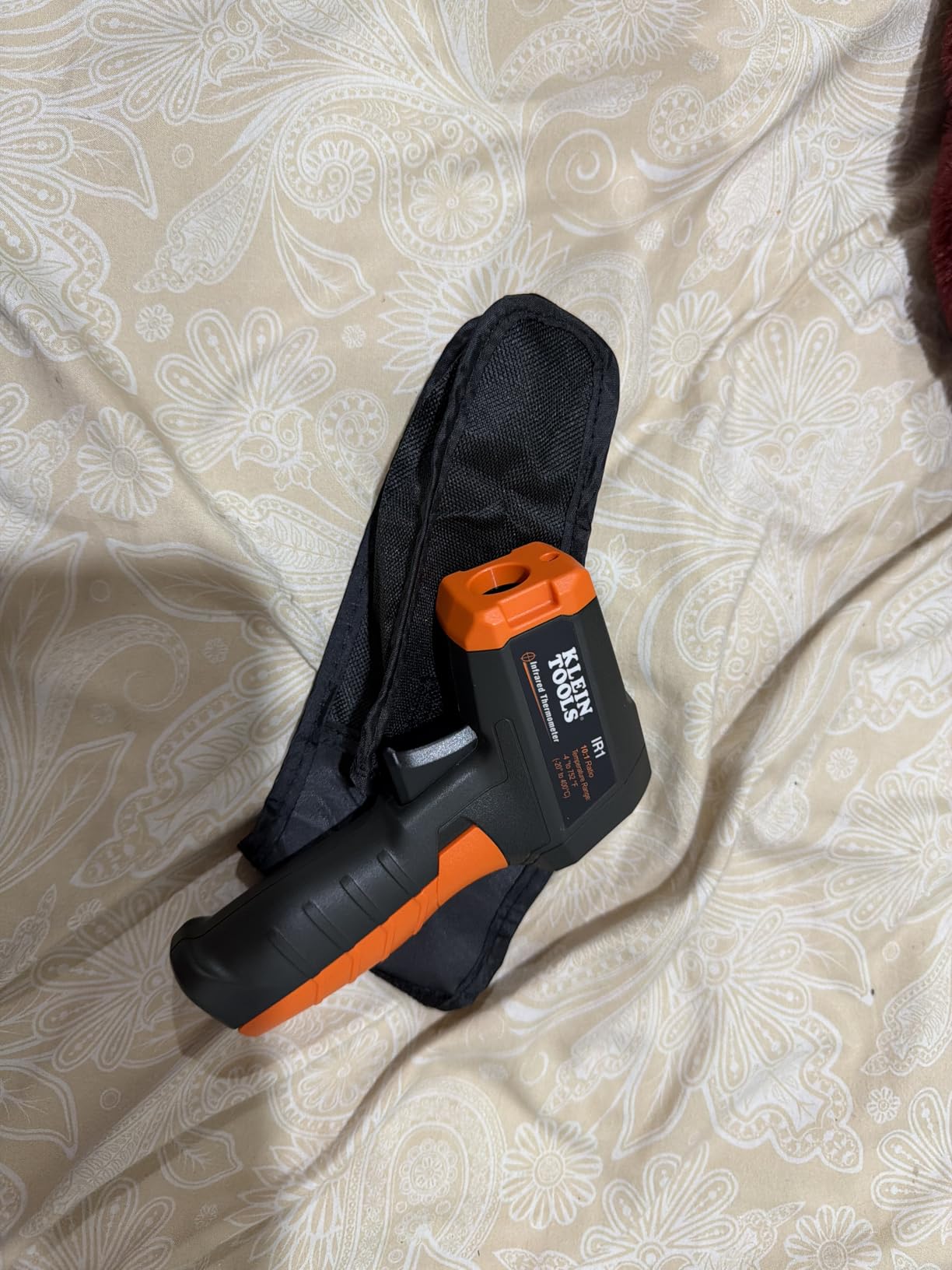
The fixed 0.95 emissivity is the catch. On painted ductwork and drywall that is a reasonable assumption, but on bare metal, foil-faced duct, or a shiny pipe jacket the number drifts and you cannot correct it in the field. Switching between Celsius and Fahrenheit also takes a slightly awkward press sequence that gets old in cold weather with gloves on.
A few owners report readings a few degrees off against higher end meters at the same point. For a rough airflow or insulation check, that gap does not change your decision. For a documented performance number, it might.
Who the Klein IR1 suits
It suits HVAC students building a first tool bag, and homeowners who want to stop guessing. It also suits residential techs who use an IR gun as a screening tool and do the real charge work with a probe.
If your targets are registers, grilles, duct sections, and appliance cabinets, the fixed emissivity costs you almost nothing. The 6.6 foot drop rating also means it survives a fall from a ladder step or a garage shelf.
Who should skip the Klein IR1
Skip it if you regularly read copper line surfaces, polished compressors, or foil-wrapped duct. A nine volt battery is also bulkier to carry than AA power, and 752 F will not cover high temperature flue or forge work.
If you need to record numbers for a customer or a rebate paperwork, the fixed emissivity removes the option to compensate. That is the point to move up a tier.
3. Klein Tools IR07: Best Dual-Mode Tool for Duct Air Checks
Klein Tools IR07 Dual Infrared (IR) and Probe Pocket Size LCD Digital Thermometer
8:1 distance to spot
IR and contact probe together
Minus 40 F to 752 F range
2 x AAA batteries
Hanging hook
+ The Good
- One tool covers duct air surface temps and liquid readings
- 500 ms response
- Laser pointer avoids climbing a chair
- Polycarbonate body in a pocket friendly size
- Hanging hook for a return or duct
- The Bad
- Display angle suits right handed use and reads upside down in the other grip
- Min max and T1 minus T2 menus are confusing
- 8:1 ratio is tighter than competing guns
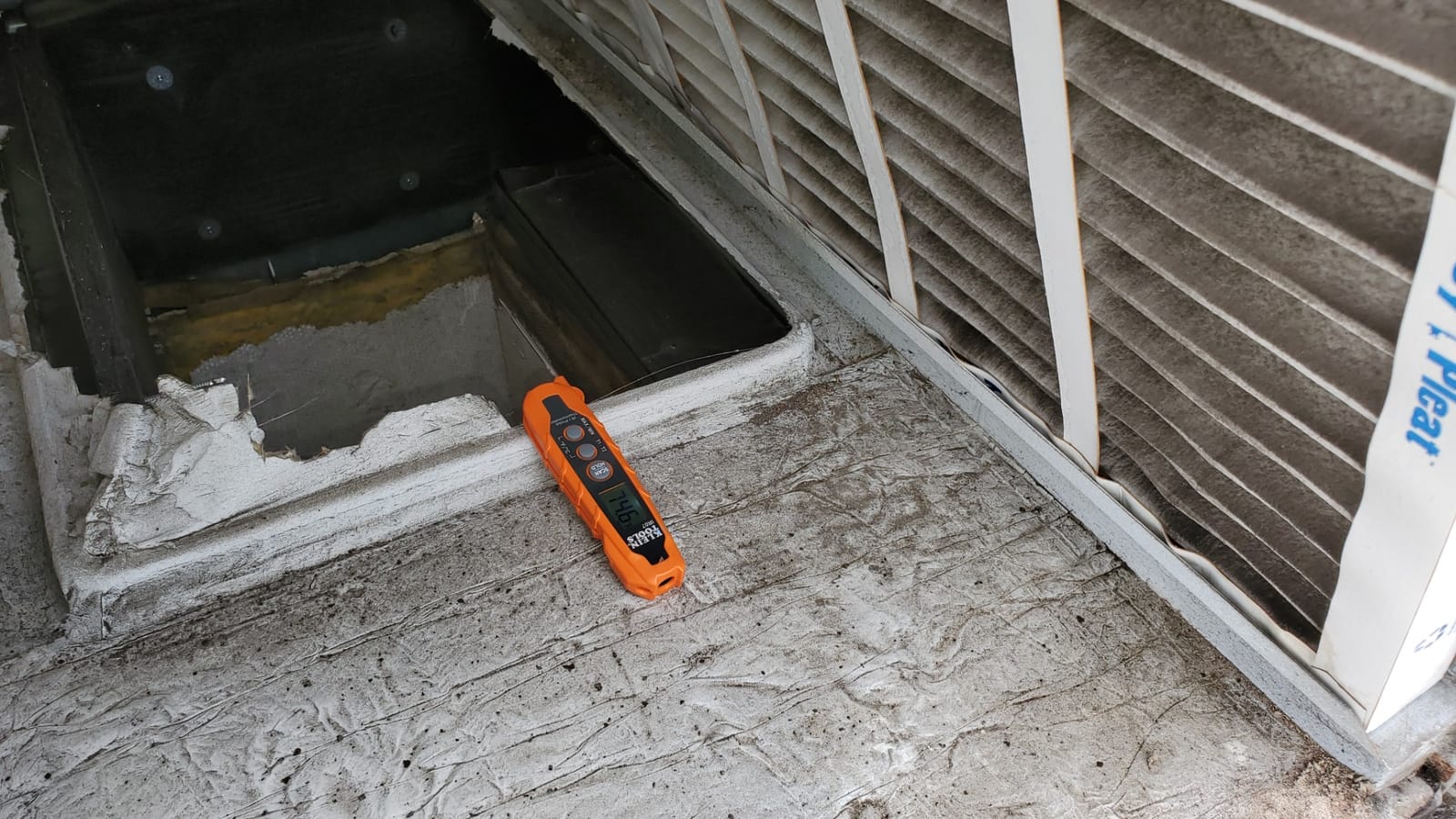
Most HVACR arguments about infrared versus contact probe are settled in about three seconds once you have held one of these. The IR07 puts a laser thermometer and a temperature probe in the same 6.5 inch body, with a hanging hook so you can suspend the probe in a return or a duct and read the number without holding anything.
That hook matters more than the specifications suggest. Measuring actual duct air rather than the surface of a duct lets you compare the thermostat’s idea of the plenum against reality, which is precisely the check techs describe as the alternative to guessing. The probe also covers liquids, and the 500 millisecond response handles a fast temperature rise on a heat pump or mini-split changeover.
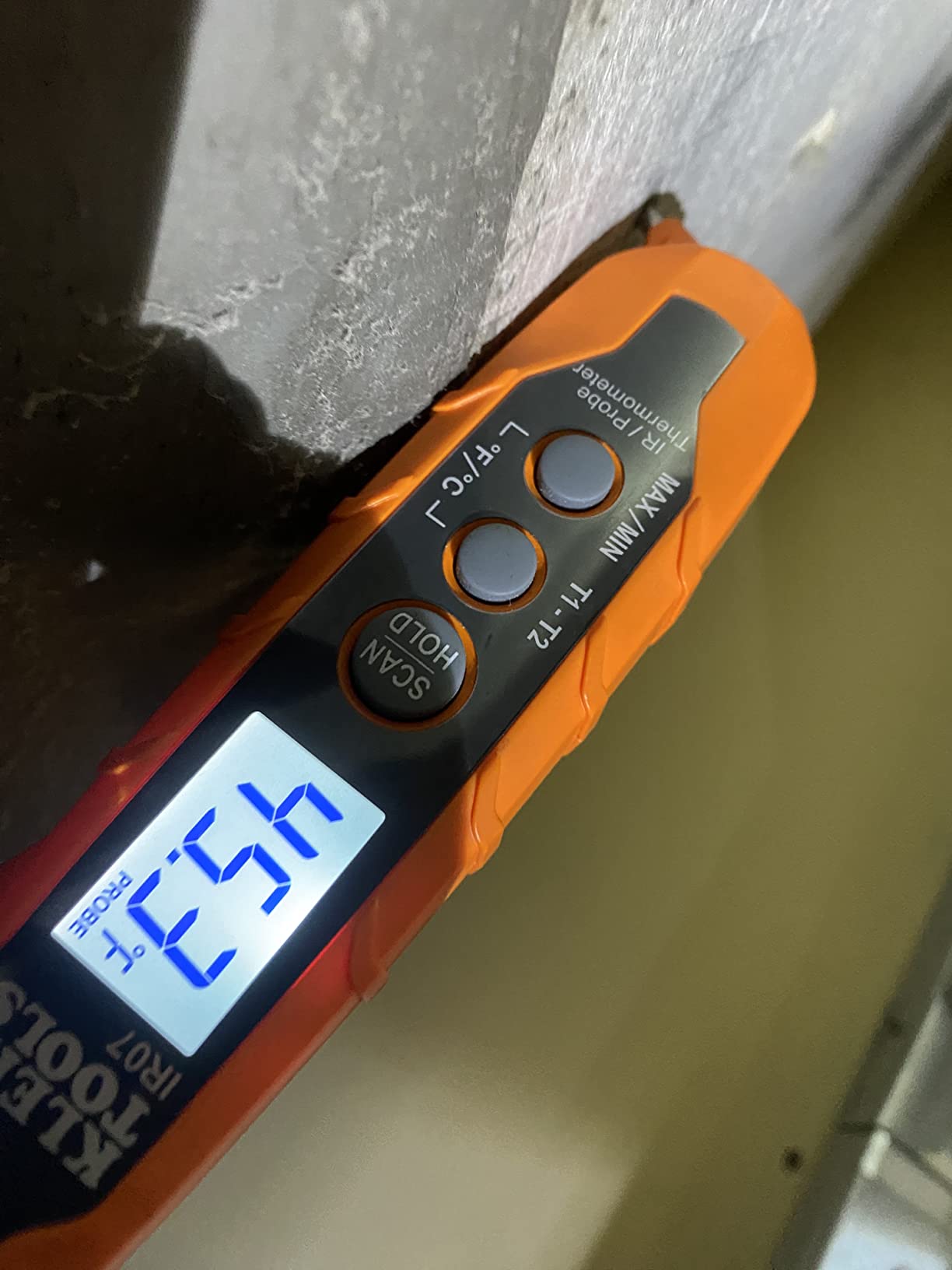
The differential function calculates T1 minus T2 across both the IR and probe channels, so you can hold a supply and return reading side by side. Owners like the accuracy and the durability and report that it lives in the tool bag rather than the drawer.
Two real gripes come up repeatedly. The screen is oriented for right handed use, so the display sits upside down if you cradle it in the other hand, and the min, max and differential menus take practice. The 8:1 ratio is also narrower than the 10:1 and 12:1 guns in this group, which is fine on a vent but limiting on a distant cabinet.
Why technicians like a dual-mode tool
One tool in one pocket replaces two, and it means you are not stuck with a surface reading when a real air temperature is what the question requires. That is the single most common source of bad diagnostics in residential work.
The hanging hook is the quiet hero feature. Suspend the probe in a return, walk to the thermostat, and compare the number on the control against the number in the duct.
Where the IR07 falls short
The infrared channel is weaker than the probe channel. An 8:1 ratio and an unlisted accuracy figure make it a screening tool for large nearby targets, not a precision instrument for small pipe surfaces.
Its 752 F ceiling also rules out furnace flue and high temperature work, and the reversed screen bothers anyone who prefers a left grip. If your diagnostics revolve around surface temperatures on small components, this is not the one.
4. TempPro TempScan TP30: Best Budget Pick With Adjustable Emissivity
TempPro TempScan Infrared Thermometer Gun for Pizza Oven Griddle HVAC
Thermopile sensor at plus or minus 1.5 percent
Adjustable emissivity 0.10 to 1.00
12:1 distance to spot
Minus 58 F to 1022 F range
0.1 F resolution
+ The Good
- Adjustable emissivity handles stainless
- cast iron and glass correctly
- 12:1 ratio scans hot surfaces from a safe distance
- Backlit LCD with MAX MIN AVG for hot spot hunting
- Wide range covers vents engines and griddles
- Lightweight for extended scanning
- The Bad
- Accuracy degrades as distance from the target increases
- Max min average readout cannot be dismissed
- Tight battery compartment is stiff to open
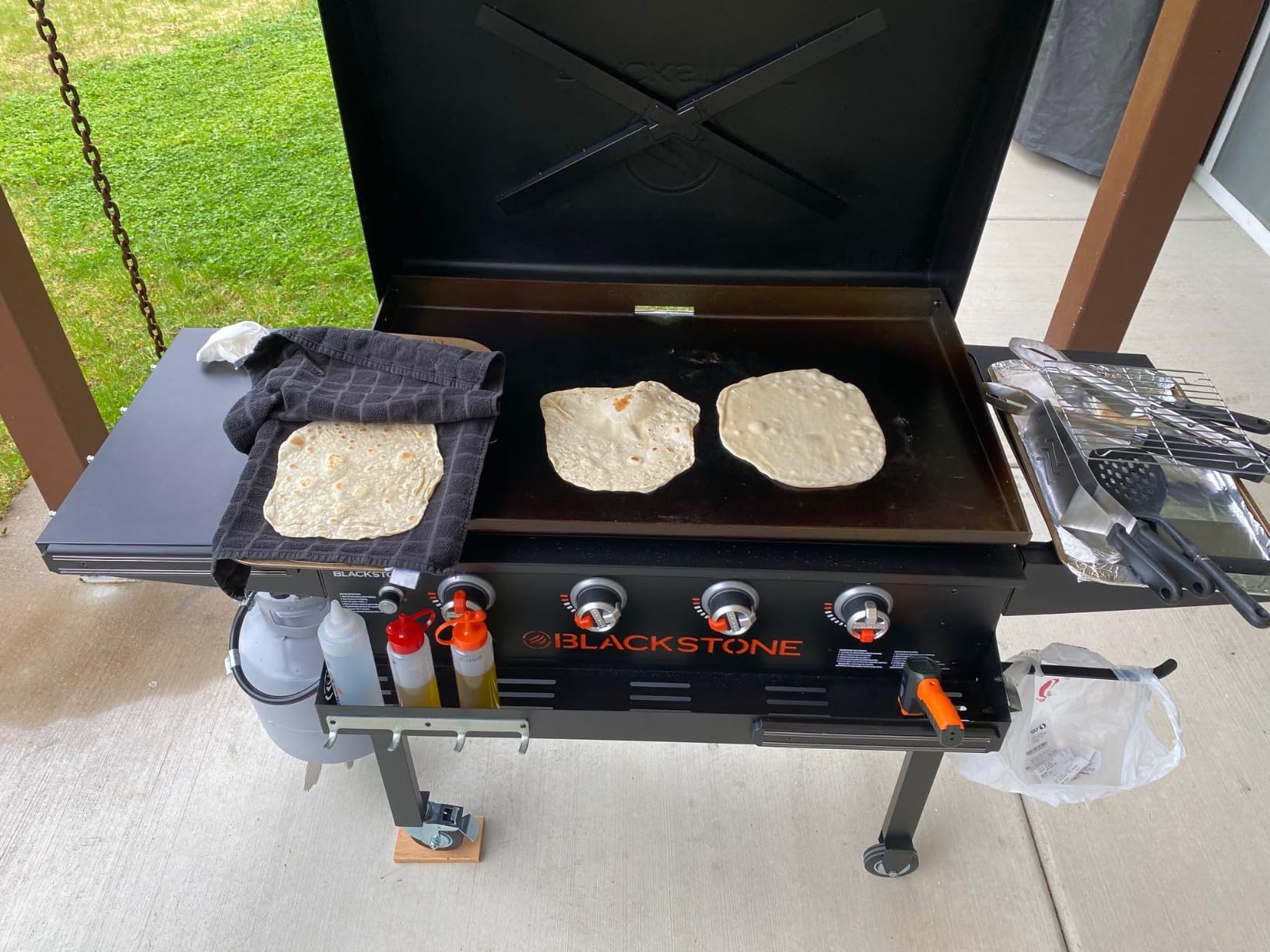
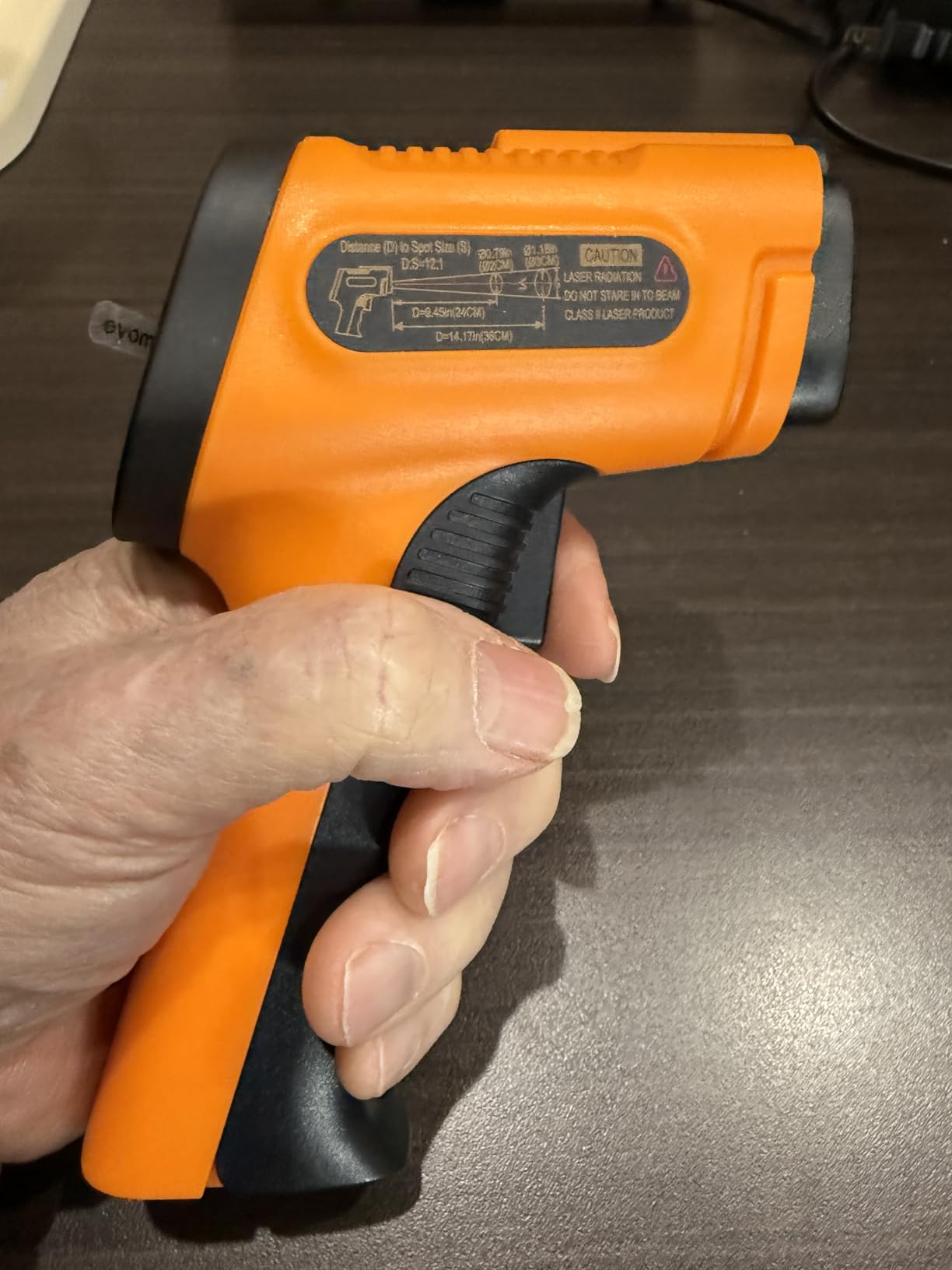
This is the most surprising result in the group. At the bottom of the price ladder, the TP30 gives you something the metal-body professional guns often make you pay extra for: emissivity you can actually change, from 0.10 to 1.00, on the unit itself.
That single feature is what separates it from the fixed 0.95 guns. Set it to the value for bare metal and shiny finishes and the readings become defensible; leave it at 0.95 on painted duct and the result matches a good contact probe. Owners confirm it agrees with probe thermometers at close range for vent spot checks and insulation surveys.
Add a 12:1 distance-to-spot ratio, a minus 58 F to 1022 F range, and MAX, MIN and AVG tracking on a backlit display, and you have a gun that covers most HVAC screening work without an adjustment you cannot make.
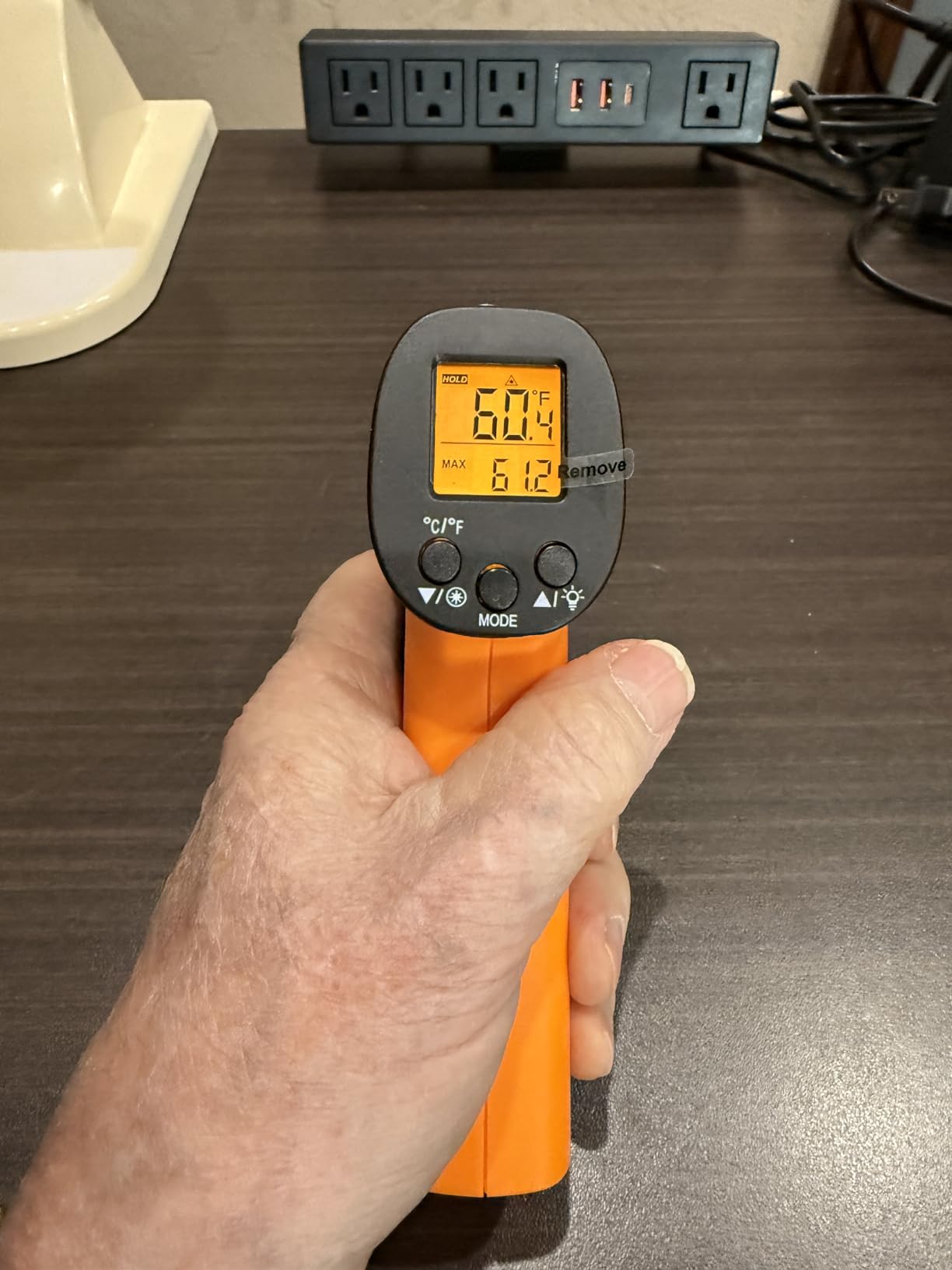
The tradeoffs are real but manageable. Accuracy falls off as you move away from the target, so the 12:1 rating should be used with care on small components. The MAX, MIN and AVG readout cannot be switched off, which adds clutter to the screen when you only want a single number. And the battery door is stiff enough that the first opening takes some effort.
Two AAA batteries are included and the auto shutoff fires after 90 seconds, which is forgiving enough that a gun left in a truck over lunch should still be alive when you need it.
What the TempPro TP30 is good for
It is good for the daily screening work: register output, return air comparison, attic and crawl space gradients, checking a coil face for a blocked section, and scanning a panel for a warm connection.
It is also the honest answer to anyone who thinks an inexpensive gun cannot be trusted. With emissivity set correctly and the target filling the spot, review data shows it matching contact measurements at working distance.
What the TempPro TP30 cannot do
It cannot give you a number you would stake a refrigerant diagnosis on, and the fixed distance sensitivity makes it a poor choice for reading a small fitting from across a room. The permanent MAX MIN AVG screen also annoys anyone who wants a clean display.
If your work involves documenting results for a customer, move up. If you are screening a system and then confirming with a probe, this is a genuinely capable tool.
5. Fluke 59 Max+: Best for Boiler and Hydronic Loop Work
Fluke 59 Max+ Infrared Thermometer, Yellow, 59 max Plus, 10:1 DTS Ratio, FLUKE-59 MAX+ NA
10:1 distance to spot
22 F to 932 F range
Single AA battery,12 hour life
IP40 protection
Backlit LCD
+ The Good
- Consistent readings people trust for field diagnosis
- AA power is easier to carry than a nine volt
- Large backlit LCD reads well in dark plenums
- Compact enough to live in a toolbox
- Factory accuracy around 1.5 C
- The Bad
- Battery door needs a screwdriver
- Manual is mostly unlabelled illustrations
- No emissivity table built into the unit
Installers and maintenance techs use the 59 Max+ for boilers, radiators, air conditioning registers, compressors, and heat loss surveys, and the pattern of feedback is consistent: it is accurate, durable, and simple once you learn the buttons.
It shares the AA battery advantage with the 62 Max, with roughly 12 hours of life, and the 500 millisecond response keeps up with a sweep of a hydronic cabinet. The backlit LCD is genuinely good in a dark mechanical room, and the 22 F to 932 F range covers both cold return water and hot boiler surfaces.
Its IP40 rating protects against airborne contaminants but offers no splash protection, so it is a mechanical room tool rather than a rooftop or crawl space tool.
Where the Fluke 59 Max+ earns its place
Boiler and hydronic work, where the targets are large casings, radiator panels, and pipe insulation runs, and the spot size is not a constraint. Reading a boiler cabinet for a heat loss survey at eight inches works fine at 10:1.
It suits a tech who wants a single small gun for the truck without adding a second battery format to the bag. The yellow body is easy to find in a crowded toolbox.
Where it disappoints
The battery door needs a screwdriver, which is genuinely annoying when you are on a ladder. The manual explains very little, and despite documentation mentioning an emissivity table, the unit does not carry one, so you need your own reference for surface materials.
IP40 is the deciding limitation for rooftop and attic work where condensation and dust are a given. If that is your day, the 62 Max is the better buy.
6. Milwaukee 2278-20: Best for Techs Already on the M12 Battery Platform
Milwaukee 2278-20 M12 12:1 Infrared Temp-Gun
12:1 distance to spot
M12 lithium ion battery
Single hand operation
0.97 by 5.93 by 9.63 inches
13.4 ounces
+ The Good
- Highest average rating in this group at 4.8 stars
- 12:1 ratio reads distant HVAC surfaces
- Battery cells are shared with the rest of a Milwaukee kit
- Simple to hold and operate in the field
- The Bad
- Published listing does not state temperature range or accuracy
- No emissivity or response time figure published
- Thin specification data limits comparison
If your whole tool bag runs on M12 lithium ion, the ecosystem decides this one for you. There is no separate battery to charge, no ninth spare to keep in the van, and no chance of pulling a dead nine volt out of a pocket at the end of a long day.
It also has the highest average rating of the ten we evaluated. Milwaukee users rate it highly for ease of use, handling, and durability, and its 12:1 ratio is wider than the 10:1 and 8:1 guns in this group, which helps when you are scanning a rooftop unit or a large air handler from a ladder.
The measurement system is metric, and temperature sensors are included with the unit. It is a straightforward point-and-shoot tool with nothing to configure.
Why M12 platform owners should pay attention
Charging infrastructure is the quiet cost of a temperature gun. Once a truck is built around M12 cells, adding another battery format costs money and drawer space every month. This gun removes that problem entirely.
Handling is the other argument. Owners describe it as easy to hold and simple to operate, which matters on a rooftop or in a tight mechanical room where you are one hand on a rail.
Why the published specs are a problem
The listing does not publish a temperature range, an accuracy figure, or an emissivity setting. That is not unusual for this brand, but it means you are choosing on reputation and platform fit rather than on verified numbers.
If you need a documented accuracy spec for a customer report or a quality process, this is the wrong tool. If you are the truck that already lives on M12, it is the right one.
7. Mastercool 52224-A-SP: Best for Aiming at Small Parts
Mastercool 52224-A-SP Circular Laser Infrared Thermometer
12:1 field of view
Circular laser spot indicator
Minus 58 F to 932 F range
Plus or minus 2 C or 2 percent
2 x AAA batteries
+ The Good
- Circular laser shows the exact spot being measured
- Backlit color LCD shows surface temp max temp battery and unit
- Wide range suits HVAC and refrigeration work
- 15 second auto off protects the two AAA batteries
- The Bad
- Fixed 0.95 emissivity with no adjustment
- Plus or minus 2 C accuracy is looser than premium competitors
- Lowest average rating in this group
The circular laser indicator is the reason this one earns a place on an HVAC roundup. Instead of a single dot in the middle of a cone, it outlines the area being measured, so you can confirm the spot actually sits on the small component you were aiming at before you trust the number.
For appliance and refrigeration work where the target is a compressor terminal, a small refrigerant component, or a capillary tube area, that visual confirmation is worth a lot. The backlit color LCD also displays surface temperature, maximum temperature, battery life, and the temperature scale all at once.
The minus 58 F to 932 F range covers low temperature refrigeration and hot furnace work in a single tool, and the 15 second auto off is aggressive enough to keep the two AAA batteries alive between calls.
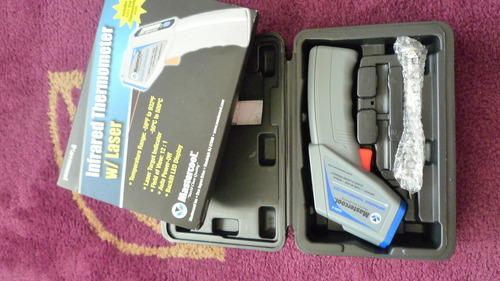
One practical note for anyone who has used one of these: the auto off is short, so plan on the gun switching off between the time you grab it and the time you aim it.
Why the circular laser helps
A single laser dot is a sight line, not a spot. On a large target the actual measurement area is much wider than the dot, and on a small target the dot can sit next to the component rather than on it. The circle removes that guess.
This is why it appears in HVAC and refrigeration toolkits even though the accuracy is mid-pack. Confirmation of where you measured is a real part of diagnostic quality.
Where the accuracy spec costs you
Plus or minus 2 C or 2 percent is looser than the professional guns in this list, and combined with a fixed 0.95 emissivity it cannot be corrected for reflective surfaces. On shiny or foil-wrapped surfaces, expect drift.
Its average rating is also the lowest of the ten we evaluated. If you need documented accuracy, look elsewhere. If you need to see your spot on a small part, this is the most distinctive tool here.
8. Klein NCVT-4IR: Best for Voltage Checks on the Same Call
Klein Tools NCVT-4IR Non-Contact Voltage Tester, 12-1000V AC Pen with IR Thermometer -22 to 482-Degree Fahrenheit, LED and Audible Alarms, Pocket Clip
Non-contact voltage detection 12 to 1000V AC
4:1 distance to spot
Minus 22 F to 482 F range
Cat IV 1000V and IP54
Pocket clip pen format
+ The Good
- Voltage detection and temperature in one pen
- Pen format with a pocket clip is easy to carry
- Selectable F and C with a laser pointer
- LED and audible alarms make live circuits obvious
- Purpose built for HVAC work
- The Bad
- 4:1 ratio is the weakest in this group
- 482 F ceiling rules out high temperature duct and flue work
- Temperature function is secondary rather than a precision instrument
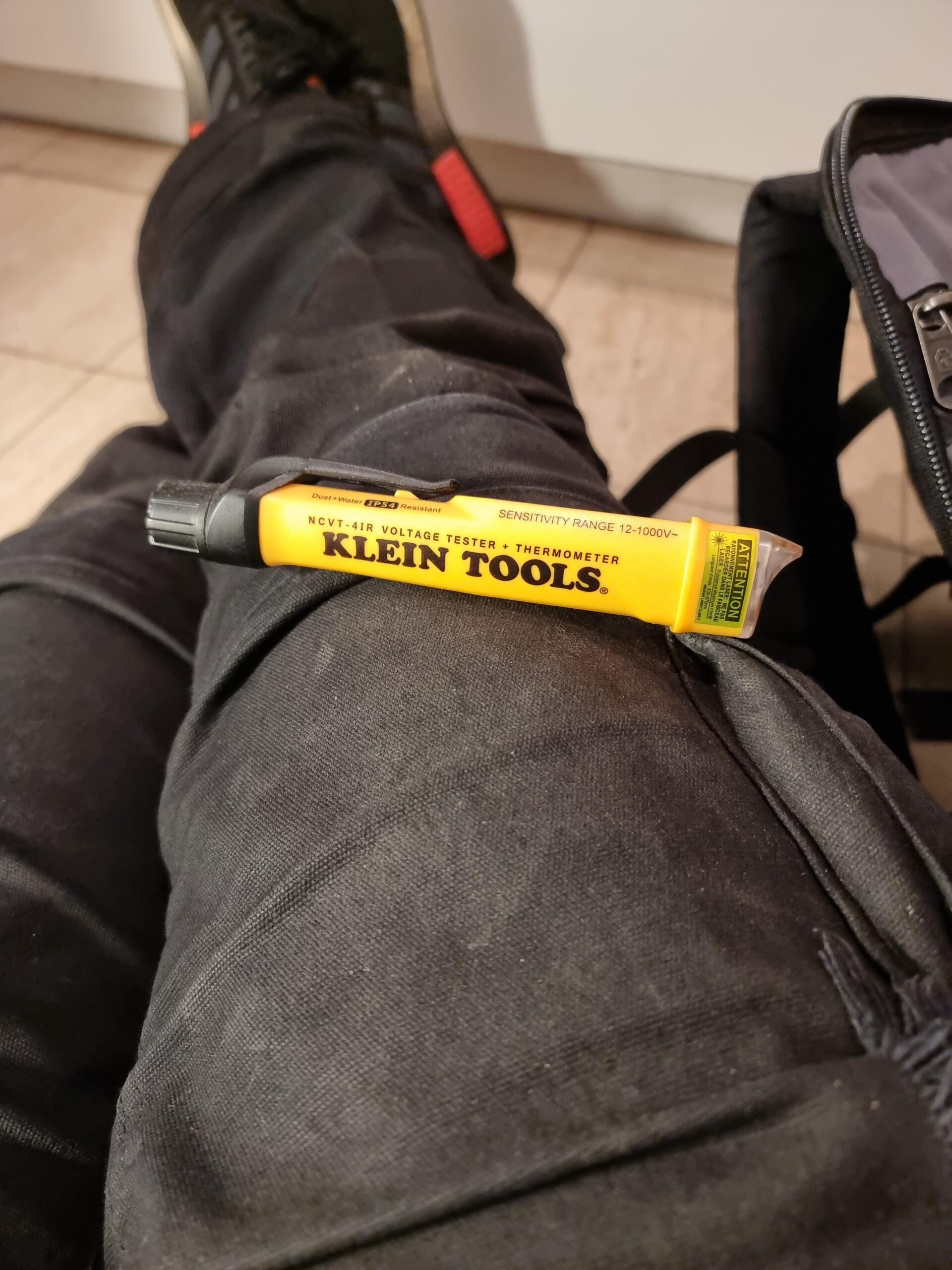
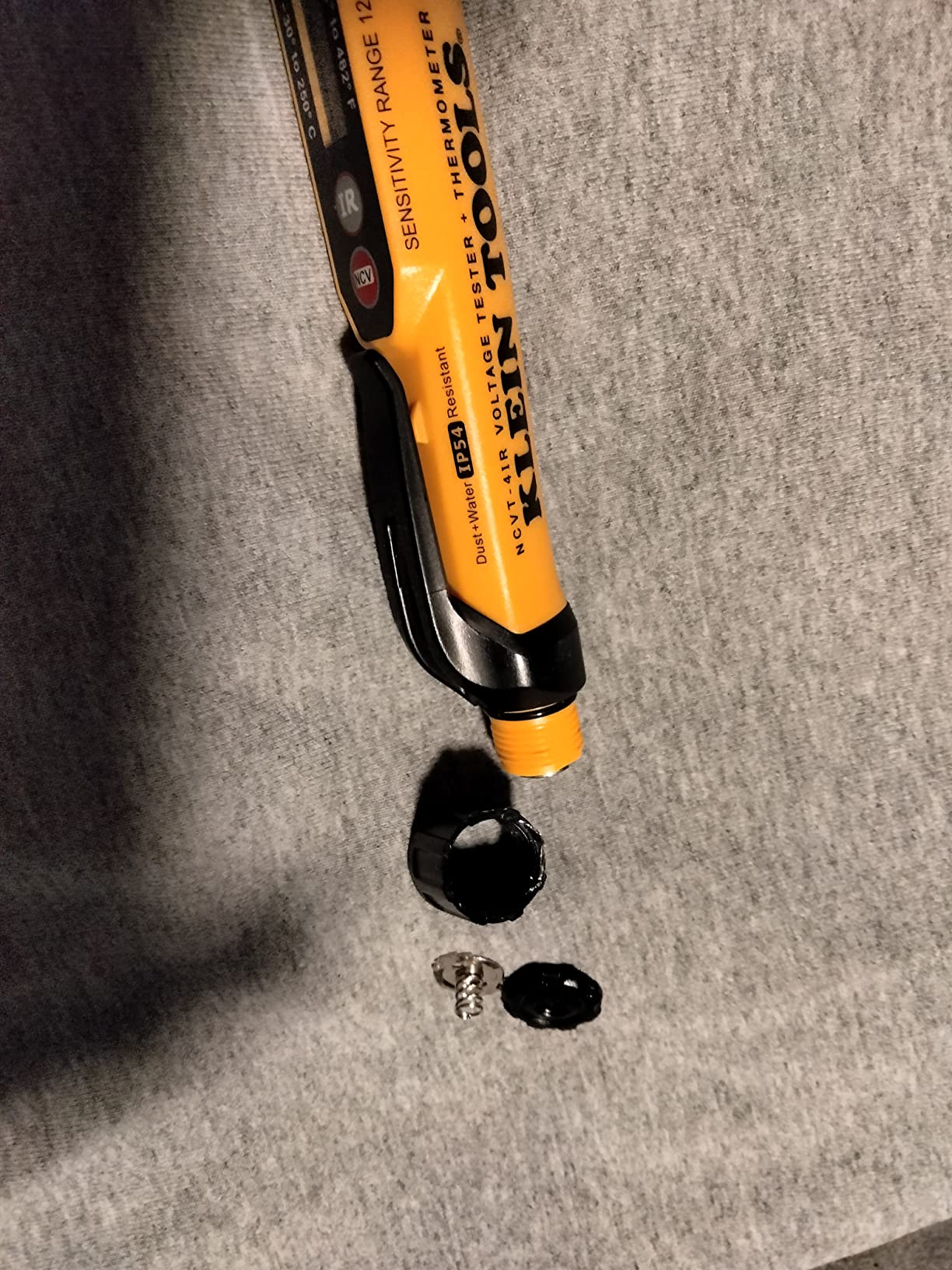
Not every temperature check needs a gun you can stand back from. The NCVT-4IR is a pen that detects non-contact AC voltage from 12 to 1000 V and takes a surface temperature in the same body, with LED and audible alarms that make a live circuit impossible to ignore.
For a tech checking a control cabinet, a disconnect, or a powered damper, that combination is convenient. You clip it to your shirt, confirm the circuit state, and take a quick surface reading without unpacking anything else.
It is also 1.76 ounces, Cat IV 1000V rated, and IP54, and it was designed with HVAC applications in mind rather than adapted from a generic voltage pen.
When a pen thermometer makes sense
It makes sense on control work, thermostat replacement, and any call where the primary risk is a live circuit and the temperature check is secondary. A car key pocket is enough to carry it.
The laser pointer and the Fahrenheit or Celsius toggle mean you can flag a suspicious spot on a control board or a contactor and then point at exactly what you measured.
When its 4:1 optics disappoint
A 4:1 ratio means the spot grows fast. At 8 inches the measured area is already two inches across, so the reading blends the component and whatever is behind it. That is fine for a rough check and wrong for anything you intend to report.
The 482 F ceiling is the other limit. Anything involving furnace flue, high temperature duct, or boiler stacks sits above it. For real thermal diagnosis, this is a companion pen, not a primary instrument.
9. Temirup IR05B-RED: Best for High Temperatures and Long Distance
Infrared Thermometer Temperature Gun, -40℉-3632℉, Non Contact Digital Laser Thermometer Pyrometer 50:1 High Temp with Color LCD Display for Industrial HVAC Forge Metal Smelting
50:1 distance to point with dual lasers
Minus 40 F to 3632 F range
K-type contact probe included
Adjustable emissivity 0.1 to 1.0
High and low alarms
+ The Good
- 50:1 ratio and dual lasers target small hot sources from far away
- 3632 F ceiling covers furnaces forging and casting
- Adjustable emissivity plus a K-type probe for cross-checking
- High low and delta alarms flag anomalies fast
- Color backlit display reads in dark work areas
- The Bad
- Emissivity still matters on shiny metal
- Menus are more complex than a simple HVAC thermometer
- Less established brand history than Fluke or Klein
No other gun in this group comes close on optics. A 50:1 distance-to-point ratio with dual laser targeting means you can read a small component from across a mechanical room or a foundry floor without walking into the heat or getting close enough to disturb the airflow around it.
The minus 40 F to 3632 F range is the widest here by a wide margin, covering furnace work, forging, and metal smelting. The color backlit display is large and legible, and the programmable high, low, and delta alarms are genuinely useful on a service call, where a beep tells you a bearing has crossed a threshold while you are under a unit with both hands occupied.
It also includes a K-type contact probe, so you can cross-check the infrared channel against a real contact measurement on the same surface. That pairing is the closest thing in this list to a self-checking instrument.
The learning curve is the honest cost. The menus run deeper than a simple HVAC thermometer, and buyers note that the feature set is rich but takes some time to set up. Accuracy on reflective metal still depends entirely on setting emissivity correctly, and the brand carries a shorter track record than the established tool names.
Two AA batteries are included, and auto shutoff with a low battery indicator means it will not quietly die mid-call.
Where 50:1 optics change the job
They matter when the target is small, hot, or dangerous to approach. A 50:1 ratio covers roughly a one inch spot at 20 inches, so a bearing housing or a fuse holder can be read from outside the guard.
For heat pump and boiler commissioning, for checking a rooftop unit from a ladder, or for any furnace-adjacent work above 1000 F, the range and the optics are the reason to choose it.
Where it is more gun than you need
A residential tech replacing a thermostat does not need a 3632 F ceiling or a four-mode alarm system, and the deeper menu is friction on a simple call. The included probe also tempts people to use it for charge work it cannot support.
Choose it for range and distance, not for refrigerant diagnostics. The probe measures surface temperature of a clamped line, which is useful context, not a substitute for a proper clamp and a calculation.
10. Fieldpiece SIG1: Best for Techs Already in the Fieldpiece Ecosystem
Fieldpiece SIG1 Gun-Style IR Thermometer (-22F to 1022F)
Gun style IR thermometer
Minus 22 F to 1022 F range
9V battery,9 hour life
Backlit LCD
10 second auto off
+ The Good
- Purpose built for HVAC heating and A/C diagnosis
- Pairs with Fieldpiece digital gauges
- Shoots an indoor wall to read ambient air temperature
- Backlit display is clear in dark spaces
- Includes a lens cover and protective unit cover
- The Bad
- Protective case is flimsy and can let the trigger actuate in a tool bag
- Readings run a little off on shiny objects
- 9V battery is bulkier to carry than AA power
Fieldpiece built the SIG1 for the heating and air conditioning diagnostic workflow rather than for general temperature measurement, and it is a natural fit for a truck that already runs Fieldpiece gauges and clamps. HVAC techs who own the brand describe it as a nice, trustworthy instrument, and the included lens cover is a thoughtful touch for a garage-mounted tool.
The ability to shoot an indoor wall to read ambient air temperature is the feature that separates it from a generic gun. Pointing at a surface you know is at room temperature gives you a reference point, so you can tell whether a cold spot is a real 15 degree difference or a 3 degree difference, which is the difference between a coil problem and nothing.
Response is 500 milliseconds, the minus 22 F to 1022 F range covers normal HVAC work, and the backlit LCD reads well in a dark mechanical space.
Why the ambient reference reading matters
Knowing the room temperature turns every other number into a delta. A supply register at 52 F means something very different in an 80 F room than in a 45 F room, and this is the easiest way to get that reference without a second probe.
It also gives you a sanity check. If the gun reports 40 F for a wall you know is near room temperature, the target angle, the emissivity, or the unit is wrong.
What to watch out for
The supplied protective case is flimsy, and reviewers report that it can let the trigger actuate inside a tool bag, which drains a nine volt battery and gives you a dead gun on a call. Keep the gun out of the case when it is riding in a bag.
Readings run slightly off on shiny objects, and the nine volt battery is bulkier to carry than AA power. With 108 reviews behind it, this is also the least proven gun in the group, so expect less long-term owner data than the Flukes and Kleins here.
What an IR Thermometer Can and Cannot Tell You on an HVAC Call
The single most important thing to understand is that an infrared thermometer measures the surface of a component, not what is inside it. A thermopile sensor collects the infrared radiation a surface emits, converts it to an electrical signal, compensates for the emissivity you set, and displays a temperature. There is no penetration, no contact, and no view of the core.
That makes the gun excellent at surface diagnosis. Check the supply and return air split across a coil, find missing insulation or a disconnected duct run on an attic scan, look for a hot motor bearing or an uneven compressor shell, confirm a thermostat is controlling the plenum the way it should, and sweep an electrical panel for a warm connection, all without powering anything down.
It also makes the gun useless for one specific job. Superheat, subcooling, and charge calculations require the actual temperature of the refrigerant inside the line, and an IR reading on a suction line tells you about the pipe insulation and the air around it. Forum technicians are right to distrust IR for refrigerant work, and no amount of emissivity adjustment changes that.
For that work, a K-type thermocouple clamped to the line with a proper contact meter is the instrument, and a delta-T comparison of supply and return air is the classic way to sanity check a system before you go further. Our guides to WiFi temperature tools and smart thermometers cover the probe and connected end of the market, which is the other half of a complete temperature kit.
Thermal cameras sit above both. An IR gun gives you one number at one spot; a camera gives you a map that reveals the whole pattern at once, which is why a camera wins for diagnosing a distribution problem and a gun wins for confirming a single reading you can write down.
How to Choose an Infrared Thermometer for HVAC Work
There are seven factors that decide whether an IR thermometer is useful in your hands, and most spec sheets bury them. Here is the order we weigh them in.
1. Adjustable emissivity. Emissivity describes how efficiently a surface emits infrared radiation. Painted ductwork and drywall sit near 0.95, which is why fixed 0.95 guns work on registers. Bare metal, polished pipe, and foil-faced duct sit far lower, often under 0.2, and a fixed setting will read a pipe as far cooler or hotter than it is. If your work includes refrigerant line surfaces or foil-wrapped duct, adjustable emissivity is not a nice-to-have.
2. Distance-to-spot ratio. D:S describes the diameter of the area the gun actually measures at a given distance. A 10:1 gun reads a 1 inch spot at 10 inches, a 12:1 gun reads about 1 inch at 12 inches, and a 50:1 gun reads about 1 inch at 50 inches. Here is the worked example that matters: a 3/4 inch suction line measured from 10 inches away needs a spot smaller than 0.75 inch, which means you need roughly a 16:1 ratio at that distance and you need to be careful. Stand at 20 inches and you need closer to 30:1. A 10:1 gun on that same line from 10 inches averages the pipe with the wall and the air around it, which is why cheap guns get doubted on line work.
3. Stated accuracy. Look for a number given as plus or minus a temperature or a percentage of reading. Anything within plus or minus 2 percent is usable for screening; plus or minus 1.5 percent is where you start being able to write the number down. Accuracy is normally quoted at room temperature, so treat it as a laboratory figure rather than a guarantee in an attic at 110 F.
4. Temperature range. Most residential and light commercial work sits between minus 20 F and 1000 F. A 752 F ceiling is fine for supply air, registers, and duct work. If you touch boilers, furnace flues, forging, or foundry work, you need more headroom, and the units that reach past 2000 F are a different category of tool.
5. Response time and modes. 500 milliseconds is effectively instant and lets you sweep a coil face for a hot spot. MAX, MIN, and AVG tracking is useful for a quick scan, and delta temperature lets you compute a supply to return difference in one step. High and low audible alarms are worth having when your hands are busy.
6. Display and ergonomics. A backlit display is a hard requirement, not a preference, because half of HVAC work happens in attics, plenums, and equipment rooms with no light. A pocket clip or a belt pouch is part of the tool, and one hand operation matters when you are on a ladder. Our wireless temperature tool roundup covers the remote monitoring and display side in more depth for anyone comparing screens.
7. Power and durability. AA or AAA power beats a nine volt for pocket carry, and lithium ion beats both if your truck already runs on that platform. Look for an IP54 rating or better, since dust and drip protection is what separates a tool that survives a crawl space from one that does not.
One last habit worth adopting: verify the gun you already own. A cup of ice water stirred to a steady slurry should read about 32 F, and boiling water at sea level should read about 212 F. Run both once a year and you will know whether your readings are trustworthy before a customer does.
Frequently Asked Questions
What thermometer do HVAC technicians use?
HVAC technicians carry three main types. A digital thermistor probe measures air and water temperature in ducts, plenums, and hydronic loops. A K-type thermocouple clamps onto a refrigerant line to measure superheat and subcooling. An infrared thermometer reads surface temperature from a distance in under a second. Most techs carry all three, using the IR gun for screening and the probe for diagnostics.
What is one of the negatives of the infrared thermometer?
The biggest negative is that it measures surface temperature only. It cannot see the temperature inside a pipe, duct, or cabinet, so it cannot be used to calculate superheat, subcooling, or refrigerant charge. Readings also drift on shiny metal unless you set the correct emissivity value, and a wide distance-to-spot ratio will average a small component together with the background behind it.
Are infrared temperature guns accurate?
A quality industrial gun is typically rated within plus or minus 1.5 percent of reading, and budget models fall closer to plus or minus 2 percent. Accuracy depends on three things: filling the spot with the target, setting emissivity to match the surface, and avoiding reflected infrared radiation. With those handled, a good gun agrees closely with a contact probe at working distance.
What are the three main types of thermometers used in HVAC systems?
The three main types are digital thermistor thermometers, K-type thermocouples, and infrared non-contact thermometers. Thermistors measure air and water in place, thermocouples clamp to a refrigerant line for charge work, and infrared guns read surface temperature from a distance. Each has a role, and none of them replaces the other two.
What distance to spot ratio do I need for HVAC work?
For registers, ductwork, air handlers, and boiler cabinets, 10:1 to 12:1 is enough. For small pipe surfaces, a 3/4 inch suction line read from 10 inches needs roughly 16:1, and from 20 inches you need closer to 30:1. Rule of thumb: if the target is under 1 inch across, you need a ratio high enough to keep the spot smaller than the component.
How do you calibrate an infrared thermometer?
Most infrared guns are not user-calibrated, but you can verify them. Stir a cup of ice water into a steady slurry and read the target surface, which should give about 32 F. Boiling water at sea level should read about 212 F. If the gun is off by more than a few degrees at either point, it needs service or replacement rather than adjustment.
Final Call: Which Infrared Thermometer Should You Buy in 2026
The Fluke 62 Max is our pick for the best infrared thermometers for HVAC work overall. Its plus or minus 1.5 percent accuracy, adjustable emissivity, AA power, and IP54 rating make it the most defensible tool in a report and the most forgiving on a rooftop or in an attic.
Students and homeowners should start with the Klein IR1 or the TempPro TP30, and the TP30 wins if you want emissivity control at the entry level. Techs on the M12 platform should look at the Milwaukee, and anyone working near boilers or past 1000 F should look at the Temirup for its 50:1 optics and 3632 F ceiling.
Whatever you choose, keep a contact probe in the bag beside it. The IR gun finds the problem, and the probe confirms the number.