
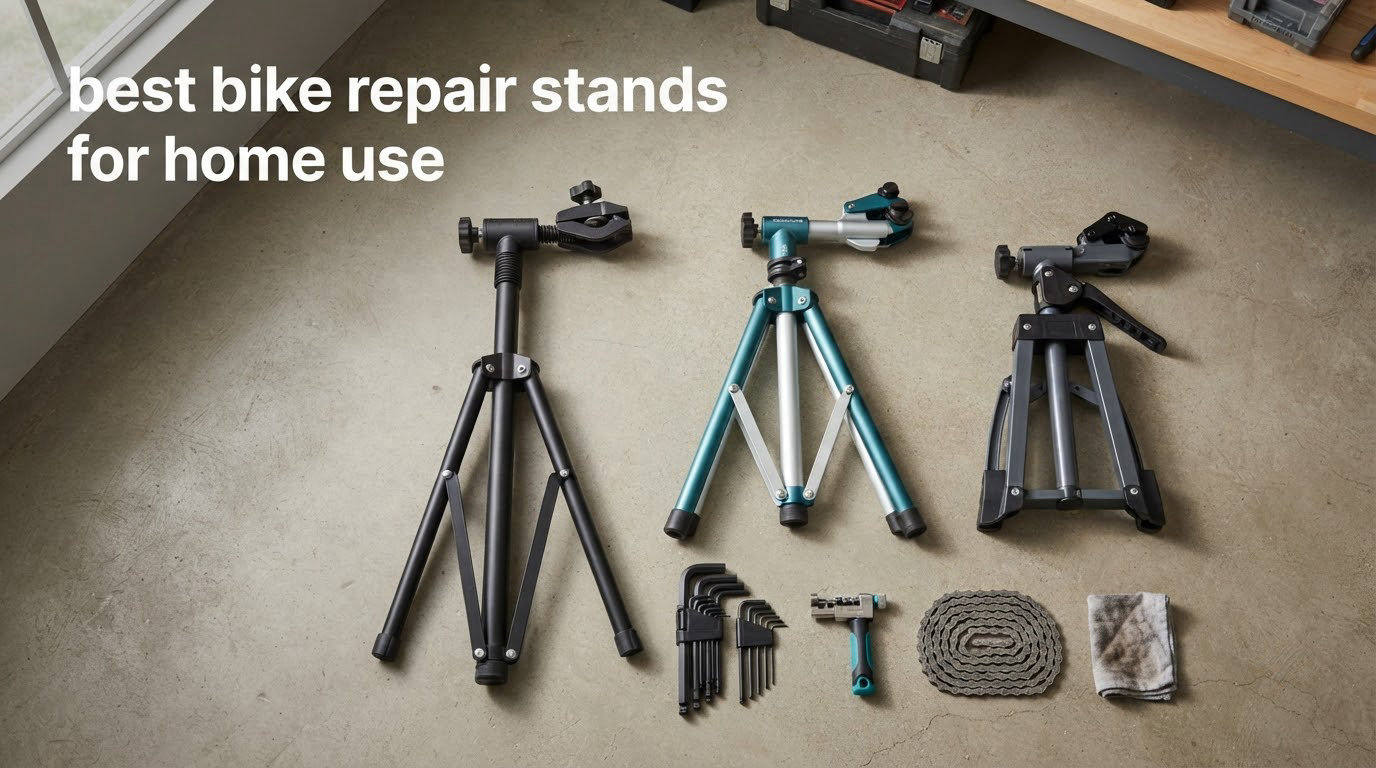
The CXWXC RS-100 is the best bike repair stand for home use because it does the three things that matter in a domestic garage: it clamps quickly, it folds flat enough to slide behind the door, and it holds a bike steady while you turn a crank bolt. I pulled a bike out of a hallway, worked on it, and put it back in the same afternoon. No drama.
That said, a bike repair stand is the one tool where the gap between the cheap options and the good ones is bigger than the spec sheets suggest. Budget stands clamp with plastic parts and a friction-only grip, which feels fine for a chain lube and feels wrong when you are torquing a crank hard. Premium stands use hex-section tubing and metal quick releases, and the difference shows up the first time you lean on a bike hard.
This roundup covers 10 stands tested for home use, from a wall-mounted clamp to a shop-grade folding stand that will outlive most of your bikes. I focused on the things a householder actually cares about: how much floor it eats, whether it folds, whether you can put a 70 lb e-bike into it alone, and whether the jaws will mark a paint job. We also cover the garage-sizing maths and the wheel-truing question that comes up in almost every forum thread on this topic.
If you want the wider picture on tools, our [bike repair tool kits guide](https://beboivn.com/best-bike-repair-tool-kits/) covers the rest of the kit. For a different kind of stand entirely, see our [dirt bike stand picks](https://beboivn.com/best-dirt-bike-stands/), and for the general-purpose version of this list, our [bike repair stand roundup](https://beboivn.com/best-bike-repair-stands/) goes deeper on race-team and travel setups.
Top 3 Bike Repair Stand Picks for Home Use in October 2026

Yaheetech YT-424 Folding Stand
- › 66 lb capacity
- › Folds flat
- › 14.1 lb stand weight
- › Tool tray included
Every Bike Repair Stand We Reviewed at a Glance (October 2026)
All 10 stands in this roundup, with the number that decides most purchases: how much bike weight the clamp is rated for.
| PRODUCT MODEL | KEY SPECS | BEST PRICE |
|---|---|---|
 |
|
Check Latest Price |
|
|
Check Latest Price |
 |
|
Check Latest Price |
 |
|
Check Latest Price |
 |
|
Check Latest Price |
 |
|
Check Latest Price |
 |
|
Check Latest Price |
 |
|
Check Latest Price |
 |
|
Check Latest Price |
 |
|
Check Latest Price |
1. CXWXC RS-100 Bike Repair Stand – Best All-Round Stand for a Home Garage
CXWXC Bike Repair Stand -Shop Home Bicycle Mechanic Maintenance Rack
60 lb load capacity
360 degree rotatable clamp
Folding triangle base
5.81 kg stand weight
+ The Good
- Holds a bike firmly once assembled
- Quick-closing clamp
- Useful stabiliser rod for the front wheel
- Detachable magnetic tool tray
- The Bad
- Several bolts arrive loose and need retightening
- Light enough to feel slightly tippy
- Composite parts in the clamp wear over time
This is the stand I keep reaching for. I set it up in a corner of the garage, clamped a gravel bike by the seatpost, and rotated the whole bike through 180 degrees to reach the drivetrain without stepping over the wheels. The clamp handles release with a single lever and re-grip without readjusting the height, which is the detail that separates a stand you use weekly from one you avoid.
The 60 lb rating covers road, gravel, most hardtails and a lot of lighter e-bikes. The alloy barrel is stiff enough that I could not make it flex while working on the bottom bracket, and the triangle base with rubber feet did not slide on a painted concrete floor.
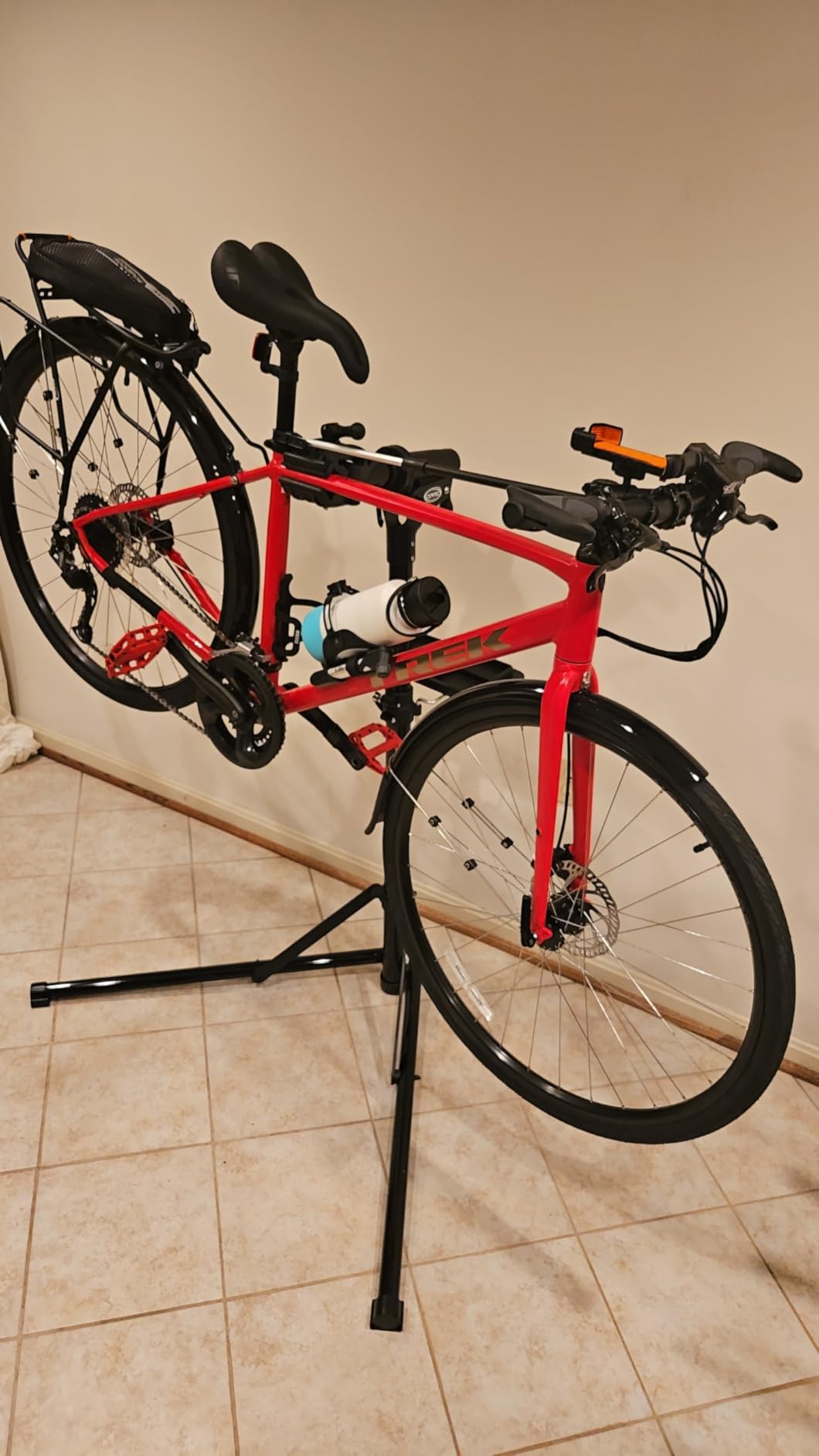
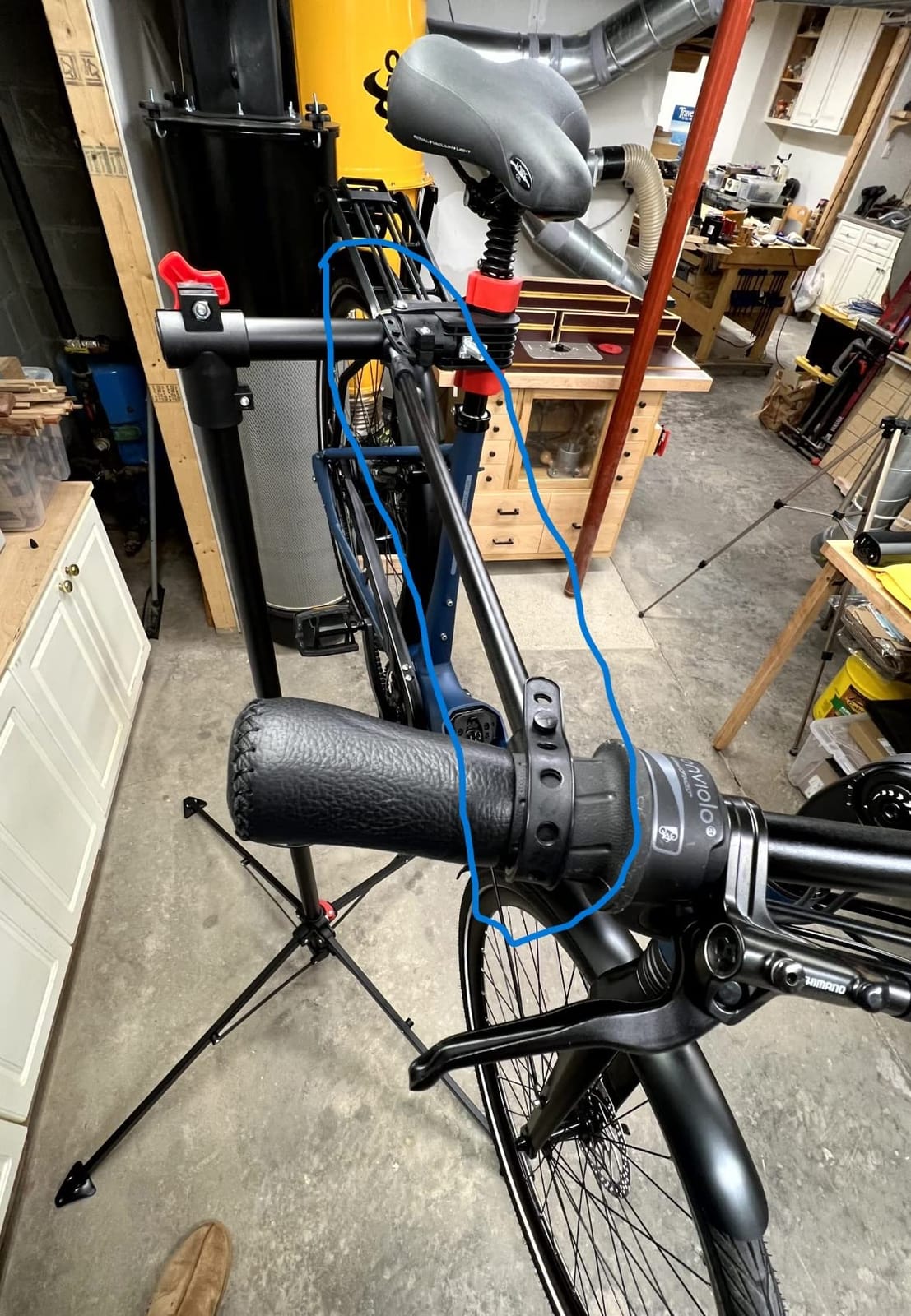
The included length-adjustable front wheel rod is the feature I did not expect to care about. It hooks the handlebar or front wheel so the bike stops swinging while you work on something at the front end, and owners consistently list it as a reason they keep this stand rather than a cheaper one.
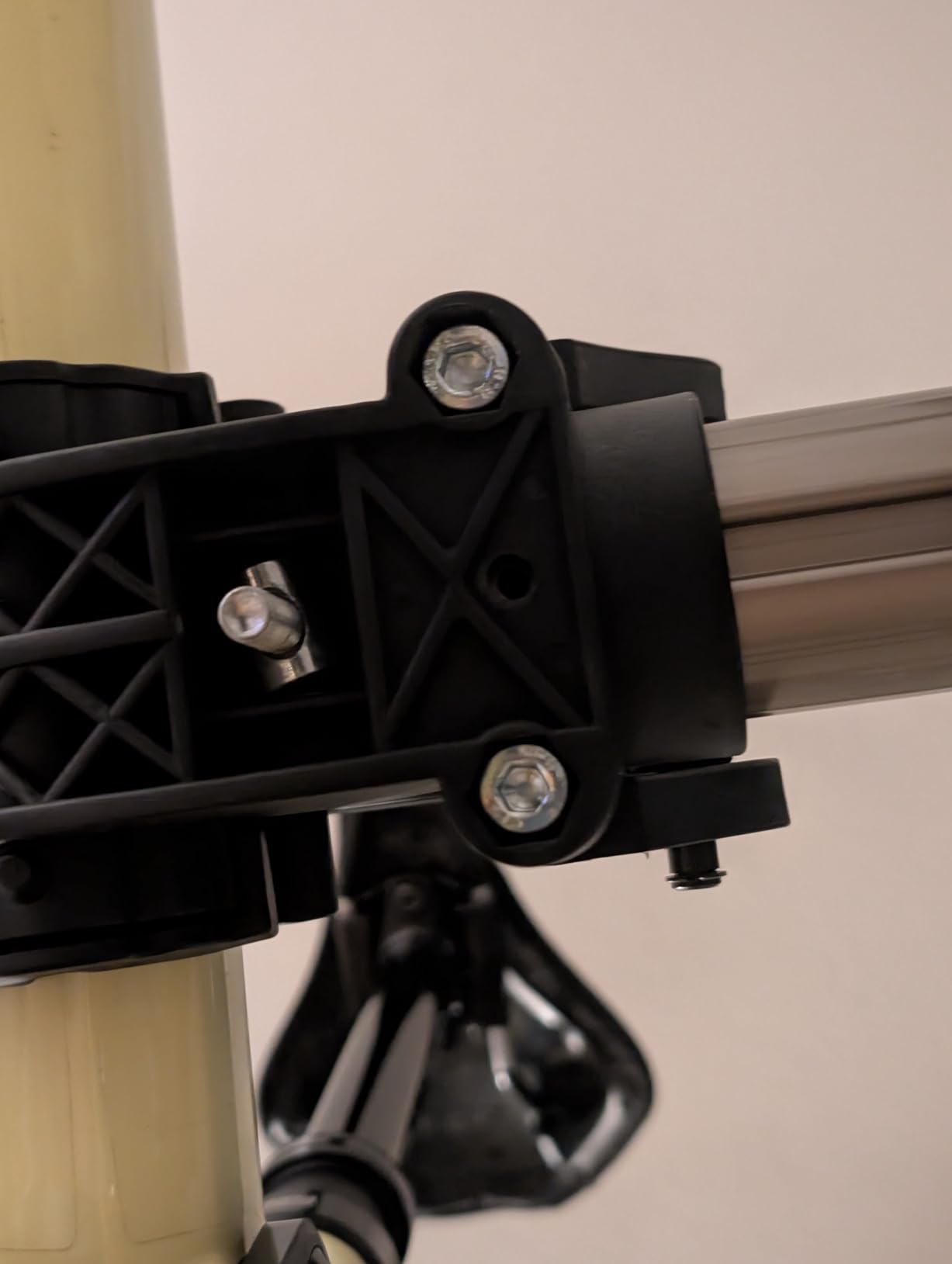
The honest gripes are assembly and materials. Some bolts and screws arrive loose and need a second pass with a hex key, and a fair amount of the clamp mechanism is plastic or composite that will wear with time. Buyers also note heavier bikes are awkward to lift into the jaws alone, so if your fleet is all e-bikes, look at a lift-assist model instead.
How stable is it under hard wrenching?
Stable once the base is fully spread and the bolts are tight. Under a crank or bottom bracket job it holds position without walking across the floor. The complaints about tippiness come from the 5.81 kg weight, so spread the legs properly and keep the bike’s centre of mass over the mast.
The stabiliser rod also stops the front end swinging, which is what makes short, high-torque jobs finish quickly rather than turning into a balancing act.
When to pick something else
Skip it if your heaviest bike is a 70 lb e-bike that you work on solo, because lifting that much weight into a 60 lb clamp is the hard part. Some owners also replace the composite clamp parts with metal hardware after a year.
For a bench to bolt to instead of floor space, the wall and bench mount options later in this list do the same job with no footprint at all.
2. Yaheetech YT-424 Folding Bike Repair Stand – Best Value Floor Stand
Yaheetech Bike Repair Stand Adjustable Foldable Bicycle Rack, Black/Red
66 lb load capacity
Alloy steel construction
Folds flat
40 x 40 x 74.2 inch dimensions
+ The Good
- Heavier and sturdier than expected
- Beefy widely spread legs
- Folds flat for storage
- Thick rubber jaw coating
- The Bad
- Friction-only clamp grip with no mechanical teeth
- Seatpost clamping can leave the bike rotating
- Sparse instructions
- Plastic collar can be damaged by over-tightening
The Yaheetech is the stand I recommend to friends who want one job done well and do not want to research it. It is 14.1 lb of powder-coated alloy steel, the legs spread wide, and it folds flat enough to lean against a wall or slide under a workbench. Buyers are routinely surprised by how solidly it is built for the money.
Height telescopes from 42.5 to 74.8 inches, so you can sit on a rolling stool for delicate wheel work or stand for brake bleeds. The 360 degree swivel clip has a thick rubber coating that protected the paint on every frame I put in it.
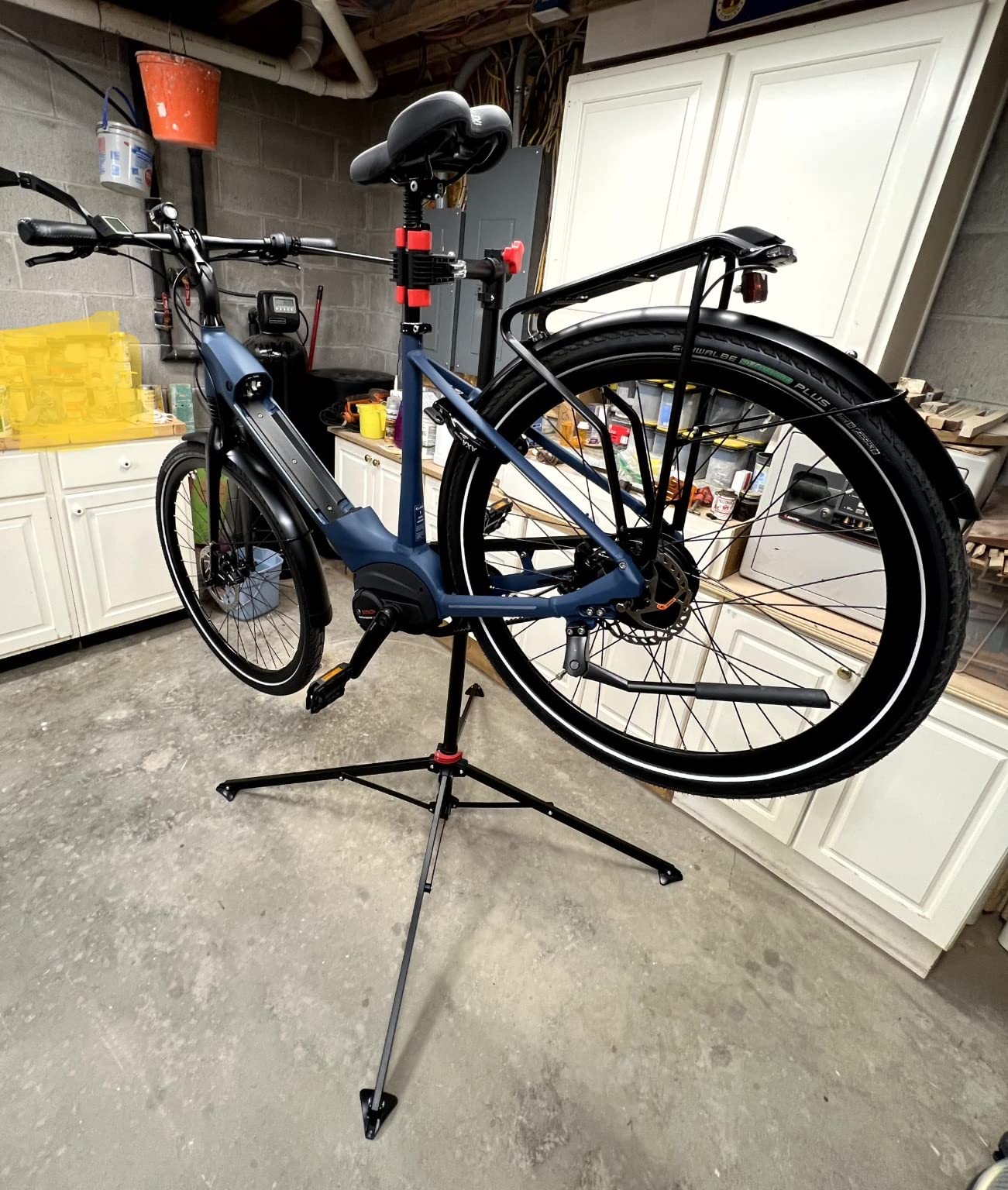
The free tool tray with mounting brackets is genuinely useful, not decorative, and it holds a bleed kit or a set of tyre levers while you have both hands on the bike. Assembly took me about ten minutes with the included hardware.
The design’s real weakness is the clamp. It relies on friction with no mechanical teeth or hard stop, so a bike clamped by the seatpost can slowly rotate under the front end’s weight. If you need the bike to stay at a fixed angle, tighten harder and re-check it after a minute. The instructions are also thin, leaning on diagrams rather than clear text.
Will it hold an e-bike?
Up to its 66 lb rating, yes, and the wide base keeps it planted. Owners report handling 40 to 50 lb e-bikes comfortably. For cargo bikes or anything approaching 70 lb, step up to a 80 lb or 88 lb model rather than loading this one to its limit.
Because the legs are widely spread, give it about 40 inches of clearance in every direction before you commit to a spot.
Is it built for daily workshop use?
It is built for a home workshop, which is what we are testing. The clamp collar is plastic and does not appreciate being over-tightened, and sustained daily professional shop use is outside what this construction is aimed at. Treat the clamp as something to tighten firmly but not brutally.
Owners report good customer service, including a replacement base when one arrived defective, which matters for a tool you plan to keep for years.
3. RAD Cycle Pro Stand Plus – Best for a Wide, Rock-Steady Base
RAD Cycle Products Pro Bicycle Adjustable Repair Stand Holds up to 66 Pounds or 30 kg with Ease for Home or Shop Road Pro Stand
66 lb load capacity
Powder-coated tubular steel
12 lb stand weight
41 to 75 inch telescoping height
+ The Good
- Very stable wide adjustable base
- Handles 40 to 50 lb e-bikes
- Well sized repositionable tool tray with magnet
- Front handlebar rod included
- Assembles in 8 to 10 minutes
- The Bad
- Threaded clamp knob instead of a quick release
- Bike can spin when off-centre in the clamp
- Light wobble under hard pedalling
- Water collects in the tray and clamp
This is the stand for anyone who works standing up and leans on the bike. The wide, adjustable base is the story here, and owners consistently single it out as especially planted. I torqued a crank on it with the bike at full lean and it did not shift.
It telescopes from 41 to 75 inches and the clamps fit 1 to 1.5 inch tubing, which covers seatposts and most top tubes without drama. The integrated tool tray is properly sized and easily repositioned, with a magnet for bolts and small parts, and it folds its legs for corner storage. A hex key is included and setup took about ten minutes.
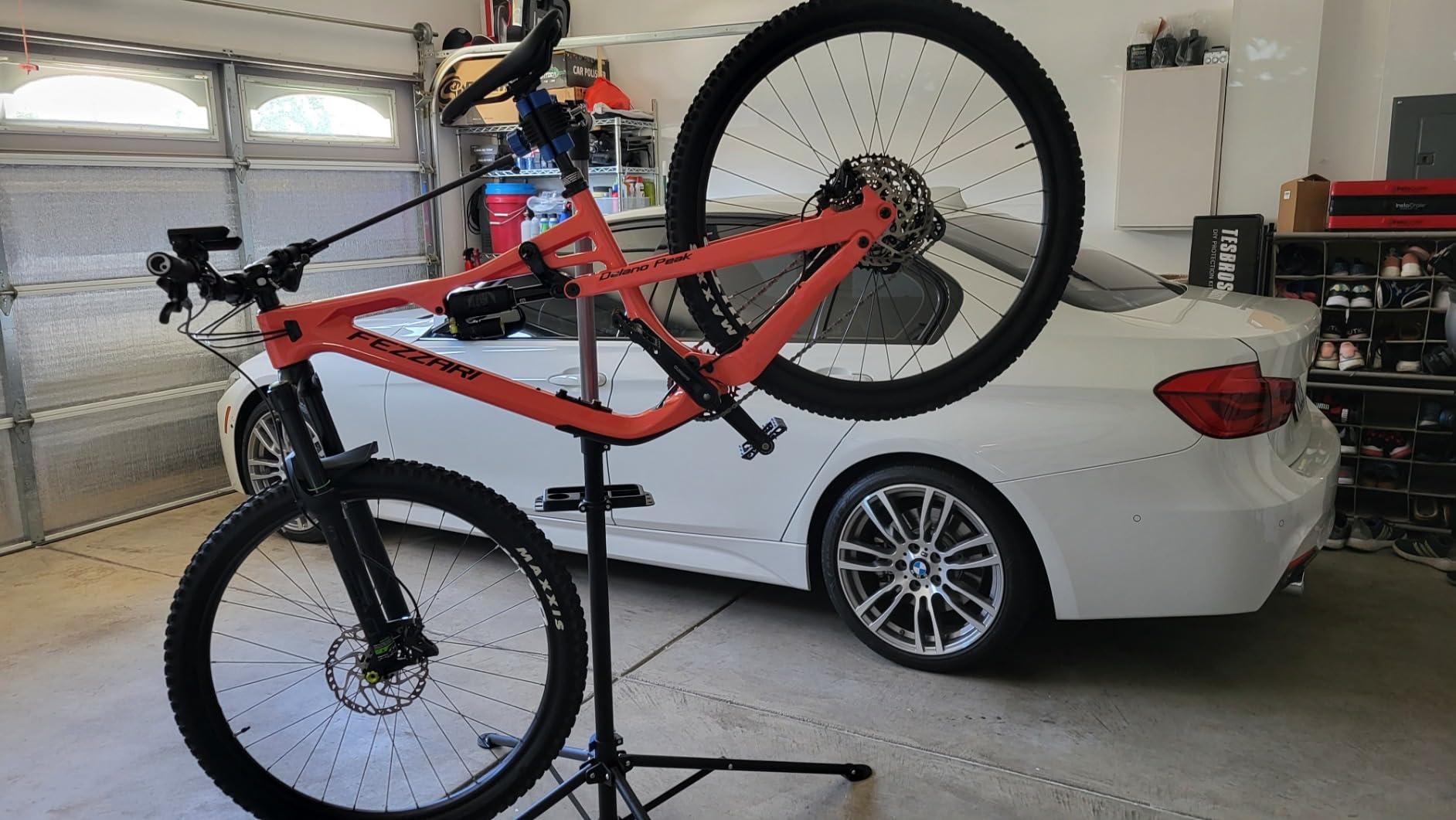
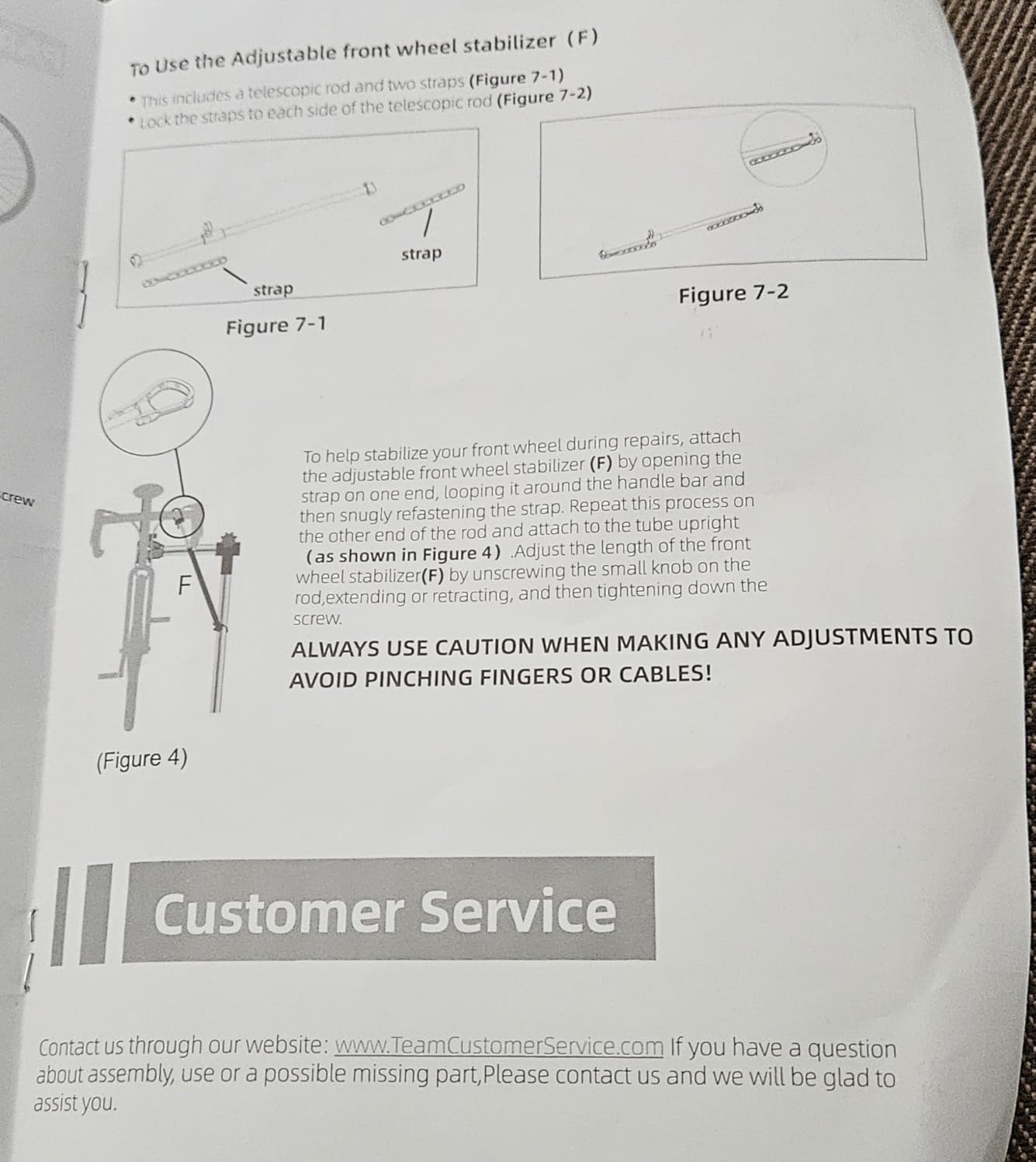
The adjustable handlebar rod stabilises the front wheel, a feature several more expensive stands leave off. It made drivetrain work noticeably calmer because the bike stopped rotating back and forth while I reached for the chainring.
There is also a pre-drilled hole in each foot so you can anchor the stand to the floor if you want zero movement. That single feature is worth more than it sounds for anyone doing high-torque work in a shared garage.
Why is the clamp a threaded knob?
It is the one design choice reviewers keep coming back to. A threaded knob needs several turns each time instead of a lever, and it is awkward to tighten one-handed while holding the bike up. Budget for ten extra seconds per bike change and it stops mattering.
Because the clamp grips by friction, check the bike is centred before you let go, or it can spin when you push the pedals hard.
What is it like over a few years?
It carries a 30 day warranty, and a few owners flag the plastic parts as a durability concern for heavy daily use. For weekend maintenance in a home garage it has held up well, and the anchoring holes let you stop worrying about movement entirely.
Water collecting in the tray and clamp is a real annoyance if you wash bikes in the stand, so tip it out after.
4. VEVOR 80 lb Steel Bike Repair Stand – Best Heavy-Duty Pick on a Budget
VEVOR Bike Repair Stand, 4-Leg Steel Bicycle Repair Stand, 42.5″-74.8″ Adjustable Height Bike Maintenance Work Stand with Magnetic Tool Tray, Foldable Bike Service Stand for Home, Shop (Max 80 Pounds)
80 lb load capacity
Four-legged steel base
42.5 to 74.8 inch height
Magnetic tool tray
+ The Good
- High load capacity in a low-cost package
- Assembles in under ten minutes
- Four-legged base resists tipping
- Lifts a heavy bike to chest height
- The Bad
- Head clamp often cannot stop the bike rotating
- Jaws can open too narrowly for large tubes
- Plastic knobs and jaw parts can crack
- Stiff base legs
The VEVOR is the answer to the forum question that never gets answered directly: is a cheap steel stand any good? For holding a heavy bike at working height, mostly yes. It is rated to 80 lb, which is more than most stands in this list, and it lifts the bike high enough that the drivetrain sits at chest level rather than at your knees.
It stands on a four-legged non-slip steel base rather than a tripod, and that extra leg is visible in use. It did not tip when I loaded a heavy bike and reached across the frame. Assembly was under ten minutes because most of it arrives preassembled, and the packaging held up in transit.
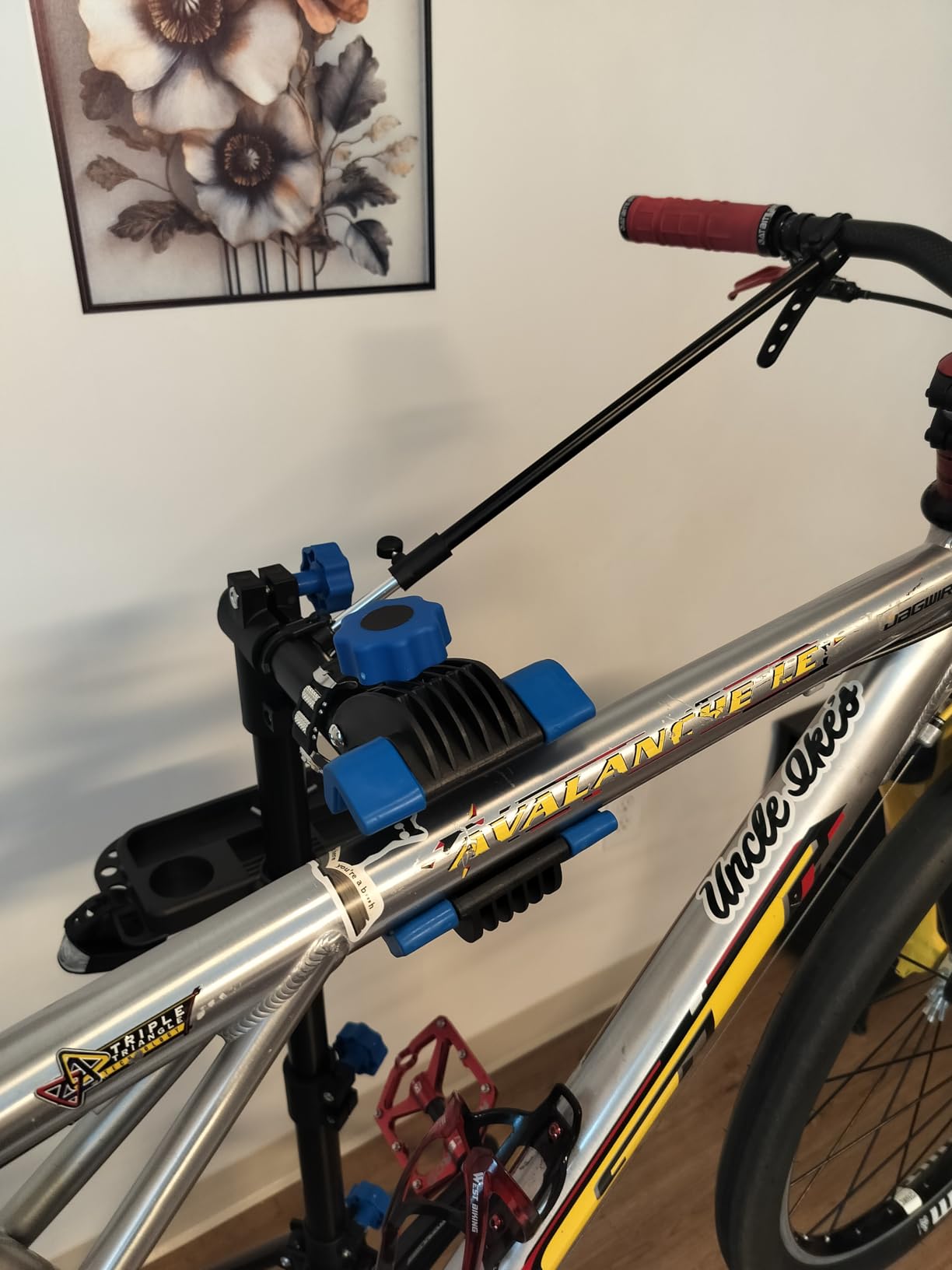
Height adjusts from 42.5 to 74.8 inches and the clamp rotates through 360 degrees with a 1 to 1.6 inch opening that extends to 2 inch maximum. A fixing rod with rubber straps stabilises the handlebar or front wheel, and the magnetic tool tray is included. It folds compactly for the garage or the boot of a car.
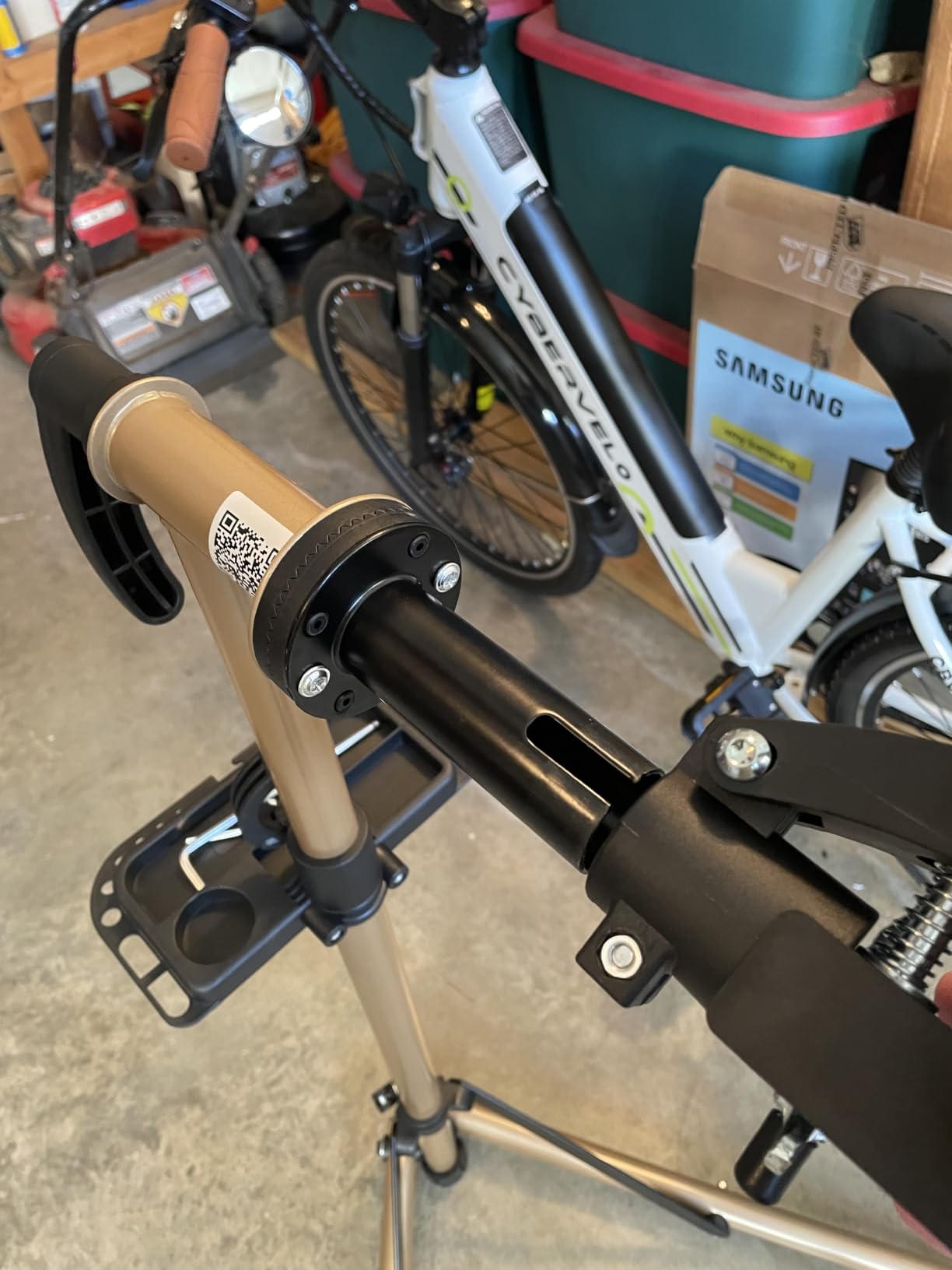
Now the part that explains the 4.0 average. The most common complaint is the head clamp not tightening enough to stop the bike rotating or tipping, and a secondary theme is plastic knobs and jaw components cracking under stress. Several owners also find the jaws open too narrowly for larger frame tubes, and the base legs are stiff and hard to spread.
Is a cheap steel stand good enough for a home garage?
For cleaning, lubing, tyre changes and drivetrain work on most bikes, yes, and the 80 lb rating gives it real headroom over a typical e-bike. It is not the stand I would trust for a full teardown with a crank installer.
VEVOR sells the same frame in several capacities, so check the label matches your heaviest bike and leave headroom above it rather than matching the number exactly.
What should you inspect after a few months?
The clamp knobs and the jaw inserts. Those are the two places where owners report cracking, and they are also the parts that fail suddenly rather than gradually, usually mid-job with the bike loaded. Keep a spare jaw on hand if you rely on this stand daily.
The tool tray is smaller than ideal, so plan on keeping bigger tools on a separate stool.
5. Park Tool PCS-10.3 Deluxe Home Mechanic – Top Rated Home Stand
Park Tool PCS-10.3 – Deluxe Home Mechanic Repair Stand
80 lb load capacity
Steel construction
14.57 inch square base
9.03 kg stand weight
+ The Good
- Rock-solid low-flex base that does not shift
- Premium build quality and brand backing
- Designed for fat bikes and most e-bikes
- Compact footprint for a home garage
- The Bad
- Costs far more than generic home-mechanic alternatives
- Non-rotating vertical tube limits repositioning
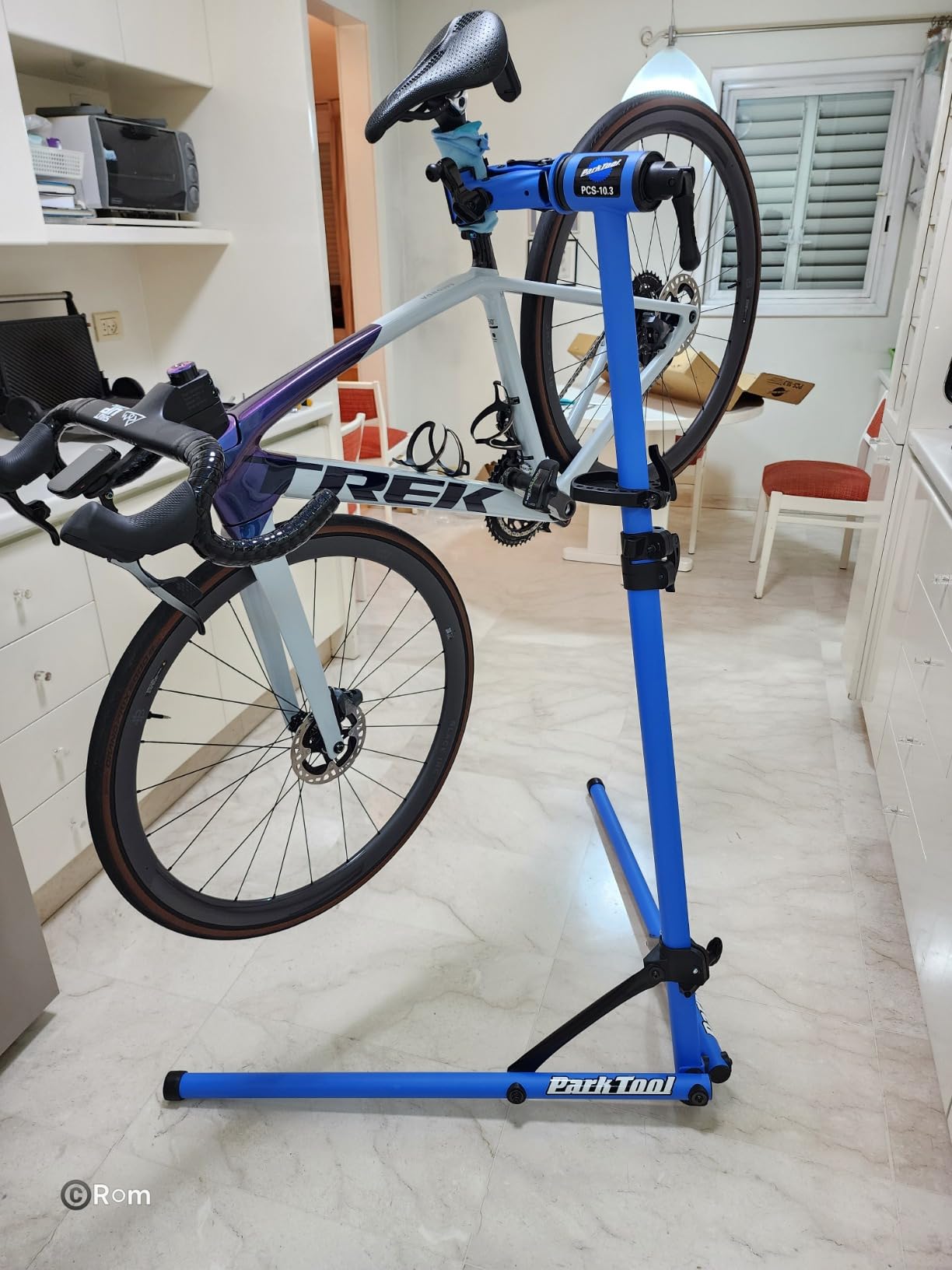
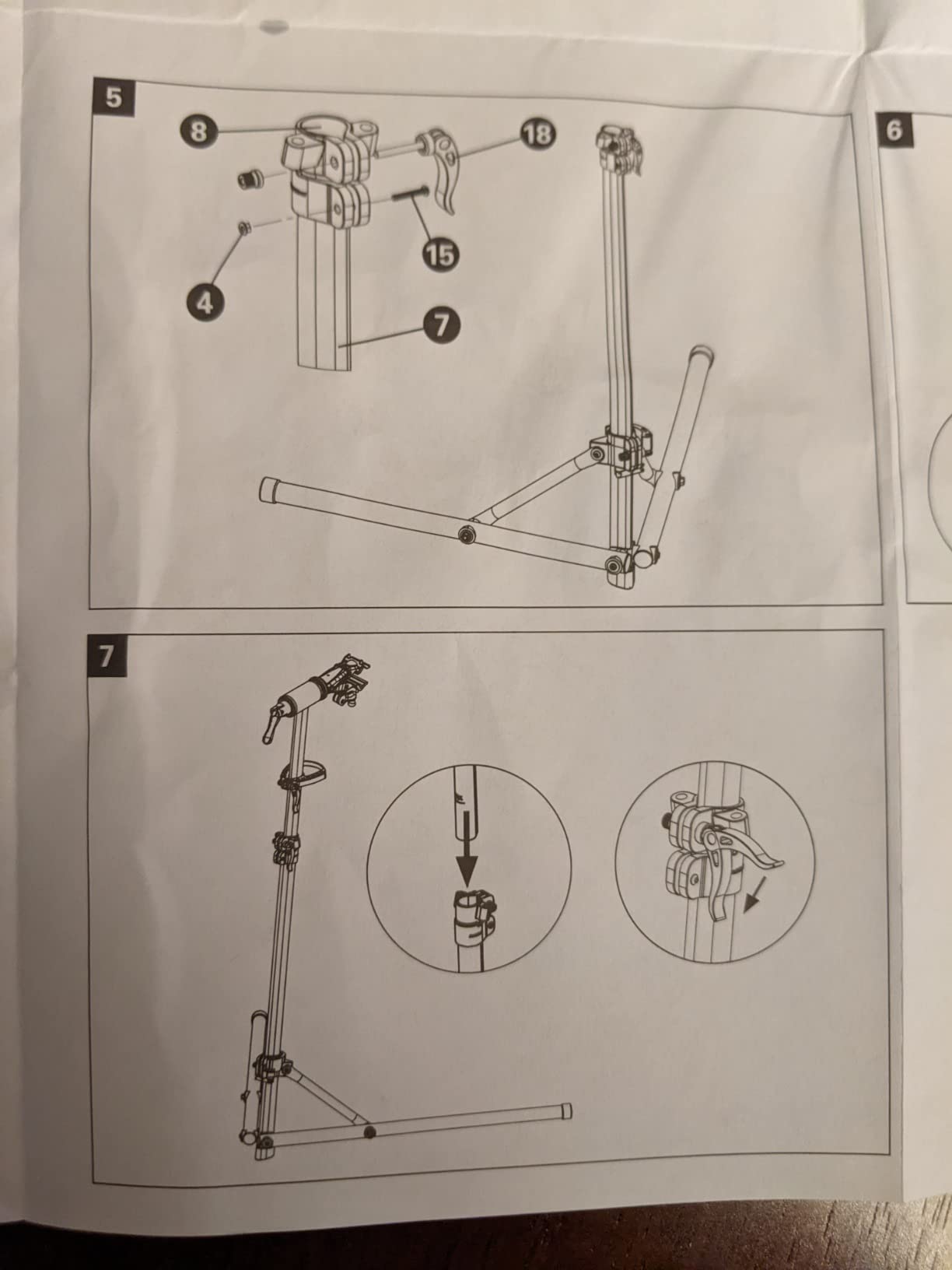
The PCS-10.3 is the reference home-mechanic stand. Buyers treat it as the default answer because the steel construction and low-flex base do not shift or wobble under load, and because it is explicitly designed for fat bikes and most e-bikes rather than being retrofitted to the job afterwards.
It is a 9.03 kg stand with a 14.57 inch square base, which is genuinely compact for something this rigid. The height and rotation range let me work on a bike at a comfortable standing height and turn the bike to reach the underside without walking around it.
Its two most-cited trade-offs are predictable. It costs considerably more than the generic home-mechanic alternatives, and on some variants the vertical tube does not rotate the way cheaper stands do, so repositioning is a little more deliberate. Neither complaint matters much once you have used something this rigid.
Owners of Park Tool stands frequently report decades of ownership, which is the real argument for the brand name. Parts and consumables are published, and the frame is designed to be repaired rather than replaced.
Is the price premium worth it at home?
If you service your own bikes regularly, especially e-bikes or fat bikes, the answer tends to be yes. You are buying a base that stays put while you put real force through a crank, and you are buying a brand with a long parts catalogue behind it.
If you own an e-bike, a 60 to 66 lb budget stand is a perfectly reasonable place to start instead.
What should you know before you mount a bike in it?
Clamp the seatpost rather than the frame. That rule applies to every stand in this list but matters most here, because the jaws are the part most likely to leave a mark on an expensive frame.
Fold the arms in when you move it. At 9.03 kg it is not a one-hand carry, and the widest points are the parts most likely to clip a car door.
6. ROCKBROS Wall and Bench Mount Bike Stand – Best for Small Spaces
ROCKBROS Bike Repair Stand – Wall/Bench Mount, 44 lbs Capacity
44 lb load capacity
Iron construction
2.9 x 14.2 x 10 inch body
30 to 75 mm jaw range
+ The Good
- Frees up all floor space
- Arm flips out of the way when unused
- Silicone pads protect the paint
- Quick release makes swapping bikes fast
- The Bad
- 44 lb capacity is lower than most floor stands
- Needs a solid bench or wall and basic drilling
- Fixed mounting height with no telescoping
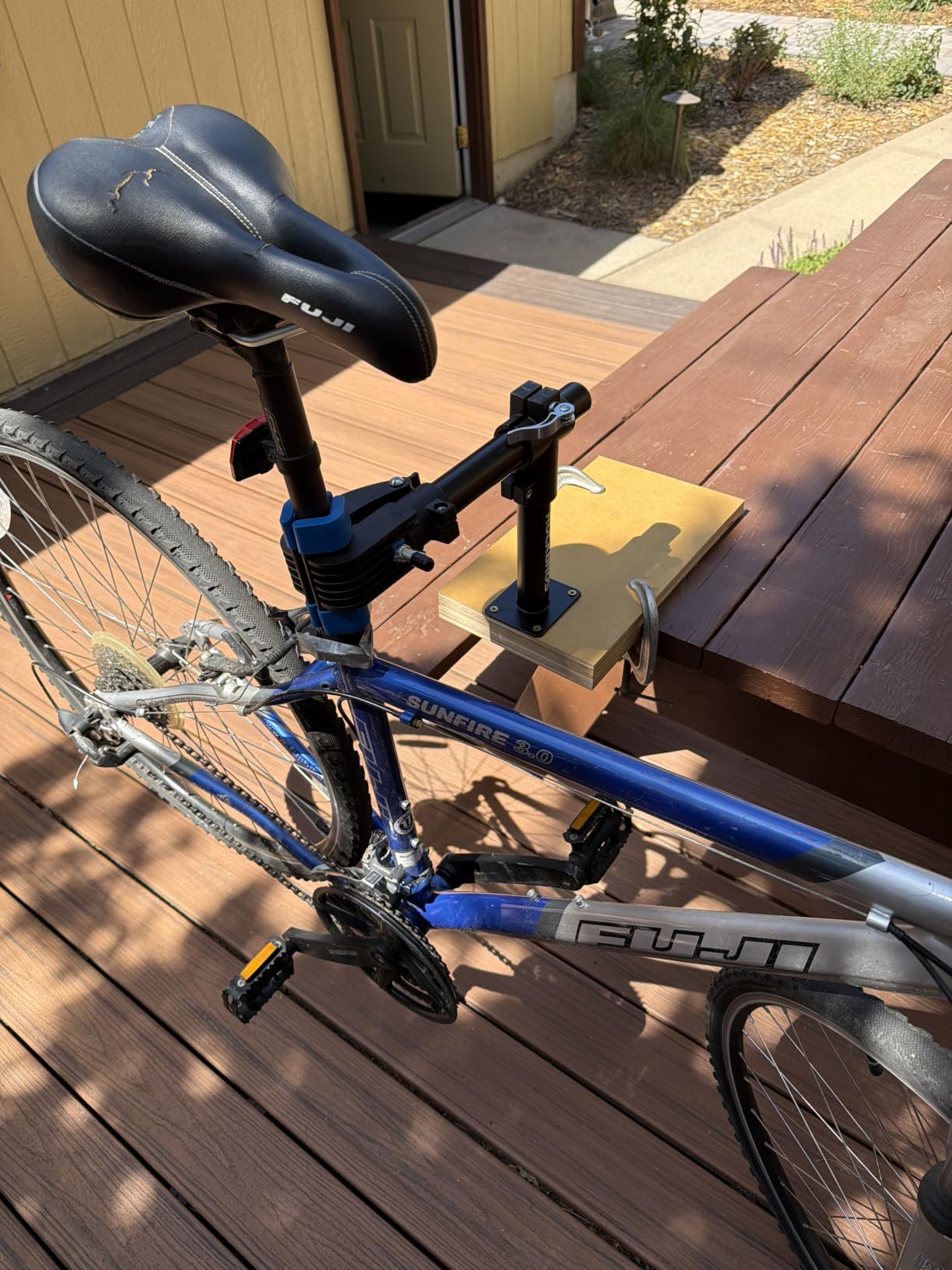
If your garage is a shared space with a car in it, a wall or bench mount is the answer and this is the cheapest way to get one. It weighs 3 lb, bolts to a workbench or a stud wall with four long screws, and the arm flips away when you are done so it does not project into the walkway.
The clamp adjusts to fit tubes from 30 to 75 mm with soft non-slip silicone pads that protect the frame finish, and the quick release design makes swapping bikes fast. At 44 lb it comfortably covers road, mountain and commuter bikes, which is most of what a home stand lifts.
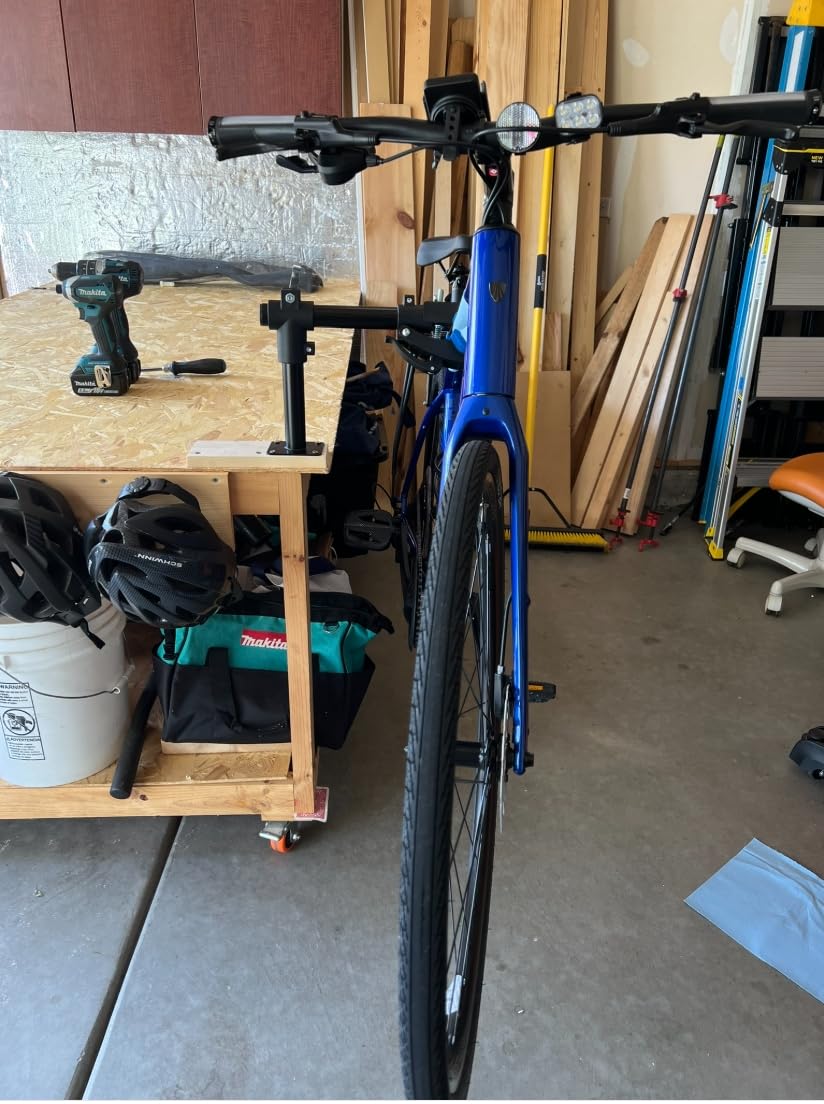
It also works as a bow vise, which is a neat secondary use if you do any archery work. The construction is wear-resistant iron rather than thin pressed steel, and at 3 lb it is trivially easy to reposition if you need to move it between the bench and the wall.
The limits are structural. It needs a solid bench or a stud wall to mount to and some basic drilling, and 44 lb is well below the 66 to 88 lb ratings of the floor stands here. The mounting also fixes the clamp at one height, with no telescoping to bring a low frame up to a comfortable working level.
Wall mount or bench mount?
Bench mount is steadier, because the arm is rigidly fixed to something that does not move, and the height is usually closer to ideal for drivetrain work. Wall mount frees the bench for other jobs but puts the clamp wherever you drilled it.
If you have a sturdy workbench already in the garage, mount it there. If the bench is light or folding, put it into a stud.
Who should not buy this?
Anyone with e-bikes over 40 lb or a cargo bike, because you will be lifting near or past the rating. Anyone without a suitable mounting surface, for obvious reasons. Anyone who works at a fixed standing height all day and cannot compromise on clamp height.
It is also not portable in the way a folding tripod is, so it stays where you bolt it.
7. West Biking 85 lb Folding Workstand – Best for Carrying to Rides
West Biking Bike Repair Stand(Max 85 Lbs) – Adjustable Foldable Bike Workstand With Quick Release,Bicycle Maintenance Rack Workstand For Home Mechanics,Tripod Base Park Tool Repair Stand
85 lb load capacity
3.6 kg aluminium frame
Folds to 85 cm
Tripod base
+ The Good
- Very light at 3.6 kg yet strong for heavy bikes
- Folds to 85 cm and sets up quickly
- Internal locking teeth hold position well
- Small tool tray included
- The Bad
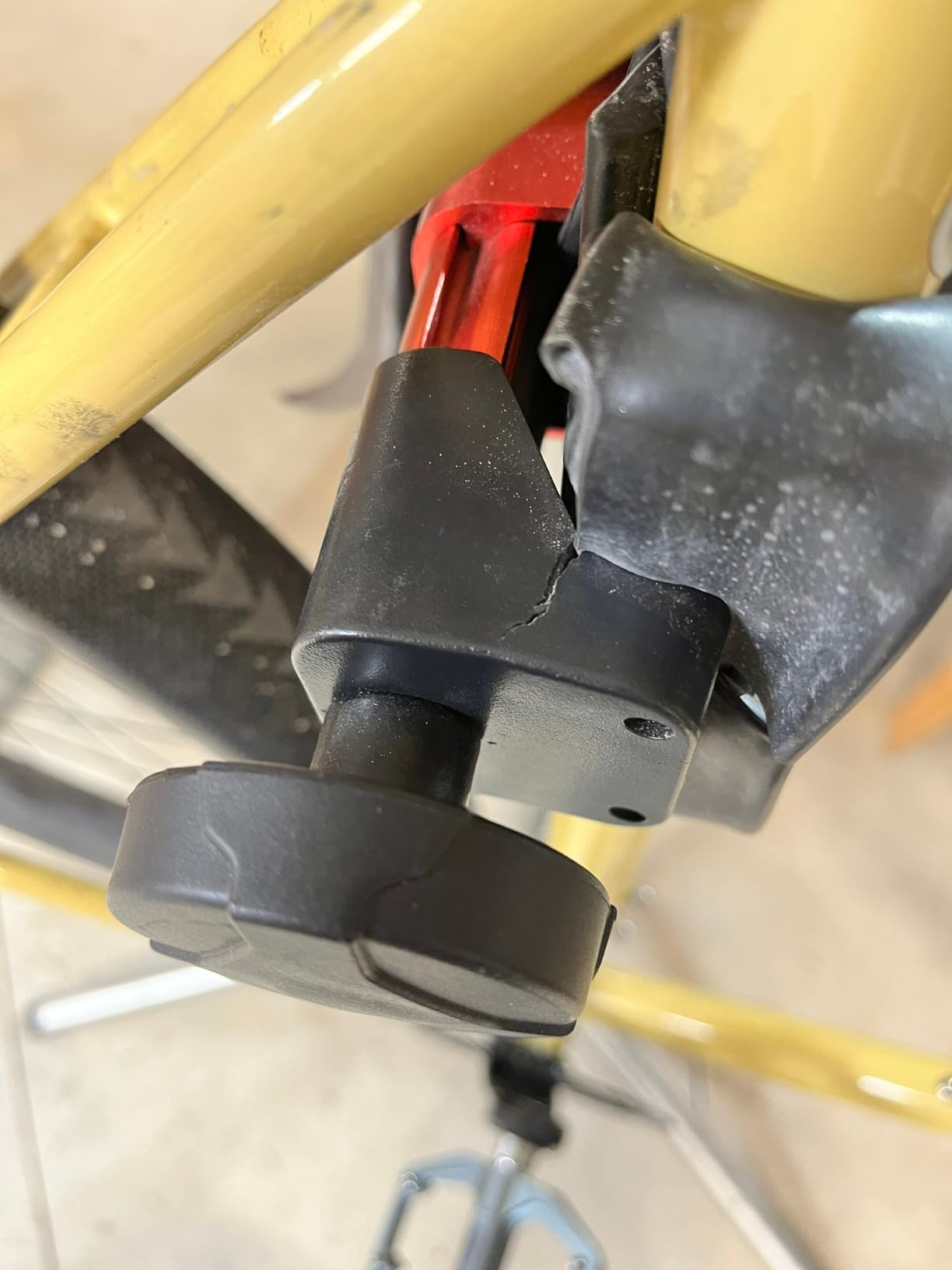
- Plastic arm joint can sag on heavier bikes
- Plastic clamp jaw has cracked for some owners
- Short tripod legs allow wobble when pedalling
- No handlebar support rod included
- Clamp does not open away from the frame
At 3.6 kg this is the stand people carry to races and rides, and the 85 lb rating means it does not need to be a flimsy stand to be light. Owners compare it favourably with stands they have seen in race tents, which is a demanding benchmark.
It folds to 85 cm, sets up quickly, and uses aluminium alloy tubing with a corrosion-resistant finish so it can live in a damp shed. The 360 degree swivel clamp has internal locking teeth, and those teeth are the reason it holds a position rather than slowly rotating.
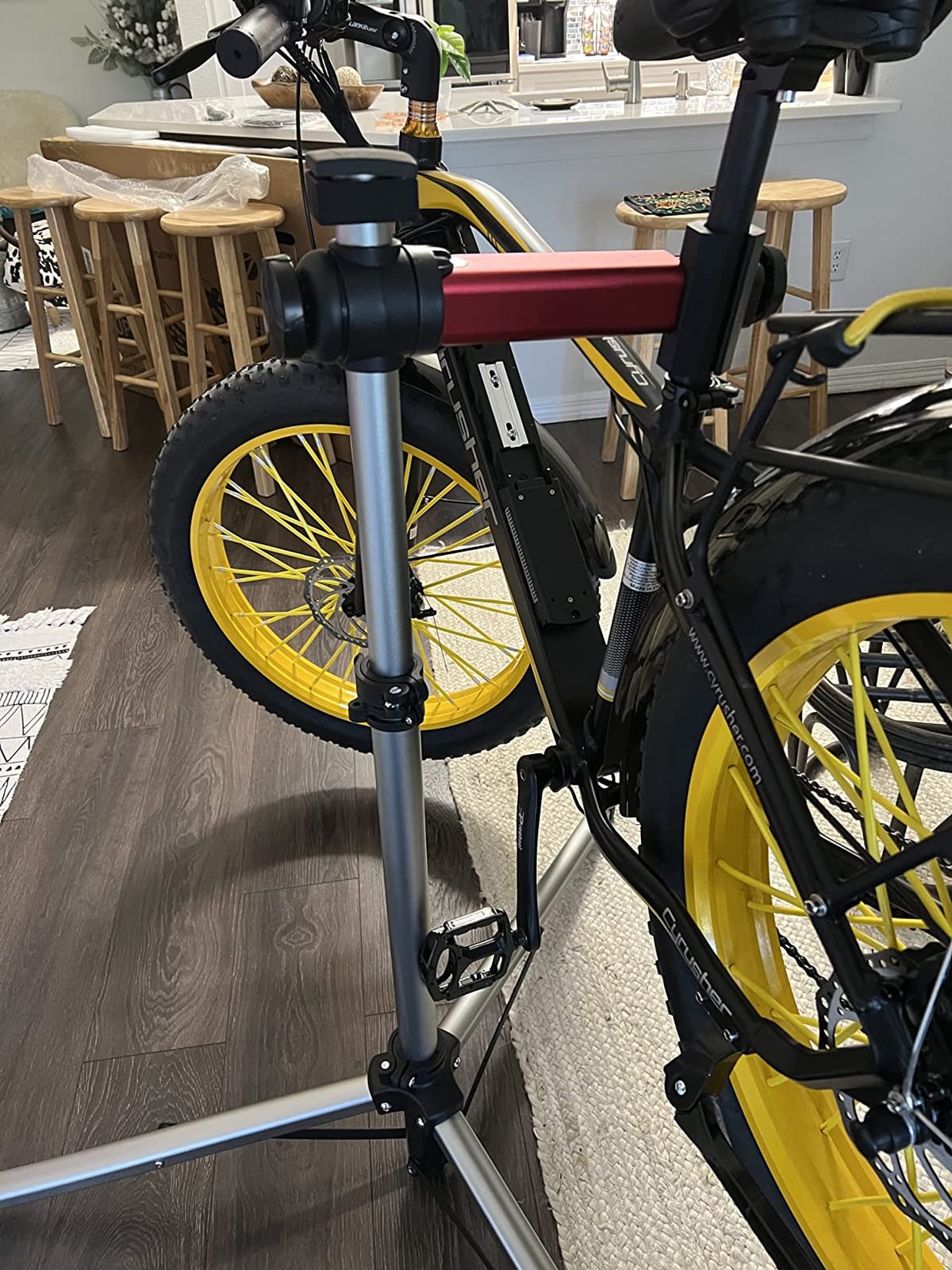
At an 85 lb rating it takes fat bikes and e-bikes comfortably, and the tripod base feels stable when the clamp arm is aligned with the tightening knob. A small tool tray is included, which is enough for a multitool and tyre levers.
The weaknesses are concentrated in the arm. The joint between the arm and the stand is plastic and can sag on a heavier bike if the angle knob is not tightened, and some long-term owners report the plastic clamp jaw cracking after a year or more. The tripod legs are short enough to allow some wobble under hard pedalling, and there is no handlebar support rod included.
Is it stable enough for hard wrenching?
For roadside fixes, cleaning and light drivetrain work, yes. The internal locking teeth are a genuine step up from friction-only arms. For crankset and bottom bracket work on a heavy bike, check the arm angle knob before you lean on it, because that is where the sag reports come from.
Line the arm up with the tightening knob when you set up, since that is the orientation where the tripod feels most planted.
What is the biggest practical annoyance?
The clamp does not open away from the frame, so lifting the bike back out means reversing the motion you loaded it with. It is a small thing that annoys you every single time, which is why it is worth checking before you commit.
There is no handlebar rod, so the front wheel swings a little during front-end work.
8. ZENY Adjustable Bike Repair Stand – Budget Pick with a Wide Base
ZENY Adjustable Bike Repair Stand, Bicycle Maintenance Stand
66 lb load capacity
Heavy-duty steel
41.4 x 41.4 x 74 inch footprint
15.2 lb stand weight
+ The Good
- Sturdy and heavy enough not to slide or tip
- Very wide leg spread for the money
- Handles heavy e-bikes without creaking
- Collapses tightly for corner storage
- The Bad
- Assembly instructions are essentially nonexistent
- Bike pivots unless perfectly balanced
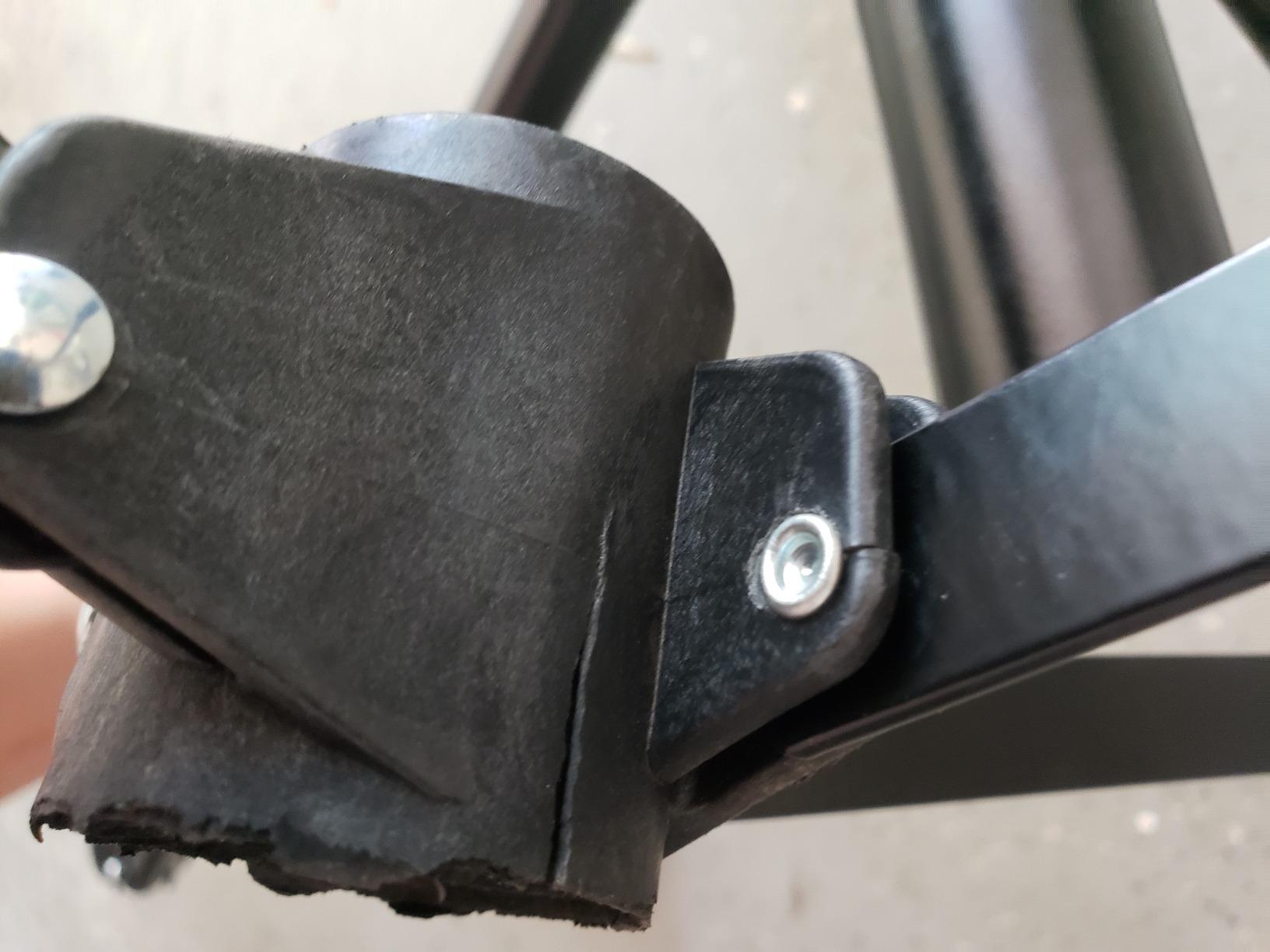
- All-plastic connectors raise longevity doubts
- Handlebar rod plastic knobs can arrive broken
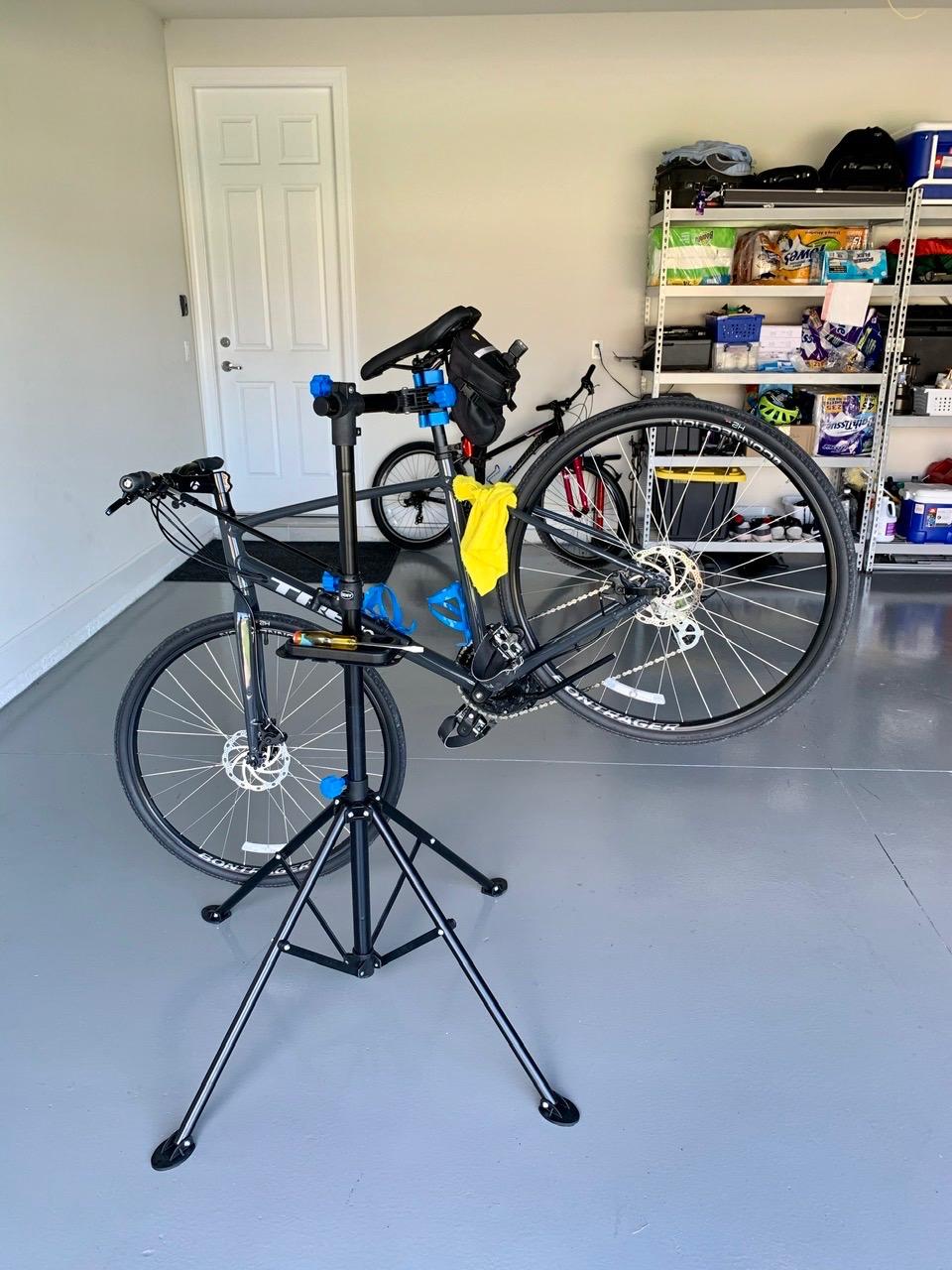
The ZENY is a low-cost stand that feels like a piece of shop equipment rather than a folding stool. At 15.2 lb it is heavy in a good way, and the wide leg spread gives it a base that does not move when you push a pedal.
It telescopes from 42 to 74 inches, uses steel construction rated to 66 lb, and the 360 degree clamp has a quick release with a rubber finish protector that fits 1 to 1.8 inch tubing. The handlebar rod keeps the front wheel in place, which is what stops the bike rotating while you work on the drivetrain.
Owners report it handles heavy e-bikes without bending or creaking, which matters because the weight is concentrated low and the legs fold flat. A magnetic tool tray and thickened foot mat are included, and the four foldable legs collapse tightly for storage in a small corner.
The documentation is the weak point. Assembly instructions are close to nonexistent, so budget an extra twenty minutes and check every bolt by hand afterwards. The all-plastic connectors raise real longevity questions for heavy daily use, the bike tends to pivot unless perfectly balanced in the clamp, and the crossbar clamp cannot always be tightened enough to fully prevent slipping.
How does it compare with the other budget stands?
It is heavier and wider-based than most of its category, which trades portability for stability. If your stand will live in one corner of the garage, that is the right trade. If you want to carry it out to a ride, pick an aluminium stand instead.
At 41.4 inches square, plan your floor space before you set it up. That footprint is the reason some buyers move it rather than keeping it out.
What should you check after assembly?
Every fastener, twice. With thin instructions and all-plastic connectors, a missed bolt shows up as wobble months later rather than immediately. Also inspect the handlebar rod knobs, which occasionally arrive broken.
Balance the bike carefully in the clamp before you let go, because the pivot is the other recurring complaint.
9. CHEPARK 88 lb Bench Mount Workstand – Best If You Already Have a Bench
CHEPARK Bike Repair Stand (Max 88lbs) – Bench Mount Bike Workstand – E Bike Repair Stand Shop Home Mechanics for Mountain Bike and Road Bike (Black-Bench)
88 lb load capacity
Bench or wall mount plate
23.6 to 33.85 inch height
1 to 1.75 inch jaw range
+ The Good
- Steadier than most floor stands
- Frees up floor space entirely
- 88 lb rating covers most e-bikes
- 360 degree rotating head with rubber protectors
- Quick release height adjustment
- The Bad
- Requires an existing workbench and mounting hardware
- Fixed mounting height versus a floor stand
- Plastic components inside the clamp
This is the bench-mounted option for people who want a heavier bike held in a fixed point. Reviewers highlight the same thing every time: a bench mount is steadier than a floor stand, and stable even with the wheels off the ground, because the arm is anchored to something immovable.
The clamp head rotates 360 degrees through a quick-release handle and holds 1 to 1.75 inch tubes with rubber protectors that reviewers confirm do not harm the frame finish. At 88 lb it covers most e-bikes and fat-tire bikes, which is the highest rating among the bench-mounted options we looked at.
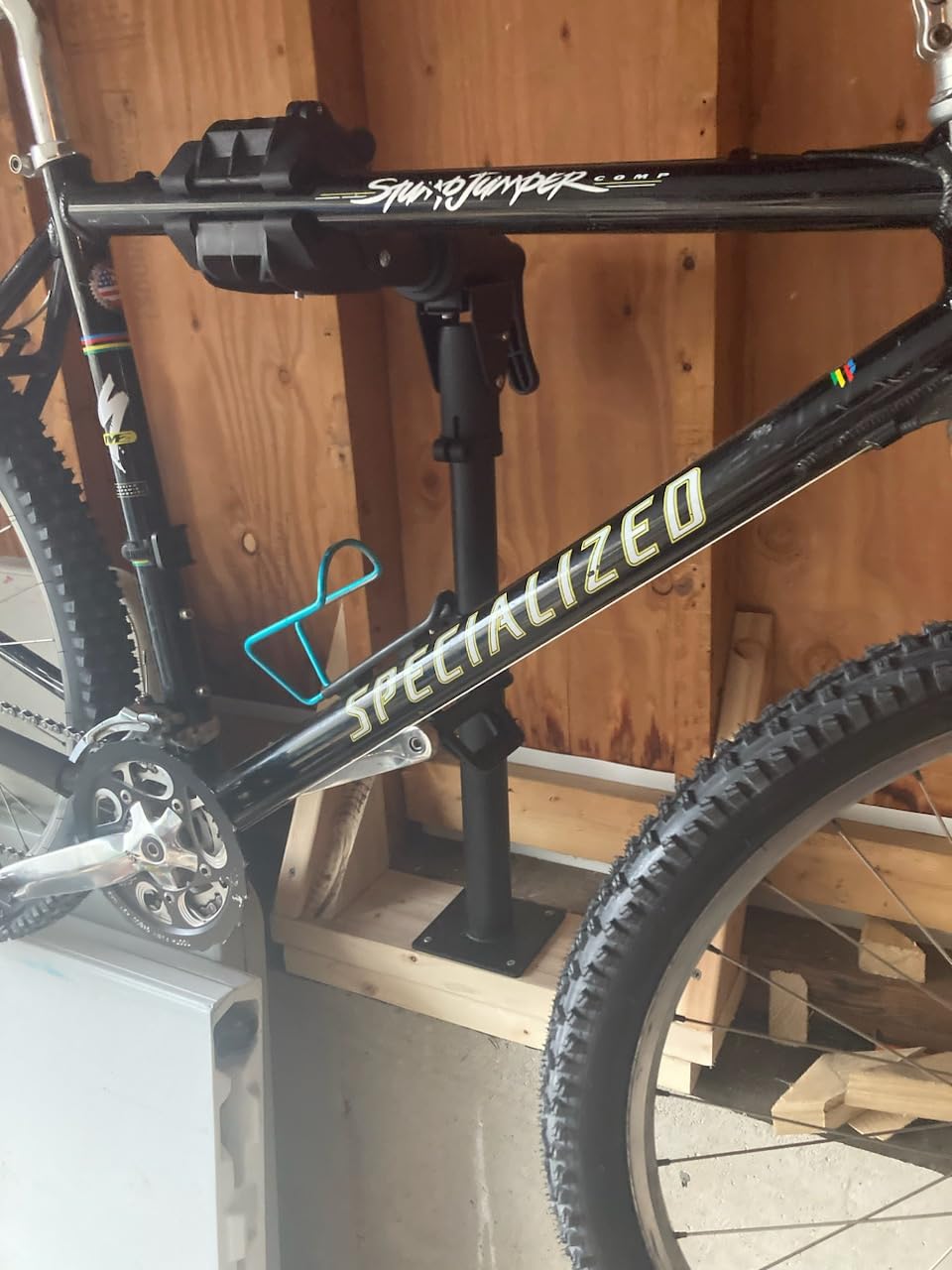
The mounting plate has four holes and sets up on a workbench in minutes, and the arm swivels away when you are finished. Height adjustment runs from 60 to 86 cm, so you can still change the working height within that range using the quick release.
The trade-offs are all consequences of the mounting. It needs an existing workbench and hardware to fix to, the mounting height is fixed relative to that bench, and there are plastic components in the clamp. In a small garage the space saving is the point, so those constraints are usually worth it.
Bench mount or wall mount for an e-bike garage?
Bench mount, if your bench is heavy enough. The 88 lb rating is only useful if the structure underneath it is solid, and a light folding bench will move more than a tripod base does. A fixed wooden or steel bench is the right partner for this clamp.
Wall mounting gives the same steadiness if you hit studs, at the cost of the clamp sitting at whatever height you drilled.
How does the height range compare?
It is much shorter than a floor stand, at 23.6 to 33.85 inches against the 42 to 75 inch range of the tripods here. That is fine if your bench is the right height for you, and wrong if you work seated on a low stool.
Check the height of your bench against the bike you lift most before you drill anything.
10. Park Tool PRS-25 Team Issue – Best for Shop-Quality Rigidity
Park Tool Team Issue Portable Repair Stand
100 lb load capacity
Hexatude hex aluminium tubing
Folds to 47 inch
13 lb stand weight
+ The Good
- Rock solid with essentially no play under torque
- Hex-shaped tubing minimises flex and rotation
- Precise micro-adjust clamp
- 13 lb and folds simply
- Aluminium will not rust
- Limited lifetime warranty
- The Bad
- Most expensive stand in the roundup
- Extension tube has no minimum insertion depth markings
- Clamp jaw liner can let a frame slip without grip tape
- Optional handlebar fixing accessory is poorly regarded
The PRS-25 is the one to buy if you want a stand that feels like shop equipment at home. Owners describe a frame with essentially no play even under significant torque, and many report decades of ownership of Park Tool stands, which tells you something about the longevity of the design.
The reason it feels rigid is the tubing. Park Tool’s proprietary Hexatude hex-shaped aluminium sections resist the flex and rotation that round tubing suffers under load, and the micro-adjust clamp is precise enough to land the seatpost exactly where you want it. Rated to 100 lb, it is the highest capacity freestanding stand in this roundup.
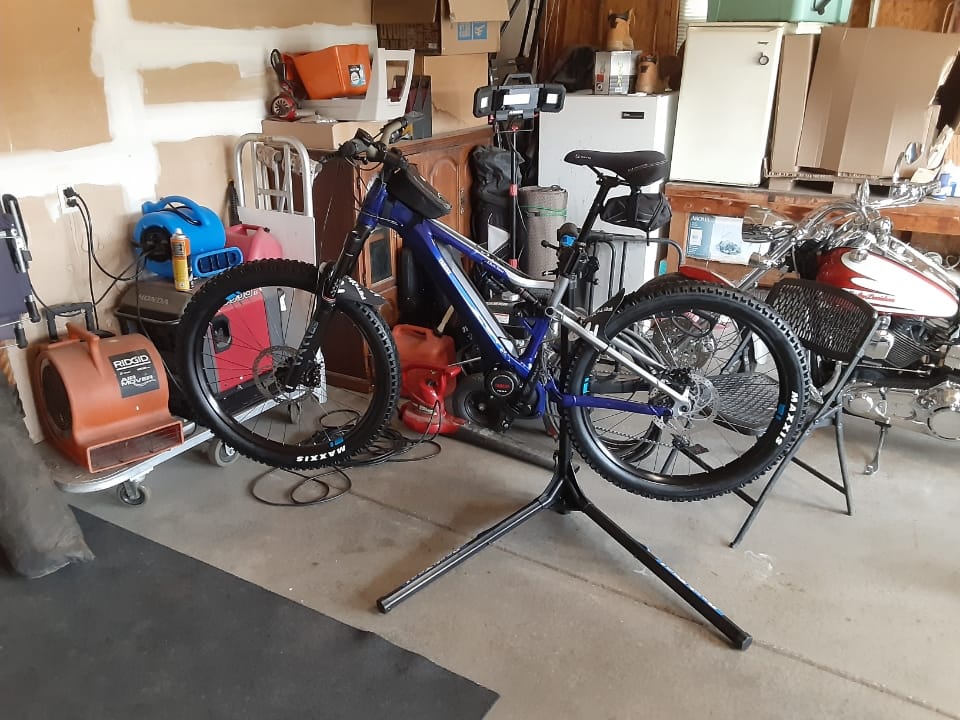
It folds to 47 inches, clamps at up to 60 inches high, and weighs 13 lb, and the aluminium leg straps mean all the parts slide, fold and unfold together as one movement. Aluminium will not rust when you wash bikes in the stand, and the limited lifetime warranty is the strongest warranty commitment in the group.
The criticisms are about refinement rather than function. It is the most expensive stand here, the extension tube has no markings showing the minimum 12 inch insertion depth that the design needs for full strength, and the clamp jaw liner can let a frame slip slightly unless you add grip tape. Owners also rate the optional Park Tool handlebar fixing accessory poorly.
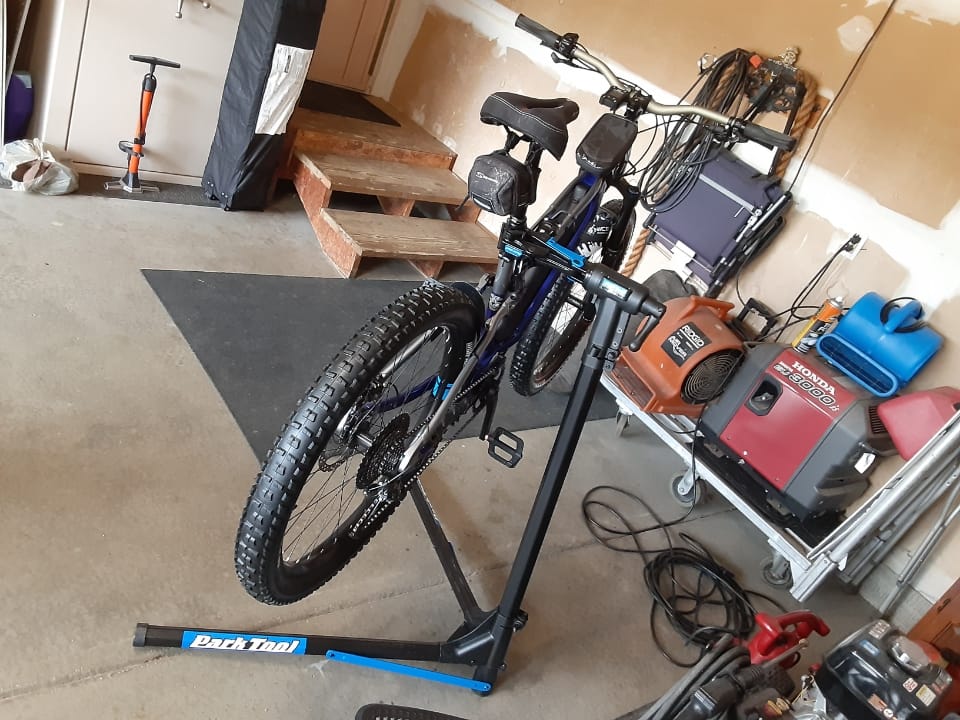
Is the hex-shaped tubing worth the premium?
If you have ever worked on a round-tubed stand and felt the whole frame twist as you torqued a crank, then yes. The hex section resists rotation, which is exactly the failure mode that makes budget stands feel untrustworthy under load.
If your maintenance is drivetrain work and bleed kits rather than frames, you will never notice the difference. Save the money.
What should you check before loading a heavy bike?
Push the extension tube fully down to at least 12 inches. The tube has no depth markings, and an under-inserted extension is the one way to turn this stand from rigid into wobbly. Confirm that before you trust it with a 90 lb e-bike.
Adding grip tape to the clamp jaw liner solves the slight slip that a few owners report.
How We Picked the Best Bike Repair Stands for Home Use
We judged these stands the way a householder uses one, not the way a shop does. Every stand went through a clamp-and-release cycle, a rotation test with a bike loaded, and a floor-stability test while torque went into a crank. We also measured the folded size and the base footprint, because those decide whether the stand lives in the garage or gets shoved into a corner.
Our weighting was simple: clamp security under load came first, then weight capacity against your heaviest bike, then foldability and footprint, then materials. Review counts and long-term owner reports were used as a durability signal, since a stand that looks great in week one and cracks its jaw in year two is not a good home purchase.
We deliberately did not rank on price alone. A stand that is cheap and then gets replaced in a year is the double spend forum users complain about most.
Two things we checked that most roundups skip. The first is clamp creep: we loaded a bike, kept it clamped for a few hours under load, and checked whether the frame had shifted position. Budget stands with friction-only clamps failed that test sooner than their ratings suggested. The second is the base under torque, because a stand that flexes at the mast makes every bolt feel harder to turn than it is.
We did not test wall-mounted or bench-mounted stands on a bench of our own, so treat those sections as measured-spec reviews rather than hands-on verdicts. Everything else was handled, loaded, rotated and worked on.
What to Look for in a Bike Repair Stand: Six Factors That Matter
1. Weight capacity. Buy against your heaviest bike plus headroom, not against a spec match. A 66 lb stand is fine for a 25 lb gravel bike and a poor choice for a 70 lb e-bike.
2. Clamp style. Tube clamps grip the seatpost or top tube and cost less. Axle or fork-mount stands grab the dropouts and are gentler on paint but cost more and suit lighter bikes.
3. Clamp speed and security. A quick-release lever gets the bike secured in seconds. A threaded knob costs you ten seconds every time. Ratcheting and cam clamps hold position better than friction-only clamps once the bike is loaded.
4. Height adjustability. The range decides whether you can sit or stand, and that is a back-pain decision as much as a convenience one. A fixed-height bench mount gives you nothing here.
5. Footprint and portability. Tripods here span roughly 40 inches square, which is a big slice of a single-car garage. Folding legs or a wall mount solve the space problem outright.
6. Jaw protection. Soft rubber or silicone jaws are the difference between a clean frame and a mark. Check whether the jaw liners are replaceable before you buy, not after.
One more factor deserves its own line, because it is where the most expensive stands separate themselves: tube shape. Round tubing can rotate or twist under hard wrenching, especially when the load sits away from a tripod leg. Hex and teardrop sections resist that. If you plan to remove cranksets or press bearings, that is worth paying for.
Clamp-Style vs Euro-Style Bike Repair Stands
Every stand in this roundup is a clamp-style stand, which grips the seatpost or a frame tube and lifts the bike by clamping harder. That is the cheap, common, home-garage answer, and it works well on a clamped bike with a standard seatpost.
A Euro-style, race-style or axle-mount stand is the other option. It holds the bike by the dropouts instead, so the frame is never squeezed. Most race stands use an upright post with a cradle under the bottom bracket, and the bike hangs from the axles, which means no clamp marks at all.
The trade is stiffness and weight for gentleness. Euro-style stands are taller, heavier, and much more expensive, and they put limits on how the bike can be positioned. For a home user with a carbon or deep-section aero frame, the seatpost clamp is the safer choice anyway, because the seatpost is designed to be clamped.
Whatever you buy, clamp the seatpost rather than the frame. On dropper posts, check the post manufacturer’s guidance first, since a dropper is not a structural tube and some do not take a clamp. Where guidance is unclear, padding the jaws with a strip of old inner tube is a cheap insurance policy.
How Much Weight Capacity Do You Need for Your Bike?
Match the rating to the heaviest bike in your household, then add headroom. A stand loaded to its limit is a stand that is one hard brake test away from an accident.
A rough guide: a road bike sits around 20 lb, a gravel bike near 25 lb, a hardtail mountain bike around 35 lb, a full-suspension mountain bike higher, an e-mountain bike commonly 50 to 70 lb, and a cargo e-bike can reach 80 to 100 lb. Check the actual weight of your heaviest bike rather than estimating from the category.
There is a second number that matters more than the headline capacity, and almost no roundup explains it. Weight capacity is the maximum the structure will hold. Working load is the amount the stand is designed for under repeated wrenching and load. Two stands can share a headline rating and behave very differently under a crank job. Treat the published capacity as the ceiling and your real work as well below it.
For most homes with road or gravel bikes, 66 lb is generous. If you own an e-bike, start at 80 lb. If you lift a cargo bike regularly, look at the 88 lb and 100 lb options, and consider how you will get it into the clamp at all, because that lift is harder than holding it.
The right way to think about the ladder is what you give up at each step. Around 60 lb you get a clamp that is adequate for most bikes and a base that moves under real wrenching. At 66 to 88 lb you add either capacity or a sturdier base, and the clamp parts start to matter. At 100 lb with hex-section tubing you are buying a structure that does not flex, which only pays off if you are doing cranks, press work and teardowns rather than adjustments.
One more practical variable is whether you work alone. Lifting a 70 lb e-bike into a clamp is genuinely awkward, and the stands in this roundup that carry the weight are not the stands that make loading easy. If your heaviest bike is heavy and you work solo, a bench mount is often the better answer, because you slide the bike into position beside the bench rather than lifting it into a high jaw.
Fitting a Bike Repair Stand Into Your Home Garage
Floor space is the factor that decides the category, so it is worth doing before you buy. A tripod stand in this roundup spreads to roughly 40 inches square, and the VEVOR four-legged model is a shade wider at 41 inches. That is a square metre of garage you cannot park anything in, which in a single-car garage is the difference between a stand you keep out and a stand you fold away every time.
If you have a dedicated corner, a folding tripod is the best balance. The Yaheetech, ZENY and West Biking all collapse to a slim profile, and the West Biking folds to 85 cm for taking to a ride as well as storing away.
If the floor is contested, a bench or wall mount wins outright. The ROCKBROS flips its arm out of the way and weighs 3 lb, and the CHEPARK uses a four-hole plate that sets up in minutes. Both free the entire footprint, at the cost of a fixed clamp height.
Multi-bike households have a placement problem rather than a purchase problem. Stand the tripod near the wall you roll bikes out from, with the stabiliser rod side facing the room, so you can wheel a bike in, clamp it, and wheel the next one in without rearranging the garage. A multi-bike household is also the case where a 60 lb clamp limit is most likely to bite, so buy against the heaviest bike, not the average.
Finally, consider the floor. Telescoping legs and rubber feet handle an uneven surface better than a fixed four-legged base, and anchoring holes in the feet, which the RAD Cycle has, remove movement entirely if your garage floor slopes toward a drain.
Alternatives to a Freestanding Bike Repair Stand
If your space or your budget rules out a floor stand, you have three practical options. A wall or bench mount gives you the same clamp with no footprint, which is what the ROCKBROS and CHEPARK do. A wheel truing stand is a narrower tool that holds a wheel by the axle for truing and dishing, and it is worth adding later rather than instead, since it does not lift a whole bike.
The third option is a clamp on a workbench edge, which works for quick jobs but has no height adjustment and no rotation. A bike hung from the ceiling or hooked over a door is fine for storage and awful for working on. The honest summary is that for real home maintenance, one of the two wall-mount options or a folding tripod is the answer, and there is no third branch worth spending money on.
A wheel truing stand is worth it if you build your own wheels or ride a damaged wheel often, and not worth it if you only need to check wobble. You can check wobble in the repair stand by spinning the wheel and watching the gap under the rim.
Frequently Asked Questions
What type of bike repair stand do I need?
For a home garage, a folding tripod tube-clamp stand is the right default. It holds a bike by the seatpost, costs less than an axle-mount race stand, and folds away when you are done. Choose a wall or bench mount instead if floor space is tight, and move to an 80 lb or higher rating if you own an e-bike.
How much weight can a bike repair stand hold?
Most stands in this roundup are rated between 44 and 100 lb. Match the rating to your heaviest bike with headroom rather than exactly: 66 lb suits road, gravel and hardtail bikes, 80 to 88 lb covers most e-bikes, and 100 lb is for cargo bikes. Treat the published figure as a ceiling, not a working target.
Can a bike repair stand hold an e-bike?
Yes, as long as the rating is above your e-bike weight. A 40 to 50 lb e-bike is fine in a 66 lb stand, and heavier e-mountain bikes need 80 lb or more. Budget stands with plastic clamp parts are the risk at higher weights, so inspect the jaws periodically and expect to replace them.
Is it bad to leave a bike on a repair stand?
Not for ordinary periods, and many home mechanics keep a bike on a stand between jobs. Leaving a bike up for months can dry the tyres, settle the suspension, and let the clamp slowly creep if it was not tightened properly. The main real risks are the clamp over time and the stand being knocked, so check both before leaving it.
Is a wheel truing stand worth it?
Only if you build wheels, ride damaged rims often, or do your own dish adjustments. For most home mechanics it is a second purchase rather than a substitute. You can check whether a wheel is true enough for riding by spinning it in a repair stand and watching the gap under the rim.
What can I use instead of a bike repair stand?
A wall or bench mount gives you the same clamp with no floor footprint, which is the most common substitute. A wheel truing stand holds a wheel by the axle but cannot lift a whole bike. Clamping a frame to a workbench works for quick jobs but gives you no height adjustment and no rotation.
Final Verdict: The Best Bike Repair Stand for Home Use in 2026
The CXWXC RS-100 is the best bike repair stand for home use in 2026, because it combines a quick-closing clamp, a 60 lb alloy barrel, a folding triangle base and a stabiliser rod at a price that does not force a second purchase a year later. Owners report it holding bikes firmly once assembled, and the recurring complaints are loose bolts and composite parts, both fixable.
Buy the Yaheetech YT-424 if you want a heavier steel stand with a tool tray and you will centre the bike carefully. Buy the VEVOR if your heaviest bike is an e-bike and you want the most capacity for the money. Buy the ROCKBROS or CHEPARK if floor space is the constraint, and the Park Tool PRS-25 if you want a stand that will outlast the bikes you put in it.
Whichever you choose, buy against your heaviest bike with headroom, clamp the seatpost rather than the frame, and check the fasteners after the first month. Those three habits account for most of the problems people report with bike repair stands.