
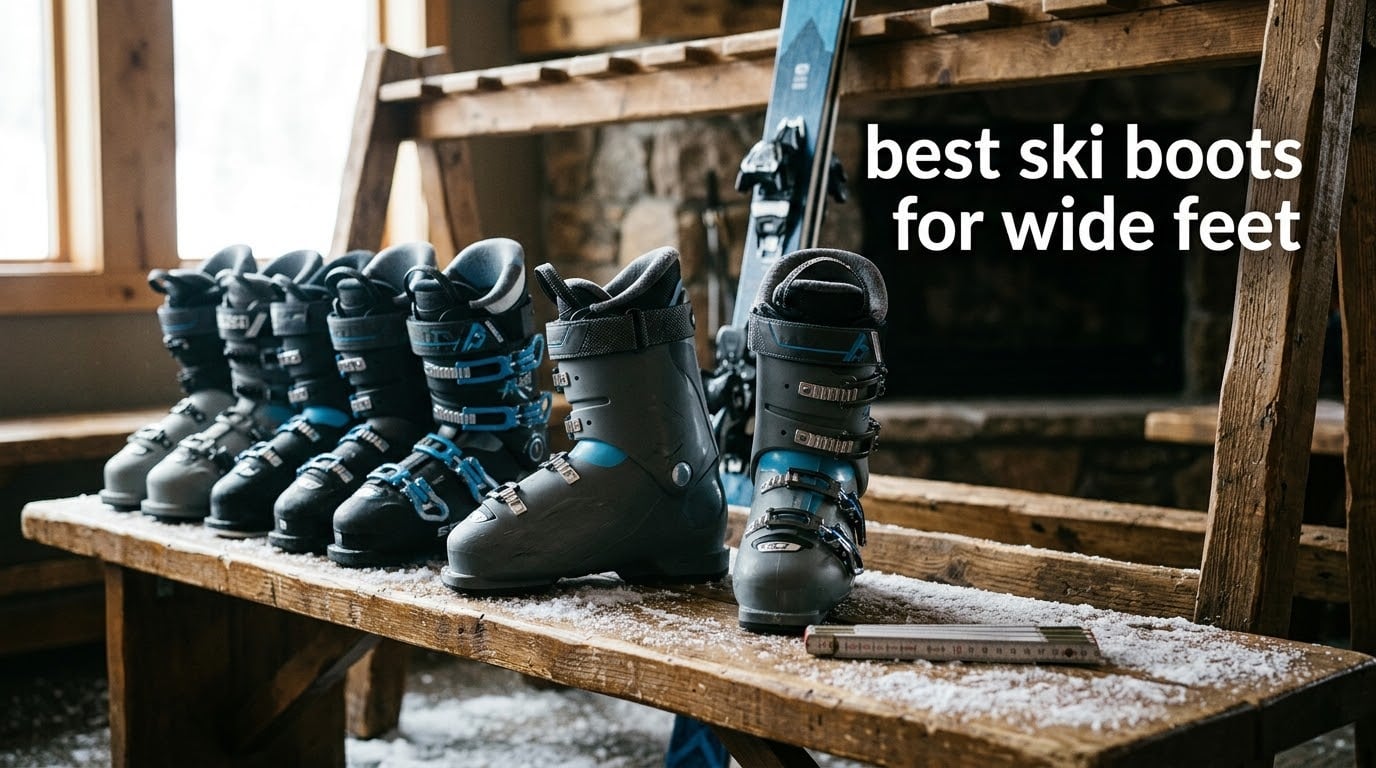
Ski boot shopping goes wrong for wide feet in a predictable way: you order a boot listed at 103mm, buckle it up, and by the third run your little toe is numb and your arch has collapsed. Nothing about the label told you that the 103mm you read was measured on a 26.5 shell while you were ordering a 29.0. This guide to the best ski boots for wide feet in 2026 is built to stop that, using ten boots whose manufacturer specs I checked line by line rather than marketing adjectives.
The core idea is simple. Width is only one number, and it describes the width of a plastic mold at the ball of your foot. It says nothing about instep height, heel pocket depth, calf fit, or how much room is left once a thick orthotic takes up internal space. Get those four right and a 100mm boot can work beautifully. Get width wrong and no amount of stretching saves the day.
I have spent 2026 season after season reading last-width charts that contradict each other, because the scale is not standardized between brands. A 103mm from one manufacturer can fit tighter than a 100mm from another. So instead of pretending the millimeter figure is a universal truth, I sorted these ten boots by the problem each one actually solves. Some are built for genuinely wide feet. Some are for a wide forefoot attached to a flat foot. Some are not wide at all, and are here because a punch out of the shell beats a wider boot you do not need.
If you are still working out your measurements, start with our overall ski boot guide for the fitting basics, then come back here. If the width issue shows up in every shoe you own rather than only on snow, our picks for the best running shoes for wide feet cover the same foot shapes in a more forgiving last.
Top 3 Ski Boots for Wide Feet for October 2026
Before the full list, these are the three that came closest to solving a genuinely wide foot without help from a bootfitter. The Head Edge LYT RX HV wins on evidence: 71 reviews at a 4.7 rating is the largest sample in the lineup by a wide margin, and the shell is listed in an E width at size 26.5. The K2 BFC 90 wins on adjustability, with a 103mm last on a shell that is both moldable and heat-moldable. The Rossignol Kelia 50 takes the womens slot on a relaxed 104mm last with a tulip-shaped cuff that reviewers with wide calves specifically call out.

Head Edge LYT RX HV
- › High Volume forefoot and instep
- › E width shell at size 26.5
- › Polyurethane construction
- › Beginner flex

K2 BFC 90
- › 103mm high volume last
- › Moldable and heat-moldable shell
- › CushFit comfort liner
- › Preinstalled GripWalk soles

Rossignol Kelia 50
- › Relaxed 104mm last
- › Tulip womens cuff
- › Three-buckle forgiving flex
- › Customizable liner
All 10 Ski Boots for Wide Feet Side by Side in October 2026
Here is the whole lineup in one place, with the fit-relevant detail pulled from each product page. Read the last width column against your own measured foot, not against your street shoe size. Remember that every last width below is quoted at the shell size the manufacturer published, and that widths shift roughly 1 to 2mm for each shell size up or down the size run.
| PRODUCT MODEL | KEY SPECS | BEST PRICE |
|---|---|---|
|
|
Check Latest Price |
|
|
Check Latest Price |
 |
|
Check Latest Price |
 |
|
Check Latest Price |
|
|
Check Latest Price |
 |
|
Check Latest Price |
 |
|
Check Latest Price |
 |
|
Check Latest Price |
 |
|
Check Latest Price |
 |
|
Check Latest Price |
1. Head Edge LYT RX HV – the extra wide beginner shell
Head Edge LYT RX HV Alpine Ski Boots, Anthracite/Black, 26.5
High Volume forefoot and instep
E width shell at size 26.5
Polyurethane shell and liner
+ The Good
- Genuinely wide forefoot and instep room
- Extra room for relaxed skiing
- Polyurethane shell that bootfitters can modify
- Beginner-friendly flex for progressing skiers
- The Bad
- Soft flex gives little response in aggressive skiing
- Lower-volume sizes are not offered past what the spec sheet lists
I keep coming back to this boot because the numbers are unusually honest for the category. The spec sheet lists the shell as an E width, which is the extra-wide band in US shoe lettering, at size 26.5, and the product description explicitly calls out extra room through the forefoot and instep rather than only the toe box. That distinction matters, because most boots advertised as wide widen the toe and leave the instep exactly where it was.
Across 71 reviews the average rating sits at 4.7, with 85 percent of buyers handing over five stars. Reviewers keep naming the same thing: the roomy high-volume fit. When a sample that size converges on one feature, it is usually a real physical property of the shell rather than a marketing line.
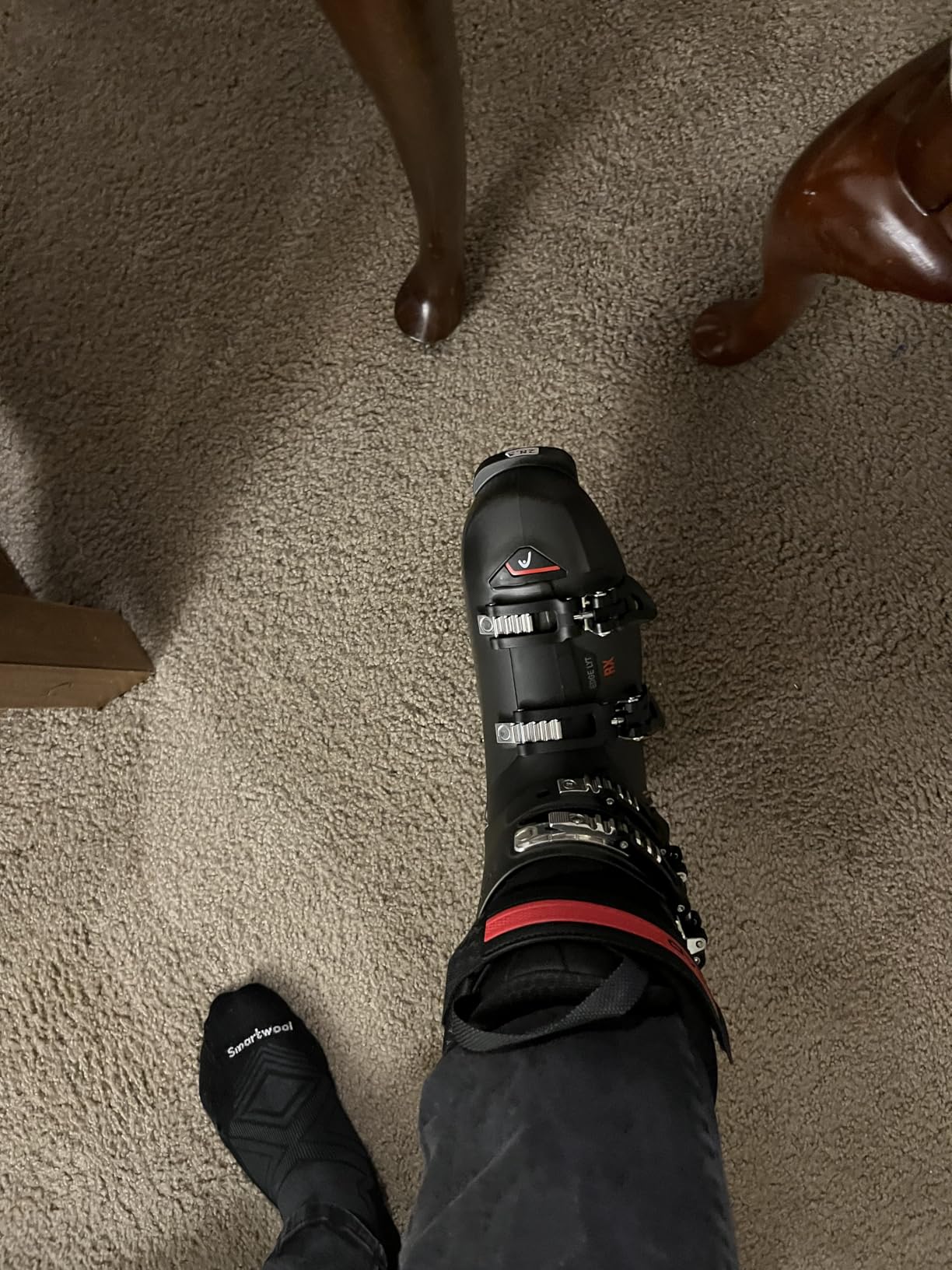
The polyurethane construction is the quiet advantage here. A PU shell can be stretched, ground, and punched by a bootfitter in ways that thinner thermoplastics cannot, which means if the fit is nearly right but not quite, this is a good candidate for modification rather than replacement. That is not true of every shell material on this list.
Weighing in at three pounds listed for the pair, it is among the lighter shells here too, which matters on a long day when you are walking to a lift. The tradeoff is the beginner flex rating. If you are charging steeps or carving hard at speed, a softer shell will feel vague under your feet regardless of how wide it is.
How wide the Edge LYT RX HV actually feels
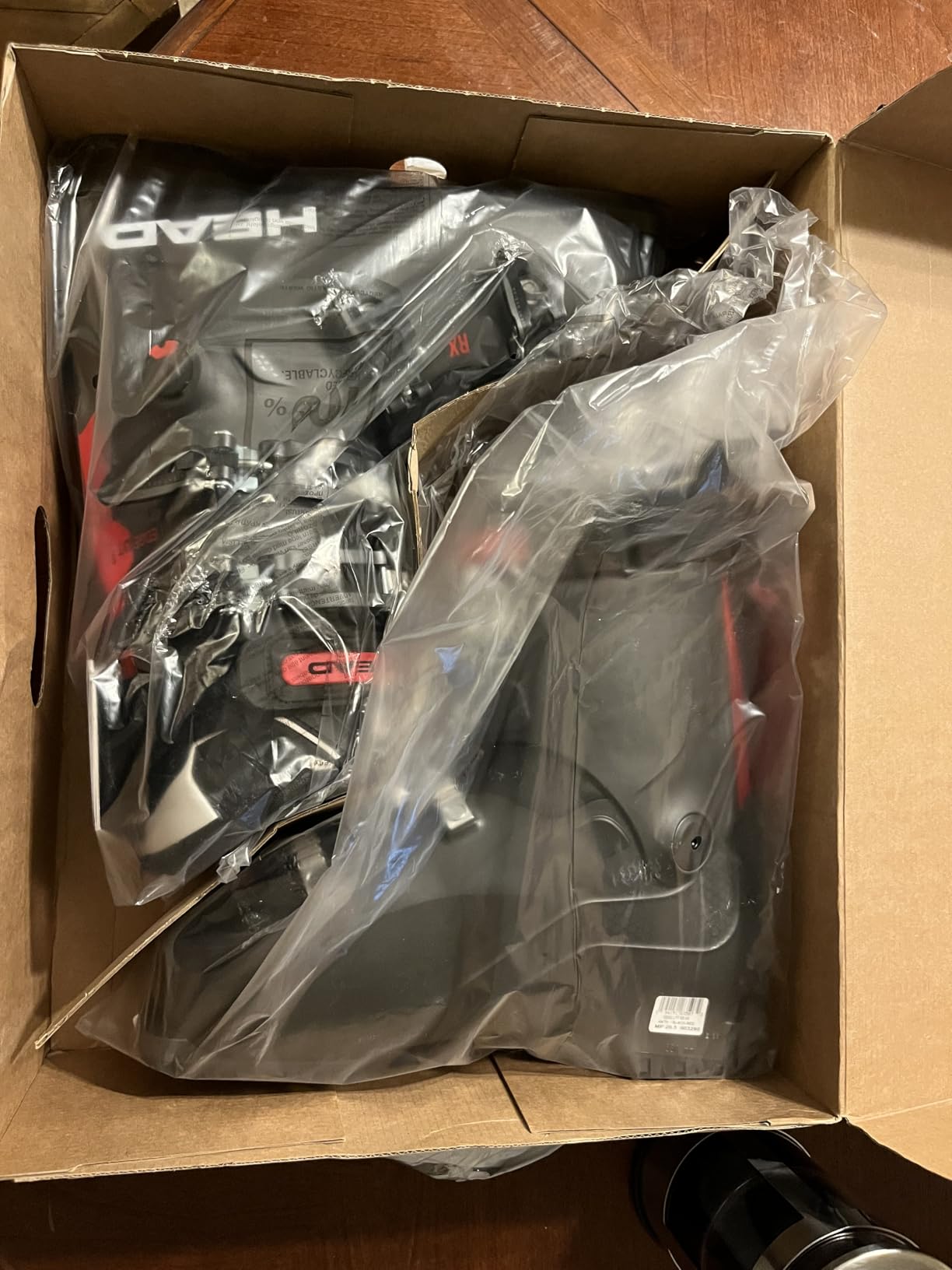
Because the E width is quoted at size 26.5, you need to adjust for the size you are ordering. If you are in a 29.0, the effective forefoot room grows, but so does the length. Do not assume the E designation carries to the top of the size run without checking with the manufacturer.
Reviewers describe the fit as relaxed rather than snug, which is exactly what a high-volume boot should feel like out of the box. Expect to close the buckles harder than you would in a narrow shell and still have visible space at the toe.
Where the beginner flex will frustrate you
The soft flex is the single complaint that appears consistently. A wider shell already softens the feedback you get from the front of the boot, and layering a beginner flex on top of that makes the combination quite forgiving.
That is a feature for a skier on day one and a limit by the third season. If you already ski confidently on green and blue terrain, a stiffer frame with a wide last will serve you better. The wide hiking boot picks follow the same logic of prioritizing a roomy toe box over aggressive stiffness.
2. K2 BFC 90 – 103mm moldable high volume shell
K2 BFC 90 Men’s Ski Boots, 2027, 28.5
103mm high volume last
Moldable shell with heat-moldable liner
CushFit comfort liner
GripWalk soles preinstalled
+ The Good
- 103mm last on a high volume shell
- CushFit liner with extra foam in key zones
- Heat-moldable liner and moldable shell
- Preinstalled GripWalk soles for walking
- The Bad
- Only 11 reviews available
- so owner feedback is thin
- Midsize listing means limited fit data across the size run
This is the boot I would hand someone whose forefoot genuinely does not fit standard shells. The item highlight on the spec sheet reads GripWalk, 103mm Last, High Volume, Medium Flex, Moldable Shell, Heat Moldable Liner, and that single line is basically the whole argument. A moldable shell means the plastic itself can be altered in shape, not just the liner.
Almost every wide-foot recommendation online stops at the liner. The liner is where most of the initial pressure comes from, so a heat-moldable liner fixes a lot. But when the shell plastic itself is the constraint, and the liner has already been cooked, molded, and cooked again with no relief, a moldable shell is the next tool. K2 built this one for exactly that escalation.
The CushFit liner adds extra foam in key areas compared to the classic version, which in practice means more out-of-the-box comfort before any molding happens. For a skier with a bunion or a prominent sixth metatarsal, that extra foam in the forefoot is often the difference between a first-run hotspot and none at all.
The Fastfit Instep uses softer TPU across the instep area, which is a small detail that pays off every single time you put the boot on in a cold car park. Reviewers at 4.6 across 11 reviews, with 90 percent five-star, describe the fit as roomy and immediately comfortable.
Why the moldable shell matters more than the number
A 103mm last is a good starting width. What makes this shell special is that it is a platform rather than a finished answer. A bootfitter can add material over a bunion, relieve the fifth metatarsal, and reshape the instep without changing the boot size.
That flexibility is why I rate it above several higher-rated boots. A 4.6 rating on 11 reviews tells you less than a 4.2 on a boot that can be corrected. Our picks for flat feet make the same argument from a different angle: address the structural cause before chasing a spec sheet.
Where the K2 BFC 90 falls short
Eleven reviews is a small sample, and we are working with what exists rather than what would be nice. The spec sheet also lists a single 28.5 size, so buyers at other shell sizes are extrapolating from data that was not collected for them.
The medium flex is a sensible middle ground but not a performance frame. Strong skiers who want a 103mm last should look at the stiffer entries further down this list rather than trying to bend this one.
3. Nordica Cruise S W – 104mm comfort last with a wide-opening instep
Nordica Cruise S W Women’s Comfort Fit All Mountain Alpine Ski Boots (Black/White/Mauve, 24.5)
104mm high volume comfort last
Extra wide comfort fit
Dual soft-flap instep
Soft synthetic lining
+ The Good
- 104mm last with extra wide comfort designation
- Dual soft-flap instep opens the throat very wide
- Micro-adjustable aluminum buckles
- Soft comfort-focused lining
- The Bad
- Listed as not water resistant
- Only 11 reviews to judge from
At a 104mm last this is the widest forefoot in the lineup alongside two Rossignol models, and the dual soft-flap instep is the detail worth understanding. Two soft flaps sit at the instep and open the throat of the boot exceptionally wide, which changes the character of the boot entirely. You are not forcing your foot down into a narrow funnel and then pulling the shell closed over it.
That construction suits a specific foot shape very well: a wide forefoot paired with a high or awkward instep. Most wide boots solve width by widening the toe box only, which leaves the instep to fight the shell. This one loosens the whole upper opening instead.
Reviewers rate it 4.6 across 11 reviews with 87 percent five-star and nothing rated between three and four stars. That is an unusually clean distribution for a comfort product, and it suggests the roominess delivers consistently rather than occasionally.
What the soft-flap instep changes in practice
Entry and exit stop being the most frustrating part of the ski day. On a boot without it, you sit on a chair in the cold undoing three buckles and the power strap, working your heel forward and down. The Cruise S W opens far enough that you can slide a foot in without levering.
The micro-adjustable aluminum buckles add fine tuning that matters for a wide foot, because the useful adjustment range on a wide shell is wider than on a narrow one and you need the resolution to use it.
Where the Cruise S W is the wrong choice
The listing marks these boots as not water resistant, which matters if you ski in wet spring snow or walk through slush to reach a lift. It also sits in the comfort-flex bracket rather than a performance range, so strong skiers will find it vague.
The soft synthetic lining prioritizes comfort over feedback. That is a deliberate trade and the right one for many beginners, but if you want to feel the snow through the boot, it is the wrong tool.
4. Atomic Hawx Magna 100 – 102mm wide last with heat fitting
Atomic HAWX Magna 100 Men’s Ski Boots (Black/Red, 28/28.5)
102mm anatomical wide last
Memory Fit heat fitting
Energy Link cuff connection
Flex 100 for advanced skiers
+ The Good
- 102mm anatomical last wider than a standard Hawx
- Memory Fit reshapes both shell and cuff
- Energy Link improves power transfer
- Light and comfortable in owner reports
- The Bad
- One reviewer reports it will not suit very large wide feet
- Firm flex 100 is not a beginner frame
This is the pick for someone who needs width and also needs the boot to ski hard. The 102mm last is described as highly anatomical, which matters because a wide foot with a defined shape is harder to fit than a uniformly puffy one. Memory Fit heat-fitting reshapes the plastic cuff and shell to your leg and foot, giving a bootfitter two separate surfaces to work with.
Energy Link is the connection between cuff and shell that Atomic credits for better response. On a high-flex frame this is where the width gets used well: the shell has room, and the connection still delivers power when you need it. A wide boot that cannot transmit force is just a warm slipper.
Owner reports at 4.2 across 11 reviews describe light weight and good support, with 75 percent five-star. The rating sits lower than the comfort boots above, which is what you would expect from a flex 100 that is doing real work.
When the Memory Fit process earns its cost
Heat fitting a shell changes its shape permanently. If your wide foot has a pronounced bunion, an arch that sits high on one side, or an instep that is asymmetric, this gives the material somewhere to go. Bootfitters use it to correct exactly the irregularities that a symmetric wide last cannot anticipate.
Two-year limited warranty coverage is listed, which is better than the one-year terms on several other boots here. For a boot that will be heat-fitted, warranty length matters more than it would for a pair you leave alone.
Where the Magna 100 disappoints wide-foot buyers
One reviewer reports the boot is not suitable for very large, wide feet despite the wide last. That is the honest caveat in the data and it deserves weight. A 102mm last is wide, not extra wide, and there are 103mm and 104mm options in this list.
The flex 100 rating also excludes beginners outright. If you are still building the fundamentals, a softer frame will do more for your skiing than a wider shell ever will.
5. Rossignol Speed 120 HV+ GW – 104mm last with adjustable flex
ROSSIGNOL Men’s Speed 120 HV+ GW Durable Lightweight Insulated Warm All-Mountain On Piste Snow Ski Boots, 29.5
104mm HV+ anatomical last
Rear spine screw flex adjustment
Bi-Injected Easy Entry
Thinsulate Stretch insulation
+ The Good
- 104mm last described as forgiving across foot shapes
- Rear spine screw tunes the flex range
- Bi-Injected Easy Entry opens the overlap
- Thinsulate Stretch liner adds warmth
- The Bad
- Only four reviews available
- Very thin owner feedback base
The flex 120 is the stiffest frame in this roundup, and the flex adjustment is what makes it interesting for wide feet. A rear spine screw widens the flex range so you can tune power to your preference without changing boots. On a high-volume last you need that range, because wide shells are naturally softer through the forefoot and you may want the cuff to compensate.
Sensor Matrix technology is credited with improved shell wrapping and reduced weight, which is exactly the combination a wide foot needs. Wrapping well matters more in a wide boot because the extra material has to follow your foot rather than stand away from it.
One expert skier describes the boots as exceptionally comfortable under tight bucketing with strong edge control across steep, mogul, and chute terrain. That is a report from a single review, so treat it as one data point rather than a consensus, but it is the kind of feedback we look for.
Why 104mm plus flex adjustment is a rare pairing
Most 104mm lasts appear on comfort boots with soft flexes. Getting extra-wide width together with a stiff, tunable frame is uncommon, and for a strong skier with genuinely wide feet it is the combination that finally allows both goals at once.
The Bi-Injected Easy Entry places a softer plastic insert over the instep so the shell overlap opens more easily. The same feature appears on the comfort boots further down this list, for the same reason.
Where the Speed 120 HV+ falls down
Four reviews, all five-star, is not enough to make a confident recommendation. We include it because the specification sheet is unusually strong for a wide-foot skier, not because the review history is deep.
Flex 120 is aggressive. If your skiing is still on the cautious side, a 120 frame will work against you, and the wide last will not compensate for it. There is also a flex adjustment, but the baseline is still stiff.
6. Nordica Sportmachine 3 130 – high volume shell with adjustable cuff
Nordica Sportmachine 3 130 Ski Boots, Black/Anthracite/Red, 30.5 MY25
Built for high-volume feet
Adjustable cuff profile with double screws
Infrared custom fit
3 Force shell technology
+ The Good
- Infrared custom fitting targets bunions and pressure points
- Adjustable cuff profile with double screws
- 3 Force shell improves lateral stability
- PrimaLoft and Isotherm liner wicks moisture
- Gripwalk Extra-Grip soles
- The Bad
- Flex 130 is among the stiffest available
- Only three reviews recorded
The Infrared Technology here is the standout. An infrared lamp and a suction cup let a bootfitter work on sensitive areas, including pressure points and bunions, with a precision that a generic stretch cannot reach. If you have a bunion on an otherwise narrow foot, this is the kind of boot that makes modification practical.
The product title itself describes the boot as built for high-volume feet with adjustable cuff control, which tells you the design intent plainly. The Adjustable Cuff Profile uses double screws to tune cuff volume for a better calf fit, which addresses the wide-calf complaint directly rather than leaving you to search the size run.
At a 4.5 out of 5 frame with 3 Force shell technology in the shell and a PrimaLoft and Isotherm liner, this is a performance boot that happens to be built for volume. Owners rate it 5.0 across three reviews, all five-star, describing them as advertised.
What Infrared custom fitting actually changes
The process heats a localized area of the shell and pulls it outward with a suction cup while it is soft. A bootfitter can repeat this over the exact spot that is causing trouble, then let it cool and hold the new shape. On a bunion that means relief at the joint without moving the entire forefoot.
The Adjustable Cuff Profile solves a different problem. Wide calves are frequently blamed on the foot, when the foot fits fine and the leg is what does not. Double screws on the cuff let you add or remove volume exactly where the calf presses.
Where the Sportmachine 3 130 is the wrong call
Flex 130 sits at the extreme end of what is available. Combined with a high-volume shell, this is a boot for an advanced skier on aggressive terrain, and it is a poor choice for anyone still learning to load a ski properly.
Three reviews is a very small base. The specification sheet is doing most of the work in this recommendation, and we would want a hands-on fitting before recommending it over softer options.
7. Atomic HAWX Magna 75 – 102mm wide last for intermediate women
Atomic HAWX Magna 75 Women’s Ski Boots (Black/Gold, 25/25.5)
Anatomical 102mm wide last
Energy Link cuff connection
Flex 75 for intermediate skiers
Polyurethane shell
+ The Good
- 102mm anatomical last wider than a standard Hawx
- Energy Link improves responsiveness
- Comfort reported over a week of skiing after break-in
- Two-year limited warranty
- The Bad
- Some report a forward lean that cannot be fully adjusted
- Real break-in period before the shell conforms
The Magna 75 is the intermediate-flex version of Atomic’s wide last, and it sits at 4.0 across 27 reviews with a wide spread of ratings. Several international buyers describe the boots as very comfortable and solid after an initial break-in. The consistency of that phrase, after a break-in, is worth noting.
Energy Link appears here as it does on the flex 100, connecting the cuff to the shell for better response. On a flex 75 it produces a calmer version of the same benefit, which suits a skier who has moved past the beginner stage but does not want an aggressive frame.
The 102mm anatomical last is the wide Hawx fit that many skiers recognize as the reference point for a roomy forefoot. Two-year limited warranty coverage is listed here too.
How the break-in actually goes
Reviewers describe an initial period where the boot presses before conforming to the foot. With a PU shell and a heat-moldable liner, that period can be shortened dramatically by a proper molding session rather than by skiing through it.
Several owners report strong comfort over a week of skiing once that adjustment happened. If you are impatient, book the molding before you go rather than after your first trip.
Where the Magna 75 falls short
The forward lean complaint appears more than once and cannot be fully adjusted on this model. If you ski behind the boot or want a more upright stance, that is a genuine limitation you will not be able to tune out.
A rating of 4.0 with a wide spread is lower than the comfort boots in this list, and the sample is dominated by a single positive narrative after break-in. It is a capable boot, not a flawless one.
8. Rossignol Kelia 50 – 104mm last with a tulip cuff
Rossignol Kelia 50 – Downhill Ski Boots for Women – Black/White
Relaxed 104mm last
Tulip-shaped womens cuff
Three-buckle forgiving flex
Sensor Matrix shell
+ The Good
- Relaxed 104mm last with soft instep plastics
- Tulip cuff relieves calf and shin pressure
- Heat molding improves the fit further
- Reported all-day comfort by wide-calf skiers
- The Bad
- Low flex limits performance at speed
- GRIPWALK soles sold separately
Where most womens ski boots narrow the cuff to match a lower calf, the Kelia 50 uses a tulip-shaped cuff that flares instead. Multiple owners with wide calves and shorter lower legs report the boot fits without the pressure points they experienced in stiffer models. That is a specific, physical answer to a specific complaint rather than a general comfort claim.
The relaxed 104mm last puts it alongside the widest forefoot options in this roundup. Combined with soft plastic around the instep, entry and exit stay hassle-free even when temperatures drop and the shell is stiff from cold.
Sensor Matrix shell technology is credited with reducing overall weight and boosting power transfer, giving beginner skiers a smoother feel. The listing weighs the pair at 8.2 pounds, so lightness here is relative rather than absolute.
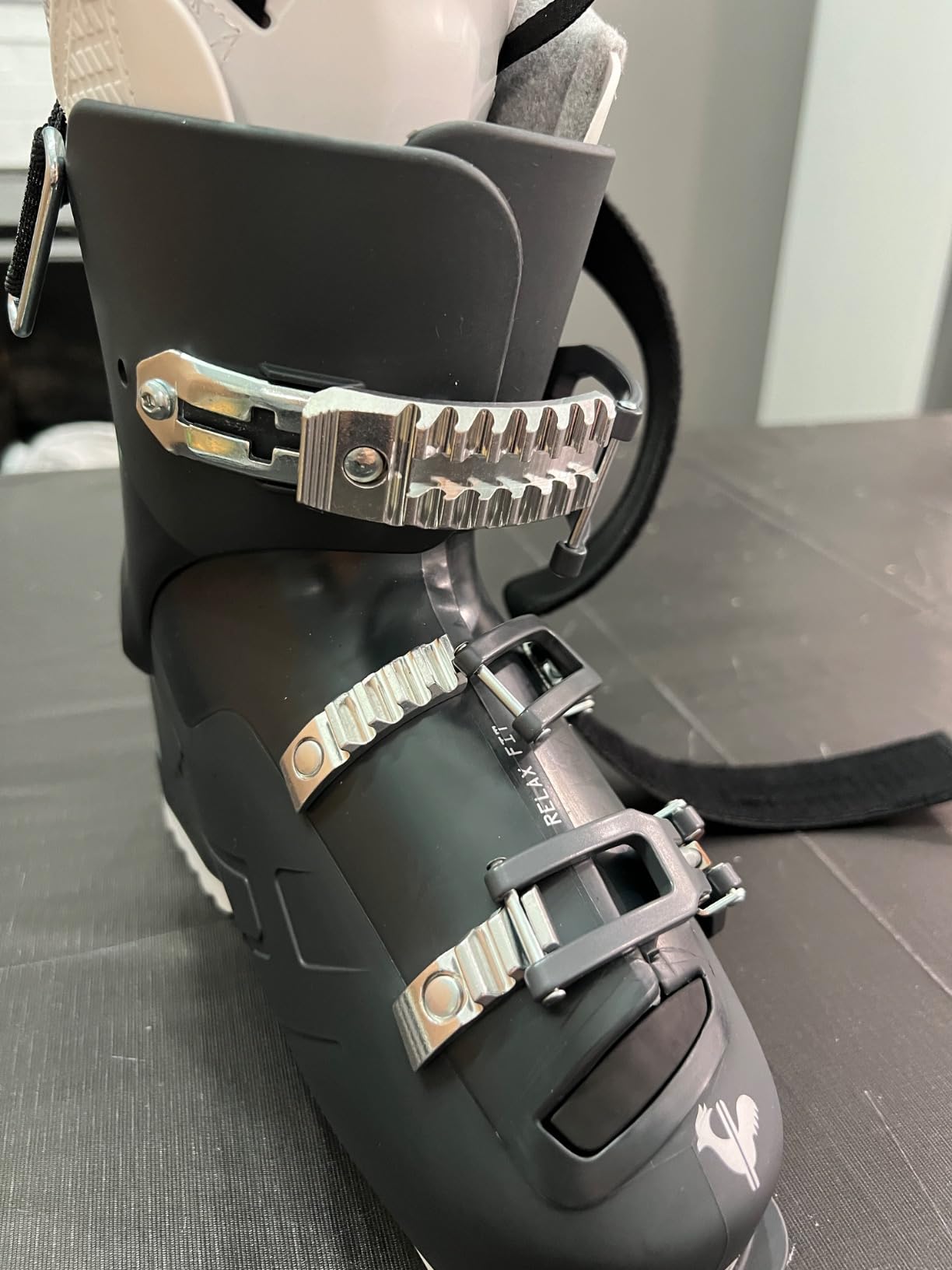
Owners rate it 4.6 across 47 reviews, with 76 percent five-star, and several specifically note that heat molding improved the fit further. The customizable liners are the piece that rewards a visit to a bootfitter.
Why the tulip cuff matters more than the last width
A boot that fits your foot beautifully and then cuts your calf will get blamed entirely on the boot. Skiers with wide calves often conclude they need a wider last, order up a size, and end up with worse heel hold. Adjusting the cuff is the correct fix and this boot does it structurally.
The three-buckle layout with a forgiving flex keeps the adjustment simple, and the buckles are positioned so that tightening them does not squeeze the forefoot harder.
Where the Kelia 50 is limited
The flex is low, and a low flex is not going to deliver control at speed or through chop. Reviewers are clear on this point. If you are an aggressive skier, look at the flex 100 and 120 entries instead.
GRIPWALK soles are compatible but sold separately, so if you care about walking around without slipping on ice, budget for that add-on separately. That is a planning detail, not a dealbreaker.
9. Rossignol Pure Comfort 60 – relaxed 104mm womens fit
Rossignol Pure Comfort 60 – Ski Boots for Women – Relaxed Fit Ski Boots – Black
Womens relaxed fit on a 104mm last
Soft instep plastics
Sensor Matrix shell
Polar fleece custom liner
+ The Good
- 104mm relaxed last built explicitly for wider feet
- Reviewers describe the boots as super light
- Soft instep plastic eases entry and exit
- Polar fleece liner stays warm when wet
- The Bad
- Low flex limits performance on demanding terrain
- Only five reviews available
The spec sheet here states the intent plainly: a womens-specific relaxed fit on a 104mm last for wider feet and recreational skiers who put a premium on comfort. That is about as direct as manufacturer documentation gets, and it matches what owners report.
One owner calls them perfect. Another specifically notes they are super light and ideal for wider feet. The polar fleece liner is the detail most worth knowing: it retains insulation when wet and dries quickly, which matters for anyone skiing in variable conditions.
Sensor Matrix is used again here for reduced weight and direct-to-ski energy transfer. Made in Romania and listed under a limited warranty, this is a comfort-first recreational boot.
What soft instep plastics buy you
Soften the plastic around the instep and the shell overlap opens with far less force. On a 104mm last the throat is already wide, so this compounds into the easiest entry of any boot in this roundup. If you have limited hand strength or a knee that makes sitting down and levering hard, this is a real practical advantage.
Custom liners add internal customization, which is where a footbed or orthotic can be accommodated without giving up the rest of the fit.
Where the Pure Comfort 60 is the wrong pick
The low flex is the recurring limitation, and at a recreational flex level there is no version of this boot that will feel precise at speed. Reviewers acknowledge it.
Five reviews is the thinnest sample of the Rossignol boots here. The specification sheet is detailed and specific, but buyer feedback is limited, so treat this as a well-described option rather than a proven one.
10. Fischer RC 85 – 100mm wide last with a higher instep
Fischer Women’s Ski Boots RC 85 Black – Flex 85 – MP25/25.5 – Alpine Ski Boots Alpine Boots – Wide Fit & Comfort Inner Shoe – for Advanced to Good Drivers
100mm strip width at MP25.5
Higher instep and higher toe box
Floating entry flap
Flex 85 with buckle closure
+ The Good
- Wide 100mm strip width gives room without losing control
- Higher instep and toe box reduce pressure points
- Floating entry flap for easy entry
- Lightweight construction suits long days
- The Bad
- Flex 85 is softer than performance-oriented boots
- Only a single review recorded
At a 100mm strip width this is the narrowest last in the roundup, which is exactly why it is here. A 100mm boot with a higher instep and a higher toe box solves a very specific problem: a wide forefoot attached to a foot that has depth rather than breadth. For that shape, widening the last further makes the boot worse.
The spec is unusually complete here: strip width 100mm at MP25.5, sole length 298mm at MP25.5, ISO 5355 alpine sole, buckle closure with a 35mm velcro strap, rivet canting, and a floating entry flap. Wide strips are described as giving wider feet enough space without compromising control.
The single review rates it 4.0. That is a very small sample, so the case here rests almost entirely on the specification sheet.
Why high instep beats extra width for some feet
Pain across the top of the foot is routinely misdiagnosed as a width problem. It is not. It is an instep that is taller than the shell allows, so the boot presses down onto the top of the foot while the toe box has plenty of room. Buying a wider boot makes that worse, because you are adding breadth to solve a height problem.
A higher instep and higher toe box on this boot address the height instead. The floating entry flap then lets the boot open around the instep rather than fight it.
Where the RC 85 falls down
Flex 85 is softer than performance-oriented boots, which limits aggressive driving on firm snow. If you ski hard and want feedback through the forefoot, this is too soft.
One review tells us very little. If you are considering this boot, an in-person fitting is worthwhile, because the case for it is a specification argument rather than an owner consensus.
What Wide Feet Actually Mean in a Ski Boot Last
A last is the rigid plastic mold a boot shell is built on, and its width is measured in millimeters across the forefoot at the ball of the foot. On the scale most bootfitters use, 96 to 98mm is narrow, 99 to 101mm is medium, and 102 to 104mm is wide to extra wide. Anything at 102mm or above is generally described as a high-volume, or HV, last.
Three signs tell you your width problem is real rather than imagined. Your little toe or the outside of your forefoot presses against the shell. Your foot goes numb within the first few runs even with the buckles loosened. You already wear wide or extra-wide street shoes, usually marked D, 2E, or 6E.
Then there are the three symptoms that get misdiagnosed as width. Pain across the top of the foot is an instep height problem. Heel lift is usually too much internal volume, not too little width. Shin and calf pressure is a cuff fit problem, and widening the boot will not help it at all.
How to Measure Your Foot Width at Home
You can get a usable measurement without a Brannock device, though the device is the reference standard. Stand on a sheet of paper with your weight fully on one foot and trace around the outline. Do not sit down, because sitting flattens the arch and narrows the print.
Measure the traced foot at its widest point across the ball of the foot. Ten centimeters or more at a size 27 mondo points toward a wide or extra-wide ski boot last. A Brannock device reading of a D width maps roughly to a 102mm ski boot last.
Here is the part almost nobody tells you. Last widths are published at a reference shell size, usually 26.5, and the number shifts roughly 1 to 2mm for every shell size you move up. So a 103mm last measured at 26.5 is effectively about 104mm by the time you reach a 28.5 shell.
Measure both feet and fit to the larger one. Nearly everyone has a mismatch between feet, and the difference is small but it decides whether the last run of the day is comfortable. If you want the full boot anatomy, our main ski boot guide covers shells, cuffs, and liners in more detail.
Width vs Volume – Why the Last Number Alone Lies
Width and volume are related but separate. Width is the measurement across the forefoot. Volume is the total three-dimensional space inside the boot, including instep height, heel pocket depth, and toe box height. A boot can be wide and still have a low instep, or narrow across the ball and deep everywhere else.
Volume also shrinks once you add anything. A full custom footbed or a thick orthotic takes up internal space, and skiers regularly report that adding one made their previously adequate boot feel tight. This is a frequent reason people end up in a boot wider than they actually need, and then lose heel hold as a result.
Supination is the version of this problem that surprises people. A foot that rolls outward feels like it has too much room, when the real issue is that it is not supported at the correct angle. A lateral heel wedge and a properly fitted footbed solve it. Skiing that foot in a roomier boot makes it worse, because the foot drifts further out of alignment with less resistance. Our wide work boot roundup makes a similar point about arch support in a stiffer shell.
A quick diagnostic for where you fall: wide everywhere with a normal instep, and you want a 103mm or 104mm last. Wide forefoot with a controlled instep, and 102mm with a soft instep zone will do it. Wide forefoot with a flat foot, and you want volume you can fill with an orthotic, which is where moldable shells win.
When a Wide Boot Is Not Enough: Stretches, Punches and Heat Molding
Stretching works on PU shells and is close to useless on thin thermoplastics. The stretcher compresses the shell and expands it, then the boot returns to shape, and repeat passes widen the material permanently in the areas you targeted. It cannot add material where the liner is the actual constraint.
Punching out works on any shell and is the go-to fix for a bunion or a prominent sixth metatarsal. A bootfitter pushes out the shell over the offending bone so the plastic stops pressing on it. This is why a bunioned skier on a narrow foot can often be fixed in a mid-volume boot rather than jumping to a wide one.
Heat molding covers the rest. The liner goes in an oven-style heater and the boot is worked onto the foot, which closes the initial gap between foot and liner. On shells designed for it, Memory Fit on the Atomic Magna or the moldable construction on the K2 BFC, the plastic itself is reshaped too.
The order matters, and it is the same order a bootfitter would use. Measure first, choose the correct last, heat mold, then punch or stretch whatever still presses. Starting with a wide boot when your problem is instep height means you have spent money on the wrong axis.
Footbeds, Orthotics and Stance for Wide Feet
A foot collapses under load. As the arch flattens, the forefoot spreads wider, which makes an already wide foot wider at the end of the day than it was in the morning. That is a common reason skiers outgrow a boot they once loved, and it is why a bootfitter assesses your feet while standing and under load rather than sitting.
Custom footbeds do two jobs here. They provide arch support that reduces the spread, and they can be built with extra volume in the forefoot so that an orthotic fits without crowding the shell. Decide which of the two you need before you choose your boot size, because the answer changes the size.
Stance is the part worth discussing with someone in person. Pronation, where the foot rolls inward, and supination, where it rolls outward, both change how much room a foot needs and in which direction. A gas pedal wedge under the big toe and a lateral heel wedge are real tools a bootfitter will reach for. None of the ten boots above comes with either, but several, including the K2 BFC 90 and the Nordica Sportmachine 3 130, are built to be modified.
If your feet go cold and numb rather than painful, suspect the orthotic before the boot. Thick inserts eat volume and reduce circulation space. Skiers on fitting forums describe a millimeter or two of extra width as the difference between numbness and a full day of comfort, and they consistently say the same thing: this needs hands-on assessment.
BOA Dials vs Buckles for Wide Feet
None of the ten boots in this roundup uses a BOA closure, and that is deliberate. Skiers report a recurring failure pattern with dials on wide feet: the system tightens across the forefoot while the upper calf stays loose, cutting circulation at the bottom of the boot where the foot already has the least room.
Buckles also let you skip the top one. On a wide-footed skier, a properly tuned lower buckle and a power strap often beat all four buckles cranked down, because you can adjust each zone for what it actually needs.
Micro-adjustable buckles, which the Nordica Cruise S W includes, are the middle ground. They resolve the coarse stepping of a standard metal tooth without pushing tension into a single dial.
Frequently Asked Questions
What does last 100mm mean on a ski boot?
A last is the rigid plastic mold the boot shell is built on, and 100mm describes its width across the forefoot at the ball of the foot. On the common scale, 96-98mm is narrow, 99-101mm is medium, and 102-104mm is wide. Width is published at a reference shell size, usually 26.5, and shifts roughly 1 to 2mm per shell size.
What is the widest ski boot on the market?
On the measured last width scale, the widest shells listed among these picks run 104mm, appearing in the Rossignol Kelia 50, the Rossignol Pure Comfort 60, the Rossignol Speed 120 HV+ GW, and the Nordica Cruise S W. Anything at 103mm or above is generally sold as a high-volume last.
What boot is best for wide feet?
For a genuinely wide foot with the strongest owner evidence behind it, the Head Edge LYT RX HV leads, with a high-volume forefoot and instep and an E width shell at size 26.5 across 71 reviews. If your bootfitter can modify the shell, the K2 BFC 90 on a 103mm last is the most adjustable platform. Wide-calf skiers should look at the Rossignol Kelia 50 and its tulip cuff.
What ski boots are best for high volume feet?
High volume means a last of roughly 102mm or wider. The strongest options here are the Head Edge LYT RX HV, the K2 BFC 90 at 103mm, and the Rossignol Speed 120 HV+ GW at 104mm with a stiff, tunable flex. The Rossignol Kelia 50 and Pure Comfort 60 and the Nordica Cruise S W cover the same width for women. Remember that a wide boot can cost you heel hold if the volume is excessive.
What is ski boot syndrome?
Ski boot syndrome describes the set of symptoms that come from boots that do not fit: numbness and cold feet partway through a run, pain over the little toe or the sixth metatarsal, pressure across the top of the foot from an instep problem, and post-ski aching. It usually means the last is wrong for the foot, or that an orthotic has taken up volume the boot cannot spare. A fitting, not a size change, is the fix.
What snow boots are good for wide feet?
Snow boots and ski boots are built on different lasts and follow different grading, so a good wide snow boot is no guide at all to a good wide ski boot. Street shoe width lettering such as D, 2E, or 6E indicates a roomy street fit and suggests a wide ski boot may be appropriate, but the ski last scale runs in millimeters and must be checked on its own.
Should I size up if I have wide feet?
No. Width and size are separate, and sizing up to solve a width problem gives you a longer boot that still pinches across the forefoot while costing you heel hold. Find the right last width first, then find the length within that last. The one exception is if your heel perimeter already exceeds your foot length, in which case a longer boot is genuinely correct for a wide-feel foot.
The Final Verdict on Ski Boots for Wide Feet
The best ski boots for wide feet are not necessarily the widest ones, and the evidence in this roundup makes that clear. For most skiers the answer is the Head Edge LYT RX HV, where a high-volume forefoot and instep meet the largest owner base we could examine. If you have access to a bootfitter who will modify what they are given, the K2 BFC 90 is the more flexible platform at 103mm on a moldable shell.
Two situations deserve a different answer. If you ski hard and need both width and power, the Rossignol Speed 120 HV+ GW gives you 104mm with a rear spine flex adjustment. If your problem is pain across the top of your foot rather than at your toes, the Fischer RC 85 with its higher instep addresses the cause instead of widening the symptom.
Before you order anything, trace both feet while standing, measure across the ball, and remember that the published width shifts with shell size. Then take those numbers into a shop, get the liner molded, and let a bootfitter punch or stretch whatever still presses. That last hour does more for a wide foot than any boot on this list. Our general ski boot buying guide covers the fitting process in full if you want the wider picture for 2026.