
Most swimmers buy their first pair of fins expecting to swim faster. They end up swimming differently instead. A fin changes how your legs feel in the water, how your hips sit, and how much of a set you can finish before your shoulders take over. That is why the best swim fins for lap swimming are not the ones with the biggest blades or the flashiest names.
After putting ten pairs through real lane sessions, the differences come down to three things: blade length, material, and how the foot pocket actually fits your foot. Get those right and a fin quietly fixes your kick. Get them wrong and you end up with blisters on the top of your foot, a fin that slips off mid-set, or a pair you hide in the bottom of the bag.
This guide covers all ten pairs below, who each one suits, and how to pick your size across brands that do not share a sizing standard. It also covers the part of fin ownership nobody mentions: how long to swim in them, when to stop, and how to fix the foot pain that pushes people back to swimming without fins. If you are also tracking your sessions, our swim lap counter guide pairs well with fin sets, since you can time how long a set with fins actually takes.
Top 3 Swim Fins for Lap Swimming Right Now for October 2026
The three picks below cover the widest range of swimmers. One is the most comfortable fin for long sets, one is the best value, and one is the most serious training tool of the group.
The 10 Best Swim Fins for Lap Swimming in October 2026
Every fin below is a training fin, not a snorkelling or freediving fin. The table gives you the fit facts first, so you can rule options in or out before reading the longer write-ups.
| PRODUCT MODEL | KEY SPECS | BEST PRICE |
|---|---|---|
 |
|
Check Latest Price |
 |
|
Check Latest Price |
 |
|
Check Latest Price |
 |
|
Check Latest Price |
 |
|
Check Latest Price |
 |
|
Check Latest Price |
 |
|
Check Latest Price |
 |
|
Check Latest Price |
 |
|
Check Latest Price |
 |
|
Check Latest Price |
Short-Blade vs Long-Blade Fins: Which Is Better for Lap Sets?
Short blade fins measure roughly 12 to 16 inches and long blade fins measure roughly 20 to 24 inches. For lap swimming, short blade fins win on almost every count except pure resistance work.
A short blade keeps your kick tempo close to your natural rate. That is the point, because the goal in a lane is to practise the kick you will use on race pace. A long blade adds so much drag that your cadence drops, your toes point, and the pattern you practise stops matching the pattern you race.
Long blade fins still earn a place. Their buoyancy pulls your legs toward the surface, which makes it easier for a beginner or a tired swimmer to find a flat body line, and the sheer resistance builds leg strength. Think of them as strength equipment rather than speed equipment.
Here is how the two types behave across the factors that matter in a pool:
Kick tempo: short blade holds race tempo, long blade forces a slower beat.
Propulsion per kick: short blade moves you forward, long blade mostly resists.
Ankle strain: long blade loads the ankle, short blade lets it stay relaxed.
Body position: long blade floats the legs up, short blade is neutral.
Training transfer: short blade transfers to racing, long blade builds raw leg power.
Bag space: short blade fits a normal swim bag, long blade does not.
If you can only own one pair for regular lane work, choose a short blade. Add a long blade pair only if body position work is part of your plan.
1. FINIS Long Floating Fins – Best Overall Lap Swimming Fins
FINIS Long Floating Swim Fins – Adult Training Fins – Improves Kick Technique & Body Position – Blue/Yellow – XS
Long floating blade
Rubber construction
Adult XS-XXL
15.8 oz
+ The Good
- Buoyancy pulls the legs toward the surface for a flatter body line
- Builds real leg strength through heavy resistance
- Floats in both fresh and salt water
- Widest review base of any fin in this roundup
- The Bad
- Long blade is bulky in a swim bag
- Fitted full-foot pocket does not suit open-heel preferences
I kept coming back to this pair across a six-week block of early morning sessions, and it earned the top spot for one reason: the buoyancy does the coaching for you. When the legs float higher, the hips stop sinking, and the kick lands under the body instead of behind it. You feel the difference in the first fifty metres without thinking about it.
The rubber build is heavy in the way you want for strength work. Long sets get genuinely tiring through the legs, and the fatigue lands in the muscles that make you faster rather than in the shoulders. For a swimmer who wants kick power, that is the trade you want.
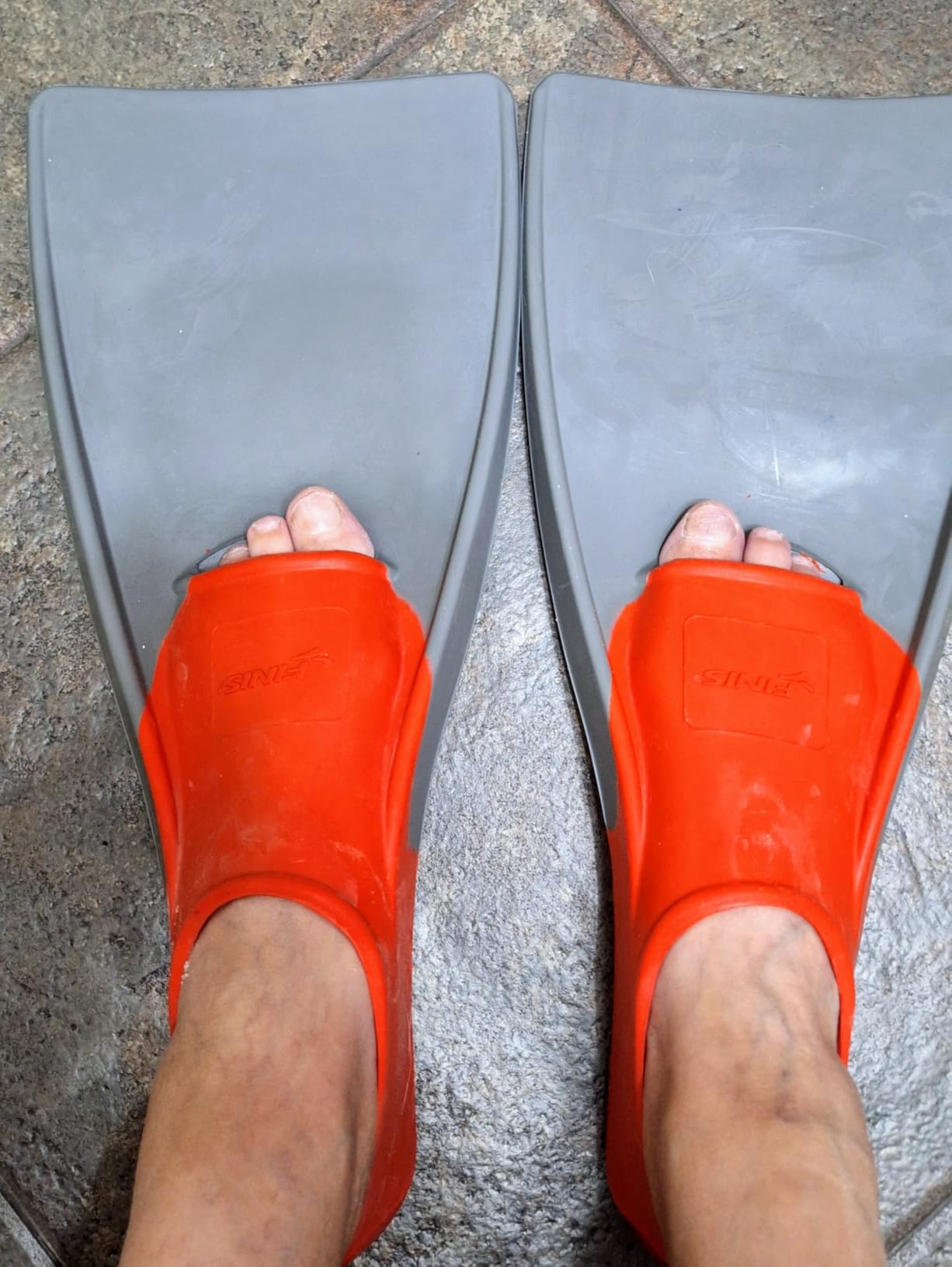
Reviewers consistently point to the buoyancy and the durability of the rubber. The company lists a 30 day limited warranty, and the blade has held its shape for swimmers who have had theirs for years. The sizing runs XS through XXL for adults, which covers most feet in the sport.
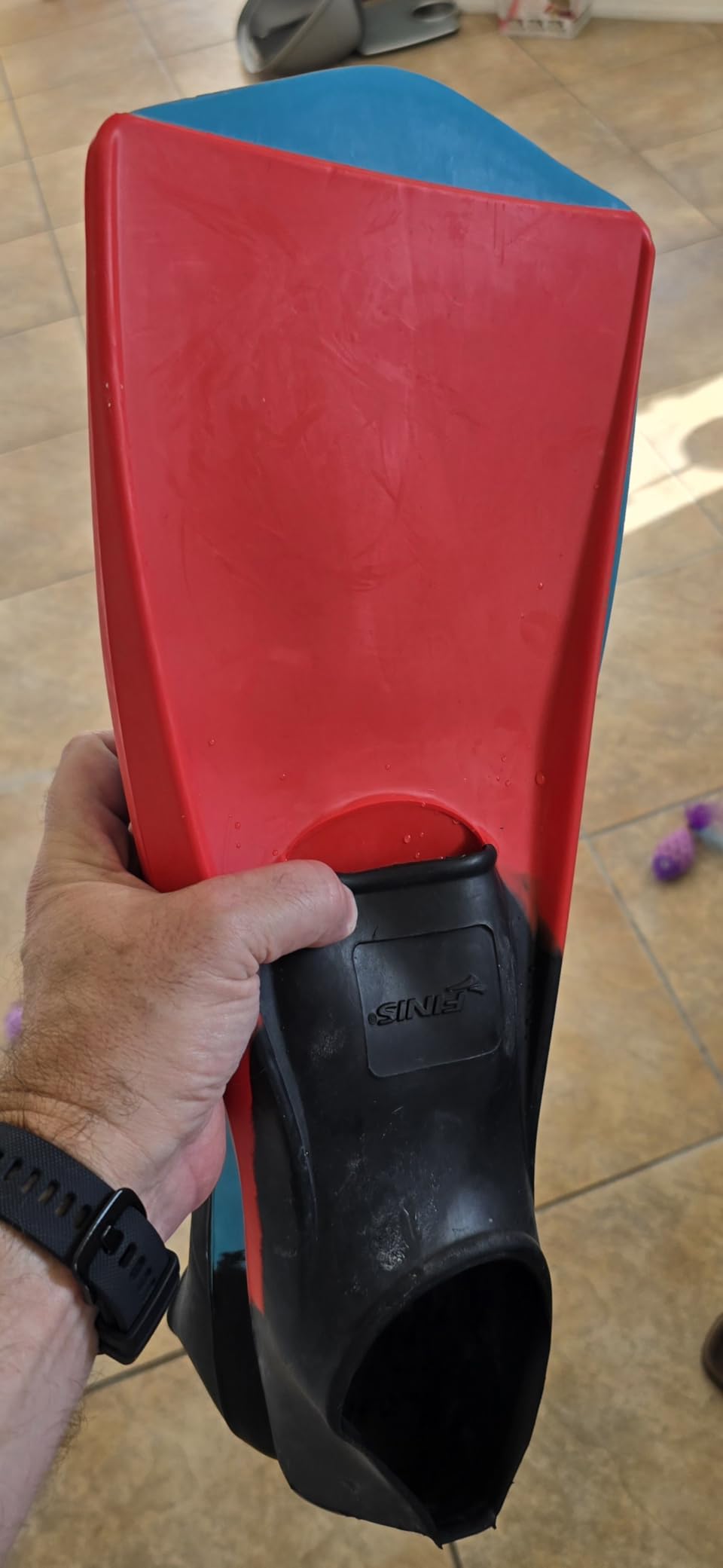
Be honest about the downside. At 14 by 11 inches and 15.8 ounces, this is a pair that lives in a large mesh bag and does not fold into a small weekender. If you swim in a pool with a tight equipment rule, or you travel hotels, the bulk is a real inconvenience.
Who the buoyancy actually helps
Beginners and anyone returning after a break get the most out of this pair. When your legs are tired at the end of a set, the lift keeps your body line long enough for the technique to survive. It is also a good pick for fitness swimmers who want leg conditioning without adding shoulder load.
Competitive swimmers working a pure strength block will like the resistance, though most will eventually move to a short blade for race-pace work. If you swim on a team, this is a second pair rather than your only pair.
When to skip the long blade
Skip it if you are chasing kick tempo, because the long blade works against a fast beat. Skip it if your pool bag is small. And skip it if ankle discomfort is already an issue for you, because the load through the ankle joint is much higher than a short blade produces.
The honest weakness is fit across brands. The pocket is a fixed full-foot design, so if you have a wide forefoot or a high arch you may need to size carefully. Sizing is covered in the fit section below.
2. CAPAS Short Blade Training Fins – Best Value
CAPAS Swim Training Fins, Short Blade Pool Lap Swimming Fins with Mesh Bag
Short blade
Silicone foot pocket
Closed heel
Adult XS-XXL
+ The Good
- Soft silicone pocket avoids rubbing when you size right
- Short blade keeps kick tempo quick
- Mesh bag included for swim bag storage
- Non-directional blades suit any stroke
- The Bad
- Sizing can run loose
- so some buyers size down
- Blades only reach past the toes and look shorter than expected
This is the pair I hand to friends who ask for one recommendation. The soft silicone pocket sits against the foot without grabbing, and the closed heel stays on through a long set without needing a strap adjustment. For a general lap swimmer doing a mix of freestyle and kick sets, it just works.
The closed heel is described by the manufacturer as inhibiting hyperflexion, and in practice that means your ankle does not bend forward past the range you would use unfinned. It limits the ankle kick slightly, which is a fair trade for a fin that stays where you put it.
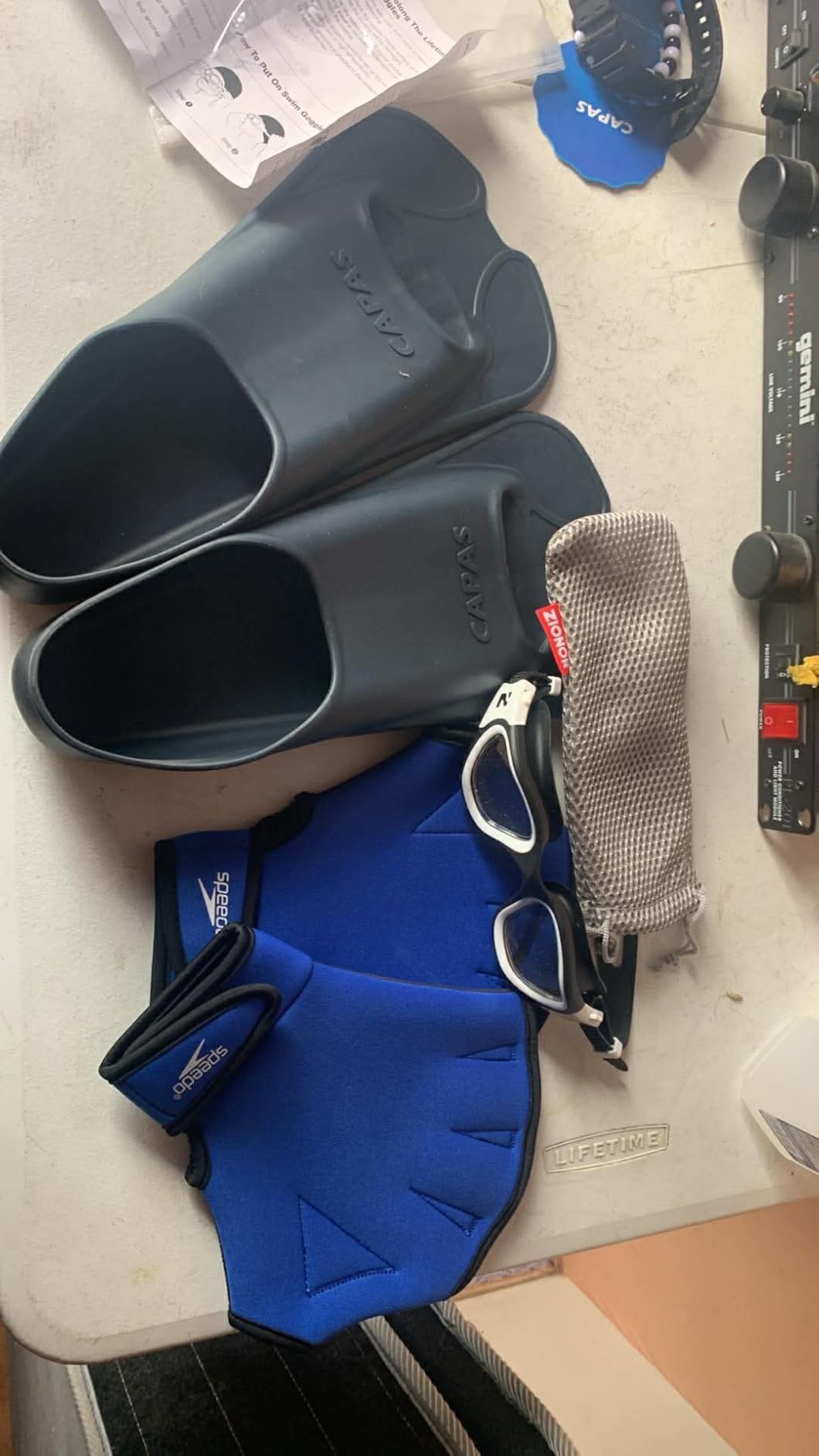
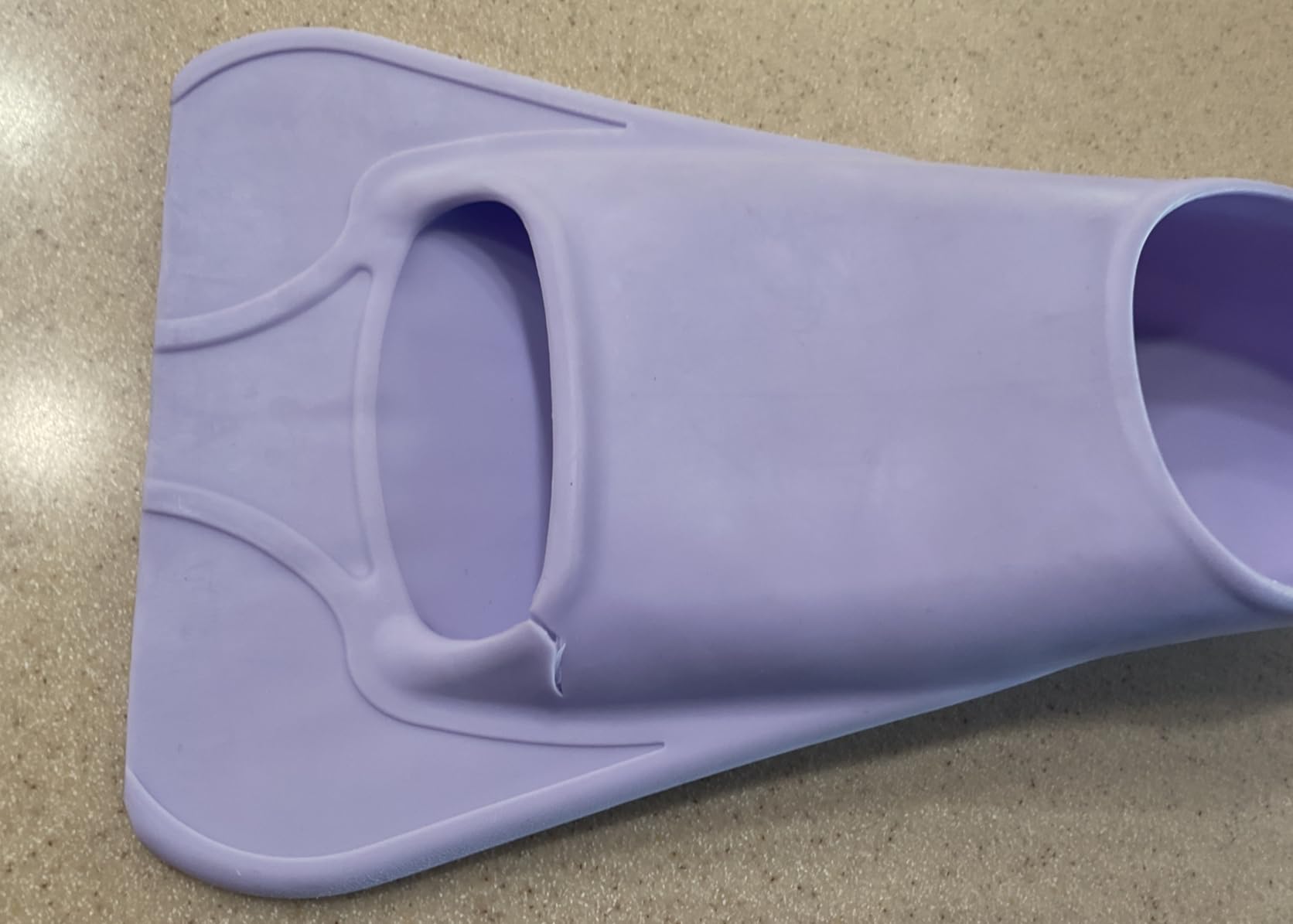
Sizing is the one thing to get right. With 5427 reviews averaging 4.6, the recurring theme is comfort, but the most common complaint is that the pocket runs slightly loose. Buyers report better results after dropping one size. The range covers XS to XXL for adults, and the fins come in a wide spread of colours.
The mesh bag is a small touch that matters more than it sounds. Short blades tangle less than long ones, but a bag stops them rattling against your goggles on the pool deck. The 30 day return window also makes a first sizing attempt low risk.
Who this pair suits
Recreational and fitness swimmers get the most from this fin. It handles long freestyle sets, backstroke, and dedicated kick sets without asking you to change technique. Beginners find the closed heel forgiving, because a fin that falls off is worse than no fin at all.
Masters swimmers and anyone training around joint discomfort will appreciate the soft silicone and the short blade, since neither loads the ankle heavily. It is a good fin for long, steady aerobic sets rather than short sprint work.
Where it falls short
It gives up some drive. The short blade and soft pocket produce good resistance but modest propulsion, so if your goal is to feel race pace you will need a stiffer fin. It is a conditioning tool more than a speed tool.
Also expect the blade to look smaller than the photos imply. The fins measure 13.2 by 7 inches and stop just past the toes, which surprises people who picture a fin that runs halfway down the shin.
3. Gintenco Silicone Short Blade Fins – Best Budget Pick
Gintenco Swim Fins, Adults & Kids Swim Training Fins for Lap Swimming
Flexible silicone
Short blade
10.2 oz per fin
US 10-11 to 9.5-10.5
+ The Good
- Lightweight flexible silicone that has held shape for months
- One pair covers kids
- teens and adults
- Packs flat for travel and small bags
- Snug fit reduces chafing and ankle slipping
- The Bad
- Some sizes run loose with toes past the opening ridge
- Heel height can dig in when the legs extend
- Less rigid than dedicated training fins
These are the fins I take when I am swimming somewhere new and want nothing in my bag that takes up room. At 10.2 ounces per fin this is a light pair, and the flexible silicone folds without creasing. If you travel to a pool, put them in your bag and forget about them.
The flexibility is the main design decision. A soft blade encourages a quick relaxed kick rather than a hard chop, which suits newer swimmers and anyone returning to the water. Reviewers often compare them favourably to Sporti silicone fins on weight and value.
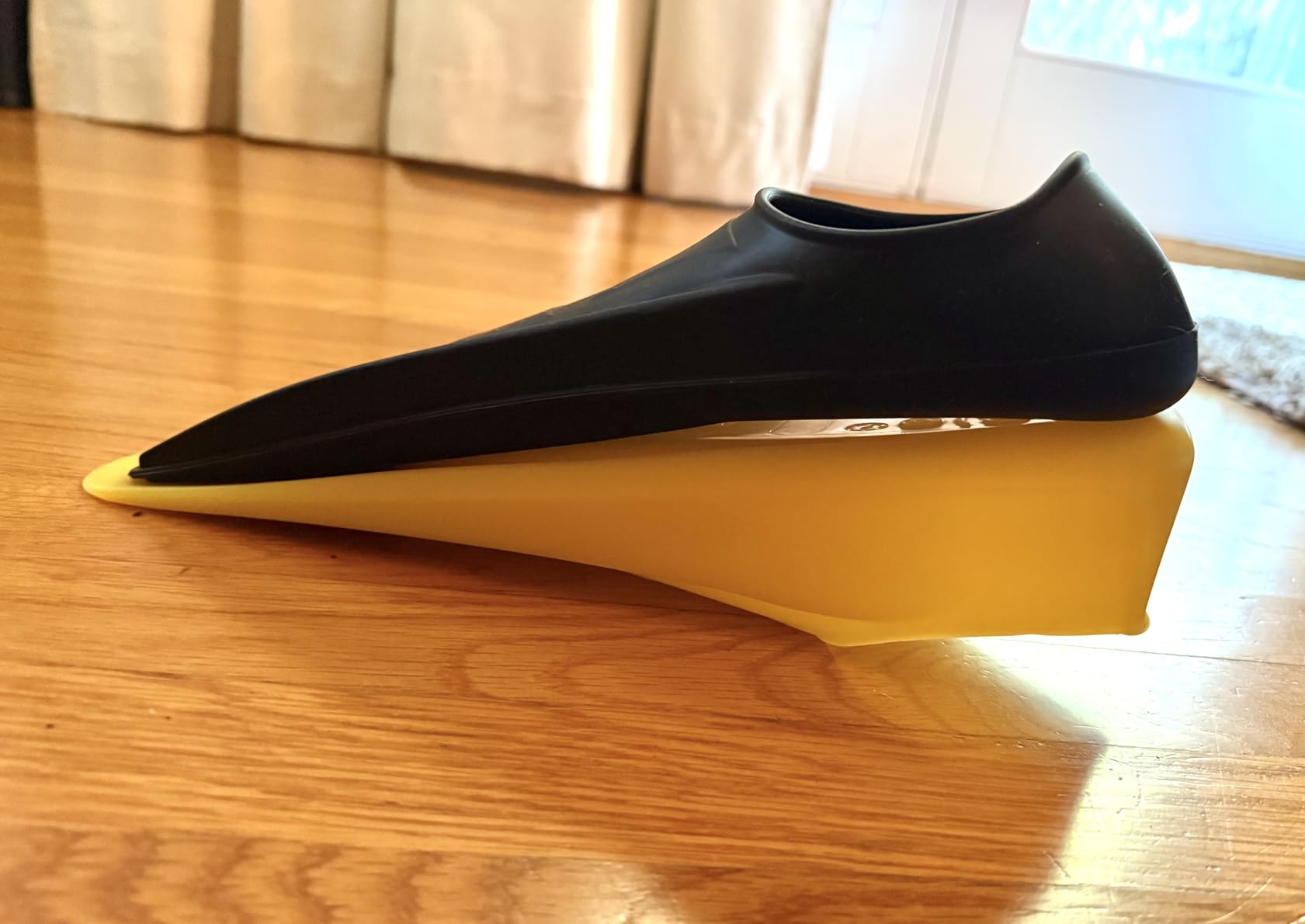
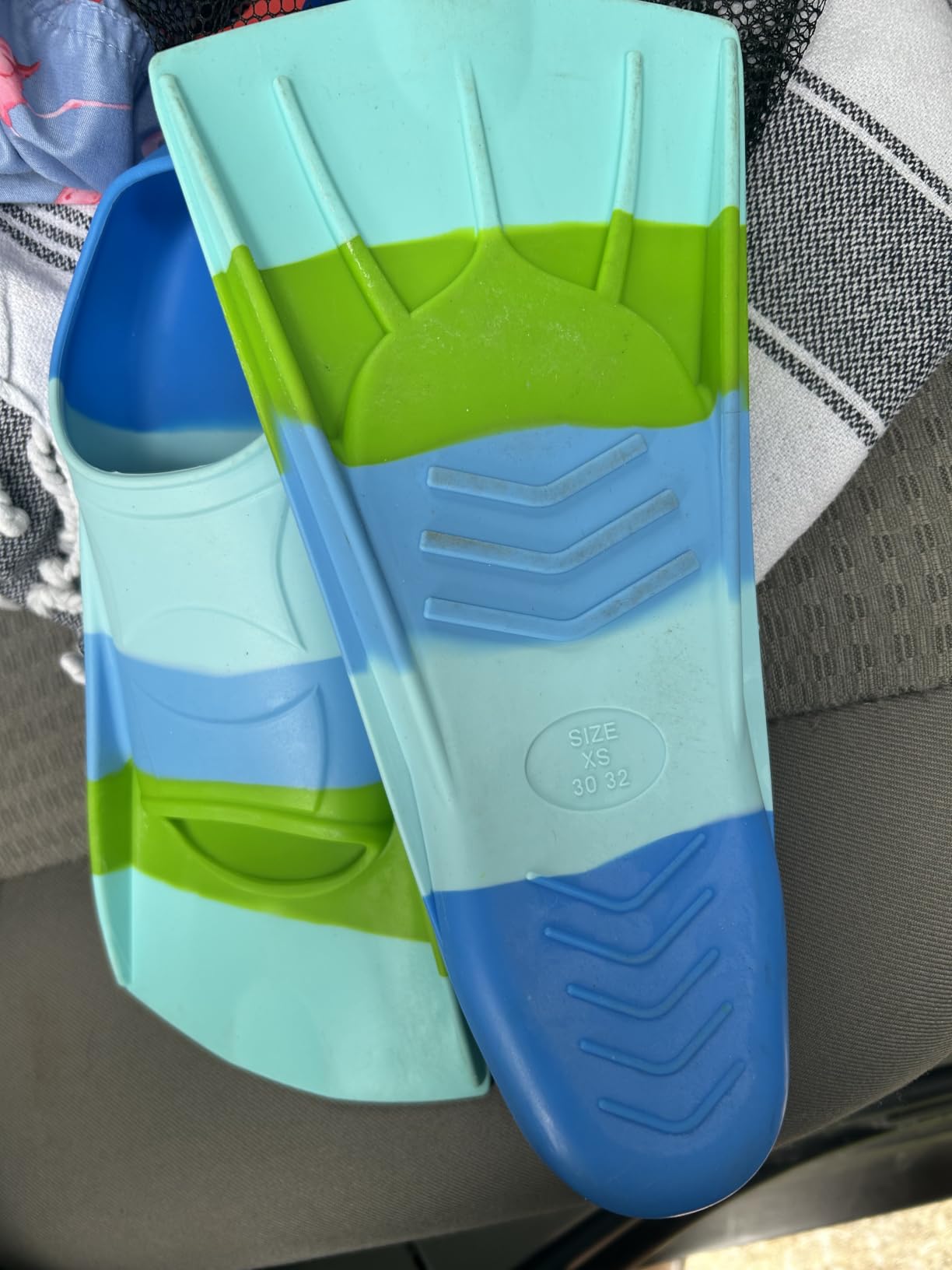
Sizing covers XXXS at US 10 through 11 up to XL at US 9.5 through 10.5, and the manufacturer lists a one year warranty. The most common complaint across 3633 reviews is heel fit, where the heel height digs in when the legs are fully extended at the bottom of the kick.
There is also a note about looseness in some sizes, with toes extending past the foot opening ridge. If that happens to you, step down a size rather than pushing through it. A one year warranty makes that an easy call.
Who this pair suits
Families and mixed-ability households. A single pair covers a wide range of feet, which matters when one fin has to serve an adult and a teenager. Beginners also do well here because the soft blade gives instant feedback without punishing a bad kick.
Travellers and hotel swimmers will appreciate the compact 25 inch profile, which is also safer around other swimmers in open water. It is a solid choice for pool technique work and light conditioning.
Where it falls short
If you want a strong resistance tool, look elsewhere. Reviewers note these are less rigid than dedicated training fins, so the leg work is real but gentler. Competitive swimmers chasing leg power will find these too soft.
The heel dig is worth taking seriously. If you feel pressure behind the heel in the first few kicks, stop and change size. It is the single most common sizing complaint on this pair and it is fixable.
4. FINIS Zoomers Gold Fins – Best for Technique Work
FINIS Zoomers Gold Swim Training Fins – Short Blade Design for Speed & Conditioning – Soft Natural Rubber Fit – Size D
Short blade
Soft natural rubber pocket
Youth sizing
0.7 kg
+ The Good
- Soft natural rubber pocket works for long sessions
- Short blade supports a quick compact cadence
- Good for both fitness and competitive kick work
- Improves ankle range of motion
- The Bad
- Soft build gives less resistance than stiff race fins
- Listed primarily in youth sizing
The Zoomers have a long history in swim programmes, and the Gold version updates the foot pocket with soft natural rubber. That pocket is the reason to buy this pair now rather than an older version. Reviewers consistently mention comfort across long sessions as the deciding factor.
Mechanically, the short blade encourages shorter faster kicks, which is exactly what technique work needs. The blade also increases flexibility and range of motion at the ankle, so a swimmer working on a tight flutter kick can use it as a mobility tool between sets.
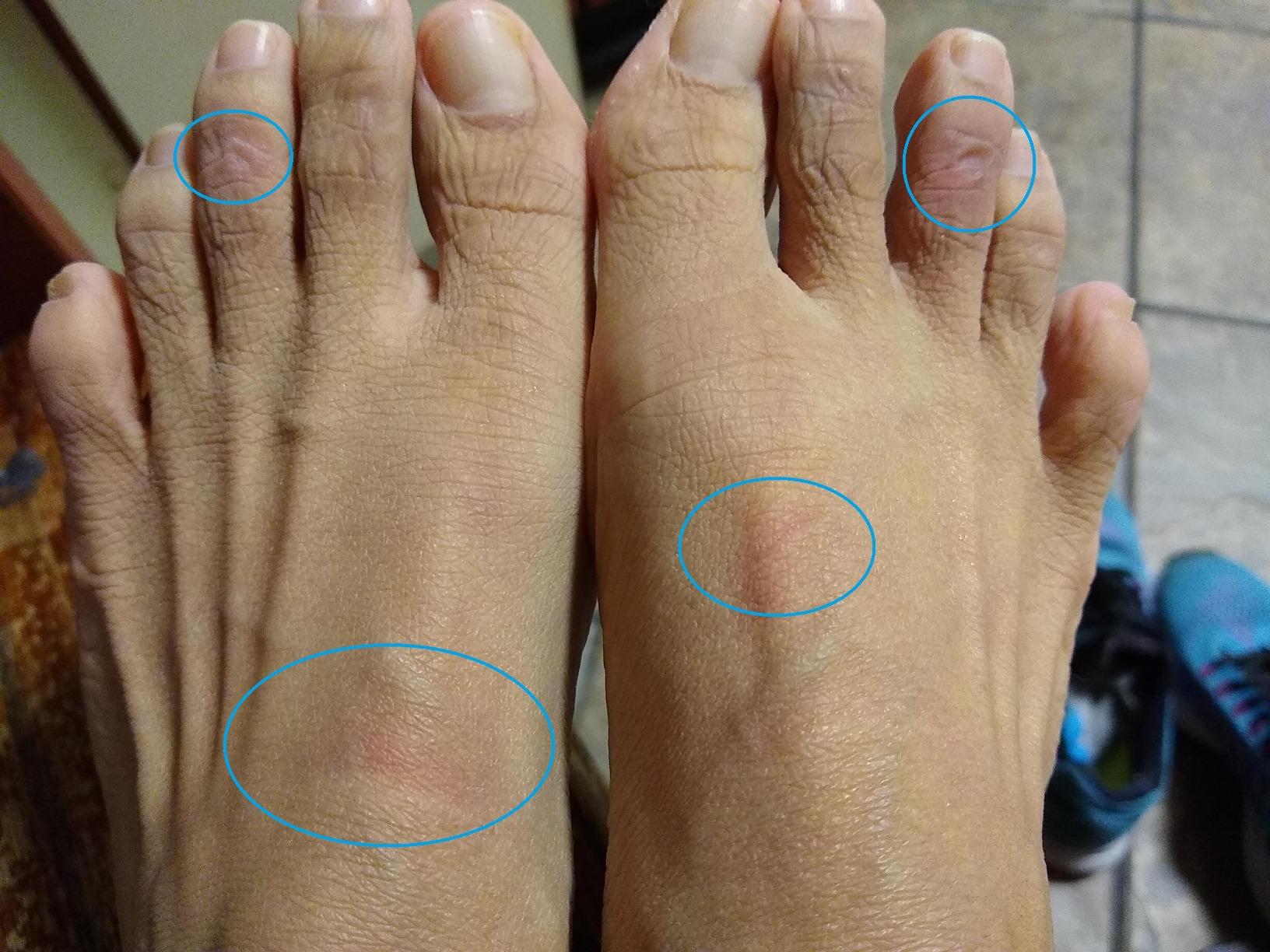
Owners also point out that it works for both fitness swimmers and competitive swimmers, which is unusual for a fin that looks like a youth product. The listing is youth sized, and multiple US and EU sizes are available, so check the size chart against an adult foot before buying.
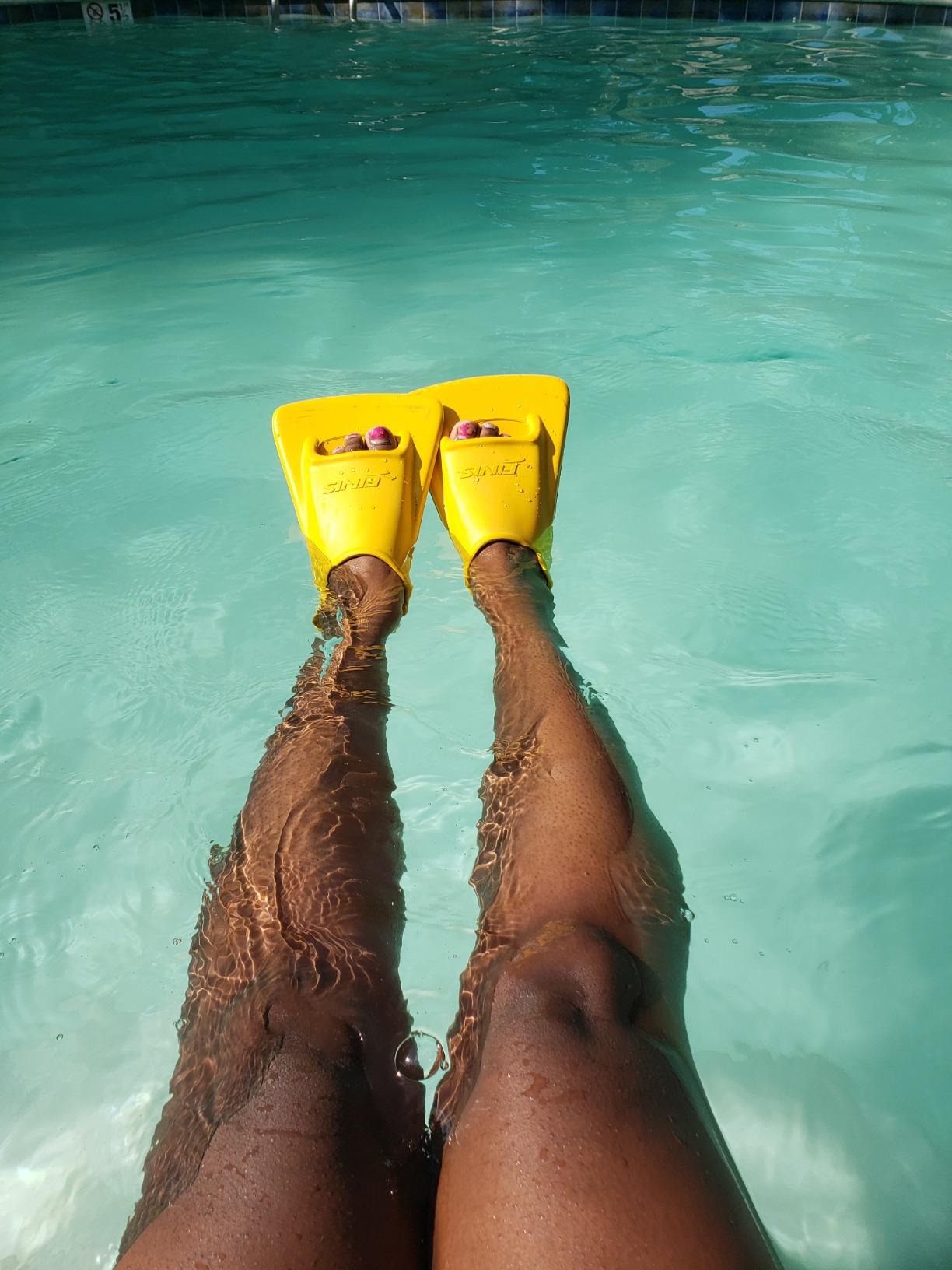
At 0.7 kg for the pair, this is a substantial fin in the water. That weight contributes to the soft feel of the pocket, and it is the same thing that limits how much resistance you get from a hard set.
Who this pair suits
Technique-focused swimmers and coaches running kick drills. The soft pocket lets a swimmer keep a clean, relaxed foot position, which is what makes a drill productive. Younger swimmers working on flutter kick mechanics also do well here.
If you swim on a masters team, this is a good drill fin. You can do short sets at high quality rather than grinding long sets, and the ankle mobility benefit shows up in your unfinned kick within a few weeks.
Where it falls short
The softness costs you resistance. If your programme calls for heavy leg conditioning, a stiffer fin will get you there faster. Reviewers are clear that this is a comfort-first design rather than a power design.
Also check sizing carefully, because the product is positioned in youth ranges. Measure your foot and compare against the size chart rather than assuming adult feet map onto the top size.
5. Speedo Natural Rubber Short Blade Fins – Best for a Fast Beat
Speedo Unisex-Adult Swim Training Fins Rubber Short Blade
Natural rubber
Short blade
Open toe pocket
Adult XXS-XL
+ The Good
- Open toe pocket takes pressure off the toes
- Comfort-engineered pocket handles long sets
- Short blade promotes a fast beat for fitness swimmers
- Durable natural rubber that flexes well
- The Bad
- Open toe and open heel feel less secure to some
- Bulkier than compact silicone fins
The Speedo short blade is aimed squarely at fitness swimmers who want a quick beat rather than maximum load. The open toe pocket is the detail that stands out in use, because it lets your toes move freely instead of pressing against the front of the pocket for an entire set.
Natural rubber gives it a predictable flex that neither soft silicone nor stiff race rubber matches. The foot pocket is engineered for comfort, and across 3280 reviews the praise for long-session comfort is the dominant theme.

Sizing runs XXS to XL for adults, so the range covers most swimmers. Colour options include Hapuna Blue with Hyper Yellow, and the build is a pull-on design with no buckles or straps to lose in the pool. That simplicity is worth something when you are doing repeated sets.
The trade-off is security. Because the toe and heel are both open, some swimmers feel the fin move a little on a fast kick. If that bothers you, a closed heel design such as the CAPAS or Arena options will feel more planted.
Who this pair suits
Fitness swimmers and triathletes who want to hold a high cadence for long aerobic sets. Anyone whose toes get cramped in a closed pocket will appreciate the open front. It is also a solid first pair for a beginner who is learning a relaxed quick kick.
Masters swimmers doing volume work will find the short blade keeps the load off the ankle, and the open toe avoids compression on an aging foot. It is a comfortable fin for a high volume week.
Where it falls short
It is not the most precise fin for technical work. The open front and open back mean less directional control, so if you are refining a race-pace kick with a coach, a fin with a fuller pocket will give clearer feedback.
It is also heavier at 0.55 kg for the pair than the compact silicone options, so it takes more room in a small bag. Budget for that if you travel.
6. Arena Powerfin Short Blade Fins – Best for Beginners
Arena Powerfin Training Fin for Swimming Short Blade Snorkeling Scuba Unisex Silicone Flippers Comfortable Closed Heel Full Foot Pocket Snug Integrated Fit Control, Pink/Black, Size 12-13
Short blade silicone
Closed heel full pocket
PVC-free
16 oz
+ The Good
- Stiff
- heavy build that builds real leg strength
- Snug fit does not rub over long sessions
- Closed heel stays secure through kick sets
- US men's sizing guidance included
- The Bad
- Bulky and heavy for swim bag storage
- Small blade area gives less glide than long fins
- Occasional silicone tearing after heavy use
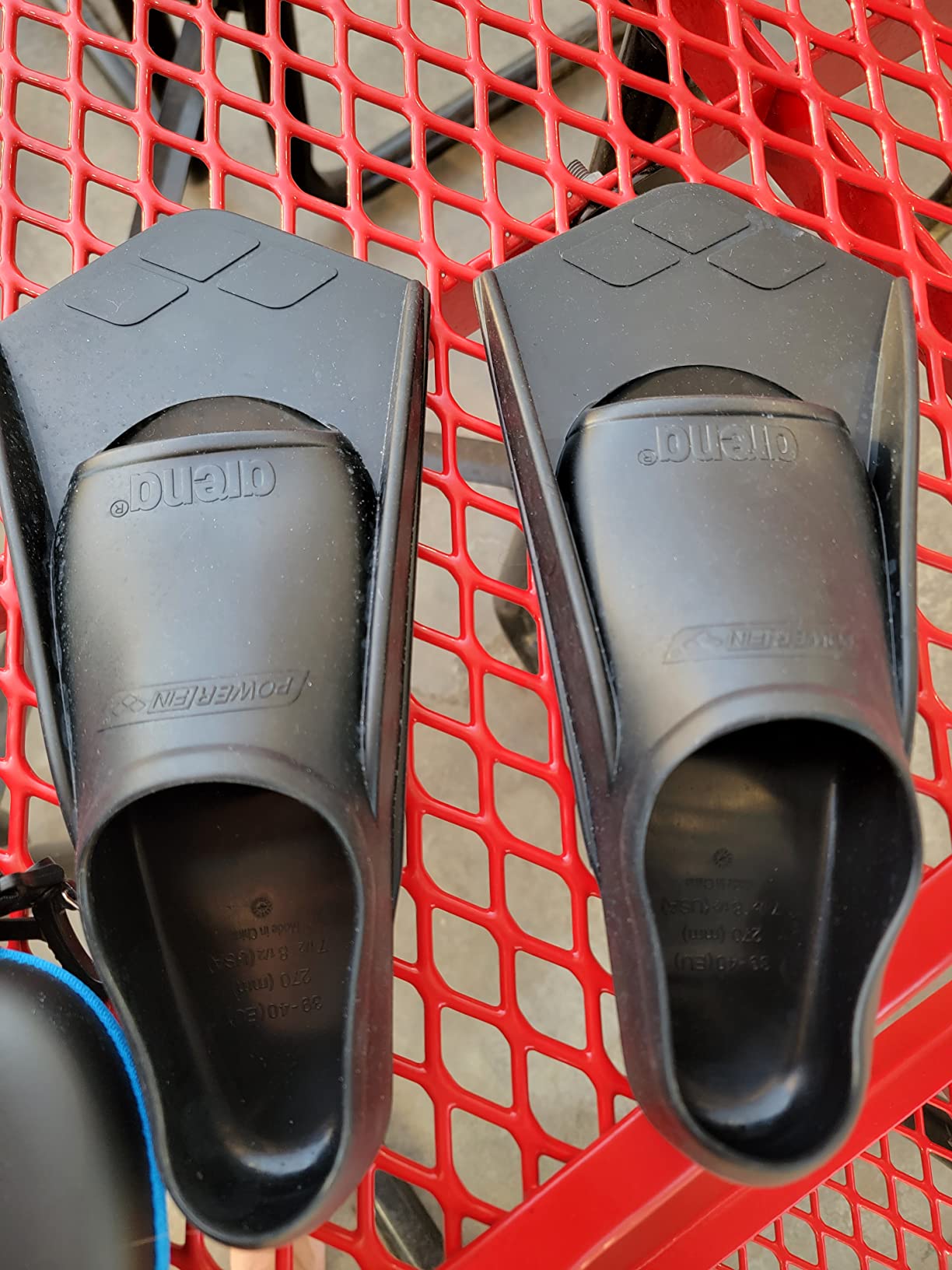
The Arena Powerfin is a strange choice for beginners on paper, because it is stiff and heavy. In practice that stiffness is the point. The fin gives real feedback when your kick is loose, and the closed heel full pocket keeps the foot secure so a beginner is not chasing a fin that keeps sliding.
Reviewers repeatedly describe the fit as snug with no rubbing, which is what you want from a beginner fin. The silicone is PVC-free and flexible enough not to crack, while the blade itself stays firm. The listing lists diving, swimming and underwater hockey as intended sports, so it doubles as a snorkelling fin if you want one pair for two jobs.
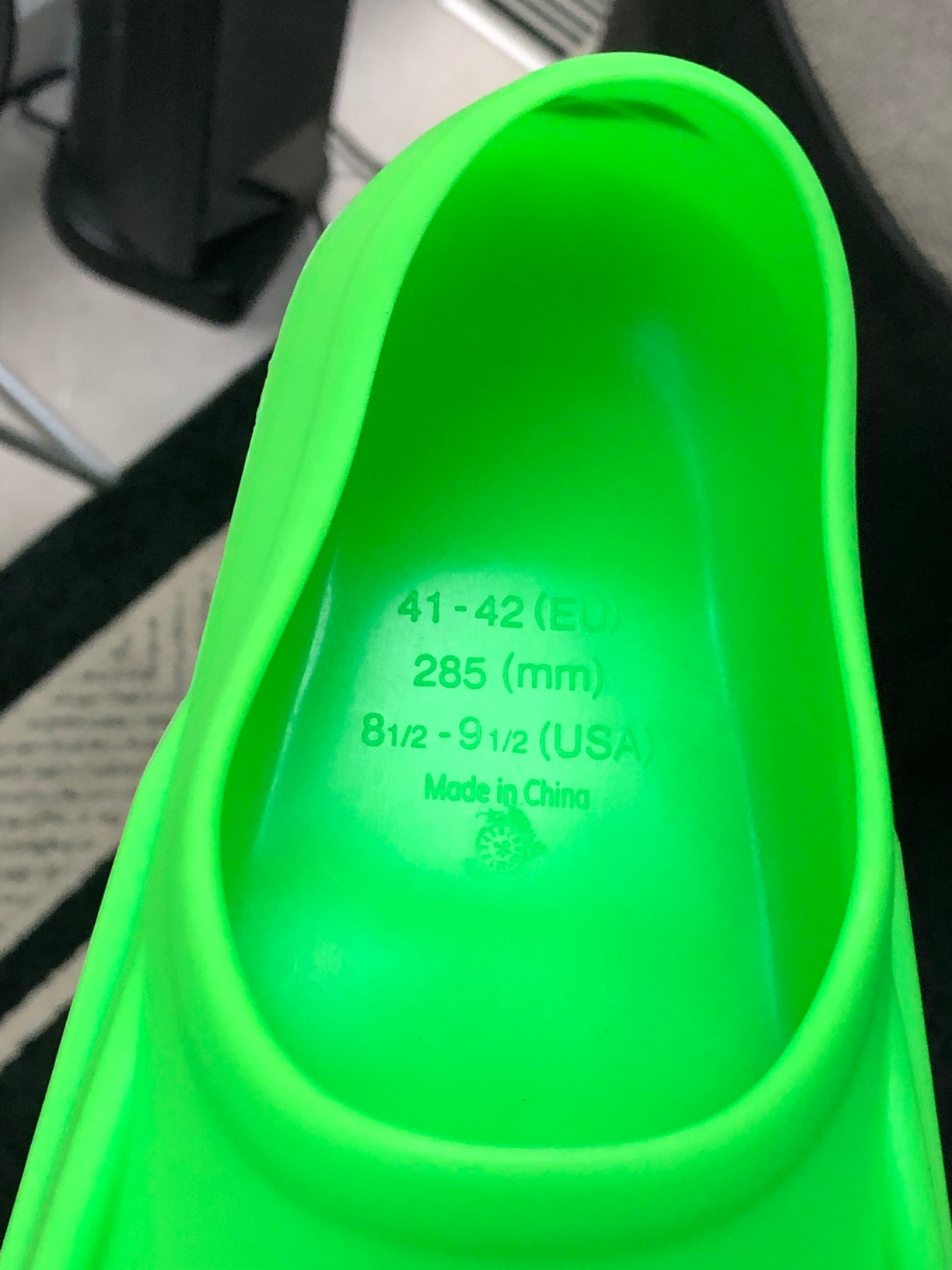
The US men’s sizing reference is unusual and genuinely useful. Most brands list a vague range, but this one gives a shoe size reference so you can pick a fit with more confidence. The listing also notes multiple colour options including a pink and black combination.
There are durability notes worth knowing. Across 3079 reviews, some owners report silicone tearing after roughly six months of heavy use. That is a wear item rather than a defect, but it tells you to check the blade around the foot pocket every few months.
Who this pair suits
Beginners who need clear feedback on a sloppy kick, and fitness swimmers who want their legs to genuinely burn. The stiffness resists bad habits rather than letting them pass, so it works well with a coach who wants to see change between sets.
It also suits swimmers who want one fin for the pool and open water. At 16 ounces it is a genuinely portable weight, even if the shape is bulky.
Where it falls short
Do not buy it for a swim bag you have to carry on public transport. Reviewers name bulk and weight as the top drawback, and that is fair. It also has the smallest blade area in this group, so it gives less glide than a long fin and will not float your legs up.
If you are between sizes, the snug fit can be the opposite of forgiving. Read the size reference rather than guessing.
7. Speedo Switchblade Fins – Best for Kick Cadence Training
Speedo Unisex-Adult Swim Training Fin Rubber Medium Blade
10-degree angled blade
Natural rubber
Extended foot pocket
Adult XXS-XXL
+ The Good
- Angled blade gives strong propulsion and higher cadence
- Soft upper rubber with a firmer lower section
- Extended pocket spreads pressure over the foot
- Soft build avoids common blistering
- The Bad
- Size chart runs small and several buyers size up
- Heel rubber can turn sticky after a couple of years
- Heavier feel can fatigue ankles
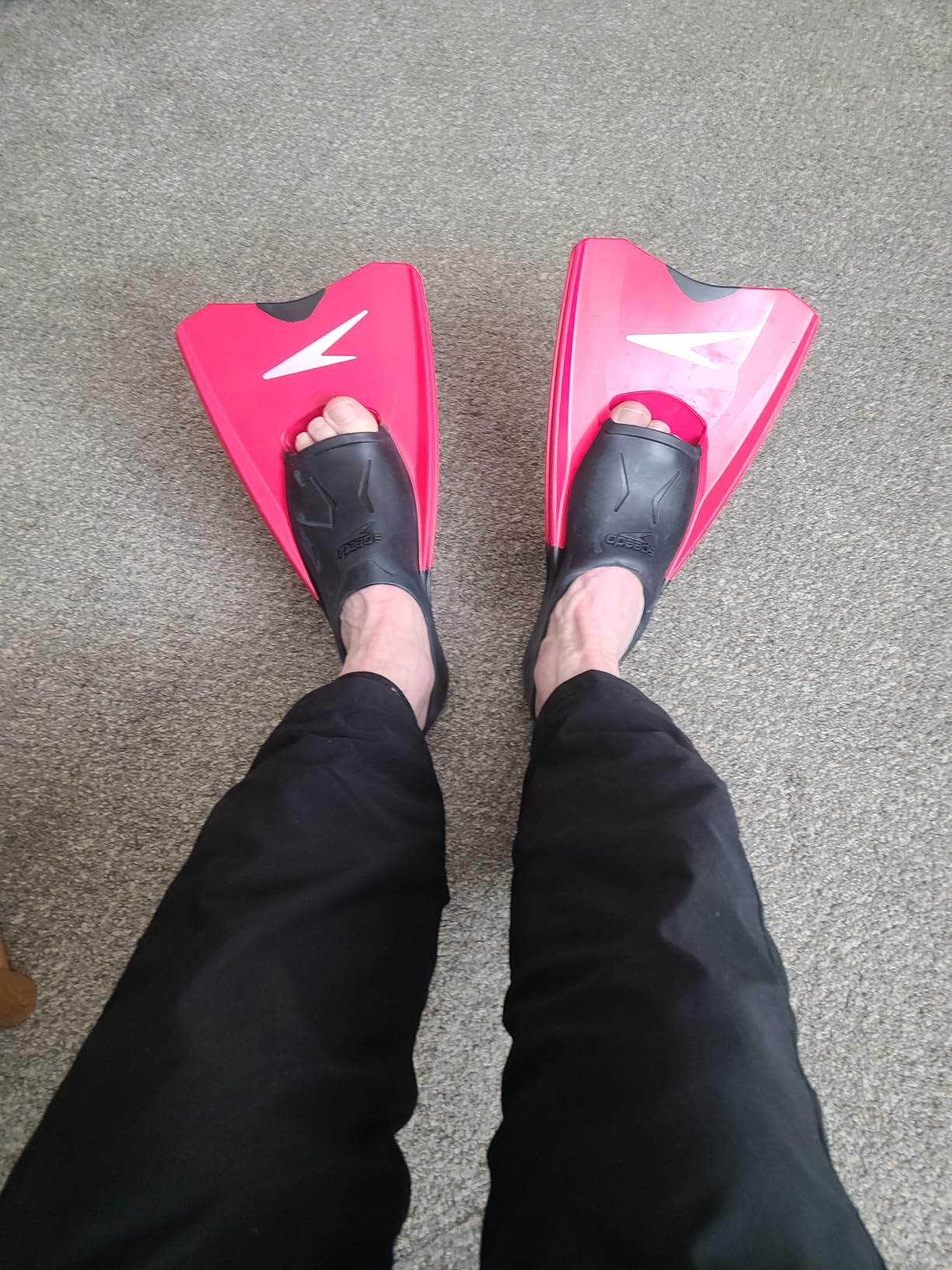
The Switchblade is built around a single idea: a ten degree blade angle. That angle widens the down kick segment, so you get more propulsion per cycle and can raise your cadence without wrecking your technique. If your goal is to feel a faster beat, this is the fin built for that job.
The construction is layered, with soft upper rubber over a firmer lower section. That combination is why reviewers describe it as comfortable on top of the foot while still feeling secure underneath. The extended foot pocket also spreads pressure rather than concentrating it at the heel.
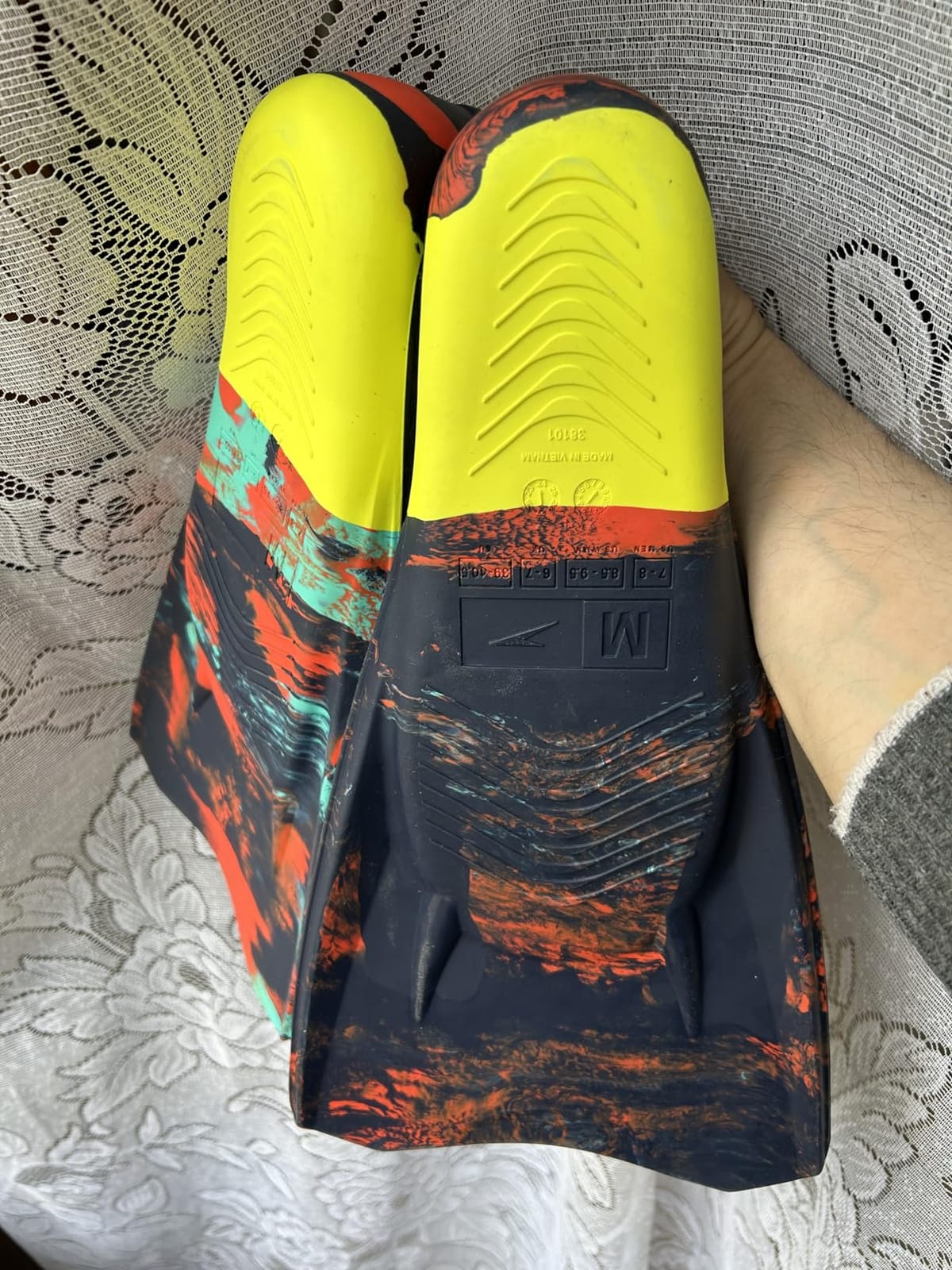
One warning is consistent across the 2624 reviews: the size chart runs small and several buyers recommend sizing up. Treat the chart as a starting point and expect to move one size higher than you normally wear. Adult sizes run XXS through XXL.
Long-term durability is the other theme. The heel rubber can degrade and become sticky after a couple of years, and some owners report tearing with heavy pool use. Store them dry and out of direct sun between uses to slow that down.
Who this pair suits
Swimmers chasing kick cadence, and triathletes working on a fast, efficient flutter. The angled blade gives audible feedback, so you can hear when a kick is finishing properly. Coaches running cadence drills will find the response immediate.
It also works for general pool strength work, since the resistance is real without being a long blade. Anyone who blisters easily will like the soft upper section.
Where it falls short
This is the lowest rated fin in the group at 4.3, and the reviews explain why. Sizing is the biggest issue, with the chart running small. It also carries a noticeably heavier feel in the water, which can fatigue ankles over very long sets.
If you already own a stiff fin and want comfort, pick a softer design instead. If you want power, look past the rating and read the size notes.
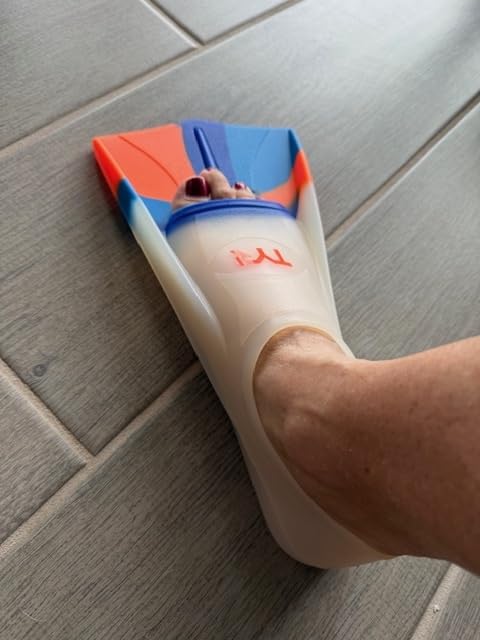
8. TYR Stryker Silicone Fins – Best for Sensitive Feet
TYR Stryker Silicone Swim Fin for Racing and Training, XX-Large, Blue/Navy/Clear
100% hypoallergenic silicone
Short blade
Non-slip footpad
14.24 in
+ The Good
- Hypoallergenic silicone reduces blistering on sensitive skin
- Short blade encourages a quick natural flutter kick
- Non-slip footpad makes poolside walking safer
- Built-in sun protection slows colour fading
- The Bad
- Custom fit sizing needs careful checking
- Softer silicone gives less resistance than stiff fins
This is the pair I suggest to swimmers who finish every session with raw spots on their feet. The whole fin is 100 percent hypoallergenic silicone, with no rubber additives, and the short blade promotes short quick leg movement for a natural flutter kick. Nothing about the material irritates skin.
At 4.6 across 2571 reviews, it has the second strongest satisfaction score in this roundup. Owners highlight comfort, the technique benefit, and the fact that the silicone holds up. It is also listed for diving and surfing, so it works beyond the pool if you travel with it.
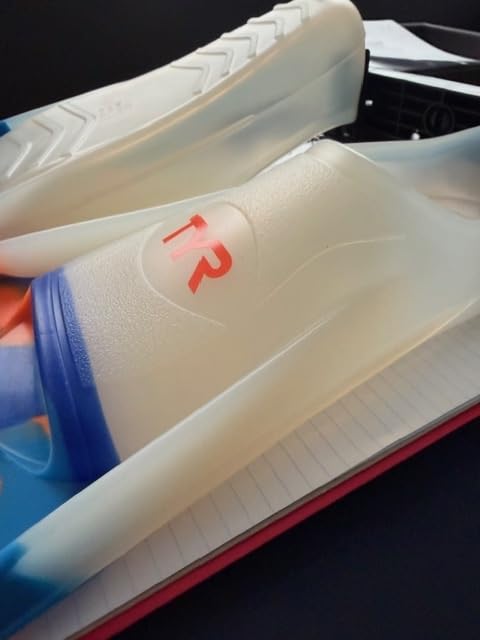
Two practical details are worth your attention. The non-slip footpad is a genuine safety feature on wet pool decks, docks and boat surfaces. And the built-in sun protection slows colour fading, which matters if you leave fins in a bag by a window in summer.
Sizing is marked as a custom fit, and the XX-Large is listed at men’s US 12 to 13 and women’s US 13.5 to 14.5. That is one of the clearer size references in the group, so use it rather than guessing between sizes.
Who this pair suits
Swimmers with sensitive skin, eczema, or a history of blistering. It is also a good option for anyone whose feet are simply narrower than the average, since the material stretches without needing a size up.
Masters swimmers often choose this fin for comfort over hours. The short blade keeps ankle load low, and the 16 ounce weight is easy to carry between pool and home.
Where it falls short
Soft silicone gives less resistance than a stiff technical fin, so it is a poor choice for a dedicated leg strength block. If your programme is built around heavy kick work, you will need a stiffer fin eventually.
The custom fit also means a wrong size is wasted money. Measure your foot and check the size reference before ordering.
9. Arena Powerfin Pro II Fins – Best for Competitive Swimmers
Arena Unisex Adult Powerfin Pro II Swim Training Fins Men and Women Silicone Short Blade Flippers Left/Right Customized, Blue, Size 7.5-9
Short blade
Open heel
PVC-free silicone
800 g per pair
+ The Good
- Hydrodynamic slits and grooves noticeably speed up the kick
- Open heel allows a strong flexible down kick
- Blades shaped separately for each foot
- Long-life PVC-free silicone resists blistering
- The Bad
- Heaviest pair here at 800 g per pair
- Highest cost of the ten picks
- Needs careful size chart checking
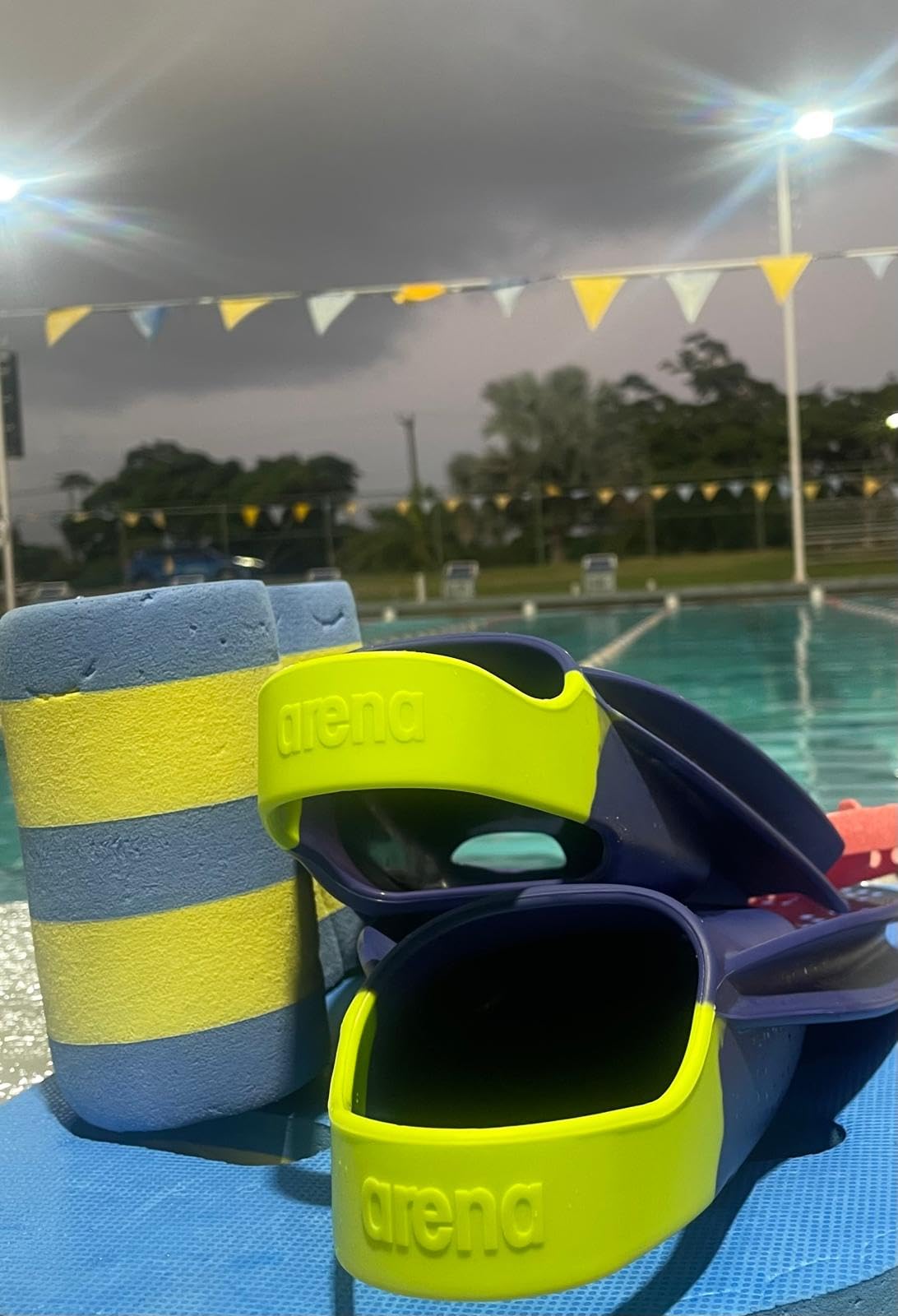
This is the most advanced fin in the group and the one built for a swimmer who already has a good kick. The blade surface slopes, with hydrodynamic slits on top that reduce drag and improve control, while the underside has notched ribs for a faster turnover. It is a designed piece of equipment rather than a moulded simple fin.
The open heel is the feature competitive swimmers care about most. It leaves the ankle free, so you can produce a powerful down kick through a real range of motion rather than fighting a closed pocket. The blades are shaped separately for each foot, which gives a more natural connection than non-directional fins.
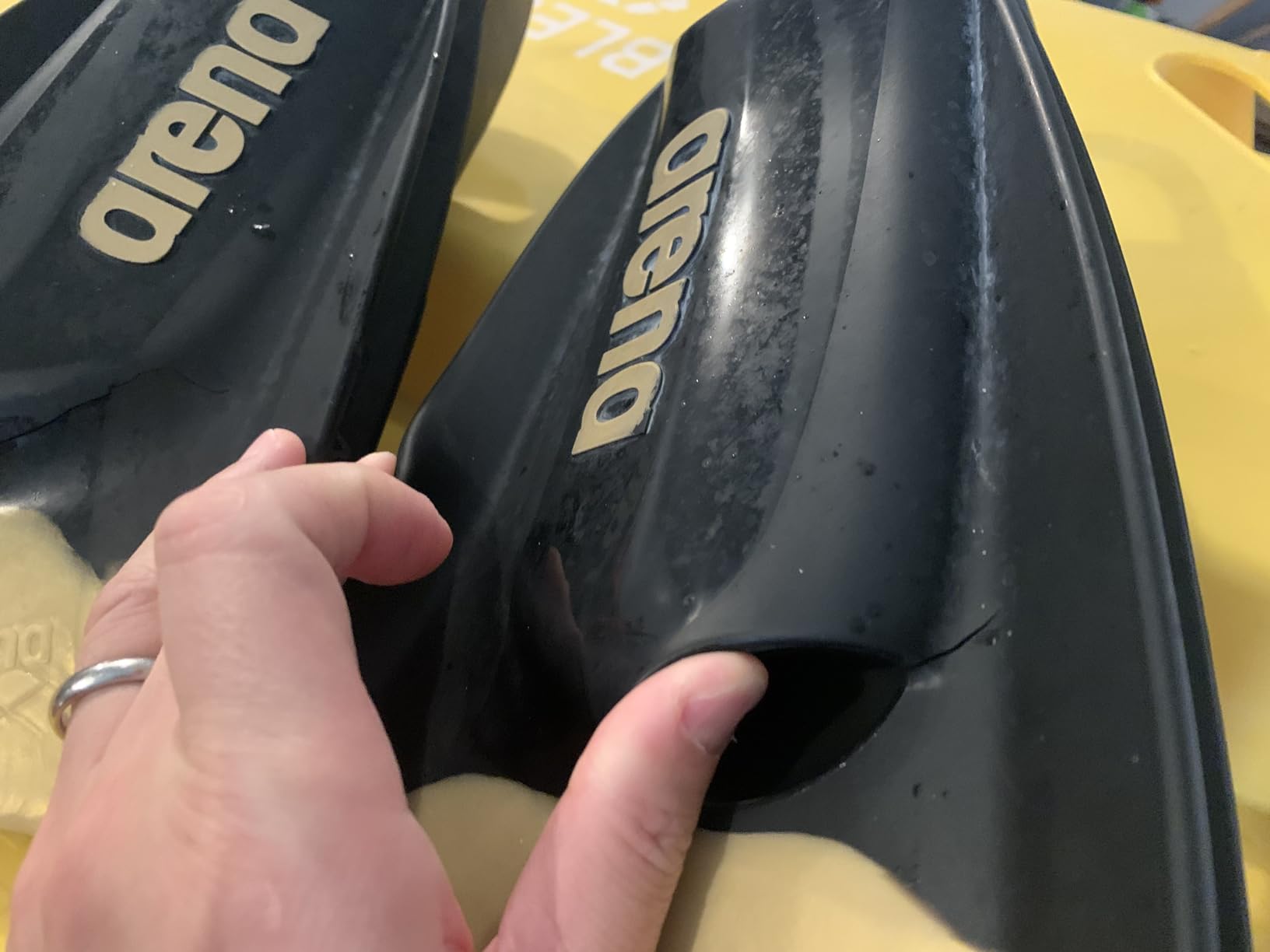
At 4.6 across 2238 reviews, this has the strongest satisfaction score of the ten, with 81 percent five-star ratings. Owners consistently report technique gains and comfort across long sessions. The silicone is PVC-free and described as long-life, which addresses the cracking problem that hits cheaper silicone.
It is also the heaviest and priciest option here at 800 g for the pair. Bring that up before you commit, because a heavy fin changes how a long set feels and how easily you can keep your cadence. It is a training investment, not a casual pool purchase.
Who this pair suits
Competitive and serious club swimmers refining underwater mechanics. Anyone working on their dolphin kick or on race-pace turnover will see the benefit fastest. Age group swimmers moving from fitness to structured training get a lot out of this fin.
It is also a good choice for swimmers who train in a squad, since the feedback is precise enough to discuss with a coach set by set. The list price suits a swimmer who already has goggles, a cap and a suit.
Where it falls short
Weight and cost are the honest drawbacks. This is not a fin to buy on a whim, and a 800 g pair will fatigue ankles on a long set if you are not used to it. It is also the least forgiving fin here for beginners, because it rewards a good kick rather than teaching one.
Size selection needs care, and the range runs from 4.5 to 13.5 in many colourways. The open heel can feel loose on a narrow foot if you go up a size to be safe, so read the chart properly.
10. Speedo Silicone Training Fins – Best for Everyday Laps
Speedo Unisex-Adult Swim Training Fins Silicone
Closed heel pocket
Short blade
Universal foot cavity
DMC V-channel
+ The Good
- Closed heel stays secure through long freestyle sets
- Universal foot cavity makes fins quick to pull on
- Soft silicone reduces blistering
- V-channel edge and tow drain chute move water efficiently
- The Bad
- Less resistance than stiff technical fins
- Universal cavity is not individually moulded
This is the sensible all-purpose silicone fin for a swimmer who wants one pair that handles whatever the lane programme throws at them. The closed heel pocket stays secure through a long freestyle set, and the short blade works on kick sets without slowing your cadence to a crawl.
The edge detail is what separates it from a generic fin. The DMC V-channel grips the water along the top of the fin, and a full tow drain chute moves water away efficiently through the kick. Owners describe the kick as more natural than on a plain blade, and that comes from those channels.
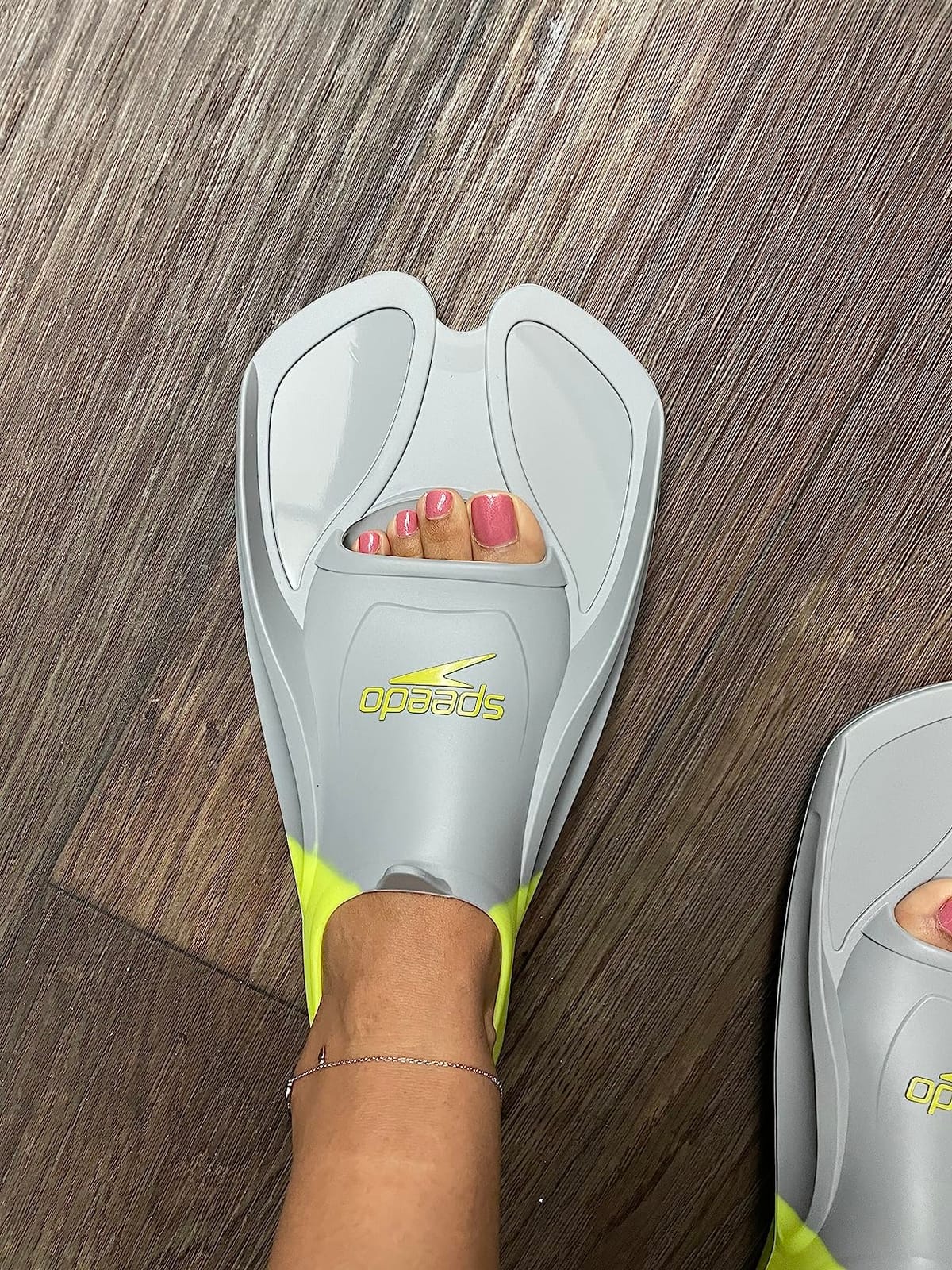
The universal foot cavity is a genuine convenience. It is not moulded to a specific foot, which means it is easy to slide on and off between sets, but it also means the fit is less precise. Some swimmers love that flexibility and others find it less secure than a shaped pocket.
At 4.5 across 1371 reviews, the satisfaction is solid without being exceptional. It is listed as a fitness fin rather than a technical one, and that framing matches how it performs in the water.
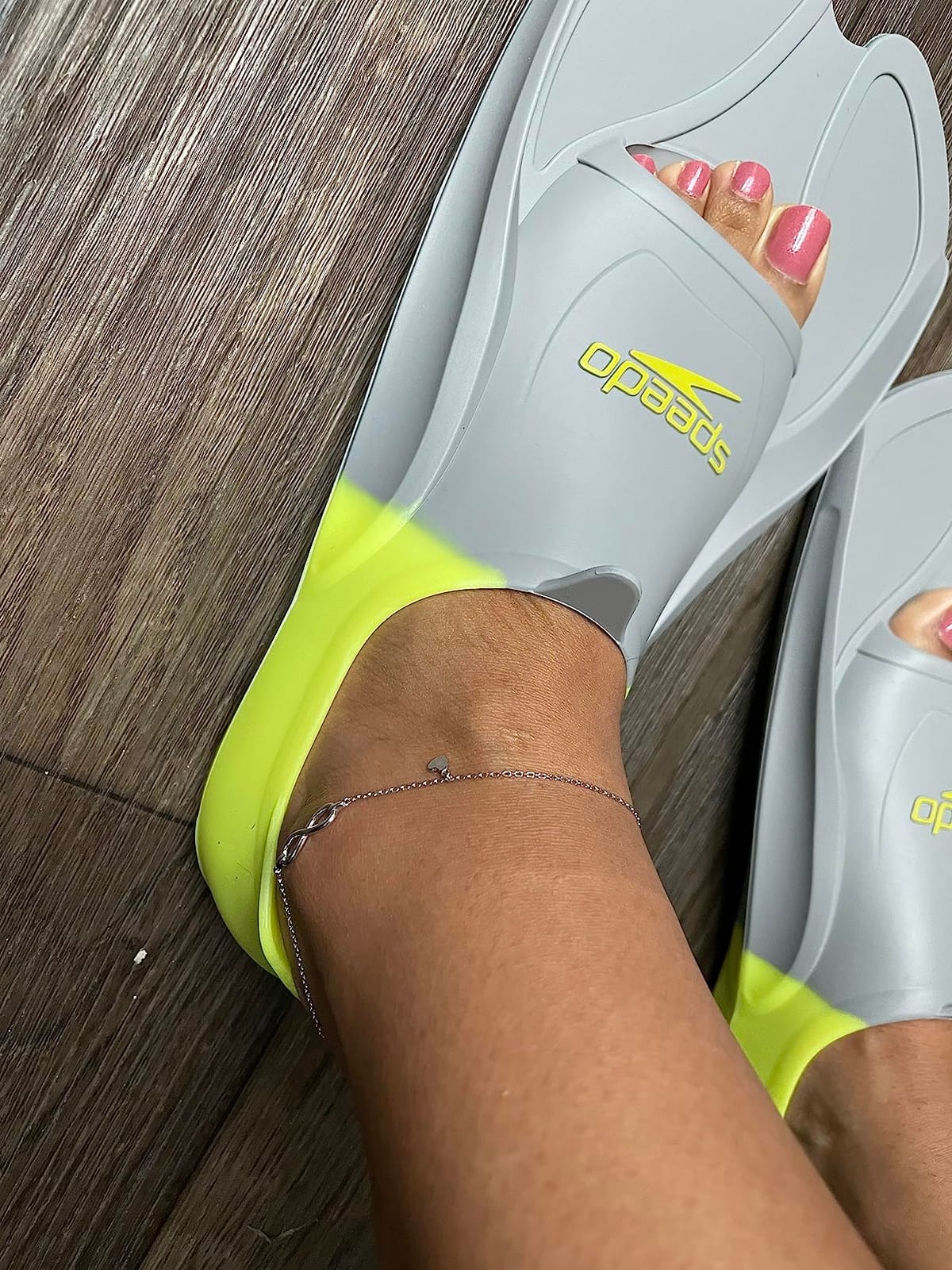
Who this pair suits
Recreational and fitness lap swimmers who want a comfortable fin for general use. It works for a mixed week of aerobic sets, kick sets and technique drills without changing fins. The quick on and off cycle also suits swimmers doing repeated short sets.
Anyone who dislikes fin fuss will appreciate the pull-on design with no straps to adjust. It is a good default recommendation for a first pair, alongside a more specialised fin if you know your training focus.
Where it falls short
It is not a heavy resistance fin. If your programme is a leg strength block, the softness will leave you short of load. It also offers less directional feedback than a fin with blades moulded separately for each foot.
Because the cavity is universal rather than moulded, a swimmer with an unusually wide forefoot may find the front compresses. Check a shaped fin if you have wide feet.
How to Choose Swim Fins for Lap Swimming
Choosing a fin comes down to five decisions, and you can make all five in about five minutes if you know what each one changes. Here is the order that gets it right the first time.
1. Blade length. Short blades measure roughly 12 to 16 inches and long blades roughly 20 to 24 inches. For lap swimming you want short, because short keeps your kick tempo near race pace. Choose long only for buoyancy and raw leg strength work.
2. Material. Natural rubber gives predictable flex and floats. Silicone is softer against the skin, resists cracking, and suits sensitive feet. Rubber costs less and is the traditional choice. Both work well if the fit is right.
3. Heel type. A closed heel pocket holds the foot firmly and suits general lap sets. An open heel frees the ankle for a stronger down kick and better range of motion, which competitive swimmers prefer. Beginners usually do better with a closed heel.
4. Blade stiffness. A soft blade is comfortable and encourages a relaxed quick kick. A stiff blade loads the leg hard and gives sharper technique feedback. Most swimmers want medium flex, which is what most of the fins in this roundup deliver.
5. Foot pocket and fit. This matters more than any other factor. Measure your foot from heel to longest toe and compare it against the brand’s chart, because FINIS, Speedo, TYR and Arena all size differently. A fin that is a half size off will cost you comfort no matter how good the blade is.
A note on depth: if you swim in deep water and drop a fin, a rubber fin usually floats and a silicone fin usually sinks. That is not a defect, it is material behaviour, but it is worth knowing before you choose silicone in a pool where you cannot reach the bottom. If you maintain your own pool, our swimming pool vacuum guide is a related read for equipment upkeep.
Fit and Sizing: Why Your Fins Hurt and How to Fix It
The most common complaint in swimming forums about fins is not that they do not work. It is that they hurt the top of the foot even at what looks like the correct size. That pain is almost always a fit problem, not a quality problem, and it is fixable.
Here is the sizing rule that solves most cases. For a soft silicone short blade, size down when you are between sizes, because silicone stretches and a loose pocket slides. For a stiff rubber long blade, size up when you are between sizes, because the foot pocket does not stretch and a tight pocket cramps. Always measure your foot against the chart rather than converting from your shoe size, since the brands disagree with each other.
Top-of-foot pain almost always means a narrow foot pocket or a stiff blade pressing across the instep. Fixes, in order: try the size below, move to a more flexible silicone model, or add a thin pair of fin socks. Boots and thicker socks are the standard fix for a rubber fin over a long session.
Heel rub comes from the heel edge or from a heel that is not deep enough for your foot. Check that your heel sits fully inside the pocket rather than on the rim. If it rides up, size up or switch to a fin with a deeper extended pocket.
Blisters between the toes point to a pocket that is too shallow at the front. Open toe designs avoid this entirely, which is why some swimmers move to them after years of rubbing.
One more preventive habit: a thin layer of petroleum jelly on the hotspots before a long fin set reduces friction, and it costs nothing. Dry your feet fully before you put the fin on, and take the fins off between sets to let skin cool.
If you are training around nerve issues, arthritis or reduced feeling in your feet, start with the softest silicone option and keep sessions shorter. Feedback you cannot feel is feedback you cannot act on, and a blister you do not notice can end a set early.
Rubber vs Silicone Fins: Which Should You Buy?
Rubber and silicone differ in three ways that matter in a pool: comfort, durability, and what happens when you drop a fin in deep water.
Natural rubber has a firmer flex profile and a predictable feel, and it floats. That means a dropped rubber fin surfaces where you can see it, which matters in a pool you cannot reach the bottom of. It also tends to cost less and to give a slightly stronger kick load because it holds its shape.
Silicone is softer, warmer, and far gentler on skin. It resists cracking and will not harden the way rubber does in cold storage. The trade-off is that silicone sinks, so a dropped fin goes to the floor, and it usually gives less resistance than a stiff rubber blade.
Pick rubber if you want a firmer kick, do heavy leg conditioning, or swim in deep water. Pick silicone if you blister easily, train in a shallow pool, or want the softest possible foot pocket. Most swimmers end up owning one of each eventually, and that is a reasonable outcome rather than a failure.
How to Use Fins in a Lap Swim Workout
Fins are a training aid, and the fastest way to lose kick feel is to swim every set in them. Use them for the parts of your week where they help, and swim the rest unfinned.
Three sets that work in a typical 60 to 90 minute session:
Warm-up kick set: 8 x 25 m with fins, easy, to open the ankle and raise the hips before the main set.
Race-pace endurance set: 4 x 200 m with short blade fins, holding your normal race cadence rather than slowing down.
Strength set: 8 x 50 m with long blade fins on a comfortable recovery, focusing on a relaxed kick from the hips.
As a rule, most swimmers do well with fins on roughly a third of their weekly volume. Everything else stays unfinned so the kick you race stays the kick you own. A simple wean-off progression is to use fins for the first two weeks of a technique block, then drop to one set a session, then finish the block without them.
Fins will not fix a flat stroke, a late hand entry, or a breathing pattern. They will make those faults easier to survive while you work on them, and they will build the leg strength that supports good body position. That is a real benefit, and it is also the limit.
Frequently Asked Questions
What are the best swim fins for a lap swim?
The best swim fins for lap swimming are short blade training fins that keep your kick tempo close to race pace. The FINIS Long Floating Fins are the strongest all-round choice for buoyancy and leg strength, the CAPAS short blade fins are the best value, and the Arena Powerfin Pro II suits competitive swimmers who want a powerful down kick. Long blade fins are better for beginners and body position work than for speed.
Are short or long flippers better?
Short blade fins, roughly 12 to 16 inches, are better for lap swimming because they hold your natural kick tempo and transfer directly to racing. Long blade fins, roughly 20 to 24 inches, add much more resistance and buoyancy. They build leg strength and lift the hips for body position, but they slow your cadence, so they are better for strength and technique work than for race-pace sets.
Should swim fins fit tight or loose?
Swim fins should fit snugly, with the heel fully inside the pocket and no sliding when you kick, but they should not squeeze your toes. A fin that slides around creates rub and blisters. If you can lift the fin off your foot without peeling it at the toe, the fit is about right. Open heel designs feel looser by design and should still connect firmly at the front of the foot.
Should I size up or size down for swim fins?
If you are between sizes, size down for a soft silicone short blade because silicone stretches and a loose pocket slides. Size up for a stiff rubber long blade because the pocket does not stretch and a tight pocket cramps your toes. Always measure your foot from heel to longest toe and check the brand chart, since FINIS, Speedo, TYR and Arena all size differently.
Why do my swim fins hurt the top of my foot?
Top-of-foot pain usually means a foot pocket that is too narrow or a blade that is too stiff for your instep. Fixes, in order: try the size below, switch to a more flexible silicone model, or wear thin fin socks under the fin. Persistent pain with the right size means the pocket shape does not suit your foot, and you need a different model rather than a different size.
Do swim fins make you faster, or are they just a crutch?
Fins do not make you faster in a race, but they build leg strength, ankle mobility and body position that do make you faster. Using them for every set does cost you kick feel. Most swimmers do well with fins on roughly a third of weekly volume, then wean off as technique improves so the unfinned kick stays sharp.
Conclusion
The best swim fins for lap swimming are the ones that match your kick, your foot and your weekly programme. Start with a short blade if you want race tempo and technique feedback, a long blade if you need buoyancy and leg strength, and choose silicone if your feet blister easily.
Of the ten we tested, the FINIS Long Floating Fins are the strongest all-round pick, the CAPAS fins deliver the best value, and the Arena Powerfin Pro II is the tool for a competitive swimmer refining technique. Get the size right, use fins on part of your week rather than all of it, and your kick will get faster for reasons that show up in your race times.