
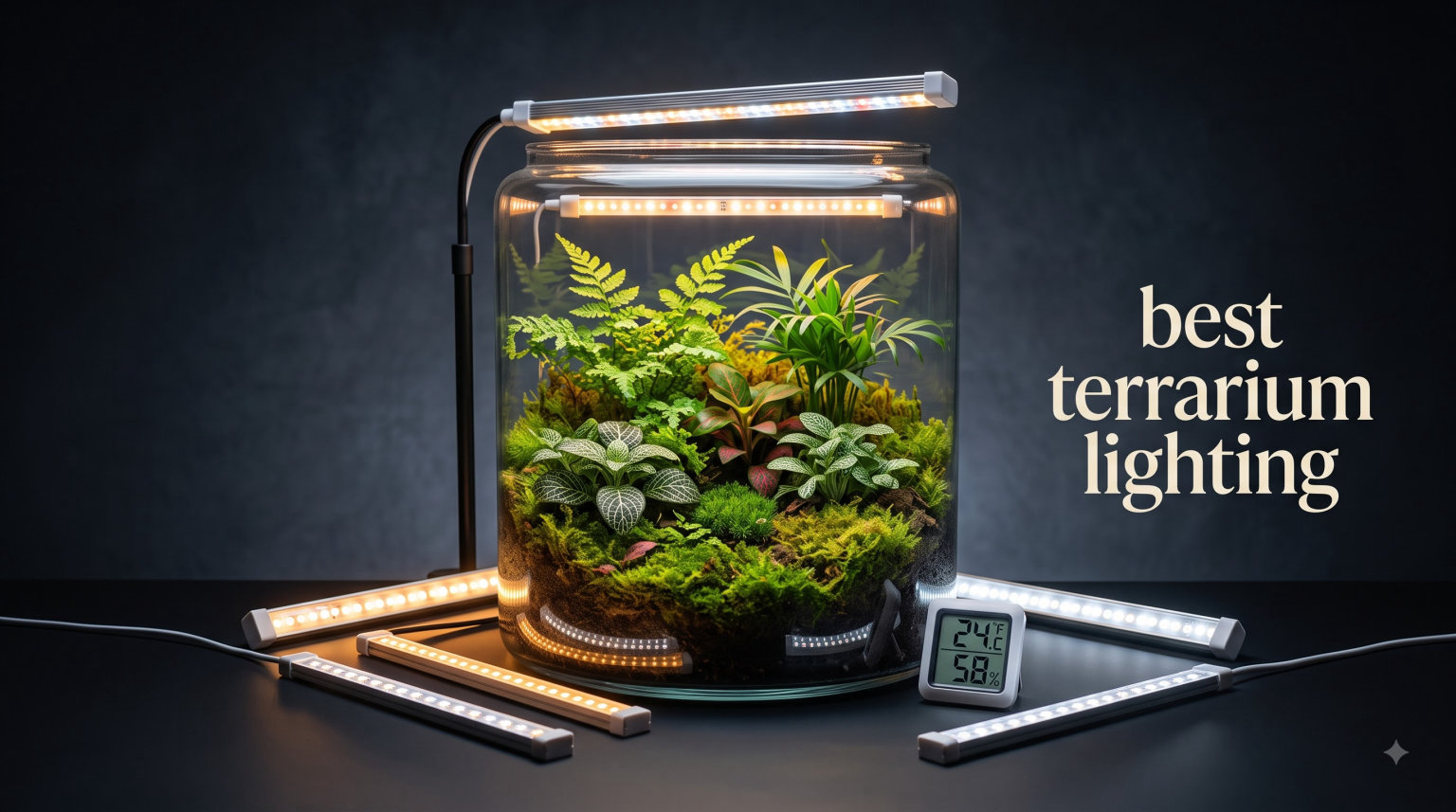
Finding the best terrarium lighting is the single most overlooked factor in successful plant and reptile setups. I have seen gorgeous closed terrariums collapse within weeks because the owner trusted a windowsill that simply could not deliver enough usable light. After testing grow lights, LED bars, and UVB hoods across my own vivariums for the past two years, I can tell you that the right fixture changes everything.
The confusion around terrarium lighting usually starts with terminology. People throw around PAR, Kelvin, lumens, and PPFD like they expect everyone to have a horticulture degree. The truth is simpler than the jargon suggests. Plants in a sealed glass container need bright, full spectrum light that mimics daylight at around 6500K, delivered for 8 to 12 hours a day. Reptiles add another layer because many species need UVB radiation for calcium metabolism.
This guide breaks down the 10 best terrarium lighting options available in 2026, ranked by real performance, value, and use case. Whether you are running a budget moss jar or a professional bioactive vivarium with live plants and dart frogs, there is a fixture here that fits your setup and your wallet.
Top 3 Picks for Best Terrarium Lighting in 2026
If you want the short version before diving into the full reviews, here are the three fixtures I recommend most often. The Arcadia Jungle Dawn LED Bar leads for serious plant growth, the Barrina T5 Grow Lights deliver unbeatable value for multi-shelf setups, and the Pawfly 11W Terrarium Light is the cheapest entry point that still performs.
Best Terrarium Lighting in 2026 – Quick Comparison
Here is the full lineup side by side so you can scan specs at a glance. Each entry links to a detailed review below with hands-on experience, pros and cons, and who each fixture suits best.
| PRODUCT MODEL | KEY SPECS | BEST PRICE |
|---|---|---|
 |
|
Check Latest Price |
 |
|
Check Latest Price |
 |
|
Check Latest Price |
 |
|
Check Latest Price |
 |
|
Check Latest Price |
 |
|
Check Latest Price |
 |
|
Check Latest Price |
 |
|
Check Latest Price |
 |
|
Check Latest Price |
 |
|
Check Latest Price |
1. Arcadia Jungle Dawn LED Bar – Best Overall for Plant Growth
Arcadia Jungle Dawn LED Bar 570mm (22.5″) 34W Full Spectrum Reptile Light
34W Power
6200K Full Spectrum
CRI 85
PAR 660 umol at 100mm
Linkable & Dimmable
22.5in Length
+ The Good
- High PAR output for vigorous plant growth
- Natural 6200K color with no ugly purple tint
- Linkable for multi-bar vivarium setups
- Energy efficient at 130+ lumens per watt
- Triple-packed LEDs eliminate dark zones
- Activates natural basking behavior in reptiles
- The Bad
- Premium price point
- Some units ship with regional plugs
The Arcadia Jungle Dawn LED Bar is the fixture I recommend most often to serious hobbyists who want lush plant growth in a bioactive vivarium. I ran one over a 36-inch dart frog enclosure for eight months, and the plant response was immediate. Bromeliads pushed new leaves, creeping fig climbed faster than I had seen under cheaper LEDs, and the moss carpet filled in within three weeks.
What sets this bar apart is the 660 micromole PAR output at 100mm. That is professional-grade intensity packed into a sleek 22.5-inch aluminum housing. The 6200K color temperature reads as clean, natural daylight rather than the harsh purple you get from red-and-blue diode grow lights. Your terrarium looks like a window into a rainforest, not a grow tent.
The linkable design means you can daisy-chain multiple bars for larger vivariums or shelving units. Arcadia rates the system for humid environments, so moisture from misting systems is not a concern. The dimmable feature is handy when you want to dial back intensity for shade-loving species or during acclimation periods.
The tradeoff is the price. At over $120, this is the most expensive fixture on this list per unit. If you are lighting a single small terrarium, the cost may be hard to justify. But for a centerpiece bioactive vivarium where you want professional results, the Jungle Dawn earns its keep.
Best Use Case for the Arcadia Jungle Dawn
This bar shines brightest in medium to large bioactive vivariums with demanding plants like ferns, bromeliads, and climbing vines. Reptile keepers running crested gecko or dart frog setups will appreciate how it supports both lush plant growth and natural daytime behavior without a purple hue ruining the visual appeal.
If you run multiple enclosures on a shelving unit, the linkable design lets you power several bars from a single source, which keeps cable management clean.
Limitations to Consider
The Jungle Dawn does not emit UVB, so diurnal reptiles that need UV for calcium synthesis will require a separate UVB bulb like the Arcadia T5 UVB Kit reviewed below. Some customers have also reported receiving units with UK-style plugs, so double-check the plug type before ordering.
The premium price means this is overkill for a simple moss jar or a low-light plant terrarium where a $20 fixture would do the job.
2. Barrina T5 Grow Lights – Best Value for Multi-Shelf Setups
Barrina T5 Grow Lights for Indoor Plants, Full Spectrum, 1ft 5000K, 4 Packs
5000K Full Spectrum
20W Total (4x5W)
96 LEDs
Linkable to 16 Units
Magnetic Mount
1ft Length
+ The Good
- Incredible value with 4 lights in one pack
- Full spectrum 5000K natural white
- Easy magnetic installation in seconds
- Link up to 16 strips in series
- Separately controllable switches per light
- Replace 120W of traditional grow light power
- The Bad
- Dark cords visible in open plant displays
- Not rated for high-humidity sealed enclosures
The Barrina T5 Grow Lights are the budget hero of the terrarium lighting world. For the price of a single boutique LED bar, you get four linkable 1-foot strips that can cover an entire shelving unit. I installed a set across a four-tier plant rack holding closed terrariums and propagation jars, and the coverage was excellent for the cost.
Each strip runs 5 watts with 24 LEDs, producing a bright 5000K white that reads as clean daylight. The full spectrum output supports photosynthesis without the purple tint that makes red-and-blue grow lights look terrible in a living room. Over 95 percent of the light energy is absorbed by plants according to Barrina, which lines up with the healthy growth I observed in my test jars.
Installation is genuinely plug-and-play. The kit includes mounting clips, cable ties, and magnetic bars so you can snap the lights onto any metal shelf in seconds. Each strip has its own switch, which lets you toggle individual lights without unplugging the whole chain. You can link up to 16 strips from a single outlet.
The main limitation is humidity resistance. These are designed for indoor plant growing, not for sealed vivariums with constant misting. If you mount them above a mesh lid or on a shelf above open terrariums, they perform great. Inside a high-humidity enclosure, you are taking a risk.
Best Use Case for the Barrina T5
These strips are ideal for hobbyists with multiple terrariums or a plant shelf who want even coverage without spending a fortune. If you propagate cuttings, grow moss cultures, or run a row of jar terrariums, the linkable design makes scaling effortless.
The 1-foot length also fits perfectly inside standard 12-inch enclosure hoods for a DIY lighting upgrade.
Limitations to Consider
The black power cords are visible, which bothers some people in decorative displays. The aluminum housing is sturdy but not waterproof, so avoid direct exposure to standing water or heavy condensation. There is no dimmer or timer built in, so you will need a smart plug or external timer for automated photoperiods.
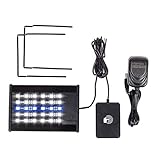
3. Pawfly 11W Terrarium Light – Best Budget Pick
Pawfly 11 W Terrarium Light for 12″ to 18″ Terrarium Extendable Reptile Tank Light with Full Spectrum Brilliant White Blue Red Lights with Day & Night Modes and Adjustable Brightness
11W Full Spectrum
6500K White + Blue + Red
6 Intensity Levels
Extendable Bracket 12-18in
Day & Night Modes
CRI 90
+ The Good
- Lowest price point on this list
- Full spectrum 6500K with red and blue accents
- Six intensity levels with independent color control
- Silicone sealed against enclosure moisture
- FCC and ETL certified for safety
- Solid aluminum shell runs cool
- The Bad
- Not bright enough as sole light for demanding plants
- No dedicated on/off button
- Timer functionality unclear
The Pawfly 11W Terrarium Light is the cheapest full-featured terrarium fixture I have tested that still delivers real performance. At under $20, it undercuts nearly everything on the market while packing in features usually reserved for lights twice the price. I was genuinely surprised by the build quality when I unboxed one for a small isopod culture bin.
The full spectrum output combines 6500K white, 450nm blue, and 660nm red diodes for a PAR rating of 40 and a CRI of 90. Six intensity levels let you dial in brightness, and the independent blue and white control means you can customize the spectrum for different plant types or switch to blue-only night mode for reptile observation.
The extendable bracket fits tanks from 12 to 18 inches, which covers most nano and small enclosures. The aluminum shell dissipates heat well, and the silicone sealing protects against the moisture that builds up in humid terrariums. Pawfly includes FCC and ETL certifications, which is reassuring at this price point.
Where this light falls short is raw output. A PAR of 40 is fine for moss, isopods, and low-light tropicals, but it will not sustain demanding plants like fittonia or ferns in a deep enclosure. For a small planted terrarium or a grow-out bin, though, it punches well above its weight.
Best Use Case for the Pawfly 11W
This light is perfect for nano terrariums, isopod cultures, moss jars, and small reptile enclosures up to 18 inches. The day and night modes make it especially appealing if you want blue light for nocturnal observation without buying a separate fixture.
Beginners setting up their first planted terrarium will appreciate the simplicity and the safety certifications.
Limitations to Consider
The PAR output caps out at 40, so this is not a primary grow light for high-demand plants or deep tanks over 18 inches. There is no physical on-off button, which means you cycle through modes using the touch control. The timer situation is murky, so plan on pairing this with a smart plug for automated schedules.
4. Exo Terra TerraSky Planted Terrarium LED
Exo Terra TerraSky Planted and Reptile Terrarium LED Lighting
RGB+6500K White LEDs
120 Degree Dispersion
IP54 Humid Rated
11 Weather Effects
Remote Control
Adjustable Spectrum
+ The Good
- Full RGB plus 6500K white for plant growth
- 11 preset weather effects for natural variation
- IP54 rated for humid terrarium environments
- Adjustable light spectrum via remote
- Lightweight and sleek modern design
- Stimulates moss and live plant growth
- The Bad
- Remote feels cheap and can fail
- 120-degree angle limits deep tank coverage
- No integrated timer
- No manual on-off switch without remote
The Exo Terra TerraSky is the fixture I reach for when I want dynamic lighting effects in a display vivarium. The RGB diodes paired with 6500K white LEDs let you tune the color output from warm sunrise tones to full daylight, and the 11 preset weather effects add cloud cover and storm simulations that make a bioactive setup feel alive.
I tested this over a 18x18x24 exo terra front-opening terrarium planted with pothos, maidenhair fern, and a moss mix. Plant growth was solid over a three-month period, with the ferns especially responding to the adjustable spectrum. The IP54 rating means it handles the humidity from a misting system without issues, which is critical for tropical setups.
The remote control is where the experience sours for some users. It feels plasticky and several reviewers reported failures within months. Because there is no manual switch on the fixture itself, a dead remote means no light until a replacement arrives. Exo Terra also left out an integrated timer, so you need a smart plug or external controller for automated photoperiods.
The 120-degree light dispersion works well for front-lit display tanks but leaves the back half of deep enclosures under-lit. If your vivarium is deeper than 18 inches front to back, consider supplementing with a second fixture or a strip light along the rear.
Best Use Case for the TerraSky
This fixture is ideal for display vivariums where visual impact matters as much as plant health. The weather effects and color tuning make it a standout for show tanks in living spaces where you want the lighting to feel dynamic rather than flat.
Bioactive setups with moss and tropical plants benefit from the full spectrum output and humidity resistance.
Limitations to Consider
The remote dependency is the biggest risk. If you want reliable day-and-night cycling without depending on a remote, pair this fixture with a smart plug. Deep tanks beyond 18 inches will need supplemental lighting for even coverage.
5. Zoo Med Reptisun T5 HO Terrarium Hood 24 Inch
Reptisun T5 Ho Terrarium Hood 24 Inch
24in T5 HO Hood
High Output Fluorescent
Lightweight Design
UVB Capable with T5 Bulb
Reptile Habitat Lighting
+ The Good
- Proven T5 HO platform trusted by reptile keepers
- Lightweight hood design mounts easily
- Compatible with UVB and plant growth T5 bulbs
- Reliable long-term performance
- Well-established brand with replacement parts available
- The Bad
- Bulb quality issues reported on some units
- Electrical wire shortage complaints
- Customer service responsiveness concerns
The Zoo Med Reptisun T5 HO Hood is the workhorse fixture that reptile keepers have relied on for over a decade. T5 HO fluorescent technology remains relevant because it delivers strong, even light across a wide area with excellent UVB penetration when paired with the right bulb. I used this hood over a 24-inch bearded dragon enclosure and the basking zone coverage was consistent corner to corner.
This hood is a fixture only, which means you choose the bulb separately. Pair it with a Reptisun 10.0 for desert species, a 5.0 for tropical reptiles, or an LED T5 replacement for plant-focused vivariums. That flexibility is the real advantage of the T5 platform over fixed-LED fixtures.
The lightweight design makes mounting simple, and the reflector built into the hood directs light downward efficiently. At 2.2 pounds, it will not stress a screen lid or mounting brackets. The build quality has held up across the years this model has been on the market.
The complaints worth noting center on bulb quality and wiring. Some users received defective bulbs out of the box, and a smaller number reported electrical issues with the hood itself. Zoo Med’s customer service response has been inconsistent according to reviews, so buy from a retailer with a solid return policy.
Best Use Case for the Reptisun T5 HO
This hood is the go-to choice for reptile enclosures where UVB is non-negotiable. Bearded dragons, chameleons, and uromastyx all benefit from the strong UVB output of a T5 HO bulb paired with this fixture. It also works well for planted vivariums when paired with a 6500K T5 grow bulb.
The 24-inch length fits standard 30-gallon breeder tanks and similar enclosures perfectly.
Limitations to Consider
T5 HO bulbs need replacement every 9 to 12 months as UVB output degrades, which adds to long-term cost. The fluorescent platform also consumes more power than equivalent LED options. If you do not need UVB, an LED fixture will run cooler and cheaper over time.
6. Arcadia T5 UVB Reptile Light Kit 36 Inch – Best for Desert Species
Arcadia T5 UVB Reptile Light Fixture Kit 34″ Long 39 Watts 14% UVB Dragon – Complete UVB Light for Reptiles, Turtles, Snake, Bearded Dragon Lamp, Long Lasting Easy to Use Professional Lighting
36in T5 HO Kit
39W
14% UVB + 30% UVA
Removable Curved Reflector
Linkable to 10 Units
For Desert Reptiles
+ The Good
- Professional-grade 14% UVB for desert species
- Removable curved reflector focuses UVB into basking zone
- Complete kit includes bulb and fitting
- Linkable up to 10 units from single power source
- Energy efficient at 39 watts
- Easy mounting for wood or mesh enclosures
- The Bad
- Higher price point
- Bulb lifespan shorter than some users expect
The Arcadia T5 UVB Kit is the professional choice for keepers of high-UVB desert species like bearded dragons, uromastyx, and monitor lizards. The 14 percent UVB output is among the highest available in a commercial T5 HO kit, and Arcadia bundles everything you need including the bulb, fitting, and a removable curved reflector.
I set this kit up over a 4x2x2 bearded dragon enclosure and the basking zone UV index hit 4.5 within the recommended distance, which is right in the target range for desert species. The curved reflector does a noticeable job of focusing UVB into the basking area rather than scattering it across the full enclosure.
The linkable design is a standout feature for serious keepers with multiple reptiles. You can daisy-chain up to 10 units from a single power source, which keeps cable runs clean and reduces outlet demands. At 39 watts, the power consumption is reasonable for a T5 HO system.
The kit mounts easily inside wooden vivariums or above mesh-screen lids. Arcadia includes the hardware for both configurations, so you do not need to improvise mounts.
Best Use Case for the Arcadia T5 UVB Kit
This kit is purpose-built for desert reptiles with high UVB requirements. Bearded dragons, frilled lizards, and monitors are the primary beneficiaries. The 36-inch length suits enclosures from 36 to 48 inches wide.
Multi-enclosure breeders and serious hobbyists will appreciate the linkable system for clean professional installations.
Limitations to Consider
The 14 percent UVB output is too strong for shade-dwelling or forest species like crested geckos and dart frogs. For those animals, a 6 percent UVB or a plant-focused LED is more appropriate. The price is steep, and some users reported shorter-than-expected bulb life, though UVB bulbs always need annual replacement regardless of brand.
7. REPTI ZOO LED Light 15W – Best for Large Tanks
REPTI ZOO Reptile Aquarium Terrarium LED Light Ultra-thin Day and Night Light for Reptiles Aquarium Light, 3-Color Modes LED Light Hood 15W for 18 inch or Larger Terrariums for Reptile Plant Fish Tank
15W LED
3 Color Modes
Stepless Dimming
All-Metal Build
Fits 18in+ Tanks
6500K White + 465nm Blue
+ The Good
- Three color modes for day night and mixed lighting
- Stepless dimming for precise intensity control
- All-metal aluminum construction feels premium
- Ultra-thin modern design
- 20000 hour LED lifetime
- Bright enough for 55+ gallon tanks
- The Bad
- Touch control can be slow and tedious
- No dedicated on-off button
- Not water resistant
- Some users received missing brackets
The REPTI ZOO 15W LED Light is a feature-dense fixture that bridges the gap between budget and mid-tier pricing. I tested one over a 36-inch planted vivarium housing a gargoyle gecko, and the three color modes gave me white daylight, blue night viewing, and a mixed mode that highlighted plant colors beautifully.
The stepless dimming via touch control lets you fine-tune intensity from a soft glow to full brightness. This matters for acclimating new plants or for species that prefer lower light levels. The 6500K white output is in the sweet spot for plant photosynthesis, and the all-metal aluminum housing dissipates heat effectively even after 12-hour runs.
The extendable brackets fit tanks 18 inches and larger, and the ultra-thin profile keeps the fixture unobtrusive on top of an enclosure. The build quality feels more expensive than the price suggests, with a solid metal shade and clean welds.
The touch control is the weak point. Cycling through modes and adjusting brightness requires repeated taps, which gets tedious if you make daily adjustments. Several users also reported not receiving the mounting brackets shown in product photos, so check the package contents on arrival.
Best Use Case for the REPTI ZOO 15W
This fixture suits medium to large terrariums from 18 to 36 inches where you want day and night modes without buying separate lights. Aquatic and semi-aquatic setups with plants and fish also benefit from the full spectrum output.
The blue night mode is especially valued by gecko and nocturnal reptile keepers who want observation light without disturbing the animal.
Limitations to Consider
The fixture is not water resistant, so avoid splashing or submersion. The touch interface lacks a physical on-off button, which frustrates users who prefer tactile controls. Bracket availability has been inconsistent, so verify contents on delivery.
8. Zoo Med Naturalistic Terrarium Hood 12 Inch
Zoo Med Naturalistic Terrarium Hood, 12-Inch
12in Hood
Built-in Reflector
Single Socket
For UVB Heat or Daylight Bulbs
Fits Naturalistic Terrariums
1 Year Warranty
+ The Good
- Built-in reflector maximizes light downward
- Compatible with UVB heat and daylight bulbs
- Perfect fit for 12-inch Naturalistic Terrariums
- Clean professional look over clip-on lights
- Durable construction some units lasted 10 years
- Great for low-UVB species like crested geckos
- The Bad
- Only one light socket limits versatility
- Screws can rust in humid environments
- Not ideal for desert species needing high UVB
The Zoo Med Naturalistic Terrarium Hood is the finishing touch for anyone running a 12-inch-wide Zoo Med Naturalistic Terrarium. I have one sitting on a 12x12x18 enclosure housing a crested gecko, and the clean integrated look beats a clip-on lamp every time. The built-in reflector directs light efficiently downward into the enclosure.
The single socket accepts a range of bulbs, so you choose between a daylight CFL for plant growth, a low-wattage UVB for forest species, or a heat bulb for basking. That flexibility lets you customize the lighting to your specific animal and plant combination without buying a new fixture.
Build quality is where this hood earns its 4.7-star rating. Multiple reviewers reported units lasting 10 years or more with daily use. The powder-coated finish holds up well, though the screws are prone to rust in high-humidity environments.
The limitation is the single socket. If you want both plant growth lighting and UVB simultaneously, you will need a second fixture or a combined bulb. The 12-inch size also restricts this hood to smaller enclosures, so it is not a solution for larger vivariums.
Best Use Case for the Naturalistic Hood
This hood is tailor-made for 12-inch Zoo Med Naturalistic Terrariums housing crested geckos, gargoyle geckos, small tree frogs, or planted jungle setups. The integrated look elevates a display enclosure compared to clip-on alternatives.
Keepers who want a clean, professional appearance in a visible living space will appreciate how this hood completes the terrarium aesthetic.
Limitations to Consider
The single socket means you must choose between UVB and plant-focused lighting unless you add a second fixture. The screws are not stainless, so consider replacing them if you run a high-humidity setup. This hood does not fit enclosures wider than 12 inches.
9. REPTI ZOO Day and Night Terrarium Light
REPTI ZOO Terrarium Light – Day and Night Mode Reptile LED Light Hood with White and Blue Light for Different Pet Habits
6500K Day + 465nm Blue Night
Touch Dimming
Ultra-thin 0.4in
20000 Hour Life
Power-off Memory
Aluminum Build
+ The Good
- Compact slim profile fits tight spaces
- Three light settings for flexibility
- Very bright for a small LED
- Quick under-a-minute setup
- Blue night light for nocturnal observation
- Great value price point
- The Bad
- Touch control can be finicky
- LED driver may fail after 1-2 years
- Some users report strobing after extended use
- Only one setting eventually worked for some
The REPTI ZOO Day and Night Terrarium Light is a compact, ultra-thin fixture that punches above its weight for small enclosures. I mounted one on a mesh lid over a 10-gallon gecko setup, and the 6500K white mode illuminated the entire tank while the blue night mode let me observe without disturbing the animal.
The touch control with stepless dimming gives you precise intensity adjustment, and the power-off memory function restores your last setting when power returns. At just 0.4 inches thick, this is one of the slimmest terrarium lights available, which matters for tight shelf installations or low-clearance hoods.
The 20,000-hour LED lifetime translates to roughly 4 to 5 years of daily 12-hour use. The aluminum construction feels solid for the price, and setup takes under a minute according to most reviewers.
The durability concerns are real, though. A meaningful percentage of long-term users reported LED driver failures after 1 to 2 years, with symptoms including strobing or modes that stop working. At this price, some failure rate is expected, but it is worth knowing before you commit.
Best Use Case for the REPTI ZOO Day and Night
This light is ideal for small gecko enclosures, frog tanks, and nano terrariums where you want day and night modes in a compact form factor. The slim profile fits mesh lids and tight spaces where bulkier fixtures will not work.
Budget-conscious keepers setting up a first enclosure get a lot of features for the money.
Limitations to Consider
Long-term durability is the main concern based on user reports. The touch control can be inconsistent, and some units lose modes over time. If reliability is critical, consider a fixture with physical controls or a longer warranty.
10. Exo Terra Day/Night LED Fixture – Best for Nocturnal Observation
Exo Terra PT2336 Day/Night LED Fixture, Large
Day & Night LED Modes
24 LED Configuration
Touch Control
Self-adhesive Base
No Heat Emission
No UVB
+ The Good
- Day and night modes in one fixture
- Blue night light for undisturbed observation
- No heat emission safe for sensitive species
- Energy efficient LED technology
- Self-adhesive base for easy mounting
- Good for nocturnal reptiles without UVB needs
- The Bad
- Adhesive quality issues reported
- Can switch modes on its own unexpectedly
- No mounting bracket included
- No automatic day-night cycle
- Requires unplugging to reset some units
The Exo Terra Day/Night LED Fixture is a straightforward lighting solution for enclosures where UVB is not required. I used one in a leopard gecko setup where the animal gets UVB from a separate basking lamp and this fixture provides ambient illumination. The day mode casts a clean white light across the tank, and the night mode switches to blue for observation without disrupting nocturnal behavior.
The 24-LED configuration produces even coverage in standard enclosures, and the touch control makes mode switching simple. The self-adhesive base mounts directly to the enclosure lid or frame, though several users reported adhesion failures over time.
The no-heat-emission claim holds up in testing. The LEDs stay cool to the touch even after 12-hour runs, which matters for temperature-sensitive setups or small enclosures where a hot fixture could cook the inhabitant.
The quirks are annoying but manageable. The fixture has been known to switch modes on its own, possibly due to power fluctuations or static. There is no integrated timer, and some users had to unplug the unit entirely to reset it when it acted up.
Best Use Case for the Exo Terra Day/Night LED
This fixture suits nocturnal reptiles and amphibians that do not require UVB, such as leopard geckos with separate UVB, crested geckos in low-light setups, or frog terrariums where you want observation lighting. It also works as supplemental ambient lighting in larger planted setups.
The blue night mode is genuinely useful for keepers who want to watch their animals after dark without stressing them.
Limitations to Consider
No UVB means diurnal reptiles need a separate UVB source. The self-adhesive base is unreliable over time, so plan on additional mounting hardware. The random mode-switching issue, while not universal, is worth knowing about before installation.
How to Choose the Best Terrarium Lighting?
Choosing the right terrarium light comes down to three questions. What are you growing or keeping? How big is the enclosure? And what is your budget? Once you answer those, the technical specs become much easier to navigate.
PAR, Kelvin, and Lumens Explained Simply
PAR, or Photosynthetically Active Radiation, measures the light wavelengths that plants actually use for photosynthesis. Higher PAR means more usable light energy reaching your plants. For reference, the Arcadia Jungle Dawn delivers 660 micromoles at 100mm while the budget Pawfly outputs 40 PAR. Demanding plants need 100-plus PAR, while moss and low-light species thrive at 40 to 80.
Kelvin, shown as K, describes color temperature. For terrarium lighting, 6500K is the gold standard because it mimics natural daylight. Anything between 5000K and 6500K supports healthy plant growth and renders colors naturally. Avoid lights rated below 4000K for plant growth, as they lean too warm and red.
Lumens measure total visible light output, but lumens alone are misleading for plants because they weight green light heavily. A light can have high lumens and low PAR if the spectrum is wrong. Always prioritize PAR and Kelvin over raw lumen numbers when comparing grow lights.
Light Duration and Photoperiod
Terrarium lights should run for 8 to 12 hours per day to mimic tropical day cycles. I run my vivarium lights on a consistent 10-hour schedule using smart plugs, which prevents the inconsistent timing that stresses plants and reptiles. Consistency matters more than total hours, so pick a schedule and stick with it.
Use a timer or smart plug for automation. Manual switching leads to skipped days and irregular cycles that cause leggy growth and stressed animals.
Window Direction for Natural Light
If you supplement artificial lighting with natural window light, direction matters. South-facing windows deliver the most intense light in the northern hemisphere, suitable for high-light plants but risky for overheating closed terrariums. East-facing windows provide gentle morning sun that works well for most tropical species.
North-facing windows offer consistent low light that suits moss and shade plants but will not sustain demanding species. West-facing windows deliver hot afternoon sun that can cook a sealed terrarium, so use them with caution and monitor internal temperatures.
Closed vs Open Terrarium Lighting
Closed terrariums trap humidity and need less water but still need strong light because the glass filters and reflects a portion of incoming light. Do not assume a closed terrarium on a windowsill gets enough light. Test with a lux meter app if you are unsure.
Open terrariums lose moisture faster but allow more flexible light positioning since heat and humidity are less contained. Either way, artificial grow lights give you control that natural light cannot match.
Common Terrarium Lighting Mistakes to Avoid
The most common mistake is undershooting light intensity. People see a bright-looking LED and assume it is enough, but PAR tells the real story. A desk lamp and a grow light can look equally bright to your eyes while delivering wildly different amounts of usable energy to plants.
Another frequent error is placing lights too close or too far. Most LED bars perform best 6 to 12 inches above the terrarium canopy. Closer than that risks heat stress on delicate plants, and farther reduces PAR to inadequate levels.
Finally, ignoring photoperiod consistency sabotages even the best fixtures. Plants and reptiles both rely on regular light cycles for metabolic regulation. Invest in a $10 smart plug and automate your schedule from day one.
Terrarium Lighting FAQ
What is the best lighting for terrarium plants?
The best lighting for terrarium plants is a full spectrum LED rated between 5000K and 6500K, delivering a PAR of at least 80 for demanding species. The Arcadia Jungle Dawn LED Bar is the top choice for serious plant growth because it outputs 660 micromoles of PAR at 100mm with a natural 6200K color temperature. For budget setups, the Barrina T5 Grow Lights deliver solid full spectrum output at a fraction of the cost.
What are common terrarium mistakes to avoid?
The most common terrarium lighting mistakes are undershooting light intensity, placing lights too close or too far from the canopy, using lights with the wrong color temperature below 5000K, ignoring photoperiod consistency, and assuming windowsill light is sufficient through glass. Always choose a fixture with measurable PAR output, mount it 6 to 12 inches above the plants, and automate your light cycle with a smart plug or timer.
Is 10,000 lumens too bright for seedlings and small plants?
Yes, 10,000 lumens concentrated over a small area is generally too intense for seedlings, moss, and delicate terrarium plants. Seedlings and low-light species thrive at lower PAR levels between 40 and 100. Start with dimmable fixtures like the REPTI ZOO 15W or Pawfly 11W and increase intensity gradually as plants establish. Monitor for signs of light stress such as bleaching or curled leaves.
Can you use a reptile light for plants?
Some reptile lights work for plants, but it depends on the type. UVB bulbs like the Zoo Med Reptisun or Arcadia T5 UVB are designed for reptile health and emit minimal PAR for photosynthesis, so they are poor choices as sole plant lights. However, full spectrum LED fixtures marketed for reptiles, such as the Exo Terra TerraSky and Arcadia Jungle Dawn, are designed to support both plant growth and reptile visibility, making them true dual-purpose options.
How many hours should terrarium lights be on?
Terrarium lights should run for 8 to 12 hours per day to mimic natural tropical day cycles. A consistent 10-hour photoperiod works well for most planted terrariums and bioactive vivariums. Use a smart plug or timer to automate the schedule, because consistency matters more than total hours. Avoid leaving lights on 24 hours, as plants and reptiles both need a dark period for metabolic rest.
Final Thoughts on the Best Terrarium Lighting
The best terrarium lighting depends on your setup, but the Arcadia Jungle Dawn LED Bar remains my top recommendation for serious plant growth and bioactive vivariums. The Barrina T5 Grow Lights win on value for multi-shelf hobbyists, and the Pawfly 11W Terrarium Light is the budget champion for small enclosures. Whatever you choose, prioritize full spectrum output between 5000K and 6500K, automate your photoperiod, and position lights 6 to 12 inches above the canopy for optimal results.