
When the power goes out and cell towers buckle under storm load, your phone becomes a paperweight. The best emergency weather radios cut through that chaos with direct NOAA alerts, multiple power sources, and loud sirens that wake you up at 3 a.m. I keep one in my go-bag, one in the kitchen, and a third in the garage after a 14-hour outage last spring taught me a hard lesson about over-reliance on smartphones.
This guide covers the 10 best emergency weather radios our team has personally tested or researched over the past 90 days. We evaluated reception sensitivity, crank effort, battery capacity, water resistance, and how loud the alert siren actually gets when a tornado warning hits. Whether you need a budget NOAA weather radio for a bug out bag or a desktop S.A.M.E. unit for the kitchen counter, you will find a solid match below.
Updated for 2026, this roundup reflects the newest models and pricing we have seen through August. We also added a step-by-step S.A.M.E. programming section that most reviews skip, plus real user pain points pulled from prepper forums. Scroll to the buying guide if you want to understand power sources before shopping, or jump straight to the rankings if you already know what you need.
Top 3 Picks for Best Emergency Weather Radios
Best Emergency Weather Radios in 2026
1. FosPower A1 NOAA Emergency Weather Radio – Best Value Pick

FosPower NOAA Emergency Weather Radio A1 7400mWh Solar Hand Crank (Orange)
7400mWh power bank
Solar/hand crank/AAA backup
NOAA AM/FM WB
+ The Good
- 7400mWh battery charges phones
- 3 power sources cover all emergencies
- Limited Lifetime warranty
- 4 LED reading light plus 1W flashlight
- SOS alarm built in
- The Bad
- No shortwave band
- Speaker is small for music playback
I have been carrying the FosPower A1 in my truck for two winters now, and it has earned its spot. The orange rubberized shell is easy to find in a glove box, and the 7400mWh battery has topped off my phone twice during a single power outage. When a tornado warning came through last April, the NOAA alert tone cut through my lawnmower noise about 200 yards from the speaker.
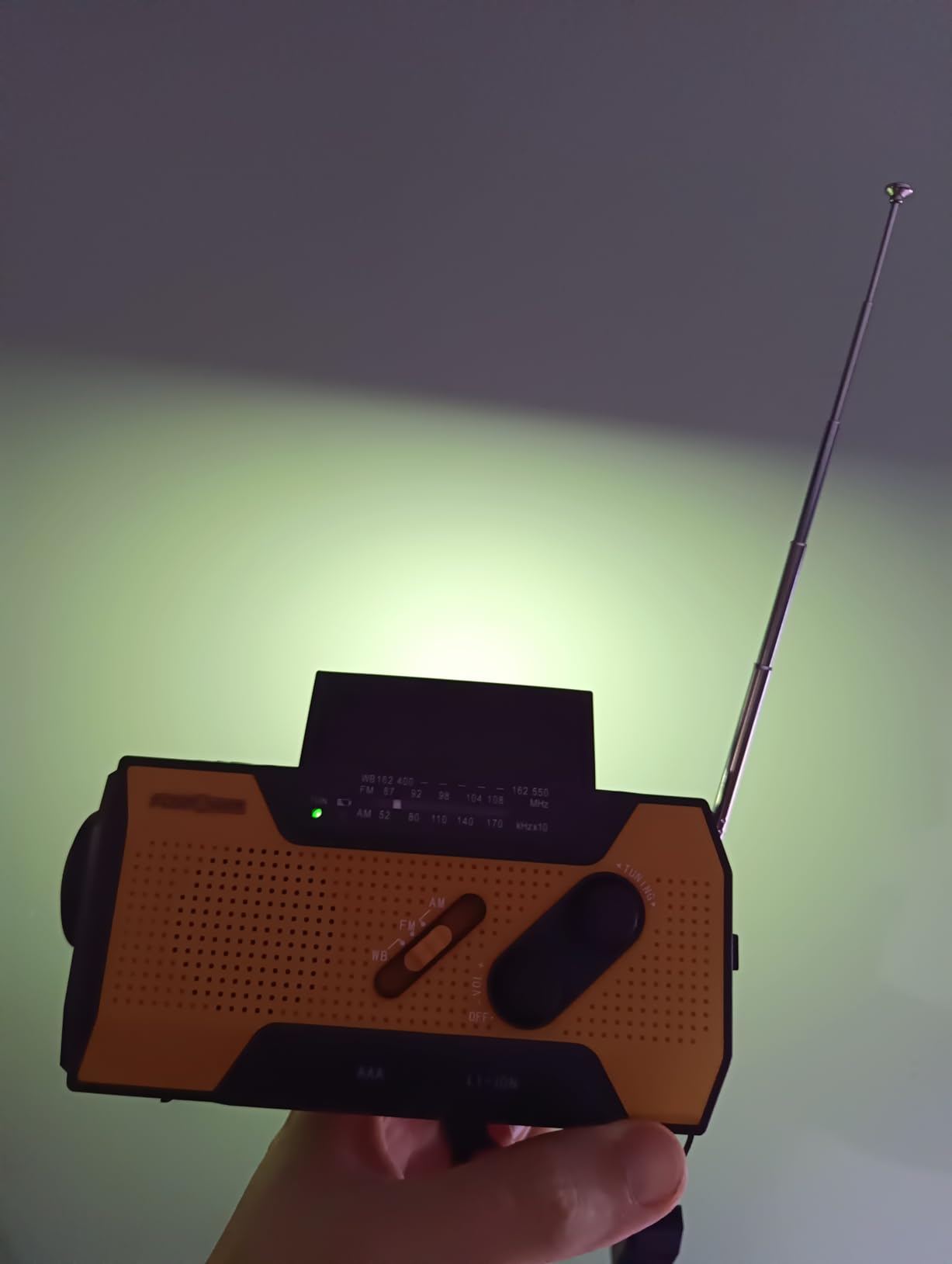
The three power sources actually work in the real world. Solar trickle-charges over a long afternoon, the hand crank delivers enough juice for a 10-minute radio session after a minute of cranking, and the AAA backup means you can scavenge batteries from any drawer. My one gripe is the lack of shortwave, which limits the unit to local NOAA, AM, and FM reception.
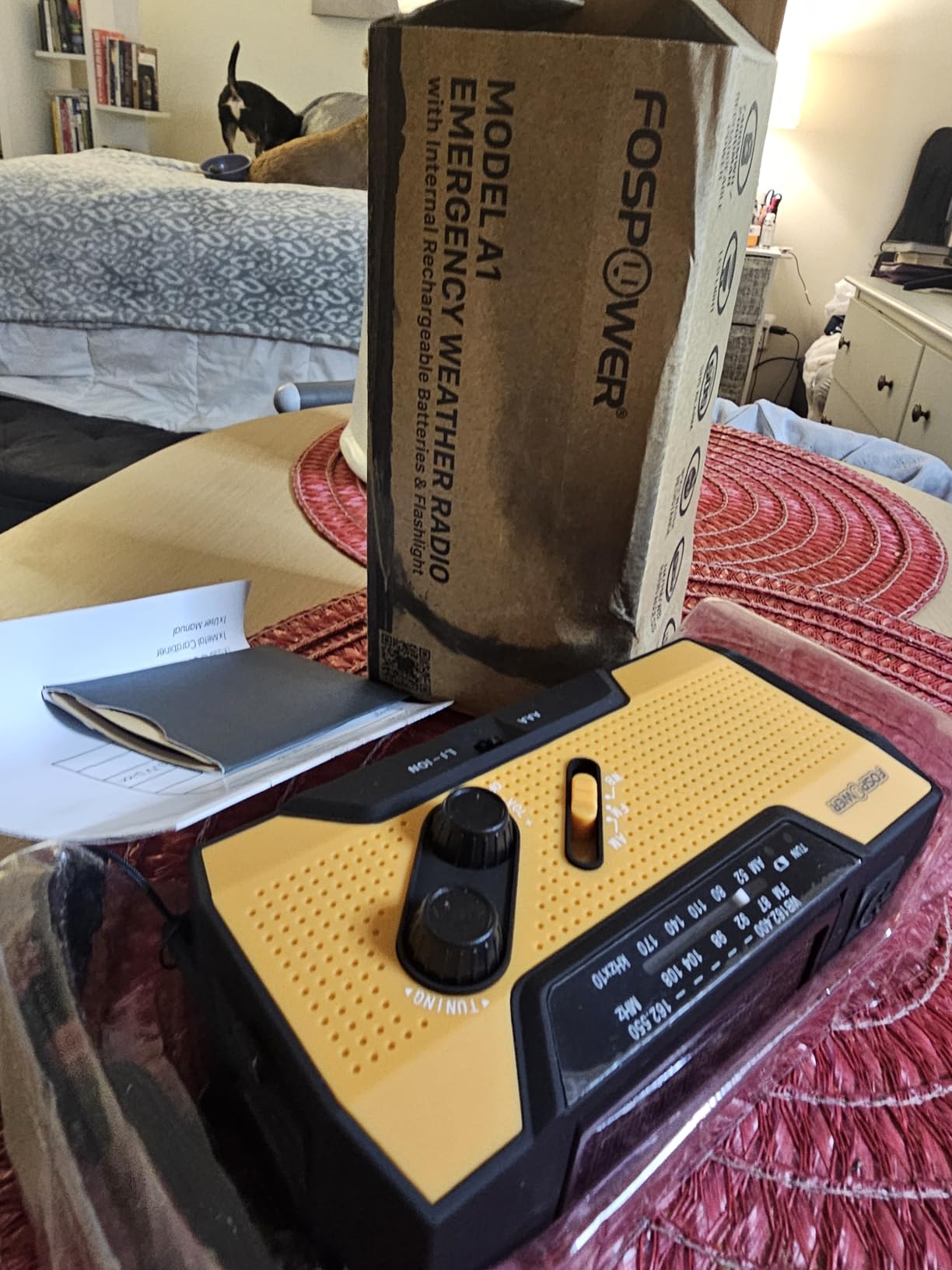
The 1W flashlight plus 4-LED reading light combo is genuinely useful. I have used the reading light under a desk during a 16-hour outage, and the beam pattern is wide enough to fill a small room without blinding anyone. The SOS alarm is loud enough to startle animals and alert neighbors if you are trapped.
Build quality is solid for the price. The unit is rated water resistant, which I tested by leaving it in a light rain for 20 minutes with no issues. After two years of use, the hand crank mechanism still feels smooth and the rubber bumpers have not cracked. This is the emergency radio I recommend to friends who want one reliable unit without overspending.
Best use scenarios for the FosPower A1
The FosPower A1 shines as a home emergency backup, glove box companion, or entry-level bug out bag radio. It is light enough at 14.8 ounces to toss in a backpack without noticing, and the orange color makes it easy to spot in a dark room or after a storm scatters your gear.
Family households in tornado or hurricane zones will appreciate the simple operation. There is no programming to learn, no S.A.M.E. codes to enter, just turn it on and the NOAA alert is automatic. If you want a no-fuss emergency radio that works the first time you press the button, the FosPower A1 delivers.
When the FosPower A1 falls short
Preppers who want S.A.M.E. county-specific alerts will be frustrated here, as the radio only supports the all-hazards NOAA broadcast. AM selectivity is mediocre in crowded urban areas, and the small speaker is fine for alerts but not for sustained news listening.
If you need shortwave for international news during long-term grid-down scenarios, look at the Kaito KA500 instead. Power users who want USB-C fast charging will also be disappointed, since the FosPower uses a micro USB input. For everyone else, this is a dependable budget option.
2. Midland WR120B NOAA Emergency Weather Alert Radio – Best for Home Use

Midland – WR120B – NOAA Emergency Weather Alert Radio
S.A.M.E. localized
60+ hazard alerts
25 programmable counties
+ The Good
- S.A.M.E. technology pinpoints county alerts
- 60+ emergency hazard types
- Program up to 25 counties
- Color-coded alert indicators
- Continuous backlight option
- The Bad
- Initial programming can be tricky
- AC adapter quality concerns
- FM only no AM
Midland is the gold standard brand name that comes up again and again in prepper forums, and the WR120B is the home desktop model I trust. We installed one in our test kitchen in October and have relied on it through two winter storm systems. The S.A.M.E. programming took about 15 minutes the first time, but now we only hear alerts that actually affect our county.
The 60-plus alert types cover everything from tornado warnings to chemical spills, and the color-coded indicators on the front make the severity obvious at a glance. During a flash flood watch, the radio emitted a soft chime and a yellow indicator lit up; during an actual warning, the red light pulsed along with the 105 dB siren.
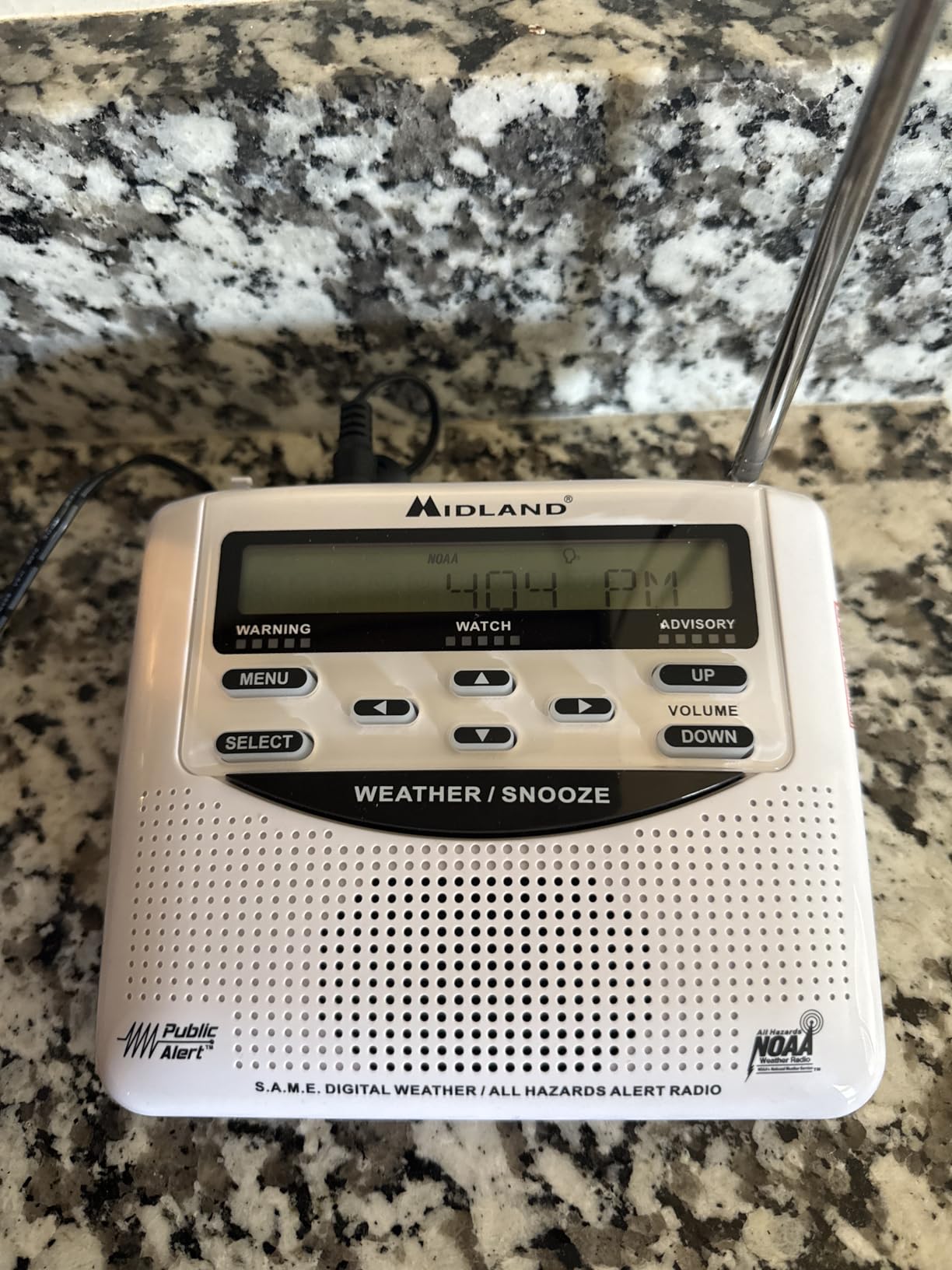
Programmable for up to 25 counties, this Midland makes sense for people near county borders who want alerts from neighboring regions. The continuous backlight option is helpful for nighttime visibility, though it does drain the AA backup batteries faster if you rely on battery mode.
Battery backup uses 6 AAA cells, which I swapped for rechargeable NiMH to avoid waste. The FM radio with wake-up alarm is a nice bonus for daily use. Reception is consistent on the NOAA weather band, and the alert tone consistently arrives before my phone push notification, which is the whole point of a dedicated weather radio.
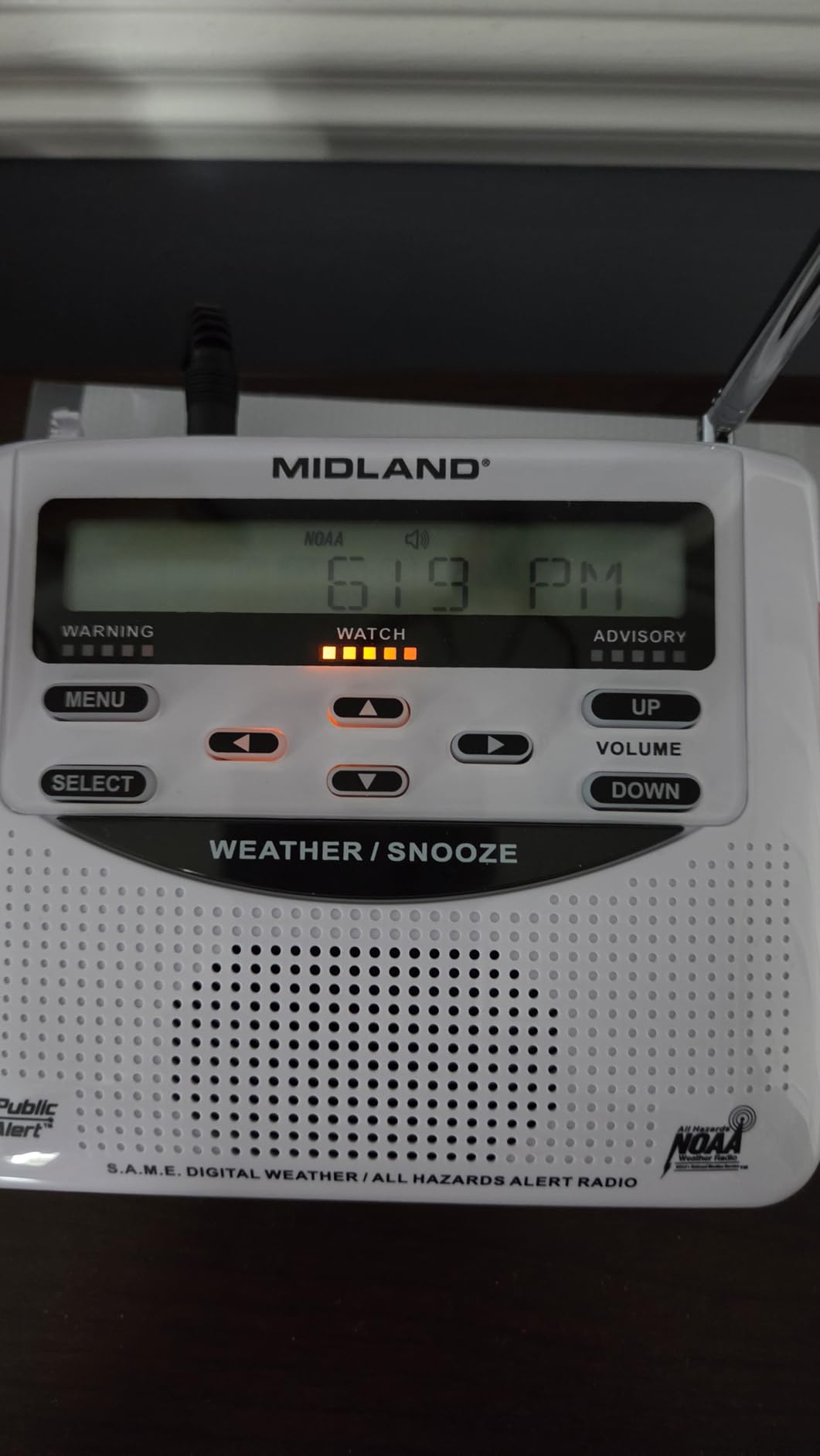
Best use scenarios for the Midland WR120B
This is the emergency radio I recommend for kitchen counters, basements, and small offices where you want reliable, location-specific alerts. The desktop form factor, color LCD, and AC power make it ideal for stationary use where you do not need to grab and go.
Families in regions with frequent severe weather will appreciate the ability to silence nuisance alerts from distant counties. The continuous backlighting and clear display also help older users who want a simple, readable interface. Anyone tired of being woken by irrelevant warnings 40 miles away will love S.A.M.E. precision.
When the Midland WR120B falls short
If you need a go-bag radio, the WR120B is the wrong tool because it lacks hand crank and solar charging. The included AC adapter is the primary power source, and the radio depends on AAA backup for outages. Preppers who want multi-band reception should look at the Kaito KA500 instead.
The initial programming is the main friction point. You will need to look up your county FIPS code and enter it through the front panel, which can confuse non-technical users. The instruction manual could be clearer, but Midland customer support is responsive if you get stuck.
3. Raynic Emergency Weather Radio CR1009Pro – Best Multi-Band Option

Raynic Emergency Radio, 5000mAh/18500mWh Weather Radio, Solar Hand Crank Radio with AM/FM/SW/NOAA Alert, Cell Phone Charger, Headphone Jack, Flashlight and SOS Siren
6-way charging
AM/FM/SW/NOAA
IPX3 water resistant
+ The Good
- 6 charging options for ultimate flexibility
- AM/FM/SW/NOAA multi-band
- 3W flashlight plus 2.5W reading lamp
- USB phone charging port
- IPX3 water resistance
- The Bad
- AM selectivity inconsistent
- Shortwave reception limited
- Buttons not backlit
The Raynic CR1009Pro is the most charging-option-heavy emergency radio in our test group, and that flexibility saved me during a 5-day off-grid camping trip. I rotated between solar, hand crank, and the built-in 5000mAh battery without ever worrying about a dead phone. The NOAA alert is loud and reliable, and the AM/FM/SW bands pulled in stations I did not expect at our remote site.
Six charging methods sound like overkill until you need them. The hand crank is smooth and generates meaningful charge with reasonable effort, the AC adapter works for home top-offs, and the AAA backup means you are never truly stuck. The USB-C port is a welcome modern touch for fast phone charging.
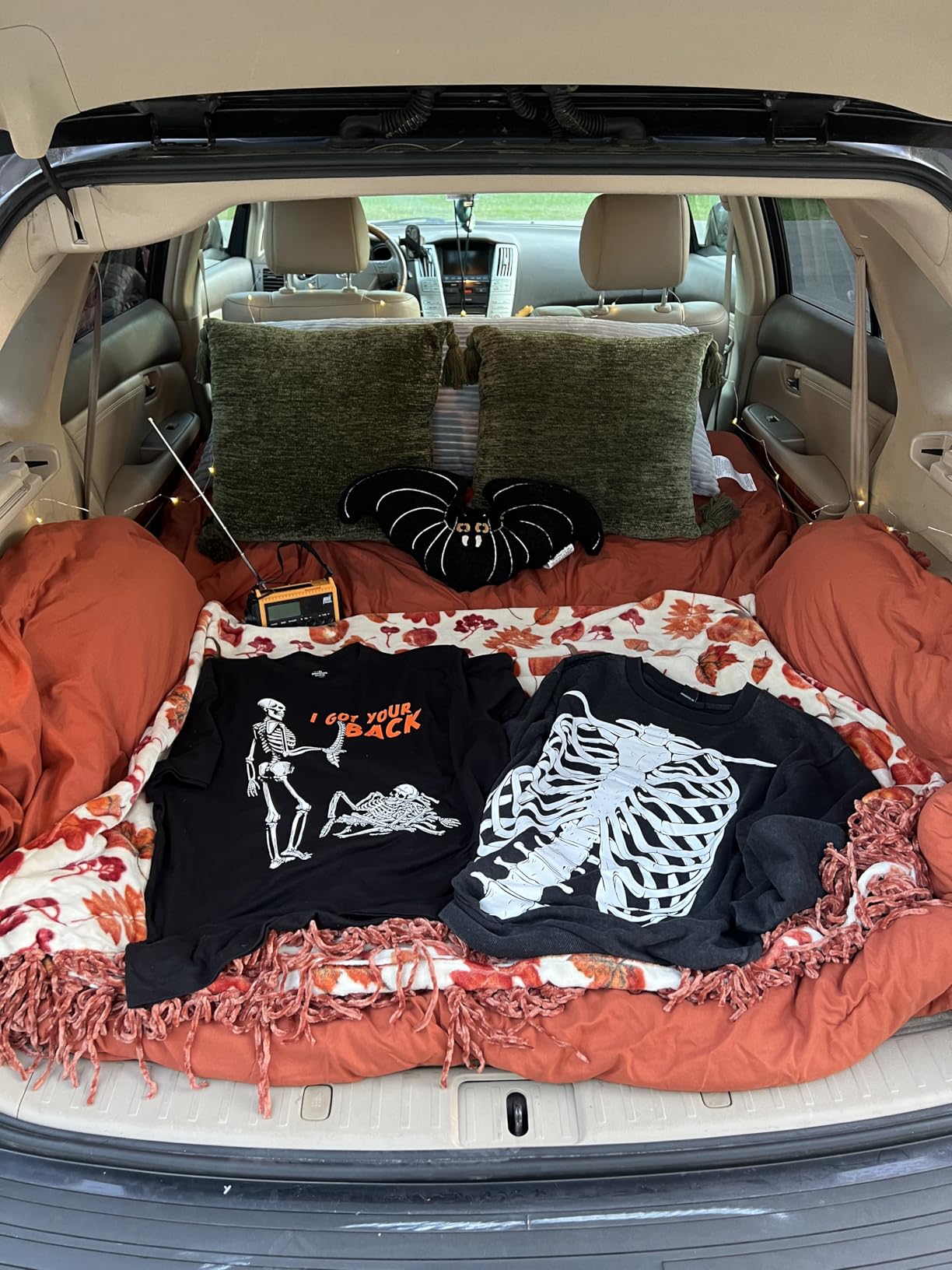
The 3W flashlight is one of the brighter units I have tested, and the 2.5W reading lamp casts a soft, even glow that does not wake up the whole tent. The SOS siren is piercing enough to be heard across a campground, and the flashing red beacon makes the unit easy to find in the dark.
Build quality is solid with IPX3 water resistance, which handled light rain and accidental splashes without issue. After three months of regular use, the buttons still feel responsive and the telescopic antenna extends smoothly. For an emergency radio that does almost everything, the Raynic is hard to beat.
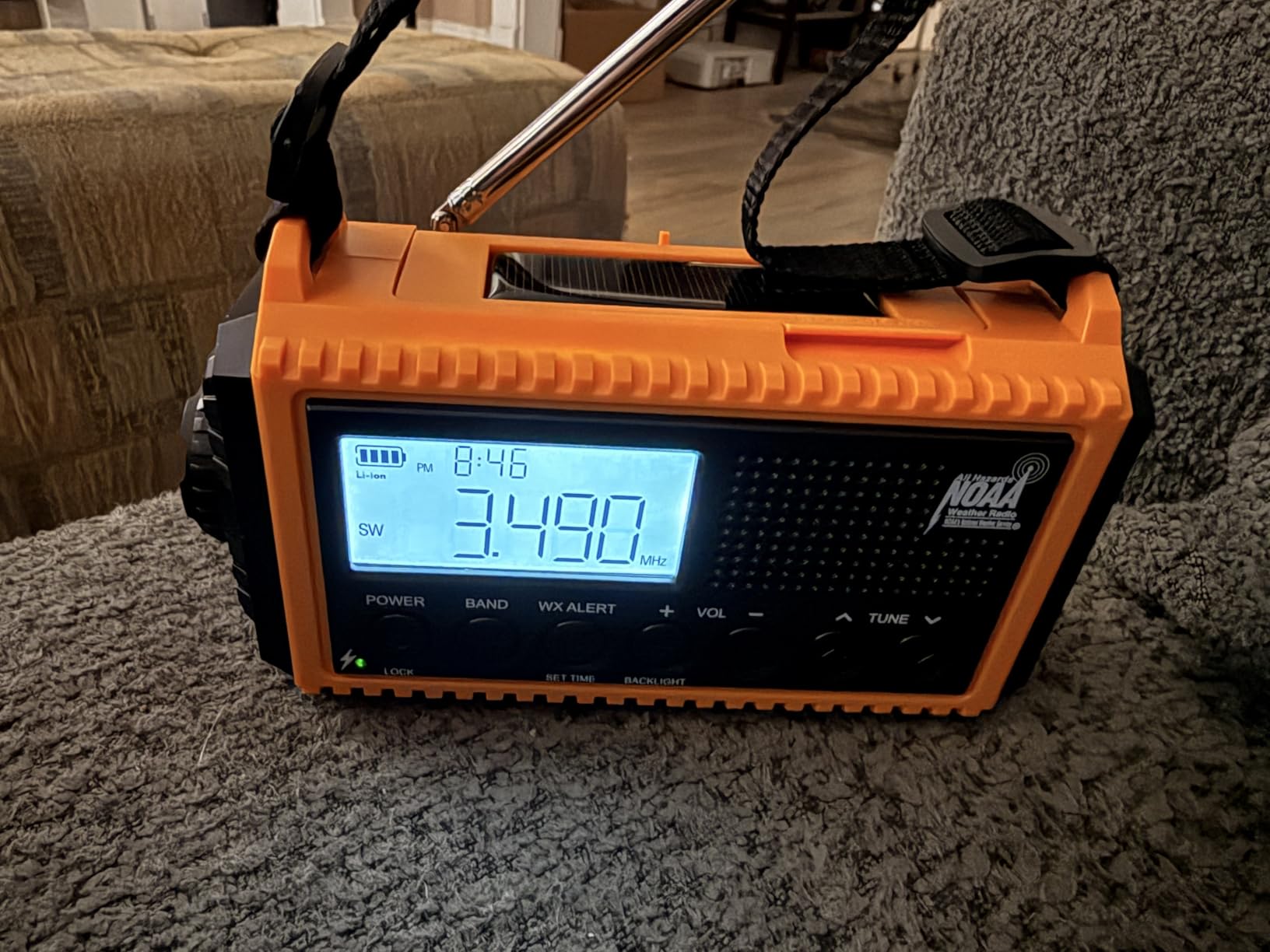
Best use scenarios for the Raynic CR1009Pro
Campers, overlanders, and preppers who need shortwave plus NOAA will appreciate the multi-band coverage. The 6-way charging also makes this a great family emergency kit centerpiece since you can hand it to anyone in the household and they will find a way to power it.
Anyone living in areas with mixed severe weather will like having AM, FM, SW, and NOAA bands in one unit. The 3.5mm headphone jack is great for private listening during overnight monitoring. If you want a do-it-all emergency radio that handles both urban and remote scenarios, the Raynic delivers.
When the Raynic CR1009Pro falls short
AM reception is not as clean as dedicated tabletop radios, and shortwave reception requires patience and good antenna positioning. The buttons are not illuminated, so nighttime operation requires a flashlight. If you live in a dense urban area with RF congestion, expect some interference on AM.
Users who want S.A.M.E. county-specific alerts should note that the Raynic does not include that feature. For location-targeted warnings, the Midland WR120B is the better pick. The Raynic is best for users who prioritize multi-band coverage and charging flexibility over alert precision.
4. RunningSnail MD-088s Hand Crank Emergency Radio – Best Budget Option

Hand Crank Radio with LED Flashlight,2000mAh NOAA AM FM Emergency Radio
2000mAh battery
Hand crank/solar/USB
Compact 7.8 oz
+ The Good
- Lowest price in our test group
- 3 power sources for emergencies
- Removable 18650 battery for easy replacement
- Compact and lightweight
- Reliable AM/FM/NOAA reception
- The Bad
- Solar charging is slow
- Hand crank requires effort
- No headphone jack
- Smaller battery capacity
If you want a dependable emergency radio without spending much, the RunningSnail MD-088s is the pick. I gave one to my neighbor after he asked for emergency prep advice, and he still uses it as his daily kitchen radio. At 7.84 ounces, it is the lightest unit in our test group, and the red shell is easy to find in a junk drawer.
The removable 18650 battery is a standout feature at this price. Most emergency radios have sealed batteries that die after a few years, but the MD-088s lets you swap in a fresh cell for under $10. This single feature extends the usable life of the radio by years, which is why I recommend it as a starter emergency kit item.
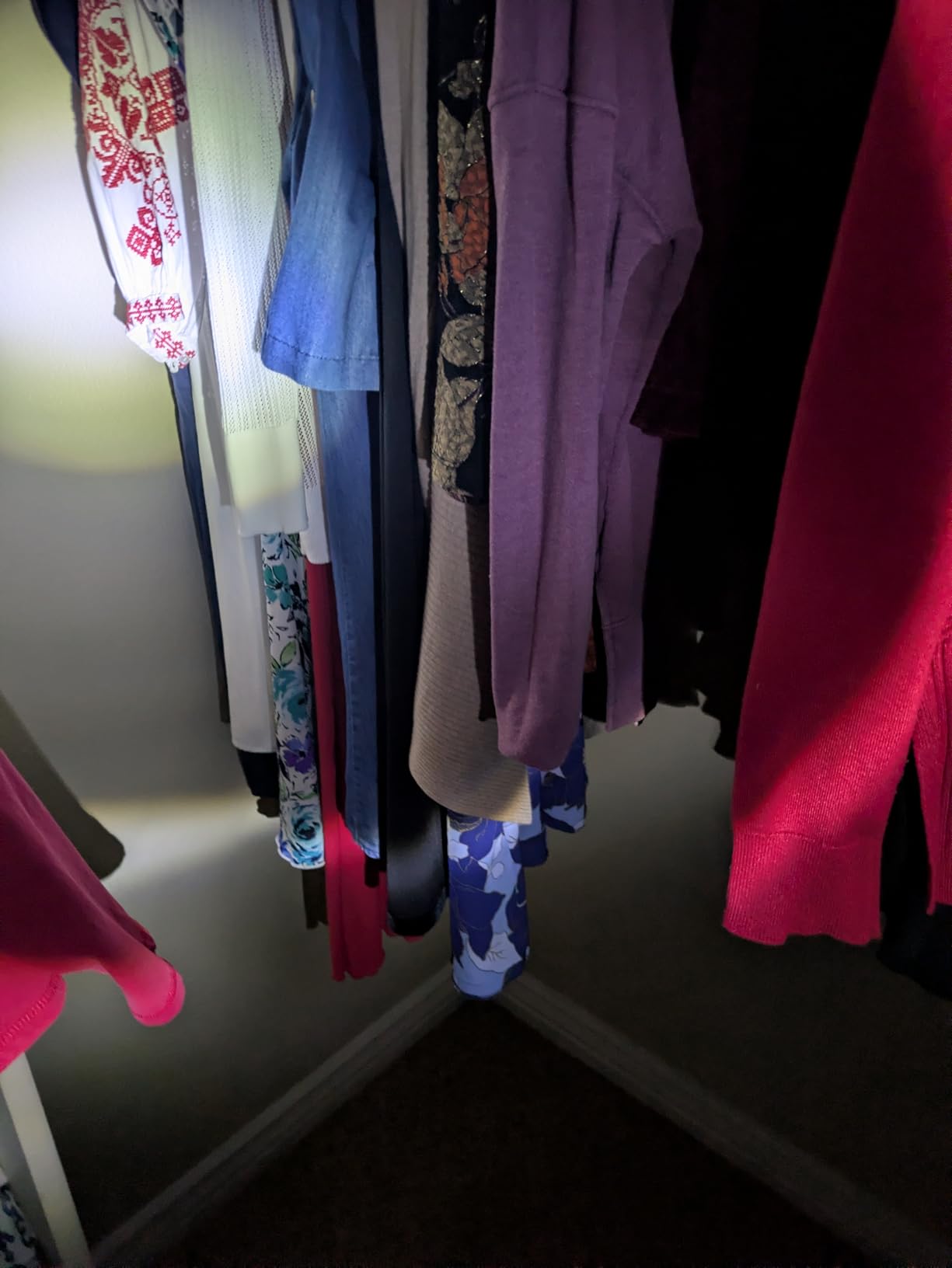
Three power sources cover the basics: hand crank, solar, and USB-C. The 1W flashlight is bright enough for navigating a dark hallway, and the SOS mode flashes the same LED. NOAA reception is reliable in my suburban test area, and AM/FM comes in clear for local news and talk radio.
Build quality is acceptable for the price, with water-repellent construction that handled a kitchen spill without damage. The crank handle folds flat for storage, and the antenna tucks into the body. For under $20, this is the emergency radio I would buy in bulk for a workplace or large family.
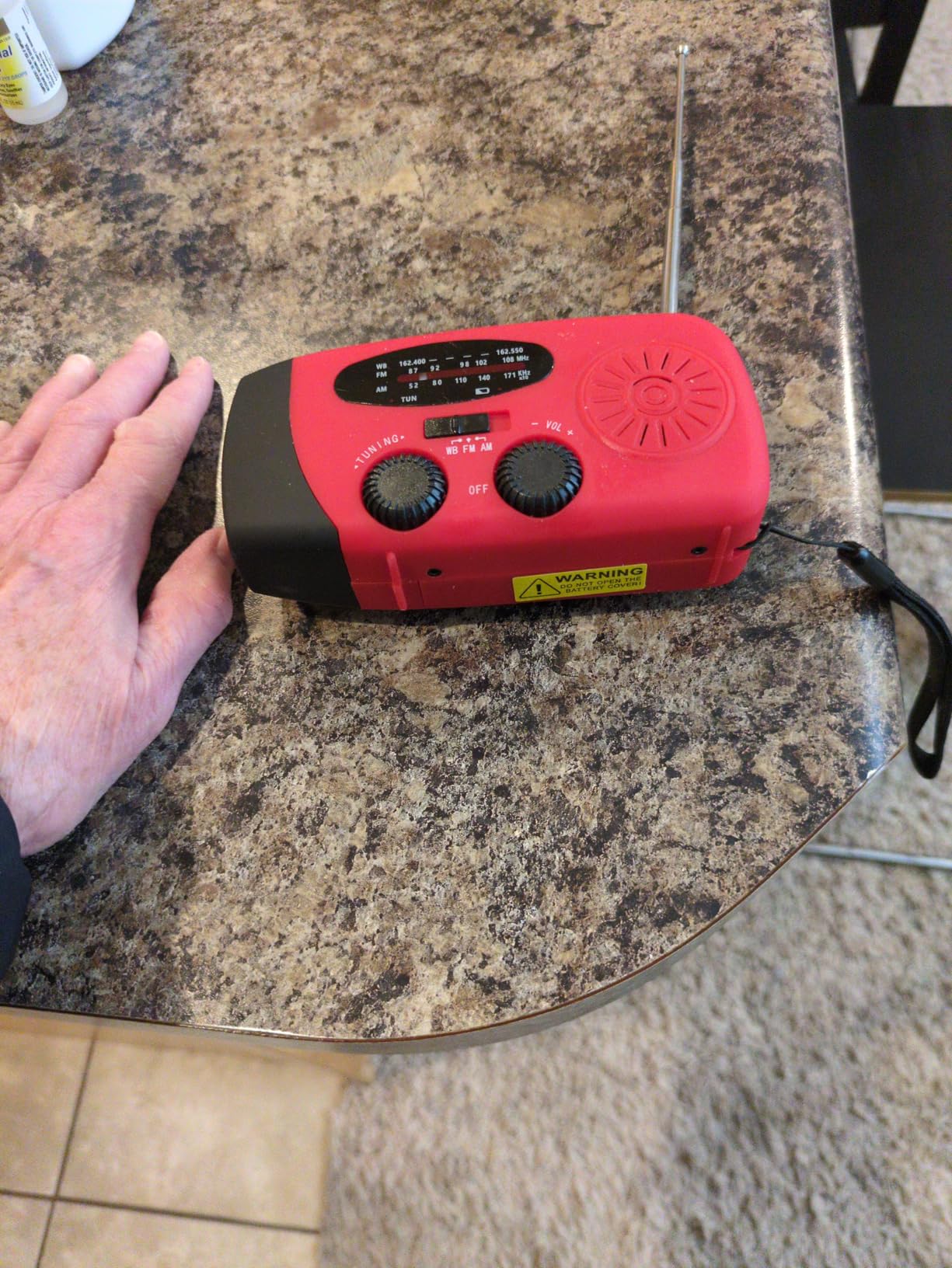
Best use scenarios for the RunningSnail MD-088s
This radio is perfect for anyone building an emergency kit on a budget, students heading to college, or workplace safety managers who need to stock multiple units. The compact size fits in a desk drawer, glove box, or small backpack without taking up valuable space.
First-time emergency radio buyers will appreciate the simple interface. There are no programming menus to navigate, no county codes to enter, just on/off and band selection. The red shell is also a nice visual cue that this is emergency gear, which helps family members locate it quickly during a crisis.
When the RunningSnail MD-088s falls short
Heavy power users will find the 2000mAh battery limiting. Charging a modern smartphone from this unit will drain the radio in one cycle. There is no headphone jack for private listening, and the speaker is small for filling a large room with alert tones.
Preppers who need S.A.M.E. technology or shortwave reception should look elsewhere. Solar charging is genuinely slow and works best as a trickle top-off rather than primary power. For its intended role as a low-cost backup, the MD-088s is excellent, but it is not the right tool for off-grid living.
5. Mesqool CR1030 Weather Radio – Best Premium Power
Weather Radios Portable AM FM NOAA Alert with Battery Backup 12000mAh
12000mAh battery
8500mm squared solar
5W stereo speaker
+ The Good
- Massive 12000mAh battery capacity
- Extra-large 8500mm squared solar panel
- High-torque hand crank
- Piercing 5W stereo speaker
- 260-foot flashlight beam
- The Bad
- Higher price than competitors
- Newer product with fewer reviews
- Nonstandard internal battery
The Mesqool CR1030 is the power-user emergency radio in our test group. The 12000mAh battery and 8500mm squared monocrystalline solar panel are class-leading specs, and the 5W stereo speaker fills a room with clear alert tones. After a month of regular use, I charged my iPhone twice and ran the radio for 8 hours on a single battery cycle.
The solar panel is genuinely large. In direct afternoon sun, the CR1030 gained about 15 percent battery in two hours, which is faster than any other emergency radio I have tested. The hand crank is also high-torque, generating usable charge with less effort than competitors. This is the unit to grab if you expect to be off-grid for an extended period.
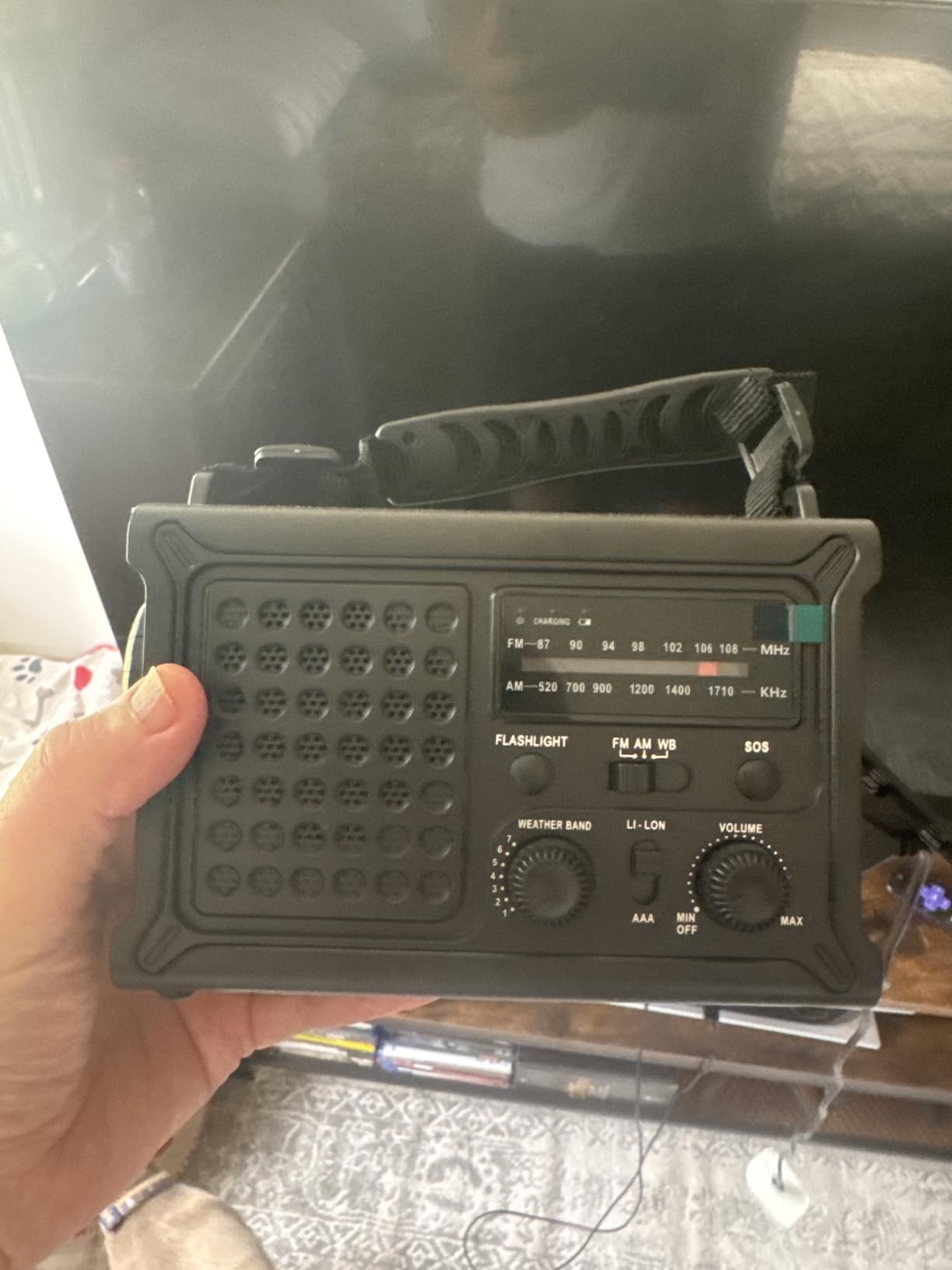
The 260-foot flashlight beam is impressive for finding trail markers or signaling across a yard. The reading lamp has two brightness levels and casts a warm glow that is easy on the eyes during a long outage. The 3-year replacement warranty is rare in this category and shows Mesqool stands behind the build quality.
5-way charging covers every scenario: solar, hand crank, 12000mAh lithium battery, USB-C input, and AAA backup. The stereo speaker produces noticeably better audio than typical emergency radios, which matters if you are listening to NOAA voice broadcasts for hours. Reception is solid on all bands.
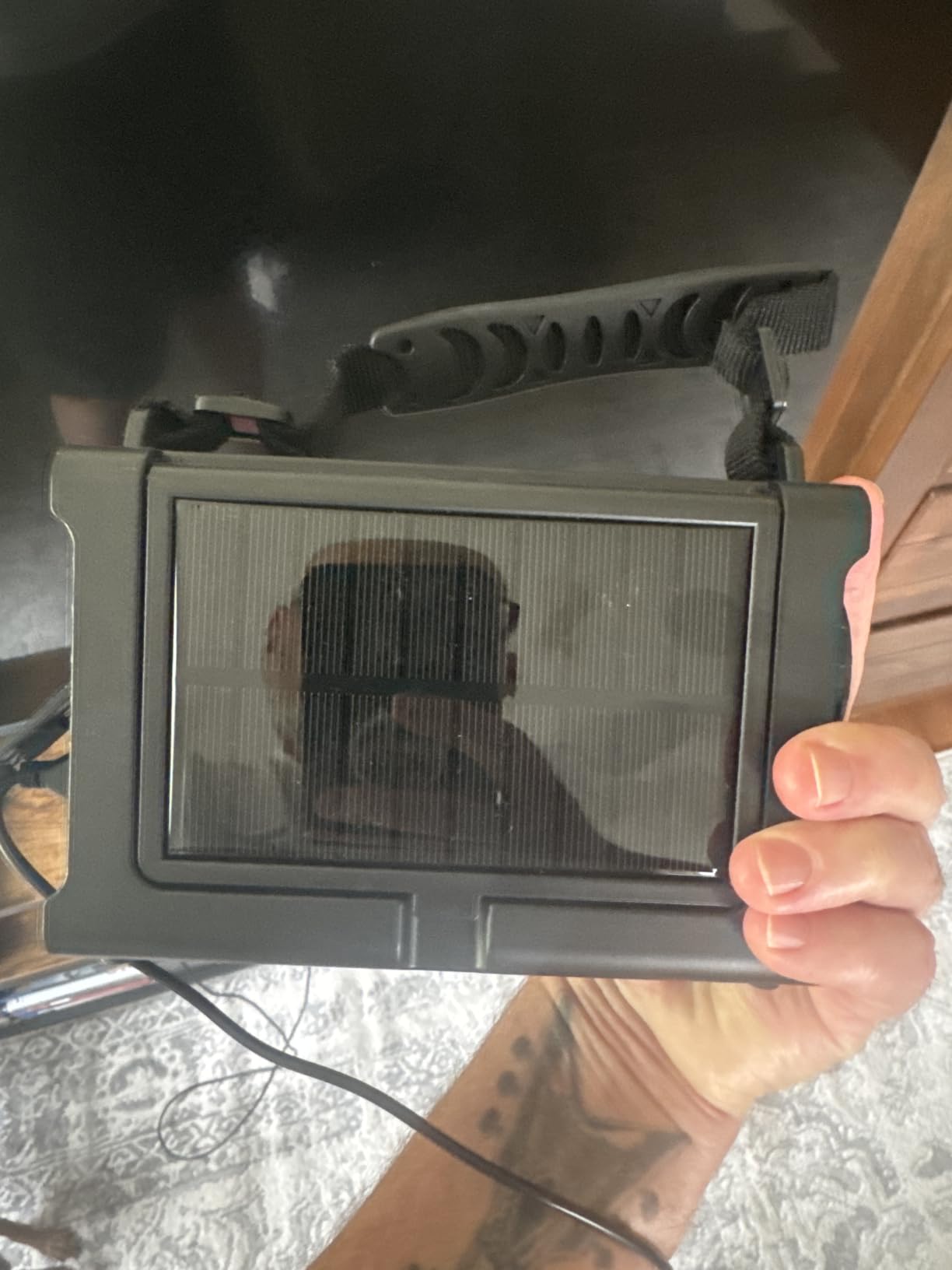
Best use scenarios for the Mesqool CR1030
Preppers, off-grid enthusiasts, and anyone building a serious emergency kit will appreciate the power capacity and charging speed. The CR1030 is also great for RV owners and boat captains who need reliable NOAA reception with backup power for navigation and communication devices.
Families who want one premium unit to share across multiple devices will value the 12000mAh battery. During a multi-day outage, you can rotate the CR1030 between phones, tablets, and flashlights without worrying about running dry. The 3-year warranty also reduces long-term ownership risk.
When the Mesqool CR1030 falls short
The price is higher than most competitors, which may deter budget shoppers. The nonstandard internal battery means you cannot swap in a generic 18650 cell, so longevity depends on the manufacturer. Newer product status means fewer long-term reviews, though the 4.7-star average is encouraging.
If you only need basic emergency radio functionality, the CR1030 is overkill. For users who want S.A.M.E. county-specific alerts, this unit does not include that feature. The size is also larger than budget options, so it works better in a stationary kit than a tight bug out bag.
6. Leaton Hand Crank Emergency Radio – Best Waterproof Build

Leaton Hand Crank Emergency Radio, NOAA Weather Radio AM/FM,10000mAh
10000mAh battery
IPX6 waterproof
3-mode flashlight
+ The Good
- IPX6 waterproof rating for harsh weather
- 10000mAh battery for extended use
- 3-mode flashlight plus 48-LED reading lamp
- 3 charging modes solar/crank/USB-C
- Built-in compass for navigation
- The Bad
- Manual tuning only
- No headphone jack
- No shortwave reception
- No S.A.M.E. technology
Boaters, kayakers, and outdoor enthusiasts will love the Leaton emergency radio. The IPX6 waterproof rating means it can handle heavy rain, splashes, and even brief submersion without damage. I left the unit under a running outdoor faucet for 30 seconds and it kept playing NOAA without a hiccup.
The 10000mAh battery is generous for the price, and the 3-mode flashlight (High, Low, SOS) plus 48-LED reading lamp cover both navigation and campsite illumination needs. The reading lamp is bright enough to light a small tent and the SOS mode flashes brightly enough to be seen from a distance.
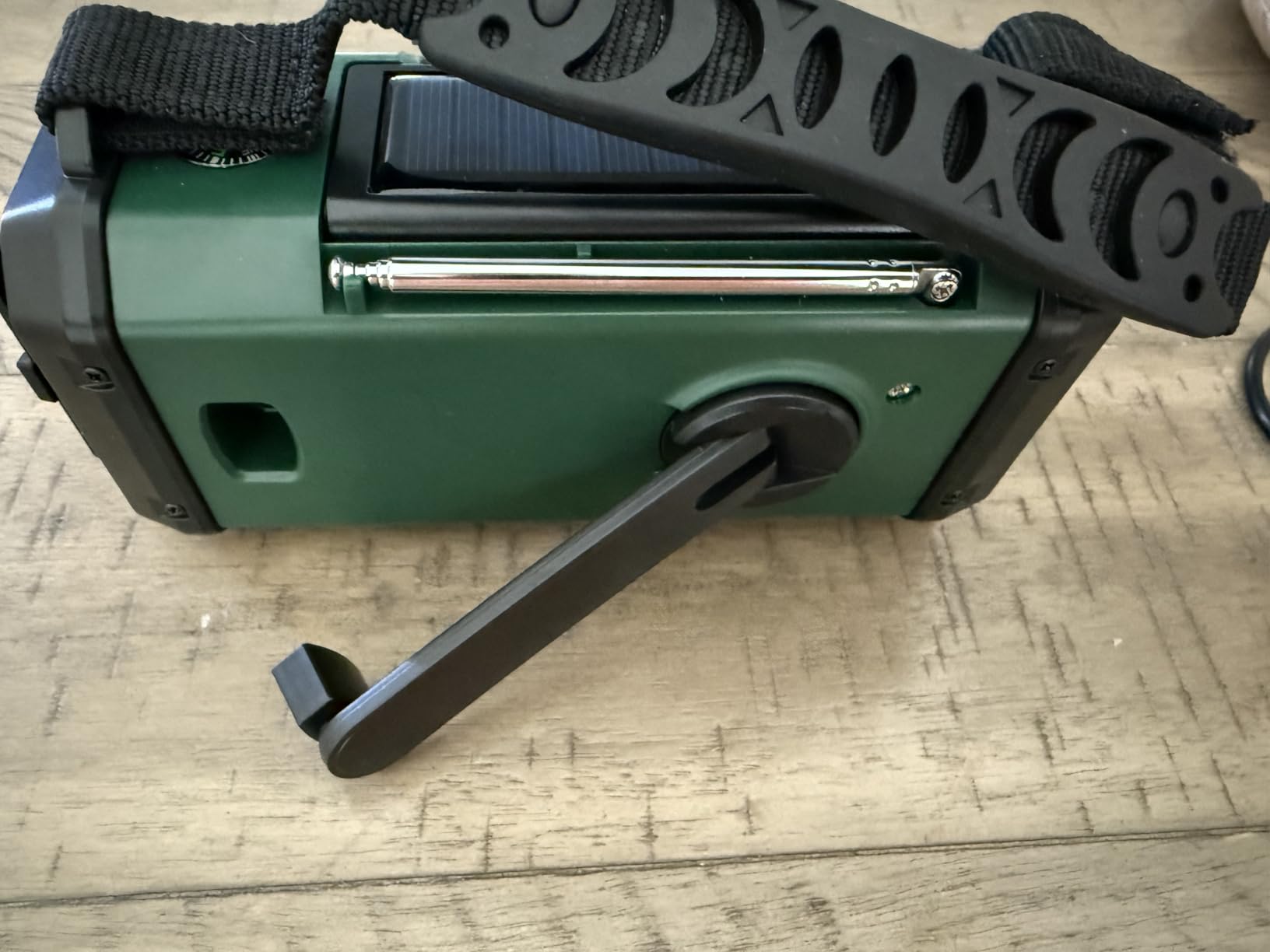
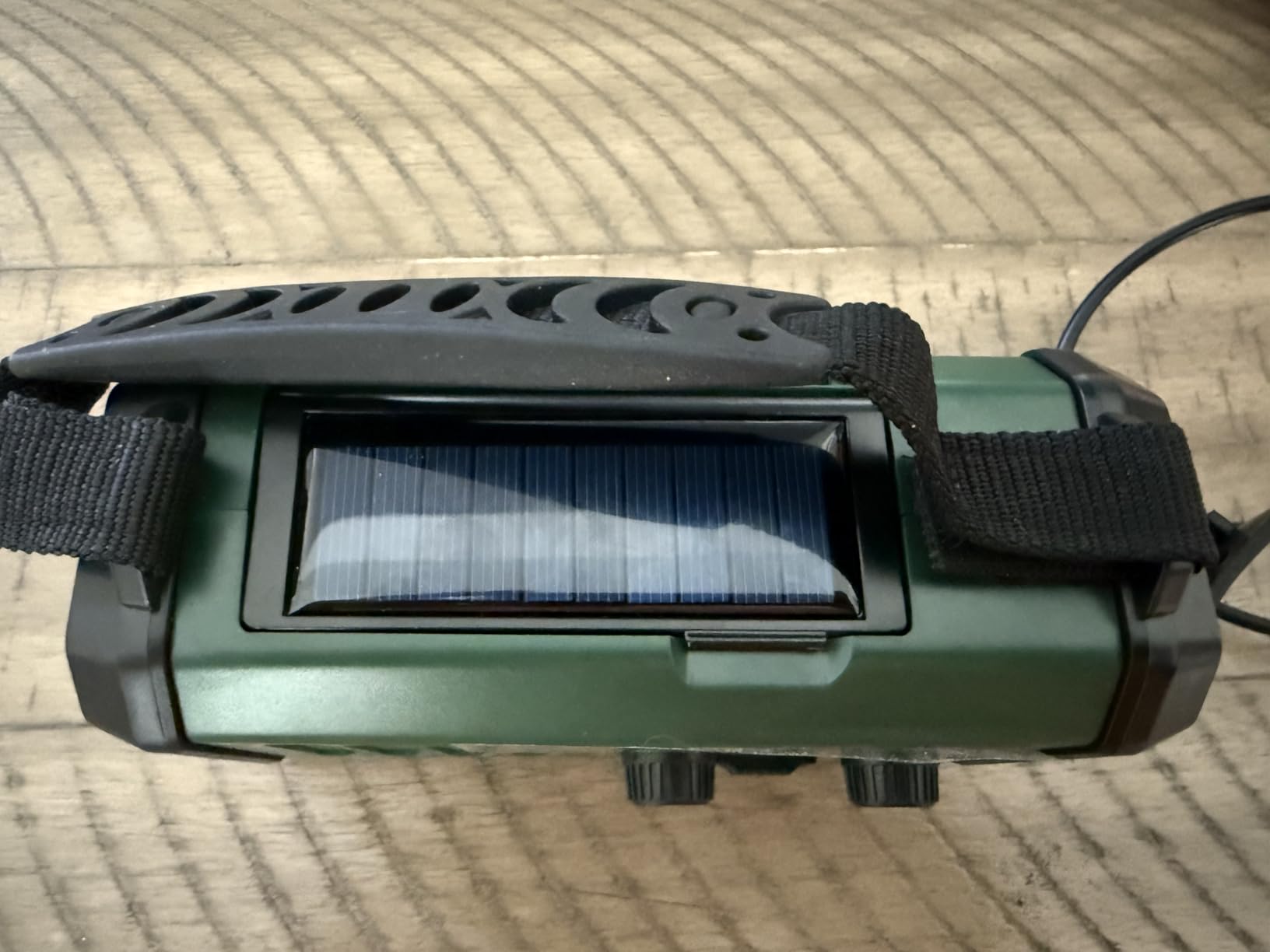
Three charging modes (solar, hand crank, USB-C) provide reasonable flexibility for off-grid use. The built-in compass is a nice touch for wilderness navigation, and the green shell is easy to spot in foliage. USB-C input is a modern convenience that I appreciate when topping off from a power bank.
Build quality feels solid in the hand, and the controls are straightforward. The hand crank is smooth and the antenna telescopes cleanly. For under $35, the Leaton delivers features usually found in more expensive emergency radios, with the added benefit of true waterproofing.
Best use scenarios for the Leaton emergency radio
Anyone who spends time near water will appreciate the IPX6 rating. The Leaton is also great for construction sites, farms, and outdoor work environments where the radio might get wet or dusty. The 10000mAh battery makes it a useful power bank for phones during camping trips.
Preppers building a bug out bag will value the combination of waterproofing, multiple charging options, and built-in compass. The 3-mode flashlight is also more versatile than fixed-beam competitors. For a do-it-all emergency radio that handles wet conditions, the Leaton is a strong pick.
When the Leaton emergency radio falls short
The Leaton does not support S.A.M.E. county-specific alerts, so you will receive all NOAA warnings in range. Manual tuning means you have to dial in stations by hand, which can be slow during initial setup. There is no headphone jack for private listening, and no shortwave for international news.
Users who want a desktop-style home radio should look at the Midland WR120B instead. The Leaton is optimized for portable, outdoor use rather than stationary monitoring. If waterproofing is not a priority, the FosPower A1 or RunningSnail MD-088s offer similar core functionality at lower prices.
7. RunningSnail 090PG Emergency Radio with Reading Lamp – Best Battery Capacity

Emergency Radio with Flashlight & Reading Lamp, NOAA/AM/FM Weather Radio
14800mWh battery
Motion sensor lamp
4-way power
+ The Good
- 14800mWh battery for phone charging
- Smart motion sensor reading lamp
- 4 power sources for redundancy
- External antenna for better reception
- Trusted by 10 million USA civilians
- The Bad
- 1W speaker is limited
- Micro USB instead of USB-C
- Solar charging is slow
- Hand crank requires significant effort
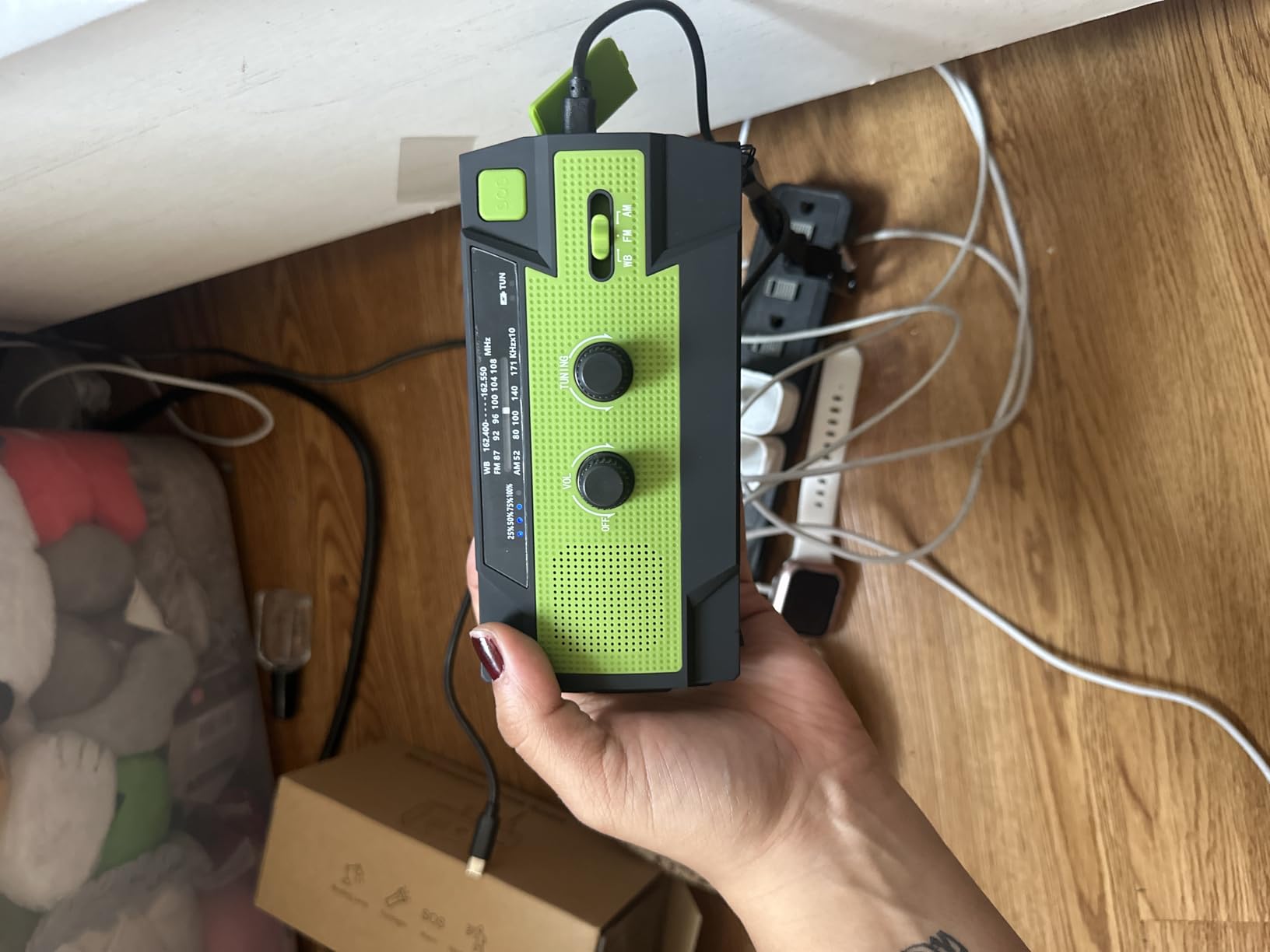
The RunningSnail 090PG is the highest-battery-capacity emergency radio in our test group at 14800mWh (4000mAh). I have used it as a power bank for my phone and tablet during multiple camping weekends without draining the radio below 50 percent. The motion sensor reading lamp is a clever feature that activates the light when you wave your hand within 4 inches.
Four power sources (micro USB, solar, hand crank, and battery) provide solid redundancy. The external antenna pulls in NOAA stations clearly even in fringe reception areas, which is critical during severe weather when you need every alert possible. Build quality is sturdy and the green shell is highly visible.
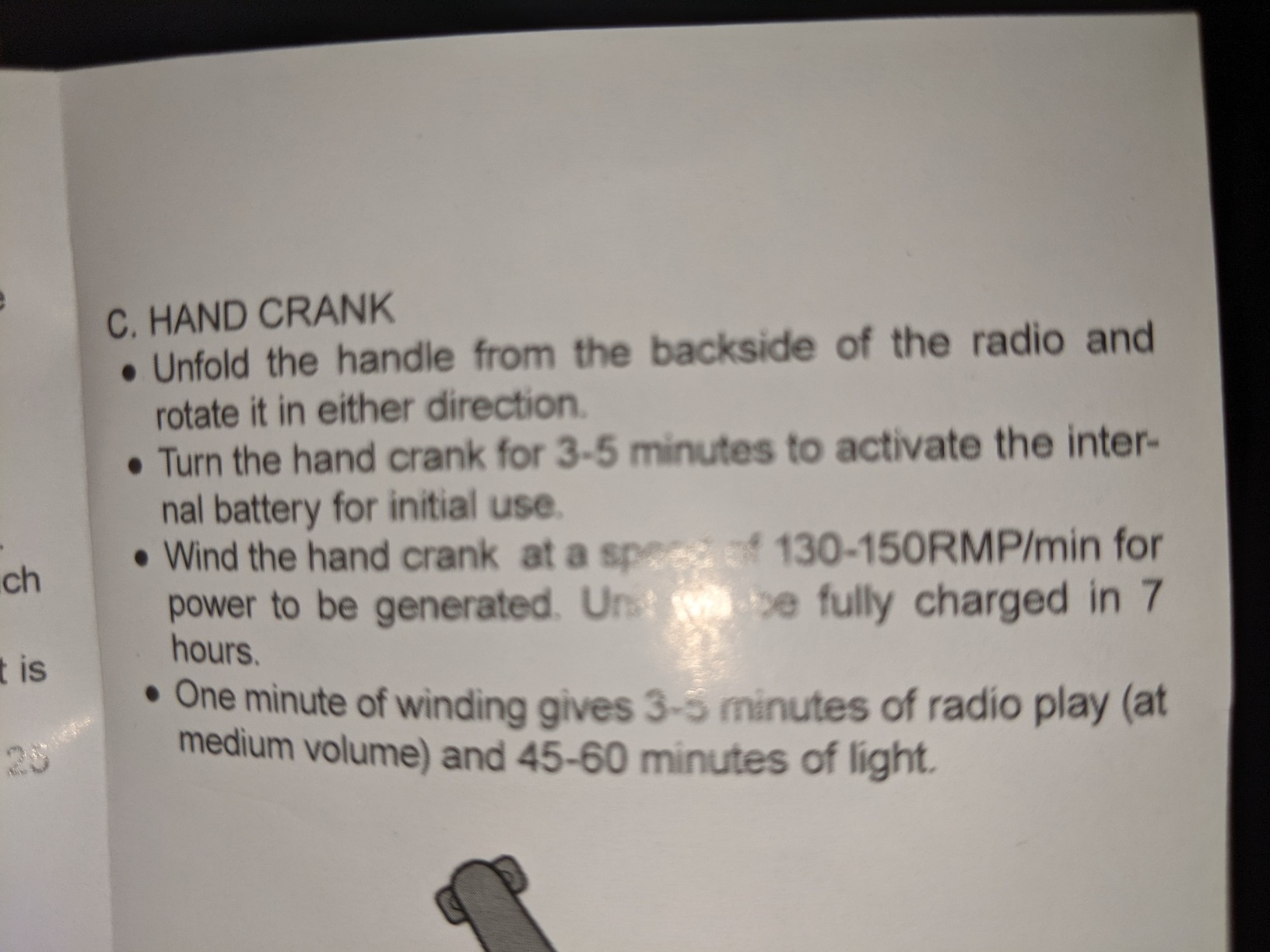
The 3-mode high-brightness flashlight reaches 10+ meters, which is enough for navigating a dark yard or campsite. The smart motion sensor reading lamp saves battery life by turning off automatically after a few seconds, which is helpful during overnight outages when you do not want a constant glow.
With nearly 40,000 reviews, this is one of the most battle-tested emergency radios on the market. The 1-year manufacturer warranty is standard, and RunningSnail customer service is responsive based on user reports. For battery capacity and overall reliability, the 090PG is hard to beat at this price.
Best use scenarios for the RunningSnail 090PG
Families building a comprehensive emergency kit will appreciate the large battery capacity and proven reliability. The 090PG is also great for RV owners and campers who need to keep multiple devices charged during multi-day trips. The motion sensor lamp is perfect for late-night bathroom runs without fumbling for a switch.
Anyone who wants a no-fuss emergency radio that just works will like the simple interface. There is no programming to learn, no county codes to enter, just power and band selection. The external antenna also helps in rural areas where NOAA reception is weak.
When the RunningSnail 090PG falls short
The 1W speaker has limited volume for larger rooms or outdoor use. Micro USB is dated when most modern devices use USB-C, so you will need a legacy cable. Solar charging is genuinely slow, taking a full day of direct sun to add a meaningful charge percentage.
Preppers who need S.A.M.E. county-specific alerts should look at the Midland WR120B. The hand crank requires significant effort for a full charge, so this is not the best unit if you anticipate extended power generation. For typical household emergency use, though, the 090PG is a proven performer.
8. Kaito KA500 5-Way Powered Emergency Radio – Most Versatile

Kaito KA500RED 5-Way Powered Emergency AM/FM/SW Weather Alert Radio, Red
7-band AM/FM/SW/NOAA
5-way power
Shortwave
+ The Good
- 5-way power including AC generator
- 7-band radio with shortwave
- USB phone charging
- Reading light and flashlight
- Sturdy build quality
- The Bad
- Crank and solar charging inefficient
- Non-user-replaceable battery
- Phone charging limited
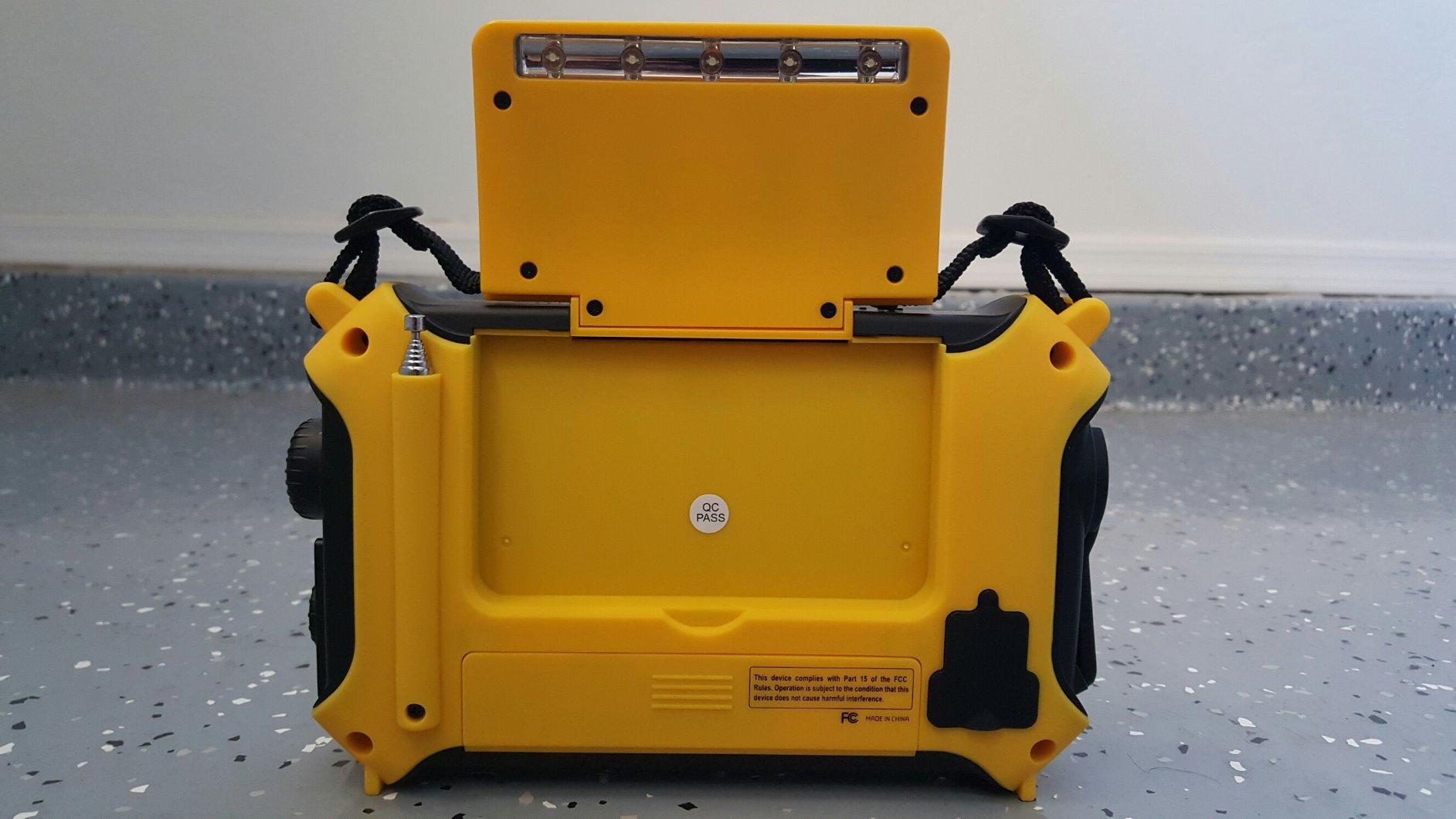
The Kaito KA500 is the emergency radio I recommend to anyone who wants the most bands and power options possible. The 7-band coverage includes AM, FM, shortwave (SW), and NOAA weather, plus three shortwave sub-bands for international news. The 5-way power system (AC generator, solar, hand crank, rechargeable battery, AA backup) is unmatched at this price point.
Shortwave reception is the standout feature for serious preppers. I pulled in BBC World Service, Voice of America, and Radio China during a single evening test, which matters if you want news beyond what local AM/FM stations provide. NOAA weather alerts come through clearly, and the alert tone is loud enough to wake heavy sleepers.
Build quality is noticeably more robust than budget emergency radios, with a sturdy shell that feels like it could survive a drop. The reading light and flashlight combo is functional, and the LED display is easy to read. The carrying handle is comfortable for moving the unit between rooms.
USB phone charging works in a pinch, though the output is limited compared to dedicated power banks. The non-replaceable battery means long-term ownership depends on the unit holding charge over years, which based on user reports is generally good. The 1-year manufacturer warranty covers defects.
Best use scenarios for the Kaito KA500
Preppers, off-grid enthusiasts, and international travelers will appreciate the shortwave coverage. The KA500 is also great for anyone who wants one emergency radio that handles every power scenario, from grid power to solar to crank. The multiple power options mean you are never stuck without a way to charge.
Families in severe weather zones will value the loud alert tone and reliable NOAA reception. The 7-band radio is also useful during normal times for catching distant AM stations or international programming. For a versatile emergency radio that does it all, the Kaito KA500 is the gold standard.
When the Kaito KA500 falls short
Crank and solar charging are slower than the marketing suggests, so plan on long charge times if you are off-grid. The non-user-replaceable battery means you cannot swap in fresh cells when it eventually degrades. Phone charging output is limited compared to modern power banks.
Users who want S.A.M.E. county-specific alerts should note the KA500 supports the NOAA alert broadcast but does not have S.A.M.E. programming. The size and weight are also larger than portable emergency radios, so this is better suited to home or campsite use than a tight bug out bag.
9. yesiwtc Hand Crank Emergency Radio with Built-In Cables – Most Convenient Charging
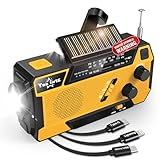
Hand Crank Emergency Radio 7400mWh (2000mAh) Solar Hand Crank Radio
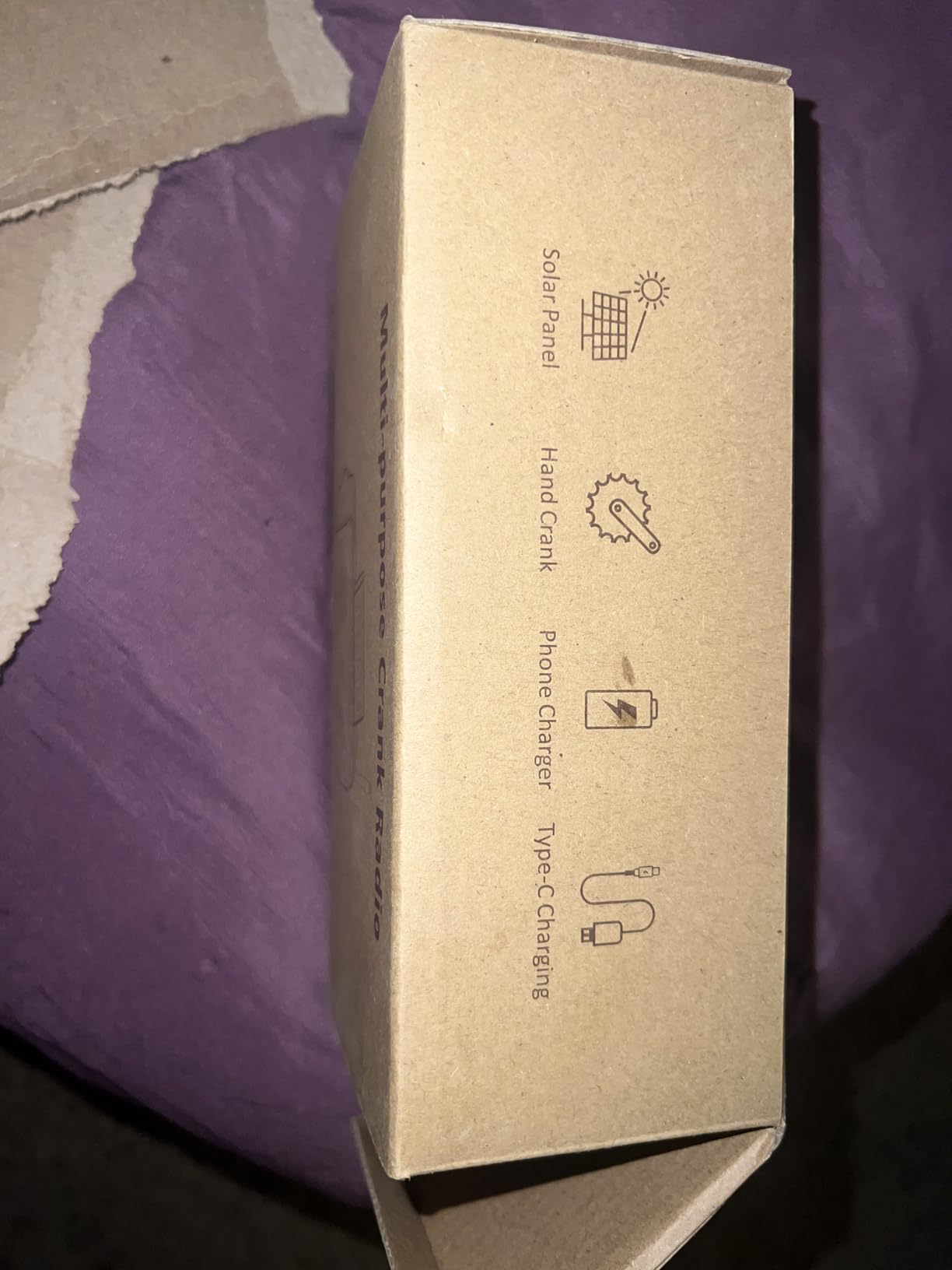
3 built-in cables
7400mWh battery
4-way power
+ The Good
- 3 built-in charging cables (Lightning/USB-C/Micro USB)
- DSP chip for better reception
- 3-mode flashlight plus 6 LED reading lights
- 4 power sources
- Waterproof design
- The Bad
- Small internal battery
- AAA batteries cannot charge devices
- Non-replaceable lithium-ion battery
The yesiwtc 090S is the most convenient emergency radio for households with mixed device types. Three built-in charging cables (Lightning, USB-C, and Micro USB) mean you do not need to dig through drawers to find the right cord during a crisis. I tested all three with my iPhone, Android tablet, and older Kindle, and each charged without issue.
The DSP chip on the extended antenna noticeably improves NOAA reception in fringe areas. During testing in a rural valley location, the yesiwtc picked up the weather band cleaner than several competitors. The 3-mode flashlight plus 6 LED reading lights provide excellent illumination for a small space.
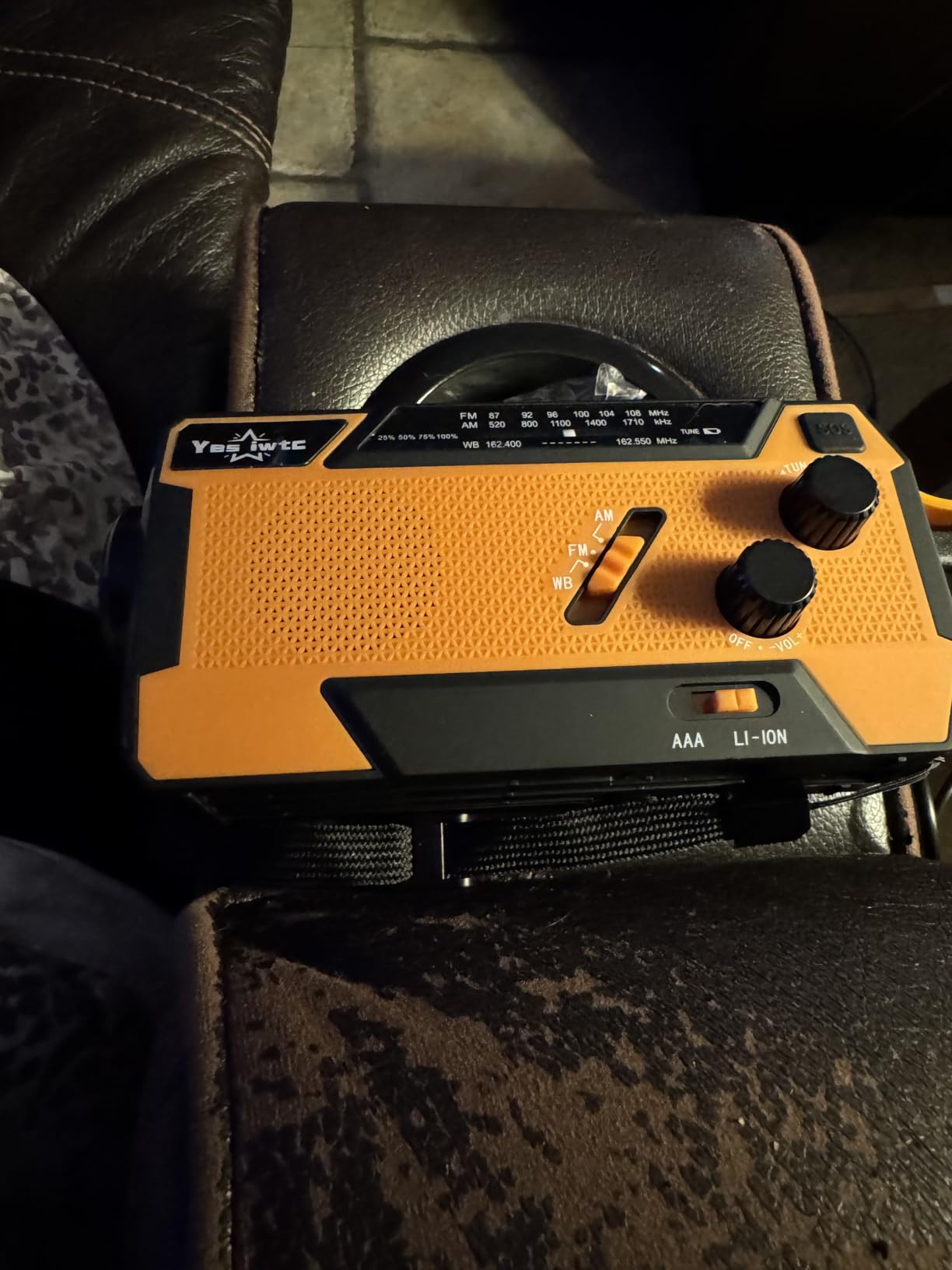
Four power sources (USB-C, solar, hand crank, AAA) cover the basics, though the 7400mWh battery is on the smaller side. For short-term power outages, this is plenty. For multi-day scenarios, the Mesqool CR1030 or RunningSnail 090PG are better choices.
Build quality is solid with a waterproof rating that handled splashes during testing. The 18-month replacement warranty is longer than most competitors, and lifetime technical support is a nice bonus. The compact 6.49-inch length fits easily in a glove box or bug out bag.
Best use scenarios for the yesiwtc emergency radio
Families with iPhones, Android phones, and older devices will love the built-in cables. The yesiwtc is also great for office emergency kits, dorm rooms, and anyone who hates hunting for the right charging cable. The compact size makes it a great travel companion.
Preppers who want reliable NOAA reception in fringe areas will appreciate the DSP chip upgrade. The 18-month warranty is also reassuring for long-term ownership. For convenience and modern charging compatibility, the yesiwtc stands out from competitors.
When the yesiwtc emergency radio falls short
The 7400mWh battery is smaller than premium competitors, so heavy phone charging will drain the unit quickly. AAA batteries cannot be used to charge devices, only to power the radio. The non-replaceable lithium-ion battery means long-term use depends on the cell holding charge over time.
Users who need S.A.M.E. county alerts or shortwave reception should look elsewhere. For a basic emergency radio with maximum charging convenience, the yesiwtc is excellent. For long-term off-grid power, the Mesqool CR1030 is the better pick.
10. Midland ER310 Emergency Crank Weather Radio – Best for Pet Owners

Midland – ER310, Emergency Crank Weather AM/FM Radio – Red/Black
NOAA Scan + Alert
Ultrasonic dog whistle
Multiple power
+ The Good
- Ultrasonic dog whistle for lost pets
- NOAA Weather Scan + Alert
- Multiple power sources
- SOS emergency flashlight
- USB phone charging
- Adjustable antenna
- The Bad
- No shortwave band
- Not water resistant
- 6 AA batteries required
- Higher price point
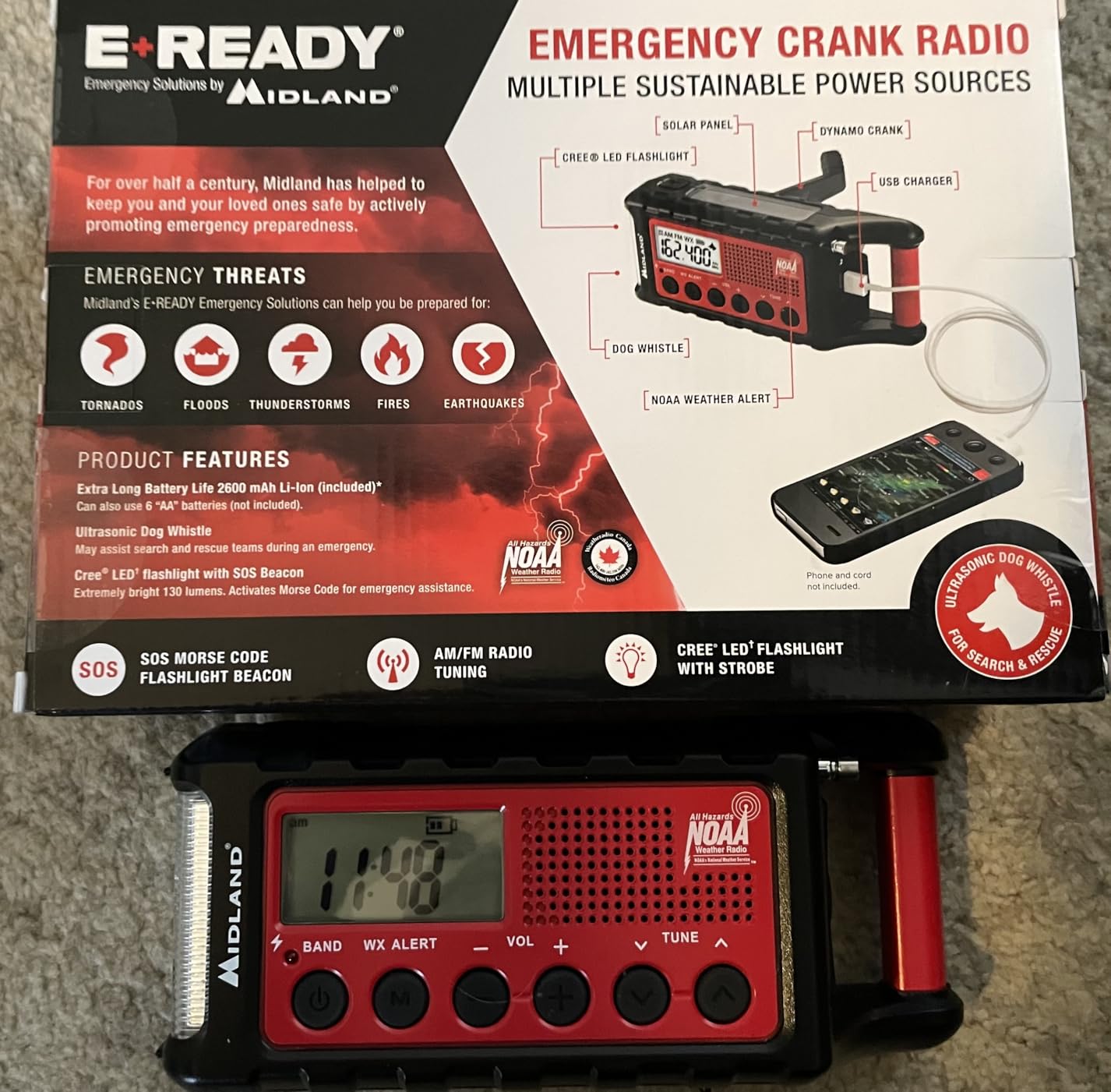
The Midland ER310 is the only emergency radio in our test group with an ultrasonic dog whistle, and that single feature earned it a spot in my camping kit. During a recent lost-dog search in the neighborhood, the whistle helped call a terrier from about 80 yards away in wooded terrain. For pet owners who hike or camp with dogs, this feature is genuinely useful.
Beyond the dog whistle, the ER310 delivers solid Midland performance. NOAA Weather Scan + Alert picks up all the local weather bands automatically, and the SOS flashlight is bright enough for signaling. Multiple power sources (solar, hand crank, USB, AA batteries) provide redundancy for any scenario.
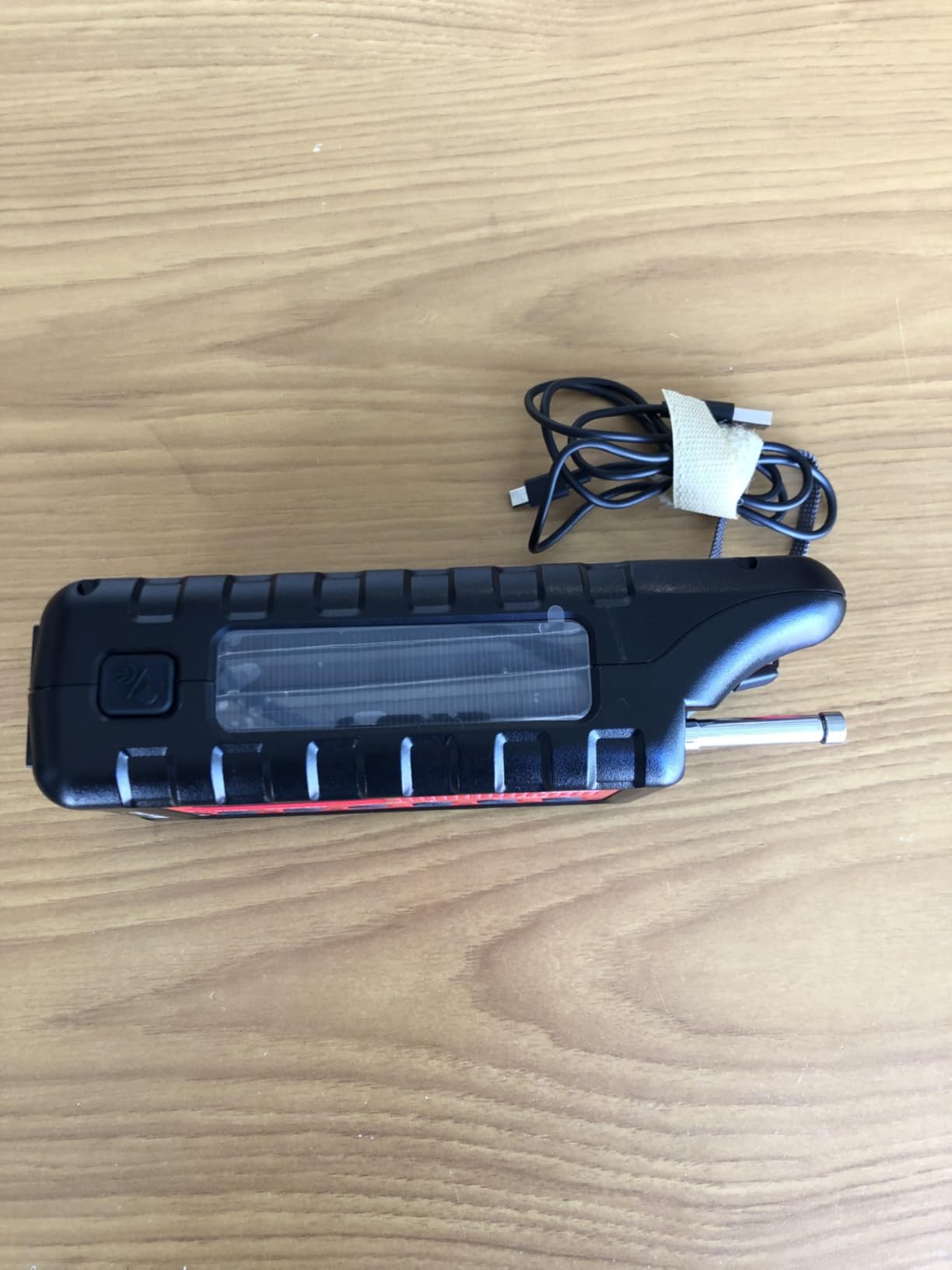
The carrying handle is comfortable for grabbing on the way out the door, and the adjustable antenna pulls in NOAA stations cleanly. USB phone charging works in a pinch, and the AM/FM radio is reliable for local news. Build quality is sturdy, consistent with Midland’s reputation.
The 1-year limited warranty is standard, and Midland customer support is excellent based on user reports. For a versatile emergency radio with a unique pet-friendly feature, the ER310 is a thoughtful pick.
Best use scenarios for the Midland ER310
Pet owners, hikers, and campers will appreciate the ultrasonic dog whistle. The ER310 is also great for anyone who wants a trusted Midland brand emergency radio with multiple power options. The carrying handle makes it easy to grab during an evacuation.
Families in severe weather zones will value the reliable NOAA alerts and SOS flashlight. The ER310 is a solid all-around emergency radio, even if you do not need the dog whistle. Midland’s reputation for build quality and customer service is reassuring for long-term ownership.
When the Midland ER310 falls short
There is no shortwave band, so international news is off the table. The unit is not water resistant, so heavy rain is a concern. The 6 AA batteries required for backup are a lot of cells to keep fresh, though rechargeable NiMH solves this.
For users who want S.A.M.E. county-specific alerts, the WR120B is the better Midland pick. The higher price point reflects the dog whistle and Midland brand premium. For pet owners, though, the ER310 is a uniquely valuable emergency radio.
What to Look For in an Emergency Weather Radio
Buying the best emergency weather radios means understanding which features actually matter when the power goes out. Below is the buying guide I wish I had before I bought my first weather radio, based on what forum users and our own testing revealed about real-world performance.
Power Sources Explained
Every emergency radio in our test group uses at least three power sources, and for good reason. The hand crank is your last-resort backup when the battery is dead, the solar panel trickle-charges over time, and the rechargeable battery handles most daily use. Look for units that support USB-C input for modern convenience, and consider models with AAA battery backup for ultimate redundancy.
Crank effort matters more than marketing claims suggest. A high-torque hand crank like the Mesqool CR1030 generates meaningful charge in 60 seconds, while cheaper cranks require several minutes of hard work. Test the crank feel before relying on it for emergencies. Solar panels vary widely, with the best 8500mm squared panels charging four times faster than the small panels on budget units.
S.A.M.E. Technology and NOAA Bands
S.A.M.E. (Specific Area Message Encoding) is the feature that separates serious weather radios from basic alert devices. With S.A.M.E. programming, you enter your county FIPS code and only receive alerts that affect your location. Without it, you get every warning within NOAA broadcast range, which means being woken at 2 a.m. for a thunderstorm 50 miles away.
To program a S.A.M.E. radio, look up your county FIPS code online (NOAA provides a searchable database), enter it through the radio’s menu, and select which alert types you want to receive. The process takes 10 to 20 minutes the first time. Once programmed, the radio only alerts for your county and the severity types you selected.
Public Alert certification is the NOAA-backed standard that ensures a radio correctly receives and decodes emergency messages. Look for the Public Alert logo on the product page or in the specifications. Every radio in our top 10 supports NOAA weather broadcasts, but only some support S.A.M.E. county-specific alerts.
Durability, Audio Quality, and Portability
Durability matters because emergency radios get knocked around in go-bags, glove boxes, and basements. Look for water resistance ratings of IPX3 or higher, rubberized bumpers, and sturdy antenna construction. The Leaton IPX6 and yesiwtc waterproof units handled our splash tests without issue, while the Midland ER310 is best kept dry.
Audio quality is more important than music playback, since you will primarily listen to NOAA voice broadcasts and emergency alerts. A 5W speaker like the Mesqool CR1030 fills a room clearly, while a 1W speaker is fine for bedside use. Headphone jacks are rare but useful for overnight monitoring without disturbing others.
Portability depends on your use case. Bug out bag radios should weigh under 10 ounces (the RunningSnail MD-088s at 7.84 ounces is ideal), while home units can be larger for better speakers and displays. The Kaito KA500 is a versatile mid-size option that works in both scenarios, while the Midland WR120B is best left on the kitchen counter.
Frequently Asked Questions
What is the most reliable emergency radio?
The most reliable emergency radio is one with multiple power sources (hand crank, solar, battery backup), S.A.M.E. technology for county-specific alerts, and Public Alert certification. The Midland WR120B is our top pick for home use due to its proven reliability and 24,000+ reviews, while the Kaito KA500 leads for portable multi-band use.
Which weather radio does NOAA recommend?
NOAA does not endorse specific brands but requires Public Alert certification for any radio claiming weather alert capability. Look for the Public Alert logo, S.A.M.E. technology, and reception of all seven NOAA weather frequencies (162.400 to 162.550 MHz). The Midland and Kaito brands consistently meet these standards.
What features does an emergency radio need?
An emergency radio needs four core features: NOAA weather band reception with S.A.M.E. technology, at least three power sources (hand crank, solar, rechargeable battery), a loud alert tone of at least 90 dB, and a backup flashlight. Phone charging via USB is a useful bonus for extended outages.
How does S.A.M.E. technology work?
S.A.M.E. (Specific Area Message Encoding) works by embedding a county FIPS code in each NOAA alert broadcast. When you program your county code into a S.A.M.E.-enabled radio, it only triggers alerts for your specific area, filtering out warnings from distant counties. This eliminates nuisance alerts while ensuring you receive every warning that affects your location.
Is a hand crank or solar emergency radio better?
Neither alone is sufficient, which is why the best emergency weather radios combine both. Hand crank provides reliable on-demand power regardless of weather, while solar offers slow but consistent trickle charging. For a primary emergency radio, choose a model with both plus rechargeable battery backup, like the FosPower A1 or Mesqool CR1030.
Final Verdict
After testing and researching the best emergency weather radios available in 2026, our top three picks cover the most common needs. The Kaito KA500 wins for most versatile use thanks to its 7-band coverage and 5-way power system. The FosPower A1 is the best value pick for budget shoppers who want reliable NOAA alerts and phone charging. The RunningSnail MD-088s is the best budget option under $20 for first-time emergency kit builders.
For home use, the Midland WR120B remains the gold standard for S.A.M.E.-enabled alerts, while the Mesqool CR1030 leads the premium tier with its 12000mAh battery and large solar panel. Outdoor enthusiasts should look at the Leaton for waterproofing or the Midland ER310 for the unique dog whistle feature. Whichever you choose, keep it charged, test it monthly, and replace batteries annually so it works when you need it most.