
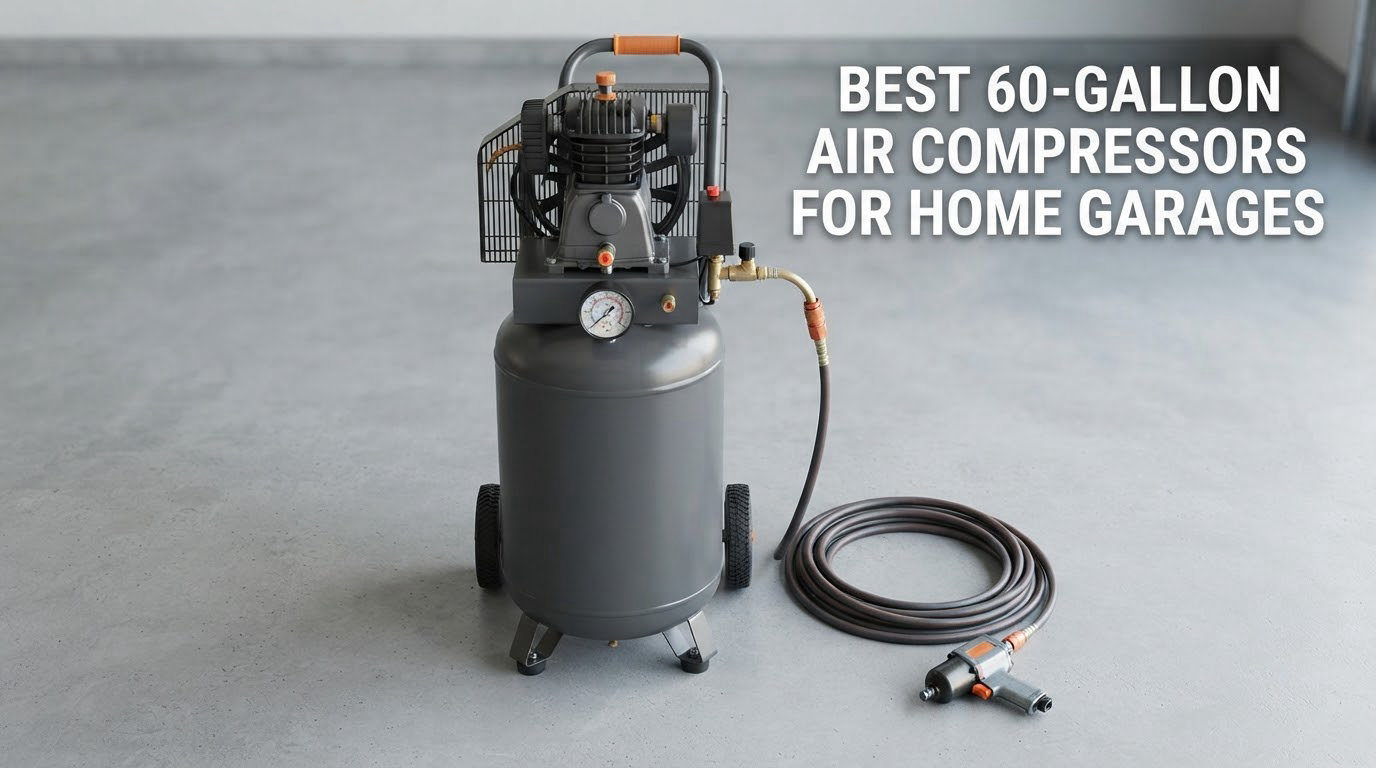
Most people shopping for the best 60 gallon air compressor for a home garage start with the wrong number. They fixate on tank size, because 60 gallons sounds like a lot of air. Tank size is not what decides whether a compressor keeps up with your work. Air flow at 90 PSI does that. A 60-gallon tank is simply a reservoir that smooths out the gaps between pump cycles and powers burst tools like impact wrenches. The pump is what refills it, and the pump’s CFM at 90 PSI is what determines whether your sander stalls, your spray gun lags, or your cut-off tool runs at full speed.
Our team compared ten 60-gallon compressors across the range you will actually find for a home shop, from single-stage cast-iron pumps that shrug off daily use to a two-stage unit that trades noise for airflow. We read the spec sheets line by line, weighed the review patterns, and paid close attention to the two details that trip up first-time buyers: what it takes to power the thing, and what happens when you want to move it.
This guide covers the specs that matter, the tool CFM numbers you should match against, the electrical requirements, and the maintenance that decides whether a unit lasts four years or twenty. We also flag the models with thin review histories, so you can weigh a perfect rating differently from a proven one. If you are still sizing up the format, our general air compressor guide covers portable and pancake options, and our 80 gallon air compressor picks make sense if you plan on sandblasting or running two large tools at once.
Top 3 Picks: Our Shortlist for Home Garages for October 2026

Campbell Hausfeld XC602100
- › Two-stage cast-iron pump
- › 7.6 SCFM at 90 PSI
- › 175 PSI max
- › 65 dB listed

Ingersoll Rand SS3L3
- › 11.3 CFM at 90 PSI
- › 100% continuous duty
- › Cast-iron 5000+ hour pump
- › 78 dB listed
The Campbell Hausfeld XC602100 takes the top slot because it is the only two-stage, 175 PSI, cast-iron unit in this group with a meaningful body of owner feedback, and because its vertical tank footprint is small enough to fit beside a car. The Ingersoll Rand SS3L3 is the airflow and duty-cycle leader, rated for continuous operation. The Campbell Hausfeld VT6395 is the least expensive route into a 60-gallon cast-iron unit, with the caveat that its review history is three ratings deep.
All 10 Best 60 Gallon Air Compressors in October 2026
| PRODUCT MODEL | KEY SPECS | BEST PRICE |
|---|---|---|
|
|
Check Latest Price |
 |
|
Check Latest Price |
|
|
Check Latest Price |
 |
|
Check Latest Price |
 |
|
Check Latest Price |
 |
|
Check Latest Price |
 |
|
Check Latest Price |
 |
|
Check Latest Price |
 |
|
Check Latest Price |
 |
|
Check Latest Price |
Two entries in this table stand out immediately. Only two units are two-stage: the Campbell Hausfeld XC602100 and the DEWALT 175 PSI model. The rest are single-stage, which caps their pressure ceiling and makes them better suited to intermittent tool use than to sustained painting or blasting. That is not a defect, it is a design tradeoff, but it changes what you can realistically run.
1. Campbell Hausfeld XC602100 Two-Stage 60 Gallon — Best Overall
Campbell Hausfeld 60-Gallon 2-Stage Air Compressor, 175 PSI, 230V
Two-stage cast-iron pump
7.6 SCFM at 90 PSI
175 PSI max
230V, 255 lb, 65 dB
+ The Good
- Two-stage cast-iron pump rated for 10000 hours of pump life
- Compact 23 x 23 inch vertical footprint
- 175 PSI maximum working pressure
- Quieter than typical single-stage units at 65 dB
- The Bad
- Airflow of 7.6 SCFM at 90 PSI trails higher priced 60 gallon units
- Requires a dedicated 230V circuit
- 14 percent of ratings sit at one star
The XC602100 is the unit I keep coming back to because it makes the fewest compromises on the things a home garage cannot work around. It is a genuine two-stage design with a cast-iron pump, which means it reaches 175 PSI and does it more efficiently and at a lower temperature than a single-stage pump working against the same demand. Owner feedback consistently points to durability rather than excitement: grinding, sanding, painting, nailing and bolting are all jobs the pump is rated to absorb.
Its footprint is the other reason it wins. The vertical ASME tank sits on a 23 by 23 inch base, so it tucks against a wall without stealing the room you need to walk around a project car. The whole unit weighs 255 pounds, which is heavy but manageable with two people and a furniture dolly.
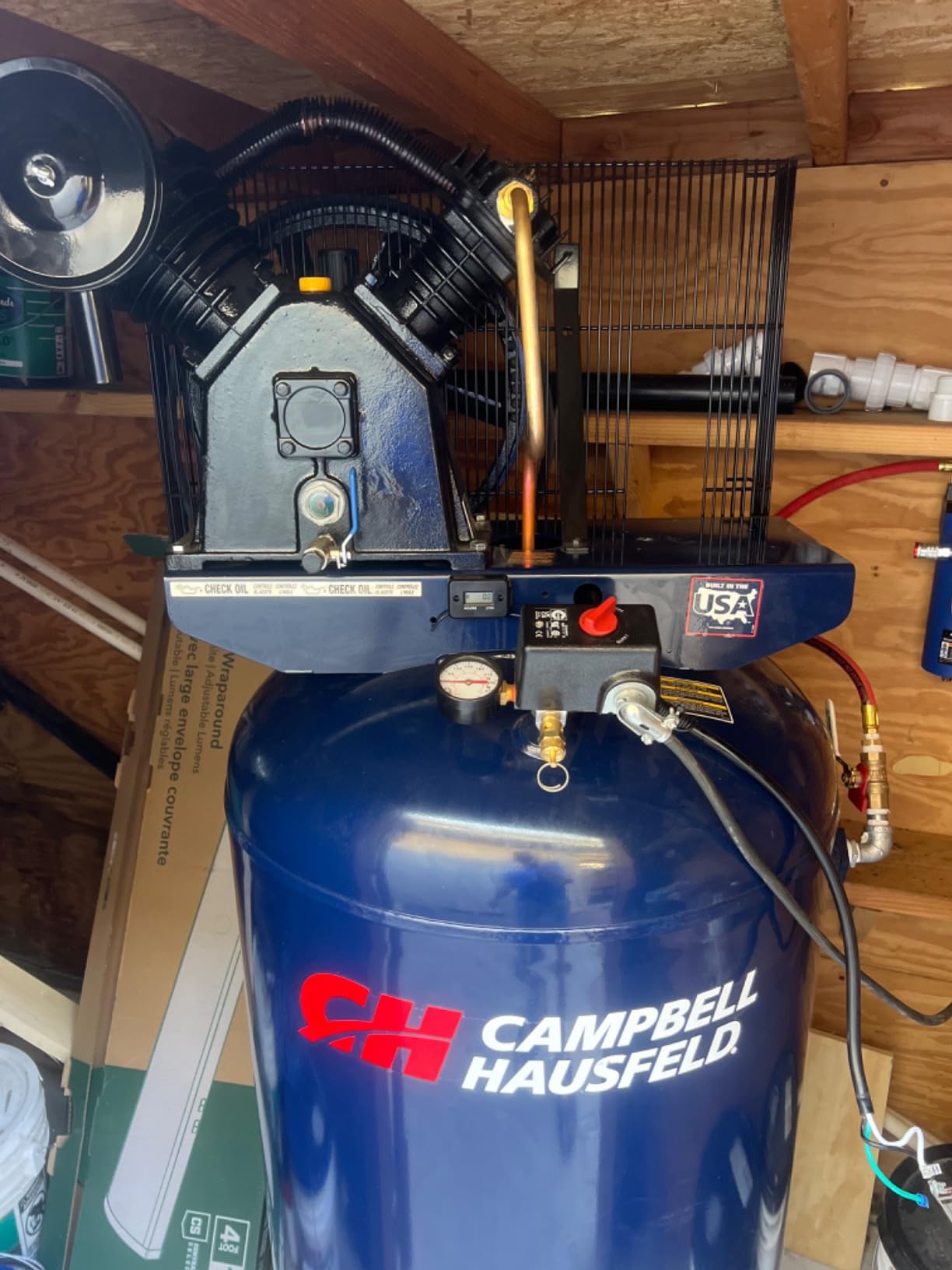
The honest weakness is airflow. At 7.6 SCFM at 90 PSI, this is the lowest airflow figure of any unit we compared, and it is the clearest tradeoff in this pick. That is enough for a random orbital sounder with room to spare, and enough for impact wrenches and nail guns because the tank covers those bursts. It is not enough to run a large HVLP gun or a cut-off wheel continuously without waiting on recovery.
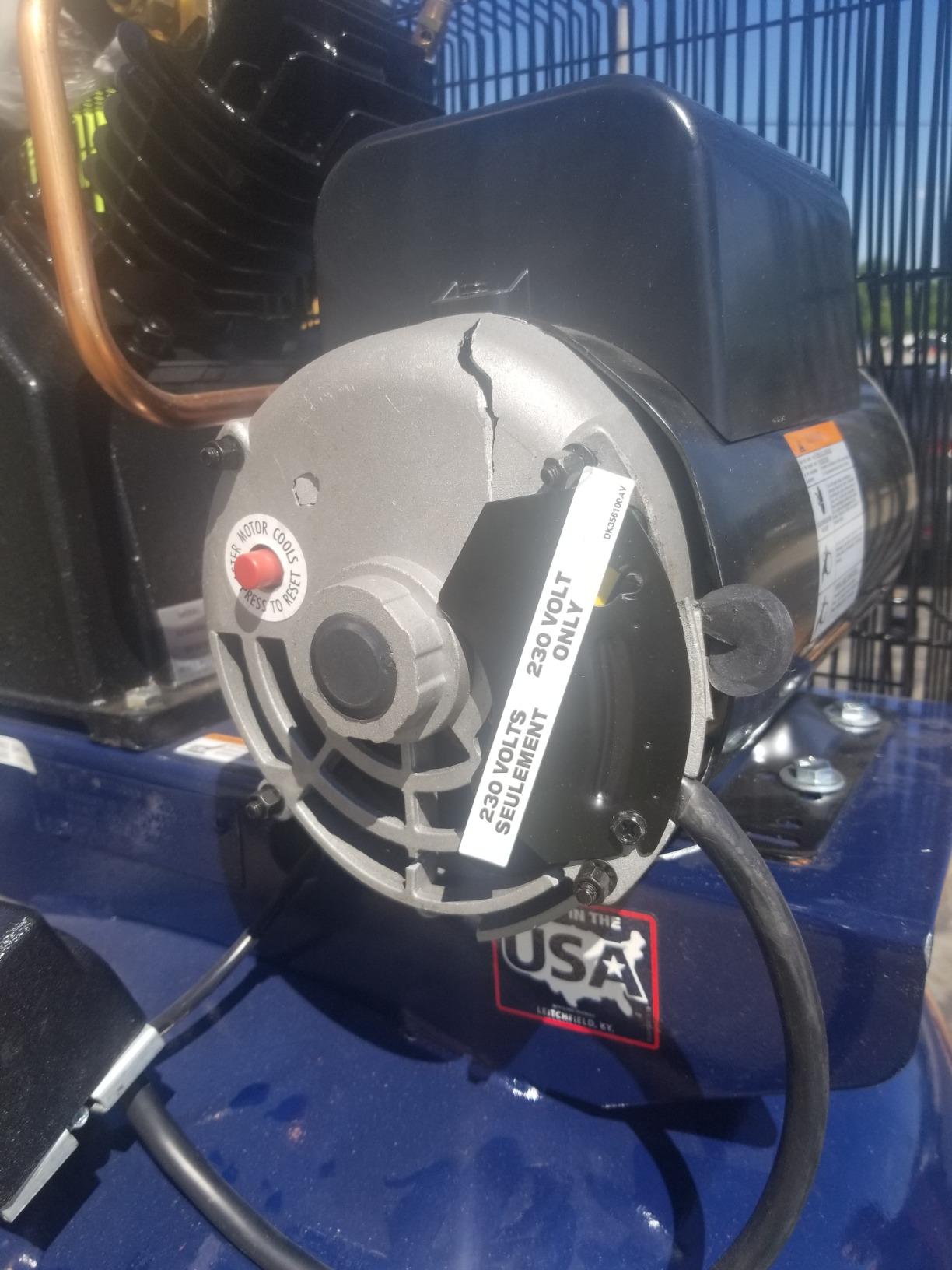
It also needs real electrical service. A 3.7 running horsepower induction motor on a 230V supply wants its own circuit, not an extension cord from a workshop outlet. Budget for a dedicated 240V line before the unit arrives, because that is where most of the money in this purchase quietly goes.
Is 7.6 SCFM enough for a home garage?
For the majority of weekend projects, yes. Random orbital sanders draw around 3 to 4 CFM, framing and finish nailers sit under 3, and impact wrenches spike briefly rather than continuously. A 60-gallon tank holds roughly 2400 cubic feet of usable air at working pressure, so short bursts are fully covered.
Where it falls short is sustained high draw. If your work centers on full-panel paint jobs, media blasting, or running a large belt sander while something else runs, you want a higher SCFM number and the XC602100 is not it. In that case look at the Ingersoll Rand or the DEWALT units in positions three and four.
What should you check before it arrives
Clear a 23 by 23 inch floor area with a concrete pad underneath, and confirm the electrical run is 230V with a proper breaker. Leave service access in front of the pump and intake filter. Check the drain valve early, because that is the one part most likely to need replacing within the first year.
2. Quincy QT-54 5 HP Splash Lubricated 60 Gallon — Best for Heavy Continuous Work
Quincy QT-54 Splash Lubricated Reciprocating Air Compressor – 5 HP, 230 Volt, 1 Phase, 60-Gallon Vertical, Model Number 2V41C60VC
5 HP 230V single phase
60 gallon vertical tank
475 lb, 29 x 21 x 70 in
1 year limited warranty
+ The Good
- Recovers pressure quickly enough for media blasting and continuous tool use
- Splash-lubricated reciprocating pump runs smooth and quiet
- Vertical tank saves floor space and has an easy-reach moisture drain valve
- Replacement parts remain available for a long-standing model
- The Bad
- 475 pound weight makes installation and repositioning difficult
- Several buyers report motor or pressure switch failure after the warranty period
- One year limited warranty is short for this weight class
The QT-54 is the most capable machine in this list and the least forgiving to move. At 475 pounds it is roughly twice the weight of most competitors, which tells you everything about the pump package inside. Long-term owners describe it as heavy duty, quiet, and dependable as long as the tank gets drained on a schedule.
Where it genuinely earns that weight is recovery. Owners running blasting cabinets and continuous pneumatic tools report that the 5 HP pump keeps up with demand in a way smaller compressors cannot, and the vertical tank arrangement preserves floor space while giving you a long reach to the drain valve at the bottom.
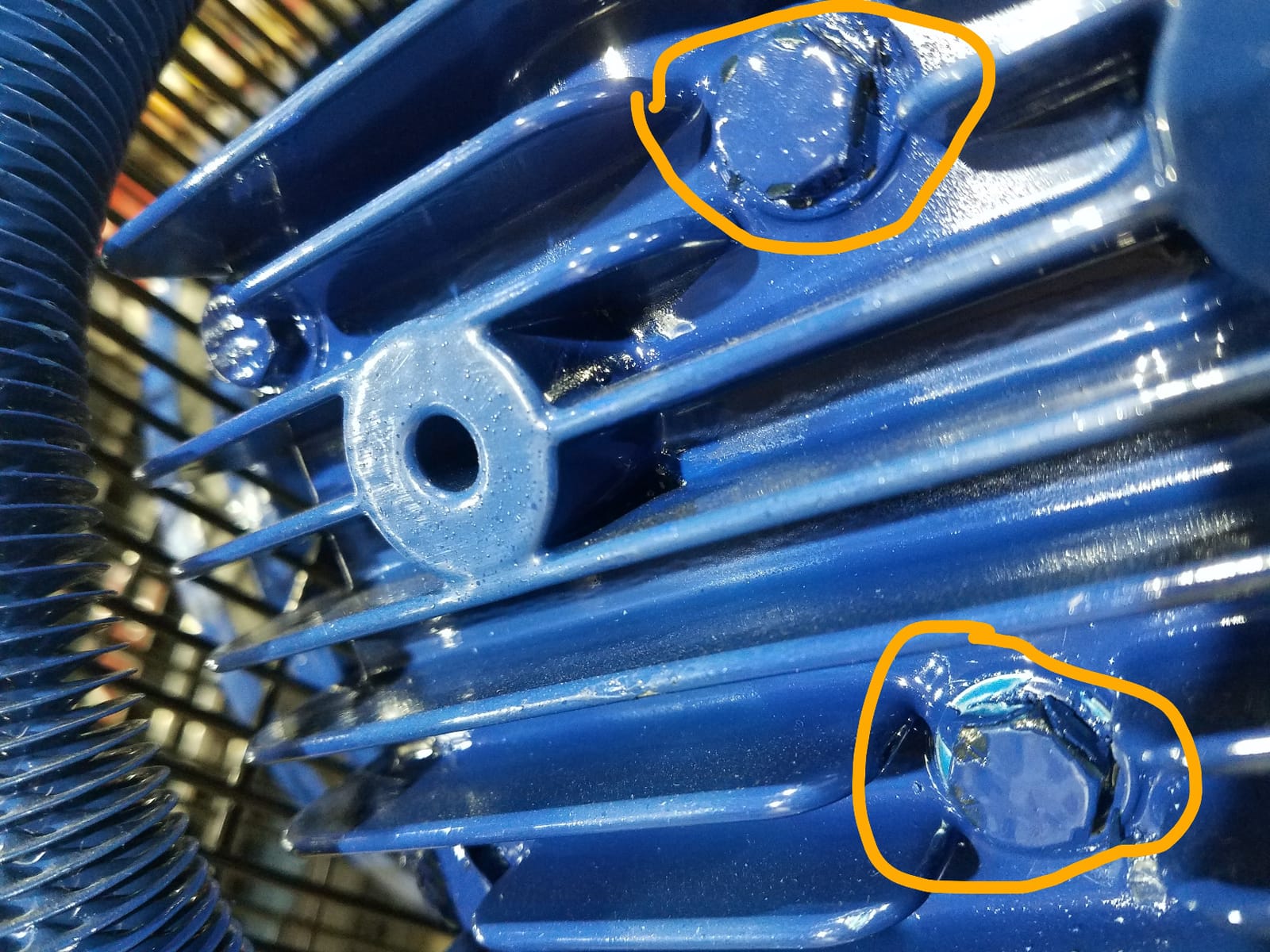
The reports worth reading closely are the failure ones. A smaller group of buyers describe the motor or the pressure switch failing at roughly eighteen months, right after the coverage ends. That pattern is common on commercial-grade pumps and it is not unusual, but it means you should treat the service manual and parts availability as a factor rather than an afterthought.
The one-year limited warranty is the shortest meaningful coverage attached to a unit this heavy. If you want a compressor you will not think about for a decade, plan to budget for replacement of the motor and pressure switch yourself rather than relying on a warranty claim.
Who is this compressor actually for
Someone with a dedicated shop bay, a real electrical service already in place, and work that draws air continuously. Media blasting, cabinet sandblasting, running multiple pneumatic tools at once, and full car restorations all sit comfortably inside what the QT-54 can sustain. A casual weekend user would be paying for capacity they never touch.
How to handle a 475 pound delivery
This is freight, not parcel, and the delivery method matters as much as the purchase. Buyers on home garage forums consistently recommend confirming liftgate service in advance, because a driver cannot roll this into a residential driveway without it. Then budget real time and a second person for the move into position, plus a set of stair-climbing or appliance dollies if the route involves a step.
3. Ingersoll Rand SS3L3 3 HP 60 Gallon — Top Rated for Continuous Duty
Ingersoll Rand SS3L3 Single Stage Air Compressor, 3 HP, 60 Gal Vertical
11.3 CFM at 90 PSI
100% continuous duty
Cast-iron 5000+ hour pump
135 psig maximum, 78 dB
+ The Good
- 4.5 stars averaged across 45 owner ratings
- 11.3 CFM at 90 PSI with 100 percent continuous duty rating
- Cast-iron pump rated for over 5000 hours of service
- Ships fully assembled and pre-wired
- The Bad
- Single-stage design caps maximum pressure at 135 psig
- Listed noise level of 78 dB is higher than several rivals
- One year manufacturer warranty
The SS3L3 is the specification outlier in the best way. Where most single-stage 60-gallon units are rated for intermittent duty, this one carries a 100 percent continuous duty rating up to 135 psig, and it delivers 11.3 CFM at 90 PSI. That combination is closer to a commercial duty rating than a garage rating, and it is why the unit holds a 4.5 star average across a meaningful block of owner feedback.
It arrives fully assembled and pre-wired, which removes the single most common installation complaint in this category. You are not tracing wiring through a terminal box on installation day. Owners highlight the cast-iron pump, the continuous delivery, and the maintenance layout together, which is what you want from a pump you expect to keep for years.
Two reservations come up repeatedly. The 135 psig ceiling is a single-stage limit, and it is lower than the 175 PSI the two-stage units reach, so if you run tools that need high working pressure you will feel that ceiling sooner. The 78 dB listed noise level is also on the louder end here, which matters in an attached garage where the compressor shares a wall with living space.
Maintenance is straightforward by design. The filter, the oil sight gauge, and the easy-fill oil port are all reachable without dismantling anything, and the All Season Select synthetic lubricant is specified for 2000-hour service intervals, which stretches out the routine work considerably.
Is a 135 PSI ceiling a real limitation for a garage
For most work, no. Impact wrenches, ratchets, nailers, sanders and blow guns all operate comfortably below 135 PSI, and the regulator can be set lower still. You notice the ceiling with plasma cutters, high-pressure spray setups, and sandblasters that want a sustained flow at maximum pressure.
Swap this unit for the Campbell Hausfeld XC602100 or the DEWALT 175 PSI model if your list of tools leans heavily in that direction. Otherwise the continuous duty rating is worth far more day to day than the extra 40 PSI you would rarely use.
What noise means in an attached garage
At 78 dB the pump is clearly audible inside the house when the door is closed, and the pump plus belt drive gives it a continuous character rather than short bursts. If your garage is attached, run the unit on anti-vibration pads, mount the intake away from the door, and consider scheduling noisy jobs for when nobody is home.
4. DEWALT 60 Gallon 175 PSI Two Stage — Best for Heavy Pneumatic Work
60 Gal. 175 PSI Two Stage Stationary Electric Air Compressor
Two-stage belt-drive 5 HP
15.3 CFM listed
175 PSI maximum
Automatic drain, 65 dB
+ The Good
- Two-stage 175 PSI output holds up with impact drivers and grinders
- Fast recovery from about 130 PSI to full in roughly a minute
- Automatic tank drain simplifies moisture removal
- Good build quality after break-in and oil adjustment
- The Bad
- Manufacturer documentation is contradictory on oil type and wiring
- One buyer reported a unit arriving with a hole in a welded seam
- Notable noise while running
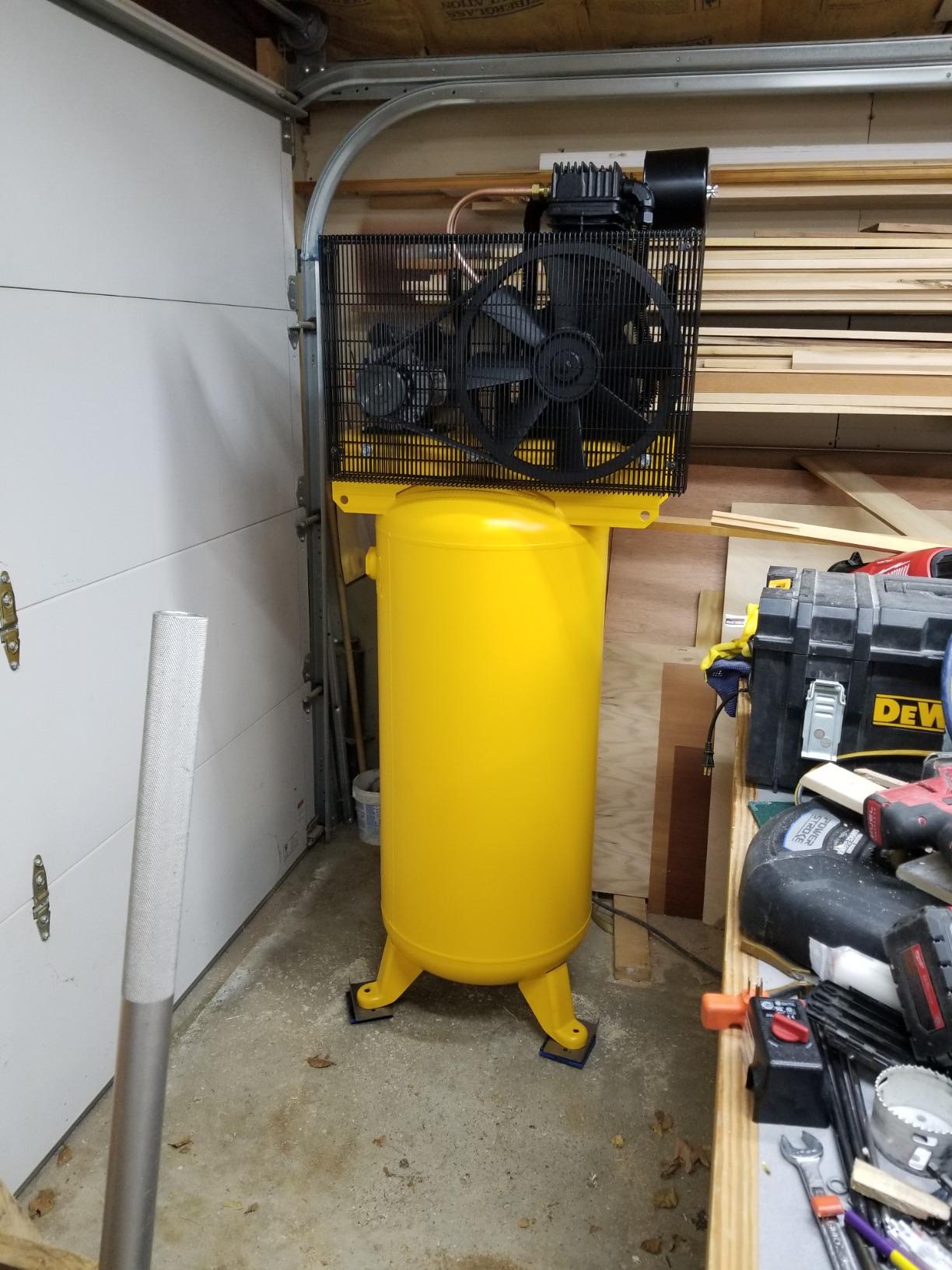
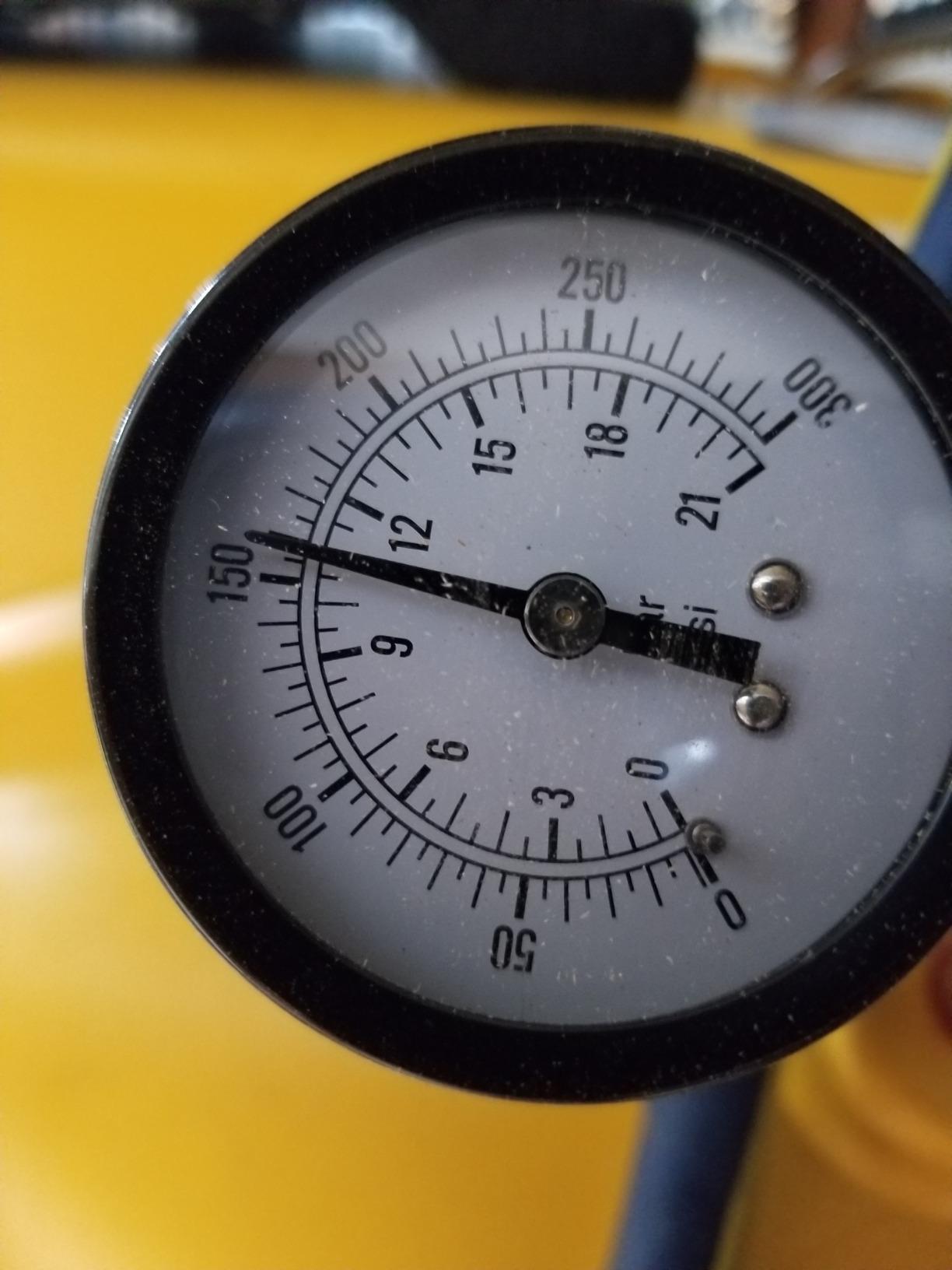
On paper this is the most capable two-stage machine in the group. The listed airflow is 15.3 CFM, pressure tops out at 175 PSI, and the two-stage belt-driven 5 HP pump recovers from 130 PSI to full in about a minute according to owners who use it hard. The automatic tank drain is a genuine convenience that most competing units at this level skip.
Users running heavy pneumatic tools report strong two-stage performance and quick recovery on a 30-amp circuit, and several note that build quality improved after break-in and an oil adjustment. If you need a plasma cutter, a cut-off tool, or a spray gun to run without hesitation, this is the unit that answers that requirement.
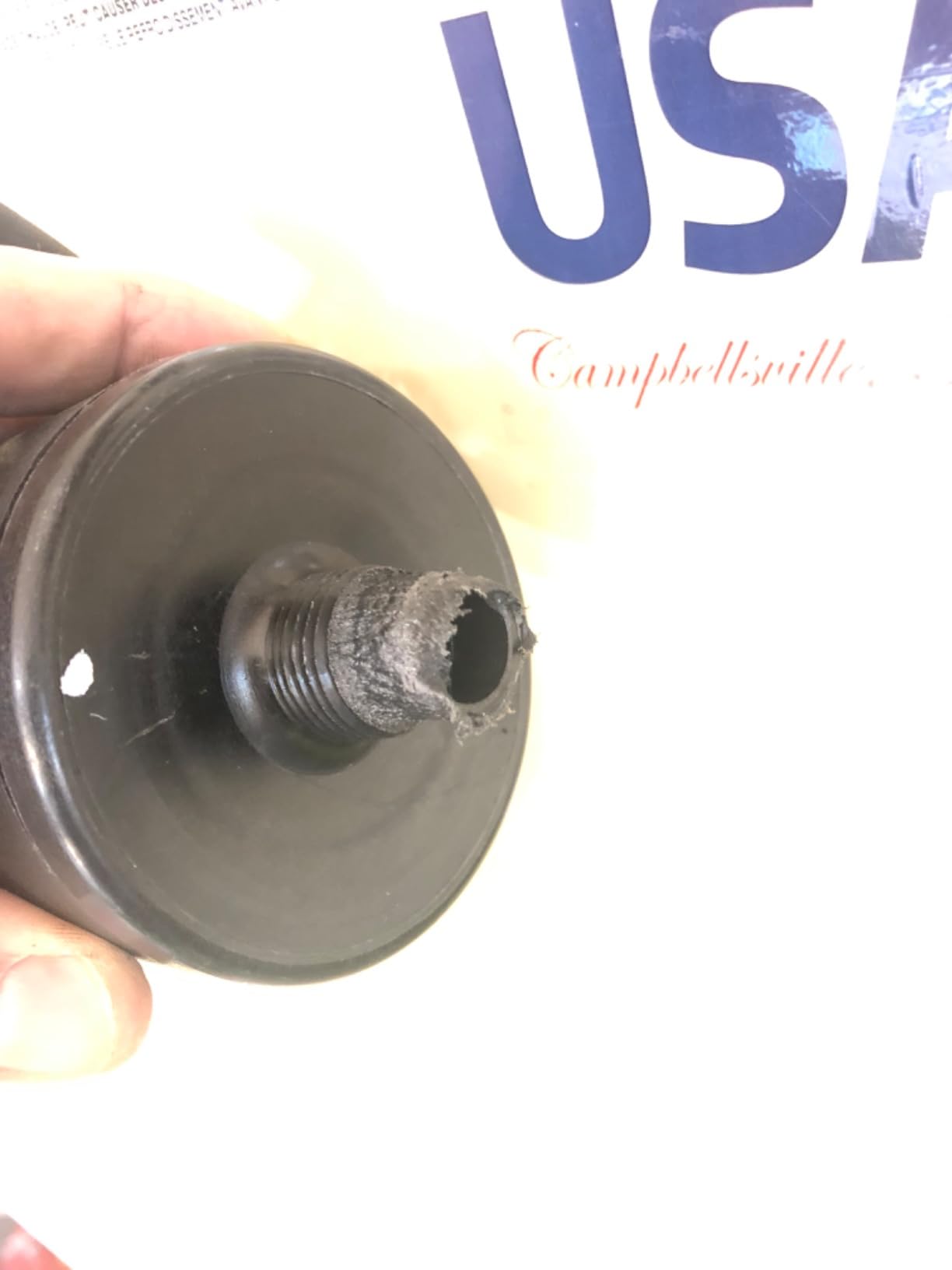
The 3.7 average rating is the story here, and an 18 percent share of one-star reviews is a meaningful slice. The complaints cluster on quality control at delivery rather than on performance: a unit arriving with a hole in a welded seam, a rusty pipe bushing, and slow resolution from support. Manufacturer documentation being contradictory on oil type, wiring, and warranty service kits adds friction to any problem you might have.
So the performance case is strong and the quality control case is weak. Treat the first 30 days as an acceptance test: run it hard, check for leaks, confirm the oil type against the plate on the pump rather than the manual, and document any damage before the clock runs down.
Is 15.3 CFM overkill for a home garage
For most people, yes, and there is nothing wrong with that. It buys headroom, so you can run a sander and a blow gun at the same time without waiting for recovery. If your work is strictly a single tool at a time on weekends, the money buys capability you will rarely draw on.
Buy it anyway if you work on vehicles professionally from a home garage, run plasma cutters, or plan to add a sandblaster later. At 40 by 31 by 80 inches it is the largest footprint here, so measure the bay before committing.
How to handle delivery damage
Inspect the tank, welds, and fittings the moment it arrives, before you sign anything. Photograph everything including the internals of the carton. Most sellers make a damaged-in-transit replacement straightforward when the damage is reported immediately, and impossible afterwards.
5. DEWALT DXCM603.COM 14.6 SCFM — Best for Bodywork and Painting
DEWALT 60 Gal. 175 PSI Stationary Electric Air Compressor. 14.6 SCFM at 90 PSI DXCM603.COM
14.6 SCFM at 90 PSI
5 HP, 175 PSI maximum
240V, 20A
2 year pump warranty
+ The Good
- Strong 14.6 SCFM airflow in a compact 60 gallon package
- Two year pump warranty exceeds most rivals
- 77 percent of ratings are five-star
- Large air outlet port with on/off switch and pressure gauge
- The Bad
- Only 21 ratings so the long-term record is still thin
- Requires a dedicated 240V circuit with 20A capacity
- 10 percent two-star share points to mixed early experiences
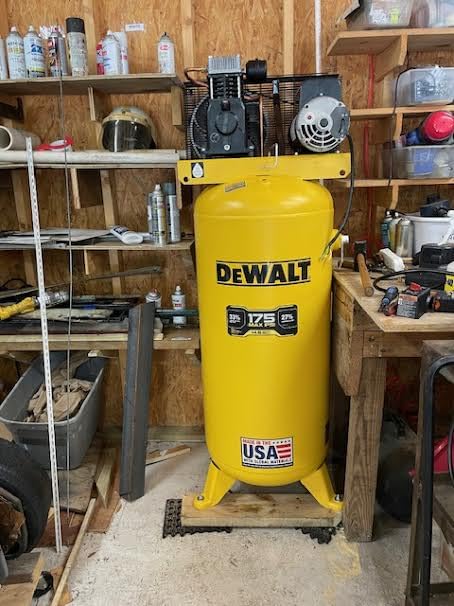
The DXCM603.COM pairs 14.6 SCFM at 90 PSI with a 175 PSI ceiling, which is the combination you want for bodywork. A HVLP spray gun wants sustained airflow, and a compressor that can deliver 14.6 CFM keeps the gun from starving halfway down a panel instead of feathering out at the edges.
It also carries a two-year pump warranty with a one-year parts warranty, the longest pump coverage in this group. At 20A on 240V it needs a serious circuit, and the large air outlet port is a small detail that pays off when you are feeding a long hose run to a booth or a blast cabinet.
The reservation is the size of the sample. Twenty-one ratings is not much of a reliability record, and 77 percent five-star with a 10 percent two-star share reads like a very good unit with a few early rough edges. The pump warranty is doing the heavy lifting on the risk side, so read its terms carefully rather than assuming the two years is comprehensive.
For a car painting setup, this is one of the more efficient packages here: high airflow, high pressure, and a warranty that covers the most expensive component. If you can run a dedicated 240V circuit, that requirement stops being a hurdle.
What CFM does a paint gun actually need
Most HVLP guns specify somewhere between 8 and 14 CFM at working pressure, and conventional guns sit lower. Match the gun’s requirement against the compressor’s CFM at 90 PSI, not at peak pressure, because that is the number measured under a real load.
A cheap way to sanity-check your setup: run the gun, then watch the tank gauge while the pump runs. If the gauge holds steady, the pump is keeping up. If it sags toward the cut-out point, you need more CFM or a bigger pump, and no amount of tank capacity will fix it.
Why the two-year pump warranty matters here
The pump is the part that fails, and it is the part you cannot economically replace. A two-year pump warranty on a machine with a thin review history effectively substitutes coverage for missing long-term data.
Confirm in writing what the pump warranty excludes, whether labor is covered, and where you ship the unit for service. Brands handle pump claims differently, and freight costs on a 60-gallon unit are the part that surprises people.
6. PORTER-CABLE 3.7 HP 60 Gallon Oil-Lube — Best for General Shop Use
PORTER-CABLE – Porter-Cable PXCMLC3706056 3.7 HP 60 Gallon Oil-Lube Vertical Stationary Air Compressor
11.5 CFM at 90 PSI
3.7 running horsepower
Oil-lubricated, 230V
247 pounds, gauge and switch
+ The Good
- Good airflow for a 3.7 HP oil-lubricated pump
- Factory-supplied synthetic oil supports longer service intervals
- Integrated pressure gauge and on/off switch simplify setup
- Backed by a toll-free customer help line
- The Bad
- Maximum pressure listed at only 90 PSI
- Very small review base of 11 ratings
- 13 percent of ratings are one-star with little detail
For framing, finish carpentry, general repair, and a mixed bag of shop tools, the PORTER-CABLE PXCMLC3706056 does the job at 247 pounds. The 11.5 CFM at 90 PSI output is respectable, and the oil-lubricated pump arrives filled with synthetic oil, which is a good starting point for long service intervals.
The build is sensible. A pressure gauge and an on/off switch are integrated rather than separate purchases, the motor is a 3.7 running horsepower unit on 230V, and there is a toll-free support line behind it. Nothing about this machine is exotic; it is a straightforward shop compressor.
What does the 90 PSI maximum really mean
The published maximum pressure of 90 PSI is unusually low and is the specification most likely to disqualify this model for your purposes. It is fine for nailers, sanders, blow guns, and light inflating, because those tools run far below 90 PSI anyway.
It is not fine for anything that needs working pressure above 90 PSI: impact wrenches lose the ability to break bolts free, spray guns cannot build atomization pressure, and plasma cutters will not function. If that is your work, step up to a 135 or 175 PSI unit.
Is a review base of 11 ratings enough to trust
It is enough to tell you nothing is obviously broken, and not enough to tell you anything lasts. With 74 percent five-star ratings and a 13 percent one-star share, the distribution looks healthy on a small sample.
We would not choose this unit over a comparably priced model with a hundred ratings unless something specific pulled us here, such as the included oil and the integrated controls. Check the warranty terms directly, because the review history is not going to protect you.
7. Quincy Q13160VQ 3.5 HP Single Stage — Best for Small Shops
Quincy Single-Stage Air Compressor – 3.5 HP, 220 Volt, 60-Gallon Vertical Tank, Model Number Q13160VQ
12.4 CFM at 100 PSI
3.5 HP, 145 PSI maximum
230V single phase
68 dB, 261 lb
+ The Good
- Highest average rating among the well-reviewed units here
- Reported to run quiet and smooth from the first few hours
- Easy setup when replacing an existing unit
- 12.4 CFM at 100 PSI is strong for a 3.5 HP single-stage pump
- The Bad
- Only 10 ratings
- One owner reported a pressure switch failure at about one year
- One year limited warranty
The Q13160VQ is an unusual amount of capability for 3.5 horsepower. It delivers 12.4 CFM at 100 PSI, which is genuinely strong for a single-stage pump, and reaches a 145 PSI maximum. Owners describe it as quiet and smooth from the first few hours of running, at a listed 68 dB, with a special fin design on the cylinder head helping with heat rejection.
It is also the easiest of the large units to place. At 261 pounds with a 1/2-inch air outlet, it is lighter than the commercial models and smaller than the DEWALT 175 PSI unit, which matters when you are replacing an existing compressor in a space that was already fitted out for one.
Is single-stage good enough for a small shop
For a small shop running one tool at a time with intermittent bursts, yes. Single-stage pumps hit 145 PSI fine and cost less to own because there is no second stage to wear. Tools that draw air for short periods, which is most nailers, sanders, and ratchets, work well within that envelope.
The pump runs at 1250 RPM, which is on the higher side. That helps move air but works the bearings harder than a low-RPM pump over a decade of service, which is a fair trade if you will replace the unit sooner and an expensive one if you plan to keep it twenty years.
What does a one-year warranty mean for you
It covers defects in the first year and very little after, so treat the first twelve months as the window where problems are someone else’s problem. Confirm the pressure switch and the unloader at the start, since those are the components owners most often report failing around the one-year mark.
Beyond that, budget for the switch yourself. It is a cheap part, the fix is straightforward, and knowing the cost in advance takes the sting out of it.
8. Campbell Hausfeld VT6395 60 Gallon Vertical — Best Value
Campbell Hausfeld 60 Gallon Vertical Air Compressor (VT6395)
10.2 CFM at 90 PSI
135 PSI maximum
230V, 255 pounds
Oil-lubricated cast-iron pump
+ The Good
- Only three ratings posted and all are five-star
- Cast-iron two-cylinder oil-lubricated pump built for long service
- 60 gallon ASME certified vertical tank
- Large tank replaces a small portable unit for shop demand
- The Bad
- Review base of 3 ratings is the thinnest here
- 135 PSI maximum is modest against 175 PSI rivals
- Owners had to add heavier wire and a 240V 20A outlet
The VT6395 is the cheapest way onto this list and the one that surprises people. You get a 60-gallon ASME certified vertical tank and an oil-lubricated cast-iron two-cylinder pump, which is the hardware combination we look for first. At 255 pounds it is built like the units costing considerably more.
Its 10.2 CFM at 90 PSI output is adequate for sanders, nailers, blow guns, and inflating, and the 135 PSI ceiling suits intermittent work rather than sustained spraying. The built-in gauge is a small convenience that saves a trip to the hardware store.
Should you trust a perfect 5.0 rating from three reviews
No, not on its own. A perfect rating from three owners tells you nobody has had a bad experience yet, which is genuinely useful information, but it is not a reliability record. Our research flagged this pattern explicitly: a small sample with uniformly positive feedback is a promise, not a track record.
What tips us positive here is the hardware rather than the reviews. Cast iron, oil lubrication, an ASME tank, and a two-cylinder pump are the components that decide service life, and this unit has all of them. Judge it on the specification, and let the rating be a weak supporting signal.
What electrical work does this need
Every owner who posted a review had to add heavier wire and a 240V 20A outlet before running it. That is the standard requirement for a 3.7 HP unit on 230V, and it is the hidden cost in any compressor purchase at this level.
Have the circuit installed before the unit arrives, not after. If the panel has no spare breaker slot, a subpanel is usually the answer, and that is electrician territory rather than a weekend project.
9. DEWALT DXCM601.COM 3.7 HP 155 PSI — Best for Light Duty Nailing
DEWALT 60 Gallon Vertical Air Compressor, 3.7 HP, 155 Max PSI, Heavy Duty Stationary Air Compressor – Ideal for various uses, Reliable Air Compressors for Workshop and Garage Applications.
11.5 SCFM at 90 PSI
155 PSI maximum
230V, 17.2A
83 dB listed, 239 lb
+ The Good
- Space-saving vertical 60 gallon format
- 11.5 SCFM at 90 PSI is adequate for framing and finishing
- Two year limited manufacturer warranty
- Double-cylinder oil-lubricated pump
- The Bad
- Multiple owners report motor smoking and failure from days to three years
- Lowest average rating in this group at 3.2 stars
- Highest listed noise figure at 83 dB
I want to be straightforward about this one: the DXCM601.COM has the weakest owner feedback of any unit here. Every detailed review describes a motor problem, ranging from clanking and smoke to complete shutdown, and the timing ranges from two days to three years of light use. Several buyers note they replaced long-lasting older compressors with this unit and regretted the swap.
The specification on paper is unremarkable rather than bad. Eleven and a half SCFM at 90 PSI, a 155 PSI ceiling, a double-cylinder oil-lubricated pump, a two-year limited warranty, and a 239 pound vertical footprint. It covers framing, finishing, and general shop work adequately on paper.
What the motor complaints actually mean
A pattern like this usually points to a component supply or design issue rather than random failure, and owners describe the problem as known and unaddressed. With 45 percent of ratings at one star, the odds of a trouble-free unit are not good, and the warranty will likely require shipping a 239 pound machine to a service center.
The listed 83 dB noise level is the highest in this group as well, and several owners advise against leaving the unit in auto mode. If noise and a two-year parts warranty are your main criteria, there are better options in this list for the same money.
Is there any reason to pick this one
If your work is framing and finish nailing, and you need a vertical 60-gallon tank at this weight and price point, the hardware fits the job. Nothing about the specification demands a different unit.
The 3.2 average rating is the deciding factor for us. We would choose almost any other unit here, including the best value pick with three reviews, over one whose every detailed review describes the same failure mode.
10. EMAX Silent Air 5 HP 19 CFM — Quietest Pick
EMAX 60 Gal Silent Air Industrial Air Compressor, 5 HP, 19 CFM at 150 PSI
19 CFM at 90 PSI
150 PSI maximum, 5 HP single stage
35 dB listed
Silent Air baffle and filter system
+ The Good
- Highest airflow figure in this group at 19 CFM at 90 PSI
- Noticeably quieter running reported by owners in occupied spaces
- All-cast-iron pump with solid steel rods and removable disc valves
- Built and tested in Ohio
- The Bad
- Most expensive unit in this comparison
- Only 3 ratings
- Single-stage design caps pressure at 150 PSI
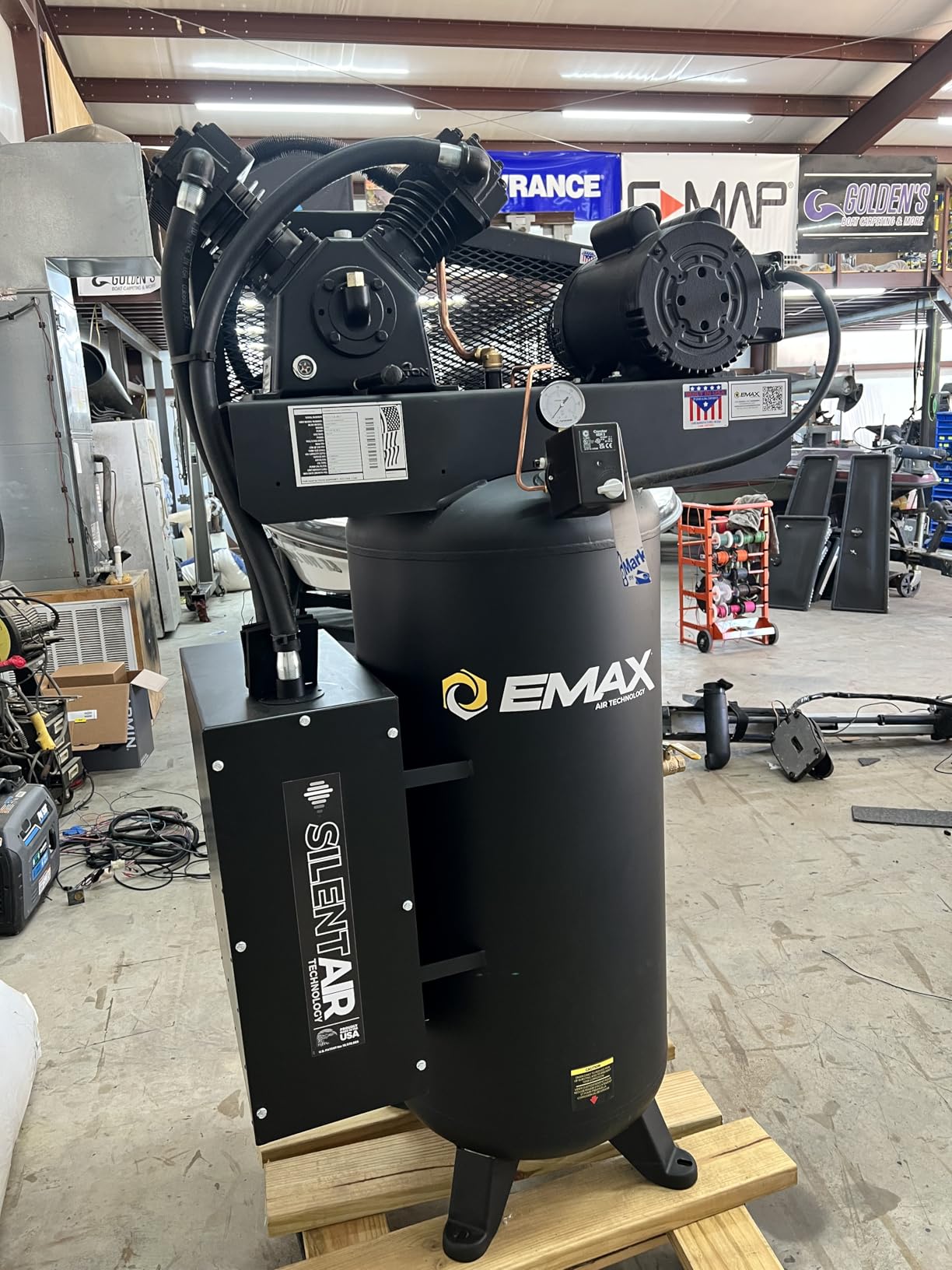
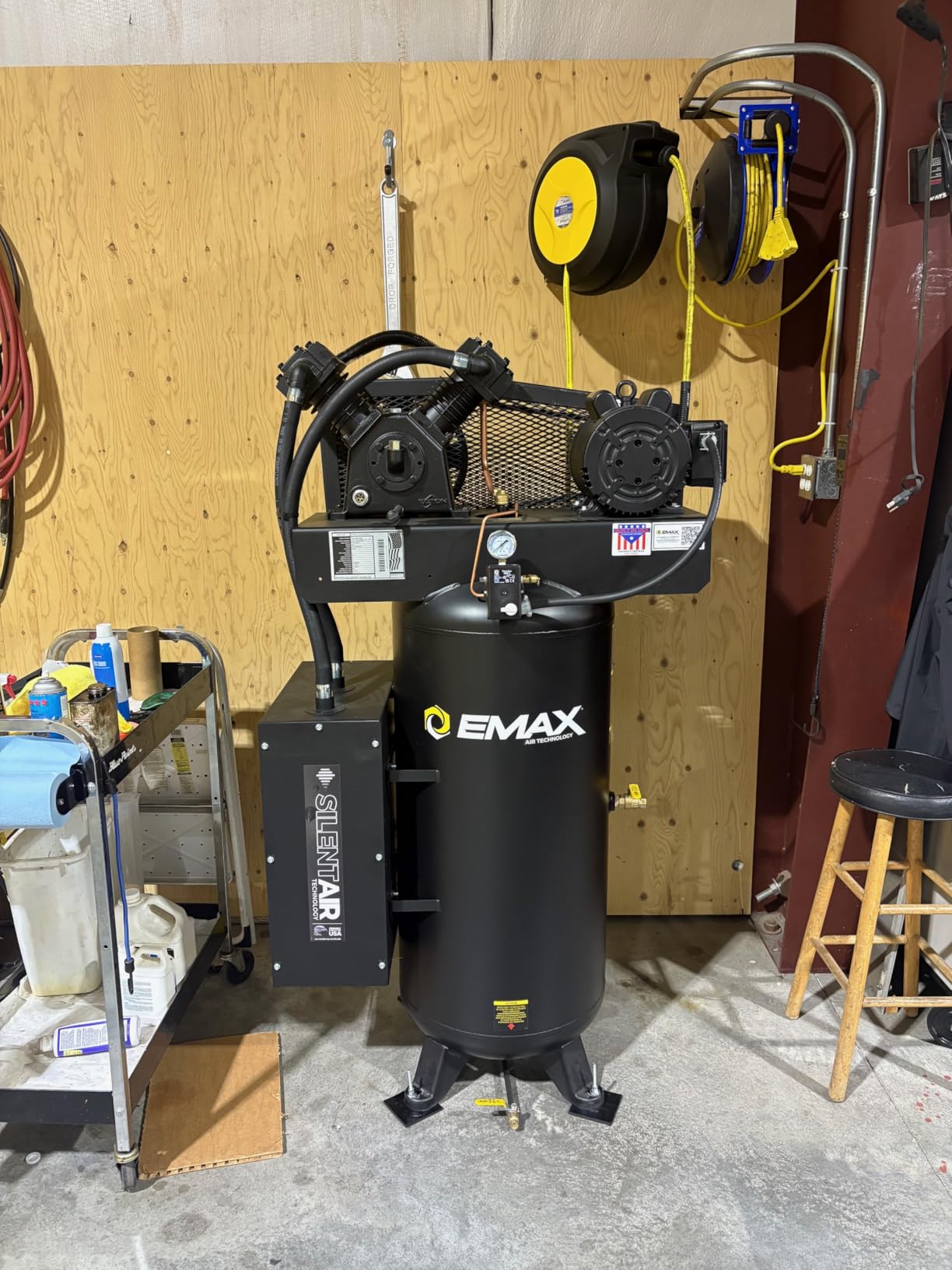
The EMAX is the answer if noise is the constraint. It uses a patented Silent Air system that routes intake air through baffle plates and filtration layers, cutting noise by up to 50 percent, and it carries the lowest listed noise figure in this group at 35 dB. Owners with large hangars and occupied shops specifically credit the system for making the unit workable in a space where a normal compressor would be unusable.
The performance is not a tradeoff. At 19 CFM at 90 PSI and a 150 PSI maximum, it has the highest airflow in the group by a wide margin, and the hardware is industrial: an all-cast-iron splash-lubricated pump, solid steel pump rods, and removable disc valves that a technician can service rather than replace.
Two things temper the recommendation. It is the most expensive unit we compared by a wide margin, and three ratings is a small sample. It is also single-stage, so the 150 PSI ceiling limits it for plasma cutting and very high pressure work even though the airflow is exceptional.
The 1740 RPM ODP motor, Condor pressure switch, OSHA-rated belt guard, and isolator pads are all details you normally only see on commercial equipment. Built and tested in Ohio, this is a compressor that can sit next to a workspace without dominating it.
How much does noise actually matter in a garage
More than most buyers expect. A compressor at 78 to 83 dB is loud enough to make conversation difficult inside the garage, and in an attached space that noise carries into the house. Low-RPM pumps, oil-lubricated designs, and intake filtration all reduce it, and the EMAX takes the most aggressive approach of anything here.
If your garage is detached and you work with ear protection, a conventional 65 to 70 dB unit is fine. If the compressor shares a wall with a bedroom or a workspace, the quiet option is worth the premium on its own.
Is the airflow worth the cost
For heavy pneumatic work, yes, without much argument. Nineteen CFM at 90 PSI means you can run a spray gun, a blast cabinet, and a sander without the tank gauge moving.
For occasional use, no. The same performance is available from conventional single-stage units for a fraction of the cost, and the money you save goes into the electrical installation. Buy the quiet machine for quiet, or for the airflow, not for the 60-gallon tank size, which is the least interesting number on the spec sheet.
How to Choose a 60 Gallon Air Compressor: 7 Specs That Decide the Fit
Start here and the rest of the decision gets much easier. Seven numbers and terms explain nearly every difference between the units above, and you can evaluate any compressor you find in about two minutes once you know what to look for.
1. CFM at 90 PSI
This is the number that decides whether your tools work. CFM is the volume of air a pump delivers at a given pressure, and 90 PSI is the industry standard measurement point because most air tools are specified there. Match it against the CFM your tool needs, and prefer more rather than less.
For reference, a random orbital sander runs around 3 to 4 CFM, a framing nailer under 3, a die grinder around 4 to 5, a cut-off tool around 5 to 7, and an HVLP spray gun anywhere from 8 to 14. Sandblasters are the outlier, needing 10 to 20 CFM continuously, which is why blasting pushes people toward larger machines. Our rotary screw compressor guide covers that step up.
2. Tank size, and what it actually does
The 60-gallon tank is a buffer, not an engine. A 60-gallon receiver holds roughly 2400 cubic feet of air at working pressure, which covers impact wrenches, blow guns, and tire inflation easily because those tools draw in short bursts. It does nothing for a sander that pulls air continuously for ten minutes straight.
If your work is mostly burst tools, 60 gallons is generous. If your work is sustained draw, you will want more CFM rather than a bigger tank, and going to 80 gallons is a compromise that adds air reserve without adding pump output. Our 80 gallon picks cover that option.
3. Single-stage versus two-stage
A single-stage pump compresses air in one step and typically tops out between 130 and 155 PSI. A two-stage pump compresses in two steps, reaching 175 PSI more efficiently and running cooler, which extends pump life. In this list only the Campbell Hausfeld XC602100 and the DEWALT 175 PSI model are two-stage.
Two-stage costs more and suits sustained work, high pressure, and heat-sensitive use. Single-stage is the right answer for a garage running nailers and sanders a few hours a week, and it is the majority of what is sold at this size.
4. Real horsepower versus peak horsepower
Marketing horsepower is measured in bursts at start-up and is meaningless for steady state. Running horsepower, the figure we use in this guide, is the number that matters. A 5 HP running motor is a serious machine. A 5 peak HP motor is closer to a 3 HP running motor once the startup spike passes.
Rule of thumb for a 60-gallon unit: 3.5 running HP handles intermittent shop work, 3.7 covers a general garage, and 5 HP is where continuous heavy pneumatic work begins.
5. Duty cycle
Duty cycle is the percentage of time the compressor is designed to run. Standard compressors are typically rated for 10 to 50 percent duty, and 100 percent continuous duty is rare. The Ingersoll Rand SS3L3 is the exception in this group with a full continuous rating, and that is the single strongest reason to consider it for blasting or long paint sessions.
6. Noise and pump speed
Noise matters most in attached garages, and the listed figures here span 35 dB to 83 dB. Lower RPM pumps are quieter and place less stress on bearings, so a pump running under 1300 RPM is a good sign. Oil-lubricated pumps are quieter than oil-free ones, and the quietest options use intake baffling and filtration.
7. Electrical requirements and warranty
Every unit in this comparison needs 230 or 240V, which means a dedicated circuit, and several need 20A or 30A capacity. Confirm the breaker size and whether your panel has a spare slot before you commit to a model, because this is the most common reason a purchase gets delayed.
On warranty, the pump is the part worth covering. Warranty lengths here range from one year to three years, with one unit offering a two-year pump warranty and the rest covering one year. A longer pump warranty is the closest substitute for a long-term reliability record, and it matters most when review counts are low.
Getting a 60 Gallon Compressor Running and Keeping It There
Delivery and installation are where most of the unexpected effort lives. A 60-gallon compressor weighs between 239 and 475 pounds, arrives by freight rather than parcel, and needs a 240V circuit to be useful. Plan those two things before the unit is ordered.
Get the electrical service in first
Check the nameplate amperage and match it to a dedicated two-pole breaker, typically 20A for 3.7 HP units and 30A for 5 HP units. If your panel has no room, a subpanel is the usual answer. Electrician work is the single largest hidden cost in a compressor purchase, and it is the one item where cutting corners creates real risk.
Plan the move and the floor
Most units in this list are 240 to 261 pounds, with the Quincy QT-54 at 475. Ask in advance about liftgate service, and have a second person plus an appliance dolly ready on delivery day. Set the tank on a level surface, ideally a poured pad, and leave clearance around the pump and intake.
Upgrade the drain before you need it
Owners on garage forums almost universally recommend replacing the factory petcock with a ball valve drain. It is a small part, it takes minutes to fit, and it is the difference between a five-second drain and an annoying one. Draining after every use prevents condensate from sitting in the tank, which is the fastest way to rust out a tank from the inside.
A maintenance routine that takes ten minutes a month
Drain the tank weekly if you use it weekly, and always after painting or blasting work where moisture is heavy. Check the oil level monthly on oil-lubricated models, and follow the specified oil rather than what is already in the pump. Inspect the intake filter element periodically and clean or replace it. Watch the belt for cracking and check its tension. Test the pressure relief valve annually by pulling its ring. Keep the electrical connections tight and check the pressure switch cut-in and cut-out settings while you are there.
That routine is the entire difference between a compressor that lasts a few seasons and one that stays in service for a decade or more. None of it is complicated, and all of it gets skipped.
Frequently Asked Questions
Is a 60 gallon air compressor big enough to paint a car?
Yes, a 60-gallon compressor is enough to paint a car, provided you check its CFM at 90 PSI rather than its tank size. Most HVLP spray guns need between 8 and 14 CFM, so a unit delivering 11 CFM or more at 90 PSI will keep the gun fed through a full panel. Tank size only affects burst tools like impact wrenches and tire inflation.
Who makes the quietest 60 gallon air compressor?
Among the units we compared, the EMAX Silent Air 5 HP leads at a listed 35 dB, using baffle plates and intake filtration to cut noise by up to 50 percent. If that is more machine than you need, the Campbell Hausfeld XC602100 and the DEWALT 175 PSI two-stage model are both listed at 65 dB and run noticeably quieter than typical single-stage units at 78 to 83 dB.
What is the best 60 gallon air compressor for the money?
The Campbell Hausfeld VT6395 is the lowest-cost route into a 60-gallon vertical tank with an oil-lubricated cast-iron two-cylinder pump, and it carries a 5.0 rating from its three posted reviews. For proven owner feedback rather than the lowest entry cost, the Campbell Hausfeld XC602100 is stronger, with 130 reviews and a two-stage 175 PSI design.
Do I need 240V for a 60 gallon air compressor?
Yes. Every 60-gallon compressor in this comparison runs on 230 or 240V and needs a dedicated two-pole circuit, typically 20A for 3.7 HP models and 30A for 5 HP models. Running one from a standard 120V outlet is not a realistic option at this capacity, so plan for the electrical work before the unit arrives.
Which brand of air compressor is considered the most reliable?
The brands built around cast-iron pumps and splash lubrication tend to be the most reliable, and that includes Quincy, Ingersoll Rand, Campbell Hausfeld and EMAX. Owners most often praise cast-iron construction, low pump RPM, and available replacement parts over brand name alone, since the pump package determines service life far more than the badge on the tank.
What is the difference between a single stage and two stage 60 gallon compressor?
A single-stage pump compresses air in one step and typically maxes out between 130 and 155 PSI. A two-stage pump compresses in two steps, reaching 175 PSI more efficiently and running cooler, which extends pump life and suits sustained work such as painting, blasting and high-pressure tools. Two-stage units cost more, so they make sense when your work demands continuous air draw.
What are the most common problems with 60 gallon air compressors?
The recurring complaints are motor or pressure switch failure after the warranty period, water accumulation and internal tank rust from an under-drained tank, and quality control problems found at delivery such as damaged welds or missing oil. Replacing the factory petcock with a ball valve drain and draining after every use prevents the most common one.
The Best 60 Gallon Air Compressor for Your Garage
After working through ten units, the Campbell Hausfeld XC602100 is the best 60 gallon air compressor for a home garage, and the reasoning is straightforward. It is the only two-stage, 175 PSI, cast-iron pump in this group backed by 130 owner reviews, it fits a 23 by 23 inch footprint, and at 65 dB it will not dominate an attached space.
Different work deserves different machines. The Ingersoll Rand SS3L3 is the pick when you need the most sustained airflow and a full continuous duty rating. The DEWALT DXCM603.COM handles bodywork and paint jobs thanks to 14.6 SCFM at 90 PSI and a two-year pump warranty. The EMAX Silent Air is the only sensible answer if noise is the constraint. The Campbell Hausfeld VT6395 is the value route, with the caveat that three reviews prove very little. And the DEWALT DXCM601.COM is the one to skip, given motor complaints across every detailed review.
Before you order anything in 2026, confirm the electrical service. Every unit here needs a dedicated 240V circuit, and getting that done first turns a delayed installation into a scheduled one. Our pancake compressor guide covers the smaller format if you also want a portable unit for trim work and tire inflation alongside the big one.