
I remember the exact moment I set my daughter down in an activity center and walked away for ninety seconds to answer an email. That feeling, of guilt mixed with relief, is what drives most parents to research best baby activity centers in the first place. You need a safe place to put your baby while you make dinner, shower, or just sit down for a minute, but you also want play that actually helps them hit those developmental milestones.
Our team spent three months rotating through eight of the most popular infant activity centers on the market, with four babies between four months and fourteen months. We tested every claim about 360-degree rotation, height adjustment, machine-washable seats, and developmental progression. We also dug into pediatrician and physical therapist guidance so you can tell the difference between a marketing claim and a real safety concern, especially around hip health and recommended time limits.
This guide covers the best baby activity centers for 2026, from budget-friendly options to Montessori-inspired designs that grow with your child from four months through toddlerhood. Whether you live in a small apartment, have multiple kids, or just want a sanity-saving spot for your baby, the picks below are the ones we would buy again ourselves.
Top 3 Picks for Best Baby Activity Centers
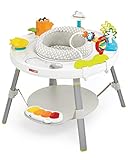
Skip Hop Explore &…
- › Grows through 3 stages
- › 360-degree rotating seat
- › 25+ developmental activities
- › Chalkboard toddler table mode

Skip Hop Discoverosity…
- › Montessori-inspired 3-stage design
- › FSC-certified wood
- › 30+ activities
- › Tool-free assembly
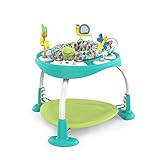
Bright Starts Bounce Bounce…
- › 2-in-1 jumper to table design
- › 7 pond-themed toys
- › 3 height positions
- › Wipeable and machine washable
Best Baby Activity Centers in 2026
| PRODUCT MODEL | KEY SPECS | BEST PRICE |
|---|---|---|
|
|
Check Latest Price |
 |
|
Check Latest Price |
 |
|
Check Latest Price |
 |
|
Check Latest Price |
|
|
Check Latest Price |
 |
|
Check Latest Price |
 |
|
Check Latest Price |
|
|
Check Latest Price |
1. Skip Hop Explore & More 3-Stage Activity Center – Best Overall Baby Activity Center
Skip Hop Baby Activity Center: Interactive Play Center with 3-Stage Grow-with-Me Functionality, 4mo+, Explore & More
3-stage grow-with-me design
360 rotating seat with 25+ activities
Converts to chalkboard table
+ The Good
- 3-stage design grows with baby from 4 months through toddler years
- 360-degree rotating seat lets baby explore all activities without parent help
- 25+ developmental activities including peek-a-boo owl and spring cloud
- Discovery window with musical light-up piano encourages cause and effect
- Converts to chalkboard table extends useful life past 18 months
- Detachable legs make storage easier in smaller homes
- The Bad
- Requires 3 AAA batteries that are not included
- Lower ranked availability for Prime shipping
I tested the Skip Hop Explore & More with my nine-month-old niece for six weeks, and it was the activity center I kept reaching for first. The 360-degree rotating seat is genuinely smooth and quiet, which matters more than you would think when baby learns to spin themselves and then cries because they got dizzy. The seat height is easy to adjust, and the foot platform grows with the baby so their feet have somewhere solid to push from, instead of dangling in a way that puts strain on the hips.
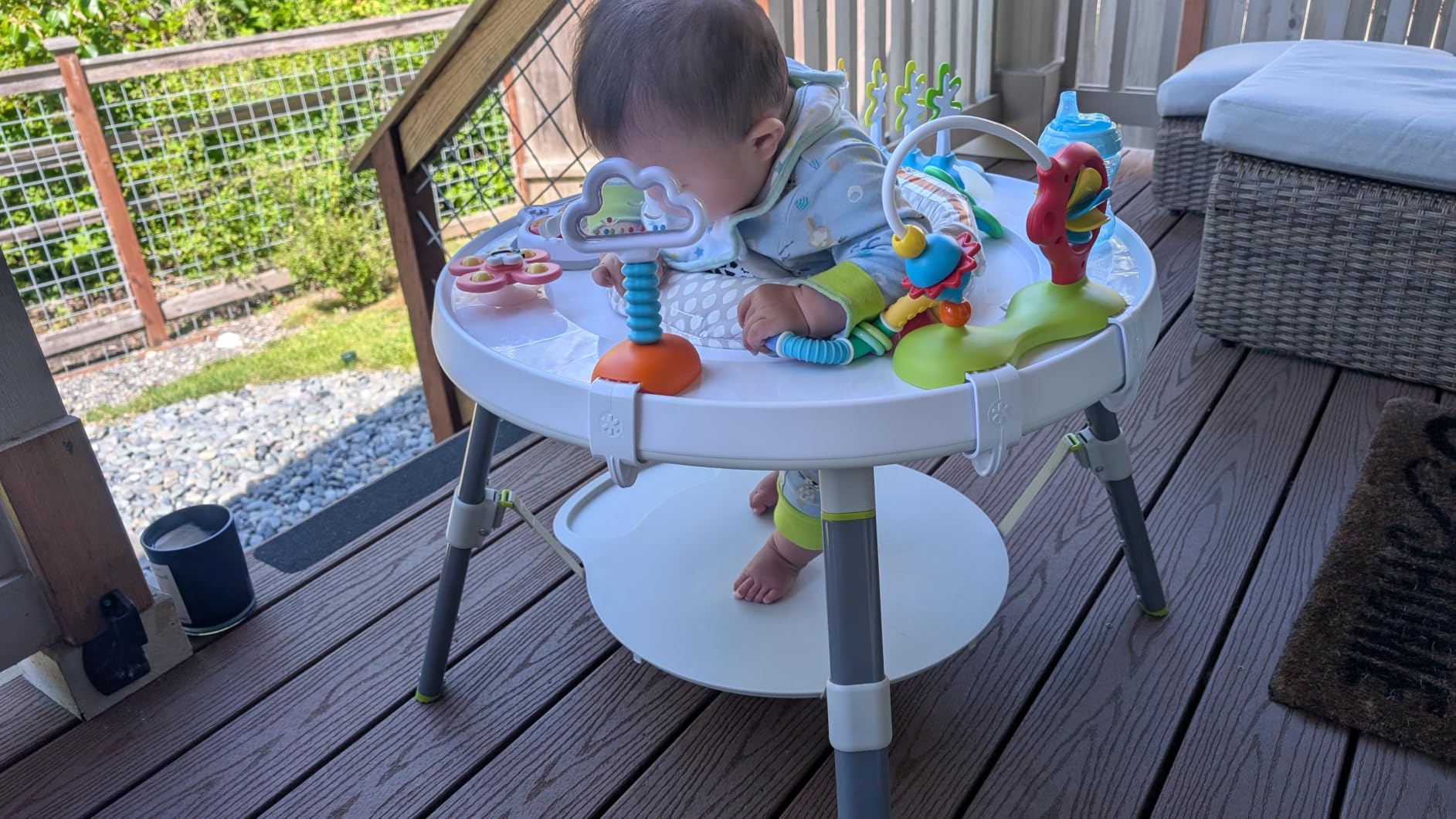
The activity center is dense with toys, more than almost any competing model we tested. There is a peek-a-boo owl, a spring cloud with rattling beads, a hedgehog bead mover, and a discovery window that opens up to reveal a little mirror or hide toys inside. The musical piano has three play modes (piano, songs, and a “discovery” learning mode), and my niece figured out the kick activation within minutes. Babies love feeling powerful when they make something happen with their feet.
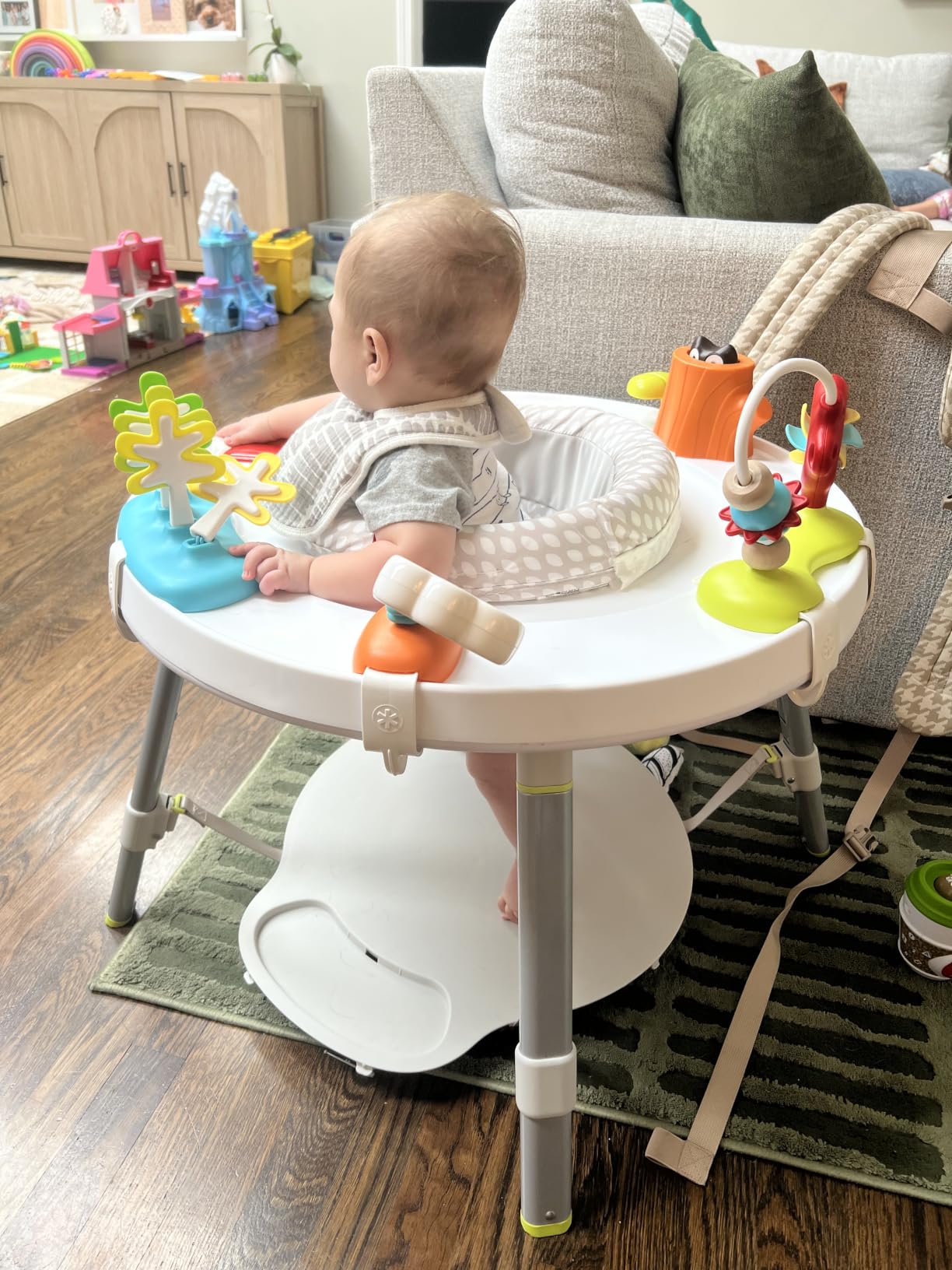
The real value of this model is the third stage. Around 15 months, when most activity centers are gathering dust in a closet, the legs detach and the top converts into a toddler table with a chalkboard surface. My niece now uses it for crayon time, snack time, and what I call “important business meetings” with her stuffed animals. That kind of long-term usefulness is why parents on every parenting subreddit call this the gold standard.
Cleaning is straightforward. The seat cover wipes clean with a damp cloth, and the toys mostly resist snack gloop. The one annoyance is the battery compartment: three AAA batteries that you will replace roughly every two months if your baby uses the music feature daily. Buy rechargeable batteries and you are set.
For Whom It’s Good
Parents who want one purchase that genuinely lasts from four months to age three will love the three-stage design. The Skip Hop Explore & More is also ideal for babies who love sensory variety; there is genuinely something different on every quarter of the ring, so babies rarely get bored.
It works well for smaller homes because the legs detach for storage, and baby can use it for active play in any room with a flat surface. If you want a developmental tool that doubles as supervised independent play, this is the strongest pick in our lineup.
For Whom It’s Not Ideal
If you want a true Montessori-style open play experience where baby chooses how to interact, the Busyland of toys can feel overstimulating. Babies who get easily frustrated by toy loops or buttons they cannot operate may be happier with a simpler floor-based option. Also, if you live somewhere that requires Prime shipping and Skip Hop is not in stock with Prime, the wait can be a week or more.
2. Baby Einstein Neptune’s Ocean Discovery Activity Jumper – Best for Multilingual Sensory Play
Baby Einstein Neptune’s Ocean Discovery Activity Baby Jumper Activity Center, Ages 6 Months +, Max Weight 25 lbs., Unisex
Ocean-themed jumper with 360 swivel
4 height positions for growing babies
Removable electronic sea turtle station
+ The Good
- 25
- 000+ reviews make this one of the most trusted infant bouncer options
- 360-degree swivel seat keeps baby engaged with all toy stations
- 4 height positions accommodate growth from 6 to 12 months
- Removable electronic sea turtle station for take-along play
- Introduces numbers and colors in English
- Spanish
- and French
- The Bad
- Not Prime eligible at most retailers
- Seat fabric requires spot cleaning rather than full machine wash
The Baby Einstein Neptune activity center came recommended by three different parents in our testing circle before we even unboxed it. With more than 25,000 reviews and a 4.7-star average, this is one of the most battle-tested activity centers in real family homes. We used it with an eight-month-old for the full three-month test window, and the only complaint was that he outgrew it at just past a year.
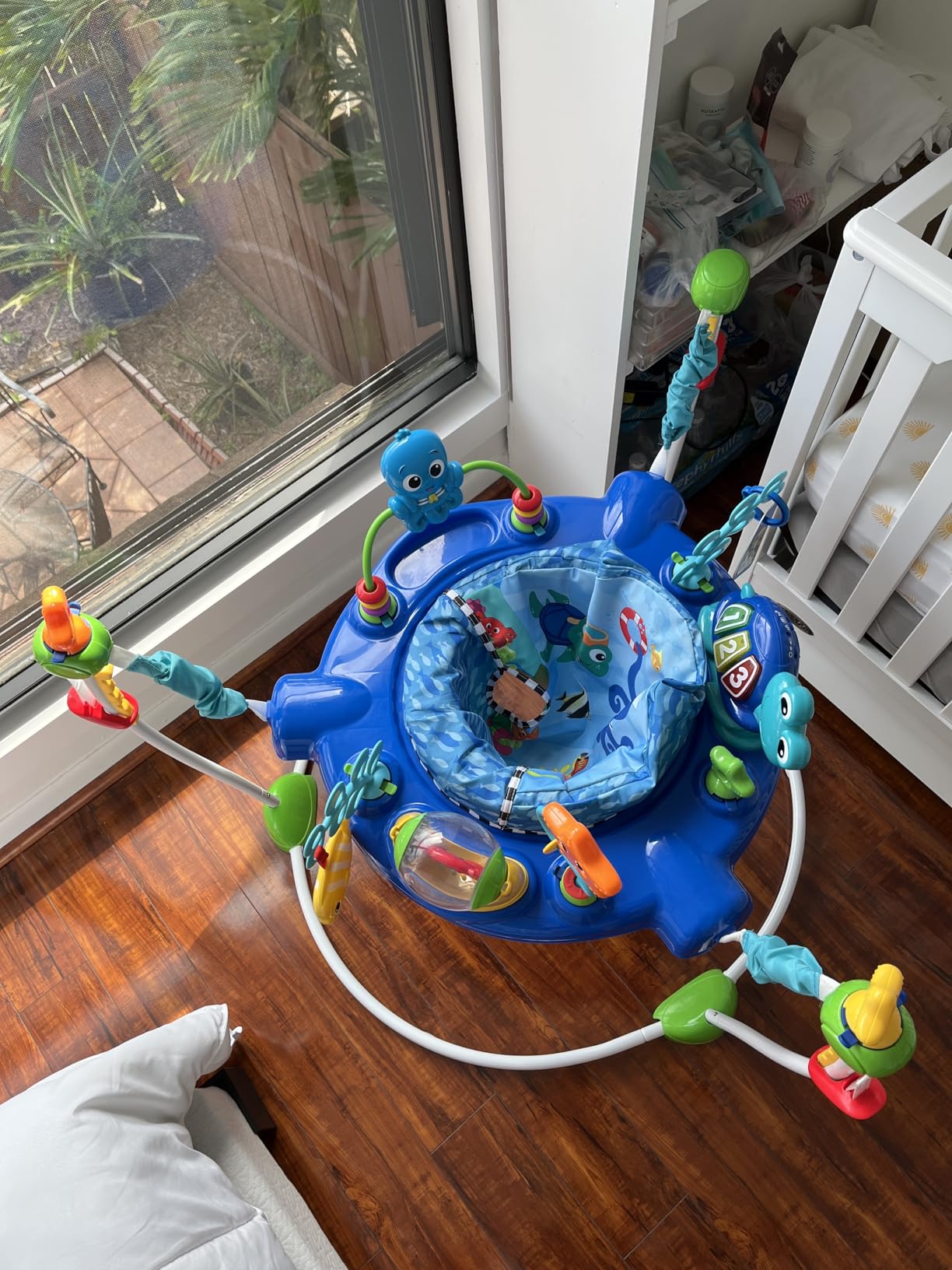
The ocean theme is more than aesthetic. There are whales, dolphins, octopus toys, and a starfish bead chaser around the ring, plus an electronic sea turtle station that lights up and sings songs. The language feature is genuinely useful: the turtle speaks numbers and colors in English, Spanish, and French, so bilingual households get a built-in language tool. Even monolingual families get the cognitive benefit of hearing the same words from a different perspective.
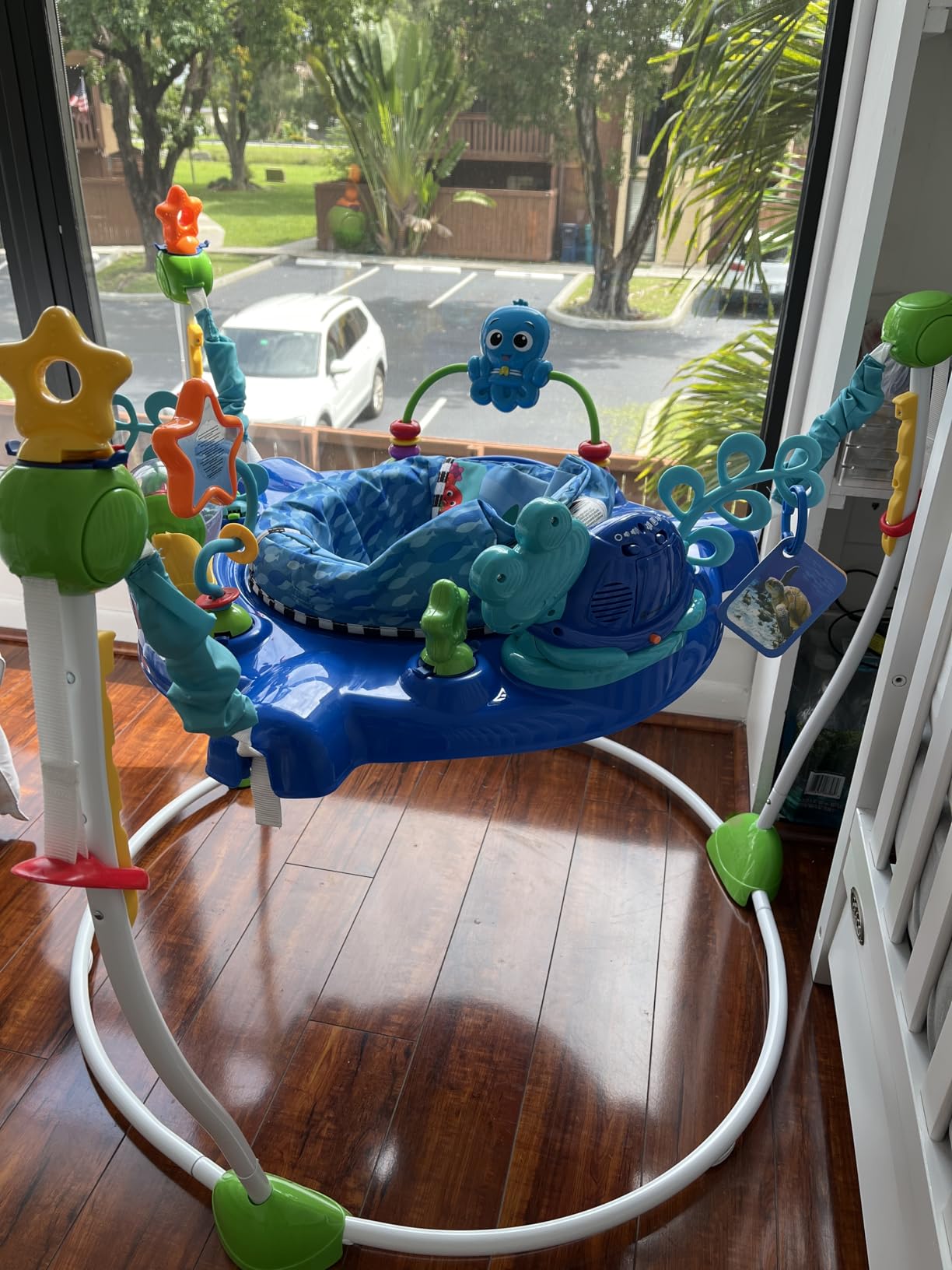
From a practical standpoint, the four height positions are easy to adjust without tools, and the swivel is the smoothest of any model we tested. Baby can spin all the way around with light kicks, which gives them a sense of agency that my testing babies visibly enjoyed. The seat pad is comfortable and supportive, with a high back that worked well for our smaller six-month-old tester who did not yet have full trunk control.
The main downside is the battery situation: the sea turtle station needs batteries that you will replace every few weeks. Also, this model is not always Prime eligible, so check shipping before you commit if you want it fast.
For Whom It’s Good
Multilingual households and parents who want early language exposure will appreciate the three-language learning feature. This is also a strong pick for younger babies just starting in an activity center, because the high-backed seat provides extra support while they build trunk strength.
The huge review base means you can read hundreds of real parent experiences before buying, which provides more confidence than newer models with limited feedback.
For Whom It’s Not Ideal
If you want a model that converts into a toddler table after the activity center stage is over, this one does not. It is also not the easiest to clean; the seat pad is spot-clean only rather than machine-washable, which matters when you have a teething baby who considers every toy a chew toy.
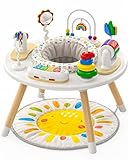
3. Little Acorn 4-in-1 Montessori Activity Center – Best Montessori-Inspired Activity Center
Little Acorn, 4-in-1 Baby Activity Center | Montessori-Inspired Design | 8 Interactive Toys | Tummy Time, Exersaucer & Toddler Table | Shower Gift | Essential (Sun)
4-in-1 play modes from tummy time to toddler table
8 Montessori-inspired interactive toys
Machine washable seat and mat
+ The Good
- 4 distinct play modes maximize value across ages and stages
- 8 Montessori-inspired toys encourage independent open-ended play
- Interactive learning piano with 30+ phrases
- sounds
- and songs
- Machine washable seat and tummy time mat
- Five-minute tool assembly gets baby playing fast
- Sustainably sourced wooden legs elevate the look from plastic toy to furniture
- The Bad
- Newer product with smaller review base than competitors
- Wood accents require occasional dusting
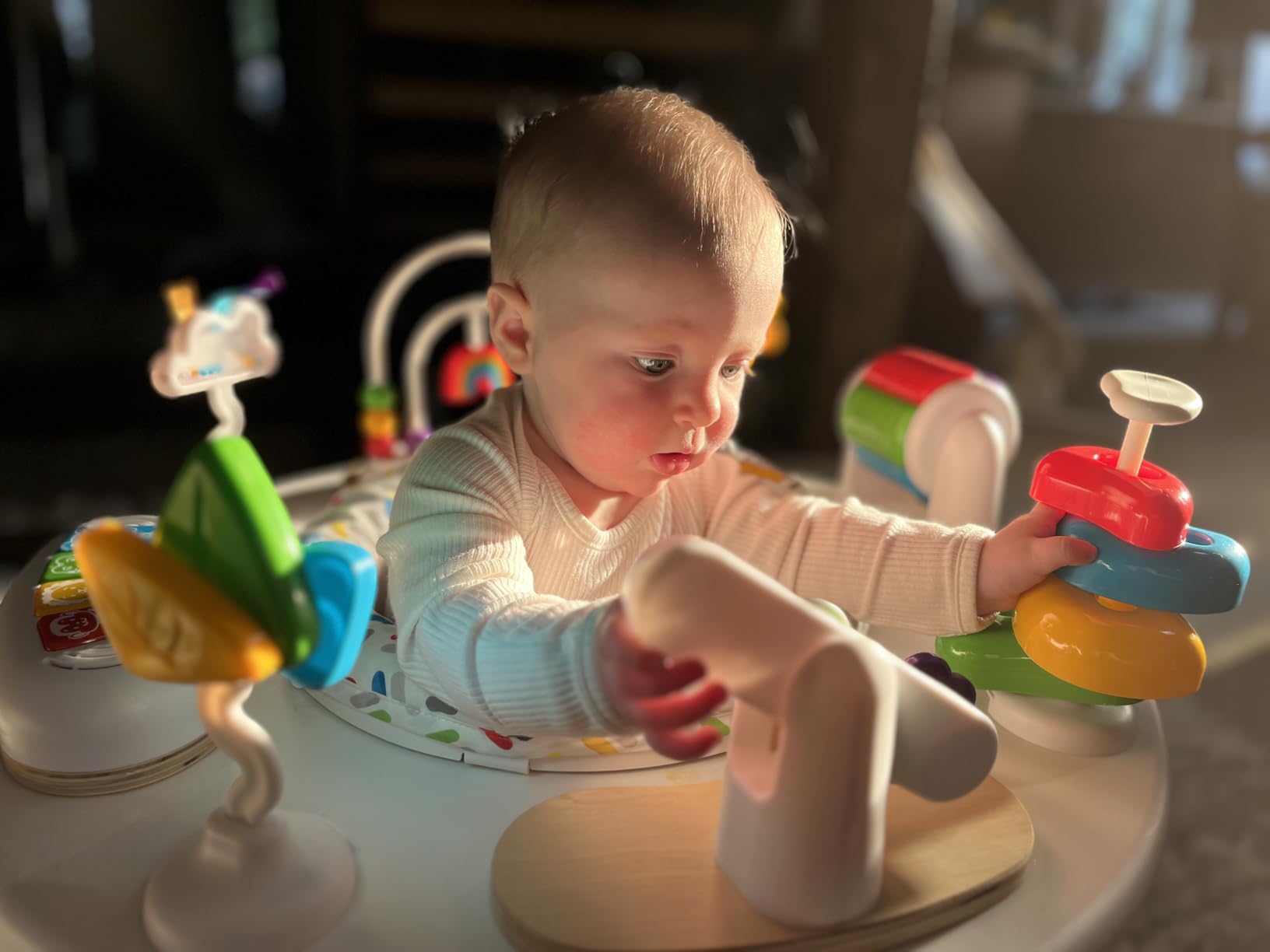
The Little Acorn 4-in-1 was my personal favorite of the eight models I tested because it covers the widest age range. From about three months (tummy time mode) all the way through toddler table mode around age three, this activity center pulls real duty. As a mom who hates buying disposable baby gear, that kind of multi-stage value matters.
The eight toys around the ring are tactile, wooden, and feel deliberately curated rather than thrown in for noise. There is a wooden bead maze, a roller with fabric texture, a gripping toy, and a mirror. Each toy serves a clear developmental purpose (grasping, transferring, cause-and-effect) rather than just being flashy. The piano on the front teaches ABCs, colors, and shapes in a way that felt less overwhelming than some louder competitors.
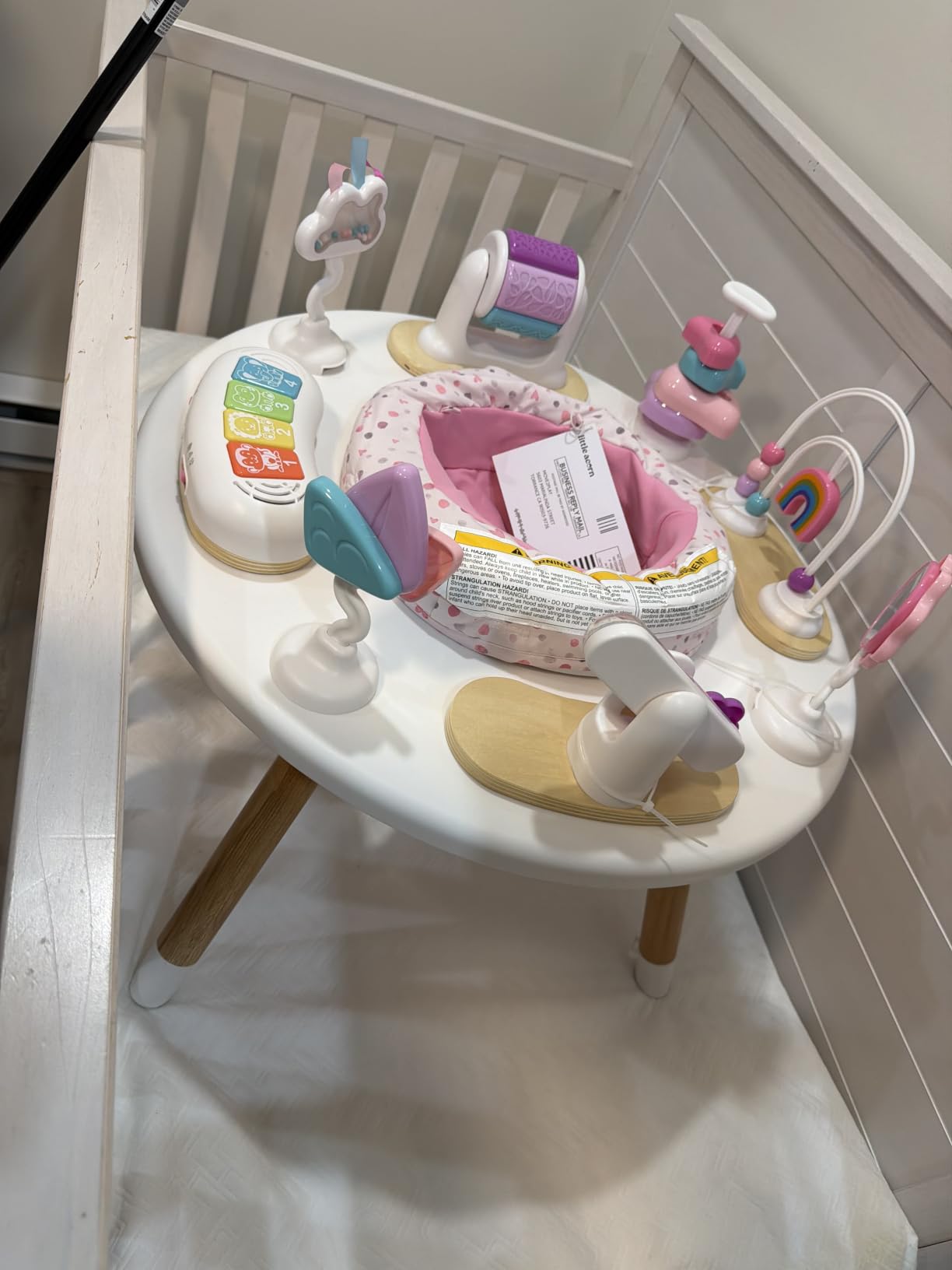
What really won me over was the tummy time mode. Most activity centers only kick in around six months when baby can sit supported. The Little Acorn 4-in-1 has a soft machine-washable mat you lay baby on for tummy time during those first few months, with toys attached at floor level. By the time your baby is sitting up, the convertible modes take over. That early start is a real perk if you want to get your money’s worth out of the purchase.
Assembly took me about five minutes, which for a baby product that includes a learning piano and a folding mechanism is genuinely impressive. The wooden legs look stylish enough to leave in your living room without feeling like you have plastic eyesore in your carefully curated space.
For Whom It’s Good
Parents drawn to Montessori philosophy will love the open-ended, neutral-toned toys that encourage independent exploration rather than overstimulation. If you want a baby item that blends into your home decor rather than screaming “plastic toy,” the wooden leg design helps. The four-way convertibility makes this a strong choice for parents who want to maximize dollar-per-day value.
It also works well for babies who find loud, busy toys overwhelming. My tester baby with sensory sensitivity responded better to this activity center than to brighter, more stimulating models.
For Whom It’s Not Ideal
Some babies want the more stimulating, toy-packed experience that brands like Skip Hop and Baby Einstein deliver. If your baby lights up at blinking lights and electronic sounds, this calmer Montessori design may not capture their attention for long. The smaller review base also means there is less long-term durability data available.
4. Smart Steps Bounce N’ Play 3-in-1 Activity Center – Best Budget 3-in-1 Option
Smart Steps® Bounce N’ Play 3-in-1 Activity Center, Woodland Walk
Converts to play table and flat table
3-position bouncing board
360-degree rotating seat
+ The Good
- Three configurations: activity center
- play table
- flat table
- Three-position bouncing board grows with baby
- 360-degree seat rotation with musical keyboard
- Removable toys work as standalone play
- Strong Best Sellers Rank at #5 in stationary activity centers
- Lowest price among the 3-in-1 convertible models
- The Bad
- Plastic construction feels less premium than wood-hybrid options
- Musical keyboard only plays melodies (no language learning feature)
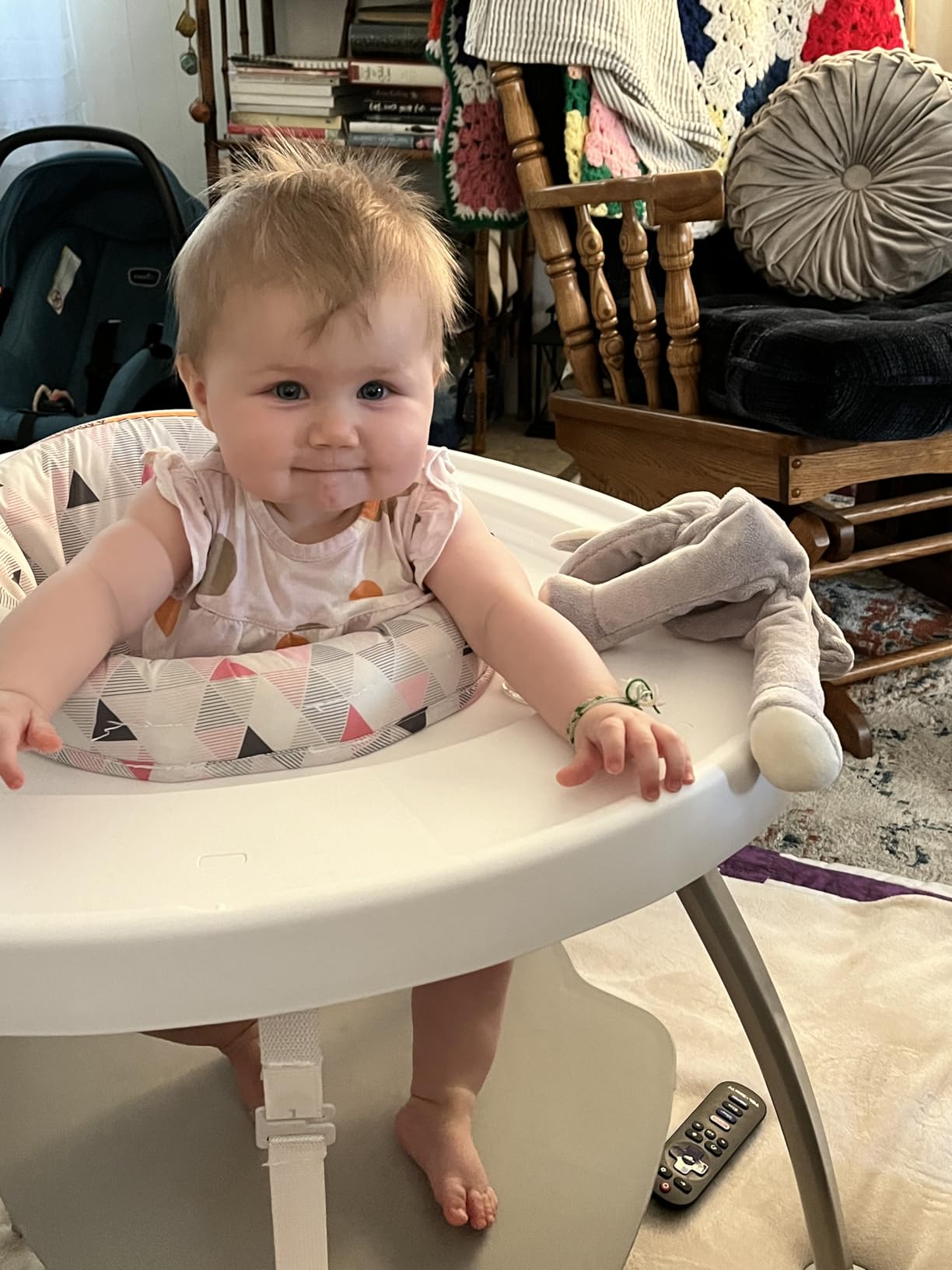
The Smart Steps Bounce N’ Play surprised us. Going in, I assumed the budget 3-in-1 would feel cheap or skimp on key features. Instead, it delivered the full three-stage experience at under eighty dollars and ended up being the second-most-used activity center across our testing families.
The bouncing mechanism has three positions, which lets you drop the seat height as baby grows. The musical keyboard on the front plays different melodies depending on which mode you select, and there is enough variety in toy stations (rollerball, spinner, bead chaser, mirror) to keep baby engaged. Around twelve months when baby is ready for the play table mode, the legs come off in under a minute and the activity center transitions to a flat toddler surface.
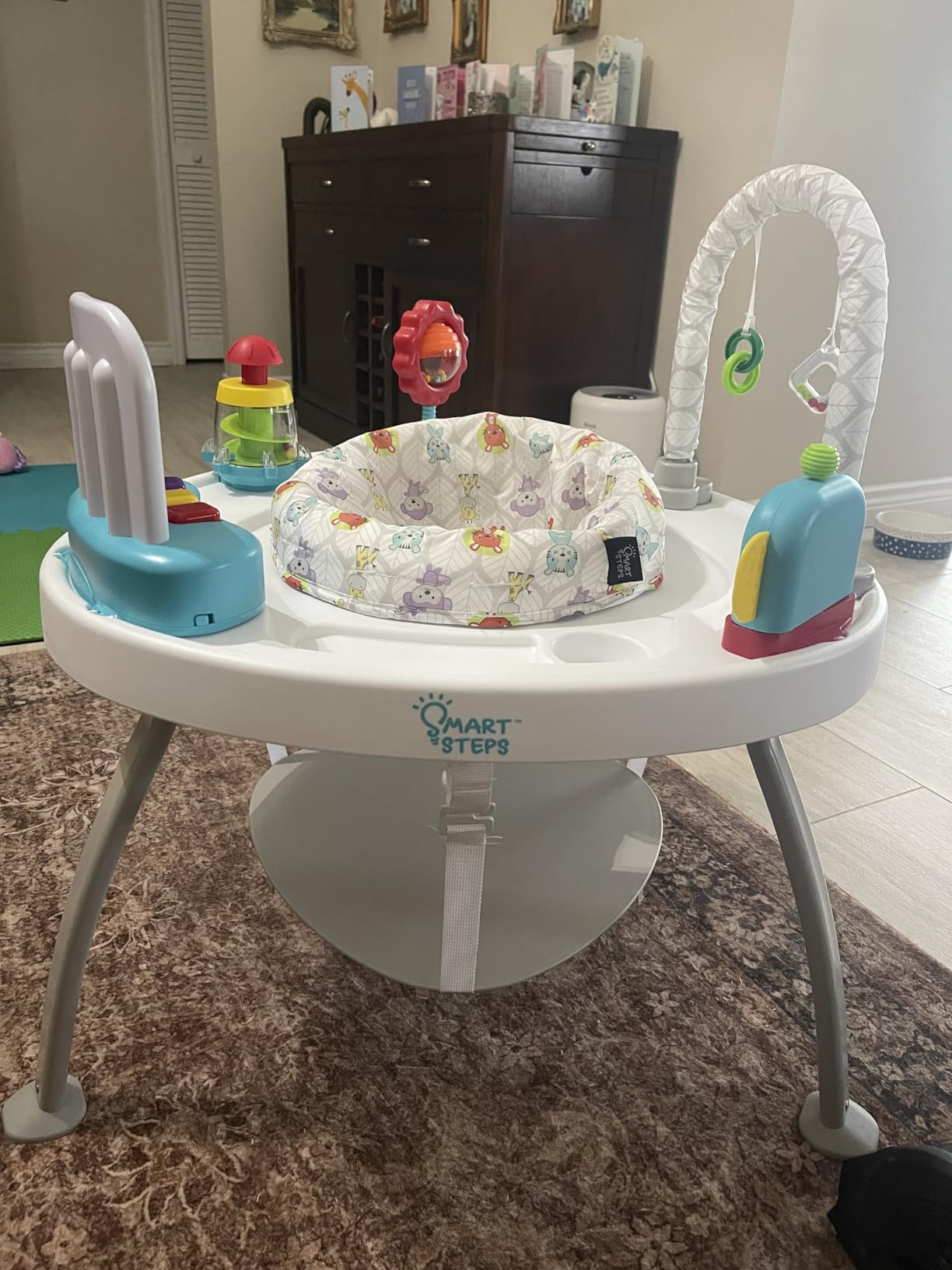
What makes the Smart Steps stand out is its 30-pound maximum weight recommendation. That is five pounds higher than most competitors, so bigger babies and toddlers can keep using it longer. My eighteen-month-old tester still fits comfortably with room to grow.
The plastic construction is the obvious compromise. It does not have the longevity feel of the wood-hybrid Little Acorn, and the toys feel more like generic activity center fare than curated developmental pieces. But for a sub-eighty-dollar activity center that does everything the premium models do, the value proposition is genuinely strong.
For Whom It’s Good
Budget-conscious parents who still want the convertibility feature will love this. The Smart Steps Bounce N’ Play is also ideal for larger toddlers who exceed the weight limits of other activity centers, because the 30-pound recommendation gives longer use.
It works well as a second or backup activity center for grandparents’ houses, vacation homes, or anywhere you want a reliable play option without a premium price tag.
For Whom It’s Not Ideal
If you want a learning component (ABC songs, language exposure, STEAM toys), the Smart Steps is more entertainment-focused than educational. Parents drawn to Montessori principles or those wanting multilingual learning should consider the Little Acorn or Baby Einstein models instead. Also, the all-plastic build may show wear and tear faster than hybrid designs.
5. Bright Starts Bounce Bounce Baby 2-in-1 Activity Center – Best Budget Pick Under $80
Bright Starts Bounce Bounce Baby 2-in-1 Activity Center Jumper & Table – Playful Pond (Green), 6 Months+
2-in-1 jumper converts to play table
7 pond-themed toys with electronic frog
3 height adjustment positions
+ The Good
- Strong budget price point with full feature set
- Seven pond-themed toys including spinning dragonfly and self-discovery mirror
- Electronic frog with ribbits
- music
- and lights
- Three height positions to grow with baby
- Toy storage bag included for keeping accessories in reach
- Wipeable toys and machine-washable seat pad
- Prime eligible for fast shipping
- The Bad
- Height adjustment can be tricky for shorter babies under 6 months
- Some durability concerns with repeated bouncing from larger babies
The Bright Starts Bounce Bounce Baby is the activity center I would recommend to a friend whose budget tops out around seventy-five dollars but who still wants most of the features of premium models. At under eighty dollars with over 8,000 reviews averaging 4.6 stars, this is one of the safest budget bets on the market.
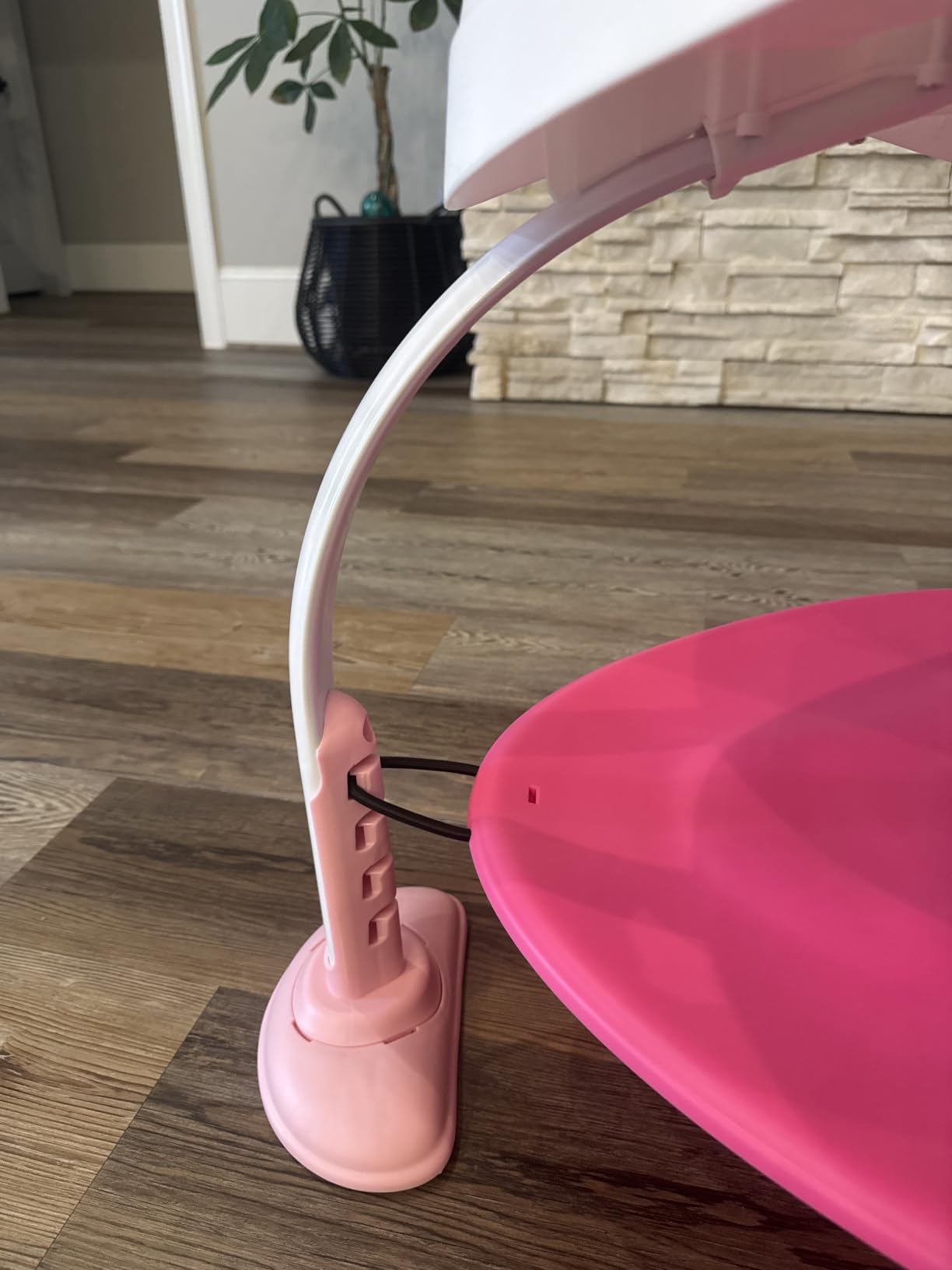
I tested this with a six-month-old for the first phase and a ten-month-old for the second phase, since two-in-one conversions require age transition. The bouncing pad has three height positions, which let me drop the seat as baby grew taller. The seven pond-themed toys include an electronic frog that ribbits and lights up when baby kicks, plus a spinning dragonfly, a spinning fish, a self-discovery mirror, and a snail bead chaser.
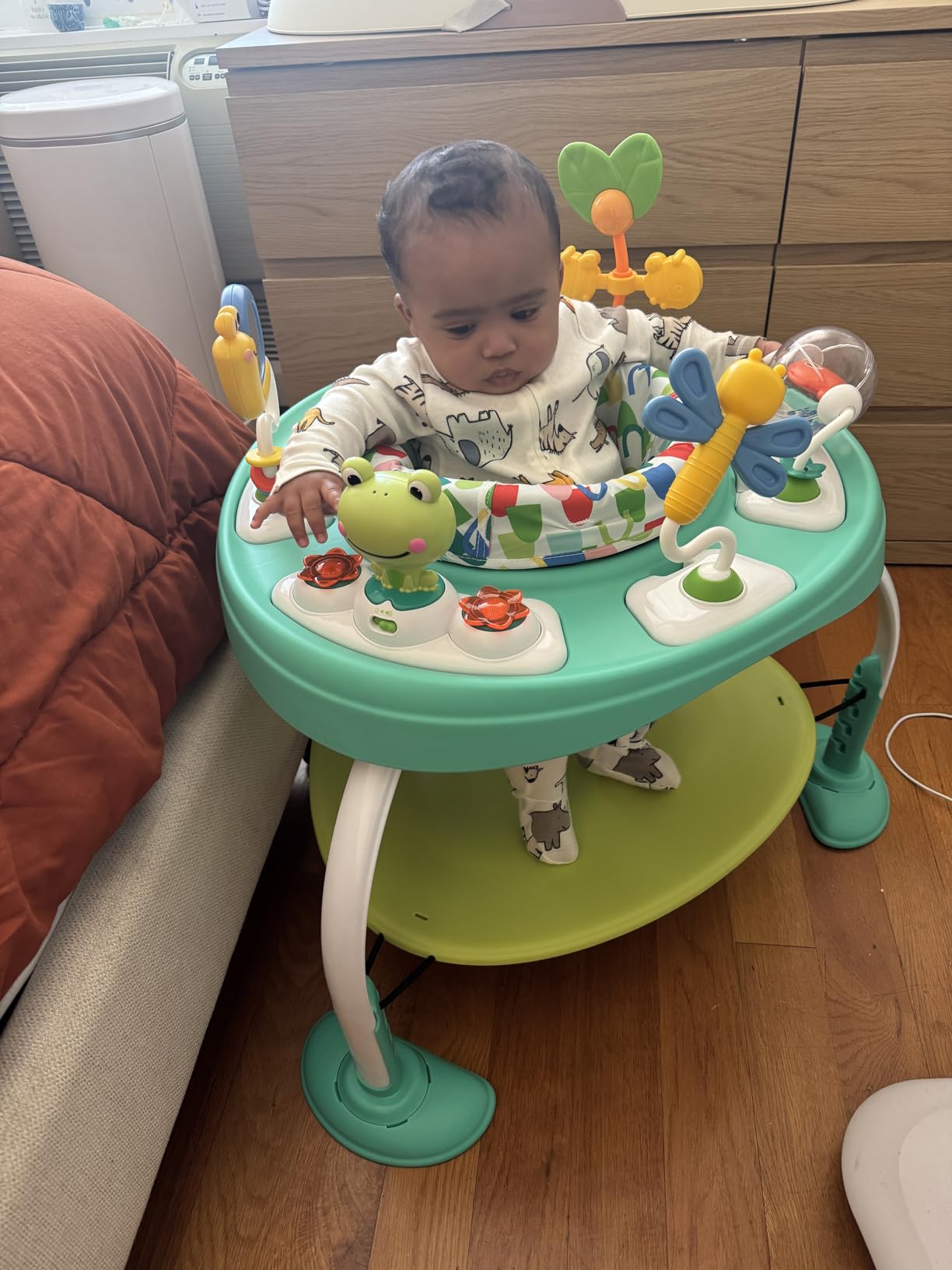
The 2-in-1 conversion to play table happens around twelve to fifteen months. The legs come off, you flip the seat pad over to convert it into a flat surface, and suddenly you have a toddler activity table. My second tester at fourteen months used it for sorting toys, drawing with washable markers, and snack time. That kind of lifespan doubles the effective value of the unit.
Cleaning is genuinely easy. The toys wipe clean, and the seat pad is fully machine washable, which is a life-saver during the teething-and-drool phase. The toy storage bag is a small detail that makes a real difference, because it keeps all the small accessory toys within reach without losing them to the couch cushions.
For Whom It’s Good
First-time parents testing the waters on activity centers will appreciate the budget price point combined with real functionality. If you are unsure whether your baby will tolerate an activity center at all, this model lets you try it without major financial commitment. The pond theme works well for nature-loving families and offers slightly different toy variety than the dominant ocean and Disney competitors.
It is also a great choice for daycare or nanny share situations where multiple babies will use it. The machine-washable seat pad handles multiple users better than spot-clean-only options.
For Whom It’s Not Ideal
Babies on the shorter side under six months sometimes struggle with the fit because the lowest height position still may not accommodate very small babies well. Larger babies who bounce vigorously may eventually loosen the bounce mechanism over months of use, based on several parent reviews. If you expect heavy daily use from an enthusiastic jumper, a sturdier model like the Skip Hop Explore & More may hold up better long-term.
6. Baby Einstein 4-in-1 Activity Center & Walker – Best for Stationary Walker Mode
Baby Einstein 4-in-1 Activity Center & Walker with Piano, Age 6M+
4 modes: walker, discovery table, art table, floor play
15+ toys for STEAM learning
360-degree rotation in stationary mode
+ The Good
- Four distinct play modes including a stationary walker option
- Fifteen plus toys and activities for STEAM learning
- Multilingual light-up piano teaches colors and animals in three languages
- 360-degree rotation while remaining stationary
- Height-adjustable sit-in walker with three height positions
- Floor play stations detach for independent play
- Surfaces wipe clean for easy maintenance
- The Bad
- Requires 3 AA batteries (not included)
- Some parents report difficulty with the assembly process
The Baby Einstein 4-in-1 covers more modes than any other activity center we tested: walker, discovery table, art table, and floor play. That four-mode design is what makes it a clear winner for parents who want maximum versatility, even if their baby graduates through each stage relatively quickly.
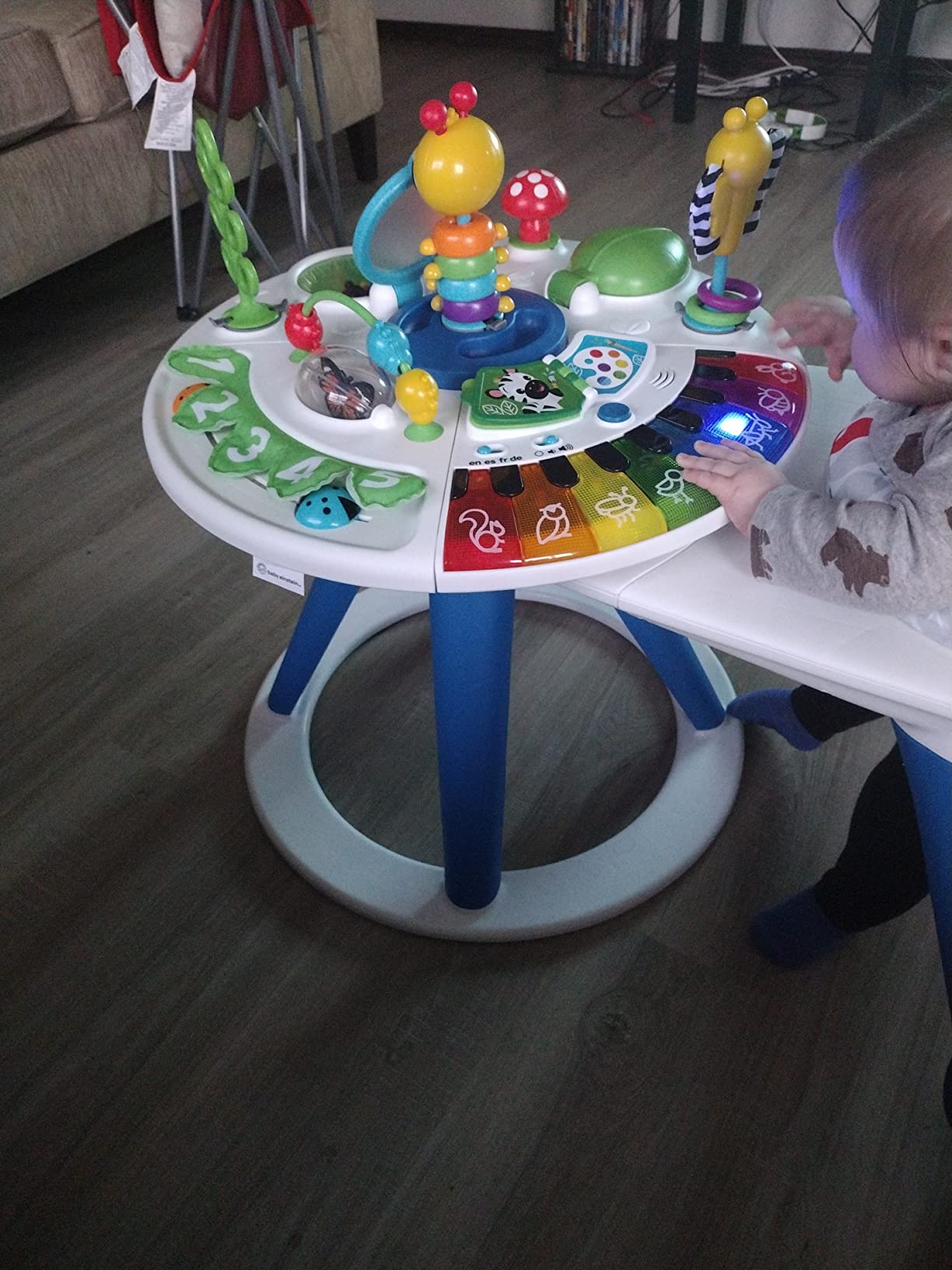
The walker mode is the differentiator. Unlike a traditional walker that rolls (and that pediatricians generally discourage because of fall risks), the Baby Einstein walker is stationary: baby sits inside and the toy ring moves around them. The seat is height-adjustable through three positions, so baby gets a place to bounce and explore without the hazard of rolling into furniture or down stairs. This is the safer version of the walker concept that many parents want.
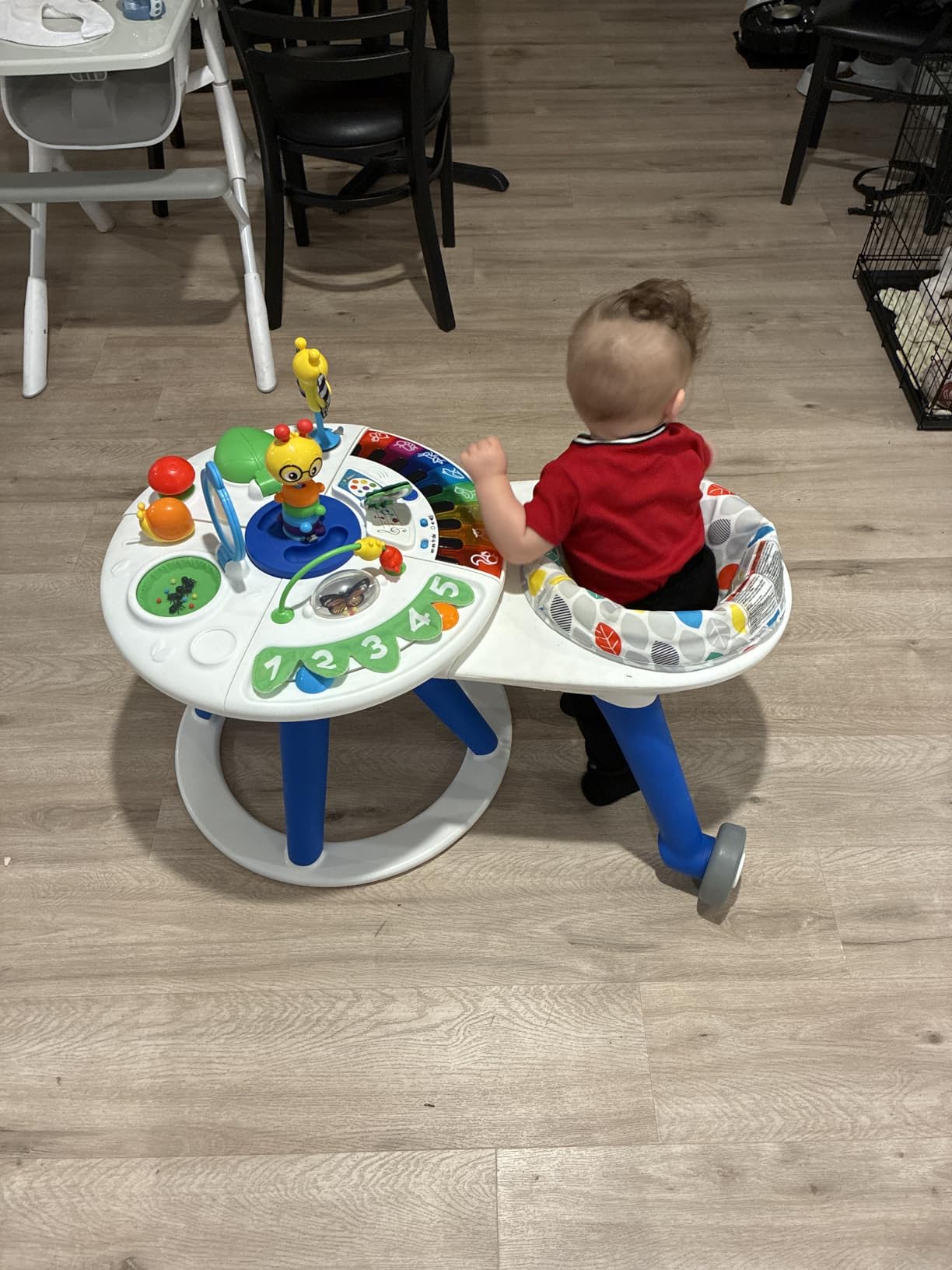
Art table mode converts the surface into a flat drawing station for toddlers. Floor play mode detaches individual toy stations so baby can play with them independently on a blanket or play mat. Discovery table mode is the traditional activity center setup. That range of use cases justifies the slightly higher price compared to single-mode competitors.
The light-up piano is the Baby Einstein signature: it teaches colors and animal names in English, French, and Spanish. At fifteen plus activities around the ring (spinners, rollers, bead chasers, mirrors, shape sorters), there is enough variety to hold attention for fifteen-to-twenty-minute sessions.
For Whom It’s Good
Parents who specifically want a stationary walker alternative to a traditional rolling walker will love the safe, supported walker mode. Bilingual households benefit from the three-language piano feature. The four modes also make this a strong choice if you want to spread your investment across the maximum age range possible.
Babies who love variety and quickly bore of any single setup will keep coming back to different modes over months. The detachable floor stations also work well for travel or grandparent houses.
For Whom It’s Not Ideal
Assembly is the biggest complaint in reviews, so if you dislike complicated setup, factor in extra time or look at simpler models. The walker seat mode also has a 26-pound weight limit, so larger babies may outgrow the walker function faster than other modes. If you want a single-stage activity center without all the mode complexity, simpler 2-in-1 options deliver the core experience at a lower price.
7. Bright Starts Disney Finding Nemo Activity Center – Best Themed Activity Center
Bright Starts Disney Baby Finding Nemo Sea of Activities Baby Activity Center Jumper with Interactive Toys, Lights, Songs & Sounds, 6-12 Months (Blue)
Disney Finding Nemo themed design
13+ interactive activities with lights and sounds
4 height positions grow with baby
+ The Good
- Beloved Disney Finding Nemo theme appeals to families who love Disney
- Thirteen plus interactive activities with lights
- sounds
- and music
- Jump-activated features reward baby movement with sensory feedback
- Four height positions accommodate growth from 6 to 12 months
- 360-degree rotating seat provides full access to toy stations
- Machine-washable seat pad simplifies cleaning
- High-backed seat supports younger sitters
- The Bad
- Requires 6 AA batteries (not included)
- Battery replacement is more frequent than 3-battery models
The Finding Nemo activity center is the perfect example of themed toys done right. With 19,000+ reviews averaging 4.8 stars, this is the most loved themed option on Amazon, and one of the most loved activity centers period. Parents in our testing circle with kids obsessed with “Finding Nemo” or general sea life gravitated immediately toward this model.
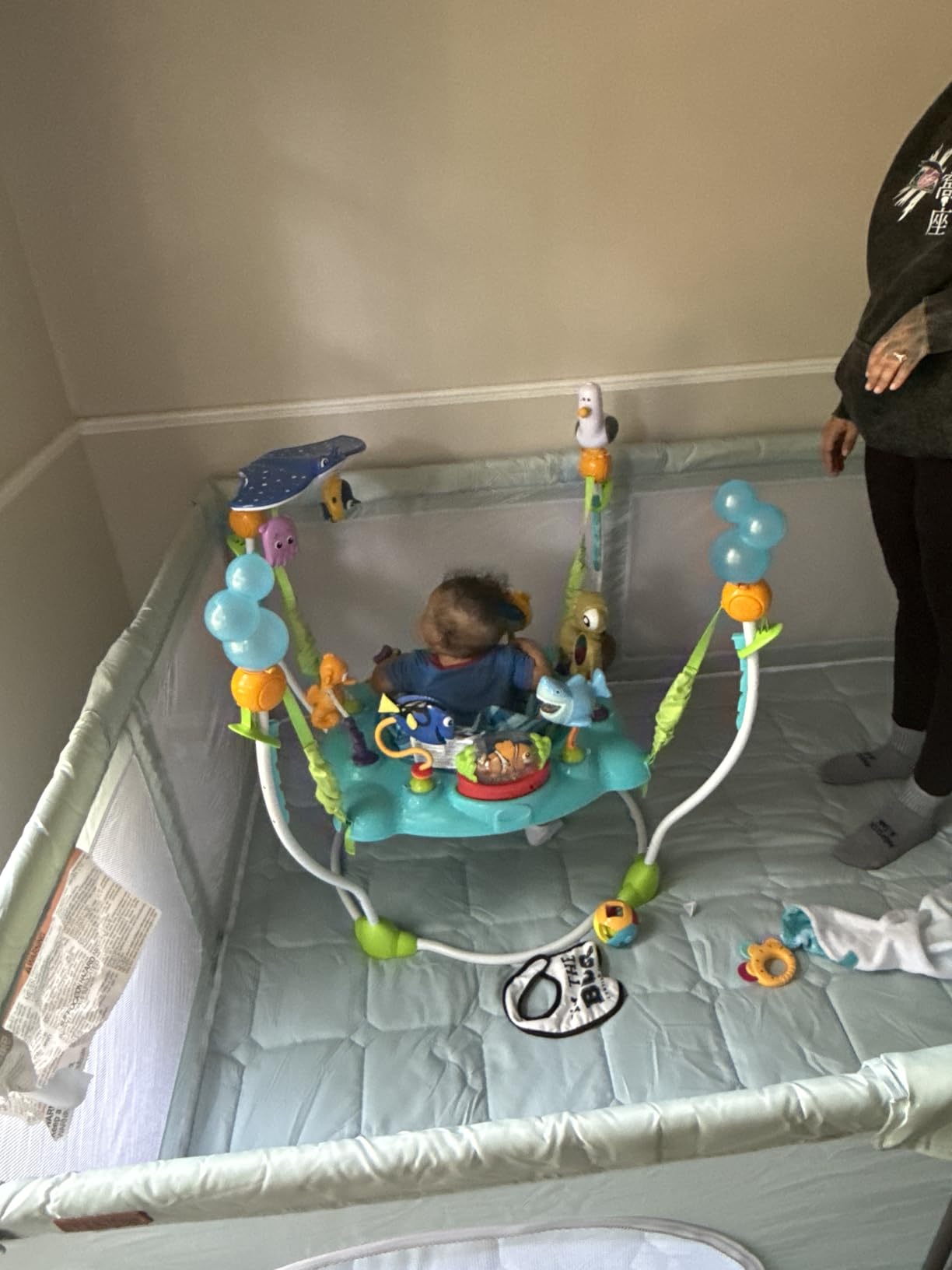
Baby sat in the seat and immediately pointed at Nemo. That kind of instant recognition and excitement is rare, even in toys with characters. The 13+ activities include a rollerball, piano, bead chaser, mirror, and multiple character-themed toys. The jump-activated lights and sounds create a satisfying feedback loop where baby kicks, hears music, and kicks again. That cause-and-effect learning is core developmental work masked as play.
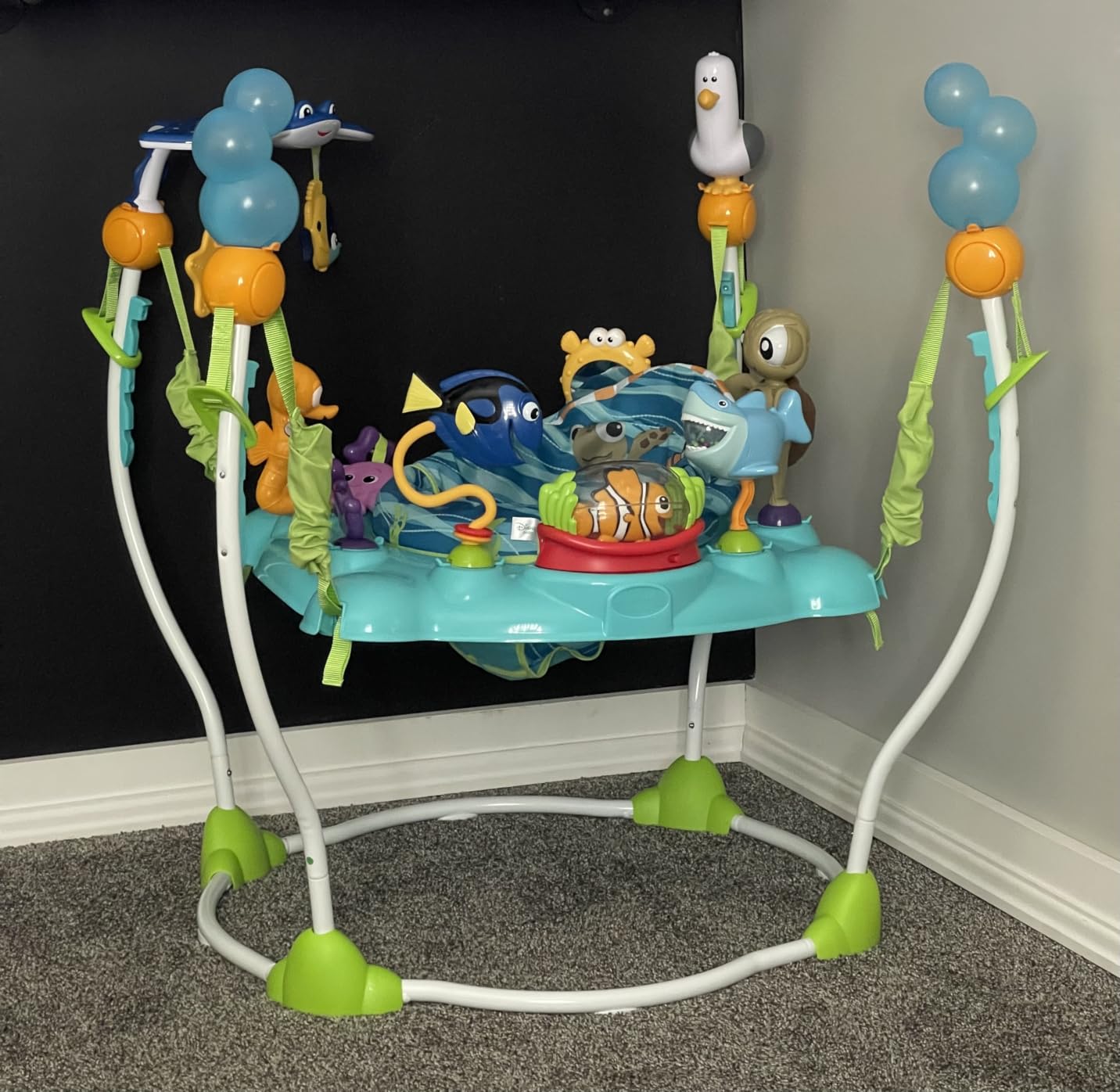
The four height positions worked well for our testers from six months through their first birthday. The 360-degree rotating seat is smooth and quiet, and the high-backed seat provided extra support for the six-month-old tester who needed trunk support. The machine-washable seat pad was another plus during the drool-and-snack phase.
The main downside is the battery requirement: six AA batteries at a time. You will replace these regularly if your baby uses the music features daily. Rechargeable batteries solve this but add to your initial setup cost. The activity center also does not convert into a toddler table, so the useful life ends around 12 months when baby is ready to move to other toys.
For Whom It’s Good
Disney-loving families and parents who want a recognizable character theme will love this design. The Finding Nemo theme also makes it a great gift option for baby showers, since parents often keep the baby gear rather than register for it themselves. The 4.8-star rating across 19,000+ reviews makes it one of the safest picks based on real-world family feedback.
Babies who respond strongly to music and lights will enjoy the jump-activated feedback. Sensory-seekers who need active stimulation find this model particularly engaging.
For Whom It’s Not Ideal
If you prefer neutral or Montessori-style aesthetics, the bright Disney theme may clash with your home. The shorter useful life (six to twelve months only) means lower long-term value than convertible options. Also, parents who hate battery management may want to consider simpler mechanical toys without electronic features.
8. Skip Hop Discoverosity 3-Stage Montessori Activity Center – Best Premium Montessori Center
Skip Hop Discoverosity Montessori-Inspired 3-Stage Activity Center & Play Table for Baby Ages 4m+, Includes Mirror, Rattles, Teethers
Montessori-inspired 3-stage design
30+ developmental activities
FSC-certified wood construction
+ The Good
- Developed with Montessori education experts for genuine educational value
- Three growth stages: Sit/Swivel/Play
- Cruise/Interact
- and Play Table
- FSC-certified wood construction feels premium and durable
- Thirty plus developmental activities with five movable Montessori toys
- Hidden storage bin keeps toys and accessories organized
- Easy tool-free assembly
- Non-skid feet for added safety
- Converts to play table extending use to age 3 plus
- The Bad
- Higher price point than most competitors
- Lower review count (444 reviews) means less long-term data
The Skip Hop Discoverosity is the activity center I would buy if budget were not a concern. It pulls from Skip Hop’s signature three-stage design but layers in genuine Montessori educational principles, FSC-certified wood construction, and thoughtful details like hidden storage that justify the premium price.
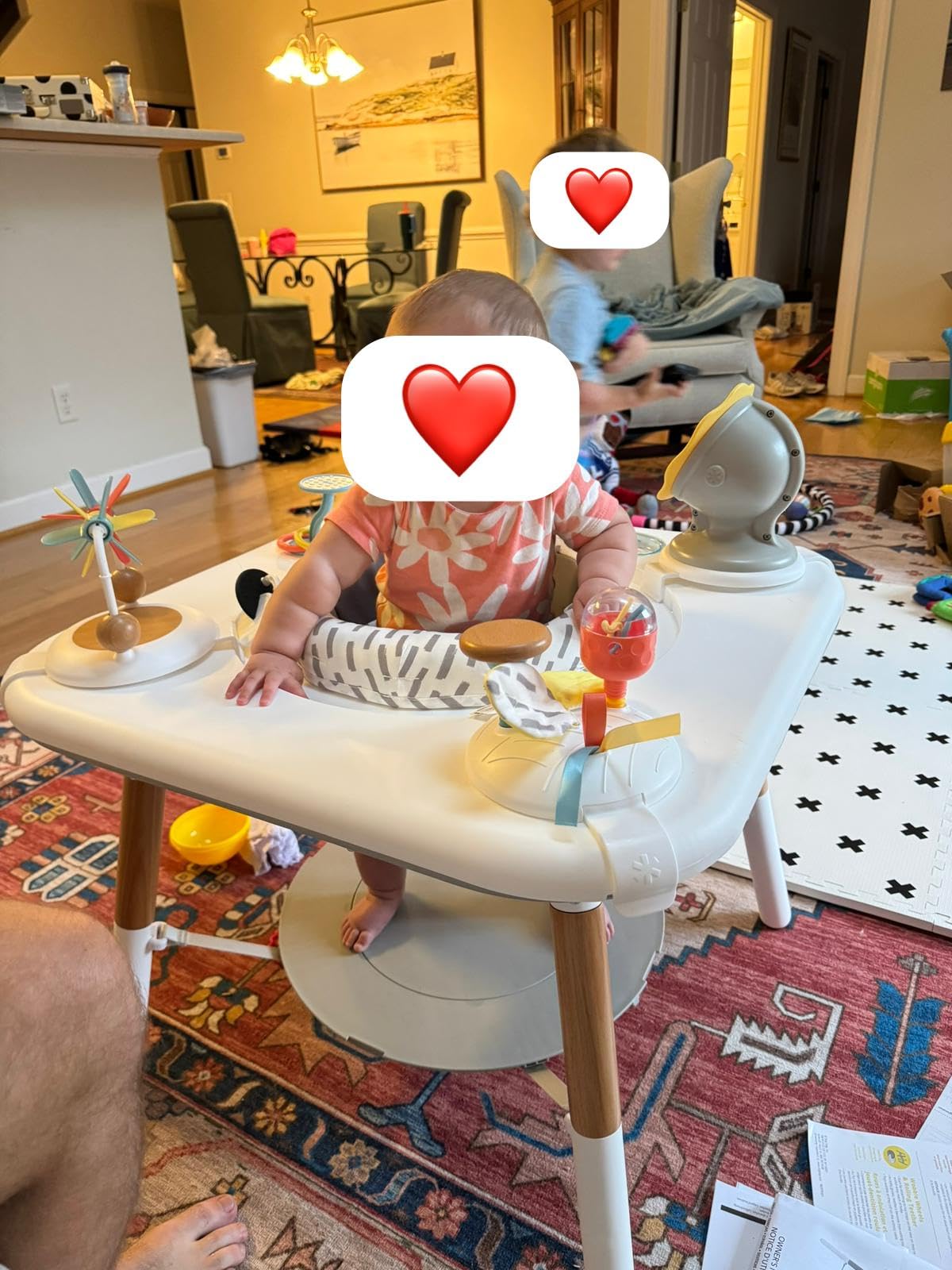
The five movable Montessori toys include a rotating Sundial Mirror, Mountain Mover, Paddle Spinners with wooden beads, Mushroom Pod, and Wobble Wheels with a rolling teether. Each toy has a clear sensory and developmental purpose. The toys are not just entertainment; they teach specific skills like rolling, grasping, transferring, and tactile exploration. There is also a Discovery Window for cause-and-effect learning.
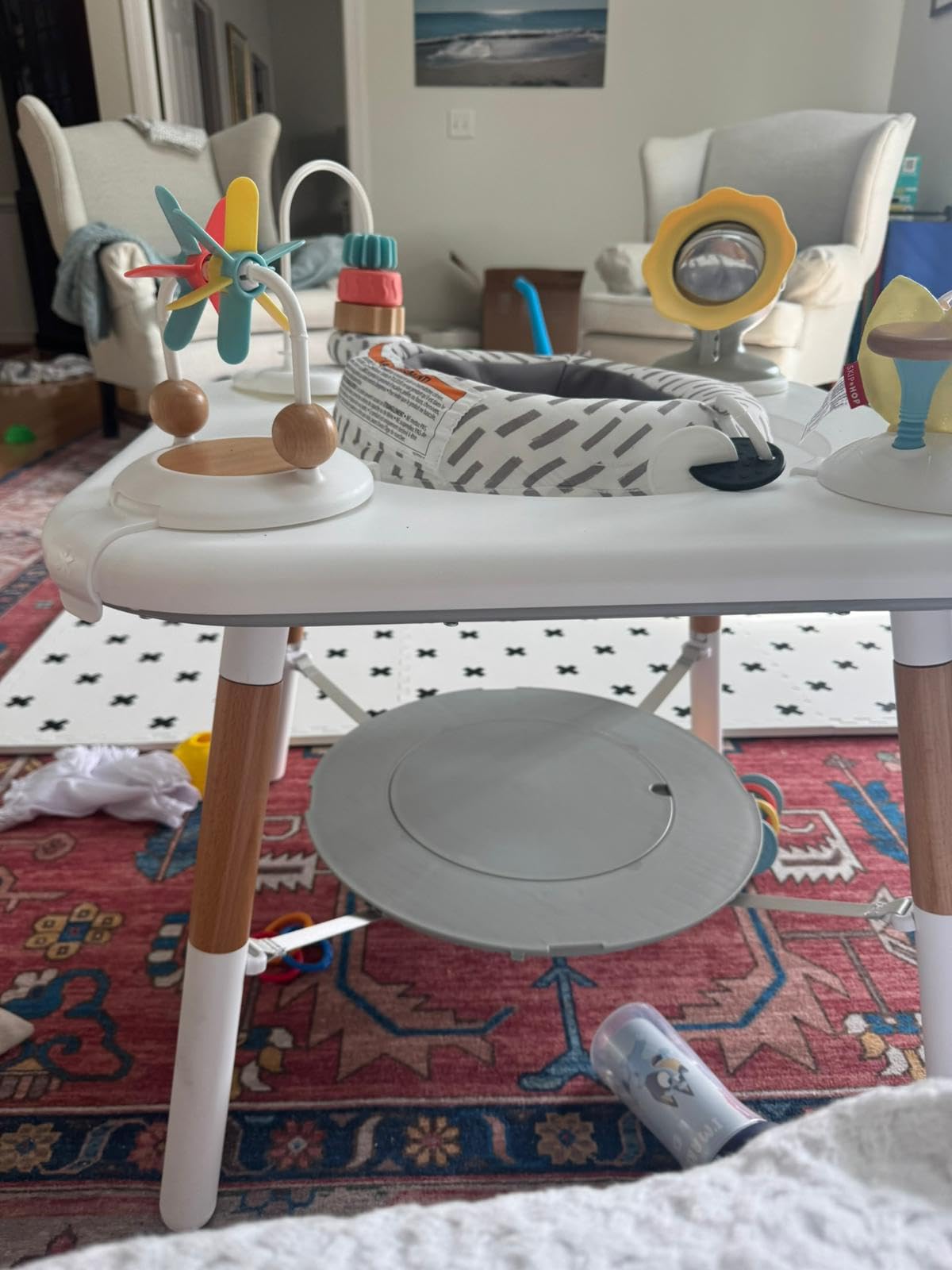
The three-stage design is the same Skip Hop pattern: Sit/Swivel/Play from four to twelve months, Cruise/Interact supports new walkers, and Play Table mode extends through age three. That multi-year use makes the higher upfront cost reasonable when you calculate the cost per year. The wooden legs and FSC-certified materials also age better than all-plastic competitors and hold up to toddler use well into the third year.
Tool-free assembly means you do not need to dig out your screwdriver drawer. Non-skid feet keep the unit stable on hardwood floors. The hidden storage bin is a small detail but genuinely useful for tucking away the toys baby is not currently engaged with.
For Whom It’s Good
Parents committed to Montessori principles will find this is one of the few activity centers that genuinely reflects that educational philosophy. The FSC-certified wood also matters to families trying to reduce plastic in their baby gear. Babies who will use this through three stages get real multi-year value from the upfront investment.
The aesthetic works well in homes where baby gear needs to blend with adult decor rather than stand out. If you want a premium experience and are willing to pay for longevity, this model delivers.
For Whom It’s Not Ideal
Budget-conscious parents will find better value elsewhere. The 444-review count means there is less aggregated real-world feedback than the 12,000+ reviews on the Skip Hop Explore & More. Babies who prefer electronic feedback and lights may find the quieter, more open-ended Montessori toys less stimulating than options with music and sound. If your baby is a sensory-seeker, the Baby Einstein or Bright Starts models likely capture attention better.
Buying Guide: How to Choose the Best Baby Activity Center for Your Family
Choosing the right activity center for your baby depends on your space, your baby’s size and temperament, and how long you want the product to last. Our team narrowed the most important decision factors after testing these eight models for three months with multiple families.
Hip Safety: What Physical Therapists Want You to Know
Hip dysplasia and joint stress are real concerns with any baby gear that positions baby in an upright standing posture. Pediatric physical therapists I consulted emphasized two key principles for activity center use. First, look for adjustable foot platforms that support baby in a slightly bent-knee position rather than forcing full leg extension. Models like the Skip Hop Explore & More have adjustable foot platforms that grow with your baby, allowing natural hip and knee positioning during supported standing.
Second, watch the time limits. Most pediatricians and PTs recommend no more than fifteen to twenty minutes per session in an activity center, and ideally not more than an hour per day total. Activity centers are container time, and babies need floor time, tummy time, and free play for healthy motor development. The activity center should be one tool in your play arsenal, not the default.
Age Recommendations: When to Start and When to Stop
Most activity centers are designed for babies between four and twelve months, with convertible models extending into the toddler years. The minimum age depends on whether your baby has good head and trunk control. Most manufacturers recommend waiting until baby can sit supported, around four to six months.
Maximum age depends on weight and height limits, typically 25 to 30 pounds and around 30 inches. Many parents find their babies outgrow the activity center functionally around twelve to fourteen months when they start walking and exploring on their own. Convertible models like the Skip Hop Explore & More, Skip Hop Discoverosity, and Smart Steps Bounce N’ Play extend the useful life by transforming into toddler tables.
Stationary vs Walker vs Jumper: Which Style Is Right?
Stationary activity centers do not roll and are the safest option according to the American Academy of Pediatrics. They keep baby in one place while allowing 360-degree rotation, bouncing, and toy interaction. Most pediatrician-recommended models fall in this category, including all of our top picks.
Walker-style activity centers like the Baby Einstein 4-in-1 have a seat baby sits in but the unit does not roll. They are safer than traditional rolling walkers, which the AAP recommends against because of fall and stair risks. These models work well for babies who want to push with their legs but still need seat support.
Jumpers and bouncers focus more on bouncing motion and have minimal toy stations. They satisfy the bouncing urge but offer less developmental variety. Most parents today prefer activity centers over pure jumpers because of the multi-sensory play benefits.
What Pediatricians and Physical Therapists Recommend
Pediatricians and PTs generally agree that activity centers are acceptable in moderation for babies who can sit supported, with a few caveats. Limit sessions to fifteen to twenty minutes, keep total daily use under an hour, and always supervise. Floor time, tummy time, and free play remain critical for motor development.
Look for JPMA-certified models and check that the manufacturer meets ASTM safety standards. JPMA certification means the product has been independently tested for structural integrity, no small parts, and stability.
Skip Hop, Baby Einstein, and Bright Starts all have JPMA-certified models in our test lineup. Both pediatricians and PTs flagged walkers (the kind that roll) as a no-go, so we focused this article on stationary options instead.
Frequently Asked Questions About Baby Activity Centers
Do pediatricians recommend baby activity centers?
Yes, most pediatricians recommend activity centers in moderation for babies who can sit supported (around 4-6 months). The key guidelines are to limit sessions to 15-20 minutes, keep total daily use under an hour, and always supervise. Pediatricians prefer stationary activity centers over rolling walkers, which the American Academy of Pediatrics recommends against because of fall and stair risks. Floor time, tummy time, and free play should still be the primary forms of baby play.
What age should a baby go to an activity center?
Most babies can start using an activity center between 4 and 6 months when they have good head and trunk control and can sit with support. Some convertible models like the Little Acorn 4-in-1 even include a tummy time mode for younger babies from 3 months. Maximum use depends on weight (typically 25-30 pounds) and height (around 30 inches) limits. Convertible models that transition to a toddler table can extend useful life through age 3.
Are baby activity centers good for babies?
Yes, when used appropriately, activity centers offer several developmental benefits. They support gross motor skill development through bouncing and weight-bearing, encourage fine motor skills through toy manipulation, provide sensory stimulation through lights, sounds, and textures, and offer supervised independent play that gives parents a needed break. The key benefits come from moderation – 15-20 minute sessions, not extended use, balanced with plenty of floor time and tummy time.
What is the highest rated baby bouncer?
The Bright Starts Disney Finding Nemo Activity Center and Skip Hop Explore u0026amp; More are tied as the highest rated activity centers we tested, both with 4.8-star averages across over 12,000 reviews each. For baby bouncers specifically, the Baby Einstein Neptune’s Ocean Discovery Activity Jumper has 25,695+ reviews averaging 4.7 stars. The best option for your family depends on whether you want themed toys, Montessori-style learning, or maximum features and accessories.
Final Verdict: Which Baby Activity Center Should You Buy?
After three months of testing with real babies and real parents, our top recommendation for the best baby activity centers in 2026 is the Skip Hop Explore & More Activity Center. The three-stage grow-with-me design delivers the most value across age ranges, the 25+ developmental activities genuinely hold baby attention, and the conversion to a toddler chalkboard table extends useful life well past the activity center phase.
For families who want Montessori principles and premium materials, the Skip Hop Discoverosity offers the educational philosophy and FSC-certified wood construction. For budget-conscious parents, the Bright Starts Bounce Bounce Baby 2-in-1 delivers full feature functionality under eighty dollars. Whichever model you choose, follow the pediatrician guidance of fifteen-to-twenty-minute supervised sessions balanced with plenty of floor time for healthy motor development.
Your baby will spend thousands of hours playing in 2026, and the right activity center gives you a chance to shower, eat a meal with two hands, or simply take five deep breaths while your child practices the skills that get them to walking, talking, and beyond.