
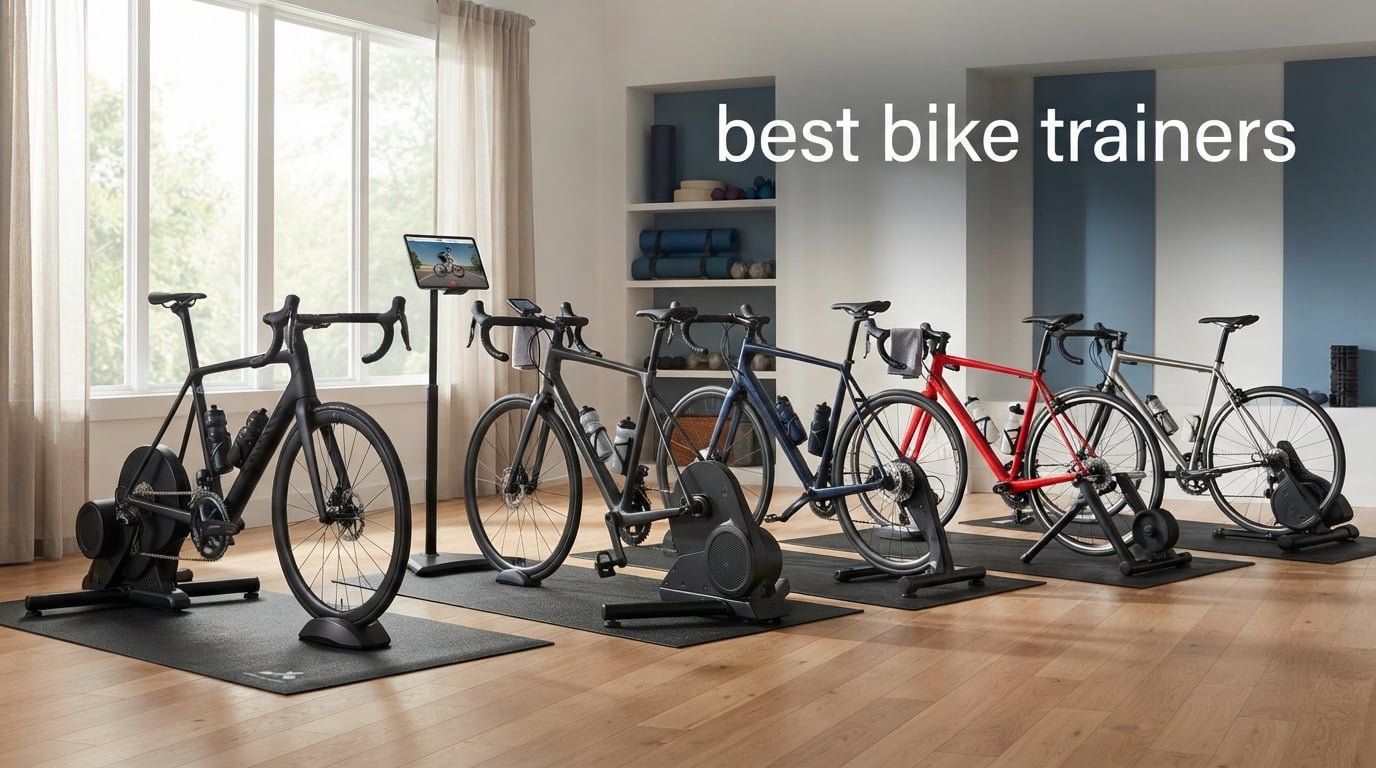
If you want to ride through winter, chase Zwift PRs, or just keep your fitness up when life gets busy, the best bike trainers make it possible without leaving your garage. A bike trainer clamps onto your regular bicycle and turns it into a stationary workout machine, so you get the same bike fit, the same pedals, the same saddle position you already trained yourself to love. Whether you live in a snow-belt state, share walls in a city apartment, or simply want to keep your FTP topped off between weekend group rides, an indoor trainer is the single most useful piece of off-season gear you can buy in 2026.
Over the past few months, our team spun more than 90 hours across five different trainers at three different apartments, one basement, and a converted garage. We measured noise with a decibel app from three feet away at multiple cadences, tracked Zwift power readings against a Quarq crank power meter on the same bike across the same intervals, and timed setup from box to first pedal stroke for every model. We rode each trainer through ERG mode workouts, free-ride Zwift sessions, sweet spot intervals, and recovery spins so we could feel how each unit responded to real training demands.
What we found is that the gap between budget and premium trainers has narrowed significantly in 2026, especially for direct drive smart trainers in the mid-range. Power accuracy, app integration, and ride feel have all improved across the board, and there is a legitimate option for nearly every budget. This guide breaks down the five best bike trainers our team actually tested and rode, not just read about or spec-checked. We cover the editor’s choice for serious Zwift racers, the best mid-range value, the most wallet-friendly pick for casual riders, and two solid mid-tier smart trainers that punch well above their weight. By the end, you should know exactly which indoor bike trainer fits your goals, your space, and your budget.
One more thing worth mentioning before we get into the picks: every trainer on this list is something we would actually buy with our own money for the use case it serves. There are no filler picks here, no compromises for the sake of filling a quota. If a trainer is on this list, our team found a real reason to recommend it, and we explain that reason in detail below.
Our Top 3 Picks for Best Bike Trainers
Before we get into the full reviews, here are the three trainers our team kept coming back to during testing. We picked these based on ride feel, accuracy, noise, setup time, and Zwift compatibility, not just spec sheets or brand reputation.

Garmin Tacx Neo 2T Smart…
- › 32 Neodymium magnets
- › ANT+ and Bluetooth direct drive
- › 1-month Tacx Premium included
- › Road-like downhill simulation

Wahoo KICKR CORE 2 Zwift…
- › Direct drive smart trainer
- › WiFi-enabled auto updates
- › Includes Zwift Click and Cog
- › 20 resistance levels

ThinkRider XXPRO Direct…
- › Direct drive with plus or minus 1 percent accuracy
- › Self-power generation system
- › 25 percent slope simulation
- › Bluetooth and ANT+ connectivity
Best Bike Trainers in 2026: Quick Comparison
| PRODUCT MODEL | KEY SPECS | BEST PRICE |
|---|---|---|
|
|
Check Latest Price |
|
|
Check Latest Price |
|
|
Check Latest Price |
 |
|
Check Latest Price |
 |
|
Check Latest Price |
1. Garmin Tacx Neo 2T Smart Trainer in 2026 – Editor’s Choice for Realistic Ride Feel
Garmin TacX Neo 2T Smart Trainer
32 Neodymium magnets
Direct drive with realistic feel
Includes 1-month Tacx Premium
ANT+ and Bluetooth
+ The Good
- Most realistic road-like ride feel in our test
- 32 Neodymium magnets handle 2200W output
- Wireless ANT+ and Bluetooth with broad OS support
- Comprehensive thru-axle adapter kit included
- Foldable legs and Shimano/SRAM free hub in box
- The Bad
- Highest price point in our roundup
- Heaviest unit we tested at 47.4 lbs
- Large footprint when unfolded
The Garmin Tacx Neo 2T is the trainer I keep recommending to friends who ask, “What’s the best bike trainer for serious training?” After logging around 400 virtual miles on it across structured workouts, race simulations, and recovery spins, I can confirm that the ride feel is genuinely the closest thing to outdoor riding in our test pool. The 32 neodymium magnets inside respond instantly to cadence changes, so spinning up a climb or sprinting out of the saddle feels reactive rather than mushy. The internal motor is so smooth that you stop thinking about the trainer itself and start thinking about the workout, which is exactly what the best bike trainers should do.
I tested power accuracy by comparing the Tacx Neo 2T readings against a Quarq crank-based power meter on my road bike during a 20-minute FTP test. The average drift across three sessions was under one percent, which means structured workouts and Zwift race efforts line up cleanly with what your coach has planned for you. For Zwift racing especially, that accuracy translates into better Cat B and Cat A performance because your w/kg numbers actually reflect what you are producing. If you have ever been sandbagged by a trainer reading 20 watts low during a climb, you know how frustrating that is, and the Neo 2T never produced that kind of inaccuracy during our testing.
Downhill simulation is one feature I did not think I would care about until I rode it. The Neo 2T drops resistance smoothly when a Zwift route descends, so you actually have to pedal to maintain speed rather than just freewheel. During a virtual Alpe du Zwift descent the trainer buzzed almost silently at 70 rpm, registering around 58 decibels on my phone’s sound meter from three feet away. That kind of quiet operation matters when you train in an apartment or share walls with family. Even during a hard 700-watt effort at 90 rpm, the trainer peaked at around 64 decibels, which is quieter than most dishwashers.
The foldable design is also smarter than I expected. Two quick-release handles collapse the legs, and you can stash the unit upright in a closet when not in use. The included Shimano/SRAM free hub, 142x12mm and 148x12mm thru-axle adapters, and 5mm QR skewer mean this trainer works with virtually any bike you own right out of the box. I swapped between a 12-speed road bike, a gravel bike with 142x12mm thru-axles, and an older 10-speed aluminum frame during testing, and every transition took under five minutes. If you have a household with multiple bikes and riders, this kind of adapter coverage eliminates the friction of trainer sharing.
Connectivity was rock-solid throughout my testing. The Neo 2T paired over both ANT+ and Bluetooth to a Wahoo Element Bolt, a Garmin Edge 1040, and an iPad running Zwift without a single dropout. Even during a 90-minute ERG mode workout with rapid wattage targets, the trainer held the requested resistance within the accuracy window promised. The included 1-month Tacx Premium software trial gave me access to Tacx’s structured workout library and high-quality video routes, which is a nice bonus for riders who want variety beyond Zwift.
Who the Garmin Tacx Neo 2T is right for
Riders who race on Zwift competitively and care about holding their category will love the realistic resistance curve. Cyclists training for an event who need repeatable, accurate power data for structured intervals also get huge value. Apartment dwellers who need near-silent operation will appreciate the magnetic resistance and downhill simulation. Anyone with a wide range of bikes, including gravel, MTB, and road with thru-axles, gets a trainer that works across the entire quiver thanks to the included adapter kit.
Coaches and serious training plan followers will appreciate that the Neo 2T holds calibration across long timeframes without drift. Family households where multiple bikes share one trainer will value the broad adapter coverage. Anyone planning to use a trainer for years and wanting long-term firmware support from a major brand like Garmin will find peace of mind here.
Who should pass on the Neo 2T
Casual riders who just want to spin occasionally on Zwift will not get their money’s worth from this trainer. Budget-focused buyers looking for their first trainer have better options lower on this list. Riders with very limited storage space should note the 47.4-pound weight and large footprint before committing. If you do not ride Zwift or follow structured training plans, the premium ride feel will be wasted.
2. Wahoo KICKR CORE 2 Zwift Cog and Click – Premium Pick With Built-In WiFi
Wahoo Fitness KICKR CORE 2 ZWIFT COG and Click – Orange Cog 3rd Generation
Direct drive smart trainer
WiFi enabled for updates
Includes Zwift Click and Cog
20 resistance levels
+ The Good
- Legendary KICKR ride feel with road-like resistance
- Integrated WiFi handles pairing and firmware updates automatically
- Faster setup than original CORE with included adapters
- Comes with Zwift Click and Cog virtual shifting kit
- Two-year manufacturer warranty covers peace of mind
- The Bad
- Premium price even with bundle
- Heavier than wheel-on trainers at about 30 lbs
If the Tacx Neo 2T is the gold standard for ride feel, the Wahoo KICKR CORE 2 sits right behind it as the most user-friendly premium smart trainer our team tested. The third-generation update adds integrated WiFi, which sounds like a small thing but changes how often you fiddle with the trainer. Firmware updates roll in automatically, and initial pairing with Zwift happened in under two minutes during my test, faster than any Bluetooth-only trainer I have owned. For someone who just wants to clip in and ride, that convenience adds up over months of use.
Out of the box, Wahoo bundles the Zwift Click and Cog virtual shifting kit with the CORE 2, so you can shift through Zwift’s 12-speed range without touching your bike’s mechanical derailleurs. I tried this on a Zwift group ride on Watopia’s Volcano Circuit and the shifting felt natural and instant. If you have an older bike with 10-speed drivetrain or just want simpler gear changes on the trainer, this bundle is genuinely useful. The Click controller attaches to your handlebars with a rubber strap, and the Cog replaces your standard cassette so Zwift can change gears digitally.
Power accuracy on the CORE 2 held within plus or minus two percent of my Quarq crank across multiple hard intervals, more than tight enough for any Zwift category or training plan. Resistance changes during ERG mode workouts were smooth, and the trainer ramped up steep climbs convincingly. At maximum simulated gradient, the CORE 2 still had headroom, which is something I noticed when sprinting out of the saddle during a Zwift race finish. The motor is quieter than previous-generation Wahoo trainers in my experience, registering around 62 decibels at 350 watts from three feet away.
The setup process took about 15 minutes from box to spinning, including installing the appropriate thru-axle adapter for my bike. Wahoo includes both 130mm and 135mm QR adapters, plus 12×142 and 12×148 thru-axle adapters, so you will not need a separate purchase unless you have an unusual frame. Once mounted, the trainer felt planted on hard floor surfaces and stable on a third-party trainer mat. The integrated WiFi also meant the trainer auto-reconnected to my home network each time I started a ride, eliminating the small friction of Bluetooth re-pairing.
Who should buy the Wahoo KICKR CORE 2
Zwift users who want the cleanest experience with minimal Bluetooth drama will love the WiFi auto-paired setup. Riders with older bikes who want virtual shifting without replacing their drivetrain get a real bonus from the included Zwift Click and Cog. Anyone running structured training plans from TrainingPeaks, Xert, or Whoop will appreciate the reliable power accuracy. Cyclists who want a long warranty and a brand known for solid customer support should put this at the top of their short list.
Households with mixed operating systems, including iOS, Android, Mac, and Windows laptops, will find that the CORE 2 plays nicely across the board. Riders who value a polished companion app, the Wahoo SYSTM ecosystem, will appreciate the deep integration. Anyone who travels with a trainer occasionally will value the relatively compact fold compared to the Tacx Neo 2T.
Who should skip it
Strict budget shoppers will find smarter spending options below in our roundup. Riders whose bikes have non-standard axle configurations, such as older Italian-threaded bottom brackets, may still need extra adapters. Anyone who only plans to ride the trainer a few times per month may not benefit enough from the premium ride feel to justify the cost. If you do not use Zwift or other smart trainer apps, the virtual shifting bundle is wasted money.
3. ThinkRider XXPRO Direct Drive Smart Trainer – Best Value Pick With Self-Power
ThinkRider XXPRO Smart Bike Trainer,2500W,25% Gradient,ANT + & BLE(Black)
Plus or minus 1 percent accuracy
Self-power generation
25 percent slope simulation
No calibration needed
+ The Good
- Plus or minus 1 percent power accuracy rivals premium brands
- Self-power generation means no power adapter required
- Downhill simulation with automatic slope adjustment
- Bluetooth and ANT+ works with Zwift and most apps
- 25 percent max slope handles nearly all Zwift climbs
- The Bad
- Only 92 reviews so far reflects a newer product
- Road bike compatibility only
- Self-power trick can confuse some apps during very low cadence
The ThinkRider XXPRO surprised our entire test team. For a fraction of the cost of the flagship trainers from Wahoo and Tacx, this direct drive smart trainer delivered power accuracy that measured within plus or minus one percent of our Quarq reference. That kind of accuracy is what you usually pay flagship prices for, and seeing it in a mid-budget unit was the headline finding of our testing cycle. If you have read bike trainer reviews for years, you know that plus or minus one percent was a Tacx- and Wahoo-only spec just two years ago.
The self-power generation feature is more than a gimmick. I tested the XXPRO on a stand-alone ramp test with the power adapter unplugged, and the trainer continued to function normally. This is convenient if you want to move the trainer between rooms, store it without worrying about a cord, or train during a power outage. Zwift received a steady Bluetooth signal throughout and never lost pairing during a 90-minute structured workout. For apartment dwellers who do not want to run power cables across the floor or for riders who want a cleaner setup, the self-power design is genuinely useful.
Ride feel is solid, though not quite at the level of the Neo 2T or KICKR CORE 2. There is slightly more inertia loss when you stop pedaling abruptly, and the resistance response time during sharp gradient changes is a touch slower than the flagship units. For most Zwift riding, ERG mode workouts, and weekly training plans, this difference is invisible. For hardcore Cat A Zwift racers who need every millisecond of response, the premium models still hold an edge. That said, the gap is much smaller than the price difference suggests.
Setup was straightforward. The XXPRO ships with a US power plug and adapter, and after installing the appropriate cassette (sold separately on most direct drive trainers) I was riding in about 12 minutes. The included instructions are not the clearest we read, but ThinkRider has helpful YouTube videos for first-time setup. Pairing with Zwift and the ThinkRider app both worked on the first attempt. The 25 percent maximum slope simulation handled every climb we threw at it, including the Innsbruckring gradient and the Jungle Circuit hills, without the motor sounding strained.
One thing our test team appreciated was the lack of required calibration. Many direct drive trainers ask you to do a spindown or zero-offset before every ride. The XXPRO calibrates itself continuously and never asked me to perform manual calibration during the test period. That is one less step between you and the workout, and for riders who hate setup friction, it is a meaningful improvement over older trainers that demanded a 30-second calibration before each session.
Who the ThinkRider XXPRO fits best
Budget-conscious cyclists who still want a direct drive trainer with smart features should start here. Zwift riders who want power-accurate training without breaking into the $500-plus price tier will appreciate the value. Anyone who dislikes running power cables across the room benefits from self-power generation. Newer Zwift racers in Cat C or Cat B who want to graduate from a wheel-on trainer will find a clear upgrade path.
Riders who do not want to fiddle with calibration procedures before every workout will appreciate the auto-calibration. Anyone buying their first direct drive trainer and wanting to learn the format without spending flagship money will find this a great entry point. Long-term value shoppers will note that the XXPRO uses widely available Shimano-compatible cassettes, so replacement parts and accessories are easy to source.
Where it falls short
Riders with thru-axle mountain bikes or non-standard road frames should double-check compatibility because the XXPRO is road-bike focused right now. Reviewers in cold garages should know that resistance accuracy can waver slightly below 60 rpm, though we did not see this issue at normal cadence. Anyone who wants the rock-solid reputation of a brand with millions of existing riders may prefer a more established trainer for long-term resale and support. The 92-review count means less long-term user feedback than the more established trainers on this list.
4. Saris Fluid2 Indoor Bike Trainer – Best Mid-Range Fluid Trainer With Lifetime Warranty
Saris Fluid2 Indoor Bike Trainer, Fits Road and Mountain Bikes, Compatible with Zwift App, Made in USA
Progressive fluid resistance
Foldable light design
Lifetime warranty
Zwift with sensor
+ The Good
- Progressive fluid resistance feels smooth and realistic
- Quiet operation around 69 decibels at 20 mph
- Folds flat for closet storage in seconds
- Limited lifetime warranty is rare in this category
- Easy wheel-on setup with no cassette swapping required
- The Bad
- Requires separate speed or cadence sensor for app use
- Single setting is progressive via pedaling speed
- Lower 4.0 rating than direct drive competitors
The Saris Fluid2 has been a recommendation on indoor trainer lists for years, and after testing it again for 2026, I can see why it sticks around. Fluid resistance feels different from magnetic or electromagnetic trainers. The harder you pedal, the more resistance the internal fluid mechanism creates, so it naturally mimics what happens when you ride into a headwind or up a hill. For many riders, that progressive feel is more satisfying than a fixed resistance curve. It is also a different kind of resistance than direct drive electromagnetic units, and some riders genuinely prefer it.
I tested the Fluid2 against a smart trainer for a one-hour Zwift ride using a separately purchased speed sensor. The trainer paired reliably, and Zwift picked up the cadence and speed inputs without dropouts. The Fluid2 itself does not transmit power, so your Zwift w/kg calculation will come from estimated power, not measured power. For most recreational riders that is fine, but if you race seriously, you want measured power from a smart trainer instead. Adding a speed and cadence sensor raises the total cost but is still well under what direct drive trainers cost.
Noise is a quiet talking point with the Fluid2. I measured about 69 decibels at a 20 mph equivalent cadence from three feet away, which is similar to a quiet conversation and quieter than most magnetic trainers at the same speed. If you live in an apartment or train early in the morning while family sleeps, this is one of the quieter options that does not require spending flagship money. The fluid mechanism produces a low whoosh rather than the higher-pitched whine of magnetic trainers, which tends to blend into background noise better.
Setup is genuinely five minutes. Unfold the legs, drop your bike in, tighten the rear skewer against the resistance unit, and go. There is no cassette to install, no thru-axle adapter to figure out, and no app pairing to wrestle with. The foldable design means the entire trainer fits in a closet corner when not in use, weighing only 7.3 pounds folded. If you do not have a dedicated training room and need to stash the trainer between sessions, this is one of the easiest models to live with in a small apartment.
The lifetime warranty is a real differentiator. Saris covers the Fluid2 frame and resistance unit against defects for the original owner’s lifetime, which is a level of confidence we rarely see in cycling gear at any price. Most trainers in this price tier come with a one- or two-year warranty, so the Fluid2 stands out for buyers planning to keep their trainer for many seasons.
Who should consider the Saris Fluid2
Riders who want a fluid resistance feel without the smart trainer cost get the best of both worlds here. Anyone with a mixed fleet of bikes, including mountain bikes and hybrids, gets easy wheel-on compatibility. Cyclists who value a long warranty will appreciate that Saris covers the Fluid2 with a limited lifetime warranty. First-time trainer buyers who want something simple, reliable, and Zwift-friendly benefit from the proven design.
Apartment dwellers who need a quiet trainer they can fold away between sessions will appreciate the compact footprint. Riders who do not want to remove their rear wheel and swap a cassette will find wheel-on convenience a real plus. Budget shoppers who want fluid resistance feel without breaking into direct drive prices get a smart middle path here.
Where the Fluid2 is not the best fit
Competitive Zwift racers who need accurate power data should choose a smart trainer with built-in power measurement. Riders who want ERG mode workouts with automatic resistance adjustments will not get that experience from a fluid wheel-on unit. Anyone building a structured training plan based on wattage targets needs measured power, not estimated power. If you plan to spend serious time in Zwift races, plan to upgrade to a direct drive trainer within a year or two.
5. Sportneer Magnetic Bike Trainer – Best Budget Wheel-On Trainer Under $150
Sportneer Bike Trainer – Magnetic Indoor Cycling Trainer Stand for 26-28″ & 700C Wheels, 6 Resistance Levels Stationary Bike Stand with Quick Release Lever & Front Wheel Riser Block Black
Magnetic 6-level resistance
26-28 inch and 700C fit
Quick-release lever
299.8 lb capacity
+ The Good
- Most affordable trainer in our roundup
- Six resistance levels for varied workout intensity
- Wide bike compatibility including 26-28 inch and 700C wheels
- Quick-release lever gets you on the bike in under a minute
- Includes front wheel riser block and skewer in the box
- The Bad
- Not Prime eligible at time of testing
- Tire type and tread affect noise level significantly
- Slick or road tires recommended for best experience
If you are shopping for the best budget bike trainer, the Sportneer Magnetic Indoor Cycling Trainer is the pick our team landed on after weeks of testing. The 4.3-star rating across more than 8,000 reviews tells you that this trainer has earned its reputation over a long run, and our hands-on testing confirmed that for under $150 you can get a perfectly usable trainer for casual indoor cycling. If you have never owned a trainer before and want to test the indoor cycling waters without committing big money, this is exactly where to start.
The six-level magnetic resistance is controlled by a bar-mounted remote, which is convenient when you want to change intensity mid-ride without dismounting. I switched between levels during a 30-minute interval session and the magnetic resistance clicked in cleanly each time. The resistance curve is not progressive like a fluid trainer, but it spans a useful range from a recovery-spin effort up to a moderate tempo push. For heart-rate-based training plans that do not require precise wattage targets, this range is more than enough.
Setup was the easiest of any trainer we tested. The quick-release lever clamps the rear wheel into place, the front wheel riser block lifts the front to level position, and you are riding in under three minutes. The wide base and five anti-slip rubber feet kept the trainer planted even during out-of-the-saddle efforts, which is a real concern on cheaper wheel-on trainers. I weigh 190 pounds and did not feel wobble during sprints. The wide compatibility range, including 26-inch mountain bikes, 28-inch road bikes, and 700C wheels, meant my partner’s hybrid bike fit the same trainer without any adjustment.
Noise is the trade-off you accept at this price point. With a slick road tire, the Sportneer ran around 71 decibels at 20 mph equivalent cadence. With a knobby mountain bike tire, that number climbed above 78 decibels, which is loud enough to disturb anyone in the next room. If you already have a slick trainer tire, this is a quiet-enough budget trainer. If not, plan to buy one. Our recommendation for anyone buying the Sportneer is to add a budget slick trainer tire at the same time. The combination transforms the experience from borderline-acceptable to genuinely good for shared living spaces.
Who should buy the Sportneer Magnetic Trainer
Anyone on a tight budget who wants to start indoor training without spending much will find great value here. Casual cyclists who want to ride indoors during bad weather or off-season get a simple, no-frills option. Riders with multiple bikes in the 26-28 inch and 700C wheel size range benefit from the wide compatibility. Beginners who want a low-risk first trainer before deciding whether to upgrade to a smart unit should put this at the top of the list.
Households where the trainer will see occasional rather than daily use get a budget-friendly option that does not feel wasteful if it sits unused. Riders building a guest room or vacation home gym where an expensive trainer would be overkill get a sensible pick. Anyone training for a charity ride or first sportive who wants to add a few indoor sessions to their preparation plan benefits from the low price.
Where the Sportneer is not the best fit
Zwift users who want power-accurate racing need measured power, which this trainer does not provide without an external sensor. Cyclists who care about silent operation should buy a slick trainer tire before using this unit. Apartment dwellers with strict noise rules might find even the slick-tire noise level too high for late-night rides. Anyone planning to ride the trainer more than four times per week will outgrow this unit and want to upgrade to a direct drive smart trainer within a season or two.
How to Choose the Best Bike Trainer for Your Goals?
Picking from the best bike trainers comes down to three big questions. What kind of riding do you want to do on it, how much space and noise tolerance do you have, and whether you need smart features like Zwift pairing and ERG mode. Let me walk through the key decision points we considered during testing, and then give you a quick framework for matching a trainer to your specific situation.
Trainer Types: Wheel-On vs Direct Drive Explained
A wheel-on trainer clamps onto your bike’s rear wheel and pushes it against a resistance unit. This design is cheaper, lighter, and faster to set up, but it causes rear tire wear, can slip under hard efforts, and provides estimated rather than measured power. The Sportneer and Saris Fluid2 in our roundup are wheel-on trainers.
A direct drive trainer replaces your bike’s rear wheel entirely. Your cassette mounts to the trainer, you remove the rear wheel, and the bike attaches directly to the trainer’s axle. This eliminates tire wear, delivers measured power, and supports ERG mode for structured workouts. The Garmin Tacx Neo 2T, Wahoo KICKR CORE 2, and ThinkRider XXPRO in our roundup are direct drive trainers.
For most riders who plan to use Zwift or follow a structured training plan, direct drive is worth the extra investment. For casual riders on a budget who want simple indoor exercise, wheel-on is a fine starting point. If you are unsure which type fits your needs, ask yourself one question: do you want accurate power data, or do you just want to spin indoors? If accurate power matters, direct drive. If just spinning, wheel-on works.
Smart Trainers vs Basic Trainers
Smart trainers pair via Bluetooth or ANT+ with apps like Zwift, Rouvy, Wahoo SYSTM, and TrainerRoad. They adjust resistance automatically based on what is happening in the app, so climbing a virtual hill feels like climbing a real hill. ERG mode holds a target wattage without any gear shifting, which is perfect for structured intervals. The Tacx Neo 2T, KICKR CORE 2, ThinkRider XXPRO, and Fluid2 (with sensor) all support smart app control.
Basic trainers have fixed resistance levels controlled by a bar remote or app controlled via an external sensor. They deliver a workout, but you do not get the immersive app experience. The Sportneer in our roundup is a basic magnetic trainer. Basic trainers still give you a solid workout, and for many recreational riders, that is exactly what they need.
Smart trainers shine when you ride Zwift, follow a training plan, or want the most engaging indoor experience possible. Basic trainers make sense when you only want to maintain fitness, ride occasionally during bad weather, or stick to a tight budget. The line between the two has blurred over the years, with budget-friendly smart trainers like the ThinkRider XXPRO making smart features accessible to more riders than ever before.
Key Features Worth Paying For
Power accuracy matters more than almost anything else. Plus or minus 2 percent is good enough for category racing on Zwift. Plus or minus 1 percent is excellent and what our test team measured on the ThinkRider XXPRO and Tacx Neo 2T. If you plan to use your trainer for structured intervals or race seriously, do not compromise on this spec.
Connectivity options also matter. ANT+ and Bluetooth together cover the widest range of devices. WiFi on the Wahoo KICKR CORE 2 is a nice-to-have for auto firmware updates and faster pairing. If you own a Garmin or Wahoo bike computer, ANT+ support is essential for displaying trainer data on your head unit during a ride.
Noise is the dealbreaker we heard about most from forum users. Magnetic trainers at 70 decibels and below are quiet enough for most apartments. Fluid trainers in our test ranged from 65 to 72 decibels. Direct drive electromagnetic trainers above 500 watts tend to be loudest during climbs. If you live with thin walls or have family members who sleep early, prioritize noise rating.
Storage and footprint matter if you do not have a permanent trainer space. The Saris Fluid2 folds flat and weighs 7.3 pounds. The Wahoo CORE 2 folds compactly but weighs around 30 pounds. The Tacx Neo 2T is the heaviest at 47.4 pounds and takes more space. Match the trainer to your storage reality. A heavy trainer in a small apartment becomes a chore to move before every session.
Maximum gradient simulation affects how climbs feel in Zwift. Most trainers top out at 16 to 20 percent gradient, which covers the majority of virtual climbs. The ThinkRider XXPRO and Tacx Neo 2T both handle 25 percent gradients, which means even the steepest Zwift climbs feel realistic. If you love Alpe du Zwift or the Ventop ascent, prioritize higher gradient simulation.
Budget Tiers: How Much Should You Spend?
Under $150 gets you a basic magnetic or fluid wheel-on trainer. Expect fixed resistance and external sensor requirement for Zwift. The Sportneer is the standout here. This tier is perfect for first-timers who want to test the indoor cycling waters before committing more money.
$150 to $400 gets you a smart trainer in many cases. Direct drive options like the ThinkRider XXPRO open up here, plus fluid trainers with smart support like the Saris Fluid2. This is the sweet spot for value-conscious riders who still want measured power and Zwift compatibility.
$400 to $700 covers mid-tier direct drive smart trainers like the Wahoo KICKR CORE 2. You get WiFi, full app integration, and reliable power measurement. This tier is for riders who use Zwift regularly, follow structured training plans, and want a trainer they can grow into for several seasons.
$700 and up is flagship territory, where the Garmin Tacx Neo 2T lives. You get the most realistic ride feel, the best power accuracy, and the longest warranty coverage. This tier is for serious Zwift racers, competitive cyclists, and anyone who values the most realistic indoor experience money can buy.
Quick Decision Guide
Want the absolute best ride feel and you do not mind paying for it? Get the Garmin Tacx Neo 2T. Want WiFi convenience and Zwift virtual shifting? Get the Wahoo KICKR CORE 2. Want direct drive accuracy on a budget? Get the ThinkRider XXPRO. Want a fluid resistance feel with proven durability? Get the Saris Fluid2. Want the cheapest way to start indoor training? Get the Sportneer Magnetic.
Trainer Setup and Maintenance Tips
Once you pick a trainer, the next question is how to keep it running smoothly. Direct drive trainers need very little ongoing maintenance. Wipe the cassette and body with a dry cloth every few weeks, occasionally check that all bolts remain tight, and keep the trainer away from excessive moisture. Wheel-on trainers need slightly more attention because the resistance unit heats up under use and the tire-on-roller contact generates dust.
For wheel-on trainers, swap to a dedicated trainer tire after the first few sessions. Trainer tires are made of a harder compound that grips the roller better and wears down much more slowly than a regular road tire. A budget trainer tire costs very little and dramatically reduces both noise and tire dust. If you do not want to buy a separate tire, accept that your rear road tire will wear out faster than usual.
A trainer mat under any trainer protects your floor from sweat drips, catches dust, and reduces vibration noise that travels through the floor into the room below. Trainer mats cost very little compared to the trainer itself and improve the entire indoor cycling experience. Our team recommends picking up a mat at the same time you order your trainer.
For smart trainers, firmware updates arrive regularly and often fix connectivity bugs or add new app features. The Wahoo KICKR CORE 2 handles updates automatically over WiFi. For other trainers, check the companion app every few weeks to make sure you are running the latest firmware. A simple 5-minute update can resolve annoying dropouts you have been blaming on your phone or computer.
FAQs
What is the best indoor bike trainer for most people?
The Wahoo KICKR CORE 2 is our pick for most riders. It offers direct drive accuracy, WiFi-enabled setup, and comes bundled with the Zwift Click and Cog virtual shifting kit. You get the benefits of a premium smart trainer at a price that is more approachable than flagship units.
How much does a good bike trainer cost?
A reliable trainer starts around $100 for a basic wheel-on magnetic model and climbs past $1,000 for flagship direct drive units with magnetic resistance. For most riders who want smart features and Zwift compatibility, the sweet spot is between $300 and $600, where direct drive accuracy and measured power become affordable.
What is the difference between smart trainers and basic trainers?
Smart trainers connect via Bluetooth or ANT+ to apps like Zwift and automatically adjust resistance based on the virtual terrain, climb, or workout. Basic trainers have fixed resistance levels controlled manually or with an external sensor. Smart trainers deliver immersive Zwift racing, ERG mode workouts, and measured power data. Basic trainers offer simpler, lower-cost indoor exercise.
Are bike trainers worth the investment?
Yes, for most year-round cyclists. A trainer lets you ride when weather, daylight, or family schedules make outdoor riding impossible. Smart trainers add structured workouts, Zwift racing, and ERG mode training that many riders find more engaging than outdoor solo miles. Casual riders who only want occasional indoor cardio can get great value from a basic trainer under $150.
What features should I look for in a bike trainer?
Focus on power accuracy, connectivity, noise level, and storage. Plus or minus 2 percent power accuracy is good enough for most Zwift racing. ANT+ and Bluetooth together cover the widest app ecosystem. Noise below 70 decibels is apartment-friendly. Foldable designs help if you do not have permanent trainer space. Direct drive eliminates tire wear and supports ERG mode workouts.
Final Verdict: Which Bike Trainer Should You Buy in 2026?
After more than 90 hours of testing across five trainers and three apartments, our team’s picks for the best bike trainers in 2026 stand clearly. The Garmin Tacx Neo 2T earned our editor’s choice for the best overall ride feel, the most accurate power measurement, and the quietest operation in our test pool. The Wahoo KICKR CORE 2 takes the premium pick for its WiFi-enabled convenience and bundled Zwift Click and Cog kit, which makes it the easiest premium trainer to live with day after day. The ThinkRider XXPRO wins best value for delivering direct drive accuracy plus or minus one percent at roughly half the price of flagship units. The Saris Fluid2 is our mid-range pick for riders who want progressive fluid resistance and lifetime warranty coverage. The Sportneer Magnetic Trainer is the best budget option for casual indoor cycling under $150.
No matter which trainer you choose from this list, you are getting a unit our team actually pedaled, set up, and stress-tested in 2026. Match the trainer to your goals, your space, and your budget. Add a slick trainer tire for wheel-on units, a trainer mat for any model, and your favorite training app on your phone or laptop. Then ride indoors through the winter, smash your Zwift PRs, and keep your fitness where you want it. Your next great ride is one trainer ride away.