
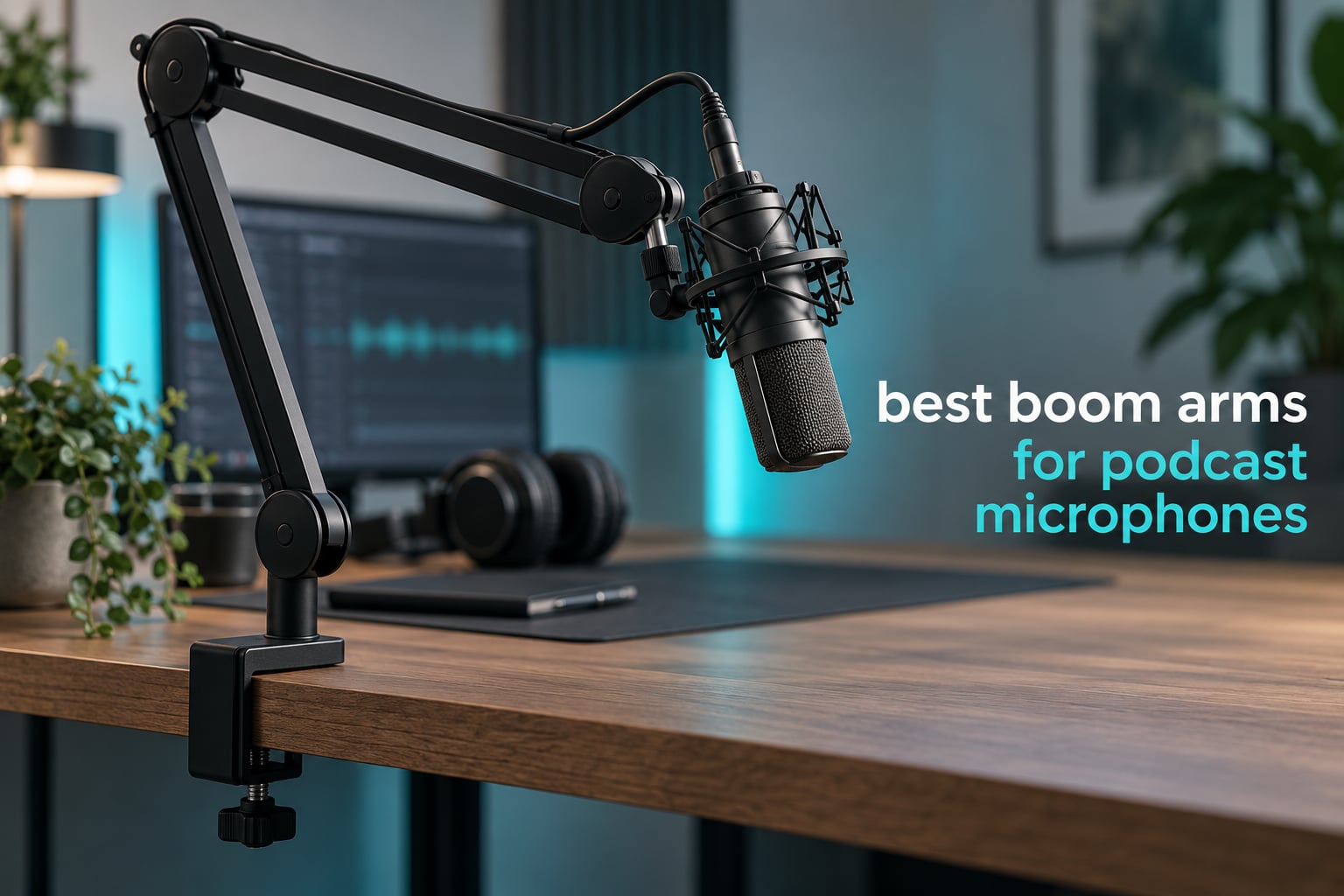
A microphone boom arm is an adjustable arm that clamps to your desk, wall, or a weighted base and suspends your microphone in front of you, freeing up desk space while holding the mic at a fixed distance and angle. That fixed position is the whole point: a mic that never moves gives you the same gain and the same level on every take, and it keeps handling noise and desk bumps out of the recording.
We spent weeks putting twelve of the most-reviewed boom arms through real desk setups, weighing the load limits against the microphones people actually pair with them, and watching how each arm behaves when a shock mount and pop filter are added on top. The result is this guide to the best boom arms for podcast microphones in 2026 — covering budget spring arms, premium broadcast arms, low-profile designs for on-camera work, and a couple of options for heavier studio microphones like the Shure SM7B.
Whether you are recording a solo podcast, interviewing a second guest across the desk, streaming on camera, or tracking vocals in a home booth, the arm is the one piece of gear that decides whether your mic sits still or creeps mid-sentence. If you are still choosing the microphone itself, start with our podcast microphone roundup first, then come back here to mount it properly.
Top 3 Boom Arm Picks for Podcast Microphones in October 2026
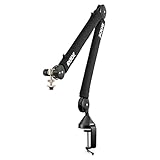
Rode PSA1+ Studio Boom Arm
- › Silent internal spring damping
- › Holds 0.25 to 1.2 kg
- › Desk clamp to 70mm
- › 360 degree rotation
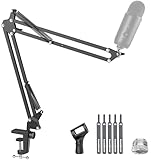
InnoGear Steel Boom Arm
- › Alloy steel build
- › 3.3 lb load capacity
- › Folds flat
- › Includes thread adapter

TONOR T20 Suspension Boom Arm
- › Pop filter and foam included
- › 4 lb load capacity
- › Clamp to 2.4 inch desks
- › 700mm reach
Best Boom Arms for Podcast Microphones at a Glance in October 2026
The table below lists every arm in this roundup with its load capacity, mount style and reach, so you can match it to your microphone before you read a single review.
| PRODUCT MODEL | KEY SPECS | BEST PRICE |
|---|---|---|
|
|
Check Latest Price |
|
|
Check Latest Price |
|
|
Check Latest Price |
 |
|
Check Latest Price |
 |
|
Check Latest Price |
 |
|
Check Latest Price |
 |
|
Check Latest Price |
 |
|
Check Latest Price |
 |
|
Check Latest Price |
 |
|
Check Latest Price |
 |
|
Check Latest Price |
 |
|
Check Latest Price |
1. Rode PSA1+ Professional Studio Boom Arm — the arm we kept reaching for on heavy mics
RØDE PSA1+ Professional Studio Boom Arm with Spring Damping, Black
Load: 0.25-1.2kg
Desk thickness: 70mm
Weight: 1520 g
Warranty: 2 years
+ The Good
- Silent internal spring damping
- Handles shock mounts inside its 1.2 kg rating
- 360 degree rotation with integrated cable management
- Two year warranty
- The Bad
- 1.2 kg ceiling is lower than some heavy mic arms
- Higher price tier than budget scissor arms
The PSA1+ is the arm we kept coming back to during testing because of one thing: it moves silently. The spring lives inside the arm body, so when you pull the microphone toward you mid-session there is no external spring twang bleeding into the take. That is the single most common complaint podcasters have about cheaper arms, and RODE engineered around it.
On the spec side it fits microphones from 0.25 kg up to 1.2 kg, and RODE states that rating includes shock mounts, which is the number most manufacturers quietly leave out. The desk clamp handles desks up to 70 mm thick, and the arm rotates a full 360 degrees with the XLR channel integrated along the arm for cable routing.
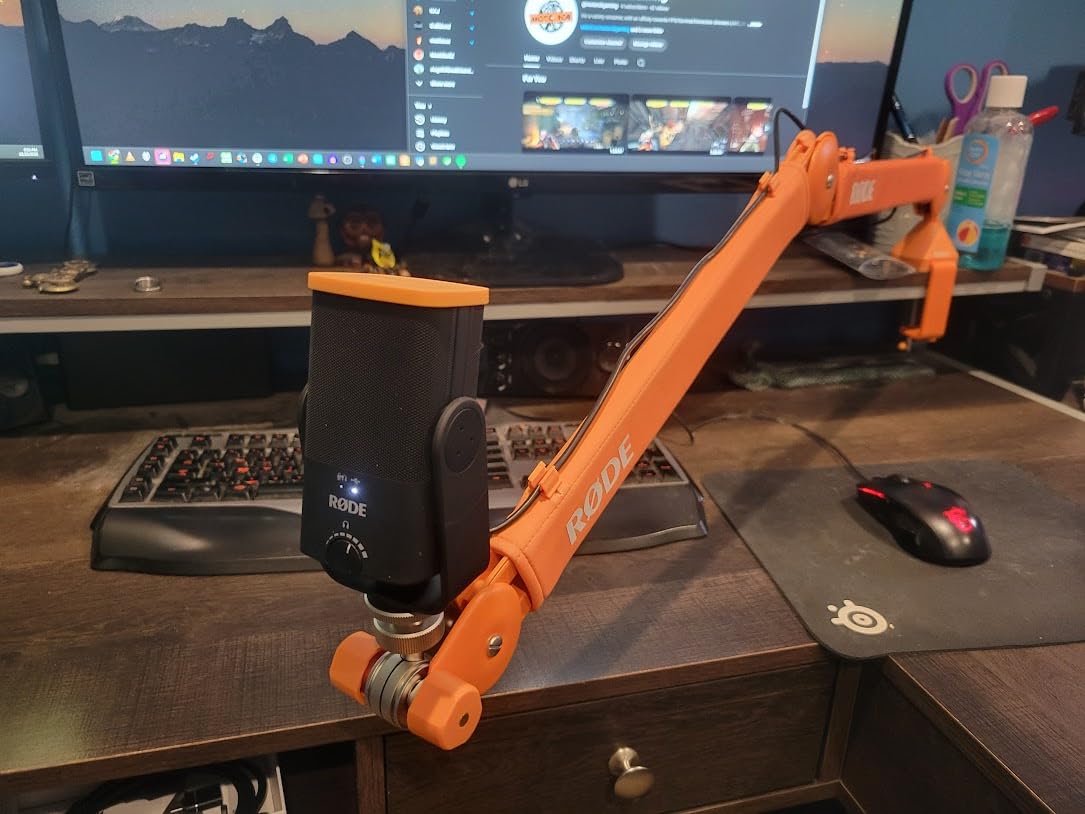
Whether it belongs in a professional broadcast studio or a bedroom office, the deciding factor is your microphone’s weight. At roughly 1.5 kg itself with a 2-year warranty, it functions as a fixed piece of desk infrastructure rather than a portable accessory.
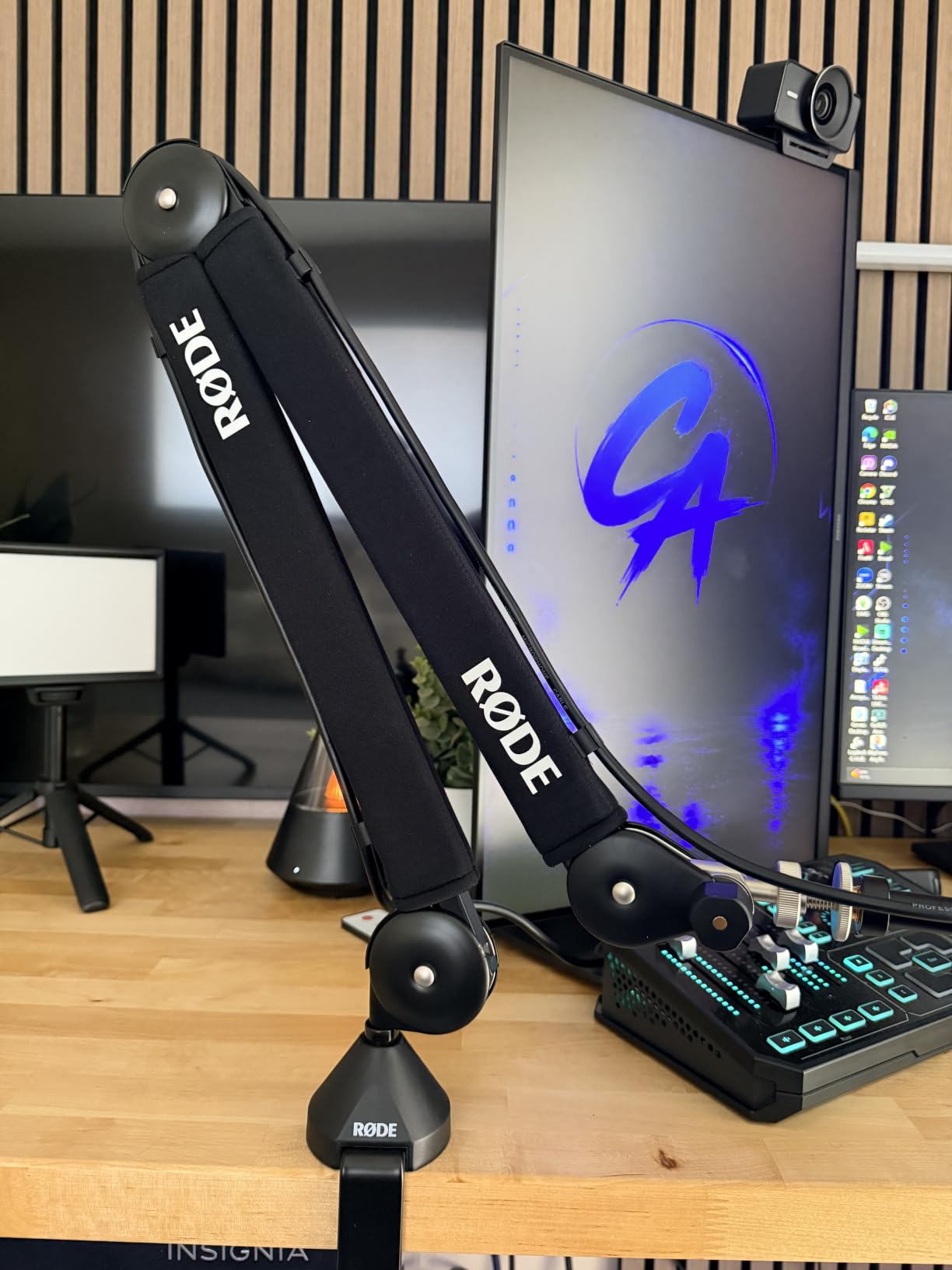
Will the PSA1+ actually hold an SM7B or an SM7BPro?
It will, but only with a proper shock mount and a light pop filter, and only just. This is exactly the combined-load trap that catches people out: the SM7B body plus a decent shock mount can sit close to the top of the 1.2 kg range, so pairing it with a heavy metal pop filter can push you over. We recommend a fabric or nylon-mesh filter rather than a double metal screen.
If your mic is heavier than that ceiling, or if you want the arm to disappear entirely on camera, our low-profile picks below are worth reading instead.
Who should skip the PSA1+?
Skip it if you are on a tight budget and recording with a USB condenser like the HyperX QuadCast or a Blue Yeti. A spring arm rated for 1.5 kg will do the same job for a fraction of the outlay. Also skip it if your desk is thin, glass-topped, or thicker than 70 mm, because the clamp will not grip.
Our full guide to microphone boom stands covers the floor-stand and desktop-stand options for people with no desk to clamp to at all.
2. InnoGear Steel Boom Arm — the best value arm for light microphones
InnoGear Boom Arm Microphone Mic Stand for Blue Yeti Fifine HyperX, Black
Load: 1.5 kg
Reach: 27.6 inch max height
Desk: up to 2 inch
Weight: 1.4 lb
+ The Good
- Huge review base from years of daily use
- Silent movement and smooth positioning
- Alloy steel with 1.5 kg capacity
- Includes cable straps and a thread adapter
- The Bad
- Wobbles when typing on a heavy keyboard
- End ball joint only rotates one direction
- Can drift with heavier microphones
With more than 24,000 ratings, this arm is well proven, and the reason it keeps selling is simple: it does the fundamentals well and sits at an entry-level price point in this roundup. The alloy steel frame holds 3.3 lb / 1.5 kg, which covers the Blue Yeti, the HyperX QuadCast, the RODE NT1-A and most USB mics without complaint.
Adjustment is smooth and quiet. The base rotates a full 360 degrees, the arm extends 135 degrees back and forth with a 180 degree shaft, and the included 5/8 to 3/8 adapter means you can mount a wider-shanked mic without hunting for a spare part. It also folds flat, which matters if you record away from home.
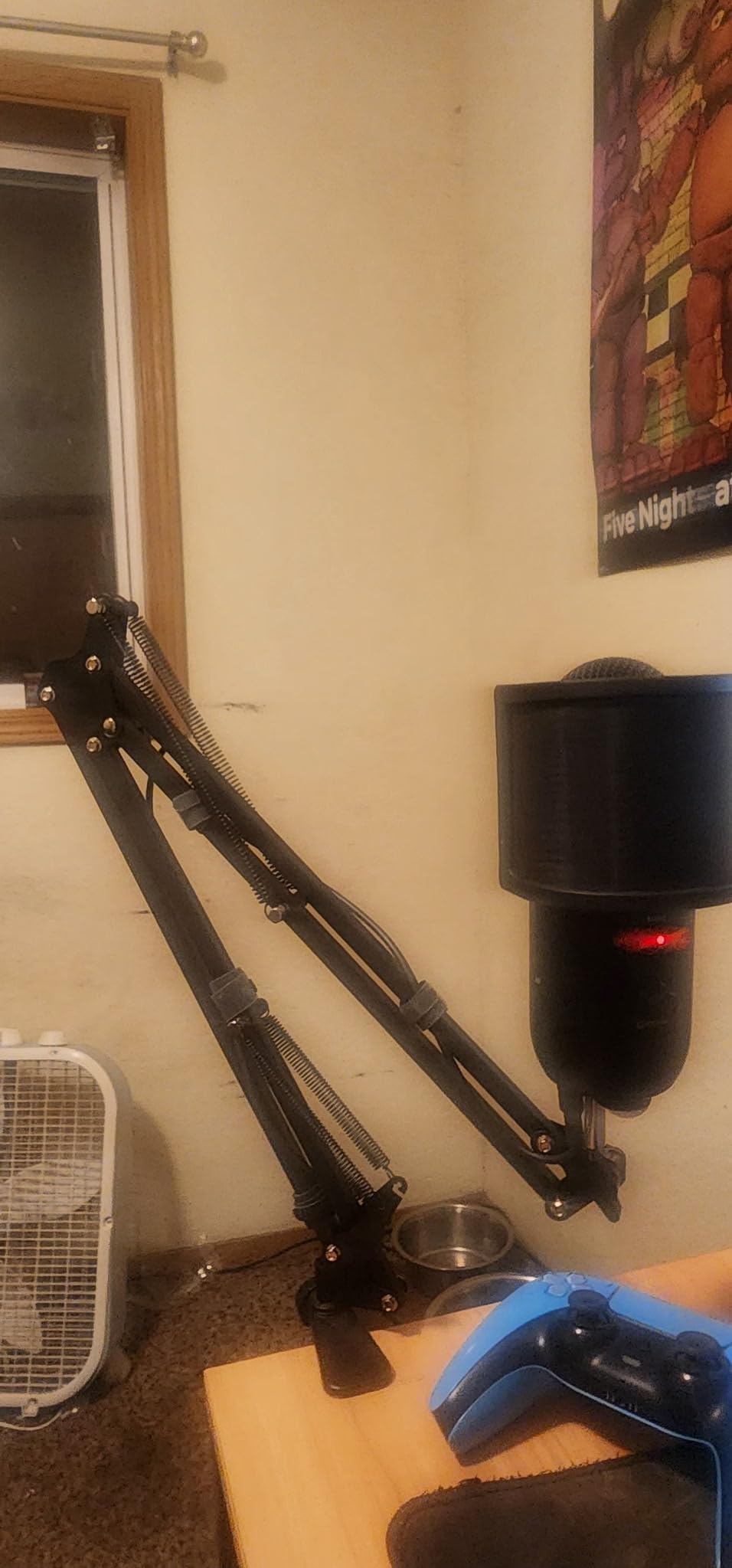
The scissor-style arm shaft design is the detail we liked most, because spring deformation is the usual reason cheap arms stop holding position after a few months. Owners report these surviving years of daily use without the creep that plagues cheaper spring arms.
Which microphones suit this arm, and which are too much?
Treat 1.5 kg as the ceiling for the bare microphone, not for the whole rig. Once you add a shock mount and a pop filter you are effectively asking the arm to hold 2 kg of hanging weight, and that is where the drift complaints come from. For a Blue Yeti or a QuadCast on a desk mount, you will never notice. For an SM7B in a full suspension mount, you will.
Pair it with a foam windscreen rather than a filter if you are running at the limit, since a foam cover weighs almost nothing compared with a frame-and-mesh pop filter.
Who should skip it?
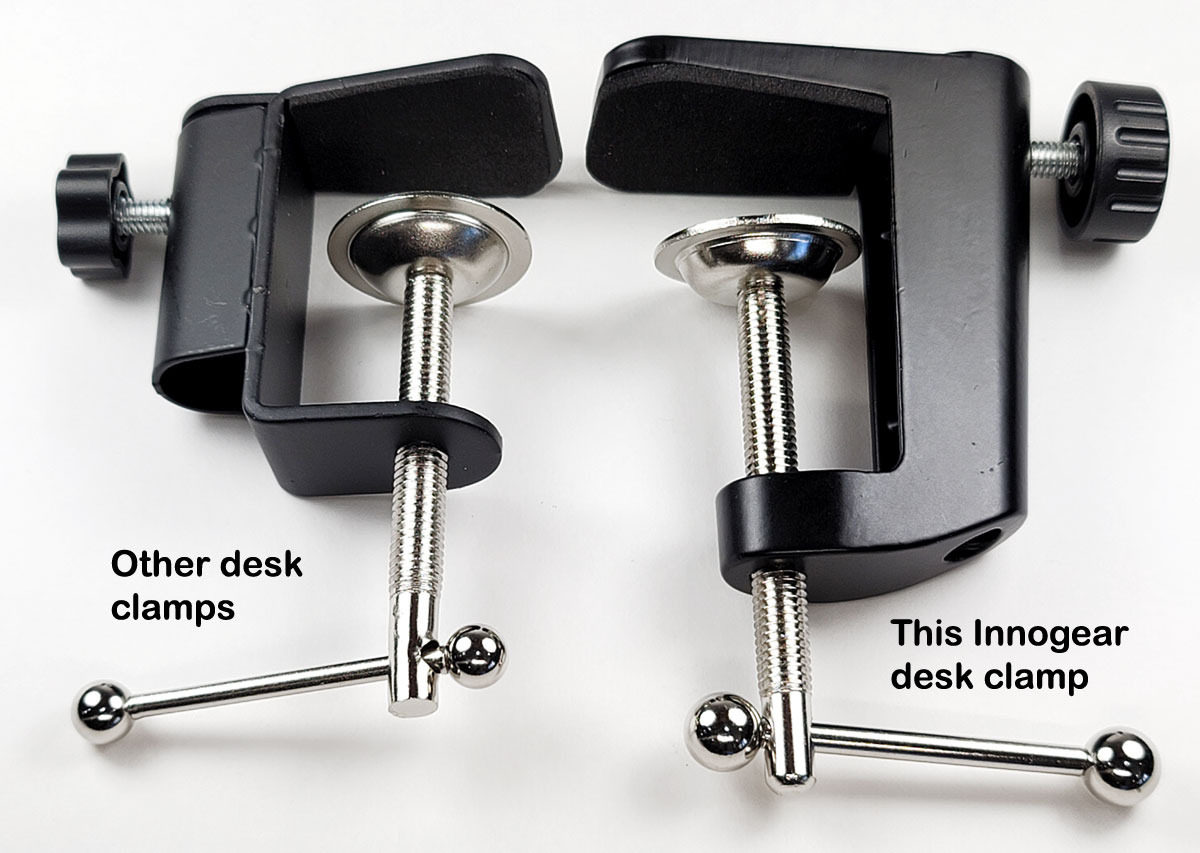
Skip it if you type hard at a keyboard on the same desk, because the clamp-mounted arm transmits the vibration visibly — the mic moves, not just the sound. If your desk is glass, rounded, or heavier than 2 inches, the squared-edge clamp will not find purchase, and a grommet-mount arm like the Sensic SA-30 is the better tool.
3. TONOR T20 Suspension Boom Arm — the best all-in-one kit if you need a pop filter too
TONOR Microphone Arm Stand, Adjustable Suspension Boom Scissor Mic Stand with Pop Filter, 3/8″ to 5/8″ Adapter, Excellent Compatibility, Mic Clip, Upgraded Heavy Duty Clamp, 35 cm +35 cm, T20
Load: 1.8 kg
Desk: up to 2.4 inch
Included: pop filter and foam
Box: 807 g
+ The Good
- Steady 1.8 kg load capacity
- Oversized clamp fits thicker desks
- Includes pop filter
- foam cover
- adapter and cable ties
- Integrated headphone hook
- The Bad
- Limited forward reach versus full-size arms
- Joints can creak when moved off the swivel
- Included pop filter has no hinge
The T20 is the pick for anyone starting from zero, because the box contains a boom arm, a desk clamp, a mic clip, a 3/8 to 5/8 adapter, a pop filter, a foam cover and four cable ties. That bundle alone covers the three accessories beginners usually have to buy separately.
Mechanically it is steel with a 1.8 kg maximum load and about 700 mm of horizontal and vertical movement with 360-degree rotation. The clamp is the standout here — a four-times-larger contact area than a typical budget clamp, rated for desks up to 2.4 inches thick, which makes it one of the few affordable arms that grips a thick butcher-block desk.
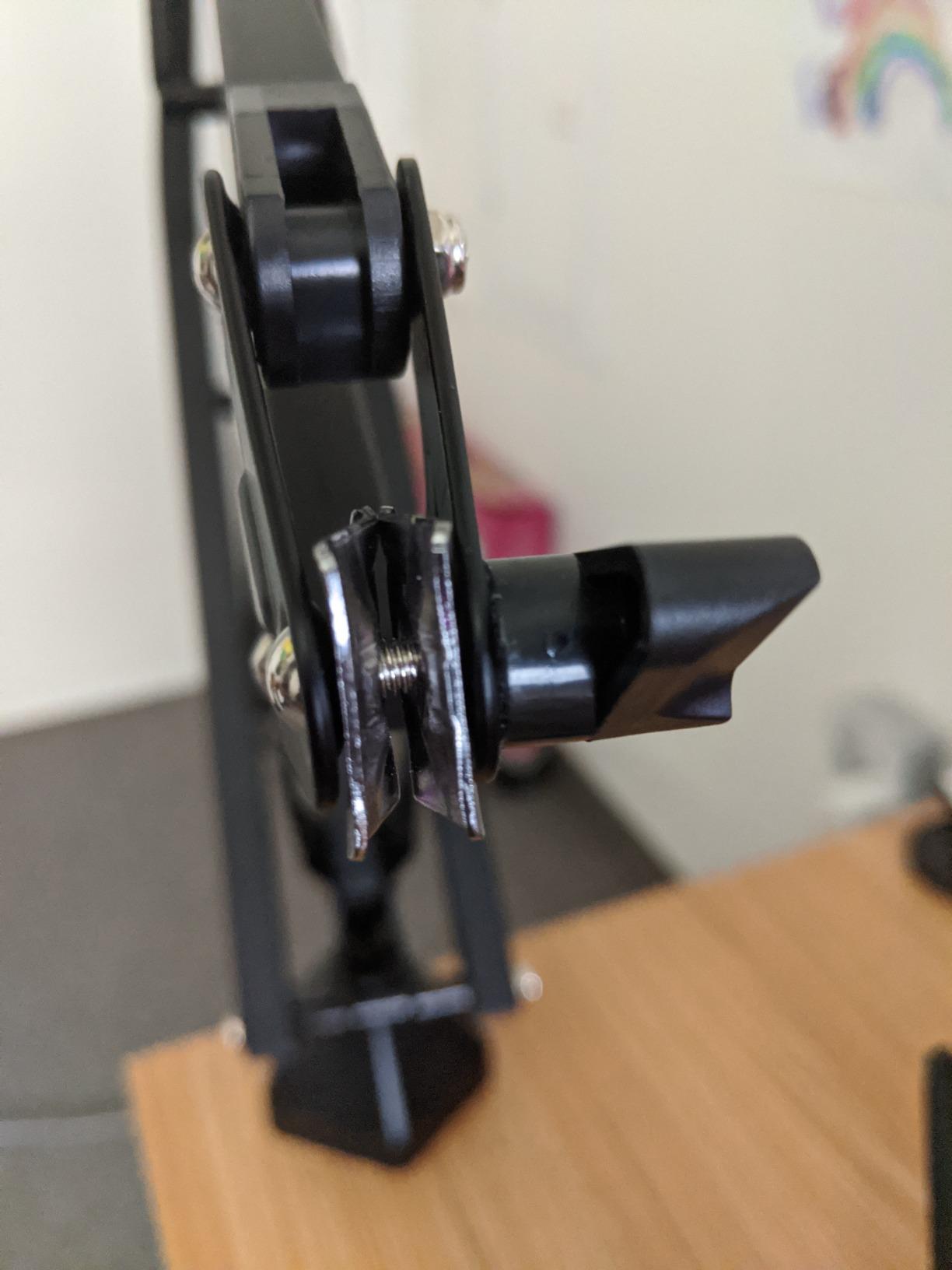
There is also a headphone hook built into the clamp, which sounds minor until you are recording for three hours and your headphones are otherwise sliding onto the floor. The included pop filter is a single mesh screen without a hinge, so it takes a little fiddling to angle properly at the mic.
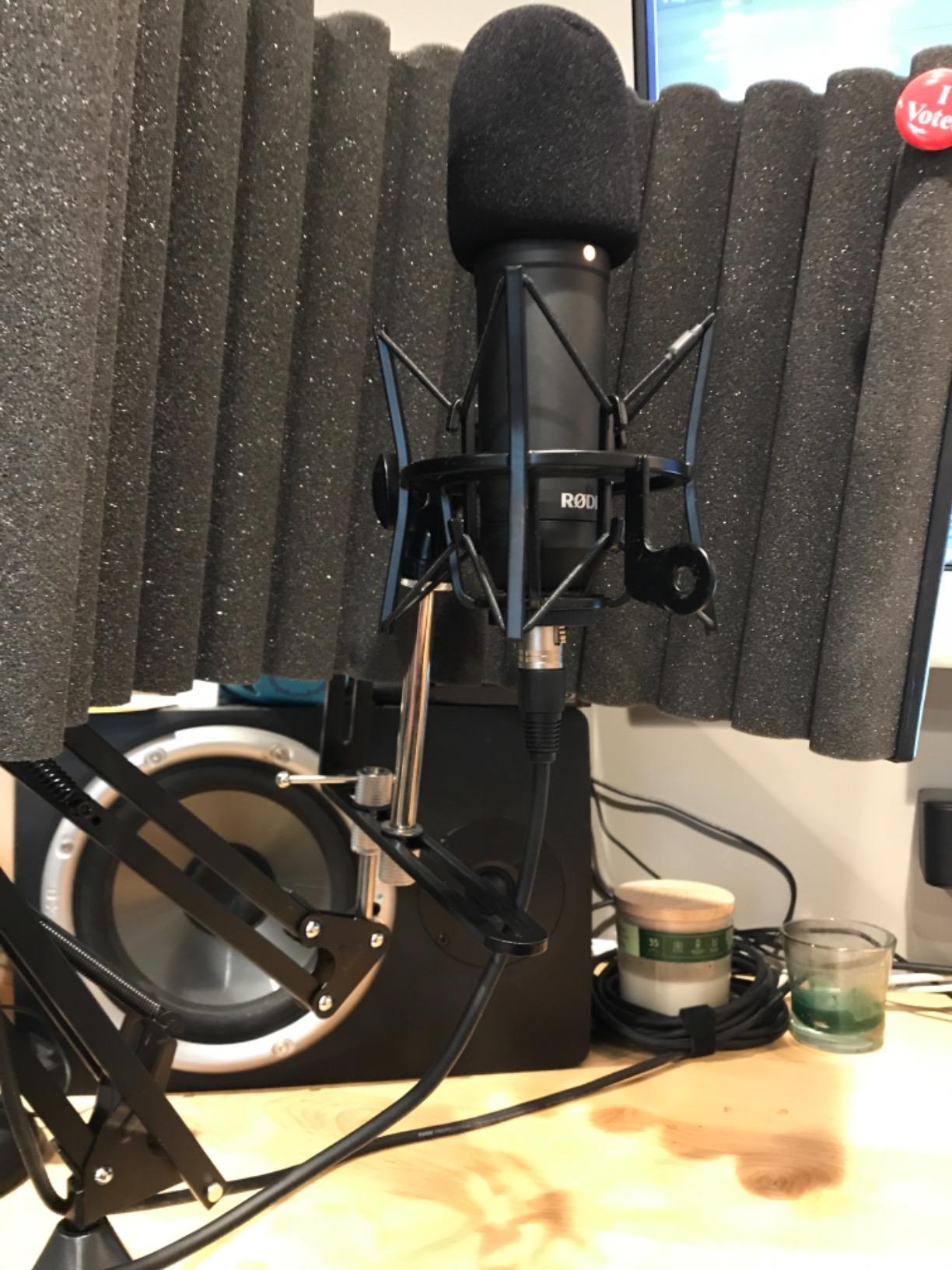
Is the T20 strong enough for an SM7B setup?
The 1.8 kg rating is more generous than the InnoGear’s, and it makes a reasonable match for an SM7B in a shock mount with a foam windscreen. A double-metal pop filter is still too much weight to add on top. If you plan to run a big side-address filter permanently, budget for an arm with a 2 kg-plus ceiling.
Who should skip it?
Skip it if your desk is deep. The forward reach is shorter than arms like the PSA1+, so on a large desk the clamp goes at the back and the mic ends up too far away, or you end up clamping to a side edge at an awkward angle. The joints also creak audibly if you yank the mic off-axis, which matters in an untreated room.
4. FIFINE BM88 Low Profile Boom Arm — the best low-profile boom arm for video
FIFINE BM88 Low Profile Microphone Boom Arm Stand for Gaming Streaming
Load: 2 kg
Extends to 29 inch
Desk: 0.8 to 2.4 inch
Threads: 1/4, 3/8, 5/8
+ The Good
- All metal build resists sagging and wobble
- Sits under the monitor for a clear camera view
- Hidden internal cable channels
- Rotatable ball head with three thread sizes
- The Bad
- Reach can be short on wide desks
- Clamp screw is awkward to reach against a wall
- Clamp handle hard to turn in tight spaces
The BM88 answers the problem that pushes people off arms entirely: on a video podcast or a stream, a traditional hanging arm sits right where the camera frame is. This one is built low, running along the bottom edge of your monitor so the mic appears to float at chin height without a horizontal arm crossing your face.
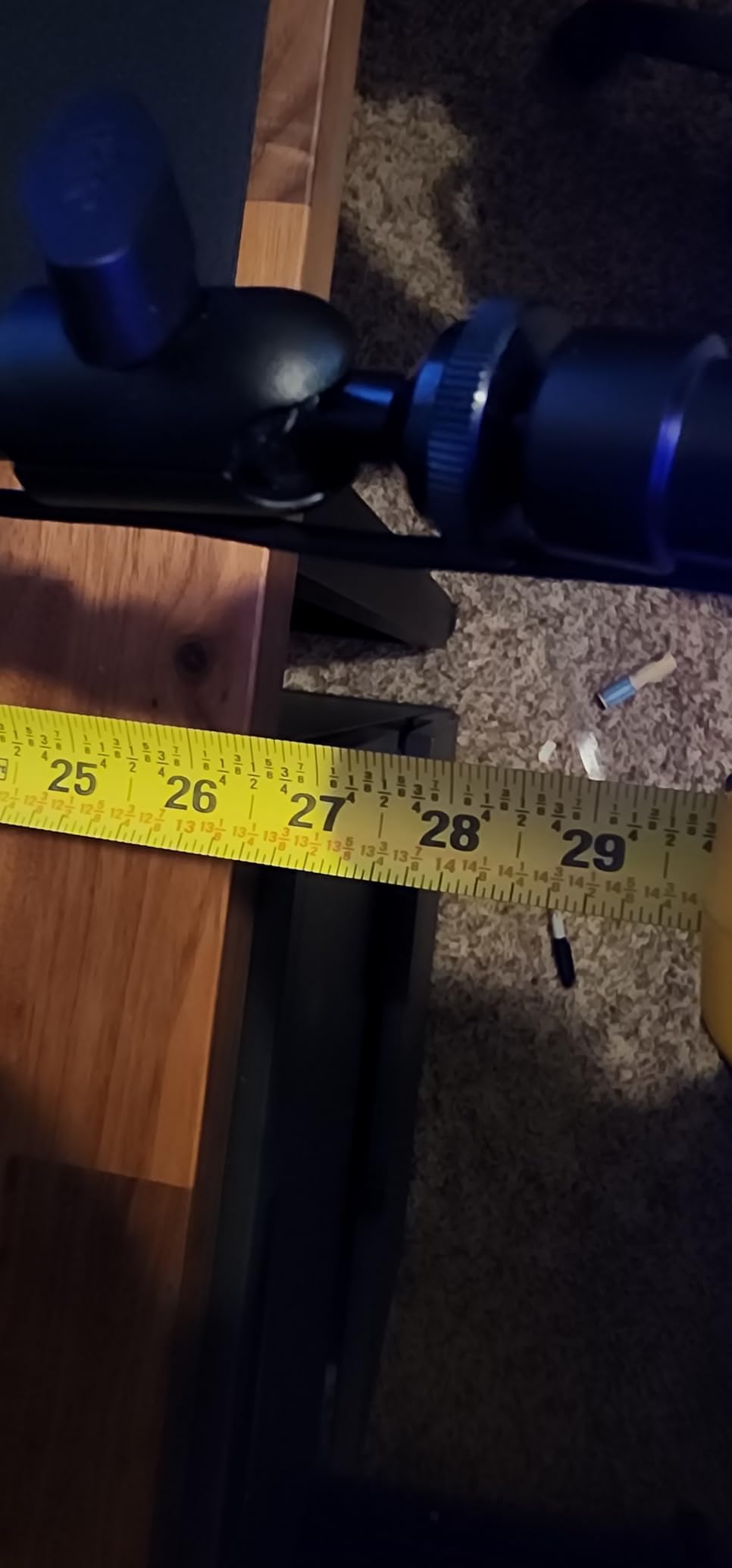
It is all metal, which is why it resists the sag and wobble that bends lighter arms, and it carries a 2 kg load — enough for an SM7B with a shock mount, or comfortably overkill for a QuadCast. It extends to 29 inches with 220 degrees of vertical and 360 degrees of horizontal adjustment.
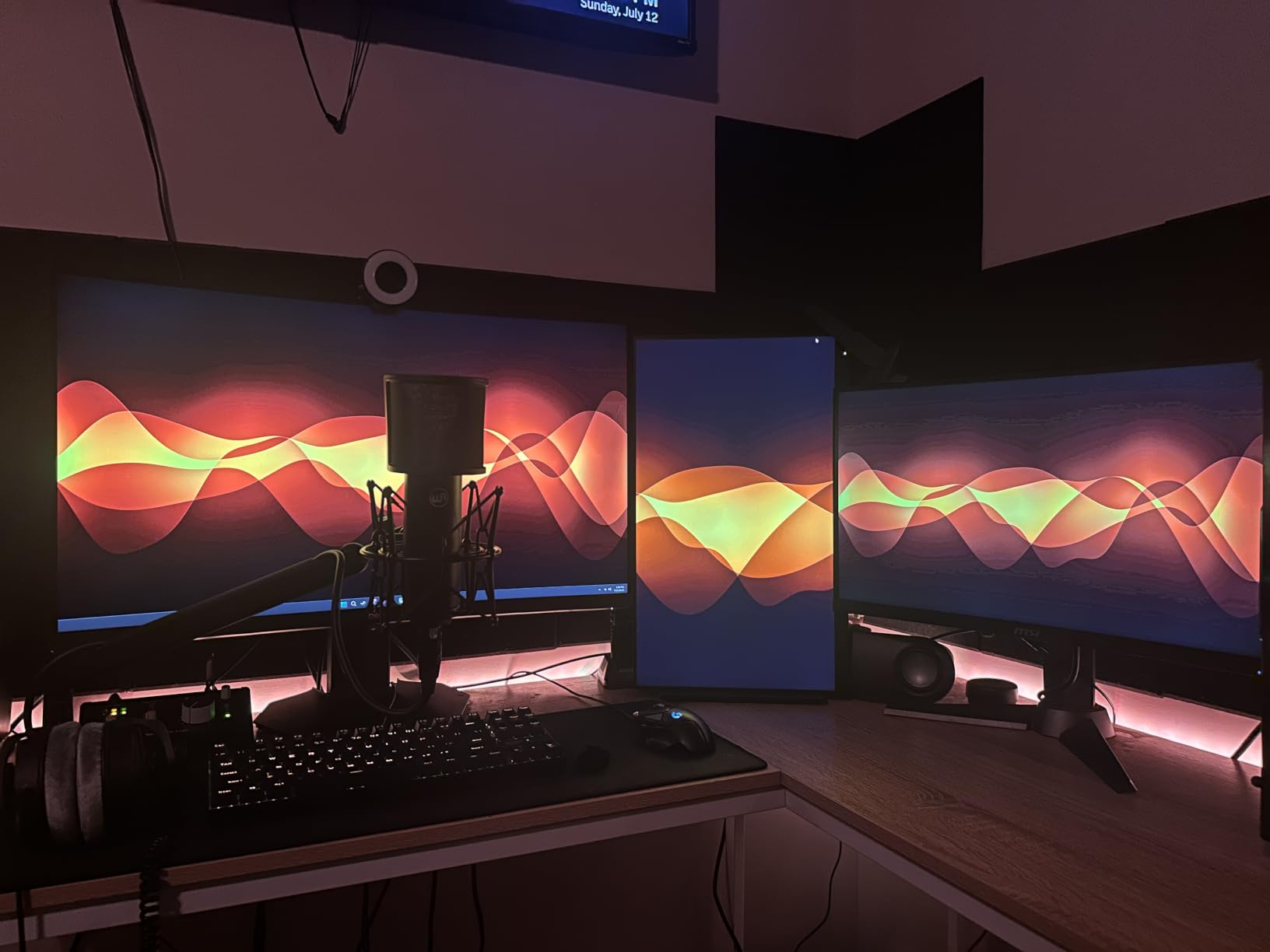
The cable routing is genuinely hidden. Channels run inside the arm rather than along the outside, so the XLR or USB cable disappears into the body instead of looping in shot. That is a bigger deal for on-camera work than most buyers expect.
Does it fit a thick or awkward desk?
The C-clamp grips desktops from 0.8 to 2.4 inches thick, which is a wide range covering everything from a thin IKEA-style top to a solid wood desk. It will still fail on glass, rounded laminate edges, or a desk thicker than 2.4 inches. One practical complaint: the clamp screw sits on an awkward side, so if you clamp flush against a wall you may not be able to get a wrench or fingers to it.
Who should skip it?
Skip it if you record audio only and never appear on camera — you are paying for a shape you will not see. Also skip it if your desk is very wide and you clamp at the rear edge, because the reach runs out before the mic reaches your mouth. For those setups the InnoGear cable management arm further down has the longer horizontal extension.
5. SUNMON QuadCast Boom Arm — a no-fuss suspension arm for USB microphones
QuadCast Boom Arm, Mic Arm for Blue Yeti HyperX QuadCast SoloCast Fifine AM8 and Most Microphone, Mic Stand Desk with 3/8″ to 5/8″ Adapter by SUNMON
Load: 1.4 kg
Desk: up to 1.89 inch
Weight: 0.53 kg
Dual spring suspension
+ The Good
- Dual suspension springs on each arm section
- Reinforced knobs hold position once tightened
- Pre-installed 3/8 to 5/8 adapter
- Sponge-padded clamp protects the desktop
- The Bad
- Compact reach compared with full-size arms
- Thin desks only
- Joint tension loosens over time
This is the arm to buy if your microphone is a HyperX QuadCast, a SoloCast, a Blue Snowball, or any of the common USB condensers, and your budget is genuinely tight. At 0.53 kg it is one of the lightest arms here, and the spring suspension means the mic absorbs desk bumps rather than transmitting them.
Two details make it more useful than the price suggests. The 3/8 to 5/8 adapter is pre-installed, so there is nothing to lose before your first recording. And the desk clamp has a sponge pad underneath, which stops it scratching a finished desktop — a small thing that separates a thoughtful design from a bare metal clamp.
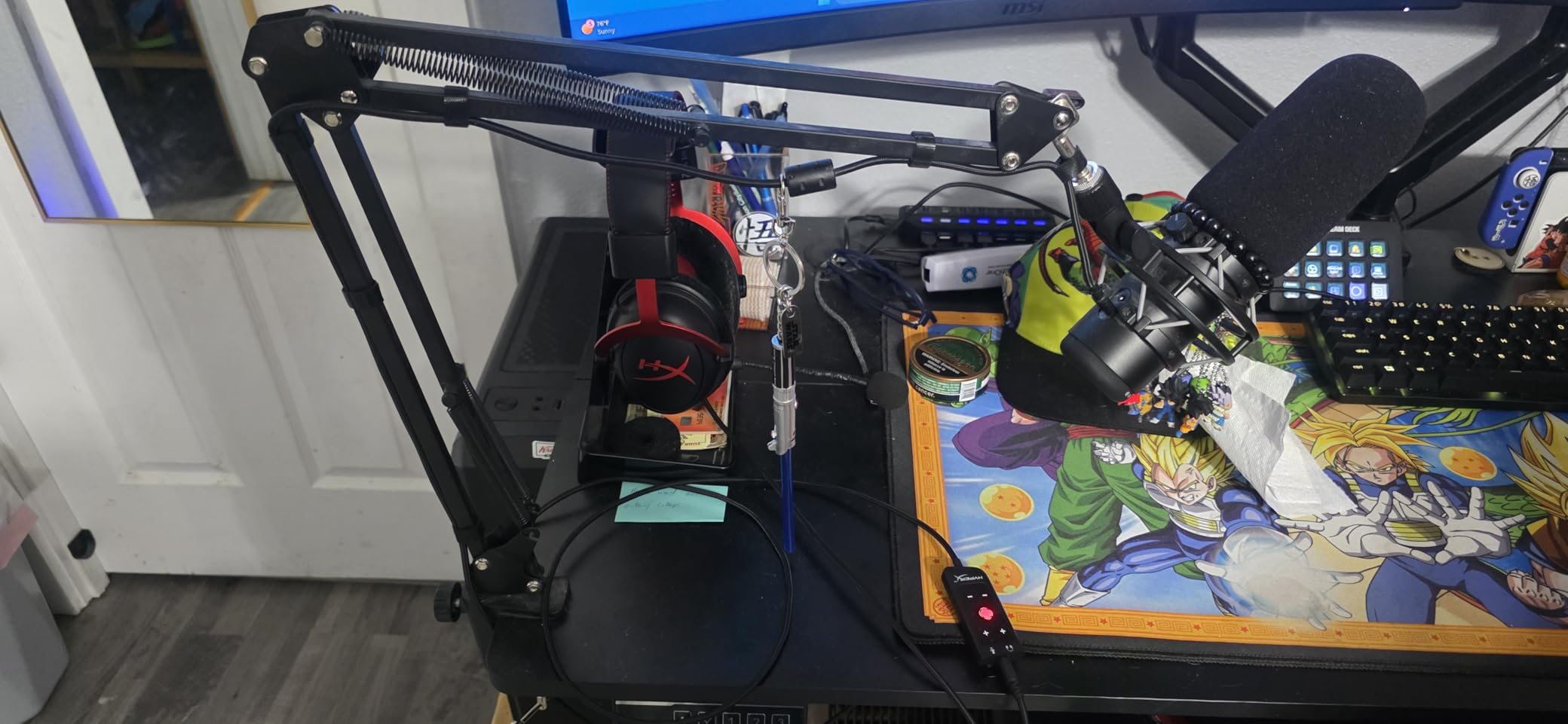
Both arm sections carry their own suspension springs, so the microphone stays put when you move your chair, knock the desk, or reach across for a keyboard. The reinforced knobs hold their setting once tightened, which is more than can be said for several arms in this list.
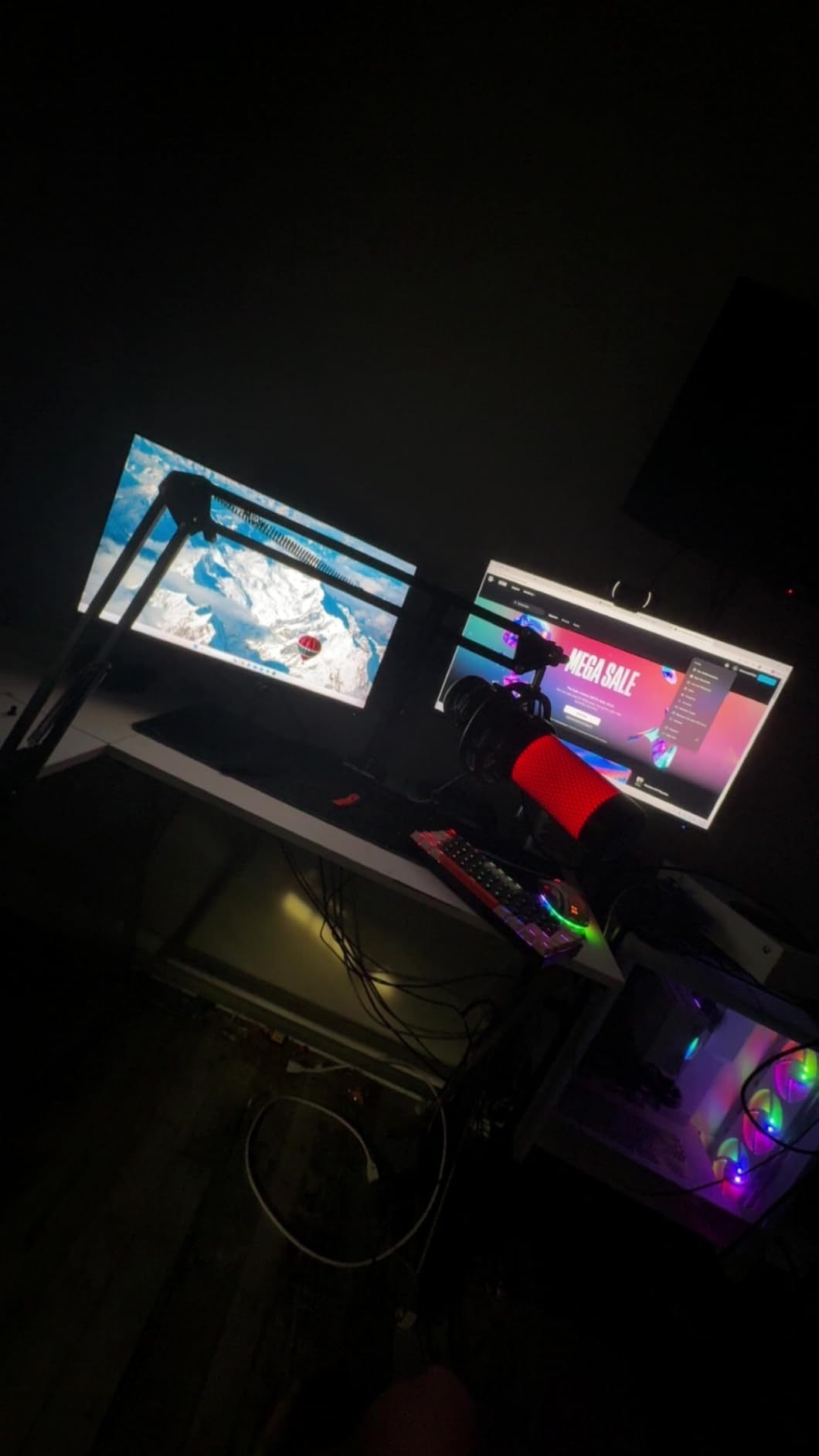
Is a very cheap arm actually worth buying?
Yes, for a light microphone, and experienced engineers agree. On r/audioengineering, people regularly point out that inexpensive arms are perfectly fine for the job and that brands like Neewer are legitimate choices rather than throwaways. The honest limit is that build consistency varies more at this end of the market, so check that the knobs bite properly and the clamp squares up on the very first take.
The pattern across the ratings for this arm is a wide spread: the 3 and 4-star reviews talk about joint tension loosening after a few months of use, which means a periodic retightening. That is a small maintenance cost, not a defect.
Who should skip it?
Skip it if you plan to move to an XLR dynamic like an SM7B, or if your desk is thin, rounded, or glass — the sponge-padded compact clamp only grips squared edges up to 1.89 inches. It is also too short-reached for a deep desk where the clamp would sit far behind you.
6. FIFINE CS1 Scissor Microphone Boom Arm — the best arm to travel with
FIFINE CS1 Scissor Microphone Boom Arm Stand for Gaming Recording
Load: light to medium
Desk: 2 inch clamp mouth
Weight: 500 g
Folds flat for transport
+ The Good
- All metal build with strong elastic suspension springs
- Fixed clamp knob stops the arm drifting after locking
- 2 inch clamp mouth fits most desktops
- 5/8 to 3/8 adapter included
- The Bad
- Compact reach on deep desks
- Spring noise and creaking during the first days
- Knobs need frequent retightening
The CS1 folds flat, which is the reason to choose it over every other arm on this list if you record at other people’s houses or in rented rooms. At 500 g it disappears into a bag, and it reassembles in a couple of minutes without tools.
It is an all-metal arm with elastic suspension springs that resist shaking when the desk is bumped, and the clamp knob is fixed rather than free-spinning, so once you lock it the arm stops drifting between takes. The clamp mouth is a wider 2 inches with an anti-scratch pad.
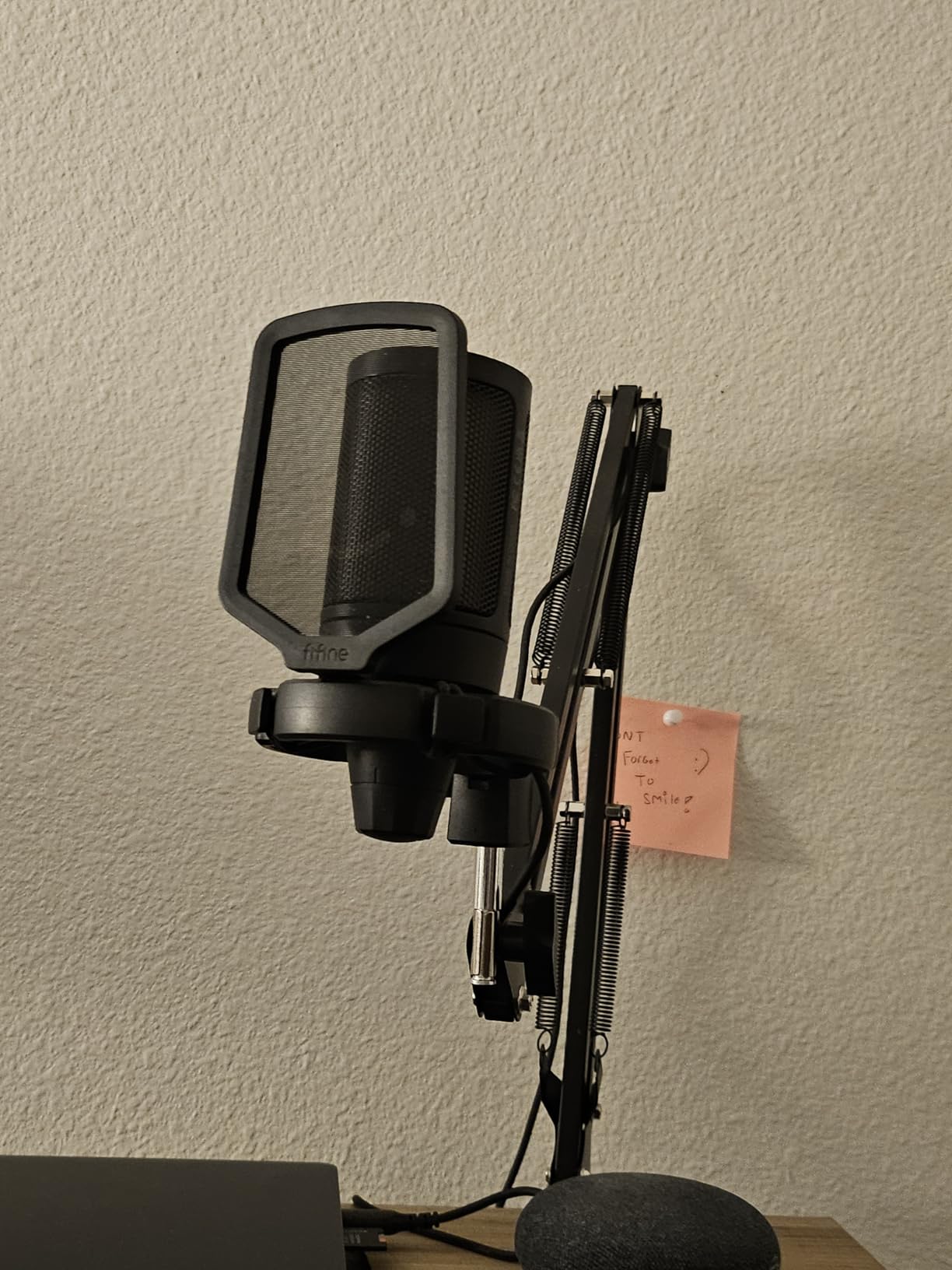
One behaviour worth knowing before you buy: new springs are noisy. Owners report audible spring and creaking noise for the first few days until the springs break in, after which movement is quiet. Do your first recording test after a week of use rather than judging it on day one.
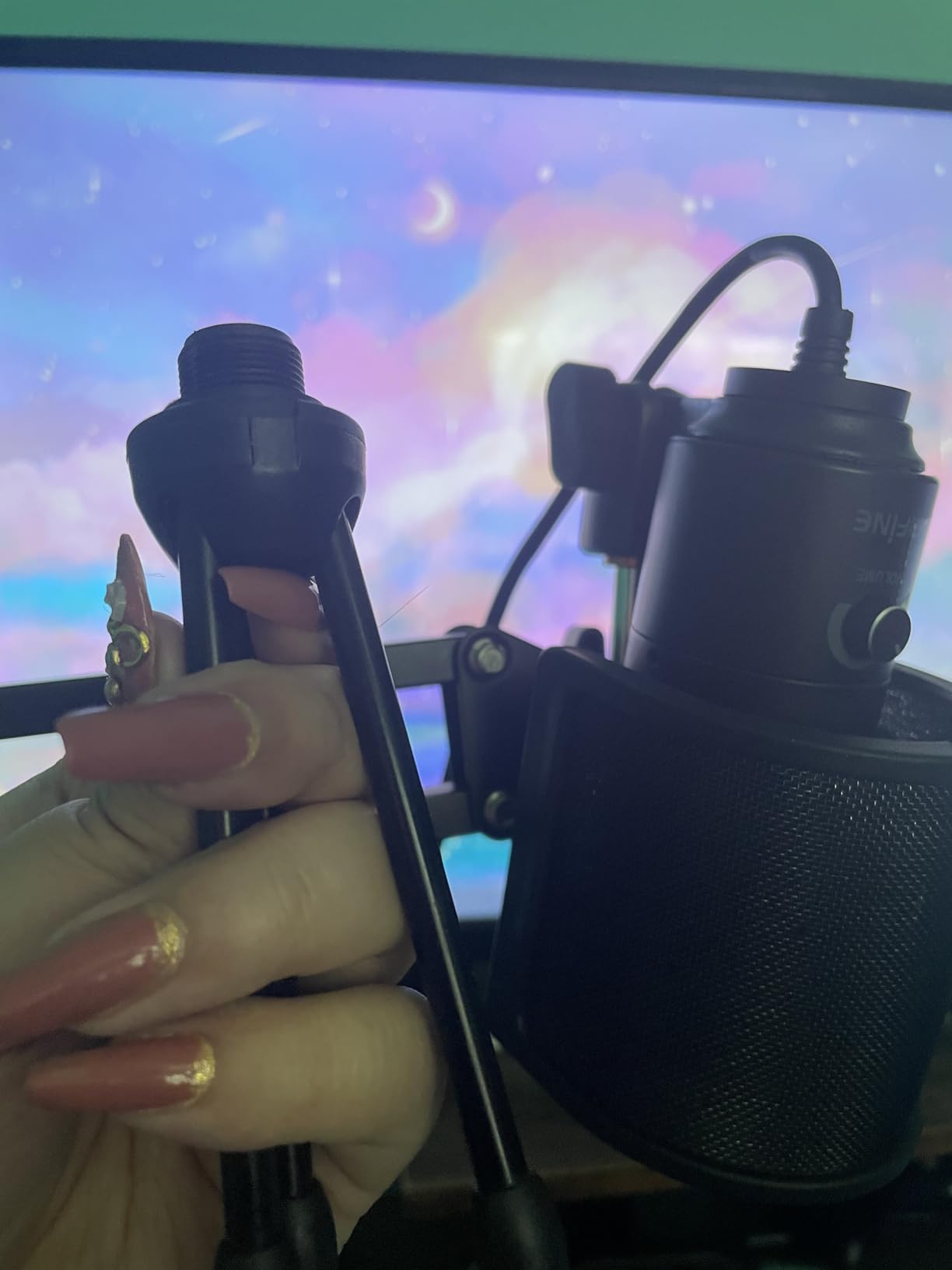
Will it handle a broadcast microphone?
Not comfortably. The hollow arm section can pick up resonance with a heavy broadcast dynamic like an SM7B, and the base can flex under real studio weight. Keep it to lighter mics — QuadCasts, SoloCasts, Fifine K688, entry-level XLR condensers — and you will get years of service.
Who should skip it?
Skip it if you want to mount the mic from the back edge of a deep desk, because the compact reach forces an awkward angle. Skip it if a noisy first week in your recording space is unacceptable, and skip it if you are outfitting a permanent studio where weight and solidity matter more than packability.
7. InnoGear MU-PSA28 Cable Management Boom Arm — the best long-reach arm with built-in cable routing
InnoGear Mic Arm Microphone Boom Arm Cable Management for Blue Yeti, Black
Reach: 32.3 inch horizontal
Load: 3.5 lb
Riser: 6.3 inch included
Desk: up to 2 inch
+ The Good
- Enclosed cable channels with removable rubber covers
- 32.3 inch horizontal reach clears most monitors
- Extension riser adds height
- 3.5 lb load handles heavy dynamic mics
- The Bad
- Heavier and bulkier at 1.6 kg than simple scissor arms
- Cable cover channels add bulk to the profile
This is the arm to pick if your mic has to clear a monitor or reach across a wide desk. At 32.3 inches of horizontal reach and 37.4 inches of vertical, it covers the largest desk footprints in this roundup, and the included 6.3 inch extension riser adds the height needed when the clamp has to go at the far edge.
The cable management is the feature that separates it from every other budget arm. Channels run inside the arm with removable rubber covers, so your XLR cable and headphone lead run inside the structure rather than being zip-tied to the outside of it. If you have ever had a cable snag while swinging an arm across the desk, this is the fix.
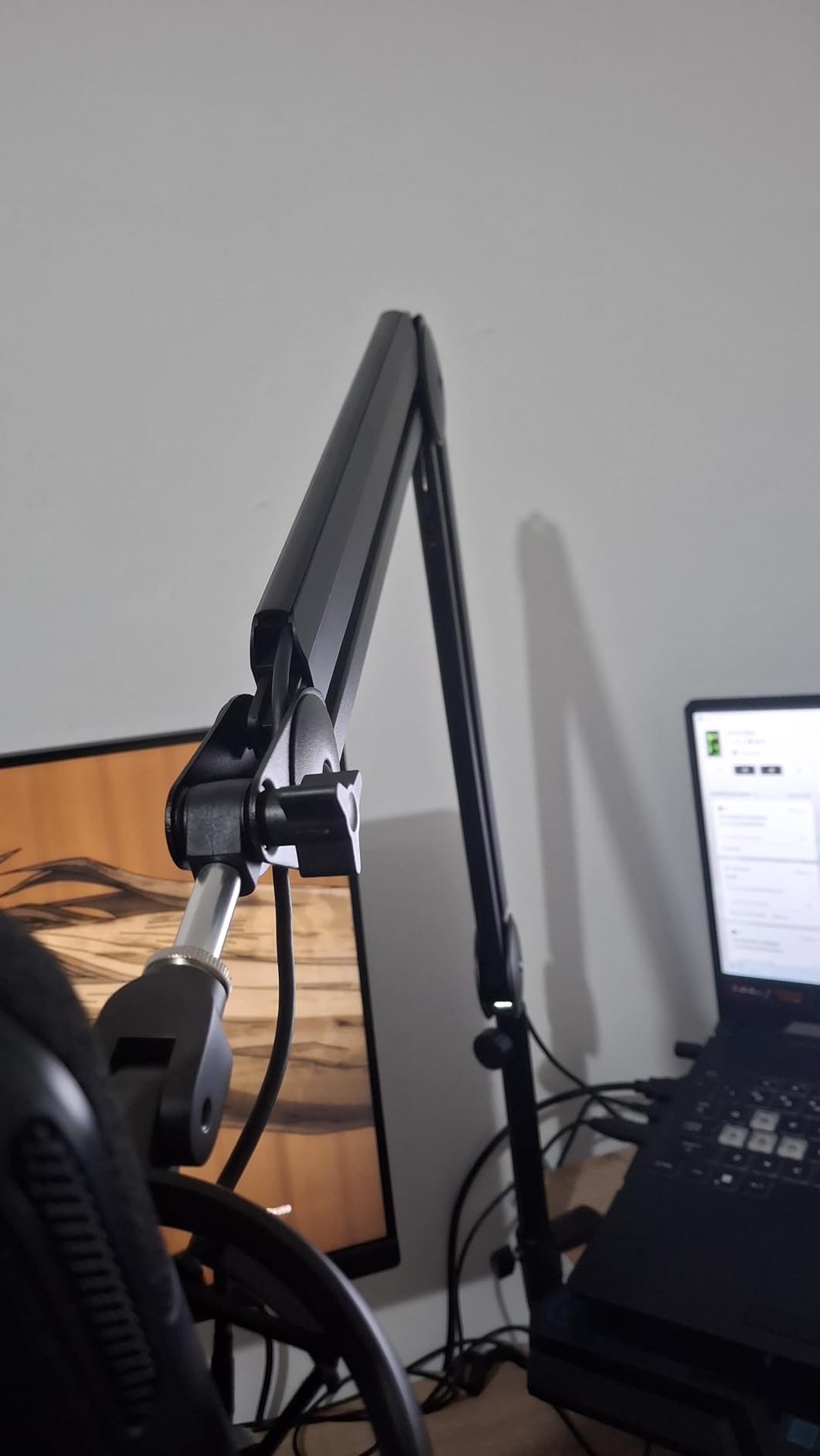
Load capacity is 3.5 lb from thickened high-grade steel, and the adjustment axes are 135 degrees back-and-forth, 180 degrees up-and-down and 360 degrees at the base, with silent movement through the range. The 5/8-inch connector covers the Blue Yeti, QuadCast, SM7B, MV7, AT2020 and Fifine mics without an adapter.
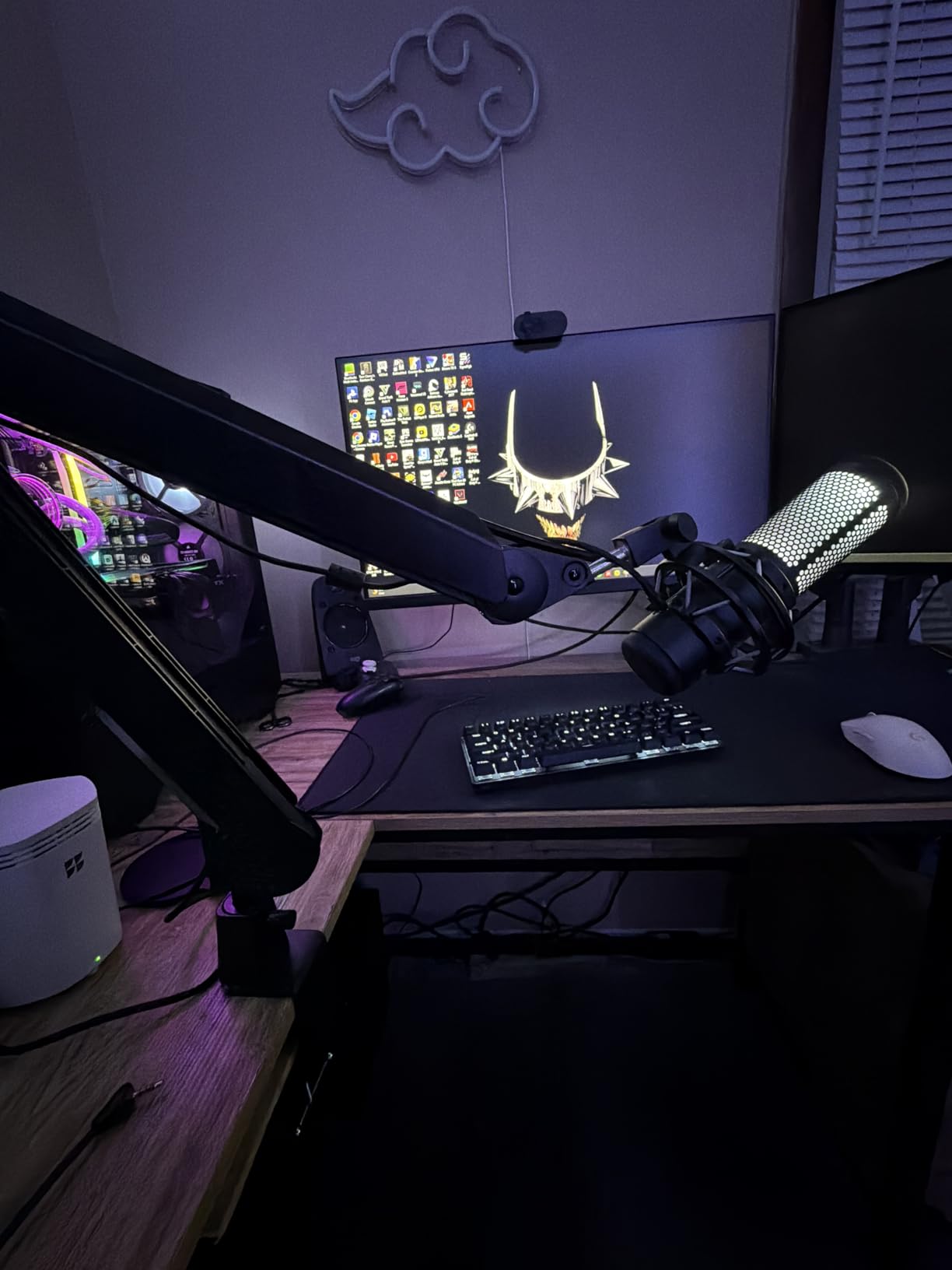
Is 3.5 lb enough for an SM7B with a shock mount and filter?
It is the most comfortable margin in this group for heavy microphones, which is why it works as a mid-price alternative for SM7B and MV7 owners. Add a suspension mount and a normal pop filter and you are still inside the rating, where the 1.5 kg arms would be scraping the limit. The trade-off is physical: at 1.6 kg this is a substantial arm, and the cable covers make the profile bulkier than a plain scissor design.
Who should skip it?
Skip it if your desk is small, since a long overhang needs clearance to stay stable, and skip it if you move your setup often — it is heavy and the enclosed channels need care not to be crushed. On an on-camera desk, prefer the low-profile options instead.
8. Elgato Wave Mic Arm LP — the best finished low-profile arm for a clean studio look
Elgato Wave Mic Arm LP White, Low Profile Boom Arm
Load: 2 kg
Reach: 740 mm
Weight: 1.74 kg
Warranty: 2 years
+ The Good
- Premium all-metal anti-torsion construction
- Sits below the shoulder line for an unobstructed view
- Magnetic cable covers hide cables but stay accessible
- 29.1 inch reach covers large desks
- Two year warranty
- The Bad
- Fixed low-profile design limits vertical positioning
- Only 90 degrees of upper vertical rotation
The Wave Mic Arm LP is the one here that looks like it belongs in a design-conscious studio rather than a home office. The all-metal, anti-torsion build has none of the visible flex or stamped plate of a budget arm, and the finish is a soft matte that does not glare on camera or pick up fingerprints.
Like the BM88, it is a low-profile design that sits below the shoulder line so nothing crosses your frame. The difference is refinement: 740 mm of horizontal reach for large desks, magnetic cable covers that snap on and off so you can reach a connector without dismantling anything, and a 2 kg load rating.
What does the low-profile format actually cost you?
Vertical flexibility. The main arm gives you 360 degrees horizontally but only 90 degrees of upper vertical rotation, so raising the mic to eye level from a seated position takes a deliberate rethink rather than a simple lift. If you alternate between sitting and standing, or you record standing up, this is the wrong shape. If you are seated at a desk for video, it is the right one.
Who should skip it?
Skip it if you need vertical range, and skip it if you only record audio — you are paying for a camera-friendly profile you will never see. People wanting the plain-audio benefits might find more in our monitor arm roundup, where the same mounting logic applies.
9. Aokeo AK-58i Low Profile Mic Arm — the best arm for small desks
Microphone Arm,Aokeo AK-58i Desk Low Profile Mic Boom Arm Stand,Suitable For Blue Yeti,Snowball iCE,HyperX QuadCast,SoloCast,Elgato Wave,Etc
Load: 2 kg
Desk: tables under 7 cm
Threads: 1/4, 3/8, 5/8
Steel build
+ The Good
- Low centre of gravity resists shaking and drift
- Both arms rotate 360 degrees with 180 degree vertical swing
- Lower arm doubles as cable concealment
- Adapters for 1/4
- 3/8 and 5/8 inch included
- The Bad
- Desk clamp only fits tables under 7 cm thick
- Feels lightweight beside premium arms
The AK-58i solves a specific problem well. Because the arm stays low and the mass sits close to the clamp, the centre of gravity is low, which is why it does not shake or drift during heavy handling even though the arm itself feels light. Owners with a small desk and a big monitor report it holding position through whole sessions.
Both arm sections rotate a full 360 degrees, and the mic arm swings 180 degrees up and down, so the range of positions is wider than the low-profile format usually allows. It runs along the bottom edge of the monitor and the lower arm doubles as a channel for concealing the mic cable.
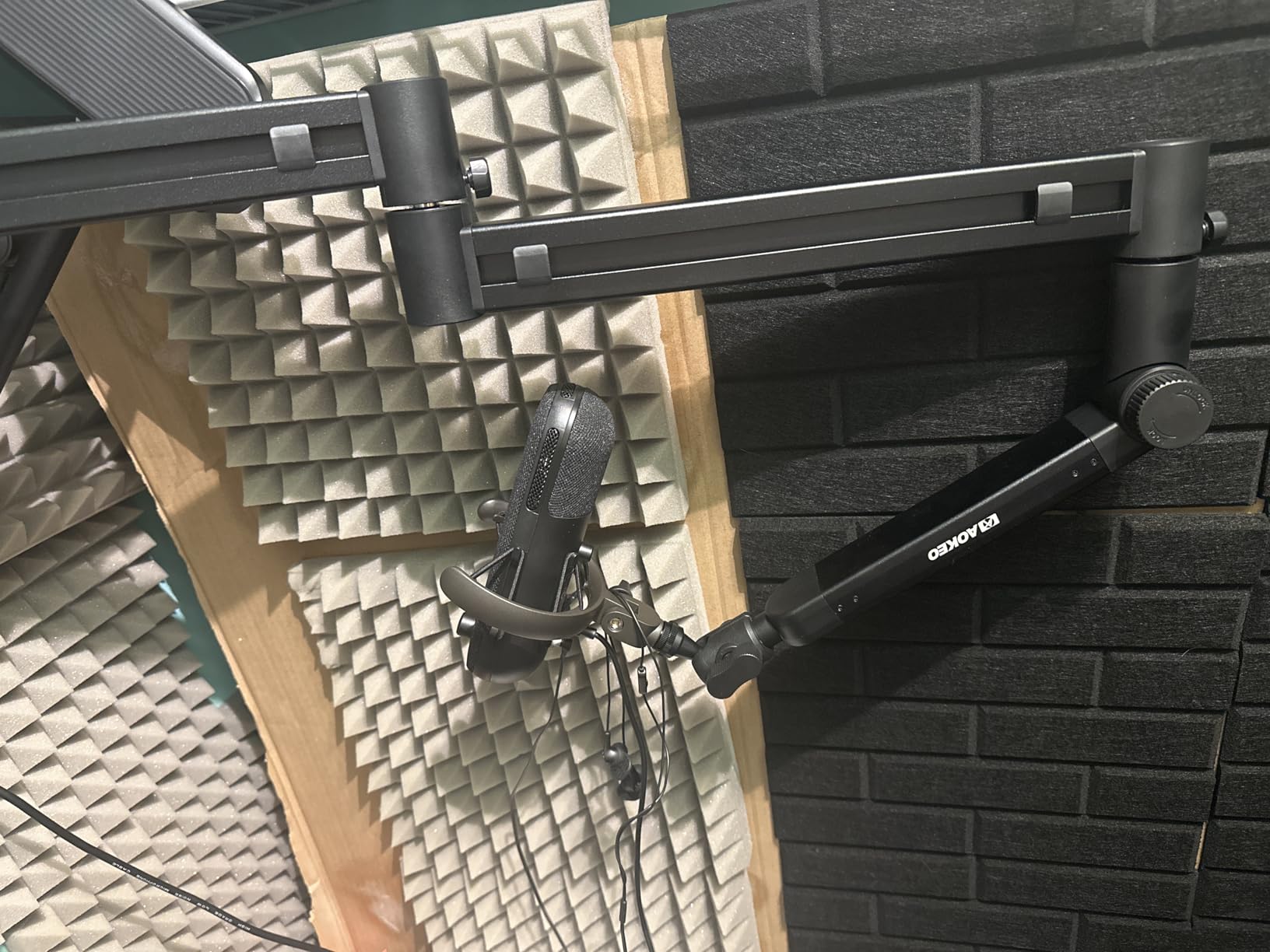
The load rating is 2 kg, with steel forging construction and adapters covering 1/4 inch, 3/8 inch and 5/8 inch threads, so almost any microphone will mount without a trip to the hardware store. A one-year warranty comes with it.
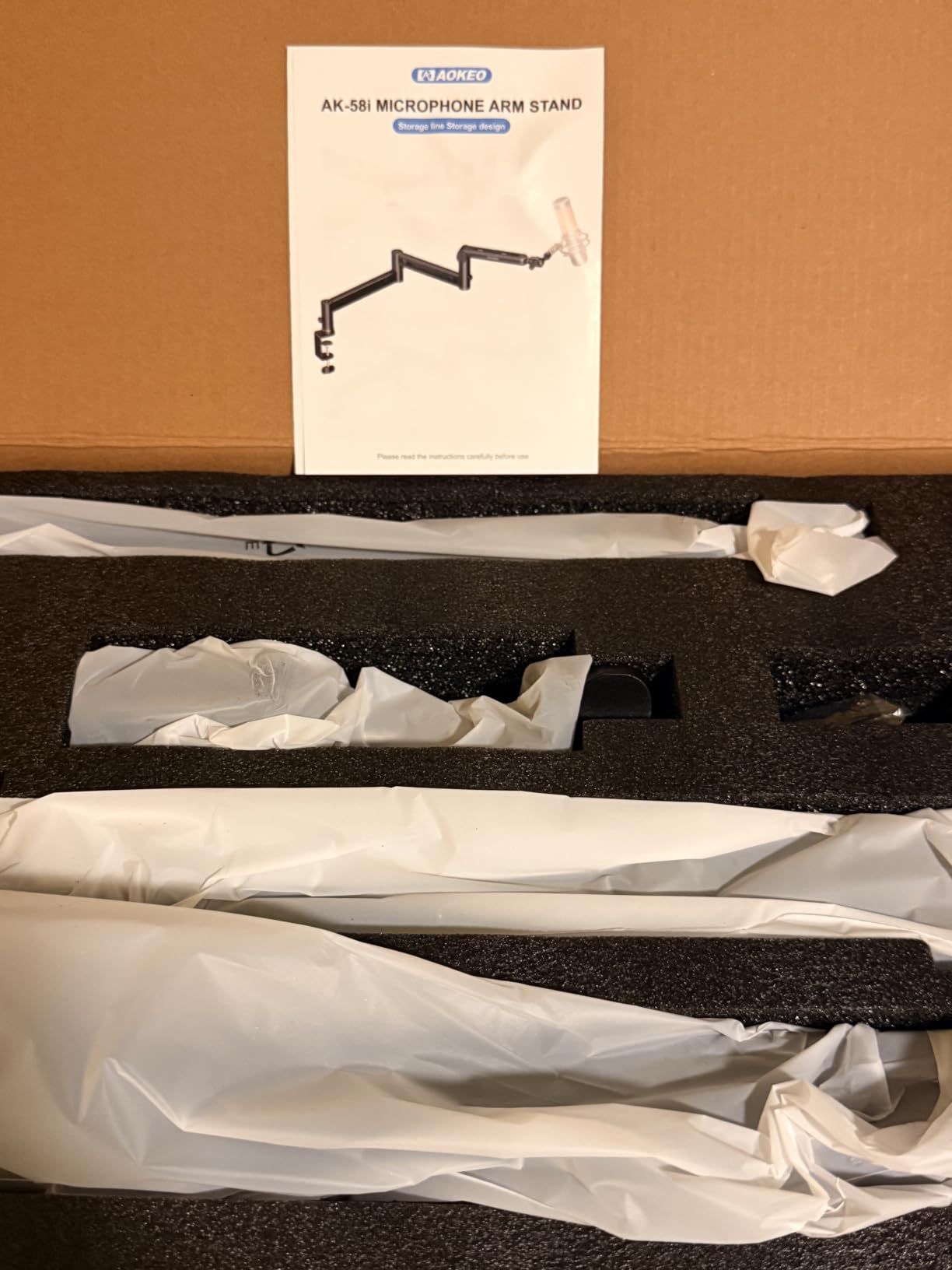
How thick a desk can it clamp to?
Less than 7 cm — a shade under 2.75 inches. That covers most domestic and office desks including a solid wood top, but it is a real limit worth measuring before you order. It will not grip glass or a rounded edge either. If your desk is unusually thick, the TONOR T20 at 2.4 inches and the BM88 are the better fits.
Who should skip it?
Skip it if you want the solid, damped feel of a heavier metal arm and are not recording on camera — the lighter build does not have the same inertia. Also skip it for a thick or glass desk, and skip it if you plan to hang a full suspension mount and a large filter on a sensitive condenser.
10. Sensic SA-30 Boom Arm — the best arm when the mic has to sit above a monitor
Sensic SA-30 Microphone Boom Arm, 360° Rotatable Mic Stand with 6 inch riser, Microphone Holder with 1/4″, 3/8″ and 5/8″ Adapters, Professional Microphone Arm with Accessories, Mic Boom Arm Black
Load: 1 kg
Riser: 6 inch included
Reach: 85 cm
Table clamp and grommet mount
+ The Good
- Included riser for overhead placement behind a monitor
- Precise machining and clean cable hideaway
- Holds heavy mics without creeping
- Table clamp and grommet mount both included
- The Bad
- 1 kg recommended load is lower than most rivals
- Spring return needs careful tension adjustment
- Base socket is fragile in tight spaces
Most arms can only put the microphone in front of the monitor or below it. The SA-30 ships with a 6 inch riser that raises the arm high enough to place the mic overhead, which is the position many people want for a vocal or a room with an awkward desk layout — the mic points down at your mouth instead of sitting on a horizontal arm in the way.
Build precision is the standout. Reviewers repeatedly single out the machining and tolerances, particularly how cleanly the riser fits, and that matters because a loose riser is exactly what makes an arm wobble. The cable hideaway runs along the top of the arm with enough room to flex an XLR cable inside it.
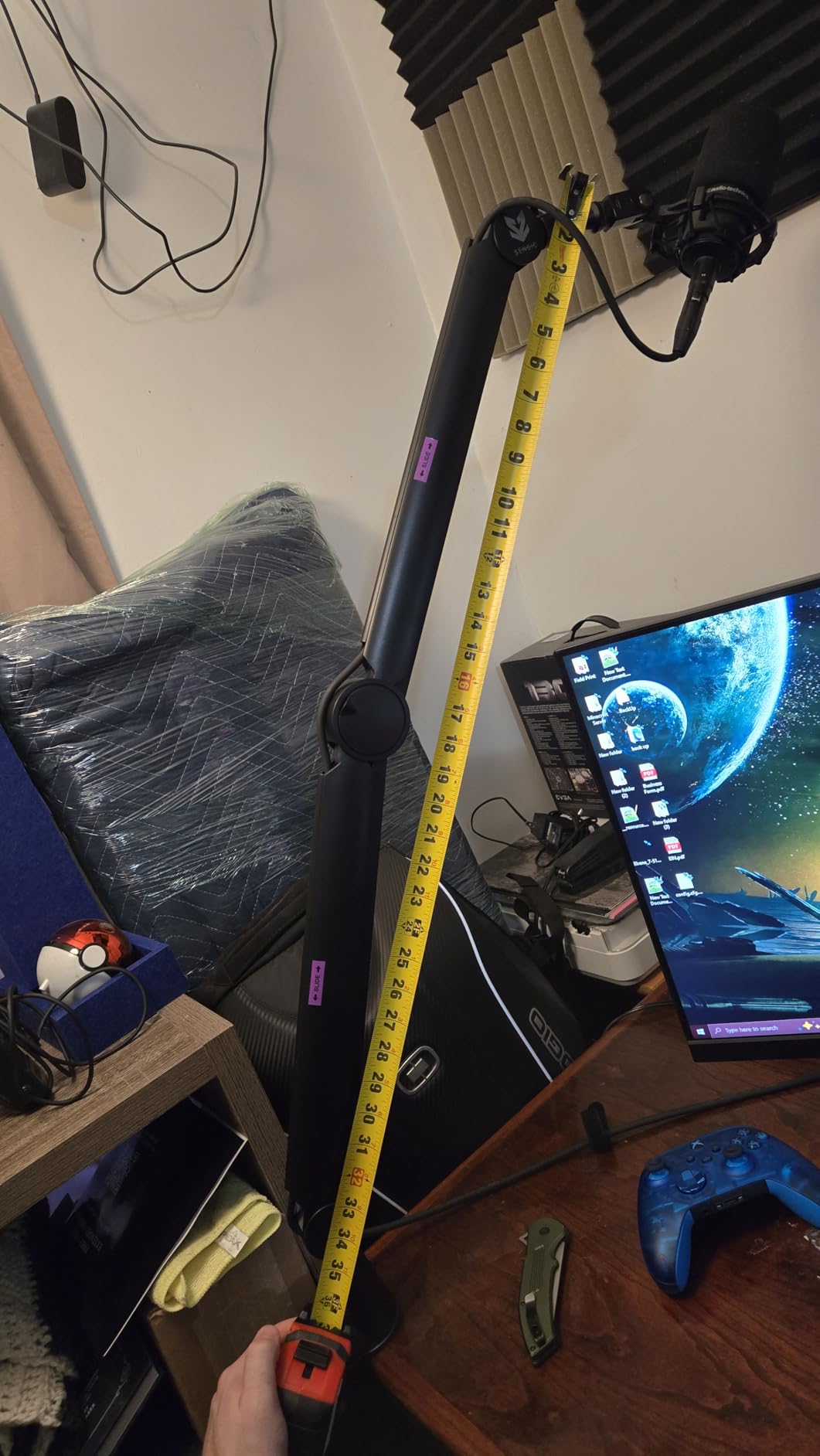
Two mounting options come in the box: a table clamp and a grommet mount for desks with a cable pass-through. The grommet option is the answer for glass and panel desks where a clamp cannot work at all. At 1.97 kg it folds for mobile use.
Will it hold a heavy condenser?
It will hold a heavy condenser without creeping, which reviewers confirm with mics like the RODE NT-1. But note the stated recommended load is 1 kg, which is lower than most arms here, so if you are running an SM7B in a heavy suspension mount you are at the edge of what the manufacturer recommends. The other caution is spring return: the arm tends to swing back toward its resting position unless the tension is dialled in carefully.
Who should skip it?
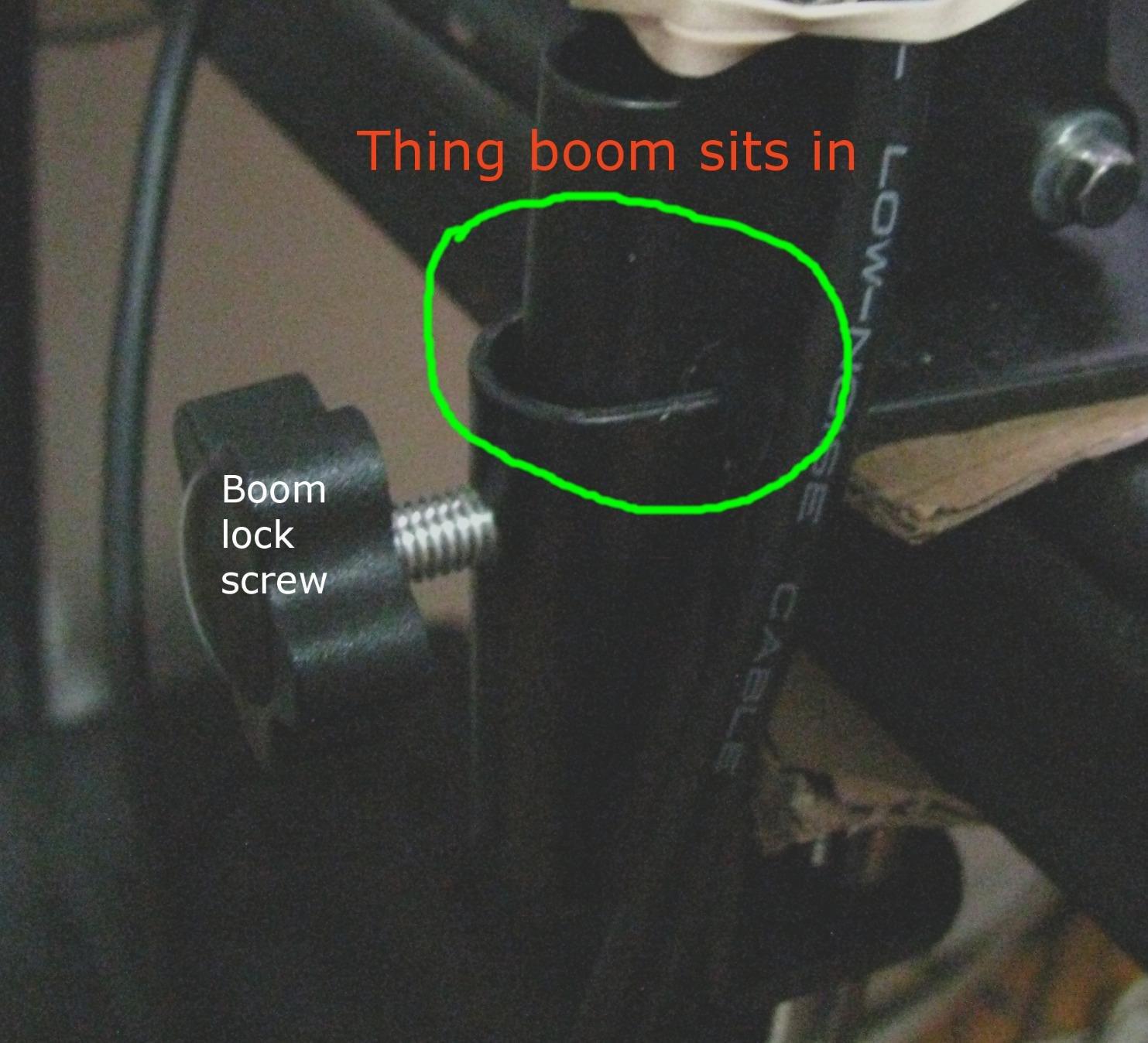
Skip it if your desk space is cramped, because the section that slides into the base has been reported as fragile when forced in a tight gap. Also skip it if you want a light USB mic with lots of spare capacity, or if you would rather not spend time tuning spring tension before each take.
11. Neewer NW-35 Suspension Boom Arm — the best first buy for a new podcaster
NEEWER Microphone Arm Stand, Suspension Boom Scissor Mic Arm Stand
Load: 1.5 kg
Desk: up to 2 inch
Threads: 1/4, 3/8, 5/8
Includes five cable straps
+ The Good
- Springs and metal screws support 1.5 kg
- Springs sit clear of the adjustment knob
- Folds up for carrying between sessions
- Rubber-padded clamp protects the desktop
- Five cable straps included
- The Bad
- Lowest average rating here at 4.2 stars
- Springs and joints lose tension over time
- Not compatible with the Blue Yeti Nano
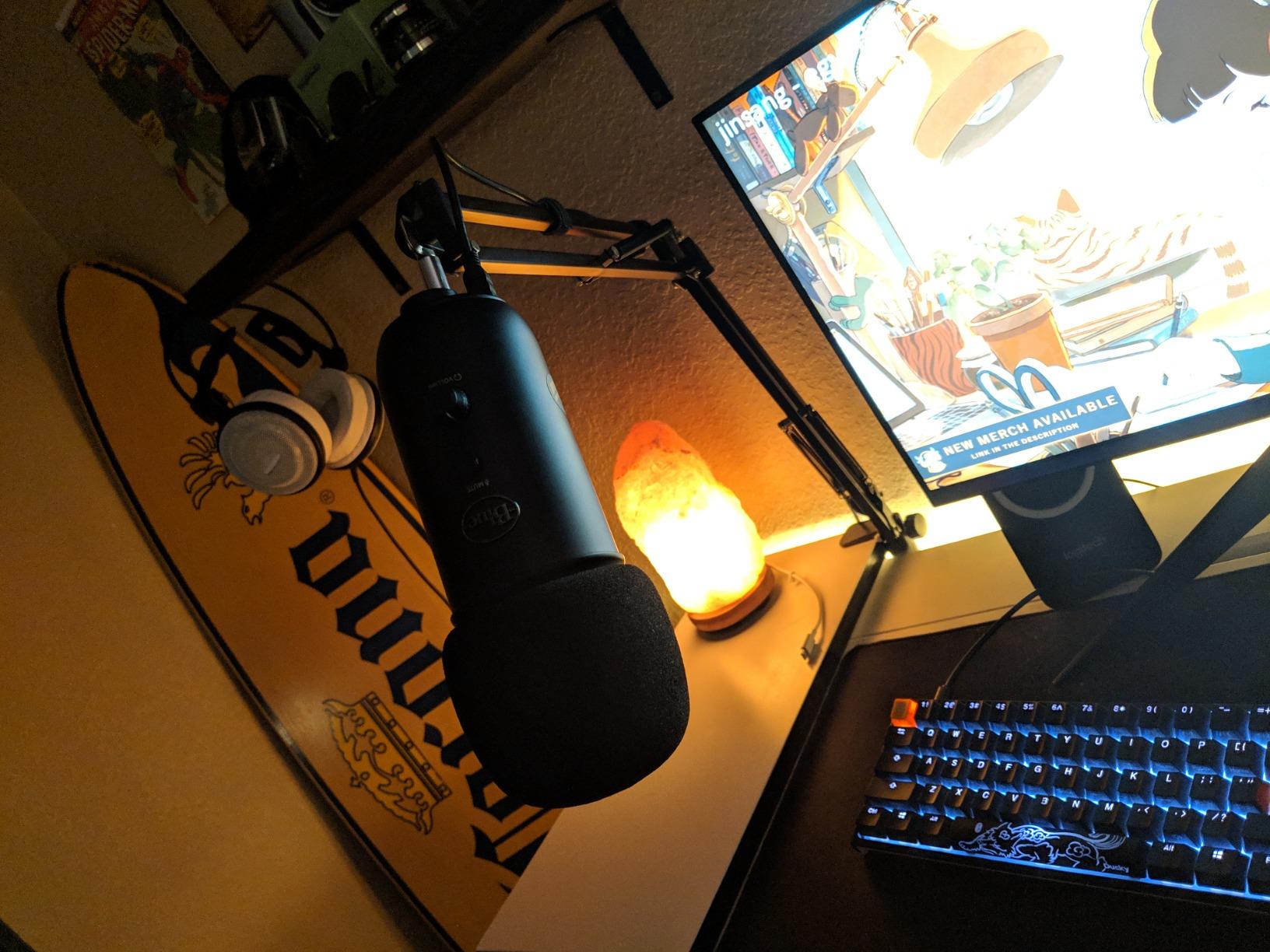
It is a long-running budget reference in this category, and with more than 24,000 ratings it is one of the most proven budget arms available. The steel construction and metal positioning screws carry 3.3 lb / 1.5 kg, which fits the Blue Yeti, Yeti X, Snowball and QuadCast without complaint.
A detail that shows real design thinking: the springs are positioned so they do not obstruct the adjustment knob, so you can change the height without fighting the spring. The rubber-padded clamp grips desks up to 2 inches and protects the surface, and the arm folds for transport between sessions. Five cable straps are included, which is generous.
And it is an honest one to recommend to a beginner because it is genuinely used by working podcasters. On r/podcasting, people regularly name Neewer alongside Tonor and InnoGear as budget arms that are widely owned and recommended once weight limits are respected.
Why is its rating lower than the others?
At 4.2 stars across 24,529 reviews it carries the highest proportion of critical feedback in this group, and the reasons are consistent: springs and joints lose tension over time and need periodic retightening, and the base connector can wear until the arm lifts slightly out of its socket. Neither is a deal breaker for a light USB microphone, and both are mechanical parts you can tighten with a screwdriver.
Who should skip it?
Skip it if you own a Blue Yeti Nano, which uses a 1/4 inch thread — check your mic before buying. Skip it if you want a permanently silent arm or plan to hang an SM7B in a heavy mount, and skip it if you will not touch a screwdriver when the tension drops after six months.
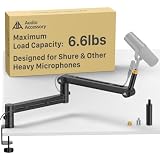
12. AA Audio Accessory Heavy Mic Boom Arm — the best gear-lock arm for an SM7B
AA AUDIO ACCESSORY Mic Arm Desk Mount (Design for Heavy Mic) 6.6lbs Load Capacity, Stable Gear Lock Never Sags, Metal Low Profile Microphone Boom Stand for Shure SM7B SM7dB MV7, Blue Yeti, Rode PodMic
Load: 6.6 lb / 3 kg
Reach: 780 mm
Gear-lock mechanism
Includes both adapters
+ The Good
- Highest load capacity here at 6.6 lb for heavy studio mics
- Gear-lock holds position with no spring creep over time
- 780 mm reach with 360 degree horizontal rotation
- Deep cable channels route multiple cables
- The Bad
- Final joint has a limited angle range for some shield mounts
- Adjustment knobs are plastic
- No printed instructions in the box
This arm solves the problem every other sprung arm shares: springs drift. The AA Audio Accessory arm uses a gear-lock mechanism instead, which clamps down and stays put indefinitely. For someone recording on an SM7B with a shock mount and a pop filter, that is not a minor upgrade — it is the difference between re-adjusting before every take and never thinking about it again.
The load rating is 6.6 lb / 3 kg, the highest in this group, and the arms are 40 by 25 mm reinforced aluminium alloy with glass-fibre nylon sections, so the structure itself is far heavier-duty than a typical spring arm. Reach is 780 mm, 40 mm longer than a standard arm, with 360 degrees of horizontal and 120 degrees of vertical rotation.
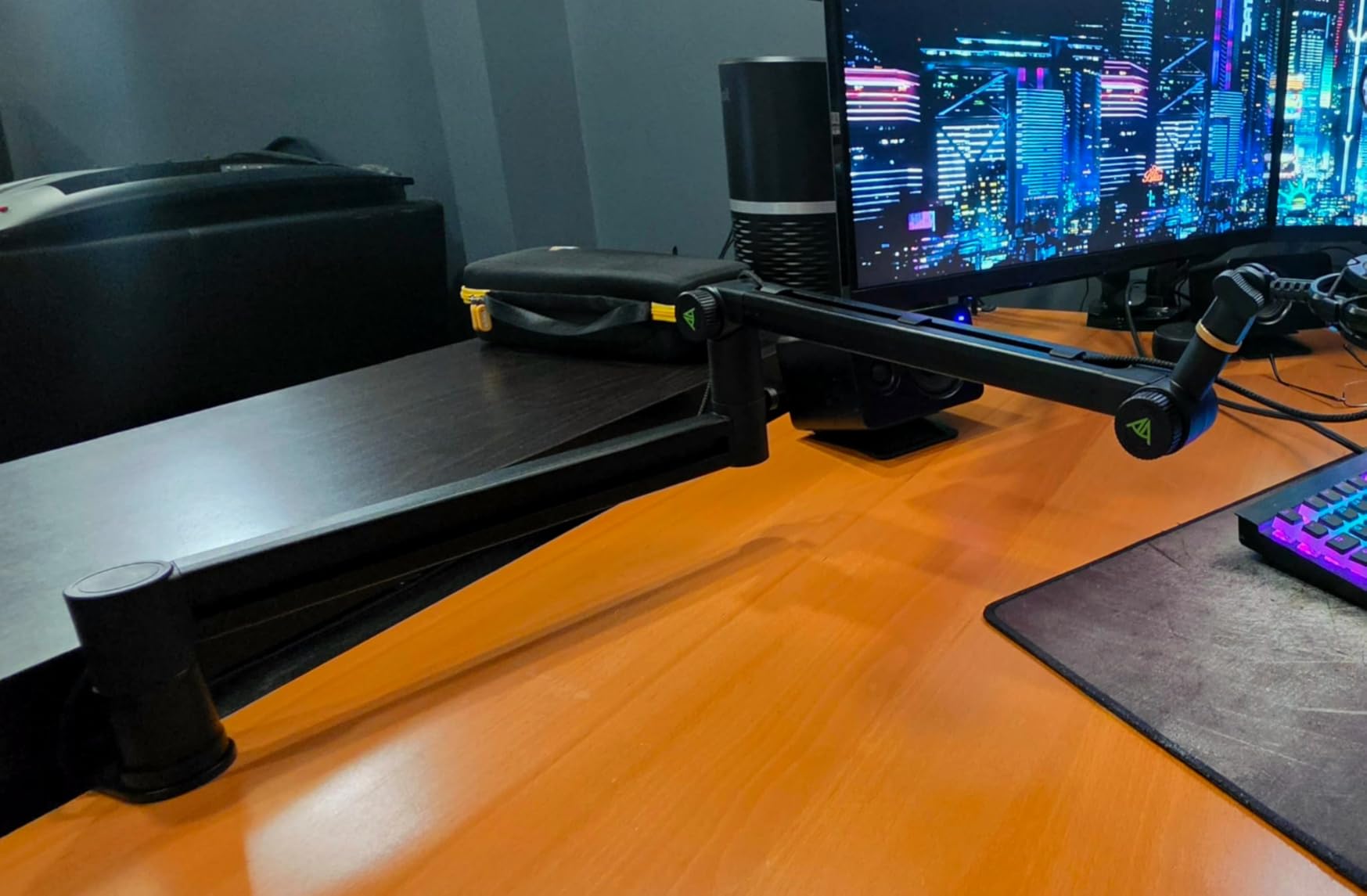
It is built for the microphones that break cheaper arms: the Shure SM7B, SM7dB, MV7, RØDE PodMic, AT2020 and Blue Yeti are all named as supported. Both a 3/8 to 5/8 and a 3/8 to 1/4 adapter are included, plus an extension rod.
What are you giving up compared with a sprung arm?
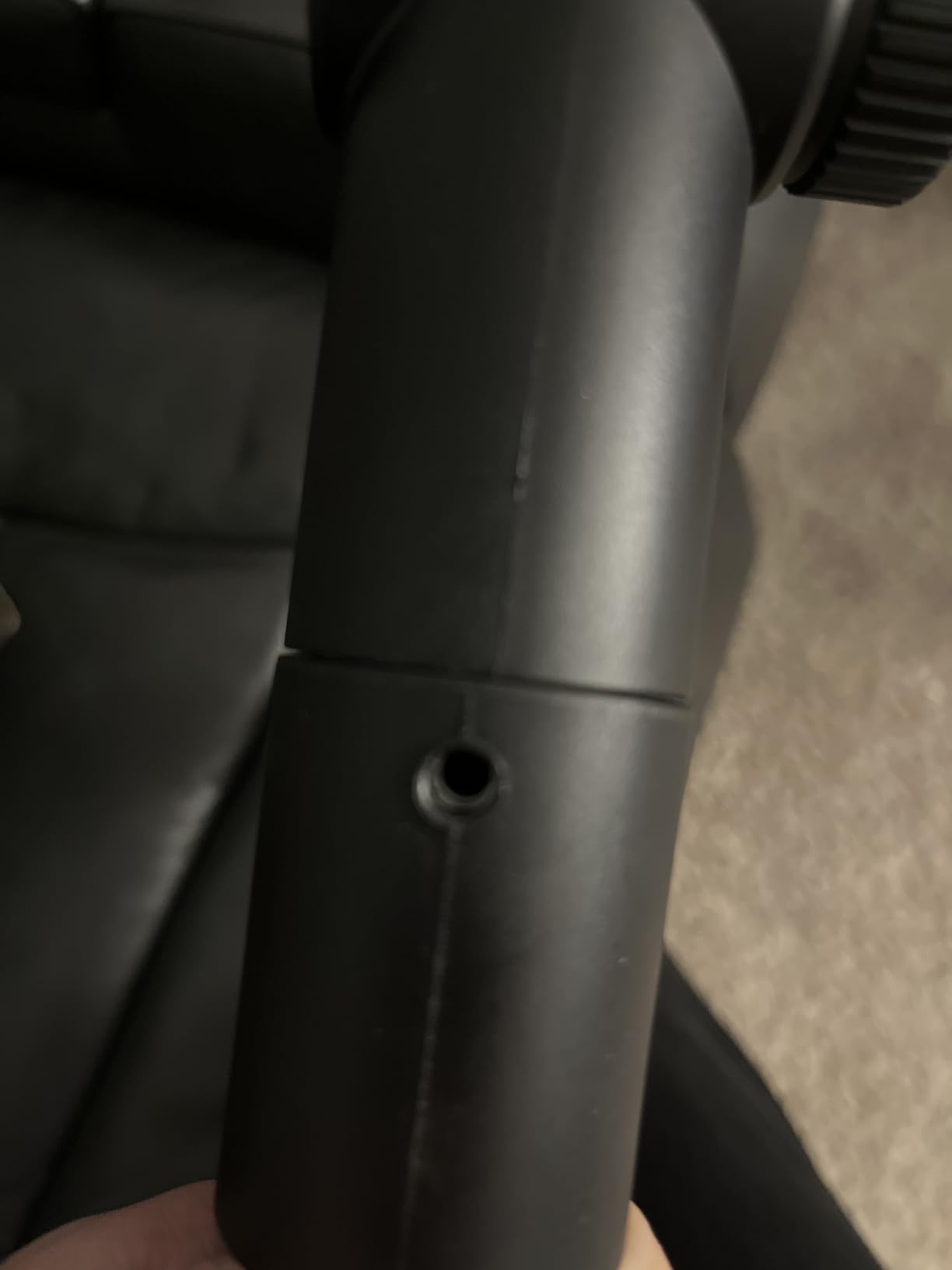
Two things. First, the mic-end joint has a limited angle range, which can stop certain side-address shields or deep shock mounts from seating at the angle you want. Second, there is no printed instructions in the box — assembly relies on an online video, which is friction if you are setting up in the dark at a venue. A small number of owners also report sagging even below the stated limit, so treat 3 kg as the absolute ceiling and aim comfortably under it.
Who should skip it?
Skip it for a light USB microphone. A 1.5 kg spring arm will hold a QuadCast for a fraction of the cost, and there is no spring to silence in the first place. Also skip it if you need the mic-end joint to pivot freely or if you are working somewhere without reliable internet for the assembly walkthrough.
How to Choose a Boom Arm That Fits Your Mic and Your Desk
Most boom arm regrets come down to two numbers nobody checked before ordering: the load capacity and the desk thickness limit. Get those right and almost any arm will serve you; get them wrong and you will be shopping again within a month.
1. Match the load capacity to your total hanging weight
The published load rating is for the microphone. Your actual hanging weight is the mic plus a shock mount or suspension mount, plus a pop filter, plus any adapter or ring. On this list the budget arms top out at 1.5 kg, which is plenty for a Blue Yeti or a HyperX QuadCast on their native mount, but tight the moment you hang a dynamic in a frame.
As a working rule: a bare USB condenser under 1 kg is safe on almost anything; a side-address dynamic in a shock mount wants 2 kg or more; a large condenser in a suspension mount with a double-layer filter wants 3 kg. The AA Audio Accessory arm at 3 kg and the InnoGear cable management arm at 3.5 lb are the two here with real margin for that last case.
2. Measure your desk thickness before choosing a clamp
Clamp limits are the most commonly ignored spec. In this roundup the range runs from 1.89 inches on the SUNMON up to 2.4 inches on the TONOR T20 and the FIFINE BM88, and the Aokeo AK-58i caps out at under 7 cm. Measure the thickest point of your desk edge, and if it is glass, rounded laminate, or over 2.75 inches, do not buy a C-clamp arm at all.
For glass and panel desks, look for a grommet mount instead — the Sensic SA-30 includes both a table clamp and a grommet mount, and it is the only arm here that solves that desk type. For thick desks, the TONOR’s oversized four-times contact area is the safest bet in this group.
3. Check the thread size before you order
Most microphones use a 5/8 inch thread, but plenty of smaller USB mics use 3/8 inch and camera-style mounts use 1/4 inch. Most arms in this roundup include adapters, but the detail that matters is whether the adapter is in the box or something you have to find. The SUNMON arm ships with the 3/8 to 5/8 adapter pre-installed, and the FIFINE BM88 includes 1/4, 3/8 and 5/8 inch fittings.
Watch out for the Blue Yeti Nano, which uses a 1/4 inch thread and is not supported by every arm. Five of the arms here list 1/4 inch compatibility explicitly; if your mic uses an unusual thread, verify before you buy.
4. Choose your mechanism: internal spring, external spring, or gear lock
Three mechanisms exist, and the trade-off is noise against consistency. External springs — the cheap springs on a scissor arm — are the worst case for recording: bump the arm and the springs twang, and the microphone picks it up. This is the most widely reported flaw in podcasting forums, and it is why the RODE PSA1+ hides its spring inside the arm body for silent operation.
Internal or hidden springs give you the smooth movement without the noise. Gear-lock arms, like the AA Audio Accessory model, remove the spring entirely, so nothing can drift or twang, but you lock them with knobs rather than adjust them with continuous tension. For heavy microphones where drift is the real enemy, gear lock wins. For a light mic you reposition constantly, a silent internal spring is easier to live with.
5. Do not forget cable management and mic placement
Cable routing is not a luxury. An arm without channels will pinch an XLR cable the first time you swing it fully, and a pinched cable is both a noise source and a failure point. The InnoGear MU-PSA28 and the Sensic SA-30 run cables inside the arm, the Elgato Wave Mic Arm LP uses magnetic covers, and the NEEWER NW-35 bundles five cable straps so you can at least tie things down cleanly.
On placement, aim for roughly four to eight inches from your mouth, angled slightly off-axis rather than straight on, with a pop filter between the mic and your face. A low-profile arm helps here because the horizontal arm stops crossing the path of your hand when you gesture, which knocks down handling noise. If your desk still shakes under a heavy keyboard, a low-profile design with a low centre of gravity, like the Aokeo AK-58i, absorbs far more of that than a hanging arm does.
If your setup is mounted on a rig or stand rather than a desk, our camera boom arm guide covers the longer-reach and fly-weight options built for video work, while boom light stands solve the same reach problem for lighting in a small room.
Frequently Asked Questions
What size boom arm do I need for my microphone?
The arm you need is decided by three numbers: your microphone weight, the thread size on the bottom of the mic, and your desk thickness. A USB condenser under 1 kg is fine on any arm in this roundup. A side-address dynamic in a shock mount wants 2 kg or more, and a large condenser in a suspension mount with a filter wants 3 kg. Most arms include 5/8 and 3/8 inch adapters, but confirm the thread if you own a 1/4 inch mic such as the Blue Yeti Nano.
Will a boom arm hold a Shure SM7B?
Yes, if you choose the right arm and count the whole rig. The Shure SM7B plus a shock mount can sit close to 1.2 kg, so budget arms rated at 1.5 kg are workable but tight. The RODE PSA1+ states its 1.2 kg rating includes shock mounts, while the InnoGear cable management arm at 3.5 lb and the AA Audio Accessory arm at 6.6 lb leave real margin. Add a foam windscreen rather than a double metal filter if you are near a limit.
How do I stop my mic arm from sagging?
Three causes, three fixes. If the arm has drifted downward it is usually a spring arm past its rating, so either tension the adjustment knob or move to an arm with a higher load capacity. If it sags only after you add a shock mount and pop filter, you have exceeded the bare-microphone rating. If it moves position on its own over months, the springs or base connector have worn, and that is the point to switch to a gear-lock mechanism such as the AA Audio Accessory arm.
What is the best boom arm for the HyperX QuadCast?
The HyperX QuadCast weighs well under 1 kg and uses a 5/8 inch thread, so it does not need a heavy arm. For the least money, the SUNMON QuadCast boom arm ships with the 3/8 to 5/8 adapter pre-installed and a sponge-padded clamp. For video, the FIFINE BM88 keeps the arm below the monitor line. For an audio-only desk, the InnoGear steel arm is the most proven option, with more than 24,000 ratings.
Is a boom arm better than a desk stand for podcasting?
A boom arm is better in almost every podcasting scenario because it locks your mic at one repeatable distance and angle, which keeps your levels consistent from take to take and cuts desk vibration. A desktop stand is cheaper and quicker, but you reposition it constantly and its position changes between sessions. If your desk is thick enough to clamp to, the boom arm is worth the upgrade; if not, a weighted desktop stand is your realistic option.
What thread size does my microphone use?
Most broadcast and podcast microphones use a 5/8 inch thread, which is the most common standard. Smaller USB microphones often use 3/8 inch, and camera-style or small compact mics use 1/4 inch. Nearly every arm in this roundup includes a 5/8 to 3/8 adapter, and the FIFINE BM88 includes 1/4 inch and 3/8 inch fittings as well. If the adapter is not in the box, a single screw-in adapter is the only part most people ever need to buy separately.
Do boom arms reduce noise in a podcast?
A boom arm reduces noise caused by the desk and by handling, not noise inside the microphone. Suspending a mic on a spring arm removes the direct path between your desk surface and the capsule, so typing, chair movement, and knocking the desk stop transferring into the recording. It cannot reduce room echo or a noisy room tone. A boom arm does not cancel sound the way noise-cancelling microphones do, so it pairs with treatment rather than replacing it.
How do I attach a boom arm to a thick desk?
Check the clamp rating first, because most budget arms stop at about 2 inches and the widest clamps in this roundup reach 2.4 inches. The TONOR T20 has a four-times-larger contact area than a typical clamp and is the safest choice on a thick desk. If your desk is glass, rounded, or thicker than about 2.75 inches, a C-clamp will not work at all and you need a grommet mount, which the Sensic SA-30 includes alongside its clamp.
Which Boom Arm Should You Buy?
If you want one answer, take the RODE PSA1+. Its internal spring is silent, its 1.2 kg rating explicitly covers shock mounts, and it rotates a full 360 degrees with cable management built in — it is the arm that keeps working when the recording starts, not just when you set it up.
Match the rest to your situation. On a budget with a USB condenser, the InnoGear steel arm is the proven choice with the largest review base. Recording on camera, use the FIFINE BM88 for reach or the Elgato Wave Mic Arm LP for finish. Running an SM7B or MV7 needs 2 kg or more, which points to the InnoGear cable management arm or the AA Audio Accessory gear-lock arm. On a thick desk, the TONOR T20 clamps hardest; on glass, you need the grommet mount on the Sensic SA-30.
Whichever you choose, buy it for your total hanging weight rather than the bare mic, and measure the desk edge first. Those two checks prevent almost every regret we saw while testing the best boom arms for podcast microphones in 2026.