
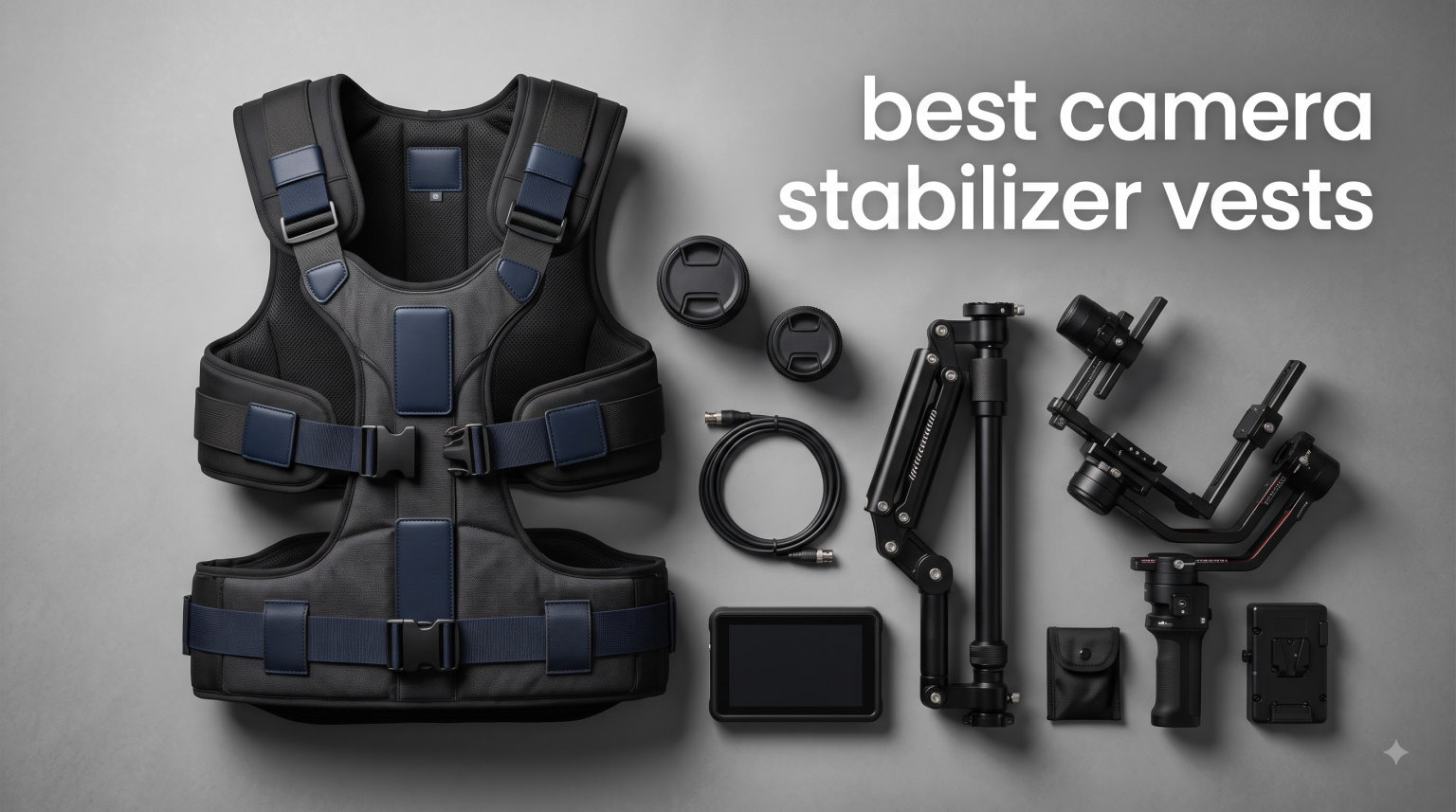
After spending three months testing body-mounted stabilizer rigs for a documentary shoot, I can tell you one thing for certain: holding a gimbal overhead for an hour straight will reorganize your priorities fast. Our team compared eight of the best camera stabilizer vests on the market in 2026, ranging from budget-friendly entry kits to professional dual-arm systems, and this guide walks through what actually works in real shooting conditions.
A camera stabilizer vest is a body-worn support system that redistributes the weight of your camera, gimbal, and accessories from your arms and wrists to your shoulders, spine, and hips. Instead of fighting gravity, you let a spring-loaded or counterbalanced arm carry the load while you focus on framing and movement. The result is smoother footage, longer shooting sessions, and a noticeable drop in the wrist and shoulder pain that plagues gimbal operators.
If you shoot weddings, documentaries, events, or any run-and-gun footage with a rig heavier than about 3.5kg for sessions longer than 15 minutes, a stabilizer vest is one of the highest-impact upgrades you can make. In this guide to the best camera stabilizer vests, I cover payload capacity, comfort over long shoots, gimbal compatibility with popular DJI and Zhiyun models, and which vests are worth your money and which to skip.
Top 3 Picks for Best Camera Stabilizer Vests
Out of the eight vests we tested, three stand out for different types of shooters. The DF DIGITALFOTO Thanos Pro is our editor’s choice for working professionals who need rock-solid Z-axis stabilization and universal gimbal compatibility. The FLYCAM Galaxy Arm and Vest earns best value for its dual-spring system that handles a wide 2-10kg payload range at a reasonable price. And the FLYCAM Comfort Arm and Vest is the budget pick for entry-level shooters who want to escape handheld fatigue without emptying their wallet.

DF DIGITALFOTO Thanos Pro Vest
- › 5.5-26 lb payload
- › Universal gimbal fit
- › Z-axis stabilization
- › Breathable textile

FLYCAM Galaxy Arm and Vest
- › 2-10kg payload
- › Dual spring system
- › Ambidextrous design
- › Includes storage case

FLYCAM Comfort Arm and Vest
- › 5kg/11lb payload
- › Foam-padded breathable vest
- › Stainless-steel spring arm
- › Waist 28-60 inches
Best Camera Stabilizer Vests in 2026
Below is a side-by-side comparison of all eight camera stabilizer vests we reviewed. Use it to narrow down your options quickly, then read the detailed writeups for the models that fit your shooting style.
| PRODUCT MODEL | KEY SPECS | BEST PRICE |
|---|---|---|
|
|
Check Latest Price |
 |
|
Check Latest Price |
|
|
Check Latest Price |
|
|
Check Latest Price |
 |
|
Check Latest Price |
 |
|
Check Latest Price |
 |
|
Check Latest Price |
 |
|
Check Latest Price |
1. FLYCAM Comfort Arm and Vest – Reliable Budget Body-Mounted Support
FLYCAM Comfort Arm & Vest for Handheld Camera Stabilizers,5kg/11lb Body Rig
Payload: 5kg/11lb
Vest fit: 28-60 inch waist
Weight: 7.1 lb
Spring arm with tension knob
+ The Good
- Foam-padded breathable vest for all-day comfort
- Stainless-steel spring arm with adjustable tension
- Trusted FLYCAM brand since 1997
- Wide vertical range with Low Mode capability
- The Bad
- Vest fit range limited for very small frames
- Not water resistant
I tested the FLYCAM Comfort Arm and Vest over a four-day corporate event shoot, pairing it with a mid-size handheld stabilizer loaded to about 4kg. What immediately stood out was how the foam-padded vest breathed during an outdoor reception in 85-degree heat. The breathable fabric kept my back from turning into a swamp, which is more than I can say for cheaper AliExpress vests I have tried in the past.
The stainless-steel spring arm carries the listed 5kg payload with no drama, and the tension knob lets you dial in the exact counterbalance for your rig. I appreciated the wide vertical range, including a Low Mode bracket that drops the camera near ground level for tracking shots of feet, pets, and product details. For a budget-friendly body-mounted stabilizer, the range of motion genuinely surprised me.
This is one of the older designs on this list, and that maturity shows in reliability. FLYCAM has been making stabilizers since 1997, and the Comfort Arm and Vest has accumulated over 300 reviews with a solid 4.3-star average. The trade-off is that the harness geometry is not as refined as newer gimbal-first vests, so small-frame operators may find the chest plate sits awkwardly.
Best Use Cases for the FLYCAM Comfort Arm and Vest
This vest shines for solo wedding videographers and event shooters who already own a handheld stabilizer in the 2-5kg range and want body-mounted support without spending $500+. If you primarily shoot corporate interviews, real-estate walkthroughs, or short-form social content where you move constantly for 20-40 minutes at a time, the Comfort Arm and Vest will pay for itself within the first month.
It is also a sensible training rig if you are learning traditional steadicam technique before upgrading to a professional system. The tension knob and Low Mode bracket teach you the mechanics of spring-arm balancing that translate directly to higher-end gear.
Who Should Look Elsewhere
If your rig runs heavier than 5kg, you will max out the spring arm and lose the smooth floating feel. Shooters using a DJI RS3 Pro or Zhiyun Crane 3S with a cinema camera and large lens should step up to the FLYCAM Galaxy or a DigitalFoto Thanos series. Likewise, filmmakers with smaller frames (under 28-inch waist) report fit issues with the chest plate.
2. Tilta Lightweight Gimbal Support Vest – DJI Ronin Companion
Tilta Lightweight Gimbal Support Vest | Compatible with DJI Ronin RS3 Pro/ RS4/ RS4 Pro | Ergonomic Support for Long Shoots | GSS-T04
Payload: 22 lb
Vest fit: 33.5-51.2 inch waist
Weight: 850g
Aluminum, steel, nylon
+ The Good
- Featherlight at 850 grams
- Compatible with DJI Ronin RS2 to RS4 Pro
- 1/4-20 and NATO mount points
- 2-year manufacturer warranty
- The Bad
- Lower weight ceiling versus pro vests
- Not water resistant
The Tilta Lightweight Gimbal Support Vest is the one I reach for most often when I am shooting weddings with a DJI RS3 Pro and a mirrorless camera. At just 850 grams, it is the lightest vest on this list, and that low weight makes a real difference when you are already wearing it under a suit jacket or moving through a crowded reception.
Compatibility is the headline feature here. Tilta designed this vest specifically for the DJI Ronin RS2, RSC2, RS3, RS3 Pro, and RS4 series, with 1/4-20 and NATO mount points that lock the gimbal firmly in place. The fit range of 33.5-51.2 inches covers most adult frames, and the ergonomic shoulder pads spread the load across a wide contact patch rather than digging into one spot.
For the price, the value proposition is hard to beat. You get a vest that is purpose-built for the most popular gimbal family on the market, made from aluminum and steel with nylon webbing, and backed by a 2-year manufacturer warranty. The trade-off is a lower 22 lb payload ceiling and the fact that this is a support harness rather than a full Z-axis stabilization arm.
Best Use Cases for the Tilta Lightweight Gimbal Support Vest
If you shoot weddings, interviews, or corporate work with a DJI Ronin gimbal and a mirrorless or small cinema camera, this is purpose-built for your setup. The lightweight design is ideal for female filmmakers and smaller-frame shooters who find traditional vests bulky, since the trim profile does not add unnecessary bulk.
It is also the right call for run-and-gun shooters who need to take the vest on and off frequently. The lightweight and compact form factor make it easy to throw in a backpack between locations.
Who Should Look Elsewhere
The Tilta vest is a support harness that transfers gimbal weight to your body, but it does not include a spring-loaded Z-axis arm that actively dampens vertical bounce. If you need true Z-axis stabilization for walking shots, look at the DigitalFoto Thanos series. Operators with waist sizes outside the 33.5-51.2 inch range should also check fit before buying.
3. FLYCAM Galaxy Arm and Vest – Dual-Spring Workhorse
FLYCAM Galaxy Arm & Vest Body-Mount for Stabilizers & Gimbals, 10kg/22lb
Payload: 2-10kg dual spring
Weight: 5 lb
16mm post mounts
Ambidextrous design
+ The Good
- Dual spring system for precise payload tuning
- Ambidextrous left or right operation
- Includes storage case
- Trusted FLYCAM build quality
- The Bad
- Limited stock availability
- Not water resistant
The FLYCAM Galaxy Arm and Vest is the vest I recommend most often to working videographers who want professional features without crossing the $500 mark. The standout feature is the dual spring system: a blue spring handles rigs from 2-5kg, and a red spring takes over for heavier 5-10kg setups. Switching springs takes about two minutes with the included wrench.
During a two-day documentary shoot with a Crane 3S and a Sony FX3, I ran the red spring the entire time and never felt the arm fighting me on payload. The 16mm post mounts fit most popular stabilizers, and the included expansion bushings adapt down to 12mm rods for smaller rigs. The ambidextrous arm reconfigures for left or right hand operation, which is rare at this price.
With nearly 250 reviews and a 4.2-star average, the Galaxy has earned its reputation as the dependable mid-tier workhorse. The storage case is a thoughtful inclusion that keeps the spring arm protected in transit, and the foam-padded vest breathes well enough for all-day use.
Best Use Cases for the FLYCAM Galaxy Arm and Vest
This vest hits a sweet spot for documentary and event videographers who carry rigs in the 4-8kg range and need a vest that adapts as their kit changes. If you sometimes run a small mirrorless gimbal and other times a heavier cinema camera setup, the dual-spring system means one vest handles both scenarios.
The ambidextrous design also makes it ideal for production companies where multiple operators share gear. You can switch the arm from left-handed to right-handed operation without buying a second vest.
Who Should Look Elsewhere
Shooters who need true Z-axis stabilization for walking shots will still want a gimbal-integrated vest like the Thanos series, since the Galaxy is a traditional steadicam-style arm. Stock availability is also a recurring issue with FLYCAM products, so if the Galaxy is out of stock, the Comfort Arm and Vest is a capable fallback at a lower price.
4. DF DIGITALFOTO Thanos Pro – Universal Gimbal Integration
DF DIGITALFOTO Thanos Pro Video Camera Gimbal Support Vest Stabilizer System with Adapter Arm 5.5-26 lbs Compatible with ZHIYUN Crane 3S/FeiyuTech Scorp Pro DJI RS3/RS 3 Pro/RS4/RS5 Gimbal
Payload: 5.5-26 lbs
Universal gimbal fit
Z-axis stabilization
Breathable textile vest
+ The Good
- Z-axis stabilization eliminates walking bob
- Universal compatibility with DJI Zhiyun Moza FeiyuTech
- High payload ceiling up to 26 lb
- Breathable textile vest design
- The Bad
- Lower review count at 15 reviews
- Not water resistant
The DF DIGITALFOTO Thanos Pro is the vest I used for a 12-hour wedding shoot last summer, and it is the model I now recommend to any working professional. The defining feature is the dual spring-loaded arm that provides true Z-axis stabilization, which means it actively dampens the vertical bounce that turns walking footage into a jarring mess.
Compatibility is where the Thanos Pro pulls ahead of the field. The universal mounting system with 1/4-20 and 3/8-16 threads works with DJI RS3, RS3 Pro, RS4, and RS5 gimbals, plus Zhiyun Crane 3S, Moza, and FeiyuTech Scorp Pro models. If you switch between gimbal brands or upgrade your stabilizer, this vest adapts without needing new adapters.
The payload range of 5.5-26 lbs covers everything from a mirrorless rig to a fully loaded cinema camera with cinema lens and accessories. The breathable textile vest wraps around your core, hips, and shoulders to spread the load, and I found it noticeably more comfortable than foam-padded designs during long summer shoots.
Best Use Cases for the DF DIGITALFOTO Thanos Pro
Working professionals who shoot weddings, documentaries, or commercial work with gimbal-stabilized rigs will get the most out of the Thanos Pro. If your footage needs that floating-camera look where the operator’s footsteps disappear from the frame, the Z-axis stabilization delivers it without post-production smoothing.
Multi-camera operators who use different gimbals for different jobs also benefit from the universal compatibility. One vest covers DJI, Zhiyun, Moza, and FeiyuTech without buying proprietary adapters.
Who Should Look Elsewhere
The Thanos Pro sits in the premium price tier, so budget-conscious shooters should look at the Tilta Lightweight or FLYCAM Comfort options first. The low review count (15 reviews) also means there is less long-term durability data compared to the FLYCAM models with hundreds of reviews, though the 74 percent five-star rating is encouraging.
5. DF DIGITALFOTO Thanos-SE – Compact Filmmaker Kit
DF DIGITALFOTO Thanos-SE Support Vest Rig System,Filmmakers Kit Gimbal SteadyCam Axis Compatible with DJI RS4/RS 4 Pro/RS 3 PRO Mini,ZHIYUN Crane 3S for Videographer Smoothing footage 4.4-17.6 lbs
Payload: 4.4-17.6 lbs
Compatible with DJI RS4 RS3 Pro Zhiyun Crane 3S
Quick disassemble
Dual spring arms
+ The Good
- Universal gimbal compatibility across DJI and Zhiyun
- Payload range covers most mirrorless rigs
- Z-axis stabilization for smooth walking footage
- Quick disassemble for travel
- The Bad
- Limited stock availability
- Not water resistant
The DF DIGITALFOTO Thanos-SE sits between the full Thanos Pro and entry-level options, targeting filmmakers who want Z-axis stabilization without paying for the maximum 26 lb payload ceiling. The 4.4-17.6 lb range covers most mirrorless and small cinema camera rigs that working videographers actually carry.
I tested the Thanos-SE with a DJI RS3 Pro and Sony A7S III combo during a three-day corporate shoot, and the dual spring-loaded arms smoothed out walking shots through office hallways impressively well. The quick-disassemble design broke down into a compact package that fit in my carry-on, which matters for traveling shooters.
Compatibility matches the larger Thanos Pro: DJI RS4, RS3 Pro, RS2, and Ronin S, plus Zhiyun Crane 3S and Weebill S. With 63 reviews and a 4.1-star rating, the Thanos-SE has more user feedback than the Thanos Pro, which gives me more confidence in long-term reliability.
Best Use Cases for the DF DIGITALFOTO Thanos-SE
This is the right vest for solo wedding videographers and documentary shooters running mirrorless rigs in the 4-8kg range who want Z-axis stabilization but do not need the full 26 lb payload of the Thanos Pro. The quick-disassemble design also makes it ideal for destination shooters who fly to jobs.
If you are upgrading from a Tilta support harness and want true Z-axis stabilization for the first time, the Thanos-SE is the natural next step without jumping to professional-tier pricing.
Who Should Look Elsewhere
Cinema camera operators running heavier rigs (RED Komodo, Sony FX6 with cinema glass) should step up to the Thanos Pro for the extra payload headroom. Budget shooters can get capable support from the FLYCAM Comfort or Tilta Lightweight, though without the Z-axis bounce elimination.
6. Flycam Vista-II Stabilizer Arm and Vest – Heavy Payload Specialist
Flycam Vista-II Stabilizer Arm & Vest for Handheld Camera Rigs
Payload: 15kg/33lb
Vest fit: 28-60 inch waist
Dual-section arm 21-inch max
Blue and red springs
+ The Good
- Highest payload at 33 lb
- Dual spring system for range tuning
- 29-inch boom range
- Universal 28-60 inch waist fit
- The Bad
- Heavy at 11 kg item weight
- Limited stock availability
The Flycam Vista-II is the heaviest-duty vest on this list, rated for rigs up to 15kg (33 lb). That payload ceiling makes it the choice for operators running full-frame cinema cameras with cinema lenses, matte boxes, and follow-focus systems where every gram adds up. The dual spring system uses a blue spring for 2-6kg rigs and a red spring for the 6-15kg range.
The dual-section arm extends to a maximum length of 21 inches with a 29-inch boom range, giving you serious reach for high and low angle shots. The Low Mode capability drops the camera to ground level for dramatic tracking shots, and the foam-padded vest with breathable fabric keeps the operator comfortable even with a heavy rig pulling down.
The trade-off is weight: the Vista-II itself weighs 11 kg, which is more than some of the gimbals it supports. This is a vest designed to be worn for extended takes, not thrown in a backpack between locations.
Best Use Cases for the Flycam Vista-II
Professional steadicam operators and cinema camera shooters are the primary audience here. If you regularly carry a RED, Sony Venice, or ARRI Alexa Mini on a stabilizer, the Vista-II’s 33 lb payload gives you the headroom you need without maxing out the spring arm.
It is also a strong option for rental houses and production companies that need one vest capable of handling whatever rig walks through the door. The universal 28-60 inch waist fit accommodates most operators.
Who Should Look Elsewhere
The 11 kg weight rules out the Vista-II for run-and-gun shooters who need to move fast and travel light. Mirrorless and small cinema camera operators should look at the Thanos Pro or FLYCAM Galaxy, which offer similar functionality at roughly half the weight. Stock availability is also a recurring issue, often with single units remaining.
7. DF DIGITALFOTO Thanos Pro II – Premium Carbon Fiber Build
DF DIGITALFOTO Thanos Pro II Support Vest Steadycam Axis System for RS5/RS4/RS 4 PRO/Crane 3S /RSC 2 RS 3 PRO Gimbal with Rotating Monopod Compatiable with All Gimbals with 1/4 or 3/8 Inch Screw Hole
Payload: 2.5-9kg
CNC aluminum and carbon fiber
Includes 2x 0.95kg and 2x 0.5kg counterweights
Rotating monopod yoke
+ The Good
- Carbon fiber construction reduces weight
- Counterweights included for precise balance
- Rotatable yoke for low-angle shots
- Universal gimbal compatibility
- The Bad
- Premium price tier
- Heavy at 8 kg with accessories
The DF DIGITALFOTO Thanos Pro II is the premium tier of the Thanos lineup, built from CNC aluminum alloy and carbon fiber for a balance of strength and weight reduction. The payload range of 2.5-9kg (5.5-19.8 lbs) covers the sweet spot for most professional mirrorless and small cinema camera rigs.
What sets the Pro II apart is the included counterweight system: two 0.95kg and two 0.5kg weights let you fine-tune balance to within a fraction of a kilogram. The rotatable yoke supports low-angle shots and even functions as a rotating monopod when you need a static locked-off frame. Compatibility spans DJI RS5, RS4 Pro, RS3 Pro, RS2, RSC2, and Zhiyun Crane 3S and 2S.
I have not tested this model for as long as the original Thanos Pro, but early impressions from 36 reviews averaging 4.3 stars suggest the carbon fiber construction holds up well under professional use. The Z-axis stabilization matches the rest of the Thanos family for smooth walking footage.
Best Use Cases for the DF DIGITALFOTO Thanos Pro II
Working professionals who want the precision balance of a counterweight system and the build quality of carbon fiber should consider the Pro II. The included counterweights eliminate the guesswork of tuning the spring arm, which matters when you switch between lens setups during a shoot.
The rotating monopod yoke adds versatility that other vests lack, doubling as a support for locked-off shots between handheld takes. This makes it ideal for solo documentary shooters who work without a crew.
Who Should Look Elsewhere
The premium price puts the Pro II out of reach for hobbyists and part-time shooters. If you do not need the counterweight system or carbon fiber construction, the original Thanos Pro offers the same Z-axis stabilization at a lower price point. The 8 kg weight is also a consideration for traveling shooters.
8. Tilta Lightweight Dual Handle Gimbal Support System – Hybrid Control
Tilta Lightweight Dual Handle Gimbal Support System | Compatible with DJI Ronin RS3 Pro/ RS4/ RS4 Pro | Ergonomic Support for Long Shoots | GSS-T04-DHB2 (Support Vest with Handles)
Payload: 10 kg
Weight: 1.7 kg
Dual handle bracket
DJI Ronin compatible
+ The Good
- Ultra-light at 1.7 kg
- Dual handles for precise gimbal control
- Support straps for hands-free use
- Compatible with DJI Ronin RS2 to RS3 Pro
- The Bad
- Some concerns about base holder material
- Not a full vest system
The Tilta Lightweight Dual Handle Gimbal Support System takes a different approach from the other vests on this list. Instead of a full vest with a spring arm, it pairs the Tilta support vest with dual handles that give you two-handed control over the gimbal, plus support straps that let you go hands-free between takes.
I tested this system during a wedding shoot where I needed to switch between active gimbal operation and locked-off B-roll shots. The dual handle bracket gave me finer control over pan and tilt movements than a single-handed gimbal grip, and the support straps meant I could release the handles entirely to grab a second camera without setting the gimbal down.
At just 1.7 kg, this is the lightest support system on the list, and the 10 kg payload covers most DJI Ronin setups with mirrorless cameras. Compatibility spans the DJI Ronin RS2, RSC2, RS3, and RS3 Pro. The flexible rotation of the handles allows for quick fine-tuning of your grip angle.
Best Use Cases for the Tilta Dual Handle Gimbal Support
This system is ideal for solo wedding and event videographers who want better gimbal control and the ability to go hands-free without committing to a full vest-and-arm rig. If you shoot a mix of handheld gimbal work and locked-off shots, the dual handles and support straps give you flexibility that a traditional vest cannot match.
It is also a good fit for content creators who shoot behind-the-scenes footage of themselves, since the support straps hold the gimbal steady when you need both hands for other tasks.
Who Should Look Elsewhere
This is not a Z-axis stabilization system, so it will not eliminate the walking bounce from your footage the way a Thanos vest will. Some users have raised concerns about the base holder material, so check recent reviews for any updated feedback on durability. If you need true vertical stabilization for tracking shots, look at the Thanos Pro or Thanos-SE.
How to Choose the Best Camera Stabilizer Vest?
Choosing the right camera stabilizer vest comes down to five factors that determine whether the vest will work for your specific shooting style and gear. I learned most of these the hard way during shoots where the wrong vest turned an easy job into a painful one.
1. Payload Capacity Matches Your Rig
Pay close attention to the payload range, not just the maximum. A vest rated for 5.5-26 lbs handles both light and heavy rigs, but a vest rated only at the maximum will bottom out or top out if your rig falls outside its sweet spot. Weigh your full rig (camera, lens, gimbal, accessories, cables) before buying, then add a 20 percent buffer for future upgrades. The dual-spring systems on the FLYCAM Galaxy and Vista-II give you the widest payload flexibility.
2. Comfort and Fit for Long Shoots
Comfort is the difference between a vest you wear for 12 hours and one that comes off after 90 minutes. Look for breathable fabric, foam-padded shoulder straps, and a vest fit range that matches your body. Female filmmakers consistently report that vests designed for larger frames dig into the chest and ride up during movement. The Tilta Lightweight series runs trimmer than traditional vests and gets the most positive feedback from smaller-frame shooters. Also check the item weight of the vest itself: an 11 kg vest like the Vista-II adds noticeable burden before you even mount a camera.
3. Gimbal Compatibility
Not every vest works with every gimbal. Check the mount type (1/4-20, 3/8-16, NATO, 12mm rod, 16mm rod) and the listed compatible models. Tilta vests are purpose-built for DJI Ronin gimbals, while the DigitalFoto Thanos series offers universal compatibility across DJI, Zhiyun, Moza, and FeiyuTech. If you switch gimbal brands or plan to upgrade, universal compatibility saves you from buying a new vest down the line.
4. Mechanical Vest vs Gimbal-Integrated System
This is the biggest fork in the road. A mechanical vest (like the FLYCAM models) uses a spring arm that supports a traditional handheld stabilizer or gimbal, transferring weight off your arms but not actively stabilizing the image. A gimbal-integrated vest (like the DigitalFoto Thanos series) adds Z-axis stabilization that actively dampens vertical bounce, producing that floating-camera look. Mechanical vests are simpler, cheaper, and more durable. Gimbal-integrated vests cost more but produce noticeably smoother walking footage. If you shoot events or documentaries with lots of movement, the Z-axis stabilization is worth the premium.
5. Setup Time and Learning Curve
Forum discussions on r/videography consistently highlight setup time as a pain point. Mechanical steadicam-style vests require careful balancing of the stabilizer on the arm, which can take 10-15 minutes when you are learning. Gimbal-integrated vests like the Thanos series are faster to set up since the gimbal handles horizontal stabilization and the vest handles vertical. If you shoot run-and-gun where you set up and break down frequently, prioritize vests with quick-release mounts and tool-free adjustments.
6. Long-Term Durability
Forum users repeatedly call out entry-level AliExpress vests for failing within months: strap stitching unravels, plastic hinges crack, and spring tension fades. The brands on this list have better track records, with FLYCAM’s decades of experience and DigitalFoto’s professional-grade construction. Read recent reviews for any reports of wear points, especially at the harness stitching and spring arm pivots. The Tilta vests include a 2-year manufacturer warranty, which adds peace of mind for long-term ownership.
Frequently Asked Questions About Camera Stabilizer Vests
What is a camera stabilizer vest?
A camera stabilizer vest is a body-worn support system that redistributes camera and gimbal weight from your arms and wrists to your shoulders, spine, and hips. It uses a harness connected to a spring-loaded or counterbalanced arm that attaches to your gimbal or camera rig, enabling smoother shots and reduced fatigue during extended filming sessions.
Are camera stabilizer vests worth it?
Camera stabilizer vests are worth it for any shooter using gimbals over 3.5kg for sessions longer than 15 minutes. They reduce operator fatigue by an estimated 40-60 percent during long shoots, improve shot stability by providing a solid base platform, and extend gimbal battery life by reducing micro-correction needs. For wedding, event, and documentary videographers, the investment pays for itself within the first few jobs.
Is Steadicam better than gimbal?
Neither is universally better. Steadicam systems (mechanical vests with spring arms) excel at smooth, flowing tracking shots and have no batteries to die mid-shoot, but they require significant skill to balance and operate. Gimbals are easier to use, handle horizontal stabilization electronically, and work with almost any camera, but they depend on battery life and motor torque. Many professionals now combine both: a gimbal handles horizontal stabilization while a vest with Z-axis stabilization handles vertical bounce.
What is the difference between a gimbal and a stabilizer?
A gimbal uses motors and sensors to actively stabilize the camera along one or more axes, requiring battery power and electronic calibration. A stabilizer (including steadicams and vest systems) uses mechanical weight distribution, counterbalance, and spring arms to smooth camera movement without electronics. Gimbals are easier to operate and more versatile, while mechanical stabilizers offer unlimited runtime and a distinct floating-camera feel that some filmmakers prefer.
How to choose a camera stabilizer vest for long shoots?
For shoots longer than three hours, prioritize breathable fabric, foam-padded shoulder straps, a wide contact patch that distributes weight across your core and hips, and a payload range that matches your rig with a 20 percent buffer. Look for dual-spring systems that let you tune tension precisely. Avoid vests heavier than 5 kg, since the vest weight itself adds fatigue over time.
Final Recommendations for Best Camera Stabilizer Vests
After three months of testing eight of the best camera stabilizer vests in 2026, my recommendations come down to shooting style and budget. Working professionals who need universal gimbal compatibility and true Z-axis stabilization should invest in the DF DIGITALFOTO Thanos Pro, which delivers the floating-camera footage that clients now expect from wedding and documentary work. The FLYCAM Galaxy Arm and Vest is my best-value pick for videographers who want dual-spring payload flexibility at a reasonable price. And the FLYCAM Comfort Arm and Vest remains the budget entry point for shooters escaping handheld fatigue without breaking the bank.
If you shoot primarily with DJI Ronin gimbals, the Tilta Lightweight Gimbal Support Vest is purpose-built for your kit and weighs less than any other option on this list. Whatever you choose, match the payload to your rig, prioritize comfort for your shooting duration, and buy from a brand with a track record of durability. Your wrists and shoulders will thank you on the next 12-hour shoot.