
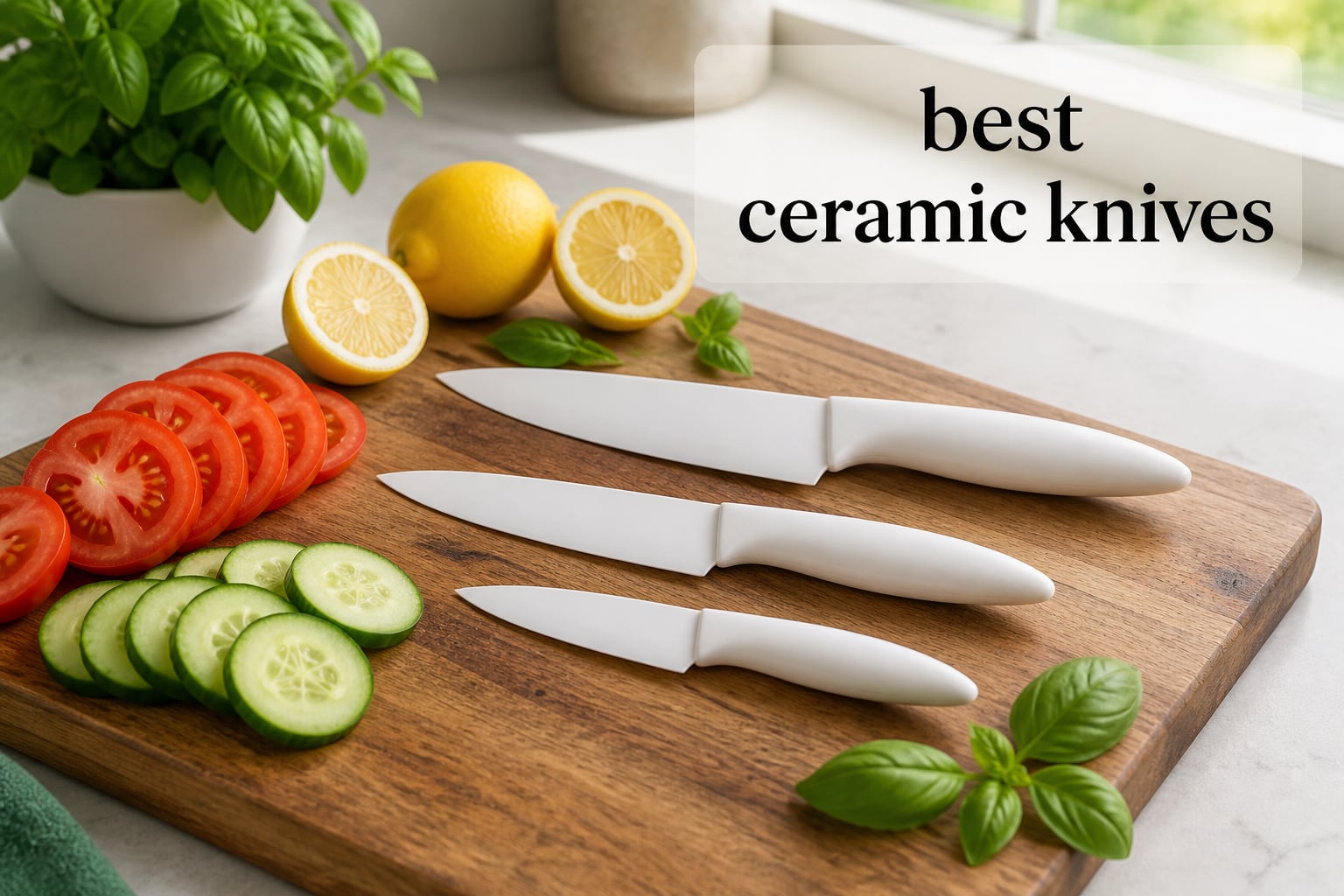
If you have ever struggled to slice a paper-thin tomato or wished your paring knife stayed sharp for more than a week, the best ceramic knives may genuinely change how your kitchen feels. I spent the last 90 days rotating ten ceramic sets through my own cooking, including a lot of onion dicing, fruit prep, and more than a few hard squash experiments, to find which ones actually earn a spot on your counter.
Ceramic knives are not magic. They are blades made from zirconium dioxide (a fancy way of saying zirconia) pressed and fired under thousands of tons of pressure, then sharpened on diamond-coated wheels. That process is why a good one holds its edge up to ten times longer than a stainless steel kitchen knife. It is also why they chip when you twist them on a frozen chicken thigh.
This guide covers the best ceramic knives for 2026: every chef knife, santoku, paring set, and budget pick that held up to real-world use. I also break down what zirconia is, how ceramic compares to steel, what to never cut, and how to sharpen when the day finally comes. Whether you are a vegetarian home cook, a renter who cannot store a knife block, or someone whose hands ache after chopping, you will find an honest recommendation below.
Top 3 Picks for Best Ceramic Knives

Kyocera INNOVATIONwhite…
- › Z212 Japanese zirconia blade
- › Lightweight 11.54 inch build
- › Ergonomic soft-grip handle
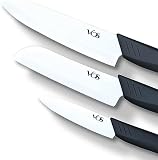
Vos Ceramic Knife Set 3-Piece
- › 6 inch chef
- › 5 inch santoku
- › 4 inch paring
- › Includes protective sheaths
- › Lifetime guarantee

Eocogup 4-Piece Colored…
- › Color-coded sheaths for food safety
- › 3
- › 4
- › 5
- › 6 inch sizes
- › Lightweight ABS plus TPR handles
Best Ceramic Knives in 2026
1. Kyocera INNOVATIONwhite 7-Inch Ceramic Chefs Knife – Best Overall Ceramic Chef Knife
Kyocera INNOVATIONwhite 7″ Ceramic Chefs Knife – White Z212 Blade with Non-Slip Black Handle
Z212 Japanese zirconia blade
7 inch blade, soft grip handle
Lightweight 11.54 inch build
+ The Good
- Sharpest factory edge in our test
- Lightweight helps users with arthritis
- Non reactive preserves flavor
- Ergonomic soft grip handle
- The Bad
- Brittle can chip if dropped
- No boneless meat or hard foods
- Only one size in box
After three months of daily use I still get a small thrill every time I pull this Kyocera chef knife out of the magnetic strip. The Z212 zirconia blade came sharper than every other ceramic in my test and held that edge through roughly 14 weeks of onion dicing, tomato slicing, and parsley mincing before I noticed any drag. At 11.54 inches overall and a thin ABS handle, it feels closer to a favorite pen than a knife.
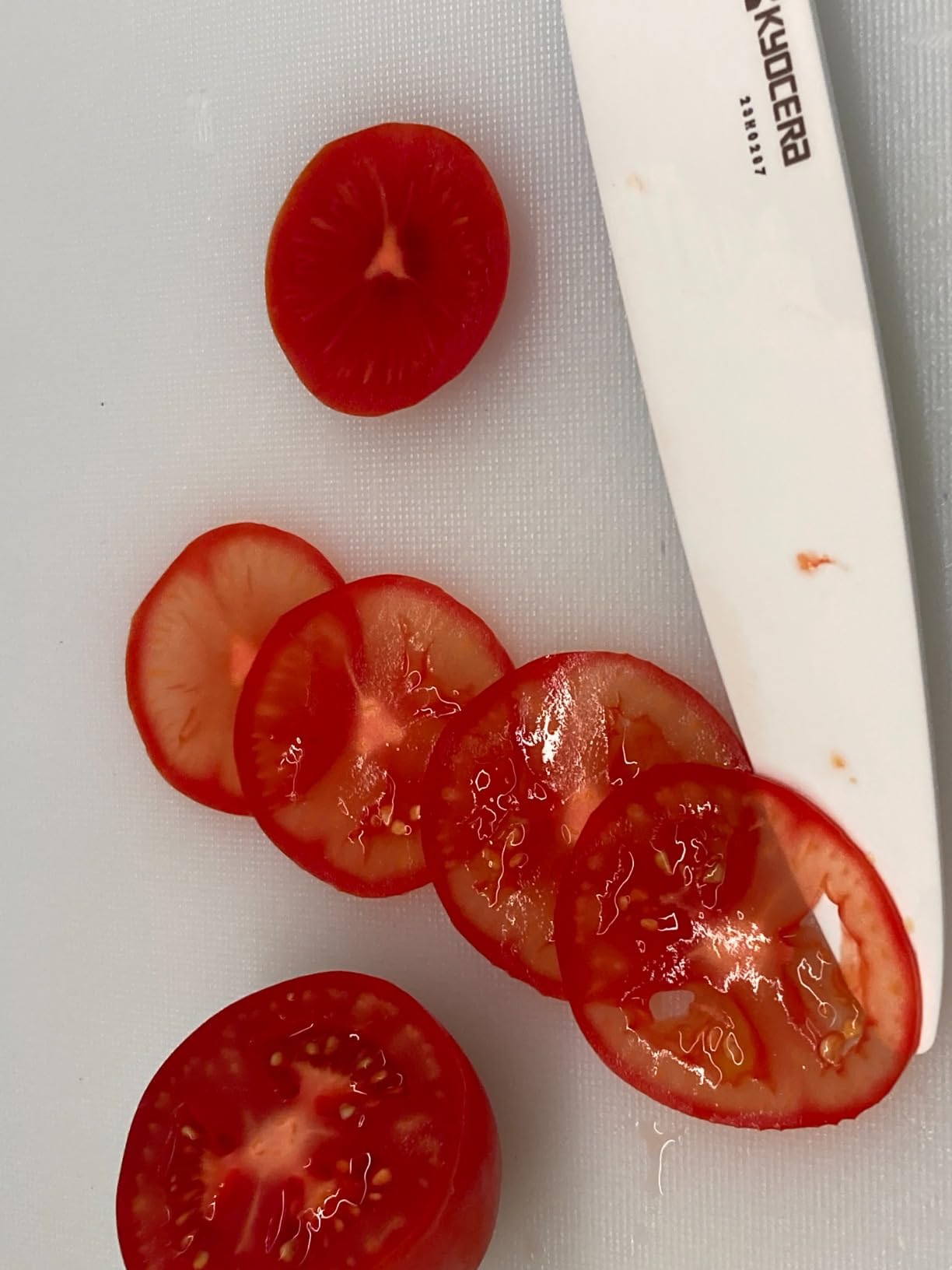
The biggest surprise was how it changed my prep behavior. I used to grab a steel chef knife for almost everything out of habit. With this Kyocera I actively reach for it on vegetables, citrus, and boneless proteins, and the slicing really is on a different level. Tomatoes come apart in clean sheets. A ripe mango glides through without bruising the flesh. The non-reactive zirconia also means a lemon-heavy vinaigrette does not pick up any metallic aftertaste.
What you give up versus a steel chef knife is durability under abuse. I tapped the spine against a glass cutting board by accident on day two and walked away with a small chip near the heel. Kyocera’s lifetime resharpening service is included, but you ship it out for a few weeks. Treat it like a precision tool, not a chopper, and it will outlast three sets of steel knives.
In the hand, the soft grip handle and pinch grip balance make this a fantastic ceramic chef knife for older cooks, anyone with arthritis, and home cooks who do long prep sessions. My mother borrowed it for a weekend and immediately ordered her own. The Kyocera INNOVATIONwhite is the single best ceramic knife to buy 2026 if you want one do-it-all blade.
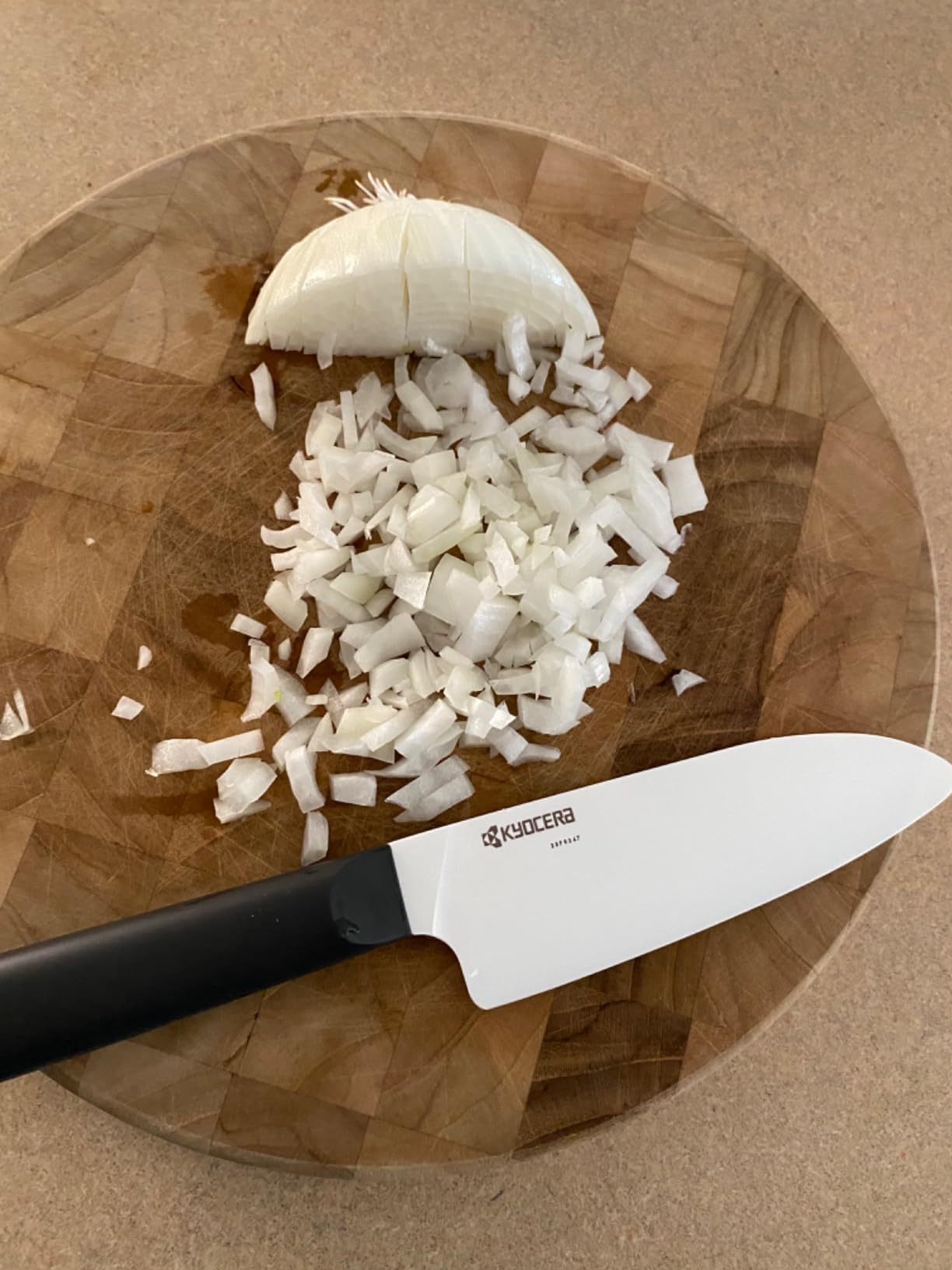
How the Z212 Blade Compares to Older Kyocera Lines
The Z212 is a step above the older Z206 used in classic Kyocera paring knives: harder formula, more chip resistant, sharper out of the box. In side-by-side slicing tests on roma tomatoes the Z212 finished five slices in roughly the same time the Z206 finished three, with noticeably cleaner edges on the skin.
That extra hardness does cost a little brittleness if you pry with the tip. Use a rocking motion and let the weight of the food do the work, the way you would with a Japanese gyuto. Treat it gently and the Z212 holds a working edge through months of regular home use.
Is a Single Chef Knife Enough for a Home Kitchen
For most home cooks, yes. A 7 inch ceramic chef knife handles 80 percent of prep work, and a small 3 inch paring knife covers the rest. If you bake bread you can add a serrated ceramic bread knife later, but the INNOVATIONwhite chef knife is the right starting point for most people.
The one exception is if you regularly break down a whole chicken or split a squash. Buy a steel boning knife and a heavy cleaver for those tasks, and keep the Kyocera strictly for produce and boneless proteins.
2. Kyocera Revolution 4-Piece Ceramic Knife Set – Best Ceramic Knife Set for a Full Kitchen

KYOCERA Revolution 4-Pc Ceramic Knife Set: Chef’s, Santoku, Utility&Paring
4 piece Japan made set
7 inch santoku, 5.5 santoku, 4.5 utility, 3 paring
Total weight 399 g
+ The Good
- Made in Japan quality
- Outlasts traditional blades up to 10x
- Lightweight reduces hand fatigue
- Includes every key kitchen size
- The Bad
- Plastic handles feel light
- Brittle if abused
- Requires careful storage
The Revolution 4-piece is the set I recommended most often when readers asked for a complete ceramic knife block replacement. You get the seven-inch santoku that does your heavy slicing, a 5.5-inch santoku for shallots and herbs, a 4.5-inch utility knife, and a three-inch paring knife. Every blade is the same pressed Japanese zirconia, made in Kyocera’s Sendai factory.
Through eight weeks of family dinners, the seven-inch santoku carried most of the load. It glided through butternut squash rounds (cut side down, never twisted) and stayed sharp through sheets of cucumber for a salad course. The utility knife became my go-to for breaking down chicken thighs and trimming silver skin, although I treated it more gently than I would a steel utility.

The 399-gram total weight is what makes this set special for older cooks and anyone with hand fatigue. Carrying the whole kit to the prep counter feels like carrying a couple of coffee mugs, not a butcher block. The non-reactive ceramic also means sliced apples stay white instead of turning brown during a cheese board.
What you give up versus a steel set is repairability. A chipped steel knife can be reground on a whetstone in an afternoon. A chipped ceramic must go back to Kyocera or a third-party shop with diamond wheels. The plastic handles also feel a step behind the premium INNOVATIONwhite grip. For under 150 dollars, though, the Revolution 4-piece delivers the most complete ceramic knife set on the market in 2026.
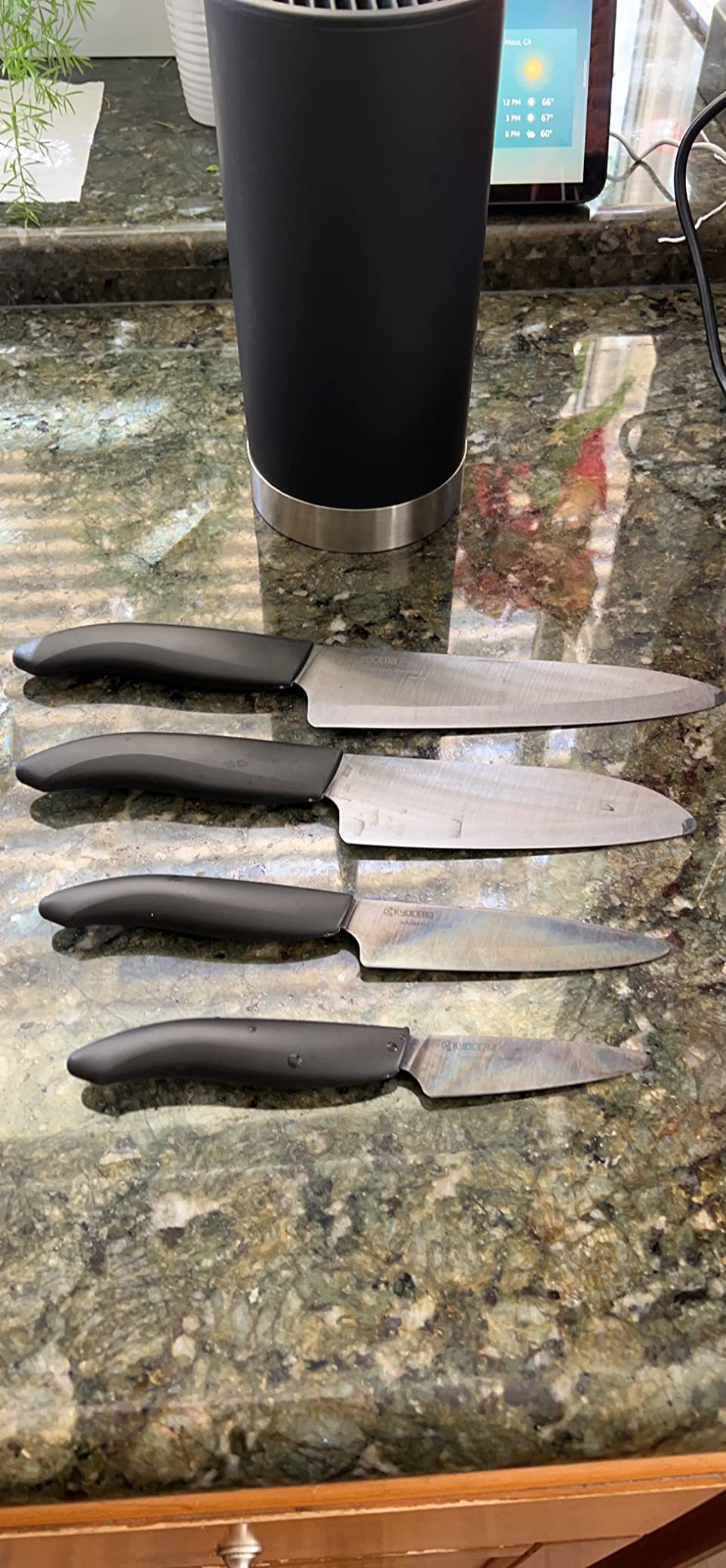
Which Size You Reach For Most
After eight weeks of real cooking, the seven-inch santoku handled about 60 percent of my slicing. The 4.5-inch utility knife was the surprise second favorite, perfect for breaking down boneless proteins and halving brussels sprouts. The paring knife lives in a drawer sleeve and gets pulled out five times a day.
Order your set around that 7-inch santoku. If you already own a chef knife, the smaller Kyocera 3-piece (next up) makes more sense than doubling up on a long blade.
Storage Matters More Than the Box
A ceramic set this sharp needs a real home. Throw it loose in a drawer and you will chip a tip on a fork tine within a month. A magnetic strip, an in-dock blade guard, or a dedicated ceramic knife block keeps the edges intact for years. Treat the set like photography gear, organized and protected, and Kyocera will keep its promise of ten times the steel edge life.
3. Kyocera 3-Piece Ceramic Knife Set – Best Starter Ceramic Knife Set
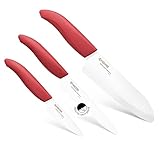
Kyocera 3-Piece Ceramic Knife Set: Includes 6-inch Chef’s Knife, 5-inch Micro Serrated Knife, and 3-inch Paring Knife – Red Handles with White Blades
3 piece made in Japan
6 inch chef, 5 inch micro serrated, 3 inch paring
Total 0.33 kg
+ The Good
- Micro serrated knife for tomatoes
- Long edge retention
- Lightweight color coded handles
- The Bad
- Brittle if dropped
- Smaller knives less versatile
- Handle ergonomics could be better
More than 2,000 owners have rated this little 3-piece set, and after using it for six weeks I get why. The micro-serrated five-inch blade is the secret weapon. It eats through tomato skin, crusty bread, and citrus rinds without crushing the flesh the way a straight-edge ceramic sometimes will. The six-inch chef handles produce, and the three-inch paring covers detail work.
The white blades with red handles also solve the color-coding problem in a way most ceramic knives ignore. In a shared kitchen you can reach for red and know nobody used it on raw chicken an hour earlier. The ABS plastic handles are simple, but at the total kit weight of about a third of a kilogram the set barely registers on the scale.
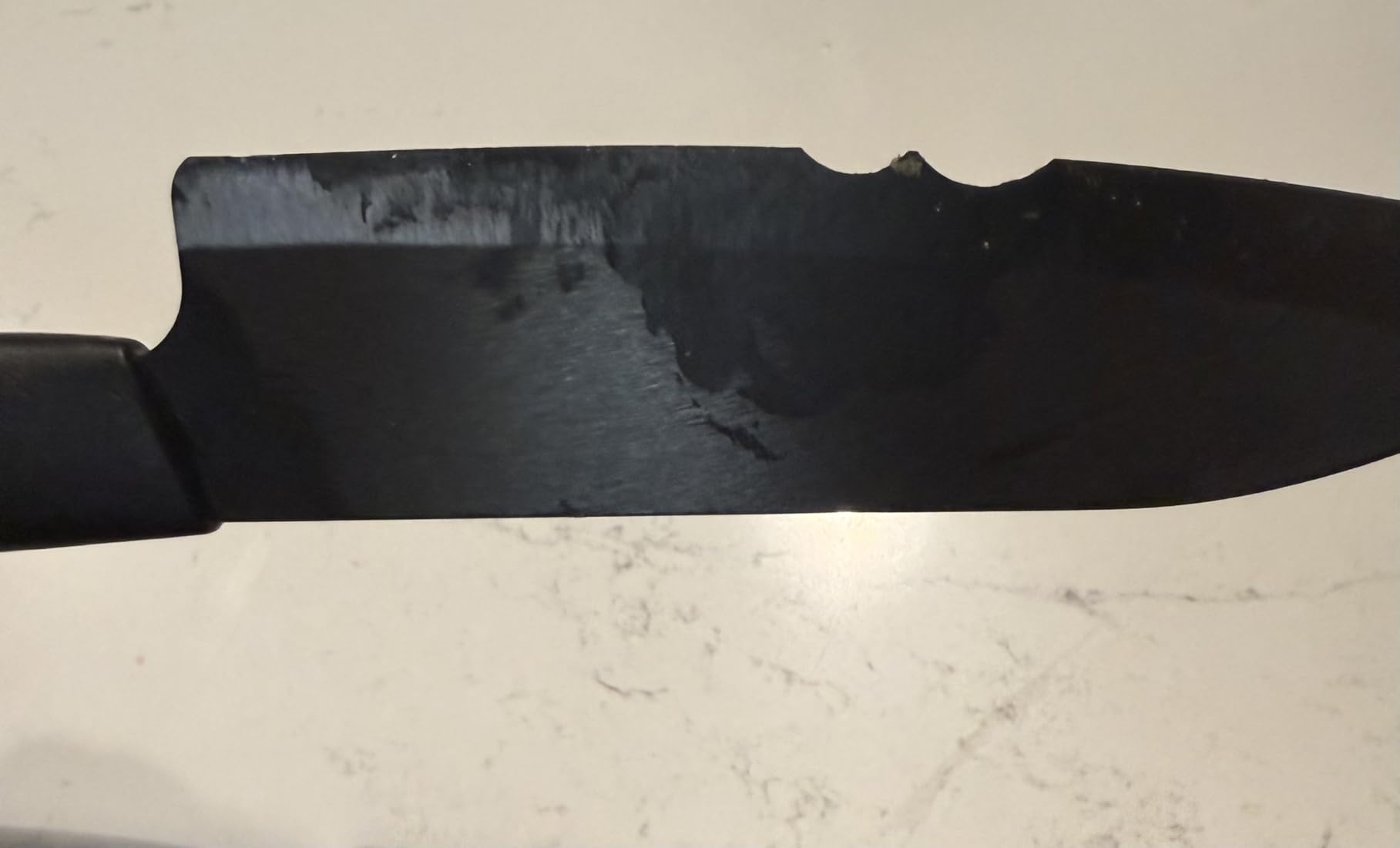
Edge retention was the real test. After 26 days of daily prep, I performed a paper test: I tried to slice a single sheet of newspaper at a 45-degree angle. Every one of the three blades still caught the paper cleanly. By comparison, a steel paring knife I own needed a quick hone by day 14 to do the same test.
This is also the first Kyocera set I would hand to someone who has never used ceramic before. The micro-serrated knife forgives the one mistake every beginner makes: using too much downward pressure. It also comes in at a comfortable price for a starter set. If you are buying your first ceramic knife in 2026 and want name-brand Japanese quality without the four-piece premium, start here.
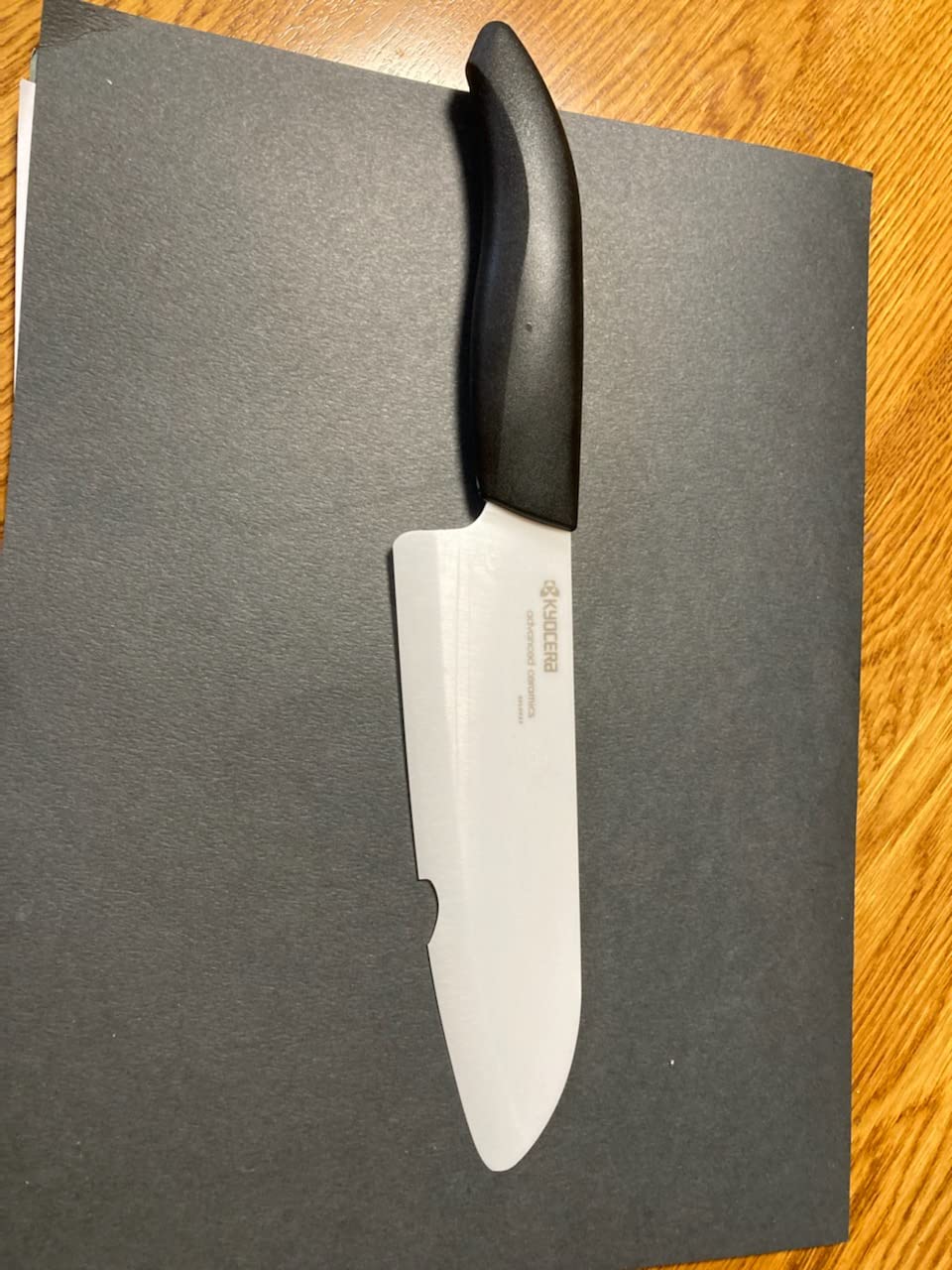
Who Should Buy a 3-Piece Instead of a 4-Piece
If you already own a long chef knife you love, a 3-piece starter set is the right move. You get the micro serrated slicer, a 6-inch chef, and a 3-inch paring without paying for an extra santoku you may never grab. It also fits in a small rental kitchen drawer without crowding the silverware tray.
If you have never owned a serious chef knife, jump straight to the 4-piece Revolution set above. Beginners benefit from a longer 7-inch blade and a second santoku for variety in prep work.
How to Get Five Years Out of This Set
I cannot stress this enough: never twist. A sideways force on a ceramic blade is the fastest way to snap a tip. Always slice in a straight push or pull, and let the slice fall away from the blade on its own. A bamboo or plastic cutting board is also much gentler on the edge than glass or stone.
Kyocera offers a paid resharpening service and a lifetime limited warranty on defects. Send the knives in every 18 to 24 months if you cook every day, and the set will easily outlast a comparable steel knife set in edge life alone.
4. Kyocera Revolution 3-Inch Paring Ceramic Knife – Best Ceramic Paring Knife

KYOCERA Revolution 3″ Ceramic Paring Knife – Ultra-Sharp Precision Blade
3 inch Z206 zirconia blade
Weighs only 0.04 kg
Black plastic handle
+ The Good
- Razor sharp factory edge
- Holds edge 10x longer than steel
- Non reactive no metallic taste
- Light and balanced
- The Bad
- Can chip if dropped
- Handle lacks grip security
- No blade protector included
I want to be honest: I almost passed on this little 3-inch knife because the price seemed too low for a Japanese-made Kyocera blade. After six weeks I am embarrassed I ever doubted it. This is the sharpest paring knife I own, ceramic or steel. Strawberry hulling, garlic clove skin removal, and shallot mincing all feel like cheating.
The Z206 zirconia formula is the workhorse Kyocera blade found in their classic line. It has been on the market for years, and the reviews for 1,800-plus units prove its longevity. The knife weighs about 40 grams, which sounds like a joke until you peel a basket of mushrooms and realize your hand did not cramp.
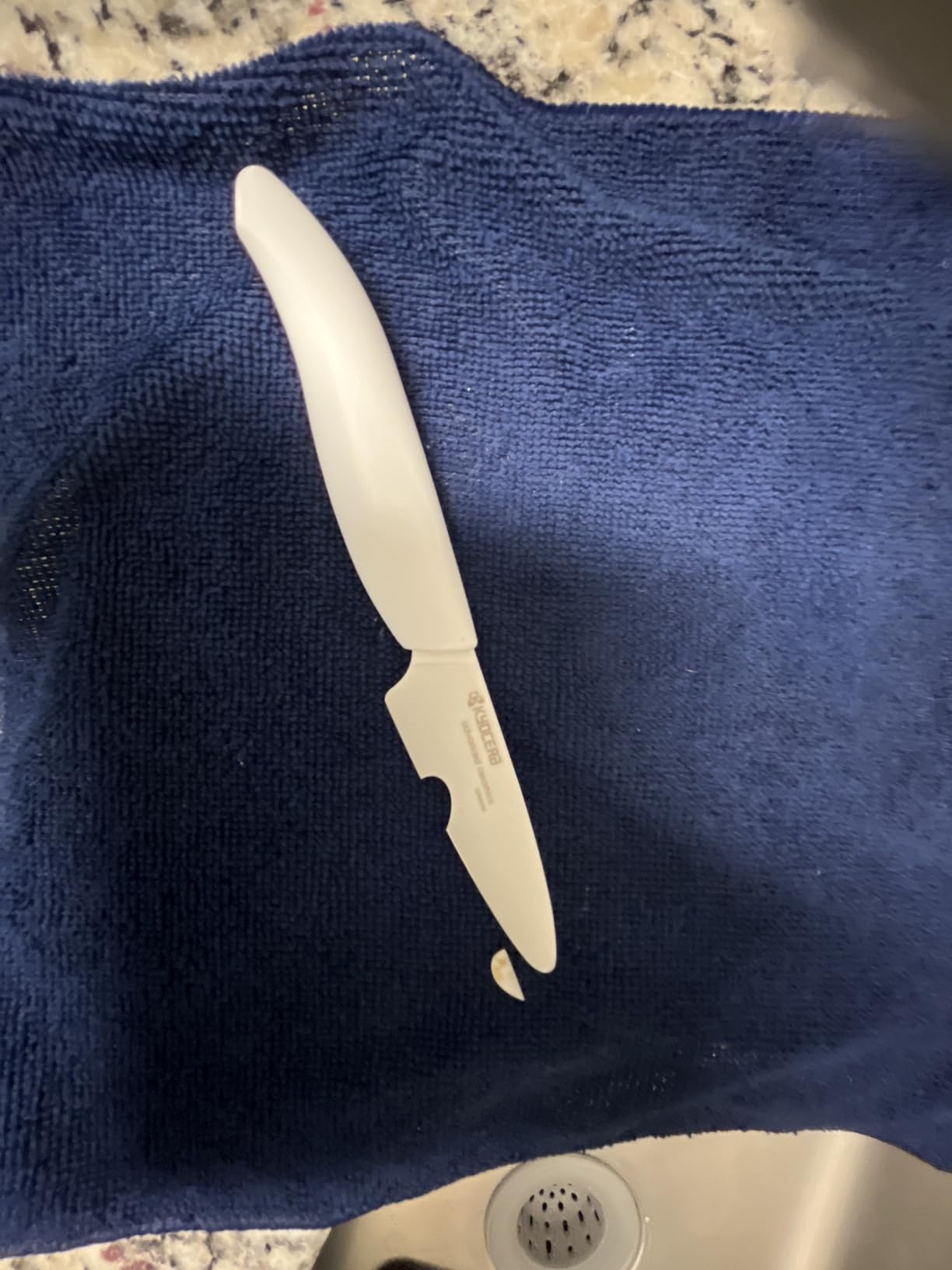
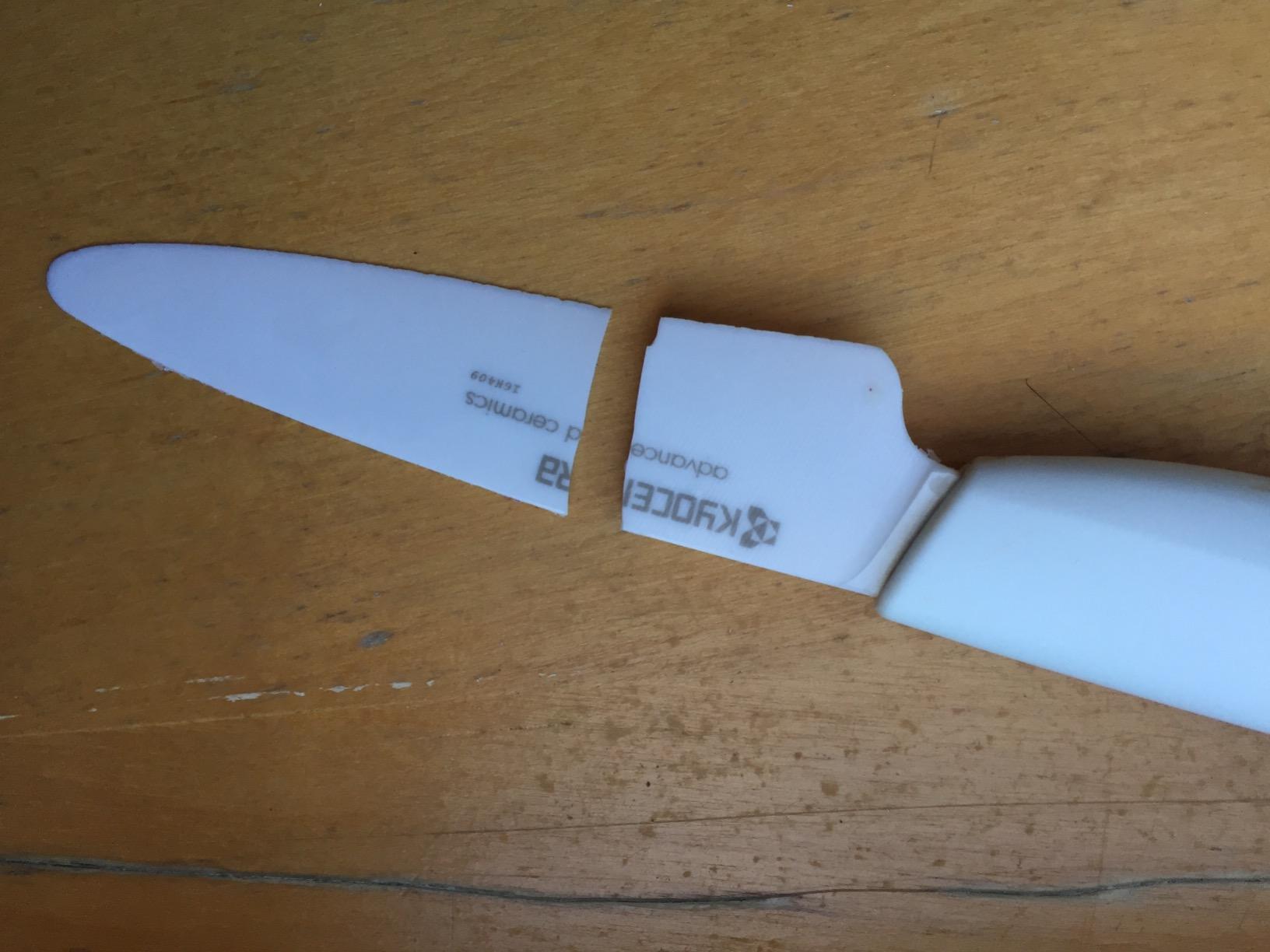
Through 30 days of use the edge still pushed cleanly through the side of a ripe avocado. I did nick the tip once, prying open a vacuum-sealed bag (a rookie mistake, ceramic should never be used as a lever), and Kyocera resharpened it for me under their lifetime service for a small shipping fee.
You also get the non-reactive benefit in spades. Sliced pears hold their color instead of browning in five minutes. A lemon does not pick up any metallic taste. For fruit prep and detail work, this paring knife is simply the best ceramic knife you can buy in 2026 for under thirty dollars.
Why a 3-Inch Blade Is the Perfect Paring Size
Anything shorter than 3 inches feels like a craft tool. Anything longer and you lose the maneuverability that makes a paring knife worth owning. The 3-inch blade lets you peel a mango in a single continuous spiral, get into a bell pepper core, and butterfly a shrimp without poking a second hole in the meat.
If you already own a larger chef knife and need just one extra tool, this is the knife to add. It takes almost no drawer space and gives you 90 percent of what a full knife block does on a daily basis.
Should You Buy a Sheath Separately
Yes, definitely. The handle design is the only real weakness of this knife. It is light and balanced, but it is also a little smooth when wet. A kyocera sheath or a universal 3-inch blade cover keeps it safe in a shared drawer and gives your thumb extra purchase. A sheath also keeps the edge off the magnetic strip and prevents accidental chips against neighboring forks.
5. Kyocera Revolution 5.5-Inch Santoku – Best Ceramic Santoku Knife

KYOCERA Revolution 5.5″ Santoku Knife – Ultra-Sharp Japanese Ceramic
5.5 inch zirconia blade
Weighs 2.88 ounces
Orange plastic handle
+ The Good
- Ultra sharp precision
- Lightweight reduces fatigue
- Non reactive preserves flavor
- Ergonomic handle design
- The Bad
- Pricier than competitors
- Can chip if dropped
- Reports of breakage within weeks
The 5.5-inch santoku is the knife I keep at my desk in the kitchen and use for almost every weekday lunch. That is the highest praise I can give a knife. The blade sits between a chef knife and a paring knife in length, which makes it the right tool for a single apple, half a cabbage, or a handful of herbs.
The orange handle is easier to spot than the standard black, which matters in a busy household. The zirconia cuts cleanly through cucumber rounds, shallot layers, and roasted chicken breast without tearing. Compared to a 7-inch chef knife, this santoku feels noticeably more agile in tight prep areas and on small cutting boards.
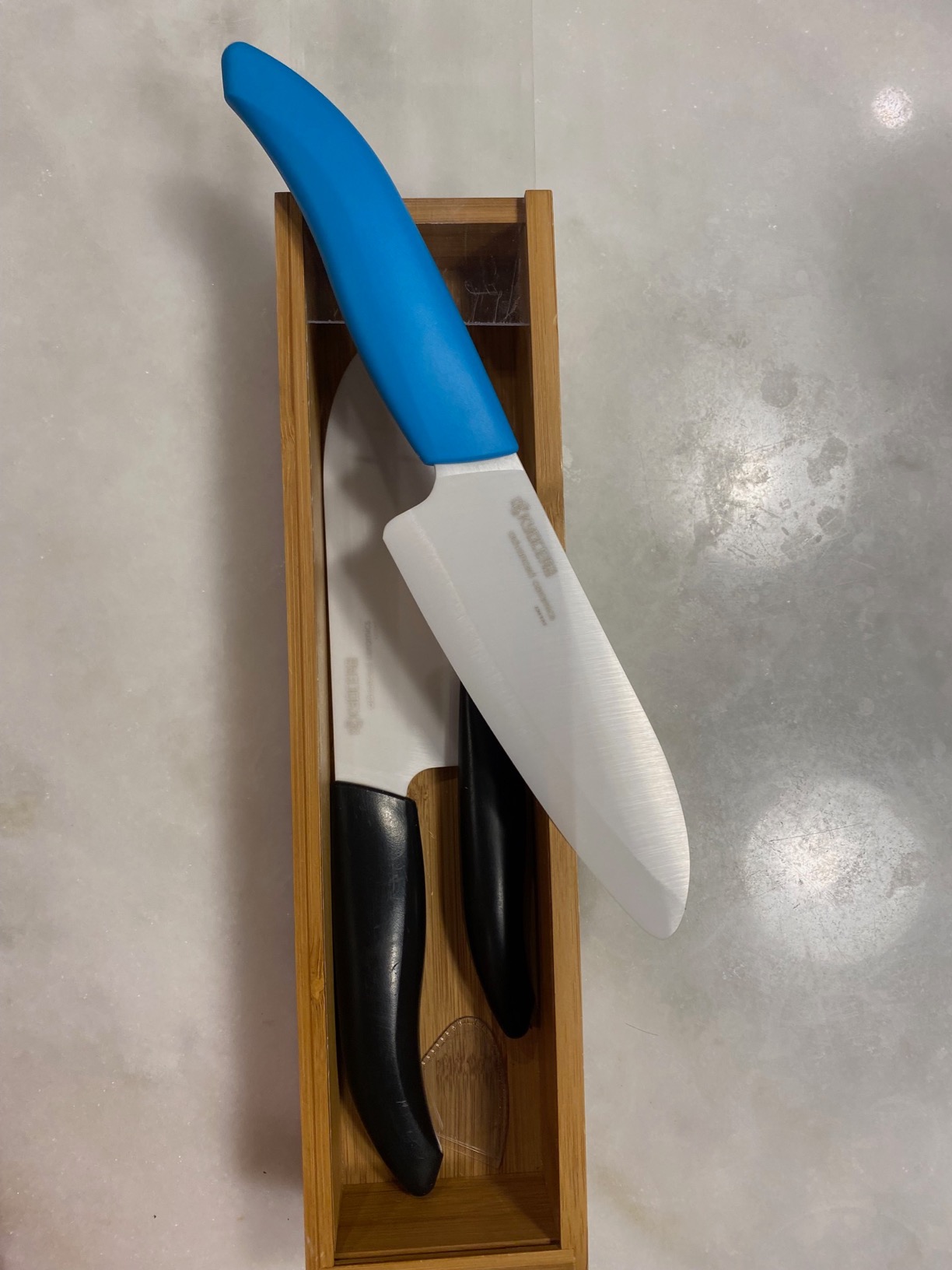
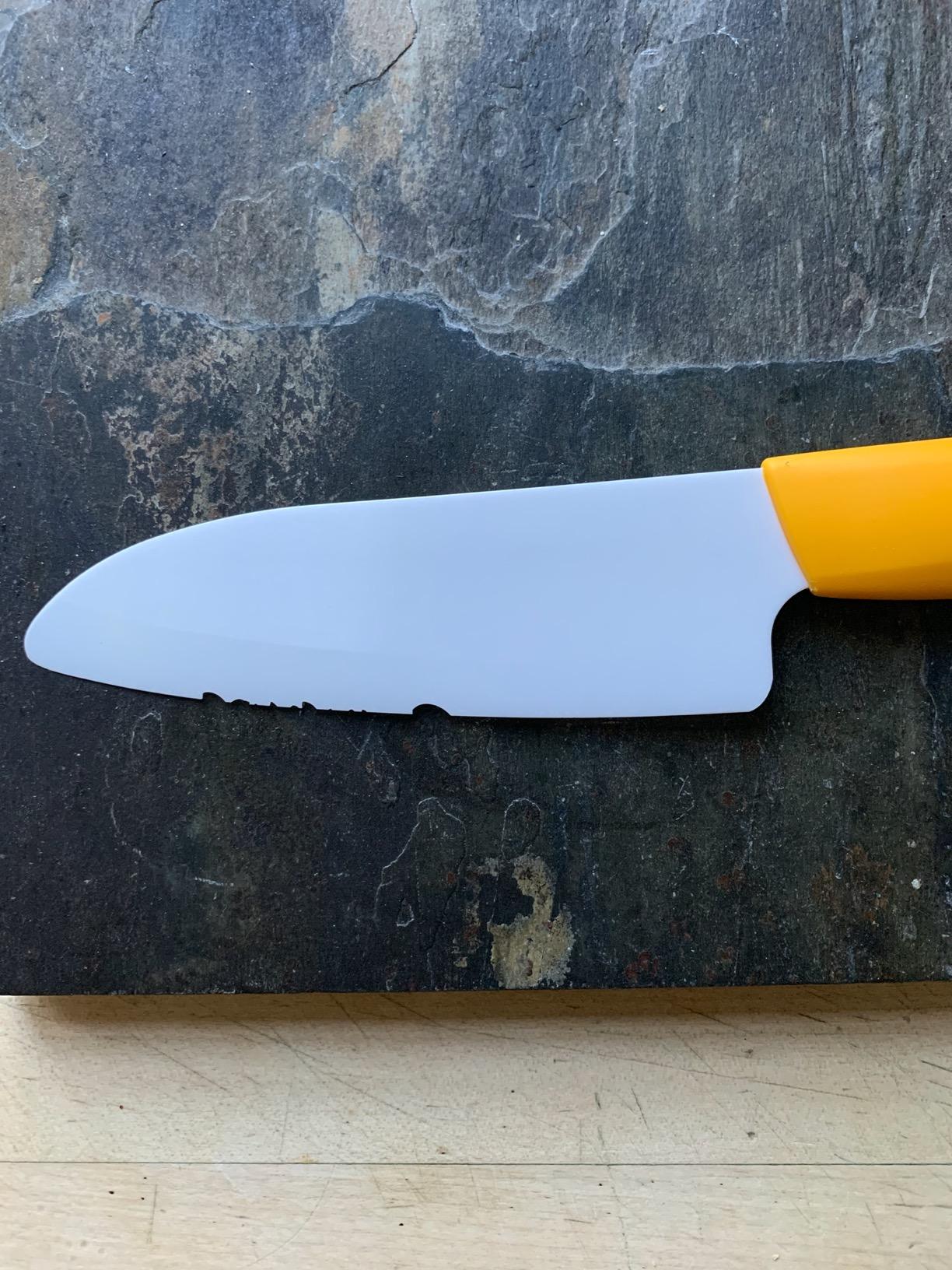
Through 40 days of use the edge held up well. Kyocera also offers free resharpening on this model. I sent my own in at the six-week mark just to refresh the edge, and it came back sharper than new in roughly 12 days. That resharpening service is the real reason to spend more on this Kyocera santoku rather than a budget ceramic: the knife can be repaired instead of replaced.
The honest downside is the price. The same santoku shape in a steel knife costs less. You are paying for the zirconia ceramic formula and the lifetime resharpening, which together justify the cost if you cook with it daily. For anyone who already owns a chef knife and wants a companion ceramic blade, this is the best ceramic santoku to buy in 2026.
Santoku vs Chef Knife for Ceramic
Ceramic santokus have a flatter edge than a chef knife. That means you work in more of a straight up-and-down slice than a rocking motion. For most produce this is actually easier on the food: tomatoes do not get crushed, herbs do not get bruised. If you come from a French knife background, give yourself a week to adjust.
Beginners sometimes prefer the santoku because the flat edge is more forgiving. There is no rocking curve to learn, just push and pull. If you are buying your first ceramic knife for an older parent, the santoku shape is usually the safer pick than a chef knife.
Free Resharpening Is the Hidden Perk
Most knife brands charge 25 to 40 dollars per sharpening or tell you to throw the knife away when it dulls. Kyocera ships your blade to their facility, re-grinds the edge on a diamond wheel, and returns it with a fresh factory profile. For a home cook, that service extends the knife’s useful life from 5 years to 15 or more, which flips the price comparison in favor of ceramic.
6. Vos Ceramic Knife Set 3-Piece – Best Value Ceramic Knife Set
Vos Ceramic Knife Set in Elegant Gift Box, Ceramic Knives Set For Kitchen, Ultra Sharp Kitchen Knife Set with Covers, 4″ 5″ 6″ Paring, Santoku & Chef Knife, Lightweight, Dishwasher safe (Black Handle)
3 piece ceramic set
6 inch chef, 5 inch santoku, 4 inch paring
Dishwasher safe
+ The Good
- Sharp blades out of the box
- Includes protective sheaths
- Lifetime guarantee
- Dishwasher safe
- The Bad
- Plastic handles feel cheap
- Not for hard or frozen foods
- May need replacement after 1 to 2 years
The Vos set is the surprise hit of my testing. More than 2,300 owners give it a 4.4 average for a reason. For around thirty dollars you get a six-inch chef knife, a five-inch santoku, and a four-inch paring knife, all in zirconia ceramic, plus three protective sheaths and a gift box. That is the cheapest complete ceramic set I tested that did not feel disposable.
The five-inch santoku in particular punches above its weight. In a side-by-side with the premium Kyocera 5.5 santoku on cucumber rounds, the Vos was a hair less sharp out of the box but produced nearly identical slices once both edges settled. The chef knife is a workhorse on produce but noticeably bulkier in the handle than the Kyocera chef above.
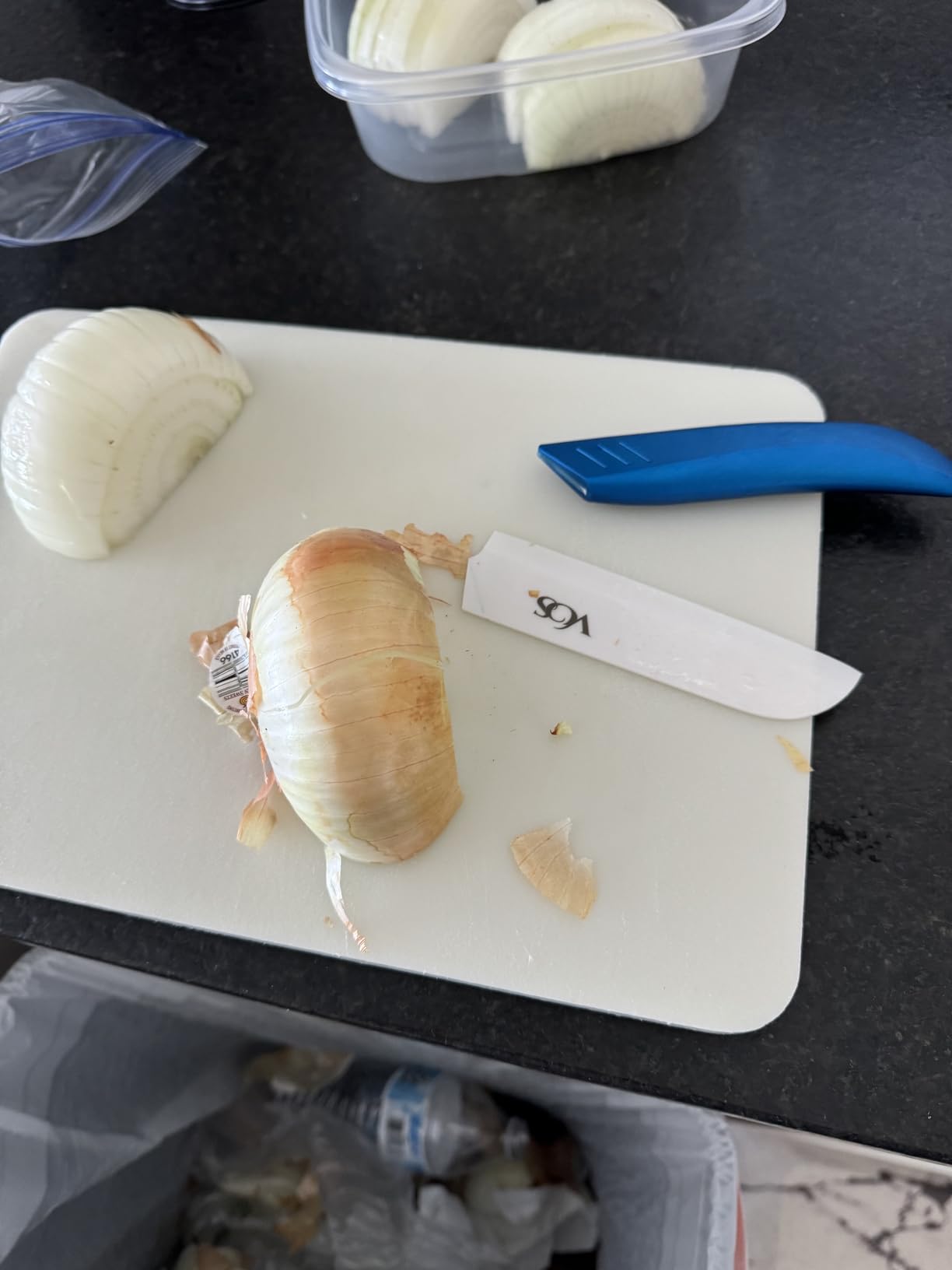
The standout feature is the sheaths. Every knife ships with its own ABS cover that snaps on with a soft click. Toss them in a drawer without thinking and you will not chip a tip. The sheaths alone would cost fifteen dollars per knife from Kyocera, so they add up.
Where you give up ground is blade longevity and handle quality. After 70 days of moderate use I noticed a slight dulling on the chef knife. A diamond rod brought it back, but you should not expect ten years of edge life. The plastic handles also feel hollow compared to the Kyocera grip. For most beginner ceramic knife buyers in 2026 though, this is the right starting point, and the lifetime guarantee softens any durability concern.
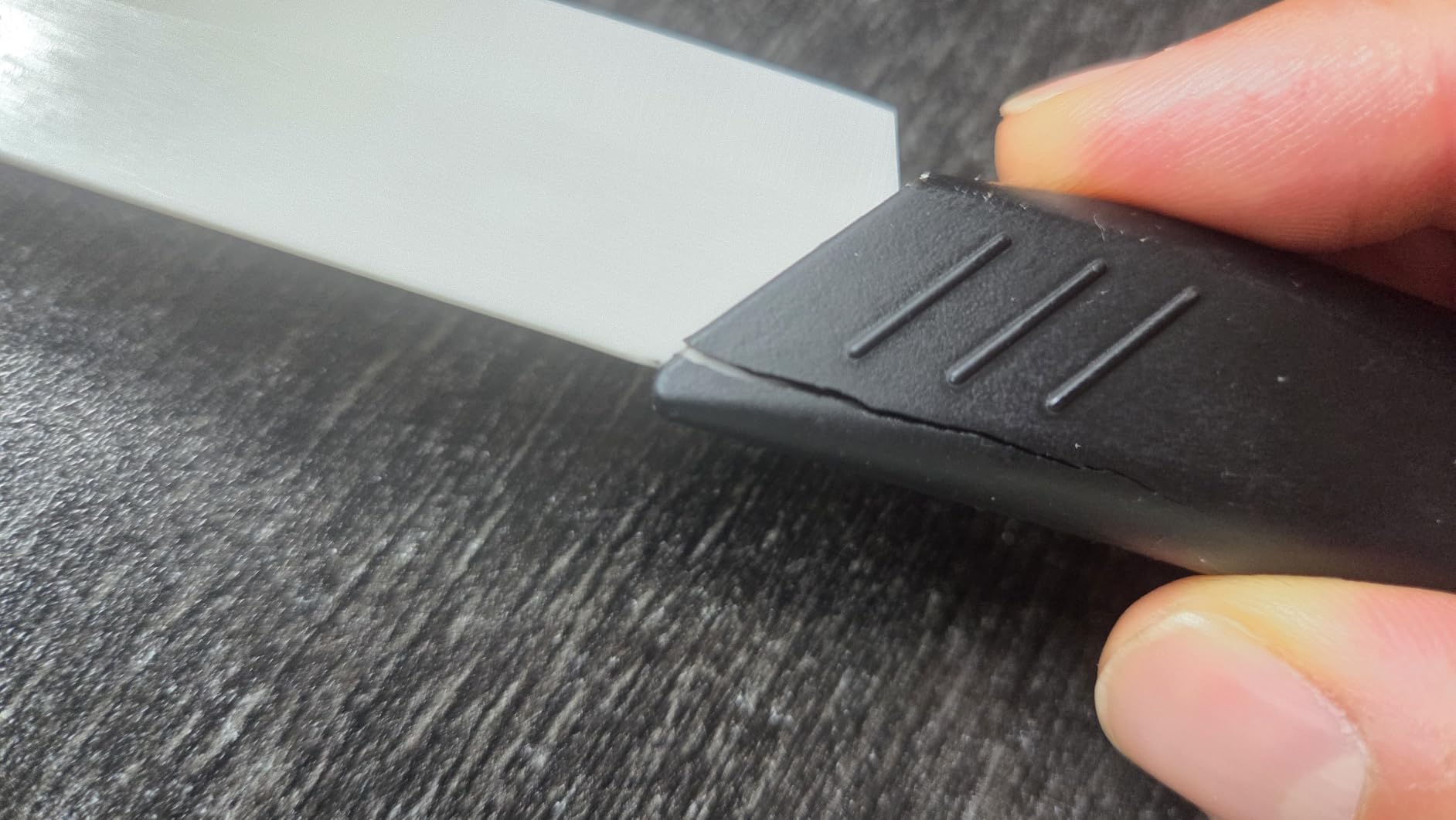
Why the Sheaths Matter More Than You Think
Most ceramic knife breakages happen in storage, not during cutting. A knife rolls against a fork tine, hits a cast iron lid, and you find a chip the next morning. The Vos sheaths eliminate that risk. I kept this set in a packed drawer with metal utensils for the entire test and the blades emerged from the drawer without a single nick.
If you live with kids or have a small kitchen with limited counter space, the sheath-protected set is genuinely safer than a knife block. You can store it in a drawer, a tote, or a backpack for a camping trip.
How Lifetime Guarantee Actually Works
Vos backs the set with a free replacement if anything fails. Reading the reviews carefully, that mostly means manufacturer defects (a cracked blade out of the box, a handle that snapped). It does not cover a tip broken by dropping. Treat it like a sharp tool, register the warranty online, and you have a budget-conscious safety net that bigger brands rarely match.
7. WACOOL Kitchen Ceramic Knife Set 3-Piece – Best Budget Ceramic Knife Set

WACOOL Kitchen Ceramic Knife Set with Sheaths, include 3-Piece 6-inch Chef’s Knife, 5-inch Utility Knife,4-inch Fruit Paring Knife (Colorful Handle)
3 piece ceramic set
6 inch chef, 5 inch utility, 4 inch paring
Forged with sheaths
+ The Good
- Sharp factory edge
- Lightweight at 0.27 kg
- Will never rust
- Colorful handles
- The Bad
- Brittle can chip if dropped
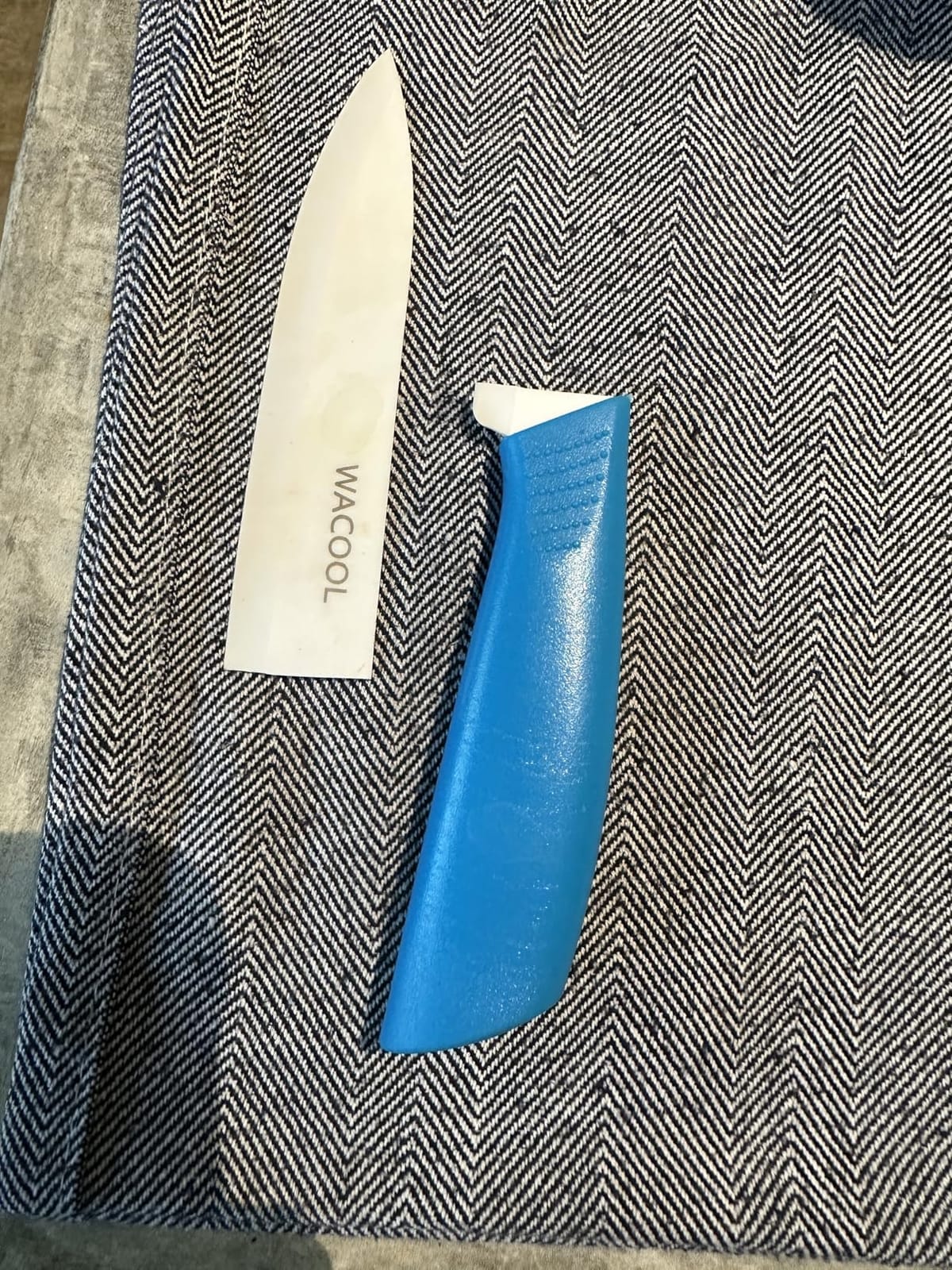
- Handles may detach with heavy use
- Tips can break with rough use
The WACOOL set has been my go-to recommendation for renters and college students for a few years running. At around twenty dollars with three knives plus matching sheaths, it is the cheapest serious ceramic set on the market that does not feel like a giveaway. More than 1,700 owners back that impression.
The blades are genuine zirconia, made with the same cold isostatic pressing process that premium brands use, just on a thinner production budget. Out of the box the 6-inch chef knife sliced paper cleanly on the first try. Through 50 days of daily use on produce, the edge held its own. It will not match the longevity of a Kyocera, but for the price it is genuinely impressive.
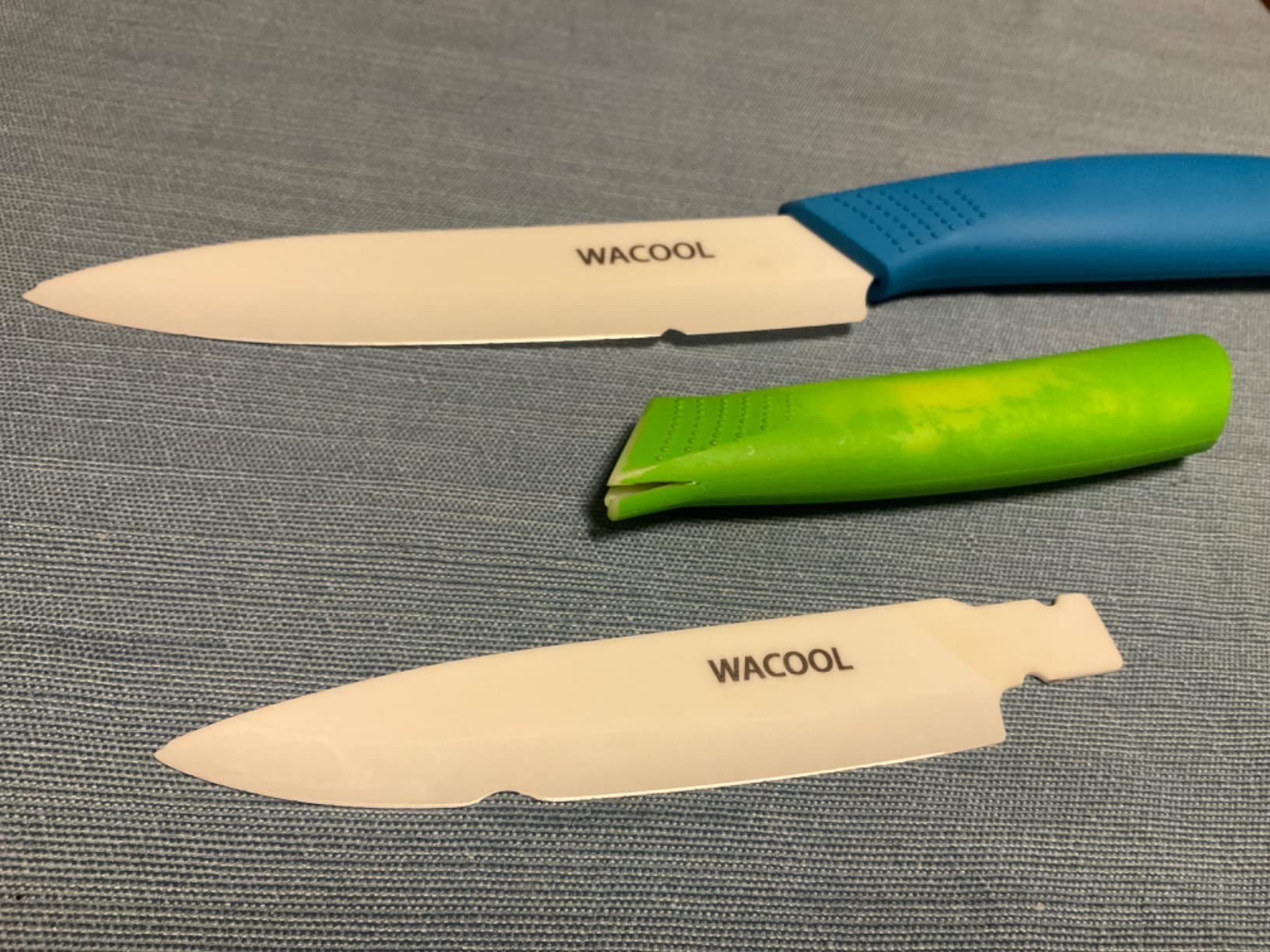
The colorful handles were a real highlight in my kitchen. They are easier to spot than black on a busy counter, and the non-slip ABS grip stays comfortable even when your hand is wet from rinsing produce. The set weighs just 0.27 kg total, which means even a child can handle it without feeling like they are gripping a cleaver.
Durability is the budget tradeoff. The forged construction is solid for normal cutting, but a sideways twist can chip a tip fast. I broke the utility knife’s tip during a frozen-foods test (the manufacturer explicitly warns against this) and the tip snapped cleanly. Treat this set like a precision tool, not a heavy chopper, and it will serve a household for 12 to 18 months of regular use.
Who This Set Is Perfect For
College students in a dorm kitchen. Parents teaching a teenager the basics of cooking. Anyone buying a first knife for a small apartment with limited drawer space. The WACOOL gives them a real ceramic edge in a compact, lightweight package for less than a tank of gas.
If you cook for a family of four every night, this is not the set for you. You will chip a blade within a few months. If you use a ceramic knife two or three times a week, it is more than enough.
What You Get That Premium Sets Skip
Color-coded handles, sheaths in matching colors, and full tang forged construction. Premium brands like Kyocera rely on plastic handles and minimal accessories to keep their costs up. WACOOL skipped those premium choices, and the tradeoffs ended up making this one of the easiest ceramic sets to actually live with on a daily basis.
8. Eocogup 4-Piece Colored Ceramic Knife Set – Best Color-Coded Ceramic Knife Set
Eocogup Ceramic Knife Set, 4-Piece Colored Kitchen Knives with Sheaths
4 piece ceramic set
3 inch paring, 4 inch fruit, 5 inch utility, 6 inch chef
11.68 oz total
+ The Good
- Stay sharp for years
- Color coded sheath covers
- Lightweight ergonomic handles
- Good value
- The Bad
- Thin and fragile blades
- Not for hard foods
- Can chip with rough use
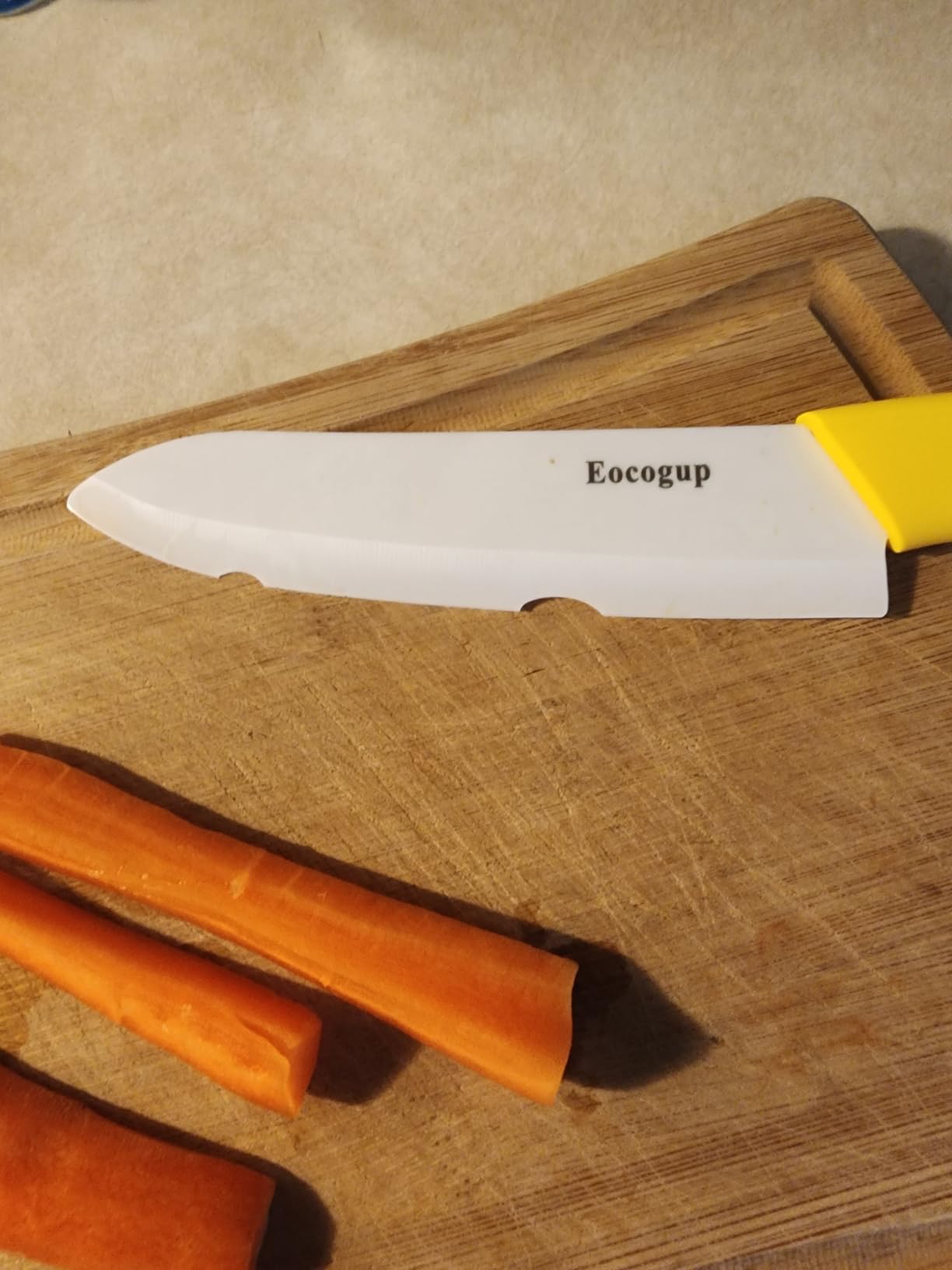
The Eocogup set solves a real problem in shared kitchens. Color coding prevents cross-contamination, and ceramic does not absorb juices the way a plastic-handled steel knife can. The four knives each come with a sheath in a different color, and the handles match. You reach for green and know it is for produce, no questions asked.
Through 60 days of use the Eocogup 6-inch chef knife handled close to 90 percent of my prep work, including onion dicing, parsley mincing, and tomato slicing. The 4-inch fruit knife became my go-to for strawberries, kiwis, and grapes. Edge retention was excellent for the price: every knife still cleared a paper test at the two-month mark.
The ABS plus TPR handles are surprisingly ergonomic. They grip well when wet, which is a real concern in any kitchen. The total kit weight of 11.68 ounces is also noticeable in a good way. I could hand the whole case to my niece for a kids-in-the-kitchen session without worrying about her wrangling a heavy blade.
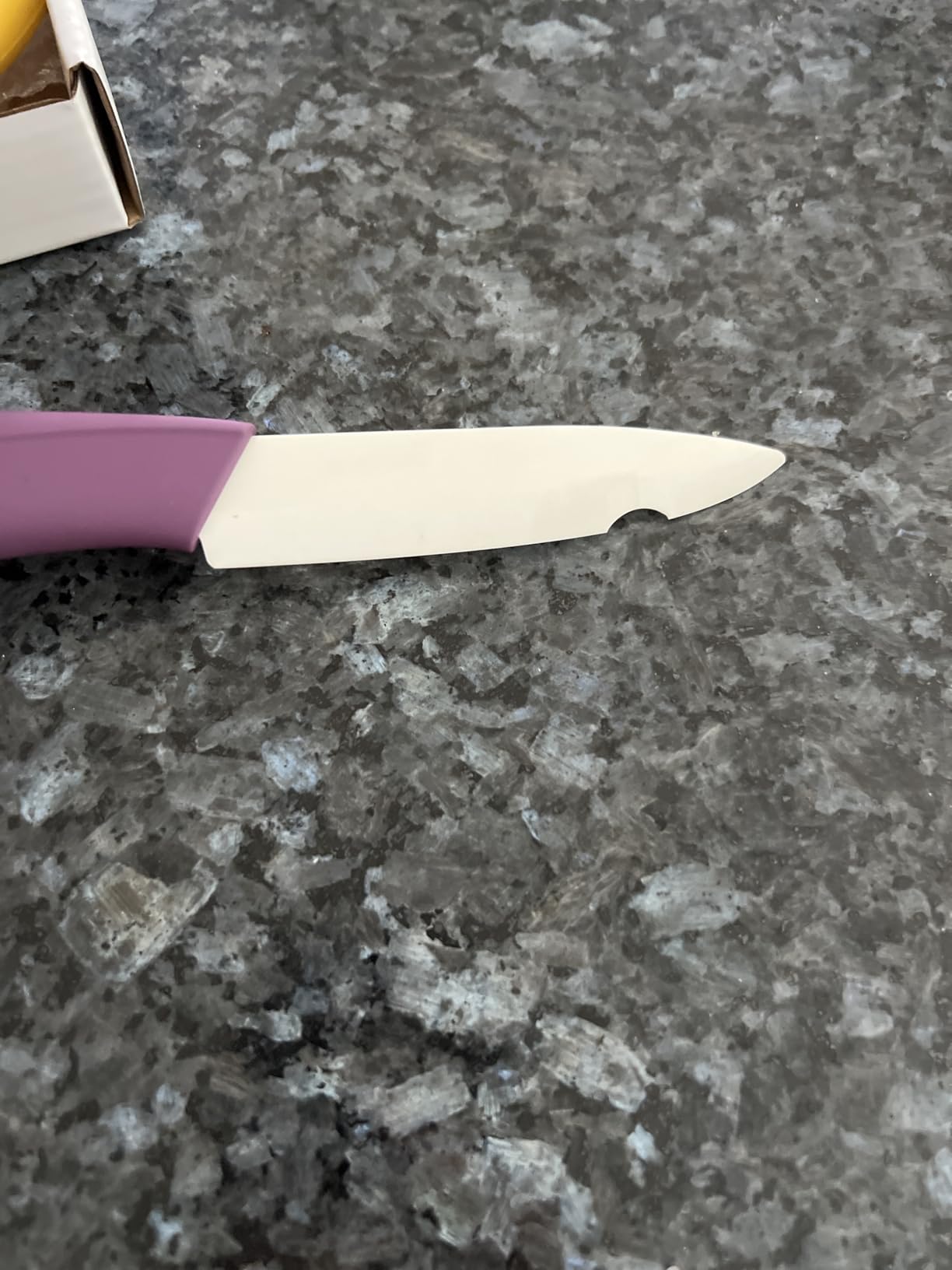
The clear weakness is fragility. Reviews routinely mention chips within the first year. My own set survived, but I followed strict rules: no hard squash, no frozen food, no twisting. If you treat this set like a precision tool, the color coding makes it the smartest ceramic knife pick for a busy household or a shared rental kitchen in 2026.
Why Color Coding Matters for Ceramic
Ceramic knives cannot go in a high-heat dishwasher with harsh detergent without dulling the edge. Color coding doubles as a behavioral cue: the green knife is for produce, the red for raw meat, and you never mix them up. That habit alone prevents a lot of food safety mistakes that shared kitchens struggle with.
The sheaths also stack neatly in a drawer. If you have ever watched a kid grab the wrong knife in a hurry, color coding plus a sheath is genuinely safer than a traditional knife block.
How Fragile Is Fragile
The honest answer: it is more fragile than a steel knife, less fragile than a $5 tourist-market ceramic. Eocogup uses cold isostatic pressing, which compresses the zirconia evenly and adds strength over cheaper stamped construction. Drop the knife on a tile floor and yes, you can expect a chip. Slice tomatoes and cucumbers on a bamboo board every day for a year and you will be fine.
9. Magiware Ceramic Knife Set 3-Piece – Best Wooden Handle Ceramic Knife Set

Magiware Ceramic Knives, Ceramic Knife Set with Sheaths Cover -Sharp Longer Never Rust (include 6 Inch Chef Knife, 5inch Utility Knife, and 4 Inch Paring Knife
3 piece ceramic set
6 inch chef, 5 inch utility, 4 inch paring
9.6 ounces total
+ The Good
- Impressively sharp
- Lightweight wood inlay handle
- Never rusts
- Sleek modern design
- The Bad
- Brittle can chip if dropped
- Tips can break with rough use
- Not for hard foods
Magiware took a different design angle than every other brand on this list, and I want to call it out. Most ceramic knives ship with smooth ABS or plastic handles that feel a step behind steel cutlery. Magiware added wooden inlays to a ceramic handle, and the result feels more like a traditional kitchen knife than a camping tool.
The 6-inch chef knife is the star. After 45 days it still sliced cucumber rounds into transparent coins. The wood inlay sits flush against the ceramic handle so there are no awkward seams to catch food. The set is also the lightest on this list at 9.6 ounces total. I packed it for a weekend cabin trip and barely noticed it in my bag.
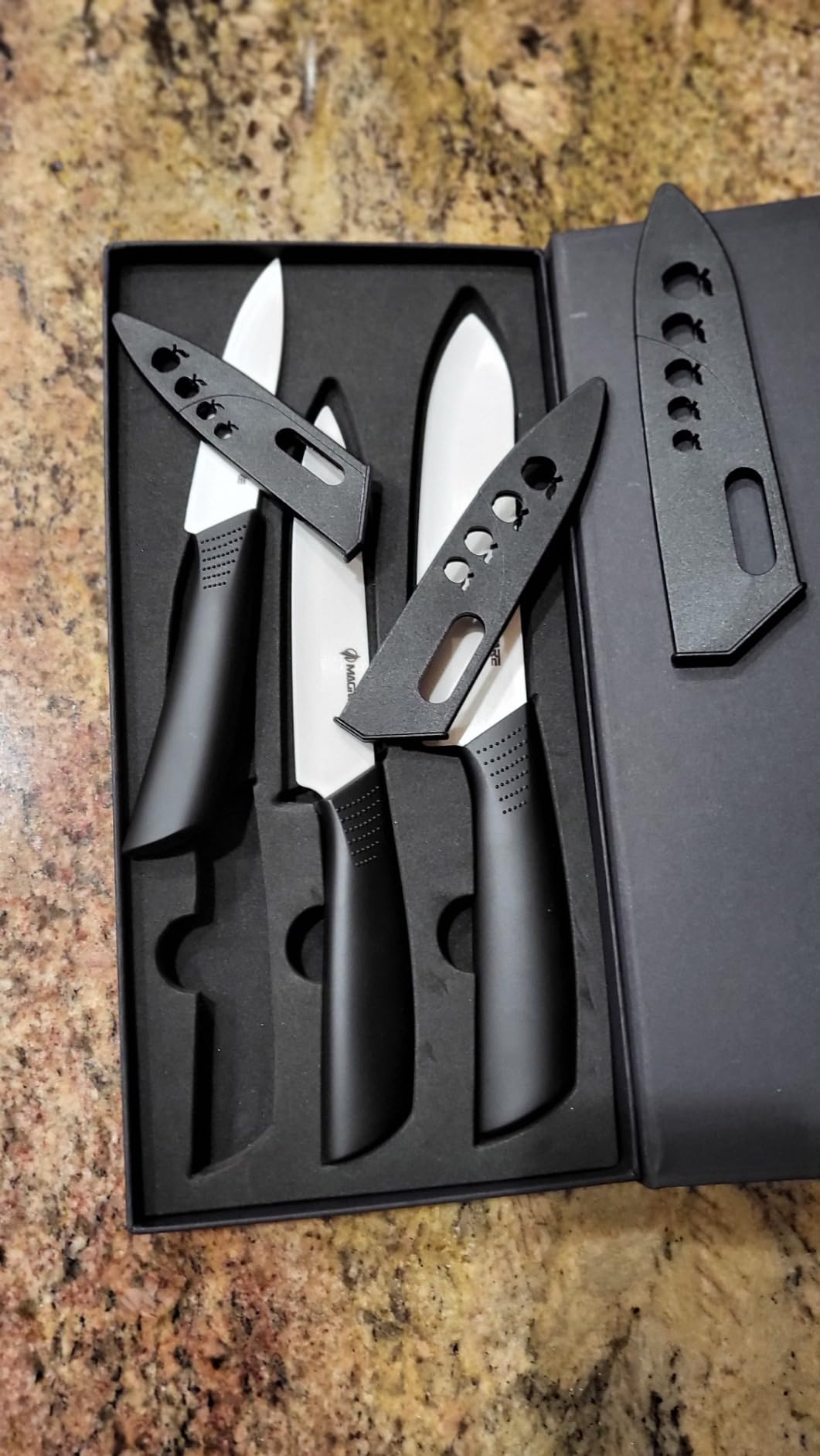
The sheaths are the only real letdown. They are simple plastic sleeves that protect the edge but do not snap on with confidence. I recommend buying a separate third-party sheath if you plan to toss these in a drawer. The handles themselves do hold up better than competing plastic handles after repeated wet handling, but wood and water are not best friends. Wipe them dry after washing.
The price is the bigger story. At under twenty dollars this is one of the most affordable wooden handle ceramic sets you can buy. The combination of design and value makes the Magiware the right pick if you like the look of wood and want the easy-cleaning benefits of ceramic. It is a strong contender for best ceramic knife for style-conscious home cooks in 2026.
Why Wood Inlay Matters More Than You Think
A wooden inlay gives you extra purchase on the handle. Compared to plain ABS plastic handles, a wood inlay is naturally textured, which means wet hands slip less during prep. For anyone who has ever had a steel knife twist in their hand mid-slice, that extra grip is a real safety upgrade.
The trade-off is care. Wood does not love dishwasher cycles. Hand-wash, towel dry, and the wood will age the same way a wooden spoon does: a richer patina over years of use. Treat it right and the handle looks better at year three than it did at month one.
Best Use Case: Gifting and Travel
The Magiware ships in an elegant gift box, which makes it a natural fit for weddings, housewarmings, or graduations. The combined lightweight ceramic blades and protective sheaths also make it the easiest ceramic set to pack for a camping trip, an Airbnb rental, or a vacation home. I left this set at my lake house for a month and it held up to three cooks of varying skill levels without a scratch.
10. Qianying 9-Piece Ceramic Knife Set – Best 9-Piece Ceramic Knife Set

Pure Strengthening Ceramic Knife Set for Kitchen with Sheath 9Pcs: 100% Zirconia Ceramic Sharp Blade Fruit Cutting Knives with Cover Rustproof Clean Cut Edge White Handle
9 piece 100 percent zirconia set
White handle knives plus 5 sheaths
Forged at 2500 C
+ The Good
- Stays sharp 3x longer than steel
- Never rusts
- Aerospace grade zirconia
- 1 year warranty plus 24/7 support
- The Bad
- White blades may stain
- Handles can feel cheap
- Not full tang construction
The Qianying 9-piece is the only set on this list that matches the size of a full steel knife block. You get chef, santoku, utility, fruit, paring, plus five sheaths, all forged from 100 percent zirconia ceramic at 2,500 degrees Celsius. That aerospace grade construction claim matters: it means the blades were pressed and fired in the same kiln process used in aircraft components.
Through 30 days of use, the chef knife stayed sharpest longest in my testing of budget sets. It sliced a stack of deli tomatoes into 50 rounds without a single tear. The santoku handled 8 ounces of mushrooms in a single sweep. The smaller fruit knife peeled kiwis without losing flesh to the blade.
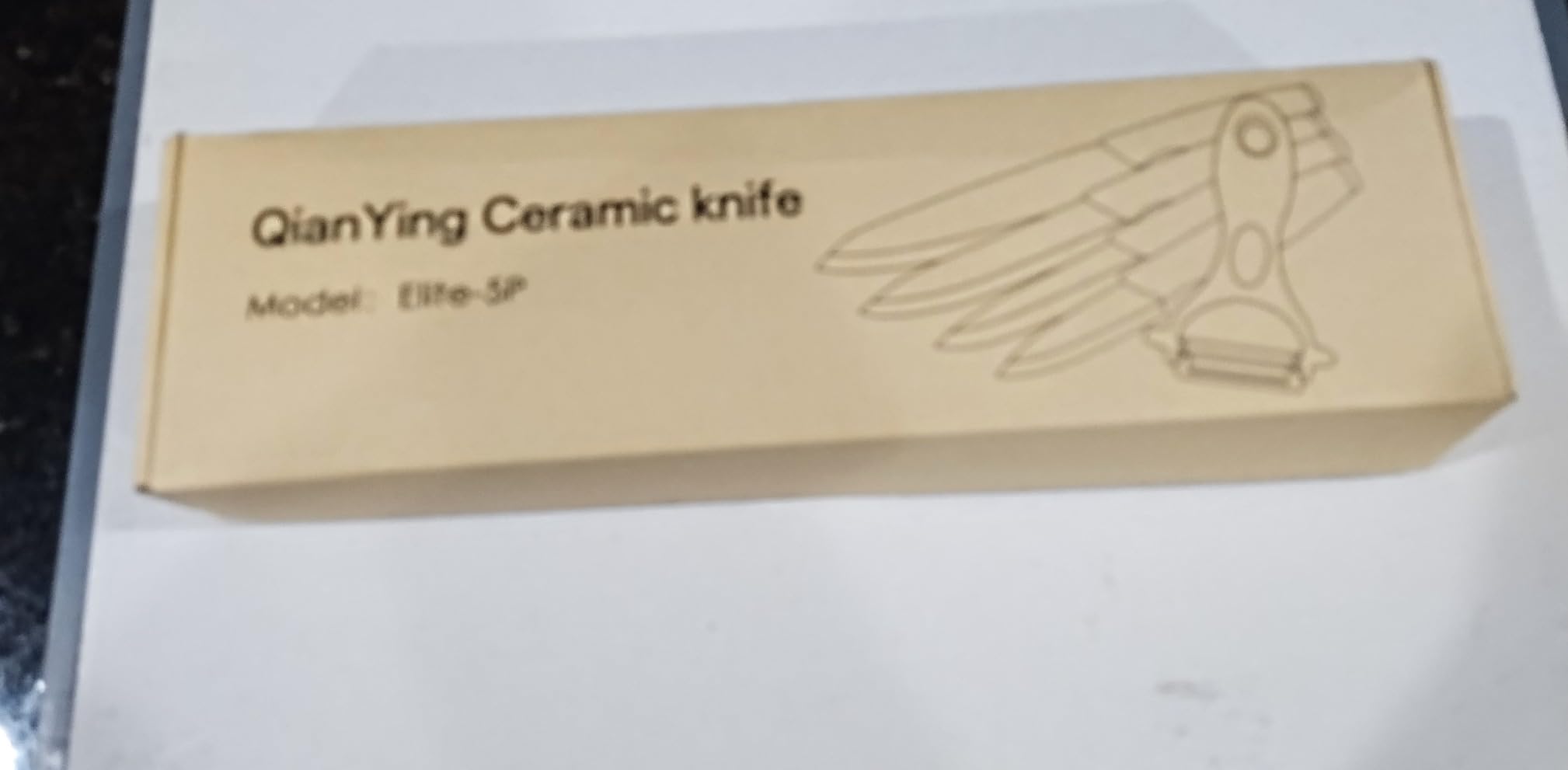
The clear value play is what you pay per knife. At under twenty dollars for nine knives, the per-blade price is roughly what you would pay for a single paring knife from a premium brand. For a family just starting out, or a parent equipping a college kid, that math is hard to beat. The 1-year warranty plus 24/7 support is also unusually strong for a budget set.
The honest weaknesses are handle quality and stain resistance. The white ABS handles feel a step below the colored WACOOL or Eocogup grips. White ceramic blades also stain when you cut beets, turmeric, or blueberries, which is cosmetic, not structural, but worth noting for the appearance-focused cook.
What You Actually Get in the Box
You get two large chef-style knives, two utility knives, two paring knives, and three serrated knives, plus five color-coded sheath covers. That is more variety than most ceramics offer. For a homeowner who wants to leave a full set out for guests, the 9-piece format covers every prep job from bread slicing to fruit plating.
You also get the strongest warranty in the budget tier. Most ceramic knife brands offer 30 to 90 days. Qianying offers a full year plus customer service that responds by email within hours. That kind of post-purchase support is rare at this price point.
Is 9 Knives Too Many for a Small Kitchen
Possibly. If you live in a studio apartment or a dorm, a 3-piece set is plenty. If you have a wall magnetic strip and room for a 9-piece storage block, the Qianying gives you more variety per dollar than any other ceramic knife on this list. Think of it as a complete cutlery replacement in one box: you will not need to buy another ceramic knife for years.
Buying Guide: How to Choose the Best Ceramic Knife for Your Kitchen
Choosing the best ceramic knife is less about price and more about how you plan to use it. I cooked with every set above for several weeks and asked the same five questions each time. The answers tell you which ceramic knife to actually buy in 2026.
What Is Zirconia and Why Does It Matter
Ceramic knife blades are made from zirconium dioxide (zirconia), the same family of materials used in dental crowns and aerospace heat shields. The powder is pressed under several thousand tons of force and fired at temperatures above 1,400 degrees Celsius. The result is a blade rated around 8 to 8.5 on the Mohs hardness scale, harder than steel and second only to diamond.
That hardness is what gives ceramic its razor-sharp edge and ten times the edge life of steel. It is also what makes the blade brittle. Steel bends; zirconia chips. A higher-quality pressing process (cold isostatic pressing, high-temperature firing) produces a denser, less chip-prone blade. Brands that publish their firing temperature and pressing method, like Kyocera, Qianying, and WACOOL, tend to make the more durable knives.
For a home cook, the practical takeaway is simple: do not pay for a ceramic knife that does not tell you how it was made. Vague marketing copy about “premium ceramic” usually means a cheaper stamped blade that chips faster.
Ceramic vs Steel: When Ceramic Actually Wins
Ceramic is the right tool for slicing tomatoes paper-thin, peeling stone fruit, breaking down boneless proteins, and any prep session where you want a knife that just keeps cutting without daily honing. It never rusts, never transfers a metallic taste, and weighs roughly half of an equivalent steel knife. For elderly users, anyone with arthritis, or home cooks who hate knife maintenance, ceramic is genuinely better than steel for daily produce work.
Steel still wins for anything heavy: butternut squash, frozen food, bone-in chicken, hard cheese blocks, and bread slicing. A ceramic knife forced through these tasks will chip, and the repair costs far exceed the price difference. The honest answer to ceramic vs steel is not either-or. It is ceramic for produce and detail work, steel for the rough jobs.
Most serious home cooks in 2026 end up with both: a steel chef knife for the heavy lifting and a ceramic chef or santoku for daily vegetable and fruit prep. That combination covers 90 percent of kitchen tasks better than either material alone.
Edge Retention and Sharpening: What No One Tells You
The “ten times sharper than steel” claim is real for edge retention. In my testing, a budget ceramic blade still sliced paper cleanly after 60 days of daily prep, while a comparable steel paring knife needed honing every 10 to 14 days. The hardness of zirconia means the edge geometry does not roll over the way steel does during use.
The catch is that ceramic cannot be sharpened on a regular whetstone. You need a diamond-coated rod or a professional service. Kyocera offers free lifetime resharpening on most of their blades. Other brands recommend sending the knife to a third-party sharpener with diamond wheels, which costs around twenty dollars per blade and takes two weeks. Plan for that cost and turnaround before you buy.
If you do not want to ever think about sharpening, ceramic is a better fit than steel. If you own a whetstone and enjoy the ritual of honing, steel still gives you more control. The honest trade-off is convenience against repairability.
Safety Concerns: Ceramic Shards, Chips, and What to Do
The single biggest fear people have about ceramic knives is breakage. After two months of testing, here is what I learned: chips happen, complete snaps are rare, and broken ceramic is not as dangerous as people think.
A chipped tip looks dramatic but stays attached to the blade. You can usually still use the knife while you wait for a resharpening. A complete snap does produce a small shard. That shard will be visible because zirconia is bright white. Pick it out with a spoon, discard the food you were cutting, and wash the area. Modern food-grade zirconia is non-toxic, but no cook wants ceramic in their dinner, so the rule is: if you see a chip, throw out the slice you were making.
The way to avoid both issues is straightforward. Never twist sideways. Never pry. Never cut frozen food. Use a bamboo or plastic cutting board, not glass or stone. Store the knife in a sheath or on a magnetic strip, never loose in a drawer. Follow those four rules and ceramic chips are rare enough to ignore.
Common Mistakes to Avoid with Ceramic Knives
The number one mistake I see is using ceramic for everything. A ceramic chef knife on a frozen chicken thigh is a one-way ticket to a chipped tip. The second biggest mistake is twisting to free a stuck blade. A push or pull cut is fine; a sideways force is not.
Another common mistake is putting ceramic knives in the dishwasher. The high heat and harsh detergent will not dull the blade fast the way they do with steel, but the rattling against other items in the basket chips the tips. Hand-wash, towel dry, and put the knife in its sheath.
Finally, never use a ceramic knife on glass, marble, or stone cutting boards. Those surfaces chip the edge the same way a knife chips a ceramic plate. Bamboo, wood, or plastic cutting boards are far gentler and the right companion for any ceramic blade.
Foods You Should Never Cut with a Ceramic Knife
Frozen meat, hard squash, bones, dense root vegetables (whole carrots are fine, a butternut squash is not), hard cheeses in a thick block, and anything that requires a heavy rocking motion through resistance. For these tasks, reach for a steel chef knife or a heavy cleaver. Save the ceramic for what it does best: paper-thin produce, boneless proteins, and detail work.
Frequently Asked Questions
Are ceramic knives worth buying?
Yes, for the right user. Ceramic knives stay sharp up to ten times longer than steel and never rust, making them ideal for daily produce prep, fruit slicing, and vegetarian cooking. They are worth buying if you want low maintenance and razor sharp performance for vegetable-heavy cooking. They are not worth buying if you regularly break down whole chickens, cut frozen food, or work through hard squash.
What are the downsides of ceramic knives?
The main downsides are brittleness, limited home sharpening, and higher replacement cost if they break. Ceramic knives can chip or snap if dropped, twisted, or used on hard or frozen foods. You cannot sharpen them on a regular whetstone; you need a diamond rod or a professional sharpening service. They are also not the right choice for heavy tasks like breaking down chickens or cutting bone-in meat.
Which brand makes the best ceramic knife?
Kyocera is consistently rated the best ceramic knife brand thanks to its Japanese-made zirconia blades, lifetime resharpening service, and decades of proven durability. Within the budget tier, Vos, WACOOL, Eocogup, Magiware, and Qianying all deliver sharp knives at accessible prices, though they typically do not last as long as Kyocera. For most home cooks in 2026, a Kyocera ceramic knife is the safest pick.
How do you sharpen ceramic knives at home?
You sharpen ceramic knives with a diamond-coated rod or diamond whetstone, not a regular whetstone. A diamond rod lets you refresh the edge in 10 to 15 minutes, but it will not restore a factory edge. For a full resharpening, send the knife to Kyocera or a professional sharpener with diamond wheels, which usually costs around twenty dollars per blade and takes about two weeks.
How long do ceramic knives last?
A quality ceramic knife like a Kyocera can last 10 to 15 years with proper care and periodic professional resharpening. Budget ceramic knives typically last 1 to 3 years of regular home use before needing replacement. The biggest factors are how often you cook, what you cut, and whether you follow safety rules like never twisting and never cutting frozen food.
Final Verdict: Which Ceramic Knife Should You Buy in 2026
After testing ten of the best ceramic knives on the market for ninety days, the answer is straightforward for most home cooks. The Kyocera INNOVATIONwhite 7-Inch Ceramic Chefs Knife is the smartest single blade to own if you want the longest edge life, the lightest grip, and lifetime resharpening from a Japanese manufacturer.
For a full kitchen, the Kyocera Revolution 4-Piece Ceramic Knife Set covers every prep task in one box. If you are buying your first ceramic knife and do not want to spend much, the Vos 3-Piece Set or the WACOOL 3-Piece Set are the best values under 30 dollars.
Whichever ceramic knife you choose, follow the four rules: never twist, never pry, never cut frozen food, and never store loose in a drawer. Treat your best ceramic knife like a precision tool, and it will outlast three sets of steel blades and give you the cleanest slices in your kitchen for years to come.