
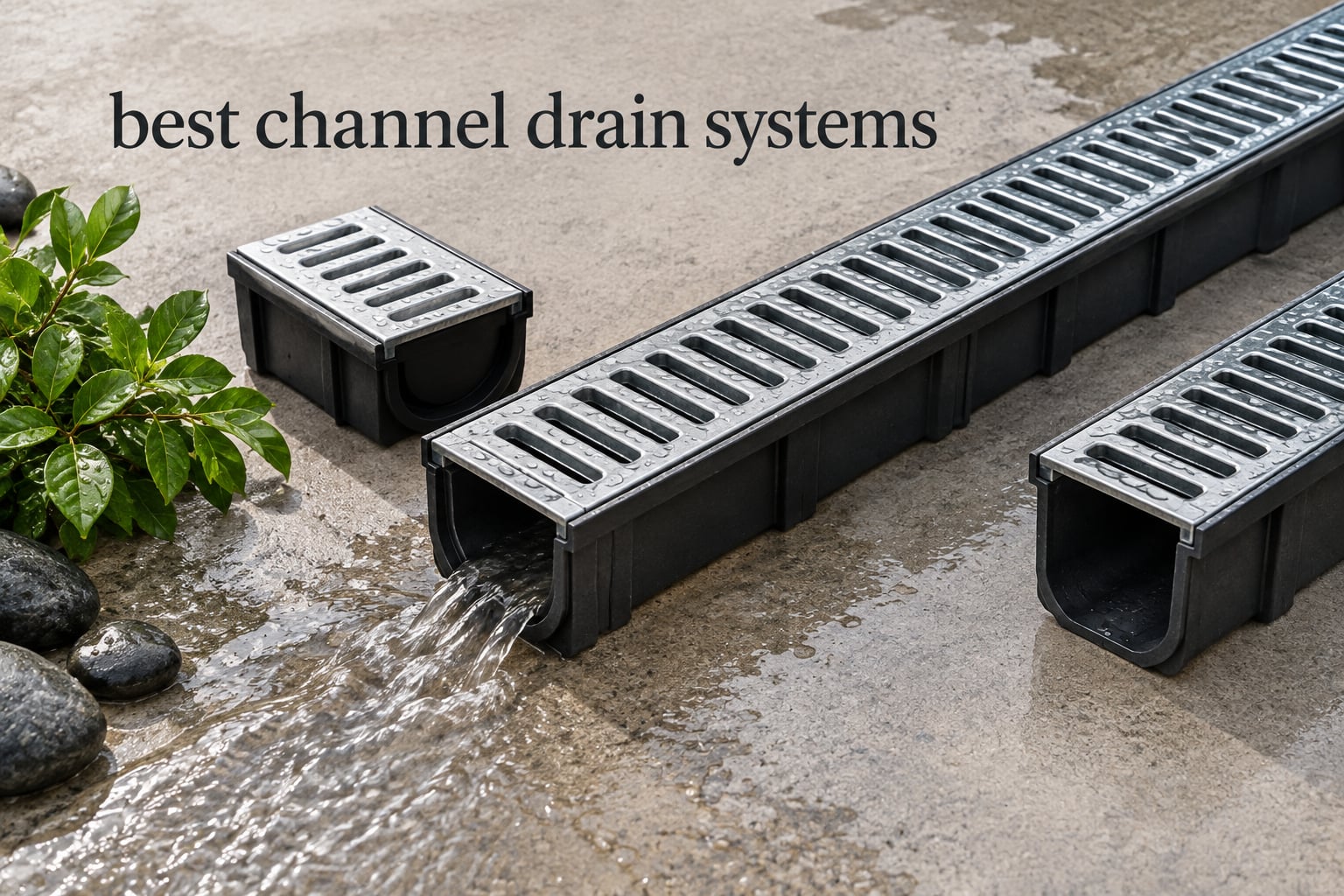
A channel drain system is a linear trough made of three working parts: a channel body, a removable grate on top, and an outlet that empties into a pipe or catch basin. It sits flush with a hard surface such as a driveway, patio, walkway, or pool deck. Water running across that surface drops through the grate slots into the trough, travels along it, and leaves through the outlet instead of spreading, pooling, or heading for your foundation.
Channel drain, trench drain, and linear drain all describe the same product family, and most spec sheets mix the three words freely. That is why the best channel drain systems for a residential driveway differ so much from the ones that suit a pool deck or a bathroom floor: the deciding factors are channel width, depth, the load class of the grate, and how the outlet ties into your drainage. Our team read the spec sheets for 12 of these systems line by line, checked the flow and load figures against each other, and read the owner reviews to separate what holds up on site from what only looks good on a product page.
If your problem is surface water running across a paved area, a channel drain is the right tool. If your problem is soggy ground that stays wet long after the rain stops, a channel drain will not fix it. That split is the first thing we sort out in this guide, and it is the mistake that sends people into expensive purchases that never solve the original complaint. The short version: buy for the water you can see, sized for the surface it runs across, rated for the traffic that crosses it.
For the indoor side of the same question, our picks for the best kitchen sink drain cover the fixture end of a wet area, while this guide covers the linear drain at the floor.
Top 3 Channel Drain Picks for September 2026
The three systems below are the ones we would put on a shortlist first. Each solves a different problem, so read the verdict on the card before you buy rather than picking on price.
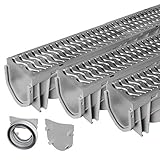
Source 1 Drainage 3-Pack
- › Galvanized steel snap-in grates
- › Interlocking 4.5 in. sections
- › Bottom outlet for 3 in. or 4 in. pipe

NDS 864G Pro Series HDPE
- › 72 GPM per foot flow
- › Cut down to 4 in. sections
- › Bottom side and end outlets
Best Channel Drain Systems Compared in September 2026
Every system below is a complete kit: channel body, grates, end caps, and outlet pieces. The table is the fastest way to narrow the field, and each row links to the full review further down the page.
| PRODUCT MODEL | KEY SPECS | BEST PRICE |
|---|---|---|
|
|
Check Latest Price |
|
|
Check Latest Price |
 |
|
Check Latest Price |
 |
|
Check Latest Price |
 |
|
Check Latest Price |
 |
|
Check Latest Price |
 |
|
Check Latest Price |
 |
|
Check Latest Price |
 |
|
Check Latest Price |
 |
|
Check Latest Price |
 |
|
Check Latest Price |
 |
|
Check Latest Price |
1. Source 1 Drainage 3-Pack with Galvanized Steel Grate — Best Overall Channel Drain System
Source 1 Drainage Trench & Driveway Channel Drain with Galvanized Steel Grate – 3 Pack
4.5 in. W x 5 in. H interlocking channels
Galvanized steel snap-in grates
Bottom outlet for 3 in. or 4 in. pipe
+ The Good
- Sections interlock into long continuous runs easily
- Galvanized grates hold up under vehicle traffic once encased in concrete
- The wide opening makes it simple to reach in and clear sand and grit
- The bottom outlet accepts both 3 in. and 4 in. drain pipe
- Grates lift out by hand for quick maintenance
- The Bad
- Installation is not beginner friendly and needs the trench and backfill instructions followed precisely
- The galvanized grate can show rust within a few months if the plating is thin
- Retaining tabs fight removal when the channel is fully encased in concrete
The Source 1 Drainage 3-Pack earns the top spot because it pairs the deepest owner feedback in this group with a galvanized steel grate rather than a plastic one. At 4.5 inches wide and 5 inches deep across three interlocking sections, it carries more captured grit than the shallow plastic kits without the weight of a concrete-body system. Reviewers consistently describe the same result: once it is bedded in concrete with a real downward grade, it moves water away from the driveway edge reliably.
What separates it from the rest is not the trough, it is the outlet. The bottom outlet accepts 3 inch and 4 inch drain pipe, which is the connection most homeowners assume and few kits actually deliver. You tie into an existing line or a catch basin without hunting for a converter, and the knockouts are sized to match standard pipe rather than a proprietary fitting.
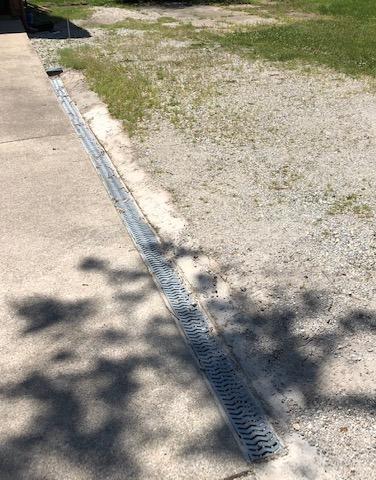
The second detail worth knowing is how the grate behaves in service. These are snap-in galvanized grates with no screws, so you can pull one out with a pry bar in seconds when leaves pile up. That matters more than it sounds: a channel that cannot be opened is a channel that gets left clogged, and a clogged channel is just a trench full of water.
Be realistic about the install, though. This is a concrete-encased system, and the trench has to be cut to the channel’s footprint with a consistent fall toward the outlet. Owners who followed the backfill instructions report a clean, straight finished line. Owners who tried to bed it in loose fill report sections shifting, which is a trench problem, not a product problem.
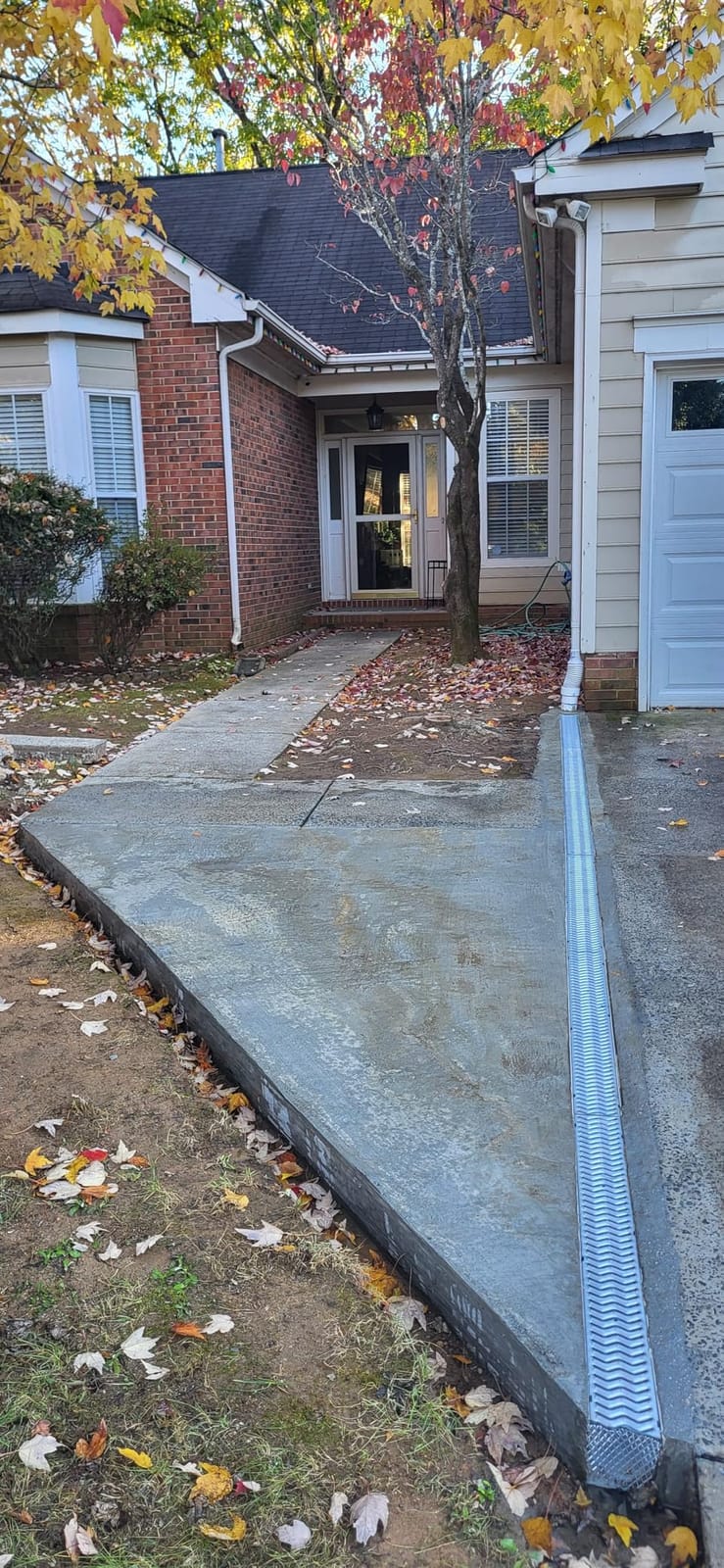
What 701 reviews confirm
The volume of feedback here is the real story. With hundreds of owners reporting on it, the pattern is stable: sections interlock without fighting, the steel grates feel solid under foot and vehicle weight once set, and the wide interior clears easily. That consistency across a large sample is why it sits at the top of our list rather than a system with a higher single score and a much smaller base.
Where it gives ground
Two complaints recur. A minority of owners see surface rust on the galvanized grate within the first few months, which points to plating thickness rather than a bad unit. The other is tab interference: if the channel is poured in so tight that the retaining tabs bind against the concrete, the grate becomes difficult to lift out later.
2. NDS 864G Pro Series HDPE Channel Drain Kit — Best Value for High-Flow Runs
NDS 5” Pro Series Deep Profile Channel Drain Kit With HDPE Plastic Grates and End Caps, Trench & Channel Drainage For Driveway, Patio, Pool Deck, Courtyard, 5.5” x 39.4”, Gray
72 GPM per foot flow rate
23.5 sq. in. open area per foot
Class B rated and ADA compliant
+ The Good
- The 72 GPM per foot rating handles roof and hardscape runoff with room to spare
- Grates lift out by hand for cleaning
- Sections join for long runs or cut down to 4 in.
- Bottom side and end outlet options give routing flexibility
- The muted gray blends with gravel and stone
- The Bad
- The supplied end cap has no groove and will not seal permanently without extra fastening
- The pipe adapter fitting can sit loose and pop out
- The polypropylene body resists adhesive so glued joints are unreliable
- Listed 3 in. and 4 in. outlets are NDS solid pipe sizes rather than flexible drain pipe
The NDS 864G is the pick when the water volume is the problem, not just the pooling. Its published flow rate of 72 GPM per foot, with 23.5 square inches of open grate area per linear foot, is the highest figure in this roundup, and the channel body is deep enough at 4.75 inches to carry that volume without going shallow. For a roof line or a large slab shedding water onto a narrow run, that capacity margin is the whole point.
It is also the most flexible layout tool here. Sections connect for long runs, and they can be cut back to as short as 4 inches, which is what makes the system workable around an existing slab edge or a column footing. Outlets are offered at the bottom, the side, and the end, so you can pick where the water leaves rather than being forced into one arrangement.
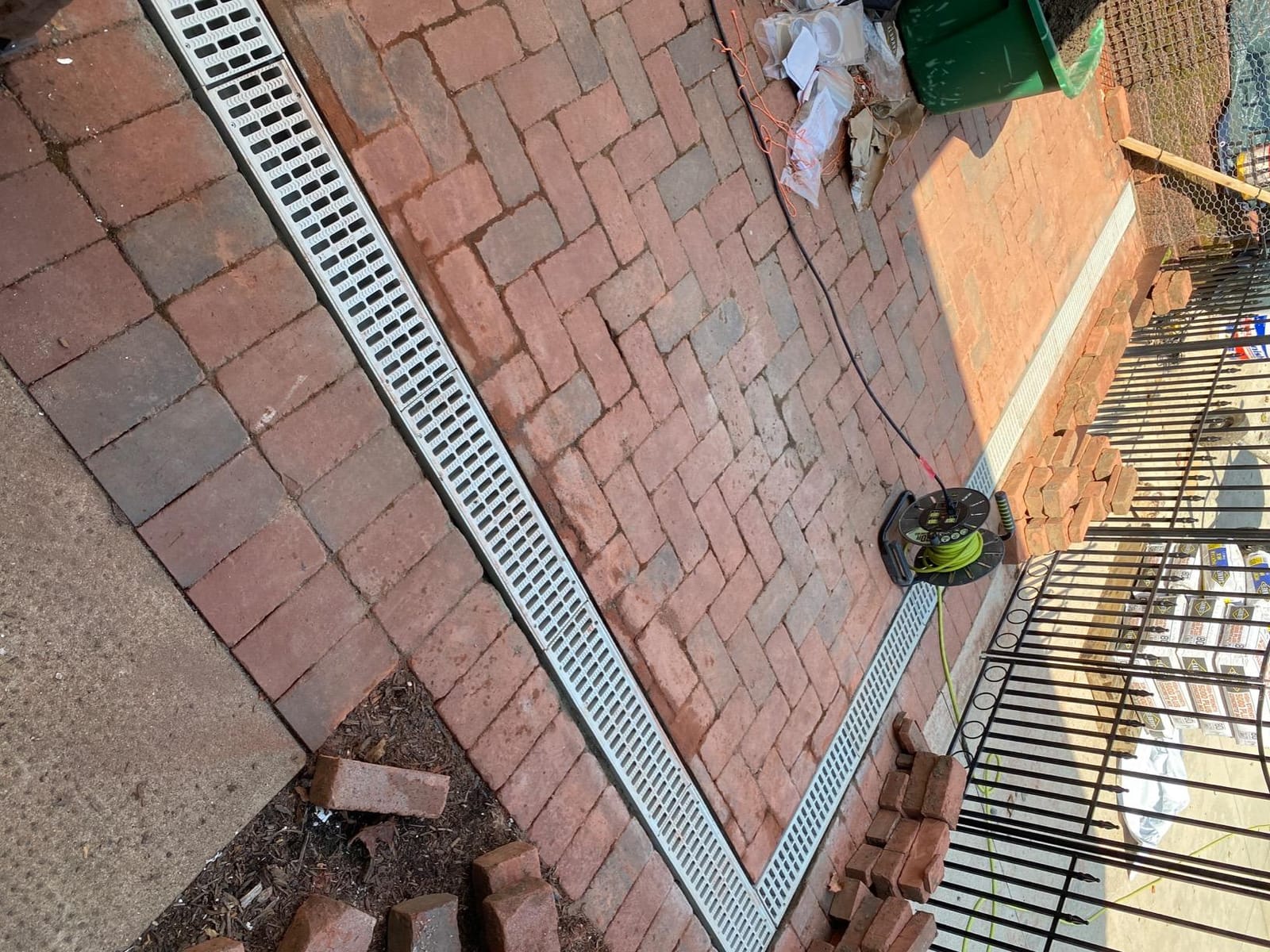
The grates are HDPE rather than steel, which is a deliberate trade. You give up the crisp feel and the load margin of a galvanized grate, and you get a grate that will not rust, weighs almost nothing, and lifts out one-handed. Buyers running them through a full driveway report no problems holding up under vehicles and pedestrians.
Know what you are buying before the trench is open. The listed 3 inch and 4 inch outlets refer to NDS solid pipe sizes, not flexible drain pipe or Schedule 40, and the polypropylene body will not bond reliably to adhesive. Plan the discharge line to match the fitting rather than the other way around.
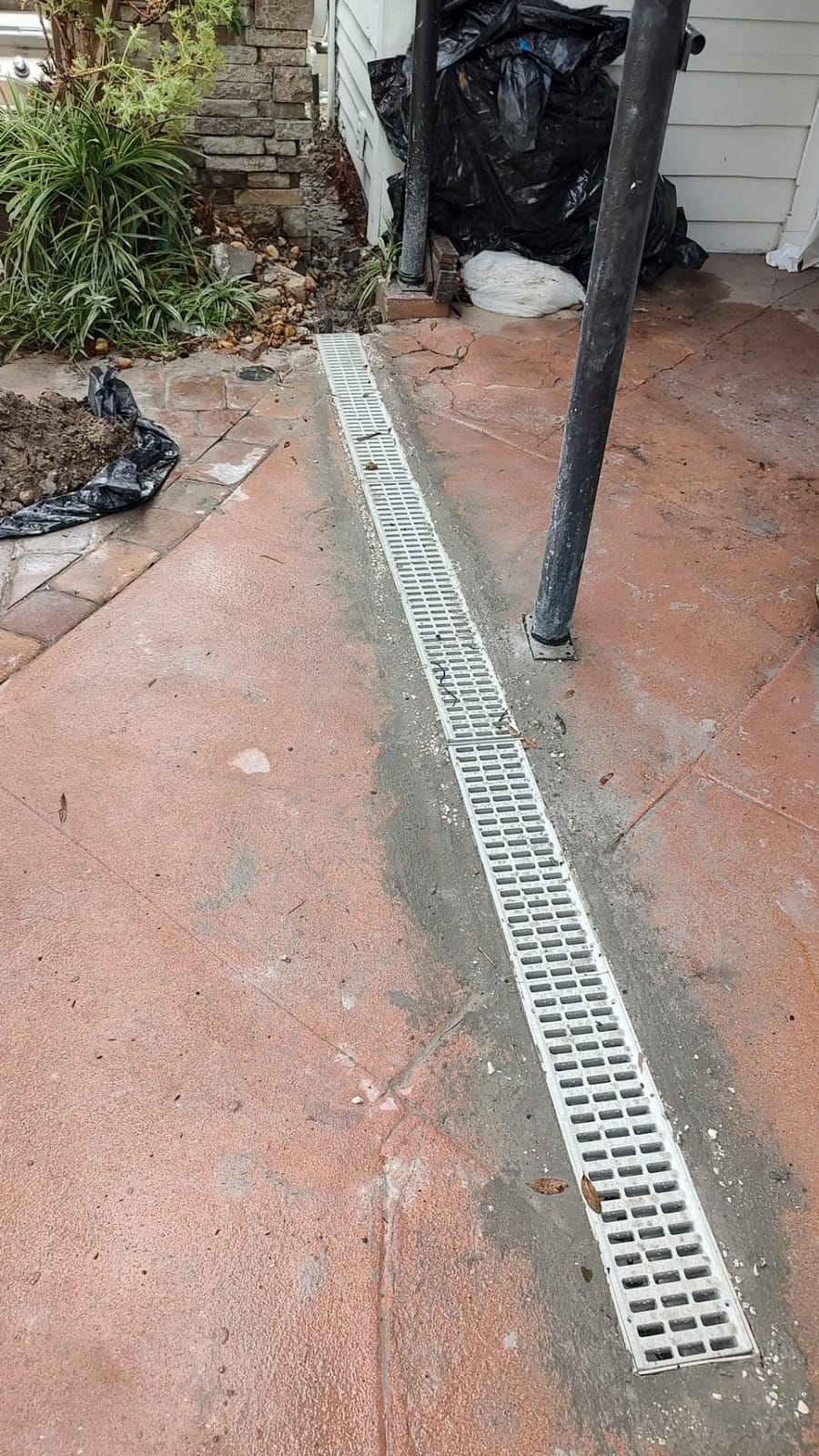
Why the flow figure changes the purchase
Flow rate is the number most shoppers ignore and the one that decides whether a run keeps up during a hard storm. A channel that looks oversized on paper can still back up if its cross-section is too small for the catchment feeding it. The 72 GPM per foot rating gives you room to size by drainage area rather than by guesswork.
The end cap is the weak point
Owners are clear that the end cap is the part to inspect on arrival. It has no groove, so it does not seat and seal permanently without additional fastening, and the pipe adapter can sit loose. Budget a few minutes of mechanical fixing, and check the fit before the trench is covered.
3. NDS 864GMTL Pro Series with Galvanized Steel Grates — Most Versatile for Patios
NDS Pro Series Channel Drain Kit, 5-1/2 in. X 39-3/8 in. Deep Profile Channel, Galv. Steel Grates, End Caps/Outlet, 5 in.
Galvanized steel grates on a 5 in. deep body
59 GPM per foot flow
Class B rated, ADA compliant
+ The Good
- The steel grates feel sturdy and hold position under foot traffic and pet weight
- The finished line looks neat and professional along a patio or stone deck
- Bottom tap-outs knock out cleanly with a tap from a small sledge
- Easy to trim with a saw for custom fits beside existing slabs
- Solid construction for light duty drainage runs
- The Bad
- The polypropylene channel resists adhesive so sections cannot be glued reliably
- Only one glue socket per section makes long straight runs awkward
- The side interlocks alone do not hold alignment during install
- The listed width does not include the rebar notches on the sides
Choose the 864GMTL when the look of the finished line matters as much as the drainage. A galvanized stamped steel grate reads as a metal edge detail rather than a plastic strip, and owners installing these along a patio or a stone deck report the finished appearance as the feature they mention most. The 59 GPM per foot rating and 19.32 square inches of open area per foot handle typical patio and walkway runoff without strain.
The knock-out bottom ports are genuinely useful. A tap from a small sledge opens the outlet you want, and the outlets accept 3 inch and 4 inch sewer and drain fittings, so the discharge line is a standard size. Sections trim easily with a saw, which is how you get a clean termination at an existing slab instead of a rough overrun.
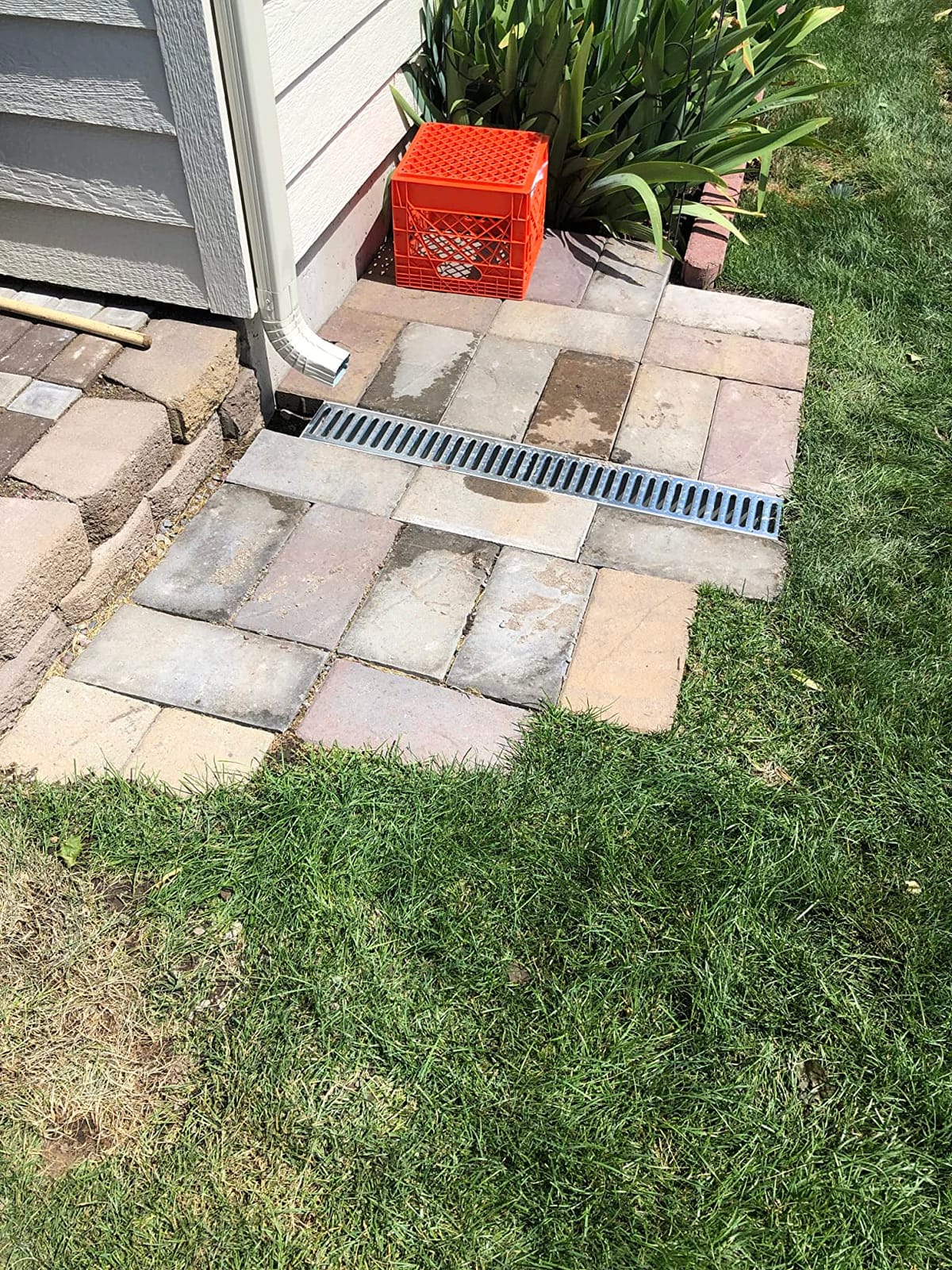
Two installation facts save time. First, the channel is polypropylene, so adhesive will not create a structural joint; the concrete pour is what holds the run together, not glue. Second, the listed 5 inch width does not include the rebar notches molded into the sides, so cut your trench a little wider than the number on the box if you are setting reinforcing.
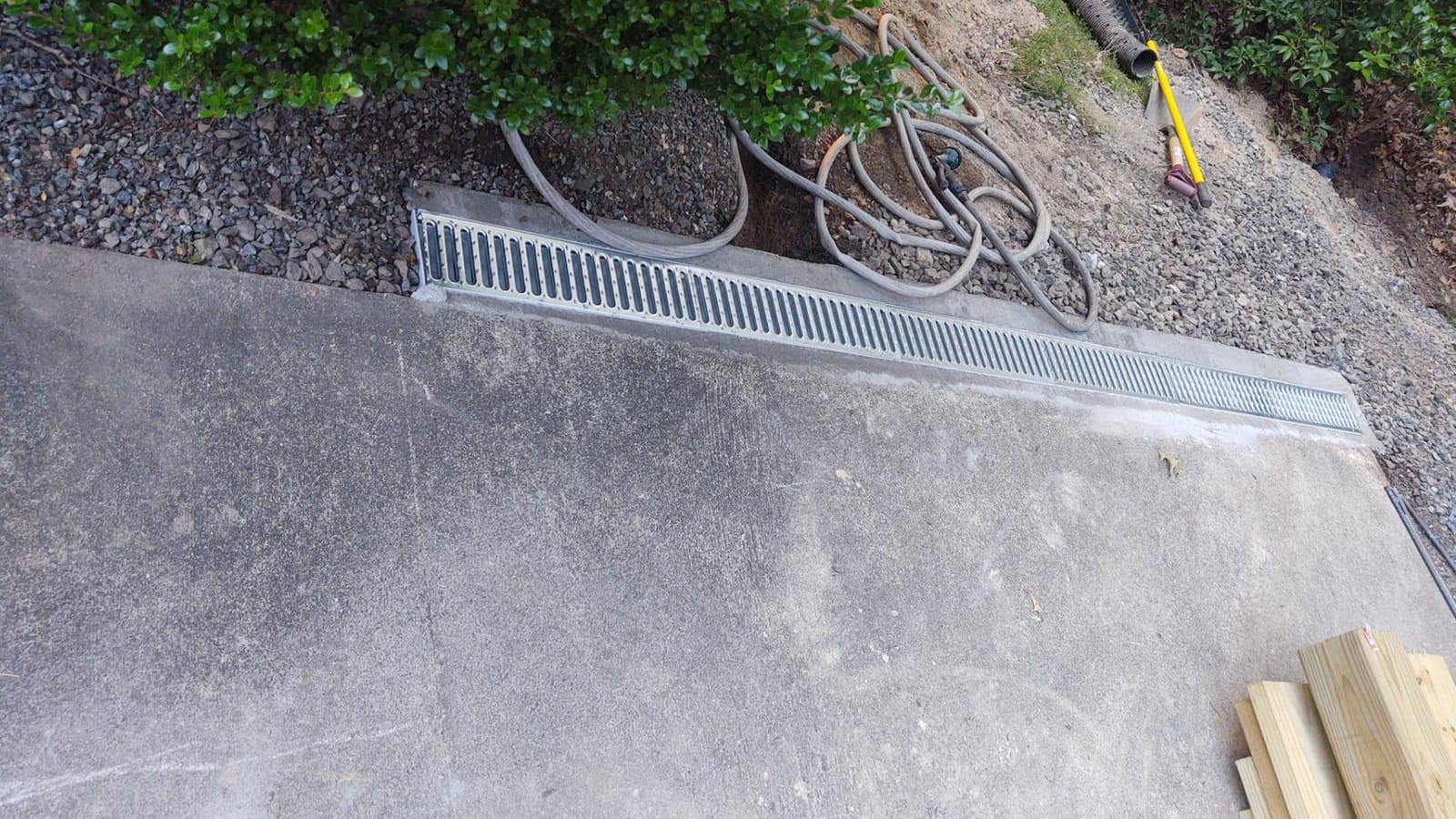
Long straight runs are the case to plan for. There is one glue socket per section and the side interlocks do not hold alignment on their own, so installers anchor each section and let the pour hold everything. Owners doing this report straight, level lines with no drift.
Where steel grates earn their place
Steel grates matter in two situations: a visible edge where a plastic grate would look out of place, and a surface where you want the solid, quiet feel underfoot rather than a rattling plastic grid. They also do not flex, which is why they stay put under pet claws and rolling equipment.
The joining problem is real, and solvable
The single most common complaint is drift between sections. The fix is mechanical rather than chemical: pin or tie each section as you set it, and treat the concrete pour as the structural connection. Owners who anchored and poured have nothing to report; owners who expected a snap-fit to hold a long line by itself are the ones who see gaps.
4. VEVOR 6-Pack HDPE Trench Drain System — Best for a Full Driveway Crossing
VEVOR Trench Drain System Channel Drain 5.9×5.1-Inch HDPE Drainage Trench
Six 39.4 in. channels at 5.9 in. wide
A125 load capacity
Built in 3.1 in. and 3.6 in. bottom outlets
+ The Good
- A smooth continuous basin interior with no casting defects
- It holds up under daily truck and SUV traffic once concreted in
- Grates detach by hand for debris clearing after installation
- Built in bottom and side outlets need no separate connector fittings
- Good value against equivalent big box channel drains
- The Bad
- HDPE resists adhesive so connections need scuffing before gluing
- Channels can float up during a floor pour unless set into ready mix first
- End caps have no cutouts and are thin so the connection happens at the bottom outlet
- Must be cemented on sides and bottom to avoid movement
The VEVOR 6-Pack is the answer when a single run has to span a full driveway width. Six channels at 39.4 inches each give you more than 19 feet of continuous line from one box, and at 5.9 inches wide and 5.1 inches deep the cross-section carries real volume without the weight of a polymer concrete body. A125 load capacity is the right class for passenger vehicles on a residential slab.
What we like most is the outlet design. The bottom outlets are built into the body at 3.1 inch and 3.6 inch sizes with a 2.2 inch side outlet, so there is no separate connector to lose in the trench and no adapter to buy later. The anti-flotation shape beds itself into the pour, which removes a whole category of alignment problems.
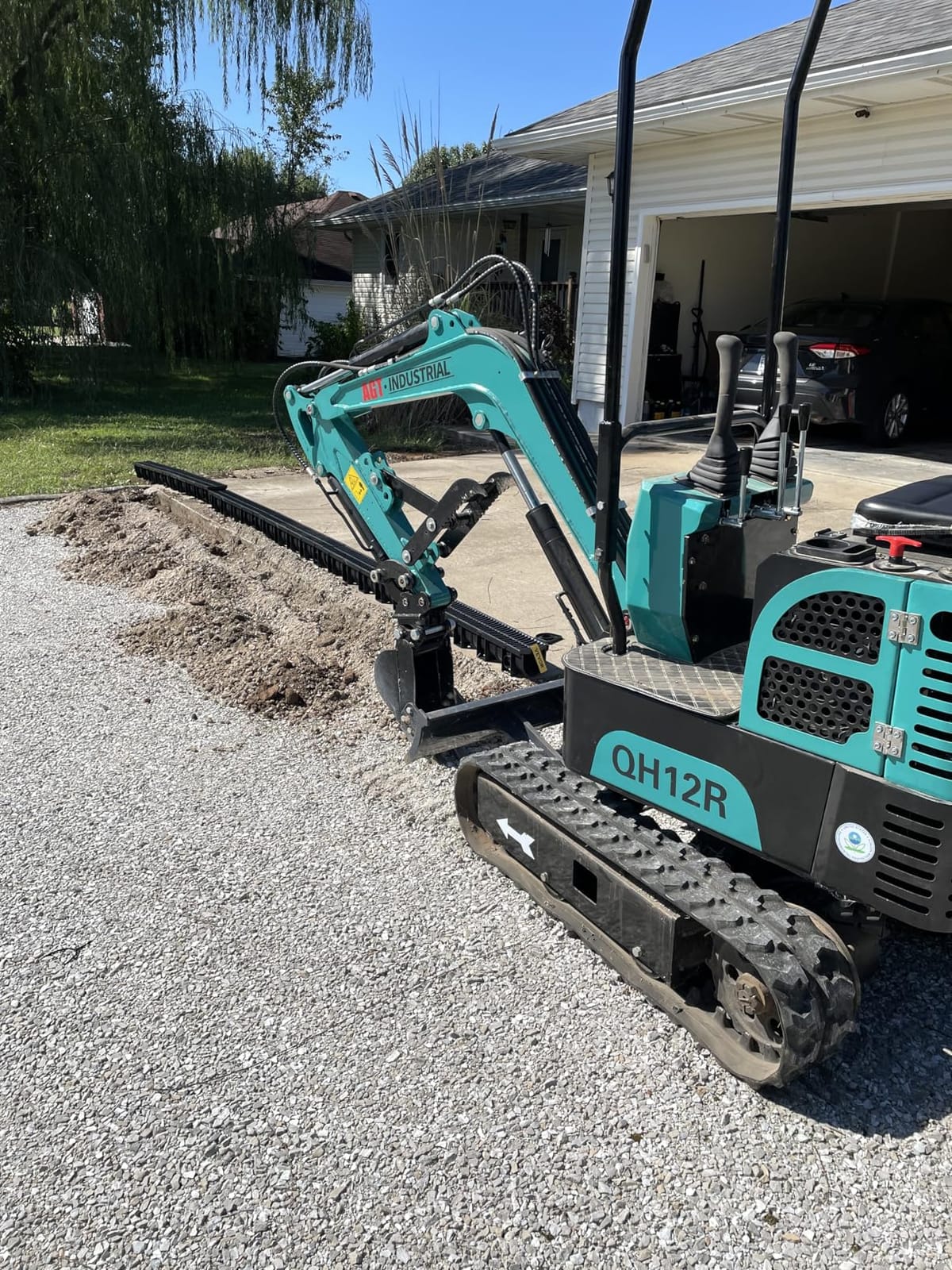
Owners report the same experience: set it correctly and it works exactly as specified, with grates that come out by hand and a smooth interior that does not catch silt at the joints. The value comparison against equivalent big box systems is the reason it keeps showing up in install threads.
The deciding factor is pour order. Channels placed into ready mix before the pour stay aligned; channels set during the pour tend to float. If you have never bedded a channel before, set and level the whole line first, then pour over and around it. HDPE also needs scuffing before adhesive will take, so treat any glued joint as secondary to mechanical restraint.
How it handles vehicle traffic
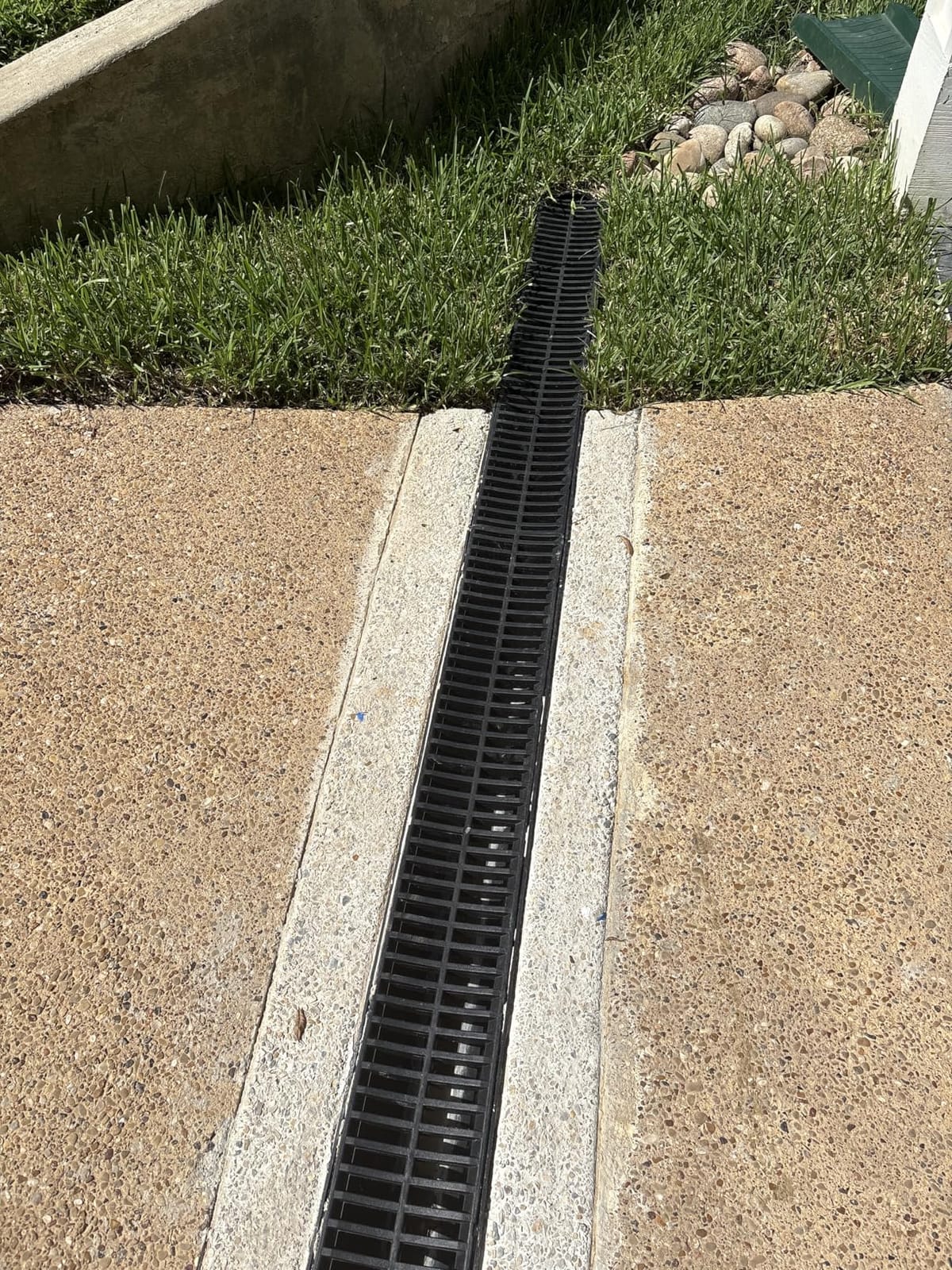
A125 is a sensible residential ceiling: it covers cars, SUVs, and light trucks on a properly encased channel. The grate only performs to that rating when the surrounding concrete fully supports the channel walls, which is why the grates are specified as screw-free, hand-removable parts rather than bolted plates.
The pour-order mistake to avoid
Buoyancy is the single failure we see reported. An empty HDPE trough displaces enough water to rise during a pour, and a line that floats ends up proud of the finished slab. Set the run, level it, brace the ends, and only then place the concrete. It is an extra ten minutes that saves a re-cut.
5. URA WATER UA-100 3-Pack Low Profile Set — Best for Shallow Patio and Path Runs
URA WATER – Model UA-100 – Drainage Trench Set – Channel Drain with Grate – Black Plastic – 3 x 39 – (117″ Total Length)
5 in. wide by 3 in. deep channel body
117 in. total across three sections
4 in. outlet adaptor included
+ The Good
- Strong thick plastic that works well for patios paths and light foot traffic
- Grates lift out by hand for cleaning
- The side connector fits solid PVC well for routing to a discharge point
- 117 in. of total length covers a decent run in one kit
- Anti flotation feet keep the channel seated during the pour
- The Bad
- Connection tabs are flimsy and pop apart during assembly
- The end cap does not snap in and must be glued to hold
- Sections are not secure against uplift so shims and rivets are often needed
- Water can jump over the shallow 3 in. channel in heavy rain without added edging
The UA-100 solves a problem the deep systems cannot: a patio, path, or garden edge where there is not enough build-up height for a 5 inch channel. At 3 inches deep and 5 inches wide, three sections give you 117 inches of line, and the body is thick polypropylene with structural reinforcement rather than a thin shell.
It also arrives with more of the connection hardware than most kits at this level. You get a bottom outlet connector, an end outlet connector, and an end cap, and the included adaptor fits 4 inch sewer and drain pipe, which removes the most common cause of a stalled install. Bottom and side outlet positions are marked with cut-out guides so you choose the discharge point before the trench is dug.
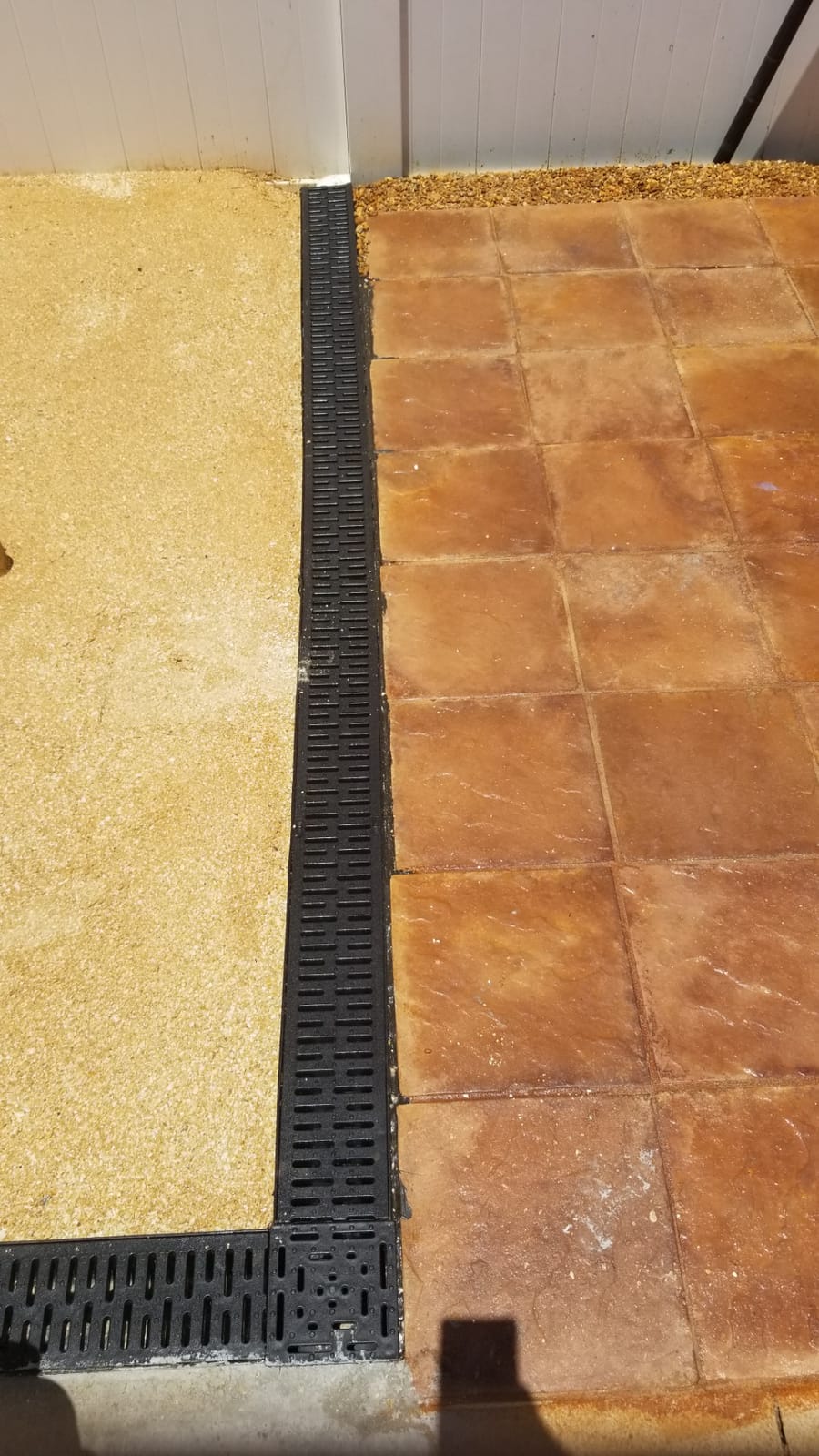
Owners using it for patios, garden paths, and light foot traffic are generally happy, particularly with the hand-removable grates and the side connector fitting solid PVC cleanly. Grates come out in seconds, which is what keeps a low-profile line from turning into a silt trap in a planting bed.
Understand the depth trade-off. A 3 inch channel has less cross-section than a 5 inch one, so in heavy rain, water can jump over the grate unless you add edging behind the line. The connection tabs and end cap are also the recurring weak points, and owners who roughened the surface and used a strong waterproof adhesive report good service where a mechanical lock was expected, none.
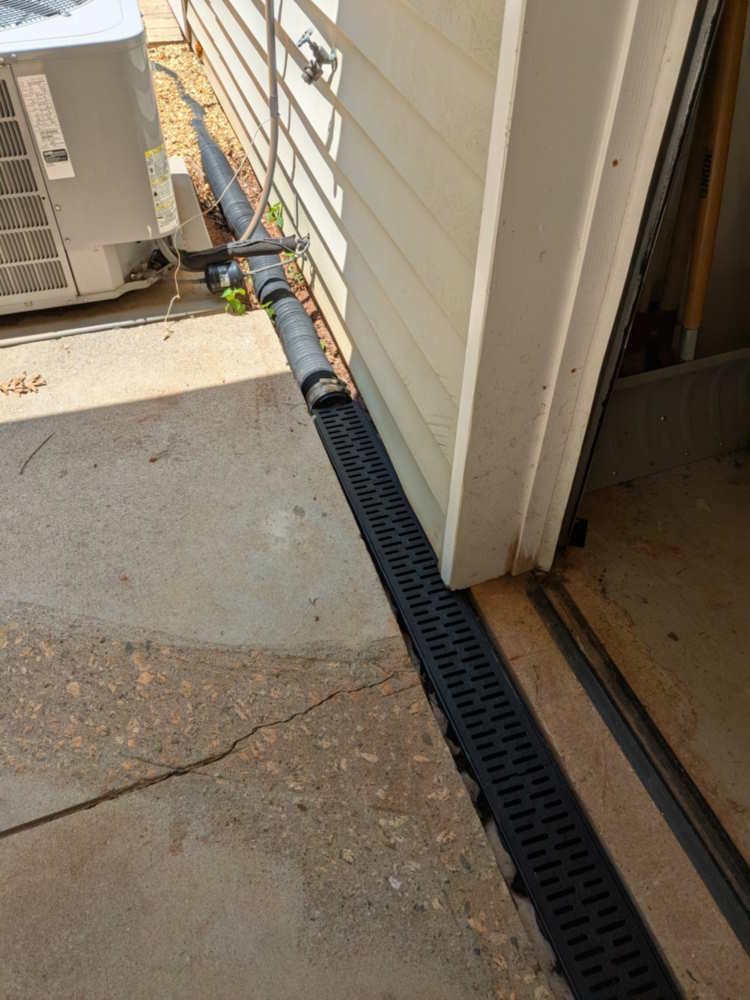
When a shallow profile is the right call
Choose a low-profile body when the surrounding surface is thin: a paver border with no room to raise the grade, a path tight against a wall, a garden edge. The 3 inch depth also means less excavation, so this is often the most approachable system for a first install where the trench walls will not hold much.
Where the joints give way
The tabs and the end cap are the honest weakness here. They pop apart, they do not snap in, and sections need shims or rivets against uplift. None of that is a dealbreaker in a bedded install, but if you need a line that survives an uncooperative installer, this is not the one.
6. Vodaland 4 Inch Easy 2 Premium 5-Pack — Best for Recessing into Paving
Vodaland – 4 Inch Easy 2 Premium Trench Drain Channel – Galvanized Stamped Steel Grating (5)
Shallow 4 in. body with steel grating
16.5 ft of run in the 5 pack
Class A pedestrian rated
+ The Good
- The metal grate is easy to sweep clean and pops out for channel maintenance
- A shallow profile that can be recessed into pavers and chipped out to sit flush
- Right angle corner connection is possible
- Channels snap and lock together and grates lift out by hand
- Useful for roof drip line drainage in place of gutters
- The Bad
- The joints between sections are flimsy and need sealant to stay secure
- End pieces and end caps break easily and are the weakest components
- The main drain connection is not included and must be bought separately
- Does not connect easily to standard drain pipe
- Prone to collecting leaves
The Vodaland 4 Inch is the system for a flush finish in paving. Because the body is only 2.875 inches deep at 4.63 inches wide, an installer can recess it into pavers and chip the surrounding stone so the galvanized grating ends up level with the finished surface. That is the detail that separates a professional-looking detail from a plastic strip sitting on top of a patio.
Five sections give 16.5 feet of linear drainage, and the channels snap and lock together while the grates snap in and lift out by hand. It is Class A rated, which covers pedestrian loads, so this belongs on walkways, patios, and roof drip lines rather than anywhere a vehicle crosses.
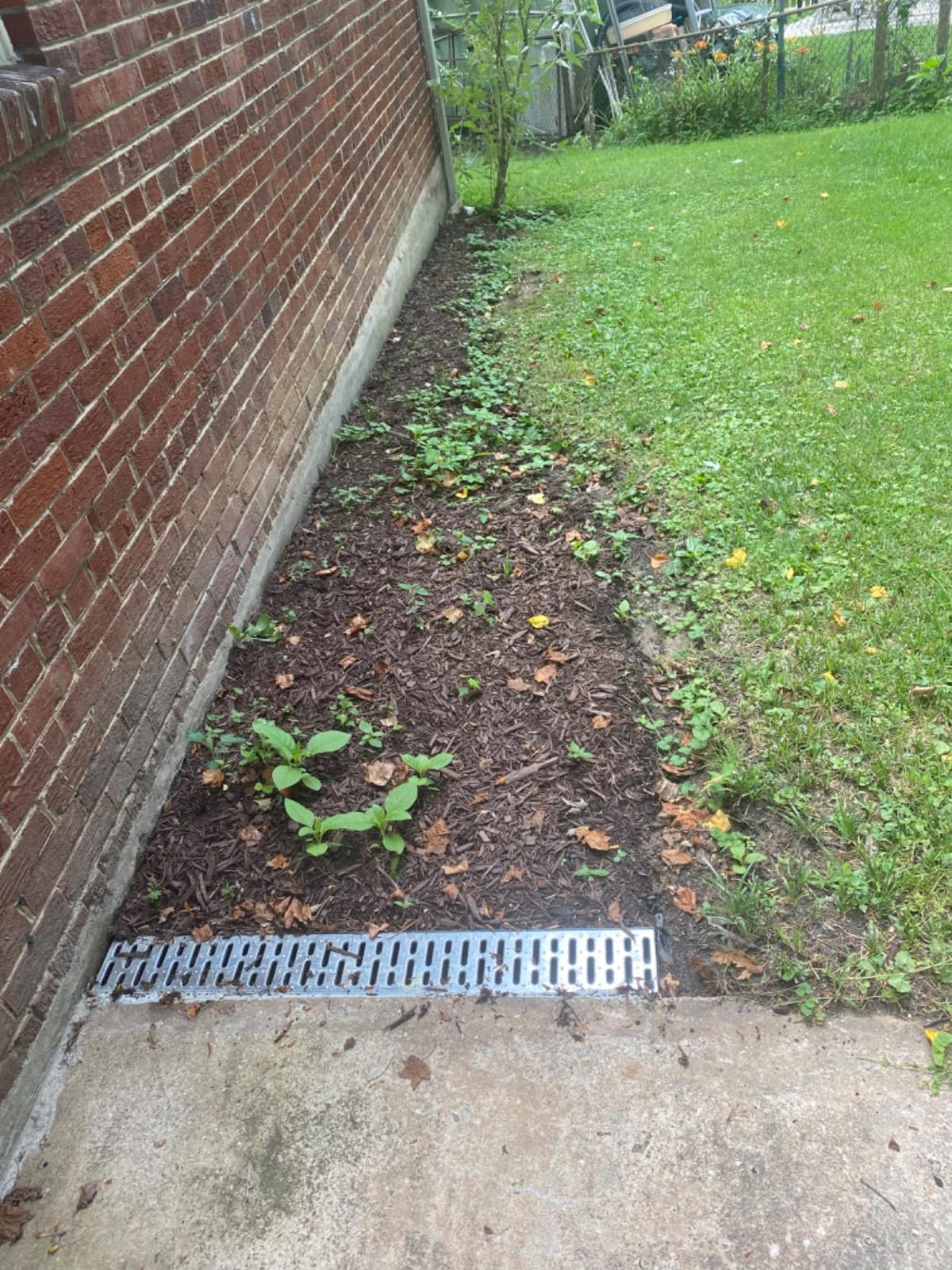
Owners like the steel grating for practical reasons. It sweeps clean, it does not hold a leaf layer the way a perforated plastic grate can, and it pops out so you can flush the channel interior. The ability to turn a right angle down either side of the run is useful when the outlet is not straight ahead of the trench.
The compromise is hardware. The joints are described as flimsy and need sealant, and the end pieces and caps are the first thing to break. More importantly, the main drain connection is not in the box, so budget for the outlet component before you start the trench or the run ends in a dead end.
Flushing a finish into pavers
This is the one system in the group whose shallow body is a design feature rather than a limitation. A 2.875 inch deep channel can be bedded into a paver bed and cut flush, and the steel grate then reads as part of the paving pattern. It is the most convincing answer to the problem of a drain that looks like an afterthought.
Plan for the missing connection
Before the trench is open, confirm the outlet piece is on hand. It is sold separately, and the system does not tie into standard drain pipe without it. Buyers who planned the discharge line in advance report smooth installs; buyers who discovered the gap on install day lost a day of labour.
7. FAHKNS 6-Pack HDPE System B125 — Best for Higher Traffic Ratings
Trench Drain System, Channel Drain with Plastic Grate, 5.9×5.1-Inch HDPE Drainage Trench, Black Plastic Garage and GardenDrain, 6×39 Trench Drain Grate, with 6 End Caps,Convenient Assembly(6 Pack)
Six 5.9 in. channels, 236 in. total
B125 load capacity
Built in bottom and side outlets
+ The Good
- Sturdy enough to walk drive and mow over once concreted in place
- 236 in. of total run covers a full driveway crossing
- Good value with buyers reordering the same pack to extend a line
- Anti flotation design helps the channel stay put during the pour
- Grates fit snugly and the body is easy to cut with a sawzall
- The Bad
- No corner or turn pieces are available in the system
- No base holes for rebar anchors so installers have to drill their own
- Grates lock in and become very hard to pry out after the pour
- There is no screw retained grate option for future cleaning access
The FAHKNS 6-Pack is the rating-conscious choice. Its B125 load capacity sits a step above the A125 systems in this group, which matters if delivery vans, ride-on mowers, or occasional trailers cross the run rather than just family cars. Each channel measures 5.9 inches wide, 5.1 inches deep, and 39.4 inches long, and six of them give you 236 inches of line.
Performance-wise the details are the same family as the other HDPE systems: an anti-flotation design that holds position during the pour, interlocking sections, hand-detachable grates, and built in bottom outlets at 3.1 inch and 3.6 inch with a 2.2 inch side outlet. Buyers who took the chance on a plastic system for a driveway crossing report that it holds up and performs well.
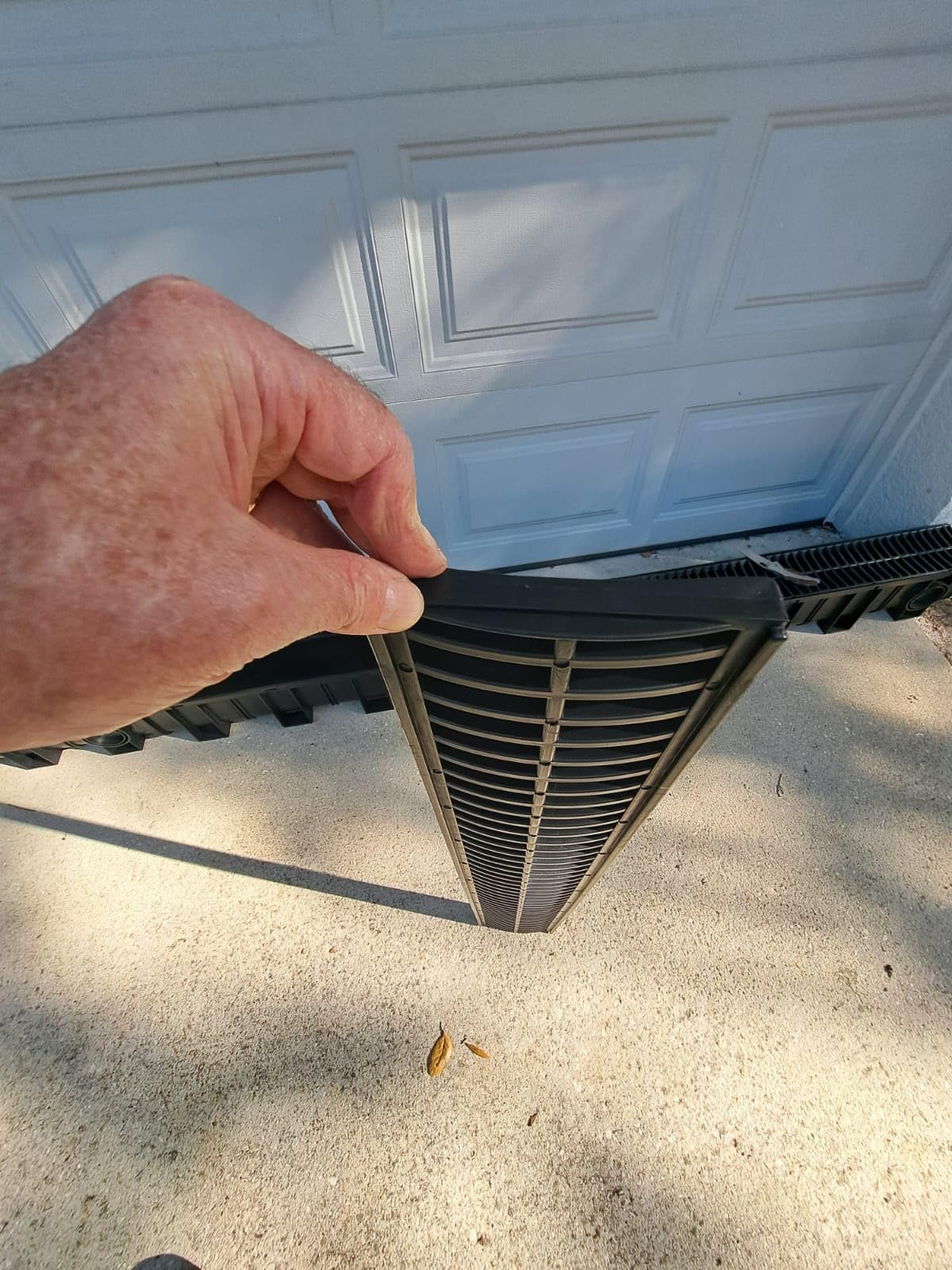
What makes this kit appealing for a longer project is the repeat ordering. At 236 inches per box, and with the same pack used to extend a run, the per-foot economics work out in your favour if the driveway is wide or the property has more than one low spot.
The gripes are fit-out details, not drainage failures. There are no corner or turn pieces in the system, there are no factory rebar holes so you drill your own, and the grates are difficult to pry out once the concrete is set, with no screw-retained option as a backup. Plan your layout as a straight run and the system does its job.
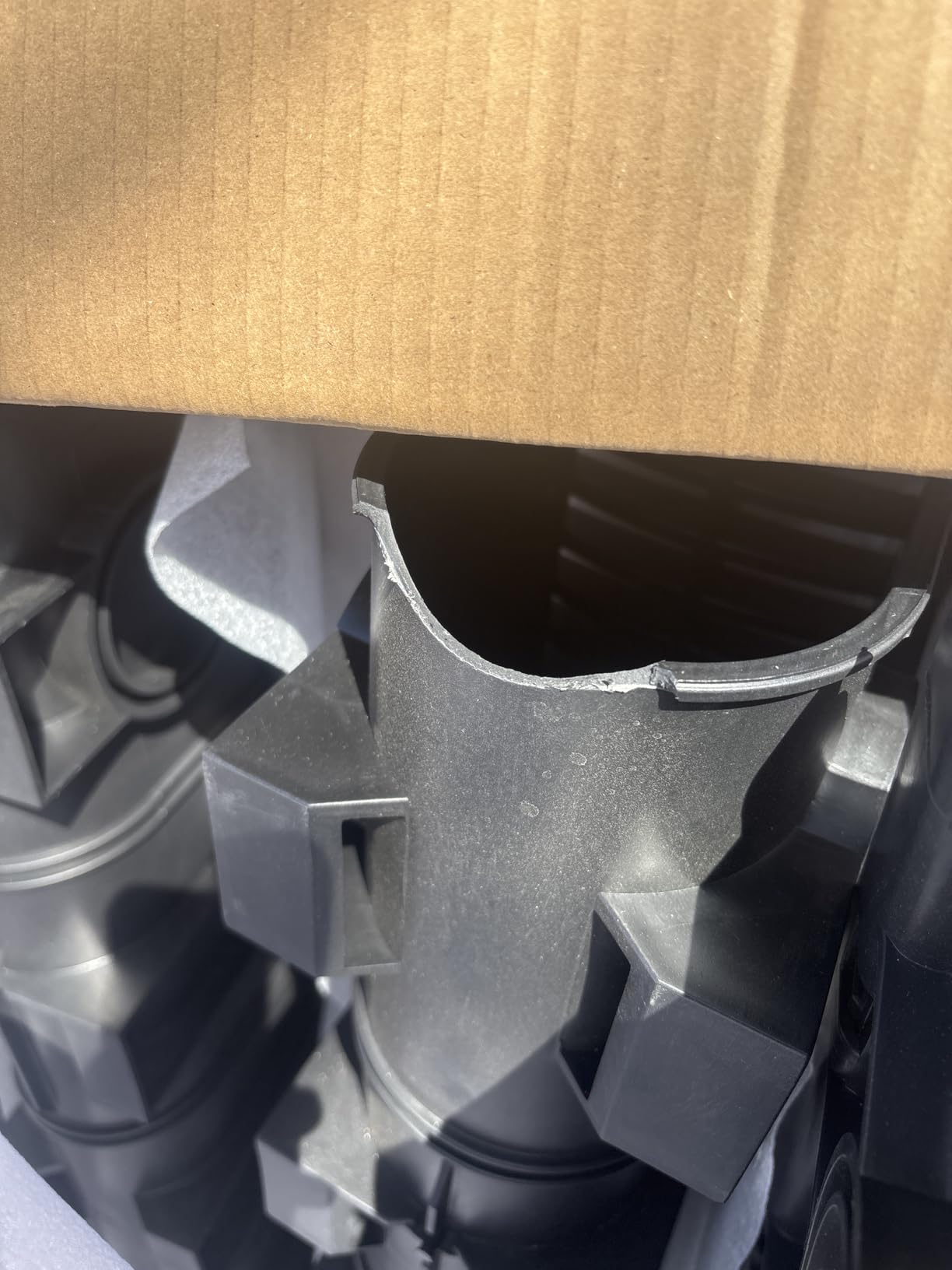
What B125 actually buys you
B125 is the traffic class for passenger vehicles and light trucks on a properly encased channel, one step above A125. On a driveway that sees delivery vans, ride-on mowers, or occasional trailers, that extra margin is the difference between a grate that stays flat and one that eventually deforms at the ribs.
Fit-out gaps to plan around
There are no corner pieces, so a run that needs to turn is out of scope for this system. There are also no factory anchor holes for rebar, which means extra drilling on site, and the grates become stubborn after the pour. If cleaning access matters to you, decide that before the concrete goes down.
8. StormDrain 3-Pack Concrete Grey Grate — Best for Matching New Concrete
Source 1 Drainage Trench and Driveway Channel Drain with Concrete Grey Grate, 3-Pack
5.12 in. H x 4.53 in. W x 117.60 in. L
Class B load rated
Cement grey grates
+ The Good
- The cement grey grate coordinates closely with existing poured concrete
- Class B rating holds up under a 4500 lb vehicle when set in concrete
- Interlocking sections need no screws
- The end outlet accepts 4 in. Schedule 40 pipe with a tight friction fit
- Easy to install and looks clean once set
- The Bad
- The one meter section lengths cannot be shortened with the current design
- Only one outlet and one end barrier are included per pack
- Loose soil install lets sections wash out and pop up
StormDrain wins on finish quality. The cement grey grate is a shade and a texture that sits with poured concrete rather than sitting on top of it, and owners consistently call out the appearance once the run is set. At 4.6 stars on a smaller review base than most here, the feedback is unusually clean: Class B rating that holds under a 4500 lb vehicle, screw-free interlocking sections, and an end outlet that grips 4 inch Schedule 40 pipe tightly.
Ten feet of channel across three interlocking sections is enough for a garage apron or the width of a single driveway bay. The body is 5.12 inches high and 4.53 inches wide, which gives you real depth for a modest trench, and the kit includes an end cap and an end outlet so the run terminates properly.
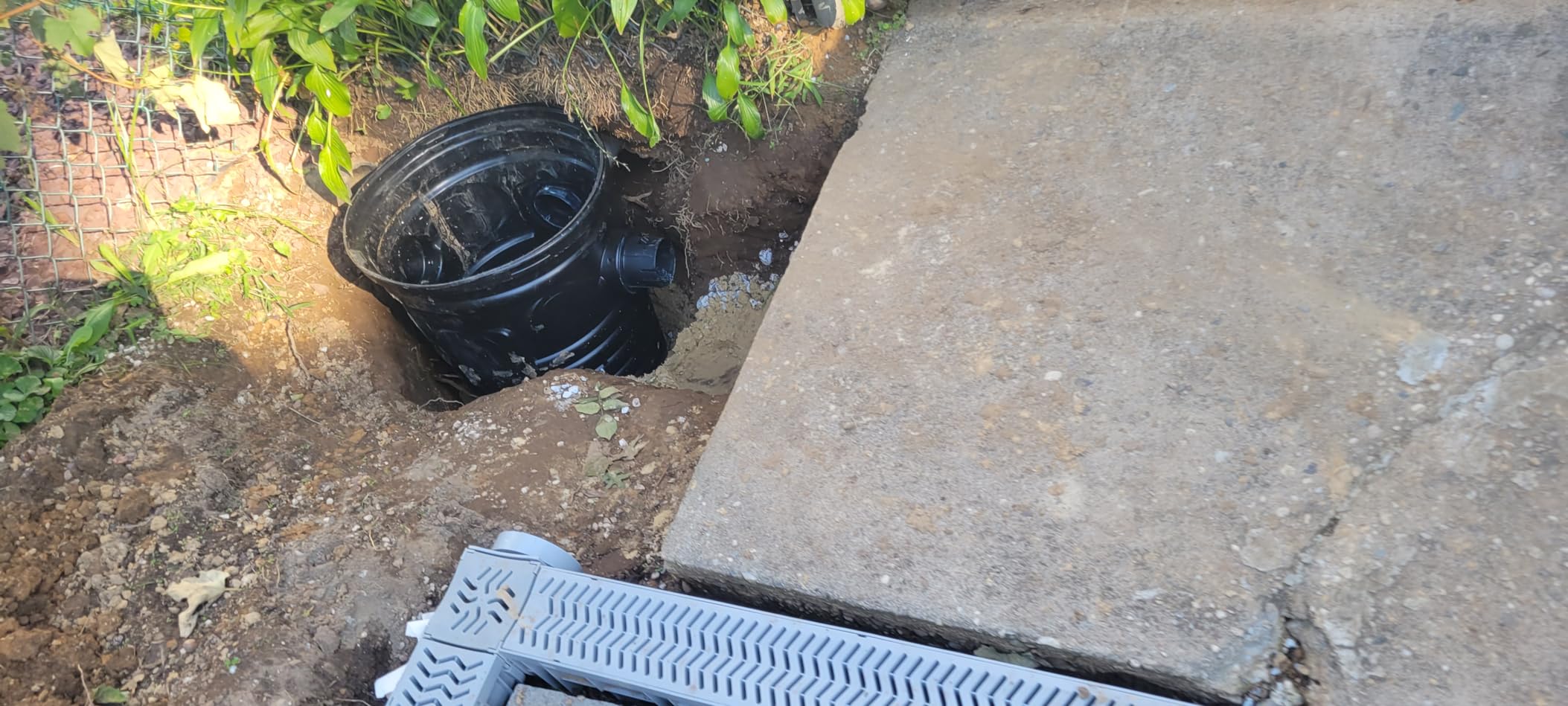
The honest caveat is rigidity of layout. The channel sections are a fixed one meter length and cannot be shortened with the current design, so a run that is not close to a full multiple of that length leaves you with an overhang or a gap. Measure the full run before ordering, not after.
It also has to be set in concrete. Installed in loose soil, sections wash out and pop up, which is the single most common cause of early failure across this whole product category. If your install is in a planted bed with no concrete pour, pick a system designed for that instead.
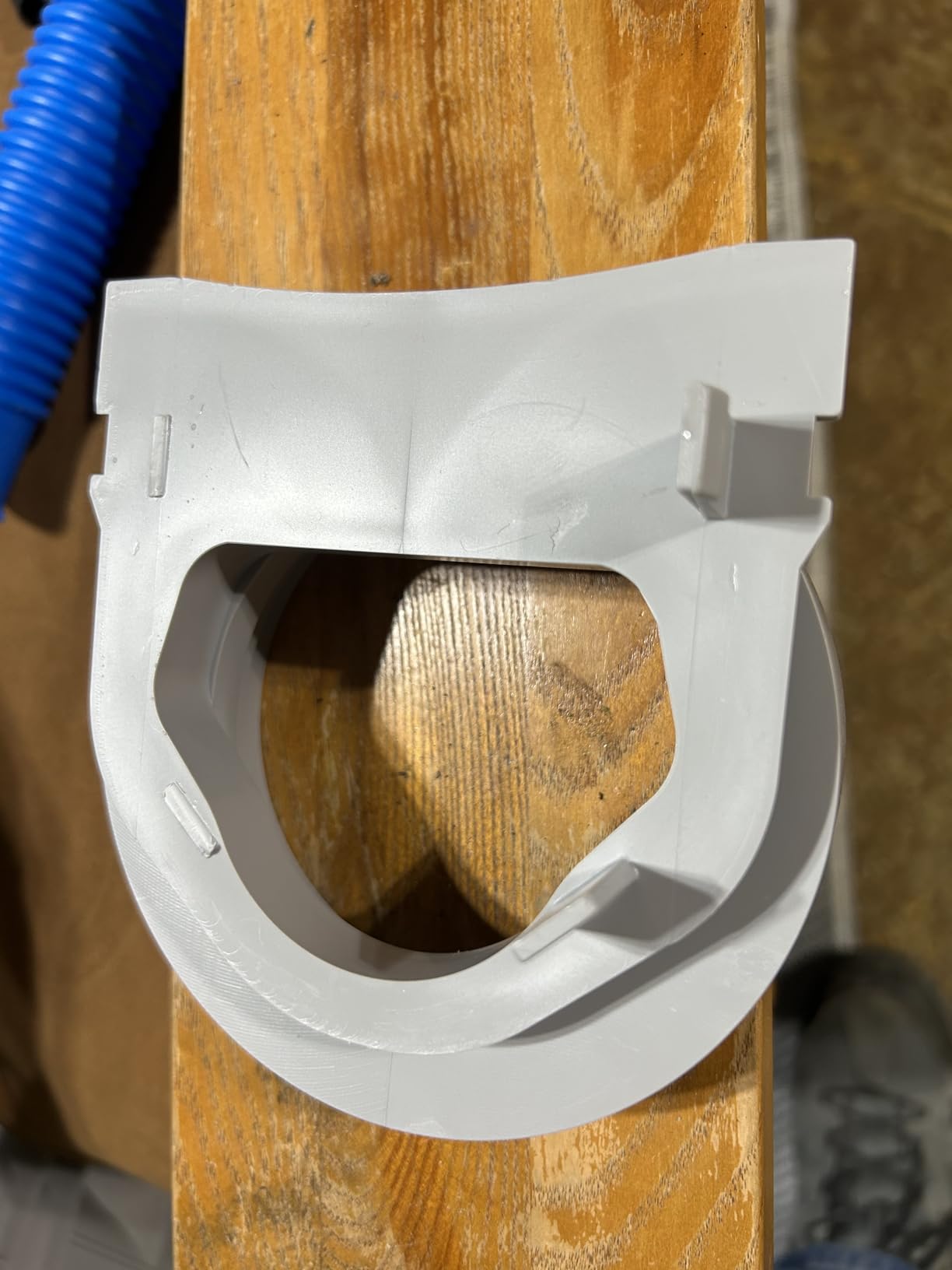
Matching new concrete
A grey grate in the wrong grey is the most visible mistake in a hardscape project. This one is matched to a cement grey that lines up with standard poured concrete, so a new apron and a new drain read as one job rather than two. It is the detail that makes the run disappear into the slab.
Where the fixed length hurts
One meter sections are efficient in a straight run and frustrating everywhere else. Plan the full length, work out how many sections it needs, and accept that you will have a short overrun or a small cut piece. The kit also ships with a single outlet and end barrier set, so order a spare kit if your run needs a second discharge point.
9. Natotela 12-Pack Short Module A15 System — Best for Tight Layouts and Pool Decks
Natotela 12 Pack 19.7×5.5×3.7 in. A15 Channel Drain with HDPE Grates
19.7 in. long modules, 236.3 in. total
Dotted grate surface for grip
A15 load class
+ The Good
- Short 19.7 in. modules give real layout flexibility around curves and posts
- The dotted grate surface improves grip around pools and walkways
- Tongue and groove sections lay quickly into a shallow trench
- Perforated design drains fast and keeps leaves and small objects out of the bottom
- Solid HDPE grates that feel strong under foot traffic
- The Bad
- Section locking latches are weak and pieces pull apart easily without sealant
- Grates sit snugly but are not positively secured and can be dislodged
- The supplied end caps do not fit or clip into place
- No factory anchor holes so rebar or screws must be added by the installer
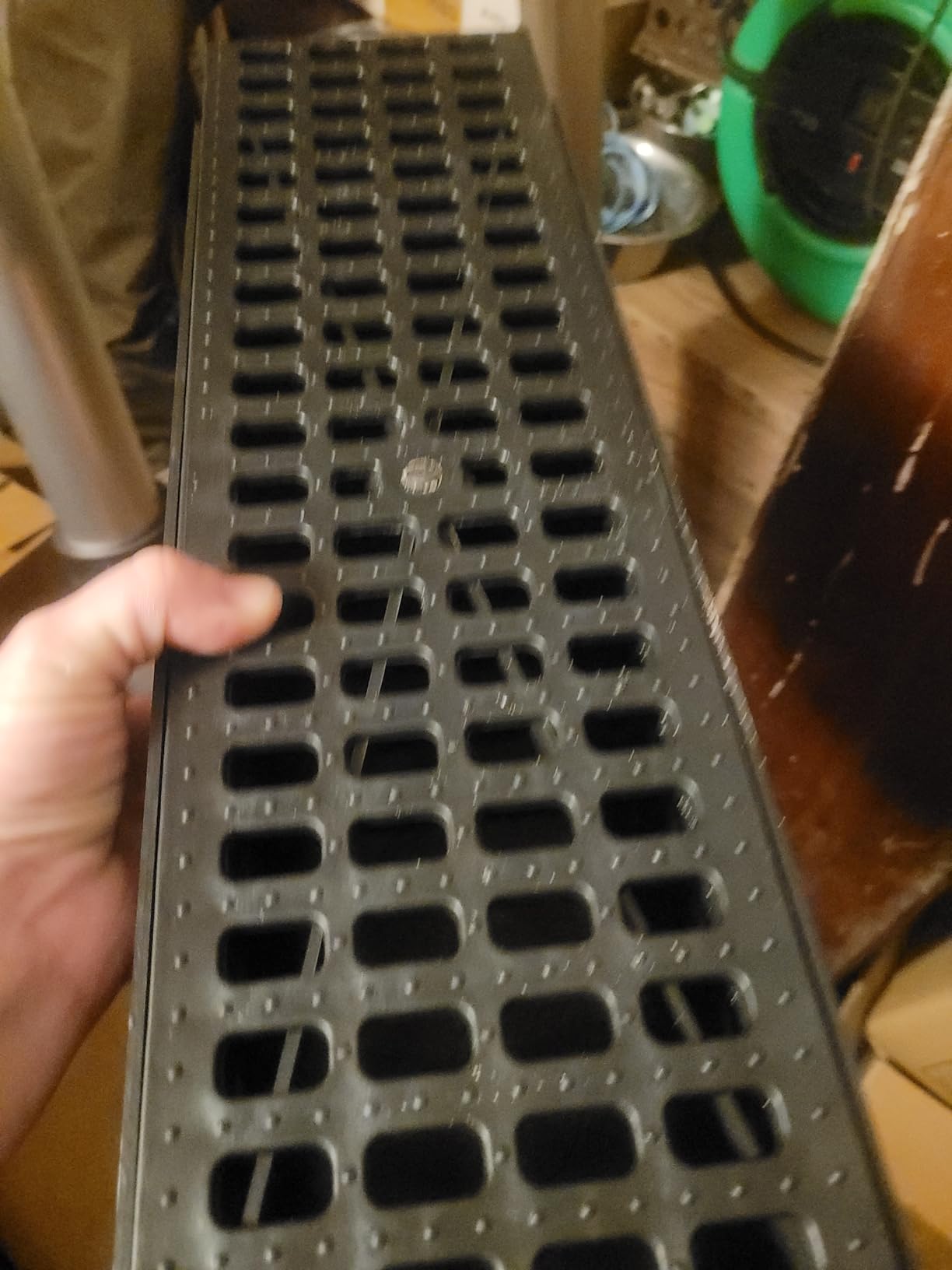
The Natotela pack is built around a different idea of layout: short modules. Each section is only 19.7 inches long, so twelve of them give 236.3 inches of run while letting you turn a line around a curved pool edge, a post, or an irregular patio border. Almost nothing else in this roundup lets you reposition a drain in 20 inch increments.
The grate surface is the other reason to like it. A dotted texture raises friction underfoot, which is a genuine safety argument on a wet pool surround where a smooth plastic grate becomes a slip hazard. At 5.5 inches wide and 3.7 inches deep it is another shallow-profile system, and the perforated design drains quickly while keeping leaves and small objects out of the trough.
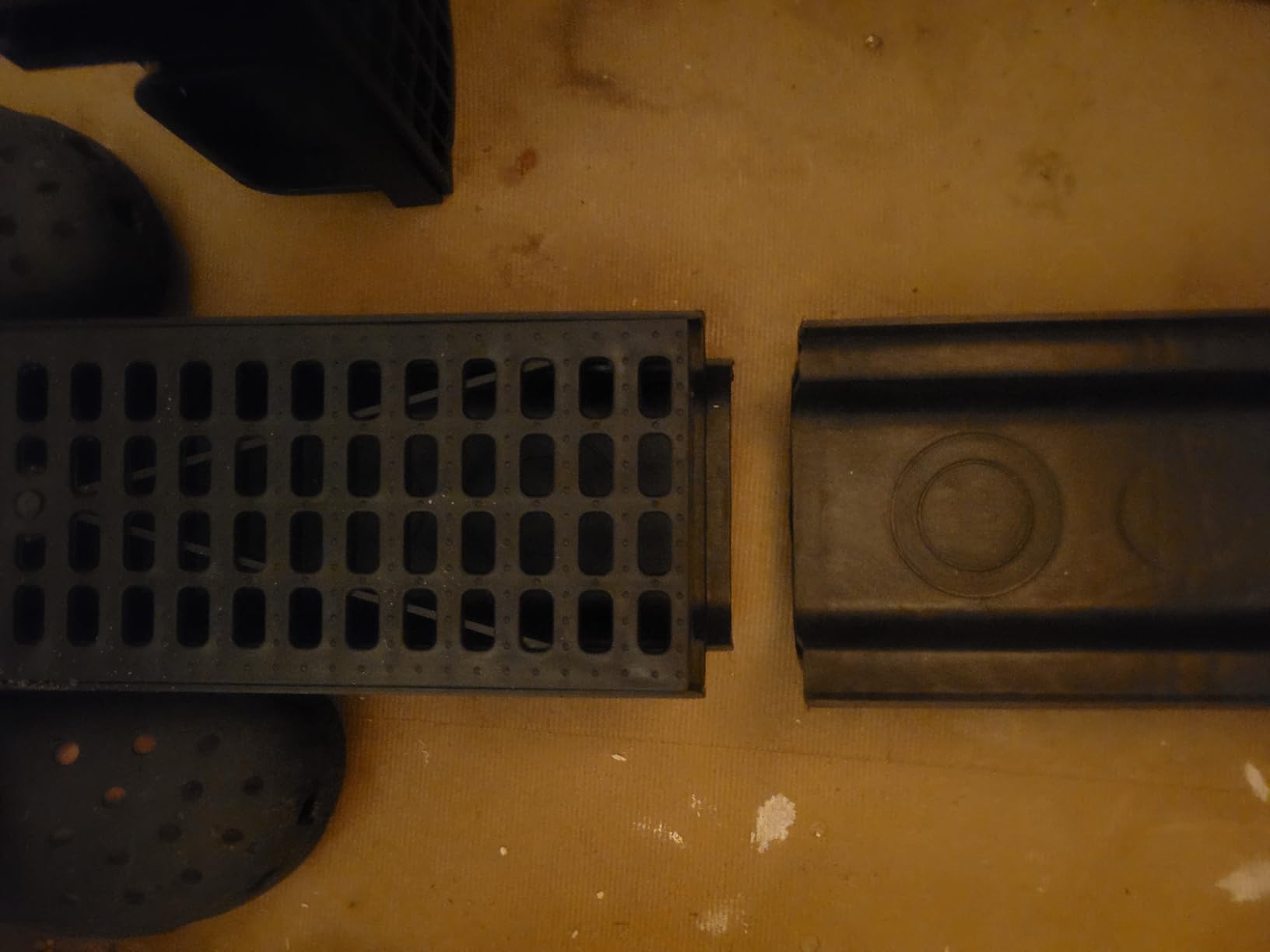
The kit includes twelve grates, twelve channel bodies, and two outlet adapters with 2 inch and 3 inch bottom outlet options, so the connection hardware is not an afterthought. Reviewers rate the material quality and value highly and like how quickly tongue and groove sections lay into a shallow trench.
Connection hardware is the recurring complaint. The locking latches are weak, the grates are not positively secured and can be dislodged, and the supplied end caps do not clip into place. Installers work around all three with sealant and their own screws, but plan for that rather than discovering it on the day.
Short modules for tricky layouts
Fixed 39 inch sections force you to either overrun a curve or accept a gap. Short 19.7 inch modules solve that, and for pool surrounds with curved edges, garden borders, and short side-yard runs, the flexibility is worth more than the extra joints. Buyers often finish a run with a shorter second pack rather than cutting a long channel.
What A15 means for you
A15 is a pedestrian rating. It is the correct class for pool decks, walkways, downspout splash zones, and garden paths, and the wrong class for anything a vehicle crosses. Read the class as a hard boundary, not a suggestion, because an overloaded plastic grate bends long before it breaks loudly.
10. Goldshire 6-Pack HDPE Trench Drain — Best Long Run on a Single Order
Goldshire 6PCS Trench Drain System with Plastic Grate (39.4″x5.9″x5.1″)
Six 39.4 in. channels, 236.4 in. total
HDPE body with plastic grate
Interlocking joints join by hand
+ The Good
- Heavy strong plastic that connects easily by hand
- 236 in. of run from a single six pack
- Pieces fit together well and drain effectively for pool deck and yard use
- Interlocking joints form a tight seal without tools
- Affordable against similar channel systems
- The Bad
- Grate tops do not snap in securely and can work loose
- Some shipments include five end caps rather than the stated six
- A small sample of reviews limits confidence in long term durability
The Goldshire pack is a long-run option. Six channels at 39.4 inches each give 236.4 inches of line, and at 5.9 inches wide and 5.1 inches deep it has the same cross-section as the deeper HDPE systems here without the freight weight of a concrete-body product. Buyers report strong plastic that connects by hand with no tools, and joints that form a tight seal on their own.
Outlets are built into the body at 3.1 inch and 3.6 inch on the bottom plus 2.2 inch on the side, and the grate is designed to keep debris and small animals out of the trough. That last detail matters in a yard install where a channel without a closed profile becomes a shelter for whatever is looking for one.
What 236 inches covers
Nearly 20 feet of line from one order is the practical reason to buy this rather than two smaller kits. It suits a full driveway crossing, a long side-yard run, a pool deck edge, or a commercial interior where the run has to be continuous and the joints as few as possible.
What the small review base hides
Be honest about the evidence here. The rating is strong, but with only a couple of dozen reviews there is not yet a long-term install history to read. The known issues are that grate tops do not snap in securely and can work loose, and that component counts in the box occasionally fall short, so count the parts before you start the trench.
11. VEVOR 3-Pack Shallow HDPE System — Best Budget Starter for Light Duty
VEVOR Trench Drain System 3 Pack, Channel Drain with Plastic Grate 5.7 x 3.1 in HDPE Drainage Trench, Black Plastic Garage Floor Waterway 3 x 39 in with 3 End Caps for Garden Driveway
5.7 in. W x 3.1 in. H x 39 in. sections
A15 to B123 load capacity
Built in bottom outlet connector
+ The Good
- A low cost entry point for a garage floor garden or light driveway section
- Hand removable grates make debris clearing straightforward
- Interlocking joints keep leaks to a minimum
- The built in outlet connector simplifies the pipe hookup
- A wide range of size and material variants in the same family
- The Bad
- The shallow 3.1 in. profile limits flow against deeper 5 in. channels
- The B123 rating only applies when the channel edges are fixed in place
- Plain HDPE does not bond to standard adhesives without surface preparation
The VEVOR 3-Pack is the cheapest sensible way into this product category, and for a garage floor or a garden edge it is enough. Three channels at 39 inches long, 5.7 inches wide, and 3.1 inches deep give you a little under 10 feet of line, with a built in bottom outlet connector that hooks straight to piping and screw-free hand-removable grates.
The anti-flotation design keeps the channels aligned during a pour without extra anchoring, which is genuinely helpful for a first install. Reviewers are satisfied with installation ease and grate removal, and the same product family comes in a range of sizes and materials if you outgrow this one.
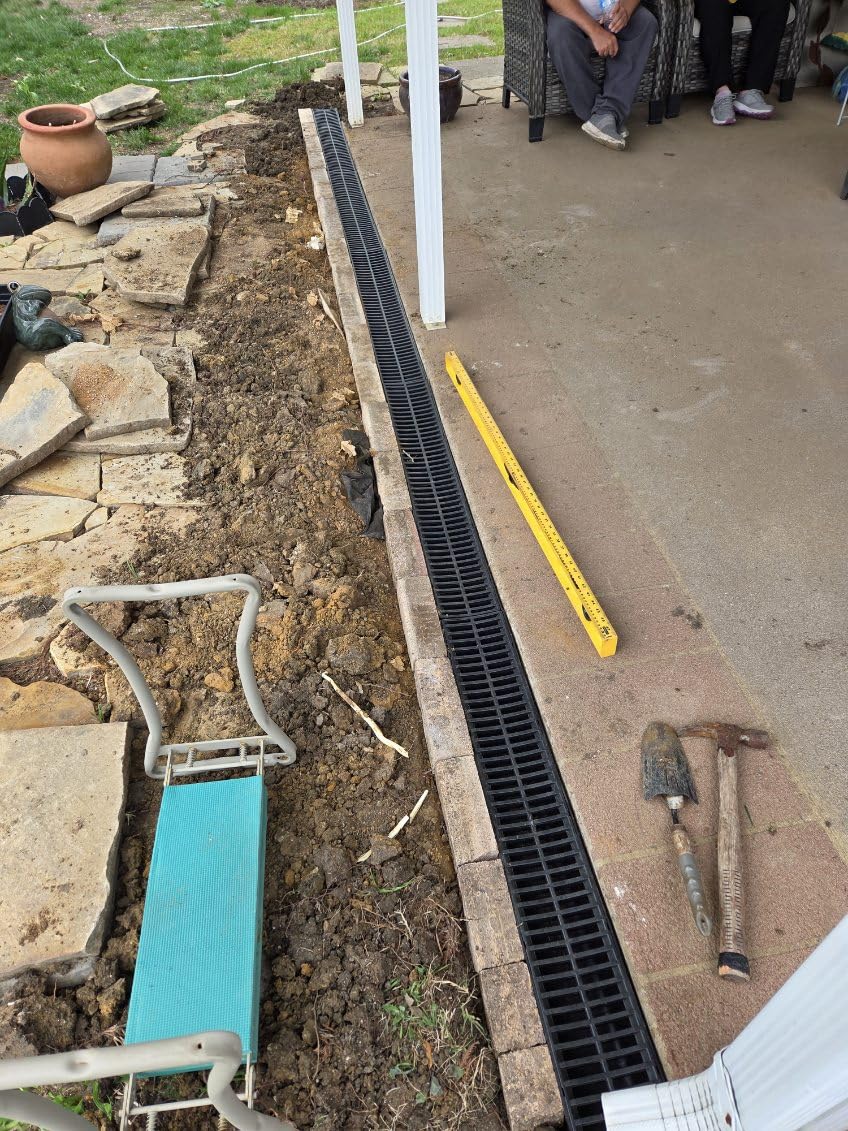
Two limits are worth stating plainly. At 3.1 inches deep, this is a low-volume channel, and a larger catchment will outrun it in a serious storm. And the B123 figure only applies when the channel edges are fixed in place, so treat the load rating as conditional rather than automatic.
Plain HDPE will not bond to standard adhesives without surface preparation, so plan the same mechanical restraint you would use on any of the plastic systems here. Rough the surface or use a purpose-made bonding system rather than assuming a solvent joint will hold.
When 3.1 inches of depth is enough
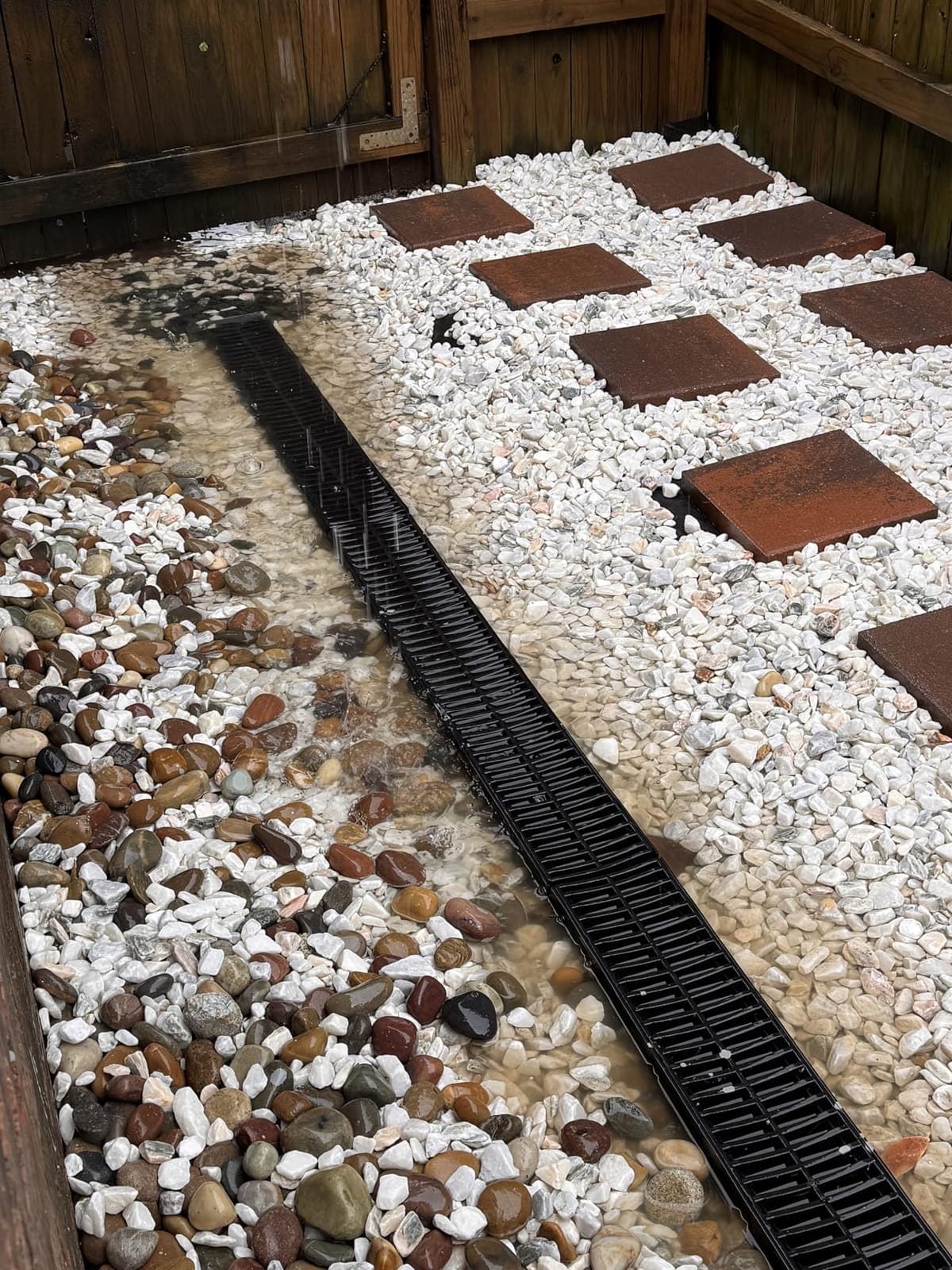
Shallow channels are correct when the drainage area is small and close by. A garage slab that sheds water off a door, a garden edge that catches roof runoff from a short downspout, or a light driveway section all fall in this range. The system is not trying to serve a large catchment, and at this size it does not need to.
Making the B123 rating real
The load figure here is conditional on restraint. Anchor the channel edges, restrain the ends, and let the surrounding concrete support the walls, and you get the higher rating. Leave it floating in a shallow bed and you are down to the pedestrian figure, whatever the box says.
12. FAHKNS 6-Pack Slotted Lid HDPE System — Best for Indoor Wet Areas
6 Pack Trench Drain System, Channel Drain with Plastic Grate, Driveway Drainage Channel Systems,Channel Drain Pipe Outdoor Trench Drainage System,5.9X5.1X39 Inch
5.9 in. W x 5.1 in. H x 39.4 in. sections
Clip-in cap removes without tools
Cut to size for custom runs
+ The Good
- The channel installs quickly and diverts driveway water effectively
- The cap lifts out by hand for clearing mud and leaves without tools
- A seamless slotted lid blends neatly with paving
- Corrosion resistant plastic that handles acids bases and salts
- Easy to drive over when set in a stone and gravel bed
- The Bad
- Not rated for vehicle traffic despite being marketed for driveway drainage
- The multi size pipe connector end cap shown in the listing is not included
- The downspout outlet device is sometimes missing from the box
This is the system to look at for indoor and semi-indoor linear drainage. The listing covers kitchens, bathrooms, balconies, laundry rooms, basements, and garage floors, and the HDPE body resists acids, bases, and salts with a smooth interior that minimizes flow resistance. That chemical tolerance is what separates it from the outdoor-only kits in this group.
The cap is secured by a simple clip and gravity design and lifts out without tools, so clearing mud and leaves takes seconds. The slotted lid integrates neatly with paving, which is why installers use it on patios, pool surrounds, and courtyard thresholds where a chunky grate would look wrong. Sections cut to size with a sawzall, so custom runs are straightforward.
Indoor wet rooms
In a bathroom, laundry, or basement, the criteria change. You want a sanitary, corrosion-proof body, a grate or cap that lifts out for cleaning, and a narrow profile that sits under tile. This system meets the first two comfortably and is compact enough at 5.9 inches wide to suit a threshold or a shower run. For the fixture end of the room, our kitchen sink drain guide covers the other half of the system.
What is missing from the box
Two fit-out gaps are reported repeatedly. The multi-size pipe connector end cap shown in the listing is not included, and the downspout outlet device is sometimes absent, with the supplied fitting not gripping tightly. There is also a caution worth repeating: this system is not rated for vehicle traffic even though it is often marketed for driveway applications.
Channel Drain vs. French Drain vs. Slot Drain: Which One Fits Your Problem
Channel drains and French drains solve different problems, and choosing the wrong one is the most expensive mistake in this category. A channel drain collects water that is already on a hard surface and moving across it. A French drain intercepts water that has soaked into soil and is moving below ground. A slot drain is a narrow, grated channel with a small slot opening, usually installed flush with the same hard surface but with less open intake area than a full channel grate.
Diagnose the water before you shop. If rain runs off your driveway and puddles at the bottom, or flows toward the garage door, you have a surface runoff problem and a channel drain is the right answer. If a patch of lawn stays soft and saturated for days after the rain stops, you have a groundwater problem, and no amount of surface drainage will fix it. That distinction is the one homeowners most often get wrong, and it is the reason drainage quotes vary so widely.
A slot drain captures water through a much narrower opening, which means less intake per foot but a far less visible installed line. If appearance matters more than intake capacity, a slot drain on a patio edge is a reasonable choice. If you are taking runoff off a large roof area or a wide slab, you want the open grate area of a full channel drain, and the system in this roundup is sized for that job.
Many properties end up using both. A channel drain in front of the garage door handles the sheet of water coming off the driveway, while a French drain in the side yard handles the soggy ground behind it. The failure mode we see most often is buying one system for two problems, then blaming the product.
How to Choose a Channel Drain System
Five decisions decide whether a channel drain works: width, depth, load class, material, and the outlet. Get those right and almost any decent kit will perform. Get them wrong and no amount of brand reputation will save the install.
Start with width and depth
Width sets how much water the grate can intake, and depth sets how much the trough can carry. A 4 inch or 5 inch wide channel is the residential norm, and 5 inch deep bodies handle roof and hardscape runoff better than 3 inch shallow ones. If your catchment is large, buy depth before you buy width, because a wide shallow channel will still back up in a hard storm.
Depth is also constrained by the site. A patio edge with limited build-up height can only accept a shallow low-profile system, and a 3 inch body is a legitimate choice there. The question to ask is not how deep the drain should be in the abstract, it is how much depth you have between the finished surface and the pipe or catch basin it discharges into.
Match the load class to the traffic
Load class is the safety rating of the grate, and it is not a marketing word. A15 covers pedestrian areas like walkways and pool decks. B125 covers passenger cars and light trucks on a residential driveway. C250, D400, and F900 step up to vans, heavy vehicles, and forklifts or aircraft. Buy the class for the heaviest thing that crosses the run, not the lightest.
For a residential driveway, B125 is the sensible target. Read the rating on the grate rather than the box, and remember that on several plastic systems the higher rating only applies when the channel edges are properly fixed and concreted in. An unanchored channel performs at the pedestrian figure no matter what the listing claims.
Choose the material for the location
HDPE and polypropylene bodies are light, chemical resistant, and easy to cut, which makes them the practical choice for most residential work. Their weakness is joint integrity: the plastic does not bond reliably to adhesive, so alignment depends on mechanical restraint and the concrete pour. Galvanized or stainless steel grates add stiffness and a better finish at the surface, which is why they appear on patios and visible edges.
Polymer concrete bodies are the heavy-duty option used where impact loads are extreme, and stainless steel is the standard where a sanitary washdown surface is needed. For a garage floor, a garden edge, or a driveway apron, a plastic body with a steel grate is the combination most owners end up happy with.
Plan the outlet before the trench
The outlet is where most installs go wrong, and it is the cheapest thing to get right. Check whether the system accepts the pipe size you actually have, because several kits list proprietary solid pipe sizes rather than flexible drain pipe or Schedule 40. Confirm the outlet adapter is included in the box, because some kits ship without the main drain connection.
Then decide the discharge point. A channel drain that ends in a hole in the lawn has moved the problem rather than solved it. It needs a pipe run to a catch basin, a dry well, a storm sewer connection, or a defined low point, and that pipe has to be sloped consistently from the first outlet to the last.
Installation, Maintenance, and Failure Modes
Most of these systems are concrete-encased, and that is not a shortcut, it is the design. The channel is set to a fall toward the outlet, restrained against uplift, and surrounded by concrete that transfers vehicle load to the surrounding slab and holds the grates at a flush height. Set the run first and level it, then pour over and around it. A channel placed during the pour tends to rise.
Whether you need a professional comes down to the trade as much as the skill. Concrete contractors install channel drains as part of hardscape work, and that is the right call for a driveway apron where the pour and the slab have to move together. Grading and irrigation crews handle them in planting beds and paths. Plumbers get involved where the discharge line connects to a sewer line. In a residential install, the concrete contractor is usually the correct trade, and permit requirements vary by region, so check locally before the trench is dug.
Grate security is worth planning for on a visible driveway. A snap-in grate can be lifted by hand, which is convenient for maintenance and convenient for anyone else. On a street-facing run, use a bolt-down grate or a locking grate, and accept the extra maintenance step in exchange for the grate staying where you put it.
Maintenance is simple and it is the difference between a channel that works and a channel that stopped working. Lift the grates, flush the trough, and clear the outlet twice a year, with an extra pass after leaf fall if the run sits under trees. Keeping silt out of the channel body is the single most effective thing you can do for capacity. For blockages further down the line, our guide to the best electric drain snakes covers clearing the pipe after the channel.
The failure modes to watch for are predictable. Standing water means a blockage or a run with no fall. Sinkage means the channel was not supported in concrete. A grate that rocks or lifts means missing fasteners or an unanchored channel. Ponding that returns every storm in a wide area usually means the run is too short for the catchment, not that the product failed. In freezing climates, standing water inside a channel is the thing to clear before winter, because ice expands in a place with nowhere to go.
Frequently Asked Questions
Which channel drain is best?
The Source 1 Drainage 3-Pack is the best overall for residential driveways, with galvanized steel grates, a 4.5 inch wide by 5 inch deep body, and a bottom outlet that accepts both 3 inch and 4 inch drain pipe. For high water volume, the NDS 864G leads on published flow at 72 GPM per foot. For a flush finish in paving, the Vodaland 4 Inch can be recessed into pavers.
Are channel drains effective?
Yes, for surface water. A channel drain intercepts runoff that is already flowing across a paved surface and carries it to a pipe or catch basin, which stops pooling, erosion, and water reaching a foundation or garage. They do not address soggy ground or a high water table. That is subsurface drainage, and it needs a French drain, regrading, or a dry well.
How deep does a channel drain need to be?
A 5 inch deep channel is the residential standard because it carries roof and hardscape runoff without backing up. A 3 inch shallow profile is enough for patios, paths, and small catchment areas where there is limited build-up height. Depth is also limited by what sits below, since the channel has to fall to an outlet it discharges into.
Why are channel drains so expensive?
The channel body and grate are rarely the largest part of the bill. Excavation, concrete encasement, the discharge pipe run, and the labour to cut, level, and pour around the run dominate the cost, and long runs across a driveway multiply all four. That is also why quotes vary so widely between contractors, and why materials-only shopping lists look so much cheaper than installed figures.
What is the best drain channel for a bathroom?
A stainless steel or HDPE linear drain with a grate narrow enough to sit under tile, rated for pedestrian loads, and with a cap or grate that lifts out for cleaning. Avoid anything with an open slot wider than half an inch in a wet area, and pick a body that resists cleaning chemicals. A15 load class is sufficient for a residential bathroom floor.
What is the best drainage for a driveway?
A channel drain across the bottom of the driveway or at the garage apron, sized in a 4 to 5 inch wide body, set in concrete, and graded to a pipe or catch basin. B125 load class covers cars and light trucks. If water is running along the driveway rather than across it, regrading the surface is often cheaper and more effective than adding a drain.
Final Verdict: Best Channel Drain Systems in 2026
If you want one answer to the question of which channel drain system to buy, take the Source 1 Drainage 3-Pack at the top of this list. It combines galvanized steel grates, an easy three-section run, and an outlet that accepts standard 3 inch and 4 inch pipe, with the deepest owner feedback base of any system we evaluated in 2026. It is the safest default for a residential driveway or garage apron.
Pick something else when your situation is specific. Take the NDS 864G when water volume rather than pooling is the issue, the NDS 864GMTL when a steel grate and a neat visible finish matter, the VEVOR 6-Pack or FAHKNS B125 pack for a long or higher-traffic run, the Vodaland 4 Inch for a recessed finish in paving, and the Natotela short modules for a curved pool deck or an awkward layout.
Before you buy anything, diagnose whether your water is surface runoff or groundwater, because no channel drain fixes a wet yard. Size the depth to the build-up height you have, match the load class to the heaviest traffic, and confirm the outlet accepts the pipe you will connect. Get those three right and the best channel drain systems in 2026 become a straightforward weekend project rather than an expensive lesson.