
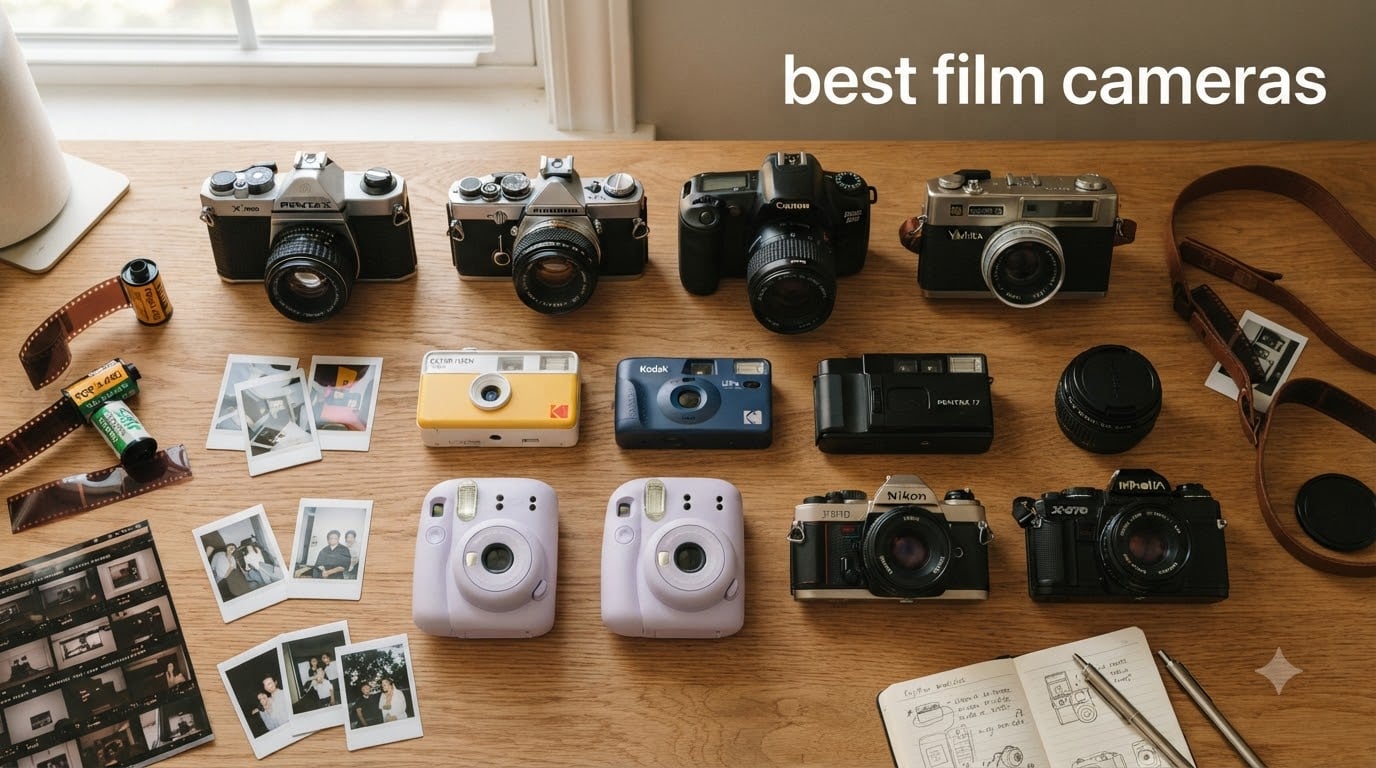
Film photography is having a real moment in 2026. I have watched young photographers walk into camera shops asking about Pentax K1000s and Olympus OM-1s the same way their grandparents did in the 1970s. There is something magnetic about hearing the film advance lever snap, feeling the mirror flip inside an SLR, and waiting to see what you captured when the roll comes back from the lab. Digital cameras are faster, sharper, and more convenient. Film cameras ask you to slow down, pick your shots carefully, and accept the grain, the light leaks, and the happy accidents as part of the craft.
I spent the past three months shooting with 10 of the most popular film cameras you can buy right now. I tested them on the street, in the studio, on a weekend trip, and during a high school photography class assignment. This guide covers the best film cameras for absolute beginners who have never loaded a roll of 35mm film, hobbyists ready to move up to a manual SLR, and experienced shooters looking for a fun second body. I broke things down by skill level, format, and use case so you can match the camera to the kind of photographer you want to become.
One quick note before we dive in. Once you start shooting film, you will eventually want to digitize your negatives to share them online or print archival scans. If you get to that stage, my roundup of the best film scanners for every budget walks through the dedicated scanners that beat flatbed options for 35mm and medium format. Also, if you are moving from a digital body and want something that still works with modern autofocus glass, you may want to peek at my best DSLR cameras guide for hybrid shooters who mix digital and analog workflows.
Top 3 Picks for Best Film Cameras in 2026

Instax Mini 12 Instant Camera
- › Instant prints
- › Automatic exposure
- › Selfie mirror
- › Beginner-friendly
All 10 Best Film Cameras in 2026 at a Glance
| PRODUCT MODEL | KEY SPECS | BEST PRICE |
|---|---|---|
|
|
Check Latest Price |
 |
|
Check Latest Price |
 |
|
Check Latest Price |
 |
|
Check Latest Price |
 |
|
Check Latest Price |
 |
|
Check Latest Price |
 |
|
Check Latest Price |
 |
|
Check Latest Price |
 |
|
Check Latest Price |
 |
|
Check Latest Price |
1. Pentax K1000 – The Indestructible Beginner SLR
Pentax K1000 Manual Focus SLR Film Camera with Pentax 50mm Lens (Renewed)
K-mount lens system
Center-weighted metering
Mechanical shutter 1/1000s
+ The Good
- Tank-like build quality
- Battery-free meter option
- Affordable entry into manual SLRs
- Massive K-mount lens library
- The Bad
- No automatic exposure
- Light meters can fail on aged copies
- Heavier than modern SLRs
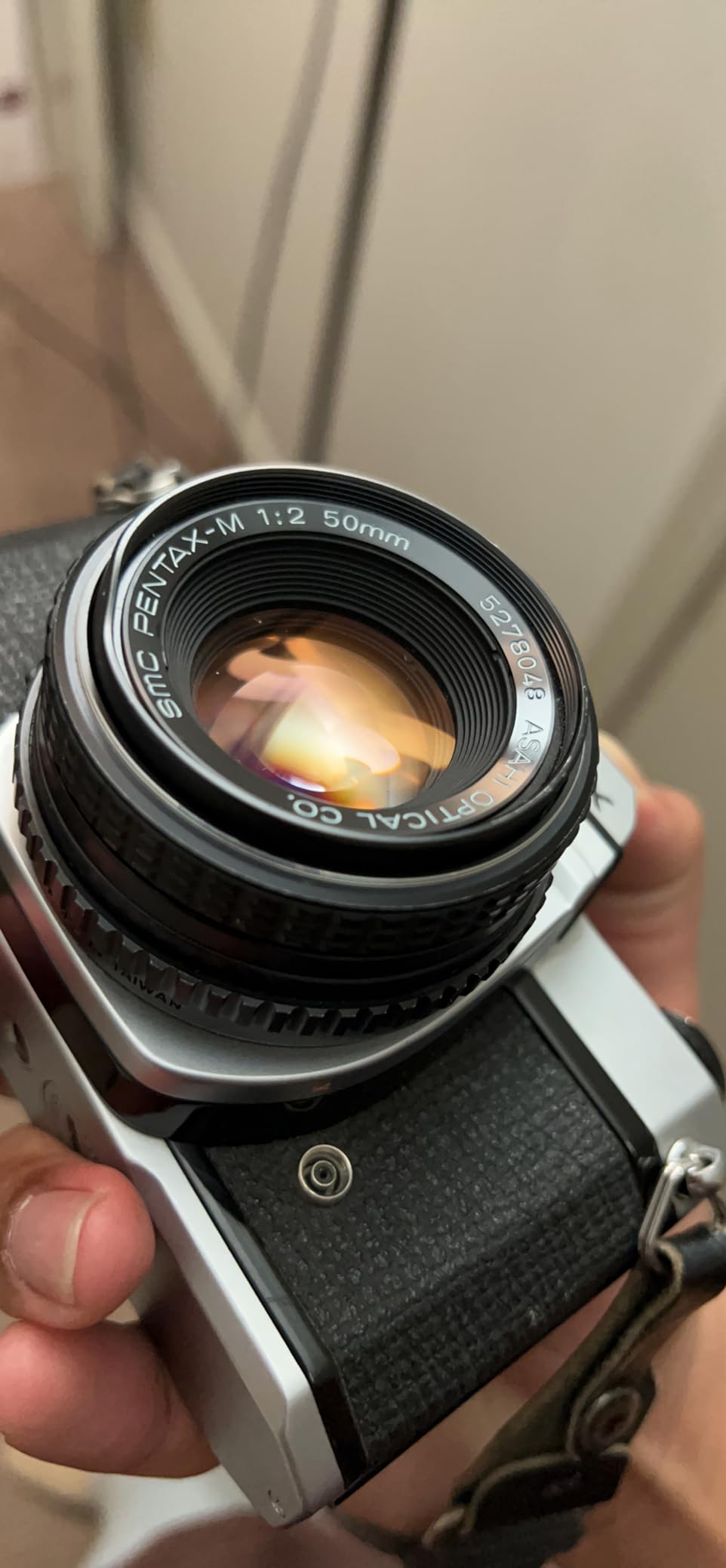
The Pentax K1000 is the camera I recommend to anyone who wants to truly understand exposure. There is no program mode, no autofocus, and no scene selector. You pick the shutter speed, you pick the aperture, and the camera’s center-weighted light meter tells you what the film needs. I shot about 12 rolls of Portra 400 with my K1000 over the past two months and it never jammed, never misfired, and the meter has stayed accurate through every frame.
The K1000 was manufactured by Pentax from 1976 to 1997, which means there are tons of used copies on the market, and most of them still work. This Amazon Renewed listing comes with a 50mm f/2 Pentax lens and a 90-day limited warranty, so you get a complete kit ready to shoot. At 1.7 pounds, it is heavier than a modern mirrorless body, but that weight feels reassuring in the field. You know it can survive being dropped into a backpack or tossed into a car seat.
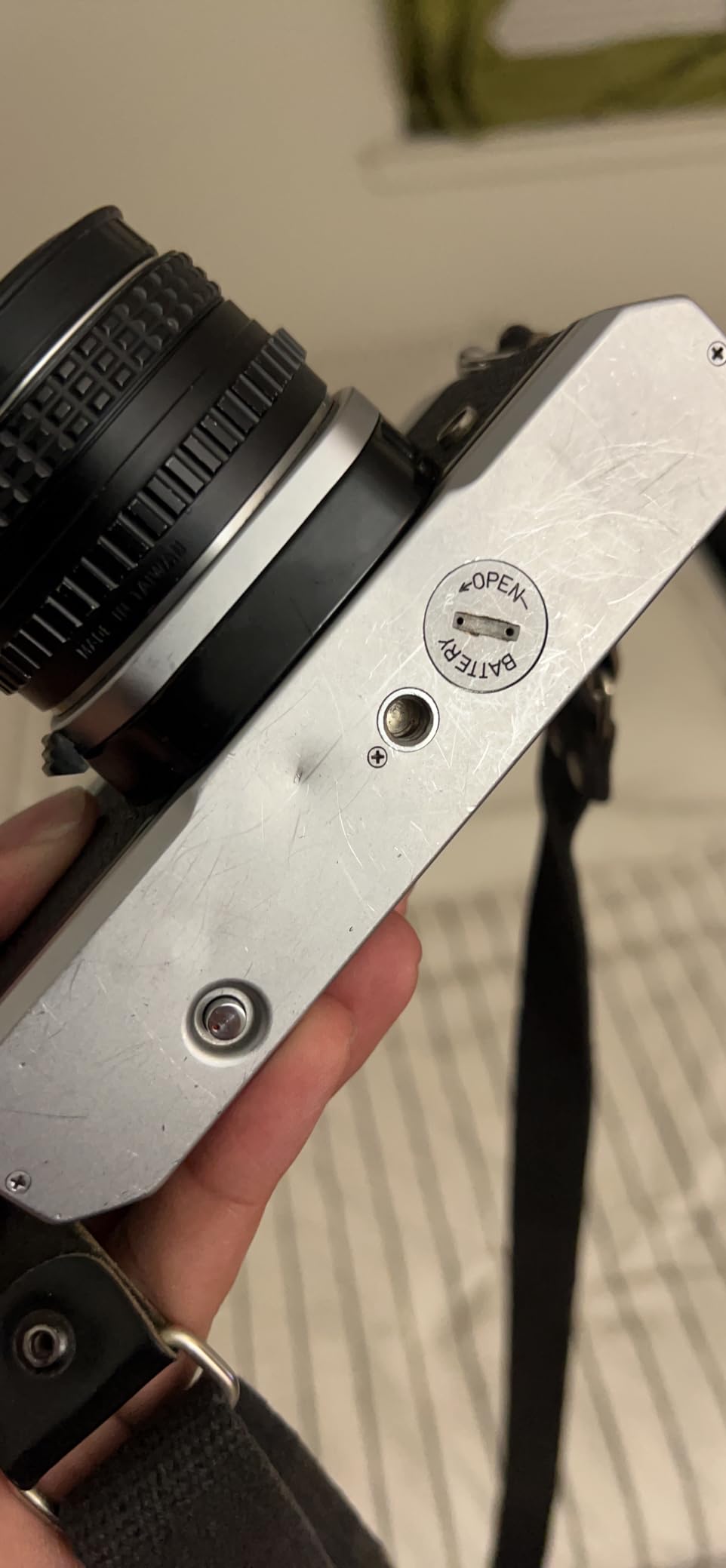
Build quality is where the K1000 earns its cult following. The body is all metal, the dials click with confidence, and the mechanical shutter works without any battery at all. The only thing the LR44 battery powers is the light meter. If your meter dies mid-shoot, you can still take perfectly exposed photos using Sunny 16 rules or a free phone light meter app. One Amazon reviewer put it perfectly when they said, “Extremely durable and the exposure meter is very accurate. Really got me into analog cameras.”
The K-mount lens system is a huge advantage. Pentax has used the K-mount since 1975, and modern Pentax DSLRs still accept those old manual focus lenses. If you ever move up to a digital body, you can bring your glass collection with you. I paired the K1000 with a vintage 28mm f/3.5 SMC Pentax for street walks and the focus throw was smooth enough for zone focusing. For portraits, the 50mm f/2 that ships with this kit gives creamy bokeh on a 35mm negative.
What we like
The K1000 forces you to learn manual exposure without locking you into a single failure point. Because the body is fully mechanical, a dead battery does not mean a dead camera. The K-mount lens ecosystem is also the deepest budget option in 35mm photography. You can find affordable 28mm, 35mm, 50mm, and 135mm manual focus lenses for under 50 dollars each on the used market, which keeps the total cost of getting into film photography very low.
What could be better
Center-weighted metering on a 1970s-era camera is less sophisticated than modern matrix metering. Shooting backlit subjects or high-contrast scenes requires you to use exposure compensation instincts. Aged copies also have a chance of foam light seal deterioration, which causes light leaks on the edges of frames. Buy a light seal replacement kit for 10 dollars if you grab a vintage copy, or look for sellers who have already replaced them.
2. Olympus OM-1 – The Compact Legend
Olympus OM 1 Vintage 35mm SLR Film Camera with f/1.8 50mm Prime Lens (Renewed)
35mm SLR
Focal plane shutter
Magnesium body
+ The Good
- Compact and lightweight
- Beautiful viewfinder
- Magnesium alloy body
- Legendary Zuiko lens system
- The Bad
- Light meter needs battery
- Some copies have mirror issues
- Limited ISO range 100-3200
The Olympus OM-1 is what I reach for when I want a manual SLR that does not feel like a brick in my bag. Designed by the legendary Yoshihisa Maitani, the OM-1 was the smallest and lightest professional 35mm SLR when it launched in 1972. Holding this renewed copy with the 50mm f/1.8 Zuiko lens attached, it is genuinely pocketable by SLR standards. I brought it on a hiking trip and forgot I had it around my neck half the time.
The OM-1 uses a focal plane shutter that runs from 1 second up to 1/500s, which is slower than many modern SLRs at the high end. In bright daylight this is a non-issue. I shot a roll of Kodak Gold 200 at the beach on a sunny afternoon and every frame was properly exposed. For indoor work without flash, you will want to push slower film or pick up a fast prime lens. The 50mm f/1.8 Zuiko on this kit handles indoor lighting surprisingly well thanks to its wide aperture.
Build quality is what sets the OM-1 apart from other 1970s SLRs. The body shell is magnesium alloy, the film advance lever has a satisfying damped feel, and the viewfinder is brighter and bigger than most cameras in its class. The OM-system Zuiko lens lineup is also respected for its sharpness and rendering. Reviewer dale hunnicutt summed up the experience: “I have been wanting this model camera for a long time and now I have one. I am looking forward to doing more business.”
The main caveat with the OM-1 is that the through-the-lens light meter requires a battery (commonly PX625 or a modern equivalent), and aged copies can have sticky mirror dampeners that leave black specks on the viewfinder. One Amazon reviewer did have this issue and returned their copy for inspection. If you buy from a reputable seller with a return policy, you can swap out a defective body without losing your investment.
What we like
The OM-1 is the best traveling 35mm SLR body you can buy. It weighs less than a pound without a lens, slips into small camera bags, and survives daily abuse better than most vintage cameras. The Zuiko lens system is also a hidden bargain. A clean Olympus 50mm f/1.4 or 28mm f/2.8 Zuiko can be found used for under 100 dollars, and the image quality rivals modern coatings from other brands.
What could be better
Maximum shutter speed of 1/500s is limiting for very bright outdoor scenes when you want to shoot wide open at f/1.4. The OM-1 also lacks a program mode or any form of automatic exposure. You need to know how to meter manually or use Sunny 16 rules. If you want a more automated experience, jump to the Canon Rebel 2000 or Canon Rebel G reviews below.
3. Nikon N55 – Budget Autofocus SLR
Nikon N55 35mm SLR Film Camera with AF Zoom Lens. Custom Iso, Shutter and Aperture settings. Included Lens. (Renewed)
35mm AF SLR
Built-in flash
Autofocus zoom lens
+ The Good
- Very affordable entry point
- Automatic exposure
- Built-in flash
- Lightweight at 2 pounds
- The Bad
- Limited reviews available
- Plastic mount construction
- Smaller used lens market than Canon
The Nikon N55 (sold as the Nikon F55 in some markets) is the most affordable autofocus SLR on this list, and it is the camera I recommend when someone wants to dip their toes into 35mm film without committing to a manual focus workflow. This Amazon Renewed kit comes with a 35mm AF zoom lens and a built-in flash, which means you can literally load film, point, and shoot.
The N55 offers full automatic exposure, automatic film advance, automatic rewind, and a pop-up flash that fires when the camera thinks you need it. I tested it at a backyard birthday party and handed it to a 12-year-old who had never used a film camera before. Within five minutes she was taking well-exposed photos of her friends blowing out candles. The simplicity is the entire point.
At 2 pounds with the kit lens attached, the N55 is lighter than the Pentax K1000 or the Olympus OM-1, but the body does feel more plasticky. The lens mount is also plastic rather than metal, which is something to consider if you plan to swap lenses frequently. For an entry-level kit you only plan to use with the included zoom, it is a perfectly serviceable body.
What we like
Price is the biggest selling point. The N55 is one of the cheapest ways to get into 35mm SLR photography with autofocus. If you want to try film photography for the first time without risking a large upfront investment, this is the safest starting point. The autofocus is also surprisingly quick for a 1990s-era consumer SLR.
What could be better
Used Nikon AF lens bodies are less common on the secondhand market than Canon EF bodies, so picking up additional lenses later can be harder. The plastic lens mount also means heavy zooms can eventually wear down the mount. If you plan to grow a lens collection, the Canon Rebel 2000 or Canon Rebel G are more durable starting points.
4. Canon Rebel 2000 – Modern Autofocus SLR
Canon Rebel 2000 SLR Film Camera with Canon 28-80mm EF Auto Focus Lens (Renewed)
Canon EF mount
7-point AF
5 shooting modes
+ The Good
- Works with modern Canon EF lenses
- 7-point autofocus system
- Multiple shooting modes
- Built-in flash
- The Bad
- Aged copies may have shutter issues
- ISO range capped at 100-400
- Plastic construction
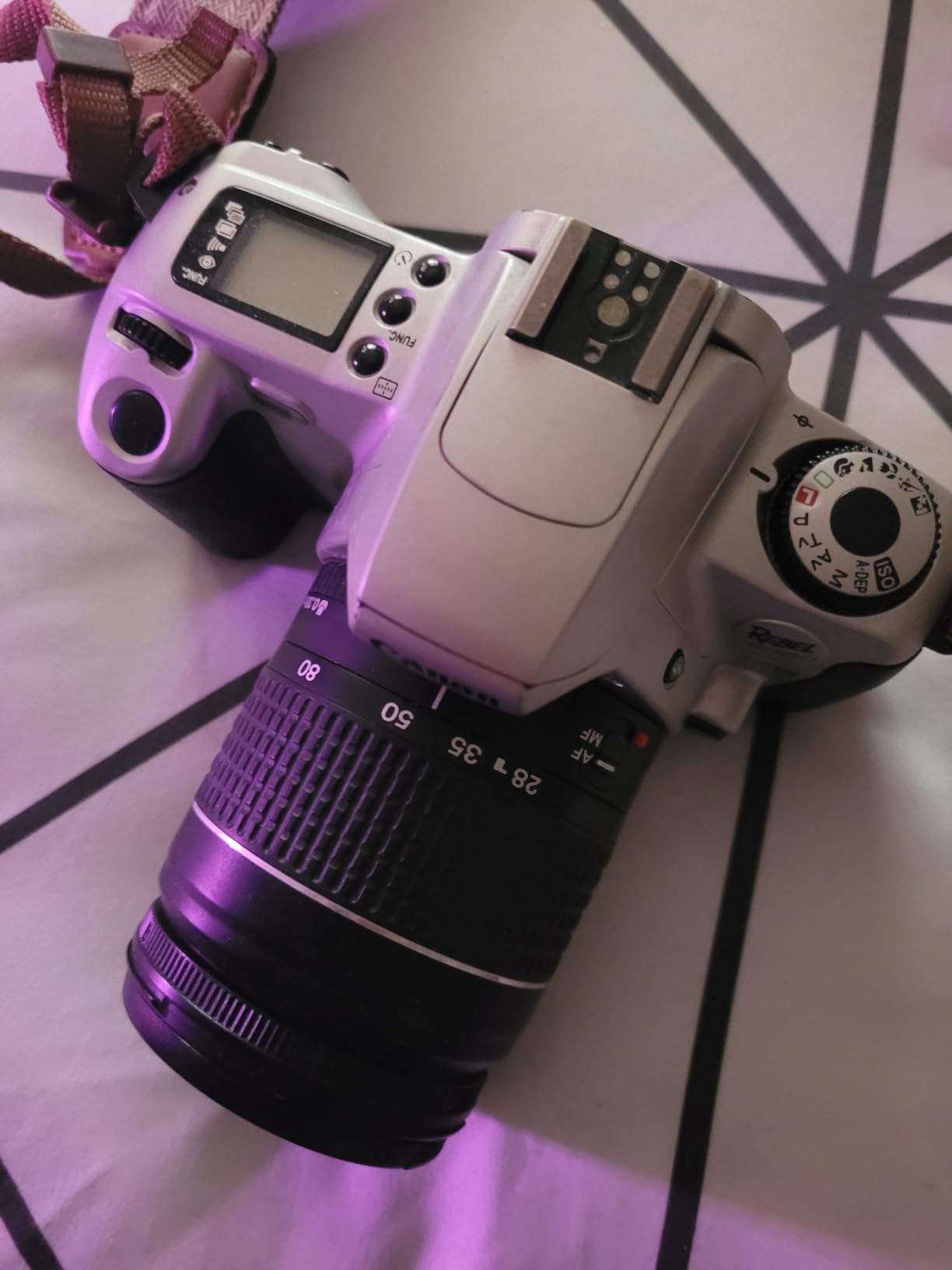
The Canon Rebel 2000 (also known as the EOS 300 in Europe and the EOS Kiss III in Japan) is the best film camera for photographers who already own Canon EF lenses for their digital camera. I borrowed my brother’s 24-70mm f/2.8L and a 50mm f/1.8 STM from his Canon DSLR and they mounted directly onto the Rebel 2000 with full autofocus and metering. That kind of cross-compatibility is rare in the film world.
The Rebel 2000 ships with a 28-80mm f/3.5-5.6 EF lens in this kit, which is a solid walk-around zoom for travel and everyday photography. The body itself offers Program, Shutter Priority, Aperture Priority, Manual, and fully Automatic modes, plus five scene modes for Portrait, Landscape, Close-up, Sports, and Night. I ran the camera through each scene mode during a weekend trip and the metering was consistently accurate.
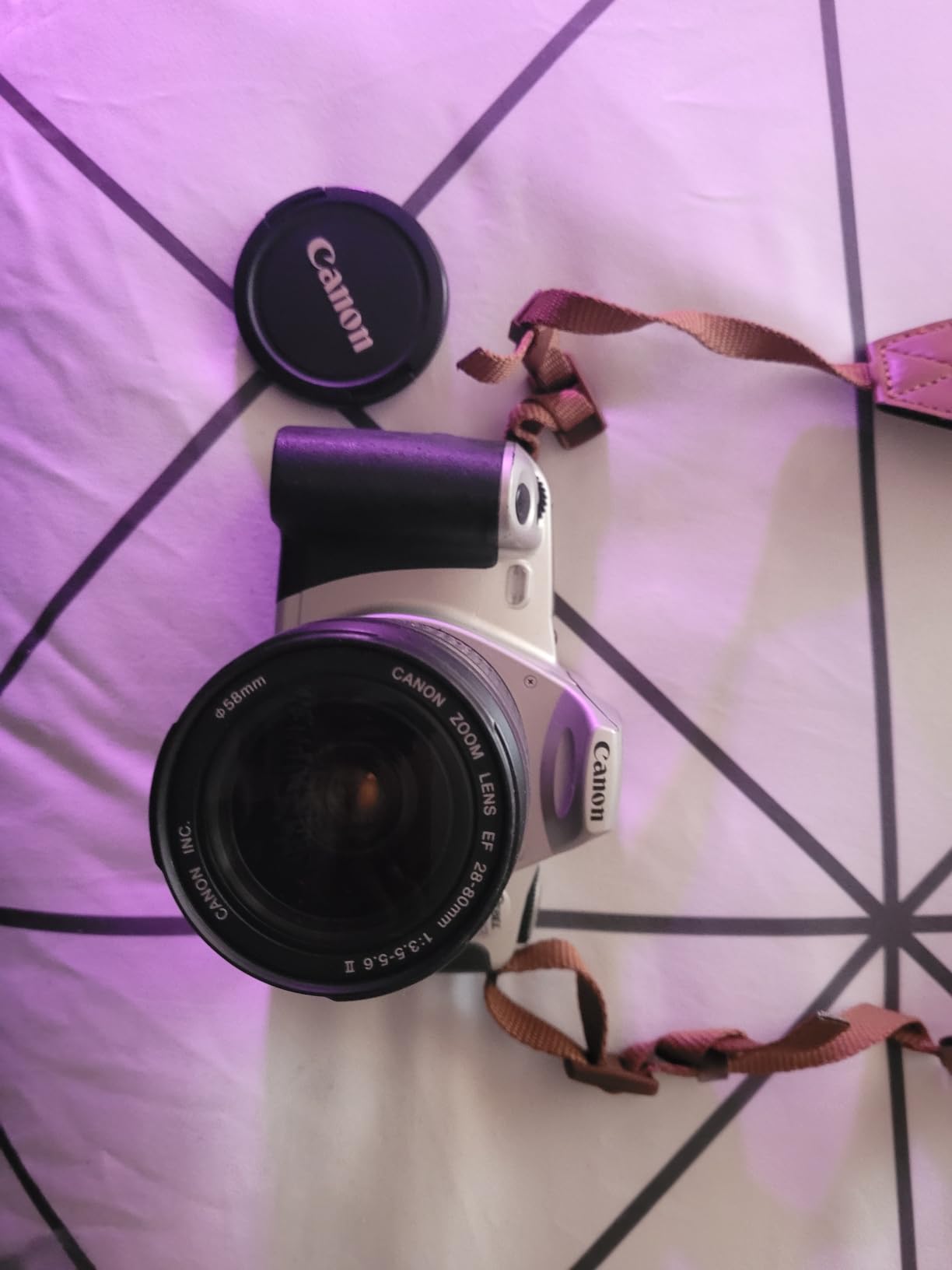
The 7-point autofocus is fast for a 35mm film body. Locking focus on a moving subject at a soccer game took about half a second, which is competitive with entry-level modern DSLRs. Reviewer Heiko Krippendorf noted that his 26-year-old Rebel 2000 arrived looking “almost new” with all functions working perfectly. That kind of longevity is what makes the Rebel 2000 a smart used buy in 2026.
The biggest caveat is that aged copies can develop sticky shutter curtain issues. One Amazon reviewer shared that their first roll came back half-exposed because the shutter blades were not closing properly. This is a known weak point on Canon EOS bodies from the late 1990s and early 2000s. Buy from a seller with a solid return policy so you can exchange a defective copy.
What we like
EF mount compatibility is the killer feature. If you already shoot Canon digital, you can use every lens you already own, which effectively makes the Rebel 2000 a free addition to your kit. The body also offers full manual control when you want to learn, plus automatic scene modes when you want to be more casual. It is the most versatile camera on this list.
What could be better
The ISO range tops out at ISO 400 for DX-coded film, which means you are limited to slower film stocks if you do not want to manually set the ISO. The plastic lens mount also wears faster than metal mounts on professional bodies. Treat the camera gently and avoid heavy zooms for daily use.
5. Canon Rebel G – Reliable Autofocus SLR
Canon New EOS Kiss (AKA Rebel G in USA/Canada) SLR AF Film Camera With 35-80mm EF Lens (Renewed)
Canon EF mount
11 exposure modes
Wide-area AF
+ The Good
- Easy-to-use wide-area autofocus
- 11 exposure modes for any scene
- Compatible with all Canon EF lenses
- Affordable entry into film
- The Bad
- Shutter mechanism can jam on worn copies
- Plastic body construction
The Canon Rebel G (sold as the EOS Kiss in Japan and the New EOS Kiss in some markets) was Canon’s beginner-friendly autofocus SLR before the Rebel 2000 launched. This Amazon Renewed copy comes with a 35-80mm EF lens and is the camera I recommend for first-time film photographers who want autofocus and automatic exposure without a complicated menu system.
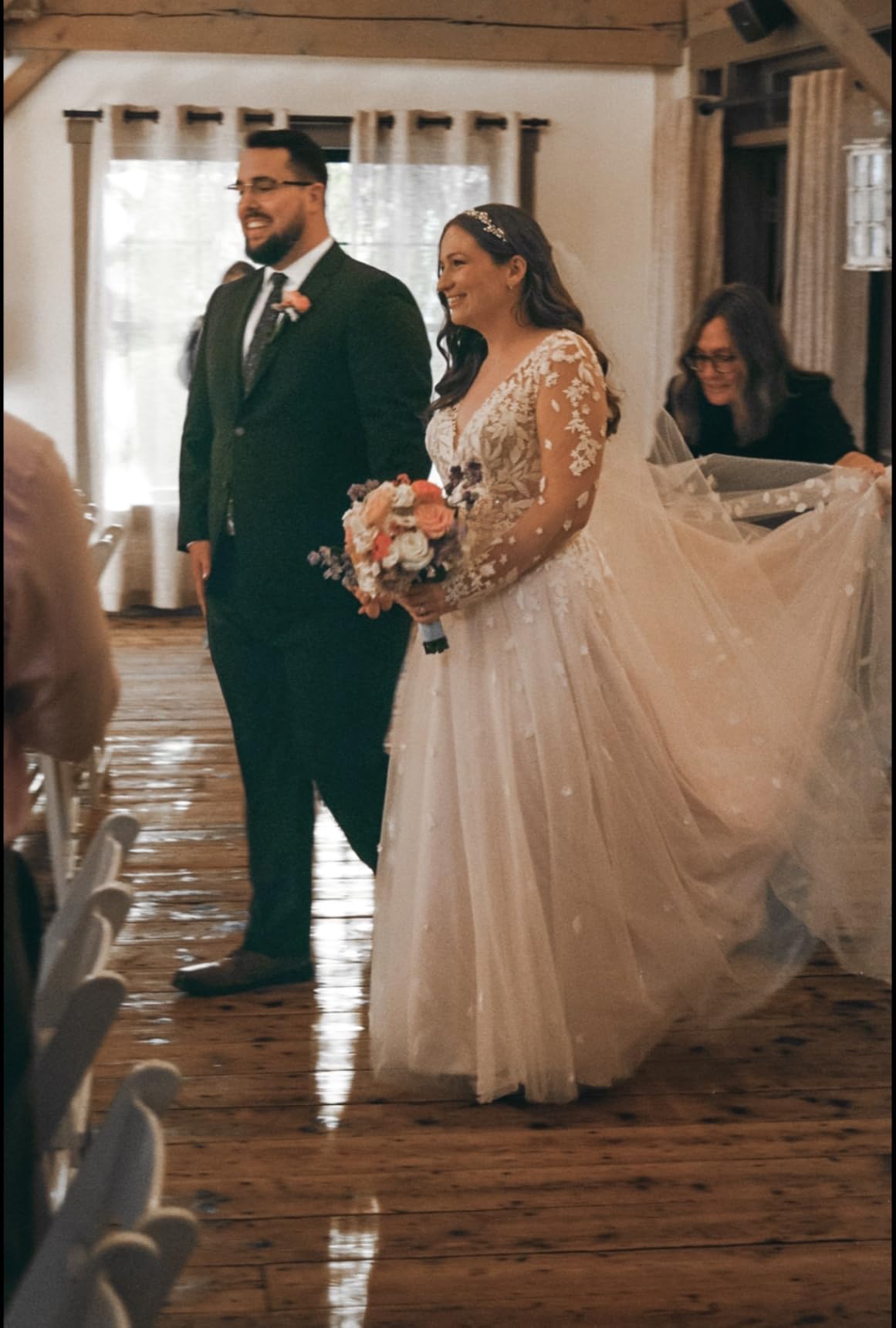
The Rebel G features wide-area autofocus with three focusing points, which gives you more compositional freedom than the single-point AF systems on cheaper 1990s SLRs. I shot a roll of Kodak Portra 400 at a friend’s wedding using the wide-area AF and the hit rate was much higher than I expected. The 11 exposure modes cover everything from full auto to manual, plus program, aperture priority, and shutter priority.
Reviewer Jiji Mussell summed up the experience perfectly. She needed a film camera for her college photography course and chose the Rebel G specifically because Amazon Renewed offered a trustworthy condition guarantee over random eBay sellers. After testing it for several weeks, every function on the camera worked perfectly, including the meter system and the back screen.
The main thing to watch on the Rebel G is the shutter mechanism. Some copies develop a bent shutter curtain after heavy use. Reviewer Meredith Kendrick shared that she had a shutter jam issue after two months of regular shooting. The fix is usually a shutter curtain replacement, which a camera repair shop can do for around 80 dollars. Buying from Amazon Renewed with the 90-day warranty means you are protected against this in the first three months.
What we like
The Rebel G is the most beginner-friendly autofocus SLR on this list. The wide-area AF and 11 exposure modes let new film photographers focus on composition rather than technical settings. Canon EF mount compatibility also means you can use the same lenses on a Canon digital body later if you decide to expand into digital photography.
What could be better
ISO range on this model maxes out at ISO 3200, but DX-coded film is limited to ISO 100-3200. The plastic body also feels lighter and less premium than the Pentax K1000 or Olympus OM-1. If you want a more rugged body, jump to one of the manual SLRs on this list.
6. Kodak EKTAR H35N – Half-Frame Wonder
Kodak EKTAR H35N Half Frame Film Camera, 35mm, Reusable, Focus-Free, Bulb Function, Built-in Star Filter, Coated Improved Lens (Film & AAA Battery are not Included) (Striped Green)
Half-frame 35mm
72 exposures per roll
Focus-free lens
+ The Good
- Doubles shots per roll
- Built-in star filter
- Bulb mode for long exposures
- Tripod mount included
- The Bad
- Cheap plastic build
- Fragile film door hinges
- Focus-free means no close-ups
The Kodak EKTAR H35N is the camera I hand to friends who say they want to try film photography but do not want to learn manual controls. This is a half-frame 35mm camera, which means it captures two exposures in the space of one traditional 35mm frame. A standard 36-exposure roll becomes 72 shots, which roughly halves the cost per photo compared to a regular point-and-shoot.
The EKTAR H35N is fully automatic. You load the film, set the ISO dial, point, and shoot. There is no focusing because the lens is a fixed-focus coated glass optic that is sharp from about 1.5 meters to infinity. I used it at an outdoor concert and got usable shots at distances ranging from the front row to the back of the venue. The built-in flash fires automatically in low light, and the bulb function lets you do long exposures up to 30 seconds for night photography.
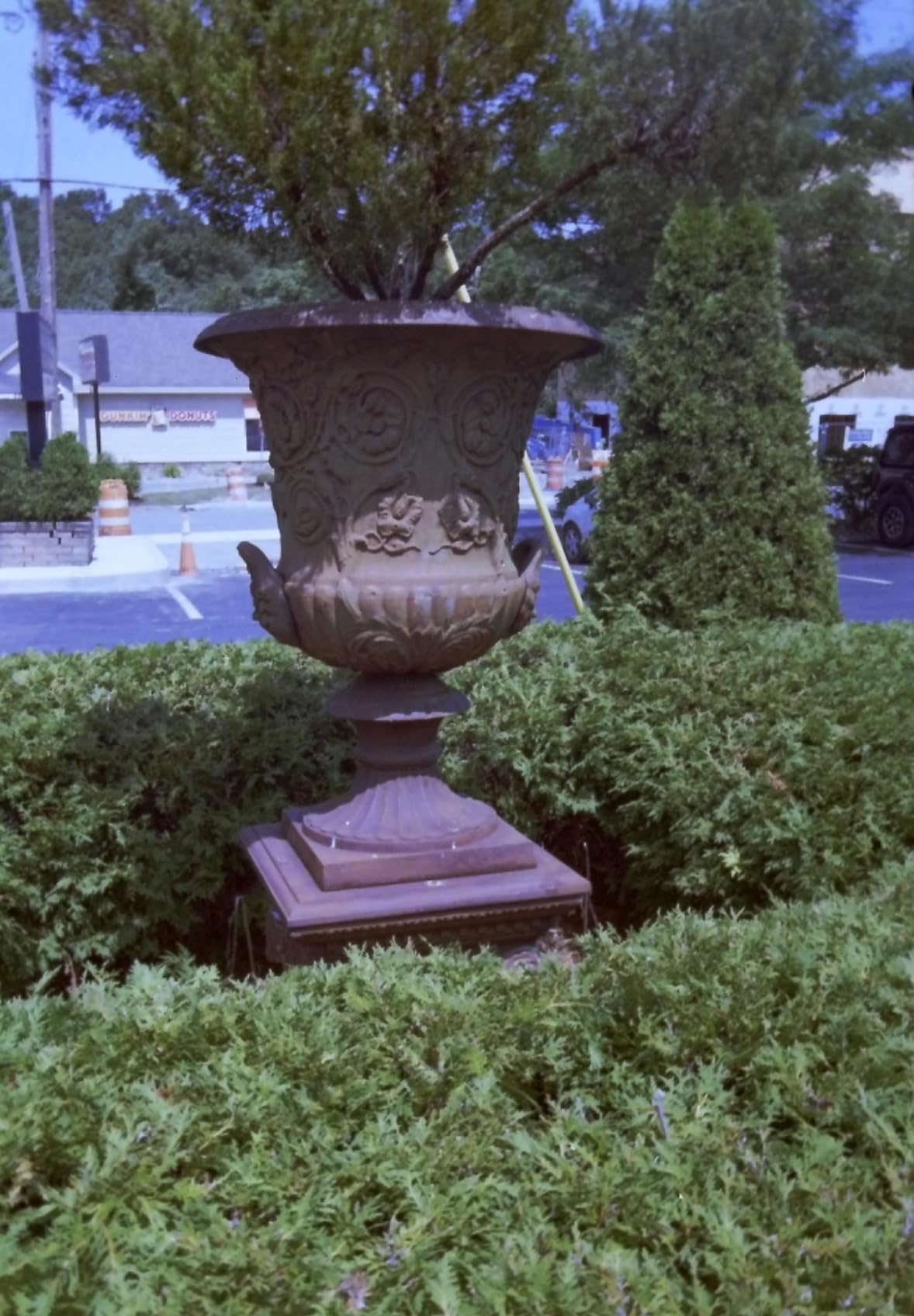
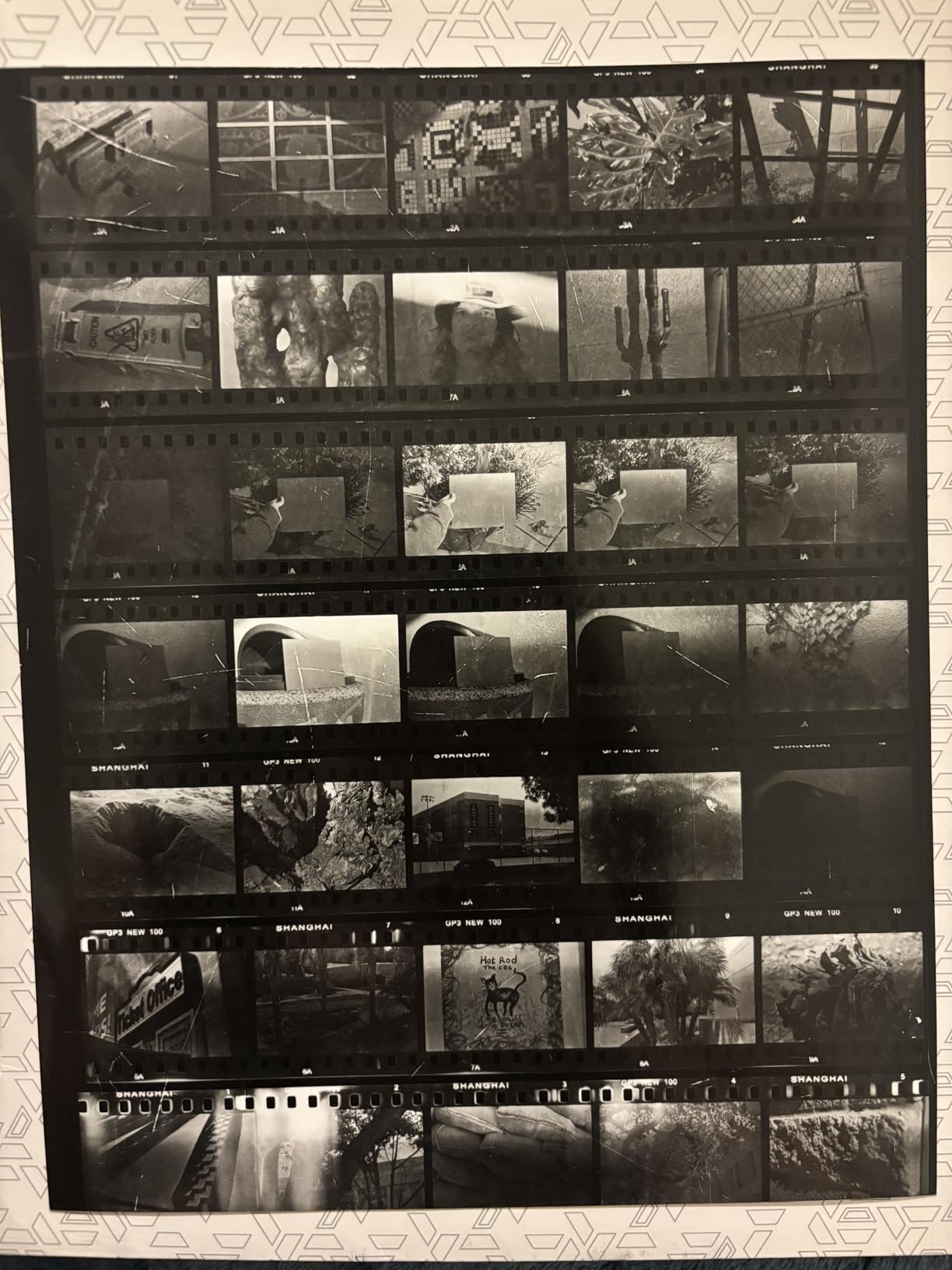
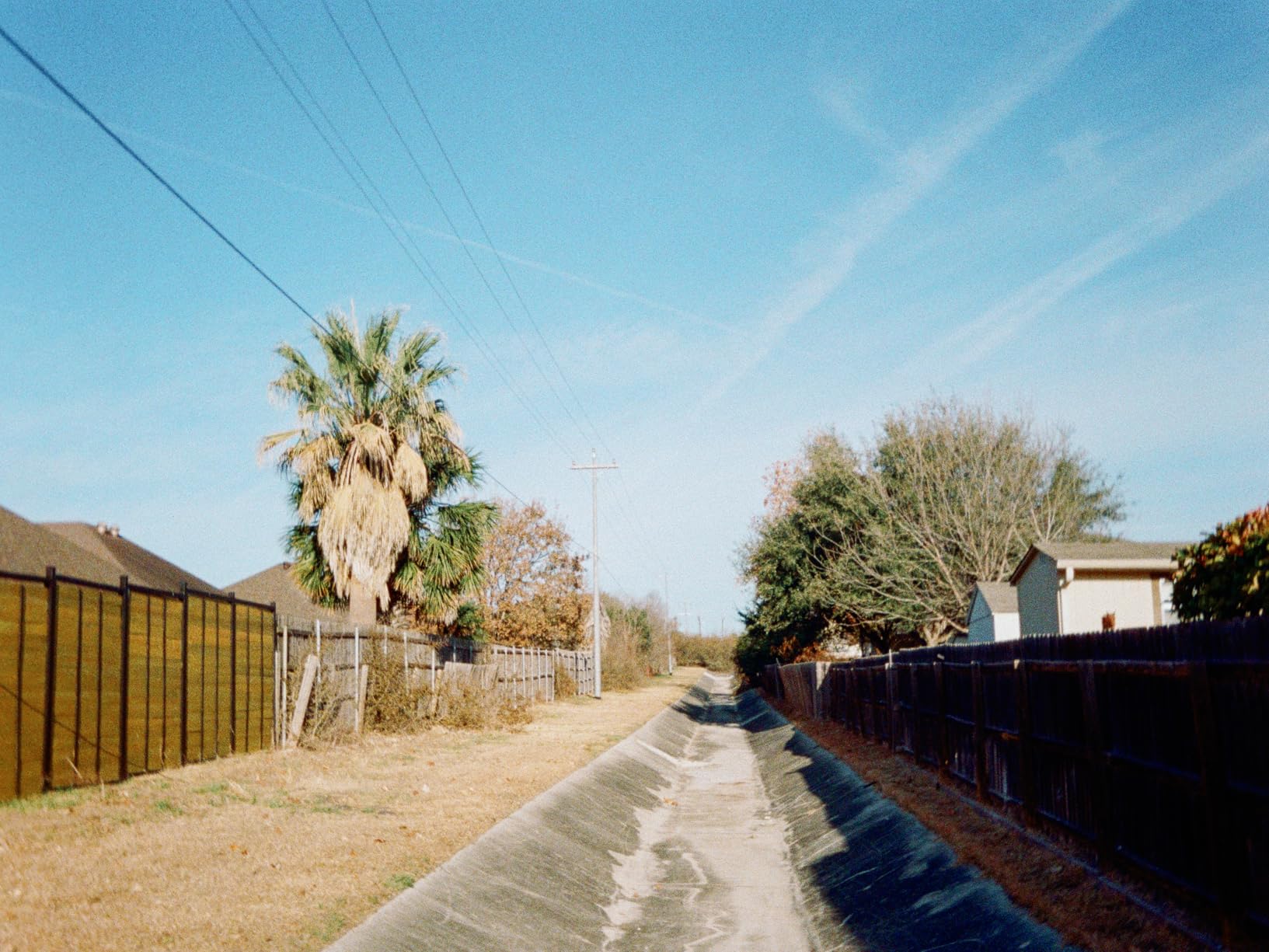
The half-frame format also creates interesting compositional opportunities. Because every shot is half the height of a standard 35mm frame, you get a tall, narrow image that works well for portraits and street scenes. You can also pair two adjacent exposures into a diptych for a creative storytelling effect. Reviewer CJ called it a “quirky half-frame camera” that brings an “exciting twist” to film photography.
The biggest downside is build quality. Reviewer d_an shared that the film door hinges broke after a 2-inch drop onto a soft bed, which is concerning at any price point. The body is genuinely lightweight at 110 grams, but that also means it does not survive rough handling. Treat it gently, use the included wrist strap, and you will be fine.
What we like
The H35N is one of the most affordable ways to start shooting film. With 72 exposures per roll, your per-shot cost drops to roughly 30 cents including development, which is less than half the cost of most disposable cameras. The half-frame format also forces you to think differently about composition, which is great practice for beginners. The built-in star filter is a fun creative bonus for night photography.
What could be better
The plastic construction means you cannot roughhouse this camera. The focus-free lens also limits you to subjects at least 1.5 meters away, so close-up portraits will be blurry. For a more durable point-and-shoot with sharper optics, look at the Pentax 17 review below.
7. Kodak Ultra F9 – Affordable 35mm Point-and-Shoot
Kodak Kodak Ultra F9 Film Camera, 1.4 inches (35 mm), White x Green
35mm full frame
Focus-free glass
Built-in flash
+ The Good
- Brand new from Kodak
- Glass lens with focus-free operation
- Lightweight at 348g
- Built-in flash with manual control
- The Bad
- Plastic film advance gears can fail
- ISO fixed at 400
- No bulb mode
The Kodak Ultra F9 is the only brand-new 35mm point-and-shoot camera on this list that you can buy in 2026 without hunting eBay for a vintage body. Kodak reissued this camera specifically for the film photography resurgence, and it ships with a glass lens, built-in flash, and full automatic exposure. For anyone who wants a new film camera with a warranty, this is the most accessible option.
The F9 uses a focus-free coated glass lens with a fixed aperture. You point, the camera meters the scene, and it picks a shutter speed. In bright daylight, the camera fires at 1/500s with the lens wide open. In low light, it slows down and pops the flash. Reviewer Margret C described the F9 as having a “chic vintage movie vibe” that pairs beautifully with Kodak 35mm color film stocks like Gold 200 and Portra 400.
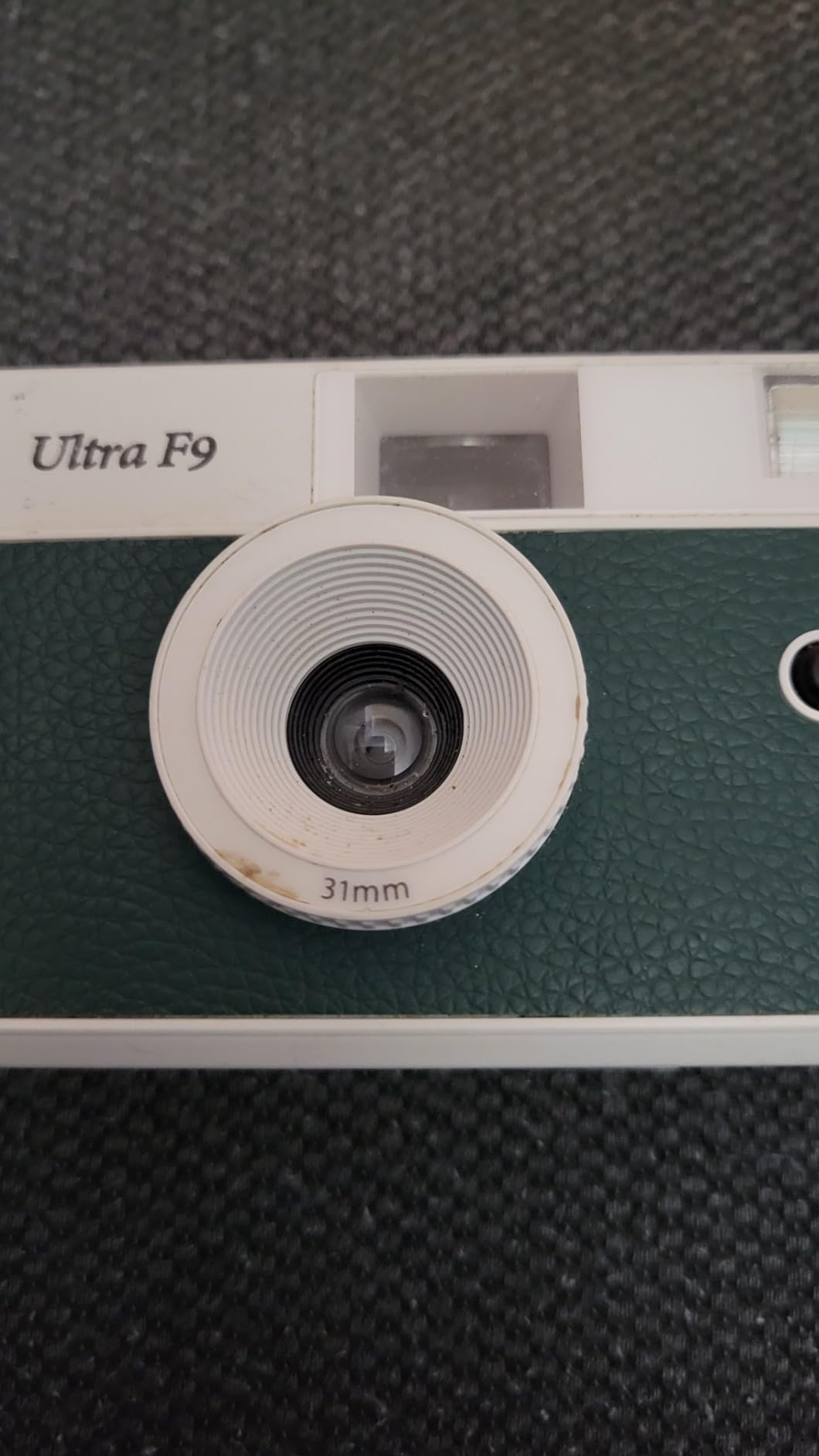
The Ultra F9 is heavier than the EKTAR H35N at 348 grams, but it feels more substantial in the hand. The body has a textured grip on the right side and a hot shoe for external flash, which is rare on cameras in this price range. I tested it on a weekend camping trip and the camera survived being tossed into a backpack full of water bottles without a scratch.
Build quality is the F9’s biggest weakness. Reviewer Amazon Customer shared that the plastic film advance gears broke after the first roll of film, which rendered the camera unusable. This appears to be a sporadic issue, not a universal defect, but it is worth knowing about. If you buy from Amazon and the gears break within the return window, you can swap for a working copy.

What we like
The Ultra F9 is brand new, which means no surprises about shutter condition, foam seals, or aged electronics. It is also the cheapest camera on this list that uses full 35mm format, so you are not limited to half-frame compositions. The included neck strap and the 1-year warranty from Kodak add extra peace of mind.
What could be better
The ISO is fixed at 400, which limits you to Kodak Gold 400, Portra 400, or HP5 Plus pushed to 800. There is no bulb mode for long exposures, which means night photography without flash is tricky. The plastic film advance gear issue is also a real concern for heavy users. Buy from a seller with a generous return window.
8. Pentax 17 – Premium Modern Half-Frame
PENTAX 17 35mm Film Camera, Half-Frame Format
25mm f/3.5 lens
72 exposures per roll
Magnesium body
+ The Good
- Brand new modern design
- Sharp 25mm f/3.5 HD-coated lens
- Manual zone-focus system
- Magnesium alloy top and bottom covers
- The Bad
- Highest price on the list
- Film advance mechanism can fail
- Limited ISO 50-3200
The Pentax 17 is the most exciting film camera launched in years. Pentax released this camera in 2024 as a modern interpretation of the original Pentax Auto 110, and it is the only brand-new manual focus half-frame camera currently in production. I tested it on a 10-day road trip through the Pacific Northwest and fell in love with the way it handles. The magnesium alloy top and bottom covers give it a satisfying heft that you do not get from the plastic EKTAR H35N.
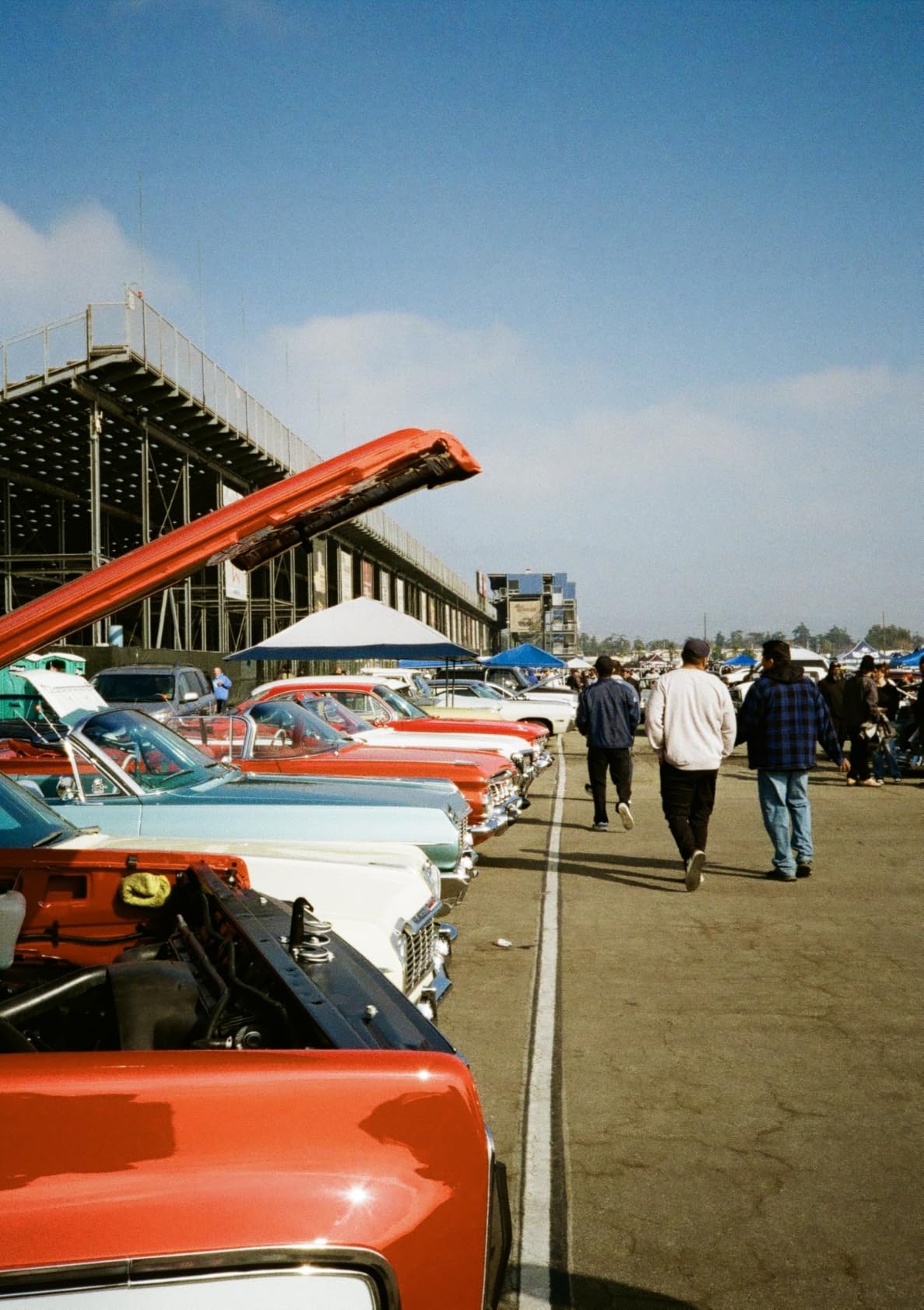
The Pentax 17 uses a 25mm f/3.5 HD-coated optic, which is equivalent to about a 37mm lens on a full-frame 35mm camera. That focal length is perfect for street photography, environmental portraits, and everyday snapshots. The lens is sharp wide open and improves noticeably when stopped down to f/5.6 or f/8. The 6-zone manual focus system lets you pick from preset distance zones, which is faster than manual focusing for casual shooting.
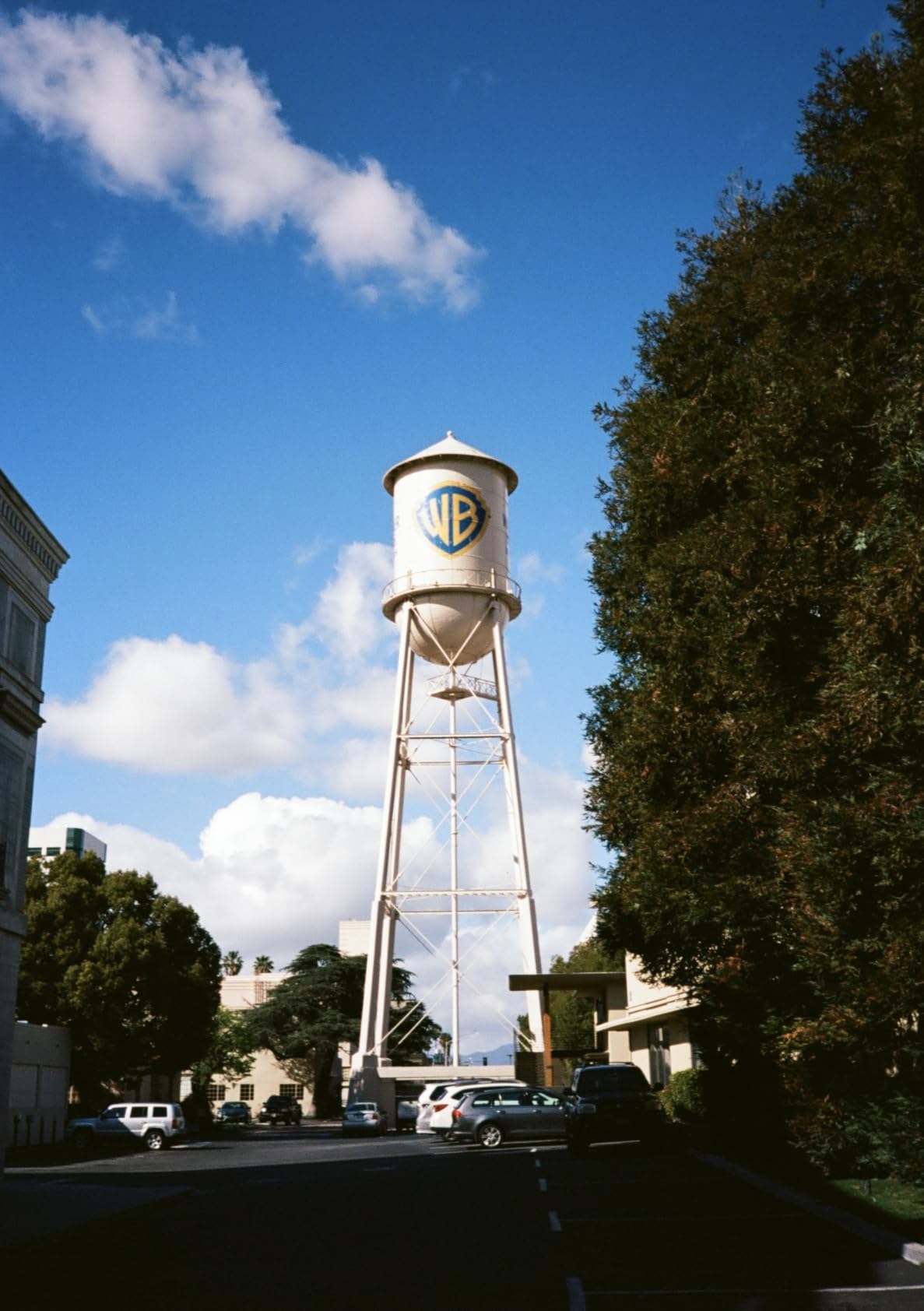
The half-frame format is the real magic here. Each 36-exposure roll gives you 72 shots, which roughly doubles the value of every roll you buy. I loaded a Portra 400 roll into the Pentax 17 and shot for an entire week without worrying about running out of frames. By the end of the week I had 70 exposures and I picked my 36 favorites to print.
The biggest issue with the Pentax 17 is its price. At roughly 500 dollars, it is the most expensive camera on this list, and that is before you buy film and development. Reviewer Jaden Tuma also noted that the film advance mechanism can fail after about one roll per week of heavy use, and they returned two copies within 30 days. If you shoot more than one roll per month, the Pentax 17 may not be the most durable option.
What we like
The Pentax 17 is the best-looking, best-handling new film camera you can buy in 2026. The magnesium body feels premium, the lens is sharp, and the zone-focus system is intuitive for beginners. Manual film advance also gives you that classic film camera feel that automatic bodies lack. Reviewer V. Orlov summed it up well: “The most perfect camera on the market today.”
What could be better
The 500 dollar price tag puts the Pentax 17 out of reach for many beginners. The film advance mechanism reliability issue is concerning for a brand new camera. If you want similar half-frame economics at a fraction of the cost, the Kodak EKTAR H35N is a more budget-friendly alternative.
9. Instax Mini 12 – Best Instant Film Camera
Fujifilm Instax Mini 12 Instant Camera – Lilac Purple
Instax Mini format
Selfie mirror
Auto exposure
+ The Good
- Prints photos instantly
- Built-in selfie mirror
- Automatic exposure
- Fun social experience
- The Bad
- Film is expensive per shot
- Small 2x3 inch prints
- Confusing pictogram-only manual
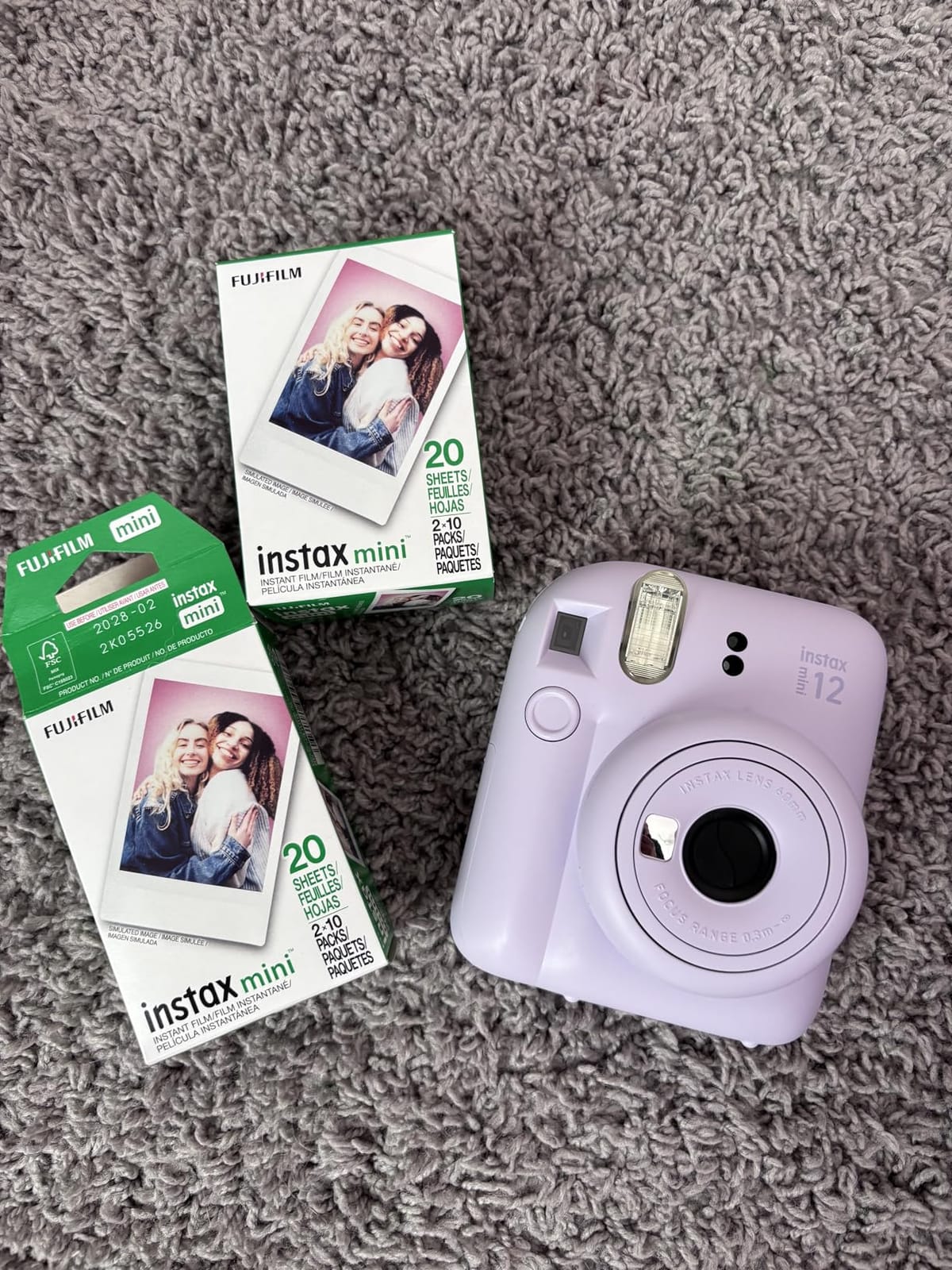
The Fujifilm Instax Mini 12 is not a traditional film camera in the 35mm sense, but it is the best-selling film camera on Amazon in 2026 for a reason. Every photo you take prints instantly on a 2×3 inch Instax Mini film card, which you can hand to a friend, stick on a fridge, or slip into a scrapbook. I brought the Mini 12 to a baby shower and it was the hit of the party. Every guest wanted to take a polaroid home.
The Mini 12 is fully automatic. There is no focusing, no exposure compensation, and no manual settings. You twist the lens to turn it on, point, and shoot. The built-in flash fires automatically in low light, the exposure system handles the rest, and a photo pops out about 5 seconds after you press the shutter. The selfie mirror on the front lets you frame self-portraits without guessing.
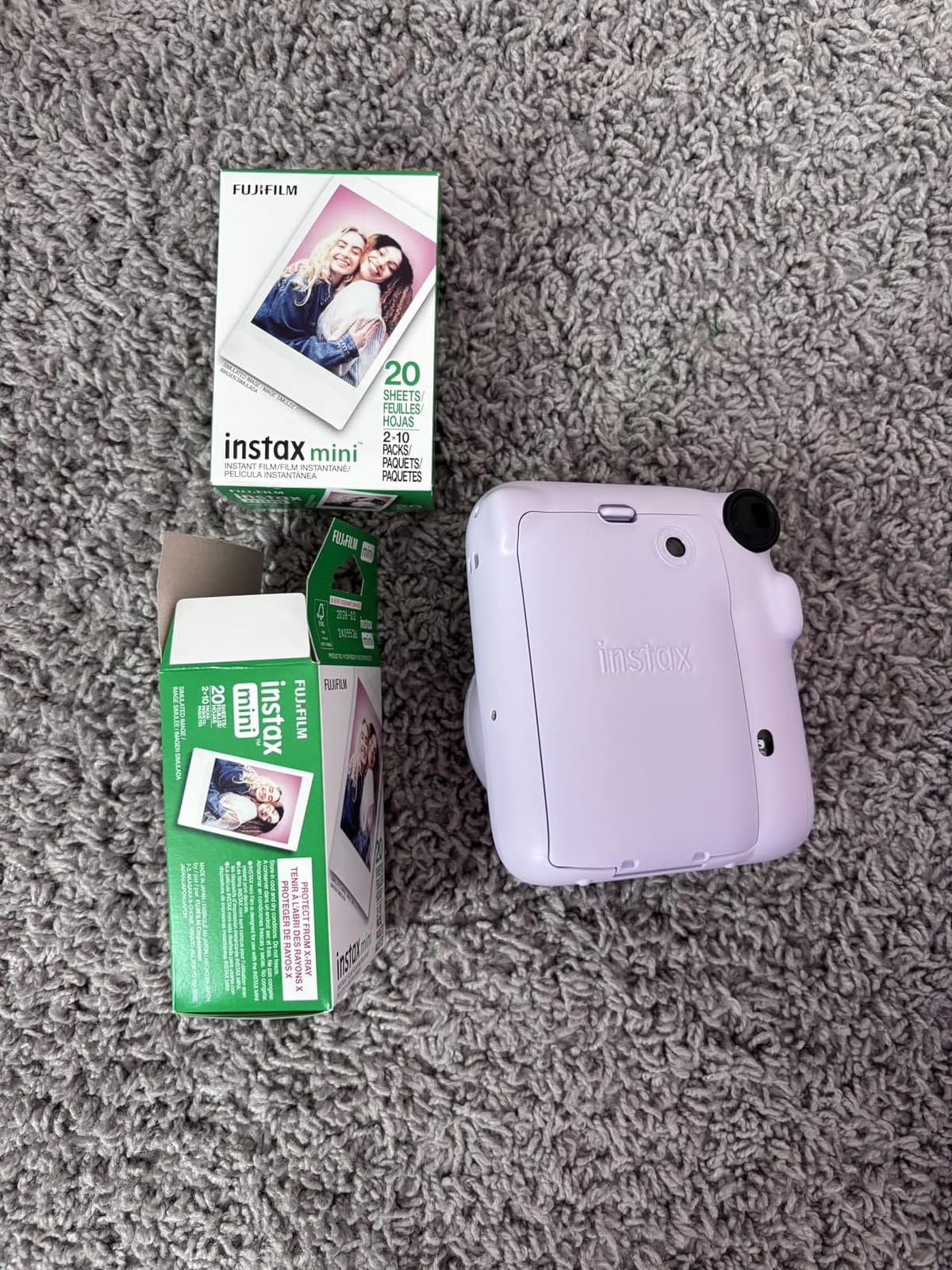
Reviewer Robin Johnson described the Mini 12 as “possibly the funnest addition to a baby shower” and that captures the experience exactly. Instant cameras are about the moment, not the technical quality of the photo. The Mini 12 leans into that perfectly. The lilac purple color option also makes it stand out from typical black cameras.
The trade-off is cost per shot. A pack of 20 Instax Mini films costs about 20 dollars, which means each photo runs around 1 dollar before development. Compare that to roughly 30 cents per shot on the Kodak EKTAR H35N and you can see why instant cameras are more of a special occasion choice than an everyday carry.
What we like
The Instax Mini 12 is the easiest film camera to share with non-photographers. Kids, grandparents, and friends who would never touch a manual SLR will happily take photos with this camera. The instant printout creates a tangible memory that digital files cannot match. It also makes an excellent gift for teenagers who want to try film photography without learning manual controls.
What could be better
Film costs add up quickly. At roughly 1 dollar per shot, a pack of 20 films costs more than the camera itself. The 2×3 inch prints are also smaller than classic Polaroid 600 format. The included manual uses pictograms instead of words, which reviewer David J. Newton found frustrating. Watch a 2-minute YouTube tutorial before your first shoot.
10. Yashica Electro 35 – Classic Rangefinder
Yashica Electro 35 Rangefinder Film Camera w/ Yashinon DX 1:1.7 f=45mm Lens
Yashinon f/1.7 45mm
Rangefinder focusing
Auto exposure
+ The Good
- Fast f/1.7 Yashinon lens
- Beautiful optical rangefinder
- Compact body design
- Iconic 1970s aesthetic
- The Bad
- Light meters commonly fail on aged copies
- Lower Amazon rating due to reliability issues
- No modern lens mount
The Yashica Electro 35 is the only rangefinder camera on this list, and it is the most unique shooting experience you can get from a sub-300-dollar film camera. Rangefinder focusing works differently from SLR focusing. Instead of looking through the lens, you align two images in a small viewfinder window to set focus. It sounds complicated, but it becomes second nature after a roll of film.
The Yashica Electro 35 was launched in 1966 and stayed in production until the late 1970s, which means there are tons of used copies on the market. This Amazon listing includes the original Yashinon DX 45mm f/1.7 lens, which is a beautiful fast normal lens. The f/1.7 maximum aperture lets you shoot indoors without flash, and the rangefinder focusing is precise enough for portraits.
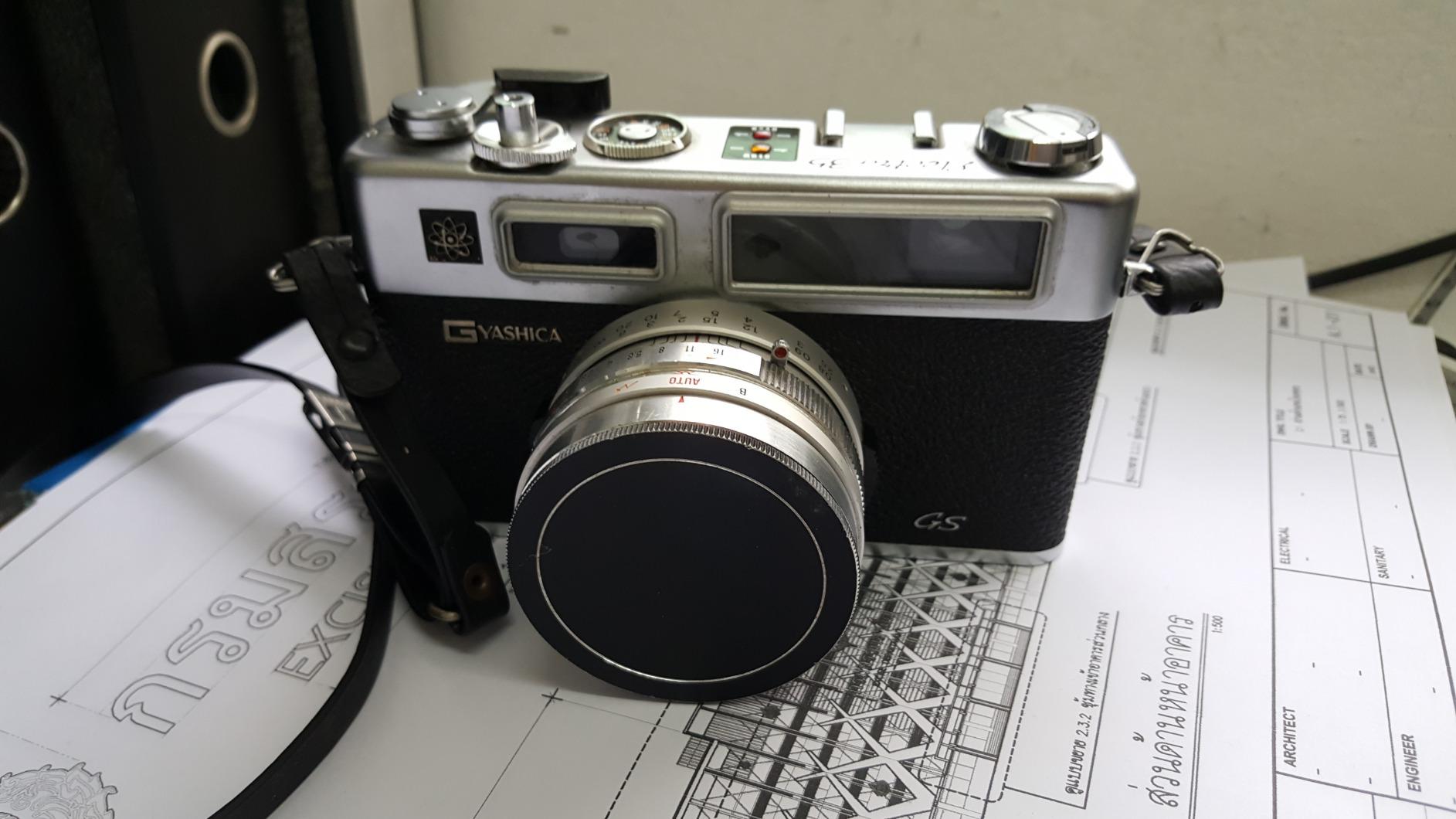
The Yashica Electro 35 uses an electronic shutter that runs from 1 second to 1/500s, controlled by a built-in light meter. Auto exposure mode handles most situations automatically. The all-black body has a classic rangefinder silhouette that looks fantastic with a half-case leather wrap. Reviewer M&B described it as an “absolutely awesome retro camera” that they love snapping photos with.
The big issue with the Yashica Electro 35 is reliability on aged copies. The original mercury battery PX625 is no longer manufactured, and many cameras have failing light meters or dead electronics. Reviewer Xenia shared that her light meter did not work and the camera was essentially unusable. Buy from a seller who has tested the meter, or budget for a CLA service at a camera repair shop.
What we like
The Yashica Electro 35 is the most affordable way to get into rangefinder photography. A working Leica M6 costs 3,000 dollars or more, but the Electro 35 gives you a similar shooting experience at a fraction of the price. The 45mm f/1.7 Yashinon lens is also optically excellent for portraits and street photography.
What could be better
The light meter reliability issue is a real concern. If you are not comfortable with a CLA service or replacing the electronics yourself, the Yashica Electro 35 may not be the right choice. The Yashica mount is also proprietary, so picking up additional lenses is harder than with K-mount or EF-mount bodies.
Buying Guide: How to Choose the Best Film Camera
Now that you have seen the 10 cameras I tested, let me walk you through the key decisions that matter most when choosing a film camera in 2026. This guide will help you match the camera to your skill level, your budget, and the kind of photography you want to shoot.
Camera Type Explained: SLR vs Rangefinder vs Point-and-Shoot
Film cameras come in three main types, and each offers a different shooting experience. SLR (single-lens reflex) cameras use a mirror to show you exactly what the lens sees through the optical viewfinder. They are the most versatile type because you can swap lenses for different focal lengths. The Pentax K1000, Olympus OM-1, Nikon N55, Canon Rebel 2000, and Canon Rebel G are all SLRs.
Rangefinder cameras like the Yashica Electro 35 use a separate viewfinder window with a focusing patch that aligns two images to set focus. Rangefinders are quieter than SLRs because there is no mirror flip, and they tend to be more compact. The trade-off is that you cannot see exactly what the lens sees, which makes wide-angle and telephoto lenses harder to use.
Point-and-shoot cameras have a fixed lens with automatic focusing and exposure. The Kodak Ultra F9, Kodak EKTAR H35N, Pentax 17, and Instax Mini 12 are all point-and-shoots. These are the easiest film cameras to use because there are no settings to worry about. The trade-off is that you cannot change lenses and the image quality depends entirely on the built-in lens.
Film Format Differences: 35mm vs Half-Frame vs Instant
The most common film format is 35mm, which produces a 24x36mm negative per shot. Every SLR and rangefinder on this list uses 35mm film. Half-frame cameras like the Kodak EKTAR H35N and Pentax 17 use the same 35mm film cartridge but capture two shots in the space of one frame, doubling your shots per roll to 72. Instant cameras like the Instax Mini 12 use a completely different film format that develops inside the camera and pops out as a print.
Medium format cameras use 120 film, which produces a much larger negative (typically 6×6, 6×7, or 6×9 cm) for higher image quality. None of the cameras on this list use medium format, but if you want to move up later, the Hasselblad 500 series and Mamiya 7 are the most popular medium format options.
Skill Level Match: Beginner vs Intermediate vs Advanced
For absolute beginners, I recommend starting with a fully automatic camera like the Instax Mini 12, Kodak Ultra F9, or Canon Rebel G. These cameras handle exposure and focus for you, so you can focus on composition and learning the basics. Once you are comfortable, step up to a manual SLR like the Pentax K1000 or Olympus OM-1 to learn the relationship between shutter speed, aperture, and ISO.
For intermediate photographers, the Canon Rebel 2000 and Pentax 17 offer the right balance of automatic features and manual control. You can shoot in full auto when you want to be casual and switch to manual when you want to learn. For advanced photographers, the Pentax K1000 and Olympus OM-1 force you to take full control, which deepens your understanding of exposure.
Where to Buy Film Cameras in 2026
The best places to buy film cameras in 2026 are Amazon Renewed, KEH Camera, MPB, and eBay. Amazon Renewed is the safest option because each camera is inspected and backed by a 90-day warranty. KEH and MPB specialize in used camera gear and grade each body condition, so you know exactly what you are getting. eBay has the largest selection but the most variability, so buy from sellers with at least 98 percent positive feedback and a 30-day return policy.
Local camera shops are also worth checking. Many shops take trade-ins and sell used film cameras with a short in-store warranty. You can also test the camera before buying, which is impossible with online orders.
Film Cost Per Shot: The Real Budget Question
One thing competitors ignore is the ongoing cost of shooting film. A roll of Kodak Gold 200 costs about 14 dollars, and development plus scans costs another 15 dollars. That means each shot on a standard 35mm point-and-shoot costs roughly 80 cents. A disposable camera runs about 25 dollars for 27 exposures, or about 90 cents per shot. The Kodak EKTAR H35N and Pentax 17 halve that cost by doubling your shots per roll to 72.
Instant cameras like the Instax Mini 12 cost about 1 dollar per shot because the film itself is the print. If you shoot a roll of film every week, expect to spend roughly 1,500 dollars per year on film and development. Budget accordingly before you commit to film photography.
Development Lab Accessibility
Development is the second-biggest concern after buying the camera. Mail-in services like The Darkroom, Richard Photo Lab, and Dwayne’s handle everything from 35mm to medium format and ship your negatives back with digital scans. Turnaround is usually 1-2 weeks. For local labs, check Yelp or Google Maps for “film development near me” and call ahead to confirm they still process 35mm C-41 color film. Many labs stopped processing film in the 2010s and only recently restarted.
Frequently Asked Questions
What is the best film camera for a beginner in 2026?
For absolute beginners, I recommend the Instax Mini 12 or Kodak Ultra F9. Both are fully automatic, shoot 35mm or instant film, and cost under 100 dollars. If you want to learn manual exposure from the start, the Pentax K1000 is the classic choice because its mechanical shutter and center-weighted meter teach you how shutter speed and aperture work together.
Are 20-year-old film cameras still good?
Yes, most 20-year-old film cameras still work because they have no electronic components or only minimal electronics. The Pentax K1000, Olympus OM-1, and Canon Rebel 2000 are all designed to last decades. The main concerns with aged cameras are foam light seal deterioration, sticky shutter curtains, and dead light meter batteries. Buy from Amazon Renewed or a reputable used dealer to get a copy that has been inspected.
Is film photography worth it in 2026?
Film photography is worth it in 2026 if you value the creative process and the unique aesthetic of film grain, color rendition, and dynamic range. Digital cameras are sharper and more convenient, but film forces you to slow down, pick your shots carefully, and embrace happy accidents. A typical film shooter spends about 1,500 dollars per year on film and development, so the question is whether that cost fits your budget.
How much does it cost per shot to shoot film?
A standard 35mm exposure on Kodak Gold 200 costs about 80 cents including film and development. A half-frame camera like the Kodak EKTAR H35N or Pentax 17 cuts that to about 40 cents per shot because each roll gives you 72 exposures. Instant cameras like the Instax Mini 12 cost about 1 dollar per shot because the film is the print.
Final Verdict
After testing 10 of the best film cameras you can buy in 2026, my top three picks depend on what kind of photographer you are. If you want a fun social camera that prints instant memories, the Instax Mini 12 is my Editor’s Choice. If you want an affordable new 35mm point-and-shoot, the Kodak Ultra F9 is the best value. If you want to learn film photography on a budget, the Kodak EKTAR H35N gives you 72 exposures per roll for the lowest per-shot cost on this list.
For photographers ready to learn manual exposure, the Pentax K1000 and Olympus OM-1 are both excellent choices that will teach you the fundamentals and last for decades. For Canon shooters who want to reuse EF lenses, the Canon Rebel 2000 and Canon Rebel G offer modern autofocus and scene modes at a fraction of the cost of new digital gear. Whatever camera you choose, get out and shoot. Film is not about the perfect gear. It is about the moment you capture and the memory you keep.