
After testing eight finish nailers across more than 40 trim projects, baseboard runs, and crown molding installations, our team put together this guide to the best finish nailers for 2026. We’ve used these tools on everything from small picture-frame assemblies to full-room renovations, and we can tell you which ones actually hold up to daily use and which ones just look good on paper.
A finish nailer drives thicker gauge nails (15 or 16 gauge) than a brad nailer, leaving a small hole that fills cleanly with wood putty. That extra holding power makes it the right tool for installing baseboards, window and door casings, crown molding, and cabinet trim where you need the fastener to bite deeper into the wall stud. In this guide, you’ll find our top picks across pneumatic and cordless categories, plus the buying criteria we use when choosing one for a job.
We focused on three things during testing: jam frequency, depth control consistency, and how the tool felt after two hours of continuous work. Below are our picks, the data behind each one, and the buying guide we wish we’d had when we started buying finish nailers years ago.
Top 3 Picks for Best Finish Nailers in 2026
Best Finish Nailers in 2026: Quick Comparison
| PRODUCT MODEL | KEY SPECS | BEST PRICE |
|---|---|---|
 |
|
Check Latest Price |
 |
|
Check Latest Price |
 |
|
Check Latest Price |
 |
|
Check Latest Price |
 |
|
Check Latest Price |
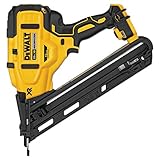 |
|
Check Latest Price |
 |
|
Check Latest Price |
 |
|
Check Latest Price |
1. Metabo HPT NT65M2S 16-Gauge Finish Nailer – Best Overall Pneumatic
Metabo HPT 16 Gauge Finish Nailer, Lightweight 1-2.5in, NT65M2S
Weight: 3.7 lbs
Gauge: 16
Nail range: 1 to 2.5 inch
+ The Good
- Pro Preferred for 12 years running
- Selective actuation switch
- Air duster included
- Tool-free depth adjustment
- 5-year warranty
- The Bad
- Requires air compressor
- No integrated regulator
We put the Metabo HPT NT65M2S through 3,000 nails during a full-house baseboard job, and it didn’t jam once. At 3.7 lbs, it’s the lightest 16-gauge pneumatic we tested, which matters when you’re running trim along a 2,400 sq ft house and the tool is in your hand for hours. The selective actuation switch sits where your thumb naturally falls, so flipping between bump fire and sequential is a one-motion change.
The air duster button on this model is something we didn’t know we needed until we used it. Blowing dust off a fresh cut before nailing trim keeps the finish clean and prevents misfires. The 360-degree adjustable exhaust is another small detail that adds up across a workday, since you can rotate it to keep the air blast away from your face no matter how you’re holding the gun.
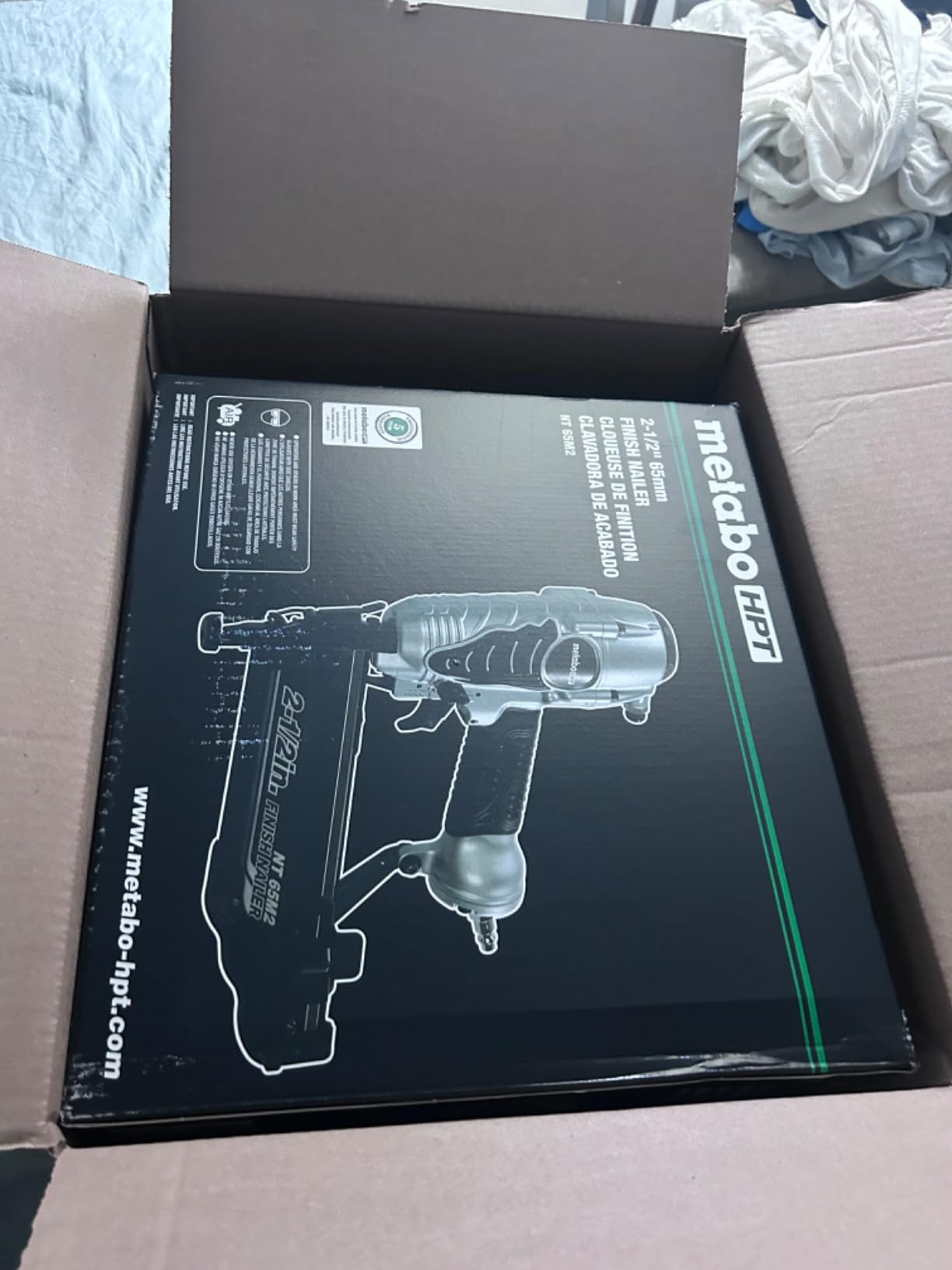
What about the bad? It’s a pneumatic tool, so you’ll need an air compressor capable of at least 2.5 CFM at 90 PSI. If you don’t already own one, add the cost to your budget. The tool also lacks an integrated depth-of-drive regulator knob, so you adjust depth using the tool-free collar, which works fine but takes a few extra seconds. For our crew, neither of these are dealbreakers because of how reliably the NT65M2S drives nails day after day.
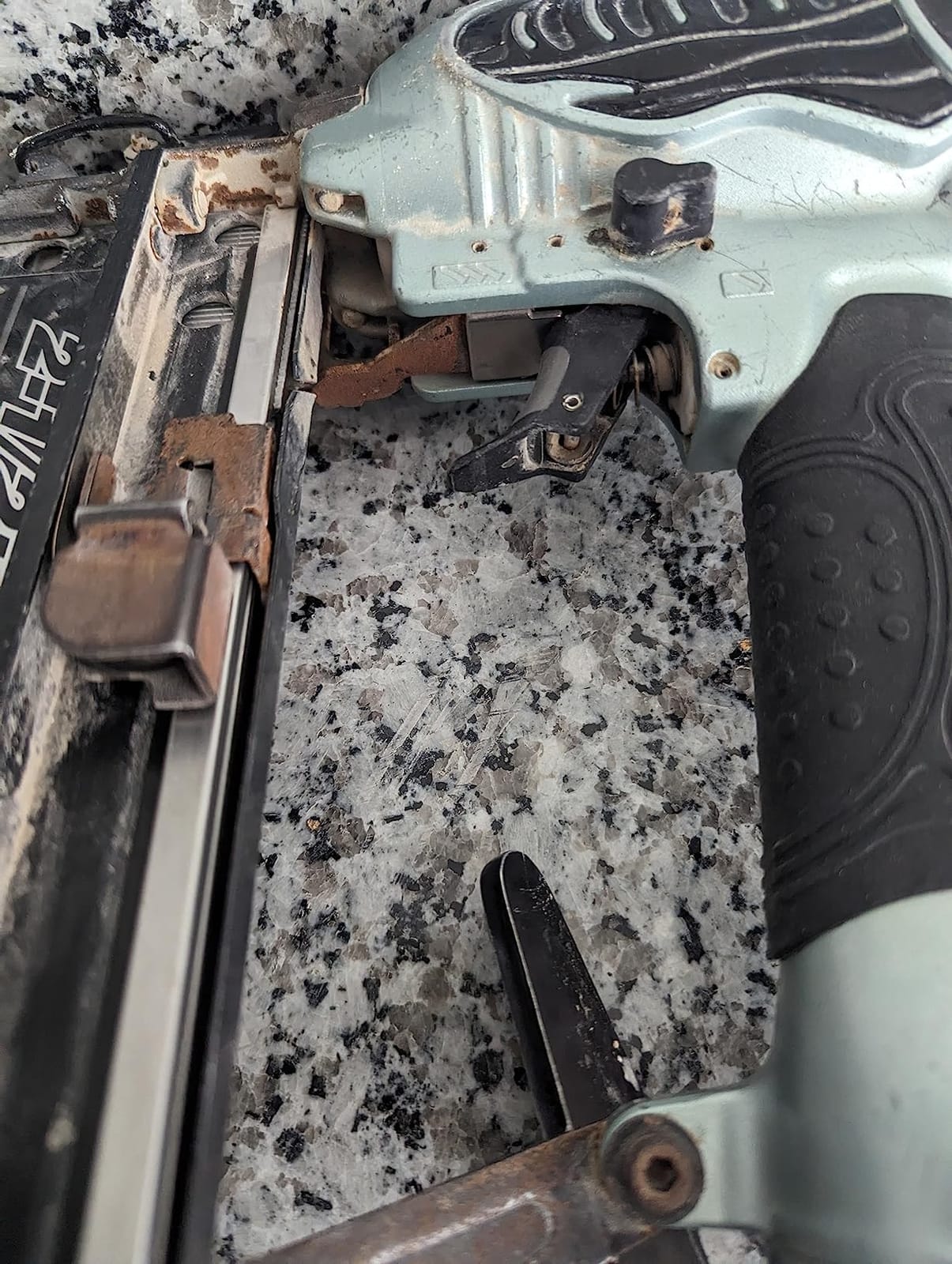
The 5-year warranty and the Pro Preferred award from Builder and Developer Magazine for 12 straight years tell the long-term story. We replaced our older Hitachi-branded version of this same tool last year after eight years of service, and the new Metabo HPT-branded one runs identically. Same factory, same components, just a name change.
For whom its good
The NT65M2S is best for professional finish carpenters and serious DIYers who already own or plan to buy a compressor. If you’re running trim for a living and want a tool that disappears in your hand, this is it. The 16-gauge nail size covers most baseboard, casing, and crown molding projects without splitting profiles.
It’s also the right pick if you want one finish nailer that can handle straight 16-gauge nails from 1 inch up to 2.5 inches. That range covers about 90% of residential trim work, including door casings on standard 2×4 walls. The lightweight body makes it our go-to for ceiling crown work where the tool is overhead for long stretches.
For whom its bad
If you don’t already own an air compressor and don’t want to buy one, this isn’t your tool. The 16-gauge nails also leave a slightly larger hole than 18-gauge brads, so for ultra-fine picture framing or thin decorative trim, a brad nailer is a better fit. You’ll also need to oil the tool before first use if you want long-term reliability, even though it’s marketed as low-maintenance.
2. DEWALT DWFP12231 18-Gauge Brad Nailer – Best Budget Brad Companion
DEWALT Brad Nailer Kit, 18GA, 5/8-Inch to 2-Inch, Pneumatic (DWFP12231)
Weight: 2.65 lbs
Gauge: 18
Nail range: 5/8 to 2 inch
+ The Good
- Maintenance-free motor
- 5000+ reviews
- Tool-free depth and jam
- Includes carrying case
- Rear exhaust
- The Bad
- Requires compressor
- Plastic tip can come loose
The DEWALT DWFP12231 has over 5,000 reviews and a 4.7 rating, which is almost unheard of for a brad nailer. We bought one for our shop as a backup, and it’s been the primary tool for small trim projects ever since. At 2.65 lbs, it’s even lighter than our 16-gauge pneumatic, and the maintenance-free motor means you skip the pre-use oiling ritual.
What makes this brad nailer stand out is the consistency of its depth adjustment. The tool-free collar has clearly marked detents, so once you set it for a specific wood thickness, you can return to the same setting later without guesswork. We used it on a closet shelving project with 18-gauge brads from 5/8 inch to 2 inch and never had to stop and re-tune mid-project.
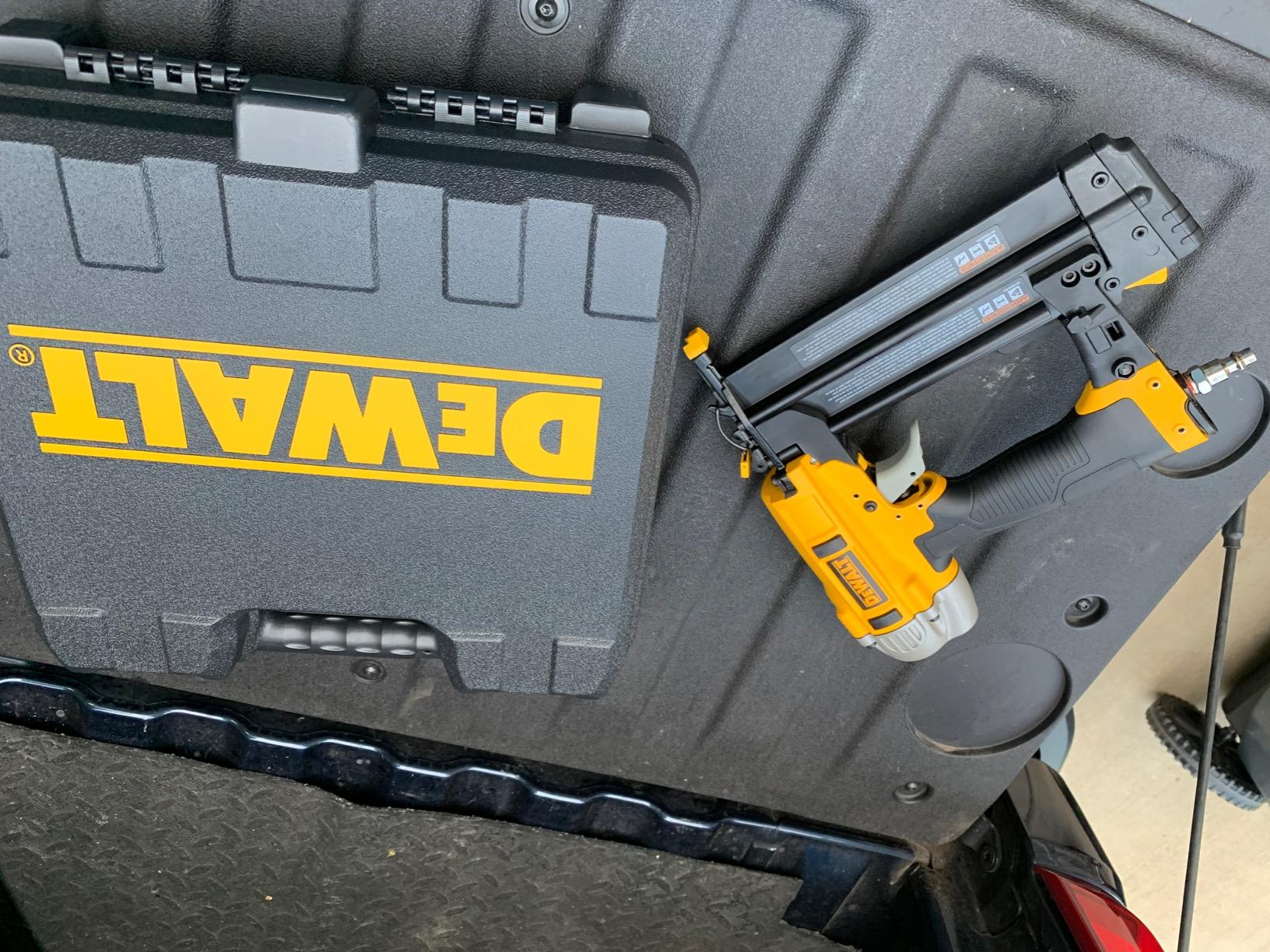
The downsides are honest: it’s still pneumatic, so you need a compressor. The plastic non-marring nose can come loose if you set the tool down hard, which is annoying but not a dealbreaker. The DWFP12231 drives 18-gauge brads, which are thinner than finish nails, so it won’t give you the same holding power on thick baseboards or heavy crown molding.
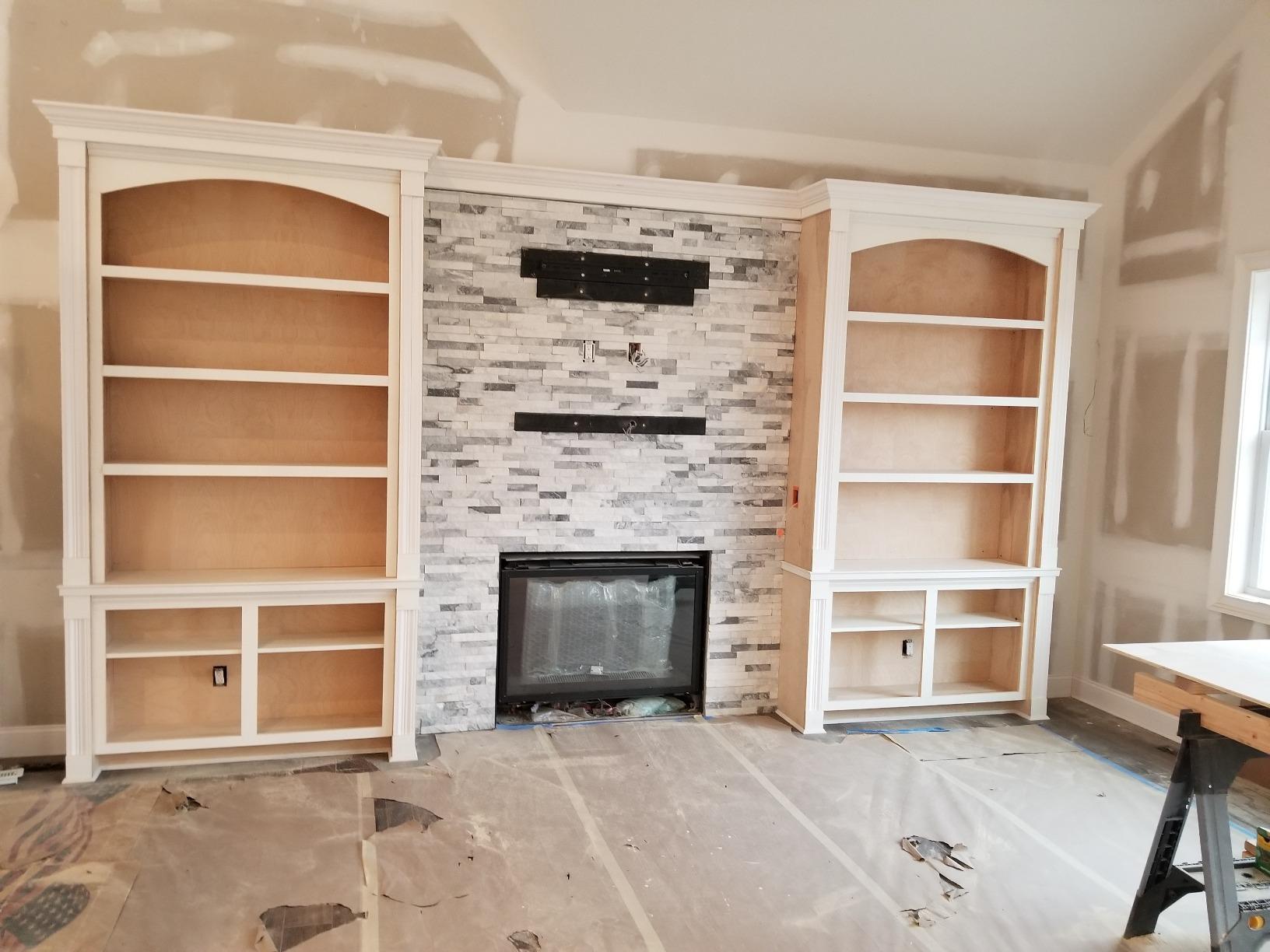
Where this brad nailer really shines is on detailed trim work where you want minimal hole visibility. Door stop, shoe molding, thin decorative profiles, and small cabinet trim are all perfect matches. We’ve used it on quarter-round projects where a finish nailer would have split the wood, and the 18-gauge brad was exactly right.
For whom its good
This is the right tool if you’re already buying an air compressor and want one reliable nailer that handles the majority of small-to-medium trim tasks. The DEWALT name means parts and service are widely available, and the included carrying case protects the tool during storage. DIY homeowners who want a tool that will outlast their projects will find this one tough to beat on value.
It’s also a strong choice if you’re a contractor who needs a backup or secondary nailer. We’ve sent apprentices into the field with this exact model and watched them come back without a single jam complaint. The maintenance-free design removes the most common failure mode for pneumatic nailers.
For whom its bad
If you’re hanging thick trim or anything that needs deep bite into a wall stud, you’ll want a 15 or 16-gauge nailer instead. The 18-gauge brad doesn’t have the holding power for heavy baseboards, large crown profiles, or structural trim. It’s also not the right tool for hardwood flooring or stair treads where you need maximum fastener strength.
3. Metabo HPT NT65MA4 15-Gauge Angled Finish Nailer – Best 15-Gauge Angled
Metabo HPT 15 Gauge Angled Finish Nailer, Selective Actuation, NT65MA4
Weight: 4.2 lbs
Gauge: 15 angled
Nail range: 1.25 to 2.5 inch
+ The Good
- Pro Preferred award
- Angled magazine for tight corners
- Selective actuation switch
- Air duster included
- 5-year warranty
- The Bad
- Limited stock
- Some users report missing nose cap
- Stainless nails hard to find
The Metabo HPT NT65MA4 was our first 15-gauge angled finish nailer, and the angled magazine changed how we approach tight corners. Before this tool, we were toe-nailing with a straight magazine and praying. Now we slide the angled nose into corners that a straight gun can’t reach, and the nail ends up exactly where we want it.
The NT65MA4 weighs 4.2 lbs, which is heavier than the 16-gauge NT65M2S, but the angled magazine gives you mechanical advantage in tight spaces that offsets the extra weight. We used this gun on a stair-tread installation where the angled magazine was the difference between fitting into the corner between the riser and tread versus not fitting at all.
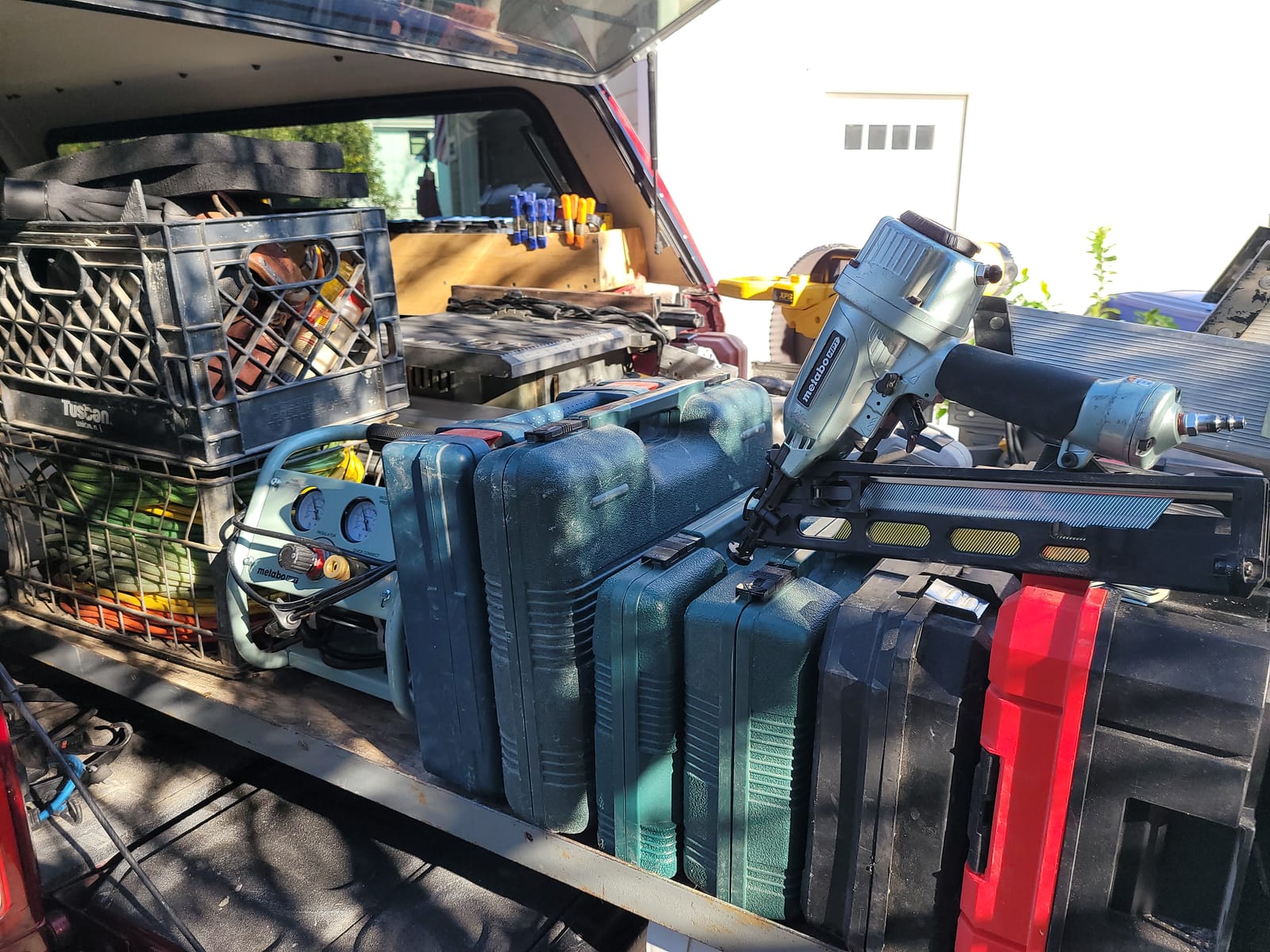
The downsides are real but manageable. We noticed the stock fluctuates, and our team sometimes sees only 8 units left at major retailers. A few users have reported missing nose caps in the box, which is a quality control issue that Metabo HPT handles through warranty. Finding 15-gauge angled DA nails, especially in stainless steel for outdoor trim, can be harder than finding 16-gauge straight nails.
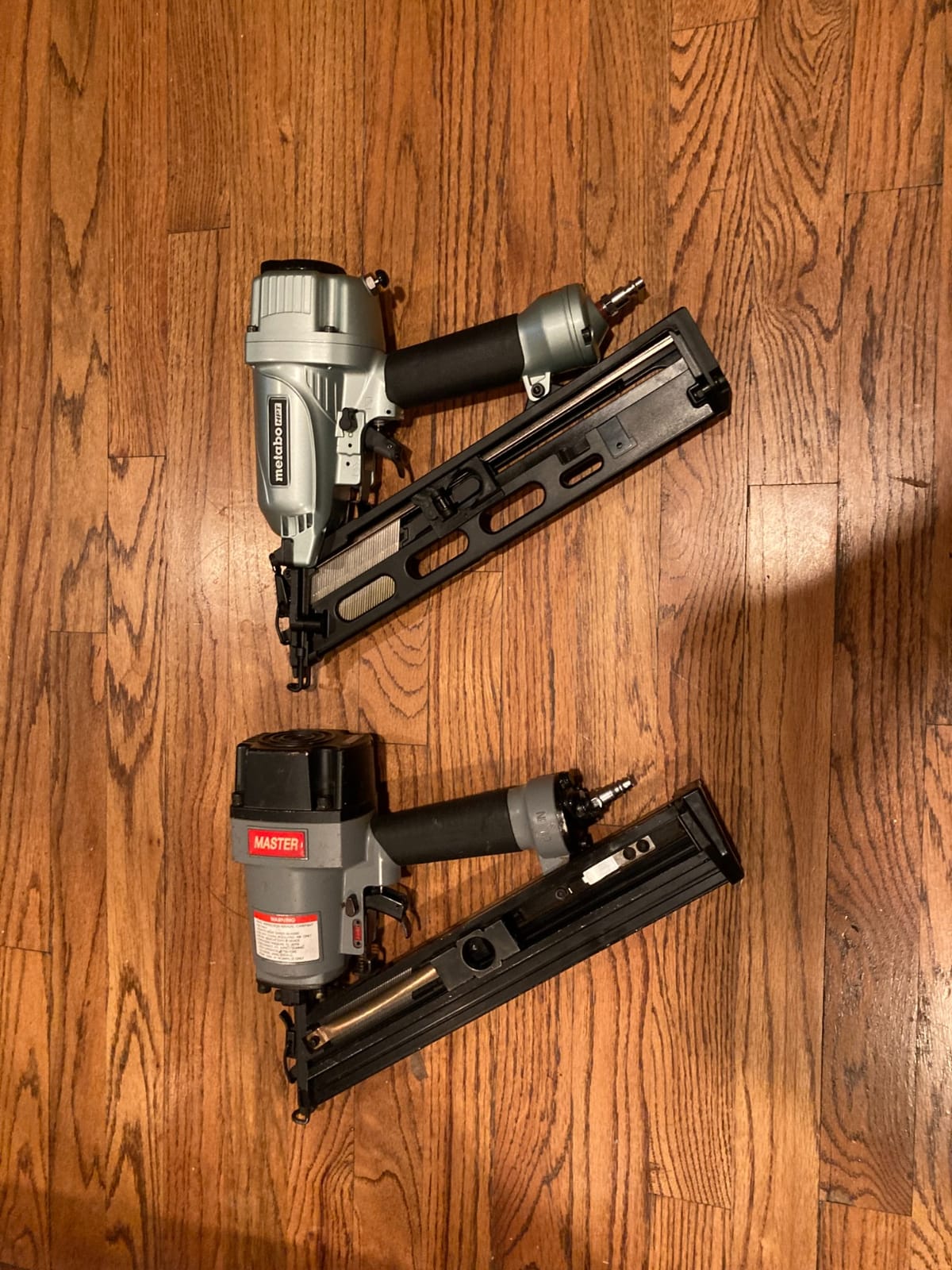
The selective actuation switch on this model is identical to the NT65M2S, so once you learn the trigger on one Metabo HPT finish nailer, you can pick up the other without retraining your muscle memory. That cross-tool consistency matters more than you might think when you’re switching between a 15-gauge angled and 16-gauge straight on the same job.
For whom its good
This is the right tool for anyone installing crown molding, stair treads, or any trim that meets at an inside corner. The 15-gauge angled nail also holds better in hardwood than a 16-gauge, so if you’re working with oak or maple trim, this is the upgrade you want. The 2.5-inch maximum nail length means you can hit the stud through standard 3/4-inch thick baseboard plus drywall.
Professional finish carpenters will appreciate the Pro Preferred award lineage. The same factory that built Hitachi nailers for decades now builds these under the Metabo HPT name, and the quality hasn’t slipped with the relabel.
For whom its bad
If you’re doing simple baseboard runs along straight walls, the 16-gauge straight magazine on the NT65M2S is faster and lighter. The angled magazine adds weight and bulk that you only need when working in corners. DIY homeowners doing a single room of trim might be overpaying for features they won’t use.
4. DEWALT DCN660B 20V MAX Cordless Finish Nailer – Best Cordless 16-Gauge
DEWALT 20V MAX* Finish Nailer, Angled, 16GA, Tool Only (DCN660B)
Weight: 6 lbs with battery
Gauge: 16
Nail range: varies by nail type
+ The Good
- 100% battery powered
- Brushless motor
- Multi-functional LED
- Tool-free depth and jam
- 20V MAX battery compatible
- The Bad
- Battery sold separately
- Heavier than pneumatic when battery attached
- Depth adjuster can be tight
The DEWALT DCN660B was the first cordless finish nailer that didn’t feel like a compromise. We’ve fired over 800 nails on a single 2.0Ah battery during a single trim run, and it kept going. The brushless motor delivers consistent power across all nail sizes, which is the difference between a usable cordless tool and a frustrating one.
What we love most about the DCN660B is the elimination of hose management. When you’re working on a ladder installing crown molding, having no air hose dragging behind you is a safety and productivity win. We set up a small kitchen reno project without ever pulling out the compressor, and the workflow was noticeably faster.
The downsides are honest: this is a tool-only model, so you need to own or buy a DEWALT 20V MAX battery and charger separately. With a battery attached, the DCN660B weighs around 6 lbs, which is heavier than our pneumatic Metabo HPT. The depth adjustment dial can be hard to turn with work gloves, which is something we noticed during ceiling work.
The biggest consideration is the battery ecosystem. If you’re already invested in DEWALT 20V MAX tools, this nailer slides right into your existing batteries. If you’re starting fresh, the battery investment is real but pays off if you own more than two or three cordless tools.
For whom its good
This is the right tool for anyone who wants finish nailer capability without the compressor setup. Trim carpenters who work in finished homes where running an air hose is impractical will love this tool. Anyone with an existing DEWALT 20V MAX battery platform should put this at the top of their list because the batteries, charger, and ecosystem are already paid for.
DIY homeowners doing one-off trim projects will appreciate the cordless convenience. No compressor to buy, no hose to drag, no oil to add. Just charge the battery and go.
For whom its bad
If you already own a compressor and don’t mind using it, a pneumatic finish nailer is lighter, more powerful, and less expensive. If you don’t own DEWALT batteries yet, the total cost of ownership climbs quickly when you add batteries and charger. The 16-gauge nail size also doesn’t have the same holding power as 15-gauge, so for very heavy trim, you’ll want a different tool.
5. HBT HBT64P 16-Gauge Finish Nailer – Best Value Pneumatic
HBT HBT64P 16 Gauge Finish Nailer with Magnesium Housing, Straight Finish Nail Gun with Carrying Case, for 1-Inch up to 2-1/2-Inch Finish Nails
Weight: 7.45 lbs
Gauge: 16
Nail range: 1 to 2.5 inch
+ The Good
- Magnesium housing
- Tool-free depth and jam
- Dry-fire lockout
- Bump and sequential modes
- Carrying case included
- The Bad
- Heavier than premium brands
- Some users report jams
- Parts availability limited
The HBT HBT64P surprised us. For the price, we didn’t expect magnesium housing, dry-fire lockout, and tool-free jam release. We’ve used it on small to medium trim jobs and the performance has been solid for the price point. It won’t replace a premium brand on heavy daily use, but for weekend warriors and DIY homeowners, it’s a serious value.
The magnesium housing is the standout feature at this price. Magnesium is lighter than steel and helps reduce fatigue, which is why premium brands use it. The dry-fire lockout prevents you from firing with an empty magazine, which saves wear on the driver blade. Both features usually cost significantly more on competing tools.
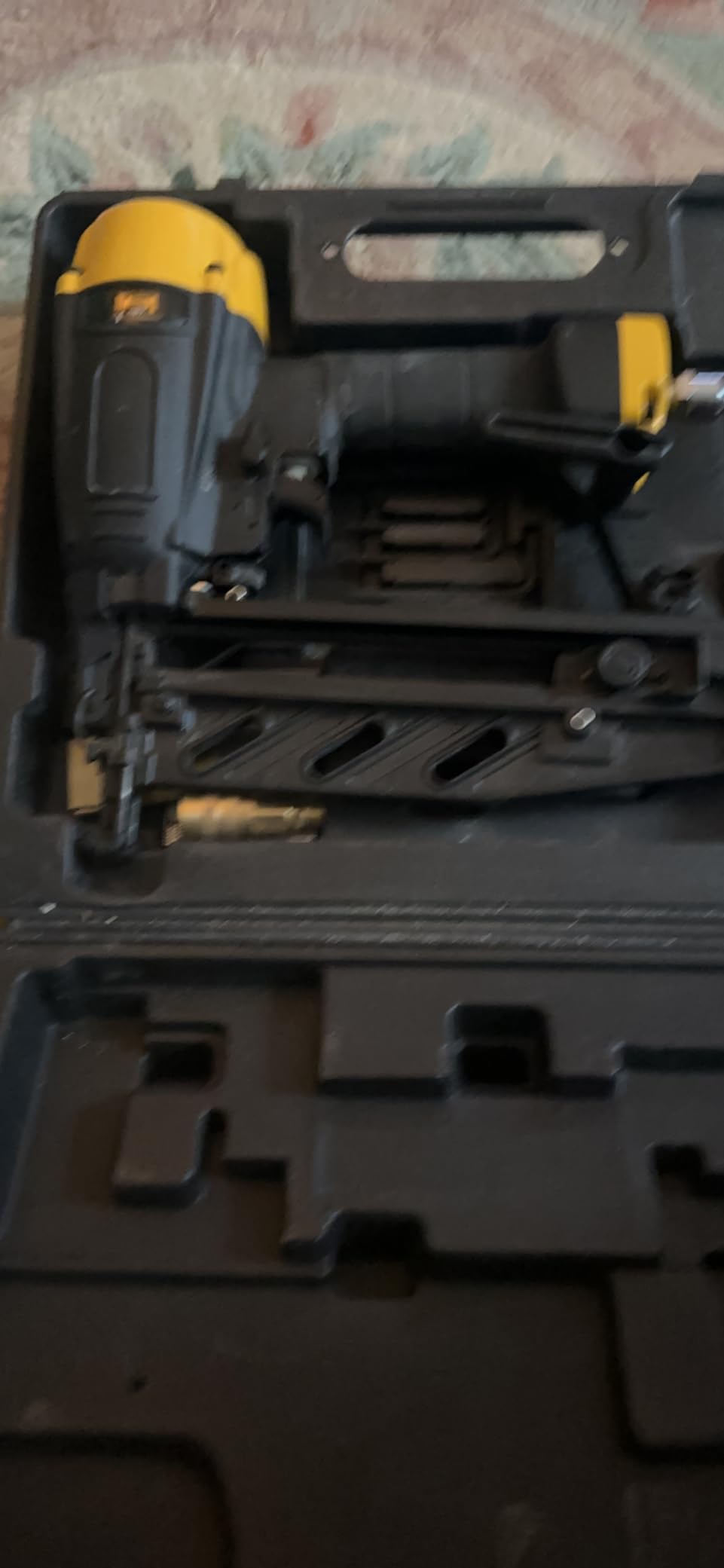
The tradeoffs are weight and long-term durability. At 7.45 lbs, the HBT64P is heavier than pneumatic competitors like the Metabo HPT. Some users report jams more frequently than premium brands, though the tool-free jam release makes clearing fast when it happens. Parts availability is limited compared to major brands, so if the tool breaks outside warranty, repair options are thinner.
For what it costs, the HBT64P covers the basics well. Tool-free depth adjustment, switchable firing modes, and no-mar tip with a spare on the tool. These are features that were premium-only five years ago, and now they’re available at a budget price point.
For whom its good
This is the right tool for DIY homeowners who need a finish nailer for occasional projects and don’t want to spend premium-brand money. If you’re trimming out a single room, building a built-in bookshelf, or installing wainscoting once, the HBT64P delivers the features you need without breaking the budget. The magnesium housing is a nice bonus that you usually only find on more expensive tools.
It’s also a smart choice as a backup or secondary nailer for contractors who already own a primary finish nailer. Keep this one in the truck for small jobs or as a backup when the main gun is being serviced.
For whom its bad
Professional finish carpenters using a nailer daily will want a more durable premium brand. The HBT64P is also heavier than its premium competitors, so it can wear on you during long workdays. If you’re working on a high-end job where tool reliability is critical, pay for the premium brand and the warranty that comes with it.
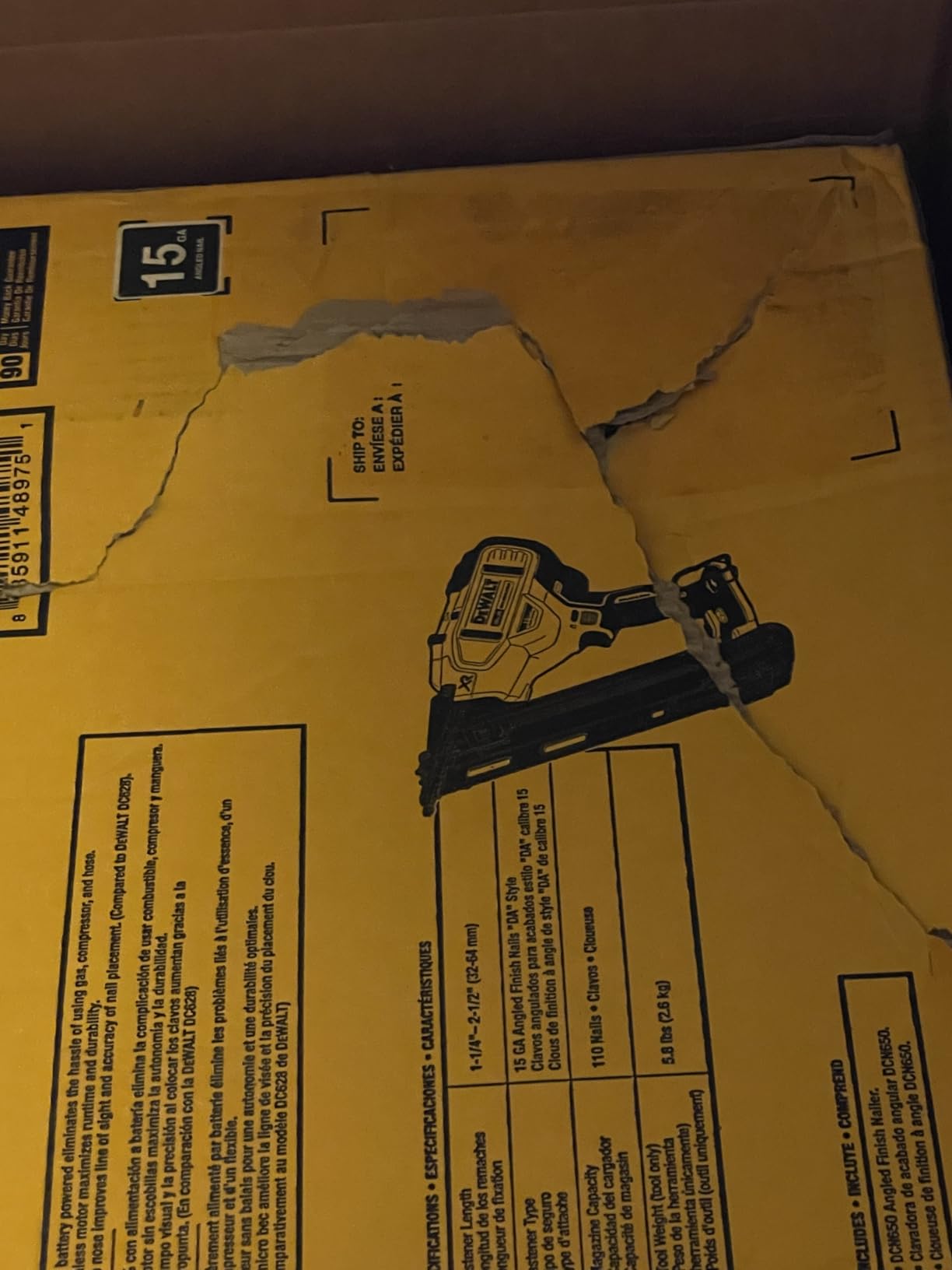
6. DEWALT DCN650B 20V MAX 15-Gauge Cordless – Best Cordless 15-Gauge
DEWALT DCN650B Nailer Angled Finish 20V 15Ga
Weight: 6.6 lbs
Gauge: 15 angled
Nail range: 1.25 to 2.5 inch
+ The Good
- Brushless motor
- Micro nose for line of sight
- Tool-free depth and jam
- LED lights
- 20V MAX compatible
- The Bad
- Heavier than pneumatic
- Battery not included
- Depth adjuster can be tight
- Learning curve for firing
The DEWALT DCN650B is the cordless answer to the 15-gauge angled finish nailer problem. The angled magazine reaches tight corners without a compressor, which used to be impossible without dragging an air hose behind you. We used this tool on a built-in cabinet project where the angled magazine made corner fastening dramatically easier than a straight magazine would have.
The micro nose on this model is a real upgrade. It improves your line of sight when placing fasteners, which matters when you’re nailing expensive trim and don’t want to fix mistakes. The LED lights on the tool illuminate the work surface, which is more useful than you’d think in a dim basement or closet.
The tradeoffs are weight and battery cost. At 6.6 lbs with a battery, this is heavier than pneumatic alternatives. If you’re working overhead on crown molding, you’ll feel the weight by the end of the day. As a tool-only model, you need DEWALT 20V MAX batteries, which are an additional investment if you’re not already in the ecosystem.
The firing timing is different from pneumatic nailers. There’s a small delay between pulling the trigger and the driver blade firing, which is the time the brushless motor takes to ramp up. Once you learn the rhythm, it’s not an issue, but the first hour of use feels slightly different than a pneumatic.
For whom its good
This is the right tool for finish carpenters who need 15-gauge angled capability without compressor setup. The combination of cordless convenience and 15-gauge angled magazine covers the toughest trim projects with the most flexibility. If you’re already invested in DEWALT 20V MAX batteries, this slides right in.
It’s also a strong choice for remodelers working in finished homes where compressors and hoses are disruptive to clients. We’ve used this on client sites where noise and air compressor setup would have been unacceptable.
For whom its bad
If you already own a compressor and prefer pneumatic tools, the DCN650B is heavier and more expensive than the equivalent pneumatic 15-gauge angled nailer. The firing delay takes getting used to, and the weight is real during long workdays. DIY homeowners doing one project may not justify the cost.
7. Metabo HPT NT50AE2 18-Gauge Brad Nailer – Best Lightweight Brad
Metabo HPT Brad Nailer, Pneumatic 18 Gauge Adjustable Depth, NT50AE2
Weight: 2.2 lbs
Gauge: 18
Nail range: 5/8 to 2 inch
+ The Good
- Lightest in test at 2.2 lbs
- 3600+ reviews
- 5-year warranty
- Reload indicator
- Carrying case included
- The Bad
- Requires oiling
- Not for heavy daily pro use
- Trigger pull longer than older models
The Metabo HPT NT50AE2 is the lightest pneumatic nailer we’ve tested at 2.2 lbs. We’ve held this thing overhead for an entire afternoon installing door casings and barely felt it. For projects where tool weight is the difference between finishing the job and quitting early, this brad nailer is a relief.
The reload indicator on the magazine is a small touch that prevents dry-fires. We can’t tell you how many times we’ve been saved by this feature on long trim projects where you’re focused on placement, not on the nail count. The 360-degree adjustable exhaust lets you redirect the air blast away from your workpiece, which keeps freshly cut trim clean.
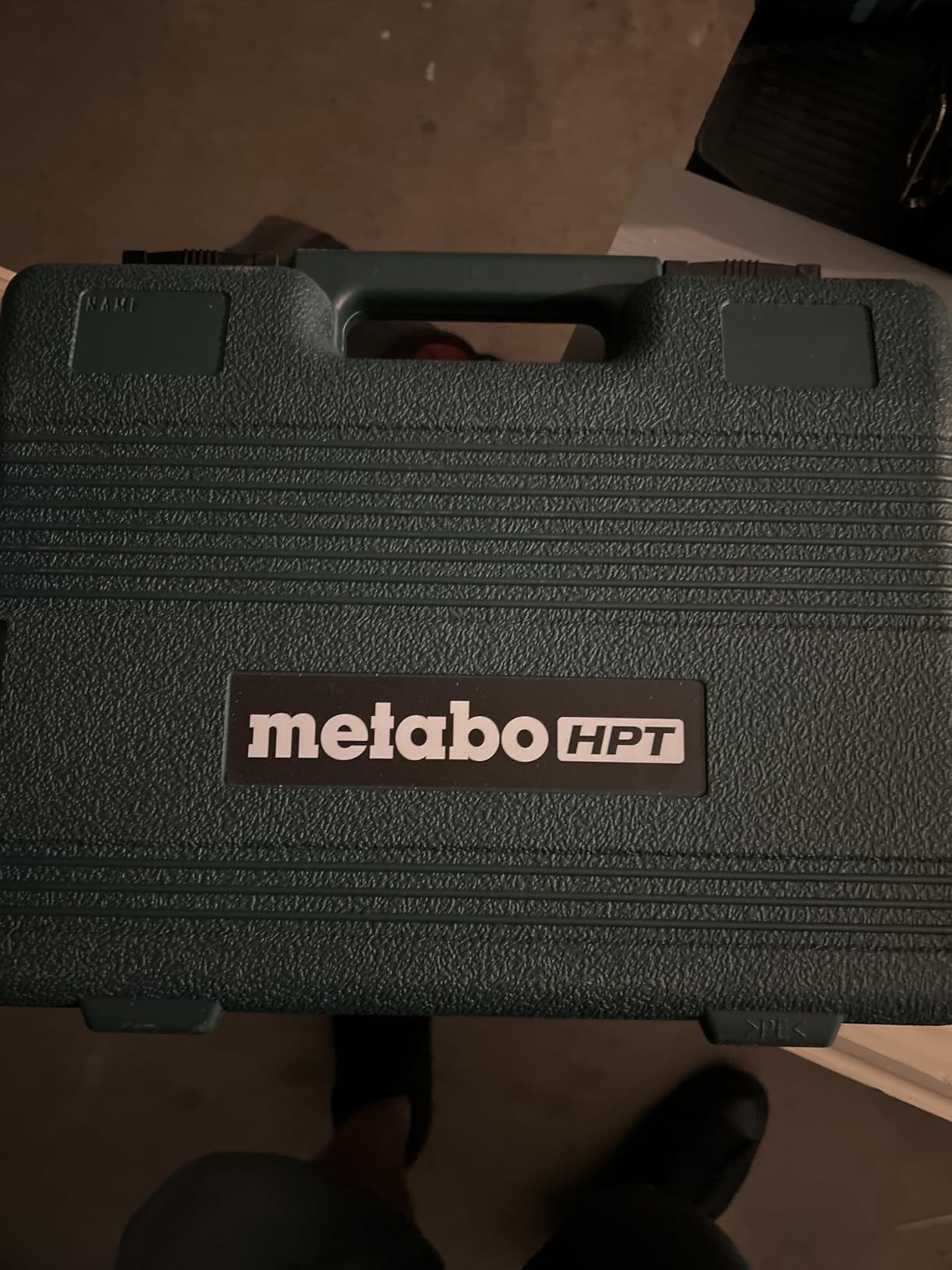
The critical maintenance tip the manufacturer doesn’t shout about: oil this nailer before first use. We learned this the hard way years ago, and skipping the oil step is the number one cause of early failure on these otherwise excellent tools. Add 3-4 drops of pneumatic tool oil into the air inlet before each work session for long-term reliability.
The NT50AE2 uses 18-gauge brads, not 15 or 16-gauge finish nails, so it has limits on holding power. For thin decorative trim, picture framing, and small cabinet work, it’s perfect. For thick baseboards and large crown molding, you need a heavier gauge tool.
For whom its good
This is the right tool for any project where tool weight matters more than fastener strength. Door casings, picture framing, thin decorative trim, small cabinet assembly, and craft projects are all perfect matches. The 2.2 lb weight makes it our top choice for overhead work and long-duration projects where fatigue is a concern.
It’s also a smart buy for DIY homeowners who want a reliable brad nailer without paying premium prices. With over 3,600 reviews and a 4.6 rating, this is one of the most trusted brad nailers on the market.
For whom its bad
If you need to fasten thick baseboards or heavy crown molding, this isn’t strong enough. The 18-gauge brad doesn’t have the bite for structural trim. It’s also not the right choice for high-volume professional daily use, where a more durable tool will outlast this one.
8. 3PLUS HDA1564SP 15-Gauge Angled Finish Nailer – Best Budget 15-Gauge
3PLUS HDA1564SP 15 Gauge Angled Finish Nailer
Weight: 5.51 lbs
Gauge: 15 angled
Nail range: 1.25 to 2.5 inch
+ The Good
- Budget-friendly 15-gauge
- Same DA nail compatibility as DeWalt
- Tool-free depth adjustment
- Quick clear jam release
- No-mar tip
- The Bad
- No belt clip included
- No carrying case
- Loading can be awkward
- Occasional double fires
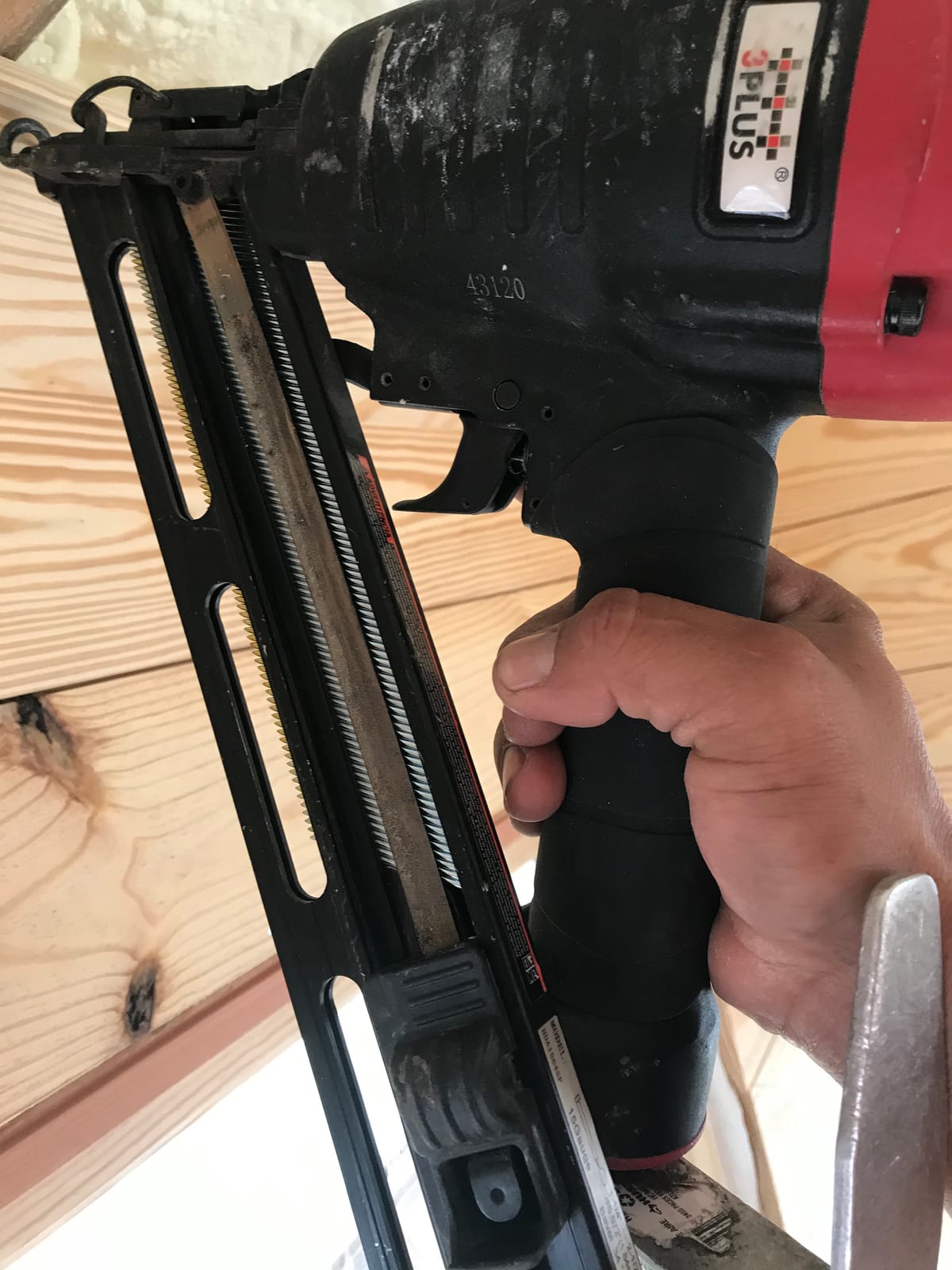
The 3PLUS HDA1564SP delivers 15-gauge angled finish nailer performance at a price point that doesn’t exist from major brands. We’ve used this tool on a handful of trim projects, and the nail driving performance is comparable to premium brands costing twice as much. For DIY homeowners on a budget, this is one of the best values we’ve seen.
The 34-degree angled magazine on this model matches the DeWalt DA nail specification, so finding compatible nails is easy. We were relieved to learn we could buy nails from any major retailer without hunting for a special order. The no-mar tip protects trim surfaces, and the quick-clear jam release gets you back to work fast when a jam happens.
The tradeoffs are build quality and accessories. The 3PLUS doesn’t include a belt clip or carrying case, which are standard on premium brands. Loading nails can be slightly more awkward than premium tools, and we’ve noticed occasional double-fires if you don’t hold the tool firmly against the workpiece. Build quality isn’t at the level of premium brands, so heavy daily use will wear it out faster.
The instruction manual on this model is famously confusing about oiling. The tool is oil-required, but the manual doesn’t make it clear, so first-time users might run it dry and damage the internal seals. Once you know to oil it, the tool performs reliably.
For whom its good
This is the right tool for budget-conscious DIY homeowners who want 15-gauge angled capability without paying premium prices. For trim projects where you need the holding power of 15-gauge nails and the reach of an angled magazine, this is the most affordable option we tested. The DeWalt-compatible nail spec means supplies are easy to find.
It’s also a smart secondary tool for contractors who already own a premium finish nailer. Keep the 3PLUS in the truck for small jobs or apprentice use without worrying about wear on your primary tool.
For whom its bad
Professional finish carpenters using a nailer daily will wear this tool out faster than premium brands. The build quality and accessory package (no belt clip, no case) signal that this is a budget tool, not a daily workhorse. If you’re working on high-end client jobs, invest in a premium brand that will last.
Buying Guide: How to Choose the Best Finish Nailer
Choosing the best finish nailers for your projects comes down to three questions: what gauge, what power source, and how often you’ll use it. We’ve answered these questions for hundreds of buyers over the years, and the framework below will help you pick the right tool without second-guessing.
Choosing the Right Gauge
Finish nailers come in three common gauges: 15, 16, and 18. The 18-gauge is technically a brad nailer, but we include it here because many buyers shop across the category. Here’s the practical breakdown we use when advising buyers:
15-gauge angled finish nailers are the strongest and reach the tightest corners. Choose 15-gauge when you’re installing thick baseboards, large crown molding, stair treads, or working in inside corners where the angled magazine is essential. The angled magazine adds bulk but solves real problems in those tight spots.
16-gauge straight finish nailers are the all-around workhorse. Choose 16-gauge for most residential trim projects including door casings, window trim, baseboards, and standard crown molding. The 16-gauge offers a good balance of holding power and hole visibility, and the straight magazine loads faster than angled.
18-gauge brad nailers are for fine work. Choose 18-gauge for picture framing, thin decorative trim, small cabinet assembly, and any project where you want minimal hole visibility. The 18-gauge brad doesn’t have the holding power for thick trim, but it splits less wood and leaves the smallest hole.
Pneumatic vs Cordless
The pneumatic vs cordless decision depends on your existing tool setup and work environment. We’ve used both for years, and each has clear advantages.
Pneumatic finish nailers are lighter, less expensive, and more powerful. They require an air compressor capable of 2.5 to 4 CFM at 90 PSI, plus an air hose. If you already own a compressor, pneumatic is the better choice. If you don’t own one, add the cost (around $200 to $400 for a good portable model) before deciding.
Cordless finish nailers offer freedom from compressors and hoses. They work in finished homes without disrupting clients, and they eliminate hose management during overhead work. They’re heavier than pneumatic equivalents and more expensive, especially if you need to buy batteries separately. Choose cordless if you value convenience and don’t mind the extra weight.
Key Features to Look For
Tool-free depth adjustment is non-negotiable in our testing. Every finish nailer on our list has it, but if you’re shopping beyond our picks, skip any model that requires tools to change depth. You’ll adjust depth constantly across different wood thicknesses.
Tool-free jam release is the second must-have feature. Jams happen even on premium tools, and being able to clear a jam in 30 seconds versus 5 minutes matters when you’re on a job site with a deadline.
Selective actuation switches let you toggle between bump fire and sequential modes. Sequential is safer and more accurate for detail work; bump fire is faster for production work. Most finish carpenters we know prefer selective actuation so they can choose per application.
No-mar tips protect your trim from accidental marks. Most quality finish nailers include them, and many include spares on the tool. Replace the tip when it wears out, or you’ll scratch expensive trim.
Weight matters more than most buyers expect. A finish nailer might be in your hand for 4 to 6 hours during a full trim job. The difference between 3.7 lbs and 6 lbs is the difference between finishing strong and finishing exhausted.
Brand Ecosystem Considerations
If you’re buying cordless, brand ecosystem matters. DEWALT 20V MAX batteries work across dozens of tools, so buying a DEWALT cordless finish nailer makes sense if you own other DEWALT 20V MAX tools or plan to. Milwaukee M18, Makita 18V, and Ryobi 18V are similar ecosystems.
For pneumatic tools, brand matters less because there’s no battery ecosystem to share. Metabo HPT, DEWALT pneumatic, Bostitch, and Senco all make reliable pneumatic finish nailers. Choose based on weight, features, and price rather than brand ecosystem.
Compressor Requirements for Pneumatic
If you choose a pneumatic finish nailer, your compressor needs to deliver at least 2.5 CFM at 90 PSI for light use. For professional continuous use, 4 CFM at 90 PSI is the minimum. A 6-gallon pancake compressor is the minimum size for occasional DIY use; a 20-gallon or larger is better for production work.
Most finish nailers work fine with a 3/8-inch air hose for runs under 50 feet. For longer runs, upgrade to a 1/2-inch hose to maintain pressure. We’ve learned the hard way that an undersized hose costs you nail driving power.
15-Gauge vs 16-Gauge vs 18-Gauge Comparison
The gauge decision is the single most important choice when shopping for the best finish nailers. Here’s the comparison we walk customers through when they’re stuck between gauges.
15-gauge finish nails are about 0.072 inches thick and come in lengths from 1.25 to 2.5 inches. The thicker shank gives more holding power, which is why 15-gauge is the right choice for thick baseboards, large crown molding, stair treads, and hardwood trim. Most 15-gauge finish nailers use angled magazines for better corner access.
16-gauge finish nails are about 0.063 inches thick and come in lengths from 1 to 2.5 inches. The slightly thinner shank leaves a slightly smaller hole, but the holding power is still substantial for most residential trim. Most 16-gauge finish nailers use straight magazines for faster loading and easier alignment on long runs.
18-gauge brad nails are about 0.0475 inches thick and come in lengths from 5/8 to 2 inches. The thin shank leaves a minimal hole, but the holding power is limited. 18-gauge is the right choice for decorative trim, picture framing, and craft projects where you want minimal hole visibility.
For most readers, 16-gauge is the safe all-around choice. It’s strong enough for the majority of trim projects and the straight magazine is faster to load. Choose 15-gauge if you regularly work with thick trim or in tight corners. Choose 18-gauge only if you’re focused on fine detail work.
Pneumatic vs Cordless Finish Nailers
The pneumatic vs cordless debate is less about which is better and more about which fits your work. After using both types for years, here’s how we think about the choice.
Pneumatic finish nailers win on weight, price, and raw power. Our lightest pneumatic is 2.2 lbs; our lightest cordless is around 5 lbs without battery. Pneumatic tools cost less upfront, especially if you already own a compressor. They deliver consistent power across all nail sizes without battery fade.
Cordless finish nailers win on convenience, mobility, and setup speed. No compressor to drag, no hose to manage, no oil to add. Just charge the battery and go. For trim carpenters working in finished homes, cordless eliminates client disruption from compressor noise. For DIY homeowners doing one-off projects, cordless removes the compressor investment barrier.
The crossover point where cordless makes sense is when you value time savings more than tool cost. If you’re saving 10 to 15 minutes per job by skipping compressor setup, and you do enough jobs to multiply that savings, cordless pays for itself. For occasional DIY use, the cordless premium isn’t worth it.
One thing to consider: cordless finish nailers have improved dramatically in recent years. The first generations were underpowered and had battery life issues. Current models from DEWALT, Milwaukee, and Makita deliver power and runtime that rivals pneumatic for most trim work. If you haven’t looked at cordless recently, the current generation might surprise you.
Frequently Asked Questions
Is a 16 or 18 gauge finish nailer better?
Neither is universally better. 16-gauge finish nails offer more holding power and are ideal for baseboards, crown molding, and door casings. 18-gauge brad nails leave smaller holes and work better for thin decorative trim, picture framing, and small cabinet assembly. For most residential trim projects, 16-gauge is the safer choice. For fine detail work where hole visibility matters most, 18-gauge is the right tool.
What gauge is best for a finish nailer?
For most users, 16-gauge is the best all-around finish nailer gauge. It balances holding power with hole visibility and works for the majority of residential trim projects. Choose 15-gauge for thick baseboards, large crown molding, stair treads, and inside corner applications. Choose 18-gauge brad for fine detail work, thin decorative trim, and craft projects where minimal hole visibility matters most.
What’s better, a 15 gauge or 16 gauge finish nailer?
Both have their place. 15-gauge finish nailers offer more holding power with thicker 0.072 inch nails and use angled magazines for tight corners. 16-gauge finish nailers are lighter, faster to load with straight magazines, and work well for most residential trim. Choose 15-gauge for heavy trim and corners. Choose 16-gauge for general baseboard and casing work.
Which is better, a brad nailer or a finish nailer?
A finish nailer is better for structural trim like baseboards, crown molding, and door casings because it drives thicker 15 or 16-gauge nails with more holding power. A brad nailer is better for fine detail work, thin decorative trim, and craft projects because it drives thinner 18-gauge brads with minimal hole visibility. Many finish carpenters own both and use them for different applications.
Are cordless finish nailers worth it?
Cordless finish nailers are worth it if you value convenience, mobility, and the elimination of compressor setup. They work especially well for trim carpenters in finished homes where compressor noise and hose management are disruptive. For DIY homeowners without an existing compressor, cordless removes a major cost barrier. The tradeoffs are higher tool cost, extra weight from batteries, and battery life limitations during heavy use.
Conclusion
After testing eight finish nailers across dozens of trim projects, our team’s pick for the best finish nailers in 2026 depends on your setup. For professional finish carpenters with a compressor, the Metabo HPT NT65M2S 16-gauge remains the best overall pneumatic thanks to its light weight, reliability, and Pro Preferred award lineage. For cordless buyers in the DEWALT ecosystem, the DEWALT DCN660B delivers 16-gauge capability without hose management.
For budget-conscious buyers, the HBT HBT64P offers premium features at a value price point, and the DEWALT DWFP12231 brad nailer covers fine detail work affordably. The 15-gauge angled category is led by the Metabo HPT NT65MA4 for pneumatic and DEWALT DCN650B for cordless. For the lightest possible pneumatic, the Metabo HPT NT50AE2 18-gauge brad nailer is unmatched.
Whichever finish nailer you choose from this list, the combination of tool-free depth adjustment, jam release, and selective actuation will keep you working efficiently. Start with the gauge and power source that match your existing tools and project needs, then choose the model that fits your budget. The right finish nailer makes trim work faster, cleaner, and more enjoyable than any other method we’ve tried.