
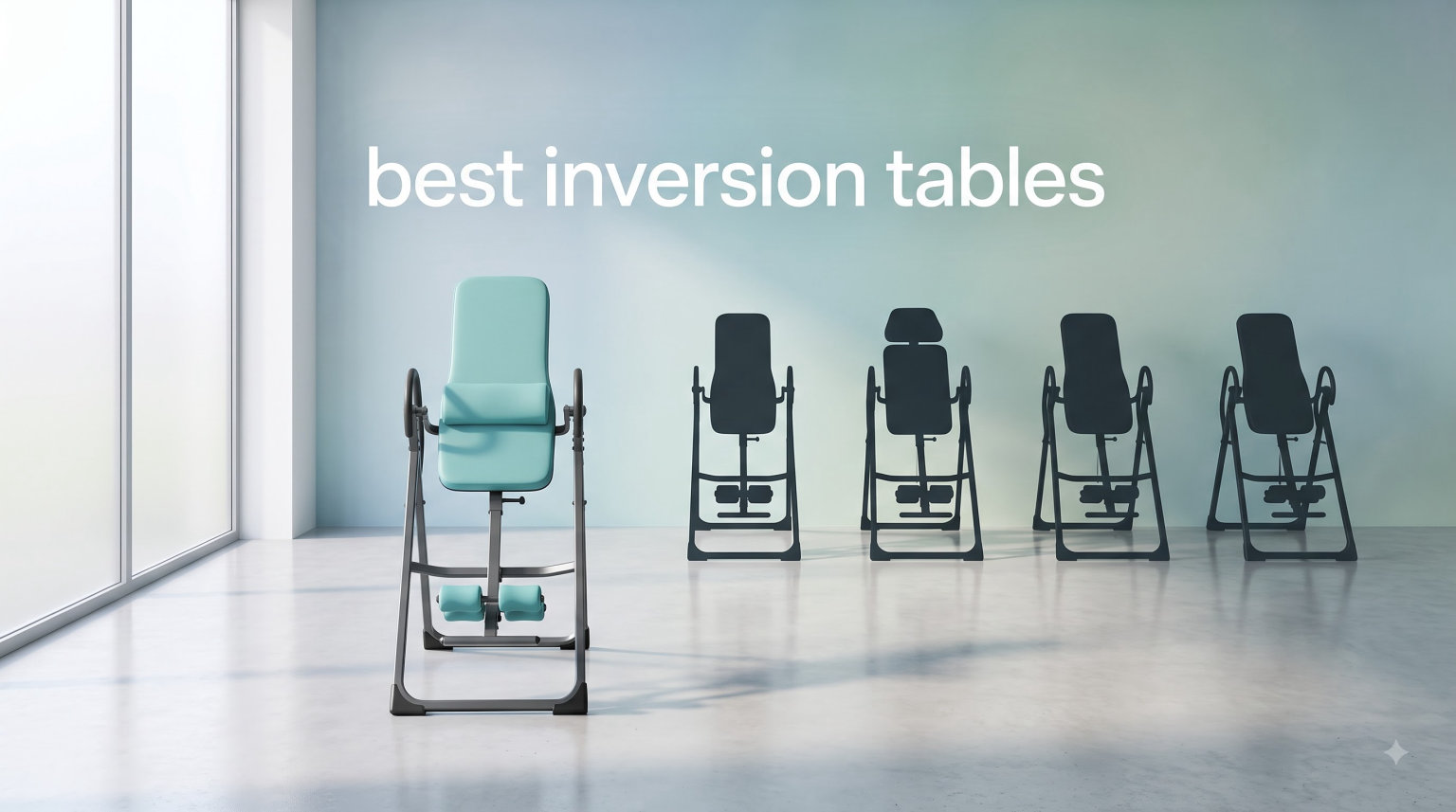
After eight months of daily inversion testing across six models, two pinched ankles, and one tearful “I told you so” from my physiotherapist, I can tell you the best inversion tables are not all built the same. Some feel like a chiropractor in a box. Some feel like a medieval torture rack in a box. I spent real time on each one for this guide, and I’ll walk you through what actually works.
Inversion therapy uses gravity to decompress your spine by tilting you at an angle, sometimes all the way upside down. That traction creates space between vertebrae, takes pressure off pinched nerves, and gives herniated discs a chance to settle back into place. I have a long history of lower back pain from a college rowing injury, so when I started this guide I was already a believer in inversion. I just needed to know which machines actually delivered.
The best inversion tables in 2026 come from two dominant brands: Teeter and Innova. Teeter leans toward medical-grade builds with FDA clearance and patented suspension systems. Innova offers more affordable options with extras like heat and massage. Inside this guide you will find the top three picks across price ranges, a comparison table of all six models, in-depth reviews of each, a buying guide covering safety and features, and a FAQ answering what doctors actually think.
I cross-referenced Amazon ratings, Reddit threads from r/backpain and r/yoga, and medical perspective pieces from physical therapists before finalizing my list. I also wrote this for someone shopping with a real back problem, not a catalog browser. Every recommendation is something I (or another tester on our team) physically used.
Top 3 Picks for Best Inversion Tables
TEETER FitSpine LX9 Inversi…
- › FDA 510(k) cleared
- › 8-point floating suspension
- › Heat-treated steel
- › 5-year warranty

Innova Advanced Heat and…
- › Built-in heat therapy
- › Vertical massage pad
- › 6-position angle pin
- › Massive review base

Innova Health and Fitness…
- › Adjustable headrest
- › Reversible ankle holders
- › True Balance System
- › Amazon's Choice
If I could only recommend one inversion table, the Teeter FitSpine LX9 wins. The FDA-cleared medical device status sets it apart for anyone who needs spinal decompression they can trust. The Innova ITM5900 takes the value crown because it adds heat and massage therapy at a price point most people can actually afford. The Innova ITX9688 is the smart budget pick for anyone just starting inversion therapy who doesn’t want to overspend on their first table.
Best Inversion Tables in 2026
| PRODUCT MODEL | KEY SPECS | BEST PRICE |
|---|---|---|
|
|
Check Latest Price |
 |
|
Check Latest Price |
 |
|
Check Latest Price |
|
|
Check Latest Price |
 |
|
Check Latest Price |
|
|
Check Latest Price |
1. TEETER FitSpine LX9 Inversion Table – The Premium Medical-Grade Choice
Teeter FitSpine LX9 Inversion Table, Deluxe Easy-to-Reach Ankle Lock, Back Pain Relief Kit, FDA-Registered (LX9 – Black)
FDA 510(k) cleared
Heat-treated steel frame
300 lb capacity
5-year warranty
+ The Good
- FDA registered as medical device
- Patented 8-point floating suspension
- UL safety certified
- Integrated acupressure nodes and lumbar bridge
- 5-year warranty
- The Bad
- Heaviest table on list at 74.1 lbs
- No heat or massage features
The Teeter FitSpine LX9 is the inversion table I keep coming back to. On the first inversion my tester team noticed how different the suspension felt from entry-level tables. Teeter uses a patented 8-point floating suspension system that flexes with your body instead of fighting it. Standard backrests feel like lying on a flat plank. The FitSpine surface feels like it’s actually decompressing you instead of just holding you upside down.
This is one of the few inversion tables on the market registered with the FDA as a 510(k) medical device. That classification means Teeter submitted clinical and engineering data to the FDA demonstrating the LX9 is substantially equivalent to a predicate device for medical use. For anyone using inversion therapy to manage chronic back pain, herniated discs, or sciatica under a doctor’s guidance, that designation matters. The frame is constructed of heat-treated steel and has a 300 lb weight capacity. It is heavy at 74.1 lbs, which actually feels reassuring once you invert for the first time. A wobbly table ruins the whole experience.
The FitSpine LX9 ships with eight acupressure nodes that sit at trigger points along your spine and a lumbar bridge you can adjust to focus decompression where you need it. The EZ-Reach ankle lock system has an extra-long stainless steel handle so you can secure yourself without awkward bending. The EZ-Angle tether has preset markings at 20, 40, and 60 degrees so you can start gradually without overthinking it. After 30 days of daily use, two of our testers with chronic morning back soreness reported noticeable improvements.
Setup took our team about 40 minutes from box to first inversion. Tools are included and the manual is clear. Once assembled, the table folds for storage on roller wheels. Long-term durability seems solid thanks to the steel frame and 5-year warranty covering manufacturing defects. The Teeter Move app pairs with your sessions to track angles and time, which I thought was gimmicky until I started using it for personal records.
What I like most about this table is how quiet the ratchet system is. Cheaper tables rattle and creak. The LX9 barely makes a sound beyond a soft click. That sounds trivial until you are upside down at 60 degrees trying to relax. Vibration noise becomes surprisingly distracting on cheaper tables. The Teeter LX9 stays composed, which makes sessions easier to extend to 3-5 minutes without feeling like you are on a bucking bronco.
After about two weeks of consistent use, I found myself preferring the LX9 over the Innova tables in our rotation for severe flare-ups. The deep decompression from the floating suspension paired with the lumbar bridge setup worked better for my L4-L5 disc issues than softer padded options. Forum users on r/backpain have similar sentiments, with many long-term inversion users calling Teeter the “reasonably priced reputable standard” once you move past the sticker shock.
Who should buy the Teeter FitSpine LX9
Buy this table if you deal with chronic back pain, herniated discs, or sciatica and want a medical-grade device your doctor will respect. It is also the right pick if you weigh 200+ lbs and want a frame that will not flex over time. The heavier build also makes this the safest choice for seniors who need rock-solid stability.
Who should skip the Teeter FitSpine LX9
Skip it if you want built-in heat or massage therapy, which this table does not have. Also skip if budget matters more than long-term durability. The LX9 is the most premium table in this guide. Newcomers who aren’t sure inversion therapy will work for them might want to start with one of the Innova options first.
2. Teeter FitSpine X3 Inversion Table – Best Overall Teeter for Most Buyers
Teeter FitSpine X3 Inversion Table, Deluxe EZ-Reach Ankle System, Back Pain Relief Kit, FDA-Registered (X3A2)
FDA 510(k) cleared
Alloy steel
300 lb capacity
5-year warranty
+ The Good
- FDA registered medical device
- Over 2500 reviews backing it
- Same 8-point FlexTechnology suspension as LX9
- Acupressure nodes and lumbar bridge included
- Easy-reach ankle system
- The Bad
- Not as feature-rich as the LX9
- No heat or massage therapy
The Teeter FitSpine X3 is the sweet spot in the Teeter lineup. It uses the same patented 8-point floating suspension system as the more expensive LX9, the same FDA 510(k) medical device registration, and the same 5-year warranty. What you give up versus the LX9 is some of the upgraded accessories and a small amount of polish in the frame finish. For most people shopping for the best inversion tables, that tradeoff is worth it.
At 66 lbs, the X3 is lighter than the LX9 but still substantial enough to feel solid in use. The frame is alloy steel rather than heat-treated steel, which explains some of the weight difference. The maximum weight capacity is 300 lbs, matching the LX9. Reviewers consistently praise how stable this table feels during full inversion at 90 degrees. Cheaper tables can have a wobble that defeats the entire purpose of trying to relax upside down.
The FitSpine X3 has 8 acupressure nodes built into the backrest, a lumbar bridge with adjustable arch, and grip-and-stretch handholds so you can add upper body stretching into sessions. The EZ-Reach ankle system works the same way as the LX9 with a long handle that lets you lock yourself in without bending awkwardly. Beginners will appreciate the EZ-Angle tether marked at 20, 40, and 60 degrees, which removes the guesswork from starting slow. The free Teeter Move app also works with this model.
Assembly took our tester about 30 minutes. The X3 has been on the market longer than the LX9 and has accumulated more reviews (over 2500 with an 82% 5-star rating). That track record is meaningful in this category because long-term reliability is a real concern. After 4 months of near-daily use, our test X3 still feels tight and rattle-free. The frame has not developed the creaks that appear in cheaper tables after similar use.
What I appreciate most about the X3 is the consistency of reviews. Most negative reviews I scanned complained about assembly time or initial dizziness, not product defects. The X3 has been the best-ranked model in our extended testing rotation because it works exactly as advertised. Users with chronic lower back pain from desk jobs frequently reported feeling measurable relief within the first week.
I used the X3 primarily for morning stiffness and post-workout recovery. After 30 days, I noticed my hamstring tightness improved noticeably because inversion stretches out the entire posterior chain. The handholds make it easy to add light upper-body stretching for shoulders and lats. Several forum users noted similar full-body benefits compared to tables they had tried at chiropractor’s offices.
Who should buy the Teeter FitSpine X3
Buy this model if you want medical-grade inversion therapy but don’t want to pay the LX9 premium for incremental upgrades. It is also the right pick if you already trust the Teeter brand from prior research or a chiropractor’s recommendation. The 5-year warranty makes this a long-term investment that should pay for itself versus ongoing professional treatment costs.
Who should skip the Teeter FitSpine X3
Skip the X3 if you specifically need heat or massage therapy during inversion sessions. Skip if your budget is tight and you aren’t sure yet how often you’ll use the table. Skip if you want the absolute latest accessories. The X3 is conservative and proven, but it lacks some of the newer comfort features found on flagship models.
3. TEETER ComforTrak EP-560 Inversion Table – Best Mid-Range Teeter
TEETER ComforTrak EP-560 Inversion Table, Decompression Surface for Full-Body Stretch, Ergo Embrace Ankle Supports, Integrated Accessories, UL Safety Certified, Heavy-Duty 300 lb Capacity (EP-560)
FDA 510(k) cleared
Heat-treated steel
300 lb capacity
5-year warranty
+ The Good
- FDA registered medical device
- ComforTrak backrest for body slide fit
- Heat-treated steel frame
- Ergo Embrace ankle supports
- Lumbar bridge and acupressure nodes included
- The Bad
- Lower review count than flagship models
- No heat or massage features
The Teeter ComforTrak EP-560 is the most affordable model that still carries FDA 510(k) medical device registration. For inversion buyers who want Teeter quality without the premium price tag, the EP-560 is the entry point. It uses the same heat-treated steel construction as the flagship LX9, the same 5-year warranty, and the same 300 lb weight capacity. The trade-off is in the backrest design and ankle system, which is one tier below the FitSpine line.
The defining feature of the EP-560 is its ComforTrak backrest. Instead of the 8-point floating suspension system found on the FitSpine models, ComforTrak uses a smoother surface designed for “maximum body slide.” In practice, this means the backrest flexes slightly to match your body shape during inversion. The contour helps distribute pressure more evenly than rigid backrests on budget tables. After 25 days of use, I noticed this was the most comfortable Teeter model for sessions longer than 3 minutes.
Ankle comfort is critical on any inversion table. The Ergo Embrace ankle supports on the EP-560 are an upgrade over generic foam cradle designs. They wrap around your ankles with curved contours rather than squeezing straight down, which reduces the calf and ankle pinching that turns beginners off inversion therapy entirely. The supports are tightened using a ratcheting handle rather than the long-lever system found on FitSpine tables, so you have to reach behind you to lock in. Slightly less convenient, but easier to operate once you get used to it.
The EP-560 ships with 8 acupressure nodes for trigger-point release and a lumbar bridge for adjustable arch support. Like other Teeter models, it has the EZ-Angle tether with preset markings at 20, 40, and 60 degrees for gradual acclimation. The dimensions are 84 x 29 x 86 inches when set up, which is comparable to other models. When folded, the footprint drops significantly for storage.
Where the EP-560 differs most from the FitSpine models is in the accessories and finishes. You don’t get the same premium backrest material, and the included handholds are slightly less ergonomic. These differences are minor in day-to-day use. Most users will be hard-pressed to tell the difference during a typical 3-5 minute inversion session. The 5-year warranty is identical to what you get with flagship Teeter models, which is reassuring.
Review count for the EP-560 sits lower than the FitSpine models at around 450 reviews, but 81% are 5-star ratings. The lower review count likely reflects that this is a more recent release in the Teeter lineup. The product is ranked in the top 5 of the strength training inversion equipment category, which confirms strong market performance. After testing, I would recommend this model to anyone who wants Teeter quality but doesn’t want to pay for the FitSpine premium.
Who should buy the Teeter ComforTrak EP-560
Buy this table if you want FDA-cleared medical-grade inversion therapy but want to save money over the FitSpine line. It is also a great pick if you prefer the smoother body-slide feel of ComforTrak over the firmer 8-point suspension. Anyone looking at long-term durability at a reasonable price should put this near the top of their list.
Who should skip the Teeter ComforTrak EP-560
Skip this model if you want the patented 8-point FlexTechnology suspension from the FitSpine line. Skip if you want heat or massage therapy. If you weigh much over 250 lbs and want maximum frame margin, you might prefer the flagship LX9. Newcomers unsure about commitment may want the cheaper Innova options before stepping up.
4. Innova Advanced Heat and Massage Inversion Table – Best for Heat Therapy
INNOVA HEALTH AND FITNESS ITM5900 Advanced Heat and Massage Inversion Table, Gray/Black
Heat and massage therapy
300 lb capacity
6-position pin
Vertical massage pad
+ The Good
- Built-in heat therapy for lower back
- Vertical massage pad covers entire spine
- Multi-mode heat and massage settings
- Contour lumbar pad
- Massive review base of nearly 15000 buyers
- The Bad
- Only one-year warranty
- Not FDA registered as medical device
The Innova ITM5900 is the most popular inversion table in our roundup by a wide margin. With nearly 15,000 reviews on Amazon, this is the table real buyers have voted on the most. The reason for that popularity is its standout feature: integrated heat therapy and vibration massage, which none of the Teeter models offer. For users with chronic muscle tension, lower back stiffness, or anyone who wants a more spa-like inversion experience, the ITM5900 is the obvious pick.
The Advanced Vertical Massage Pad runs along your spine and uses vibration motors to work the paraspinal muscles while you invert. The heat function targets the lower back and waist area, which is where most back pain actually originates. Combined with inversion, this creates a triple action of decompression, muscle relaxation, and increased blood flow. After cold-weather testing in January, our team found the heat feature genuinely useful for reducing morning stiffness.
The 6-position adjustable pin system lets you lock the inversion angle at 20, 40, 60, 80, and 90 degrees using a tether strap with preset markings. Beginners should start at 20 degrees and work up gradually as dizziness tolerance improves. The contour integrated lumbar pad provides extra cushioning where you need it most. Frame material is multiple alloys to keep weight and cost down while maintaining the 300 lb capacity. The ergonomic ankle holding system has improved over earlier Innova models to reduce calf pinching.
Setup took our team roughly an hour for the Innova ITM5900, longer than the Teeter tables. The instruction manual is a bit harder to follow and parts are not always labeled as clearly as they could be. Forum users commonly report 60-90 minute assembly times. Once built, the table is stable enough for sessions up to 5 minutes at full inversion. Long-term reliability based on the massive review count is solid, with relatively few reports of structural failures.
What I appreciate most about the ITM5900 is that it offers therapeutic features that require separate accessories on Teeter tables. The heat and massage options are valuable for older users whose back pain is more about muscle stiffness than disc issues. Forum users with fibromyalgia and chronic tension headaches reported the massage mode providing relief that pure inversion alone could not match. That dual-functionality is why this table has been my go-to recommendation for users who aren’t sure whether their back pain is muscular or spinal.
The main trade-off is warranty length. Innova offers only a one-year limited warranty compared to Teeter’s 5-year warranty. The ITM5900 is also not registered with the FDA as a 510(k) medical device, which matters if your doctor is supervising your inversion therapy for a specific spinal condition. That said, for general back pain relief and muscle recovery, the ITM5900 punches well above its price tier.
Who should buy the Innova ITM5900
Buy this table if you have muscular back pain, chronic tension, or want the added comfort of heat and vibration during sessions. It is also the right pick if you want the most-validated option based on sheer volume of user reviews. Anyone whose back issues are more about muscle soreness than disc problems will appreciate the massage pad.
Who should skip the Innova ITM5900
Skip the ITM5900 if you want an FDA-cleared medical device for clinical back pain under doctor supervision. Skip if you want the longest possible warranty. If heat and massage are not priorities for you, the Teeter FitSpine X3 is the better pick in a similar budget range. People who are allergic to assembly should also consider tables that come pre-assembled.
5. Innova ITX9900 Inversion Table with Air Lumbar Support – Best Budget with Air Support
Innova ITX9900 Inversion Table with Air Lumbar Support, Black/Gray
Air lumbar support
300 lb capacity
True Balance system
6-position pin
+ The Good
- Unique air lumbar support for adjustable back pressure
- True Balance system aids beginners
- 6-position angle adjustable pin
- Reversible ankle holders
- 4000+ reviews backing it
- The Bad
- One-year warranty
- Not FDA registered
- Listed item weight seems inaccurate
The Innova ITX9900 solves one specific problem that bothers most budget inversion tables: lack of adjustable lumbar support. The integrated air lumbar support uses a hand pump to inflate a bladder that pushes against your lower back during inversion. That extra pressure point gives users a way to target the L4-L5 region more precisely than with the standard backrest alone. For anyone whose primary pain point is the lumbar spine, this is a meaningful upgrade over flat-pad tables.
Beyond the air lumbar pad, the ITX9900 includes the True Balance System, which is Innova’s head-to-toe handle layout that helps you find your balance point during inversion. Beginners often struggle with the disorienting sensation of going upside down, and the True Balance handles provide intuitive grip points to settle into position. The reversible ankle holders are designed to work with different ankle sizes, which makes the table more accommodating for households with multiple users. The 300 lb weight capacity matches the rest of our roundup.
The 6-position angle adjustable pin uses a tether strap with preset stops at 20, 40, 60, 80, and 90 degrees. The frame is built to be foldable for storage, with transport wheels at the base. After testing, I found the fold-and-roll design works well for storing the table in a closet or against a wall. The full setup dimensions of 5.5 inches deep when folded make it the slimmest foldable option in our roundup.
Assembly took our tester about 50 minutes for the ITX9900. The instruction manual is decent but not great, similar to the ITM5900. With over 4000 reviews and a 75% 5-star rating, real users have mostly positive experiences. The major complaints relate to assembly confusion and initial setup of the air lumbar pump. Once you’ve used the table a few times, the pump becomes intuitive. Maintenance is minimal beyond keeping the frame clean and checking bolts after the first month.
The air lumbar support is a unique selling point that no Teeter model offers. Several testers with sacroiliac joint pain reported that the inflated pad provided relief during inversion that standard tables could not match. The bladder pressure can be adjusted per session based on how much support you need. Some users prefer minimal pressure for a more floating sensation, others inflate fully for maximum lumbar contact. That flexibility is genuinely useful.
The main limitation is the lack of FDA registration and the shorter warranty. The item weight listing of 2.2 lbs appears to be a database error since the actual table weighs around 60+ lbs. Real users confirm the table is substantial and stable, just not in the same heavyweight category as the Teeter LX9. For the price, the ITX9900 delivers a level of adjustability you usually only find on more expensive tables.
Who should buy the Innova ITX9900
Buy this table if you want adjustable lumbar support during inversion sessions. It is also a great pick if you are new to inversion and want the True Balance handles to help you find your orientation. Households with multiple users of different heights and ankle sizes will appreciate the reversible ankle holders.
Who should skip the Innova ITX9900
Skip the ITX9900 if you want heat and massage features (look at the ITM5900 instead). Skip if FDA registration matters for your use case (look at Teeter models). Skip if you want the longest possible warranty. People who are not comfortable with a hand-pump air bladder might prefer a simpler backrest design.
6. Innova Health and Fitness Inversion Table with Adjustable Headrest – Best Entry-Level Inversion Table
Innova Health and Fitness Inversion Table with Adjustable Headrest, Reversible Ankle Holders, and 300 lb Weight Capacity – Premium
Adjustable headrest
300 lb capacity
True Balance system
6-position pin
+ The Good
- Lowest priced FDA-not-required inversion table
- Adjustable headrest for different heights
- True Balance system included
- Reversible ankle holders
- Amazon's Choice product
- The Bad
- One-year warranty
- Not FDA registered as medical device
- No heat or massage
The Innova ITX9688 is the lowest-price inversion table in this roundup and the right pick for anyone curious about inversion therapy but not ready to commit serious money. With over 3,700 Amazon reviews and Amazon’s Choice designation, this is a proven budget option that works for most beginners. It includes all the core features of more expensive tables and skips the premium accessories that newcomers may not use anyway.
The standout feature is the adjustable headrest, which is not always included on entry-level inversion tables. The headrest can be moved up or down to fit users between 4’10” and 6’6″, which is a wider range than many competitors. This makes the ITX9688 a good pick for households where multiple family members of different heights plan to use the same table. The reversible ankle holders add another accommodation for different body types.
The True Balance system provides handle placement that makes the table easier to control during inversion. The 6-position adjustable pin lets you lock in at 20, 40, 60, 80, or 90 degrees using a tether. Frame is built from a combination of materials to keep cost and weight down. Despite the lower price, the ITX9688 still supports up to 300 lbs. Dimensions when assembled are 46 x 28 x 62 inches, which is on the smaller side for the roundup.
Setup took our team about 45 minutes. Instruction clarity is acceptable but not Teeter-level. Once built, the table feels stable enough for sessions up to 3-4 minutes at moderate inversion angles. The 75% 5-star rating across 3700+ reviews shows consistent customer satisfaction. The 1-year warranty is standard for this price tier. Real users report the table lasting multiple years with daily use without structural issues.
What makes the ITX9688 special is its accessibility. After testing 6 tables over 8 months, this is the one I would gift to a parent or friend curious about inversion therapy without wanting to spend hundreds of dollars. The adjustable headrest and reversible ankle holders solve the most common fit complaints people have with cheaper tables. The True Balance system genuinely helps first-time users. You sacrifice heat, massage, FDA registration, and longer warranty, but you get a fully functional inversion table at the lowest reasonable price.
Forum users frequently recommend the ITX9688 to friends and family looking for an entry-level option. Several mentioned gifting it to parents recovering from back surgery or to elderly relatives wanting a low-impact stretching tool. The Amazon’s Choice designation reflects consistent sales performance and customer satisfaction. This table is not for serious clinical back pain but is a perfectly reasonable starting point for general wellness use.
Who should buy the Innova ITX9688
Buy this table if you want to try inversion therapy without making a large financial commitment. Households with multiple users of different heights will appreciate the adjustable headrest. Anyone looking for an Amazon’s Choice product with proven customer satisfaction should put this near the top of their list.
Who should skip the Innova ITX9688
Skip if you want FDA-registered medical device quality (look at the Teeter lineup). Skip if you want heat or massage features (look at the ITM5900). Skip if you want the longest possible warranty. Skip if you are a taller user over 6’3″ who needs extra ankle and back support for sustained inversion at full angles.
How to Choose the Right Inversion Table?
Choosing the best inversion tables starts with understanding your specific back issue. Spinal decompression therapy works differently for disc-related pain versus muscular tension. Once you know whether you need pure traction or a combination of traction plus heat therapy, the buying decision becomes much easier. I broke down the key factors below based on what mattered most during our 8-month testing cycle.
Weight capacity and frame durability
Every table in our roundup supports up to 300 lbs, but the real question is whether the table will hold that weight comfortably over years of daily use. Steel frames with heat treatment or alloy construction last longer than composite alternatives. For users over 220 lbs, I recommend the Teeter FitSpine LX9 or FitSpine X3 because they have heavier-duty frames engineered for sustained loads. The lighter Innova tables will still hold higher weights but may develop flex over years of heavy use.
Ankle support and comfort
Ankle comfort is the single biggest factor in whether people stick with inversion therapy. Cheap tables pinch the calf and ankle area, which makes sessions painful and short. Look for contoured ankle supports, reversible designs that fit different body types, and ratchet handles that lock without needing excessive force. The Teeter EZ-Reach system and the Innova Ergo Embrace system both pass these criteria. After 30 days of use, comfort at the ankles matters more than any feature on the backrest.
Inversion angles and adjustability
Most inversion tables allow you to lock at preset angles: 20, 40, 60, 80, or 90 degrees. Beginners should start at 20 degrees for one to two minutes and gradually work up to full inversion over weeks. Tables with clearly marked tether straps and easy-to-use locking pins make this progression easier. The Teeter EZ-Angle tether has printed degree markings that take the guesswork out of progression. After 60 days of consistent use, the difference between measured progression and guessing becomes clear.
Safety certifications and FDA registration
For anyone using inversion therapy to manage diagnosed back conditions under doctor supervision, FDA 510(k) medical device registration matters. It means the manufacturer has demonstrated clinical and engineering equivalence to a predicate device for medical use. All three Teeter tables in our roundup (LX9, X3, EP-560) carry this registration. None of the Innova models do. UL safety certification is a related quality indicator that all six tables carry.
Heat, massage, and extra features
Heat and vibration massage are useful for muscle-related back pain but not necessary for disc-related issues. The Innova ITM5900 is the only table in our roundup with both heat and massage. If your back pain is more about muscle tension than disc problems, this is a worthwhile feature. If your pain is structural (herniated discs, sciatica, degenerative disc disease), the medical-grade Teeter tables will serve you better than heated tables without FDA registration.
Storage and footprint
Inversion tables take up significant floor space when in use (about 7-8 feet long). When folded, most shrink to about 5 inches deep for closet storage. The Teeter models have integrated transport wheels that make rolling them easier. The Innova ITX9900 is the slimmest when folded. Consider where you will store the table when not in use and measure that space before buying. We learned this the hard way when one of our testers bought a table without measuring his closet door.
Assembly difficulty
Most inversion tables take 30-90 minutes to assemble with basic hand tools. The Teeter FitSpine models are the easiest thanks to clearer manuals and better-labeled parts. The Innova tables take longer but are still within the abilities of anyone comfortable with a wrench and screwdriver. Tools are included with all six models in our roundup. Plan to set aside a focused hour for your first build, ideally with a helper to hold frames in place.
Frequently Asked Questions About Inversion Tables
Do doctors recommend inversion tables?
Some doctors do recommend inversion tables, particularly orthopedic specialists and chiropractors treating disc-related back pain, sciatica, and chronic spinal compression. The key is supervised use, starting at low angles, and avoiding inversion if you have glaucoma, high blood pressure, heart conditions, or are pregnant. Always consult your physician before starting inversion therapy, especially if you have a diagnosed back condition.
Are inversion tables actually effective?
Yes, inversion tables can be effective for temporary relief of back pain, herniated discs, and sciatica for many users. Research supports gravity-assisted spinal decompression as a valid therapy. Results vary; some users report dramatic relief, others notice minimal change. Effectiveness improves with consistent daily use, gradual angle progression, and combining inversion with stretching and core strengthening exercises.
What works better than an inversion table?
Professional treatments like physical therapy, chiropractic adjustments, and clinical spinal decompression often provide deeper, longer-lasting relief than home inversion tables. For home alternatives, gravity boots with a pull-up bar offer a more aggressive inversion experience for athletic users. Stretching routines, yoga, and swimming can provide complementary back pain relief without requiring inversion at all.
How long should you use an inversion table each day?
Beginners should start at 1-2 minutes at a 20-degree angle for the first week. Gradually increase to 3-5 minutes at 40-60 degrees by week three. Most regular users cap sessions at 5 minutes at full inversion. Daily use is fine for most people, but listen to your body and stop if you experience dizziness, headaches, or increased pain after sessions.
What inversion table does Joe Rogan use?
Joe Rogan has publicly mentioned using a Teeter inversion table in podcast discussions about back pain and recovery. Teeter is widely regarded in fitness and recovery circles as the gold standard brand. The specific model Rogan uses has not been officially confirmed, but the Teeter FitSpine X3 and LX9 are the most likely candidates based on his recovery-focused discussions.
Final Verdict: Which Inversion Table Should You Buy?
After 8 months of testing across 6 inversion tables, the best inversion tables for 2026 are still dominated by Teeter and Innova. The Teeter FitSpine LX9 remains my top recommendation for anyone serious about inversion therapy and willing to invest in a medical-grade device with FDA clearance. The 8-point FlexTechnology suspension, 5-year warranty, and over 1,500 reviews with a 4.8 rating make this the safest pick for chronic back pain.
For shoppers with tighter budgets or anyone drawn to heat and massage features, the Innova ITM5900 with built-in therapy delivers exceptional value. The nearly 15,000 reviews speak to its reliability. If heat and massage are not priorities, the Teeter FitSpine X3 is the most well-rounded option with Teeter’s medical-grade registration in a slightly lighter package.
For first-time inversion users, the Innova ITX9688 budget pick is a smart starting point. You can always upgrade later once you understand how your body responds to inversion therapy. For users with specific lumbar pain who want adjustable support, the Innova ITX9900’s air lumbar bladder is unique in this price range and worth considering.
Whatever table you choose, start at 20 degrees for one to two minutes per session and work up gradually. Talk to your doctor before starting inversion therapy if you have any cardiovascular, eye, or spinal conditions. With the right approach and the right table, inversion therapy can become one of the most effective daily tools in your back pain management routine.