
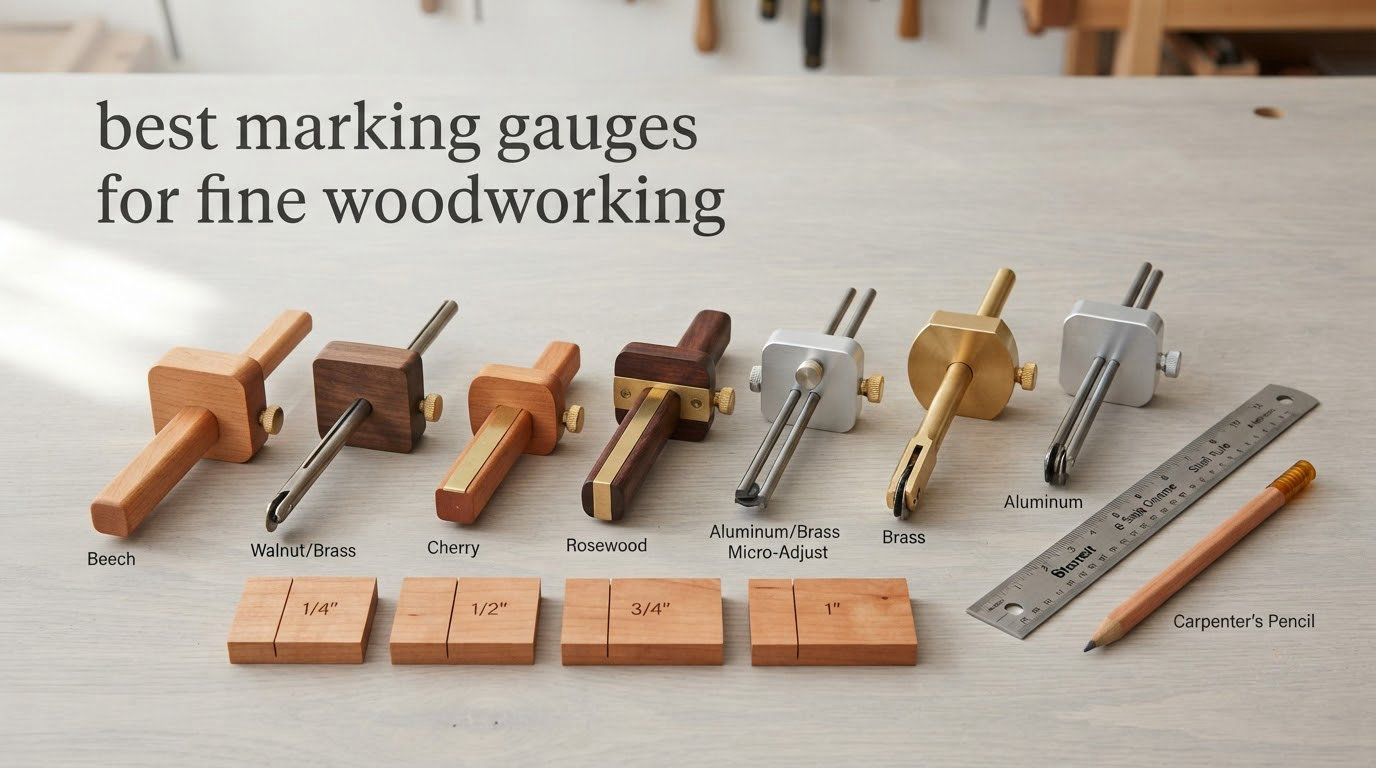
A marking gauge is a layout tool with a long beam, a movable fence that registers against the edge of your workpiece, a lock that holds the setting, and a scribing element that cuts a line parallel to that edge. Once you set the fence, every line after it is identical without measuring again, which is exactly why a good marking gauge beats a pencil and a rule for joinery. The Clarke Brothers wheel gauge is the best marking gauge for most fine woodworkers because its scale reads clearly, its fence registers flat, and it arrives with spare cutters. It is also the one most of our readers already own a version of.
I have spent the last few months putting ten marking gauges through the same bench routine: setting each one to a few repeatable widths, scribing across hard maple and white oak, then scribing the same width again on a different board to check whether the line holds. The tool that surprised me most was not the heaviest. It was the KAKURI Japanese cutting gauge, which cuts a cleaner line than the wheel gauges here because it severs fiber instead of displacing it.
What follows covers all four structural types of gauge, not just the wheel style most listings sell. You will find wheel gauges for general scribing, mortice gauges with two or three pins for fixed-width joint layout, a Japanese cutting gauge for clean baselines, and a multi-function scriber for shops that want one tool to do several jobs. If you are still setting up a shop, the surface you work on matters as much as the gauge, and our [woodworking workbench guide](https://beboivn.com/best-woodworking-workbenches/) covers how a flat, stiff top changes how a gauge behaves.
Top 3 Picks for Fine Woodworking Layout for October 2026
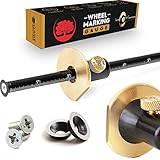
Clarke Brothers Wheel Marki…
- › Laser engraved metric and imperial scale
- › Two spare hardened steel cutters
- › Roll-stop fence with a flat spot

Taytools Micro Adjust Brass…
- › Micro adjust head with knurled knob
- › Cutter retracts into a protective countersink
- › Independent head and adjuster locks
iGaging Wheel Marking Gauge
- › Dual 1mm and 1/32 inch graduations
- › Precision machined solid brass body
- › Doubles as a depth gauge
The 10 Best Marking Gauges for Fine Woodworking in October 2026
| PRODUCT MODEL | KEY SPECS | BEST PRICE |
|---|---|---|
|
|
Check Latest Price |
|
|
Check Latest Price |
|
|
Check Latest Price |
 |
|
Check Latest Price |
 |
|
Check Latest Price |
 |
|
Check Latest Price |
 |
|
Check Latest Price |
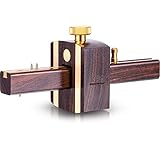 |
|
Check Latest Price |
 |
|
Check Latest Price |
 |
|
Check Latest Price |
The Four Types of Marking Gauges: Wheel, Mortice, Cutting, Combination
Four structural types cover almost everything sold under this name, and the confusion between them is the single biggest reason buyers end up with the wrong tool. Here they are in plain terms.
1. Wheel marking gauge. A single rotating or fixed wheel rides the beam and scribes one line. This is the general-purpose default: quick to set, cheap, and easy to keep sharp because a wheel does not need a razor edge to cut cleanly.
2. Mortice gauge. A marking gauge plus a second, adjustable pin, so both sides of a mortice are marked at the same fixed width without resetting between passes. Some versions add a third pin for double-line layout. Buy this one if you cut batches of joinery at one size.
3. Cutting gauge, sometimes sold as a dovetail gauge. The scribe is a sharpened knife edge that severs the wood fiber rather than displacing it. It gives the cleanest baseline and shoulder line, and it is the right choice for dovetail baselines and any line you intend to split out.
4. Combination gauge. One head carries both a wheel and a knife, or a scale plus several layout functions, so you can switch between scribing and measuring without a second tool. Convenient, and usually heavier and less focused than a dedicated single-purpose gauge.
One correction worth making early, because it is expensive to learn the hard way: wheel and pin scribers do not need to be knife sharp. They cut by being dragged, not by slicing. Only the knife on a cutting gauge or Japanese kebiki needs a real edge, and forum practitioners repeatedly note that a dull wheel that crushes fiber is a maintenance fault, not a design fault.
1. Clarke Brothers Wheel Marking Gauge: Best Overall for Fine Woodworking
Clarke Brothers Wheel Marking Gauge – Woodworking Marking Scriber Kit With 2 Replacement Cutters – Wood Marking Tools With Graduated Inch & MM Scale – Solid Metal Bar Wood Scribe Tool For Carpenter
Solid brass, steel and alloy build
8 inch graduated bar
Laser engraved to 6 in / 150mm
Two spare hardened steel cutters
+ The Good
- Laser engraved graduations in both inch and metric read clearly
- Roll-stop fence with a flat spot keeps the wheel off the bench
- Solid brass and steel construction feels premium
- Two spare hardened steel wheel cutters included
- Balanced enough for one-handed use
- The Bad
- Distance is read from the wheel face rather than the knife
- so large settings are awkward
- Cutter wheel can chip and needs honing
- Some technique needed to hold the fence flat for an even line
This is the gauge I hand to anyone who asks for one recommendation. It is a solid brass, steel and aluminum alloy body with an 8 inch graduated bar, and at 0.17 kg it balances well enough to run one-handed while your other hand steadies the board.
The detail that separates it from most metal wheel gauges is the patent pending roll stop fence with a flat spot. Most round brass bases roll when you set the tool down or when your hand brushes it mid-line, and a rolling fence is a crooked line. This one sits still.
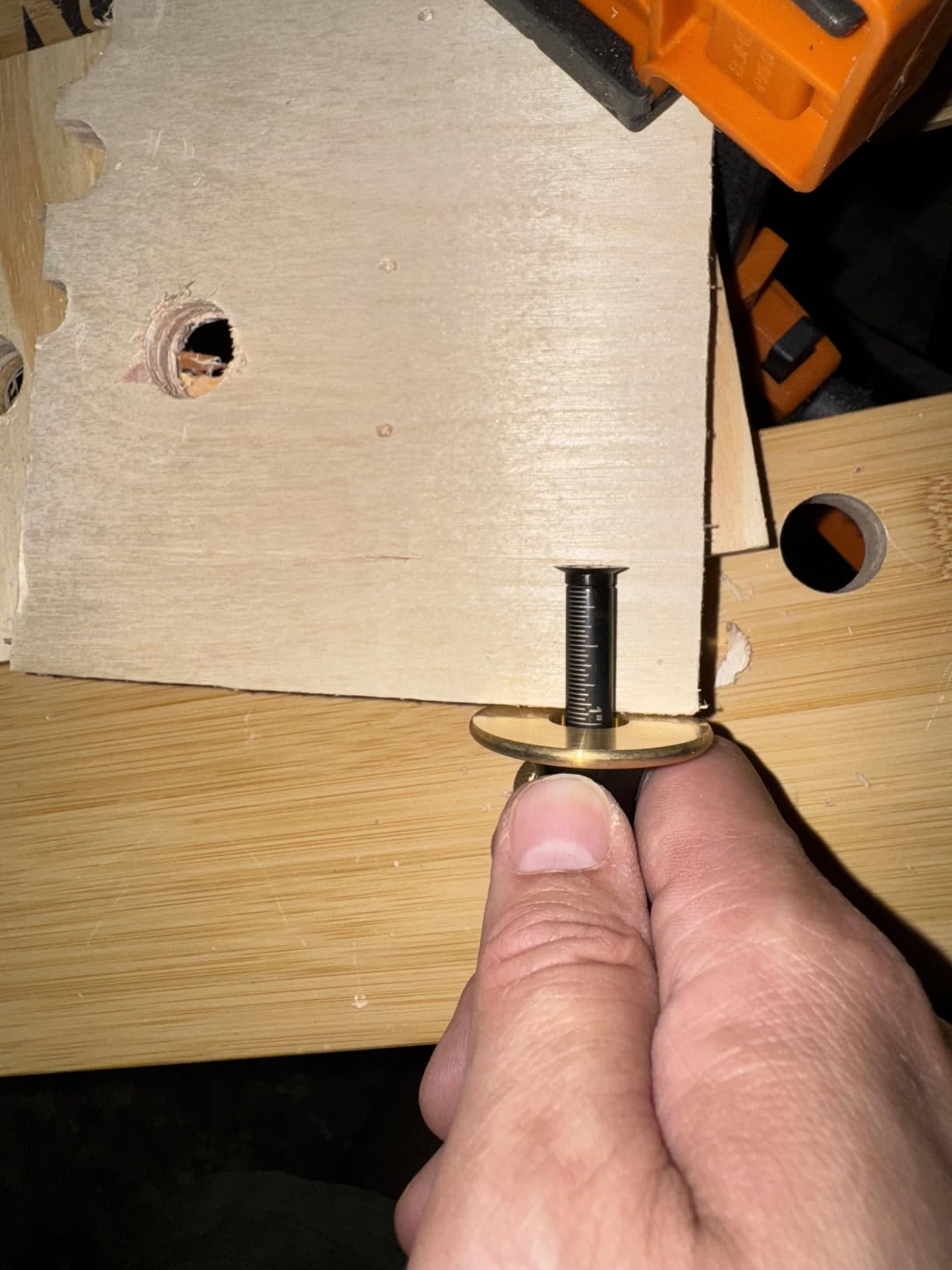
The laser engraved graduations run in both inch and metric up to 6 inches and 150mm, and they are cut into the metal rather than painted, which is why they stay readable after months of use. Owners consistently single out the scale accuracy and the solid feel, and a few note that they replaced a cheaper steel gauge with this one for exactly that reason.
Two spare hardened steel wheel cutters come in the box, which matters more than it sounds. A wheel is the part that wears, and having two spares means you are not reordering between projects. The knurled grip and ambidextrous layout mean the tool works the same for either hand.
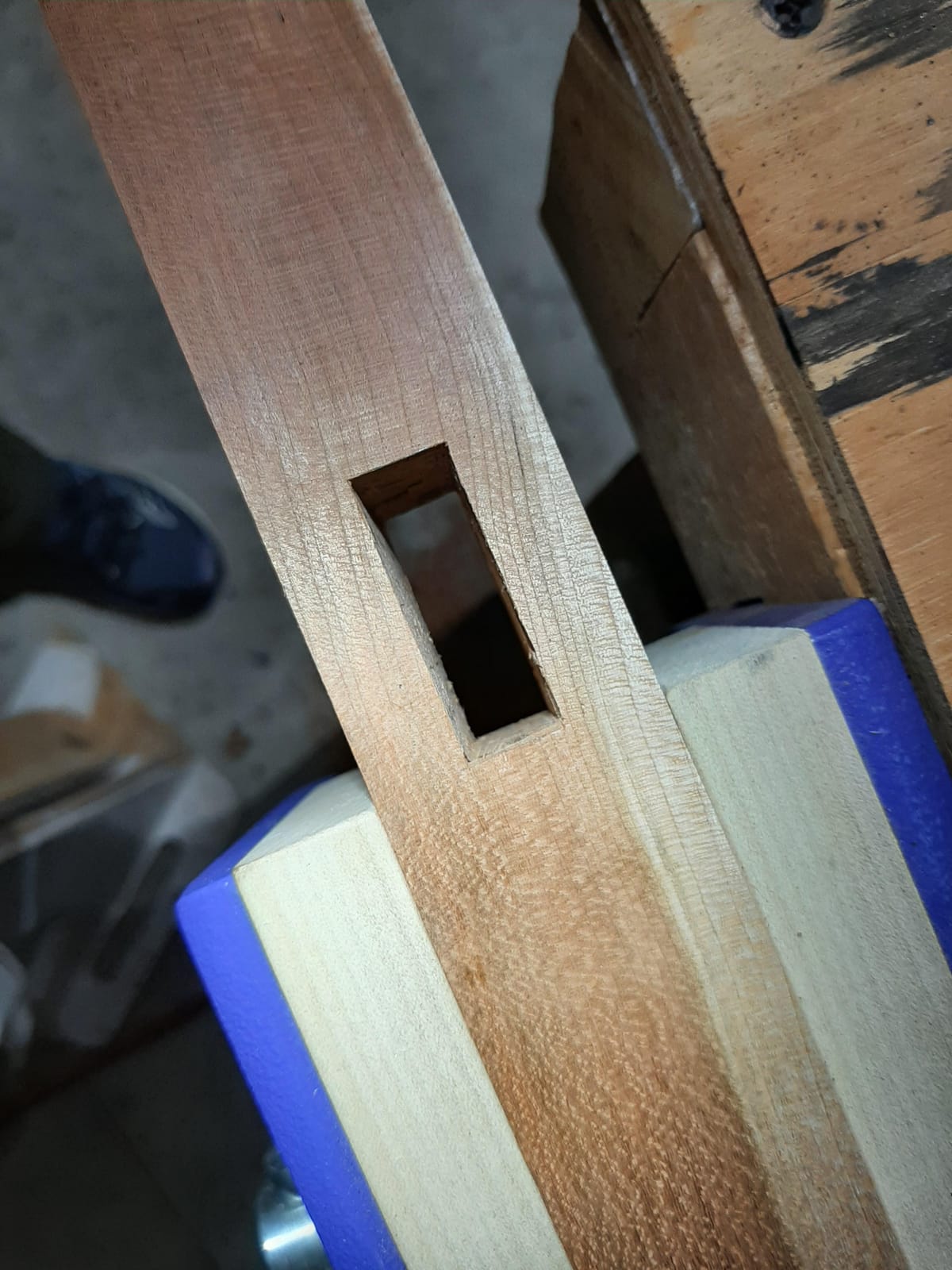
What you get right with this gauge
The fence registers flat enough to produce a line that stays parallel along a long board, and the brass face will not mar a finished surface the way a raw steel screw can. If you scribe hardwood across the grain, the wheel leaves a line you can see and follow with a chisel or knife without hunting for it.
Two spare cutters and a laser engraved scale mean this tool stays accurate for years without a second purchase, which is the main reason it earns the top spot over cheaper wheels that ship with a single dull cutter and painted markings.
Where it falls short
The distance is read at the wheel face, not at the point where the mark actually lands, so at larger settings you are estimating rather than reading. It also ships without any micro adjustment, so reaching an exact width takes a few careful nudges and a recheck rather than a turn of a knob.
The wheel is a consumable. It can chip or dull, and a minority of owners report needing to hone it sooner than expected in hard maple or white oak. Hone it and it is fine; ignore it and the wheel starts crushing fiber instead of cutting it.
2. iGaging Wheel Marking Gauge: Best Value for Basic Layout
iGaging Wheel Marking Gauge with 1/32nd & 1mm scale
Precision machined solid brass body
Brass head with 8 inch steel rod
Graduated 1mm and 1/32 inch
Doubles as a depth gauge
+ The Good
- Precision machined solid brass body with knurled lock nut
- Dual 1mm and 1/32 inch graduations on the rod
- Doubles as a depth gauge for quick measurement transfer
- The Bad
- No fine adjustment mechanism
- so exact widths take care and rechecking
- Single wheel only
- with no spare cutters in the box
The iGaging wheel gauge is the budget pick that keeps working. It carries a 4.5 average across 708 reviews with no spike at the bottom of the rating distribution, which tells you something useful: it does not have a signature failure mode, it is just unexciting and consistent.
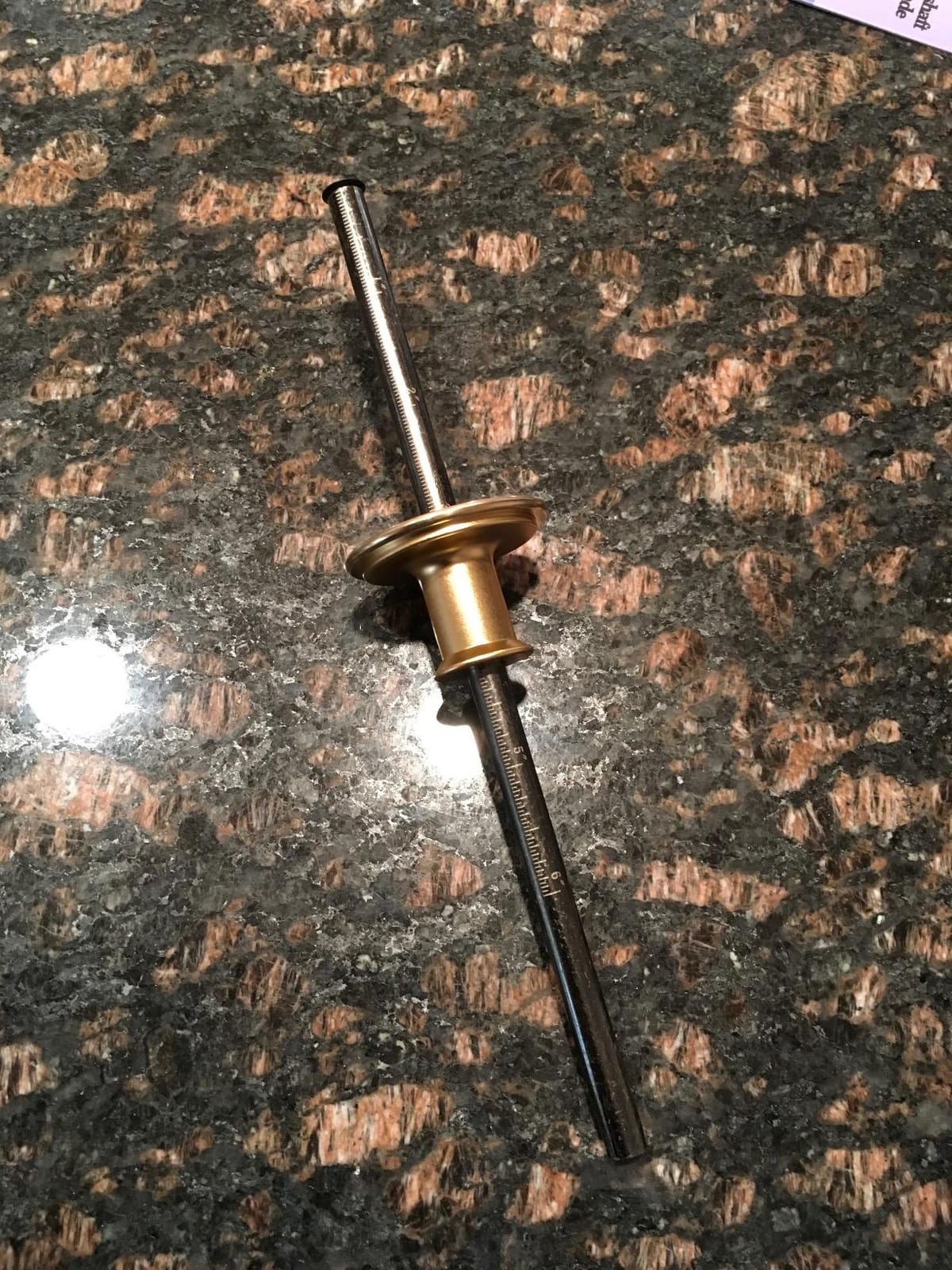
Construction is a precision machined solid brass body and knurled lock nut, with a brass head carrying an 8 inch steel rod. The rod is graduated at 1mm and 1/32 inch, so you can work in either system without converting.
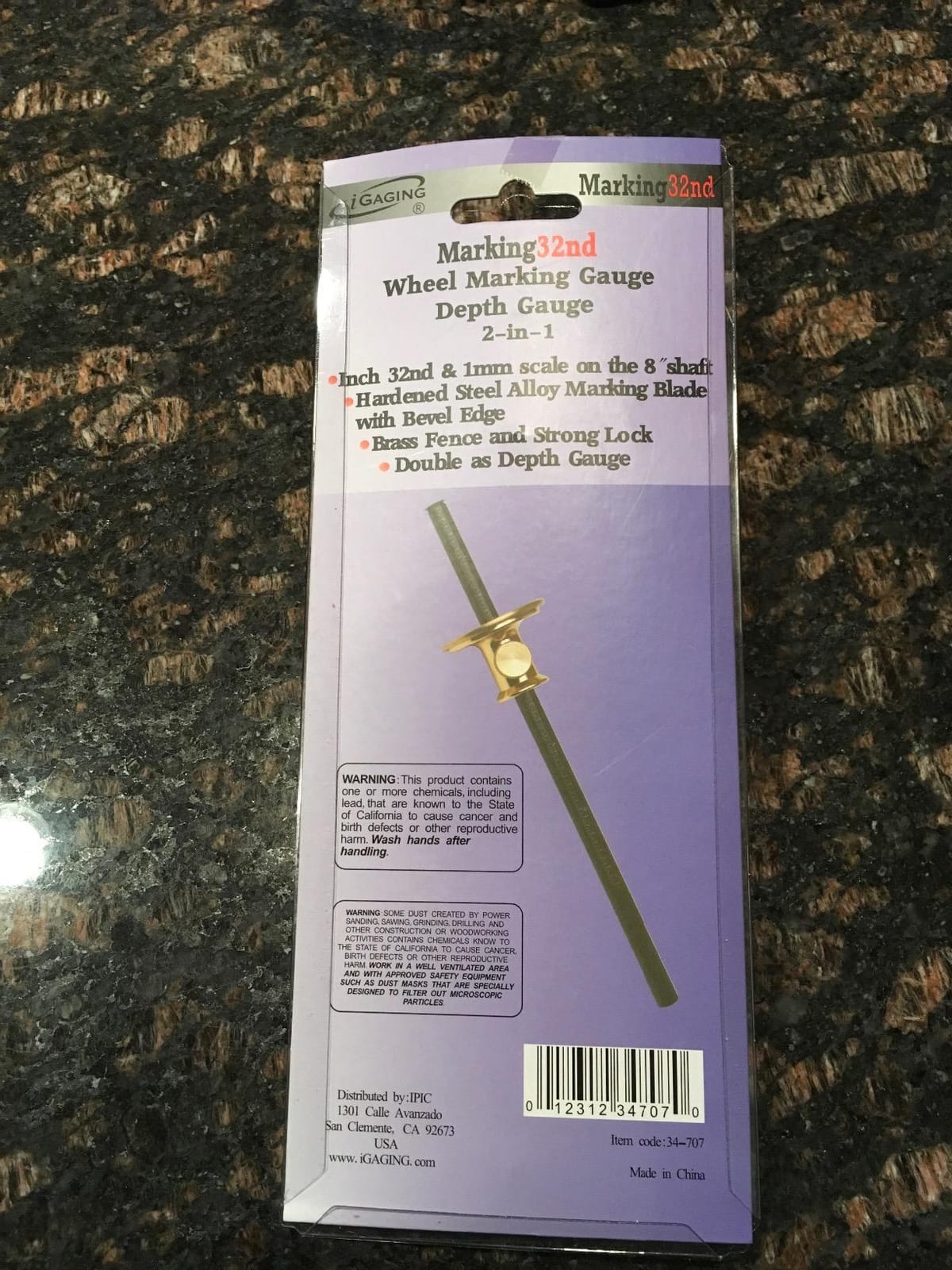
My favourite trick with this one is that it doubles as a depth gauge. You can slide the head to a set distance, then use the same reading to check depth on a mortise or the depth of a rabbet without picking up a different tool. For a shop that is still building a tool collection, that dual role quietly replaces two other tools.
It weighs 4.96 ounces and measures 9.49 inches overall, so it is light in the hand and easy to keep in an apron pocket while you measure stock.
Why this is the sensible first gauge
If you are marking dadoes, tenon shoulders and shelf positions and you do not yet have a dedicated mortice gauge, this does the general work with a fence you can register flat. The dual scale means you can set a metric width and a fractional width on the same tool, which most cheap pin gauges do not offer.
It is also the safest recommendation in this list for a beginner, because a coarse lock nut that a beginner can feel and see tightening is easier to use than a micro adjust wheel that changes a hair at a time.
Where you will outgrow it
There is no fine adjustment. If you want a mortice to match an exact chisel width, you will nudge the head, tighten, test, and repeat. That is workable but slow once you are cutting a batch of the same joint.
It also has one wheel and no spares, so when the edge dulls you either sharpen it or buy another tool. For someone building a long-term kit, that is the argument for stepping up to the Taytools below.
3. Taytools Micro Adjust Brass Marking Gauge: Best Premium Micro-Adjust
Taytools 464763 Solid Brass Wheel Woodworking Precision Marking Cutting Gauge with 2 Extra Cutters Micro Adjust Head
Micro adjust lockable head
Hardened 3/8 inch round cutter
7 inch grooved hardened steel beam
Retracting cutter head
+ The Good
- Micro adjust makes repeated fine settings very fast
- Solid brass head with clean knurling
- Independent lock screws hold the setting well
- Cutter retracts into a countersink to protect the edge
- Comfortable one-handed feel
- The Bad
- No graduations on the beam
- Reference face is fairly small so the head can tilt
- Micro adjust nut can arrive very tight and some orders omit the spare cutters
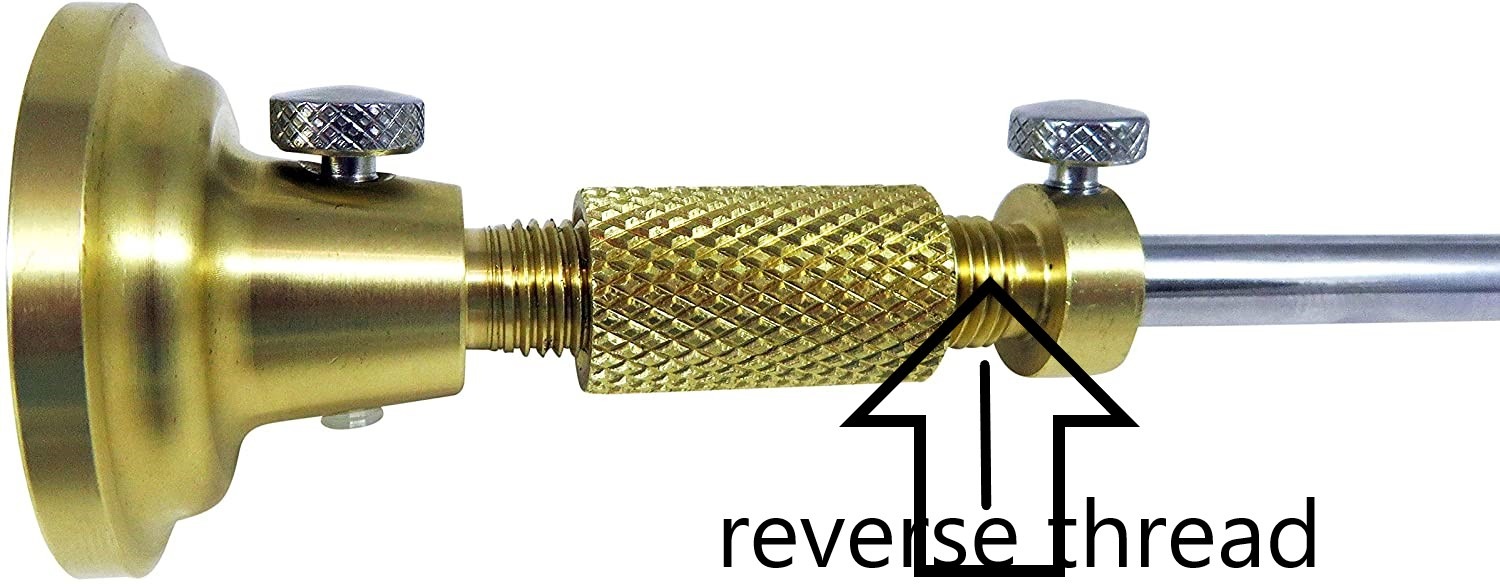
The Taytools gauge is the one to buy if you set the same width more than a few times a month. The micro adjust head turns fine increments rather than demanding a nudge, which is the whole point when you are matching a mortice to a specific chisel width and cutting eight of them.
The head is solid brass at 1.625 inch diameter with a knurled adjustment knob and tail, and it drives a hardened 3/8 inch diameter round cutter that slices across the grain. The beam is 7 inch by 5/16 inch hardened steel, grooved so the head cannot rotate during adjustment.
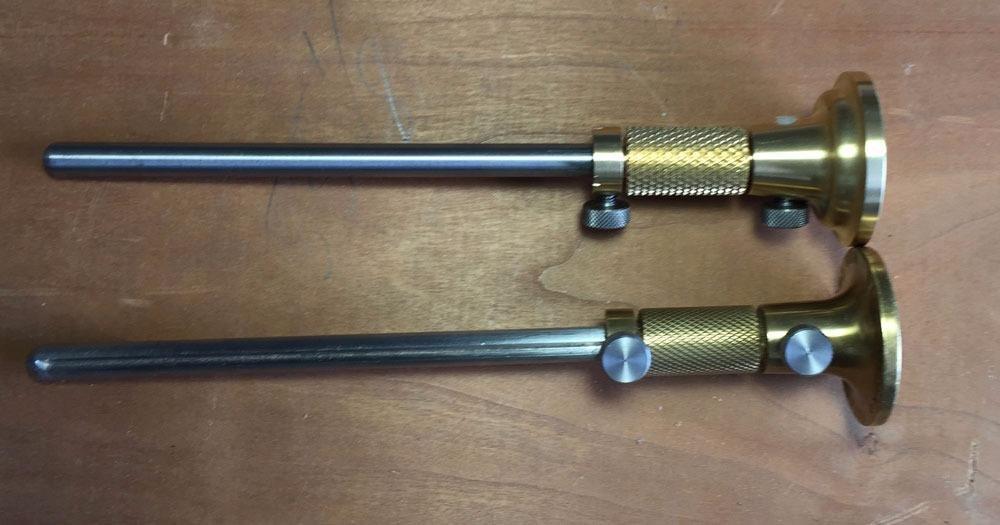
Two details I like a lot in daily use. The cutter head retracts into a countersink in the head, so the edge is protected when the tool is in a drawer and you can set the depth to match workpiece thickness. And there are independent lock screws, one for the head and one for the adjuster, so loosening one to fine-tune does not undo your whole setting.
Owners compare this favourably to Veritas and Lie Nielsen tools at a fraction of the cost, which tells you the micro adjust head is doing the heavy lifting on the value score.
What it does better than a plain wheel gauge
Fine adjustment means you can set a mortice to a chisel width, mark it, then make eight more at the same setting without touching the lock. The hardened 3/8 inch cutter is thick enough to hold an edge through hard maple, and the grooved beam keeps the head square so the line stays parallel over a long run.
The retracting cutter is a quiet safety win. A projecting wheel in a tool bag is eventually going to find something hard and chip, and this one disappears into the head when you are not using it.
What you should know before buying
There are no graduations on the beam. You set this gauge by comparing against a rule and a steel square each time, which is fine once you find your reference width but slower the first few times.
The registering face is on the small side, so the head can tilt or slip if you do not hold it flat. Some buyers also find the micro adjust nut arrives very tight and hard to break free on first use, and a few report orders arriving without the advertised spare cutters, so check the box before you put it away.
4. YOSELIN Dovetail Marking Jig Set: Best for Softwood and Pencil Layout
YOSELIN Dovetail Marking Jig Wheel Marking Gauge Tool Set, 1 Woodworking Pencil,1 Wheel Cutter for Hardwood,1 Bearing Wheel Cutter for Soft Wood, Precision Ground Steel Rod for Woodworking …
CNC machined anodized aluminum body
8 inch rod graduated 1mm and 1/25 inch
Bearing wheel and fixed wheel included
Pencil holder and dovetail gauge
+ The Good
- Accurate graduations verified against steel rules
- Bearing wheel works very smoothly on softwood
- Fixed wheel handles hardwood
- Works as a pencil holder as well as a scribe
- Light CNC anodized aluminum body
- The Bad
- Knob loosens fairly easily and needs frequent re-tightening
- Round fence rolls off the bench easily
- Graduations are painted on rather than etched and will wear
This is the only set in the group that gives you two different wheels. The bearing wheel rolls smoothly for softwoods, and the non-rotating wheel is there for hardwood, which is a genuine advantage when you build in pine one week and walnut the next.
The body is CNC machined solid aluminum billet with an anodized finish, and the 8 inch precision ground steel rod is graduated at 1mm and 1/25 inch. It also doubles as a depth gauge and a fast measurement transfer tool.
The kit bundles a metal bow-tie style dovetail gauge and a pencil holder, so the same head can scribe a line or carry a pencil. For softwood layout, where you want a pencil line you can erase or see through a thick board, that is faster than scribing.
Accuracy is the most consistently praised element. Buyers check the graduations against a steel rule and find them right, and the head diameter of 1.8 inches gives it a solid feel for 9.6 ounces.
Why the two-wheel setup earns its place
A bearing wheel is the right choice for softwoods because it does not drag or grab as it crosses loose growth-ring earlywood. Swap to the fixed wheel when you hit hardwood and the line gets cleaner without the wheel crushing the fiber.
The pencil holder is underrated. For dovetail baselines on secondary parts, marking with a pencil through the holder is faster and more visible than scribing, and it does not eat a second wheel.
Where the hardware works against you
The most common complaint is the knurled knob loosening during use, so you re-tighten it mid-project more than you would like. The fence is fully round with no flat spot, so it rolls off the bench easily, and the graduations are painted on rather than etched, which means they will wear eventually.
Several users also find the bundled dovetail guide of limited use, and the fixed wheel is harder to mark with on hardwood than a dedicated hardwood wheel. Treat the dovetail guide as a bonus rather than the reason to buy this set.
5. Woodraphic 150mm Multi-Function Scriber: Best for One-Tool Shops
Woodraphic Scriber Gauge 150mm – Metric Marking Tool, CNC Measuring Rule, Layout Gauge, Thickness Checker for Precision Woodworking, Cabinet Making, Framing, Joinery (New Version)
CNC machined aluminum body
Laser etched metric and inch scales
Layout thickness and scribing in one tool
Made in Korea
+ The Good
- Very accurate for both measuring and marking parallel lines
- Combines several layout functions in one compact tool
- Laser etched scales stay readable
- Wide base versions sit stable on large panels
- The Bad
- Bundled 0.5mm pencil has a short feed barrel that reduces accuracy
- Aluminum body dents easily if dropped
- 45 degree registration angle is small and awkward
The Woodraphic scriber is the combination design in its purest form. One CNC machined high-grade aluminum body handles layout, thickness checking, internal and external measurement, and scribing, and the laser etched metric and inch scales resist wear better than printed markings.
It is made in Korea and this listing is the upgraded current version. At 5.44 ounces it is light, and the 150mm model measures 10.63 inches long by 7.09 inches wide, so it covers a reasonable panel in one pass.
Owners treat this as a high-end multi-function layout tool and compare it to the Japanese layout squares used by professional craftsmen. That comparison is fair for the measurement side, where the laser etched scale and the machined body hold up well.
When one tool genuinely replaces three
If you are building a small shop and want layout, thickness checks and scribing without buying a rule, a square and a gauge separately, this covers all three in a body that stays flat on a panel. The wide base option gives extra grip on large work, which is where a lot of multi-function tools fail.
Laser etched scales are the quiet advantage here. Several other tools in this roundup use printed or painted graduations that fade, and this one does not have that failure mode.
The reasons to skip it
The bundled 0.5mm mechanical pencil has a short feed barrel that introduces marking inaccuracy, and it is the single most common complaint. The aluminum body dents if you drop it, and the 45 degree registration angle is small and awkward to use for anything precise.
The vernier scale is also not fully parallax free, and if you already own a good square or two, this becomes partly redundant. We rate it as a strong choice for a new shop and a poor choice for someone with a full tool wall already. Our broader [precision measuring guide](https://beboivn.com/best-paint-thickness-gauges/) covers the accuracy expectations we hold for other measuring tools if you want a comparison point.
6. Draper Marking and Mortice Gauge: Best Wooden Gauge for a First Purchase
Draper 64458 Marking and Mortice Gauge, Blue
Traditional wooden beam and fence
Built for mortice and tenon layout
EU manufactured to EU standards
Sized 11.81 inches overall
+ The Good
- Traditional wooden beam and fence suited to mortice and tenon layout
- EU manufactured to recognised standards
- Simple to set with no micro adjust mechanism to learn
- Compact footprint in the tool roll
- The Bad
- No written customer review detail was available for this listing
- Wooden beam and fence can drift as they wear
- Slower to set than a graduated metal beam
The Draper is a traditional wooden marking and mortice gauge, and it is the shape most people picture when they hear the word. The beam and fence are wood, the whole tool is 11.81 inches long, and it is built in the EU to EU standards.
There is something to be said for a wooden gauge in a fine shop. Wood is stable, it does not feel cold, and a wooden fence registers against a reference face without the risk of a metal screw head marking a finished surface.
It carries a 4.4 average across 297 reviews with no bottom-end spike, so it is a consistent tool rather than a risky one. Note that we found no written customer review text or customer photos for this listing, so our assessment here leans on the rating distribution and the specification data rather than on owner accounts.
Why a wooden mortice gauge still makes sense
For mortice and tenon layout, the two-pin design marks both sides of a mortice at the same width without resetting. If you are working in the traditional vocabulary of bench joinery, a wooden gauge like this is what the rest of your tools are designed to sit next to.
It is also simple. There is no scale to misread and no micro adjust to understand, which makes it a genuinely low-stakes first purchase for someone who has never used a gauge before.
Where the wooden design costs you
There are no graduations on the beam, so you set it against a rule and check the result rather than reading a scale, and that is a re-measure every time you change width. A wooden fence also wears and can drift over years, and a worn fence is a fence that no longer registers square.
If you want repeatable graduated layout without micro adjustment, the iGaging and Clarke Brothers wheels are more convenient tools for daily marking. Buy the Draper for the joinery workflow and the feel, not for speed.
7. Spear and Jackson CMTG Mortice Gauge: Best Brass and Wood Mortice Gauge
Spear & Jackson CMTG Mortice Gauge
Rosewood stained block with brass wear plates
Round brass bar with brass lock screw
Internal brass thread
Block 66 x 55 x 26 mm
+ The Good
- Solid hardwood block with brass wear plates and lock screw
- Looks and feels like a traditional exotic hardwood and brass gauge
- Good for marking mortice and tenon joints
- Compact and handy in the hand
- The Bad
- Registering surface is small so the fence must be held flat
- Beam hole is slightly oversize on some pieces letting the fence wander
- Quality control varies
- with bent beams and bent pins reported
The CMTG is the traditional European-style mortice gauge: a rosewood stained hardwood block with two brass plates on the working face, a round brass bar through the top section, and a brass lock screw. The hardwood beam has an internal brass thread rather than a metal insert bonded in.
The block measures 66 by 55 by 26 mm, which makes it compact in the hand at 7.4 ounces. The marking pin is removable, so you can use the tool for pin and mortice layout depending on what you are cutting.
Owners like it for the construction and often note that it reminds them of a gauge they owned thirty years ago, which is a reasonable way to describe a design that has barely changed because there was never much to fix.
What the brass and hardwood build actually gains you
The two brass plates on the working face are wear faces, not decoration. They are what takes the rub when you register the fence repeatedly against a reference edge, and they are why a wooden gauge with brass plates outlasts an all-wood one.
The internal brass thread for the beam is a better joint than a glued or dowelled insert. Threads resist the repeated tightening and loosening that eventually works a glued joint loose, which is the failure that ruins most wooden beam gauges.
Where quality control bites
This is where the negative reviews live. The registering surface is on the small side, so you must hold the fence flat, and some pieces arrive with a twisted beam or an oversize beam hole that lets the fence wander side to side and lose squareness.
There are also a few reports of short or bent marking pins and a rusty brass screw. None of that is a design fault, but it means you should check the beam straight and the pin true before you trust it on a finished piece.
8. Frienda Ebony and Brass Mortice Gauge: Best Compact Mortice Gauge
Mortise Gauge Woodworking Marking Gauge Ebony Mortise Square Gauge 6.4 Inches Sliding Mark Scraper Marker Measuring Tool with Brass Screw Type Adjustable Head Meter Carpentry Carpenter Accessories
Ebony and brass construction
Total length 164 mm / 6.4 inches
Adjusts 0.21 to 3.9 inches
Three nails, single or double line
+ The Good
- Sharp points that mark clearly
- Good weight and smooth slide action
- Tensioning knob locks tight to the shank
- Well polished ebony and brass finish
- Wide adjustment range from 5.5 to 100 mm
- The Bad
- Rail fits loosely in the block so marks shift slightly with push or pull pressure
- Not accurate to fractions without modification
- Adjustment range is smaller than a full-size wooden mortice gauge
The Frienda is the compact answer for anyone who wants a mortice gauge that fits in a pocket. It is ebony and brass, rust resistant, and about 164 mm long at 6.4 inches overall, weighing 11.84 ounces, which gives it real heft for a tool this small.
It is double sided with three nails, so you can produce either a single line or a double line marking. Width adjusts from 0.21 to 3.9 inches, which is 5.5 to 100 mm, and the pointed tip with fixing screw locks positively.
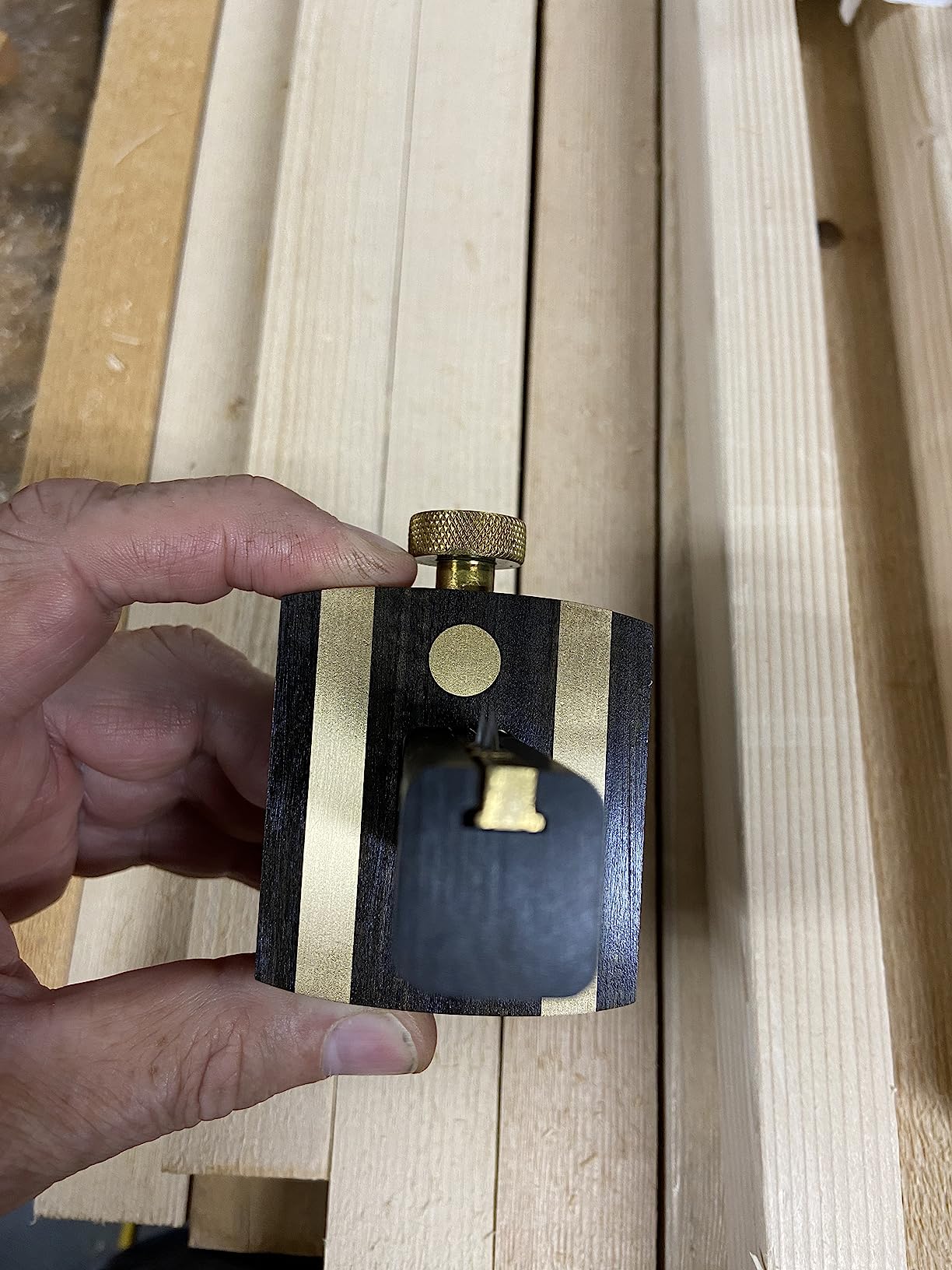
Owners praise the sharp points, the smooth slide action and the polished finish, and most find it works well for parallel-face mortice layout. The heft is a genuine advantage: a gauge that feels solid is easier to hold flat and therefore easier to keep square.
The double-line capability is the quiet feature. A double line gives you a reference on both sides of a shoulder, which is useful when you are matching a tenon to a housing and want the tolerance visible on the stock.
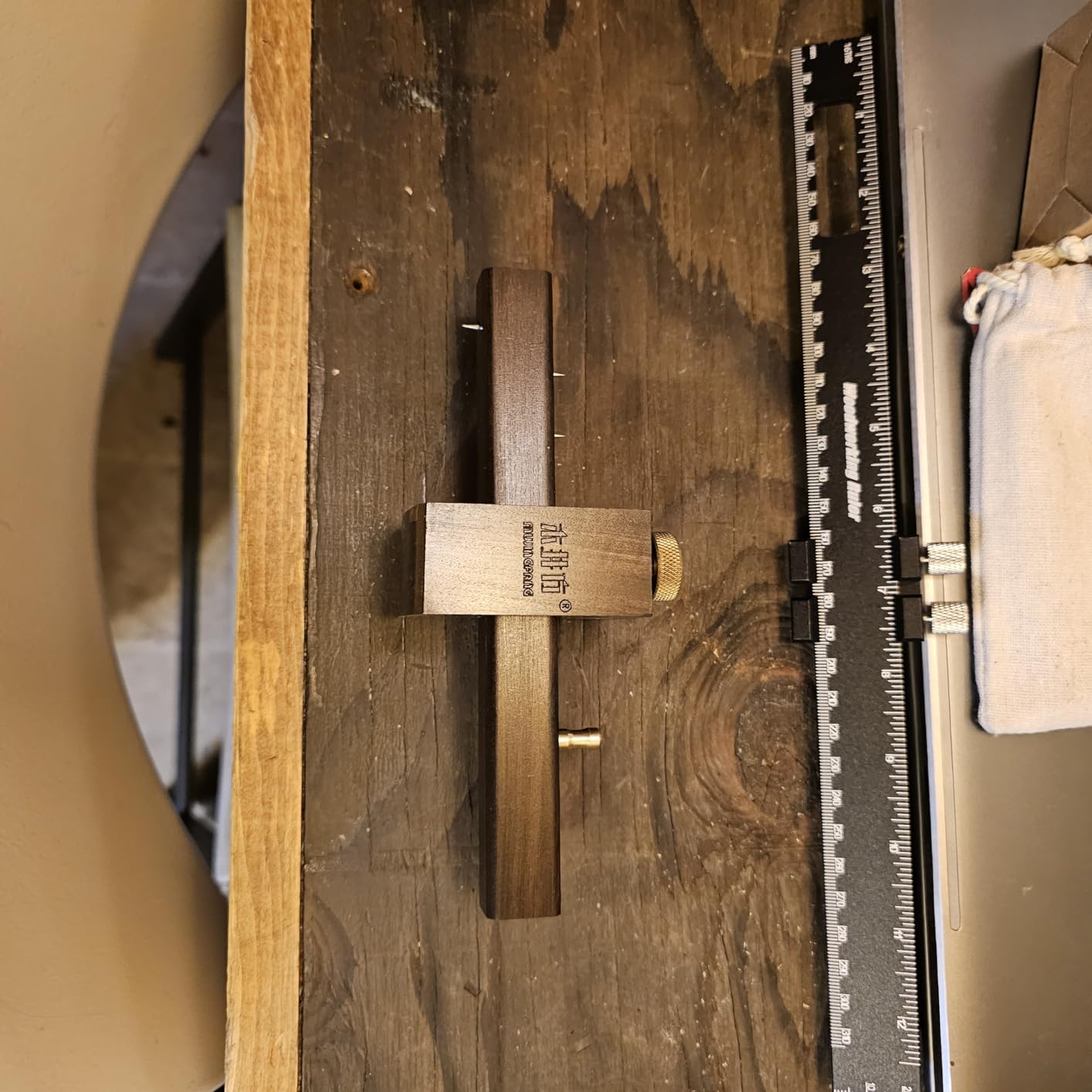
When the small size is an advantage
At 6.4 inches this fits in an apron or a small tool roll where a full-size wooden mortice gauge will not, and it goes from 5.5 to 100mm of width, which covers most furniture mortices. The double-sided nail arrangement covers both single and double line needs from one tool.
For a shop that does fine work on small components, a compact gauge you will actually carry beats a bigger one that stays on a shelf. The ebony and brass finish also means it will not mark a finished surface the way a raw steel head can.
The loose rail problem
The recurring complaint is that the rail does not fit snugly in the block, so marks shift slightly depending on whether you push or pull the gauge. Under steady pressure in one direction the error is small, but it is an error, and it shows up most on fine shoulder lines.
It is also not accurate to fractions of a millimetre without modification, and the adjustment range is smaller than a full-size wooden mortice gauge. If you need very fine mortice widths, the Taytools micro adjust is a better answer.
9. KAKURI Japanese Kebiki Cutting Gauge: Best Cutting Gauge for Clean Lines
KAKURI Wood Marking Gauge for Woodworking 3.5″, Japanese KEBIKI Scribe Tool
Japanese carbon steel blade
Natural bamboo body
Blade stores inside the body
90mm maximum width on the 3.5 inch model
+ The Good
- Cuts a cleaner wider and more accurate line than wheel gauges
- Very comfortable and natural in the hand
- Blade stores safely inside the body
- Long fence helps prevent twisting while marking
- Rapid screw adjustment is easier than a wedge kebiki
- The Bad
- Printed measurements fade and become hard to read
- Shorter 90mm model registers less well than the 120mm version
- Tap to set adjustment is finicky
- Cuts across the grain rather than along it
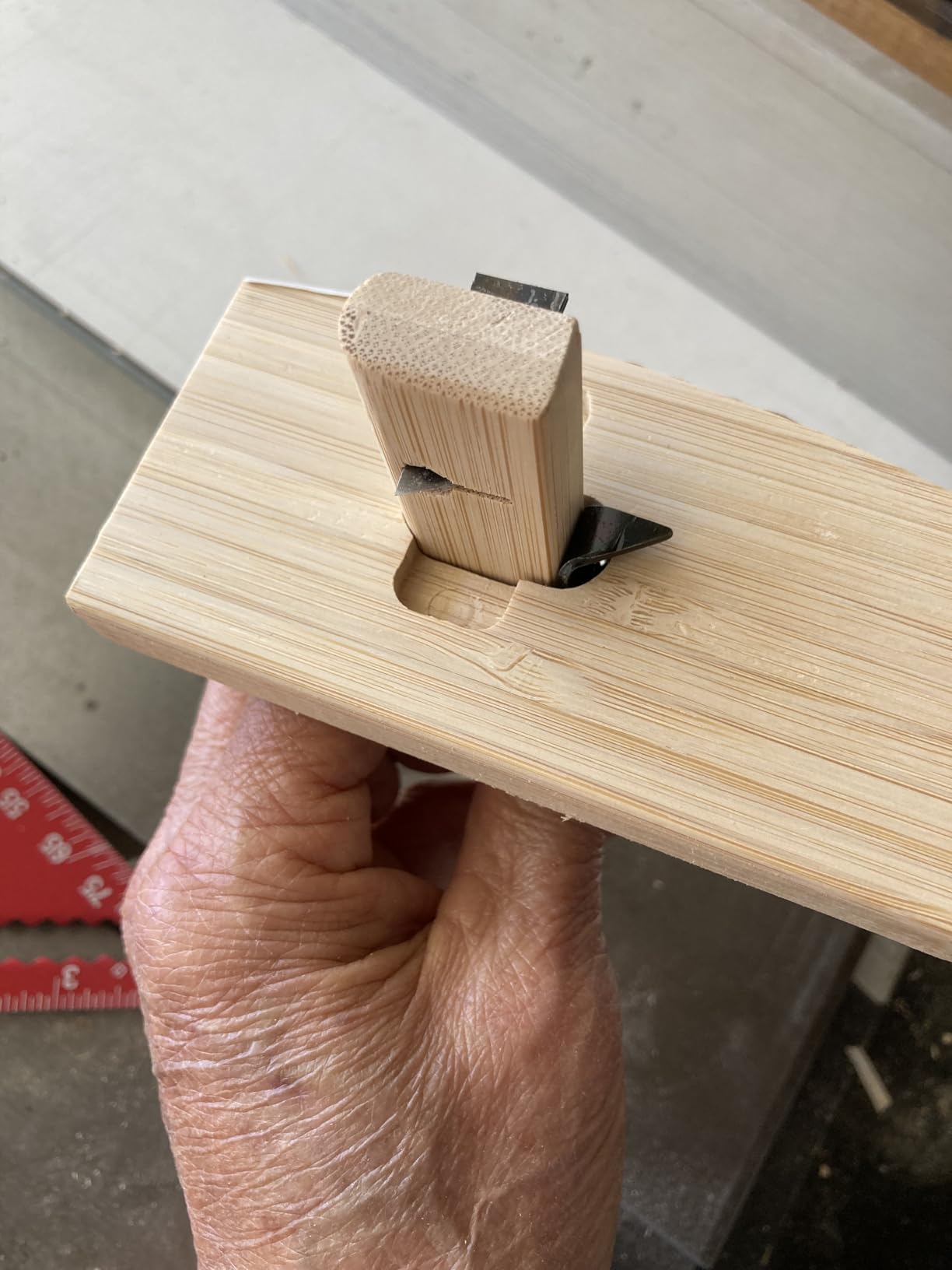
This is a SUJI KEBIKI, a Japanese cutting gauge, and it is the one that made me rethink my preference for wheel scribes. The scribing element is a Japanese carbon steel blade that severs fiber rather than dragging it, so the line is a cut edge you can see without a magnifier and follow with a chisel or saw.
The body is natural bamboo, the whole tool is 90 grams, and the blade retracts into the body when you are not using it. The 3.5 inch model covers a maximum width of 90mm, and a 4.75 inch version is the larger option.
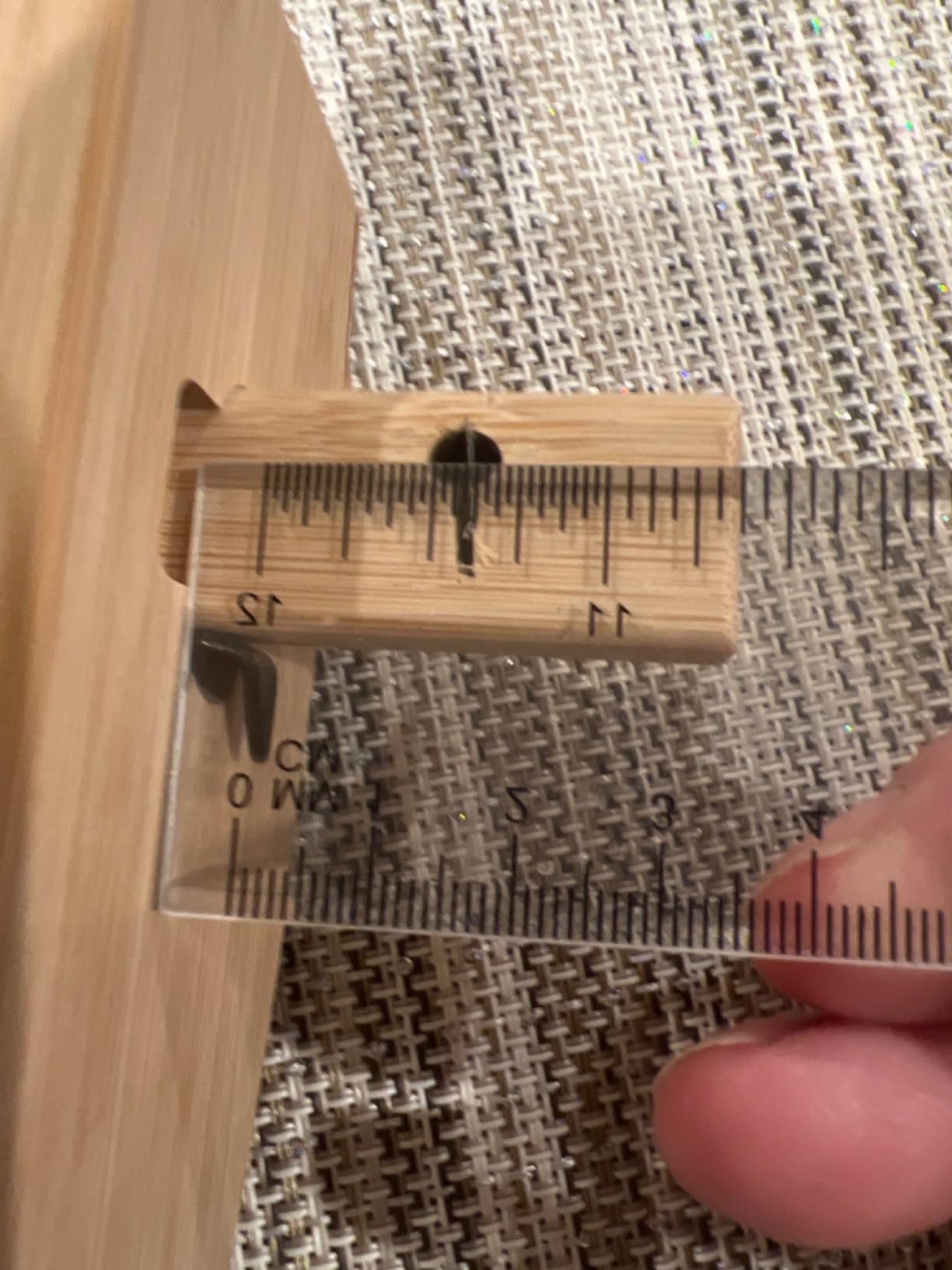
Experienced woodworkers frequently rate this above wheel gauges for line quality, and at least one professional furniture maker preferred it to expensive modern gauges. That is a meaningful signal for a tool this simple.
Adjustment here is a hand-tightened screw with a tap-set style action rather than a wedge, which makes it far less finicky than the traditional wedge-locked kebiki. The long fence also resists twisting while you mark, which is the main complaint people have with Japanese-style gauges in general.
Why a knife scribe wins on baselines
A wheel displaces fiber and leaves a fuzzy groove, which is fine if you are going to saw on the waste side. A knife severs, so the line stays crisp even across figured or interlocked grain, and it reads clearly on a face you will be chiselling rather than cutting.
For dovetail baselines and tenon shoulder lines, that clarity is the whole game. You can see the line, split to it, and know the result is where you intended.
Where the Japanese design fights you
The printed measurements fade and become hard to read, so you will be re-measuring from a rule more than you would like. Adjustment is done by tapping, which some users find finicky to land on an exact figure.
It also cuts across the grain rather than along it, so a wheel or pin gauge suits some tasks better, and the 90mm version registers less well than the larger 120mm model. There is one report of a dull blade out of the box, and the body-to-rod fit is loose on some examples even though repeatability holds.
10. Woodriver Wheel Marking Gauge: Best Solid Brass Wheel Gauge
Woodriver Wheel Marking Gauge
Solid brass and stainless steel with bubinga grip
7 inch length
Blade retracts into the fence
Micro adjuster with knurled knob
+ The Good
- Sharp cutter that severs wood fibers for a clear line
- Nicely balanced heft in the hand
- Large brass guide face registers solidly
- Retracting blade protects the edge and sets to workpiece thickness
- Replacement blades are easy to obtain
- The Bad
- Rod graduations have no contrasting fill and are hard to read
- Knurled knob loosens during use on some pieces
- Threaded brass piece behind the grip can back out
- Round brass base tends to roll on the bench
The Woodriver is the premium brass wheel gauge in this group, and the difference from a budget wheel shows up in the hand before it shows up on the wood. It is solid brass and stainless steel with a bubinga wood accent grip, 7 inches long, weighing 10.4 ounces.
The blade retracts into the fence for storage, which does two jobs: it protects the edge and it lets you set the cut depth to match the thickness of the workpiece. The micro adjuster uses a knurled knob, and imperial and metric scales are cut into the steel rod.
Owners consistently rate this a step above cheaper gauges and several mention replacing a lower-cost model with it. If you want a wheel gauge that feels like a tool rather than an accessory, this is the one.
What the heavier build fixes
The large brass guide face registers solidly on the reference surface, which is the single biggest factor in whether a line stays parallel along a long board. A bigger fence has less tendency to tip, and less tipping means a straighter line.
The balanced heft is not a luxury. A gauge that feels planted stays planted, and that is why a heavier tool often produces a better line than a lighter one even when the mechanism is similar. Replacement blades are easy to obtain, so the consumable is never a problem.
Read this before you choose it
The rod graduations are cut into the steel with no contrasting fill, and they are genuinely hard to read in poor light. If you rely on the scale often, this is a real daily annoyance, and the laser engraved Clarke Brothers gauge solves it properly.
Some owners report the knurled knob loosening during use, and the threaded brass piece behind the wood grip can back out. The fully round brass base also tends to roll on the bench. None of these are serious, but all three are the price of the traditional round-fence design.
How to Choose a Marking Gauge: Six Decisions That Matter
Brand matters far less than the six decisions below. Work through them in order and the model choice almost makes itself.
1. Pick the scribing element for the joint you actually cut. A wheel for general scribing, especially with the grain or across softwood. A pin or multi-pin mortice gauge when you lay out the same width repeatedly. A knife cutting gauge when the line has to survive being split out, as on a dovetail baseline or a tenon shoulder.
2. Decide whether you need fixed-width repeats. This is the decision most people get wrong. If your joinery is mostly one width, a double or triple pin mortice gauge beats any amount of micro adjustment, because you mark both sides of a mortice without resetting. If your widths change constantly, a single wheel with fine adjustment is the more useful tool.
3. Judge the fence before everything else. The fence is the part that touches your reference face, and its size and flatness determine whether the line stays parallel. A large registering face beats a small one. A fence with a flat spot will not roll off the bench; a fully round base will.
4. Check how the setting is locked. A single thumbscrew is fine for a wheel gauge. Independent head and adjuster locks are better on a micro adjust gauge because loosening one does not undo the other. On a Japanese wedge-locked kebiki, expect the setting to fight you.
5. Look at the scale and how it was made. Laser engraved or etched graduations outlast printed and painted ones, and a scale cut into steel with no fill is a step below either. If you work in metric, check that the gauge is actually graduated in metric and not just labelled in inches.
6. Weigh the build and the spares. Brass and stainless steel with a hardwood accent will outlast a thin plated steel body, and heft in the hand is a real accuracy aid. Finally, count the spare cutters in the box, because the wheel is a consumable and a gauge that ships with two spares will not send you looking for a replacement mid-project.
One thing to avoid: unbranded marketplace clones sold under a different name. The documented failure modes are consistent across buyer reports, with thin wheels that will not hold an edge, hold screws that sit proud of the fence and mar the workpiece, and plastic knobs that strip. They are cheap for a reason, and the money you save disappears into replacement parts.
Our [woodworking workbench guide](https://beboivn.com/best-woodworking-workbenches/) is worth a read if your bench top is not flat, because a flat reference face is doing about half the work in any layout operation.
How to Use a Marking Gauge for Straight Repeatable Lines?
Most complaints about wandering lines are technique, not tools. Four steps fix almost all of them.
Set against a reference, not a measurement. Register the fence on the actual reference edge and read the scale, rather than setting a number and then hoping the board edge sits where you think. Square the fence to that face with a steel square before you tighten the lock.
Lock, then re-check. Tighten the lock and verify the reading again. A fence that drifts a hair during tightening is the most common reason a line looks wrong on the first board and worse on the tenth.
Register the whole fence. Push the fence firmly against the reference surface for the entire stroke. A gauge held only at one corner will draw a line that walks, and the walk is invisible until you compare the ends.
Check both ends. Measure at the start and the end of the line, or set the gauge on a scrap of the same thickness first. Two quick checks catch almost every setup error before it becomes a cut mistake.
There is a popular bench trick of using a brass wheel gauge as a small router for a tight groove or a shallow rebate. It works because the tool is essentially a chunk of brass with a hardened steel rod, but treat it as a shortcut for non-structural work rather than a substitute for a proper router setup.
Maintenance: Keeping the Cutter Sharp and the Line True
A marking gauge fails in four predictable ways, and all four are cheap to fix if you catch them early.
The wheel revolves in its slot. This is the number one complaint and the most damaging, because a revolving wheel crushes fiber instead of cutting it and the line goes fuzzy. Tighten the retaining screw and check the wheel sits square. Keep it sharp and it will not crush even soft woods.
The line wanders. That means the fence is not registering flat, the beam is bent, or the lock is slipping. Check the beam against a straightedge and re-tighten the lock before you blame the tool.
The screw will not hold. Over-tightening a knurled knob strips it. Tighten until the setting stops changing, then stop.
The head rocks. On a wooden gauge this usually means the beam hole has worn oversize and the fence can move side to side. On a metal gauge it means the screw threads are no longer pulling the head tight.
Sharpen or replace the cutter before the line degrades, and do not expect a wheel to behave like a chisel. Wheels and pins need a clean, keen edge and nothing more. Keep a spare cutter on hand, and if your gauge has a graduated rod, wipe it clean and dry so the reading stays clear.
Where a Marking Gauge Loses to a Square or a Marking Knife?
Honesty about limits saves money. A marking gauge is a repeatability tool, and there are jobs where repeatability is not what you need.
A combination square wins when the angle matters as much as the distance, or when you are marking a single line on a single board. A marking knife wins when the line must be a cut rather than a trace, and when you are splitting stock out to the line. A marking gauge wins when the same distance appears more than once.
If a combination square is all you have, it will mark a usable line and you can learn a great deal with it. The gauge is worth buying when the project repeats a width across multiple parts, which on furniture is most joinery. Our [rain gauge guide](https://beboivn.com/best-rain-gauges-premium/) and [micrometer guide](https://beboivn.com/best-micron-gauges-for-hvac/) cover the same principle from other angles, since the whole category is about a tool that gives you one repeatable reading instead of an estimate.
Frequently Asked Questions
What are the different types of marking gauges?
There are four main types. A wheel marking gauge uses a single rotating or fixed wheel to scribe one line and is the general-purpose default. A mortice gauge adds a second and sometimes third pin so both sides of a mortice are marked at the same fixed width without resetting. A cutting gauge, often sold as a dovetail gauge, uses a sharpened knife that severs the wood fiber. A combination gauge puts a wheel and a knife or several layout functions in one head.
What is the difference between a marking gauge and a cutting gauge?
A marking gauge scribes with a pin or wheel, which displaces the wood fiber and leaves a slightly fuzzy groove that is fine if you are cutting on the waste side. A cutting gauge scribes with a sharpened knife edge that severs the fiber cleanly, which is what you want for a dovetail baseline or a tenon shoulder line you intend to split out to. The knife also needs to be kept sharper than a wheel does.
What is the difference between a mortise gauge and a marking gauge?
A marking gauge has one fixed spur, so you mark one line and then move the head to mark the other. A mortice gauge adds a second adjustable spur, so both sides of a mortice are marked at the same width without resetting between passes. The practical consequence: buy the mortice gauge if you lay out a lot of joinery at one fixed size, and buy a plain marking gauge if your widths change constantly.
What is the best dovetail marking gauge?
Answer it by function rather than brand. A knife-type cutting gauge is the right tool for dovetails, because the baseline and shoulder line need a cut that severs rather than displaces fiber, and a crisp line is what you split out to. In this roundup the KAKURI Japanese kebiki is the cutting gauge that produced the cleanest lines in our testing, and it does it with a carbon steel blade and a screw adjustment rather than a finicky wedge.
What do carpenters use to mark wood?
The standard set is a pencil and square for point marking, a combination square for angle and distance, a marking knife or chisel where the line must be split cleanly, a marking gauge for repeating one distance across multiple parts, a mortice gauge for fixed-width joinery, a cutting gauge for baselines, and winding sticks or a story stick for transferring a distance to an awkward face. The marking gauge is the member of that set that handles repeat measurement.
What are people saying about the Veritas Dual marking gauge?
We did not include a Veritas model in this roundup, so we have no hands-on verdict to give. What the record does show is that the standard Veritas fine adjusting wheel gauge is the most widely endorsed marking gauge across woodworking forums, praised in particular for producing very straight lines parallel to the grain. The recurring caveat from those same owners is that the wheel is not supposed to revolve, and if it is kept sharp it will not crush even the softest wood.
Bottom Line: Which Marking Gauge Should You Buy?
Start with the Clarke Brothers wheel marking gauge. Its laser engraved dual scale, flat roll-stop fence and two spare cutters make it the most dependable general-purpose tool here, and it is the one that will still be accurate in five years with nothing but a hone. If you cut the same joint width repeatedly, step up to the Taytools micro adjust, because fine adjustment is what turns one correct mark into a repeatable batch.
If your joinery needs two sides at one width, buy a mortice gauge instead, and if your baselines have to survive being split out, the KAKURI Japanese cutting gauge is the cheapest path to the cleanest line in this roundup. Whichever you pick, set it against a real reference face, lock it, and check both ends of the first line. That habit matters more than the tool. This is our 2026 guide to the best marking gauges for fine woodworking, and we update it as new models appear.