
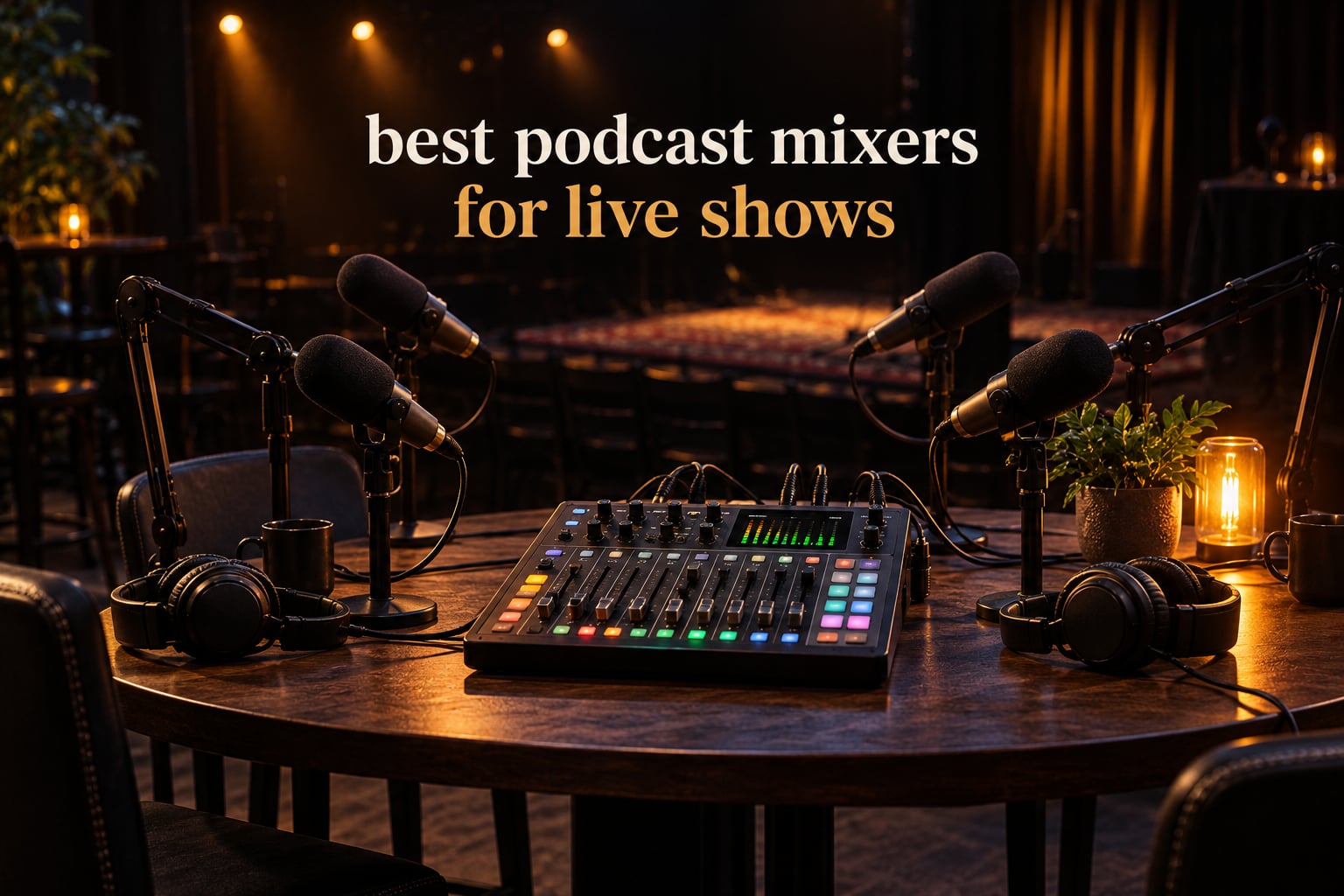
A live show has no second take. Nobody in the audience can hear your room tone, but they absolutely hear a muddy vocal, a clipped laugh, or a dead headphone mix on one host while the show is running. That single fact changes how you shop for a podcast mixer. When you are recording at a desk, the deciding factor is usually features. When you are playing a room, the deciding factors are headroom, how many headphone mixes you can hand out, whether the unit keeps recording when the computer dies, and how fast you can get from a stand-up set to a panel with four mics.
That is why the best podcast mixers for live shows are not always the ones with the longest feature lists. Some of the most capable consoles in this roundup record nothing at all beyond a stereo mix. Some of the cheapest record every voice on its own track. Both categories have a place on a stage, and the honest answer depends on what kind of show you take on the road.
We compared eight podcast mixers and live-recording consoles across four things that decide how a rig behaves in front of an audience: preamp headroom, per-host monitoring, what happens when the show feeds a PA and a stream at the same time, and how many backup recordings are captured when something goes wrong. Two of them carry their own multitrack recorders. Two are analog consoles that have been on stages for decades. The rest sit in between, and the middle is where most live podcasters actually land.
If you are still choosing microphones, start with our best podcast microphones guide before you touch a mixer. The console cannot fix a bad capsule choice, and matching a condenser to a room with no treatment produces problems that no amount of gain staging will solve.
Top 3 Picks for Live Podcast Mixers in October 2026
The short version: the RØDECaster Pro II is the most complete single-box rig we tested for live use, the Yamaha MG10XU is the console that keeps working year after year on a tour calendar, and the Zoom PodTrak P4 does more than you expect from something its size.
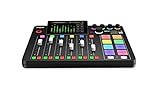
Rode Rodecaster Pro II
- › 4 XLR inputs with 4 headphone outputs
- › 8 SMART pads with mix-minus calling
- › Multitrack to SD and USB
- › APHEX voice processing

Yamaha MG10XU
- › 4 mic preamps with D-PRE design
- › One-knob compressors on two channels
- › 24-bit class-compliant USB
- › SPX effects and monitor out

Zoom PodTrak P4
- › 4 XLR inputs with 4 headphone outputs
- › Automatic mix-minus
- › 6 sound pads with multitrack SD
- › 2 AA battery power
All 8 Podcast Mixers Compared in October 2026
Every console below has at least one thing that matters in a live room. Two capture individual tracks to removable media, three keep a multitrack session safe from a computer crash, and the rest win on gain, on metal, or on the price of entry.
| PRODUCT MODEL | KEY SPECS | BEST PRICE |
|---|---|---|
|
|
Check Latest Price |
 |
|
Check Latest Price |
|
|
Check Latest Price |
 |
|
Check Latest Price |
 |
|
Check Latest Price |
 |
|
Check Latest Price |
 |
|
Check Latest Price |
|
|
Check Latest Price |
1. RØDECaster Pro II Review: the most complete single-box rig for a live room
RØDE RØDECaster Pro II All-in-One Audio Production Studio
4 XLR inputs
4 headphone outputs
76 dB noise
2 kg
2 year warranty
+ The Good
- Four studio-grade preamps handle dynamic mics such as the SM7B without a cloud lifter
- APHEX processing adds EQ and compression in a single tap
- Eight SMART pads fire music and effects from the show itself
- Records multitrack to computer or SD card and works standalone
- Metal faders and a fast touchscreen with individual headphone control
- The Bad
- Steep learning curve for beginners
- Bluetooth audio can drop and adds noticeable latency
- Desktop-sized and heavy so touring is awkward
Four XLR inputs, four headphone outputs, eight SMART pads and a multitrack recorder live in one box, and every one of those features earns its place during a show rather than in a spec sheet. The preamps are the headline for stage work because they have enough gain to run a dynamic microphone like an SM7B without an inline booster, which removes one more box between you and a clean vocal in a room with no treatment.
The APHEX processing chain is the second reason this console suits a live audience. One tap applies EQ, compression, a noise gate and a de-esser, so the sound of a host is consistent between the studio version of the show and the version played in a bar with a fridge humming behind it.
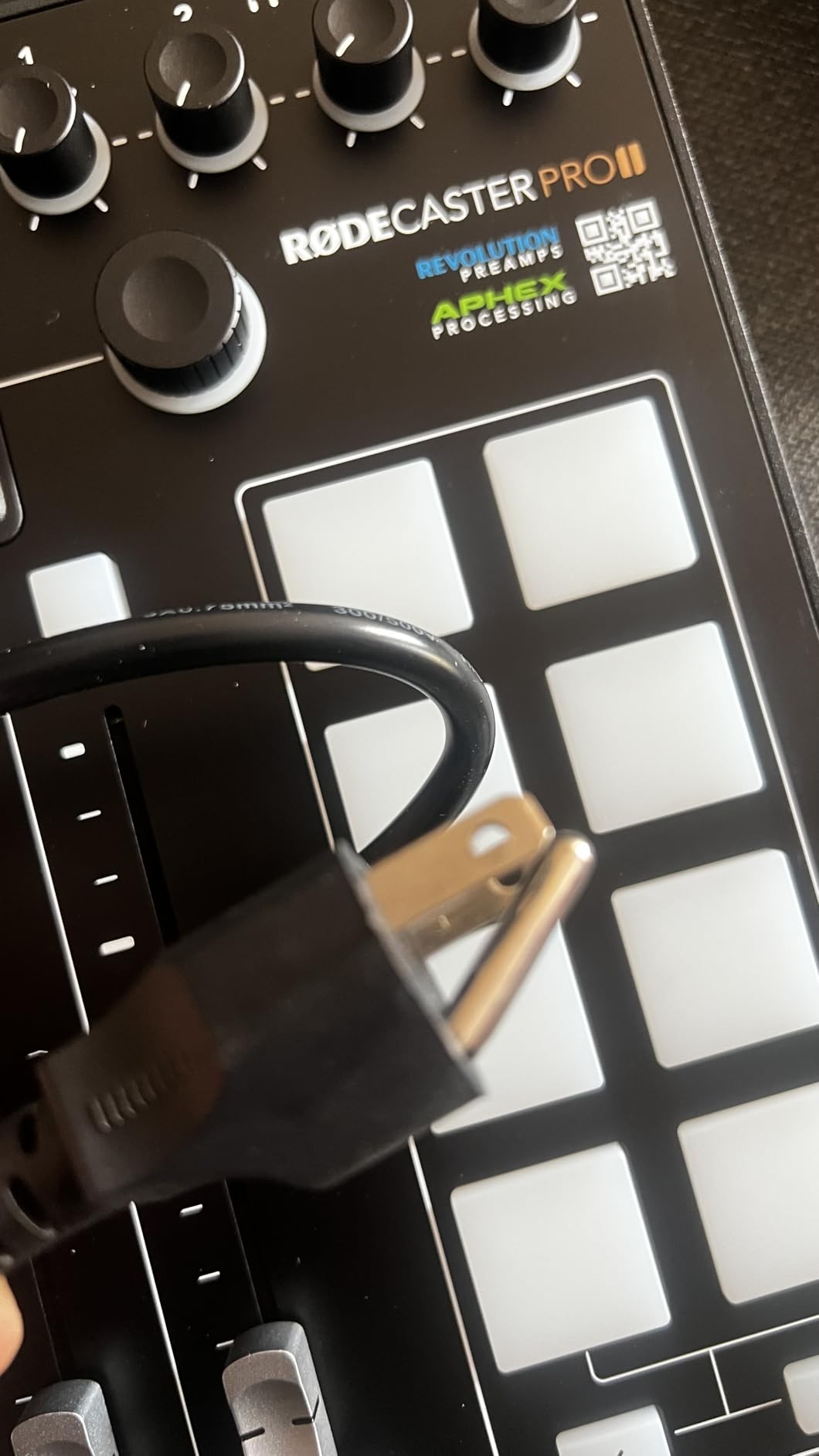
Owners working multiple hosts mention that the individual headphone control is what makes a four-person panel workable. Each person gets their own level, and with the pads you can duck a music bed or fire an intro without asking a producer to touch a mouse. That is the difference between a live show that feels produced and one that feels like four people sharing a laptop.
The recording story matters just as much. Multitrack files can go to a computer, a microSD card or a USB drive, and the unit records without a computer connected at all. If the streaming laptop hangs twenty minutes into a set, the SD session is already there and the show keeps moving.
Where the RØDECaster Pro II earns its place on a stage
This is the console to buy when your show format changes week to week. A duo recording with pads on one night and a four-host panel with mix-minus phone calls on the next can be handled without a computer operator, and the touchscreen is fast enough to make those changes between segments rather than during them.
It also handles a hybrid show well, accepting microphones, phones, Bluetooth sources and two USB-C computer connections at once, which means the room feed and the stream feed can live on the same hardware.
Where it will frustrate you
The learning curve is real. Beginners need a session with the device before a paying audience is watching, and the depth of the menu is the reason some people bounce. Syncing a multitrack session into editing software is also described as poorly documented.
At 2 kg it is a desktop unit, not a backpack item, and reviewers note that the Bluetooth path can drop or add noticeable latency, so keep a wired fallback for phone guests.
2. TASCAM Mixcast 4 Review: the most pad-heavy console in the lineup
TASCAM Mixcast 4 Podcast Streaming Mixer, Recorder, and USB Audio Interface — Four XLR/TRS Mic Inputs, Touch Screen and Editing Software Included
4 XLR/TRS inputs
4 headphone outs
14-track SD
2550 g
1 year warranty
+ The Good
- Four XLR mic inputs with four individual headphone outputs
- Eight banks of illuminated customizable sound pads
- 14-track recording direct to SD card
- Bluetooth input plus an Aux input with mix-minus
- Bundled Podcast Editor handles track arming and pad assignment
- The Bad
- Onboard effects and editing are limited for serious post work
- Large mains-powered desktop footprint
- Touch panel takes practice for live control
Eight banks of illuminated sound pads is more triggering surface than any other console here, and for a live show that plays beds, stingers and crowd-reaction clips, that surface area is the whole point. The pads light up, which means the person operating the desk can find a sound in a dark room without guessing.
Underneath, it is a serious recorder. Four XLR or TRS mic inputs feed four individual headphone outputs, and the unit writes 14 tracks straight to SD, so each speaker lands on a separate file even if the show ends badly.
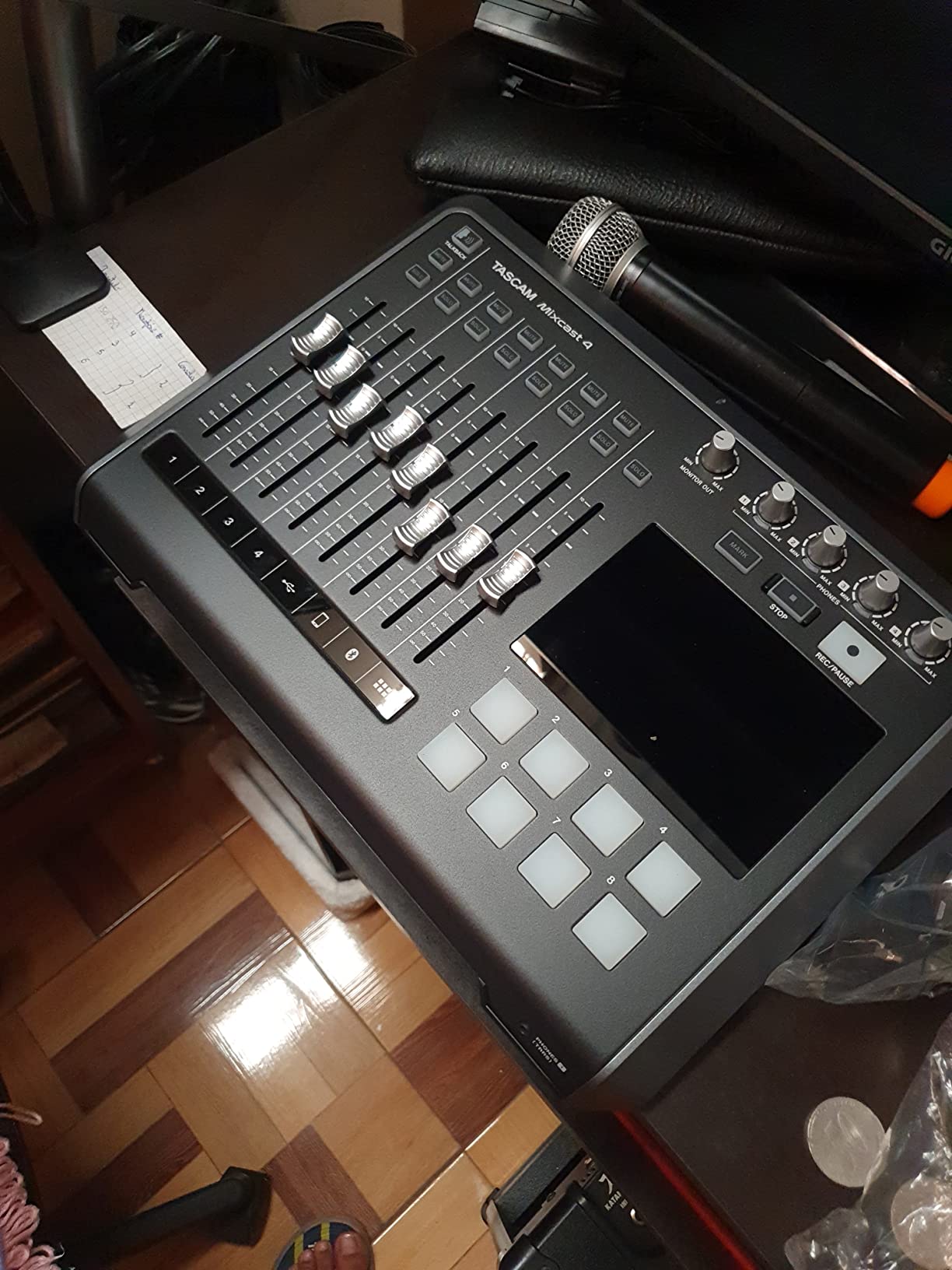
The phone-guest path is well handled. Bluetooth covers a wireless source, and the Aux input includes mix-minus, so a caller in a phone interview does not hear themselves echoed back. For a comedy club show where someone joins by phone mid-segment, that feature removes the single most common live-show audio mistake.
USB connectivity lets a computer contribute sounds, which covers walk-on music and any asset your streaming software wants to trigger.
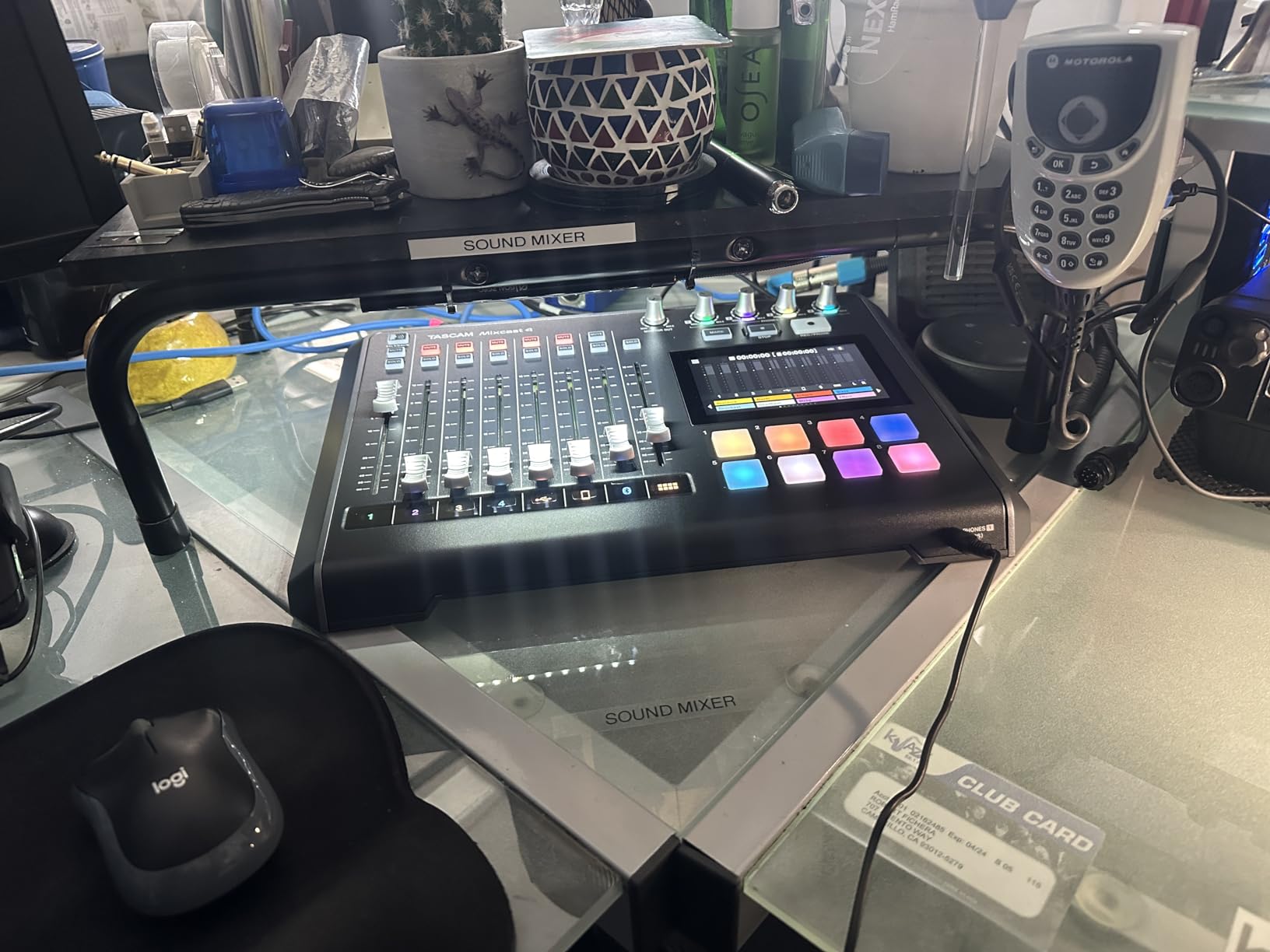
What makes it a strong live-show pick
The combination of four headphone outputs, mix-minus and a physical pad grid is built for an operator who is not also a software engineer. Reviewers describe the touch panel as low-friction once you learn it, with settings that stay put between shows.
Recording to SD while streaming to a computer means the audience gets a feed and you still keep an isolated master of every voice.
Where it falls short
At 2550 g this is a mains-powered desktop box with a wide footprint, so it needs a real table and a real power outlet. A venue with one cramped hospitality table is going to make you reconsider.
The onboard effects and editing are deliberately modest. Serious post work happens in a DAW using the bundled Podcast Editor, and the touch workflow does need practice before you run it live in front of a room.
3. Zoom PodTrak P4 Review: the best-rated unit here and the one you can carry anywhere
Zoom PodTrak P4 Podcast Recorder with 4 XLR Mic Inputs, 4 Headphone Outputs, Phone & USB Input for Remote Interviews, Sound Pads, 2-In/2-Out USB Audio Interface, Battery Powered
4 XLR inputs
4 headphone outputs
70 dB gain
130 g
1 year warranty
+ The Good
- Four XLR inputs with four separate headphone outputs
- About 70dB of clean preamp gain for dynamic mics
- Automatic mix-minus plus a TRRS jack for call-ins
- Records every input and the four pads to separate tracks
- Genuinely portable at 130 g
- The Bad
- AA battery runtime is short so USB power is needed
- Light plastic build needs careful handling
- No compressor or EQ beyond low-cut and limiting
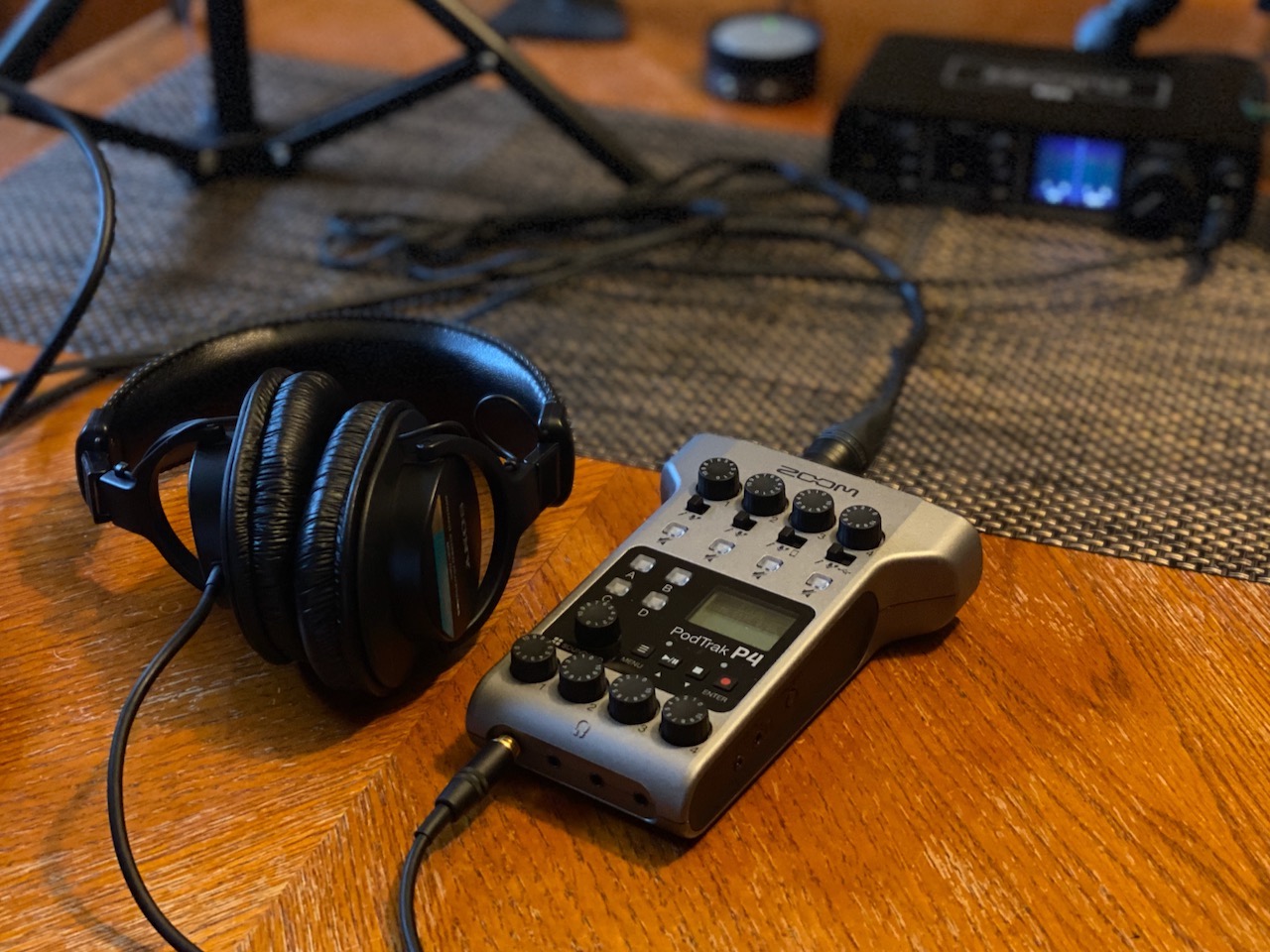
The PodTrak P4 carries the highest average rating in this group and the second-largest review count, and the reason is that it does three jobs in a very small box: a four-channel mixer, an interview recorder, and a two-in two-out USB interface. For a live show recorded on location rather than in a permanent room, that is exactly the trade you want.
About 70dB of preamp gain is enough for dynamic microphones such as an SM58 or an SM57 without a cloud lifter, and the four headphone outputs each have their own volume control, which is the feature that lets four people monitor comfortably on a panel show.
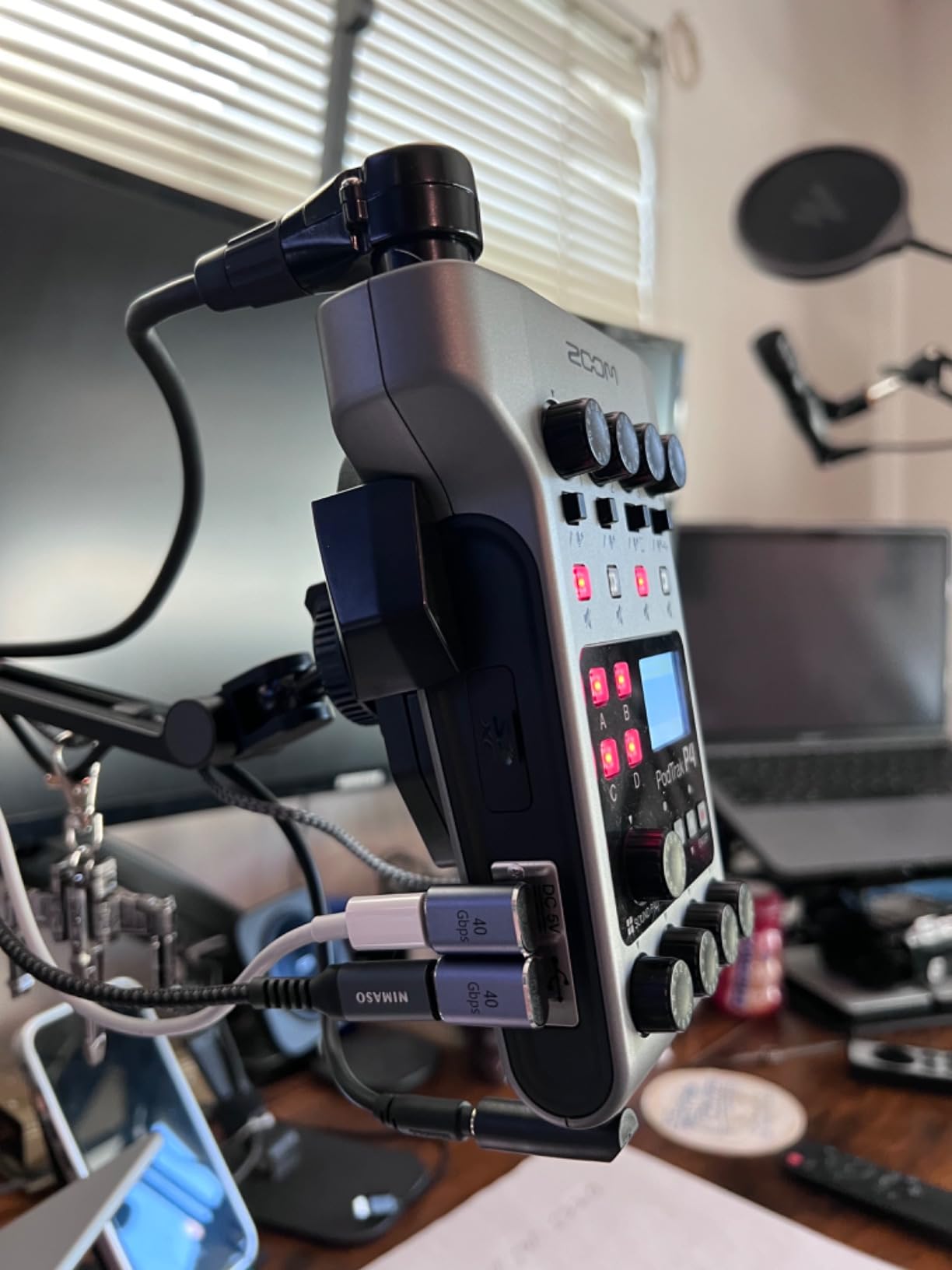
The recording model is the one that surprises people. Each input and each of the four sound pads is captured to its own track on SD, so a badly balanced laugh at the top of the show can be fixed in post instead of living in the master forever. Forum regulars describe the P4 as not technically a mixer but doing everything a mixer does.
Automatic mix-minus plus a TRRS jack means a phone guest joins cleanly, and the USB interface mode lets it act as a normal audio interface when you are back at the desk.
Why it suits touring and small rooms
At 130 g it fits in a backpack with the microphones, and the icon-labeled layout means a guest host can be handed the unit and follow it without training. That matters when the show is recorded somewhere new every week.
The SD workflow is also the safest capture path in this roundup. Nothing depends on a laptop staying awake, which is the failure mode forum users describe most often in live recordings.
Where it stops short
Two AA batteries last up to 3.5 hours, which is shorter than most sets with music and an audience. Plan on USB power or a small power bank, and carry spare cells as a backup.
There is no compressor or EQ beyond low-cut and limiting, recording is 16-bit at 44.1kHz, and the lightweight plastic body does not enjoy being carried in a case with heavy gear around it. The pre-installed pad clips are also described as forgettable, so plan to load your own.
4. Zoom LiveTrak L-8 Review: the best choice when a band joins the podcast
Zoom LiveTrak L-8 Battery Powered Mixer/Recorder for Musicians & Podcasters
6 mic preamps
12 tracks at 24-bit/96kHz
4 headphone outs
1500 g
+ The Good
- Captures 12 tracks simultaneously at 24-bit/96kHz to SD
- Six preamps with a -121dBu noise floor and up to +54dB of gain
- Three-band EQ and onboard effects on every channel
- Four headphone outputs feeding three custom monitor mixes
- Records to SD and to a computer over USB at the same time
- The Bad
- Six mic preamps is tight for four dynamic mics plus instruments
- Compact screen takes practice during a live show
- Battery life is modest for long sets
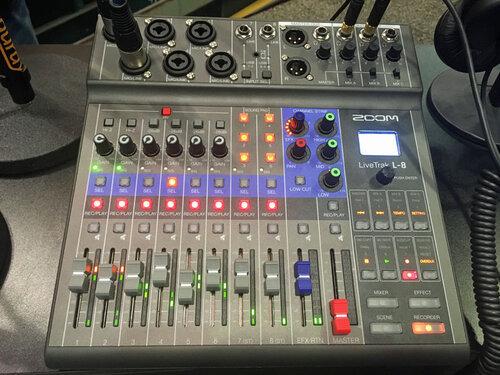
The L-8 sits in the middle of the Zoom range and answers a different question from the P4: what if the live show includes instruments? Twelve tracks recorded simultaneously at 24-bit and 96kHz direct to SD means a guitar, a bass and two voices all exist as separate files, which is the difference between a usable multitrack and a stereo blob you can never edit.
Signal quality is a genuine step up. Six preamps with a -121dBu noise floor and up to +54dB of gain leave real headroom, and every channel carries a three-band EQ and onboard effects, so you can tame a bright room without a laptop.
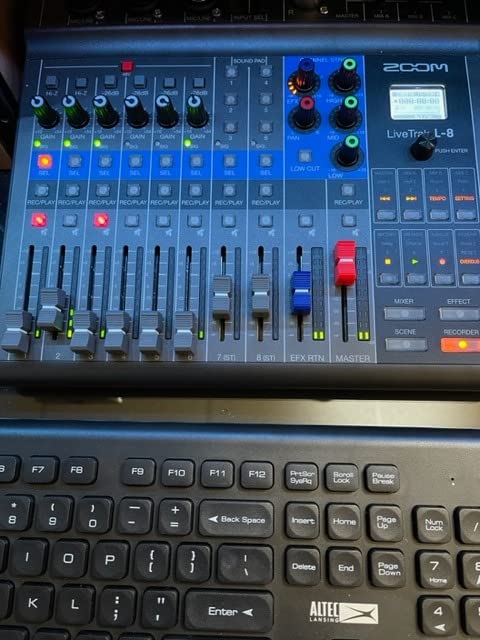
Monitoring is where this console outshines most podcast gear. Four headphone outputs feed three independent custom monitor mixes, so a drummer can hear more of the click, a host can hear themselves without the click, and a producer can have a different blend again, all at the same time.
It records to the SD card and to a computer over USB at once, which is the redundancy pattern a live show wants: two destinations, one show.
When the L-8 is the right stage box
It runs on batteries and at 1500 g it moves between a rehearsal room, a small venue and a remote session without a road case full of extras. Reviewers consistently describe it as the bridge between podcasting and live performance work, and that is precisely the brief when a house band plays under a talk show.
The high sample rate and per-channel files mean the show can be edited properly afterward, which a stereo mix can never support.
Where it disappoints
Six mic preamps is the hard limit. Four dynamic microphones for hosts plus instruments leaves you short, and reviewers who run larger podcast lineups feel the ceiling immediately.
The screen and controls are compact, so finding a setting mid-show takes practice. Battery life is modest for long sets, and phantom power plus SD writing both pull hard from the cells.
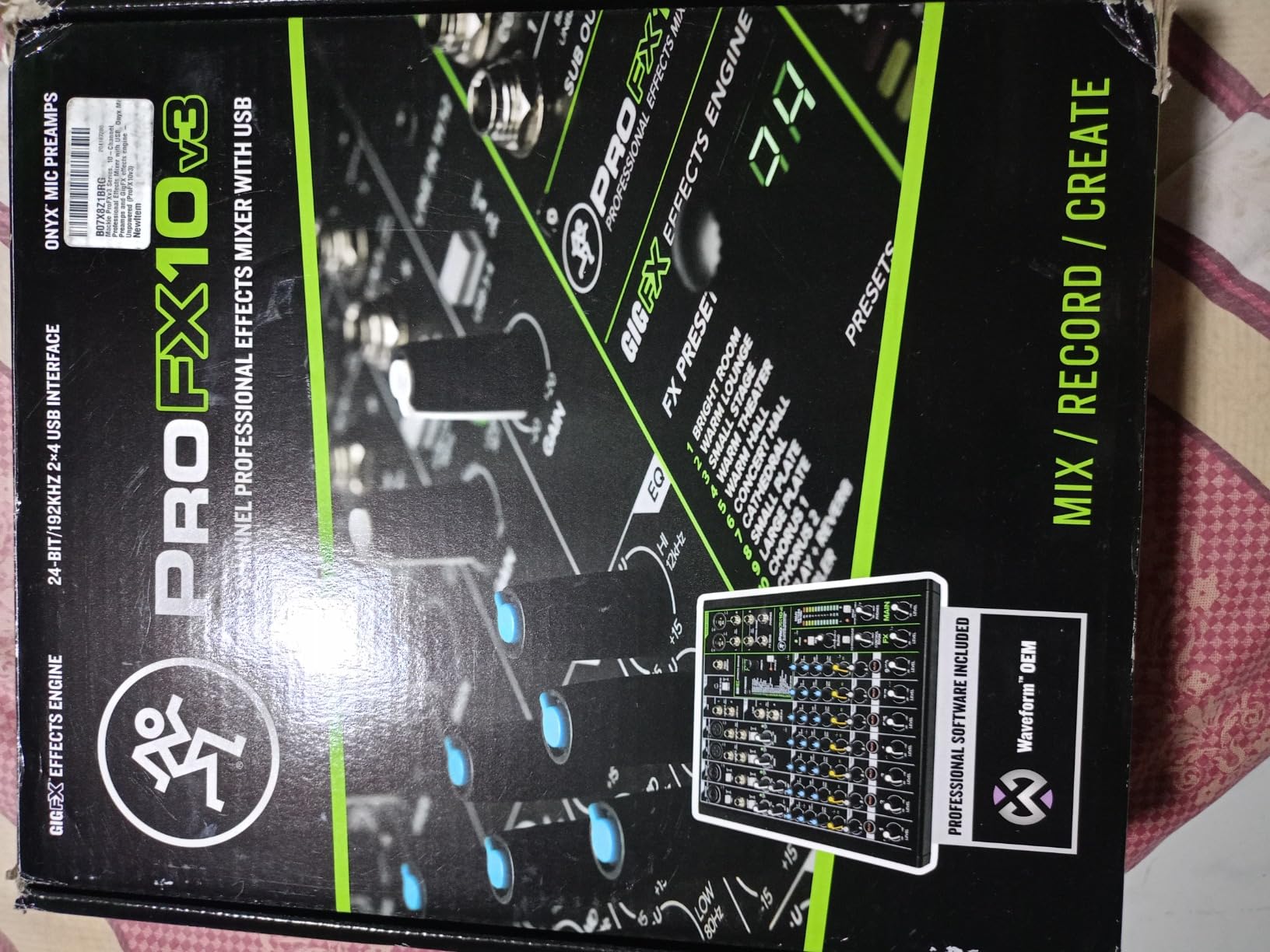
5. Mackie ProFX10v3 Review: a dependable analog console that never asks for firmware
Mackie ProFX10v3 10-Channel Mixer, USB Recording, GigFX Effects
10 channels
Onyx preamps
60 dB noise
Built-in USB
1 year warranty
+ The Good
- Onyx preamps give studio-grade gain on every mic input
- GigFX engine with 24 effects under simple controls
- Built-in USB interface for recording or streaming
- Ten channels cover mics and playback for small gigs
- Simple layout described as a dependable workhorse
- The Bad
- USB records a stereo mix only so there are no per-channel tracks
- No sound pads for live triggering
- Mains powered so it will not run on battery
The ProFX10v3 is the console you choose when you want a show to work every night without thinking about software. Ten channels of straightforward analog mixing, Onyx preamps on every mic input, and a physical layout that a volunteer can operate after one rehearsal.
The GigFX engine gives you 24 effects with simple controls, which covers reverb on a spoken segment or a light effect on a voice without opening a plugin window mid-show.
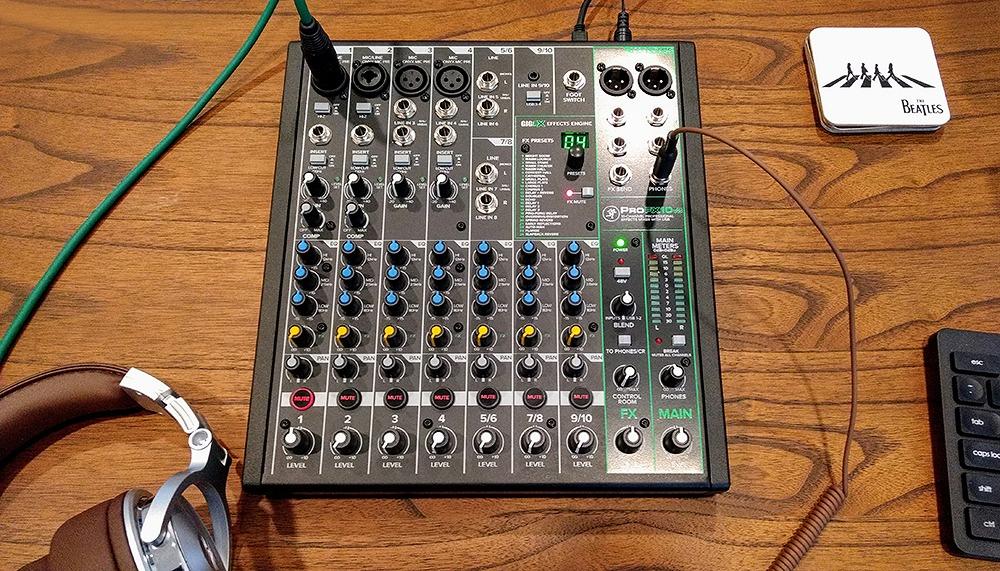
For a small venue this is a comfortable fit. The channel count handles microphones, playback sources for walk-on music, and returns from a playback device, and the USB interface sends a stereo mix to a computer for streaming.
Reviewers describe it as a house-band workhorse, and that is the honest framing: it is a general-purpose mixer that happens to record, and it will keep doing that long after newer digital consoles are out of fashion.
Where it beats the digital consoles
Nothing on the panel waits for a boot, an update or a permission dialog. That predictability is why traditional consoles still show up in forum threads about live reliability, where users repeatedly note that mixers do not crash and computers do.
Ten channels also means you are not fighting for inputs when a guest shows up with a handheld mic nobody planned for.
Where it will not fit the job
The USB output is a stereo mix only. There are no individual tracks, so a show that needs editing later has already lost the separation it would have needed.
There are no sound pads, so live sound triggering has to come from a laptop, and the unit is mains powered, which means a venue without a reliable outlet is a real problem. Some users also rate the effects engine below the preamps.
6. MAONO AME2 Review: the most feature-dense box for a first live show
MAONO AME2 Audio Interface Mixer, Podcast Studio Console with XLR Input
10 channels
60 dB gain
48V phantom power
11 sound pads
1 year warranty
+ The Good
- Three-level mic gain up to 60dB with 48V phantom power
- Eleven customizable sound pads with one-key looping
- Real-time EQ with six reverb modes and pitch controls
- Bluetooth plus USB-C and AUX inputs cover phones and PCs
- Dual front headphone outputs for two different sets of cans
- The Bad
- USB microphones are not supported
- XLR cables are not included and must be bought separately
- Uploading custom pad audio is poorly documented
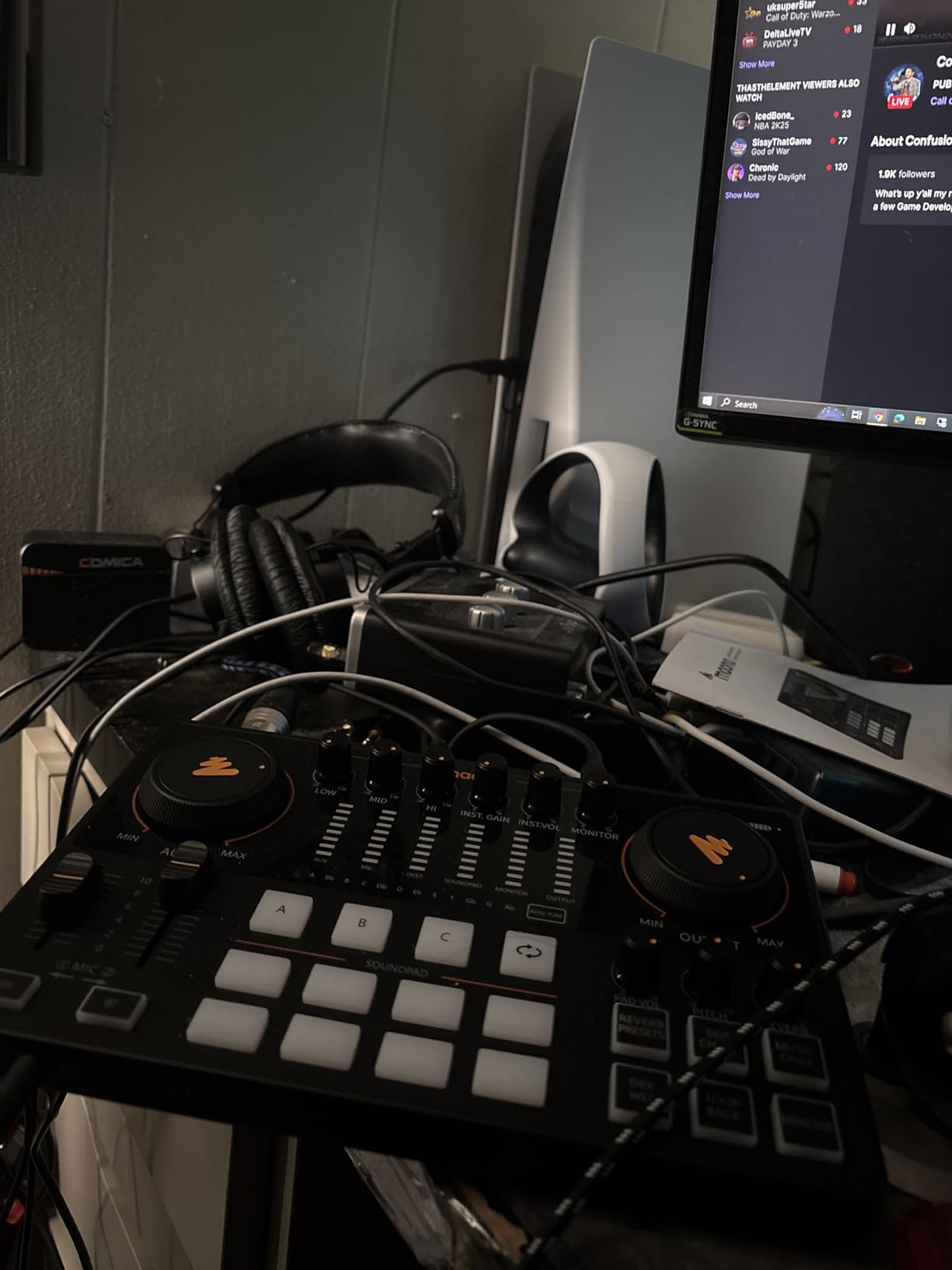
The AME2 packs an unusual amount into a compact desktop box: three-level microphone gain reaching 60dB, 48V phantom power, a denoise function on a 32-bit chipset, and eleven sound pads. That combination covers the majority of what a first-time live podcaster reaches for in software.
Three of the pads record up to 60 seconds of audio each and support one-key looping, which is a fast way to run a repeating bed under a segment without touching the mixer.
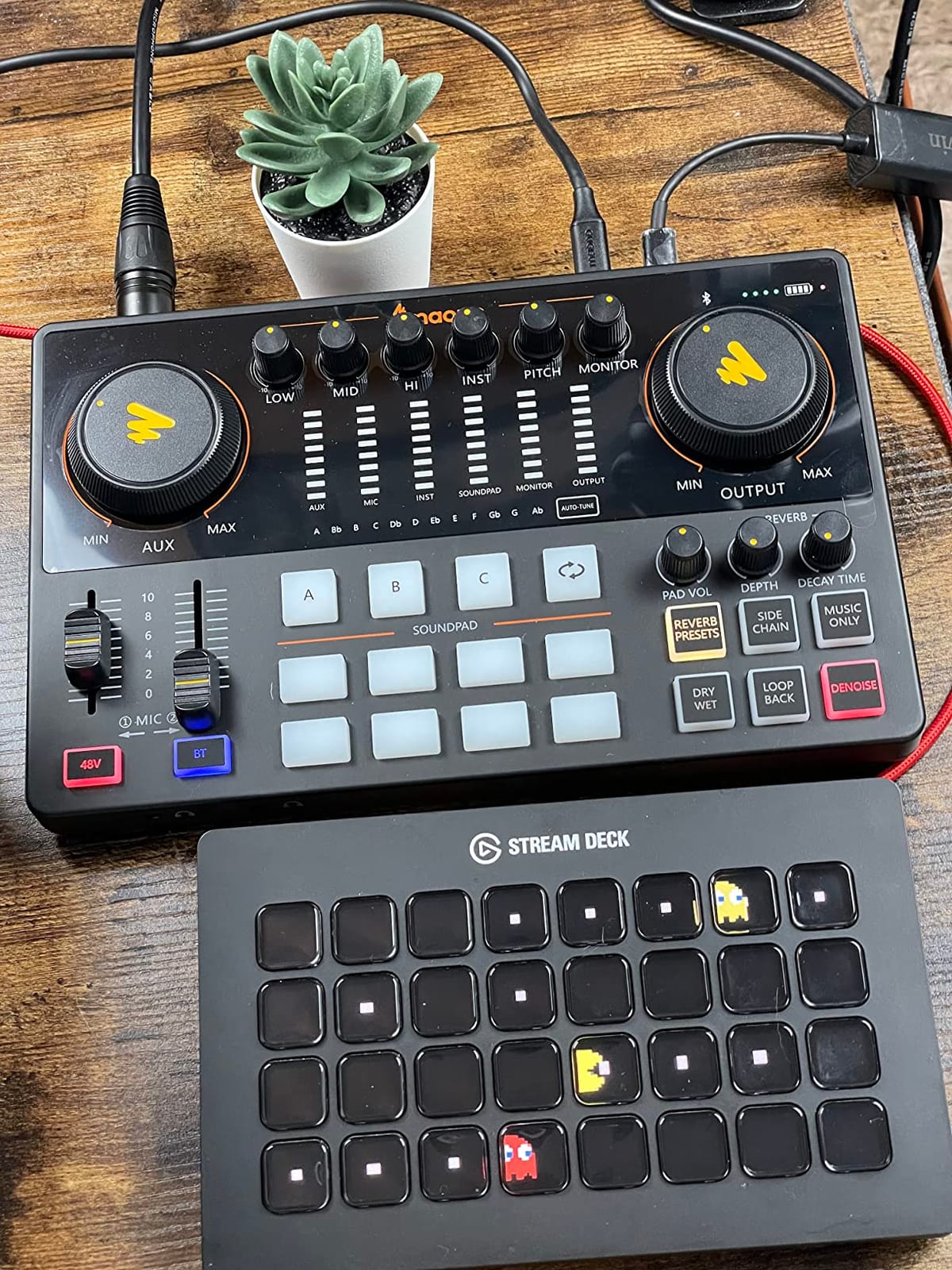
Connectivity is broad for a unit at this level. Bluetooth covers a phone, USB-C covers a computer or tablet, and the AUX input takes accompaniment from a phone, so a live stream or a hybrid show can be assembled from several sources without a separate interface.
The processing section goes further than most rivals: real-time EQ, six reverb modes, a 12-step auto-tune and three tone knobs for treble, midrange and bass. Sidechain, music-only and loopback switches give direct control over what the audience hears versus what the hosts monitor.
Why it works for a first live show
It is compatible with common dynamic and condenser XLR microphones including the Shure SM7B, SM58, Rode PodMic and Samson Q2U, which covers most starting rigs without an adapter. Two front headphone outputs mean a host and a producer can each monitor on their own cans.
At 0.95 kg it is one of the easier units here to move between a home setup and a booked room, and the feature set means you can grow into it before you replace it.
Where caution is warranted
USB microphones are not supported, and that catches people out who arrive with a USB mic and an XLR expectation. Separate XLR cables are needed for every microphone and are not included.
The lowest average rating in this lineup reflects documentation and reliability rather than core audio quality: pad uploading is poorly documented, a driver update may be needed to remove noise above half output level, and dirty wall power can introduce a hum. A minority of users report echo and trouble getting XLR microphones to work reliably, so test your exact microphone before a show.
7. Behringer XENYX 802S Review: the quiet, low-cost analog mixer that also talks to a computer
Behringer XENYX 802S Premium Analog 8-Input Mixer with USB Streaming Interface
8 inputs
Stereo USB interface
Metal chassis
1610 g
+ The Good
- Very low noise floor with no hum at moderate gain
- Stereo USB interface connects straight to a computer
- PC and gaming sounds can be mixed into the streaming output
- Separate main and monitor controls
- Metal build that survives frequent transport
- The Bad
- Integrated USB DAC is modest next to a dedicated interface
- Power supply feels cheaper than on larger models
- No onboard recorder or sound pads
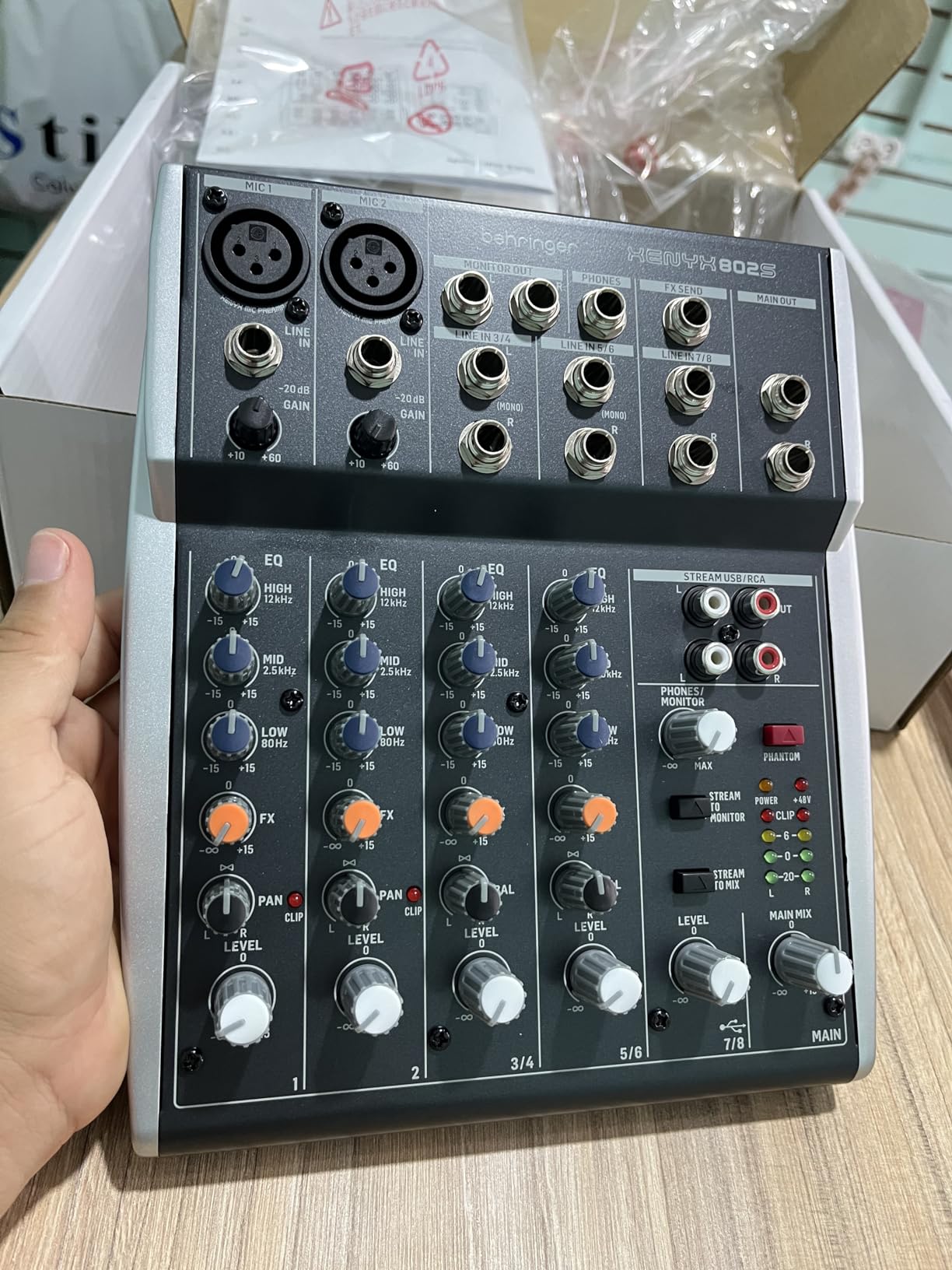
The XENYX 802S is the smallest traditional mixer here, and the reviewers who use it for live work tend to use it the same way: as a monitor hub. Speakers come off the main output, headphones off the phones output, and the USB return feeds a computer.
Its selling point is the noise floor. Users report a very low floor with no hum or hiss even at moderate gain, which matters more in a live room than in a treated studio because you are often running open gain to avoid clipping.
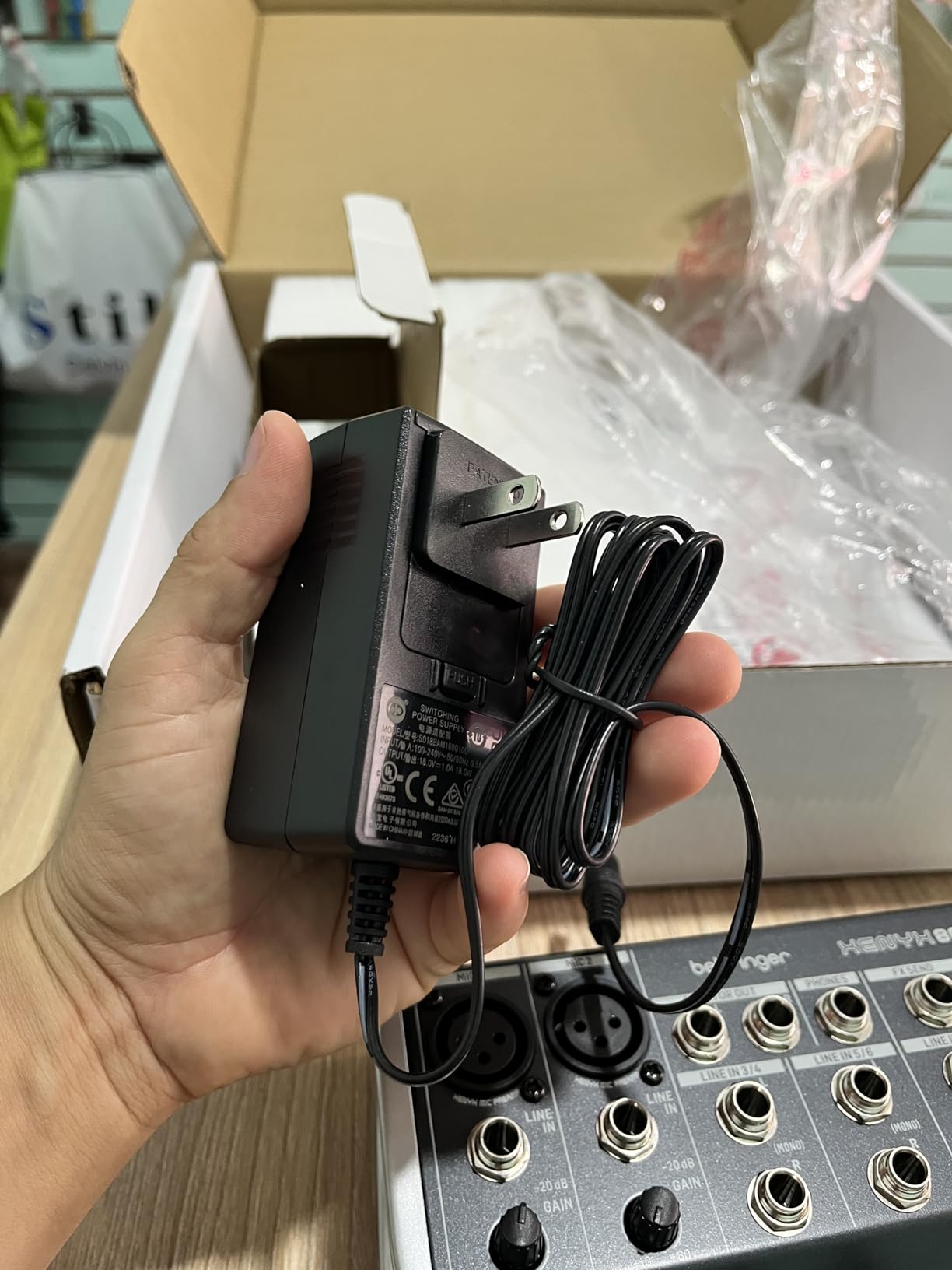
The stereo USB audio interface is a genuine addition over older versions of this mixer. PC and gaming sounds can be mixed into the streaming output alongside live sources, and simultaneous monitoring of the USB input and the analog inputs is handled with separate main and monitor controls.
At 1610 g with a metal body, it is built to be packed into a car between shows and set up quickly in a room with limited space.
Where it makes sense on a small show
If your live podcast is recorded with a separate recorder and streamed from a computer, this mixer handles the live blend cheaply and quietly. Video editors and small-venue producers use it exactly this way, feeding monitors and speakers from one box.
Eight inputs cover a small panel, and the setup and teardown time is short enough for a room you only have access to on the night.
Where it falls short
There is no onboard recorder, no sound pads and no multitrack capture. If you rely on the mixer to preserve the show and your computer is the only recording path, you are exposed.
The integrated USB DAC is modest next to a dedicated interface, the power supply feels cheaper than on larger models in the range, and EQ applies to the USB return rather than as a full per-channel sweep. Users also note no phantom power, so condenser microphones are out unless you supply it elsewhere.
8. Yamaha MG10XU Review: the standard console that outlives most rigs
YAMAHA MG10XU 10-Input Stereo Mixer with Effects
4 mic preamps
128 dBu input noise
SPX effects
24-bit USB
1 year warranty
+ The Good
- Discrete Class A D-PRE preamps with an inverted Darlington circuit
- One-knob compressors on two channels
- Three-band EQ and high-pass filters on every mic channel
- Class-compliant 24-bit USB that needs no drivers
- Powder-coated metal chassis built for years
- The Bad
- Records a stereo mix only so there are no individual tracks
- USB and stereo levels are independent with no master control
- SPX effects are tedious to change during a live show
With more than two thousand reviews, the MG10XU is the most widely used mixer in this group and the one with the longest track record on working stages. The D-PRE preamps use an inverted Darlington circuit, which is a deliberate design choice aimed at fat, natural bass and smooth highs rather than a specification race.
Two channels have one-knob compressors, every mic channel gets a three-band EQ and a high-pass filter, and the SPX effects supply reverb and delay to glue a mix together without an outboard unit.
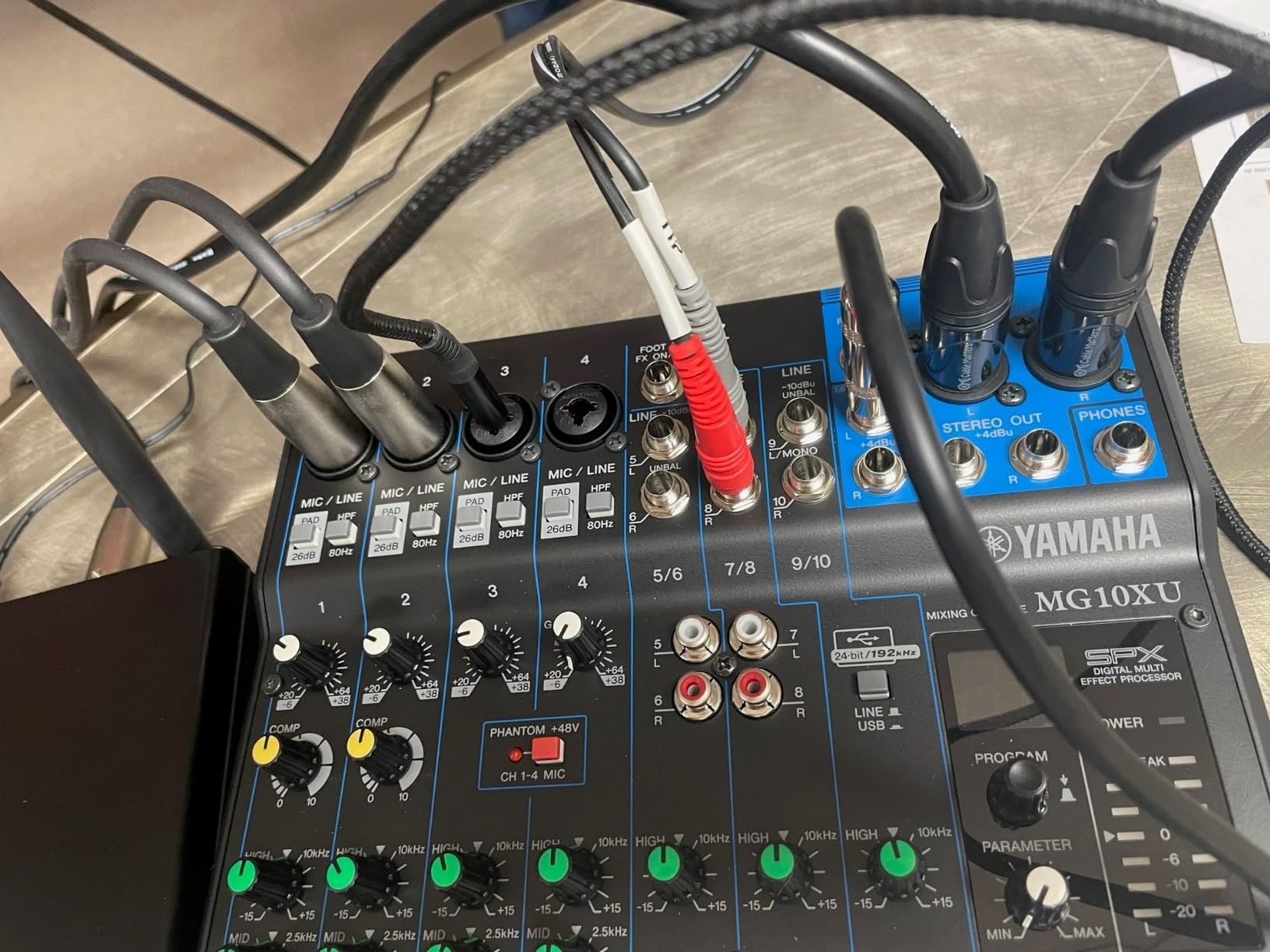
The USB side is a class-compliant 24-bit interface that needs no drivers, which removes one of the failure points that trips up visiting laptops. Owners describe it as an industry standard that survives years of daily use, with several reporting the same unit lasting a decade.
Main and monitor outputs each have independent level control, so you can feed a house PA and a separate monitor system without a splitter.
Why it holds up over a long run
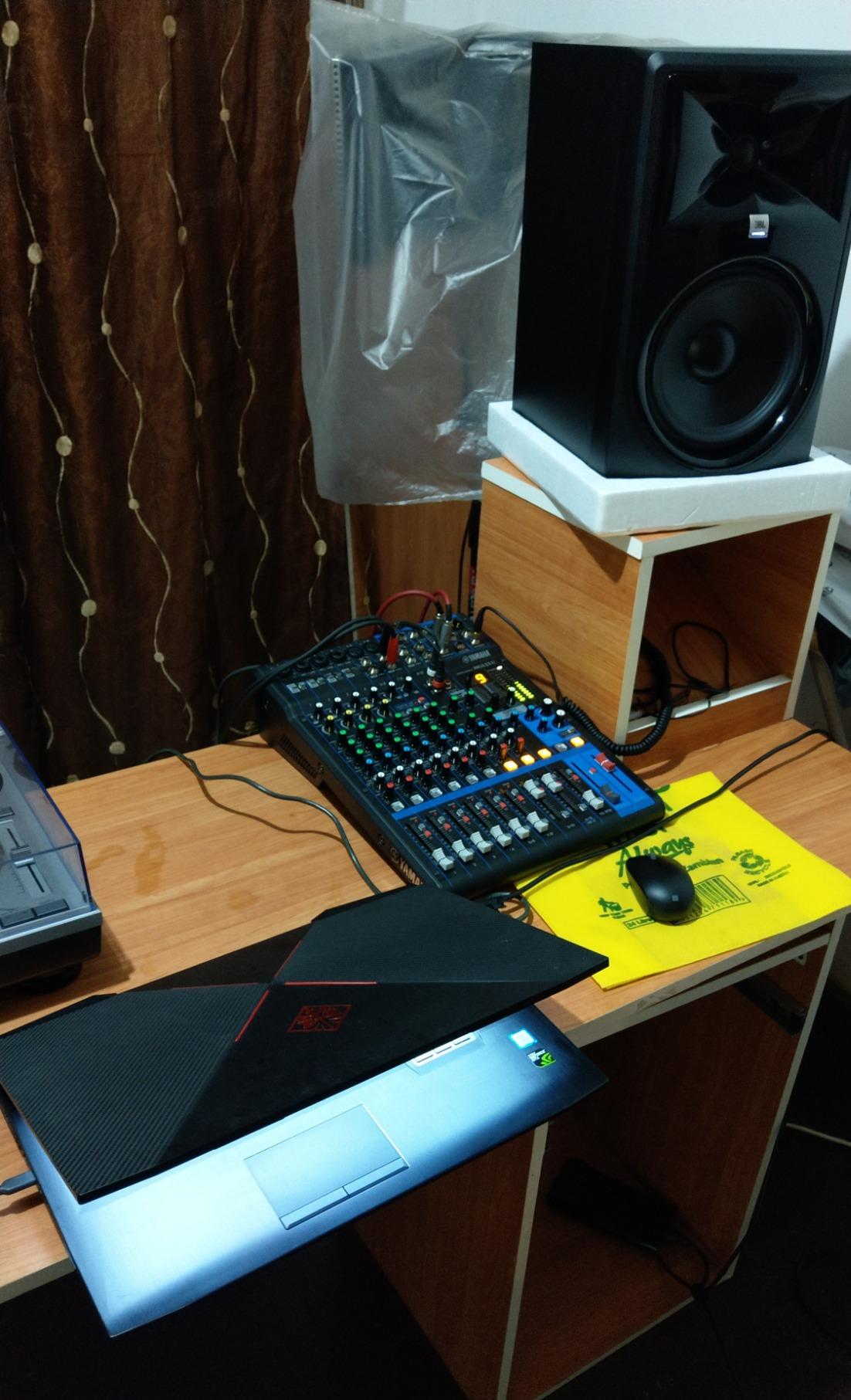
A powder-coated metal chassis and a signal path with no computer dependency mean the failure modes are limited to physical damage. For a show that travels and plays often, that predictability is worth more than any on-screen feature.
The equivalent input noise figure of 128 dBu is genuinely low, and reviewers repeatedly separate Yamaha from other analog consoles on reliability in long ownership.
Where the signal flow will trip you
The USB records a stereo mix only, so it is not a multitrack recorder. Owners are candid that this makes it a poor fit for podcast work that needs per-channel editing, and that is a real limitation for a live show you plan to cut into segments.
USB, stereo and monitor levels are independent with no master control before the USB converters, the meter cannot be switched to show the USB signal, and only the first two mic channels have compression. SPX effect changes are tedious mid-show, and the back panel runs warm during long sessions.
Live Show Setup Scenarios: Solo, Duo, Panel and Hybrid
The right console depends less on your show being good and more on how many people are talking, what else is playing, and whether a computer is allowed to fail without ending the episode. These four configurations cover most live podcasting.
Solo host on a touring schedule
One host, one microphone, a music bed and a venue that changes every week. The Zoom PodTrak P4 handles this configuration best: it fits in a backpack, runs from a power bank, records your voice and your pads to separate tracks on SD, and needs no setup conversation with venue staff beyond finding an outlet.
Carry spare AA batteries even if you run on USB, because the small controls and the short screen are easier to handle at a table than standing up, and the multitrack SD capture means a bad hour can be rescued in post.
Duo at a comedy club with a phone guest
Two hosts plus a caller joining mid-segment is the classic live-show stress test. The TASCAM Mixcast 4 is built for it: four XLR inputs, four headphone outputs, an Aux input with mix-minus so the caller never hears themselves, and eight banks of illuminated pads for the sting and the theme.
The illuminated part matters more than it sounds. Club lighting is dark and the operator is not looking at the screen, they are looking at the stage.
Four-person panel at a conference
A panel means four independent headphone mixes and enough gain for whatever microphones are handed to you. The RØDECaster Pro II gives every host their own headphone level and runs the whole desk from a touchscreen, with APHEX processing applied in one tap so a guest with an unfamiliar microphone still sounds present.
If the show also records isolated tracks for later editing, that same console writes multitrack files to computer or SD while the show runs, which removes the argument about which machine owns the master.
Hybrid show with instruments
When a band plays under the conversation, channel count and sample rate become the deciding factors. The Zoom LiveTrak L-8 captures 12 tracks at 24-bit and 96kHz straight to SD and offers three independent monitor mixes, so musicians can hear what they need without asking the host to turn something up.
It also records to the computer at the same time as the card, so the stream feed and the isolated master come from one device.
How to Choose a Podcast Mixer for Live Shows
Channel count and XLR inputs come first, and everything after that depends on the answer. Two hosts need two XLR inputs and at least two headphone outputs. A four-person panel needs four of each. A show with a live band needs line inputs for instruments on top of that, which is where six or more preamps stops being generous.
Gain staging and phantom power decide whether you can use the mic you own
Phantom power, the 48V supply that powers condenser microphones, is not universal in this category. The Behringer XENYX 802S is the one unit here where users report no phantom power at all, which rules it out if you own condensers. The Zoom PodTrak P4 provides roughly 70dB of clean gain, enough for dynamic microphones without an inline booster, while the MAONO AME2 offers three gain levels up to 60dB alongside 48V.
For a stage, gain headroom is not a nicety. A loud room forces you to run open gain, and open gain on a noisy preamp is where hiss becomes audible.
Multitrack or stereo decides how much editing you get later
Multitrack capture writes each microphone to its own file. Stereo capture writes the finished blend. Nothing recovers the difference after the fact, so a show that plans to publish edited segments should treat per-channel recording as a requirement rather than a nicety.
In this lineup, the RØDECaster Pro II, the TASCAM Mixcast 4, the Zoom PodTrak P4 and the Zoom LiveTrak L-8 all record multitrack to removable media. The Mackie ProFX10v3, the Behringer XENYX 802S and the Yamaha MG10XU record a stereo mix only, and the MAONO AME2 depends on a computer for capture.
Redundancy is the live-show feature nobody demos
A computer will crash or run out of battery during a two-hour set. A mixer with an SD card will not. Two of the units here record to an SD card and a computer at the same time, which means a failed stream does not mean a lost show.
This is the single biggest difference between a podcast mixer and a studio interface, and it is worth more than any effect processor. Users in podcasting forums consistently describe the move from a computer-based workflow to a standalone recorder as the point where their recordings stopped having gaps.
Monitoring, mix-minus and the headphone count
Every host needs to hear themselves, and a phone guest needs to hear the show without hearing themselves. That second requirement is mix-minus, and among these consoles the RØDECaster Pro II handles it through its SMART pads, the TASCAM Mixcast 4 through its Aux input, and the Zoom PodTrak P4 automatically.
Headphone outputs are a hard number to check before you buy. Four outputs is the practical minimum for a panel, and only the RØDECaster Pro II and the TASCAM Mixcast 4 give four individual headphone outputs with per-person control. The LiveTrak L-8 gives four outputs but three monitor mixes, so two people share a blend.
Power at the venue, and what your mixer does about it
Most venues have power. Far fewer have clean power. A console connected to a questionable supply can pick up a hum that is audible in a quiet room and tolerable in a noisy bar, and one owner report on the MAONO AME2 describes exactly that hum appearing when charging from a poor wall supply.
Three units here run on batteries: the PodTrak P4 on two AA cells, and the LiveTrak L-8 as a battery-powered unit. The rest need mains power, which means a power conditioner or a known-good circuit is part of your road kit.
Streaming integration and live sound triggering
For a hybrid show, the mixer needs to behave as a USB interface and accept outside material. The TASCAM Mixcast 4 adds computer sounds over USB and takes a Bluetooth source, the Behringer XENYX 802S mixes PC and gaming sounds into its streaming output, and the MAONO AME2 covers Bluetooth, USB-C and AUX from a phone or tablet.
Sound pads are the practical answer for live triggering. The TASCAM Mixcast 4 offers eight banks, the RØDECaster Pro II gives eight fully customizable SMART pads, the PodTrak P4 has four, and the MAONO AME2 has eleven. The analog consoles have none, so live effects there come from a laptop. If the desk you actually need is a larger analog board for a band rather than a podcast desk, our best commercial mixers guide covers the usual live-sound suspects.
Frequently Asked Questions
What is the best mixer for live performances?
For live podcast shows, the RØDECaster Pro II leads our lineup because it combines four XLR inputs, four headphone outputs, eight SMART pads for live sound triggering, and multitrack recording to computer or SD card without needing a computer. For a band-backed show, the Zoom LiveTrak L-8 records 12 tracks at 24-bit/96kHz. For traditional analog reliability, the Yamaha MG10XU is the long-lived standard.
What are the top 5 podcast mixers?
Our top five are the RØDECaster Pro II for the most complete live rig, the TASCAM Mixcast 4 for its eight banks of illuminated sound pads and 14-track SD recording, the Zoom PodTrak P4 for portability and a 4.7 average rating, the Zoom LiveTrak L-8 for multitrack recording with instruments, and the Yamaha MG10XU for analog reliability over many years of use.
What is the best audio mixer for podcasts?
For a recorded podcast, any mixer with four XLR inputs and per-host headphone monitoring covers the core requirement, and the RØDECaster Pro II covers it while also recording multitrack to removable media. For live shows specifically, standalone SD recording matters more than feature count, because a computer failure should not end the episode.
What is the best mixer for live sound?
For live sound in a small to mid-size room, the Yamaha MG10XU is the most proven choice here, with discrete Class A D-PRE preamps, low equivalent input noise of 128 dBu, one-knob compressors, three-band EQ and a powder-coated metal chassis. The Mackie ProFX10v3 is the alternative when you want more channels and 24 onboard effects with a built-in USB interface.
How many XLR inputs and headphone outputs do I need for a live podcast?
Count one XLR input and one headphone output per speaking host, then add inputs for any instrument or playback device in the mix. Two hosts need two of each. A four-person panel needs four of each, which is why the RØDECaster Pro II and TASCAM Mixcast 4 stand out: only they provide four individual headphone outputs with per-person volume control.
Final Verdict for Live Show Mixers in 2026
The RØDECaster Pro II is the best podcast mixer for live shows overall, because four headphone outputs, eight live pads and multitrack recording to removable media cover nearly every failure point a live room creates. Buy the Zoom PodTrak P4 if you carry the show in a backpack, the TASCAM Mixcast 4 if sound triggering drives your format, and the Yamaha MG10XU if the console needs to survive years of touring without a computer anywhere near it.
Whichever one you choose, test the exact microphones you own at the exact gain you will use in the room before an audience is in it. Every mixer here can work in a live show, and the wrong one for your format will cost you a segment.