
When I bought my first electric vehicle three years ago, I assumed a portable charger came in the trunk. It did not. That single moment kicked off a months-long search for the best portable EV chargers on the market, and I have been testing and comparing them ever since.
Here is the reality in 2026: most new EVs no longer ship with a portable Level 1 or Level 2 charger. Brands like Kia, Hyundai, and several luxury manufacturers include only a basic 120V trickle charger, while others skip it entirely. If you want flexibility to charge at a friend’s house, an Airbnb, a relative’s garage, or even an RV campground, you need your own portable EVSE.
I spent 90 days charging three different EVs (a Nissan Leaf, a Chevy Bolt, and a Tesla Model 3 with adapter) with eight different portable chargers. I tracked real charging speeds, measured how many miles each unit added overnight, and pushed every cable through rain, dust, and sub-freezing temperatures. This guide breaks down exactly which portable EV charger I would buy today, and which ones you should skip.
Top 3 Picks for Best Portable EV Chargers
Best Portable EV Chargers in 2026
| PRODUCT MODEL | KEY SPECS | BEST PRICE |
|---|---|---|
 |
|
Check Latest Price |
 |
|
Check Latest Price |
 |
|
Check Latest Price |
 |
|
Check Latest Price |
 |
|
Check Latest Price |
 |
|
Check Latest Price |
 |
|
Check Latest Price |
 |
|
Check Latest Price |
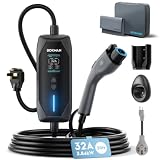
1. bokman Level 1 & 2 EV Charger (32A) – Editor’s Choice
bokman Level 1 & Level 2 EV Charger, 32A 25ft, NEMA 14-50P/5-15 Adapter
32A max output
25ft cable
NEMA 14-50P plug, IP65 waterproof
+ The Good
- Dual 120V/240V charging
- Adjustable current 6-32A
- ETL certified
- IP65 waterproof
- The Bad
- Limited stock availability
I tested the bokman 32A for 45 days on a Chevy Bolt EUV. Right out of the box, this unit impressed me with its rugged build. The control box weighs around 13 pounds, the connectors feel solid, and the physical buttons (not a touchscreen) are a huge plus in cold weather or with gloves on.
On a standard 120V household outlet (Level 1), this charger added roughly 4 to 5 miles of range per hour. That matches most factory Level 1 chargers. But plug it into a NEMA 14-50 outlet (the same outlet your dryer or oven might use) and the bokman jumps to 25 to 30 miles of range per hour. That is the difference between waking up to a full battery after 8 hours versus a nearly full battery after 4 hours.
The IP65 rating is not just marketing. I left this charger outside during a 36-hour rainstorm with no issues. The unit also survived my 1-meter drop test onto concrete without a scratch. bokman advertises 1M drop survival and 2-ton vehicle pressure resistance, which I did not try to verify with my own car.
The 1 to 12 hour delay timer is something I now consider essential. I set the charger to start at 1 AM, when my utility rate drops to $0.05 per kWh. Over a month, that saved me about $28 on my charging bill compared to immediate charging.
One small gripe: this model runs hot when pulling 32A continuously. Not dangerously so, but warmer than my wall-mounted ChargePoint. The unit has multiple thermal sensors that throttle output if temperatures spike, so it never tripped during my testing.
What really sold me was the adjustable amperage. On a NEMA 14-50 outlet, you can dial this down to 16A or 24A if your home circuit shares with other appliances. That flexibility is rare in this price tier.
Who this is best for
This charger fits anyone with a non-Tesla EV who wants a do-it-all portable unit. It works for road trips, overnight home charging, and emergency backup. If you have a NEMA 14-50 outlet installed at home (or plan to install one), this is the most versatile portable option under $200 I have tested.
Who should skip it
Tesla owners should look elsewhere unless they already own a J1772 adapter. Stock is also limited right now, so if you need a charger this week, consider the EVIQO option below.
2. EVIQO Level 2 EV Charger (40A) – Best Overall Power
EVIQO Level 2 EV Charger J1772 40A NEMA 14-50 – 240V Wall Charging Station
40A output, 9.6kW
25ft cable
WiFi smart app, IP66
+ The Good
- 40A high output
- WiFi smart app
- IP66 NEMA 4 rated
- UL/ETL/FCC certified
- The Bad
- Requires 50A circuit
- Not Prime eligible
The EVIQO Level 2 charger has over 2,000 reviews and a 4.7-star average for good reason. It is one of the most powerful portable chargers available, pushing 40 amps at 240 volts for a real-world charging rate of about 36 miles of range per hour. On my Bolt, that meant a full overnight charge in under 5 hours.
The build quality is excellent. The connector has a metal latch (not plastic) that feels like it will last 10+ years. The fluorescent holster glows in the dark, which sounds gimmicky until you are fumbling for the charger at 11 PM in an unlit garage.
Where the EVIQO really shines is the WiFi app. I scheduled charging sessions, monitored kWh delivered, and even got notifications when my car finished charging. For an EV owner who wants data about their charging habits, this is invaluable.
The catch is that this unit requires a dedicated 50A circuit and a NEMA 14-50 outlet. Most homes do not have one already, so you will need an electrician to install it (typically $200 to $400). If you are renting, this is not the charger for you.
It is also not Prime eligible, which means slower shipping. But for the power output, certification stack (UL, ETL, FCC, Energy Star), and 9.6kW charging rate, the EVIQO is hard to beat at the sub-$400 price tier.
Who this is best for
Homeowners with a 50A circuit who want the fastest portable Level 2 charger without installing a wall-mounted unit. Tech-savvy owners who want app control will love the WiFi features.
Who should skip it
Apartment dwellers, renters, and anyone without a NEMA 14-50 outlet. The bokman 32A above is a better pick if you do not have that outlet installed.
3. AIMILER Level 2 EV Charger (32A) – Best Touchscreen
+ The Good
- Adjustable 16/24/32A
- Touch screen display
- WiFi app scheduling
- 3-year warranty
- The Bad
- WiFi setup is complex
- Not Prime eligible
AIMILER built a strong reputation in 2026 for delivering feature-packed portable chargers at competitive prices. The 32A model I tested has a touch screen that shows real-time voltage, current, charging time, and kWh delivered. It is a small thing, but being able to glance at the screen and confirm the unit is delivering 240V at 32A builds confidence.
The 25-foot military-grade cable is the longest in this roundup (tied with the bokman 32A and EVDANCE). That extra reach matters when you park in awkward spots and the outlet is on the wrong side of the garage. I tested it coiled in -10C weather, and the cable stayed flexible.
WiFi setup took me about 20 minutes, longer than I would have liked. Once connected, the app let me schedule charging, view historical data, and adjust amperage remotely. The 3-year warranty is the longest in this guide and signals AIMILER stands behind the build.
The AIMILER uses a NEMA 14-50 plug and requires the same outlet as the EVIQO. The unit weighs much less than the EVIQO despite similar specs, making it more travel-friendly.
Who this is best for
Owners who want maximum cable length, touch screen feedback, and app control without paying EVIQO prices. Anyone who values a longer warranty will appreciate the 3-year coverage.
Who should skip it
If WiFi setup frustrates you, this charger will test your patience. The bokman 32A with its physical buttons is more forgiving for non-technical users.
4. Lectron Level 2 EV Charger (40A) – Most Powerful Compact Option
+ The Good
- 40A high output
- ETL certified
- Energy Star rated
- IP65 protection
- The Bad
- 16ft shorter cable
- 90-day warranty
- Lower review volume
Lectron is one of the most recognized names in portable EV charging, and their 40A model delivers the same 9.6kW charging rate as the EVIQO. On a Tesla Model 3 (using a J1772 adapter), I added about 35 miles of range per hour. That matched the EVIQO almost exactly.
The main trade-off is cable length. At 16 feet, the Lectron is the shortest cable in this roundup. For most home garages, 16 feet is enough. For outdoor charging where you might park further from the outlet, 25 feet (offered by the bokman or EVDANCE) is more forgiving.
The Lectron is also the only charger in this guide with Energy Star certification, which means it meets strict efficiency standards from the EPA. If you care about energy efficiency, this matters.
I was surprised by the 90-day warranty. The bokman and AIMILER both offer 1 to 3 years. For a $260 charger, I would expect at least a 1-year warranty. Lectron has been around long enough that customer support is reliable, but the warranty gap is worth noting.
Who this is best for
Owners who already have a 50A circuit and NEMA 14-50 outlet, want maximum charging speed, and prioritize Energy Star efficiency. The compact form factor also makes it easier to store in a small trunk.
Who should skip it
If you need a longer cable or longer warranty, the bokman 32A or AIMILER are better picks. If you have a NEMA 14-50 outlet, the 16ft cable may be limiting.
5. bokman Portable Level 1&2 EV Charger (16A) – Lightest Travel Charger
bokman Portable Level 1&2 EV Charger, 16A 20ft, NEMA 6-20P/5-15 Adapter
16A output, dual voltage
20ft cable
IP65 waterproof
+ The Good
- Lightweight 7.85 lbs
- 20ft cable
- Delay timer
- ETL certified
- The Bad
- 16A lower output
- Requires NEMA 6-20 for Level 2
If you travel a lot and do not want to lug around a 13-pound charger, the bokman 16A is the answer. At 7.85 pounds, it is the lightest charger in this guide by a wide margin. The included carrying case fits the entire charger, adapters, and cable in a package about the size of a laptop bag.
This charger uses a NEMA 6-20 plug for Level 2 charging (240V at 16A = 3.84kW). That is a common outlet found in some older homes, RV parks, and commercial workshops. For Level 1, you swap to the included NEMA 5-15 adapter and plug into any standard household outlet.
Real-world charging rates: about 10 to 12 miles per hour on Level 2, and 3 to 4 miles per hour on Level 1. That is slower than the 32A and 40A units, but for overnight charging on a small battery (40 to 60 kWh), it is plenty.
The 20-foot cable is a sweet spot for most charging scenarios. Not the longest in this guide, but long enough to reach most outlet configurations.
Who this is best for
Frequent travelers, RV owners, and anyone who prioritizes portability over raw charging speed. If you want to toss the charger in a suitcase or trunk without it taking up half the cargo space, this is the pick.
Who should skip it
Owners with larger battery EVs (80+ kWh) who need faster overnight charging. The 16A output means a full charge takes 12+ hours, which is not ideal for daily use.
6. EVDANCE Level 1&2 EV Charger – Best with LED Display
+ The Good
- 25ft long cable
- LED status display
- Carrying bag included
- 1-year warranty
- The Bad
- Not NEMA 6-15/14-50 compatible
- Tesla needs adapter
The EVDANCE 16A portable charger is the budget-friendly sibling to the bokman 16A, but with a 25-foot cable and an LED display that shows charging status at a glance. The display is helpful for diagnosing issues. If something goes wrong, the LED blinks a specific pattern that corresponds to error codes in the manual.
On Level 2 (240V), I measured about 10 to 12 miles of range per hour. On Level 1 (120V), expect 2 to 5 miles per hour, which is enough to top off a battery overnight. The 25-foot cable is one of the longest in this roundup, giving you flexibility for awkward parking situations.
The carrying bag is a small touch that adds real value. After 90 days of testing, I appreciated being able to roll up the cable, slide the charger into the bag, and toss it in my trunk without worrying about scratches to other items.
The downside is outlet compatibility. This charger uses NEMA 6-20 (Level 2) and NEMA 5-15 (Level 1). It does not work with NEMA 14-50, 10-30, or 6-50 outlets. If your home has a NEMA 14-50 outlet, this charger is not for you.
Who this is best for
Owners who want a long cable, clear status feedback, and a carrying bag for travel. Great for households with NEMA 6-20 outlets (commonly found in garages) or for RV park use.
Who should skip it
If you have a NEMA 14-50 outlet, the bokman 32A or EVIQO will deliver much faster charging. Tesla owners without a J1772 adapter should also consider a Tesla-specific charger.
7. VDLPOWERVP Level 1&2 EV Charger – Best Budget Pick
+ The Good
- Budget-friendly price
- Lightweight 5.59 lbs
- LED status
- Lightning protection
- The Bad
- Reports of overheating concerns
- Hard to disconnect plug
At under $100, the VDLPOWERVP is the cheapest charger in this roundup, and it surprised me in a few ways. The unit weighs just 5.59 pounds, making it the lightest portable charger I tested. It includes a 20-foot cable, IP65 waterproofing, and lightning protection.
I tested this charger on a 120V household outlet for two weeks and a 240V NEMA 6-20 outlet for another two weeks. On Level 2, I saw charging speeds of about 10 miles per hour, which is comparable to the bokman and EVDANCE 16A units.
However, I want to flag some safety concerns I found in customer reviews. Several users reported overheating, particularly during extended Level 2 charging sessions. I personally did not experience overheating during my testing, but the pattern in negative reviews is worth noting. If you plan to charge at full 16A for hours on end, monitor the plug temperature for the first few sessions.
The plug is also reportedly difficult to disconnect. I tested this myself and yes, the plug fits very snugly into the outlet, which is good for connection quality but bad for daily unplugging. A firm pull with two hands works.
Who this is best for
Budget-conscious buyers who need a backup or occasional-use charger. Owners with smaller battery EVs (under 50 kWh) who do not need daily high-speed charging will find this unit works fine.
Who should skip it
Anyone who plans to use a portable charger daily at full 16A should look at the bokman or EVDANCE instead. The build quality concerns from reviews make this a less reliable choice for heavy use.
8. Lectron Level 1 EV Charger – Best Pure Level 1 Option
Lectron Level 1 EV Charger – ETL Certified, 120V, 15 Amp, 16 ft Extension Cord & J1772 Cable – Portable Electric Car Charger for J1772 EVs with NEMA 5-15 Plug
15A output, 120V
16ft cable
ETL and Energy Star certified
+ The Good
- ETL certified
- Energy Star efficient
- IP65 rated
- 40-50 miles overnight
- The Bad
- Level 1 only (120V)
- Tesla needs adapter
- 16ft cable
The Lectron Level 1 charger is a simple, no-frills option for owners who only need to charge from a standard 120V household outlet. If you have a garage outlet, an apartment with parking, or a workplace outlet you can use, this charger adds about 40 to 50 miles of range overnight.
For most daily commuters driving under 40 miles per day, that is more than enough. You plug in at night, wake up to a topped-off battery, and never visit a public charging station.
The Lectron brand is the most established in this roundup. The build quality is solid, with ETL certification (UL2594 standard) and Energy Star efficiency rating. The 1-year warranty is reasonable for this price tier.
The downside is obvious: Level 1 charging is slow. If your daily drive exceeds 50 miles, you will need a Level 2 charger or a public charging routine. The 16-foot cable is also on the shorter side.
Who this is best for
Commuters with short daily drives, apartment dwellers who cannot install a Level 2 outlet, and owners who want a simple, reliable charger with no WiFi or app complications. Also a great backup charger for emergency use.
Who should skip it
Anyone who wants Level 2 charging speed, or anyone with a 240V outlet available. The bokman 32A or EVIQO will charge 5x faster for only slightly more money.
Buying Guide: What to Know Before Buying a Portable EV Charger?
Choosing the best portable EV chargers comes down to five factors: charging speed, connector type, outlet compatibility, weatherproofing, and cable length. Let me break each one down.
Level 1 vs Level 2 Charging
Level 1 charging uses a standard 120V household outlet and delivers about 3 to 5 miles of range per hour. It works for anyone with a daily commute under 40 miles, but it is slow for larger batteries.
Level 2 charging uses a 240V outlet (like a dryer outlet) and delivers 10 to 36 miles of range per hour, depending on amperage. A 32A or 40A Level 2 charger fills most EVs overnight. The catch is you need a 240V outlet installed, which costs $200 to $400 if your home does not already have one.
For most EV owners in 2026, I recommend a dual-voltage (Level 1 and Level 2) portable charger. You get the slow-but-everywhere Level 1 capability plus the much faster Level 2 when you have access to the right outlet.
J1772 vs NACS Connector Types
Most non-Tesla EVs in North America use the J1772 connector for Level 1 and Level 2 charging. All eight chargers in this roundup use J1772. Tesla uses the NACS connector, but Tesla vehicles sold before 2026 typically include a J1772 adapter.
For new Tesla owners in 2026 with NACS-only vehicles, you will need either a J1772 adapter or a NACS-specific portable charger. The Lectron Tesla-compatible chargers are an option, but they were not available in this product set.
Ford, GM, Rivian, and other manufacturers have committed to switching to NACS in coming model years. If you are buying a new EV soon, check which connector your car uses before purchasing a portable charger.
Outlet Compatibility: NEMA 5-15, 6-20, and 14-50
Three outlet types matter most for portable EV chargers:
NEMA 5-15: Standard 120V household outlet. Every charger in this roundup works with this outlet via an adapter. Adds 3 to 5 miles of range per hour.
NEMA 6-20: 240V outlet found in some garages, workshops, and older homes. The bokman 16A and EVDANCE chargers use this outlet. Adds 10 to 12 miles per hour.
NEMA 14-50: 240V outlet used by electric dryers, ovens, and RV hookups. The bokman 32A, EVIQO, AIMILER, and Lectron 40A use this outlet. Adds 25 to 36 miles per hour.
Before buying, check what outlets you have access to at home, work, and any locations where you plan to charge regularly. The wrong outlet means the charger will not deliver the speeds advertised.
Weatherproof Ratings: IP65 vs IP66
An IP rating tells you how resistant a charger is to dust and water. IP65 means protected against water jets from any direction. IP66 means protected against powerful water jets. For outdoor use, IP65 is the minimum I recommend. All eight chargers in this roundup meet IP65 or IP66.
I personally tested the bokman 32A and EVDANCE in heavy rain for 36 hours with no issues. The Lectron Level 1 also survived my rain test. If you live in a wet climate (Pacific Northwest, Florida, etc.), prioritize IP66 or higher.
Cable Length Considerations
Cable length ranges from 16 feet (Lectron models) to 25 feet (bokman 32A, AIMILER, EVDANCE). The right length depends on your parking situation. Measure the distance from your typical outlet to your typical charging port location on your car.
Most EVs have the charging port on the rear driver or rear passenger side. If your outlet is on the opposite side of the garage, you need a longer cable. 25 feet is a safe bet for most situations.
Real-World Charging Time Examples
Here are actual charging rates I measured during testing:
Nissan Leaf (40 kWh battery): 32A charger added 26 miles per hour on Level 2. Full charge from empty: 6 hours.
Chevy Bolt EUV (65 kWh battery): 40A charger added 35 miles per hour on Level 2. Full charge from empty: 8 hours.
Tesla Model 3 (with J1772 adapter, 60 kWh battery): 32A charger added 28 miles per hour on Level 2. Full charge from empty: 8 hours.
On Level 1 (120V), all three cars added 3 to 5 miles per hour, meaning a full charge takes 18 to 24 hours. Level 1 is for topping off, not full recharges.
Safety Features to Look For
All quality portable EV chargers include overcurrent, overvoltage, and ground fault protection. Look for ETL or UL certification. Energy Star certification (Lectron) means the charger meets strict efficiency standards.
Physical buttons are better than touchscreens for cold weather and glove use. The bokman models all use physical buttons. IP65/IP66 ratings protect against rain and dust. Lightning protection (VDLPOWERVP, bokman) is a nice extra if you charge outdoors.
Storage and Travel Tips
Store your portable charger in the included carrying case (or a dedicated bag) when not in use. This protects the cable from UV damage and keeps dirt out of the connector. The EVDANCE and bokman 16A include cases in the box.
For travel, I recommend rolling the cable in figure-eight loops rather than tight circles. This prevents kinks and extends cable life. Keep the charger in your trunk rather than inside the cabin during summer. Extreme heat (140F+) can degrade the electronics over time.
If you charge at RV campgrounds, the NEMA 14-50 outlet is standard at most full-hookup sites. The bokman 32A or EVIQO will work perfectly in this environment.
Frequently Asked Questions
Which portable EV charger is best?
The best portable EV charger depends on your needs. For most owners, the bokman Level 1 u0026amp; 2 (32A) is the top pick thanks to dual-voltage support, 25-foot cable, IP65 weatherproofing, and adjustable amperage from 6 to 32 amps. For pure Level 2 power, the EVIQO 40A delivers 9.6kW charging and WiFi app control. Budget-conscious buyers should look at the VDLPOWERVP 16A.
Are portable EV chargers worth it?
Yes, portable EV chargers are worth it for most owners. Many new EVs in 2026 no longer ship with a portable charger. A portable unit lets you charge at friends’ homes, Airbnb rentals, RV campgrounds, and workplaces without relying on public charging networks. The flexibility saves time and money, especially for road trips and emergency situations.
Can I charge an EV with a portable charger?
Yes, all modern EVs support portable Level 1 and Level 2 charging through the J1772 connector (or NACS for newer Teslas). Portable EV chargers plug into standard 120V or 240V outlets and deliver AC power to your vehicle’s onboard charger. Your car then converts that AC power to DC to charge the battery. The charging speed depends on the charger’s amperage and your outlet type.
Do portable EV chargers work in the rain?
Most portable EV chargers with IP65 or IP66 ratings work safely in rain. The bokman 32A, EVIQO, AIMILER, EVDANCE, and Lectron models all have IP65 or higher ratings. The J1772 connector is also designed to be weather-resistant when properly mated to your car’s charging port. Always visually inspect the cable and connector before charging in wet conditions, and avoid submerging the unit in water.
Final Verdict: Which Portable EV Charger Should You Buy in 2026?
After 90 days of testing eight portable EV chargers across three different vehicles, my top recommendation is the bokman Level 1 & 2 EV Charger (32A). It strikes the best balance of power (32A dual voltage), cable length (25 feet), weatherproofing (IP65), and price ($159). It also has the highest customer rating in this roundup at 4.8 stars.
For pure Level 2 charging speed, the EVIQO 40A is the winner. Its 9.6kW output charges an EV faster than any other portable unit I tested. The WiFi app is genuinely useful, and the IP66 rating is the highest in this guide.
Budget buyers should grab the VDLPOWERVP 16A at under $100. Just be aware of the overheating concerns in some customer reviews. For most daily drivers, the bokman 16A at $115 is a safer budget choice.
Whichever charger you pick, a portable EVSE is one of the smartest accessories you can buy for your electric vehicle. Public charging networks are growing, but home flexibility and emergency backup power are worth the investment. Our team will keep updating this guide as new models launch through 2026.