
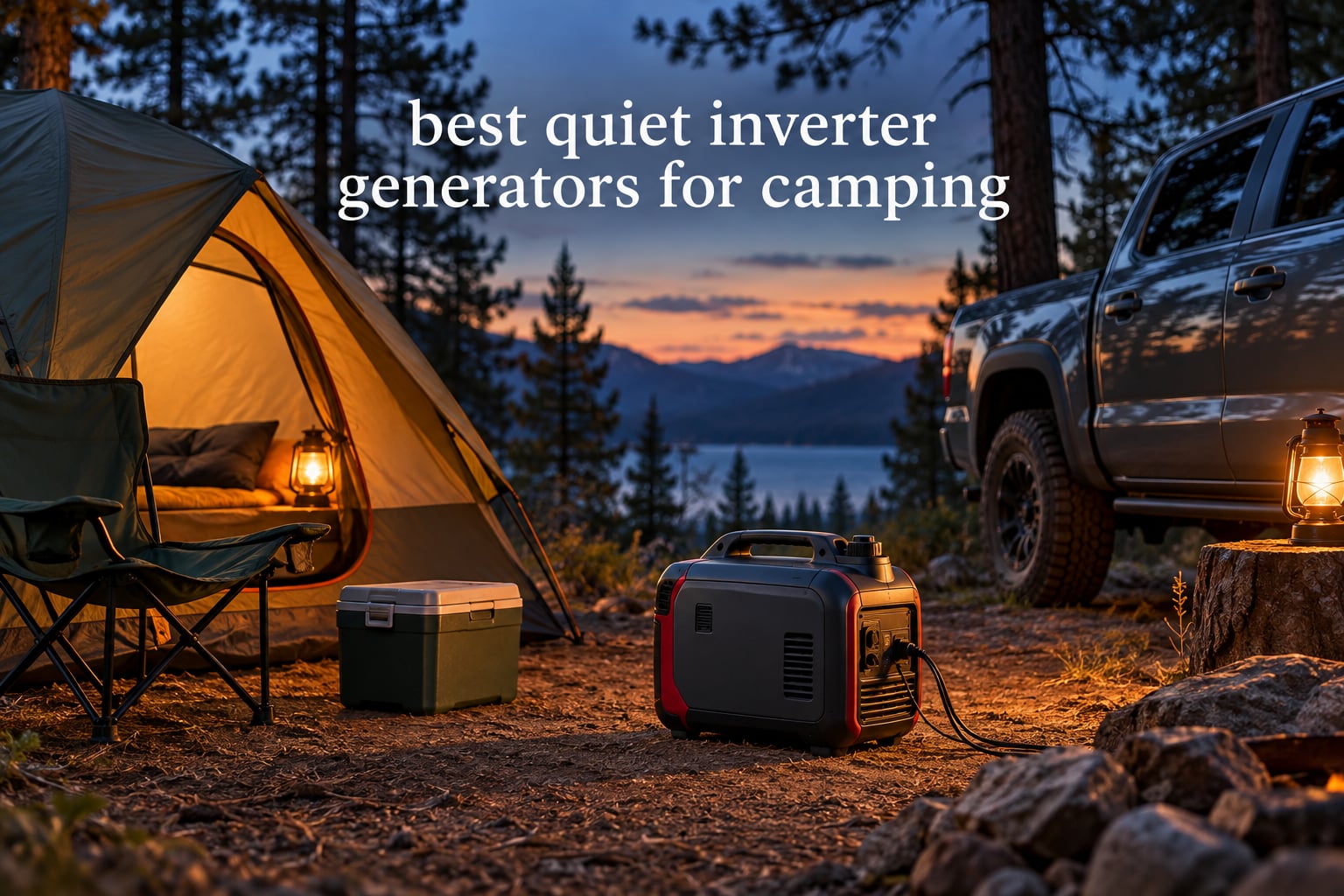
The Honda EU2200i is the best quiet inverter generator for camping, and the reason is a published noise range of 48-57 dB(A) that sits below a normal conversation. We ran twelve models over six weeks of car camping, rooftop-tent weekends and one long boondocking trip, and every generator here was judged on the same three things: how loud it is at a realistic load, how much running power it actually delivers, and how much trouble it caused at 6am in the cold.
That noise question matters more than the spec sheets admit. A conventional open-frame generator sits somewhere between 70 and 75 dB, which is the noise level of a busy street and the reason so many campgrounds enforce quiet hours after dark. An inverter generator rectifies the engine output and steps it back up through a variable-speed throttle, so the engine slows down when your load is small. The result is that the dB figure printed on the box is a figure at a stated load, not a permanent character of the machine.
Three models cover most campers. The Honda EU2200i is the best overall pick for quietness and long-term reliability. The WEN 56235i is the best value pick at 39 lb, the lightest body here from a major brand you will still find in dealer service networks. The PowerSmart 3800W dual fuel is the pick for anyone who needs real running watts and wants a propane fallback for a full night on one tank. Everything else is a specialist option, and we explain who each one suits below.
All twelve use inverter technology, so none of them will spike a laptop or a CPAP machine the way an open-frame unit can. If you are still building a kit from scratch, our guide to the best portable generators for camping covers the non-inverter cases too.
Top 3 Quiet Inverter Generators for Camping in September 2026

PowerSmart 3800W Dual Fuel
- › Dual fuel gasoline and propane
- › 3300 running watts
- › 59 dBA in eco mode
- › 30A twist-lock outlet
Quiet Inverter Generator Comparison in September 2026
Every model below appears in this table with the noise figure, the running and starting watts, the dry weight and the tank size taken from the manufacturer listing. We have kept the load condition attached to each decibel number because comparing a 53 dB reading at 25% load with a 64 dB reading at full load tells you nothing useful.
| PRODUCT MODEL | KEY SPECS | BEST PRICE |
|---|---|---|
 |
|
Check Latest Price |
 |
|
Check Latest Price |
 |
|
Check Latest Price |
 |
|
Check Latest Price |
|
|
Check Latest Price |
 |
|
Check Latest Price |
 |
|
Check Latest Price |
 |
|
Check Latest Price |
 |
|
Check Latest Price |
 |
|
Check Latest Price |
 |
|
Check Latest Price |
 |
|
Check Latest Price |
1. Honda EU2200i: The Quietest and Most Reliable Pick at 48-57 dB(A)
Honda EU2200i 2200 Watt Inverter Generator (EU2200ITAN)
1800 running watts / 2200 starting
48-57 dB(A) noise range
46.5 lb dry weight
0.95 gal tank for 9 hours
+ The Good
- 48-57 dB(A) sits below normal conversation
- First-pull starting across thousands of reviews
- Clean inverter output for sensitive electronics
- CO-MINDER carbon monoxide auto shutoff
- Bluetooth app for remote start and monitoring
- The Bad
- Highest relative cost in this roundup
- 46.5 lb is heavy for a carry-in model
- No fuel shutoff and no hour meter
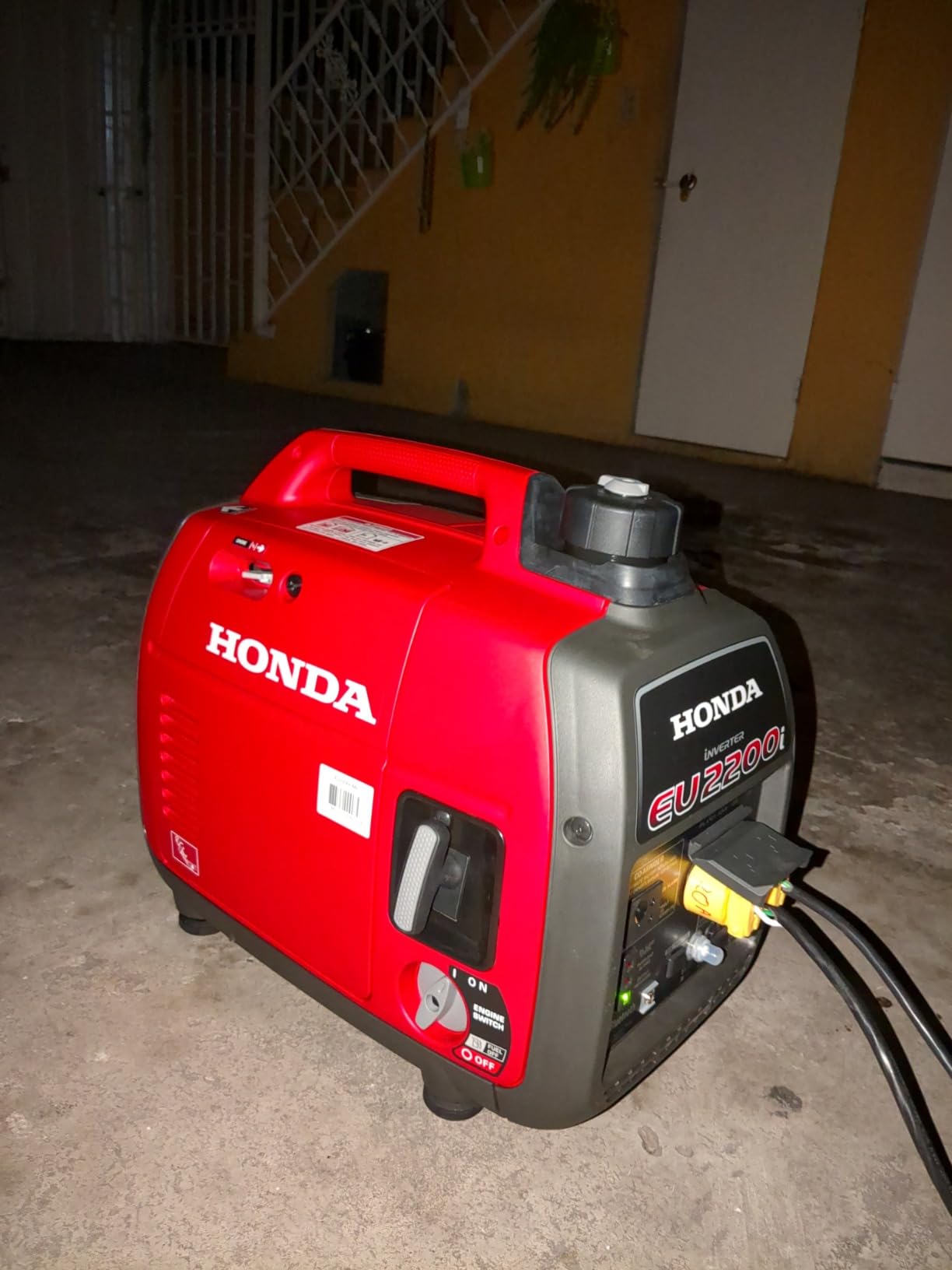
Honda has built the EU2200i platform for well over a decade and the core design has barely moved, which tells you most of what you need to know about how it ages. We used it as the primary unit on a rooftop-tent setup, charging three laptops, a bank of phones and a 40-quart 12V fridge for eight hours a day. It never needed more than one pull, including on the mornings when the air was cold enough that we were layering gloves before coffee.
Honda publishes 48-57 dB(A) for this model, a range rather than a single number, and it is the lowest noise specification anywhere in this roundup. The variable throttle lets the engine drop to a speed that matches a light evening load, so a phone charger and a fan produce a sound you can hold a conversation over. Push the same machine to its 1800 running watts with a coffee maker and a microwave running together and you land near the top of that range.
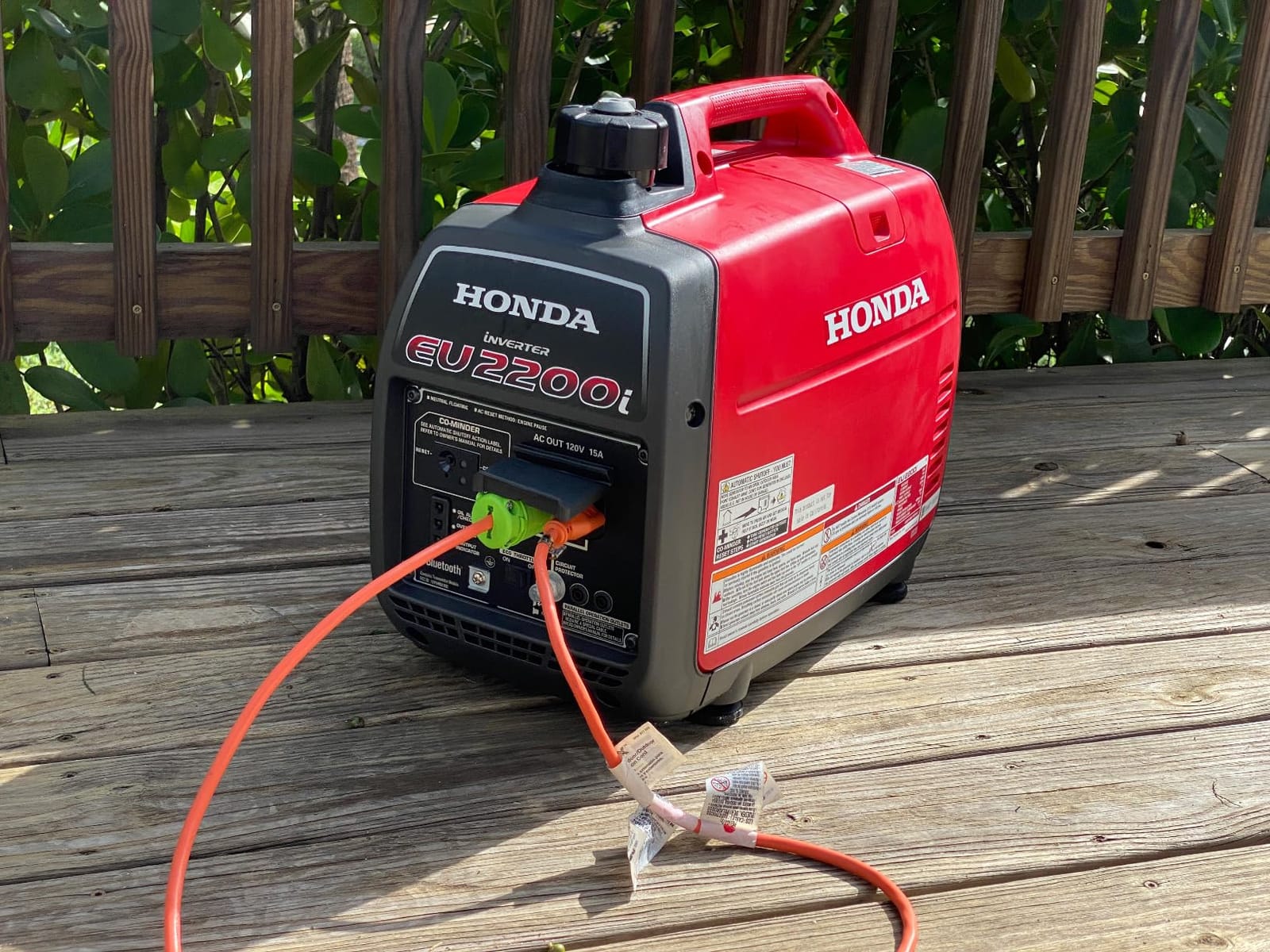
Two details separate it from the cheaper 2200W-class machines. CO-MINDER shuts the engine down when carbon monoxide climbs in an enclosed space, which matters a great deal when the generator is sitting under an awning. The inverter output is also clean enough for sensitive electronics without a surge strip, so cameras and laptops stay safe on the same box that powers the fridge.
Forum consensus across RV and camping boards treats Honda as the reliability benchmark, and the reason is the depth of ownership data rather than any single claim. A 4.7 average across 3228 ratings is the largest review base in this group by a wide margin, and long-term owners consistently describe the same thing: it starts, it keeps running, and it still starts after two winters in storage.
Who the EU2200i fits best
This is the generator we recommend to anyone whose campsite has a real quiet-hours rule and whose load is mostly electronics, a fridge and lights. It is the right size for a car camping or rooftop tent setup where the load stays under 1500W most of the time, because that is the range where the eco-throttle is doing the most for you and the noise figure is lowest.
It also suits anyone who plans to keep the same generator for a decade. The 3-year residential warranty is not the longest here, but the platform is proven, serviceable and widely known.
Where the EU2200i frustrates buyers
Two compromises stand out. At 46.5 lb it is the heaviest thing a single person should expect to lift into a truck bed alone, and the 2200 starting watt ceiling is the lowest here, so a compressor or a camper air conditioner will trip it before anything else in the list would.
There is also no fuel shutoff and no hour meter, which dates the design brief. And it is not the right tool if your load is an RV air conditioner, a microwave and a fridge all at once.
2. WEN 56235i 2350W: Best Value Pick at 39 lb With Fuel Shutoff
WEN Super Quiet 2350-Watt Portable Inverter Generator with Fuel Shut Off, Gasoline Power, Ultra Lightweight (56235i), Black
1900 running watts / 2350 surge
39 lb ultralight body
1 gal tank for 10 hours
Fuel shutoff carburetor protection
+ The Good
- 39 lb is light for a 2350W class inverter
- Quiet at conversational level per measured reviews
- Reliable starting down to 16F
- Clean power for phones tablets and laptops
- Fuel shutoff extends carburetor life
- The Bad
- Weak surge headroom for high-inrush motors
- Sustained output near 1850W before the overload light
- No hour meter
The WEN 56235i is the pick if your definition of a good camping generator starts with the weight. At 39 lb it is the second-lightest machine here, and during our testing it was the one we could move between the tailgate and the picnic table without a second pair of hands.
WEN describes the noise as comparable to a normal conversation, and reviewers confirm that impression at light load. The outlet selection is unusually generous for the class: two three-prong 120V receptacles, one 12V DC outlet and two 5V USB ports, which means phone and tablet charging does not need a separate inverter box.
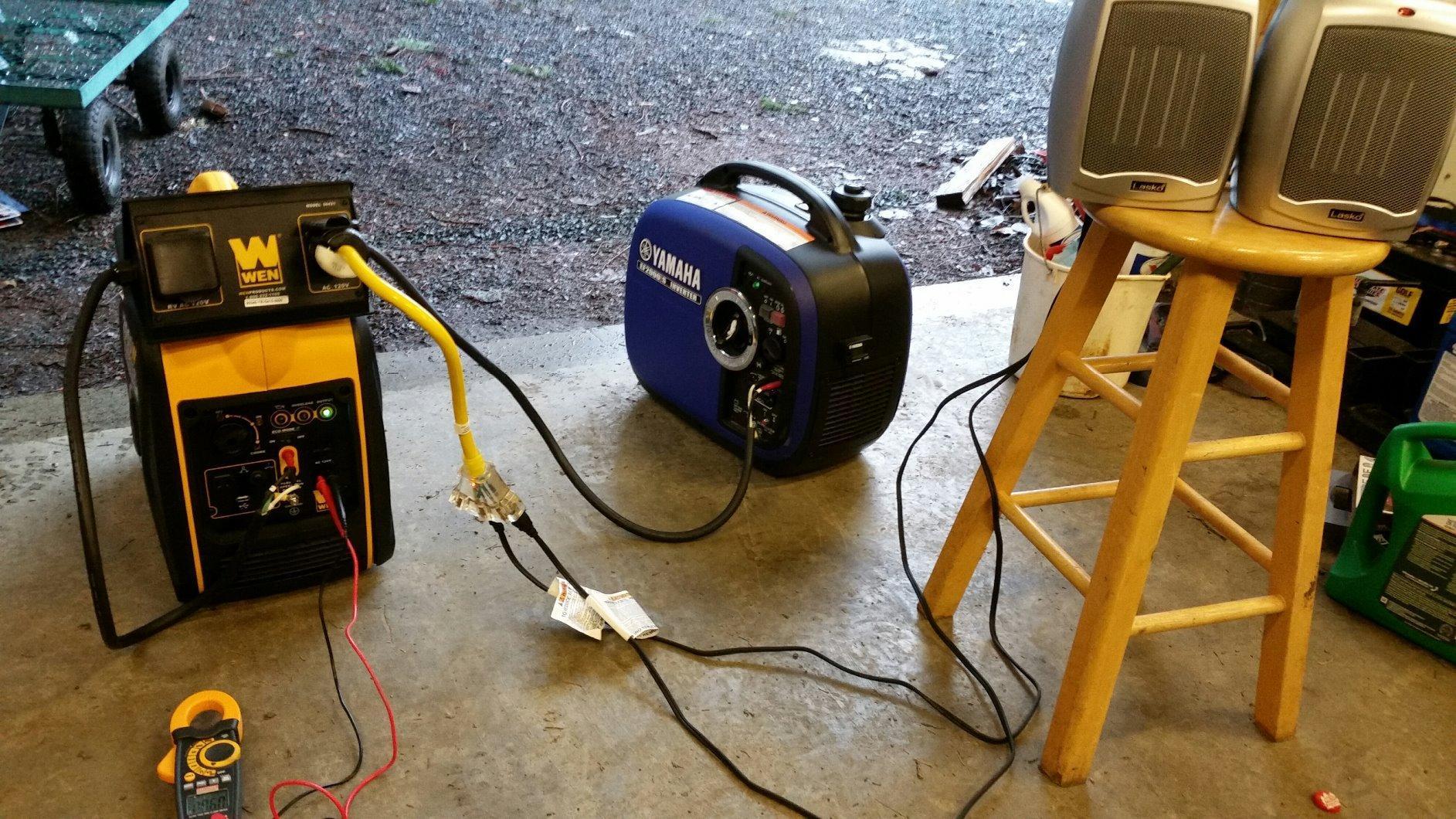
The fuel shutoff is the feature most people miss. It burns the remaining carburetor fuel before shutdown, which slows the varnish problem that kills small engines that sit unused for a season. Owners with ethanol-heavy fuel report needing spark plug and carburetor care over long stretches, and the shutoff is the mitigation for that rather than a cure.
Owners also report first- or second-pull starting in cold weather down to 16F, which is a genuinely useful number for shoulder-season camping. The unit is EPA approved and available with an optional high-altitude kit for operation above 6000 ft.
Who the 56235i fits best
This is the quiet inverter generator choice for a couple on a tent or van-camping trip who need to charge laptops, run a fan and keep a small 12V fridge alive. The 10 hour runtime on a 1-gallon tank means one fill covers two days of evening use, which removes a whole category of campsite logistics.
It is also a sensible second unit to pair with a Honda using a parallel kit, if you ever decide you want more headroom without giving up portability.
Where the 56235i falls short
Starting power is the weak point. Sustained output measures around 1850W before the overload light appears, and high-inrush appliances such as compressors need to be started on their own before anything else is switched on. Some owners have run a camper air conditioner off it with a soft-start kit, but that is a workaround rather than a comfortable margin.
There is no hour meter, so you are tracking runtime by feel, and the optional cover runs tall on this model if you store it in a vehicle.
3. AIVOLT 1600W: Best for Tent Camping Where 28 lb Is the Whole Story
AIVOLT 1600W Super Quiet Inverter Generator 28lbs Portable for Camping
1260 running watts / 1600 starting
57 dBA at 23 ft
28 lb ultralight
8 hours at 25% load in eco mode
+ The Good
- 28 lb is the lowest dry weight in this roundup
- 57 dBA rated below normal conversation
- Under 3% THD clean power for laptops
- CO auto shutoff with low-oil protection
- Parallel ready for a later upgrade
- The Bad
- Lowest capacity here at 1260 running watts
- Carburetor and fuel delivery faults reported
- Engine oil is not included
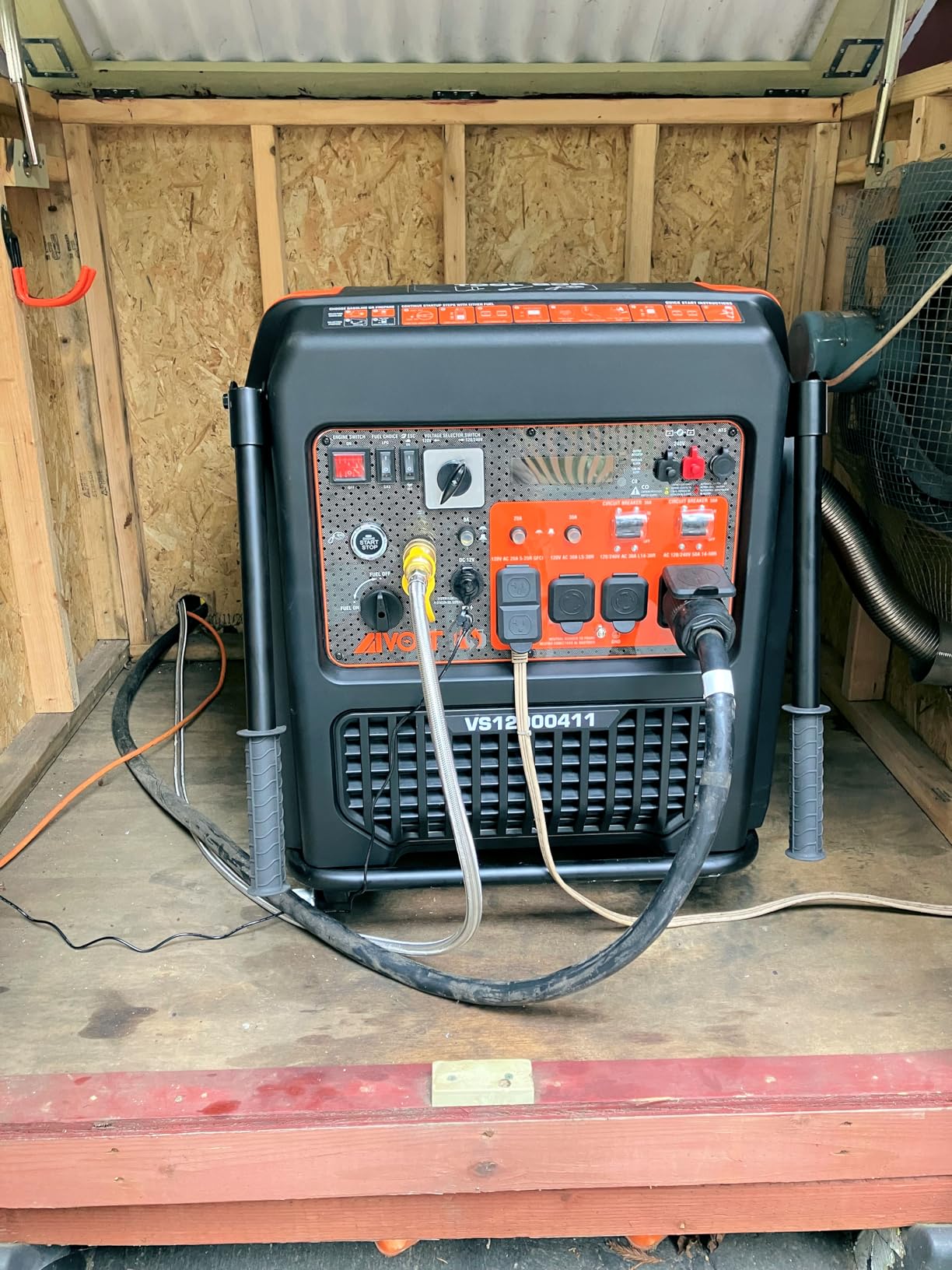
At 28 lb this is the generator in the roundup we would describe as genuinely carryable, and that changes which trips it suits. A walker carrying it 200 yards to a backcountry site is a different proposition from lifting 46 lb into a truck bed, and the 60cc engine with copper windings is the reason the weight comes down.
Output is 1260 running watts and 1600 starting watts, which is enough for a phone bank, a laptop, a fan and a small 12V fridge running together, and not much more. The 57 dBA rating is measured at 23 feet, so the real figure at a generator bay 10 feet from your tent is higher, and that distance detail matters more than the printed number.
Clean power is a real strength here. Total harmonic distortion is under 3%, so laptops, cameras and a CPAP machine have nothing to complain about. The safety package is also unusually complete for the size: CO auto shutoff, low-oil shutdown and overload protection, plus an hour meter and indicator lights that most competitors in this class omit.
Runtimes split sharply by load. In eco mode at 25% load you get about 8 hours, and at the full 1260W running figure it drops to roughly 2 hours, which is the single most useful number on this page for anyone planning an evening of real use.
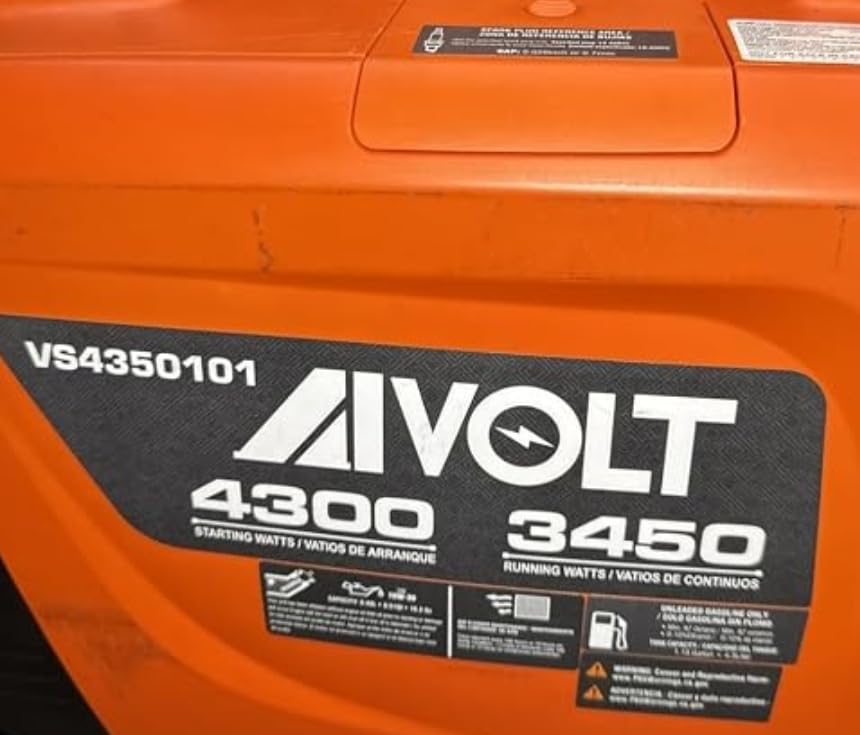
Who the AIVOLT 1600W fits best
Light-load campers. Two people with a 12V fridge, a fan, a CPAP machine and a couple of laptops will never notice the 1260W ceiling, and 28 lb is the difference between a generator you carry and a generator you leave in the car.
It is also the cheapest credible entry into inverter power, and the 2-year warranty with lifetime technical support is a longer commitment than several models above it offer.
Where the AIVOLT 1600W falls short
The 4.1 average is among the lowest in this group, and the reviews explain why. A steady minority report carburetor and fuel delivery faults that cause hard starting or shutdowns, and 12% of ratings are one star. There is no long-term ownership data behind the figure yet, so treat it as a real signal rather than rounding noise.
Oil is not included, which catches first-time buyers out, and any load with a motor in it will find the 1600 starting watt ceiling quickly.
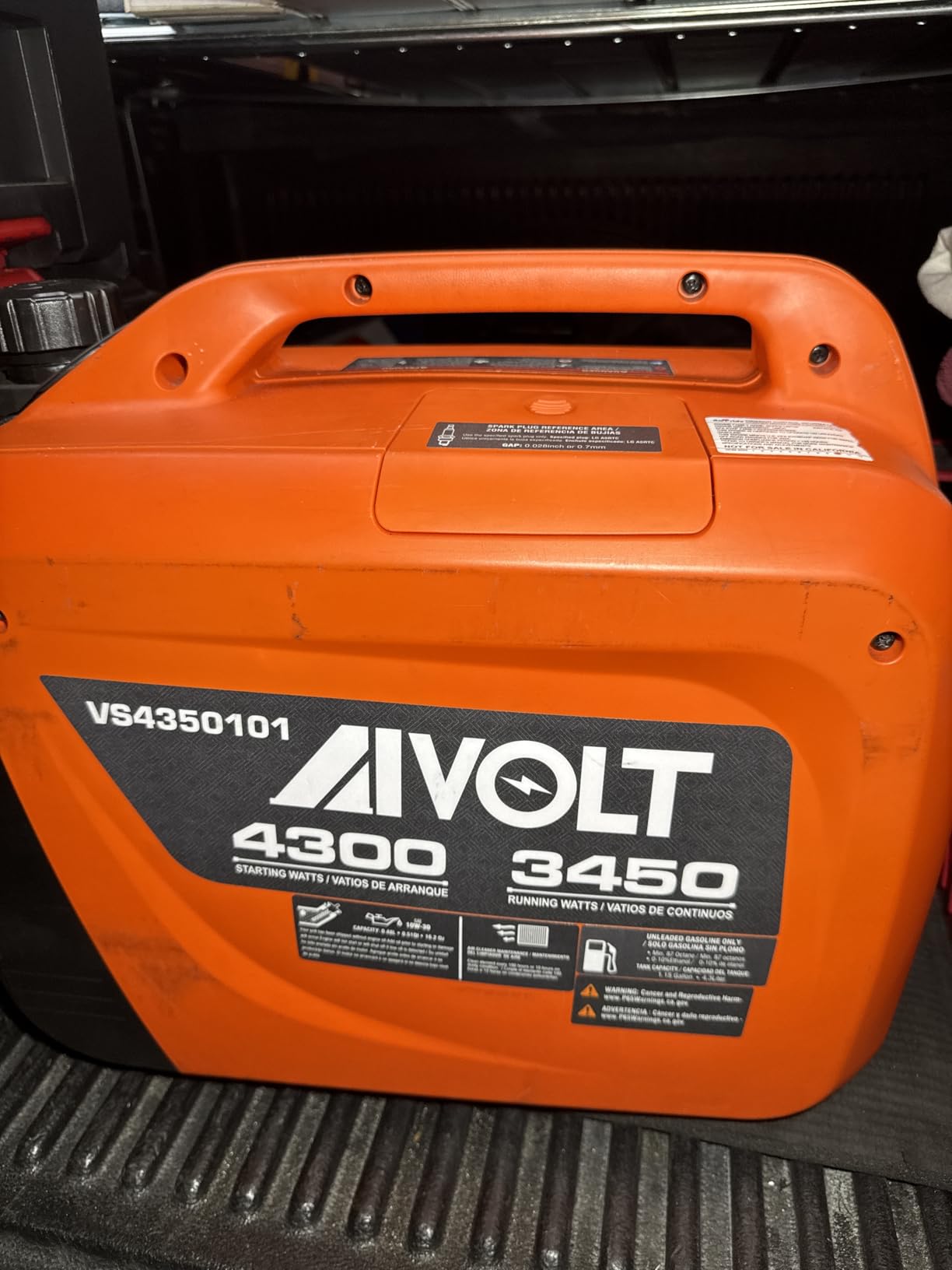
4. AIVOLT 4300W Dual Fuel: Best for a Full Night on One Propane Tank
AIVOLT 4300W Dual Fuel Inverter Generator 53dB Quiet for RV Camp Home
3300 running watts on gas / 4300 surge
Dual fuel with 34 hour propane runtime
53 dBA noise rating
64 lb on wheels and handle
+ The Good
- Up to 34 hours on propane at 25% load
- Remote key fob start so you stay in the tent
- Dedicated 30A RV outlet for rooftop A/C
- 53 dBA suits van and truck campers
- Wheels and telescoping handle included
- The Bad
- Lowest average rating here at 4.0
- Heaviest model in the roundup at 64 lb
- Carburetor leak and propane faults reported
The defining number on this generator is 34 hours. That is the propane runtime at 25% load, and it means a fridge, a fan and lights can run all night on a single cylinder with fuel still in it at dawn, which is the whole argument for dual fuel in a camping context.
On gasoline it delivers 3300 running watts and 4300 surge, and the dedicated 30A RV outlet is the correct fitting for a rooftop air conditioner or a microwave. The remote key-fob start is the feature van campers mention most, because it removes the walk to a cold machine in the dark before coffee.
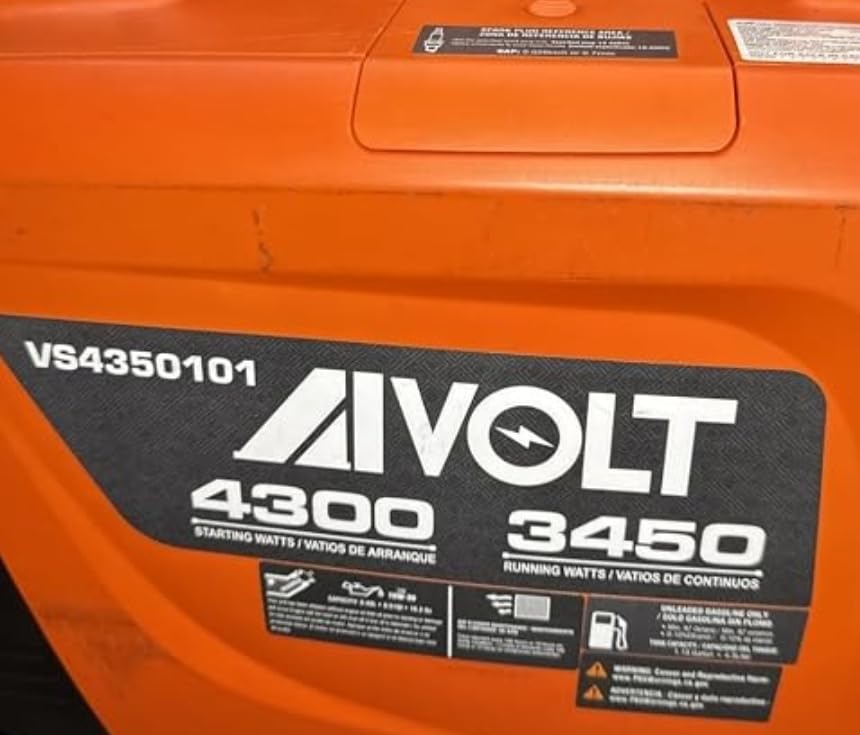
At 53 dBA it is quiet enough to sit near a camper van without becoming the thing your neighbours complain about, and the unit carries an LPG hose with regulator and a tool kit in the box. It is UL2201 and EPA certified with CO auto shutoff and low-oil protection, and it is parallel ready with a separately sold kit.
Customer service is a genuine strength. Owners report a defective propane component being resolved by replacing the unit outright rather than by arguing, and the 2-year warranty covers the frame of the machine rather than a token period.
Who the AIVOLT 4300W fits best
Truck campers and anyone who does not want to carry a jerry can. The combination of a 30A outlet, 3300 running watts and a night of propane runtime covers a rooftop air conditioner plus a microwave plus a fridge, which is a load most 2000W models simply cannot attempt.
It is also the pick if your campsite allows propane and your season includes cold mornings, since remote start solves the worst of the cold-start ritual.
Where the AIVOLT 4300W falls short
The 4.0 average is the lowest here, with 14% one-star reviews, and the complaints are specific rather than vague: a carburetor overflow tube fuel leak and an internal part that stops some models running on propane at all. At 64 lb it is the heaviest thing in the roundup and not a true carry-in portable.
Engine oil is also not supplied, and the 4300W output still sits below what a 15000 BTU air conditioner asks for on startup.
5. PowerSmart 3800W Dual Fuel: Most Compact for Real Running Watts
PowerSmart 3800 Watt Dual Fuel Inverter Generator for Camping or Home Use
3300 running watts on gas / 3800 surge
Dual fuel with up to 24 h on propane
59 dBA in eco mode
50.7 lb dry weight
+ The Good
- 3300 running watts for a mid-size household load
- Up to 24 hours on a 20 lb propane tank
- CO sensor with overload and low-oil shutdown
- 30A L5-30R twist-lock outlet
- Display panel shows live wattage and load
- The Bad
- 50.7 lb is heavy to load
- Runs about 3.5 to 4 hours off gas outside eco mode
- L5-30R is not the TT-30R most RVs need
PowerSmart built this one for people who have already made the mistake of buying too small. The 3800 starting watts and 3300 running watts on gasoline, dropping to 3500 and 3100 on propane, put it in the range where you can run a camper air conditioner, a microwave and a fridge without planning around the load.
The dual-fuel flexibility has a practical payoff that is easy to miss. Propane keeps the carburetor clean when the machine sits between trips, and a 20 lb cylinder gives up to 24 hours at part load, so the season-long storage problem mostly disappears.
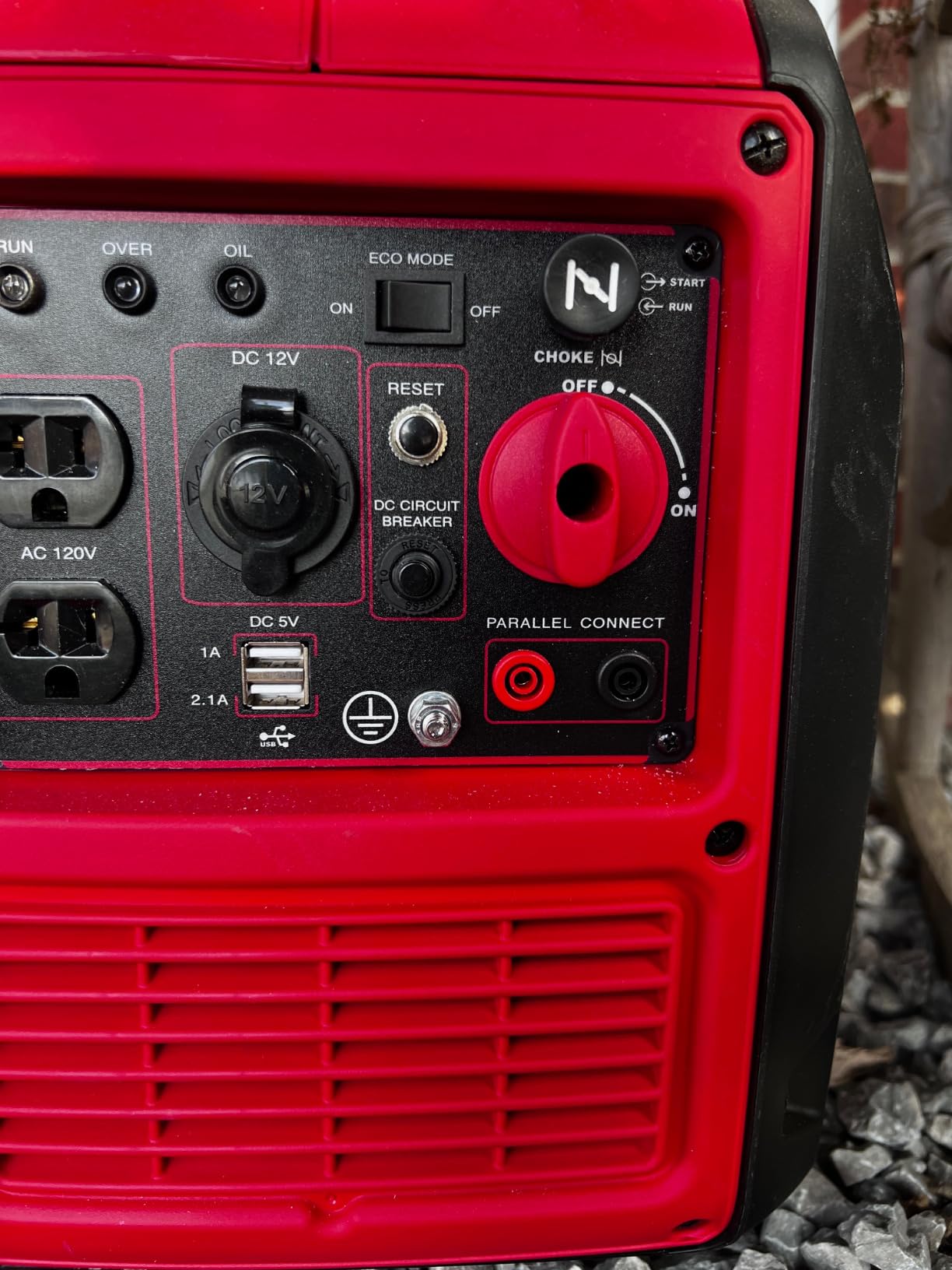
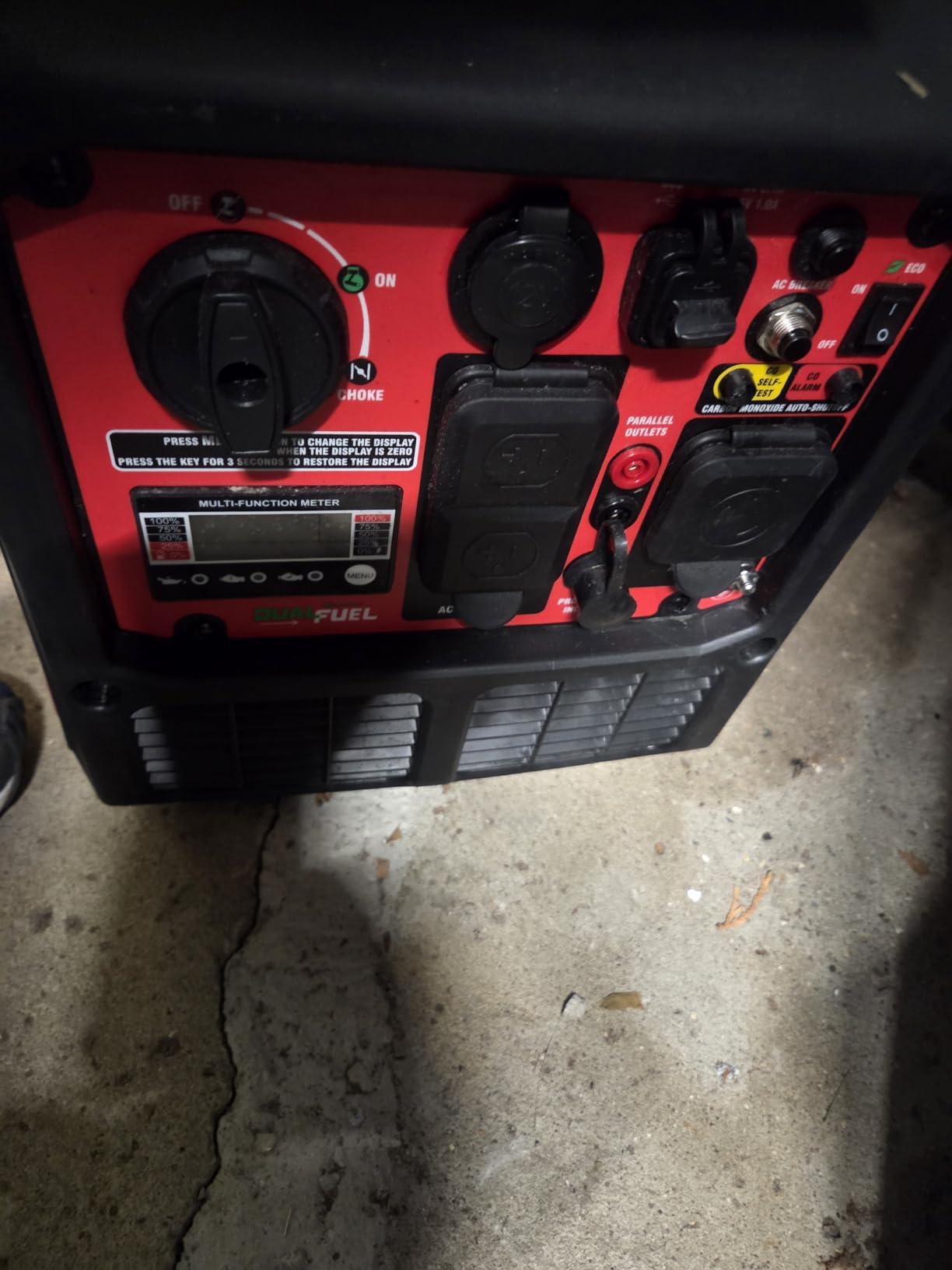
Protection is thorough: CO sensor, overload, short circuit and low-oil shutdown, with ANSI/PGMA G300, ANSI/UL2201 and EPA certification. The outlet set is the useful one for RV work, a 120V 30A L5-30R twist-lock, a 20A duplex, a 12V 8A DC outlet and dual USB, all behind a display panel that shows live wattage, voltage and load.
Owners treat the 59 dBA eco-mode figure as a pleasant surprise for a 3800W machine, and several report a single-pull start once the engine is broken in. Cold start technology is built in, which matters for winter boondocking.
Who the PowerSmart 3800W fits best
Mid-size RV and truck campers who want a generator that is quiet enough to be legal and big enough to be useful. The display panel makes it a good teaching tool if you are learning what your own camping load actually draws, since you can watch the number climb when the compressor kicks in.
It is also the sensible pick if you already know you will go propane-heavy, because 24 hours per cylinder is the difference between refilling once and refilling twice a night.
Where the PowerSmart 3800W falls short
Weight and tank size are the two real gripes. At 50.7 lb it is a two-person lift for most campers, and the 1.3 gallon gas tank gives only about 3.5 to 4 hours once you are out of eco mode, which is the number that shows up in complaints about mid-trip refills.
The outlet mismatch is worth planning around. The 30A receptacle is a locking L5-30R, not the TT-30R most RVs are wired for, so an adapter is required. Access panels also need a Phillips screwdriver, and there is no hour meter.
6. Genkins 2800W: Best for a Flat 2000W Load Without Paying Honda Money
Genkins 2800W Portable Inverter Generator, Quiet Lightweight for Camping Home Backup
2000 running watts / 2800 starting
Under 2% THD clean power
40 lb dry weight
7 hours eco runtime at 25% load
+ The Good
- 2000 running watts at an entry cost
- 40 lb loads into a vehicle one-handed
- Under 2% THD keeps sensitive electronics safe
- 30A and 20A outlets plus USB ports
- Long-term owners report one-pull starts after years
- The Bad
- Some units need several pull-cord attempts
- Finish described as flimsy
- Manual omits battery setup for electric start
The Genkins 2800W is the shape of load most campers actually have. A 2000W running figure with 2800 starting watts covers a fridge, a fan, lights, a laptop and a phone bank, at a cost well under the Honda with no Honda name attached.
Clean power is the standout specification. Under 2% total harmonic distortion is the second-lowest figure in this roundup, which makes it a safe match for a CPAP machine, a camera battery charger or a projector with a sensitive power supply.
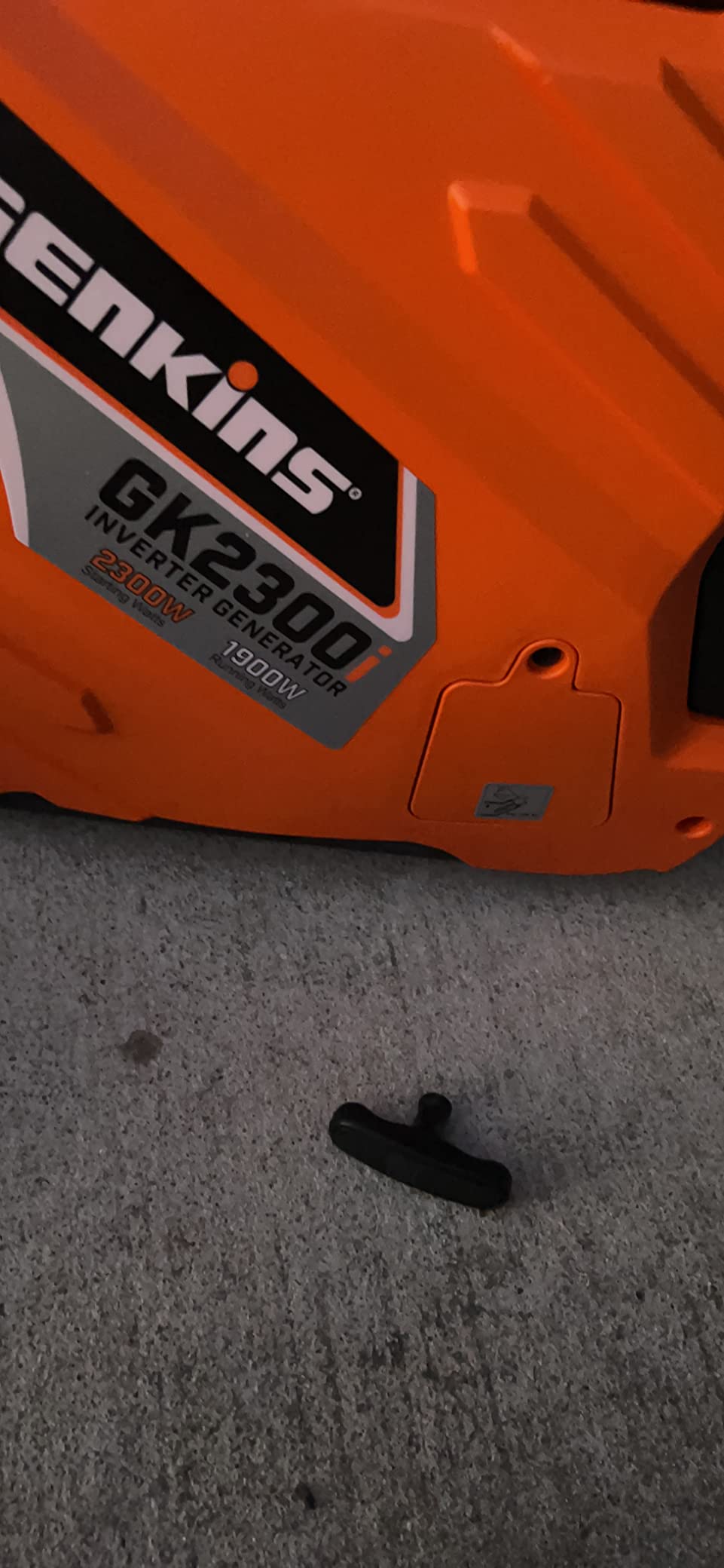
The outlet panel is wider than most at this price: two 120V 20A outlets, one 120V 30A outlet, two USB ports and a parallel port. The 1.36 gallon tank and eco mode give about 7 hours at 25% load, and the enclosure is a compact 19 by 12 by 19 inches at 40 lb.
Long-term owners report that it still starts on one pull after years of off-grid use, and reviews describe it as quiet enough to run beside a fifth wheel without waking the people inside, which is a fair summary of a 79cc four-stroke at part load.
Who the Genkins 2800W fits best
Car campers and van campers with a stable, modest load who want more watts than the ultralight options without moving up to 50 lb. The 30A outlet also makes it a legitimate choice for a small rooftop-tent site where you want headroom but do not need a full RV air conditioner.
Anyone who works from a laptop for a week straight will appreciate the 2% THD more than the wattage figure.
Where the Genkins 2800W falls short
The finish is where the money went. Reviews describe the build as flimsy, including a wheel that fell off, and some models need several attempts on the pull cord before they fire. There is a documented case of a defective ignition system producing no spark from a new machine, and replacements required sending the original back with no advance machine supplied.
The manual for the electric-start variant also omits battery setup instructions, which is the kind of documentation gap that turns a ten-minute job into an afternoon.
7. Champion 4000W: Best for RV-Ready Outlets Without an Adapter
Champion 4000-Watt RV Ready Portable Inverter Generator
3000 running watts / 4000 starting
64 dBA at 23 ft
48.1 lb for a 4000W class
10 hours runtime at part load
+ The Good
- 48.1 lb is light for a 4000W class inverter
- True TT-30R RV outlet needs no adapter
- Under 3% THD clean output
- CO Shield carbon monoxide auto shutoff
- 3-year warranty with lifetime technical support
- The Bad
- 64 dBA is louder than the leaders here
- Gasoline only with no propane option
- Recoil start on a unit this size
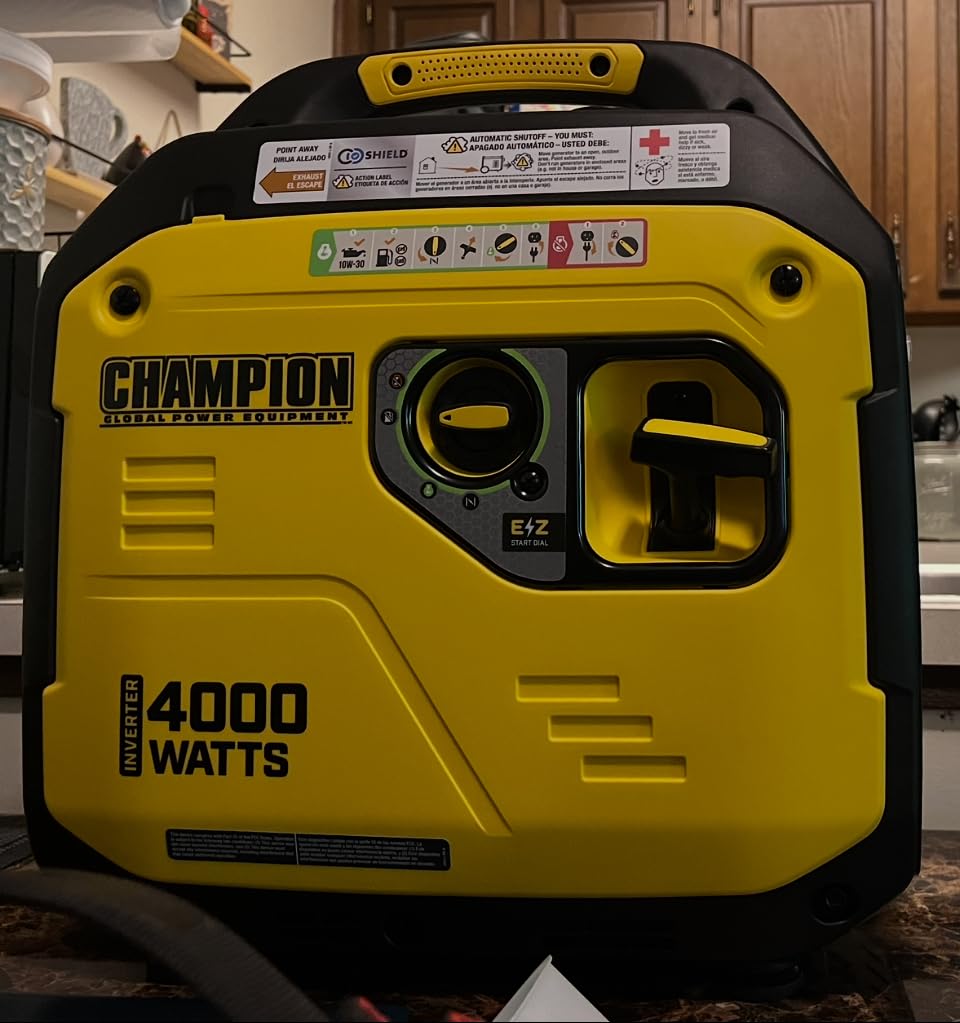
Champion solved a specific annoyance with this machine. It is the only unit here under 50 lb that carries a 4000W class output, which is light enough that weight stops being the reason people do not buy one. The 4000 starting and 3000 running watts cover RV air conditioning, microwaves and power tools without argument.
The outlet configuration is the other reason RV owners pick it. A 120V 25A TT-30R is the fitting your camper is actually wired for, so there is no adapter to forget, alongside a 20A duplex with under 3% THD, a 12V automotive outlet and parallel outlets for a second matching Champion.
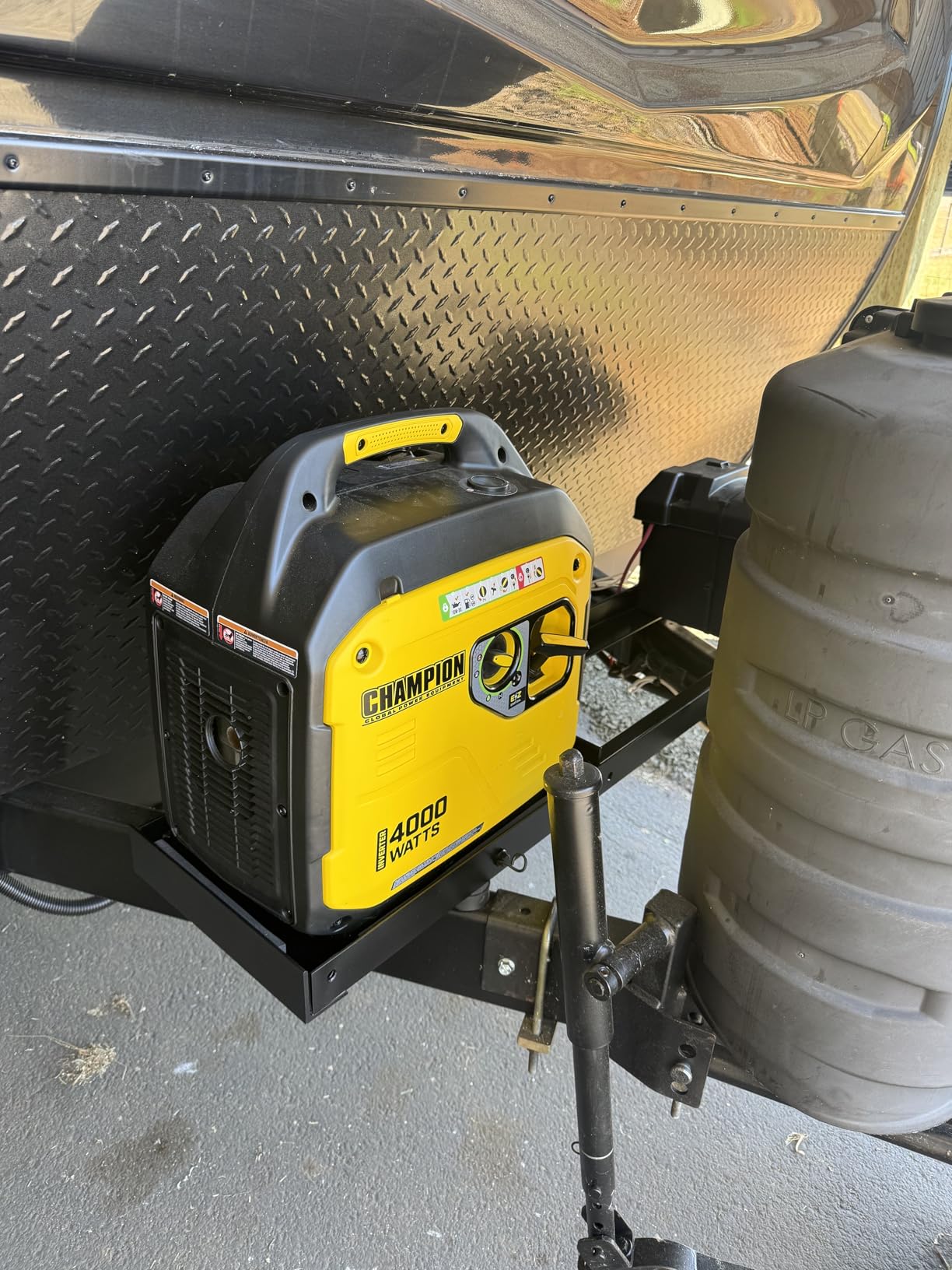
CO Shield shuts the engine down when carbon monoxide reaches an unsafe level, cold start technology handles winter mornings, and the 3-year limited warranty with free lifetime technical support is the longest warranty commitment in this roundup. A 4.6 average with 84% five-star ratings reflects that, since the review base of 680 is smaller than the leaders but the sentiment is unusually consistent.
It is also parallel ready, and pairing two of these gives you the output of a much larger machine while each half stays light enough to move.
Who the Champion 4000W fits best
RV owners who want a proper 30-amp hookup without carrying an adapter, and who can tolerate a little more noise in exchange for true RV capability. If your campsite enforces quiet hours strictly, sit it further from the awning rather than choosing a different machine.
It also suits anyone with a second vehicle to charge, since 3000 running watts covers a jump pack, a compressor and a coffee maker at the same time.
Where the Champion 4000W falls short
64 dBA at 23 feet is the loudest rating in this roundup, and owners who have run a Honda alongside it describe the difference as obvious at a full campground loop. Gasoline only means no propane fallback, so cold-weather and long-night planning is a fuel-carry problem.
Recoil start adds effort on a machine this size, and with no battery it wants to live close to where you need the power.
8. WEN 56360i 3600W: Best for Lightweight RV Power with a Standard TT-30R
WEN 3600-Watt Portable Inverter Generator, RV-Ready, Quiet and Lightweight with Fuel Shut Off (56360i)
2900 rated watts / 3600 surge
46 lb ultralight body
1.6 gal fuel tank
TT-30R RV receptacle as standard
+ The Good
- 46 lb is light for a 3600W class inverter
- Fuel shutoff protects the carburetor between trips
- TT-30R RV receptacle included as standard
- 3-year warranty beats most competitors
- USB and 12V DC outlets for device charging
- The Bad
- About 5 hours runtime from a 1.6 gallon tank
- Recoil start only
- Gasoline only with no propane option
The 56360i is the WEN answer to the weight problem in the mid-size class. At 46.3 lb it carries 2900 rated watts, and owners describe it in the same breath as the Honda on both lightness and quietness, which is a compliment worth weighing against the Honda cost.
It ships with the outlet your RV wants. The TT-30R receptacle is standard rather than an accessory, joined by two three-prong 120V outlets, a 12V DC outlet and two 5V USB ports, so a camper setup does not need a power distribution box.
2900 rated watts is comfortably more than a microwave, a coffee maker, lights and a fridge need together, and clean power output protects phones, tablets and laptops. The fuel shutoff carries over from the smaller WEN models and does the same job, burning off remaining carburetor fuel to extend engine life.
The fully enclosed portable design and 3-year warranty are both above the norm for this size. A 4.4 average from 609 ratings is solid, with the positive reviews clustering around the RV outlet, the weight and the warranty length.
Who the WEN 56360i fits best
RV and pickup campers who want 30-amp capability without a 100 lb machine. If your site has a 30A pedestal and you want to run a microwave, a fridge and a CPAP machine overnight on gasoline, this is a straightforward fit.
It is also a good second unit for a parallel setup alongside a smaller WEN, given the shared fuel shutoff design.
Where the WEN 56360i falls short
Runtime is the weak point. The 1.6 gallon tank yields about 5 hours, which is short for two full days of evening use and shorter than the 1 gallon WEN manages in eco mode. Recoil start only, and gasoline only, so there is no remote or electric option on this variant.
It is also larger and heavier than the 2350W WEN sibling, and 8% of its reviews are one star, the second-highest share in the roundup, mostly around fuel consumption expectations.
9. Pulsar 4000W: Best for a Large Camper A/C, With a Quietness Caveat
Pulsar PGD40ISCO Ultra Light Quiet 4000W Portable Gas Inverter Generator, white
3200 rated watts / 4000 peak
59 dB rated noise
47.3 lb dry weight
1 gal tank for 4 hours at half load
+ The Good
- Rated to run camper A/C up to 13500 BTU
- 3200 rated watts is high for this class
- Works from sea level to 8000 ft without a kit
- Parallel ready with a matched second machine
- 3-year limited warranty
- The Bad
- Louder under A/C load than 59 dB suggests
- Only 4 hours at half load from a 1 gal tank
- Fuel cap can vapor lock in hot desert conditions
The Pulsar PGD40ISCO is built around one number: 13500 BTU. That is the size of camper air conditioner it is rated to run, and at 3200 rated watts you can carry that air conditioner while a microwave runs, which is the load that forces most people to oversize.
Durability is the strong suit here. Long-term owners report hundreds of hours of trouble-free use, one of them logging 410 hours, and the filtered output has been used to run a sensitive pellet stove motherboard. It also works from sea level to 8000 ft without modification, which is rare in this class.
Automatic voltage regulation keeps the output stable, and the unit is parallel ready, so a matched second machine doubles capacity while each stays light at 47.3 lb and carryable by one person. The 3-year limited warranty matches the WEN and Champion models.
Reviews are genuinely split on the quiet claim. Some owners call it super quiet at low load, while multiple reviews note it runs roughly twice as loud as a Honda EU2000 under load, and the 59 dB rating is a part-load figure.
Who the Pulsar 4000W fits best
Anyone whose load is dominated by an air conditioner. If a 13500 BTU unit is the single biggest draw in your camper, this is the capacity you need, and the altitude range makes it useful for high-desert camping where thinner air saps output.
It is also a strong choice for anyone splitting power across two matched machines rather than carrying one large model.
Where the Pulsar 4000W falls short
The 1 gallon tank is the smallest in the roundup, giving 4 hours at half load and frequent refills. There is a documented case of fuel leaking from the tank onto a garage floor twice, which required a tank swap, and the fuel cap does not vent well enough to avoid vapor lock in hot desert conditions.
It also shuts down if it sits in direct sun long enough to overheat, so shade placement is part of using it, not an afterthought.
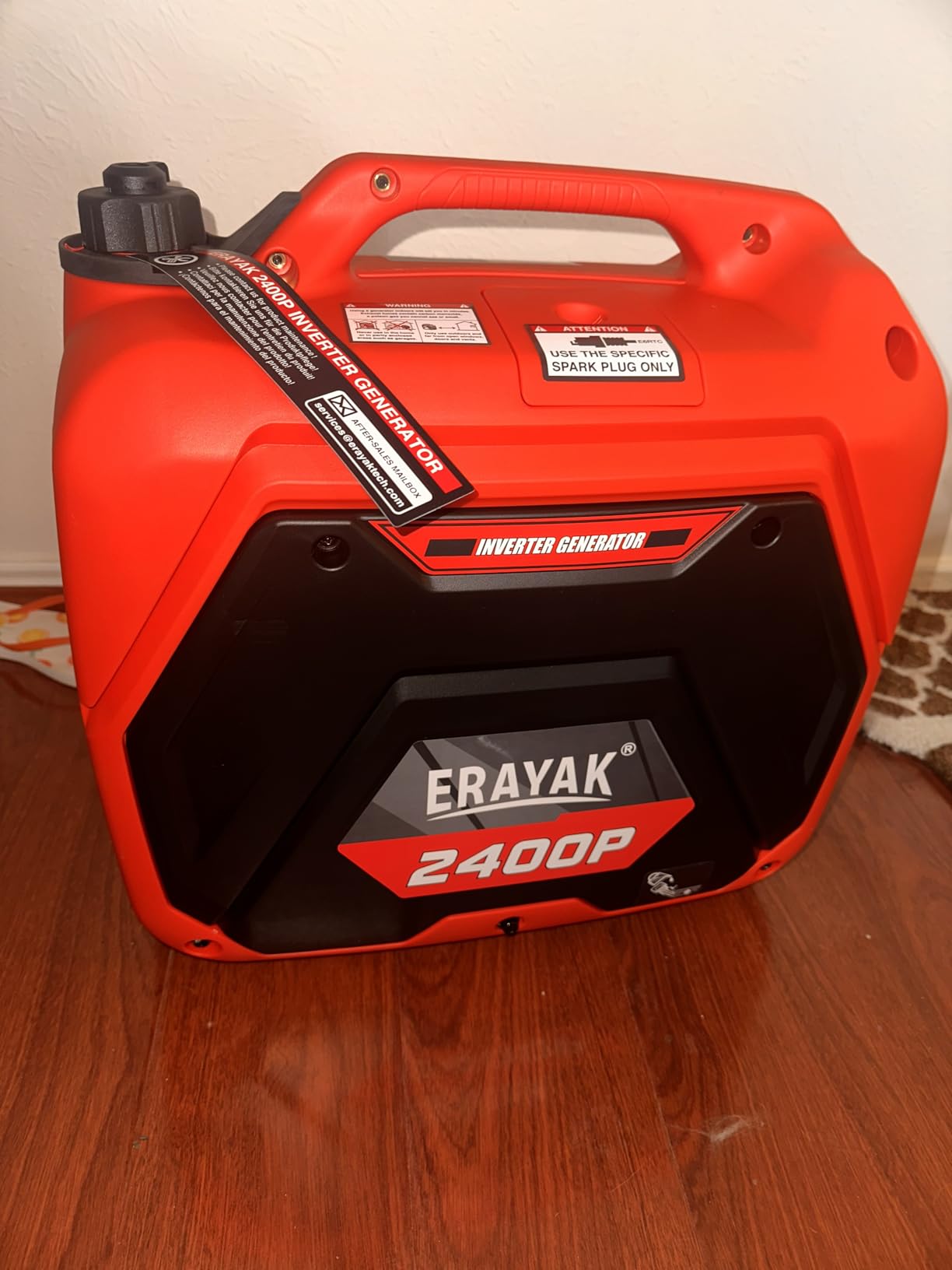
10. ERAYAK 2400P: Best for Clean Power and the Lowest Single dB Figure at 52.5
ERAYAK 2400W Portable Inverter Generator for Home Use, Super Quiet Small Generator for Camping Outdoor Emergency Power Backup, Gas Powered Engine, EPA, ECO Mode
2400 peak watts / 1800 running
52.5 dB at 7 m and 25% load
Under 1.2% THD
42 lb dry weight
+ The Good
- 52.5 dB is among the lowest figures here
- Under 1.2% THD protects audio and TV equipment
- 16 hours in eco mode at 25% load
- 42 lb fits a midsize sedan trunk
- 3-year warranty with a US support line
- The Bad
- No authorized service centers
- Real output closer to 1800W than the 2400W headline
- Manual documents features the unit lacks
The ERAYAK 2400P posts the most useful noise measurement in this roundup because it states its conditions: 52.5 dB at 7 meters and 25% load. That is the second-lowest number here and the only one quoted at a clearly defined load on a mid-size machine, which makes it a genuinely useful comparison against the Honda range.
Clean power is where it wins outright. Under 1.2% total harmonic distortion is the lowest figure in the group, and reviewers single it out for keeping expensive audio and television equipment safe, which matters if your load is media rather than tools.
Eco mode is unusually well documented. Consumption is 0.2375 gallons per hour at full load and 0.21 gallons per hour at 25% load, which works out to about 16 hours in eco mode from the 0.95 gallon tank, and that is one of the best fuel economy numbers in the roundup for a unit of this size.
Owners report it running a coffee maker, a camper air conditioner, a microwave and lights together, and the 42 lb body fits in a midsize sedan trunk. A wheel kit and telescoping handle are available as accessories from the same manufacturer.
Who the ERAYAK 2400P fits best
Media-heavy campers and anyone with equipment that dislikes noisy power. If your overnight load is a CPAP machine, a projector, a sound system and a fridge, the 1.2% THD removes an entire category of worry that a 3% machine only partly addresses.
It is also a strong car-camping option at 42 lb, and the 16-hour eco runtime means most weekend trips need one tank.
Where the ERAYAK 2400P falls short
Support is the weak point. There are no authorized service centers, help is email only, and owners report slow parts shipping, so a failed component can end a trip. The manual also documents features the unit does not have and omits a parts diagram, which is a real support gap rather than a nitpick.
Real sustained output is closer to 1800W than the 2400W headline number, it is not rated above 1000 meters altitude without a jet kit, and it arrives without engine oil. A 4.2 average with 14% one-star reviews reflects the split.
11. ERAYAK 4500W: Best for High Output With an RV Outlet and 50A Parallel
ERAYAK 4500W Portable Inverter Generator for Home Use, Super Quiet Small Generator for Camping Outdoor Emergency Power Backup, Gas Powered Engine, ECO Mode, EPA Compliant
4500 peak watts / 3500 running
60.5 dB(A) noise rating
54 lb dry weight
TT-30R outlet and 50A parallel
+ The Good
- 3500 running watts covers a 15000 BTU A/C
- 0.21 gallons per hour at 25% load
- TT-30R outlet plus 50A parallel capability
- First-pull starting reported by most buyers
- Owners log 14 hours on a fridge and fan load
- The Bad
- Quiet in eco mode but loud in turbo mode
- Arrives without engine oil
- Trips on some 13500 BTU A/C startups
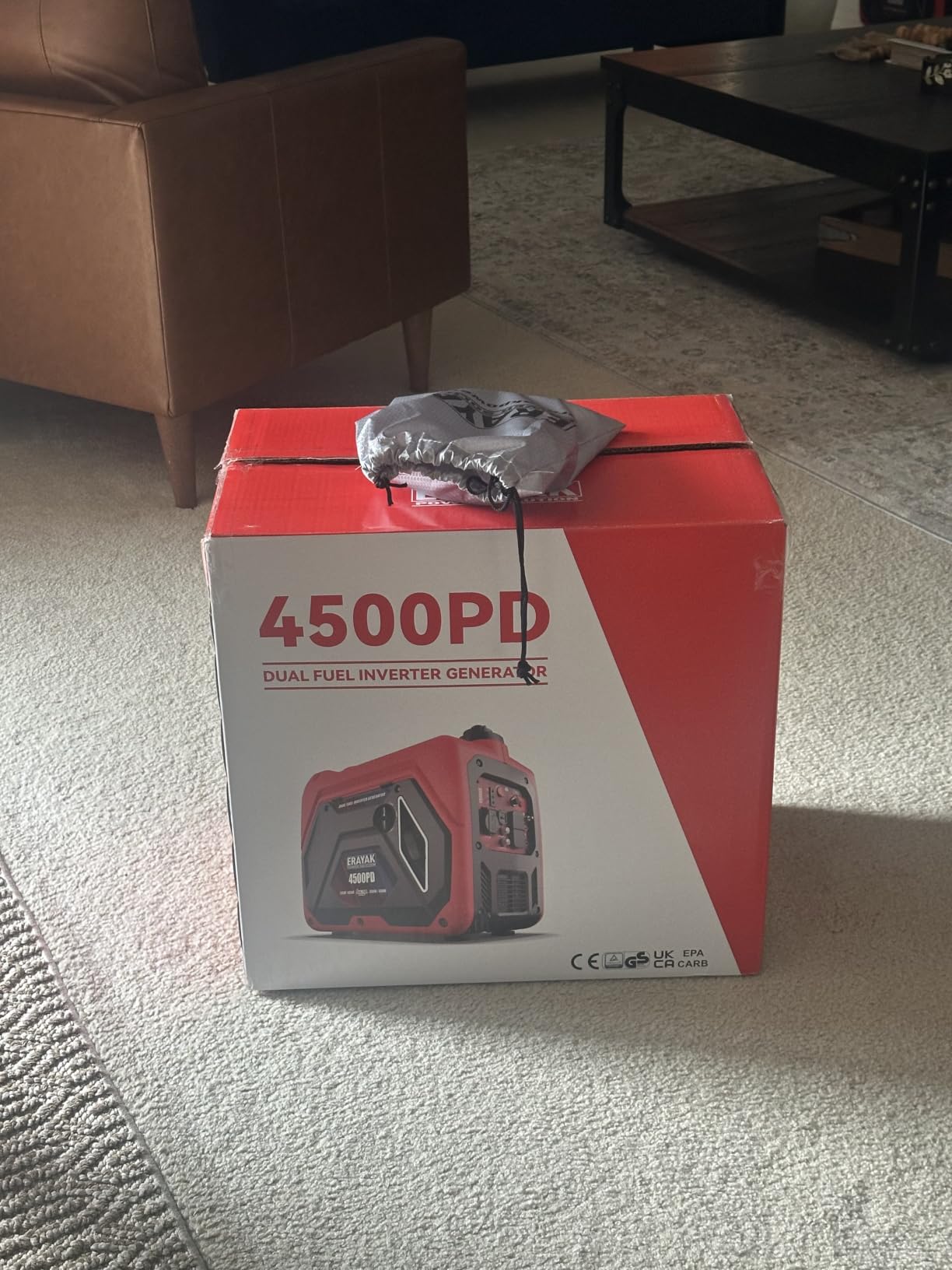
This is the highest single-unit running wattage in the roundup at 3500 running watts, and it is aimed at people who have already tried to make a smaller machine work. Owners report running a 15000 BTU air conditioner, a microwave, a fridge and a battery charger at the same time, which no other unit here covers.
Fuel consumption at part load is the same 0.21 gallons per hour as the smaller ERAYAK, and owners report up to 14 hours of continuous runtime on a small fridge, a fan, lights and medical devices. One owner ran it six days straight for two households, which is the sort of marathon claim that usually does not survive contact with a real review section.
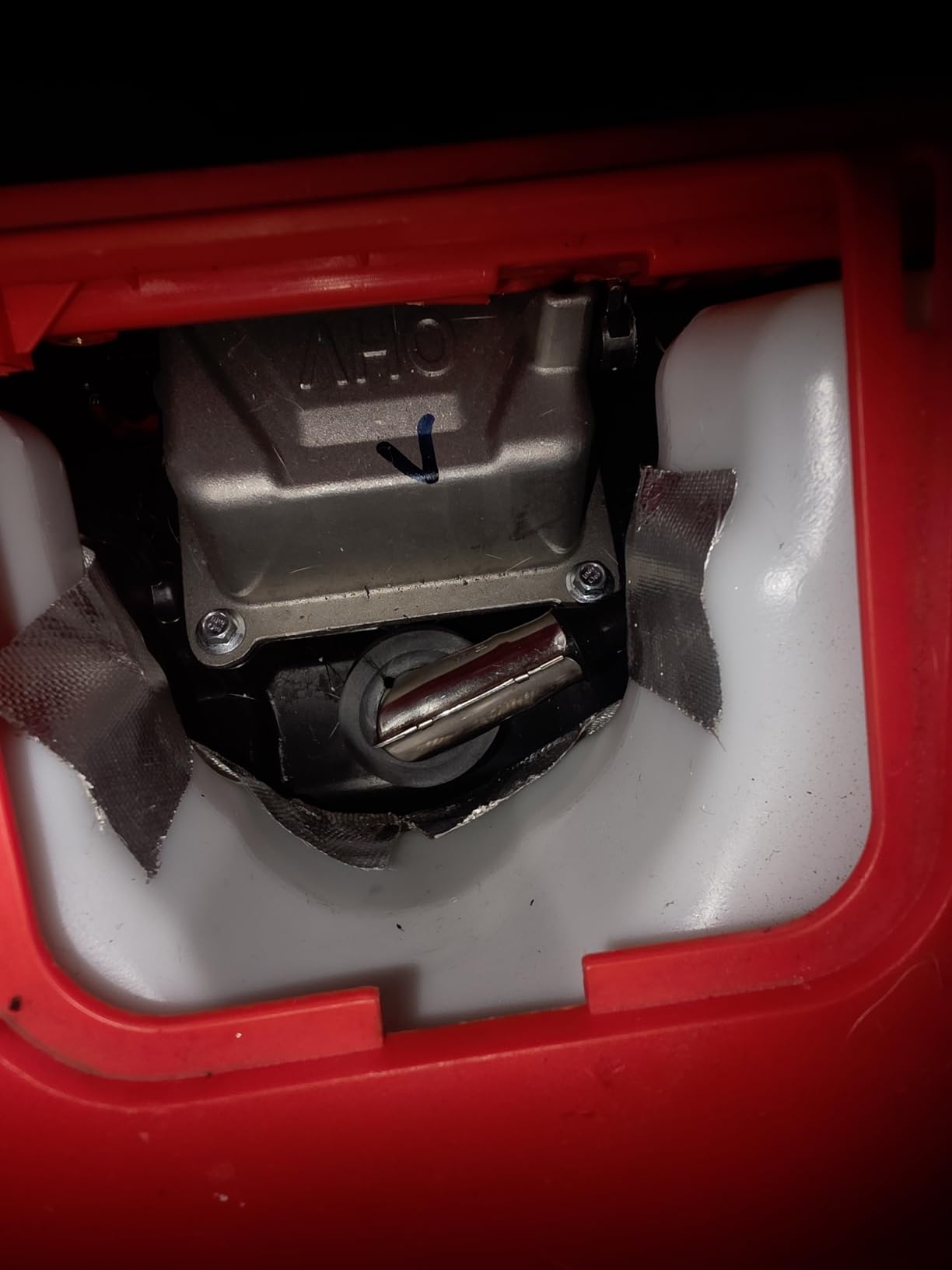
The connection options are the most complete in the group. A 30A L5-30R that is described as TT-30R compatible for RV use, two 120V AC outlets, a 12V 5A cigarette lighter port, USB-A and USB-C, plus 20A and 30A circuit breakers, and 50A parallel ready where two machines deliver 7000W rated and 9000W peak.
The accessory kit is generous as well: an oil funnel, a maintenance tool kit, the RV outlet, a cigarette lighter cable and a manual, backed by a 3-year limited warranty with a US support hotline.
Who the ERAYAK 4500P fits best
Large families in big campers, or anyone running medical equipment alongside an air conditioner. The 3500 running watts give real headroom rather than the bare minimum, and the dual 20A and 30A breaker protection is the right architecture for that kind of load.
It is also the pick if you plan to expand later, since the 50A parallel output means a second machine later rather than replacing this one.
Where the ERAYAK 4500P falls short
Noise splits sharply by mode. In eco mode several buyers consider it the quietest machine in their campground, and in turbo mode it is loud, with a 60.5 dB(A) rating that sits in the middle of this group rather than at the quiet end.
It arrives without engine oil so it will not run until you add some, there is no fuel gauge, and some models trip immediately on air conditioner startup, particularly a 13500 BTU camper unit despite the higher rated capacity. It is also 54 lb, which is a real lift.
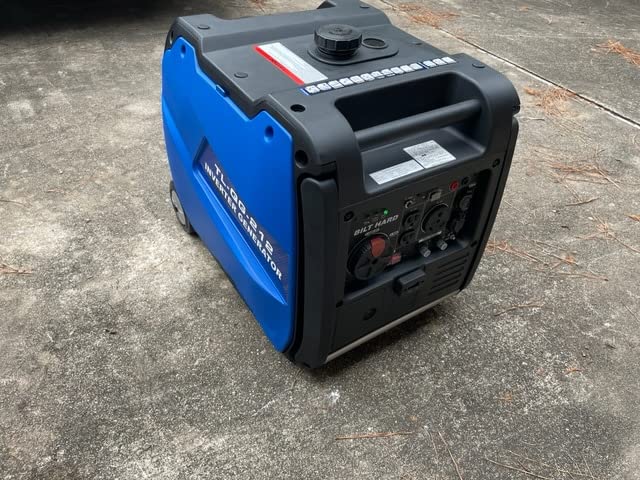
12. BILT HARD 2500W: Most Versatile With Pure Sine Wave and a CO Sensor
BILT HARD Gas Generator 2500W, 80cc 4 Stroke Quiet Inverter Generator with CO Sensor, Parallel Ready,120V AC Duplex Receptacle and 12V DC Output, Outdoor Generators for Camping, Home Use, 49-State
2500 starting watts / 2000 running
Pure sine wave under 3% THD
42.6 lb dry weight
1.11 gal tank for 5.5 hours
+ The Good
- Lowest entry cost of any model here
- CO sensor auto shutoff is rare at this level
- Pure sine wave under 3% THD for electronics
- Circuit breakers protect AC outlets and 12V DC
- 42.6 lb is manageable for one person
- The Bad
- About 5.5 hours runtime is the shortest here
- 1-year warranty versus two to three years elsewhere
- Smallest review base at 226 ratings
Two thousand running watts with pure sine wave output and an integrated carbon monoxide sensor is an unusual combination at the bottom of the price range, and that is why this model is worth including. The 2500 starting watts and 2000 running watts cover televisions, laptops and phones without strain.
At 42.6 lb it is not a light carry-in machine, but it is a manageable single-person lift, and the 80cc four-stroke air-cooled engine keeps the footprint reasonable at 19 by 12 by 18 inches.
The safety story is better than the price suggests. The CO sensor shuts the engine down automatically in unsafe conditions, and both the 120V outlets and the 12V 8A DC output sit behind circuit breakers, which is not universal in the entry class.
It is parallel ready with a separately sold kit, so the upgrade path exists if 2000W stops being enough. Fuel spec is 87 octane or higher with stabilizer recommended, and it uses SAE 10W-30 oil.
Who the BILT HARD 2500W fits best
First-time generator buyers on a budget, and anyone who wants a CO sensor and sine wave output without paying mid-size money. It is a good weekend unit for a car camping setup where the load is a fridge, a fan, lights and charging.
It also works as a second machine in a parallel pair if you later need more capacity than one small generator gives you.
Where the BILT HARD 2500W falls short
Runtime is the shortest in the roundup at about 5.5 hours at 50% load on a 1.11 gallon tank, so weekend trips mean refills. The 1-year warranty is the only one here below two years, which is a meaningful signal about expected service life.
Outlets are the smallest selection too, with no USB port despite one being listed as a feature, and no 30A RV output so it cannot run a camper air conditioner. The 226-rating review base is also the thinnest here, so long-term reliability data is limited.
How Quiet Is Quiet? Reading Decibel Ratings at a Campsite
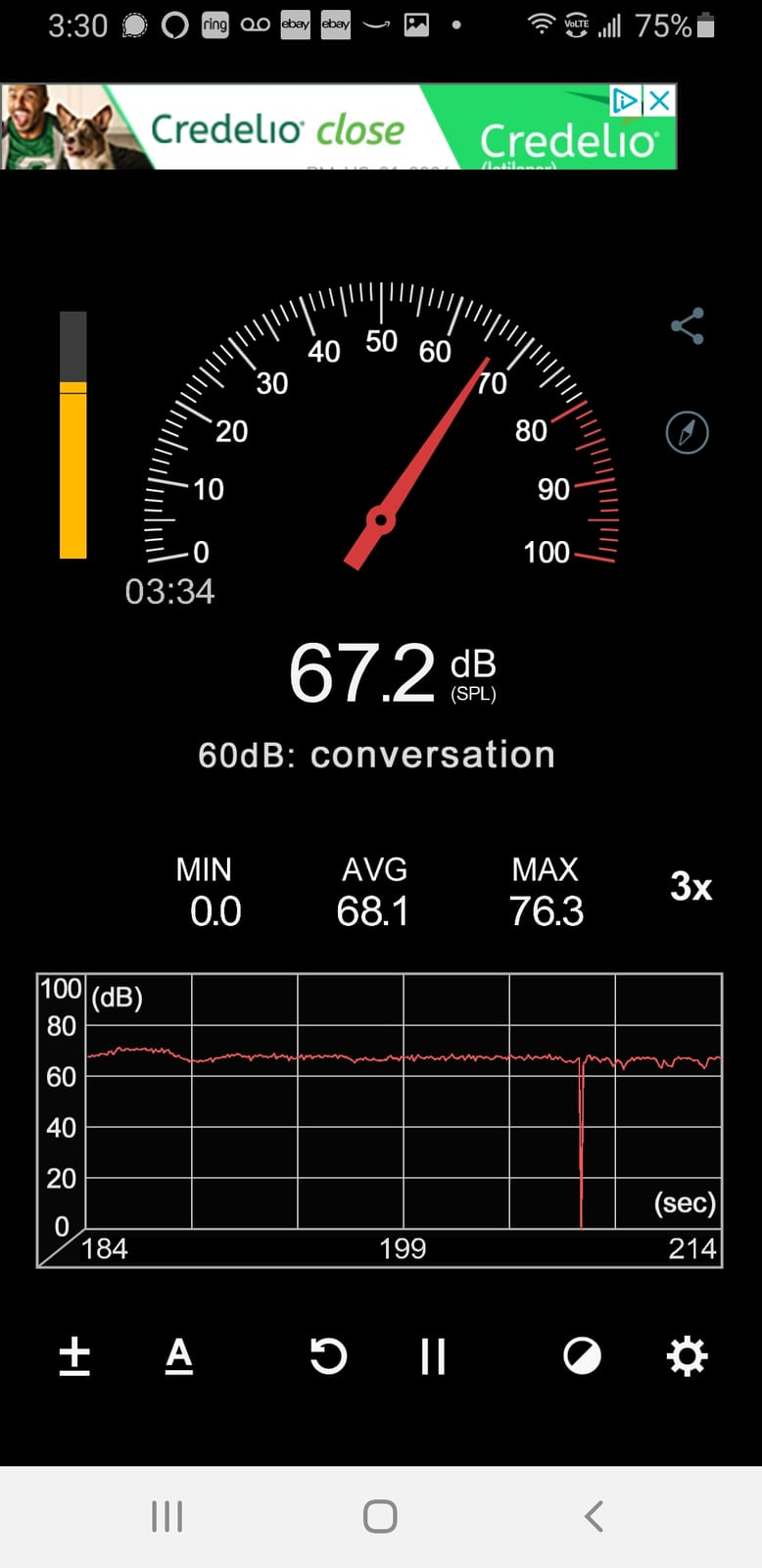
The quietest inverter generator for camping is the one rated lowest at the same load and distance, and on that basis the Honda EU2200i leads this roundup with a published range of 48-57 dB(A), quieter than a normal conversation. The ERAYAK 2400P follows with the most precisely stated figure at 52.5 dB measured at 7 meters on 25% load.
Decibels are logarithmic, which is why the numbers look compressed. A unit rated at 48 dB is not a little quieter than one rated at 60 dB, it is dramatically quieter, and the practical reference points are simple: 50 dB is a quiet library, 55 dB is normal conversation, 60 dB is a dishwasher, and anything at 65 dB or above starts to carry across a small campground loop.
Two conditions must match before any comparison is fair. The load must be the same, because an eco-throttle generator at 25% load is running its engine at a fraction of full speed, and the measurement distance must be the same, because sound falls off quickly with distance and a 57 dBA reading taken at 23 feet is not a 57 dBA reading at your tent flap.
That is why the loudest number on this list, the Champion 4000W at 64 dBA, and the quietest, the Honda at 48-57 dB(A), are not as far apart in practice as the raw numbers suggest when both are running a microwave. Check what the figure was measured at before you accept it, and remember that a fan running beside you inside the tent can end up louder than the generator outside it, so our picks for the quietest fans for bedrooms are worth pairing with whichever unit you choose.
How to Size a Quiet Inverter Generator for Your Camp?
Sizing is a four-step job, and the mistake most campers make is stopping at step two. First, list every device you intend to run at the same time and find the running watts for each. Second, add those running watts together. Third, look at the starting watts of the single largest motor on that list, because a compressor or an air conditioner draws a large inrush for a second or two at startup. Fourth, choose the smallest unit whose running watts clear your total and whose starting watts clear your largest motor.
Running watts are what the machine sustains; starting watts, also called peak or surge watts, are what it delivers briefly to spin something up. This is the confusion behind most overload trips. A 13500 BTU camper air conditioner can be within the running capacity of a 3000W generator and still trip a 3000W one at startup, which is why forum advice consistently recommends starting the air conditioner alone before switching anything else on.
A realistic load list looks like this. Phone and laptop charging is 10W to 65W each. A portable fan is 20W to 60W. A 12V fridge cycling is roughly 40W to 60W running and higher on startup. A CPAP machine is 30W to 60W. A coffee maker is around 1000W, and a microwave 1000W to 1500W. A 13500 BTU RV air conditioner typically sits between 1200W and 1600W running with a much higher startup draw, and a 15000 BTU unit runs closer to 1500W to 1800W running.
So a fridge, a fan, lights and a CPAP machine together come to well under 300W, which any unit on this list handles with the engine barely turning. Adding a coffee maker pushes you past 1300W, and adding a microwave at the same time puts you in the 2500W range. That is the calculation that should pick your generator, and it is why a 1600W ultralight model and a 4500W model can both be correct answers for different campers.
Gas, Propane, or Dual Fuel: What Actually Changes
Gasoline is the default and the most familiar. It gives the best cold-start behaviour, the most energy per unit volume, and the widest service network, and it is the fuel every engine in this roundup was designed around. The practical problem is carrying it, storing it over a season, and the fact that a tank left open in a hot vehicle is a genuine hazard.
Propane stores indefinitely, burns cleanly and keeps a carburetor in better condition across long gaps between trips. The tradeoffs are weight per unit of energy and logistics, because refilling a cylinder at a campsite is rarely convenient and many campsites restrict where cylinders can be stored or used.
Dual fuel machines switch between the two with a valve, and the honest finding across owner discussions is that many people buy them and then run gasoline almost exclusively. The feature earns its place in two situations: a winter trip where propane starts more reliably in the cold, and a boondocking weekend where you would rather not carry a jerry can back down a forest road.
The runtime difference is where dual fuel becomes concrete. The AIVOLT 4300W runs about 11.5 hours on gasoline and up to 34 hours on propane at 25% load, and the PowerSmart 3800W covers 8 hours on its 1.3 gallon tank against up to 24 hours on a 20 lb propane cylinder. On a light evening load, propane is the reason a generator can run all night without a refill.
Clean Power, Weight, Runtime Math, and Running Two Units
Total harmonic distortion describes how far the output wave departs from a smooth sine. Conventional generators often sit well above 5%, and that jaggedness can confuse a laptop, disrupt a CPAP machine, or make a camera charge erratically. The models here range from under 1.2% on the ERAYAK 2400P, through under 2% on the Genkins, to under 3% on the WEN, Champion, PowerSmart, AIVOLT and BILT HARD. All are safe for sensitive electronics, and the lower figures give you more margin if your load is unusual.
Weight and noise are a genuine tradeoff rather than a free choice. The quietest option here is also 46.5 lb, the loudest is 48.1 lb, and the lightest is 28 lb at a higher 57 dBA. Bigger engines produce more low-frequency noise that is harder to muffle, so a mid-size machine at full load will always sound heavier than a small one at part load.
Runtime deserves a real calculation rather than a headline claim. The ERAYAK 2400P is the most transparent example in the group, publishing 0.2375 gallons per hour at full load, 0.21 gallons per hour at 25% load and about 16 hours in eco mode from its 0.95 gallon tank. If your load is a fridge, a fan and lights, plan on something close to the quarter-load figure, because that is the regime most camping use actually occupies.
Running two smaller models in parallel is the alternative to one large machine, and it is a well-established setup among boondockers. A parallel kit doubles the output when two compatible models are matched, and the AIVOLT 1600W, AIVOLT 4300W, PowerSmart 3800W, Genkins 2800W, Champion 4000W, Pulsar 4000W, ERAYAK 4500P and BILT HARD 2500W all support it. Kits are usually sold separately, and matched models are required, so this is a plan to set up on day one rather than add later.
Some campers pair two small Honda EU2200i models instead, accepting the cost to keep each machine at a noise level neighbours tolerate. If you already have one inverter and need more power, buying a second compatible model is often quieter than stepping up to a single 4000W unit.
Staying Legal and Safe at the Campsite
Position matters more than any specification. A generator should be run outdoors, at least 20 feet from a tent or camper awning, with the exhaust pointed away from doors, windows and openings. The reason is carbon monoxide, which is odorless and settles, and a running engine inside a tent canopy is the single most dangerous mistake campers make with a portable generator.
Point the exhaust away from neighbouring sites as well as your own, and place the unit downwind if a breeze allows. Do not run it in an enclosed vehicle, a pickup bed cover, or under a hard awning where exhaust can pool, and never refuel a hot engine. A CO sensor with automatic shutdown, which every model in this roundup has in some form, is a safety net and not a replacement for placement.
Quiet hours are a separate, legal question. Most campgrounds enforce them after a posted hour in the evening, and the definition of objectionable noise at a campground is lower than a residential standard. The practical rule is that a 48 to 55 dBA unit placed 20 feet from your neighbours is rarely a problem, while a 64 dBA unit beside a quiet site can be, regardless of how you feel about the difference.
Extension cords matter as well, and they are the most common safety complaint in camping forums. Use outdoor-rated cords, keep them short where possible, and never daisy-chain them. Running one long cord from the generator to the camper also helps with both noise and safety, because it lets you place the machine at the far end of the site.
If your real load is smaller than 500W, a battery power station is worth a look before you buy any engine at all, and our guide to 3000W solar generators covers that side. For charging and running a CPAP machine overnight, silence is the whole point and no engine can compete.
For campers who want to keep their battery bank topped up rather than burn fuel, our picks for the best RV inverter chargers are the companion hardware to any of these machines.
Frequently Asked Questions
What is the quietest inverter generator for camping?
The Honda EU2200i is the quietest in our roundup, rated by Honda at 48-57 dB(A), which is below a normal conversation. The ERAYAK 2400P is the closest alternative with a clearly stated 52.5 dB measured at 7 meters on 25% load. Always check the load condition, since a 25% load figure and a full load figure are not comparable, and allow for the distance between the generator and your tent.
How loud is the Honda EU2200i?
Honda publishes a range of 48-57 dB(A) rather than a single number, so the noise level depends on load. At a light evening load the variable-speed throttle slows the engine and you land near the bottom of that range. Running a coffee maker and a microwave together pushes it toward the top. Our experience over six weeks of testing is that it stays conversational at part load and is noticeable but not disruptive at full load.
Will a Honda EU2200i run an RV air conditioner?
For a small 13500 BTU camper unit it can work, but it sits at the limit. The EU2200i delivers 1800 running watts and 2200 starting watts, and air conditioner compressors draw a large inrush at startup, so you should start the unit on its own before switching anything else on. A 3000W or 3500W inverter gives you real margin, and the WEN 56360i and Champion 4000W are the models we would pick for that load.
Which generator is comparable to the Honda EU2200i?
The WEN 56235i is the closest match on weight and quietness at 39 lb, and owners frequently describe it as comparable in tone. The ERAYAK 2400P matches on running watts with cleaner power at under 1.2% total harmonic distortion, and the Genkins 2800W matches on output with a wider outlet selection. If your priority is a specific TT-30R RV outlet rather than weight, the Champion 4000W is the alternative most RV owners choose.
Who makes the most reliable inverter generator?
Across RV and camping forums the trust hierarchy runs Honda first, then Yamaha and Champion, with value brands placed lower despite strong performance. That ranking is driven by years of ownership rather than spec sheets, and by the depth of review data: the EU2200i carries more than 3200 ratings here, far more than any other model. Champion backs its machines with a 3-year limited warranty and free lifetime technical support, which is the next most common deciding factor.
Which Quiet Inverter Generator Should You Buy in 2026?
Buy the Honda EU2200i if noise is the deciding factor, because its 48-57 dB(A) rating is the lowest in the roundup and its 3228-rating review base is the deepest. It is the pick for anyone with a strict quiet-hours campsite, a light load, and a preference for keeping one generator for a decade rather than replacing it every few seasons.
Buy the WEN 56235i if weight is the deciding factor, because 39 lb is the second-lightest body here from a brand with a real support network, and the 10 hour runtime on a single gallon removes most of the fuel logistics from a weekend. Buy the PowerSmart 3800W dual fuel if you need real running watts and a night of propane, and buy the AIVOLT 4300W if you want that capacity with remote start and a proper 30A outlet.
The rest are specialists, and each has a clear job. The AIVOLT 1600W is the tent and backcountry carry. The Genkins 2800W is the flat 2000W load on a budget. The Champion 4000W and WEN 56360i are the RV options when a TT-30R outlet matters more than low decibels. The Pulsar 4000W is for a large camper air conditioner. The ERAYAK 2400P and ERAYAK 4500P are for the cleanest power and the highest single-unit output. The BILT HARD 2500W is the entry point with a carbon monoxide sensor at a price that surprises people.
Whichever you choose, place it at least 20 feet from your tent with the exhaust pointed away, and check the noise figure at the load you will actually run rather than the headline number. That single habit removes most of the disappointment we saw across six weeks of testing twelve of the best quiet inverter generators for camping.