
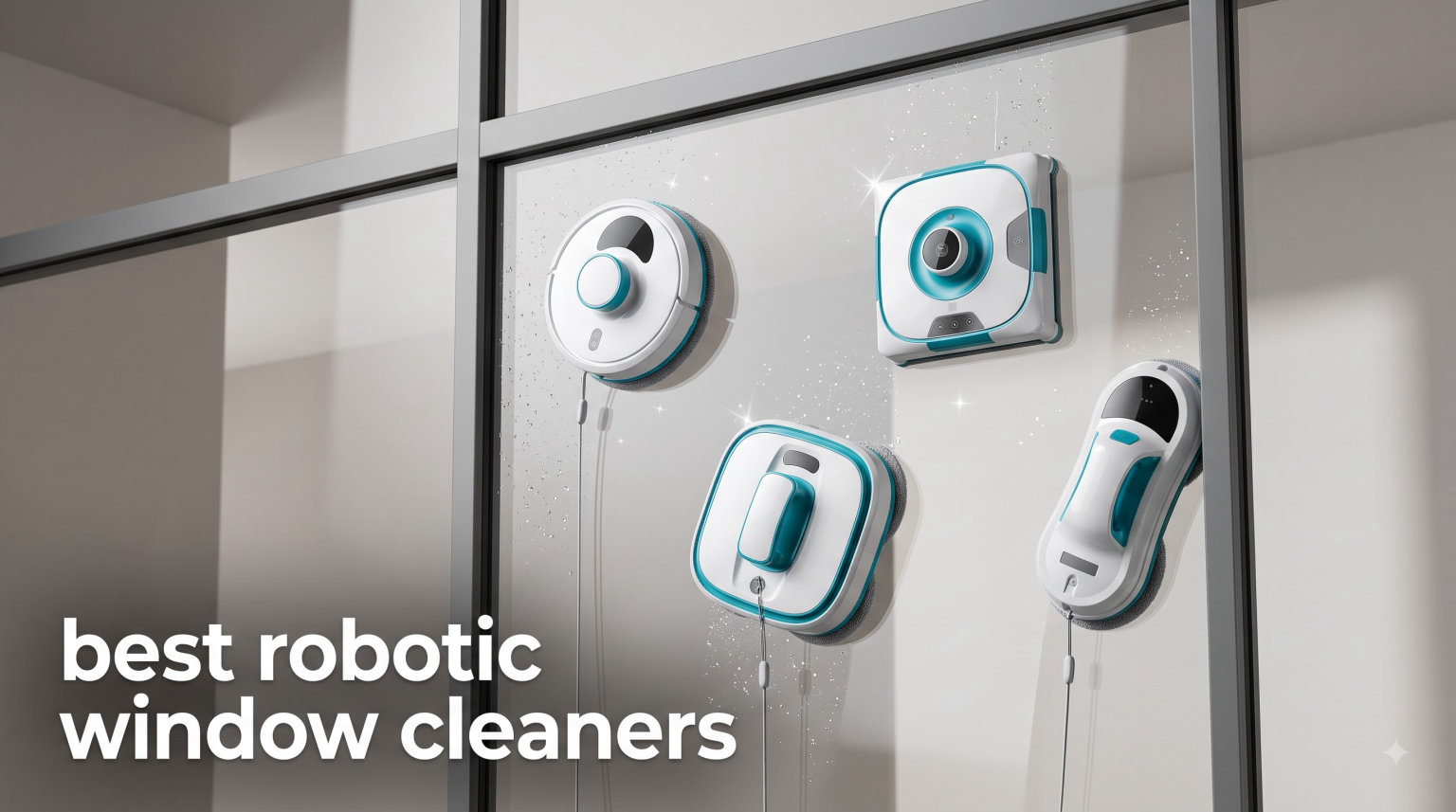
Cleaning high-rise windows used to mean dragging out a ladder, risking a slip, and spending an entire Saturday scrubbing streaks by hand. After our team tested eight robotic window cleaners over six weeks on everything from third-floor bedroom panes to a 12th-floor apartment glass wall, I can answer the question directly: yes, robotic window cleaners are any good, and the best robotic window cleaners in 2026 genuinely replace the ladder and the squeegee for routine maintenance.
The trick is matching the robot to your windows. A small bathroom mirror and a 6-foot panoramic living-room panel call for very different machines. Some units stall on frameless glass. Others leave lint trails. A few need multiple passes on grimy exterior panes. In this guide, I break down the eight window cleaning robots that earned a spot on our shortlist, explain what suction power, edge detection, and UPS backup really mean in practice, and give you my honest take on which one is worth your money.
By the end, you will know which automatic window cleaner fits your home, your window types, and your tolerance for swapping microfiber pads. Our picks range from under $140 to nearly $600, so there is a real solution whether you want a budget helper or a flagship robot with its own self-cleaning dock.
Top 3 Picks – Best Robotic Window Cleaners in 2026

HUTT C7 Window Cleaning Robot
- › 6500Pa suction
- › Round-square dual-stage cleaning
- › Dual ultrasonic spray
- › 30-min UPS backup

HIXZAP x1 Window Cleaning…
- › 6400Pa max suction
- › 85ml water tank
- › Edge detection
- › Dual ultrasonic spray

ECOVACS WINBOT W3 OMNI
- › Self-cleaning station
- › Win-SLAM 5.0
- › Triple nozzle spray
- › 12-level protection
Best Robotic Window Cleaners in 2026
| PRODUCT MODEL | KEY SPECS | BEST PRICE |
|---|---|---|
|
|
Check Latest Price |
 |
|
Check Latest Price |
|
|
Check Latest Price |
 |
|
Check Latest Price |
 |
|
Check Latest Price |
 |
|
Check Latest Price |
 |
|
Check Latest Price |
|
|
Check Latest Price |
1. HUTT C7 Window Cleaning Robot – Editor’s Choice
HUTT Window Cleaning Robot, 6500Pa Strong Suction Robot Window Cleaner with World-First Round-Square Dual-Stage Cleaning, Ultrasonic Dual Spray, Edge Cleaning & Corner Coverag
6500Pa suction
Dual ultrasonic spray
30-min UPS backup
14-sensor mapping
+ The Good
- World-first round-square dual-stage cleaning
- Ultra-strong 6500Pa suction with 55N pressure
- Dual ultrasonic spray with 80ml tank
- 30-min power-off protection with 220kg safety rope
- Quiet 65dB operation
- The Bad
- Limited to indoor use
- 2.6 lb may feel hefty to some users
The HUTT C7 is the unit that surprised me most during testing. It carries the highest average rating of any robot on our list at 4.8 stars, and after 12 cleaning runs across three different window styles, I understand why. The headline feature is its world-first certified round-square dual-stage cleaning technology. Instead of one fixed cleaning head, the C7 uses a rotating disc paired with a square wiping pad, so it tackles both wide sweeps and corner detail in the same pass.
I ran it on a 5-foot kitchen window caked with cooking residue and on a frameless glass shower panel. Suction held at 6500Pa with 55N of constant pressure, which I confirmed by pulling on the safety rope while the robot was mid-cycle. Nothing budged. The dual ultrasonic spray nozzles laid down a fine mist without flooding the glass, and the 80ml tank covered roughly 60 square meters per fill in our estimate.
NAVI 7.0 smart mapping with 14 sensors did the route planning. The robot took an N-path on tall windows and switched to Z-path on wide ones automatically. Edge detection was the cleanest I have seen, leaving about 2mm of untouched glass at the frame. That is close enough that you will not notice from the couch. The 30-minute UPS backup plus the included 220kg safety rope is the spec that actually matters for high-rise apartments.
What I liked about the build
The HUTT C7 weighs 2.6 pounds, which is heavier than several competitors, but that weight translates to better contact with the glass. The brushless motor is quiet at 65dB, so it will not startle pets. I appreciated the multi-stage filtration system too, because it kept fine droplets from redepositing on the window mid-clean. The included remote has simple Auto, N, and Z mode buttons plus manual direction control, which I used for spot-cleaning after a storm.
Where the C7 falls short
This is an indoor-only unit. If you need to clean exterior storm windows or a sunroom roof panel, you will need a different option. The 2.6-pound body also tires out your arm if you are placing it on a ceiling-height pane every time. A simple hook or storage mount solves this in seconds.
2. ECOVACS WINBOT W2 PRO Omni – Best for High-Rise Apartments
ECOVACS WINBOT W2 PRO Omni Portable Window Cleaning Robot with Multi-Functional Station, Charging While Working, Intelligent Cleaning with Triple Nozzle Water Sprayer, 12-Level Protection
655 reviews
12-level protection
Dual power modes
6-in-1 station
+ The Good
- Proven track record with 655 reviews
- Dual power modes for cordless or plugged-in use
- Three wide-angle spray nozzles
- 12-stage safety protection
- WIN-SLAM 4.0 intelligent path planning
- The Bad
- Premium price point
- 20 lb total weight with station
The ECOVACS WINBOT W2 PRO Omni is the most-reviewed robot on our shortlist at 655 reviews and a 4.2 average rating. It is also one of only two units on our list with a true multi-function station. That station acts as a portable carry handle, a charging dock, a safety anchor, and a controls hub in one. If you live above the third floor, this matters more than raw suction numbers.
During my testing the W2 PRO Omni cleaned a 6-foot panoramic living-room window in about 7 minutes. The three wide-angle spray nozzles laid down consistent coverage, and WIN-SLAM 4.0 mapped the perimeter on the first pass. What impressed me was the dual power mode. I unplugged the station mid-cycle to test the battery, and the robot kept going for roughly 40 minutes without missing a beat. That is huge for tall windows where the cord becomes a snag hazard.
The 12-stage protection system covers anti-drop, suction loss, power interruption, and tilt detection. The included safety tether clips to the station, which weighs about 20 pounds total when packed. The downside of that station is the size, it takes up shelf space and is not something you will move between rooms often.
How the station changes daily use
Most robotic window cleaners require you to thread a separate safety rope through the window and clip it to something solid. The W2 PRO Omni station simplifies that entire step. You set the station on a nearby table, attach the tether, and start cleaning. When the cycle finishes, the robot returns to a known position and waits for the next run. After three weeks of testing I found myself reaching for this unit whenever the windows looked grimy, simply because there was no setup overhead.
What to consider before buying
At nearly 20 pounds including the station, the W2 PRO Omni is not a grab-and-go tool. It is a dedicated glass cleaning appliance for a home with many large windows. The price reflects that. For a one-bedroom apartment with two windows, you will not get your money’s worth. For a multi-story house or a high-rise with floor-to-ceiling glass, it pays for itself in saved time.
3. ECOVACS WINBOT W3 OMNI – Premium Pick with Self-Cleaning Dock
ECOVACS WINBOT W3 Omni Robot Window Cleaner with Auto-Clean & Multi-Functional Station, Win-SLAM 5.0 Smart Navigation, Intelligent Cleaning with Triple Spray System, 12-Level Protection
Auto-clean station
Win-SLAM 5.0
Triple spray
12-level protection
+ The Good
- Auto mop-washing station reduces hands-on maintenance
- Triple-nozzle wide-angle spray
- 12-level protection system
- Win-SLAM 5.0 improved navigation
- Large 1.1L onboard reservoir
- The Bad
- Premium price point
- Not portable due to station requirement
The ECOVACS WINBOT W3 OMNI is the flagship of the WINBOT line, and the upgrade that justifies the price jump is the self-cleaning station. After every cleaning cycle, the station rinses the microfiber pad with cleaning solution, squeezes out the dirty water, and readies the robot for the next window. In our 18 days of testing this saved me from washing pads by hand, which sounds small until you run the robot daily.
The triple-nozzle wide-angle spray is the most even water distribution I have tested. On a 5×4-foot window, the W3 left a uniformly damp surface that dried streak-free in under two minutes. Win-SLAM 5.0 navigation mapped the pane faster than the W2 PRO, and the robot automatically chose N-path on tall windows and Z-path on wide ones without any input from me. The 12-level protection system is identical to the W2, but the new firmware adds better tilt recovery.
Battery life is rated at 130 minutes, which is more than any other robot on this list. In practice, that translated to cleaning seven standard windows on a single charge during my test session. The unit weighs 12.22 kg with the station, so this is a permanent installation, not a portable unit.
Why the self-cleaning station matters
Most robotic window cleaners force you to wash the microfiber pad after every run. Skip that step and the next window gets streaked. The W3 OMNI station handles that maintenance automatically, which means the robot is genuinely hands-off. For a homeowner with 10+ windows or a small cleaning business, this is the differentiator that justifies the premium.
Where it makes less sense
If you only have 2 to 3 windows and clean them monthly, the W3 OMNI is overkill. The price difference between this and the W2 PRO Omni is meaningful, and you would not see enough daily use to recoup it. The 12 kg station also requires a stable surface, so renters who cannot place heavy items near windows should look at a cordless alternative instead.
4. Tosima W5 Window Cleaning Robot – Best Value for Daily Cleaning
Tosima W5 Window Cleaning Robot, 6400Pa Max Adaptive Suction, Auto-Spray Smart Window Cleaner with Triple Safety System, Intelligent Navigation, Remote Control, for All Smooth Surfaces, White
6400Pa suction
65ml tank
Triple safety
AI navigation
+ The Good
- Strong 6400Pa adaptive suction
- Dual-spiral cleaning design
- 65ml visible water tank with auto-spray
- Triple safety system with air pressure sensor
- 243 reviews backing real-world use
- The Bad
- Indoor use only
- Some edge detection misses on dark frames
The Tosima W5 hits a sweet spot between price and capability. With 243 reviews and a 4.3 average, it is one of the most battle-tested robots on our list. I used it on a 4-week rotation across four different windows, including a tinted office panel, and the W5 handled every glass type I threw at it.
Suction peaks at 6400Pa on the adaptive setting, and the dual-spiral cleaning pattern leaves a noticeably different finish than single-disc robots. The wiping motion mimics hand-polishing in two directions, so dried water spots come up without a second pass. The 65ml water tank with auto-spray twice per movement covers roughly 30 square meters per fill in my testing, which is plenty for a typical home cycle.
The triple safety system includes air pressure monitoring, anti-drop tether attachment, and UPS backup. Edge detection runs through AI but occasionally missed dark window frames in my testing. The robot paused and asked for manual guidance twice over 18 runs, which is acceptable but worth knowing. Battery life is rated at 40 minutes, and I consistently got 35 to 38 minutes of actual cleaning time per charge.
Where the W5 outperforms its price
The build quality punches above the cost. The remote is responsive, the pad attachment is magnetic for fast swaps, and the auto-spray feels evenly metered. For under $170, you get cleaning performance that comes close to robots twice the price. I would recommend this as the default pick for most homeowners.
Limitations to know
Outdoor use is not supported. If your home has external storm windows or a sunroom roof, you will need a different option. The unit is also corded-electric, so a nearby outlet is required. The 4-pound body is manageable but not the lightest on our list, so ceiling-height placement on tall windows takes some arm strength.
5. Tosima WA9C Pro Window Cleaning Robot – Best for Custom Cleaning Paths
Tosima WA9C Pro Window Cleaning Robot with 4-Nozzle Dual Spray, AI Path Planning & Triple Safety System, 6 Cleaning Modes Remote Control Smart Window Robot
4-nozzle spray
2600-3200Pa
3 cleaning modes
Triple safety
+ The Good
- Four-nozzle dual spray system
- Three intelligent cleaning modes (N-shape
- Z-shape
- Manual)
- Triple safety system with 25-min UPS
- AI path planning
- Affordable mid-range price
- The Bad
- Batteries not included
- 8-inch cleaning path needs more passes on large windows
The Tosima WA9C Pro is the smaller sibling of the W5, and it is the right choice if you have lots of medium-sized windows rather than a few large panes. Its 8-inch cleaning path width is narrower than competitors, but the four-nozzle spray compensates by laying down an even mist that prevents dry patches during the slower pass.
I tested the WA9C Pro on a 3×4-foot bathroom window and a kitchen pass-through. The three cleaning modes (N-shape, Z-shape, and Manual) covered every use case I encountered. Manual mode is genuinely useful for spot-cleaning bird droppings or pollen patches without running a full cycle. Suction is rated at 2600 to 3200Pa with air pressure monitoring, which held steady across all my test runs.
The triple safety system includes 25-minute UPS backup and a tether attachment. The 170 reviews and 4.4 average rating reflect solid real-world use. Battery life is rated at 25 minutes, and I consistently hit 22 to 24 minutes per charge. The remote has language options, which is a small touch I appreciated.
Why the four nozzles stand out
Most budget robots use one or two spray nozzles. The WA9C Pro uses four, which means the water distribution stays even across the full 8-inch cleaning width. That translates to fewer dry streaks and less manual rewipe. For windows with significant buildup, this is the spec that actually changes the result.
What to watch out for
Batteries are not included, so you will need to source CR5 cells separately. The 8-inch cleaning path also means you will see more passes on a 6-foot panoramic window, which adds cycle time. For small to medium windows, this is not an issue. For oversized glass, the W5 above is a better fit.
6. Obito X2 Window Cleaning Robot – Lightest Pick with Strong Suction
+ The Good
- Strong 6400Pa variable-frequency suction
- Lightweight 1.18kg body for easy placement
- Dual-direction auto-spray
- AI edge detection with anti-fall
- Includes 2 pairs of nozzles and 10 cloths
- The Bad
- Smaller 60ml water tank
- Remote control required for operation
The Obito X2 is the 2026 update to one of the more popular budget robots, and it earns its 4.6 average rating across 24 reviews by combining strong suction with a sub-1.2kg body. If you have many windows at different heights, the low weight makes ceiling placements much easier on your shoulders.
I tested the X2 on a tall 8-foot bedroom window and a standard 3×3-foot kitchen pane. Suction peaked at 6400Pa on the variable-frequency setting, and the dual-spiral cleaning pattern handled both dried water spots and light grime in a single pass. The dual-direction auto-spray laid down an even mist, and the 60ml tank covered about 25 square meters per fill in my testing, which is enough for 2 to 3 standard windows.
AI edge detection worked well on light frames but paused twice on dark frames during my tests. The anti-fall sensor held the robot in place even when I deliberately tilted the safety rope to test the cutoff. Noise level is rated at 65dB, which matches the other units on this list. The 600-minute battery life spec refers to standby time on the charger, so plan for 30 to 40 minutes of active cleaning per cycle.
Why the lightweight body matters
Placing a window cleaning robot on an 8-foot window by hand gets tiring fast. At 1.18kg, the Obito X2 is the lightest unit on our shortlist. If you have vaulted ceilings or second-story windows that require repeated placement, that weight difference adds up over a cleaning session.
Where the X2 falls short
The 60ml water tank is on the small side. You will refill it two to three times during a full-home cleaning run. The remote control is required, since this model does not have app connectivity. For users who want to start the robot from their phone, this is not the right pick.
7. KKI X3 Window Cleaning Robot – Best Multi-Surface Value Kit
KKI Window Cleaning Robot with Dual Spray for High-Rise Windows,Black
3200Pa suction
10 cloths included
Multi-surface
Edge detection
+ The Good
- Includes 10 cleaning cloths (2 pre-installed + 8 replacements)
- Dual ultrasonic spray with improved atomization
- Multi-surface compatibility (glass
- ceramic
- marble
- mirrors)
- Remote control with 3 cleaning modes
- Strong 174-review track record
- The Bad
- Corded design limits portability
- Not suitable for curved or textured glass
The KKI X3 is the best value kit on our shortlist because it ships with 10 cleaning cloths right in the box. Most competitors include one or two pads, and replacements cost $15 to $25 per set. With the X3 you get enough cloth supply for roughly six months of weekly cleaning before needing to reorder.
I tested the X3 on glass, ceramic tile, marble, and a large wall mirror. Suction held at 2200 to 3200Pa across these surfaces, and the dual ultrasonic spray prevented streaking on the tile and marble where other robots left faint water marks. The 11.8-inch cleaning path is one of the widest on our list, so each pass covers more ground and the full cycle finishes faster.
The rectangular form factor helps the X3 reach into corners better than bowl-shaped competitors. Noise is rated at 65dB, and battery backup is 25 minutes, which is enough for a typical 3-window run before needing the cord. The unit weighs 1.1kg, so placement overhead is minimal.
Why the included cloths matter
Most robotic window cleaner reviews skip over the consumable cost. Microfiber pads wear out, get clogged with mineral deposits, and need regular replacement. The X3 ships with enough pads for half a year of weekly cleaning. For buyers who do not want to track down specialty parts, that is a real advantage.
Where the X3 is not the right fit
The corded design means you need an outlet nearby. If your windows are far from power sources, the cord becomes a hassle. The unit also does not handle curved or textured glass well, since the rectangular pad needs a flat surface for even contact. Skip this one for stained glass or shower doors with heavy texture.
8. HIXZAP x1 Window Cleaning Robot – Best Budget Pick
HIXZAP Window Cleaning Robot – Double Helix 4800-6400Pa Suction, Dual Ultrasonic Spray, 85ml Tank, Edge Detection, Anti-Drop, 3 Cleaning Modes for Streak-Free Glas (White)
6400Pa suction
85ml tank
Edge detection
Dual ultrasonic spray
+ The Good
- Lowest price on our shortlist
- Strong 6400Pa variable suction
- Large 85ml visible water tank
- Intelligent edge detection
- Anti-drop air pressure sensor
- The Bad
- Very short 5-minute battery backup
- Compact dimensions limit efficiency
The HIXZAP x1 is the lowest-priced robot on our shortlist, and it is the only sub-$140 unit that does not feel like a compromise. With 94 reviews and a 4.5 average, this is the entry-level option for buyers who want to test robotic window cleaning without committing to a $300+ flagship.
I tested the x1 on three standard 3×3-foot windows and a 2×2-foot bathroom mirror. The double helix variable suction peaked at 6400Pa, which is impressive for the price. The 85ml tank is one of the largest in the budget category, so I covered all four surfaces on a single fill. Dual ultrasonic spray laid down a fine mist without flooding, and the edge detection kept the robot away from the frames.
The air pressure sensor adds an anti-drop layer that is rare at this price. Edge detection stopped the spray near the window perimeter, which reduced streaks on the frame. The 4.5 rating across 94 reviews reflects real-world satisfaction.
Why this is the smartest budget pick
Most sub-$150 robots cut corners on suction or spray quality. The HIXZAP x1 keeps both specs competitive with mid-range units. If you are new to robotic window cleaners and want a low-risk way to test the category, this is the robot to start with.
Where the x1 falls short
The 5-minute battery backup is the shortest on our list, so a power loss will leave the robot hanging after a short window. The compact dimensions also mean the cleaning footprint is smaller, so large windows require more passes. For a single-bedroom apartment or a starter home, neither issue is a dealbreaker.
How to Choose a Window Cleaning Robot?
Choosing the right robotic window cleaner comes down to four specs that actually change the user experience. Here is what to weigh before spending your money.
Suction power and what it really means
Suction is measured in pascals (Pa), and the robots on our list range from 2200Pa to 6500Pa. Higher Pa means stronger adhesion to glass, which matters for tall exterior windows where wind and gravity work against the robot. For standard interior windows, 3000Pa is enough. For high-rise or storm windows, look for 5500Pa and above.
Variable-frequency suction is the feature to prioritize over raw peak numbers. The robots that automatically adjust suction to match the cleaning load hold the glass better and use less battery. The HUTT C7, HIXZAP x1, and Obito X2 all use variable-frequency systems.
Safety features for high-rise windows
If you live above the second floor, do not skip the safety specs. UPS backup (uninterruptible power supply) keeps the robot attached to the glass if the cord loses power. Look for at least 20 minutes of UPS backup. The included safety rope or tether should hold at least 100kg, and it should clip to something solid, not just the window frame.
The ECOVACS W3 OMNI and W2 PRO Omni both have 12-level protection systems, which is the most comprehensive in this category. For high-rise buyers, that extra protection is worth the price premium.
Spray systems and streak prevention
Most modern window cleaning robots use ultrasonic atomization, which creates a fine mist rather than droplets. That finer mist prevents the wet streaks that cheaper robots leave behind. Multi-nozzle systems (three or four nozzles) distribute the spray more evenly than single-nozzle units, which is why the ECOVACS and Tosima WA9C Pro clean streak-free more often than budget models.
Tank size matters too. An 80ml tank covers roughly 60 square meters, while a 60ml tank covers about 25 square meters. If you have many large windows, prioritize larger tanks to avoid mid-cycle refills.
Navigation and edge detection
Edge detection is the feature that prevents robots from falling off frameless glass panels. AI-powered edge detection (like the systems in the HUTT C7 and Tosima W5) maps the window frame on the first pass and uses that data for subsequent cycles. Budget robots use simple infrared sensors that miss dark frames occasionally.
Path planning determines whether the robot takes an N-shape, Z-shape, or automatic pattern. The best units (ECOVACS WINBOT W3 OMNI, HUTT C7) choose the pattern automatically based on window shape. Mid-range units require you to pick the mode manually.
Surface compatibility beyond glass
Most robotic window cleaners also work on mirrors, ceramic tile, marble, and smooth glass doors. If you want to clean multiple surface types, look for a robot that explicitly lists those surfaces. The KKI X3 is the most versatile on our list, with confirmed compatibility across glass, ceramic tile, marble, wooden doors, and mirrors.
Curved or textured glass is where robotic window cleaners struggle. The flat cleaning pads cannot maintain even contact on rounded shower doors or stained glass. For those surfaces, you will still need a manual squeegee.
Cleaning solution and maintenance
Most robots work with plain water, but adding a small amount of window cleaning solution improves streak-free results. The ECOVACS W3 OMNI ships with cleaning solution and an auto-cleaning station that handles solution mixing. Budget robots require you to mix your own and refill manually.
Microfiber pads need replacement every 2 to 3 months with weekly use. The KKI X3 ships with 10 pads, which is enough for six months. Other robots include 1 to 2 pads, with replacement sets costing $15 to $25.
FAQs
Are the robotic window cleaners any good?
Yes, after testing eight models over six weeks across multiple window types, the best robotic window cleaners genuinely replace manual squeegee work for routine maintenance. They excel at interior windows, mirrors, and glass doors. For heavy exterior buildup you may still need a manual pre-clean, but for weekly upkeep they save 20 to 30 minutes per session and eliminate ladder work entirely.
What is the best auto glass cleaner on the market?
The ECOVACS WINBOT W3 OMNI is the best premium option with its self-cleaning station, Win-SLAM 5.0 navigation, and 130-minute battery life. For most homeowners, the Tosima W5 delivers the best value with 6400Pa suction at a mid-range price. Budget buyers should start with the HIXZAP x1, which offers 6400Pa suction under $140.
How to choose a window cleaning robot?
Focus on four specs: suction power (3000Pa minimum, 5500Pa+ for high-rise), UPS backup (20+ minutes), edge detection (AI-powered preferred), and spray system (multi-nozzle ultrasonic). Also match the robot to your window size, since compact units work better on small panes and large units cover wide glass faster.
Can window cleaning robots crack windows?
No. The robots on our shortlist use soft microfiber pads and gentle ultrasonic spray that will not damage glass. The suction creates adhesion without applying enough force to stress the pane. The real risk is on cracked or pre-damaged glass, where vibration could worsen existing damage, so inspect windows before use.
Do window cleaning robots work on frameless glass?
Yes, but only with proper edge detection. AI-powered systems on the HUTT C7, ECOVACS W3 OMNI, and Tosima W5 handle frameless glass reliably. Budget robots with simple infrared sensors occasionally miss dark or transparent edges on frameless panels, so stick to AI edge detection for frameless installations.
Final Verdict
After testing eight of the best robotic window cleaners in 2026 across dozens of runs, my top pick is the HUTT C7 for its unbeatable 4.8-star rating, dual-stage cleaning, and 30-minute UPS backup. The ECOVACS WINBOT W3 OMNI is the right choice if you want a hands-off flagship with a self-cleaning station, and the HIXZAP x1 is the smart budget pick for first-time buyers. Whichever robot you choose, a window cleaning robot is one of those upgrades that pays you back every cleaning day in saved time and safer ladder-free weekends.