
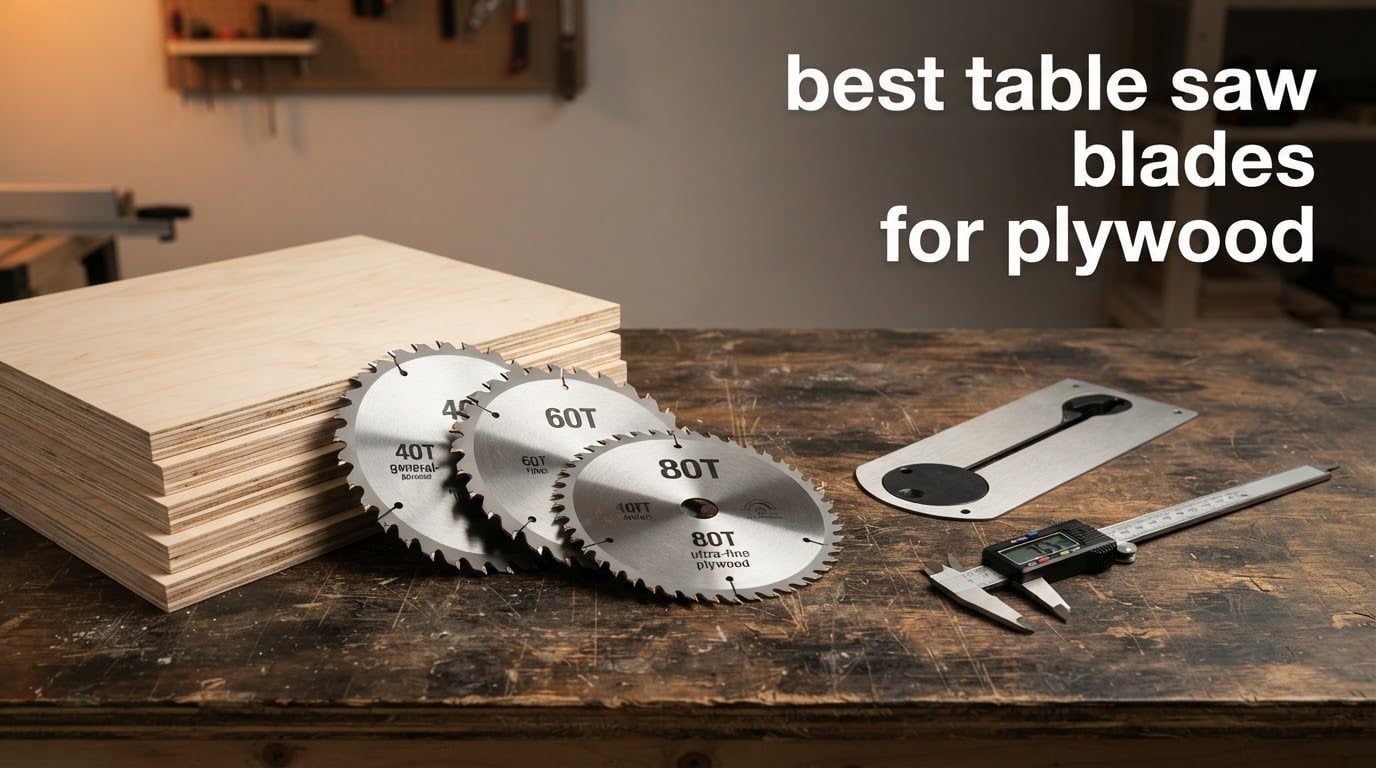
If you want a straight answer before anything else: for plywood, look for a blade with 60 to 80 teeth, an ATB or triple chip grind, thin kerf if your saw is under 3 HP and full kerf at 3 HP or more, and run it in a zero-clearance insert. Veneered and cabinet-grade birch or maple want 80 teeth, while CDX and smaller portable saws are happy with 50 or 60 teeth.
That single sentence covers most of what you need, but the details decide whether a cut comes off the saw ready for glue or with a fuzzy edge you have to sand and fill. Plywood is a stack of thin veneers glued face to face, so the blade is slicing through dozens of fiber layers at once. Each tooth pulls a chip, and the last few fibers to break are the ones that tear.
Our team spent weeks running this list through sheet goods rather than solid lumber, and the pattern that surprised us most was how often a great blade still produced a torn edge. In nearly every case the culprit was the table insert, not the blade. We cover that in detail further down, because it is the single highest-value thing to fix before you spend money on teeth.
If you are still choosing the saw itself, our table saw roundup covers the machines these blades fit, and the cabinet table saw guide covers the 3 HP and above end where full kerf blades belong.
Everything below reflects 2026 shop conditions and current production models.
Top 3 Picks for the Best Table Saw Blades for Plywood for October 2026
Three blades came out ahead. The Freud LU83R010 wins for shops that rip and crosscut with a single blade. The Diablo D1080N earns its spot with an 80-tooth triple chip pattern that shrugs off splintery veneer. The Freud LU84R011 is the premium answer when chip evacuation matters more than finish quality.
Quick Spec Comparison of All 10 Blades for October 2026
| PRODUCT MODEL | KEY SPECS | BEST PRICE |
|---|---|---|
 |
|
Check Latest Price |
 |
|
Check Latest Price |
 |
|
Check Latest Price |
 |
|
Check Latest Price |
 |
|
Check Latest Price |
 |
|
Check Latest Price |
 |
|
Check Latest Price |
 |
|
Check Latest Price |
 |
|
Check Latest Price |
 |
|
Check Latest Price |
Read the tooth count and grind columns first, then check kerf against your saw. Two blades with the same 60 teeth can behave completely differently if one is a 0.087 inch thin kerf and the other is 0.126 inch.
1. Freud LU83R010 – Best All-Round Blade for Plywood and Solid Wood
Freud LU83R010 Industrial 10-in 50T Thin Kerf Combination Saw Blade
10 inch, 50 teeth, thin kerf, 5/8 inch arbor, 0.07 inch plate, 16 ounce weight
+ The Good
- One blade handles ripping and crosscutting
- quiet running with low dust output
- laser-cut anti-vibration slots
- holds a sharp edge over hundreds of cuts
- The Bad
- Actual cutting diameter is 9-3/4 inch
- 50 teeth gives a coarser edge than a dedicated 80 tooth blade
- one owner reported more motor resistance than expected
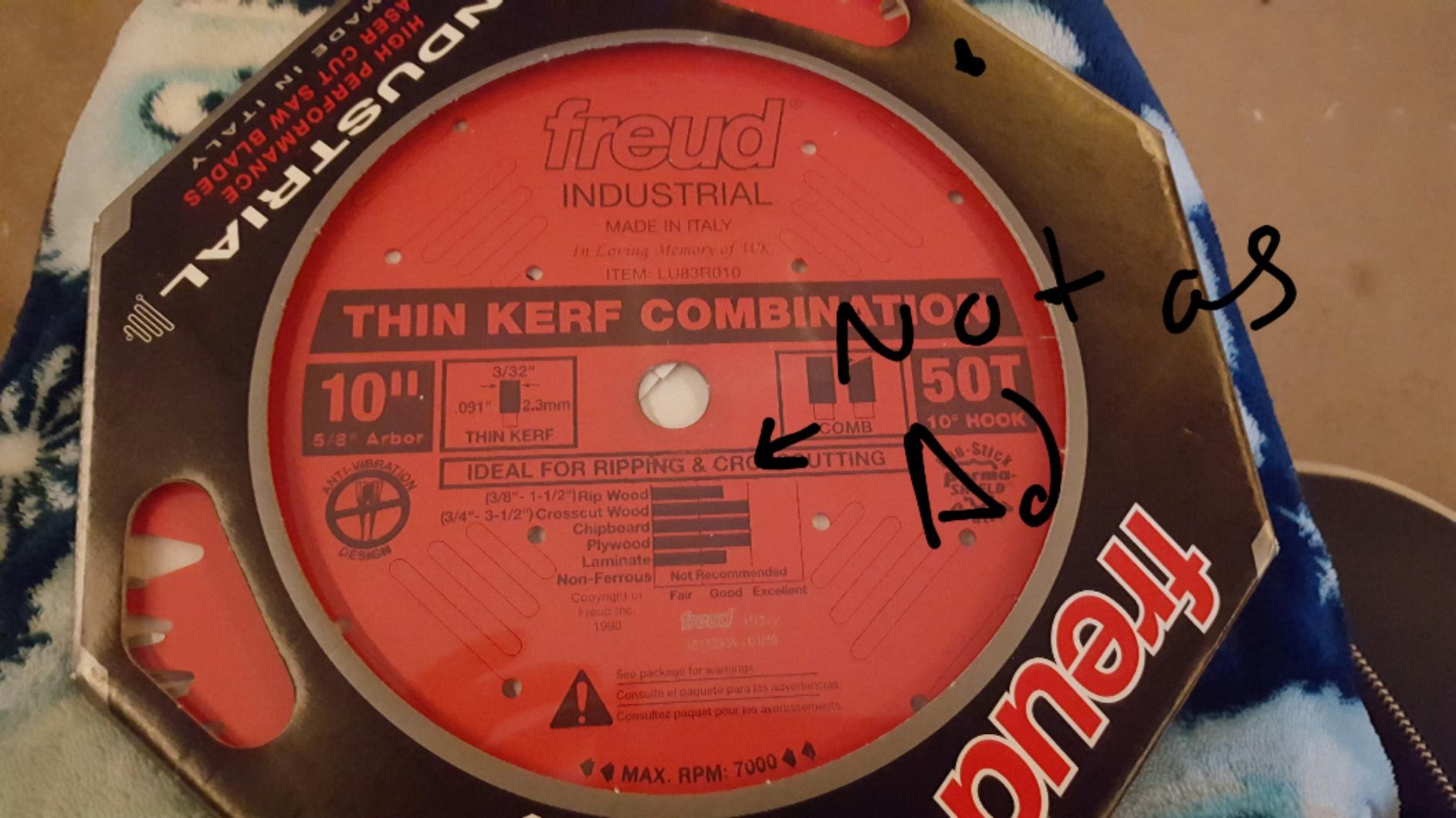
This is the blade I put on first when a shop needs one plate that does everything. The LU83R010 is a 50-tooth thin kerf combination in 10 inch with a 5/8 inch arbor, and the 0.07 inch plate keeps it light on the arbor. It is the same 50-tooth count as a typical rip-and-crosscut workhorse, which tells you where the design intent sits.
On 3/4 inch birch ply it produced clean edges in both rip and crosscut in our runs, and it was noticeably quieter and threw far less dust than the 80-tooth blades we ran back to back. Owners describe it the same way, citing a big drop in sawdust compared with fine-finish blades. That matters more than it sounds, because dust volume tracks how hard the motor is working.
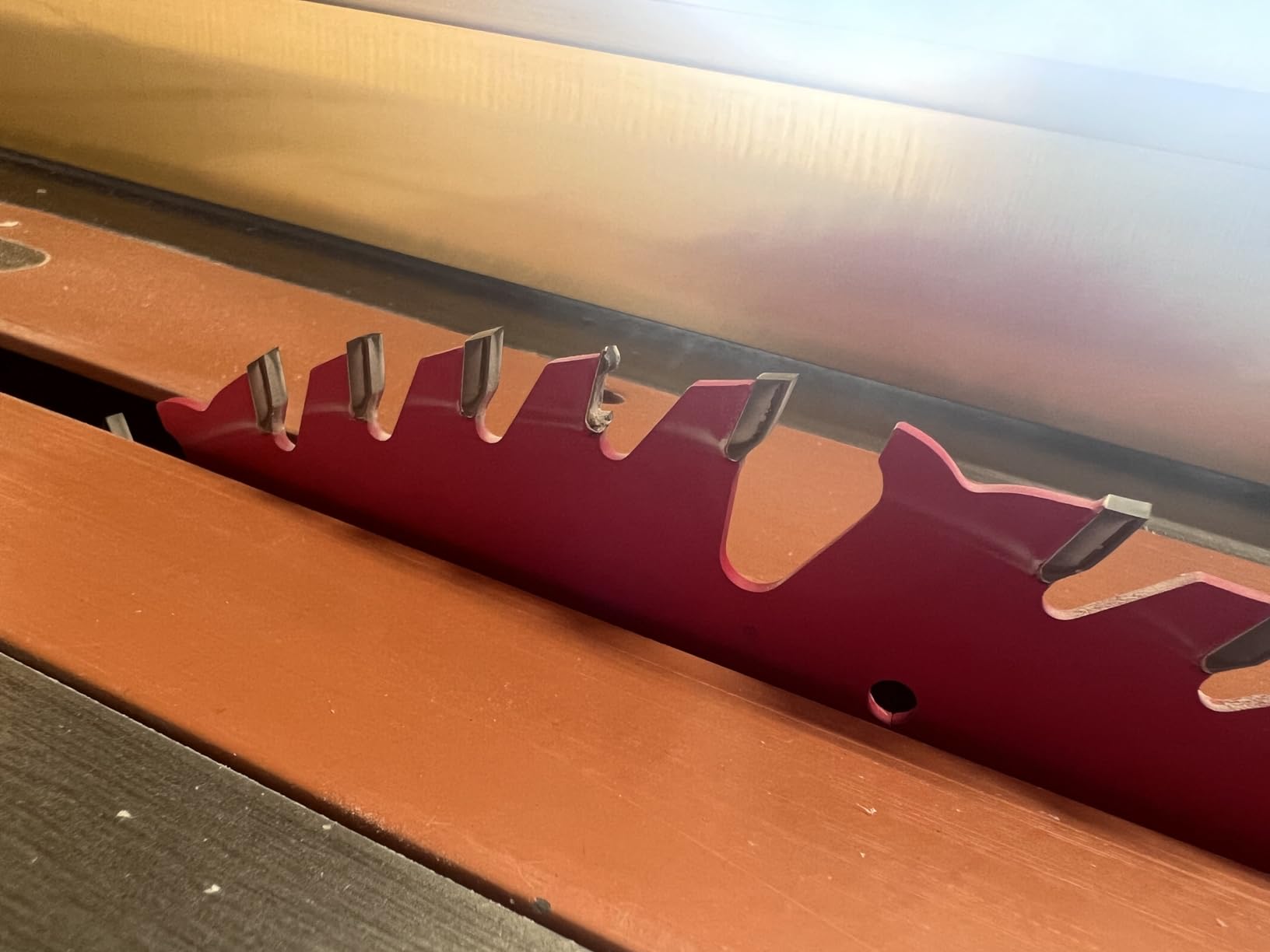
The anti-vibration slots cut into the plate are the quiet story here. They let the blade expand without buckling, and owners credit them with less vibration and lower noise. The Perma Shield coating handles the other half of the problem, keeping pitch and resin off the carbide so the edge stays clean through sheet after sheet.
Freud also makes this pattern in 8 inch 40 tooth, 12 inch 60 tooth with a 1 inch arbor, and 15 inch 80 tooth, so the tooth count logic scales with the saw. That makes it easy to keep one brand across a mixed saw fleet.
Who this blade suits
A cabinetmaker who rips cabinet rails in the morning and crosscuts a stack of doors in the afternoon gets more from this blade than from a dedicated 80-tooth crosscutter. The raker teeth at the front of the pattern handle ripping duty that a pure crosscut blade would stumble on.
It is also a good match for lower-powered saws because the thin kerf asks less of the motor. If you are running a portable or contractor saw under 3 HP, this is the shape of blade those machines were built around.
Where it falls short
The honest limit is finish quality. Fifty teeth is fewer than you want on a show face, so a veneered cabinet side still gets a touch more sanding than an 80-tooth blade would. The edge is good, not furniture-grade.
Check the diameter before you buy. The actual cutting diameter is closer to 9-3/4 inch, which is fine on a table saw but can run into the limits of a sliding compound miter saw that needs the full 10 inch. That mismatch accounts for a recurring complaint in the reviews.
2. Freud LU88R010 – Best Dedicated Crosscut Blade for Veneered Plywood
Freud LU88R010: 10″ Thin Kerf Fine Finish Crosscut Blade
10 inch, 60 teeth, ATB grind, 0.090 inch kerf, 15 degree hook, 5/8 inch arbor
+ The Good
- Smooth splinter-free crosscuts on plywood and melamine
- thin kerf feeds easily and wastes less
- 15 degree hook allows a faster feed rate
- Perma-Shield coating cuts drag and buildup
- The Bad
- Crosscut geometry only
- so it is the wrong tool for ripping sheet goods
- 60 teeth is below what a show-face cabinet side wants
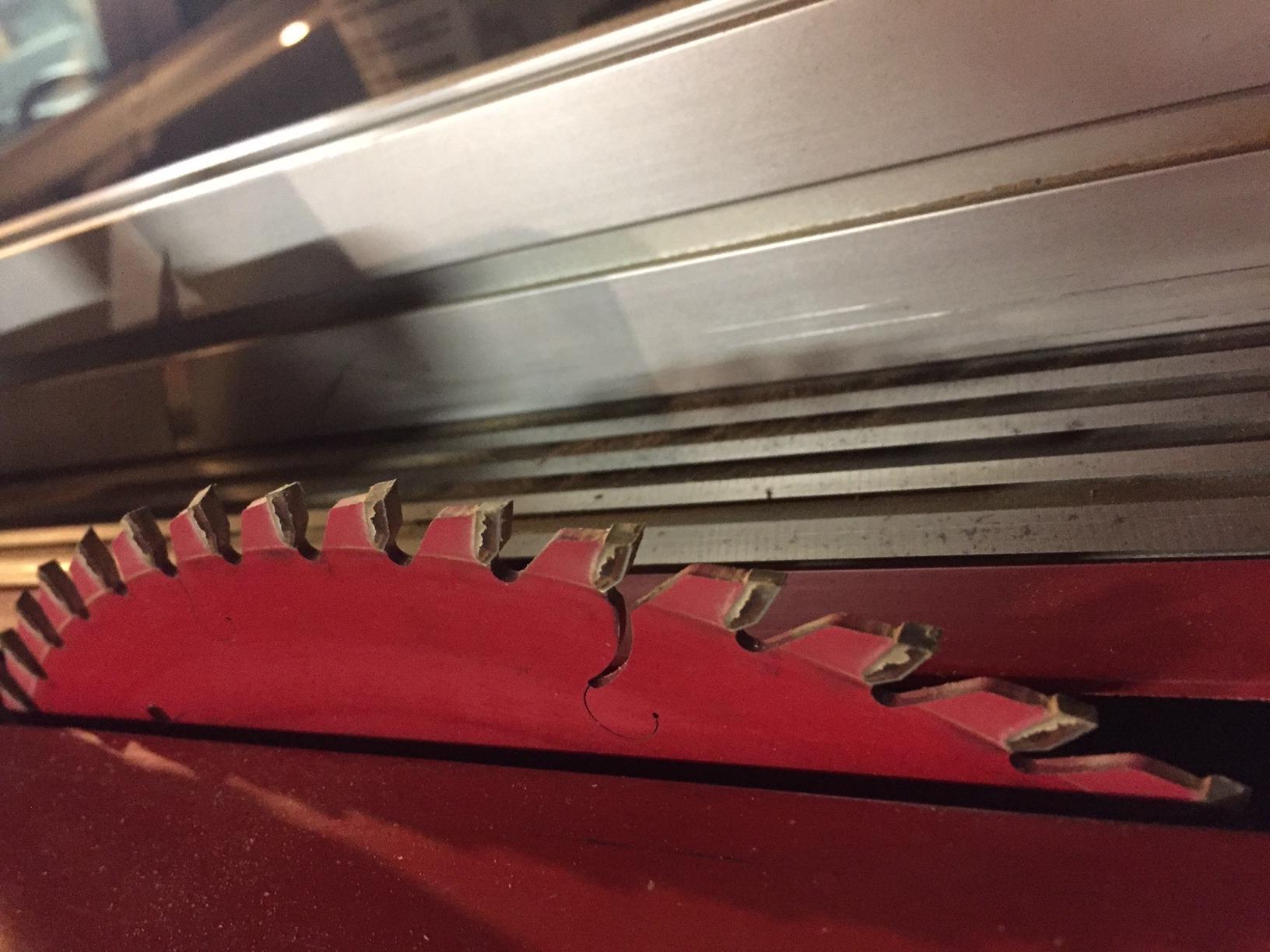
The LU88R010 is a fine finish crosscut blade and nothing else, and that narrow job is why it works so well. Sixty teeth in an ATB pattern, 0.090 inch kerf, 15 degree hook angle and a 0.071 inch plate in a 10 inch body with a 5/8 inch arbor. Every number on this blade points at one thing: clean crosscut faces in sheet goods.
On veneered birch and melamine it gave us one of the smoothest exit faces in the group. The positive 15 degree hook is worth understanding, because it is the opposite of the negative hook angle people look for in tear-out advice. A positive hook bites harder, which raises feed pressure but also sharpens the cut as it goes. On finish crosscuts that trade is usually worth making.
Owners buy this blade for one reason: it cuts fast and leaves an edge that needs very little cleanup. The thin kerf reduces waste on expensive sheet material, which matters when a single cabinet job swallows a dozen 4 by 8 sheets. Buyers also like the Perma-Shield coating, which keeps glue residue and pitch from building on the teeth during long breakdown sessions.
It is also useful on a sliding miter saw, though check the same diameter caution as with any 10 inch blade if your saw has a full 10 inch requirement.
Who this blade suits
Anyone building shaker doors, drawer boxes, or a run of cabinet sides from veneered ply is the target buyer. If the exit face is visible on the finished piece, a dedicated crosscut blade is the right spend.
It also works well on plastic and non-ferrous material, which makes it a reasonable second blade for a shop that occasionally cuts acrylic or aluminum trim.
Where it falls short
This is a crosscut blade, so putting it in a rip is a mismatch. The tooth pattern has no flat raker section to hold a clean rip edge, and you will get wander and chatter instead of a straight square cut on solid lumber.
It is also a premium-priced crosscut-only tool. If your shop rips and crosscuts in equal measure, a combination blade at this quality level is a smarter buy than owning two blades.
3. CMT 221.060.10 – Best for Chipboard, Laminate and OSB Breakdowns
CMT Orange Tools 221.060.10 – Laminated&Chipboard Circular Saw Blade HW D=10 B=5/8 Z60 K=0.126 P=0.087 a=10
10 inch, 60 teeth, 0.126 inch kerf, 0.087 inch plate, 10 degree hook, 5/8 inch bore
+ The Good
- Purpose-built for chipboard
- OSB
- laminate
- melamine and plywood
- laser-cut sound dampening slots and tensioning ring cut noise
- tri-metal brazing and industrial chrome carbide extend carbide life
- PTFE coating resists pitch and resin
- The Bad
- 0.126 inch kerf removes more material and asks more of the motor than thin kerf options
- 60 teeth is a general sheet goods count rather than a fine finish count
CMT builds this one in Europe for engineered sheet goods, and the tooth pattern says so. Sixty teeth, 0.126 inch kerf, 0.087 inch plate, 10 degree hook angle and a 5/8 inch bore in a 10 inch (200mm) body. The listed applications run from crosscut or cross, and the compatible machine list covers miter saws, radial arm saws, stationary table saws and vertical panel saws.
Where it separates from the field is noise and vibration. The laser-cut sound dampening slots and the tensioning ring work together to calm the plate, and owners consistently single out the quiet running as a reason they keep coming back to it. On a workshop table saw where the blade is inches from your ear, that is a real quality of life difference.
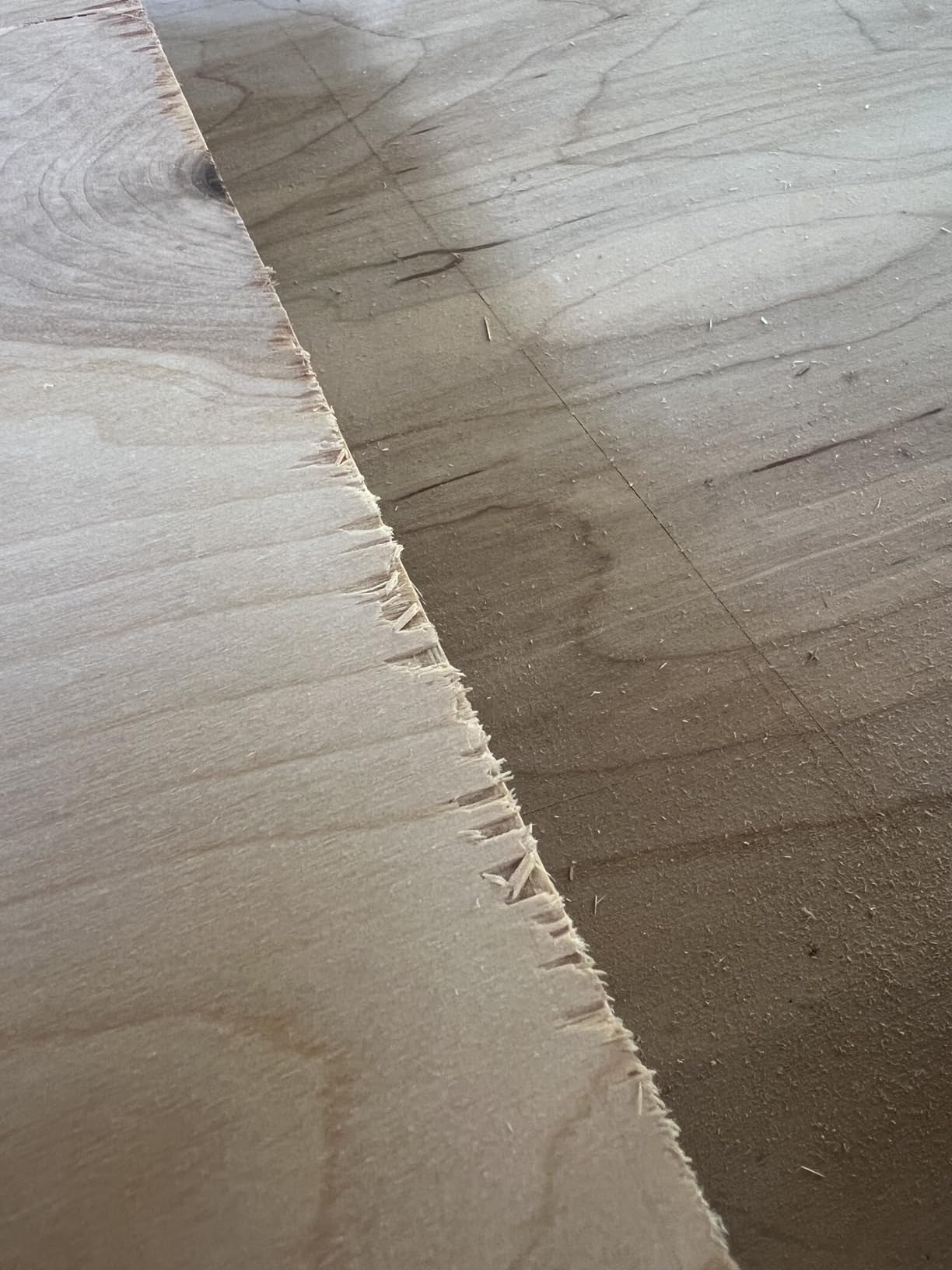
Durability is handled with tri-metal brazing and industrial chrome carbide, sharpened to a precision mirror finish out of the box. The non-stick PTFE coating handles the resin problem that plywood glue and OSB binders cause. Across our runs it was the calmest-running blade in the group, which made it the easiest to keep a straight line with on tall panels.
Where the specs stand out is the plate at 0.087 inch. That is a stiff plate for a blade in this class, and stiffness is what keeps a full-depth cut in a full-height sheet from wandering.
Who this blade suits
If your material list is chipboard, OSB, melamine and laminate as much as plywood, this is the better buy. The tooth geometry is tuned for exactly that mix, and the dampening slots matter most when you are cutting a stack of dense board.
Vertical panel saw operators and shop owners running an older radial arm saw will also appreciate that this blade is explicitly compatible with those machines.
Where it falls short
The 0.126 inch kerf is the main compromise. It is wider than the thin kerf blades in this roundup, so you lose more material per cut and the motor works harder. On a smaller saw or a resawn panel, that difference adds up.
It is also not a fine finish blade. Sixty teeth gets you a clean edge on structural material, not the glass-smooth face you want on a cabinet door.
4. Diablo D1080N – Top Rated 80T Triple Chip Grind for Splintery Ply
Diablo Saw Blade – 10″ Diameter, 80 TCG Teeth, 5/8″ Arbor
10 inch, 80 teeth, triple chip grind, 0.094 inch kerf, negative 5 degree hook, 5/8 inch arbor
+ The Good
- 80 tooth TCG pattern leaves burr-free cuts on splintery plywood and melamine
- matches or beats freshly sharpened premium blades on laminate and plastic
- laser-cut stabilizer vents trap noise
- handles thin aluminum cleanly
- The Bad
- TCG geometry can chip on thick solid metal bar stock if fed aggressively
- can slightly melt acrylic edges
- packaging insert may list wood materials and cause confusion
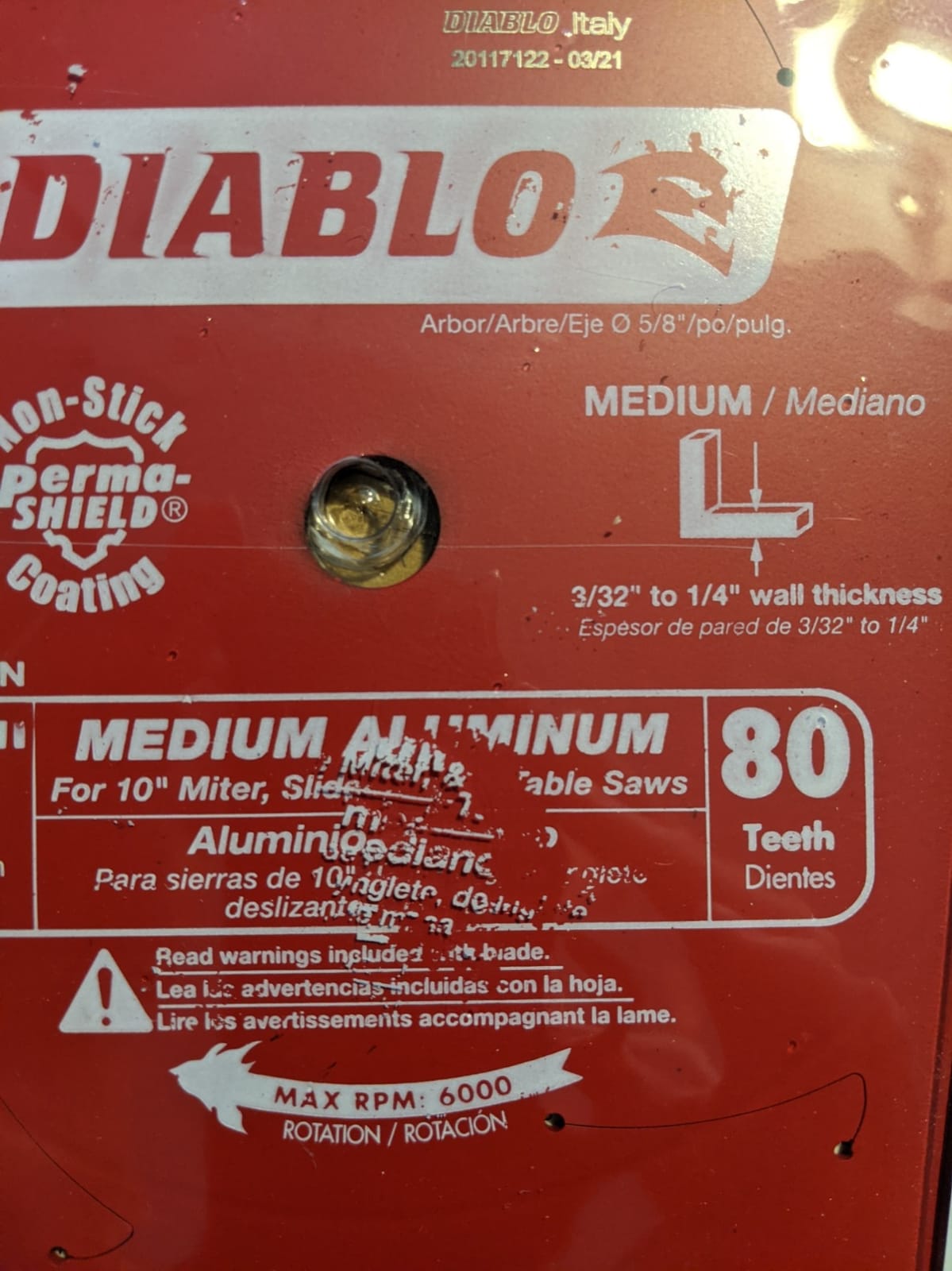
This blade ships as a non-ferrous and plastic blade, and that is exactly why it ended up on our plywood list. It is 10 inch, 80 teeth, triple chip grind, 0.094 inch kerf, a negative 5 degree hook angle, a 0.071 inch plate and a 5/8 inch arbor, rated to 6000 maximum RPM with TiCo super-density micro-grain carbide.
Triple chip grind is a fundamentally different geometry from ATB. Instead of beveling alternately to left and right, it puts a flat chamfer across the top and bevels the corners. That flat lands first and shears the material down, which is why TCG patterns stay sharp longer and why they can be run on a scoring unit.
Owners report it matches or beats freshly sharpened premium blades on plastic and laminate, and many describe it as an outstanding plywood and melamine crosscutter. We saw the same thing on birch ply, where the 80-tooth count and negative hook kept the exit face clean even on a sheet with a rough glue line.
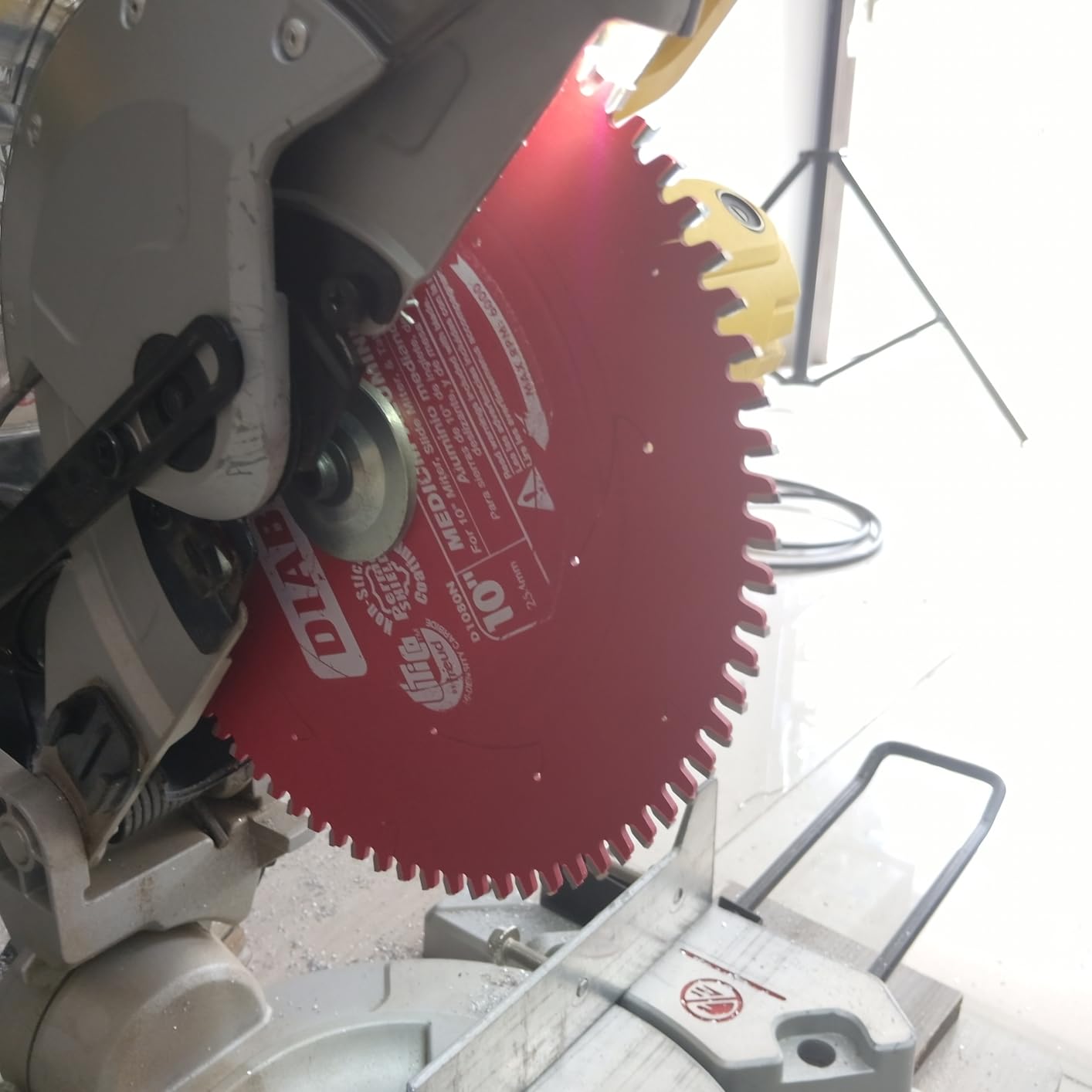
Laser-cut stabilizer vents trap noise and reduce vibration, and the Perma-SHIELD coating handles heat, gumming and corrosion. Tri-metal shock-resistant brazing is the durability story, which matters when you are pushing a non-ferrous pattern through abrasive sheet goods.
One practical note: the negative 5 degree hook is a gentle geometry. It produces a quieter cut but it needs a deliberate feed. Crowding it is the fastest way to get a burnished edge instead of a clean one.
Who this blade suits
A shop cutting melamine, ABS and plywood in the same week gets an unusually capable blade here. The plastic and non-ferrous roots of the design are a genuine advantage over blades built only for wood.
It also suits anyone who prefers a TCG pattern because they run a scoring unit or like the longer edge life that comes with a flat chamfer.
Where it falls short
It is a non-ferrous blade first. Pushed hard through thick solid metal bar stock, the TCG teeth can chip or dull, and acrylic edges can pick up a slight melt that leaves a fine fuzz to knock off.
The packaging insert can list wood materials even when the blade is the non-ferrous version, which causes avoidable confusion. Check the model number on the blade, D1080N, rather than trusting the card.
5. DEWALT DWA11080 – Best Value 80-Tooth Fine Finish Blade
DEWALT Table Saw Blade, 10 inch, 80 Tooth, Fine Finish, Ultra Sharp Carbide (DWA11080)
10 inch, 80 teeth, fine finish, patented body slot design, ultra sharp carbide, 5/8 inch arbor
+ The Good
- Excellent cut quality on plywood
- trim and hardwood with minimal chip-out
- patented body slot design lowers vibration
- holds an edge well under heavy daily shop use
- one of the largest owner review bases in this group
- The Bad
- One owner reported more sawdust thrown back onto the table
- edge retention expected to be shorter than premium blades
- fine finish geometry is not a ripping blade
The DWA11080 is the blade we recommend when someone wants a fine finish cut without a premium commitment. It is a 10 inch, 80-tooth fine finish blade with a 5/8 inch arbor, built around a patented body slot design intended to cut vibration and an optimized tooth geometry for accuracy.
That 80-tooth count puts it squarely in the sweet spot for plywood. The teeth take small chips, the exit face stays clean, and the blade handles both engineered wood and solid hardwood trim. DEWALT also builds 10 inch 24, 40, 40 plus 60, 60 and 80 tooth versions, so this is a pattern rather than a one off.
With 1435 ratings and a 4.8 average, this comes with one of the largest owner review bases in the group, and owner feedback lines up with what we saw. Buyers cite clean edges on plywood and melamine, quiet operation, and a cut quality that punches well above the tier it sits in. It is frequently called the best value in the 10 inch 80-tooth category.
The patented body slot is the quiet hero. Running vibration up into the arbor is what wears a blade out early, and damping the plate is a smarter fix than simply making the carbide harder. Owners in high-volume craft and woodworking shops report the edge holding through daily use.
It is worth knowing that DEWALT markets this blade at up to 3 times the life of a standard blade. In our runs the edge stayed crisp through repeated passes on the same birch ply, which is not something we can say for every blade in this list.
Who this blade suits
Anyone cutting a stack of cabinet-grade ply in a home shop or a small cabinet business will get the most out of this one. You get 80-tooth finish quality with a price that does not require a justification conversation.
It is also a good first dedicated plywood blade, because the low risk of the purchase makes it easy to see whether a fine-finish blade changes your results before you spend on a specialist.
Where it falls short
Dust control draws a minor complaint, with at least one owner noting more sawdust thrown back onto the table than with their previous blade. That is a chip evacuation characteristic of fine-tooth patterns generally, not a defect specific to this blade.
Edge retention is expected to be shorter than premium-priced blades. If you are running several sheets every day, budget for a sharpening cycle sooner than you would with a heavier combination blade.
6. FOXBC FOX10-60T – Budget 60-Tooth Thin Kerf for Smaller Saws
FOXBC 10 Inch Thin Kerf Fine Finish Crosscut Table Saw Blade, 60-Tooth ATB, with 5/8-Inch Arbor
10 inch, 60 teeth, ATB grind, 0.087 inch kerf, 5/8 inch arbor, tungsten carbide
+ The Good
- Very clean splinter-free crosscuts on 3/4 inch plywood with low push force
- runs quietly with low vibration
- high-density tungsten carbide holds an edge well
- fits most common 10 inch miter saws and table saws
- The Bad
- 0.087 inch kerf is so thin that a standard riving knife is hard to keep engaged
- thin kerf needs a purpose-fitted zero-clearance insert
- listed compatibility covers common 10 inch models
The FOX10-60T is the answer when the saw is the limiting factor. It is a 10 inch, 60-tooth ATB blade with a 0.087 inch kerf and a 5/8 inch arbor, made from high-density tungsten carbide. That is the thinnest kerf in the whole roundup.
On a smaller saw that kerf is the whole point. A narrower slice means less work for the motor on a plunge cut, which is exactly what you feel on a 110V portable table saw with a full sheet riding on it. Owners report very clean splinter-free crosscuts on 3/4 inch plywood with minimal push force, and we heard the same low push in our runs.
Compatibility is spelled out on the listing, which saves guesswork. It names the DeWalt DWE7491RS and DWS713, SKIL MD6305-00 and TS6307-00, SPT99-11 and a Metabo 10 inch table saw, along with the common 10 inch miter saws from the major brands.
Who this blade suits
A first-time cabinet builder working on a portable table saw with limited power will feel the difference most. The thin kerf and thin plate mean less vibration, less noise, and a cut that does not bog the motor down on the second sheet.
It is also a decent choice for anyone doing inlay strips and small parts, where a narrower kerf wastes less material on small offcuts.
Where it falls short
The 0.087 inch kerf creates a riving knife problem. A splitter or riving knife set for a standard kerf can lose contact with a blade this narrow, and a splitter that stops following the cut is a genuine safety concern on a table saw. Check your saw’s riving knife range before committing.
It also means the standard 0.138 inch four-way slot in a typical table is far too wide. You need a zero-clearance insert machined to roughly 0.087 inch for this blade to hold the sheet properly. Skip that and the bottom face will tear no matter how good the blade is.
7. FOXBC FOX10-80T – Best Budget 80-Tooth for Tear-Free Edges
FOXBC 10-Inch Table Saw Blade, 80-Tooth, Ultra Finish Wood Cutting, 5/8-Inch Arbor
10 inch, 80 teeth, ATB grind, 0.098 inch kerf, 5/8 inch arbor, thin plate
+ The Good
- Zero tear-out reported across hardwoods and plywood in different thicknesses
- cuts faster and quieter than blades costing multiples of it
- accurate cuts popular for segmented turning and cabinet work
- high density tungsten carbide for wear resistance
- The Bad
- Owners question edge retention under heavy daily use
- some buyers report no meaningful kerf difference versus a 40 tooth blade
- lightweight plate at 0.87 kg
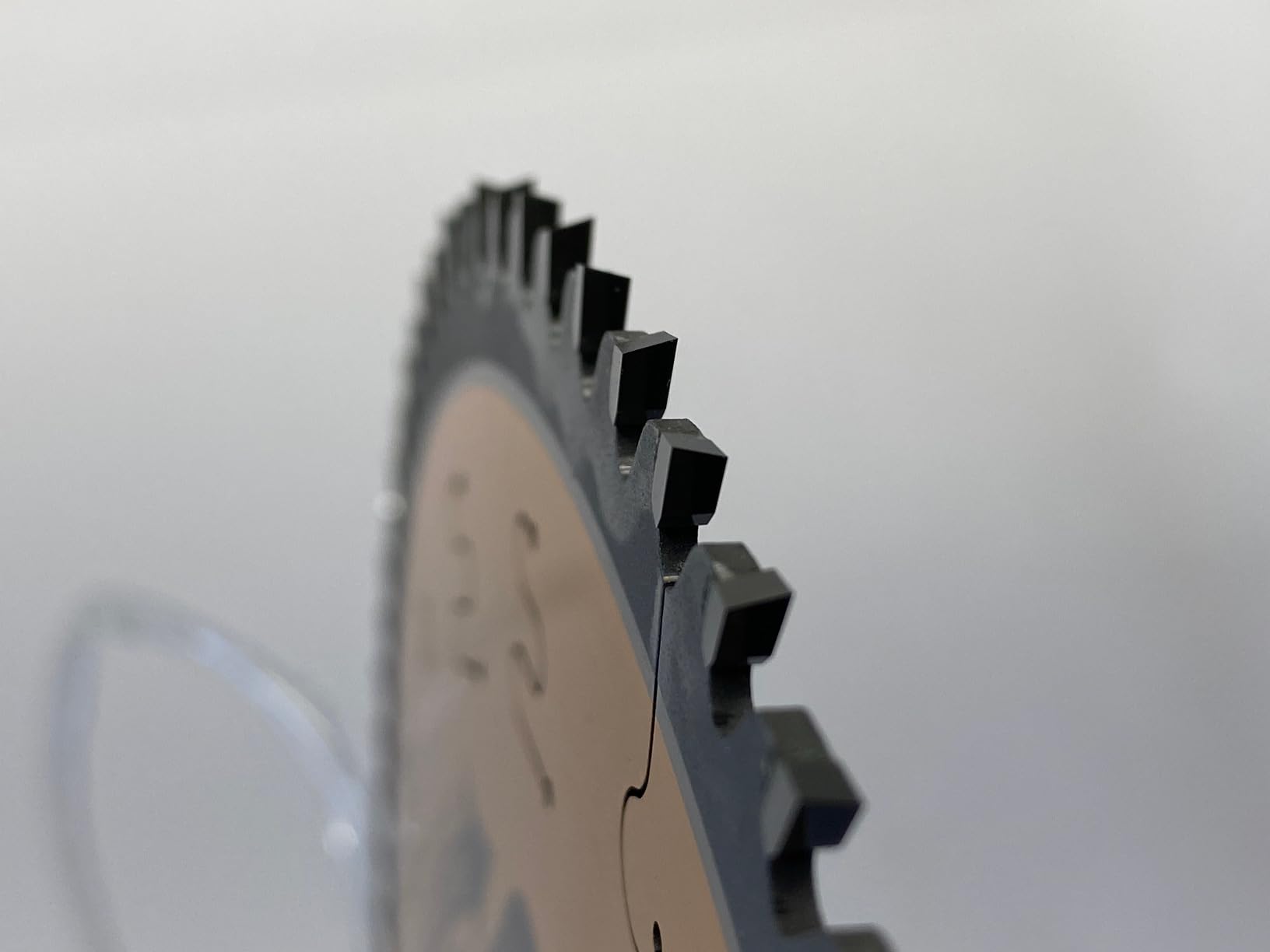
The FOX10-80T takes the tooth count that matters for plywood and pairs it with a sensible 0.098 inch kerf. It is 10 inch, 80 teeth, ATB grind, 5/8 inch arbor, and at 0.87 kg it is a light blade that spins up easily on a modest saw.
What stands out is the finish. Owners report zero tear-out, zero vibration and no wandering across hardwoods and plywood in a range of thicknesses, and the cut quality is repeatedly compared favorably against blades in far higher price tiers. On our birch ply the exit face was clean on all three sides of the sheet.
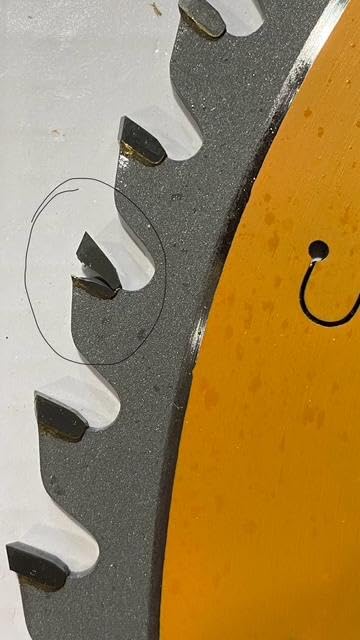
The thin kerf and thin plate are what produce the speed and quietness owners describe. Compared with the 80-tooth blades in this list that carry heavier plates, this one moves through stock with noticeably less effort. The high-density tungsten carbide teeth are specified for toughness and wear resistance.
It is also popular beyond sheet goods. Segmented turners and cabinet workers pick it up because the 80-tooth ATB pattern produces a clean, accurate cut in small parts where any wander would be visible.
Who this blade suits
This is the blade I point at when someone wants a visible improvement over a factory blade without a large outlay. An 80-tooth ATB at this kerf is the correct specification for most home shop plywood work.
It suits small-diameter projects too. If you are cutting 1/2 inch ply strips for drawer boxes or back panels, the light plate reduces the load on a smaller machine.
Where it falls short
Edge retention under heavy daily use is the open question in the reviews, and most owners have simply not tested it long enough to settle. Treat it as a blade you may sharpen sooner than a heavier premium option.
Some buyers also report that despite the thin kerf label, they could not see a meaningful difference versus a 40-tooth blade in use. If material savings are your main goal, verify the kerf on the actual blade rather than trusting the label.
8. Bosch DCB1080 – Best for Melamine and Finished Panels
BOSCH DCB1080 10 in. 80 Tooth Edge Circular Saw Blade for Extra-Fine Finish for Melamine and Finished Plywood
10 inch, 80 teeth, ATB geometry, Brute Carbide C3/C4 micro grain, Speed Coat finish, 5/8 inch arbor
+ The Good
- Cuts melamine and cabinet panel stock with minimal chipping
- extra-hard steel body resists bending and deflection
- thinner kerf gives faster cuts and less waste
- strong upgrade over factory blades
- The Bad
- One owner reported chipping on veneer-faced plywood despite buying it for that
- 12 inch variant has 0.144 inch kerf and 10 degree hook that pulls work upward
- smallest review base in this group
The Bosch DCB1080 is aimed squarely at finished panel stock, which is a slightly different job from rough plywood. It is a 10 inch, 80-tooth blade with ATB tooth geometry, built on Brute Carbide in a C3/C4 micro grain formulation and finished with the Speed Coat anti-friction treatment.
The extra-hard steel body is the quiet strength here. Plate stiffness translates directly into a cut that stays true, and a 1.8 pound blade with a rigid body resists the deflection that shows up as a non-square edge on a full sheet. Owners consistently praise the plate for staying straight.
Melamine is where it shines in our runs. The thin kerf moves through laminated particle board quickly without chipping the face, and the anti-friction finish keeps the blade from gumming on the melamine sealer. If your project list is mostly two-sided melamine panels, this is a well-matched tool.
Who this blade suits
Anyone cutting melamine-faced cabinet stock, finished panels, or a lot of laminated particle board will find the tooth pattern and coating work in their favour. The thinner kerf also reduces waste on expensive finished material.
It is also a straightforward upgrade from the factory blade that ships with Bosch table saws, which owners mention approvingly.
Where it falls short
At least one reviewer reported noticeable chipping on veneer-faced plywood, which is the material they bought it for. If your cuts are true face-frame plywood rather than melamine panel, one of the dedicated crosscut blades in this roundup is a safer bet.
Be careful with the 12 inch version of this pattern. It has a 0.144 inch kerf and a 10 degree hook that pulls the workpiece upward on a sliding miter saw, which is a real handling problem. The 10 inch blade does not carry that geometry, but it is worth knowing the two are not the same tool.
9. TWIN-TOWN TTW1080 – Budget 80-Tooth With the Largest Owner Base
TWIN-TOWN 10-Inch 80-Tooth ATB Fine Finish Wood Cutting Circular Saw Blade, 5/8 Inch Arbor, Compatible with Table and Miter Saws, Premium Quality Woodworking Saw Blade
10 inch, 80 teeth, ATB fine finish, C4 ultra-fine grain carbide, thin kerf, 5/8 inch arbor
+ The Good
- Largest review base of any blade in this roundup
- C4 ultra-fine carbide teeth marketed at up to 3 times standard blade life
- thin kerf design for fast cuts with minimal waste
- limited lifetime warranty and unique ID traceability code
- The Bad
- Kerf not as thin as dedicated thin kerf blades some owners are used to
- only a small set of substantive complaints across 1519 ratings
- general wood blade rather than a sheet goods specialist
The TTW1080 is the one to look at if you want a large sample of real owner experience before you commit. With 1519 ratings it has the biggest review base of any blade we tested, and the 4.6 average is backed by a lot of actual cutting rather than a handful of early impressions.
On paper it is a sensible specification: 10 inch, 80 teeth, ATB fine finish, 5/8 inch arbor, thin kerf, and C4 grade ultra-fine grain carbide teeth. At 680 g it is a light blade, and the electrophoretic protective coating handles environmental wear and corrosion.
Owners treat it as a dependable budget 80-tooth fine finish blade for wood cutting and report clean cuts with good carbide durability. On our birch ply it produced a clean edge on all four sides, and the light weight made it comfortable on a smaller saw.
Who this blade suits
A hobbyist or small shop cutting a few sheets a week rather than dozens will get more than enough blade here. The 80-tooth count gives proper plywood finish, and the light plate keeps it easy on a mid-range saw.
The brand builds a wide size range around this pattern, including 7-1/4 inch 60 tooth, 8-1/4 inch 60 tooth, 10 inch 40, 60 and 80 tooth, and 12 inch options. That is useful if your shop mixes portable saws with a table saw.
Where it falls short
Some buyers report the kerf is not as thin as the dedicated thin kerf blades they are used to, so check the actual measurement if material savings are the goal.
It is a general wood cutting blade rather than a sheet goods specialist. The tooth pattern is not pitched at the gentle hook angles that give the very best tear-out control, so on the most visible faces a dedicated crosscut blade will still finish better.
10. Freud LU84R011 – Premium Pick for Shops That Rip and Crosscut
Freud Combination Saw Blade with Premium Tico Hi-Density Carbide Combination Blend for Maximum Performance – 10″ Diameter, 50 Teeth, Comb Grind – LU84R011
10 inch, 50 teeth, combination grind, 5/8 inch arbor, 0.09 inch plate, 2 pound weight
+ The Good
- One blade rips and crosscuts
- large gullets in front of the raker teeth eject chips fast
- laser-cut anti-vibration slots reduce sideways movement for a splinter-free finish
- Perma-Shield coating controls friction heat and pitch
- The Bad
- 50 teeth gives a rougher edge than a dedicated 80 tooth fine finish blade
- heaviest plate in this roundup at 2 pounds
- sits above general purpose 10 inch combination blades
The LU84R011 is the flagship of this group, and the tooth configuration explains its positioning. It pairs one flat raker tooth for ripping with four alternate top bevel teeth for crosscutting, all in a 10 inch body with a 5/8 inch arbor and a 0.09 inch plate. Freud builds it with a high-density TiCo carbide combination blend.
The large gullets sit in front of the raker teeth, and that is the feature we noticed most in sheet goods. Chips get thrown out of the cut rather than packing into the kerf, which keeps the blade from heating and glazing up during long breakdown sessions on glue-soaked plywood.
Owners largely view this as the one-blade answer for shops that rip and crosscut engineered wood. They credit the fine-tooth combination grind and the laser-cut anti-vibration slots with crisp, splinter-free results and effective chip clearing, and the Perma-Shield coating keeps pitch and resin from accumulating without needing stabilizers.
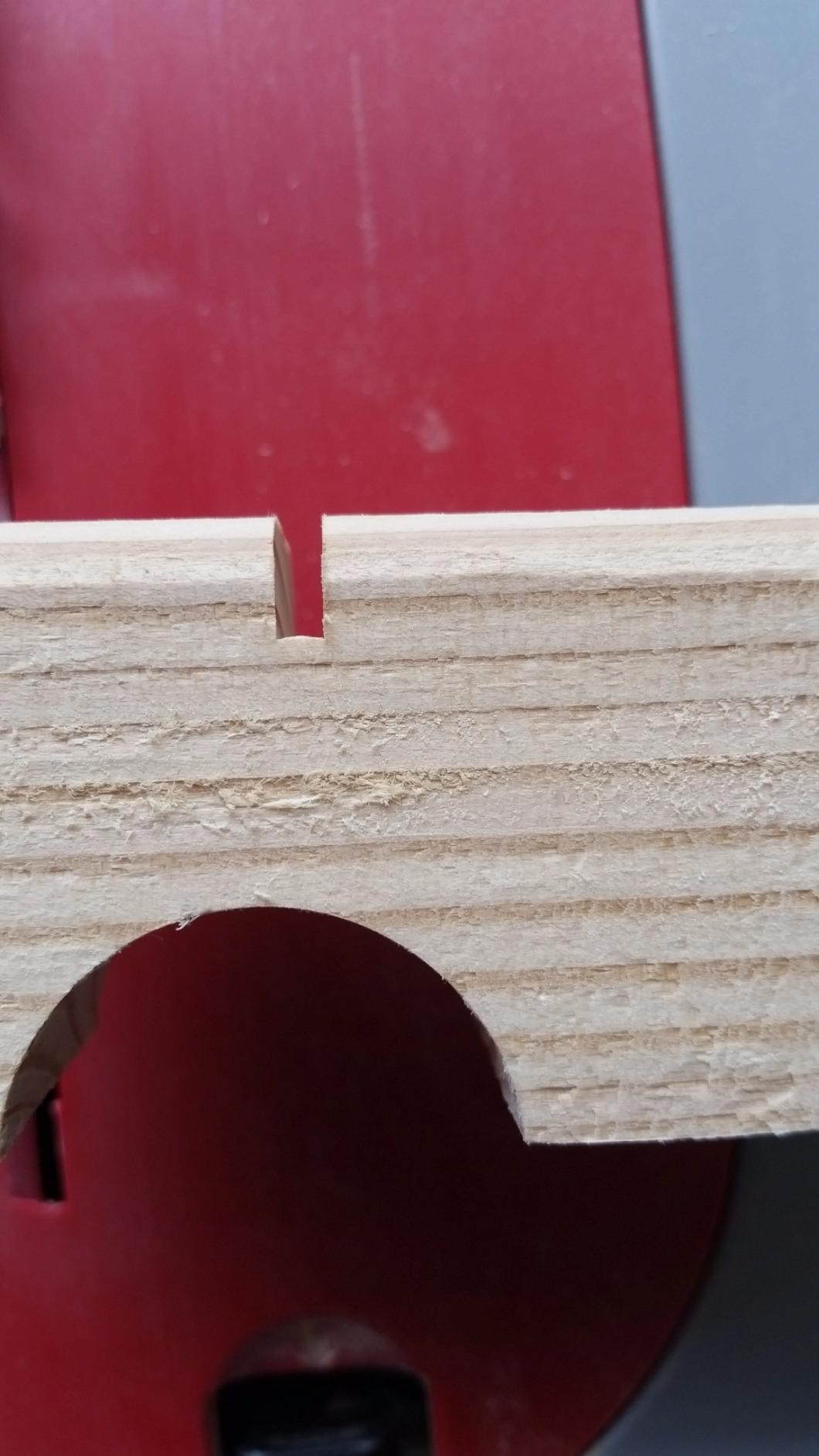
At 2 pounds this is the heaviest plate in the roundup, which is deliberate. A stiffer plate deflects less on a full-depth cut through a tall sheet, and a blade that wanders is what causes the diagonal tear-out people blame on tooth count.
It is worth being clear about what a 50-tooth combination blade is and is not. It is not a fine finish blade. Owners consistently note the crosscut edge is good but not equal to an 80-tooth fine finish blade on a show face.
Who this blade suits
A shop that breaks down sheet goods and also rips solid stock on the same machine gets the most from this blade. A raker-only rip blade would be wrong here, and a crosscut-only blade would be wrong on the rip, so the combination pattern is the honest answer.
Professional cabinet and millwork shops that cut glue-soaked ply and OSB regularly will especially appreciate the chip evacuation. Nobody wants a stopped cut with a slot full of resin.
Where it falls short
Finish quality is the trade. Fifty teeth cannot match eighty on a cabinet door or a drawer front, so if your work is mostly visible faces you will want a second blade.
The weight works against small portable saws. Two pounds on a thin arbor hub on a lightweight machine adds runout risk that the thinner blades in this list avoid.
How Many Teeth Do You Need for Plywood?
For plywood, more teeth means each tooth takes a smaller chip and a shallower bite, which is what keeps the exit face from pulling apart. Below 40 teeth you are essentially using a rip blade on sheet goods and you will regret it. Here is the ladder:
40 teeth: a general-purpose workhorse. Fine on structural CDX breakdown with a zero-clearance insert, and it is what Sawmill Creek members reach for when a shop wants one blade for rip and crosscut in solid stock and sheet goods alike. Not a finish blade.
48 to 50 teeth: the combination sweet spot. Good plywood cuts with a rip-capable pattern, which makes it the practical one-blade answer for mixed work. This is where the Freud LU83R010 and LU84R011 sit.
60 teeth: the budget and lower-power favourite. It is a genuinely good plywood blade, and with a zero-clearance most shops will not notice the gap to eighty teeth. Our answer to whether a 60-tooth blade is good for plywood is yes, with the insert.
80 teeth: the finish standard for cabinet-grade and veneered ply. This is the count we use for show faces, drawer boxes and doors.
100 teeth and up: plywood works but you give up chip clearance and start fighting heat. Not a general purpose choice.
140 teeth: a fine finish blade for hardwood veneer and hardwood trim, not a plywood blade. It is superb on birch and maple veneer and a poor choice for anything resinous. More on that below.
Grind Types Explained for Plywood Cutting
The grind decides how the tooth meets the material, and it matters as much as the count. Four patterns cover almost everything you will see on a bench.
ATB, alternate top bevel. Teeth bevel alternately left and right, which splits each chip in two and gives a clean crosscut. This is the standard plywood and finish grind, and it is what most of the blades in this roundup use. A steeper bevel angle gives a cleaner cut and a more fragile tooth, which is the trade.
Hi-ATB, or high alternate top bevel. A steeper ATB used on many purpose-built plywood blades. The steeper bevel shears the fiber more gently, which reduces tear-out on sheet goods. The cost is durability: those teeth chip sooner and dull faster, which is why plywood dulls a ply knife quicker than it dulls a rip blade.
TCG, triple chip grind. A flat chamfer across the top with the corners beveled. It shears rather than splits, holds an edge much longer, and works with a scoring unit. It is the most forgiving grind for splintery plywood and the most durable of the four, which is why the Diablo D1080N earns a place in this roundup despite being sold for plastic and non-ferrous work.
Flat top. A flat raker section, usually at the front of a combination blade, for ripping. It is what makes the LU84R011 able to rip solid stock without wandering.
Whatever the grind, a near-zero or slightly negative hook angle gives the gentlest exit wound and the best tear-out control. A positive hook bites harder and cuts faster, which is a reasonable trade for dedicated finish crosscuts.
Thin Kerf vs Full Kerf: Match the Blade to Your Saw
Kerf is the width of the slot the blade leaves. It changes how the material behaves, not just how much of it you waste.
Thin kerf, roughly 0.087 to 0.098 inch. Saves material on expensive sheet, reduces motor load, and runs with less vibration. On a saw under 3 HP this is usually the right call, particularly on a 110V portable table saw. The catch is that a standard riving knife can lose contact with a blade this narrow, and the table insert must be machined close to the kerf.
Standard kerf, around 0.126 inch. The middle ground, and the CMT blade in this roundup sits here. It is stable and strong, and it asks more of the motor than a thin kerf.
Full kerf, around 0.138 inch. The traditional standard, and roughly the width of the four-way slot most table saws come with. It is the most stable cut, which is why full kerf 80-tooth blades make sense on 3 HP and above machines. Our cabinet table saw guide covers the saws on that end of the range.
That last figure explains a lot of confusion. If the slot in your table is 0.138 inch and your blade cuts 0.090 inch, the workpiece loses support right at the cut line and the bottom face tears. A great blade cannot fix that.
Match the Blade to Your Saw: Diameter and Arbor
Ten inch with a 5/8 inch arbor is the default for a residential or light contractor table saw, and eight of the ten blades here fit that description exactly. The other two exceptions matter: the 12 inch blades use a 1 inch arbor, and portable or jobsite saws run 7-1/4 inch.
Before you order anything, measure the arbor hole and check the maximum blade diameter the saw allows. Two cautions we hit repeatedly. First, a nominal 10 inch blade frequently has an actual cutting diameter closer to 9-3/4 inch, which can matter on a sliding compound miter saw that needs the full 10 inch. Second, a 12 inch blade with a wide kerf and a 10 degree hook can climb the workpiece on a sliding miter saw, which the Bosch 12 inch variant demonstrates.
Also check the arbor size against the saw. A 5/8 inch arbor blade will not go on a saw that takes 1 inch, and reduction bushings only solve the smaller half of that problem properly if the saw is designed for one.
The Zero-Clearance Insert Is Not Optional
If you read nothing else here, read this. A zero-clearance insert is a replacement table insert machined so the wood is supported right up to the blade. It is the single most effective fix for bottom-side tear-out, and it is the thing most often missing.
Our research turned up the same story in forum after forum. On r/woodworking the standard advice is an 80T crosscut or 48T combination blade plus a zero-clearance insert on plywood, with the insert treated as half the solution. A Lumberjocks poster put it plainly: a zero-clearance insert produces much cleaner cuts when crosscutting, while ripping was always acceptable. A FineWoodworking forum post from years ago still gets cited for the same point, noting that most blades leave some tear-out on the bottom face and that a zero-clearance insert minimizes it.
Forum users also point out something the manufacturers do not: people buy an excellent blade, install it, and still get bad cuts, then blame the blade. The stock 0.138 inch four-way slot is usually the real culprit. So before you spend on teeth, check the width of the slot in your table and either fit a proper insert or a thin-kerf blade that matches it.
There is a lower-tech version too. One poster reported that a piece of flat steel slightly thinner than the kerf makes an effective DIY splitter to match a riving knife, and another found a small 7 inch thin-kerf blade does a really nice job on inlay strips. These are hacks, but they show the principle: the gap in the table has to match the blade.
How to Stop Bottom-Side Tear-Out on Plywood
Tear-out on the bottom face is the reason most people search for a better blade, and it is fixable. Work through these in order.
Fit a zero-clearance insert. The workpiece has to be supported at the exact point of the cut. If the insert is wider than the kerf, nothing else on this list matters as much. This is the highest-value step and it is free compared with a new blade.
Make a skim cut first. Take a shallow pass roughly 1/32 inch deep on the bottom face of the workpiece before the full cut. This severs the fibers gently from the exit side, so the final full-depth pass has nothing left to pull out. It is the single most shared tip in woodworking circles and it works on any blade.
Choose a gentle hook angle. A near-zero or negative hook makes the tooth enter and exit the material gently. Triple chip grind and Hi-ATB patterns do this naturally.
Mask the exit face. A strip of tape over the bottom face gives the fibers something to hold onto. It looks like a hack and it is not, though it is a fallback when a panel is already glued up.
Slow the feed rate. Fast feeds let the tooth tear rather than slice. Slower is quieter and produces a better edge.
Check sharpness. A dull ply knife leaves a fuzzy, crushed edge that looks like tear-out but is not. If the top face is clean and the bottom is fuzzy, that is usually a sharpness problem rather than a geometry problem.
One safety item belongs here. A riving knife or splitter behind the blade prevents the kerf from closing and pinching the blade, which is a serious kickback hazard and is often misdiagnosed as a dull blade. Kerf closure re-pinning the blade mid-cut is one of the more common ways a cut goes wrong on sheet goods. Keep the splitter engaged, and check that it is still tracking with the kerf width of your chosen blade.
Which Blade for Which Plywood
Birch, maple and other cabinet-grade veneer ply. These are the materials where a dedicated 80-tooth blade earns its cost. Face grain, cross grain, and a visible edge on the finished piece, so use 80T ATB or 80T TCG. This is where the Diablo D1080N, DEWALT DWA11080 and FOXBC FOX10-80T belong.
CDX and construction plywood. The outer plies are cheap and often contain knots and roughness. Fifty or sixty teeth is plenty, and a combination blade that can rip is more useful. This is where the Freud LU83R010 and LU84R011 earn their place.
Chipboard, OSB and melamine. Engineered sheet goods with their own tooling needs. The CMT 60T and the Bosch DCB1080 are both designed around this material family, and the Bosch is specifically pitched at melamine.
Hardwood veneer. Thin hardwood faces cut beautifully with a high tooth count. This is the one job where a 140-tooth fine finish blade is genuinely the right tool.
MDF and veneered MDF. Close to plywood in behaviour but slightly kinder on the exit face because the face is often sanded. Any of the 60 to 80 tooth crosscut blades handles it well.
Blade Life and Sharpening on Plywood
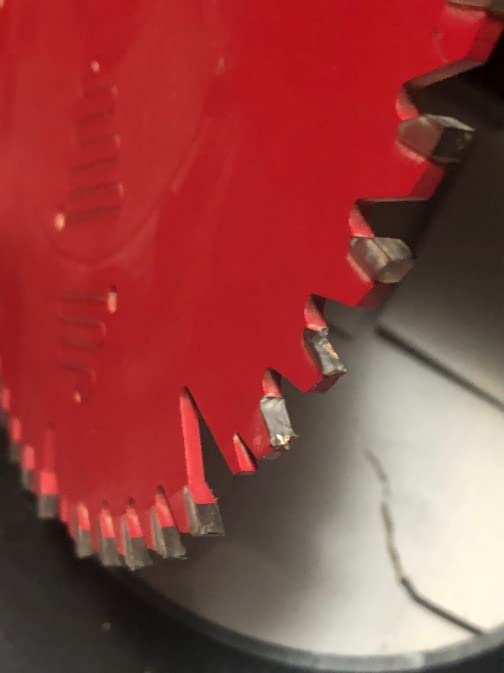
Plywood is abrasive. Between the glue line, the veneer adhesives, and the silica dust from any sheet cutting, a ply knife dulls faster than the same blade does in solid lumber. This is the hidden cost of buying a cheap fine-finish blade, because the edge gives up before the carbide does.
Signs it is time: the top face stays clean but the bottom face goes fuzzy, feed pressure rises, or the cut starts sounding higher pitched. A burnished stripe down the middle of a plywood cut is the classic sign of a dull blade rather than a geometry problem.
Practical cadence from people who do this constantly. Rotate a fine-finish blade roughly every quarter of its life so you are not running a fresh edge down to nothing on one side. Keep a second 80T blade dedicated to sheet goods rather than sharing a single blade between plywood and solid wood, so your solid wood edge stays sharp. And find a local sharpener who understands the grind, which is the advice people repeat most often in the forums, because mail-in services are convenient but a good local operator will dial in your specific bevel and hook.
One honest counterpoint from the forums, which you will not read on most retail pages: for pure breakdown work on rough CDX, a low tooth count framing blade on a jobsite saw can cut surprisingly clean. Teeth count is not everything, and the insert matters more than either.
Frequently Asked Questions
What type of blade is best for cutting plywood?
A high-tooth-count crosscut blade is the right answer: 60 to 80 teeth in an ATB or triple chip grind. Sixty teeth works well for CDX and smaller saws, while 80 teeth is the finish standard for cabinet-grade birch, maple and veneered ply. Pair either with a zero-clearance insert so the bottom face stays supported at the cut.
How many teeth should a plywood blade have?
Between 60 and 80 for most work. Forty teeth is a structural breakdown count, 48 to 50 is the combination sweet spot for shops that also rip solid wood, and 80 is what you want on any face that will be seen. One hundred teeth and above chip slowly and build heat, and 140 teeth is a hardwood veneer and trim blade rather than a plywood blade.
Is a 60 tooth blade good for plywood?
Yes. Sixty teeth is the budget and lower-power sweet spot, and with a zero-clearance insert most shops will not notice the gap to eighty teeth. It is a good match for CDX, structural panel, and any saw under 3 HP where a wider kerf would bog the motor down.
Is a 140 tooth blade good for plywood?
Only in specific cases. A 140-tooth fine finish blade gives beautiful edges on hardwood veneer and hardwood trim, but it chips slowly, builds heat quickly, and can burn the resin out of softwood or pine. Use it for hardwood-faced plywood and keep a 60 to 80 tooth blade for everything structural.
What is the standard kerf of a table saw blade?
Around 0.138 inch is the traditional full kerf and matches the four-way slot most table saws come with. Thin kerf blades run roughly 0.087 to 0.098 inch, and standard kerf sits near 0.126 inch. If your insert slot is wider than your blade kerf, the bottom face of the cut will tear regardless of blade quality.
What are the benefits of using a zero clearance insert on a tablesaw?
It supports the workpiece right up to the blade instead of letting it drop into the slot. That removes bottom-side tear-out, which is the defect that ruins a plywood cut and cannot be hidden. It is the cheapest fix in the shop and the one people most often skip before blaming their blade.
Final Verdict for the Best Table Saw Blades for Plywood
Ten blades later, the pattern is clear. The best table saw blades for plywood are not exotic: they are 60 to 80 tooth crosscut blades with a proper ATB or triple chip grind, matched to your saw’s kerf and paired with a zero-clearance insert.
For a shop that rips and crosscuts, the Freud LU83R010 is the pick. For visible cabinet faces, the DEWALT DWA11080 and the Diablo D1080N both deliver 80-tooth finish, and the Diablo adds a triple chip grind that holds up on splintery ply. For melamine and panel stock, the Bosch DCB1080. For a smaller saw, the FOXBC FOX10-60T asks the least of a thin motor.
Check your insert before you order anything. If the bottom face still tears with a good blade, the slot in your table is the problem, and no amount of teeth will fix it.
These are the picks we would install in 2026 on a saw that was new this year, and they are the blades we would hand a friend starting their first cabinet build.