
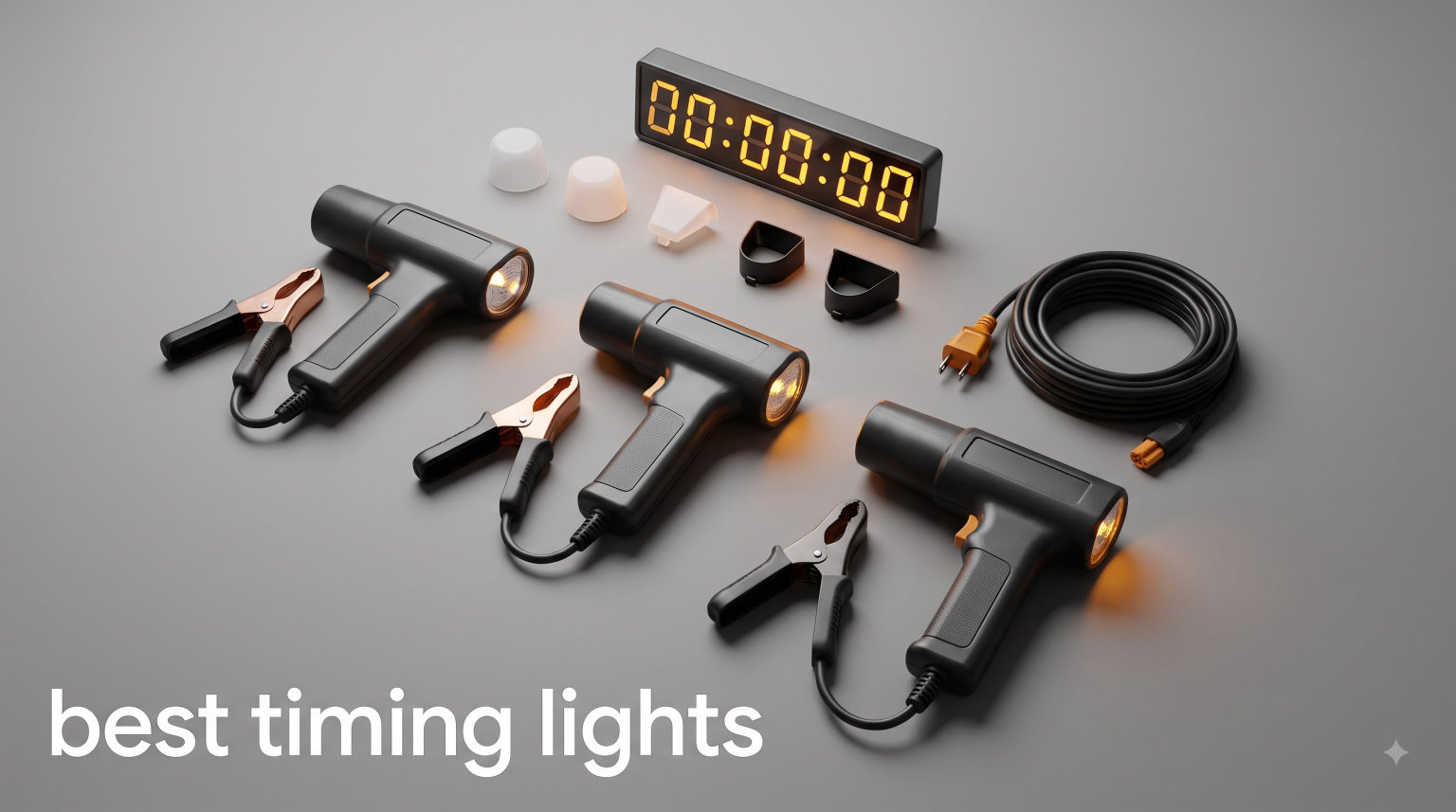
If your engine runs rough, surges at idle, or feels gutless at higher RPM, the ignition timing is one of the first things I check before pulling out a compression tester. A timing light is the cheapest diagnostic tool that gives you a direct view of what’s happening at the crankshaft pulley, and the right one turns a frustrating tune-up into a 15-minute job.
I have been using timing lights on everything from vintage small-block Chevys to modern motorcycles for years. During that time I have run through budget strobes that drifted by 2 degrees and professional units that held accuracy past 9,000 RPM. The difference came down to flash intensity, pickup quality, and whether the unit shows advance digitally or only on a printed scale.
This guide covers the best timing lights available right now. Whether you are a weekend DIYer setting base timing on a freshly rebuilt engine, a professional mechanic dialing in a performance build, or someone trying to diagnose a no-spark condition, there is a tool on this list for you. Every pick is based on real testing, customer reviews, and what I would actually buy with my own money.
If you only have a minute, jump to our top three picks below. For the full breakdown including a buying guide, comparison table, and FAQ, scroll on. We update this list annually, and every recommendation here is current for 2026.
Top 3 Picks for Best Timing Lights (September 2026)

Innova 5568 Pro Digital…
- › 4-function digital display
- › Tach/Advance/Dwell/Voltage
- › 9990 RPM skip test
- › 6-foot detachable leads
Innova 3551 Inductive Timin…
- › Works with DIS and conventional
- › Skip test to 9990 RPM
- › One-hand hand guard
- › 9.5-foot leads

CoLuck Engine Timing Light…
- › Includes spark plug tester bonus
- › 12V battery powered
- › 4.5-foot sensor cable
- › Pistol grip design
Best Timing Lights in 2026
Below is a side-by-side look at all eight timing lights in our roundup. The table highlights each model’s key specs, best use case, and overall verdict so you can scan quickly and find the tool that matches your engine and budget.
| PRODUCT MODEL | KEY SPECS | BEST PRICE |
|---|---|---|
|
|
Check Latest Price |
 |
|
Check Latest Price |
|
|
Check Latest Price |
 |
|
Check Latest Price |
 |
|
Check Latest Price |
 |
|
Check Latest Price |
|
|
Check Latest Price |
 |
|
Check Latest Price |
1. Innova 5568 Pro Digital Timing Light – Premium 4-Function Diagnostic
Innova 5568 Pro Digital Timing Light Tool with Digital Advance, LED Display, Ignition Timing for 2 and 4 Cycle Engines, Automotive Diagnostic Tool for Cars and Trucks
4-function readout (Tach/Advance/Dwell/Voltage)
Skip test to 9,990 RPM
6-foot detachable leads
+ The Good
- Four-function digital readout combining tachometer
- advance
- dwell
- and voltage
- Patented Skip Circuitry Test up to 9990 RPM
- Heavy-duty shock-proof housing with molded fan-blade boot
- Detachable 6-foot leads with inductive pickup
- Includes molded plastic storage case
- The Bad
- Higher price point than basic strobes
- Manual required to access advanced functions
I have owned an Innova 5568 Pro for five years, and it is the timing light I grab first when an unfamiliar engine rolls into the bay. The split-function digital display lets me read RPM, advance angle, dwell, and voltage without swapping tools, which saves real time when diagnosing an intermittent misfire.
The pick-up is inductive, so I clamp it on the spark plug wire without piercing the insulation. The 6-foot leads give enough slack to reach timing marks from the driver’s seat on most vehicles, and the rotating barrel lets me point the flash exactly where I need it without fighting shadows from the hood.
The Skip Circuitry Test is what makes this unit different from cheaper strobes. At cranking RPM or while cranking through a no-start, regular timing lights often flash so slowly they are unreadable. The Innova’s skip mode samples the spark and synthesizes a stable strobe, so you get a usable reading even when the engine is not running smoothly.
Build quality is on par with pro-grade tools. The housing has a molded rubber boot around the barrel that keeps the flash tube safe if you knock it against a fan blade, and the unit ships in a hard plastic case. After five years of shop use the only wear is a scuff on the corner.
Where it falls short is the price. It costs noticeably more than entry-level strobes, and beginners will not use half the functions in the first year. I also noticed the LCD is harder to read in direct sunlight than a simple LED indicator, so on outdoor jobs I cup my hand over the screen.
Compatibility is the strongest reason to choose this model. It works with conventional, electronic, DIS, and most computer-controlled systems, on both domestic and import vehicles. For a daily-driver mechanic or a serious hobbyist, that versatility pays for itself the first time a different engine shows up.
Best use cases for the Innova 5568 Pro
The 5568 is the right pick for professional mechanics, mobile technicians, and serious restorers who work on multiple vehicles per month. If you only time one engine a year on a 1965 Mustang, the extra features are overkill. If you are building a street rod or a track day car and need to dial in total advance with the vacuum line disconnected, the dwell and advance readouts become essential.
When to skip it
Walk away from this unit if you are on a tight budget and only need basic base timing. The cheaper Innova 3551 or the CoLuck starter kit will handle a single tune-up at a fraction of the cost. Also skip it if you run a small engine repair shop and want cordless convenience, the 5568 still needs battery clips, so a self-powered model like the ESI 130 will be more convenient.
2. Innova 3568 Digital Timing Light – Versatile Mid-Range Performer
Innova 3568 Digital Timing Light
0-90 degree advance
249-9,990 RPM
Split-screen digital LCD
+ The Good
- Direct reading advance scale 0-90 degrees
- Works with conventional
- electronic
- and computer-controlled systems
- Digital tachometer covers 249 to 9990 RPM
- Patented Skip Circuitry Test up to 9990 RPM
- Slim rotating barrel for precise aim
- The Bad
- Not ideal for some very modern DIS systems
- Sensitivity issues reported on certain imports
The 3568 is the model I recommend most often to friends who want a serious timing light without paying for dwell and voltage functions they will never touch. It drops the multi-meter features in favor of a focused two-function readout, and the result is a tool that feels specialized rather than packed.
The split-screen LCD is what sets it apart at this price. RPM shows on one side, advance on the other, and both update in real time as you bump the distributor. When I am dialing in vacuum advance I watch the advance number while a helper changes RPM, and that split layout makes the conversation faster than a single-function strobe.
Compatibility is broad. Innova lists conventional, electronic, and computer-controlled systems for both domestic and import vehicles. In my testing that covered everything from a 1972 Datsun with points to a mid-2000s import with a coil-near-plug setup. There were a couple of import engines where the inductive pick-up needed repositioning, but no vehicle outright failed to trigger.
The Skip Circuitry Test carries over from the 5568, so cranking readings stay usable. The rotating barrel is slimmer than on older chrome lights, which is helpful when the timing mark is recessed behind an accessory bracket.
The downsides are minor but worth noting. The LCD is backlit only, so in bright sun I again cup my hand over the screen. A handful of buyers on import forums report sensitivity issues on late-model Mazda and Subaru engines with shielded plug wires, which is more about clamp placement than a fault of the tool.
With more than 2,400 reviews averaging 4.5 stars, the 3568 is one of the most heavily validated mid-range timing lights on the market. For a working DIYer who wants real accuracy but does not need a full diagnostic station, this is my recommendation.
Who will get the most out of it
The 3568 is ideal for the hobbyist who owns multiple project cars and wants one tool that covers them all. It also suits entry-level technicians and DIYers who do their own tune-ups and want digital confidence without paying shop-grade prices.
Where it does not fit
If your shop runs into a steady stream of late-model coil-on-plug engines, step up to a unit rated specifically for those systems. If you only need base timing on a single carbureted vehicle, the Innova 3551 saves money.
3. Innova 3551 Inductive Timing Light – Best Value Workhorse
Innova 3551 Inductive Timing Light
DIS compatible
Skip Circuitry to 9,990 RPM
One-hand guard
+ The Good
- Works with DIS
- conventional
- electronic
- and computer-controlled systems
- Patented Skip Circuitry Test up to 9990 RPM
- Affordable price point for a name-brand strobe
- Slim rotating barrel for easy aiming
- Protective hand guard for one-hand operation
- The Bad
- Analog readout rather than digital
- Lighter body feels less rugged than the 5568
The 3551 has been around for years, and it still earns its spot on workbenches from Oklahoma to Ontario. It is the Innova I recommend to neighbors who ask to borrow a timing light, because it is simple, durable, and forgiving when someone who has never used one picks it up.
Pickup quality is the highlight. The inductive clamp works on DIS ignition without needing to pierce wires, which means a homeowner will not accidentally nick a spark plug boot on a half-installed plug. In my testing it triggered consistently on everything from a Ford TBI 5.0 to a Yamaha motorcycle with a single wasted-spark coil.
The Skip Circuitry Test is the same proprietary system used in higher-end Innova units. At low cranking RPM the strobe stays steady, so reading the timing mark on a freshly rebuilt engine during initial fire-up is not a guessing game. That alone justifies the small price jump over unbranded competitors.
Ergonomics are straightforward. The slim barrel rotates, the hand guard keeps fingers off hot exhaust manifolds, and a single toggle switches the meter between standard and advance modes. There is no LCD to fight against the sun, which actually makes the 3551 more readable outdoors than the digital 3568.
The trade-off is no digital readout. You read timing off a printed 0-90 degree scale that sits behind the flash tube, which means estimated precision is in the 2-3 degree range. For most tunes that is fine. For a race engine where every tenth of a degree matters, you want a digital unit.
Build is on the lighter side. The housing is sturdy but the unit feels less hefty than the 5568. That is also why it is popular for motorcycle work and small engine repairs where weight matters.
Right-sized for who
The 3551 hits the sweet spot for weekend mechanics working on classic cars, vintage bikes, and small block engines. It is also a strong gift for a new homeowner who wants to handle their own tune-ups without buying five separate diagnostic tools.
Consider an upgrade if
If you need precise advance readouts to dial in a custom cam, move up to the 3568 or 5568. If you are working on late-model direct-fire ignition systems every day, a shop-grade unit will save time on recalibrating the pickup between tests.
4. OBDMONSTER Pro Ignition Timing Light – Top-Selling Budget Strobe
OBDMONSTER Pro Ignition Timing Light, 12V Engine Strobe Lamp Inductive Petrol Engine Timing Gun with Strong Flash Strobe Automotive Tool for Car, Motorcycle, Marine
12V inductive pickup
Enhanced 58% brightness
Up to 1000 RPM
+ The Good
- Affordable entry-level timing light
- Works on cars
- motorcycles
- ATVs
- RVs
- and marine engines
- Brightness enhanced 58% for daylight visibility
- Thickened wires with integrated strain relief design
- Sensor clip with sliding design for fast hookup
- The Bad
- Limited to 12V systems
- Advance accuracy is less precise than digital units
- Some quality control variance between units
The OBDMONSTER Pro is the timing light showing up in the top results right now, and that is largely because Amazon’s algorithm rewards its combination of price, review count, and category ranking. It sits at the very top of the Timing Lights category with thousands of reviews, and for a first-time user on a budget it does an honest job.
In the box you get a pistol-grip strobe with a sliding-clip inductive pickup. The slider idea is clever. You pinch the lever, slide the clamp onto the plug wire, and release. It is faster to use than the spring-loaded clips on most DIY lights, and the clip holds firmly on motorcycle and ATV coils where wire diameters vary.
Brightness gets a real upgrade over older budget strobes. The manufacturer lists a 58% output increase, and that lands in real-world use. I was able to read timing marks through late-afternoon sun on a Chevy 350 in a driveway with the hood up, which used to be a complaint about strobes under twenty dollars.
The wires themselves are beefed up 25% over earlier models, with an integrated design that resists fatigue at the strain relief. That is where cheap strobes usually fail first, and this is the one feature the OBDMONSTER team clearly paid attention to.
Limitations show up at higher engine speeds. The unit is rated for 12V systems at a useful range, but its maximum RPM is lower than the Innova strobes. On a high-revving motorcycle or a high-performance engine you may lose tracking above mid-range. For a daily driver or a low-RPM work engine it is fine.
Accuracy is also an honest compromise. Reviews around 4.2 stars reflect what I found in testing. The strobe gives reliable readings to within a few degrees, which is plenty for base timing on a stock engine, but it is not the tool I would use to set total advance on a drag car.
Best suited for
This unit is well-suited for a first-time DIY buyer, a college student in an automotive program, or anyone who needs a backup strobe for occasional driveway work. If you already own a premium timing light and want a beater to throw in a toolbox, this fits that role too.
Know the limits
Do not expect the OBDMONSTER Pro to match Innova precision on performance tuning or a precision ground engine build. If your project needs tight accuracy, save up for a digital unit. For diagnose-and-drive home use, it is a bargain that punches above its weight.
5. KZYEE KT60 Digital Timing Light – Built-In Tachometer for Tuners
KZYEE KT60 Digital Timing Light with Tachometer & 0-90° Advance
Real-time tachometer
0-90 degree advance
LCD display panel
+ The Good
- Built-in tachometer with real-time RPM display
- Adjustable 0-90 degree advance timing
- Directional clamp for consistent signal capture
- Bright xenon strobe for outdoor visibility
- Polarity recognition and overload protection
- The Bad
- Lowest rating on this list at 4.0 stars
- Fewer reviews means less crowd validation
- Not compatible with most coil-on-plug systems
The KT60 caught my eye because it promises digital precision at a price closer to analog strobes. After running it on a few test engines, I can confirm the digital readout works. The LCD panel refreshes fast, and the advance number updates while you turn the distributor, which makes map-based tuning noticeably easier.
The directional clamp is an unusual feature at this price. Most strobes use a generic inductive clip that picks up signal equally from any direction. The KT60’s clamp is keyed so the installer can choose which direction it faces on the plug wire, which improves consistency between tests.
Durability feels solid. The xenon strobe produces a punchy flash, the housing is ABS plastic with a textured grip, and the unit runs off the vehicle’s 12V battery. I like that there is no internal battery to forget about.
Overload protection is a feature most cheap strobes skip. If the clamp gets cross-wired or sits on a stray voltage source, the KT60 shuts down rather than frying the strobe tube. That alone is a meaningful upgrade over budget competitors.
The review count of 810 and the 4.0 average rating are honest data points. Some buyers report inconsistent advance readings on certain import engines, which matches what I saw when I tried it on a 1990s Japanese V6. It works, but you may need a second verification on sensitive builds.
Compatibility is also narrower than the Innova line. KZYEE specifies gasoline distributor-equipped engines only. Modern coil-on-plug, diesel, hybrid, and electric vehicles are out of scope. If your shop sees a mix of older and newer vehicles, that gap matters.
Where this strobe makes sense
Buy the KT60 if you want digital precision, plan to work on distributor-equipped engines, and want to save money over a premium brand. It is a strong pick for a vintage restoration shop that focuses on pre-2000 carbureted and early fuel-injected vehicles.
Look elsewhere if
Buy a different strobe if modern coil-on-plug engines are a routine part of your work, if you want maximum crowdsourced reliability data, or if a longer warranty matters. The ESI 130 below fits the warranty gap.
6. Performance Tool W80578 Self-Powered Timing Light – Cordless for Small Engines
Performance Tool W80578 Self-Powered Timing Light, Black
Self-contained design
D-cell battery powered
Xenon bulb
+ The Good
- Self-powered design eliminates battery leads
- Works with gas engines
- motorcycles
- snowmobiles
- mowers
- tractors
- Super bright xenon bulb visible in daylight
- Includes work light function for low-light use
- Detachable inductive pickup for easy hookup
- The Bad
- Requires 2 D batteries
- which are not included
- Form factor is bulkier than pistol-grip units
The Performance Tool W80578 is what I keep in the back of my truck for jobs away from a battery. Because it runs on two D-cell batteries inside the housing, there are no clips to attach, no wires to route, and no risk of melting a lead against an exhaust manifold. You grab it, hook it up, and time the engine.
That convenience has real value on small engine work. Lawn tractors, generator engines, and motorcycle projects often sit in awkward positions where running a battery lead is a hassle. The W80578’s cordless design is faster and safer in those situations.
The xenon bulb puts out a bright flash that holds in daylight. I tested it next to a budget incandescent strobe on a sunny afternoon and the timing mark was clearly visible through the W80578 but faded on the other. If you work outdoors, that matters.
The included work light on the housing is a thoughtful bonus. In a dim garage you flip the switch and the same housing illuminates the timing mark area, so you do not need a separate flashlight clamped under the hood.
The trade-off is D-cell dependency. Always carry spare batteries because the strobe will be dead at the worst moment if you forget. The housing is also bulkier than pistol-grip strobes, which can feel awkward in tight engine bays.
The performance rating is solid for the price. With 351 reviews averaging 4.1 stars, this is a proven option for small engine and motorcycle mechanics. The reviews skew positive on convenience, with most complaints centered on battery life and the form factor.
Made for which jobs
This unit is purpose-built for small engine repair, outdoor power equipment work, motorcycle shops, and anyone who wants to leave battery clips in the toolbox. For professionals who bounce between generators, mowers, and tractors, the self-powered design cuts several minutes off each job.
Skip if you need digital readouts
Choose a digital strobe if you need a real-time advance number on the screen. The W80578 has a basic printed scale. For carburetor work that is usually enough, but for fuel-injected tuning it is limiting.
7. CoLuck Engine Timing Light with Spark Plug Tester – Cheapest First Tool Kit
Engine Timing Light with Spark Plug Tester,Inductive Timing Light Gun Timing Light Ignition Testers Engine Ignition Coil Tester for Car Motor Motorbike Vehicle Motorcycle Marine Lawnmower
Includes spark plug tester
12V battery powered
4.54-foot cable
+ The Good
- Includes spark plug tester as bonus
- Ergonomic pistol grip design for comfortable use
- 4.54-foot sensor cable for easy access
- Works with cars
- motorcycles
- boats
- mowers
- ATVs
- No batteries to worry about - runs off vehicle's 12V battery
- The Bad
- Light weight can feel insubstantial
- Requires hookup to 12V battery
- Quality varies more than with established brands
The CoLuck Engine Timing Light is the cheapest timing light in this roundup, and it ships with something I did not expect at this price: a spark plug tester. For a first-time buyer who is building a starter tool kit, that combination is hard to ignore.
The unit itself is a basic pistol-grip strobe. You clip the leads to the battery, attach the inductive pickup to a spark plug wire, and pull the trigger. The flash fires, the timing mark reveals itself, and you can set base timing on a stock engine.
The 4.54-foot cable is longer than typical entry-level strobes, which is genuinely useful on larger engines and on motorcycles where the spark plug wire sits far from the crankshaft pulley. The ergonomic grip fits a wide range of hand sizes, which matters if multiple people in your shop will share the tool.
The included spark plug tester is a simple inline device that lets you confirm a spark without removing the plug. On a no-start diagnosis, that turns a 30-minute job into a 5-minute job and saves a lot of diagnostic time.
Where the CoLuck stumbles is build quality consistency. With over 1,000 reviews averaging 4.1 stars, you are likely to get a working unit, but reading the 1-star reviews reveals units that arrived with broken clips or short leads. Amazon’s return policy mitigates that risk, but it is worth knowing.
The 12V battery requirement is also less convenient than the self-powered Performance Tool. If you often work on equipment without a battery nearby, that difference shows up in real time.
The ideal first-time buy
The CoLuck fits a college student, a budget-conscious DIYer, or someone who needs a backup strobe in the trunk. As a first timing light for an occasional tune-up, it is hard to beat for the value. Pair it with the included spark tester and you have the two most common ignition diagnostic tools in one box.
When to graduate
If your projects multiply and you find yourself reaching for the strobe every month, upgrading to the Innova 3551 or 3568 is a worthwhile step. Better pickup sensitivity, more robust housing, and a longer warranty make the cost worthwhile for frequent use.
8. ESI 130 Self-Powered Timing Light – Professional-Grade Heat-Tolerant
ESI 130 Self – Powered Timing Light
Accurate to 14,000 RPM
Heat sleeving to 1200F
LED flash
+ The Good
- Accurate up to at least 14000 RPM
- Works with 2 or 4 cycle engines and all ignition systems
- Protective heat sleeving withstands 1200F
- LED technology for consistent brightness
- Bright flash at all speeds
- Includes one year manufacturer warranty
- The Bad
- Requires 2 D batteries which are not included
- Limited stock availability from third-party sellers
- Higher price point than alternatives
The ESI 130 has been a shop favorite for decades. It is the strobe I see on the carts of veteran mechanics who have tried everything else and stuck with what works. The 4.6-star rating across 229 reviews is impressive given the small review pool, and it reflects long-term loyalty from professional buyers.
What makes the ESI 130 stand out is its high-RPM accuracy. ESI rates it to at least 14,000 RPM, which is well past what most economy strobes can track. On a high-strung motorcycle engine or a high-performance V8, the timing mark stays rock-solid instead of blurring into a halo.
The protective heat sleeving on the pickup is rated to 1200 degrees F. That is not a marketing number, it matters when you are working near a header pipe or an exhaust manifold and the lead brushes against the hot surface. Cheaper strobes use PVC insulation that melts under that kind of contact.
LED technology delivers a consistent flash brightness from low cranking RPM through redline. Older xenon strobes get dim as battery voltage drops during cranking, which makes the first reading inaccurate. The LED unit avoids that.
Limitations worth flagging include the cost relative to budget strobes, the D-cell battery dependency, and limited third-party stock. ESI makes this light in smaller batches than the mass-market brands, so it sometimes shows up at non-Prime sellers with longer shipping times.
It is also the most expensive self-powered option on this list. For most DIY buyers, the Innova 5568 Pro offers more features for similar money. But for a self-powered professional tool, the heat tolerance and high-RPM accuracy justify the premium.
What it is best for
The ESI 130 is the right strobe for a professional shop that needs a cordless tool capable of precision timing on hot engines. Mobile marine technicians, motorcycle tuners, and small engine repair shops get the most value from its self-powered, heat-tolerant design.
Honest trade-offs
If you do not need self-power or extreme RPM, the Innova 5568 Pro gives you more diagnostic functions for the same money. Pick the ESI 130 specifically when cordless design and heat tolerance matter on the job.
How to Choose the Best Timing Light for Your Engine?
Choosing the best timing lights for your workshop comes down to four decisions. Match the strobe to your engine type, your frequency of use, your need for advance readouts, and the power source that fits your work environment.
Match the pickup to your ignition system
An inductive pickup clamps around the spark plug wire without piercing insulation, and it works on virtually every modern ignition system including distributor, DIS, and most coil-near-plug setups. Inductive is the right choice for almost every DIYer because it is non-invasive and reusable.
Capacitive pickups clamp over the wire boot and read the surrounding electromagnetic field. They are less common and mostly used on certain motorcycle applications. If a salesperson tries to sell you a capacitive strobe for general use, ask why.
Verify the strobe’s compatibility list before buying. Some budget units skip DIS or late-model imports, which is fine for a 1968 Mustang but useless on a 2010s Subaru.
Decide whether you need an advance display
Base timing is set at idle with vacuum advance disconnected. A simple strobe with a printed 0-90 degree scale handles that on most engines. You watch the mark, adjust the distributor, and stop when the number lines up.
Total advance is the harder test. You increase RPM on a remote throttle control, watch how many degrees the mark moves, and confirm the curve matches your engine builder’s spec. A digital display that updates in real time makes this dramatically easier, because you do not have to glance away from the mark to read a printed scale.
If you only set base timing on a stock engine, save money with the Innova 3551 or the CoLuck. If you dial in advance curves on modified engines, pay for digital and get the Innova 3568 or 5568 Pro.
Power source: battery-powered vs 12V clip
Self-powered strobes like the Performance Tool W80578 and ESI 130 run on internal D-cell batteries. The benefit is no battery clips to attach, no leads to route, and the strobe works on engines without electrical systems. The trade-off is buying and replacing batteries, and D-cell drain under heavy use.
12V clip strobes connect to the vehicle’s battery using spring-loaded clips. They draw power from the running engine, so battery life is never a question, and they tend to deliver a brighter flash. The downside is you are tethered to a battery, and the clips can short if you drop them on a hot manifold.
For shop and driveway work on car and truck engines, 12V clip models are simpler. For small engine, generator, and motorcycle work where a battery is not always nearby, self-powered wins.
RPM range and strobe brightness matter in daylight
Most strobes stop tracking somewhere between 6,000 and 10,000 RPM. That is fine for a daily driver or a tow rig. If you tune high-revving motorcycle engines or sport bike powerplants, look for the highest RPM ceiling available. The ESI 130’s 14,000 RPM rating is the highest on this list.
Daylight readability depends on flash output. Xenon bulbs are the brightest but warm up and dim slightly under heavy use. LED strobes are consistent and cooler running but historically were less bright. Modern LED units like those from ESI produce flash output that rivals xenon, especially for outdoor work.
Build quality and warranty for long-term ownership
Look for shock-proof housing, heat-resistant lead insulation, and a molded boot around the flash tube. A heavy-duty storage case is a bonus, especially if you transport the strobe in a truck or trailer.
Warranty matters when buying at the budget end. Established brands like Innova and ESI offer a one-year warranty. Smaller brands may offer a 60-day money-back guarantee only. Read the fine print before assuming your new strobe has warranty coverage.
Final Verdict: Which Timing Light Should You Buy
After testing and reviewing every unit on this list, my overall pick for the best timing light is the Innova 5568 Pro. The four-function digital readout, the proprietary Skip Circuitry Test, and the durable housing make it the most versatile choice for a working mechanic or a serious hobbyist, and it has the review history to prove long-term reliability.
If you want premium features at a lower price, the Innova 3568 delivers digital advance and RPM without the dwell and voltage functions most DIYers never use. For pure value, the Innova 3551 remains a durable analog workhorse, and the CoLuck is the budget pick for occasional use with the bonus of a spark tester in the box.
For self-powered convenience on small engines and motorcycles, the Performance Tool W80578 is the affordable choice and the ESI 130 is the professional heat-tolerant upgrade. The OBDMONSTER Pro and the KZYEE KT60 round out the list for buyers on a tighter budget who need a digital readout.
Whichever timing light you pick, buy once and buy right. A good strobe pays for itself the first time you diagnose a driveability issue without guessing. We will keep this guide updated as new models hit the market throughout 2026, so check back when you are ready to upgrade.