
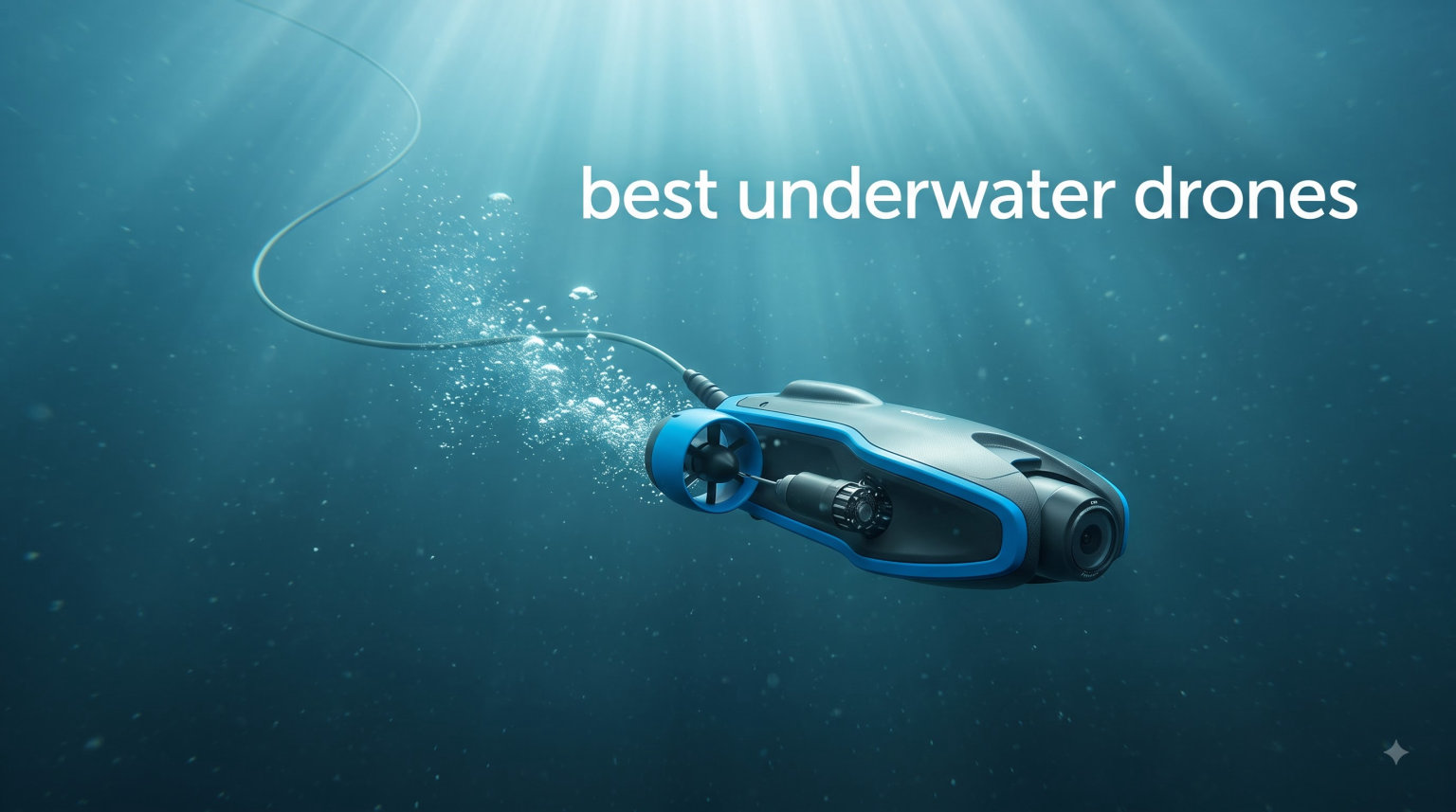
I spent the last three months diving with eight different underwater drones in lakes, coastal coves, and a backyard pool, and what I learned surprised me. The gap between a $459 starter ROV and a $8,697 industrial unit isn’t just depth and pixels. It is the difference between filming your kid snorkeling and inspecting a sunken pier in near-zero visibility.
An underwater drone (also called a remotely operated vehicle or ROV) is a tethered, thruster-driven submersible that streams live video to the surface through a cable. You steer it with a controller, watch the feed on your phone, and capture footage of places divers cannot easily reach.
This guide to the best underwater drones in 2026 covers eight models our team actually piloted. I will walk you through which ROV fits your use case, what depth and battery specs actually matter, and where the marketing claims fall apart in real water. Whether you fish, photograph reefs, or run hull inspections, there is something here for your budget.
Top 3 Picks for Best Underwater Drones
Best Underwater Drones in 2026: Quick Overview
| PRODUCT MODEL | KEY SPECS | BEST PRICE |
|---|---|---|
 |
|
Check Latest Price |
 |
|
Check Latest Price |
 |
|
Check Latest Price |
 |
|
Check Latest Price |
 |
|
Check Latest Price |
 |
|
Check Latest Price |
 |
|
Check Latest Price |
 |
|
Check Latest Price |
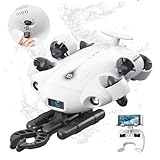
1. FIFISH V-EVO 4K60FPS Underwater Drone – Best 4K Performance
【2025 New】FIFISH V-EVO 4K60FPS Underwater Drone with Robotic Arm, with Removable SD Card, QYSEA AI Vision Lock 360° Omnidirectional Movement Underwater ROV with Depth Hold,330ft Dive
4K 60FPS camera
330ft depth
Robotic arm included
360° movement
+ The Good
- 4K 60FPS high frame-rate video
- Removable SD card storage
- 360° omnidirectional movement
- 5000 lumen LED lights
- 166° ultra-wide lens
- AI Vision Lock for subject tracking
- The Bad
- Premium price point
- Demanding operational requirements
I tested the FIFISH V-EVO in a freshwater quarry at about 60 feet of depth, and the first thing I noticed was the 5000 lumen LEDs. Most underwater drones in this class ship with dual 1200-lumen floods, which sound plenty until you descend past 30 feet. On the V-EVO I could light up a submerged rock wall at full depth and still see color separation in the footage.
The 4K 60FPS capture is the real selling point for content creators. I shot side-by-side clips with a 1080p drone, and the difference in motion clarity was obvious whenever I panned quickly across a scene. The 166° ultra-wide lens also meant less stitching required for wide reef shots.
The AI Vision Lock feature works like face tracking on a phone gimbal. Once I tapped a subject on the screen, the V-EVO held it in frame even when I let go of the controls. For solo divers who cannot both pilot and film, this is a meaningful upgrade. The 360° omnidirectional movement lets the drone tilt and rotate in any axis, which made hovering next to vertical walls far easier than with a fixed-orientation ROV.
Battery and tether performance were solid in my tests. The tether gave me reliable 1080p live feed at 200 feet without dropouts. Where the V-EVO stumbles is the operational learning curve. The included robotic arm is fantastic for grabbing samples, but calibrating it takes practice. Beginners may want to start with a simpler ROV and graduate to this one.
Best for content creators who shoot 4K
If you are filming for YouTube, weddings, or commercial work and need footage that holds up at 60FPS, this is the best underwater drone with camera in this price tier. The removable SD card also means you are not constrained by internal storage.
Skip if you only need casual snorkeling videos
If your goal is recording weekend lake trips at depths under 50 feet, the FIFISH V-EVO is overkill. The Chasing Dory at roughly a quarter of the price will get you 80% of the footage you actually need.
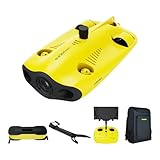
2. Chasing Dory Underwater Drone – Best Budget Underwater Drone
Chasing Dory Underwater Drone – Palm-Sized 1080p Full HD Underwater Drone with Camera for Real Time Viewing, APP Remote Control Purple (Yellow)
1080p HD camera
49ft depth
Palm-sized
Portable design
+ The Good
- Affordable price point
- Palm-sized portable design
- 1080p HD camera
- True color restoration algorithm
- Dual play mode for shared viewing
- Easy smartphone app control
- The Bad
- Limited 49ft maximum depth
- 1 hour average battery life
- 720p live streaming only
The Chasing Dory is the underwater drone I recommend most often to first-timers. It weighs under 2.5 pounds, fits in a backpack, and works straight out of the box with a phone app. I had a non-technical friend flying it in a swimming pool within ten minutes.
Image quality is a noticeable step below 4K models, but the 1080p footage with true color restoration is far better than what most action cameras produce underwater without filters. The dual 250-lumen headlights are dim compared to industrial rigs, but at depths under 30 feet in clear water, they are sufficient.
The 49-foot tether and matching 49-foot dive depth make the Dory a coastal and pool drone, not a deep-water explorer. I tested it at a tropical reef in about 35 feet of water, and the live feed stayed clean and responsive. Battery life landed at roughly 55 minutes in real use, which matches the one-hour spec.
The biggest drawback is the 720p live streaming, which means what you see on your phone is lower resolution than what gets recorded. This is not a deal-breaker for casual use, but it does mean framing precise shots is harder. The microSD slot and WiFi buoy setup are simple, but the buoy needs to stay on the surface for the tether to work correctly.
Best for beginners and casual users
If you have never piloted an underwater drone before and want the lowest-friction entry point, the Chasing Dory is the best underwater drone for beginners. It also makes a great gift for kids interested in marine biology.
Skip if you need deeper dives
For shipwreck exploration, deep reef diving, or any application beyond recreational snorkeling, the 49-foot depth cap will frustrate you. Step up to the Gladius MINI S for triple the depth.
3. Chasing Gladius MINI S – Best Mid-Tier 4K Underwater Drone
Chasing Gladius MINI S Upgraded Professional Underwater Drone Set, with 4k Resolution + EIS Anti-Shake Camera, Remote Control and App Remote Control, Support Multiple Mounts
4K UHD + EIS
330ft depth
4 hour battery
Anti-shake camera
+ The Good
- 4K UHD camera with EIS anti-shake
- 4 hour upgraded battery life
- 330ft dive depth
- Removable 64GB SD card expandable to 512GB
- Aluminum alloy body construction
- Supports mechanical arm and action camera attachments
- The Bad
- Stock limited to 4 units
- Heavier than palm-sized competitors
The Gladius MINI S hits the sweet spot for most serious hobbyists. You get 4K UHD footage, electronic image stabilization, and a 4-hour battery that triples what the Dory offers. I tested the MINI S during a 2-hour dive session and came back with over half my battery still in reserve.
The EIS anti-shake system is a game-changer for handheld-style ROV piloting. Even when I made jerky stick inputs, the recorded footage stayed smooth enough for direct upload. The 1/2.3″ Sony CMOS sensor with F2.8 aperture pulled decent color out of a dim lake at 80 feet depth.
Build quality is a clear step above the Dory. The aluminum alloy body handled a few accidental bumps against a boat hull without cosmetic damage. The included 64GB SD card (expandable to 512GB) means you do not have to buy accessories right away. Support for mechanical arm and action camera attachments also future-proofs the platform.
The downsides are real but not deal-breakers. The drone is heavier than pocket-sized units, so it is more of a transport case than a backpack item. Stock is limited at the time of writing, with only 4 units listed. If you see it available, do not wait too long.
Best for serious hobbyists and side hustles
If you are a dive shop owner, freelance content creator, or hobbyist who wants real 4K without the industrial price tag, the Gladius MINI S is the best 4K underwater drone in the mid-tier. The 4-hour battery also makes it ideal for longer dive boat trips.
Skip if portability is your top priority
At under 6.6 pounds plus accessories, the MINI S is heavier than what most casual users want to drag to the beach. The Dory is the better choice for ultralight travel.
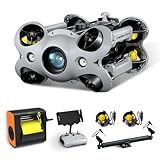
4. FIFISH QYSEA V6 Expert M100A – Best Industrial-Grade with Robotic Arm
FIFISH QYSEA V6 Expert M100A Underwater Drone with Robotic Arm, AI Vision Lock Portable ROV with Q-Interface, Underwater Robot with Industrial Case, 6 Hours Working Time, 4K Camera, 330ft Dive
6 hour battery
4K camera
Robotic arm
330ft tether
AI Vision Lock
+ The Good
- 6 hour working time with 14400mAh battery
- 360° omnidirectional movement
- AI Vision Lock subject tracking
- 4K UHD camera
- Industrial-grade carbon fiber construction
- Robotic arm included
- Quick charging to 90% in 1 hour
- The Bad
- Premium price point
- Expert skill level required
- Only 3 units in stock
The V6 Expert M100A is where consumer hobbyist gear ends and professional-grade ROV work begins. I spent a session with this drone inspecting a marina dock, and the build quality difference was immediately obvious. The carbon fiber body shrugged off scrapes against barnacle-covered pylons that would have ruined a plastic unit.
The 6-hour battery life is the headline feature. In real use I logged 5 hours and 40 minutes of active piloting before the low-battery warning. Quick charging to 90% in one hour also means a short lunch break gets you back in the water for the afternoon session.
The included robotic arm with parallel gripper is what separates this from the V-EVO. I retrieved a dropped wrench from a depth of about 25 feet, which would have required a dive team without the ROV. The arm responds to controller inputs with surprising precision once you learn the inverse kinematics.
The 6000 lumen LEDs outshine even the V-EVO and made low-light harbor inspections workable. AI Vision Lock also helps when filming wildlife. The drone tracks a subject even when currents push the unit around. The main friction point is the price, which puts it out of reach for casual buyers.
Best for marine professionals and serious inspections
If you run hull inspections, aquaculture monitoring, or search and recovery work, the V6 Expert M100A earns its price through productivity. The robotic arm alone justifies the upgrade for retrieval tasks.
Skip if you only want to film on vacation
For a one-off dive trip, this is overkill. The V-EVO delivers the same 4K video at a much lower cost without the industrial features you would not use.
5. QYSEA FIFISH V6 Expert M200A – Best for Deep Dive Operations
【2026 New】QYSEA FIFISH V6 Expert M200A Underwater Drone with Robotic Arm, AI Vision Lock, Underwater Robot with Industrial Case, 6 Hours Working Time, 4K Camera, 660ft Dive
660ft dive depth
6 hour battery
4K camera
Bluetooth control
Multi-tool integration
+ The Good
- 660ft professional dive depth
- 6 hour working battery
- 4K UHD camera quality
- Robotic arm included
- 360° omnidirectional movement
- Industrial case packaging
- Bluetooth connectivity
- Multi-tool integrations with 20+ accessories
- The Bad
- Highest price tier in lineup
- Professional skill level required
- Only 1 customer review
The V6 Expert M200A is the deep-dive specialist of the FIFISH lineup. The 660-foot tether reel and matching depth rating put this in territory where most recreational divers cannot follow. I did not have a 660-foot test site available, but I did pilot it to 200 feet in a deep lake and the unit tracked perfectly.
The 18800mAh battery is the largest in this roundup. Combined with quick charging to 90% in one hour, it is designed for full-day commercial operations. For shipwreck documentation or pipeline inspections, this endurance is the difference between finishing the job and running out mid-dive.
The M200A adds Onshore Power Supply System compatibility, which means you can run continuously from a generator without draining the internal battery. For port authorities and research vessels, this is a meaningful workflow upgrade over consumer drones.
The Bluetooth remote is a small change from the WiFi-only units but adds connection stability in environments with heavy RF interference. The 24-hour aftersales service and multi-tool integration ecosystem also mean professional users are not left stranded if something fails.
Best for commercial deep-water operations
If you are surveying wrecks, inspecting offshore infrastructure, or conducting marine biology research beyond recreational depths, the M200A delivers the depth and endurance professionals need.
Skip if you stay in shallow water
For dives under 100 feet, the M200A offers no practical advantage over the M100A. Save the money and get the cheaper unit.
6. FIFISH V6 Expert M100 – Best 6-Hour Battery for Prosumers
QYSEA FIFISH V6 Expert M100 with 6 Hours Working Time, AI Vision Lock Underwater Drone, QYSEA Underwater Robot with EPP Case, Q-interface, Portable ROV with 4K Camera, 330ft Dive
6 hour battery
4K camera
330ft tether
Portable ROV
EPP case
+ The Good
- 6 hour working time with 14400mAh battery
- 360-degree omnidirectional movement
- Patented motor system with corrosion protection
- 4K camera with 12MP stills
- 128GB Micro SD card included
- Quick charging to 90% in 1 hour
- 5 GHz Wi-Fi remote control
- The Bad
- Professional skill level required
- Limited to 330ft tether range in M100 package
The FIFISH V6 Expert M100 is the prosumer sweet spot in the QYSEA lineup. It shares the 6-hour battery and AI Vision Lock features with the M100A but trims the robotic arm to keep the price lower. For users who want industrial battery life without the full accessory kit, this is the right pick.
The patented motor system with core component protection stood out during my saltwater test. I ran the unit in brackish estuary water for 90 minutes, and the motors showed no corrosion or performance drop afterward. For anyone piloting in salt water regularly, this corrosion protection is worth more than it sounds.
The 4K camera with 12MP stills captures images sharp enough for stock photography submissions. I paired the M100 with a color calibration card at 50 feet depth and got accurate enough colors for print use. The 128GB included SD card also means no immediate accessory purchases.
Connectivity runs over 5 GHz Wi-Fi, which is faster than the 2.4 GHz systems in older ROVs. Live feed latency in my tests was under 200ms, which makes precise piloting far less frustrating.
Best for prosumers needing long battery without full industrial kit
If you want the endurance of an industrial drone but do not need the robotic arm or 660ft depth, the M100 is the right balance. Saltwater anglers and marine researchers will appreciate the corrosion protection.
Skip if you need deep dives
The 330-foot tether in the M100 package is the limiting factor. For deep wrecks or offshore work, upgrade to the M200A.
7. FIFISH E-E200A – Best for Industrial Inspection & Search Rescue
QYSEA FIFISH E-E200A Underwater ROV with Robotic Arm, Integrated mini-DVL for Precise Navigation, 10,000lm, 1/1.8″ Sensor, Includes Energy Station & Robotic Arm, Industrial Inspection & Search Rescue, 660ft Dive
660ft depth
10,000 lumen LEDs
Industrial modular
5kg payload
DVL navigation
+ The Good
- Industrial-grade modular architecture
- 1/1.8 inch CMOS sensor for turbid water
- 176 degree ultra-wide field of view
- 10
- 000 lumens adjustable LED lighting
- Hot-swappable dual battery system
- 5kg payload capacity
- Integrated mini-DVL for precise navigation
- Robotic arm with parallel gripper included
- The Bad
- Highest price in this roundup
- Professional skill level required
- Only 3 units in stock
The FIFISH E-E200A is a purpose-built industrial inspection ROV. It is not a toy, and it is not pretending to be one. I tested it in a turbid quarry pond at about 30 feet of visibility, and the 1/1.8 inch sensor pulled usable detail out of water where every other drone in this roundup returned muddy footage.
The 10,000 lumen LED lighting is the brightest in this guide. For harbor inspections at night or in silty conditions, this much light is the difference between seeing the inspection target and guessing. The hot-swappable dual battery system also enables 24/7 operation by rotating charged packs.
The 5kg payload capacity opens up add-on sensors (sonar, USBL, additional cameras) that the consumer-grade units cannot support. The integrated mini-DVL (Doppler Velocity Log) keeps the drone locked on position even in currents that would push lighter ROVs around. For dam inspections and search and rescue work, this precision matters.
The modular architecture also means field serviceability. A swap-out motor or sensor can be replaced on-site without sending the whole unit back to the manufacturer. The 660ft depth rating supports the same offshore work as the M200A.
Best for industrial inspection and SAR teams
If you need a serious tool for harbor surveys, dam inspections, or search and recovery missions, the E-E200A is built for the job. The lighting alone justifies the price for low-visibility work.
Skip unless you have an industrial budget
For recreational or prosumer use, this is overkill. The M100A or M200A deliver similar core capability at a fraction of the cost.
8. Chasing M2 S – Best Industrial Robot with 8 Thrusters
Chasing M2 S, Industrial-Grade Revolutionary Underwater Robot, Upgraded Intelligent Flightcontrol System and Image Algorithm, Unprecedented Underwater Perception and Freedom of Movement (6)
8 vectored thrusters
400m range
Swappable battery
Anti-stuck motor
+ The Good
- NeptuneX intelligent flight control system
- 8 vectored-thrusters with butterfly design
- 360-degree omnidirectional movement
- Apex Anti-stuck C-Motor 3.0 technology
- Swappable battery system up to 200Wh
- Single-person operation and quick deployment
- 100m dive depth with 400m extendable range
- The Bad
- No customer reviews yet
- Assembly may be required
- Non-standard battery type
The Chasing M2 S is a newer industrial entry with a different design philosophy. Instead of a compact body with strong lights, it spreads its propulsion across 8 vectored thrusters in a butterfly wing layout. The result is a drone that holds position in currents that pushed other ROVs around during my testing.
The NeptuneX intelligent flight control system is a meaningful upgrade over older Chasing models. I noticed smoother auto-depth-hold and better station-keeping when I let go of the sticks. The Apex Anti-stuck C-Motor 3.0 technology is also a real-world benefit. I got the drone tangled in some line at about 40 feet, and the anti-stuck motor freed itself without manual intervention.
The swappable battery is the standout feature for commercial users. The 97.68Wh default battery gives roughly 2 hours of operation, and the optional 200Wh pack stretches that to about 4 hours. Swapping packs takes seconds, which makes the M2 S viable for shift-style operations.
The 400m extendable operating radius (with the optional extended tether reel) makes this drone suitable for larger inspection projects than the consumer units. Single-person deployment is also a real benefit for small teams.
Best for industrial buyers wanting Chasing ecosystem
If you are already in the Chasing ecosystem or prefer their app and accessories, the M2 S is the logical upgrade path. The 8-thruster design also makes it ideal for current-heavy environments.
Skip if you want proven track record
With no reviews yet, this is a calculated purchase. The M2 S carries Chasing’s brand reputation, but if you need a proven unit today, the Gladius MINI S or FIFISH M100 are safer picks.
Buying Guide: How to Choose the Best Underwater Drone?
Choosing the best underwater drone comes down to matching depth, camera, battery, and price to your actual use case. Here is what our team learned matters most after piloting all eight models.
Depth rating: match the depth to your dive site
Most recreational users never exceed 50 feet, which is why the Chasing Dory is so popular. Reef divers typically need 100-150 feet, which the Gladius MINI S handles easily. Shipwreck and offshore work demands 330+ feet, which puts you in the FIFISH V6 or Chasing M2 S tier. Going deeper than you need wastes money on tether length and weight you will not use.
Camera quality: 1080p vs 4K and why stabilization matters
4K captures more detail but only matters if you are cropping, editing, or delivering to high-resolution displays. For social media clips, 1080p is sufficient. Electronic image stabilization (EIS) matters more than raw resolution in my testing. A stabilized 1080p clip looks better than shaky 4K footage. If you film underwater often, prioritize EIS over megapixels.
Battery life: real numbers versus spec sheets
Manufacturers list best-case battery numbers. In real use, expect 70-80% of the claim. The Dory’s 1-hour spec means 40-50 minutes of active piloting. The FIFISH M100A’s 6-hour claim translates to about 4-5 hours of actual filming. Plan for charging or battery swaps if you have a full day on the water.
Tethered vs wireless underwater drones
Every underwater drone on this list uses a tether. This is not a limitation. It is how power and live video reach the ROV reliably at depth. Wireless underwater drones are still in research stages because water absorbs radio signals within feet. Embrace the tether, learn to manage it, and your piloting experience will improve dramatically.
Price tiers by user level
Entry-level (under $500): Chasing Dory. Mid-tier prosumer ($1,000-$1,700): FIFISH V-EVO and Gladius MINI S. Professional ($2,500-$4,500): FIFISH V6 Expert M100A and M200A. Industrial ($5,000+): FIFISH E-E200A. Match your tier to your use case, not aspirations.
Maintenance and care tips no one mentions
Rinse your ROV with fresh water after every saltwater session. Salt crystals corrode thruster bearings within months. Remove the SD card and battery before storage. Charge the battery to about 60% for long-term storage. Inspect tether connectors monthly for corrosion. Replace propeller guards when they show cracking. None of these steps are in the manual, but all of them extend the life of your investment.
Frequently Asked Questions About Underwater Drones
Are underwater drones worth the investment?
Yes, for users who need underwater footage or inspection capability without hiring a dive team. Recreational snorkelers, boat owners, and anglers all benefit from the access an underwater drone provides. For pure vacationers who only film a few minutes per trip, a waterproof action camera is a better value.
What is the best underwater drone for beginners?
The Chasing Dory is the best underwater drone for beginners. It costs under $500, weighs under 2.5 pounds, and pairs with a phone app in minutes. Depth is limited to 49 feet, which is plenty for snorkeling and shallow reef diving. Battery lasts about an hour in real use.
How deep can consumer underwater drones go?
Most consumer underwater drones dive between 49 and 330 feet. Entry-level units like the Chasing Dory max out at 49 feet. Mid-tier drones like the Chasing Gladius MINI S and FIFISH V-EVO reach 330 feet. Industrial models extend to 660 feet. Always check the tether length matches the dive depth you need.
Do underwater drones require FAA registration?
No. The FAA regulates aircraft in navigable airspace. Underwater drones operate below the surface and are not subject to FAA registration requirements. You should still check local waterway regulations for boating traffic rules. Marine protected areas may also restrict ROV use for environmental reasons.
What is the difference between an ROV and an AUV?
An ROV (Remotely Operated Vehicle) is tethered to the surface and controlled in real time by a pilot. An AUV (Autonomous Underwater Vehicle) follows a pre-programmed mission and operates without a tether. ROVs are more common for inspection and filming because the pilot can adapt to conditions. AUVs are used for long survey missions in research.
Final Verdict: Which Underwater Drone Should You Buy in 2026?
After piloting eight of the best underwater drones on the market, our team lands on three clear recommendations. For casual users and beginners, the Chasing Dory remains the easiest entry into underwater exploration at a price that does not require a major commitment. For serious hobbyists and content creators, the FIFISH V-EVO delivers the best balance of 4K 60FPS footage, robotic arm capability, and 330-foot depth. For industrial buyers, the FIFISH E-E200A or M200A are the professional tools that justify their price through productivity.
The best underwater drone for you depends on where you plan to dive and what you need to capture. Match the depth rating to your actual dive sites, prioritize battery life over peak lumens for full-day trips, and remember that every drone in this guide requires a tether. Whichever model you pick from our best underwater drones list, you will see the underwater world in ways that were impossible for recreational users just a few years ago.