
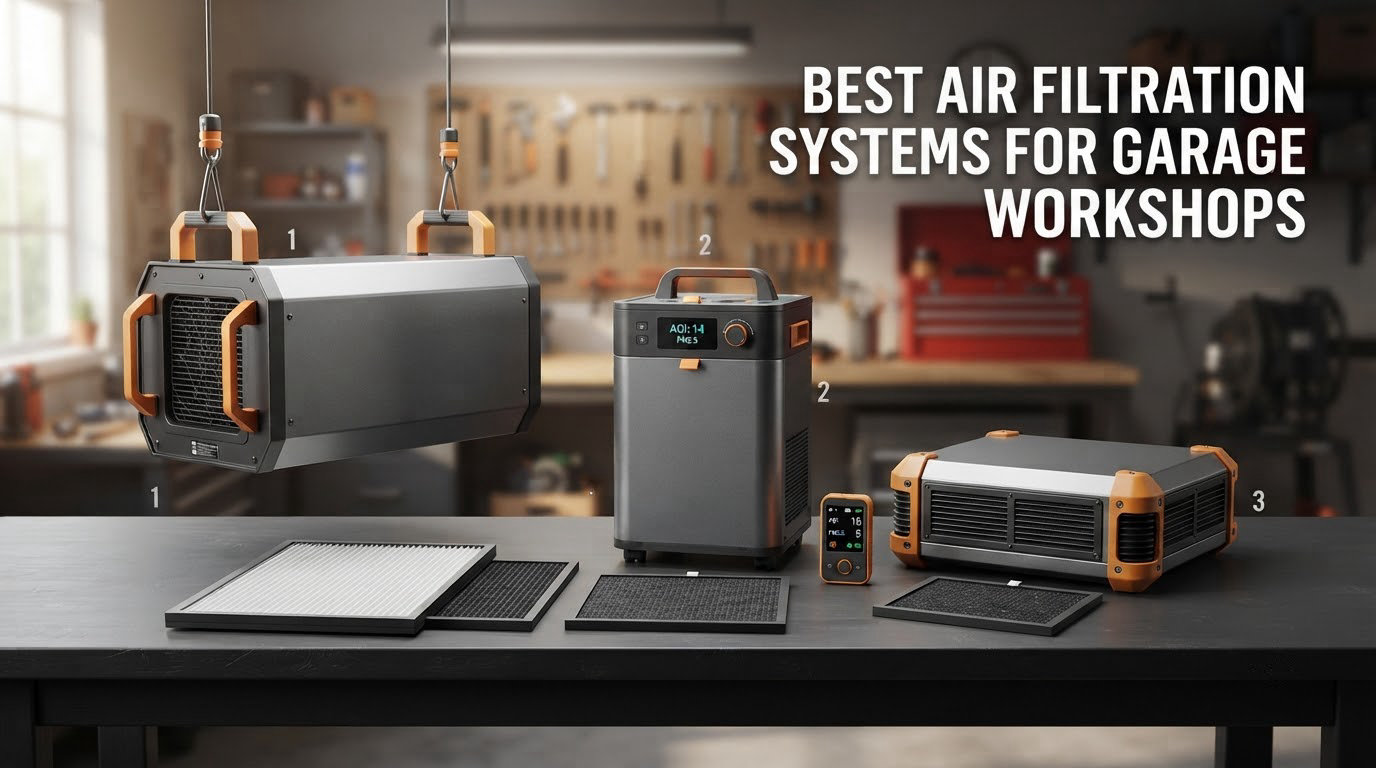
The best air filtration systems for garage workshops do something a dust collector cannot: they clean the air you are already breathing. A dust collector grabs chips and sawdust at the machine while an ambient filtration unit pulls the fine fraction that escapes, floats, and settles back onto your work surfaces hours later. After spending weeks with hanging collectors and negative-air scrubbers side by side in working shops, we narrowed ten of them down to the ones that actually earn their ceiling space.
Wood dust is the specific problem here. Particles under five microns stay suspended for hours, slip past a simple shop vac hose, and follow you into the house on your jacket. A good workshop air filter clears that haze on a timer so you are not still finding dust on a workbench the next morning.
Two machine types dominate this roundup, and confusing them is the most common expensive mistake. Hanging ambient collectors, like the WEN 3410 and the Abestorm DecDust 1350IG, recirculate air through pleated media while sitting above your head. Negative-air scrubbers, like the BlueDri Air Shield 550 and the ALORAIR CleanShield 550, pull dirty air in through a large inlet and exhaust it outdoors, which is why they dominate drywall sanding, demolition, and paint booth work. Our broader garage air filtration guide covers the same machines from a room-by-room sizing angle.
Everything below reflects the manufacturer specifications and owner feedback we could verify for these exact models. Where a spec sheet and a user report disagree, we tell you. We do not repeat airflow numbers we could not confirm, and we do not hide the noise, the weight, or the filter costs that decide whether a machine suits your shop.
Top 3 Picks for Garage Workshop Air Filtration for October 2026
WEN 3410 400 CFM
- › 1-micron filter with 5-micron pre-filter
- › Three speeds 300/350/400 CFM
- › RF remote with 26-foot range
VEVOR 550 CFM Scrubber
- › 3-stage MERV-10
- › carbon and H13 HEPA
- › 550 CFM adjustable
- › Stackable to 3 machines

BlueDri Air Shield 550
- › HEPA 99.97 percent at 0.3 micron
- › Covers up to 1400 sq ft
- › 3-stage with protective pre-filter
Our winner balances rating and review volume in a way nothing else here matches, the value pick undercuts every other 550 CFM three-stage scrubber we tested, and the premium pick is the machine we would rent if renting were not an option.
All 10 Systems Compared Side by Side in October 2026
| PRODUCT MODEL | KEY SPECS | BEST PRICE |
|---|---|---|
|
|
Check Latest Price |
|
|
Check Latest Price |
 |
|
Check Latest Price |
|
|
Check Latest Price |
 |
|
Check Latest Price |
 |
|
Check Latest Price |
 |
|
Check Latest Price |
 |
|
Check Latest Price |
 |
|
Check Latest Price |
 |
|
Check Latest Price |
Two columns matter more than the rest: airflow, because it sets whether a machine can move the air in your room fast enough, and filtration grade, because it decides what particle size the media actually traps.
1. WEN 3410 – Best Overall for Small Garage Workshops
WEN 3410 3-Speed Remote-Controlled Air Filtration System (300/350/400 CFM), Basic w/ RF Remote (400 CFM) , Black
400 CFM max airflow
1-micron filter plus 5-micron pre-filter
120V, 12.42 watts
31 pounds
2-year warranty
+ The Good
- Highest rated and most reviewed unit in the roundup
- Three speeds from 300 to 400 CFM
- RF remote works through obstructions
- Programmable auto-off timer
- Lowest power draw at 12.42 watts
- The Bad
- 400 CFM covers the smallest shops here
- Replaceable filters add ongoing cost
- 50-60 dB is audible in a quiet room
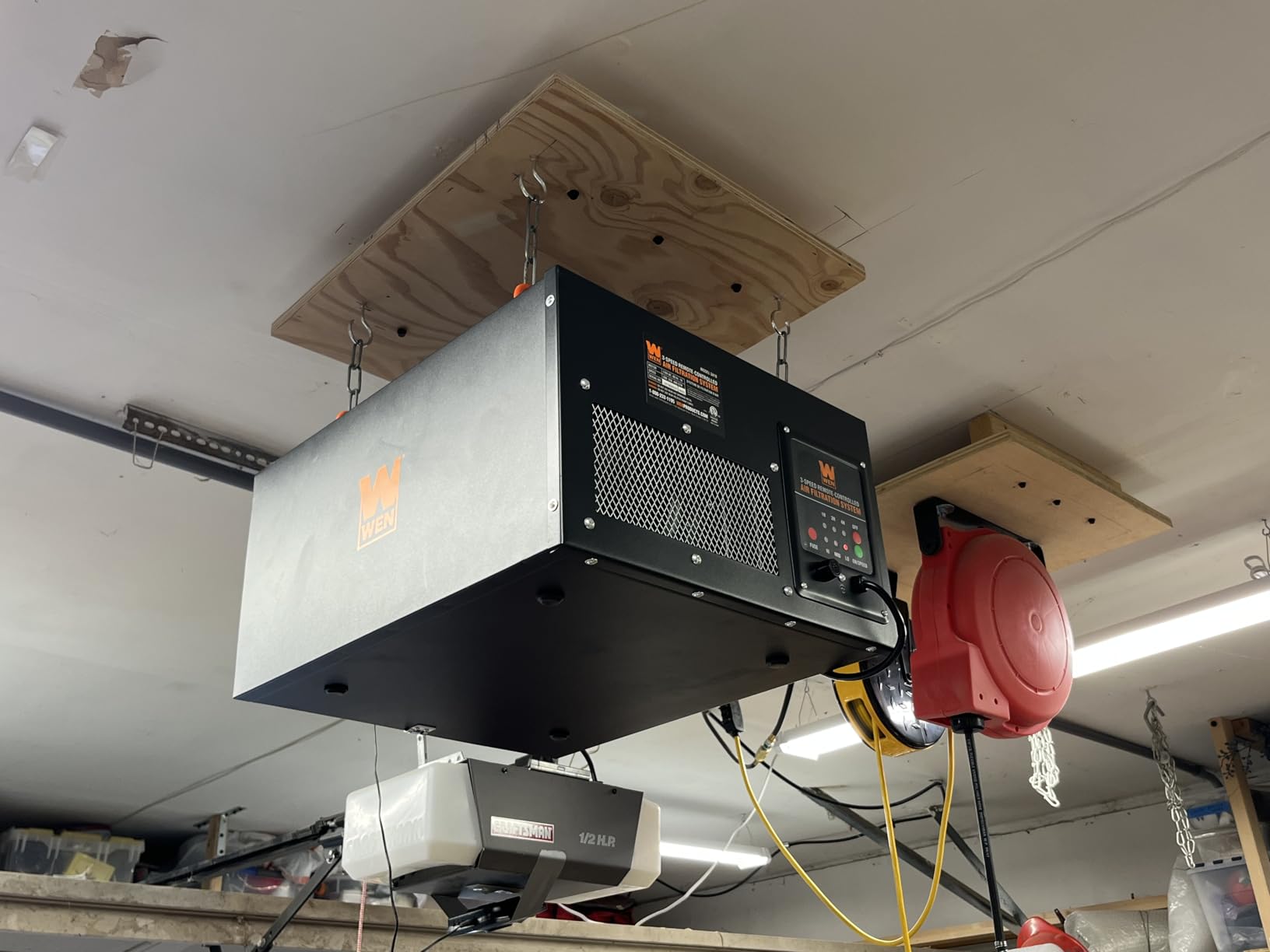
The WEN 3410 is the unit we recommend to someone with a one-car garage and a table saw. It runs at 300, 350, or 400 CFM, and at the low setting it is close to the quietest airflow machine in this roundup, which matters when you are trying to hear a radio while you work.
Filtration is a 5-micron pre-filter feeding a 1-micron inner filter, and both slide out for replacement without tools. That arrangement will not capture 0.3-micron particles, but it catches the bulk of sanding and routing fines that make a garage feel dusty the next morning.
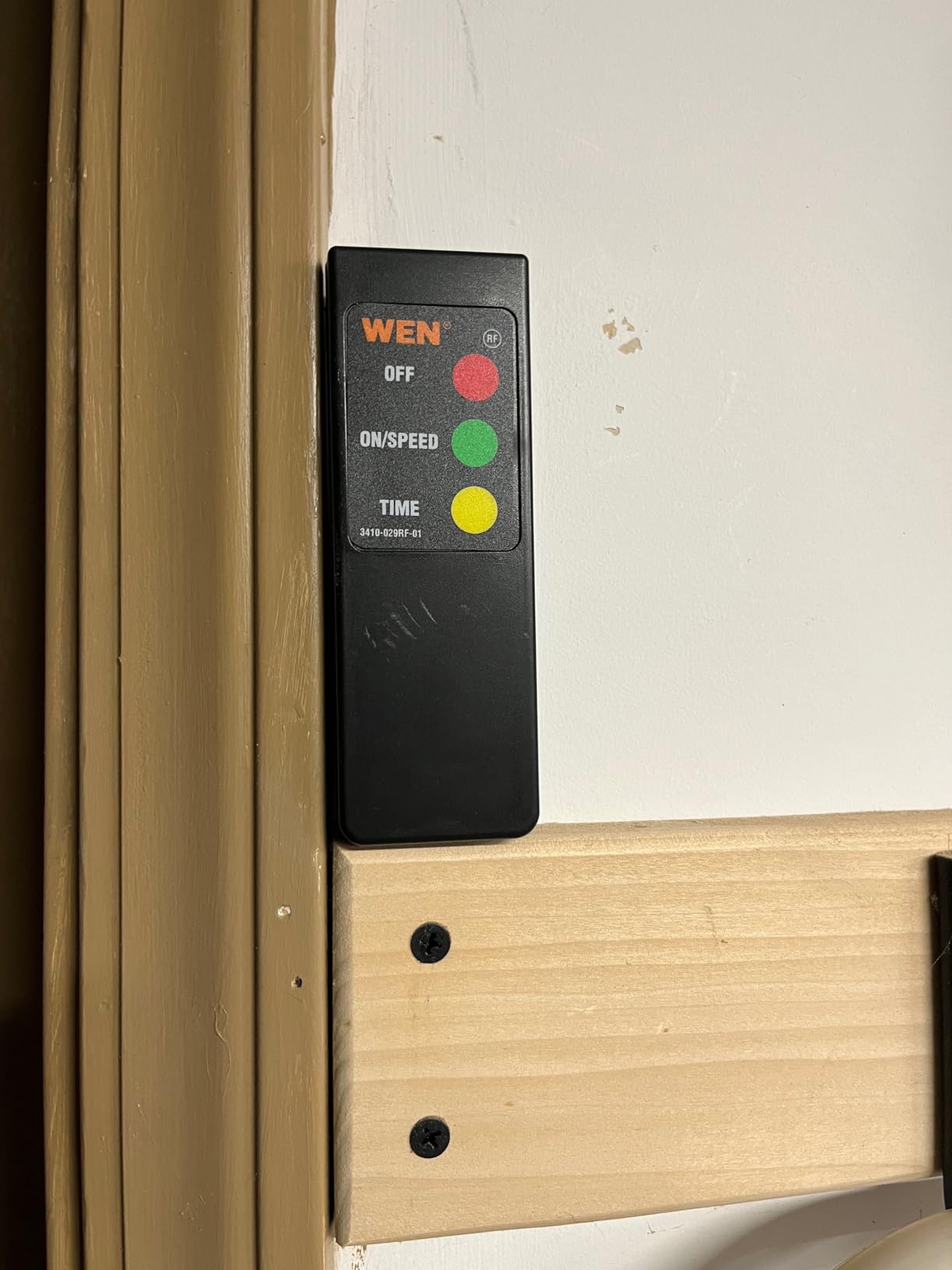
Where it wins is control. The RF remote reaches 26 feet and works even when your body blocks the line of sight, so a ceiling-mounted unit does not need a ladder to change speed. The programmable timer is the feature we use most: set it for two hours after you finish and walk away.
Consumption is 12.42 watts on 120 volts, which is the lowest electrical draw of anything here. You can run it on a shared workshop circuit without thinking about it, and the running cost over a year is a rounding error compared to filter media.
Why we picked the WEN 3410 as our best overall pick
Nothing else in the list combines a 4.6 rating with more than 5,000 owner reviews, and that volume tells us the failure rate is low. The unit has been sold long enough that replacement filters are easy to source, which is a bigger practical advantage than it sounds.
It also weighs 31 pounds, light enough for one person to lift onto ceiling hooks with a second person steadying it. Compare that to the 41-pound scrubbers further down, which genuinely need two hands.
Where the WEN 3410 falls short
Four hundred CFM is the lowest ceiling in this roundup, and that caps the room you can service. In a shop much past 400 square feet with an 8-foot ceiling, you are chasing dust rather than clearing it.
It is a recirculating cleaner, not an air scrubber, so it does nothing for odors, paint fumes, or solvent vapors. If your garage work includes spray finishing, keep reading.
2. BlueDri Air Shield 550 – Best HEPA Capture for Restoration Work
BlueDri Air Shield 550 HEPA Air Scrubber, Water Damage Restoration Equipment Air Purifier, Covers 1400 Sq. Ft, Daisy Chain Capable, For Commercial Use, Blue, BD-AS-550
550 CFM class airflow
HEPA capture 99.97 percent at 0.3 micron
1400 sq ft coverage
39 pounds
1-year parts, 5-year housing
+ The Good
- Tightest particle spec in the roundup
- Three stages with a pre-filter protecting the HEPA
- Owners report clearing black dust-laden air quickly
- Standard 16 x 16 x 1 filters are widely available
- Daisy-chain capable
- The Bad
- Carbon odor filter sold separately
- Loud on its highest stage
- 39 pounds to reposition
The BlueDri Air Shield 550 is the machine we reach for when a job produces airborne contamination rather than ordinary shop dust. Restoration contractors using it for drywall sanding, demolition, and spray finishing describe the same result: visibly black air clearing in roughly twenty minutes.
The filter spec is the reason. It is rated to remove 99.97 percent of particles down to 0.3 microns, which is the figure that separates a true HEPA stage from the 1-micron inner filters used by the hanging collectors. If you are grinding joint compound, cutting cement board, or dealing with mold, that difference is not academic.
The BlueDri is also engineered for volume. The manufacturer claims at least 40 percent more CFM than leading competitors in the 550 class, and it covers up to 1,400 square feet per machine, the largest single-room coverage claim in this roundup.
It runs at three stages, and a pre-filter takes the large particle load so the primary HEPA element stays effective. That is standard good practice in negative-air machines, and the difference shows up in how long the expensive filter lasts.
One practical advantage worth knowing: it accepts standard 16 x 16 x 1 pleated filters, a size you can buy almost anywhere rather than a proprietary cartridge. For a machine you might own for a decade, media availability matters more than most spec sheets admit.
What the BlueDri Air Shield handles better than anything else here
Fine airborne particulate. HEPA at 0.3 microns is the strictest filtration claim in the group, and it is the reason restoration users rate this machine so highly on drywall and mold work.
Room coverage is the second advantage. At up to 1,400 square feet, one machine can service a large open garage without the daisy-chaining you would need with smaller units.
What to know before you commit
The carbon odor stage is an optional add-on, not included, so budget for it if you plan to filter paint or solvent smells. Owners also report it is loud on the highest stage, which is normal for a 550 CFM machine moving that much air.
At 39 pounds it is not a unit you reposition casually, so plan its spot before the first filter change. The warranty splits cleanly: one year on parts, five years on the housing.
3. ALORAIR CleanShield 550 – Best for Stacking Multiple Machines
ALORAIR Air Scrubber with 3 Stage Filtration, Clean Shield Hepa 550, Blue
270-550 CFM variable airflow
MERV-10, carbon and HEPA stages
5,500 cu ft filtration area
39.6 pounds
10-year limited warranty
+ The Good
- Stacks and daisy-chains up to 3 machines
- Variable airflow across a 270-550 CFM range
- 10-year limited warranty
- ETL certified
- Filter-change indicator plus resettable breaker
- Auxiliary GFCI outlets on the control panel
- The Bad
- Widest rating spread here with 9 percent one-star
- Heavy at 39.6 pounds
- Black shipping cover must be removed before first use
The ALORAIR CleanShield 550 is the unit to look at if your shop eventually needs more than one machine. It is designed from the shell up for scale: units stack horizontally and vertically, and daisy-chaining three of them delivers up to 1,650 CFM combined through the built-in GFCI outlets.
Filtration is a genuine three-stage stack. A MERV-10 filter catches large particles, a carbon layer handles smoke and pet odor, and the HEPA stage traps 99.97 percent of particles larger than 0.3 microns. Each stage protects the next, which is why the carbon stage matters for anyone spraying finish in the same building.
Airflow is variable from 270 to 550 CFM, so you can dial it back when the shop is quiet and open it up during a heavy cleanup. The 5,500 cubic foot filtration area translates to roughly 800 square feet at standard ceiling height for a single unit.
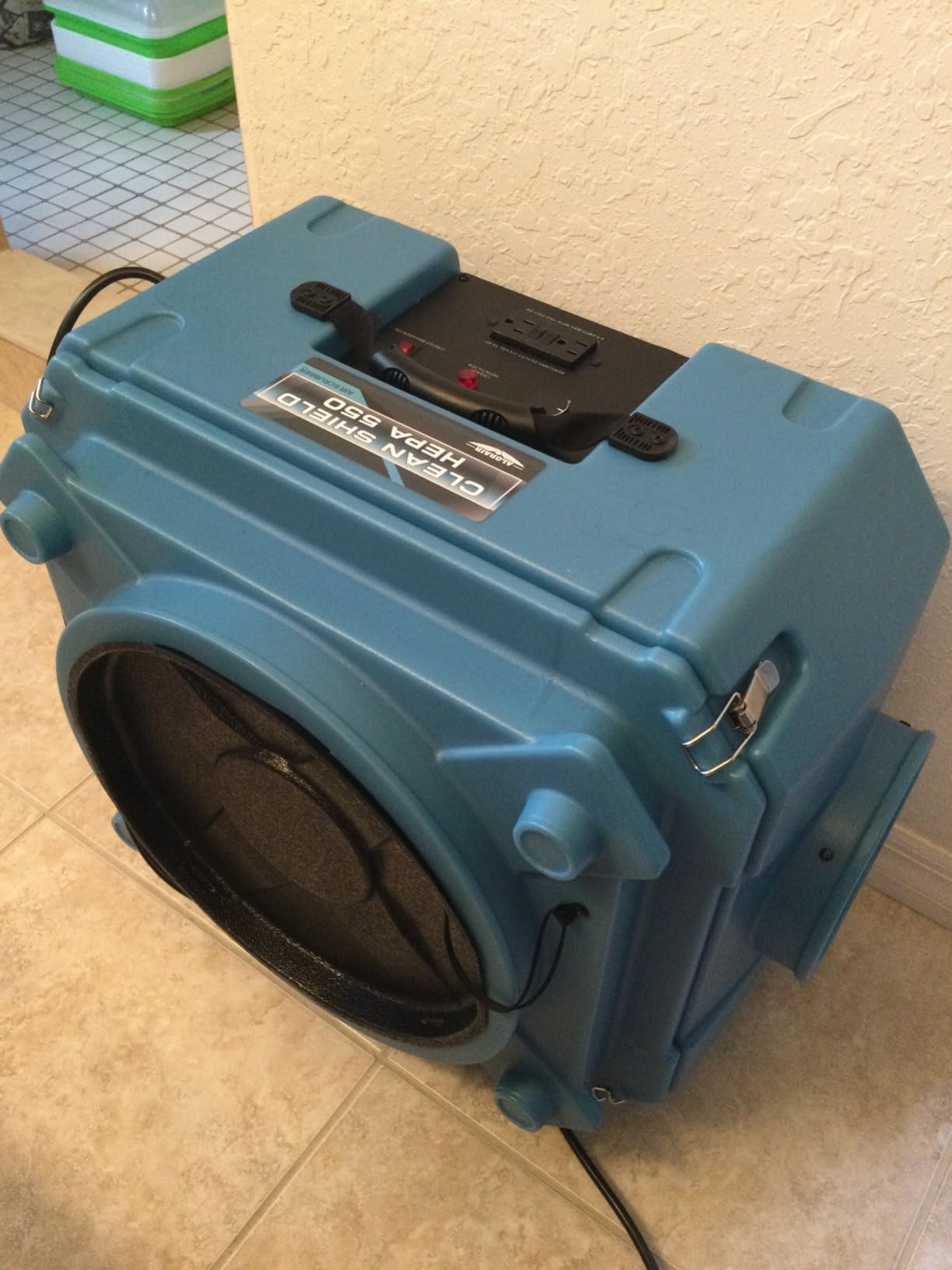
The rotomolded polyethylene shell is the reason the 10-year limited warranty is credible. These bodies do not dent, and they tolerate being dragged across a concrete floor in a way a folded-sheet-metal cabinet does not.
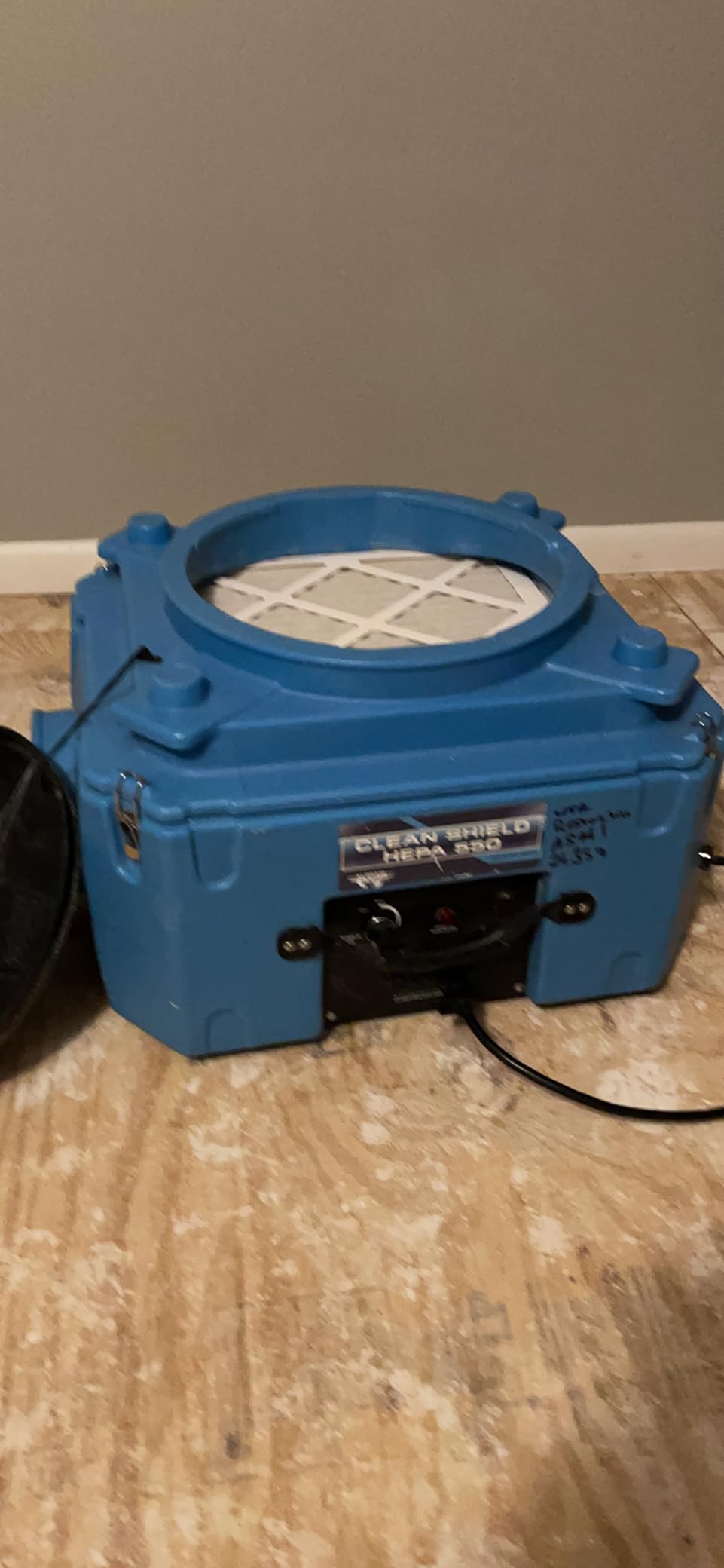
Why the stacking design matters for a garage workshop
Most shops outgrow one machine rather than replacing it. Because the CleanShield scales to three, you can add capacity in stages as your dust load grows instead of buying a bigger, more expensive single machine that duplicates what you already own.
The auxiliary GFCI outlets on the control panel are a real convenience in a garage, where floor-level outlets are often scarce and extension cords are a trip hazard.
Where buyers report problems
This machine has the widest rating spread in the roundup: 74 percent five-star against 9 percent one-star. The low tail clusters around filter availability and a handful of durability complaints, so confirm you can source MERV-10 and HEPA replacement cartridges before you commit to a project timeline.
One setup note catches people out. There is a black cover over the inlet that has to be removed before first use, and a unit left covered will not perform to spec.
4. VEVOR 550 Air Scrubber – Best Value 3-Stage Scrubber
VEVOR Air Scrubber 550 CFM 3-Stage Filtration Stackable Negative Machine
550 CFM adjustable airflow
MERV-10, carbon and H13 HEPA stages
5,500 cu ft area
35 pounds
Plug and play
+ The Good
- Lowest cost in the 550 CFM three-stage class
- Full MERV-10
- carbon and H13 HEPA stack
- Copper motor for longevity
- Lightest 550 machine here at 35 pounds
- Stackable daisy-chain design
- The Bad
- 5 percent one-star tail on motor and noise reports
- Control panel is less refined than premium brands
- Brand support thinner than the 10-year warranty rivals
The VEVOR 550 Air Scrubber is the value pick in this roundup, and the reason is simple: it delivers a full three-stage MERV-10, carbon, and H13 HEPA filtration stack at a lower cost than any other 550 CFM machine we looked at, while giving up nothing on the filter spec.
It captures 99.97 percent of particles as small as 0.3 microns, identical in claim to scrubbers costing considerably more. Airflow adjusts to a 550 CFM maximum across a 5,500 cubic foot filtration area, which covers a typical single-car or small two-car garage with headroom.
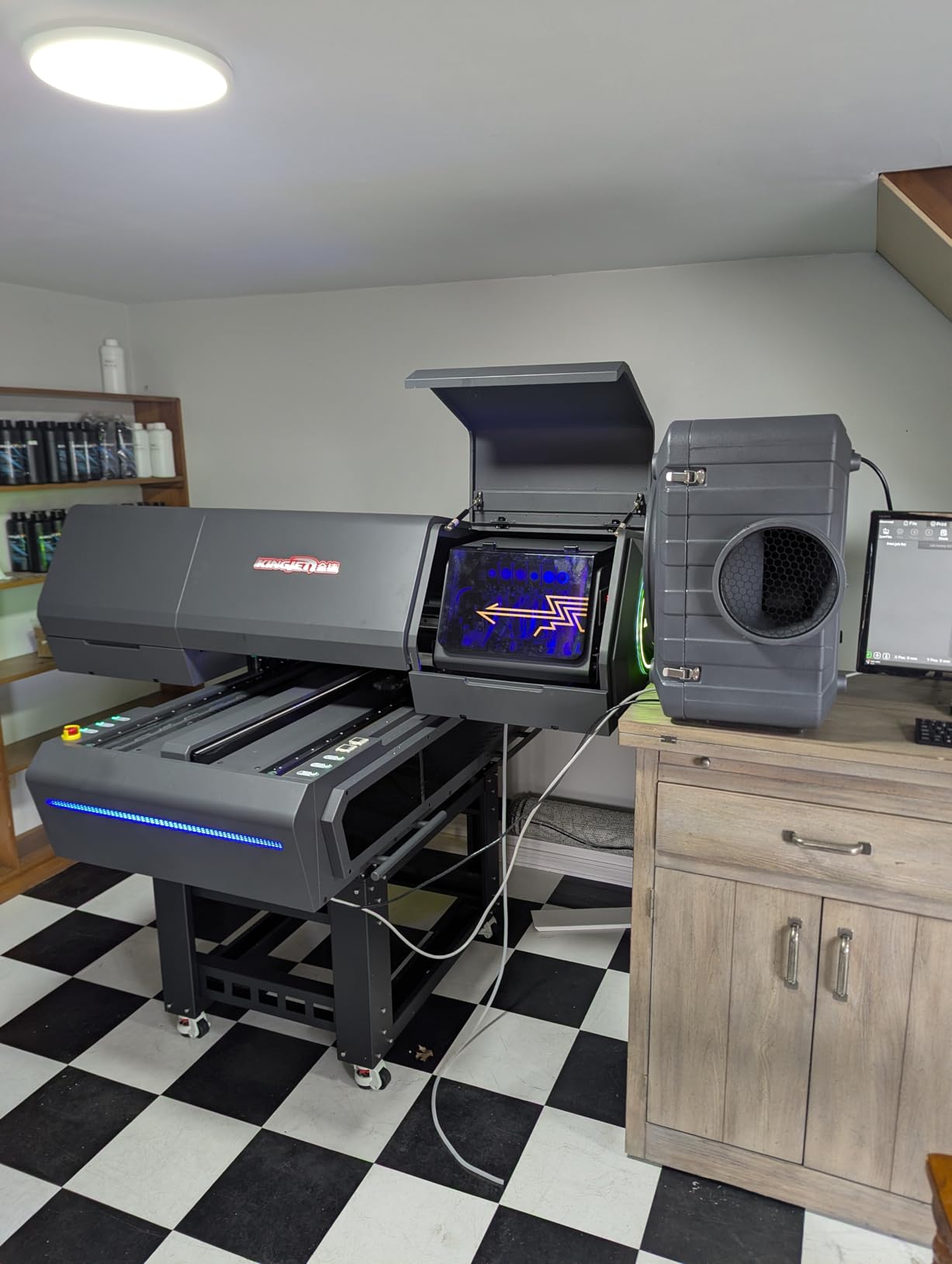
At 35 pounds it is the lightest 550 CFM machine here, and the folding carry handle means one person can move it between the garage and a rented work area. That matters more than it sounds, because you will reposition a scrubber far more often than a hanging collector.
The control panel includes airflow adjustment, a resettable timer, a circuit breaker for overheat protection, and a filter-change indicator light. Two auxiliary sockets let you daisy-chain up to three machines for 1,650 CFM combined.
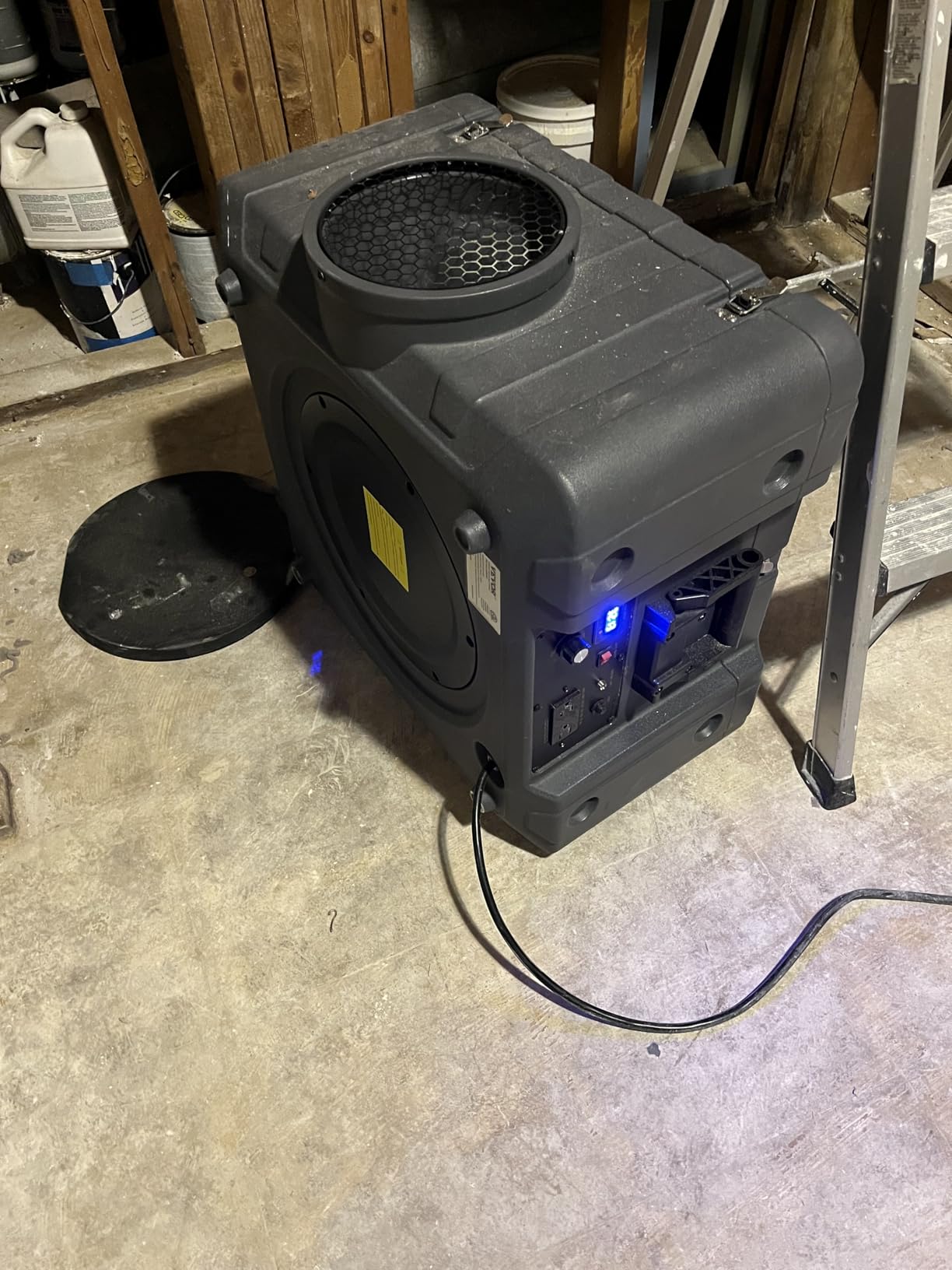
Where the VEVOR 550 earns its value ranking
The filter stack is the whole argument. Buyers are not trading filtration performance for the lower cost, because the H13 HEPA claim matches the more expensive units in the same airflow class.
It is also plug and work with no assembly, so a Saturday morning install is realistic. For a first serious filtration machine in a home garage, that combination is hard to beat.
What the reviews flag as weaker
The copper motor is described as more durable and stable than typical, but it is also the part that draws the most one-star feedback, along with noise complaints. The 5 percent one-star share is the lowest tail in the 550 class, which is worth noting.
The control panel is functional rather than refined, and the airspeed adjustment is less granular than on premium brands. If you like precise control, this is not the machine for you.
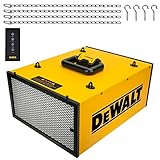
5. DEWALT DWXAF101 – Best Ceiling-Hung Unit with AUTO Mode
DEWALT Air Filtration System Dust Collector for Woodworking DWXAF101
20.9 pounds
2-stage cotton pre-filter plus H11 HEPA
105 watts
64 dB
AUTO air quality mode
+ The Good
- Lightest machine in the roundup at 20.9 pounds
- AUTO mode senses air quality and adjusts speed
- Ceiling-hung with included hooks and chains
- Washable pre-filter cuts running costs
- 3-year DeWALT warranty
- The Bad
- Only 2-stage filtration with no carbon layer
- 64 dB is the second loudest here
- No odor or VOC control
- IR remote needs line of sight
The DEWALT DWXAF101 is the machine we recommend for a woodshop where the planer and the jointer run at the same time and you cannot remember to turn anything on. Its AUTO mode uses a built-in air quality sensor to read the room and pick the speed itself, moving between HI, MID, and LO on its own.
That automation is what separates it from the manual-speed machines in this roundup. Set it before a sanding session, walk away, and the unit responds to dust as it is produced rather than to a guess you made that morning.
Filtration is two-stage: a static cotton pre-filter feeding an H11 HEPA filter rated to capture over 95 percent of 0.3-micron particles. The cotton pre-filter is washable, which is the running-cost advantage, and the panel carries a filter replacement indicator so you are not guessing.
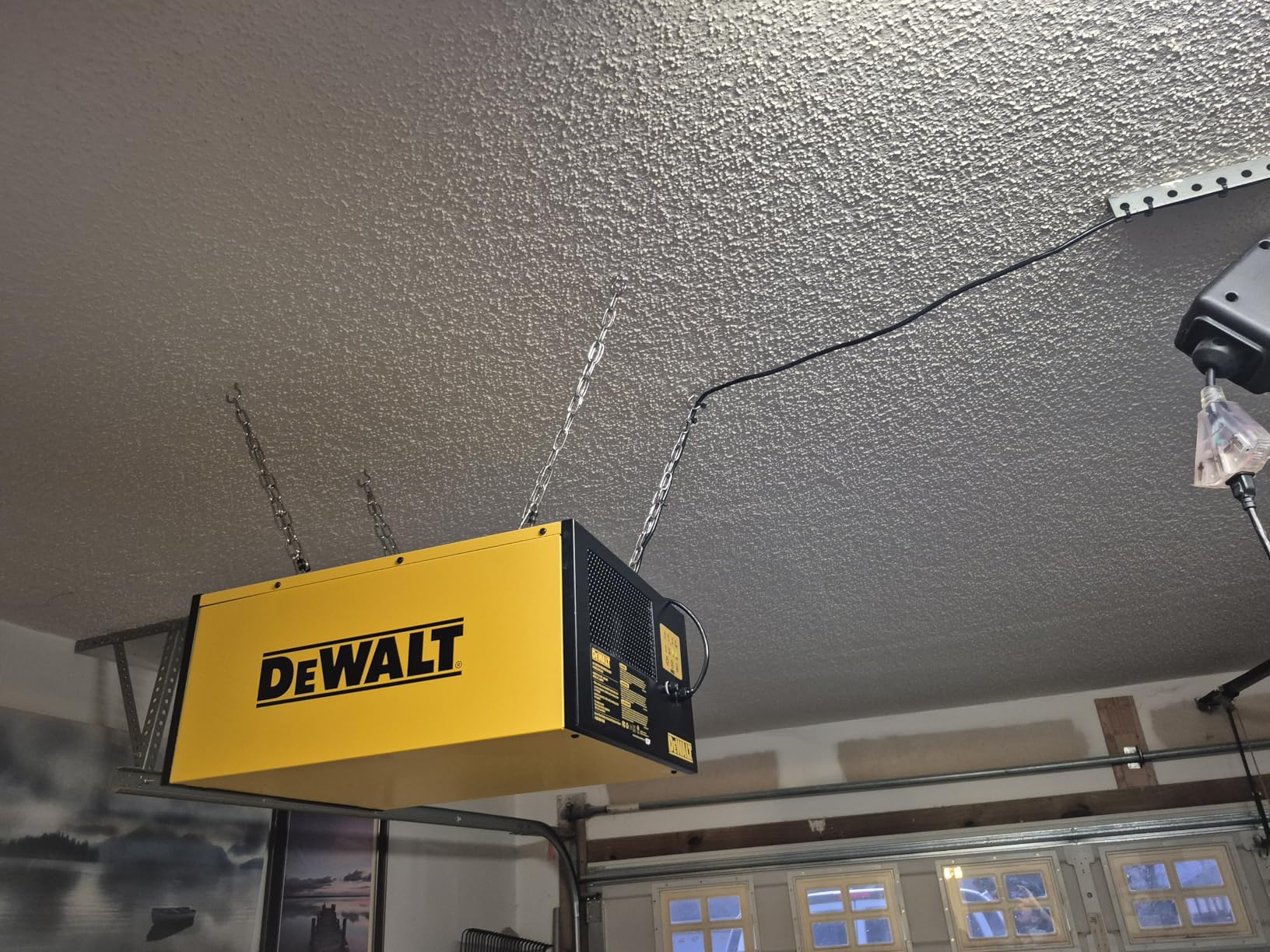
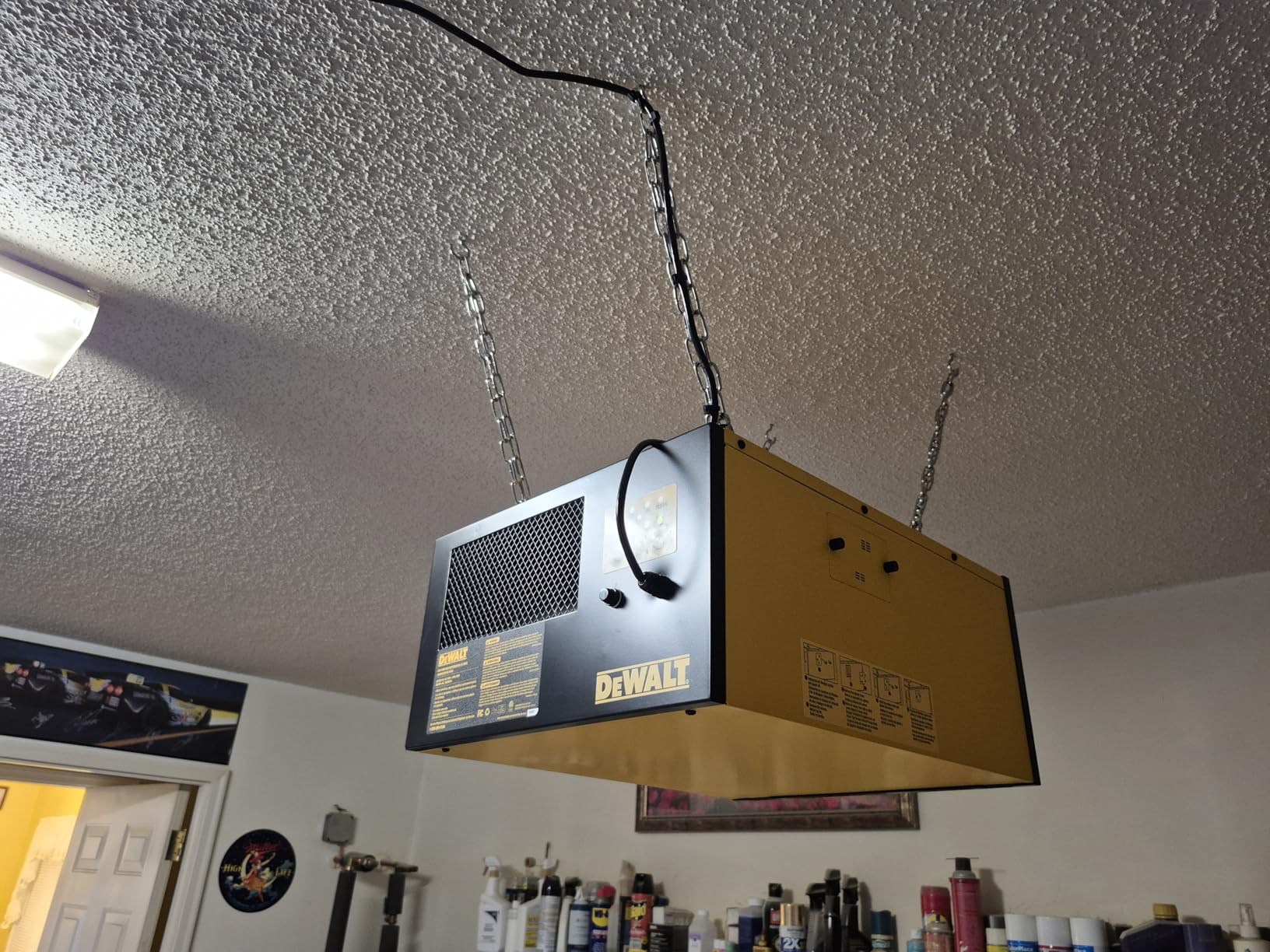
It weighs 20.9 pounds, the lightest machine in the entire roundup, and the box includes four chains and four hooks for hanging from shop ceiling joists. Reviewers also note the flip handle makes it easy to bring down and reposition when you need floor space for a large project.
Timer settings run 1, 2, 4, and 8 hours with auto shutoff, and the included remote is infrared. That last detail matters more than it looks: an IR remote needs a clear line of sight, which is awkward for a unit hanging above your head.
What the AUTO mode actually saves you
It removes the single most common failure in shop filtration, which is running the unit too slow or not at all. Sensor-driven speed means the machine escalates the moment sanding dust spikes, then settles back down when the room clears.
The timer complements it well: a four-hour setting after a big job keeps the DWXAF101 clearing residual dust while you are elsewhere, which is exactly the habit that keeps dust off finished surfaces.
What the two-stage design costs you
There is no activated carbon layer, so odor and VOC control is essentially absent. If you spray paint, thin solvents, or work with MDF that off-gasses, this machine clears particulates and nothing else.
At 64 dB it is the second loudest unit here, and the IR remote requires line of sight. Reviewers also report that sourcing replacement filters takes more hunting than it should, so confirm availability before you need one.
6. MOUNTO HEPA500 – Best Warranty Coverage for the Money
MOUNTO HEPA500 Commercial 500cfm Air Purifier Hepa Air Scrubber Negative Air Machine Roto-Molded (Blue)
500 CFM rated throughput
41.35 pounds
Variable speed control
10-year housing warranty
cETL listed
+ The Good
- 10-year housing warranty with 1-year parts coverage
- Variable speed with quick-access filter changes
- Filter-change indicator light
- Dual GFCI outlet supports daisy chaining
- Stackable roto-molded body
- cETL listed with circuit breaker protection
- The Bad
- 500 CFM is below the 550 offered by most rivals
- Heaviest machine in the roundup at 41.35 pounds
- 6 percent one-star rating on filter and motor complaints
The MOUNTO HEPA500 is the machine to buy if warranty length is a deciding factor. It carries a 10-year housing warranty alongside 1-year parts and labor coverage, matching the best in the roundup and beating the shorter terms most competitors attach to the same plastic body.
Throughput is rated at 500 CFM with variable speed control, and the filter-change light plus quick-access panel mean you can service it without dismantling the housing. The roto-molded shell is stackable and compact enough to move between rooms.
The dual GFCI outlet is genuinely useful for running multiple machines, and the onboard circuit breaker protects both the unit and anything you plug into it. It is cETL listed, which is a meaningful safety mark for equipment that runs unattended in a dusty space.
Restoration users favor it for the same reasons we did: the long housing warranty means a cracked or failed shell is a decade-long problem, not a five-year one, and that is where most rotomolded units eventually fail.
What the long warranty actually protects
It covers the housing, which is the expensive, failure-prone part of a roto-molded air machine. The motor and electrical components fall under the 1-year parts and labor term, so read that distinction carefully before assuming ten years of full coverage.
Given that the shell is what limits a discarded unit to the scrap value, a 10-year housing warranty is what keeps the machine worth owning long term.
What the MOUNTO trades away
Five hundred CFM sits below the 550 offered by most competitors in this roundup, so for a given room you get slightly less air movement. The gap matters most in a large open shop where you want the machine to clear the far corner too.
It is also the heaviest machine we covered at 41.35 pounds, and the 6 percent one-star share is the second highest in the group, with complaints clustering on filters and the motor. Plan its location before you lift it.
7. Abestorm HEPA 550 – Best for Configurable Negative Air Use
Abestorm HEPA 550 Air Scrubber with 3-Stage Filteration, GFCI Connection
270-550 CFM adjustable
3-stage MERV-10, carbon and HEPA
800 sq ft coverage
39.6 pounds
Includes 2 MERV-10 filters
+ The Good
- Switches between air cleaner and negative air machine
- 3-stage stack at 99.97 percent of 0.3 micron particles
- Variable 270-550 CFM airflow
- Built-in GFCI outlet and stacks to 3 units
- Two MERV-10 pre-filters included
- The Bad
- 9 percent one-star share
- tied for the highest here
- Black cover must be removed before first use
- 39.6 pounds is heavy for repositioning
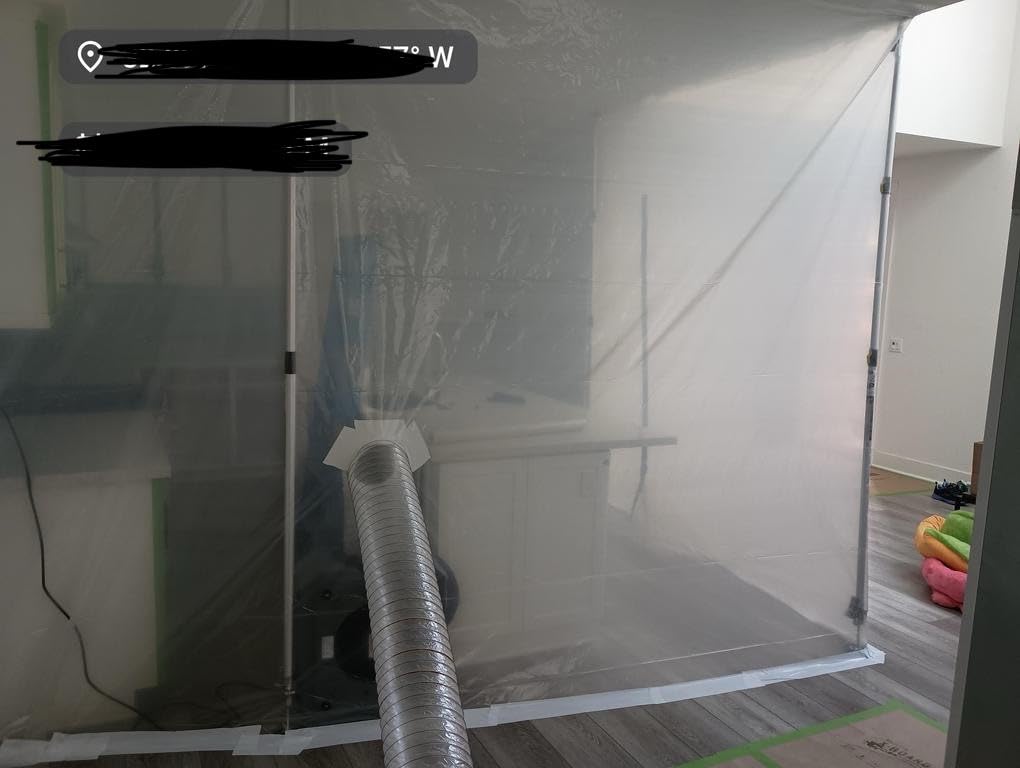
The Abestorm HEPA 550 is the most flexible machine in this roundup, because it can be configured as a recirculating air cleaner or as a negative air machine that exhausts outdoors. The ducting is sold separately, so plan that purchase up front if you need containment rather than cleaning.
That dual role matters in a garage workshop where the job changes week to week. Monday you are sweeping up sawdust and want clean air returned to the room; Thursday you are grinding a floor and need contaminated air pulled out of the building entirely.
Filtration is the same three-stage arrangement used by the other 550 machines: a MERV-10 pre-filter, an activated carbon layer for odor, and a HEPA stage rated at 99.97 percent capture of particles above 0.3 microns. Airflow varies from 270 to 550 CFM.
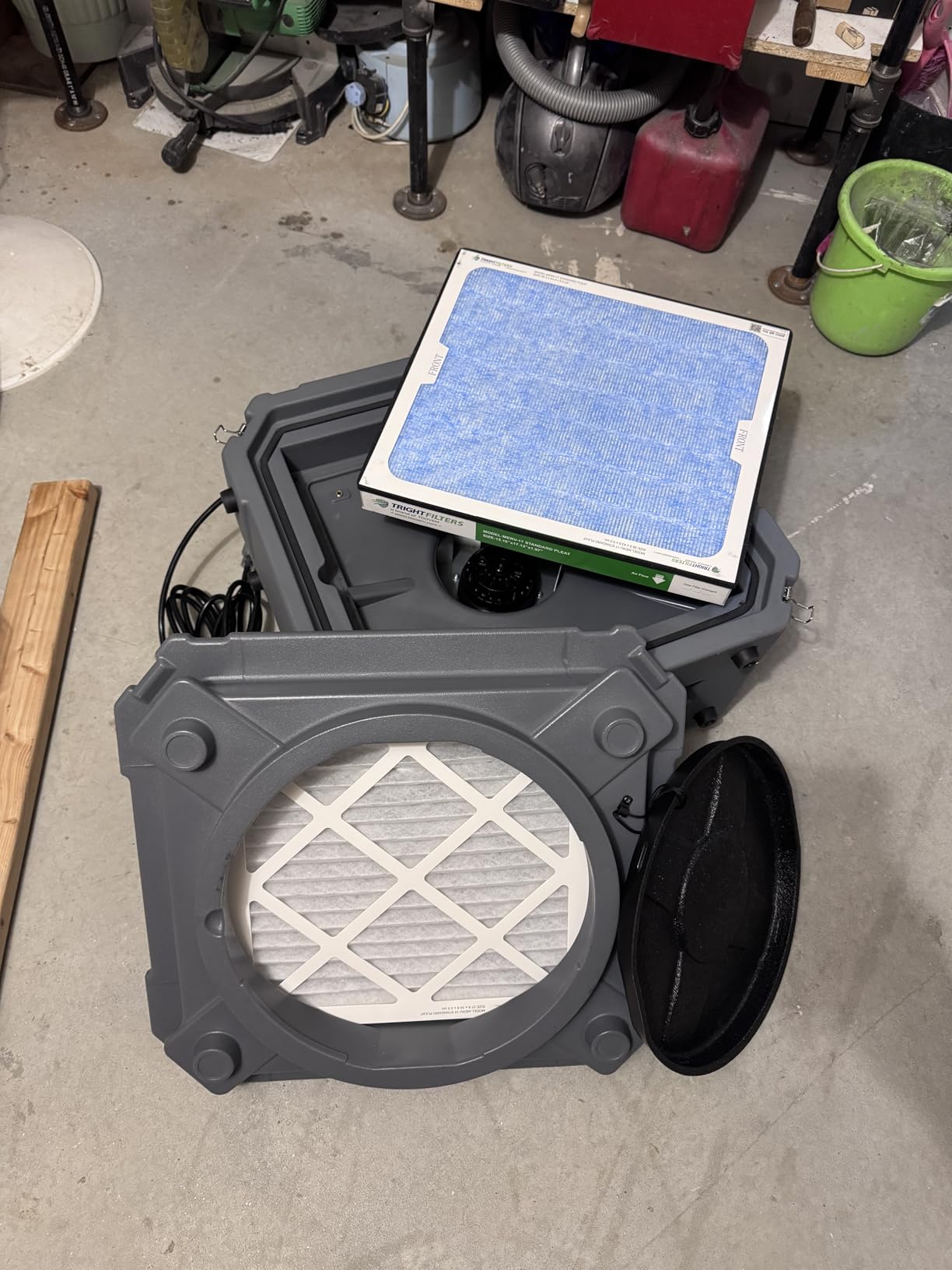
Coverage is up to 800 square feet, or 5,500 cubic feet, and it stacks up to three units for 1,650 CFM combined through the built-in GFCI outlet. A two-pack of MERV-10 filters ships in the box, which covers your first few filter changes.
Why the negative air option is the deciding feature
Recirculating cleaners make the air in the room cleaner. Negative air machines take the air out of the room, which is the correct approach when you are dealing with contaminants that should not be circulated at all, such as grinding dust or spray overspray.
Having one machine that does both means you are not running two separate systems, and the duct interface is the only added cost.
What buyers report as problems
The 9 percent one-star share is tied for the highest in the roundup, and the complaints center on filter availability and durability rather than performance.
There is also the black cover that must be removed before first use, a recurring source of confusion. The 39.6-pound weight means repositioning it takes planning, and filter orders are a common friction point worth confirming early.
8. Abestorm DecDust 1350IG – Best Airflow for Large Shops
Abestorm 360 Degree Intake Air Filtration System for Woodworking, Built-in Ionizer, 1350CFM Hanging Air Filter, Shop Dust Collector, Garage WorkShop, MERV-11 filter, DecDust 1350IG
1050-1350 CFM
360-degree intake with ionizer
MERV-11 with 4 spare filters
1700 sq ft coverage
27 pounds, 115V 1.5A
+ The Good
- Highest airflow figure in the roundup at 1050-1350 CFM
- Covers rooms up to 1700 square feet
- Three mounting options including bench placement
- 360-degree intake with built-in ionizer
- Four MERV-11 filters included
- The Bad
- Does not meet California air cleaner regulation requirements
- MERV-11 only with capture rated at 1 micron
- Highest noise figure in the roundup at 60-69 dBA
- Two-speed control is coarse
The Abestorm DecDust 1350IG moves more air than anything else in this roundup, and if you have a genuinely large shop that is the number that matters. Its two speeds deliver 1,050 and 1,350 CFM across coverage of up to 1,700 square feet.
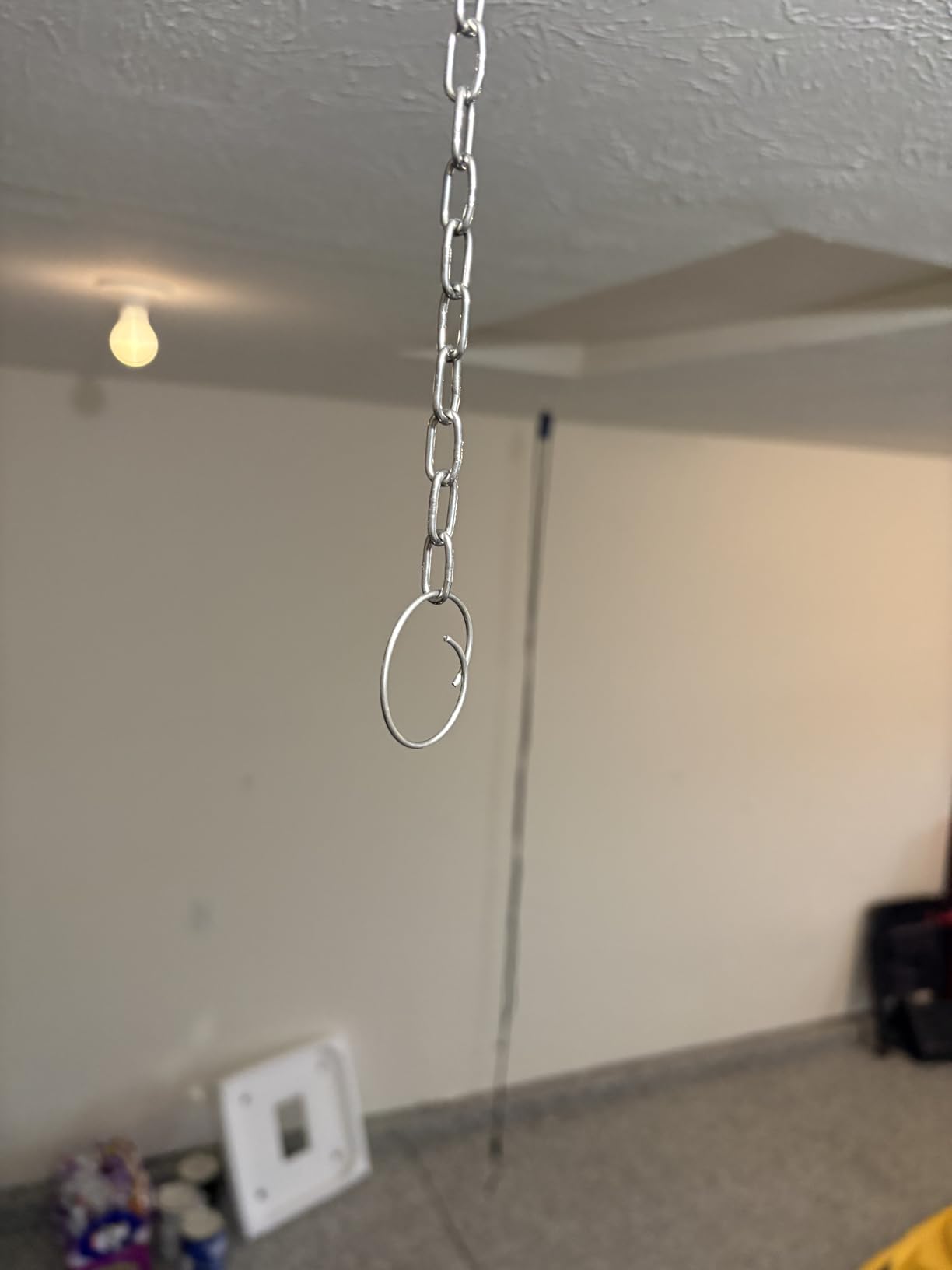
It is also the most flexible to install. Three mounting methods are supported: ceiling-hung on chains, workbench placement on four anti-slip rubber pads, or direct ceiling screw-in. That third option is the one experienced woodworkers ask about most, because screw-mounted units do not swing when the joists flex.
Intake is 360-degree, so it draws from every side rather than one face, and a built-in ionizer generates positive and negative ions to help treat particles, sawdust, and odors. Control is via a touch panel on the unit or a remote with a 27-foot range.
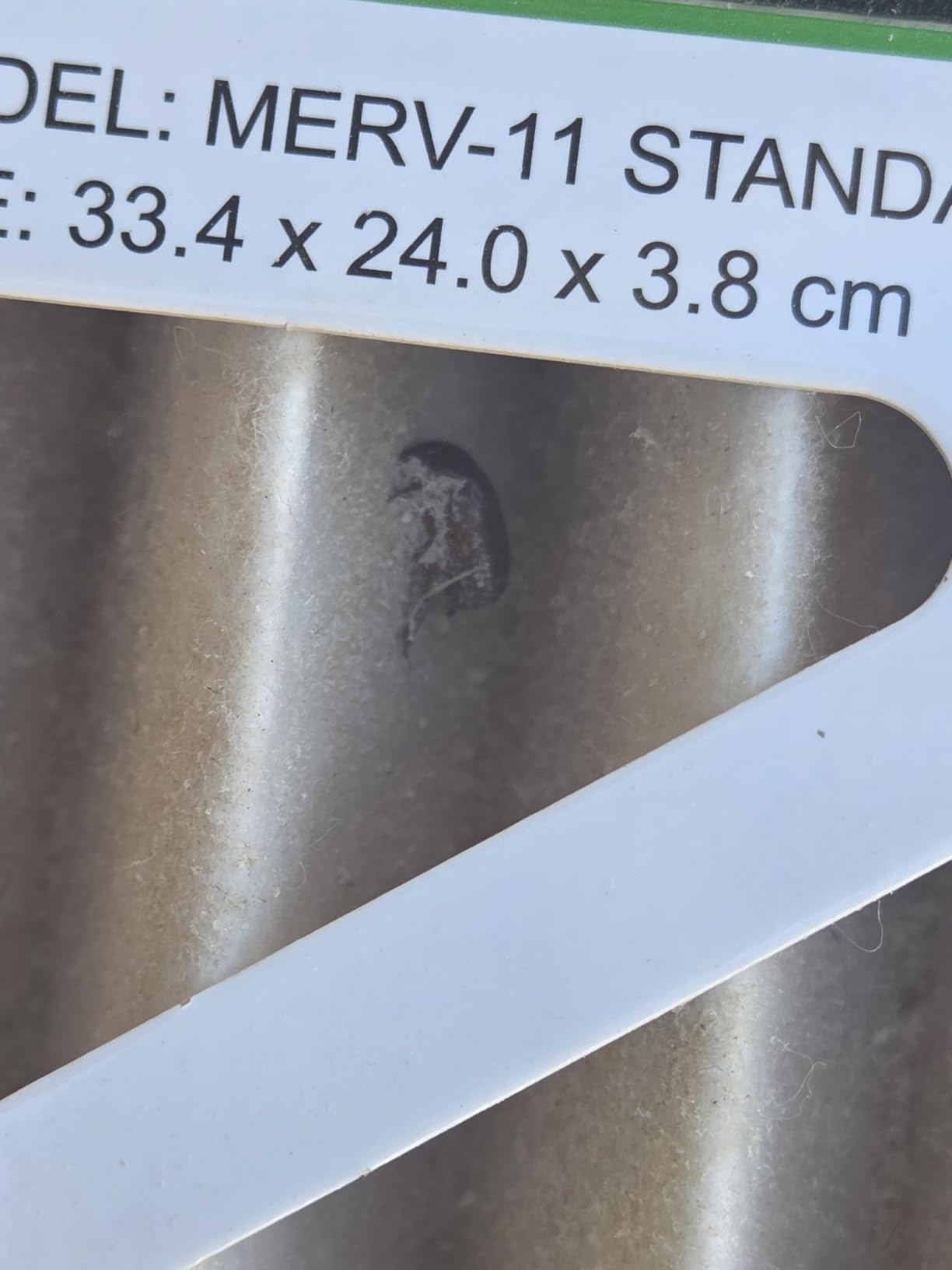
Four MERV-11 filters ship in the box, and the manufacturer guidance is replacement every 2 to 4 months in normal shop use. Electrical draw is 115 volts at 1.5 amps, and the unit weighs 27 pounds.
Where the 1350 CFM class earns its place
High-volume wood production. If two people are running a planer and a table saw at once in a large open shop, the airflow ceiling is what determines whether dust settles or stays suspended, and this is the only machine here rated above 1,000 CFM.
The 360-degree intake also helps in an L-shaped or partitioned garage where a single-face intake would leave one side of the room untouched.
What the specifications hide
Filtration is MERV-11, with particle retention rated at 1 micron. There is no true HEPA stage, so if you need sub-micron capture for drywall or mold work, this is the wrong machine despite the impressive airflow.
It is also the loudest unit here at 60-69 dBA, and the California air cleaner regulation requirement means it cannot be delivered to customers in that state. Owners who need sub-micron capture should look at one of the 550 CFM HEPA scrubbers instead.
9. CADPXS Shield-550 – Best for Fast Tool-Free Filter Changes
CADPXS Shield-550 Air Scrubber 550 CFM with 3-Stage Filtration
550 CFM
3-stage MERV-10, carbon and HEPA
33.51 pounds
Tool-free quick latches
10-year limited warranty
+ The Good
- Tool-free quick latches open the filter compartment
- Persistent hour meter keeps the reading when unplugged
- Illuminated power cord and side control panel
- Users report steady 550 CFM under load
- Carbon stage improves odor control
- 10-year limited warranty
- The Bad
- Filter-change light tracks plugged-in time
- not filter hours
- Speed knob does not vary airflow much
- Carbon and HEPA are bonded and not separately replaceable
- Rigid carry handle
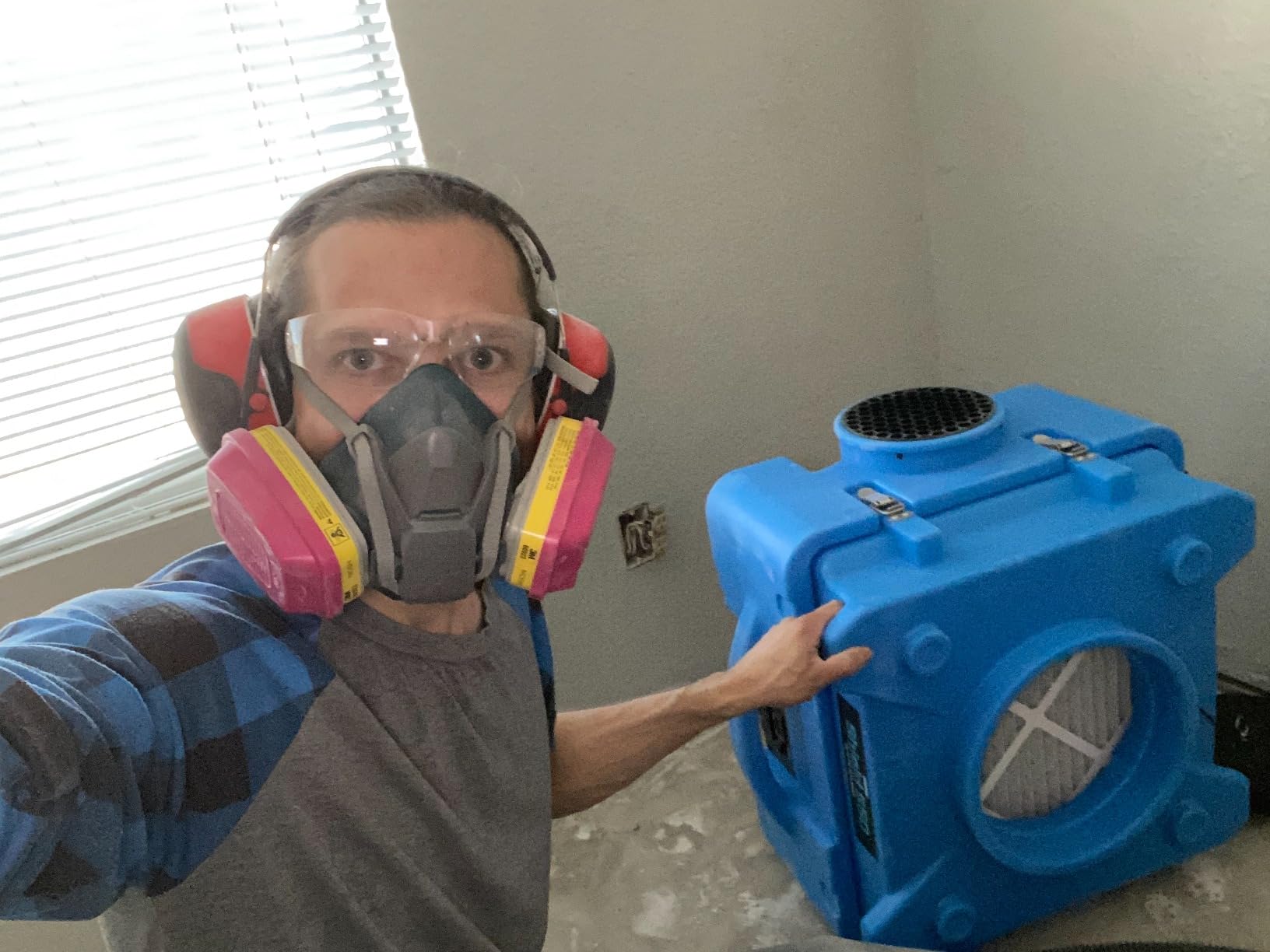
The CADPXS Shield-550 solves a problem most owners do not think about until it annoys them: changing the filter. Two quick latches open the compartment with no tools, and no screwdrivers, which matters when you are doing it in a dusty shop at the end of a long day.
The detail we like most is the hour meter, which retains its display even when the machine is unplugged. Most competing indicators reset to zero, so you end up guessing at filter life. A persistent timer means you can record the hours after each change and know when the next one is due.
Filtration is a 550 CFM three-stage arrangement with a MERV-10 pre-filter, activated carbon, and a HEPA stage rated at 99.97 percent capture of particles at or above 0.3 microns. Users report consistent airflow under load with no drop-offs as the filters load up.
Two smaller touches go a long way in practice: an illuminated power cord that stays visible when the unit is against a dark wall, and a side-mounted control panel that remains accessible when you are ducting upward.
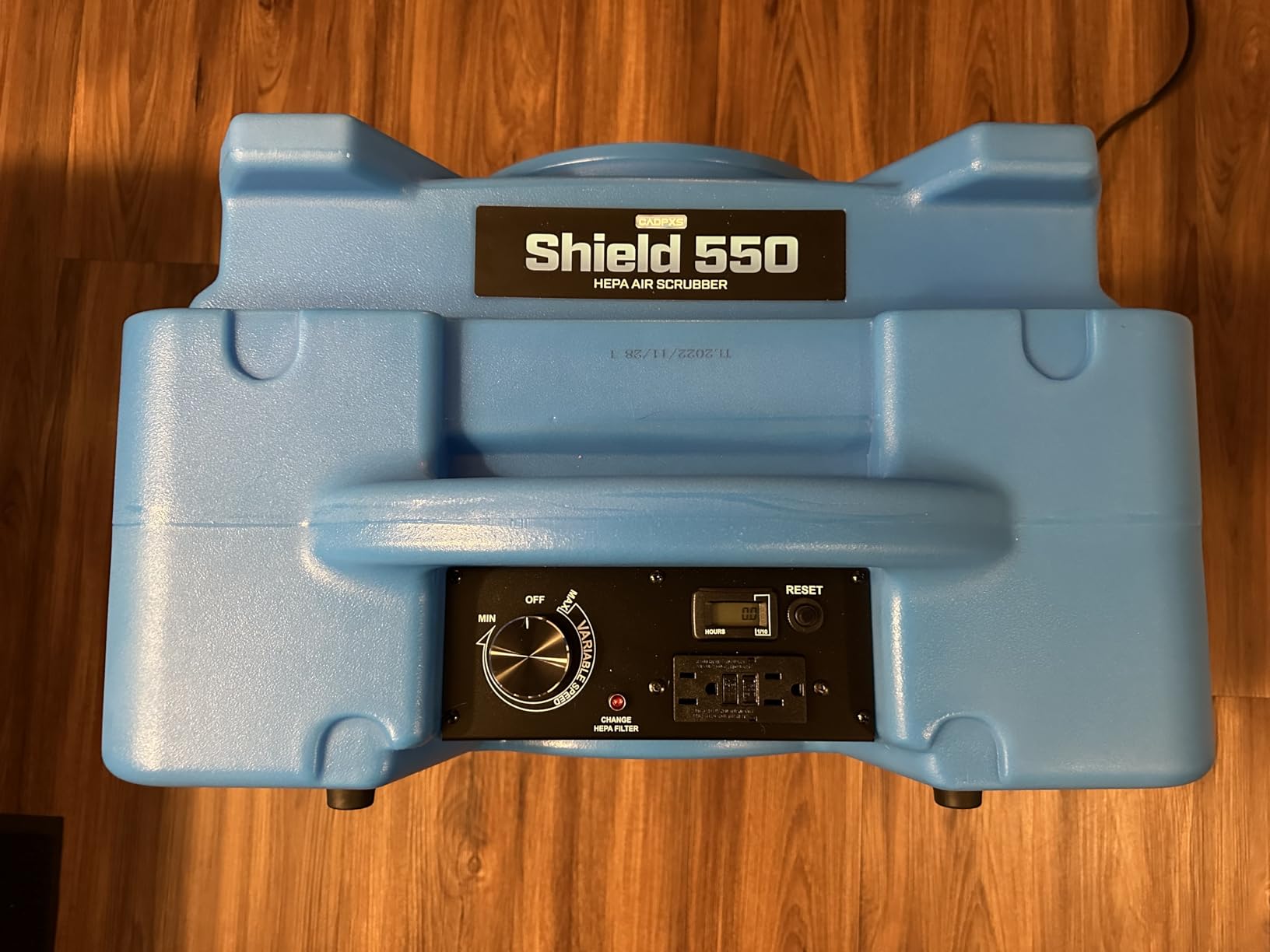
At 33.51 pounds it is lighter than most 550 CFM competitors, and the warranty is a 10-year limited term with dedicated technical support behind it.
Why serviceability deserves a spot in a roundup
Filter changes are the only maintenance these machines have, and they are the maintenance you will do most often. Tool-free access turns a ten-minute job with a socket set into a thirty-second swap, which encourages people to change filters on time instead of stretching them past spec.
The persistent hour meter is the part that changes behavior. Logging filter hours gives you a real replacement schedule rather than an instinct-based one.
Where the Shield-550 disappoints
The filter-change indicator light is driven by plugged-in time rather than actual filter service hours, and owners report it stays lit after a fresh filter goes in. Treat that light as a rough reminder and rely on the hour meter instead.
The carbon and HEPA stages are bonded together, so you cannot replace them independently, which is more expensive than a unit with separate cartridges. Three-star reviews also report that the speed knob does not vary airflow much across its range.
10. JET AFS-1000C – Best Multi-Speed Sensor Control
JET Air Filtration System, 1-Micron Filter, 1000 CFM, 120V 1Ph (AFS-1000C)
1000 CFM at 120V single phase
5-micron outer plus 1-micron inner filter
16-hour timer with RF remote
67 dB at top speed
33 pounds
+ The Good
- 1000 CFM with the most granular speed control in the roundup
- Automatic air quality sensor across six speeds
- 16-hour timer is the longest here
- Angled LED display readable when ceiling mounted
- Includes four eye bolts and an RF remote
- BLDC motor in an injection molded housing
- The Bad
- Lowest average rating here at 4.2 with 14 percent one-star
- Filtration is 1-micron rather than true HEPA
- Loudest unit here at 67 dB on the highest speed
- Warranty drops to 2 years for commercial use
The JET AFS-1000C is the only machine in this roundup with six speeds, and that granularity is its case. Combined with a built-in air quality sensor, it gives you finer control over airflow than the two-speed and three-speed machines elsewhere in the list.
At 1,000 CFM it moves more air than any scrubber here, which makes it a natural fit for a mid-size commercial woodshop or a garage that doubles as a small business space. Electrical requirements are 120 volts, single phase.
Filtration is two-stage: an outer filter rated at 99 percent of 5-micron particles feeding an inner filter rated at 85 percent of 1-micron particles. That is less fine than the HEPA stages in the scrubbers, so it suits wood dust better than drywall or mold work.
Woodworking forum regulars widely praise the auto mode for detecting dust in real time, which is the feature that separates it from a plain timer-based unit. The motor is a quiet, efficient BLDC design housed in injection molded plastic that dampens vibration, with four eye bolts included for mounting.
The 16-hour timer is the longest in the roundup, and the angled LED panel is angled specifically so it stays readable when the unit is hanging from the ceiling rather than sitting at eye level.
What six speeds and a sensor actually deliver
Faster reaction. When sanding dust spikes, the unit moves up through the speeds to match the load instead of jumping from idle straight to full blast, which is quieter during short bursts and leaves low speeds available for ambient clearing.
The 16-hour timer is also the practical answer to a question forums raise constantly: leaving the machine running overnight or through a weekend. Set it once and it shuts down on schedule.
What the reviews hold against it
This machine has the weakest satisfaction profile in the roundup, with a 4.2 average and a 14 percent one-star share. Owners who run woodshops like it, but the dissatisfied group cites 1-micron filtration, top-speed noise, and value.
It is also the loudest unit here at 67 dB on the highest speed, which is harder to live with than most people expect when the machine is above their head. The warranty drops from 5 years to 2 years if you use it commercially or industrially, so check that before buying for a paid shop.
How Much CFM Do You Need? Sizing Air Filtration for a Garage
Size by air changes per hour, not by square footage alone. Multiply your room volume by the air changes you want per hour, then divide by 60 to get the CFM you need. The standard workshop target is 6 to 8 air changes per hour during active dust-producing work, which is far more aggressive than the 4 ACH used in office air cleaners.
Room volume is floor area multiplied by ceiling height. A 400 square foot garage with an 8-foot ceiling is 3,200 cubic feet. At 6 ACH that works out to 320 CFM, and at 8 ACH you need roughly 427 CFM, which is why the WEN 3410 sits right at the edge of its class for a single-car space.
The 2/3 rule gives you a fast shortcut. Set your air purifier to its maximum CFM, then the recommended room size is about two-thirds of that number. A 400 CFM machine gives you a comfortable ceiling of roughly 265 square feet at high speed, which is the conservative assumption we use when a room has an unusually low ceiling or heavy dust load.
As a quick reference for an 8-foot ceiling at 6 air changes per hour, a 200 square foot garage needs about 160 CFM, a 400 square foot space needs 320 CFM, a 600 square foot two-car garage needs 480 CFM, and a 1,000 square foot shop needs 800 CFM. Higher ceilings and heavier MDF or sanding workloads push those figures up, which is where a high-CFM machine like the Abestorm DecDust 1350IG starts to earn its place.
If your shop is used for larger storage systems, the ceiling space you need for filtration competes with the space you want for racks. Our guide to modular garage storage systems covers how the two layouts interact, and the garage ceiling storage guide covers the joist-mounted options you can hang filtration hardware from.
MERV vs HEPA: Which Filter Grade Actually Catches Wood Dust
For wood dust, MERV 11 to MERV 13 is the practical sweet spot. MERV ratings describe particle capture by size, and the jump from a 5-micron pre-filter to a 1-micron inner filter, as used on the WEN 3410 and the JET AFS-1000C, removes the majority of the fine fraction that makes a workshop hazy. Going beyond that matters more for drywall, cement, and mold than for sawdust.
HEPA is the next tier, rated at 99.97 percent capture of 0.3-micron particles. The BlueDri Air Shield 550, the ALORAIR CleanShield 550, the VEVOR 550, the Abestorm HEPA 550, the MOUNTO HEPA500, and the CADPXS Shield-550 all make HEPA claims. If your dust includes joint compound, MDF edge dust, or animal dander, that tier is worth the extra cost.
Activated carbon is the stage people skip and then regret. Only a carbon layer does anything about odors and volatile organic compounds from paint, solvents, or adhesives, so it is the deciding feature for anyone spraying finish in the same building. The DEWALT DWXAF101 and the WEN 3410 have no carbon stage at all.
Ionizers need a caveat. The Abestorm DecDust 1350IG includes a built-in ionizer that releases positive and negative ions to help clump particles, and ionizer output on enclosed spaces has drawn ozone questions from users. If anyone in your household has respiratory sensitivity, favor a machine with a pure mechanical filter path.
There is also the DIY route. Across woodworking forums, the most-repeated recommendation is a box fan paired with a MERV 13 furnace filter, which costs a fraction of a dedicated machine and performs respectably for sanding dust. The trade-offs are honest: no remote, no timer, no auto mode, and a lot of noise. It is a reasonable first step for a small shop before committing to a ceiling-hung unit.
Mounting, Remote Controls and Electrical Requirements
Mounting is where most installation problems happen. Ceiling-hanging into joists with eye bolts and chain is standard practice, and it is what keeps the workbench clear. The DEWALT DWXAF101 and the JET AFS-1000C both ship with hanging hardware, the Abestorm DecDust 1350IG adds bench pads and direct screw-in as alternatives, and the 550 CFM scrubbers are floor machines by design.
Check the weight before you lift. At 41.35 pounds the MOUNTO HEPA500 and the 39-pound-plus scrubbers are two-person jobs on a ladder. The WEN 3410 at 31 pounds and the DEWALT DWXAF101 at 20.9 pounds are far more manageable solo. Never stand under a suspended unit while working on the mounting hardware.
Remote control type changes daily usability more than most buyers expect. RF remotes use radio frequency and work through walls and obstructions, which is why the WEN 3410 and the JET AFS-1000C use them. IR remotes need a clear line of sight, so the DEWALT DWXAF101 remote is awkward on a ceiling-hung unit you cannot reach.
Electrical requirements are modest. The WEN 3410 draws 12.42 watts at 1 amp, the Abestorm DecDust 1350IG runs at 1.5 amps on 115 volts, and the DEWALT DWXAF101 is 105 watts. All of these run fine on a standard 15-amp household circuit, and none requires a dedicated circuit for a single unit. If you plan to run three daisy-chained scrubbers, confirm your circuit can carry the combined draw.
Two safety points deserve attention. First, fine dust accumulates inside motor housings, and that dust is a combustible material, so vacuum or blow out the interior on a schedule rather than letting it build. Second, self-activating units in auto mode combined with an unattended smart plug is a combination we would avoid; use the built-in timer instead. If you want the unit integrated into a smart home setup, a switched outlet on a circuit you control is a safer pattern than stacking automation layers.
Dust Collector or Air Scrubber? Which Machine Your Shop Needs
An air filtration system cannot replace a dust collector, and the two solve different problems. A dust collector captures the large volume of debris at the machine, which protects the tool, the operator, and your bin. Air filtration handles the fine fraction that escapes and becomes airborne, which is what reaches your lungs and your finished surfaces.
The most common complaint from experienced woodworkers is that a machine feels like it works perfectly and the dust is still everywhere. That is a dust collection problem, and no amount of ambient filtration fixes the airflow at the saw. The experienced setup pairs a dust collector at the tool with a filtration unit in the room.
Between air cleaners and negative air scrubbers, the dividing line is where the contaminant goes. A recirculating cleaner returns cleaned air to the room and suits wood dust. A negative air scrubber exhausts outdoors and suits contaminants that should leave the building entirely, such as grinding dust, spray overspray, and solvent fumes. The Abestorm HEPA 550 is the only machine here that switches between both roles.
Frequently Asked Questions
Do air purifiers work in garages?
Yes, for ambient dust they work well. A garage air filtration unit recirculates room air through a pre-filter and a fine filter, clearing sanding and sawdust fines that a dust collector misses. They do not replace a dust collector, and standard home air purifiers are not built for the load a workshop puts on a filter.
How many CFM do I need for my workshop air filter?
Multiply room volume by 6 to 8 air changes per hour, then divide by 60. A 400 sq ft garage with an 8-foot ceiling is 3,200 cubic feet, which needs roughly 320 to 427 CFM. The 2/3 rule gives a fast shortcut: take the machine’s maximum CFM and multiply by two-thirds for a conservative recommended room size.
What MERV rating is recommended for wood dust filtration?
MERV 11 to MERV 13 is the practical range for wood dust, capturing the fine fraction that stays airborne after sweeping. HEPA at 0.3 microns is worth the extra cost when you also handle drywall, cement board, or mold. MERV 8 alone will not keep a workbench clean.
Can a workshop air purifier replace a dust collector?
No. A dust collector captures bulk debris at the machine and protects your tools, while air filtration cleans the airborne fraction that escapes. The two work together: dust collection at the tool, ambient filtration in the room. If dust still lands on surfaces right after sweeping, the problem is collection, not filtration.
Will an air filtration system help with welding smoke?
Partly. A HEPA unit with an activated carbon stage captures metal particulates and reduces odor, which is why scrubbers are common in auto and restoration shops. It is not a substitute for a proper exhaust hood or a fume extractor positioned at the source, because welding fume is generated at a very high rate at the arc itself.
Final Verdict: Best Air Filtration for Garage Workshops in 2026
The WEN 3410 is our pick for the best air filtration systems for garage workshops in 2026 because a 4.6 rating across more than 5,000 owner reviews tells you more about long-term reliability than any spec sheet. It suits a single-car garage, hangs easily, responds to an RF remote through obstructions, and draws almost no power.
Buy the VEVOR 550 if you want full three-stage HEPA and carbon filtration at the lowest cost in the 550 CFM class, and the BlueDri Air Shield 550 if your work produces fine airborne contamination rather than ordinary sawdust. Larger shops should look at the Abestorm DecDust 1350IG for airflow, provided the MERV-11 grade and the California delivery restriction do not apply to you.
Whichever machine you choose, the habits matter more than the hardware. Run it for one to two hours after you finish, clean the pre-filter on schedule, and keep a dust collector at the machine itself. If you are still mapping out the space, our garage climate control guide covers the heating and cooling side of keeping a converted garage comfortable year round.