
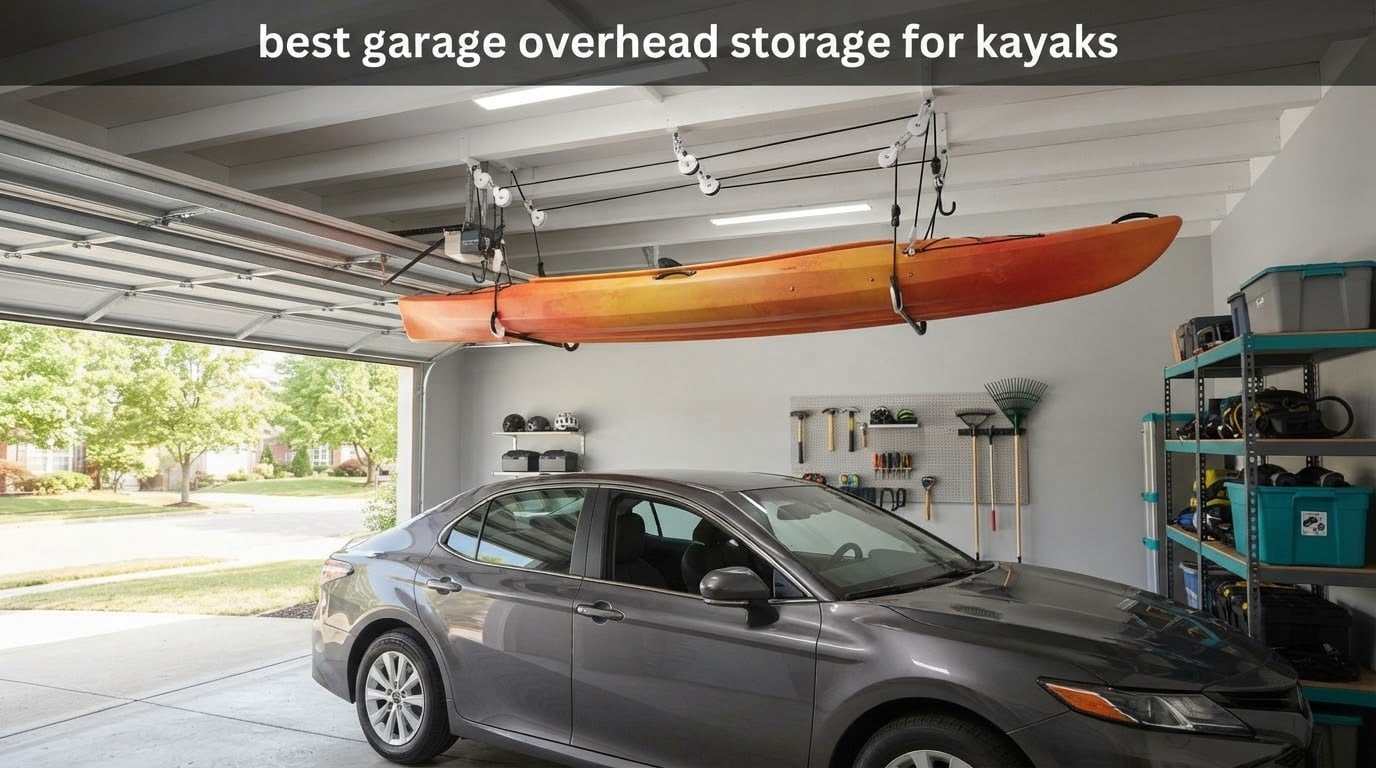
A kayak lying flat on a garage floor takes up a full parking bay, gives you a trip hazard at 6 AM, and puts uneven pressure on the hull for months at a time. The fix most owners land on is a ceiling-mounted system: a rope-and-pulley kayak hoist, a padded hard-arm rack, or a fixed two-boat rack that bolts into the ceiling joists and holds the boat horizontally against the roof. We spent weeks comparing eight of them on published load rating, joist hardware, hull protection and how much floor they actually give back.
If you want the short version, the best garage overhead storage for kayaks is a padded hard-arm rack when you own two boats or a heavy fishing kayak, and a rope-and-pulley hoist when you own one and want it to double as a bike or ladder hanger. Both bolt into joists with lag screws, both hold the hull off the deck, and both put a parking bay back within an afternoon of work.
What separates a good overhead system from a cheap one is boring and specific: whether the hardware reaches framing or just drywall, whether the rope or cleat locks under load, and whether the contact points touching your hull are rubber or foam. A [hollow-sounding rack with drywall anchors and bare steel hooks](https://beboivn.com/best-overhead-garage-storage-racks/) can hold a 60 lb recreational kayak for years and still be the wrong choice the week you load a pedal kayak.
We broke the eight systems into the five actual approaches to overhead storage, laid out the specs that matter, and matched each one to the garage it suits. Every capacity number below comes from the manufacturer listing, and every rating is the current verified review average.
Top 3 Garage Overhead Storage Picks for Kayaks in October 2026

RAD Sportz Kayak Hoist
- › 125 lb capacity
- › Automatic rope brake
- › Rubber-coated hooks
- › Ceilings up to 12 ft
StoreYourBoard Hi Port 2
- › Stores 2 kayaks
- › 150 lb total capacity
- › Foam-padded arms
- › Rotating bracket

GoSports Overhead Rack
- › 200 lb total capacity
- › 12.5 to 19.5 inch drop
- › Foam-coated arms
- › Two boat capacity
Best Garage Overhead Storage for Kayaks in October 2026
| PRODUCT MODEL | KEY SPECS | BEST PRICE |
|---|---|---|
|
|
Check Latest Price |
|
|
Check Latest Price |
|
|
Check Latest Price |
 |
|
Check Latest Price |
 |
|
Check Latest Price |
 |
|
Check Latest Price |
 |
|
Check Latest Price |
 |
|
Check Latest Price |
Five Ways to Hang a Kayak From a Garage Ceiling
Overhead kayak storage falls into five categories, and picking the wrong one is the most common expensive mistake in this space.
Rope and pulley hoists run a rope through a ceiling-mounted pulley to a wall cleat or brake. One person lifts, the rope holds the load, and the same system carries bikes, ladders and SUPs when the kayak is out.
Hard-arm ceiling racks hold the boat on foam-coated arms at a fixed height. They load fast and hold more weight, but they take up permanent ceiling space.
Padded slings and straps drop straight down from two eye hooks with no pulley at all. Simple and quiet, but you need clearance below to get the boat back down.
Sliding T-bar and track systems let you move one mount along a rail to serve a two-car bay. They need a long clear run of ceiling and careful joist alignment.
Lift platforms and crank hoists lower a full platform to waist height. They suit heavy boats and high ceilings, and they cost more floor space than a sling.
Buyers searching for [garage ceiling storage in general](https://beboivn.com/best-garage-overhead-storage-bins/) often land on a lift platform first, then discover the clearance math does not work in a one-car garage. Measure before you shop.
1. RAD Sportz Kayak Hoist – Best Overall Kayak Ceiling Hoist
Kayak Storage Hoist – Overhead Pulley System with 125lb Capacity for Canoes, Bikes, Ladders, and More – for up to 12-Foot Ceilings by Rad Sportz
125 lb capacity
Alloy steel
Pulley and rope brake
Up to 12 ft ceilings
+ The Good
- Automatic rope brake grips on every pull
- Rubber-coated hooks that will not scratch a hull
- Handles one boat plus bikes and ladders
- Mounts parallel or perpendicular to joists
- The Bad
- Single hanger stores one boat at a time
- Ladder required to load and unload
- Sold without a warranty
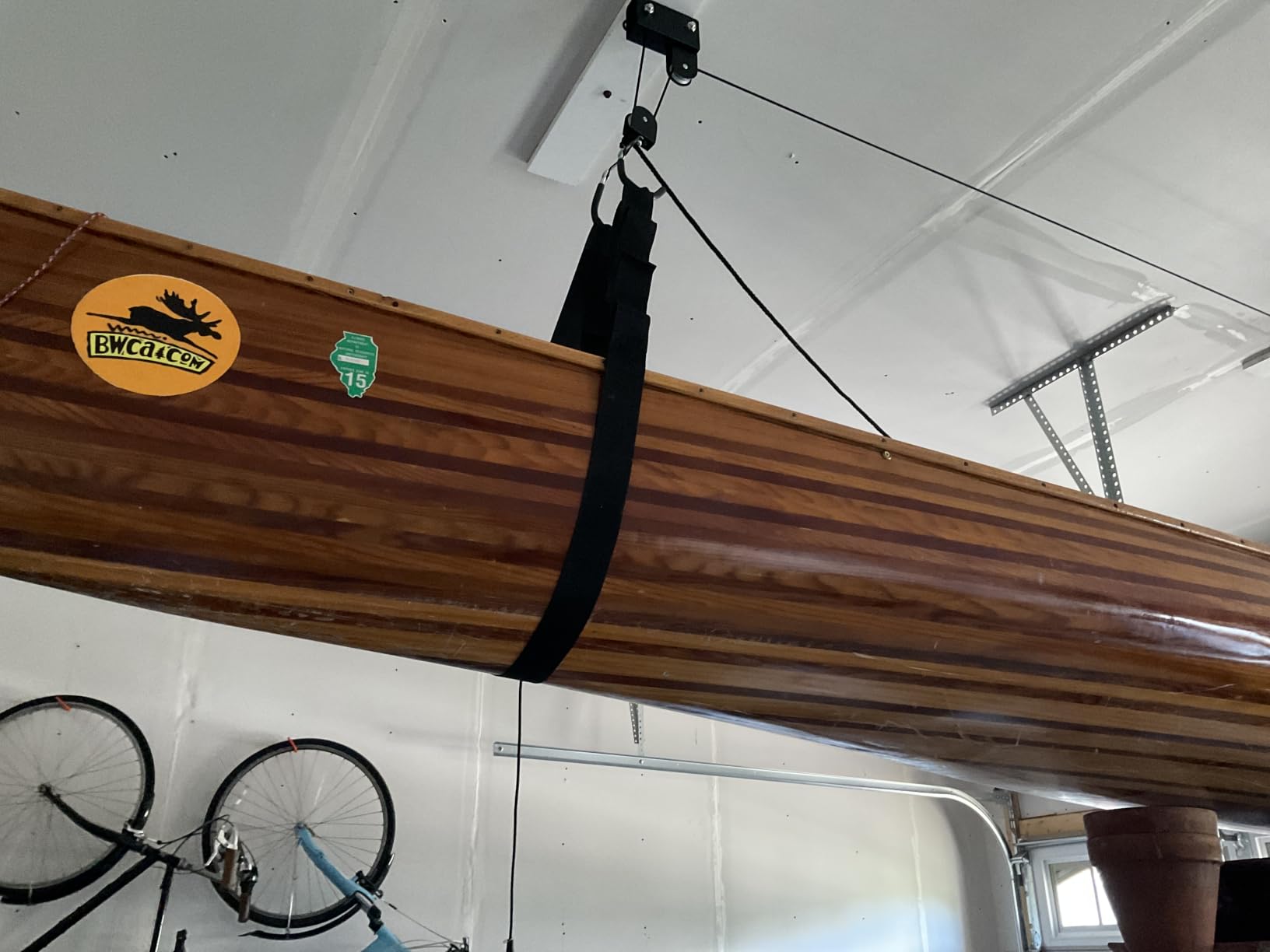
I have a lot of confidence in this hoist because the review history behind it is enormous, and that is the only real test a mechanical product gets over time. Eleven thousand reviews averaging 4.4 stars tells you something a spec sheet cannot: the rope brake keeps working after a few seasons of humidity cycles.
The mechanism is a heavy-gauge pulley with a rope brake that pinches the line on every pull, plus a wall cleat for tying off slack. One person stands on the floor and hauls, and the boat comes up. No crank, no winch, no motor to fail.
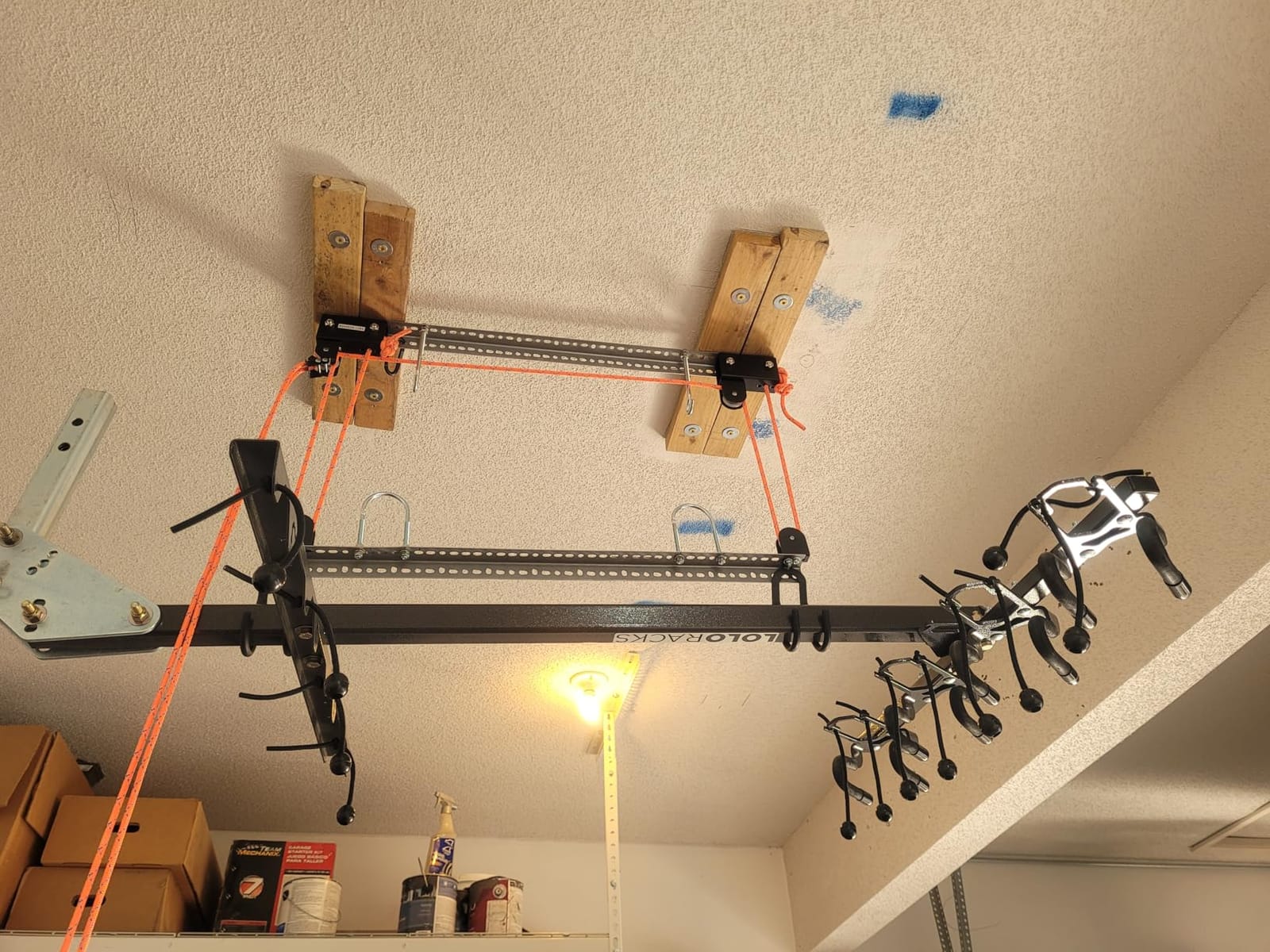
The rubber-coated hooks are the detail I would not compromise on. They touch the hull at two points and they will not leave the grey marks you get from bare powder-coated steel sitting against a polyethylene deck for a season.
Rated at 125 lb and workable to ceilings of 12 ft, this covers most recreational and light touring kayaks. A heavy pedal or fishing kayak above that number is outside its envelope, and the honest answer there is a hard-arm rack with a higher published rating.
When it fits your garage
This is the pick for a one-car garage where a single kayak blocks the only parking bay, and for owners who want one ceiling mount doing double duty as a bike and ladder hanger. Users on Reddit’s r/HomeXpert sling comparisons repeatedly name it as the reliable budget hoist, and that matches what the review volume shows.
It also works when the ceiling is tall. Because the boat rises to roughly ceiling height, you need enough headroom above the parked car to duck under, and enough joist length for the cleat to sit on a nearby wall.
Where it will disappoint you
The single-hanger format means one boat at a time. If you have two hulls, you are either buying a second hoist or looking at the two-boat racks below.
Loading requires a ladder and two hands, which is the trade every rope hoist in this roundup makes. If you paddle three times a week, that trade is not worth it, and a wall-mounted rack or a lean-stand is the better purchase.
2. StoreYourBoard Hi Port 2 Rack – Best Two-Kayak Ceiling Mount
StoreYourBoard Kayak Ceiling Rack, Adjustable Hi Port, Holds 2 Kayaks
Stores 2 kayaks
150 lb total
Alloy steel
Indoor ceiling mount
+ The Good
- Highest rated in this roundup at 4.8 stars
- Two kayaks from one mount
- Closed-cell foam holds a hull without scratching
- Removable arms simplify loading
- The Bad
- Included lag screws are thin for the job
- Base plate overhangs 1.5 inch joists
- Slight downtube play when one side is empty
This is the highest-rated product we reviewed, and the rating is not an accident of a small sample. It has 1478 reviews behind the 4.8, with 86 percent five-star, which tells you the install instructions match reality for most buyers.
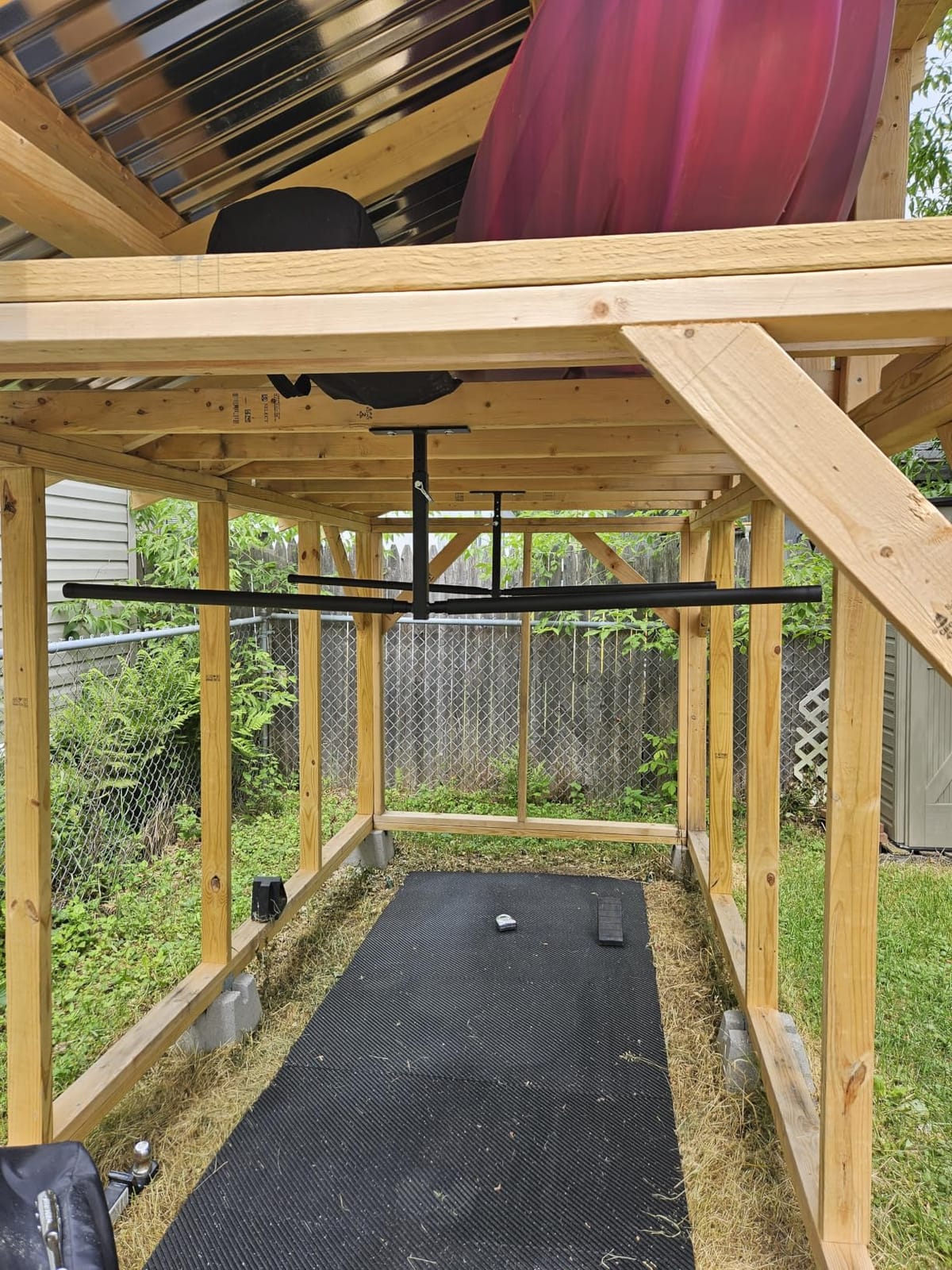
The double-sided mount is the whole idea: one set of ceiling brackets holds a cradle on each side, so a two-boat garage needs one mount instead of two. Total capacity is 150 lb, which works out to 75 lb per side, and owners running two 11 ft kayaks with a combined weight near 104 lb report completely solid support.
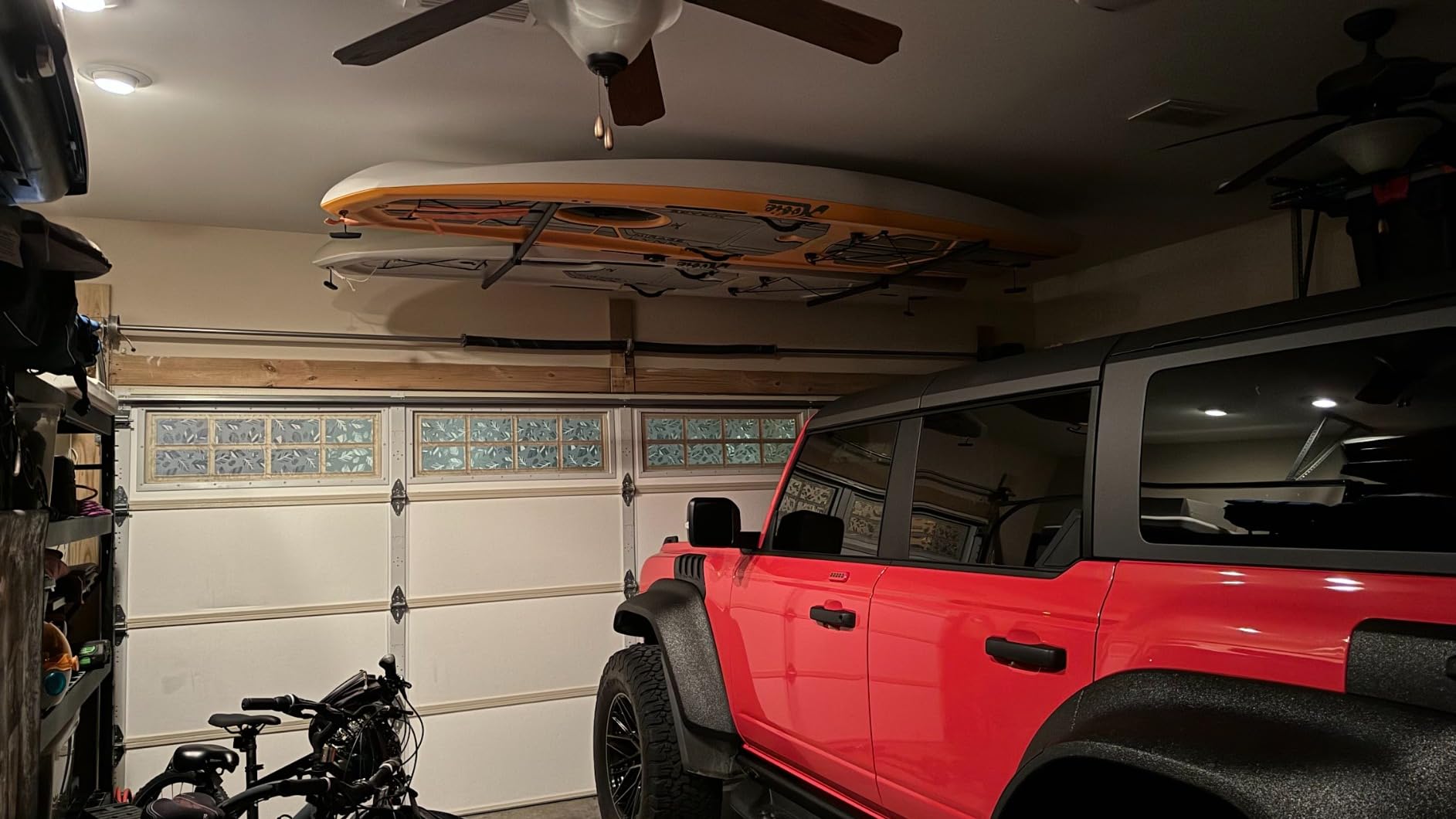
Closed-cell foam on the arms is the detail that separates it from bare steel racks. Foam does not scratch a glossy hull, and it spreads the contact over enough area that you do not get a pressure dent developing slowly over a winter.
Adjustment runs from a 10 to 18 inch drop with 30 inch wide arms, and the bracket rotates 90 degrees so the mount works whether your joists run with or across the bay. That bracket rotation alone eliminates a whole category of install headache.
What to check before you buy
Weigh both kayaks and add them together. Two boats over 150 lb combined will sit you on the per-side limit with nothing spare, and a lighter boat plus a heavier boat is where people discover the limit the hard way.
Then check your ceiling height against the drop setting. The arms are removable for loading, which helps, but a long kayak still needs room to swing up into position.
Where the weak points are
Several buyers upgraded the supplied lag screws to stainless machine screws, and the thinness of what ships in the box is the most repeated complaint in the reviews. The base plate is also wider than a standard 1.5 inch joist and overhangs a little on each side.
Downtube play causes a visible lean if only one side is loaded, so load it symmetrically. If you are installing through drywall rather than exposed framing, use a stud finder and expect the job to take longer than the box suggests.
3. GoSports Overhead Rack – Best Ceiling Rack for Heavy Fishing Kayaks
GoSports Kayak Rack for Garage Ceiling Mount – Adjustable Storage Hangers for 2 Kayaks, SUPs, or Surfboards
200 lb total capacity
Alloy steel
Adjustable drop
Powder coated
+ The Good
- Highest hard-arm capacity here at 200 lb
- 30 inch arms fit varied board widths
- Adjustable drop clears most garage door openers
- Buyers compare the steel to trailer hitch cargo racks
- The Bad
- Twisting four pipes together is the hard assembly step
- Two people recommended to lift kayaks up
- Single-sided loading makes the rack slant
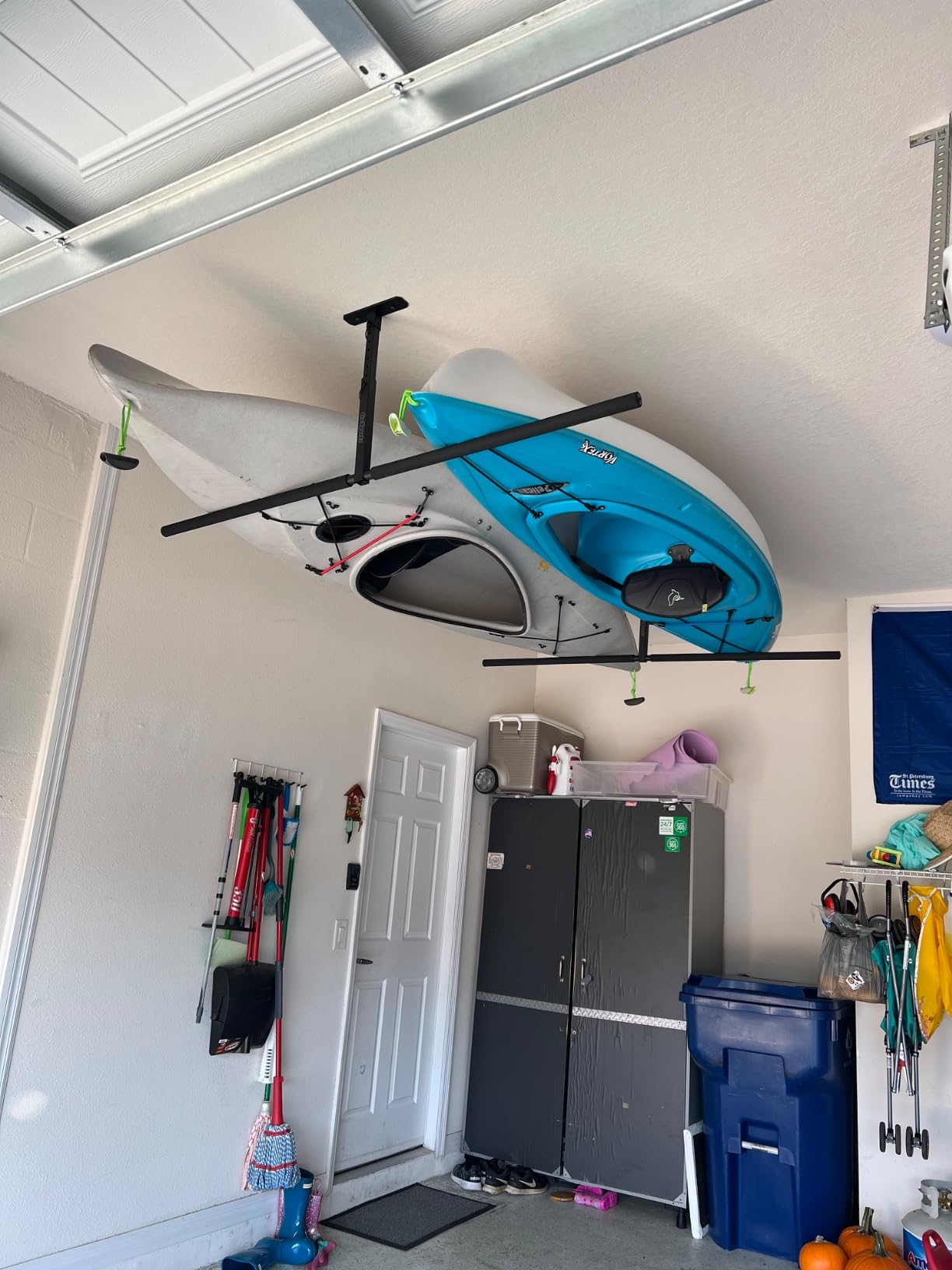
Where the Hi Port tops out at 150 lb total, this GoSports rack is rated to 200 lb across two sides, or 100 lb per side. If your kayak is a 90 lb sit-on-top fishing boat with gear, or a pedal kayak with a motor, that headroom is the whole reason to pick it.
The arms are 90 degree angled and foam-coated, which resists the sag you get with straight steel arms carrying a heavy hull over months. The drop adjusts from 12.5 to 19.5 inches using a pin lock, and that range is what lets you clear an opener rail.
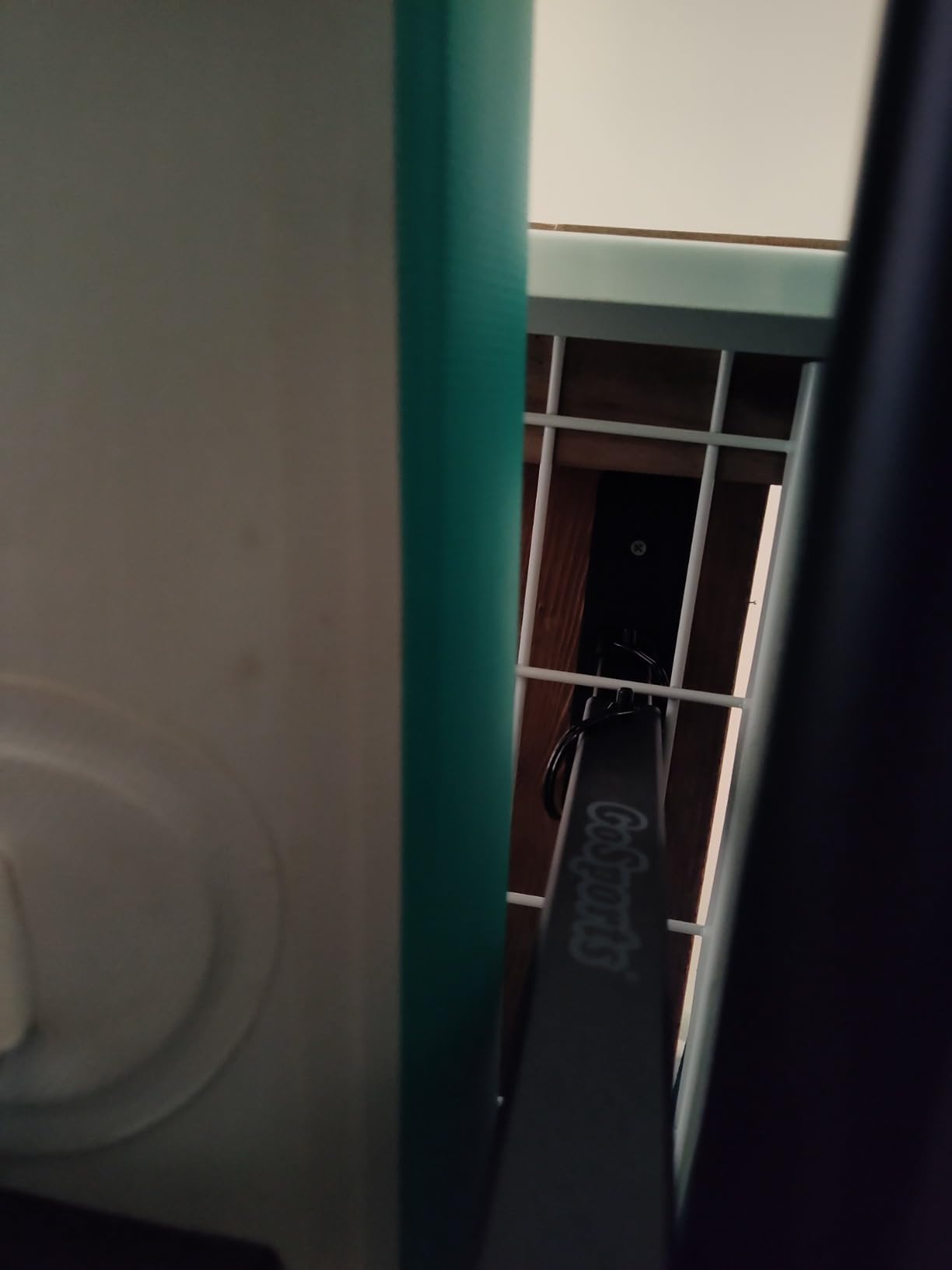
Owners describe the feel of it as closer to a hitch cargo carrier than to a home storage rack, and the ratings back that up at 4.6 stars across 253 reviews with 83 percent five-star. The steel frame is the part that inspires confidence.
It is not kayak-only hardware. The same arms take SUPs and surfboards, which matters if you switch disciplines in the same bay.
Where the extra capacity pays off
Heavier boats are also heavier to lift, and the 30 inch arm width plus angled geometry does a better job with a wide fishing kayak than a narrow touring hull rack. Foam contact keeps a wide hull from rubbing as the boat settles.
If you plan to add a second boat later, the per-side 100 lb rating covers most pairs of recreational kayaks at once.
What you should know first
Assembly is the weak point. Reviewers single out twisting the four pipes into the frame as the hardest step, so allow an unhurried first hour with the instructions open.
Two people are recommended to get a kayak up onto the arms, and loading only one side will make the rack sit at an angle until the second boat goes on. Plan your loading sequence accordingly.
4. VEVOR Two Kayak Ceiling Rack – Best Budget Heavy-Duty Ceiling Rack
VEVOR Kayak Storage Rack for 2 Kayaks, Holds Up to 250 lbs, Heavy Duty Adjustable Ceiling Rack for Garage Ceiling Mount, Overhead Garage Storage Hanger for Canoe, Ladder, SUP, Surfboard & Paddleboard
250 lb load capacity
Welded carbon steel
Powder coated
65 inch arm span
+ The Good
- Highest load rating of the racks reviewed at 250 lb
- Foam sleeves guard against compression marks
- Rust-resistant coating suits humid garages
- Winged bolts make adjustments simple
- The Bad
- Some orders arrive with missing hardware
- Rack can shift if the wheels are not locked
- Wide-beam kayaks can catch the upper bar
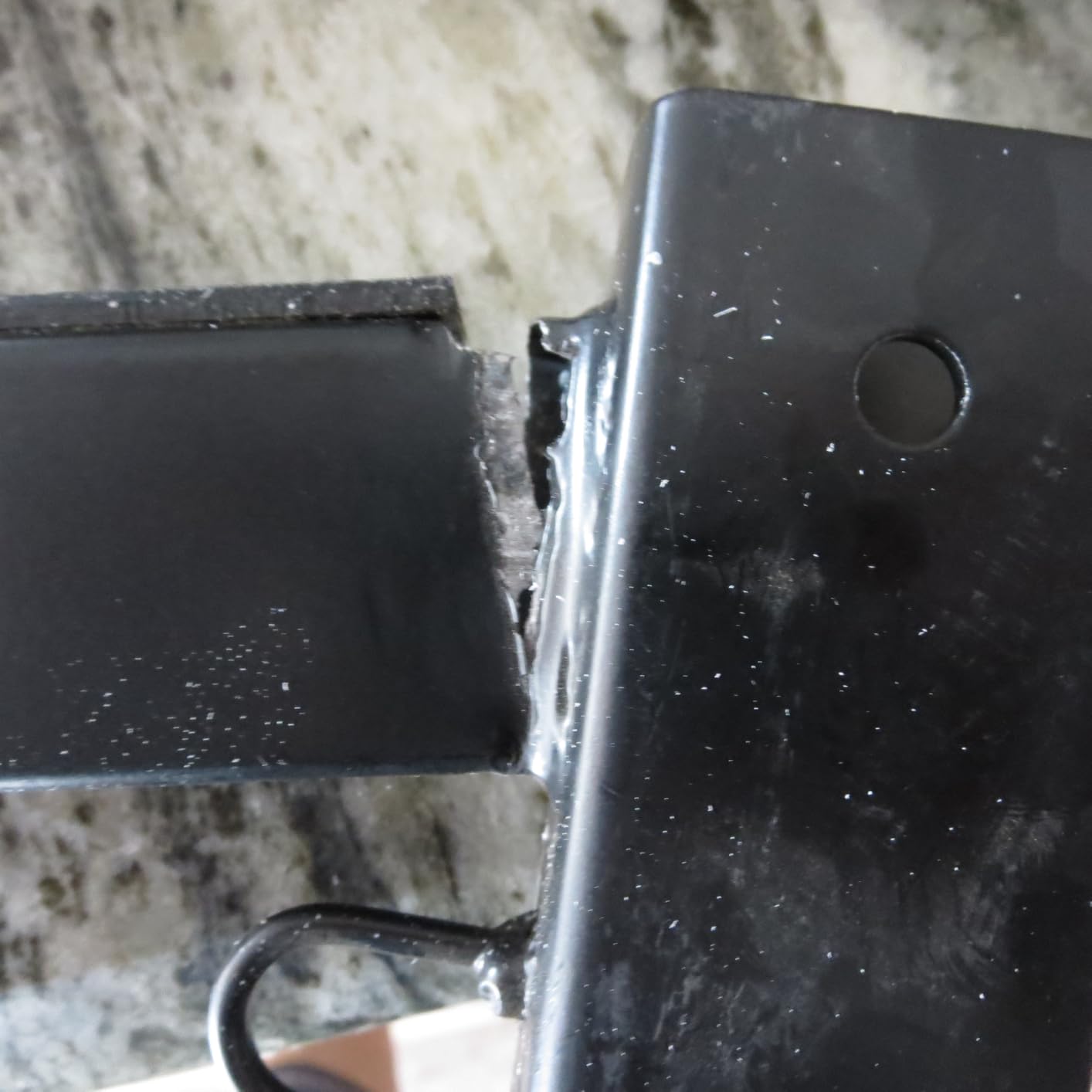
This rack claims 250 lb and has the welded frame to make that number believable. Welded construction rather than bolted-together pipe is the difference between a rack that stays rigid under a heavy hull for years and one that develops a wobble.
The arms point upward and are wrapped in thick foam sleeves, so the hull sits in a cradle rather than balanced on a flat bar. For a boat stored through a full winter, that geometry is what keeps you from finding pressure marks in the spring.
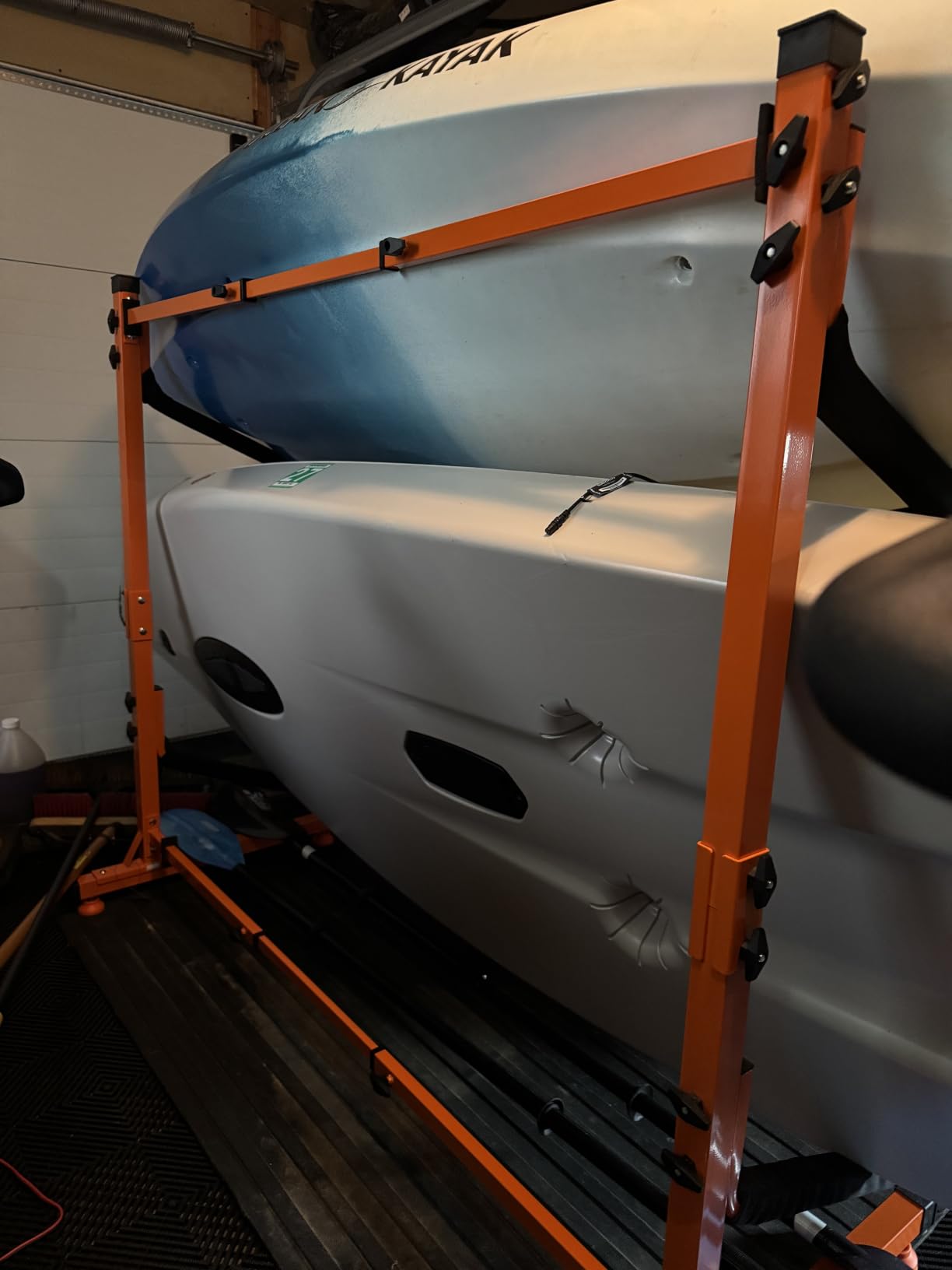
One buyer note is worth passing on: many reviews on this listing describe freestanding stand variants rather than the ceiling mount. Check that the model that arrives is the ceiling-mounted one, because the hardware differs.
Expansion anchors are included for concrete or wood, which removes the most common install complaint on budget racks. You still need to hit framing, not drywall, and the anchors are a backup rather than a shortcut.
Where it earns its rating
Two kayaks, canoes or SUPs in unused ceiling space for a hard-arm rack is the value case here. The 250 lb rating covers a heavy fishing kayak on one side with a recreational boat on the other.
The rust-resistant coating matters more than it sounds. In a coastal garage or anywhere with real humidity swings, a welded steel frame that has been coated inside and out lasts noticeably longer than bare hardware.
What buyers flag
Incomplete hardware shipments come up repeatedly, along with one report of hardware arriving damaged. Check the bag of fasteners against the hardware list before you start drilling.
The rack can shift slightly when a boat is removed unless all the wheels are locked, and wide-beam kayaks can catch on the upper bar when fully loaded. Both are manageable, but neither is something you want to discover mid-lift.
5. Bike Lane Kayak Hoist – Best Overhead System for Mixed Gear
Bike Lane Kayak Hoist Pulley System with 125lb Capacity
125 lb capacity
Steel and polypropylene
Locking pulley
Up to 12 ft ceilings
+ The Good
- Adjustable straps at both ends grip varied board widths
- Locking pulley holds the load without a separate brake
- Rubber-coated dual hooks double as a bike hanger
- Mounts to joists or a 2x4 batten
- The Bad
- Single hanger stores one boat
- Metal frame needs real effort under load
- Framing attachment is not optional
This hoist is the general-purpose option for a garage where the kayak shares ceiling space with other equipment. The dual rubber-coated hooks double as bike hangers, so two bikes and a kayak can live on one mount in a garage that also needs to park a car.
Adjustable straps at each end are the feature that separates it from simpler single-hook designs. They take a wide paddleboard or a gear board and stop it shifting, which is the difference between a tidy ceiling and one that needs rearranging every season.
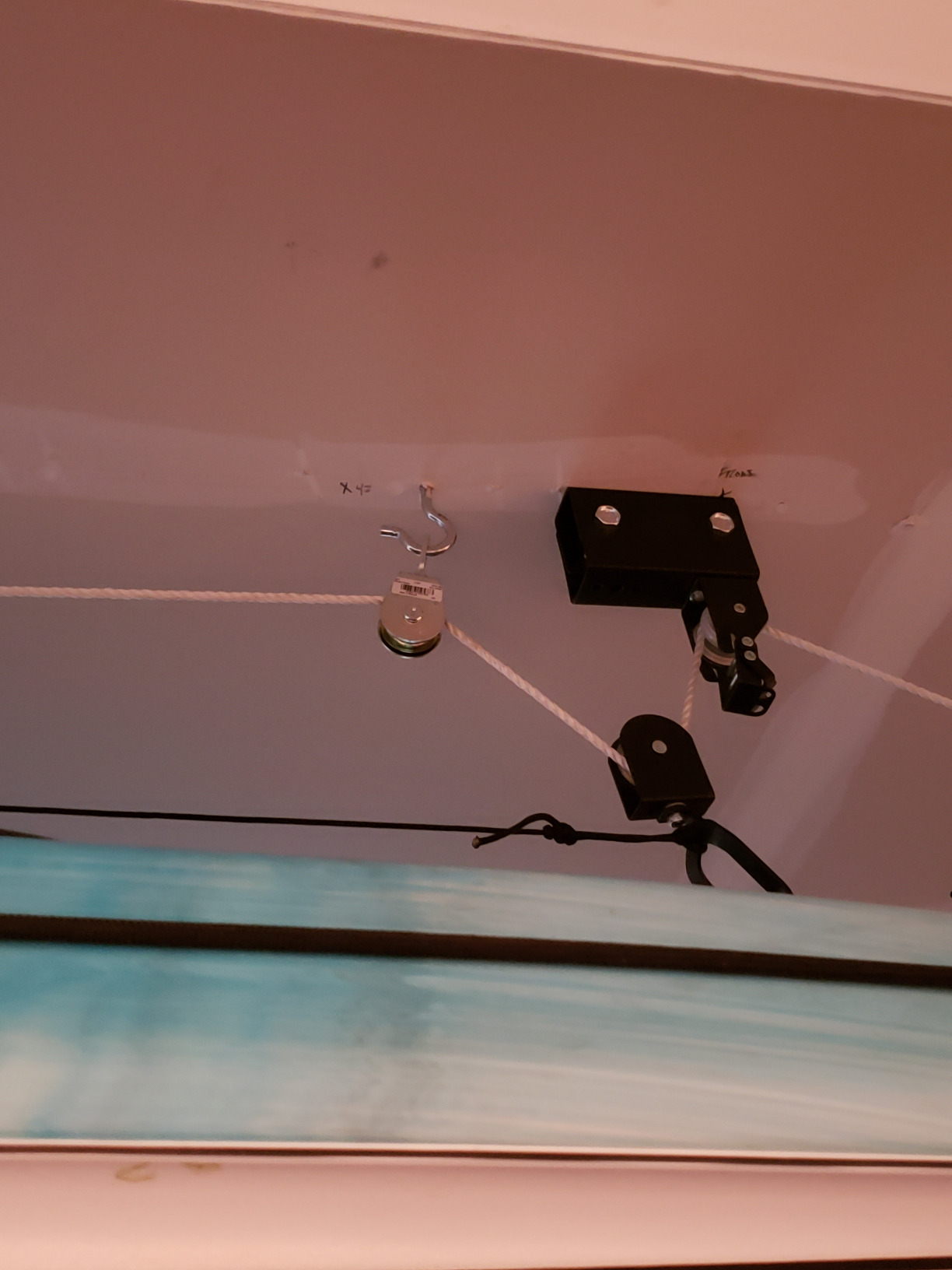
The locking pulley keeps the boat in place without a separate brake pulley, and it works on ceilings up to 12 ft. At 418 reviews and 4.4 stars with a 67 percent five-star share, it is a well-worn design with an established replacement path if a part ever wears.
It also mounts to a 2×4 batten screwed into the joists if your framing spacing does not line up with the mounting pattern. That flexibility is genuinely useful in an older garage.
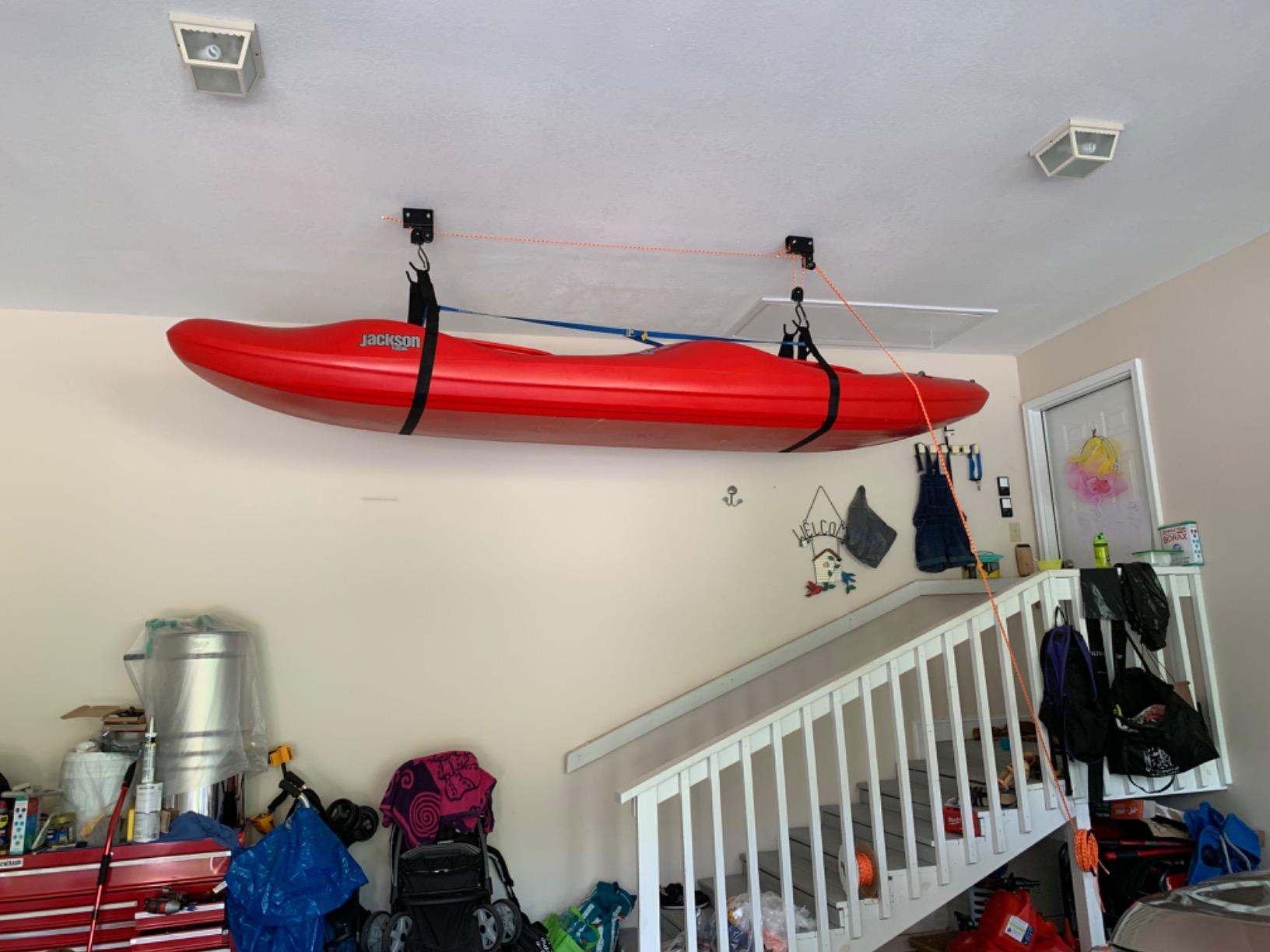
Where it makes sense
Shared family gear is the ideal case. When the same mount carries a kayak, a bike and a ladder, the cost per item drops and the space savings multiply. Buyers consistently report straightforward installation and good value.
The straps also make it tolerant of oddly shaped boards, which hard-arm racks tend to fight when a hull is much wider than the cradle.
What to watch
It still takes real physical effort to raise a loaded kayak through the metal frame, and comments about that appear often enough that you should not expect a one-person effortless lift with a heavy touring boat.
Single-hanger format again means one boat at a time, and it must be secured into joists or a properly screwed 2×4. Drywall anchors are the deal breaker forum users consistently flag.
6. Teal Triangle Pulley Hoist – Best Hoist for Tight Ceiling Clearance
Teal Triangle Pulley Hoist for Kayak, Canoe and Paddleboards, Holds 150 lb
150 lb capacity
Alloy steel
Third brake pulley
4.6 lb unit weight
+ The Good
- Third wall-side brake pulley holds the boat without the cleat
- Lifts the hull to within about 6 inches of the ceiling
- Lifetime manufacturer warranty
- Box includes hardware and clear instructions
- The Bad
- Still needs arm strength through the lift
- Rope may need trimming on some installs
- Brake pulley needs several inches off the wall
This is the hoist to look at first if your garage is short on vertical space. Because of the three-point mounting layout and the third brake pulley near the wall, it pulls the kayak up to within about 6 inches of the ceiling. Everything else we tested hangs noticeably lower.
That matters in a 9 or 10 ft ceiling garage where a lower-hanging system means a permanent duck zone over the car door. Pulling the boat nearly flush keeps the bay usable for a taller vehicle.
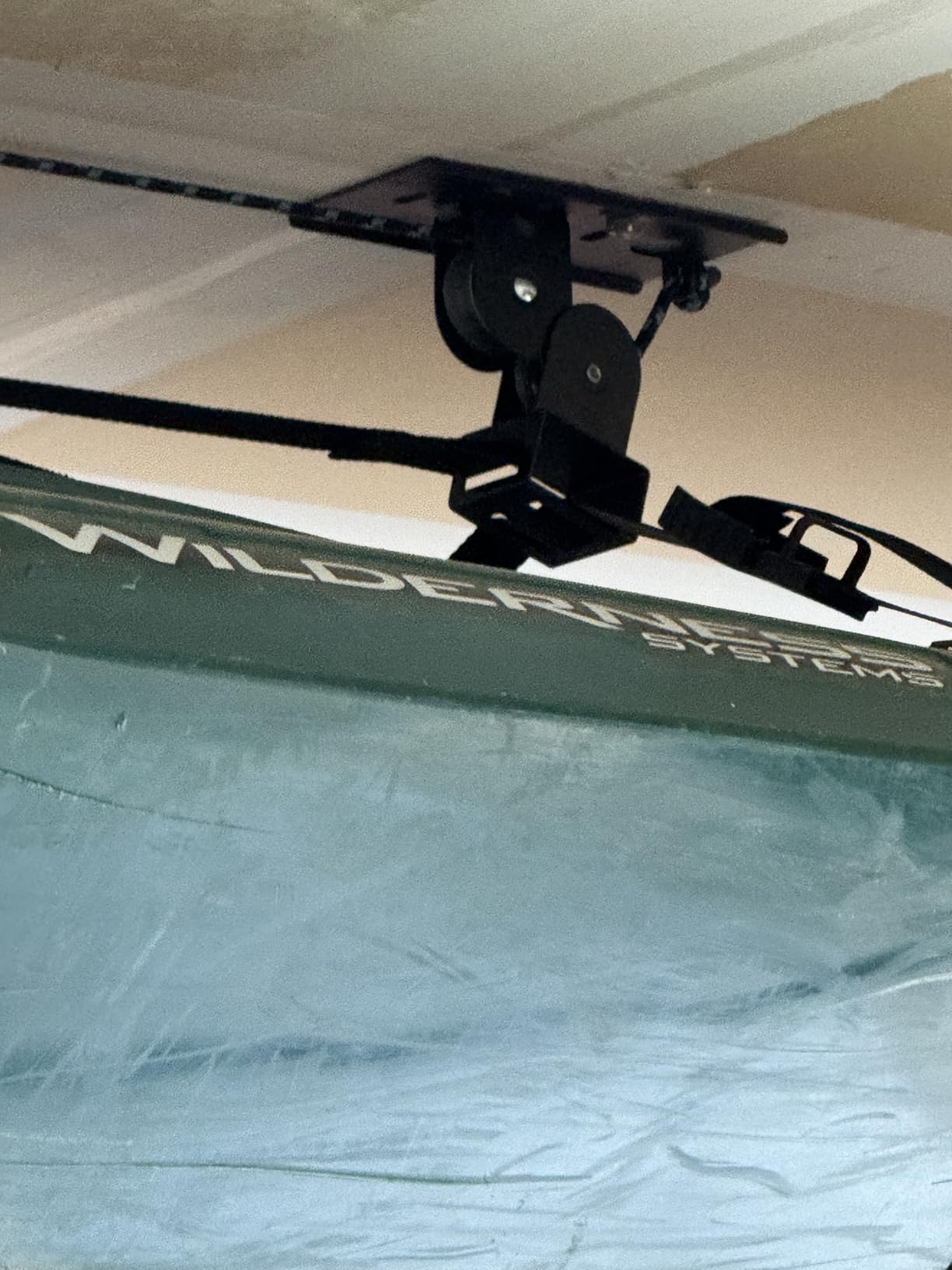
The 8 ft adjustable straps with a center connecting strap give a balanced three-point lift, which keeps a long hull from twisting on the way up. Owners lifting 56 lb poly kayaks report doing it comfortably using body weight rather than arm strength.
It is also the only hoist in this group with a lifetime manufacturer warranty behind the parts, which matters for something bolted to a ceiling you do not want to re-open.
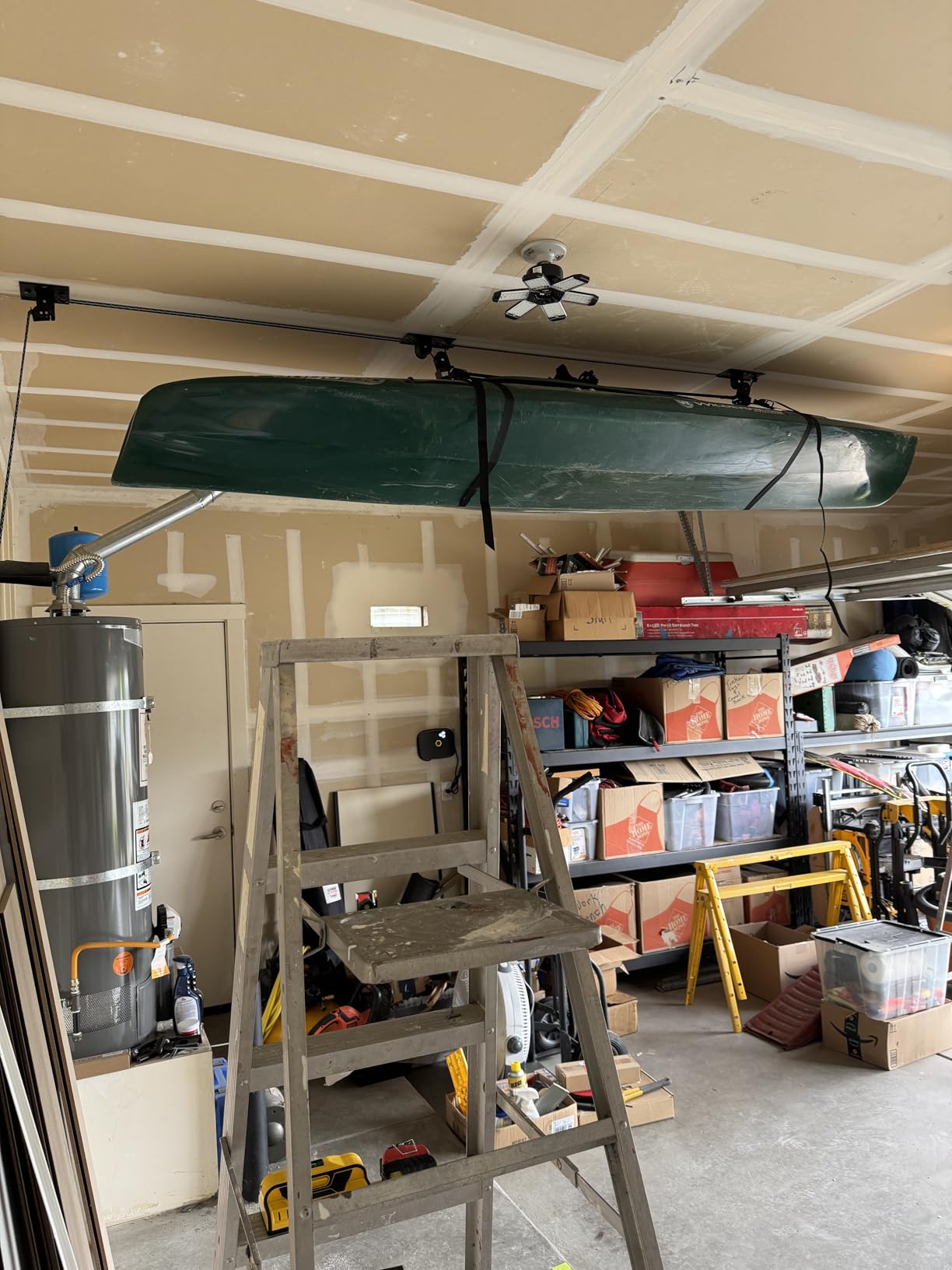
Where the third pulley earns its keep
The wall-side brake pulley holds the load mechanically instead of relying on a friction cleat or your knot work. That is a real safety difference, and it is why this hoist suits anyone nervous about a friction-based hold near a ceiling.
Two variants exist with different lift assist, at 50 percent and 75 percent. Check which one the listing sends you before ordering if your kayak is on the heavy side.
What to plan around
Lifting still requires real arm strength even with the brake pulley, and reviewers describe installation as a two-person job. One reviewer noted the included instructions read as if they were written for paddle boards, so budget a little time decoding them.
The brake pulley must sit several inches off the wall to engage properly, and excess rope may need trimming depending on your ceiling height and run length.
7. StoreYourBoard Ceiling Pulley Hoist – Best for Many Ceiling Heights
StoreYourBoard Kayak and Canoe Ceiling Hoist, Pulley Lift System
60 lb or 150 lb by model
Alloy steel
8 ft to 14 ft options
Lifetime warranty
+ The Good
- Models cover ceiling heights from 8 ft to 14 ft
- Center connecting strap prevents shifting in long storage
- Cam-action buckles adjust without tools
- Lifetime manufacturer warranty
- The Bad
- Lowest average rating here at 4.2 stars
- Capacity and brake type change by model
- The 60 lb version is light for touring boats
The strength of this hoist is range. Models cover ceilings from 8 ft to 14 ft, which makes it the safe choice if you have not measured yet or if you might move to a different garage. Most competitors stop at 10 or 12 ft.
The center connecting strap is the feature owners praise most, and the reason is long-term. A kayak hanging alone on two pulley points can swing and settle over months; the strap locks both points together so it stays put through humidity and temperature swings.
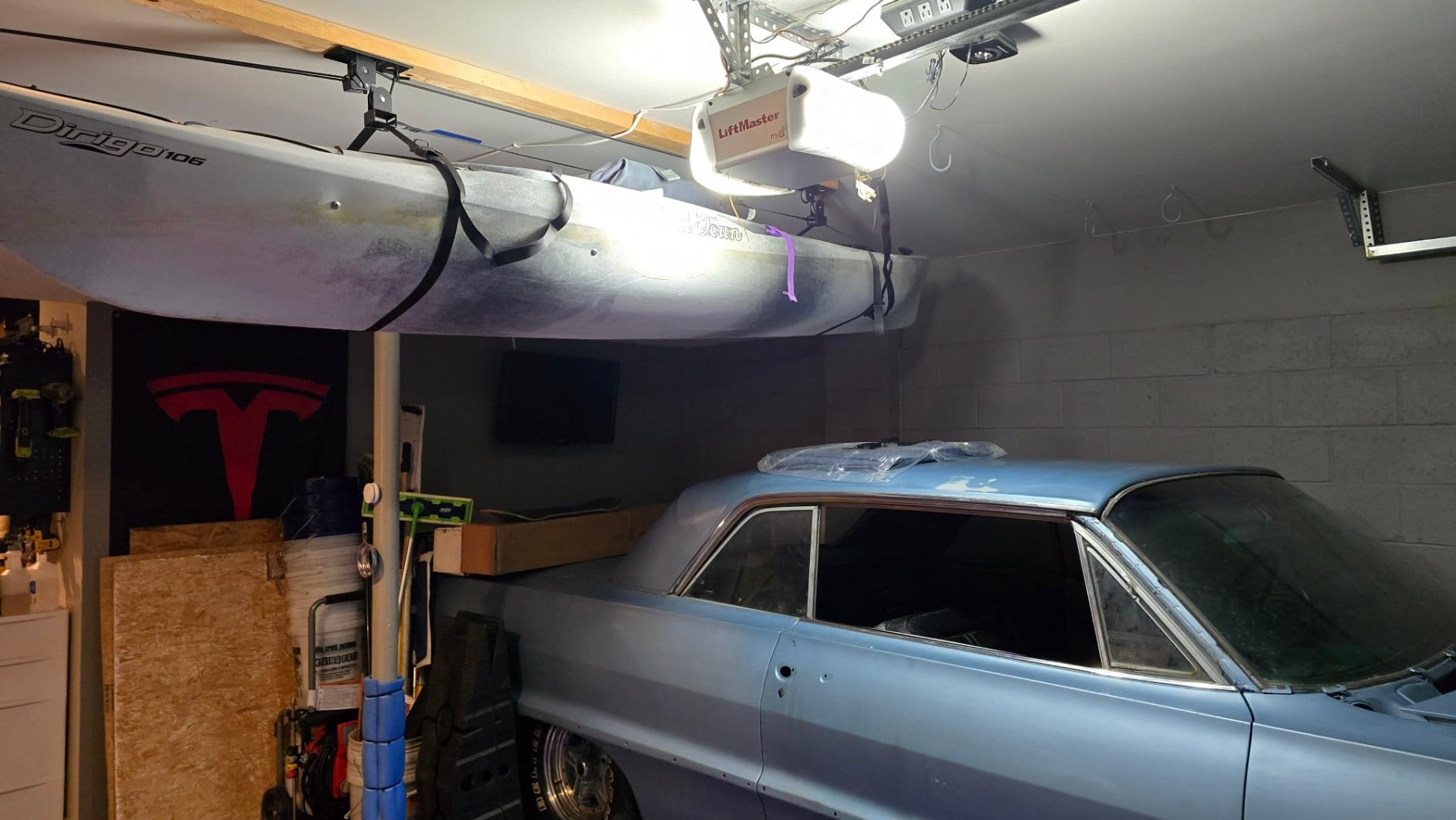
Cam-action buckles make strap length adjustment quick without tools, which is a genuine convenience when you are changing between a kayak and a set of gear boards.
Be careful with the variant, because this listing mixes capacities and brake types. Depending on the model you receive, you get either 60 lb or 150 lb capacity and either an auto-locking brake or a 2:1 pulley.
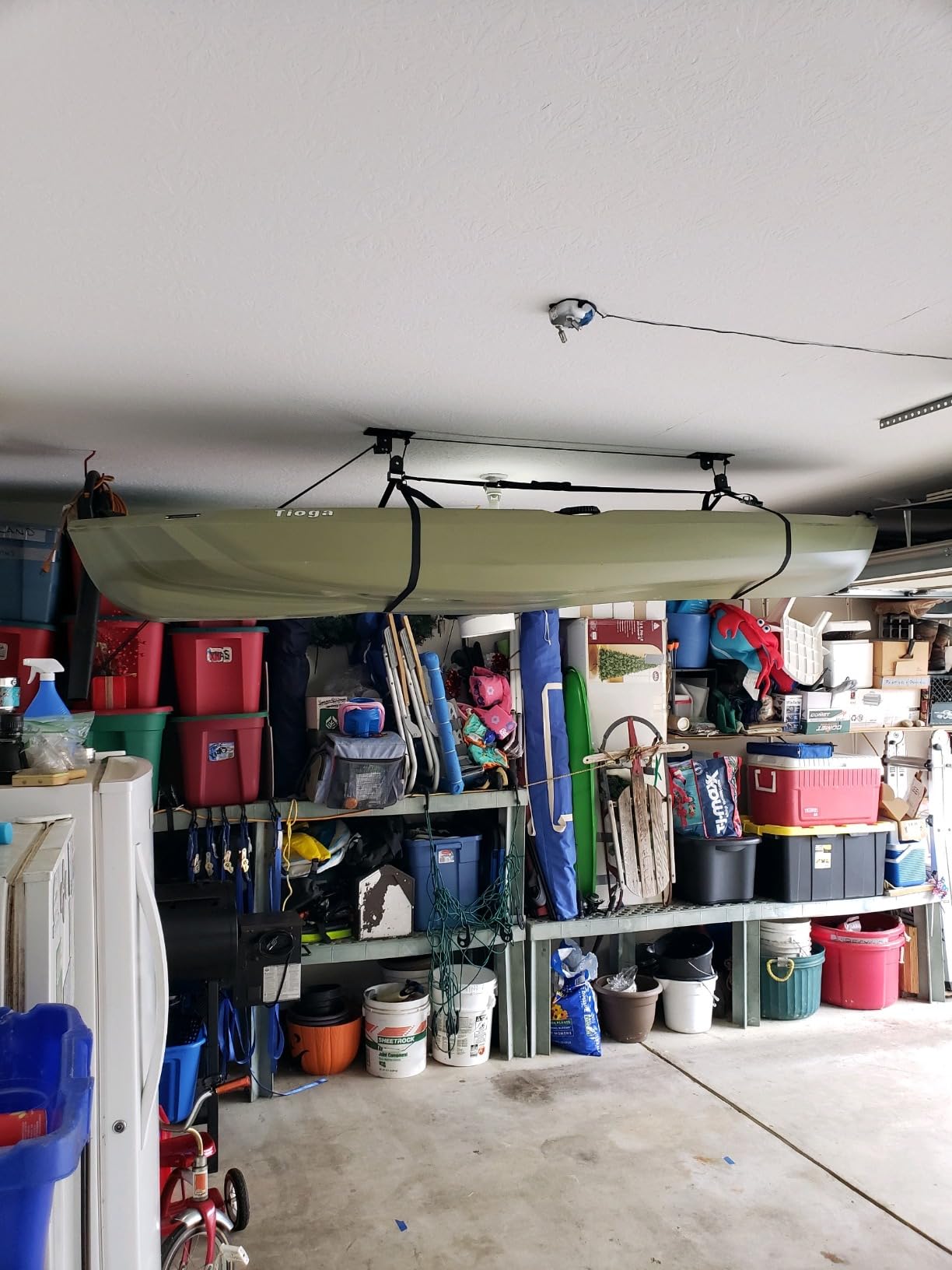
When the variant matters most
If your touring kayak weighs more than the 60 lb capacity, the lighter model is the wrong buy regardless of how good the mechanism is. Match the variant to the boat before you match it to the ceiling.
The auto-locking brake variant suits anyone who wants the load held without a friction cleat, and the 2:1 pulley variant trades that for a shorter pull.
What the ratings tell you
At 4.2 stars across 556 reviews, this is the widest gap between score and volume in the group. Nine percent one-star reviews cluster around capacity limits and buying the wrong model, which is exactly the mistake a careful read of the variant list prevents.
Positive reviews concentrate on the connecting strap, the buckles and value for money. If you pick the right capacity, the complaints largely do not apply.
8. Tie Boss Kayak Hanger – Simplest System for Light Boats
Tie Boss Kayak Hanger, Kayak Hoist & Overhead Garage Ceiling Storage System
150 lb sling capacity
Self-locking cleat
Fits 8 to 10 ft ceilings
Glass filled nylon
+ The Good
- No pulleys and few moving parts to fail
- Connecting strap keeps both loops on the hull
- Users around 110 lb raise and lower without trouble
- Made in the USA with a lifetime parts warranty
- The Bad
- Eye hooks are not included and cost extra
- Friction cleat resists hard near rated capacity
- Needs clearance to release in a confined space
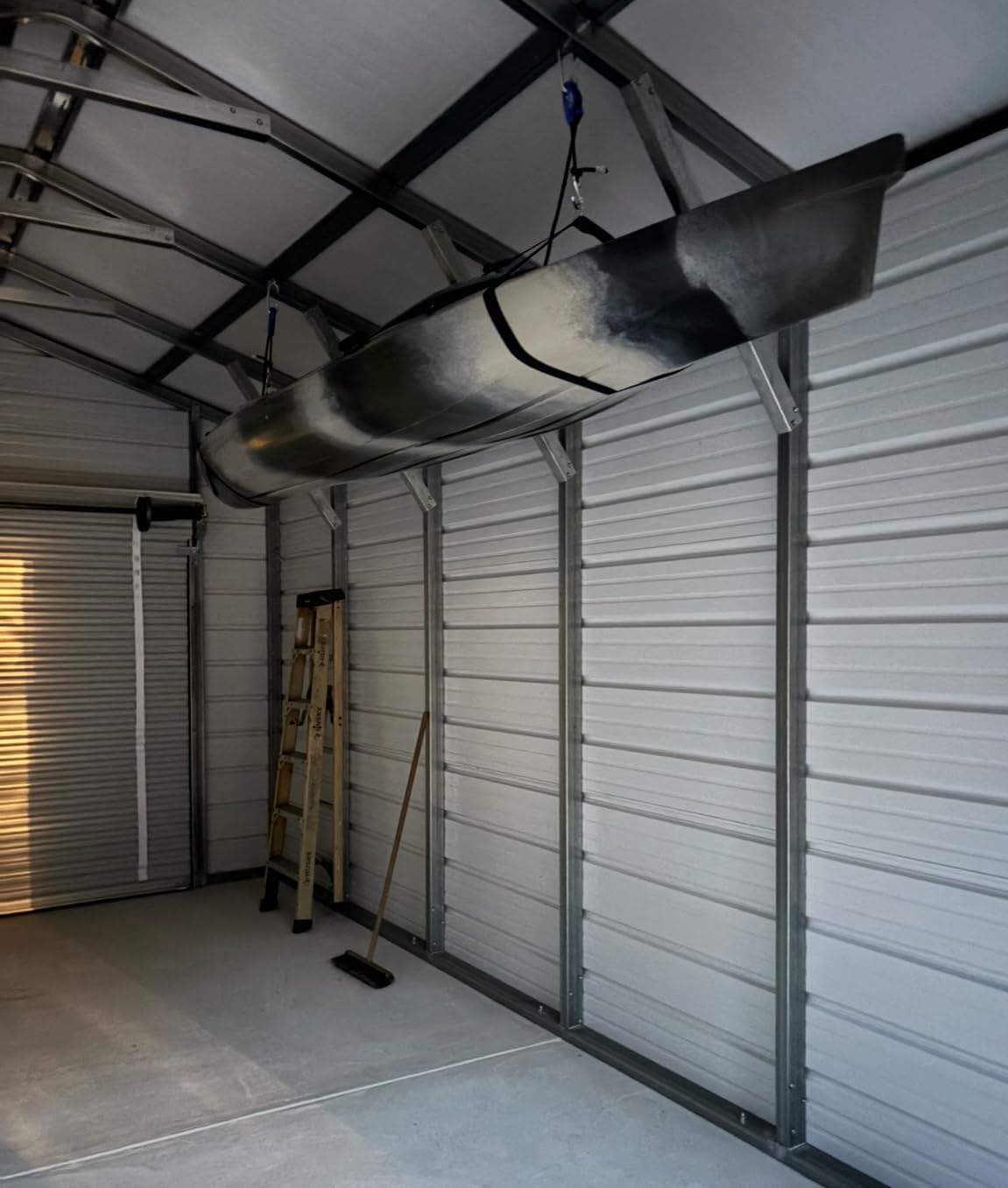
This is the least mechanical system here. Two eye hooks in the ceiling, one jam cleat, one sling, and that is the entire mechanism. There is no pulley to seize, no rope to re-reeve, and nothing in the design that can snap without a screw coming loose.
The patented jam cleat raises and lowers with one person, and users around 110 lb report operating it without trouble. For a lightweight recreational or inflatable kayak, that simplicity is a genuine advantage over a hoist with a rope brake.
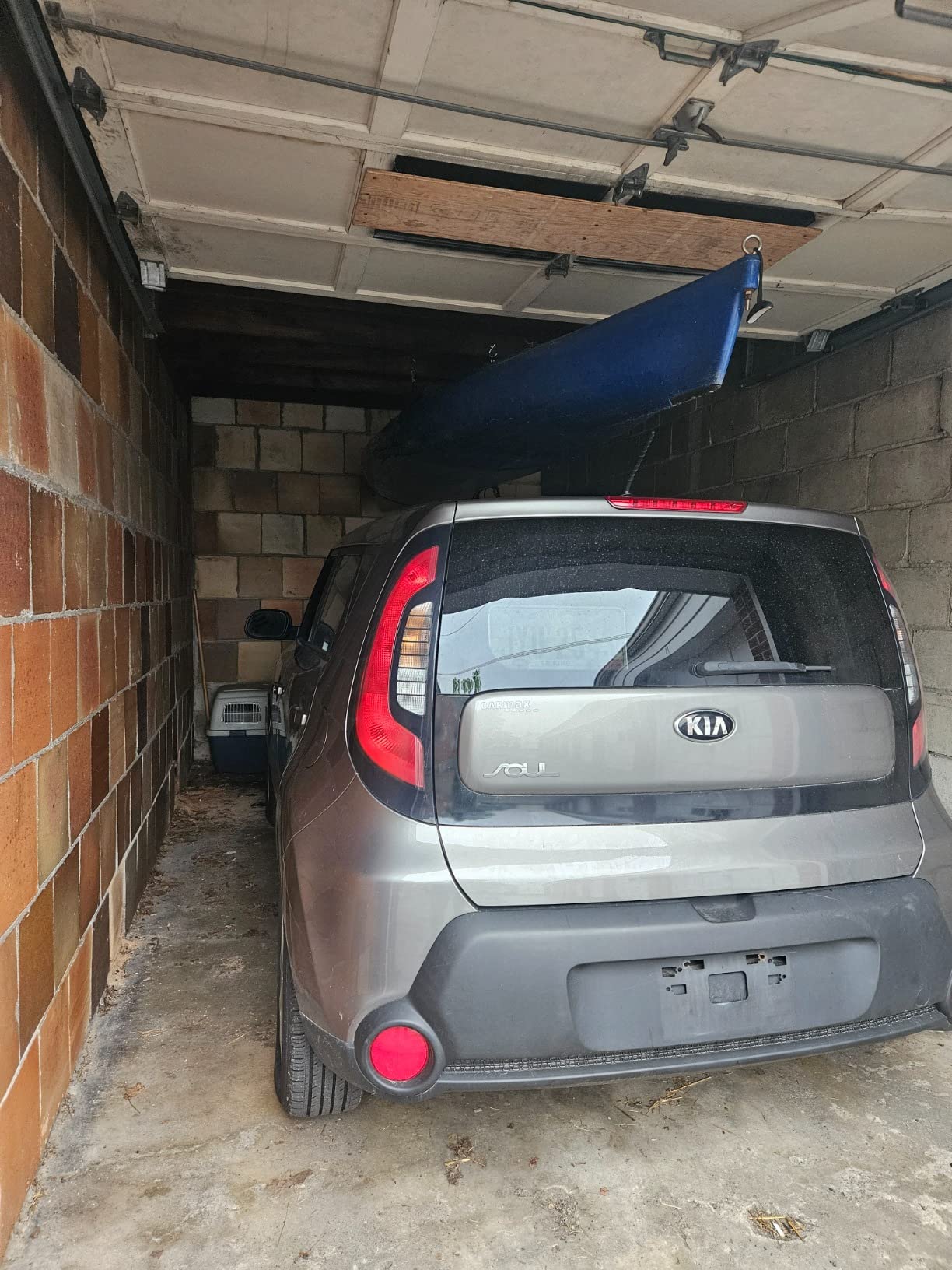
The connecting strap keeps the two sling loops from sliding off a rounded hull, which is the failure mode a simple sling design usually has. It is made in Piqua, Ohio and carries a limited lifetime warranty on all parts except rope.
Note the ceiling range. It fits 8 to 10 ft ceilings, the narrowest window of any system in this roundup, so it will not work in a taller garage without a spacer strategy.
Who will love it
Owners of one light boat who want minimal hardware overhead and do not need to hang anything else will like how little there is to think about. There is nothing to re-tension as the seasons change.
It is also the quietest option, since there is no rope running through a pulley at the top of the lift.
Why it is polarizing
This is the most divided product we reviewed, with 57 percent five-star but 19 percent one- and two-star ratings. The friction-fit rope housing resists lifting as load approaches capacity, and some critical buyers ended up buying block-and-tackle pulleys to make it workable.
Eye hooks are not included, which is friction in a system that is otherwise so simple. There have also been reports of hooks bending under a 50 lb kayak and sling straps deforming a hull on heavier boats, so treat the 150 lb sling rating as a ceiling rather than a target.
Garage Overhead Storage Buying Guide: Measure Before You Mount
The measurement mistakes in this category are all made before the box is open, and none of them are recoverable without drilling new holes.
Match your kayak weight to the capacity rating
Find your kayak’s actual weight, then buy a system rated meaningfully above it. A recreational kayak sits around 50 to 70 lb, a touring kayak runs 75 to 100 lb, and a fishing or pedal kayak can exceed 150 lb before you add a motor.
Recreational kayak under 70 lb: any of the 125 lb hoists is comfortable.
Touring kayak between 75 and 100 lb: target a 150 lb system or the 200 lb hard-arm rack.
Fishing or pedal kayak over 100 lb: use a hard-arm rack rated 200 lb or higher.
Two boats on a two-sided mount: add the weights together and check the per-side limit, not just the total.
Rated capacity also assumes even loading. One heavy kayak on one side of a two-sided rack is a different problem from two light ones.
Vertical versus horizontal storage
Horizontal overhead storage wins for hull longevity and floor space. A sling or rack supports the hull along its length and keeps the cockpit and deck in their normal shape, and it leaves a continuous parking bay underneath.
Vertical wall storage, hanging the kayak by one end, uses almost no floor at all and works in a ceiling too low for anything overhead. It concentrates the entire boat weight on a single point, which is the trade: end-hung storage needs a hull end and a wall bracket that spreads the load properly, and it is harder on the deck than a padded cradle.
For an 8 ft ceiling garage, vertical wall storage is often the answer that no ceiling system can beat.
Low ceilings and the attic drop-in build
With an 8 ft ceiling, a hoisted kayak hangs low enough to stop saving floor space, and that is the most common blocker forum users hit. There are three workable answers.
The first is a hoist that pulls the boat nearly flush to the ceiling, like the third-brake-pulley design in this roundup. The second is vertical wall storage over an unused bay. The third is the attic drop-in build: cut a framed opening through the drywall into the raft space and hoist the kayak up there instead of down to the ceiling plane.
That third option is described in detail on the Garage Journal kayak attic storage thread, where a poster in an 8 ft ceiling garage cut a framed box between trusses and used off-the-shelf pulleys to lift kayaks into attic space. A dozen posters called it brilliant and neat. If your garage has a usable attic, it converts dead space into the best possible kayak storage.
How to install into joists
Find the joists with a stud finder or knock on the drywall, and note the direction they run.
Confirm the ceiling height and mark a hang point clear of the garage door opener rail and its path.
Pre-drill pilot holes slightly smaller than the lag screws, then fasten into the centre of the joist, not the edge.
Use lag bolts rather than drywall anchors. Anchors into sheetrock are the single most common reason overhead storage fails.
Check that a wall cleat or brake point exists within reach of the rope before drilling the ceiling mount.
Test the empty system with a full bag of sand or a partner’s weight before the kayak goes anywhere near it.
Joists at 16 inches on center are the common case, but trusses and engineered joists need extra care because you cannot drill through the web of a truss at all.
Garage door opener and parked-car clearance
The garage door opener rail occupies exactly the ceiling space you want to use, and no roundup we read mentions it. Stand in your garage and look up: the rail, its curved support arm and the hanging motor all mark out a zone you cannot mount into.
Then park the car you actually own and measure. A sedan leaves far more room than an SUV or a truck with a roof rack, and a hoisted kayak sitting 18 inches below the joists can put a hard ceiling on your vehicle choice.
Owner reviews on the racks with adjustable drop settings cite opener clearance as the reason those settings exist. If your opener rail runs across your intended bay, adjust the drop or move the mount one bay over.
Building your own pulley rig
A DIY rig is achievable, and paddling forum regulars describe a version using six ceiling hooks with four in the ceiling and two in the wall, six pulleys, two spring clips and rope. A Hobie forum user runs a 3:1 mechanical advantage garage hoist that lets one person raise a smaller kayak by hand while keeping the boat inverted.
Mechanical advantage is the number that matters. A 3:1 rig means you pull three feet of rope to raise one foot of boat, which is the difference between lifting a kayak with one hand and needing two people.
Building it yourself saves money and lets you match the joist spacing exactly, but you own the safety engineering. If you go this route, use rated hardware, bolt into framing, and include a mechanical brake rather than relying on friction alone.
Hull protection and winter storage care
Hard arm racks pressing into a hull and leaving pressure dents over time is the most common long-term complaint in forums, and the fix is contact area. Foam sleeves or closed-cell foam pads spread the load over enough surface that the polyethylene does not take a permanent set.
Store the boat cockpit-up or on its side rather than upside down if the manufacturer allows, and do not tighten straps in a way that changes the hull shape. Check the hull once a month in winter for any new flat spot, and loosen contact points if you find one.
If you are combining kayak storage with bins, bikes and boards, our [garage overhead storage bin guide](https://beboivn.com/best-garage-overhead-storage-bins/) covers how to lay out several joist zones without them fighting each other.
When not to buy a hoist
If you paddle several times a week, a hoist is the wrong purchase. Retrieval takes time, most of these systems need a ladder, and a heavy boat on a friction or rope brake is not something you want to lower by feel. A wall rack, lean-stand or vertical hang gets you the floor space without the daily hassle.
Renting or borrowing a hoist for a one-time move also works. A season of swapping a kayak and a kayak rack on a trailer covers occasional transport without a permanent ceiling install.
Frequently Asked Questions
What is the best storage system for kayaks in a garage?
For most garages the best system is a padded hard-arm ceiling rack if you own two kayaks or one over 100 lb, and a rope-and-pulley kayak hoist if you own a single boat under that weight. Hard-arm racks hold more weight, load faster and stay put, while a hoist stores a boat nearly flush to the ceiling and can double as a bike or ladder hanger. Both must be bolted into ceiling joists with lag screws rather than drywall anchors.
What is the best pulley system for storing a kayak in a garage?
The RAD Sportz Kayak Hoist is the best all-round pulley system, with 125 lb capacity, an automatic locking rope brake and rubber-coated hooks, rated for ceilings up to 12 ft. For heavier boats or tighter clearance, the Teal Triangle hoist adds a third wall-side brake pulley and pulls the hull to within about 6 inches of the ceiling. Whichever you choose, verify the rope reaches a wall cleat or brake point before you drill.
Is it better to store a kayak vertically or horizontally?
Horizontal storage on a padded cradle is better for the hull, because it spreads support along the boat length and keeps the deck in shape, while vertical end-hung storage puts the full weight on a single point. Horizontal is the usual choice when the ceiling is tall enough and you still want to park a car underneath. In a low 8 ft ceiling garage, vertical wall storage often becomes the better option.
How to hang a kayak in your garage?
Locate the joists, confirm the ceiling height and keep the mount clear of the garage door opener rail. Fasten the mount into the centre of the joists with lag bolts, not drywall anchors. Install a wall cleat or brake point within reach of the rope, test the empty system with dead weight, then raise the kayak with one person on the floor and a second person steadying it. Inspect the hardware every season.
Is it possible to store a kayak on the ceiling in my garage?
Yes, as long as your joists can carry the load and the hung boat still leaves usable clearance above the parked car. A typical residential garage ceiling holds a 125 to 250 lb kayak system without special framing. If your ceiling is only 8 ft, choose a hoist that pulls the boat nearly flush, hang it vertically on a wall, or cut a framed opening into the raft space and lift the kayak up there instead.
Are kayak hoists safe to use?
A kayak hoist is safe when it is bolted into framing with lag screws and has a mechanical hold such as a locking rope brake or a jam cleat. Systems mounted on drywall anchors, or friction holds used near their rated capacity, are the ones that fail. Always test with dead weight before the first lift, keep the hull under the published rating, and inspect the rope and hardware each season.
The Best Garage Overhead Storage for Kayaks, by Use Case
There is no single winner here, because the right answer depends on how many boats you own, how heavy they are and how often you paddle. The RAD Sportz Kayak Hoist wins as the general pick: it is the only system here with a five-figure review history, its automatic rope brake has survived years of humidity cycles, and at 125 lb it covers most recreational and touring kayaks while doubling as a bike and ladder hanger.
Own two boats and want them both up at once? The StoreYourBoard Hi Port 2 does it from a single ceiling mount with the highest rating in this group, and its rotating bracket handles either joist direction. Paddle a heavy fishing or pedal kayak and go with the GoSports rack at 200 lb, or the VEVOR at 250 lb if two boats are heavier still.
Short on vertical clearance? The Teal Triangle hoist pulls the hull to within about 6 inches of the ceiling, and the StoreYourBoard pulley covers ceiling heights from 8 ft all the way to 14 ft. If you want no mechanism at all, the Tie Boss jam cleat is the simplest thing that works, best with a lightweight boat and eye hooks bought separately.
One honest caveat, and it applies to every system on this list: if you paddle most weeks, none of them. Retrieval takes a ladder, a helper and a few minutes, and a wall rack will serve you better. If the kayak lives on the ceiling from November to March, any of the eight above will hand you back a parking bay and a hull that has not picked up a dent over the winter.
Whichever route you take, measure the ceiling, find the joists, check the opener rail and keep the car in mind before you buy. Our [overhead garage storage lift comparison](https://beboivn.com/best-overhead-garage-storage-lifts/) and [garage storage cabinet picks](https://beboivn.com/best-garage-storage-cabinets/) cover the rest of the same ceiling space.